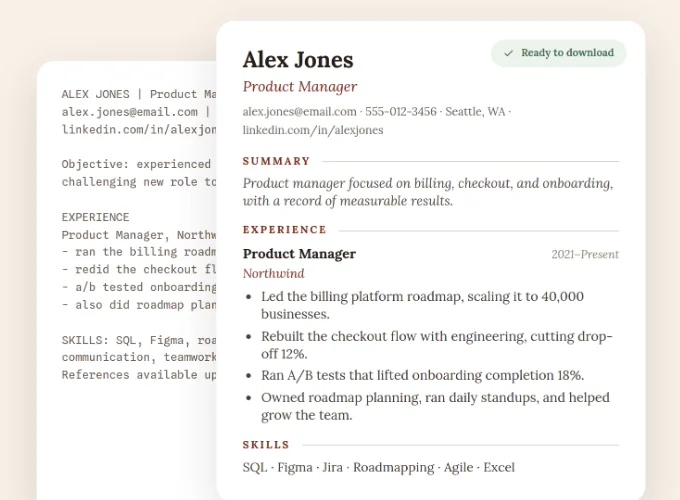
How to List AI Skills on Your Resume, With Examples by Job

List each AI skill as a tool, a task and a result you can explain in an interview. Name the tools in your skills section, then prove the best one or two in your work bullets.
"Proficient in AI" is easy to write and hard to believe. A line that names the tool, the task and your check is different. An interviewer can ask about it, and you can answer.
Below are lines for 19 kinds of job, with every tool name checked at its maker's site. Each one is an example, with made-up numbers, so change it to what you did.
In short
- An AI skill on a resume is a tool plus what you did with it.
- Use the tool or model name and skip the version number. A current frontier model is worth naming with its version.
- One line with a result is better than a list of ten tools.
- Say how you checked the AI's work, because its mistakes become yours.
- Leave out private company data, and anything you could not explain.
- If AI plays no part in your work or the job post, you can leave it out.
How do you list AI skills on a resume?
List each AI skill as a tool, a task and a result, in four steps:
- Read the job post. Mark every AI tool, task and rule it names.
- Write down what you used AI for at work, how often, and what changed.
- Put two to six tools in your skills section, each with its task in parentheses.
- Turn the best one or two into work bullets with a number.
A skills line looks like this:
- AI tools: ChatGPT (first drafts), Copilot in Excel (monthly reports), Zapier (form to spreadsheet)
A work bullet has four parts: the tool, the task, your check and the result.
- ✅ Grouped 1,200 comments with Claude, checked 100 by hand, and cut the report from four days to one
- ❌ Proficient in AI and machine learning
The first line shows work a reader can ask about. The second names no tool, task or result.
From a weak AI line to a strong one, step by step
Here is an example, made up to show the steps. A recruiter starts with "Used AI for job posts."
- Add the tool and the task: "Used Microsoft Copilot to draft job posts." Now the reader knows what it was for.
- Add the size: "Drafted 35 job posts with Microsoft Copilot." Now it is clear this was real work.
- Add your check: "and edited each for plain and fair language." Now the reader can trust it.
- Add the result: "and cut the time to post from five days to two." Now there is a reason to care.
Stop when the line is true and complete. If you do not have a number for the last step, leave the step out.
Which AI skills can you put on a resume?
AI skills for a resume include using AI assistants, prompting, checking, automating and building. Most use generative AI (gen AI), such as ChatGPT:
- Using AI assistants: drafting, summarizing, translating and planning with ChatGPT, Claude, Gemini or Microsoft Copilot.
- Prompting: writing prompts (instructions) a team can reuse, with examples, a format and limits.
- Checking: finding made-up facts, testing numbers against the source, and fixing tone.
- Automating: connecting apps and AI agents with Zapier, Make, n8n or Microsoft Copilot Studio.
- Building: code with Claude Code, Cursor, GitHub Copilot or OpenAI Codex, or an app that calls an AI model.
You do not need all five. Most people have one or two they can prove, and those are the ones to list. Two more fit almost any job: following your employer's AI rules, and teaching coworkers.
How do you describe your AI level on a resume?
An AI level reads best as plain facts. Words such as "expert" invite hard questions, and a reader has no way to check them. How often you use a tool, and who uses what you made, says the same thing better:
- Some use: Uses ChatGPT for first drafts and meeting notes
- Daily use: Uses Microsoft Copilot daily for reports; wrote 12 prompts the team shares
- Automates: Built a Zapier flow that reads 60 order emails a day into a sheet
- Leads: Wrote the team's AI rules and trained 25 people
Should you name the AI tool or the model?
Name the AI tool, such as ChatGPT or Microsoft Copilot. You can name the model too, such as Claude Sonnet or Gemini Flash. A model is the system a tool runs on. Its name helps most when you built something with it.
Leave the version number out. Versions change often, and a reader may not know them:
- Compared Claude Sonnet and Gemini Flash on 200 support emails and chose one on accuracy, speed and cost
The exception is a current frontier model, one of the most capable its maker offers. Name that one with its version. It shows you have worked with the newest models:
- Built a contract search tool on Claude Fable 5.2 and tested it with 150 real questions
Check the maker's page the week you apply. When a newer model takes its place, keep the name and drop the version.
AI tool and model names
AI tool names change too, so check each one the week you apply. These differ from names you may know:
- NotebookLM: its address now opens Gemini Notebook.
- Microsoft 365 Copilot: its page title now says Microsoft Copilot.
- Intuit Assist: QuickBooks now calls its AI Intuit AI.
- HubSpot Breeze: HubSpot calls its AI assistant Breeze Assistant.
- Fin by Intercom: its own site now says Fin.
- Workday's AI: Workday calls it Sana.
If the job post uses the old name, write both: "Gemini Notebook (NotebookLM)".
These model names are on the makers' developer pages. The first in each line is a frontier model, with its version:
- OpenAI: GPT-6.2 Astra. Others include Sol, Terra and Luna.
- Anthropic: Claude Fable 5.2. Others include Opus, Sonnet and Haiku.
- Google: Gemini 4 Carbon. Others include Neon, Hydrogen, Argon and Flash.
Makers also retire models. An older one can stay on your resume by name, with the year you used it.
What if your company has its own AI tool?
A company AI tool goes on a resume by what it does, not by its inside name. Readers elsewhere do not know the name, and it may be private. Say what went in, what came out and what you did with it:
- Company AI assistant for contract search (answers from 8,000 internal documents)
- In-house support chatbot: wrote and tested 140 answers
Where do AI skills go on a resume?
Put AI skills in your skills section first, then in your work bullets. The other four places fit some resumes:
- Skills section: the tools, each with a task. How to write a skills section has the rest.
- Work experience: one or two bullets with a result. See how to write resume bullets.
- Summary: one phrase, if the job post asks for AI.
- Projects: things you built or tried on your own.
- Certifications: courses and exams, with the issuer and the date.
- Headline: only when AI is the job itself, such as Machine Learning Engineer.
A summary with one AI phrase:
- Office manager with eight years in property firms. Uses Microsoft Copilot daily and trained 14 coworkers.
In the Resumonk editor, Skills is one text box. Projects and Certifications are ready-made sections. This sample uses all three:

Add your AI skills to your resumeStart from a blank page, an old resume file or your LinkedIn profile. Then add your own AI lines.
Build your resume
AI skills for a resume, by job: lines to copy
Each job below has a skills line, bullets to copy and one thing to leave out. Use a line only if you did that work, and change every number to yours.
AI skills for a nursing or healthcare resume
In health care, the line that counts says a person still checked the note.
Skills line: Abridge (visit note drafts), Microsoft Dragon Copilot (visit notes)
- Checked every Abridge note before signing it, for 12 patients a day
- Trained 11 nurses on Microsoft Dragon Copilot and on reporting wrong details
- Rewrote approved medication handouts with the hospital's AI tool; a pharmacist checked each one
Leave out: patient details, and any tool your hospital has not approved. Full page: nursing resume example.
AI skills for a teacher resume
Start with what it did for your students, then the time it saved.
Skills line: MagicSchool (reading levels), Khanmigo (student practice), Gemini for Education (quiz drafts)
- Used MagicSchool to rewrite science texts at three reading levels for 92 students
- Cut quiz writing from two hours a week to 30 minutes, checking each question against the standard
- Taught 8th graders a four-lesson unit on checking AI answers
Leave out: student names and work, and tools your district blocks. Full page: teacher resume example.
What the forecasts say: will AI replace teachers.
AI skills for an accounting or finance resume
Show what you caught and corrected, not only what the tool sorted.
Skills line: Copilot in Excel (variance notes), Intuit AI in QuickBooks (categories), JAX by Xero (invoices)
- Drafted variance notes for 14 cost centers with Copilot in Excel, in one day instead of two
- Checked AI categories on 900 QuickBooks transactions a month and corrected 6% of them
- Tested Copilot's forecast formulas against last year's actuals before the team used them
Leave out: client names and figures. Full page: staff accountant resume example and financial analyst resume example.
What the forecasts say: will AI replace accountants.
AI skills for a marketing resume
Tie each tool to a number you already report, such as cost or click rate.
Skills line: Claude (ad drafts), Adobe Firefly (images), Performance Max (Google Ads campaigns), Breeze Assistant in HubSpot (content drafts)
- Drafted 40 ads a month in Claude, edited each one, and raised click rate from 1.8% to 2.6%
- Ran Performance Max on $30,000 a month and lowered the cost per lead by 14%
- Wrote the brand voice prompts four writers use
Leave out: private campaign data, and results you cannot tie to your work. Full page: digital marketing resume example and marketing manager resume example.
AI skills for a customer service resume
Show how you made the answers better, not only how many there were.
Skills line: Zendesk AI (ticket replies), Fin (chat answers), ChatGPT (help article drafts)
- Built and tested the 85 help articles that the Fin agent answers from
- Handled about 45 chats a day passed on by the AI agent, at 94% satisfaction
- Found 30 wrong bot answers in a month and fixed the articles behind them
Leave out: the share of chats the bot solved, unless you trained it. Full page: customer service resume example.
AI skills for an IT or cybersecurity resume
Name the check you run before anything the tool writes is used.
Skills line: Microsoft Security Copilot (alert review), Charlotte AI (investigations), GitHub Copilot (scripts)
- Sorted 60 alerts a week with Security Copilot and cut each first review from 25 minutes to 10
- Wrote PowerShell scripts with GitHub Copilot, each one reviewed and tested before use
- Set the rules for what 400 staff may paste into AI tools
Leave out: client systems, alert details and open weaknesses. Full page: cyber security resume example and network engineer resume example.
AI skills for a lawyer or paralegal resume
Say that you read the source yourself.
Skills line: CoCounsel (research), Harvey (contract review)
- Reviewed 15 leases a month with Harvey and read each one in full for missed clauses
- Ran first-pass research in CoCounsel and confirmed each citation at the source
- Wrote the checklist for checking AI research before an attorney signs a filing
Leave out: client and matter names. Full page: paralegal resume example.
What the forecasts say: will AI replace lawyers.
AI skills for a product manager resume
Show a decision the tool helped you test.
Skills line: Figma Make (prototypes), Claude (interview notes), Perplexity (market notes)
- Built three clickable prototypes in Figma Make and tested them with 18 users before any code
- Grouped notes from 24 interviews with Claude, checked them against recordings, and dropped one planned feature
- Wrote the test set for an AI search feature: 150 questions with right answers
Leave out: "built an AI product" when you only switched on another company's feature. Full page: product manager resume example.
AI skills for an HR or recruiter resume
Show that a person made each decision about a candidate.
Skills line: LinkedIn Hiring Assistant (sourcing), Sana in Workday (HR requests), Microsoft Copilot (job posts)
- Drafted 35 job posts with Copilot and edited each for plain and fair language
- Filled 12 roles with help from LinkedIn Hiring Assistant and read every profile
- Prepared the AI use policy with the legal team and trained 60 managers on it
Leave out: candidate data and interview notes. Full page: HR coordinator resume example.
AI skills for a software developer resume
Say what you reviewed and tested, since the tool wrote some of it.
Skills line: Claude Code (migrations), Cursor (tests), GitHub Copilot (daily coding), OpenAI Codex (code review)
- Moved a 12,000-line service to TypeScript with Claude Code; reviewed and tested every change
- Raised test coverage from 48% to 81% with Cursor and deleted 200 weak generated tests
- Added help search on a model's API, with 120 test questions run before each release
Leave out: the share of code AI wrote, and code you cannot explain. Full page: software engineer resume example and web developer resume example.
AI skills for a supply chain or operations resume
Lead with the stock or delivery number the work changed.
Skills line: Copilot in Excel (demand notes), Make (order emails), Zapier (late-order alerts)
- Set up a Make flow that moves supplier delivery dates from email into one sheet
- Spotted late orders with Copilot in Excel and cut stockouts from 22 to 9 a month
- Tested an AI demand forecast against three months of real orders before the team used it
Leave out: supplier prices and contract terms. Full page: supply chain manager resume example.
AI skills for a sales resume
Keep the numbers your manager already tracks, and add the tool.
Skills line: Gong (call notes), Breeze Assistant in HubSpot (meeting prep), Perplexity (account research)
- Coached six reps from Gong call notes; the win rate went from 18% to 23%
- Researched 25 accounts a week with Perplexity, checked the facts, and booked 30 more meetings a quarter
- Made the follow-up email prompts a team of nine uses
Leave out: customer names and anything said on a recorded call. Full page: sales executive resume example.
AI skills for a writer or editor resume
Show your own judgment: what you changed, checked or threw out.
Skills line: Claude (outlines), ChatGPT (headline options), DeepL Translator (first translations)
- Edited 25 AI-drafted articles a month and checked every fact and quote
- Set the AI rules for 14 freelance writers
- Translated 80 product pages into Spanish with DeepL and edited each one as a native speaker
Leave out: pieces you did not write or edit yourself.
AI skills for a real estate agent resume
Say that you checked each listing against the file.
Skills line: ChatGPT (listing drafts), Zapier (new leads), Generative Fill in Photoshop (photo cleanup)
- Drafted 60 listings with ChatGPT and checked each against the property file and fair housing rules
- Built a Zapier flow that answers new leads within five minutes
- Removed clutter from listing photos with Generative Fill and labeled every edited picture
Leave out: client names, addresses, and photo edits your listing service bars. Full page: real estate agent resume example.
AI skills for a designer or video editor resume
Make clear which part is yours.
Skills line: Adobe Firefly (first concepts), Generative Fill in Photoshop (photo cleanup), Figma Make (prototypes), Runway (video drafts), Descript (clips)
- Made 12 first concepts a week in Adobe Firefly, then drew the final art by hand
- Cut a 50-minute webinar into 14 clips with Descript in one day
- Cleaned 300 product photos with Generative Fill and wrote the retouching guide
Leave out: generated pictures, unless your portfolio labels them. Full page: graphic designer resume example and UX designer resume example.
AI skills for a project manager resume
Show the time saved and what you did with it.
Skills line: Microsoft Copilot (status drafts), Gemini Notebook (project files), Zapier (reminders)
- Drafted weekly status reports for five projects with Copilot and saved three hours a week
- Ran an eight-week AI pilot for 30 people and wrote the go or no-go report
- Put 40 project files in Gemini Notebook and tested its answers on 25 questions
Leave out: what was said in meetings, and client plans. Full page: project manager resume example.
AI skills for a data analyst resume
Show the test you ran on the answer.
Skills line: Copilot in Power BI (report summaries), Copilot in Excel (formulas), ChatGPT (SQL drafts)
- Drafted SQL in ChatGPT, checked it against known totals, and cut report building by half
- Set up Copilot in Power BI reports for 35 managers, with clean column names and sample questions
- Labeled 2,000 reviews with ChatGPT and checked 200 by hand; 93% agreed
Leave out: company data. Never paste it into a tool your employer has not approved. Full page: data analyst resume example.
AI skills for an administrative or executive assistant resume
Show how many, and that you read each one before it went out.
Skills line: Microsoft Copilot (email replies, minutes), Gemini with Google Workspace (document drafts)
- Drafted 40 routine replies a day with Copilot and checked each before sending
- Took minutes for 12 meetings a month with Copilot and checked names, dates and decisions
- Wrote a two-page Copilot guide that 35 coworkers use
Leave out: anything from an executive's inbox or calendar. Full page: administrative assistant resume example and executive assistant resume example.
AI skills for a student or first-job resume
A class project or a club job counts when you can explain it.
Skills line: ChatGPT (study questions), Gemini Notebook (course notes), Claude Code (class project)
- Built a quiz app with Claude Code for 45 classmates; wrote the tests and the readme
- Compared 30 papers for a thesis in Gemini Notebook and read every one it cited
- Finished AI Fluency: Framework and foundations (Claude Academy, 2026)
Leave out: class work, unless the class allowed AI. Full page: college student resume example and internship resume example.
If AI is the job itself, list models, frameworks and what you put into use. The machine learning engineer resume example shows that kind of resume.
How do you put AI projects on a resume?
An AI project on a resume needs a name, a purpose, the tools, the year and a link. A small finished project is better than a large plan. It helps most when your job gives you no AI work to show.
A project entry looks like this:
- Club Handbook Helper (Claude API, Python, 2026), with a link to the code or a two-minute video
- Answers members' questions from a 60-page handbook
- Tested with 60 real questions: 55 right, and 5 passed to a person
What are good AI projects for a resume?
Good AI projects for a resume are small, finished and tested on real cases:
- Generative AI, beginner: a quiz made from your own course notes.
- Everyday automation: a Zapier flow that books appointments for a family shop.
- AI agent (agentic AI): a program that drafts support answers by itself and waits for your yes.
- Machine learning (ML): a model that predicts late orders, tested on last year's data.
- AI-related, no code: a sheet that sorts receipts with Gemini, checked by hand.
How to list projects on a resume covers where the section goes.
Which AI certifications are worth listing?
Google AI Essentials, AI Fluency and Elements of AI suit beginners. An AI certification helps most when you have no AI work to show yet. Once you do, put the work first and let the certification back it up.
These are on the issuers' own sites:
- Google AI Essentials: no experience needed, under five hours, and paid, after a free trial.
- Google AI Professional Certificate: a longer set of courses, with no experience needed.
- AI Fluency: Framework and foundations: 14 lessons, about four hours, free from Claude Academy, with a completion badge.
- Elements of AI: free, from the University of Helsinki and MinnaLearn. Its introduction needs no complicated math or programming.
- AWS Certified AI Practitioner: an exam, valid for three years.
- Microsoft Certified: Azure AI Fundamentals: an exam, AI-901. It expects basic Python and Azure.
Write the name, issuer and date exactly as the issuer does:
- AI Fluency: Framework and foundations, Claude Academy, Nov 2026
For more examples, see how to list certifications on a resume.
Should you mention AI on your resume at all?
Mention AI on your resume when it changed your work or the job post asks for it. Skip it otherwise.
Gallup asked US employees in August 2026. It found that 53% use AI at work at least a few times a year. For 32%, it is a few times a week or more. So using it no longer sets you apart on its own. Say what your use changed.
- Mention it when it saved time or money you counted, you taught others, or you built something.
- Skip it when you tried it once, the field bars it, or you cannot say what it changed.
Light use still fits on one line when you name the task: "ChatGPT (first drafts of emails)".
What AI skills should you leave off a resume?
Leave off any AI line that you could not explain, prove or share. An interviewer may pick any line, so each one should be safe to ask about:
- "AI expert", "AI guru" and "prompt wizard".
- A long row of tool names with no task.
- Customer names, patient or student details, private code and prices.
- Percentages you did not measure.
- Work the tool did with no check from you.
- Tools your employer does not allow.
- A skill only the tool has, such as Spanish you do not speak.
What will an interviewer ask about your AI skills?
An interviewer can ask for one real example of each AI skill you list. An answer about a mistake you caught shows that you check. Prepare these five first:
- What did you use it for, step by step?
- How did you check the answer?
- When was it wrong, and what did you do?
- What data did you keep out of it?
- How would you do the task without it?
A short answer sounds like this: "This report used to take four days. I gave Claude 20 labeled comments first. I checked 100 of 1,200 by hand and found 7 wrong. I changed two labels, ran it again, and checked 100 more."
Common questions about AI skills on a resume
Should I put ChatGPT on my resume?
ChatGPT belongs on a resume when you use it for work and can name the task. Write "ChatGPT (first drafts, meeting notes)". The name alone tells a reader little.
Is prompt engineering a skill for a resume?
Prompt engineering is a resume skill when your prompts are tested or reused. Say what they do and who uses them. Keep "prompt engineer" as a title for a job you held.
How do you put vibe coding on a resume?
Vibe coding goes on a resume as "built with Cursor" or the tool you used. Then say what you tested and fixed yourself. Some readers do not know the phrase.
What are AI literacy and AI fluency?
AI literacy means knowing what AI can do, where it fails and how to use it safely. AI fluency usually means doing that with ease every day. Show either one with an example.
Are AI and ML skills the same on a resume?
Machine learning (ML) means building or training models, often in Python. Using ChatGPT at work is an AI skill, not machine learning. List them apart.
How many AI tools should you list on a resume?
Two to six AI tools are enough for most resumes. Choose the ones in the job post first, then the ones you use every week.
Can you list AI skills with no work experience?
AI skills can come from a class project, a club, a family business or a certification. Say what you made and who used it.
Do employers check for AI in resumes?
A company may not tell you whether it checks. Some application forms state a rule about AI, so read it and follow it. Make sure every line is true and sounds like you. How to use AI to create a resume covers the writing itself.
What to do next
Pick the AI task you did most this month. Write its line: the tool, the task, your check and the result. Read it aloud once. If you can answer a question about each part, keep it. Then create your resume in Resumonk and put that line where it fits.
Keep reading
job hunting.
Resumonk polishes your resume, discovers matching jobs and finds connections inside companies.
Get started free- Indeed
- Greenhouse
- + more