Project Manager Resume Example and Tips
Introduction
A project manager resume is judged on the projects: their size, their budget and how they ended. This project manager resume example covers duties, bullet points, keywords, summary lines and the PMP.
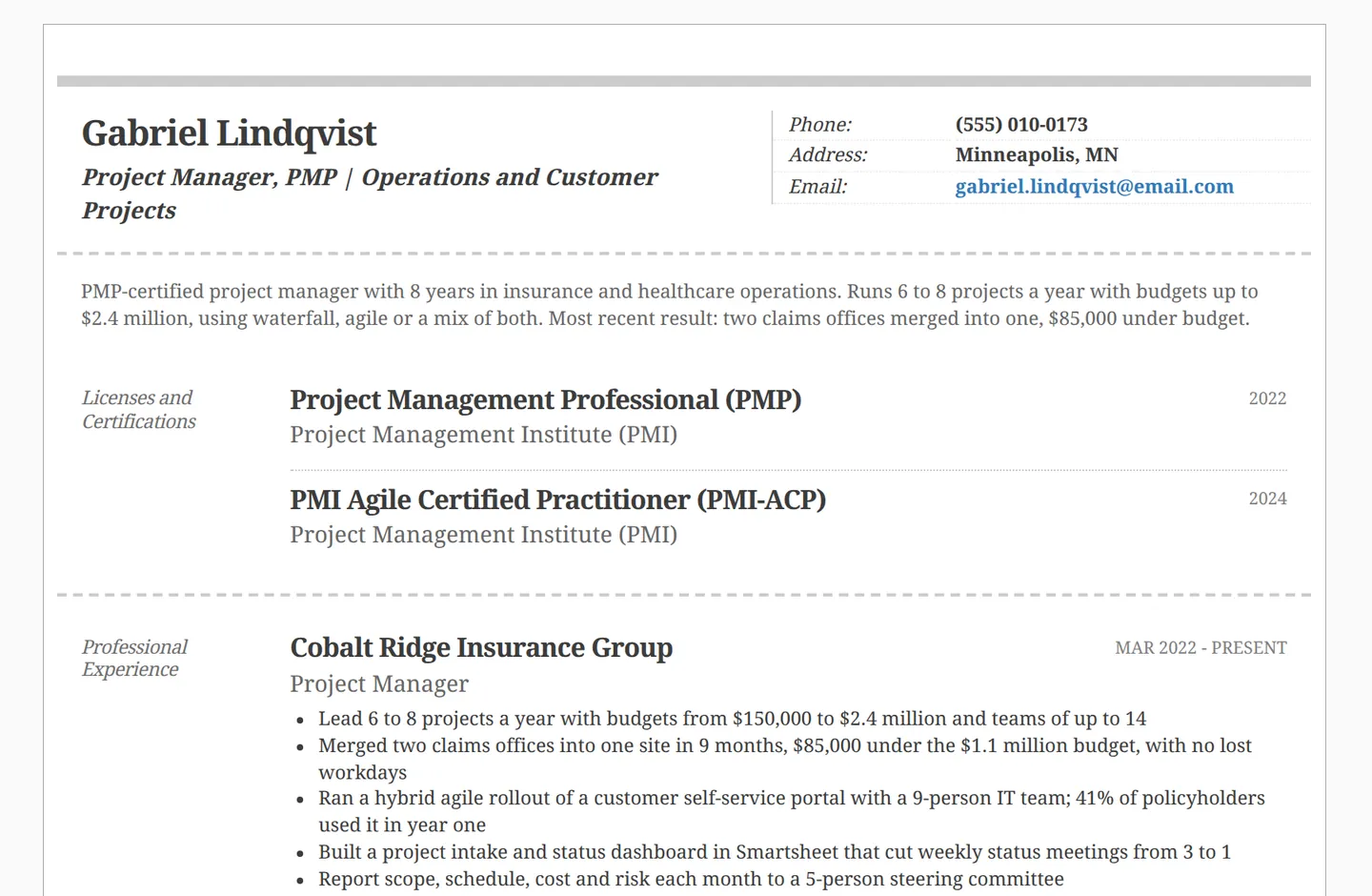
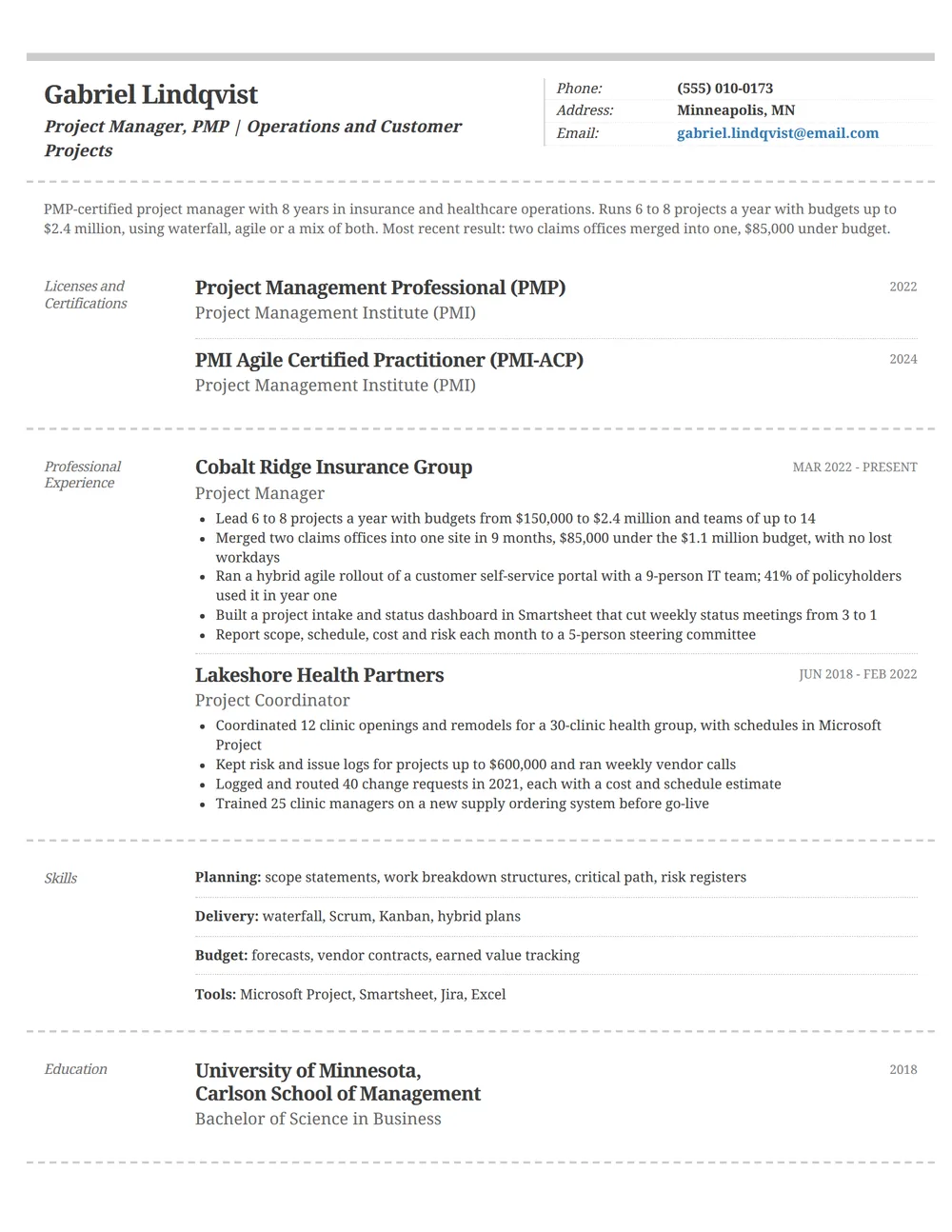
The sample belongs to Gabriel Lindqvist, a project manager with 8 years in insurance and healthcare operations. His PMP and PMI-ACP sit above both jobs. Each bullet names a budget, a team size or a result, such as an office move $85,000 under budget.
A PMP project manager's resume, projects with budgets
https://www.resumonk.com/project-manager-resumeProject ManagerProject manager resume format: projects before titles
When building a project manager resume, start from your three or four largest projects, not from your job titles. Then put them in this order:
- Name, contact details, and a headline with PMP if you hold it.
- A summary of two or three lines with years, industries and budget range.
- Certifications, as the sample does with PMP and PMI-ACP.
- Work experience, newest job first, with project results as bullets.
- Skills, then education.
A sample project manager resume template with one column and plain headings suits this order. A Word template works the same way; keep the layout simple so the file opens cleanly for anyone.
Up to about ten years of projects fit on one page. Senior project managers with large portfolios can use two.
What goes in a project manager resume headline?
Your target title, your credential and the kind of projects you run. Keep it to one line under your name:
- Project Manager, PMP | Healthcare Operations and Clinic Openings
- Agile Project Manager | Customer Web and Mobile Products
- Associate Project Manager, CAPM | Logistics and Warehouse Systems
Should a project manager use a functional resume?
Rarely. A skills-first layout hides when and where each project ran, and dates are part of a project result. If you are moving into the field, keep the dated job list and add a short Projects section above it instead.
Projects with scope, budget and outcome
Each project bullet needs three facts: what was delivered, how big it was, and how it ended against the plan. A great project manager resume gives all three in one line, as in this one from the sample:
Merged two claims offices into one site in 9 months, $85,000 under the $1.1 million budget, with no lost workdays
A hiring manager can compare it with the projects in their own plan.
Project manager duties and tasks for a resume
Use this job description as a starting list. Turn each one you did into a bullet with a number:
- Define scope, goals and deliverables with the project sponsor.
- Build the schedule and work breakdown structure, and track the critical path.
- Set and forecast the budget, and approve vendor invoices.
- Keep risk, issue and change logs, and bring decisions to the steering committee.
- Run status meetings and send written reports on scope, schedule, cost and risk.
- Manage vendors and contracts, from bids to sign-off.
- Close the project with a handover and a lessons-learned review.
Project manager resume bullet points to adapt
Example lines from different kinds of projects. Change the numbers to your own:
- Delivered a $780,000 warehouse system upgrade two weeks early with a team of 11
- Cut a product launch schedule from 14 months to 11 by running packaging and testing in parallel
- Managed 3 vendors on a $1.6 million call center move, with every contract closed on budget
- Recovered a late payroll project by resetting scope with the sponsor and finishing in 10 weeks
- Kept a 22-item risk register and closed 18 risks before launch
- Ran 2-week sprints for a 7-person web team and shipped a new booking page in 4 sprints
Project manager experience across industries
Name the industry once in your summary. The bullets carry over to other industries as long as each states scope, budget and result. Construction and IT project managers have their own pages with their own tools and permits.
Lines from settings that often hire project managers:
- Healthcare: Opened 4 urgent care sites in 14 months, each on schedule for its state inspection date
- Digital and creative: Ran a 40-page website redesign with a 6-person design team through 3 rounds of client review
- Manufacturing: Moved a packaging line to a new plant floor with 2 days of planned downtime instead of 5
- Agile software: Coordinated 3 Scrum teams on one release plan and cut missed sprint goals from 4 a quarter to 1
- Marketing: Planned and launched a 9-channel product campaign for a $350,000 budget, 2% under plan
How many projects should I list under each job?
Four to six bullets for your current job, and two to four for older ones. Pick the largest projects, the ones closest to the posting, and one recovery story if you have it. The sample gives its current job five bullets and its coordinator job four.
Project manager resume skills and keywords
Planning, delivery, budget and tools are the four labels the sample uses for its skills. Each line holds methods and software, which double as the keywords job postings repeat.
Hard skills to list
- Planning: scope statements, work breakdown structures, critical path, resource plans, risk registers.
- Delivery methods: waterfall, Scrum, Kanban, hybrid plans.
- Budget and contracts: forecasts, earned value, vendor bids, change orders.
- Tools: Microsoft Project, Smartsheet, Jira, Asana, Monday.com, Excel.
Keywords for a project manager resume
Copy the exact terms from the posting when they are true for you. Common ones are stakeholder management, scope management, risk management, project lifecycle, change control, budget tracking, status reporting, resource planning. Place them inside bullets as well as the skills list.
Leadership and communication belong in bullets, shown through a team size or a steering committee you reported to.
Which agile and Scrum terms belong on the resume?
Only the ones you have run yourself. Common ones for an agile project manager are sprint planning, backlog refinement, user stories and retrospectives. Velocity, burndown charts and SAFe follow if you used them.
Write them into a bullet with a team and a result, as the sample does with its hybrid agile portal rollout.
Which lines can a project manager cut?
- Every project you touched: list the ones you led or ran day to day.
- Tools you opened once: a long software list invites questions you cannot answer.
- Client secrets: budgets or names your contract keeps private. Write a size range and the industry instead.
- Method words with no result: "used agile best practices" tells the reader nothing.
Summary and objective lines by career stage
Use an objective if you are moving into project management, and a summary once you have run projects yourself. The sample's summary gives years, budget range, methods and one result in three sentences.
Entry level project manager resume
Entry roles often carry the title project coordinator or associate project manager. Lead with projects you coordinated, even inside another job. The Certified Associate in Project Management (CAPM) from PMI and the Google Project Management Certificate are common first credentials.
Assistant and junior project manager postings ask for the same proof at a smaller size. That means a schedule you kept, a log you ran, a vendor you chased. Example lines for people moving in from other jobs:
- From teaching: Planned a new grade 7 science course for 5 teachers, with a shared timeline and weekly check-ins
- From customer service: Tracked a 200-ticket backlog migration to a new help desk tool and finished a week early
- From administration: Coordinated an office move for 45 staff, with a 60-item checklist and two vendors
- From engineering: Kept the schedule and change log for a $400,000 equipment upgrade as lead engineer
Project manager resume objective examples
- Operations analyst with CAPM and two years coordinating system rollouts, seeking a project coordinator role in logistics.
- Event planner who ran 30 conferences on six-figure budgets, seeking an associate project manager position.
- Nurse with four years leading unit process changes, seeking a clinical project manager role.
Project manager summary examples
- Project manager with 5 years in retail operations, running store openings worth $200,000 to $900,000. PMP since 2023.
- Agile project manager with PMI-ACP who runs Scrum and Kanban teams of 6 to 10 on customer web products.
- Senior project manager for insurance and banking clients since 2014. Runs a portfolio of 10 to 15 projects worth $8 million a year and manages 4 project managers.
Senior project manager resume: what changes
A senior (Sr.) project manager resume shows a portfolio. Give the number of projects at once, the total budget, and the people you managed. Add the steering groups you report to.
A technical project manager resume adds the systems involved, such as a cloud move or an ERP rollout, in plain words.
Degree and PMP certification
List the Project Management Professional (PMP) by its full name with PMI as the issuer, near the top of the page. Many project manager postings name it, as required or preferred.
PMP needs 36 months leading projects with a four-year degree, 35 hours of project management education, and the exam. With a high school diploma or an associate degree, PMI asks for 60 months. If your exam is booked, write PMP exam scheduled with the month.
Your degree goes below, with the school and the year. Any subject works.
Should I put PMP after my name?
Yes, once PMI shows your certification as active. Write it after a comma, as in Gabriel Lindqvist, PMP, and give its full entry under certifications too. Leave it off your name while you are still preparing for the exam.
Which other certifications fit a project manager resume?
- PRINCE2 Foundation or Practitioner: issued by PeopleCert, common with UK and European employers.
- Certified ScrumMaster (CSM): from Scrum Alliance, for agile teams.
- Professional Scrum Master (PSM I): from Scrum.org, the other common Scrum credential.
- Six Sigma Green Belt: many bodies issue belts, so name yours, such as the Certified Six Sigma Green Belt (CSSGB) from ASQ.
List each with the issuer and the year, in the same section as the PMP.
Company awards and talks
An internal award for a project, or a talk at a local PMI chapter meeting, earns one line with the year. Most project manager resumes have neither, and the section can be left off.
Sponsors who saw your projects close
A project sponsor or a steering committee member saw your projects from start to close, which makes either one a good reference. Keep three names on a separate list and send it when the company reaches the reference stage.
Can a client be a reference for a project manager?
Yes, if they worked with you from kickoff to handover and their company allows it. Ask first, and tell them which project to talk about.
A project manager cover letter built on one project
Open the letter with one finished project close to the job, then say which position you want. A second paragraph gives a method or tool from the posting that you have used.
Last spring I merged two claims offices into one site in nine months, $85,000 under budget, with no lost workdays. I am applying for your Project Manager opening on the operations team.
Keep it to three short paragraphs and close with when you can start.
How do I explain a move into project management in a cover letter?
Name one project you ran in your current job, with its size and how it ended. Then link it to the role in one sentence. A teacher might write about a curriculum rollout; an office manager about a move.
Keeping your PMP line current, cycle by cycle
A PMP is active for three years at a time, so the line on your resume has upkeep:
- The year you pass: add it with PMI as the issuer, as in the sample.
- During each cycle: earn 60 professional development units (PDUs) and report them to PMI.
- PMI-ACP holders: that certificate renews on its own three-year cycle with 30 PDUs.
- Before applying: look up your record in PMI's online certification registry and copy the dates.
- If it lapses: take it off the resume until PMI shows it active again.
Build your project manager resume from your LinkedIn profile, an old resume file or a blank page. Starting is free.
More Management resume examples
- Program Manager resume example
- Operations Manager resume example
- Assistant Manager resume example
- Supervisor resume example
See all Management resume examples, or browse every category.
Resume writing tips