Assistant Manager Resume Example, Guide and Tips
Introduction
You're standing at one of the most interesting crossroads in your career. You've moved past the days of punching in, completing your assigned tasks, and punching out. You've proven you can do the work, handle the pressure, and show up reliably. Now you're stepping into something fundamentally different: a role where success isn't just about what you personally accomplish, but about what you enable an entire team to achieve. Assistant Manager positions sit in that crucial middle layer of organizations, where you're expected to bridge the gap between frontline operations and senior leadership, manage real people with real problems, and make decisions that actually affect business outcomes. This isn't about assisting anymore in the traditional sense.
This is about running operations when your manager steps away, solving problems in real-time without escalation, and proving you're ready for the next level up.
If you're reading this, you're likely in one of several situations. Maybe you've been a shift supervisor or team lead for a couple of years and you're ready to formalize that progression with an actual Assistant Manager title. Maybe you're already an Assistant Manager looking to move to a better company, a different industry, or a higher-volume operation. Maybe you've been doing Assistant Manager work without the title and you need a resume that reflects the reality of your responsibilities. Or perhaps you're making a calculated career shift, moving from a technical or individual contributor role into people management. Whatever your specific circumstance, you're here because you need a resume that positions you as the management-ready professional you are, not as the entry-level employee you used to be.
Here's what we're going to cover in this guide, and we're going to be specific about the Assistant Manager role because the title means something precise. This is a supervisory management position, typically overseeing 8-20 frontline employees, managing daily operations within established systems, handling scheduling and basic HR functions, and serving as the primary backup to a General Manager, Store Manager, or Department Head. It exists across virtually every industry with slightly different flavors: retail Assistant Managers focus heavily on sales and inventory, hospitality Assistant Managers emphasize guest experience and service quality, operations Assistant Managers in corporate or manufacturing settings concentrate on process efficiency and team productivity. The specifics vary, but the core remains constant: you're accountable for results, you're managing people, and you're expected to handle significant operational responsibility without constant supervision.
We'll start with resume format, and I'll explain exactly why the reverse-chronological format works best for Assistant Manager candidates and when you might consider alternatives. Then we'll dive deep into your work experience section, which is absolutely the centerpiece of your resume. This is where you'll demonstrate your progression from frontline worker to emerging leader, and I'll show you exactly how to write bullet points that prove capability rather than just describe responsibilities. We'll cover the skills section with specificity about which technical, operational, and interpersonal competencies actually matter for this level, moving far beyond generic buzzwords. You'll learn how to position your education appropriately, whether you have a relevant degree or worked your way up without one. We'll address awards and publications, which might seem irrelevant until you realize how powerful even modest recognitions can be as proof of performance. I'll walk you through writing a cover letter that demonstrates the communication skills and management understanding employers are evaluating, and we'll tackle the often-confusing topic of references with clarity about when, how, and who to include. Finally, we'll close with key takeaways that distill everything into actionable guidance you can reference as you build your resume.
Throughout this guide, you'll see real examples of what works and what doesn't, formatted as actual resume content so you can see the difference immediately. Some of these tips will apply universally to any Assistant Manager role. Others will be specific to certain industries or circumstances, like making an industry transition, addressing employment gaps, or positioning yourself for promotion within your current company. Pay attention to which guidance applies to your specific situation. This isn't a one-size-fits-all template you're supposed to copy. This is a comprehensive framework for building an Assistant Manager resume that honestly represents your experience while positioning you as strongly as possible for the specific opportunities you're pursuing. Let's get started.
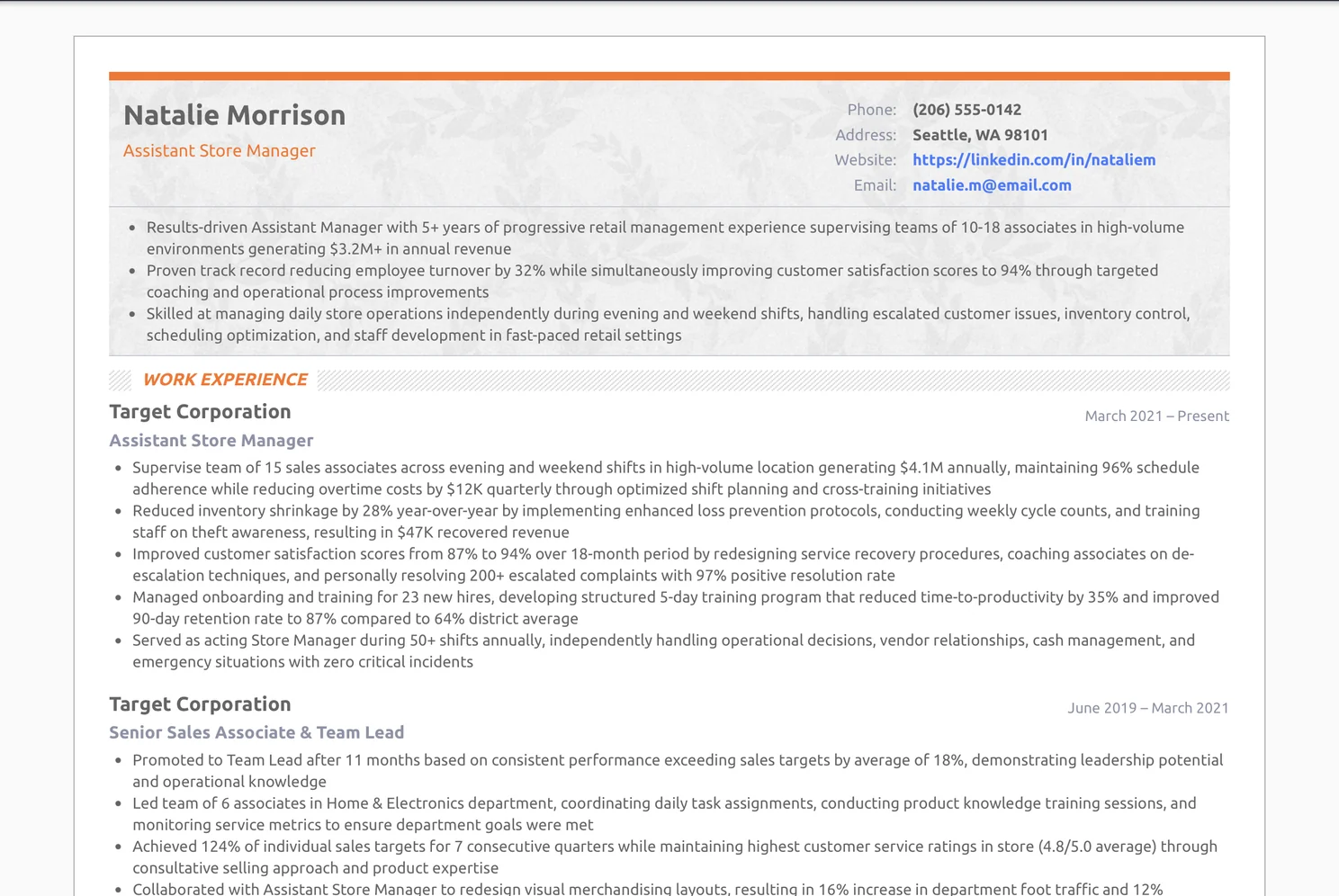
The Best Assistant Manager Resume Example/Sample
https://www.resumonk.com/assistant-managerAssistant ManagerResume Format for Your Assistant Manager Resume
You're at an interesting pivot point in your career. You've moved past the entry-level grind where you were learning the ropes, and now you're stepping into a role where you're expected to bridge the gap between frontline operations and senior management. The Assistant Manager position sits in that crucial middle layer - you're managing people, solving operational problems in real-time, and increasingly being trusted with business decisions that actually matter.
This isn't about fetching coffee or shadowing someone anymore; this is about running parts of the operation when your manager isn't around, and doing it well.
Why the Reverse-Chronological Format Works Best
For Assistant Manager roles, the reverse-chronological format is almost always your best choice, and here's why: hiring managers want to see your progression. They want to watch you climb from that entry-level position (whether it was Sales Associate, Team Member, or Junior Analyst) through to roles where you started taking on more responsibility.
The beauty of the reverse-chronological format is that it tells a story - your story - of increasing accountability, leadership development, and operational competence.
When a retail district manager or operations director looks at your resume, they're asking themselves: "Can this person handle the chaos of a busy shift? Will they make good decisions when I'm not there? Have they earned the respect needed to manage a team?" The reverse-chronological format answers these questions by showing your career trajectory.
It demonstrates that you didn't just wake up one day deciding to be an Assistant Manager; you earned it through progressive responsibility.
Structuring Your Assistant Manager Resume
Start with a strong professional summary at the top - two to three sentences that capture where you are professionally.
You're not a fresh graduate anymore, but you're also not claiming to be a seasoned executive. Your summary should reflect your current reality: someone who has proven they can manage operations, lead teams, and drive results at the departmental or unit level.
Following your summary, your work experience section becomes the centerpiece. This is where you'll spend the most resume real estate, and rightly so. Each position you list should show growth - not necessarily in job title (though that helps), but definitely in scope of responsibility. Maybe you started as a sales floor employee, became a senior associate, then a team lead, and now you're targeting Assistant Manager roles. That progression matters immensely.
After work experience, include your skills section (we'll dive deeper into this later), followed by education. Unless you're fresh out of university with a highly relevant degree, your education section should be brief. Most Assistant Manager roles care more about what you've done than where you studied, especially if you have three or more years of relevant experience.
What About Functional or Combination Formats?
You might be tempted by functional or combination formats, especially if you're making an industry shift - say, moving from retail Assistant Manager to hospitality Assistant Manager.
Resist this temptation. These formats can make hiring managers suspicious, as they're often used to hide employment gaps or lack of relevant experience. Even if you're changing industries, the reverse-chronological format works better because it shows you understand how to grow within an organizational structure, which is exactly what Assistant Manager roles require.
The combination format might seem appealing because it emphasizes skills upfront, but for Assistant Manager positions, context matters too much. It's not sufficient to say you have "team leadership skills" - hiring managers need to see that you led a team of eight people through a holiday rush season, or that you managed a department that generated $2M in annual revenue. That context only comes through clearly in a reverse-chronological format.
Length and Density Considerations
Your Assistant Manager resume should typically be one page if you have less than five years of total work experience, and can extend to two pages if you have more extensive experience or are applying to industries where detailed operational experience matters (like hospitality or healthcare). Don't artificially compress valuable information to fit one page if you're a strong candidate with seven years of progressive experience.
Conversely, don't pad your resume to two pages if you only have three years of relevant work history.
The density of information matters here. Each role you list should have three to five bullet points that demonstrate impact, scope, and progression. You're past the stage where you list basic job duties; you're at the stage where every bullet point should answer the question: "What did you actually accomplish or manage?"
Work Experience on Your Assistant Manager Resume
This is where your resume lives or dies.
You're applying for a role that exists in virtually every industry - retail, hospitality, healthcare, finance, manufacturing - and while the specifics vary, the core expectation remains constant: you're someone who can manage operations, lead people, and deliver results without constant supervision. Your work experience section needs to prove you've already been doing this, even if your job title didn't always reflect it.
The Architecture of Each Work Experience Entry
Let's talk about structure first. Each position you list should include your job title, company name, location (city and state/province), and dates of employment (month and year). But here's what many candidates get wrong: they list their most recent job as "Team Lead" when they were actually performing Assistant Manager duties in everything but title.
If you were genuinely doing the work of an Assistant Manager - managing schedules, handling operational decisions, supervising staff, dealing with escalations - consider how you present that role.
Below the header information for each role, you'll write three to five bullet points that demonstrate your impact and scope. Notice I said "demonstrate," not "describe." There's a profound difference between describing what an Assistant Manager does and demonstrating what you specifically accomplished as one.
Writing Bullet Points That Actually Matter
Here's the reality of Assistant Manager roles that many candidates miss: you're measured by outcomes, not activities.
A Store Manager doesn't care that you "assisted with daily operations" - that's literally your job title. They want to know that you reduced shrinkage by 15%, or improved customer satisfaction scores, or successfully trained and retained team members in a high-turnover environment.
Every bullet point should follow this mental framework: Action + Context + Result. What did you do, under what circumstances, and what was the outcome? This framework transforms generic responsibility statements into proof of capability.
❌ Don't write generic responsibility statements:
Assisted the Store Manager with daily operations and helped manage the team
✅ Do write impact-focused bullets with context:
Supervised team of 12 associates across evening shifts, maintaining 94% schedule adherence while reducing overtime costs by $8K quarterly through optimized shift planning
Notice the difference? The first example could describe anyone who's ever worked in retail. The second example tells a hiring manager exactly what you managed (12 people, evening shifts), what you achieved (schedule adherence, cost reduction), and quantifies your impact (specific percentages and dollar amounts).
Quantifying Your Assistant Manager Experience
Numbers are your best friend in this section, but you need to use them strategically.
Assistant Managers typically don't have P&L responsibility for entire businesses, but you absolutely have metrics you can point to. Think about: team size you supervised, sales volume or revenue you oversaw, customer satisfaction scores, inventory accuracy, turnover rates, training completion rates, or operational efficiency improvements.
If you worked in retail, you might have metrics around sales per square foot, conversion rates, or average transaction value. In hospitality, you might track occupancy rates, guest satisfaction scores, or food cost percentages. In healthcare, you might measure patient satisfaction, staff utilization rates, or compliance metrics. The specific numbers matter less than demonstrating you understand how to measure and improve performance.
❌ Don't leave your accomplishments vague:
Improved team performance and increased sales during tenure
✅ Do provide specific metrics and timeframes:
Drove 23% year-over-year sales increase in electronics department through targeted product training and enhanced visual merchandising, exceeding district average by 11 percentage points
Showcasing Leadership Without Overstating Your Level
This is a delicate balance you need to strike. You're in a leadership role, but you're not the ultimate decision-maker. You manage people, but you also report to someone.
Your resume needs to reflect this reality honestly while still showcasing your leadership capabilities.
Focus on the leadership you actually exercise: training and developing team members, making operational decisions within your authority, handling escalated customer or employee situations, and stepping in when your manager is unavailable. These are legitimate leadership responsibilities that demonstrate your readiness for Assistant Manager roles.
❌ Don't overstate your authority or level:
Directed strategic initiatives for the organization and led executive decision-making processes
✅ Do accurately represent your leadership scope:
Led weekly team huddles to communicate operational priorities and coached 5 team members to promotion-ready performance levels within 8-month period
Addressing Progressive Responsibility
If you've held multiple positions at the same company, show this progression clearly.
This is incredibly valuable for Assistant Manager candidates because it demonstrates loyalty, growth, and increasing trust from your employers. Create separate entries for each distinct role, even at the same company, so hiring managers can see your upward trajectory.
If you're applying for Assistant Manager roles but your current title is something like "Senior Team Member" or "Shift Supervisor," your bullet points need to emphasize any Assistant Manager responsibilities you've taken on. Were you the acting manager during certain shifts? Did you handle scheduling, inventory management, or performance conversations?
Make these clear in your descriptions.
Tailoring to Industry Context
Assistant Manager means something slightly different across industries, and your work experience section should reflect the specific context of where you're applying.
A retail Assistant Manager focuses heavily on sales, inventory, and customer experience. A restaurant Assistant Manager emphasizes food safety, service quality, and labor cost management. A healthcare Assistant Manager highlights compliance, patient care coordination, and staff scheduling in a regulated environment.
Research the specific industry you're targeting and ensure your bullet points emphasize the aspects of your experience most relevant to that context. If you're moving from retail to hospitality, emphasize customer service excellence, team management during high-volume periods, and your ability to maintain quality under pressure - these translate well across both industries.
Skills to Show on Your Assistant Manager Resume
Skills sections often become dumping grounds where candidates list every conceivable competency hoping something sticks. For Assistant Manager resumes, this approach fails because it doesn't reflect the reality of what the role demands.
You need a skills section that's curated, credible, and directly aligned with the supervisory and operational nature of the position you're seeking.
Understanding the Dual Nature of Assistant Manager Skills
Here's what makes the Assistant Manager role unique from a skills perspective: you need to be simultaneously operational and interpersonal.
You're managing inventory systems and managing people. You're analyzing sales data and coaching struggling team members. You're enforcing policies and building relationships. Your skills section needs to reflect both dimensions without turning into an unfocused list of buzzwords.
Think about your skills in three categories: technical/operational skills specific to your industry, leadership and people management skills that apply across contexts, and business acumen skills that show you understand how operational decisions affect broader outcomes.
Industry-Specific Technical Skills
These are the hard skills that prove you can actually do the operational work an Assistant Manager handles.
In retail, this might include point-of-sale systems, inventory management software, visual merchandising standards, or loss prevention protocols. In hospitality, it could be property management systems, food safety certification, or reservation platforms. In healthcare, it might be electronic health records systems, HIPAA compliance, or medical coding knowledge.
List specific systems and tools you've used, not generic categories. Compare these two approaches:
❌ Don't list vague technical categories:
Proficient in computer systems and inventory management
✅ Do list specific tools and systems:
Square POS, Shopify, RetailNext analytics, Kronos workforce management, Microsoft Excel (pivot tables, VLOOKUP)
The specificity matters because it tells a hiring manager you won't need extensive retraining on fundamental tools. If you've used Oracle NetSuite in your current retail role and you're applying to a company that uses SAP, your experience with enterprise inventory systems still signals you can learn their specific platform quickly.
Leadership and People Management Skills
This is where many Assistant Manager candidates either undersell themselves or resort to meaningless buzzwords.
Phrases like "strong leadership skills" or "team player" tell a hiring manager absolutely nothing. Instead, think about the specific people management capabilities you've developed: performance coaching, conflict resolution, training delivery, schedule management, or disciplinary processes.
These skills are best demonstrated in your work experience section with specific examples, but they can also be listed in your skills section if you frame them correctly. The key is to be specific enough that the skill means something concrete.
❌ Don't use generic leadership buzzwords:
Leadership, Team Building, Communication, Motivation
✅ Do specify concrete people management capabilities:
Staff Training & Development, Performance Management, Schedule Optimization, Conflict Mediation, New Hire Onboarding
Notice how the second approach describes actual activities you perform as an Assistant Manager? Someone reading these skills can picture you conducting a performance review, building a staff schedule, or training a new employee. These aren't abstract qualities; they're tangible competencies.
Business and Operational Acumen
Assistant Managers are increasingly expected to understand the business context of their operational decisions. You're not making decisions in a vacuum; you're making trade-offs that affect costs, revenue, customer experience, and team morale.
Your skills section should reflect this business awareness.
Skills in this category might include: budget management, sales analysis, inventory control, vendor relations, compliance management, quality assurance, or operational reporting. These skills signal that you understand how your daily decisions connect to broader business outcomes.
If you've worked with budgets, even departmental ones, that's worth noting. If you've analyzed sales trends to make purchasing or staffing decisions, that demonstrates business acumen. If you've managed compliance requirements in a regulated industry, that shows you understand risk management.
The Question of Soft Skills
Here's a controversial take: most soft skills don't belong in your skills section. "Communication," "problem-solving," "adaptability" - these are so overused they've become meaningless.
Every single resume claims these skills, so listing them doesn't differentiate you at all.
However, if you can make soft skills concrete and specific, they can work. Instead of "communication," consider "bilingual customer service (English/Spanish)" or "cross-departmental coordination." Instead of "problem-solving," think about "operational troubleshooting" or "customer complaint resolution."
The more specific you make it, the more credible it becomes.
How Many Skills to List
Quality over quantity applies here. A focused list of 10-15 highly relevant skills is far more effective than a sprawling list of 25+ skills that includes everything from "Microsoft Word" to "strategic thinking."
Your skills section should be scannable in about 10 seconds, allowing a hiring manager to quickly assess whether you have the core competencies the role demands.
Group your skills logically if you have enough to warrant it. You might have a "Technical Skills" grouping and a "Management Capabilities" grouping. This organization makes your skills section easier to parse and signals that you think in structured ways about your own competencies.
Skills You've Developed vs. Skills You're Learning
Only list skills you can actually discuss competently in an interview.
If you've used a system twice in training, that's not really a skill you possess. But if you're currently developing a skill that's highly relevant to the role you're targeting, consider how you might indicate that appropriately.
For Assistant Manager roles, emerging skills in areas like data analytics, digital marketing, or advanced workforce management are increasingly valuable. If you're taking coursework or have done substantial self-study in an area relevant to the position, you might note this in a professional development section rather than claiming full proficiency in your main skills section.
Specific Considerations and Tips for Your Assistant Manager Resume
Now we get to the nuanced elements that separate adequate Assistant Manager resumes from exceptional ones. These are the considerations that reflect a deep understanding of what this role actually entails and what hiring managers are really assessing when they review your candidacy.
Emphasizing Your "Manager in Waiting" Readiness
Here's something most Assistant Manager candidates don't fully grasp: you're not being hired primarily for what you can do today.
You're being hired as someone who can step into the full Manager role when the time comes, whether that's in six months or two years. Your resume needs to signal this readiness without claiming experience you don't have.
This means highlighting any situations where you've independently managed operations, even temporarily. Did you run the store for a week when your manager was on vacation? Did you close out quarters, handle escalated complaints, or make purchasing decisions within your authority? These experiences demonstrate you can handle the scope and pressure of full management responsibility.
✅ Strong framing that shows advancement readiness:
Served as acting manager during 40+ evening and weekend shifts, independently handling operational decisions, staff issues, and customer escalations with 98% incident resolution rate
This bullet point tells a hiring manager that you've already been tested in the full manager role, even if temporarily, and you performed well. That's exactly what they're looking for in an Assistant Manager candidate.
Addressing the Authority Paradox
Assistant Managers face a unique challenge: you have authority, but it's bounded.
You manage people, but you're also managed. You make decisions, but within constraints. Your resume needs to navigate this reality honestly. Overstating your authority makes you seem unaware of organizational dynamics; understating it makes you seem passive or uninvolved.
The solution is precision in language. Use words like "supervised," "coordinated," "led," and "managed" rather than "directed," "established," or "spearheaded." These words accurately reflect your level while still conveying meaningful responsibility. When you describe initiatives or improvements, make it clear whether you implemented decisions made by senior management or whether you identified and proposed solutions that were then approved.
❌ Overstating your decision-making authority:
Established company-wide inventory management protocols and restructured organizational staffing model
✅ Accurately representing your contribution level:
Implemented updated inventory management protocols across location, training 12 staff members and achieving 99.2% accuracy rate within first quarter of adoption
The Turnover Story
If you've had several jobs in a short period, you need to address this strategically on your Assistant Manager resume. The reality is that retail, hospitality, and similar industries where many Assistant Managers work have high turnover, and sometimes you've left roles for perfectly good reasons: company closures, relocations, toxic management, or better opportunities.
However, hiring managers for Assistant Manager roles are particularly sensitive to turnover because they're investing in developing you for eventual promotion. If you've held four Assistant Manager or equivalent roles in three years, that's a red flag suggesting you won't stick around long enough to advance.
If your work history shows frequent movement, ensure each role shows progression or legitimate rationale. If you left a retail Assistant Manager role for a hospitality one, that's lateral movement that suggests you're exploring where you fit best - that's acceptable. If you left because a location closed or a company went bankrupt, you might note this briefly in your resume or save the explanation for your cover letter or interview.
Education and Certification Placement
Most Assistant Manager roles don't require specific degrees, though some industries prefer or require them. If you have a relevant bachelor's degree (business, hospitality management, retail management), list it straightforwardly with your graduation year.
If you're currently pursuing a degree while working, note this with an expected graduation date - it shows ambition and commitment to professional growth.
If you don't have a degree, don't worry about it for most Assistant Manager roles. Your work experience matters far more. In this case, you might have an "Education and Professional Development" section that includes any relevant certifications: food safety, first aid, management training programs, or industry-specific credentials. These demonstrate your commitment to professional competency even without a traditional degree.
In countries like the UK, Canada, and Australia, vocational qualifications (like NVQ, Red Seal, or Certificate IV in various management areas) are highly respected for Assistant Manager roles. If you hold these, give them appropriate prominence in your education section.
Handling Internal Promotions vs. External Applications
Your resume needs differ depending on whether you're seeking promotion within your current company or applying externally. If you're applying internally, your resume should emphasize your deep knowledge of company systems, policies, and culture, plus any cross-functional relationships you've built.
Internal candidates win on organizational fit and existing knowledge.
If you're applying externally, emphasize transferable systems and processes rather than company-specific ones. Instead of "proficient in our proprietary POS system," frame it as "rapid learner of new technology systems, with experience across multiple POS platforms." External candidates win on bringing fresh perspectives and diverse experience.
Addressing Career Changers
Maybe you're moving from a completely different career into Assistant Manager roles, or you're shifting industries. Perhaps you were in a technical role and are moving toward people management, or you're leaving a professional services career for operations management.
This transition requires careful framing.
In your professional summary, acknowledge the transition directly but frame it around transferable skills and genuine interest. In your work experience, emphasize any leadership, coordination, or operational responsibilities you held, even if they weren't your primary function. If you managed projects, coordinated teams, handled customer relationships, or improved processes, these experiences translate to Assistant Manager competencies.
Consider whether you need additional credentials to make the transition credible. If you're moving from accounting into retail management, you might take a short course in retail operations or visual merchandising to signal genuine commitment to the industry change.
The Reality Check Section
Here's something no one likes to talk about: some Assistant Manager candidates are applying because they can't break into their desired field and need employment, not because they're genuinely interested in management. If this describes you, I'd encourage you to reconsider whether these roles are right for you. Assistant Manager positions are demanding, often requiring irregular hours, high stress, and constant problem-solving.
If you're not interested in operations and people management, you'll struggle and likely leave quickly.
However, if you're applying to Assistant Manager roles as a genuine career path - whether as a destination or a stepping stone to full management - make sure your resume reflects authentic engagement with the work. Show curiosity about operational improvement, real investment in team development, and pride in the results you've driven. Hiring managers can sense the difference between someone who views the role as a consolation prize and someone who sees it as a meaningful career step.
The Scheduling Flexibility Question
Many Assistant Manager roles require weekend, evening, or holiday availability.
While you won't typically address this on your resume, make sure your work experience doesn't suggest you've only worked 9-to-5 Monday-Friday schedules if you're applying to industries that require broader availability. If you've managed evening shifts, weekend operations, or holiday periods, noting this in your bullet points signals you understand and accept the scheduling realities of the role.
Avoiding the "Jack of All Trades" Trap
Because Assistant Managers do wear many hats, there's a temptation to list every single thing you've ever done. This makes your resume unfocused. Instead, emphasize the three to four core competency areas most relevant to the specific role you're applying for. If it's a retail Assistant Manager role, emphasize sales, team leadership, and inventory management over your brief stint helping with marketing materials.
Stay focused on what matters most for the specific opportunity.
Your resume should tell a clear story: you've progressively developed the operational expertise, leadership capability, and business judgment required to manage a unit, department, or location with increasing autonomy. Everything you include should support that narrative. Everything that doesn't support it, no matter how interesting or impressive, should be minimized or cut.
Education Requirements for an Assistant Manager Resume
Most assistant manager roles don't require advanced degrees, but they do require proof that you can learn, adapt, and apply knowledge practically. Whether you're in retail, hospitality, operations, or corporate support, hiring managers want to see that you've built a foundation of business acumen and people skills.
Let's talk about how to present your educational background in a way that positions you as the management-ready professional you are.
What Education Actually Matters for Assistant Manager Roles
The honest truth is that for most assistant manager positions, a bachelor's degree in business administration, management, hospitality, or a related field puts you in strong standing.
But here's what matters more than the degree itself: how you frame it to show management readiness. If you have an associate degree or even just a high school diploma paired with management certificates and strong work experience, you're still very much in the game. Assistant manager roles value demonstrated capability over pedigree.
Your education section should appear after your professional experience section (since you're likely not a fresh graduate), and it should be concise but complete. List your degree, institution, location, and graduation date. If you graduated within the last 3-4 years and had a strong GPA (3.5 or above), include it.
Beyond that timeframe, your work accomplishments speak louder than your academic performance.
Formatting Your Education Section Effectively
The structure should be clean and reverse-chronological, starting with your most recent education. Here's what works:
✅ Do - Present your education with clear hierarchy and relevant details:
Bachelor of Science in Business Management
University of Central Florida, Orlando, FL
Graduated: May 2019
Relevant Coursework: Operations Management, Organizational Behavior, Business Communication
❌ Don't - Clutter it with unnecessary information or make it vague:
School: Some University (2015-2019)
Major: Business stuff
Learned about managing and leading teams
Including Relevant Coursework and Projects
If you're relatively early in your career (within 5 years of graduation) and took courses directly relevant to management responsibilities, list them. Focus on operational management, human resources, conflict resolution, scheduling systems, or financial management. These signal that you've studied the theoretical frameworks you're now applying daily. However, if you've been in the workforce for 7+ years, skip this.
Your experience sections carry all the weight you need.
Did you complete a capstone project managing a team simulation, analyzing operational inefficiencies, or creating training programs? Include it briefly if it demonstrates management capabilities:
✅ Do - Highlight management-relevant academic projects:
Capstone Project: Designed employee scheduling optimization system for retail environment, reducing labor costs by 12% while improving coverage during peak hours
Professional Development and Management Certifications
Here's where assistant managers can really differentiate themselves. Certifications show initiative and commitment to the management path. Consider listing these either in your education section or in a separate "Professional Development" section if you have multiple credentials.
Relevant certifications include:
- Certified Manager (CM) through the Institute of Certified Professional Managers
- Professional in Human Resources (PHR) if you handle HR responsibilities
- Servicing-specific certifications like ServSafe Manager for food service
- Retail Management Certificate programs
- Leadership development programs from recognized institutions
- Industry-specific certifications relevant to your sector
Format these with the same attention to detail as your degree:
✅ Do - List certifications with issuing organization and date:
Certified Manager (CM)
Institute of Certified Professional Managers
Issued: March 2022
When You Don't Have a Degree
Let's address the elephant in the room because this applies to many successful assistant managers: you might not have a four-year degree. Perhaps you worked your way up from entry-level positions, proving your management capabilities through results rather than coursework.
That's not only acceptable, it's often preferred in industries like retail, hospitality, and food service where operational expertise trumps academic credentials.
In this case, lead with your professional experience, and keep your education section simple but present. List your high school diploma, any college coursework you completed (even if you didn't finish the degree), and emphasize certifications and training programs. The key is showing you're committed to continuous learning:
✅ Do - Show educational foundation even without a degree:
1. Business Management Coursework (45 credits completed)
Northern Virginia Community College, Alexandria, VA
2016-2018

2. High School Diploma
Jefferson High School, Falls Church, VA
Graduated: 2015
Ongoing Education and Professional Development
If you're currently pursuing a degree while working, absolutely include it. This demonstrates ambition and commitment to growth, which are exactly the qualities organizations want in their assistant managers who'll eventually become full managers.
Just make sure you clearly indicate it's in progress:
✅ Do - Show current educational pursuits clearly:
Bachelor of Business Administration (In Progress, Expected 2025)
Online Program, Arizona State University
Completed 78 of 120 credits | Current GPA: 3.6
Showcasing Awards and Publications on an Assistant Manager Resume
The question isn't whether you have traditional "publications" in the academic sense.
The question is: have you been recognized for your performance, have you contributed written insights anywhere, or have you achieved something noteworthy that can be quantified? If the answer is yes to any of these, you need to showcase them strategically.
Why Awards Matter for Assistant Manager Candidates
Assistant manager roles are all about proving you can perform under pressure, lead effectively, and deliver results. Awards and recognitions provide third-party validation of these capabilities.
They're social proof that you're not just claiming to be a strong performer but that others, specifically your current or former employers, have formally acknowledged your contributions.
Think about it from a hiring manager's perspective: they're sifting through dozens of resumes where everyone claims to be a "team player" with "strong leadership skills" and "excellent problem-solving abilities." But when you can point to being named "Assistant Manager of the Quarter" or receiving a regional recognition for operational excellence, you're no longer just claiming competence; you're proving it.
What Counts as Awards for Assistant Managers
You might be underselling yourself because you think your recognitions "don't count" as formal awards. Let me expand your definition.
Any of the following are absolutely worth including:
- Employee of the Month/Quarter/Year awards
- Performance-based recognition programs (hitting sales targets, operational metrics, customer satisfaction scores)
- Internal company awards for leadership, teamwork, or innovation
- Regional or district-level recognitions if you work for a multi-location organization
- Perfect attendance or safety awards (particularly relevant in manufacturing, warehousing, or operations)
- Training completion awards or being designated as a certified trainer
- Customer service excellence awards or high rating recognitions
- Successful project completion recognitions
How to Format Awards on Your Assistant Manager Resume
You have two options for placing awards: create a dedicated "Awards & Recognition" section, or integrate them into your work experience bullets. The decision depends on how many you have and how impressive they are.
If you have 3+ significant awards, create a separate section positioned after your experience section or after your skills section. This gives them visual prominence. Format them clearly with the award name, issuing organization, and date:
✅ Do - Create clear, specific award entries:
Assistant Manager of the Year, Northeast Region
Target Corporation | 2023
Recognized for achieving 127% of sales targets while reducing team turnover by 34%
Customer Excellence Award
Target Corporation | 2022
Achieved highest customer satisfaction scores in district (96%) for 3 consecutive quarters
❌ Don't - Be vague or omit context that makes the award meaningful:
Got an award at work (2023)
Employee of the month a few times
If you have 1-2 awards, integrate them directly into your work experience section as part of your achievement bullets. This keeps your resume streamlined while still highlighting the recognition:
✅ Do - Weave awards into your accomplishment bullets:
• Promoted to Assistant Manager after 14 months (fastest promotion in store history) and recognized as "Rising Star Award" recipient for leadership potential
Understanding Publications for Assistant Manager Roles
Now let's tackle publications, which probably feels even less relevant to you. You're managing shift schedules and resolving team conflicts, not writing journal articles.
But "publications" in your context means something different, and you may have more to include than you realize.
Have you contributed to any of the following?
- Company newsletter articles about your department's success or best practices
- Internal training manuals or standard operating procedures you wrote or significantly updated
- Blog posts on your company's website about team culture, customer service, or operational improvements
- LinkedIn articles about management, leadership, or industry trends (yes, these count)
- Case studies featured in company materials about successful initiatives you led
- Industry publication quotes or interviews where you were featured
- Procedural guides or playbooks you created that were adopted company-wide
For most assistant managers, publications won't be your strongest section, and that's completely fine. If you don't have any, don't force it or leave a blank section.
But if you've contributed written content that demonstrates thought leadership, operational expertise, or training capabilities, include it.
Formatting Publications on Your Resume
Use a simple, clear format that includes the publication title, where it appeared, and when. You don't need to follow academic citation formats (no APA or MLA here), just make it readable:
✅ Do - Format publications clearly and professionally:
1. "5 Strategies for Reducing Employee Turnover in Retail Management"
Published on LinkedIn | July 2023

2. "Streamlining Opening and Closing Procedures: A Case Study"
Featured in Hilton Garden Inn Regional Best Practices Newsletter | January 2023
When to Skip This Section Entirely
Here's permission to not include an "Awards and Publications" section: if you don't have any significant recognitions or written contributions, don't create a sparse section just to have one.
Your resume real estate is valuable, and an empty or weak section does more harm than good. Instead, focus on strengthening your professional experience section with quantified achievements. That said, really audit your career. You might be overlooking recognitions that absolutely deserve mention.
Making the Most of Limited Recognition
If you have just one award but it's significant, you can still create a brief "Recognition" section or, better yet, prominently feature it in your resume summary or integrate it into your experience section. Context is everything:
✅ Do - Use limited awards strategically throughout your resume:
Assistant Manager with 4+ years experience in high-volume retail operations. Recognized as "District Assistant Manager of the Year" (2023) for driving team performance improvements resulting in 18% revenue growth.
Including References on Your Assistant Manager Resume
Let's get straight to what you actually need to know about references for your assistant manager application.
Should References Appear on Your Resume?
The short answer is no, you should not include actual reference names and contact information on your resume itself.
This is the modern standard across industries and regions (USA, Canada, UK, and Australia all follow this convention). Your resume is a marketing document focused on your qualifications, experience, and achievements. References come into play later in the hiring process, typically after initial interviews when the employer is seriously considering you.
Here's why they don't belong on the resume:
- Space is valuable: your resume real estate should focus on your accomplishments, not use 4-6 lines listing reference contacts
- Privacy concerns: you shouldn't publicly distribute your references' contact information to every company you apply to
- Timing: employers expect to ask for references when they're needed, not receive them unsolicited
- Professional courtesy: your references should be alerted before they're contacted, which you can't control if their information is on every resume you submit
The old advice about including "References available upon request" at the bottom of your resume is now outdated and unnecessary. Employers assume you have references. You don't need to state the obvious.
❌ Don't - Add outdated reference statements to your resume:
References available upon request.
❌ Don't - List actual references on your resume:
REFERENCES
John Smith, General Manager
ABC Retail Company
[email protected] | (555) 123-4567
Sarah Johnson, District Manager
ABC Retail Company
[email protected] | (555) 234-5678
When Employers Will Ask for References
Understanding the timeline helps you prepare appropriately. For most assistant manager positions, references come into play at one of these stages:
1. During the application process: Some online application systems include a section for references. If it's required, you'll need to provide them. If it's optional, you can usually skip it initially and provide them later.
2. After the first or second interview: This is the most common timing. The hiring manager has met you, liked what they saw, and now wants to verify your capabilities and character before making a final decision.
3. As part of a formal offer process: Some organizations only check references after they've decided to hire you, essentially as a final verification before extending an official offer.
The key is being ready at any of these stages. You should have your reference list prepared from the moment you start applying, even if you don't submit it until asked.
Who Makes a Strong Reference for Assistant Manager Roles
Your references need to speak credibly about your management capabilities, operational competence, and interpersonal skills. The strongest references for assistant manager positions are:
1. Your direct supervisor (current or former): This is your most important reference. A general manager, store manager, or department head who directly managed you can speak to your day-to-day performance, how you handle challenges, how you interact with teams, and whether you're ready for increased responsibility. If you're currently employed and conducting a confidential search, you'll use former supervisors and address this proactively with potential employers.
2. A skip-level manager: A district manager, regional director, or other senior leader who knows your work provides a broader perspective on your capabilities and potential. This is especially valuable if they've observed you managing during your supervisor's absence.
3. A peer manager or fellow assistant manager: Someone at your same level can speak to your collaboration skills, reliability, and how you handle cross-functional challenges. This reference type is particularly valuable for roles requiring significant lateral coordination.
4. Someone you've managed or mentored: While less common, a strong team member you've developed can provide unique insight into your leadership style and coaching effectiveness. This is more appropriate as a third or fourth reference rather than a primary one.
Who should you avoid as references? Personal friends, family members, professors (unless you're very early career), or people who don't know your management work specifically.
Every reference should be able to speak to your capabilities in a professional management context.
How Many References to Prepare
Prepare a list of 3-4 professional references.
Three is standard and sufficient for most situations. Four gives you a backup if one person becomes unavailable. Having more than four can actually dilute impact; employers rarely check beyond three anyway. Quality matters far more than quantity here.
Your reference list should be diverse enough to cover different aspects of your management experience: someone who can speak to your operational skills, someone who can discuss your people management, someone who knows your problem-solving under pressure. Ideally, at least two should be from supervisory positions above you.
Creating a Professional Reference Sheet
While references don't go on your resume, you need a separate professional reference document ready to provide when requested. This should match the visual design of your resume (same header, font, formatting) to maintain a cohesive professional presentation.
Include the following information for each reference:
- Full name and professional title
- Company or organization name
- Phone number (mobile is often better as they can respond more quickly)
- Email address (professional, not personal)
- A brief one-line description of your relationship to this person
✅ Do - Format your reference sheet professionally and clearly:
PROFESSIONAL REFERENCES
[Your Name]
1. Marcus Johnson
- General Manager, Marriott Courtyard Downtown
- Phone: (404) 555-0198 | Email: [email protected]
- Direct supervisor for 2.5 years; can speak to operational management and team leadership

2. Patricia Nguyen
- District Manager, Marriott Southeast Region
- Phone: (404) 555-0172 | Email: [email protected]
- Skip-level supervisor; oversaw my performance during annual reviews and district initiatives

3. David Chen
- Assistant General Manager, Marriott Courtyard Midtown
- Phone: (404) 555-0183 | Email: [email protected]
- Peer manager; collaborated on regional training programs and operational improvements
Getting Permission and Preparing Your References
Here's something crucial that many candidates overlook: you must ask permission before listing someone as a reference. This isn't just courtesy; it ensures they're prepared to speak positively about you and won't be caught off guard by a call.
When requesting to use someone as a reference:
- Ask personally if possible, or by phone or email if they're no longer with your organization
- Explain what type of role you're pursuing
- Remind them of specific projects or achievements you worked on together
- Ask if they feel comfortable providing a strong reference (giving them an out if they have any hesitation)
- Provide them with your updated resume so they can speak knowledgeably about your recent experience
- Give them a heads-up when you're in active interviews and references might be checked
✅ Do - Prepare your references with context:
Email to potential reference:
Hi Marcus,
I hope you're doing well! I wanted to reach out because I'm currently exploring Assistant General Manager opportunities, particularly in hospitality operations. Given our work together at Marriott Courtyard, I was hoping you'd be willing to serve as a professional reference for me.
I'm especially proud of the work we did reducing turnover by 38% and implementing the new training program, and I think you could speak well to those operational improvements and my leadership development.
Would you be comfortable serving as a reference? If so, I'll send over my current resume so you have the most up-to-date information. I'm in preliminary conversations with a few properties but nothing imminent, so there's no rush.
Thanks so much for considering this, and for all your mentorship over the past few years.
Best,
[Your name]
What If You Don't Have Traditional References?
This is a real concern for some assistant manager candidates.
Maybe you're making a significant industry shift. Maybe your previous supervisor is no longer reachable. Maybe you had a difficult departure from your last role. Here's how to handle common reference challenges:
If you're leaving a bad situation: You still have colleagues, peer managers, or skip-level supervisors who can speak to your work. You may also have references from a role before your current one. Be prepared to briefly address why you're not using your current direct supervisor if asked.
If you're early in your management career: Use supervisors from roles where you demonstrated leadership even if you weren't formally a manager. A lead position, team project leadership, or training responsibilities all count. Make sure your reference can speak to management-relevant skills like problem-solving, communication, and initiative.
If you're changing industries: Focus on transferable skills. Your reference should emphasize operational management, team leadership, and results achievement even if the industry context is different.
If a reference becomes unavailable: This happens. People change jobs, retire, or become unreachable. This is why you prepare 4 references even though you'll likely only need 3.
Update your list regularly.
Regional Differences in Reference Expectations
While the general principles remain consistent, there are some regional nuances to be aware of:
United States: References are typically checked after interviews and before offers. Employers expect 3 professional references. It's legal to ask about performance, reliability, and eligibility for rehire.
Canada: Very similar to the US. Reference checking is standard practice, and employers expect 3 professional references.
United Kingdom: Reference checking is common but may happen later in the process, sometimes after a conditional offer. Some UK employers request written references rather than phone conversations. Two references are often sufficient in the UK.
Australia: Reference checking is standard, usually by phone. Australian employers may request contact information for both direct supervisors and HR departments to verify employment dates and eligibility for rehire.
When Applications Explicitly Request References
Some online application systems require references before you can submit your application.
In these cases, you have no choice but to provide them upfront. Make sure you've already secured permission from your references for exactly this scenario. Many candidates maintain an ongoing conversation with their references like: "I'm actively job searching and may need to list your contact information on applications. Is that still okay?"
If the application asks but doesn't require references, you can sometimes enter placeholder text like "Available upon request" in contact fields, though this varies by system. When in doubt, provide the references if you have them prepared.
Following Up After References Are Checked
Professional courtesy extends beyond just asking permission.
When you know references have been checked (either because the employer tells you or your reference mentions being contacted), follow up with a brief thank-you to your references. This maintains the relationship and keeps the door open for future reference use. A simple email or text acknowledging their time and help is sufficient.
If you receive an offer, definitely let your references know the outcome and thank them for their role in your success. If you don't get the offer, a simple thank-you is still appropriate. Your references invested their credibility in vouching for you; acknowledging that matters.
The Bottom Line on References
References are a crucial but often overlooked component of your assistant manager job search. Don't include them on your resume, but have a professional reference sheet prepared from day one. Choose people who can credibly speak to your management capabilities, get their permission in advance, and keep them informed throughout your search.
Treat your references like the valuable professional assets they are, because in a competitive hiring process, a strong reference can be the factor that tips the decision in your favor.
Writing an Effective Cover Letter for Your Assistant Manager Resume
Think about the role you're applying for.
You'll be communicating upward to general managers and district leaders, laterally to other department heads or assistant managers, and downward to frontline team members. You'll be writing emails about schedule changes, incident reports, performance documentation, and operational updates. The cover letter you write is your first writing sample, your first management communication. It needs to prove you can communicate with clarity, professionalism, and purpose.
Why Cover Letters Still Matter for Assistant Manager Roles
Let me address the elephant in the room: you've probably heard that "nobody reads cover letters anymore." That's partially true for high-volume entry-level hiring where recruiters are processing hundreds of applications. But for assistant manager positions?
Cover letters matter, and here's why.
First, assistant manager roles often involve managing people, and people management requires emotional intelligence, communication skills, and the ability to build relationships. Your cover letter demonstrates these soft skills in ways your resume never can. Second, you're likely not applying to 100 jobs. You're being selective about opportunities that align with your experience and career trajectory. A tailored cover letter shows that selectivity and seriousness. Third, many assistant manager positions are filled by internal referrals or through smaller organizations where hiring managers personally review every application. Your cover letter might be the deciding factor between you and an equally qualified candidate.
The Structure That Works for Assistant Manager Cover Letters
Forget the generic "I am writing to express my strong interest in..." opening that makes hiring managers' eyes glaze over.
Your cover letter should follow a narrative structure that mirrors the hiring manager's concerns:
Opening paragraph: Immediately establish why you're qualified and why this specific role. Lead with your strongest credential or most relevant achievement. Make them want to keep reading.
Second paragraph: Demonstrate deep understanding of the operational challenges this role faces and show how your experience directly addresses them. This is where you prove you understand what assistant managers actually do.
Third paragraph: Provide a specific example of a management challenge you've solved that's relevant to their environment. Use the STAR method (Situation, Task, Action, Result) but make it conversational, not formulaic.
Closing paragraph: Express genuine enthusiasm for the specific company and role, and provide a clear call-to-action about next steps.
Let's see this in action with a before-and-after example:
❌ Don't - Write generic, passive cover letter openings:
To Whom It May Concern,
I am writing to apply for the Assistant Manager position I saw posted on your website. I have been working in retail for several years and think I would be a good fit for your team. I am a hard worker and a team player who is passionate about customer service.
I have experience with many of the responsibilities listed in the job description.
✅ Do - Open with specific, compelling credentials and clear relevance:
Dear Ms. Rodriguez,
When I reduced employee turnover by 41% while simultaneously increasing customer satisfaction scores to a three-year high at Nordstrom Rack, I learned that assistant management is less about managing tasks and more about developing people. I'm reaching out because your Assistant Store Manager role at the new Bellevue location represents exactly the kind of growth-stage environment where this people-first approach drives measurable results.
Your job posting emphasizes building team culture during a new store opening, an experience I bring directly from launching the Tacoma location in 2022.
Demonstrating Management Understanding
The biggest mistake assistant manager candidates make in cover letters is focusing exclusively on what they want ("growth opportunity," "career advancement") rather than what they bring. Remember, hiring managers are trying to solve a problem: they need someone who can manage daily operations, develop team members, reduce the manager's workload, and potentially step up when the manager is absent.
Your cover letter needs to address these concerns directly. Show that you understand the dual nature of the role: you're both a leader and a doer. You're setting direction while also jumping in when the lunch rush hits. You're coaching team members through difficult conversations while also ensuring inventory counts are accurate.
✅ Do - Show nuanced understanding of the assistant manager role:
The Assistant Manager position at Marriott Courtyard requires balancing guest-facing leadership with behind-the-scenes operational excellence. In my current role at Holiday Inn Express, I've developed systems that let me spend 60% of my time on the floor coaching front desk agents and resolving guest concerns while ensuring back-office responsibilities like scheduling, inventory management, and financial reconciliation are completed efficiently. I built a daily checklist system that reduced administrative time by 3 hours weekly while improving compliance scores by 23%.
❌ Don't - Make vague claims without operational specifics:
I am very good at multitasking and can handle both leadership and operational duties. I'm comfortable working with guests and also doing paperwork. I'm organized and efficient.
The Power of Specific Examples
This is where your cover letter can truly shine. Your resume lists accomplishments, but your cover letter can tell the story behind one of them in a way that reveals your management approach, problem-solving process, and interpersonal skills.
Choose one example that's highly relevant to the role you're applying for and walk through it with enough detail to be compelling but concisely enough to maintain attention.
✅ Do - Provide a detailed, relevant management example:
Last holiday season, our store faced a challenge many retailers know too well: we'd hired 15 seasonal employees who needed to be fully productive within two weeks, right as our experienced staff was taking scheduled vacation time. Rather than relying on traditional shadowing, I developed a structured three-day training program combining video modules I created, hands-on practice during slower morning hours, and paired shifts with our strongest team members. I also implemented a "question of the day" system where new hires could text me directly.
The result? Our seasonal employees reached productivity benchmarks 40% faster than the previous year's cohort, customer wait times remained under our 5-minute target despite 23% higher traffic, and we received zero customer complaints related to new employee performance. Three of those seasonal hires were converted to permanent positions, and the training program is now used district-wide.
Tailoring to Industry and Company
An assistant manager in hospitality faces different challenges than one in retail, food service, healthcare administration, or corporate operations.
Your cover letter must reflect the specific operational environment and priorities of the industry and company you're applying to. Do your research:
- Read recent company news, press releases, or announcements about expansion, new initiatives, or challenges
- Review the company's website for information about their values, culture, and operational priorities
- Check employee reviews on Glassdoor (carefully) to understand real operational challenges
- Look at the hiring manager's LinkedIn profile if you can identify them
- Understand industry-specific pain points (labor shortages in hospitality, inventory shrinkage in retail, patient satisfaction in healthcare)
Then reference these specifics in your letter to show you've done your homework:
✅ Do - Reference company-specific information:
I noticed in your recent Q3 announcement that REI is expanding its focus on experiential retail and outdoor education programming. This aligns perfectly with my background: at Bass Pro Shops, I coordinated 18 in-store workshops on fishing techniques and camping skills, events that drove 12% higher foot traffic on workshop days and converted 34% of attendees into same-day purchasers. I'm excited about bringing this experience to REI's community-focused retail model.
Addressing Potential Concerns Proactively
Maybe you're making an industry shift.
Maybe you have a gap in your employment. Maybe you're geographically relocating. Maybe you're stepping up from a supervisor role to assistant manager for the first time. Whatever potential red flag might exist in your application, your cover letter is the place to address it head-on with confidence and context:
✅ Do - Address career transitions with confidence and relevance:
While my three years as Assistant Manager have been in restaurant operations, the skills directly translate to retail management: I've managed teams of 12-15 across multiple shifts, handled inventory and vendor relationships for a $2M annual operation, and maintained labor costs within 2% of budget despite industry-wide staffing challenges. The fundamentals of assistant management—developing people, driving metrics, and solving operational problems—
remain constant across industries.
Closing Strong
Your closing paragraph should accomplish three things: reiterate genuine interest in this specific opportunity, express confidence in your fit, and provide a clear next step. Avoid passive language like "I look forward to hearing from you" and instead demonstrate initiative:
✅ Do - Close with specific enthusiasm and clear next steps:
The combination of Target's investment in employee development and the high-volume operational challenges of the Downtown Seattle location makes this Assistant Manager role exactly the opportunity I'm seeking. I'm confident that my track record of building strong teams while driving operational excellence would translate immediately to your store's goals.
I'd welcome the opportunity to discuss how my experience reducing shrinkage by 28% and improving employee retention by 41% could benefit your location specifically. I'll follow up next week to see if we might schedule a conversation, or please feel free to reach me at (206) 555-0147.
Common Cover Letter Mistakes to Avoid
Now that we've covered what to do, let's talk about what kills assistant manager cover letters:
Repeating your resume: Your cover letter shouldn't be a paragraph-form version of your resume. It should provide context, tell stories, and reveal personality that your resume can't capture.
Focusing on what you want to learn: Hiring managers need someone who can contribute immediately, not someone they need to train extensively. Frame even your growth interests around what you'll bring.
Generic language that could apply to any role: Every sentence should be specifically tailored to this company and this position.
Overly casual tone: You're applying for a management position. Conversational is good; overly casual undermines your professionalism.
Errors and typos: If you can't proofread a one-page letter about yourself, how will you handle inventory reports or employee schedules?
❌ Don't - Use these resume-killer phrases:
"I am a people person who loves working with teams."
"This role would be a great learning opportunity for me."
"I am detail-oriented and organized."
"Please consider me for this position."
Cover Letter Length and Format
Keep your cover letter to one page, approximately 300-400 words across 3-4 paragraphs. Use standard business letter formatting with your contact information at the top, the date, the hiring manager's information (if you have it), and a professional salutation. Use the same header design as your resume for visual consistency.
Save and send as a PDF to preserve formatting.
One final thought: if the job application explicitly states "no cover letter" or doesn't provide a way to submit one, respect that instruction. But if it's optional or unclear, include one. The worst case is they don't read it. The best case is it's the thing that sets you apart.
Key Takeaways
You've just worked through a comprehensive guide to building an Assistant Manager resume that positions you as the management-ready professional you are. Let's distill the most important points into actionable takeaways you can reference as you create or refine your resume:
- Use reverse-chronological format: This format tells your career progression story most effectively, showing hiring managers how you've earned increasing responsibility and developed management capabilities over time. Functional or combination formats raise red flags for this level.
- Make work experience your centerpiece: Your resume lives or dies on this section. Write 3-5 bullet points per role using the Action + Context + Result framework. Focus on what you accomplished and managed, not just what your job duties were. Quantify everything possible with team sizes, revenue figures, percentage improvements, and specific metrics.
- Show leadership within your level: You're in a management role, but you're not the ultimate decision-maker. Use language like "supervised," "coordinated," "led," and "managed" rather than overstating your authority with words like "directed" or "established." Accurately represent your scope while still showcasing meaningful responsibility.
- Curate your skills section strategically: List 10-15 highly relevant skills across three categories: industry-specific technical skills (specific systems and tools), leadership and people management capabilities (concrete activities, not buzzwords), and business acumen skills (showing you understand operational impact). Avoid generic soft skills that everyone claims.
- Position education appropriately: Place education after work experience unless you're very early career. Include relevant degrees, coursework if recent, and management certifications. If you don't have a degree, that's fine for most Assistant Manager roles - emphasize your professional development and progressive experience instead.
- Include awards and recognitions: Employee of the Month, performance awards, regional recognitions, or any formal acknowledgment of your contributions provides third-party validation of your capabilities. Create a dedicated section if you have 3+ awards, or integrate them into your work experience bullets.
- Write a tailored cover letter: Use it to demonstrate communication skills, provide context for a specific accomplishment, show understanding of the company and role, and address any potential concerns in your background. Make it conversational but professional, specific to each opportunity, and focused on what you bring rather than what you want to gain.
- Prepare references separately: Don't include them on your resume itself. Create a professional reference sheet matching your resume design with 3-4 people who can speak credibly to your management capabilities. Get permission in advance, prepare them with context, and keep them informed throughout your search.
- Tailor to industry context: An Assistant Manager means something slightly different in retail versus hospitality versus healthcare versus corporate operations. Research the specific industry you're targeting and emphasize the aspects of your experience most relevant to that context.
- Address your specific situation: Whether you're making an industry transition, stepping up from a supervisor role for the first time, have employment gaps, or are applying internally versus externally, acknowledge these circumstances and frame them strategically throughout your resume and cover letter.
Creating a compelling Assistant Manager resume on Resumonk gives you the tools to implement everything you've learned in this guide. You can build your resume from scratch using our clean, professional templates designed specifically for management roles. Our AI-powered recommendations help you strengthen your bullet points with action verbs and quantifiable achievements. You'll get real-time suggestions for skills relevant to Assistant Manager positions across different industries. The platform makes it easy to tailor multiple versions of your resume for different opportunities while maintaining consistent, professional formatting. Whether you're emphasizing retail operations, hospitality management, or corporate supervision, Resumonk's templates adapt to showcase your experience effectively.
Ready to create your Assistant Manager resume?
Start building a resume that positions you as the management-ready professional you are. Resumonk's intuitive platform, professional templates, and AI recommendations make it easy to create a resume that gets you interviews.
Get started with Resumonk today and take the next step in your management career.
More Management resume examples
See all Management resume examples, or browse every category.
Resume writing tips
You're standing at one of the most interesting crossroads in your career. You've moved past the days of punching in, completing your assigned tasks, and punching out. You've proven you can do the work, handle the pressure, and show up reliably. Now you're stepping into something fundamentally different: a role where success isn't just about what you personally accomplish, but about what you enable an entire team to achieve. Assistant Manager positions sit in that crucial middle layer of organizations, where you're expected to bridge the gap between frontline operations and senior leadership, manage real people with real problems, and make decisions that actually affect business outcomes. This isn't about assisting anymore in the traditional sense.
This is about running operations when your manager steps away, solving problems in real-time without escalation, and proving you're ready for the next level up.
If you're reading this, you're likely in one of several situations. Maybe you've been a shift supervisor or team lead for a couple of years and you're ready to formalize that progression with an actual Assistant Manager title. Maybe you're already an Assistant Manager looking to move to a better company, a different industry, or a higher-volume operation. Maybe you've been doing Assistant Manager work without the title and you need a resume that reflects the reality of your responsibilities. Or perhaps you're making a calculated career shift, moving from a technical or individual contributor role into people management. Whatever your specific circumstance, you're here because you need a resume that positions you as the management-ready professional you are, not as the entry-level employee you used to be.
Here's what we're going to cover in this guide, and we're going to be specific about the Assistant Manager role because the title means something precise. This is a supervisory management position, typically overseeing 8-20 frontline employees, managing daily operations within established systems, handling scheduling and basic HR functions, and serving as the primary backup to a General Manager, Store Manager, or Department Head. It exists across virtually every industry with slightly different flavors: retail Assistant Managers focus heavily on sales and inventory, hospitality Assistant Managers emphasize guest experience and service quality, operations Assistant Managers in corporate or manufacturing settings concentrate on process efficiency and team productivity. The specifics vary, but the core remains constant: you're accountable for results, you're managing people, and you're expected to handle significant operational responsibility without constant supervision.
We'll start with resume format, and I'll explain exactly why the reverse-chronological format works best for Assistant Manager candidates and when you might consider alternatives. Then we'll dive deep into your work experience section, which is absolutely the centerpiece of your resume. This is where you'll demonstrate your progression from frontline worker to emerging leader, and I'll show you exactly how to write bullet points that prove capability rather than just describe responsibilities. We'll cover the skills section with specificity about which technical, operational, and interpersonal competencies actually matter for this level, moving far beyond generic buzzwords. You'll learn how to position your education appropriately, whether you have a relevant degree or worked your way up without one. We'll address awards and publications, which might seem irrelevant until you realize how powerful even modest recognitions can be as proof of performance. I'll walk you through writing a cover letter that demonstrates the communication skills and management understanding employers are evaluating, and we'll tackle the often-confusing topic of references with clarity about when, how, and who to include. Finally, we'll close with key takeaways that distill everything into actionable guidance you can reference as you build your resume.
Throughout this guide, you'll see real examples of what works and what doesn't, formatted as actual resume content so you can see the difference immediately. Some of these tips will apply universally to any Assistant Manager role. Others will be specific to certain industries or circumstances, like making an industry transition, addressing employment gaps, or positioning yourself for promotion within your current company. Pay attention to which guidance applies to your specific situation. This isn't a one-size-fits-all template you're supposed to copy. This is a comprehensive framework for building an Assistant Manager resume that honestly represents your experience while positioning you as strongly as possible for the specific opportunities you're pursuing. Let's get started.
The Best Assistant Manager Resume Example/Sample
https://www.resumonk.com/assistant-managerAssistant ManagerResume Format for Your Assistant Manager Resume
You're at an interesting pivot point in your career. You've moved past the entry-level grind where you were learning the ropes, and now you're stepping into a role where you're expected to bridge the gap between frontline operations and senior management. The Assistant Manager position sits in that crucial middle layer - you're managing people, solving operational problems in real-time, and increasingly being trusted with business decisions that actually matter.
This isn't about fetching coffee or shadowing someone anymore; this is about running parts of the operation when your manager isn't around, and doing it well.
Why the Reverse-Chronological Format Works Best
For Assistant Manager roles, the reverse-chronological format is almost always your best choice, and here's why: hiring managers want to see your progression. They want to watch you climb from that entry-level position (whether it was Sales Associate, Team Member, or Junior Analyst) through to roles where you started taking on more responsibility.
The beauty of the reverse-chronological format is that it tells a story - your story - of increasing accountability, leadership development, and operational competence.
When a retail district manager or operations director looks at your resume, they're asking themselves: "Can this person handle the chaos of a busy shift? Will they make good decisions when I'm not there? Have they earned the respect needed to manage a team?" The reverse-chronological format answers these questions by showing your career trajectory.
It demonstrates that you didn't just wake up one day deciding to be an Assistant Manager; you earned it through progressive responsibility.
Structuring Your Assistant Manager Resume
Start with a strong professional summary at the top - two to three sentences that capture where you are professionally.
You're not a fresh graduate anymore, but you're also not claiming to be a seasoned executive. Your summary should reflect your current reality: someone who has proven they can manage operations, lead teams, and drive results at the departmental or unit level.
Following your summary, your work experience section becomes the centerpiece. This is where you'll spend the most resume real estate, and rightly so. Each position you list should show growth - not necessarily in job title (though that helps), but definitely in scope of responsibility. Maybe you started as a sales floor employee, became a senior associate, then a team lead, and now you're targeting Assistant Manager roles. That progression matters immensely.
After work experience, include your skills section (we'll dive deeper into this later), followed by education. Unless you're fresh out of university with a highly relevant degree, your education section should be brief. Most Assistant Manager roles care more about what you've done than where you studied, especially if you have three or more years of relevant experience.
What About Functional or Combination Formats?
You might be tempted by functional or combination formats, especially if you're making an industry shift - say, moving from retail Assistant Manager to hospitality Assistant Manager.
Resist this temptation. These formats can make hiring managers suspicious, as they're often used to hide employment gaps or lack of relevant experience. Even if you're changing industries, the reverse-chronological format works better because it shows you understand how to grow within an organizational structure, which is exactly what Assistant Manager roles require.
The combination format might seem appealing because it emphasizes skills upfront, but for Assistant Manager positions, context matters too much. It's not sufficient to say you have "team leadership skills" - hiring managers need to see that you led a team of eight people through a holiday rush season, or that you managed a department that generated $2M in annual revenue. That context only comes through clearly in a reverse-chronological format.
Length and Density Considerations
Your Assistant Manager resume should typically be one page if you have less than five years of total work experience, and can extend to two pages if you have more extensive experience or are applying to industries where detailed operational experience matters (like hospitality or healthcare). Don't artificially compress valuable information to fit one page if you're a strong candidate with seven years of progressive experience.
Conversely, don't pad your resume to two pages if you only have three years of relevant work history.
The density of information matters here. Each role you list should have three to five bullet points that demonstrate impact, scope, and progression. You're past the stage where you list basic job duties; you're at the stage where every bullet point should answer the question: "What did you actually accomplish or manage?"
Work Experience on Your Assistant Manager Resume
This is where your resume lives or dies.
You're applying for a role that exists in virtually every industry - retail, hospitality, healthcare, finance, manufacturing - and while the specifics vary, the core expectation remains constant: you're someone who can manage operations, lead people, and deliver results without constant supervision. Your work experience section needs to prove you've already been doing this, even if your job title didn't always reflect it.
The Architecture of Each Work Experience Entry
Let's talk about structure first. Each position you list should include your job title, company name, location (city and state/province), and dates of employment (month and year). But here's what many candidates get wrong: they list their most recent job as "Team Lead" when they were actually performing Assistant Manager duties in everything but title.
If you were genuinely doing the work of an Assistant Manager - managing schedules, handling operational decisions, supervising staff, dealing with escalations - consider how you present that role.
Below the header information for each role, you'll write three to five bullet points that demonstrate your impact and scope. Notice I said "demonstrate," not "describe." There's a profound difference between describing what an Assistant Manager does and demonstrating what you specifically accomplished as one.
Writing Bullet Points That Actually Matter
Here's the reality of Assistant Manager roles that many candidates miss: you're measured by outcomes, not activities.
A Store Manager doesn't care that you "assisted with daily operations" - that's literally your job title. They want to know that you reduced shrinkage by 15%, or improved customer satisfaction scores, or successfully trained and retained team members in a high-turnover environment.
Every bullet point should follow this mental framework: Action + Context + Result. What did you do, under what circumstances, and what was the outcome? This framework transforms generic responsibility statements into proof of capability.
❌ Don't write generic responsibility statements:
Assisted the Store Manager with daily operations and helped manage the team
✅ Do write impact-focused bullets with context:
Supervised team of 12 associates across evening shifts, maintaining 94% schedule adherence while reducing overtime costs by $8K quarterly through optimized shift planning
Notice the difference? The first example could describe anyone who's ever worked in retail. The second example tells a hiring manager exactly what you managed (12 people, evening shifts), what you achieved (schedule adherence, cost reduction), and quantifies your impact (specific percentages and dollar amounts).
Quantifying Your Assistant Manager Experience
Numbers are your best friend in this section, but you need to use them strategically.
Assistant Managers typically don't have P&L responsibility for entire businesses, but you absolutely have metrics you can point to. Think about: team size you supervised, sales volume or revenue you oversaw, customer satisfaction scores, inventory accuracy, turnover rates, training completion rates, or operational efficiency improvements.
If you worked in retail, you might have metrics around sales per square foot, conversion rates, or average transaction value. In hospitality, you might track occupancy rates, guest satisfaction scores, or food cost percentages. In healthcare, you might measure patient satisfaction, staff utilization rates, or compliance metrics. The specific numbers matter less than demonstrating you understand how to measure and improve performance.
❌ Don't leave your accomplishments vague:
Improved team performance and increased sales during tenure
✅ Do provide specific metrics and timeframes:
Drove 23% year-over-year sales increase in electronics department through targeted product training and enhanced visual merchandising, exceeding district average by 11 percentage points
Showcasing Leadership Without Overstating Your Level
This is a delicate balance you need to strike. You're in a leadership role, but you're not the ultimate decision-maker. You manage people, but you also report to someone.
Your resume needs to reflect this reality honestly while still showcasing your leadership capabilities.
Focus on the leadership you actually exercise: training and developing team members, making operational decisions within your authority, handling escalated customer or employee situations, and stepping in when your manager is unavailable. These are legitimate leadership responsibilities that demonstrate your readiness for Assistant Manager roles.
❌ Don't overstate your authority or level:
Directed strategic initiatives for the organization and led executive decision-making processes
✅ Do accurately represent your leadership scope:
Led weekly team huddles to communicate operational priorities and coached 5 team members to promotion-ready performance levels within 8-month period
Addressing Progressive Responsibility
If you've held multiple positions at the same company, show this progression clearly.
This is incredibly valuable for Assistant Manager candidates because it demonstrates loyalty, growth, and increasing trust from your employers. Create separate entries for each distinct role, even at the same company, so hiring managers can see your upward trajectory.
If you're applying for Assistant Manager roles but your current title is something like "Senior Team Member" or "Shift Supervisor," your bullet points need to emphasize any Assistant Manager responsibilities you've taken on. Were you the acting manager during certain shifts? Did you handle scheduling, inventory management, or performance conversations?
Make these clear in your descriptions.
Tailoring to Industry Context
Assistant Manager means something slightly different across industries, and your work experience section should reflect the specific context of where you're applying.
A retail Assistant Manager focuses heavily on sales, inventory, and customer experience. A restaurant Assistant Manager emphasizes food safety, service quality, and labor cost management. A healthcare Assistant Manager highlights compliance, patient care coordination, and staff scheduling in a regulated environment.
Research the specific industry you're targeting and ensure your bullet points emphasize the aspects of your experience most relevant to that context. If you're moving from retail to hospitality, emphasize customer service excellence, team management during high-volume periods, and your ability to maintain quality under pressure - these translate well across both industries.
Skills to Show on Your Assistant Manager Resume
Skills sections often become dumping grounds where candidates list every conceivable competency hoping something sticks. For Assistant Manager resumes, this approach fails because it doesn't reflect the reality of what the role demands.
You need a skills section that's curated, credible, and directly aligned with the supervisory and operational nature of the position you're seeking.
Understanding the Dual Nature of Assistant Manager Skills
Here's what makes the Assistant Manager role unique from a skills perspective: you need to be simultaneously operational and interpersonal.
You're managing inventory systems and managing people. You're analyzing sales data and coaching struggling team members. You're enforcing policies and building relationships. Your skills section needs to reflect both dimensions without turning into an unfocused list of buzzwords.
Think about your skills in three categories: technical/operational skills specific to your industry, leadership and people management skills that apply across contexts, and business acumen skills that show you understand how operational decisions affect broader outcomes.
Industry-Specific Technical Skills
These are the hard skills that prove you can actually do the operational work an Assistant Manager handles.
In retail, this might include point-of-sale systems, inventory management software, visual merchandising standards, or loss prevention protocols. In hospitality, it could be property management systems, food safety certification, or reservation platforms. In healthcare, it might be electronic health records systems, HIPAA compliance, or medical coding knowledge.
List specific systems and tools you've used, not generic categories. Compare these two approaches:
❌ Don't list vague technical categories:
Proficient in computer systems and inventory management
✅ Do list specific tools and systems:
Square POS, Shopify, RetailNext analytics, Kronos workforce management, Microsoft Excel (pivot tables, VLOOKUP)
The specificity matters because it tells a hiring manager you won't need extensive retraining on fundamental tools. If you've used Oracle NetSuite in your current retail role and you're applying to a company that uses SAP, your experience with enterprise inventory systems still signals you can learn their specific platform quickly.
Leadership and People Management Skills
This is where many Assistant Manager candidates either undersell themselves or resort to meaningless buzzwords.
Phrases like "strong leadership skills" or "team player" tell a hiring manager absolutely nothing. Instead, think about the specific people management capabilities you've developed: performance coaching, conflict resolution, training delivery, schedule management, or disciplinary processes.
These skills are best demonstrated in your work experience section with specific examples, but they can also be listed in your skills section if you frame them correctly. The key is to be specific enough that the skill means something concrete.
❌ Don't use generic leadership buzzwords:
Leadership, Team Building, Communication, Motivation
✅ Do specify concrete people management capabilities:
Staff Training & Development, Performance Management, Schedule Optimization, Conflict Mediation, New Hire Onboarding
Notice how the second approach describes actual activities you perform as an Assistant Manager? Someone reading these skills can picture you conducting a performance review, building a staff schedule, or training a new employee. These aren't abstract qualities; they're tangible competencies.
Business and Operational Acumen
Assistant Managers are increasingly expected to understand the business context of their operational decisions. You're not making decisions in a vacuum; you're making trade-offs that affect costs, revenue, customer experience, and team morale.
Your skills section should reflect this business awareness.
Skills in this category might include: budget management, sales analysis, inventory control, vendor relations, compliance management, quality assurance, or operational reporting. These skills signal that you understand how your daily decisions connect to broader business outcomes.
If you've worked with budgets, even departmental ones, that's worth noting. If you've analyzed sales trends to make purchasing or staffing decisions, that demonstrates business acumen. If you've managed compliance requirements in a regulated industry, that shows you understand risk management.
The Question of Soft Skills
Here's a controversial take: most soft skills don't belong in your skills section. "Communication," "problem-solving," "adaptability" - these are so overused they've become meaningless.
Every single resume claims these skills, so listing them doesn't differentiate you at all.
However, if you can make soft skills concrete and specific, they can work. Instead of "communication," consider "bilingual customer service (English/Spanish)" or "cross-departmental coordination." Instead of "problem-solving," think about "operational troubleshooting" or "customer complaint resolution."
The more specific you make it, the more credible it becomes.
How Many Skills to List
Quality over quantity applies here. A focused list of 10-15 highly relevant skills is far more effective than a sprawling list of 25+ skills that includes everything from "Microsoft Word" to "strategic thinking."
Your skills section should be scannable in about 10 seconds, allowing a hiring manager to quickly assess whether you have the core competencies the role demands.
Group your skills logically if you have enough to warrant it. You might have a "Technical Skills" grouping and a "Management Capabilities" grouping. This organization makes your skills section easier to parse and signals that you think in structured ways about your own competencies.
Skills You've Developed vs. Skills You're Learning
Only list skills you can actually discuss competently in an interview.
If you've used a system twice in training, that's not really a skill you possess. But if you're currently developing a skill that's highly relevant to the role you're targeting, consider how you might indicate that appropriately.
For Assistant Manager roles, emerging skills in areas like data analytics, digital marketing, or advanced workforce management are increasingly valuable. If you're taking coursework or have done substantial self-study in an area relevant to the position, you might note this in a professional development section rather than claiming full proficiency in your main skills section.
Specific Considerations and Tips for Your Assistant Manager Resume
Now we get to the nuanced elements that separate adequate Assistant Manager resumes from exceptional ones. These are the considerations that reflect a deep understanding of what this role actually entails and what hiring managers are really assessing when they review your candidacy.
Emphasizing Your "Manager in Waiting" Readiness
Here's something most Assistant Manager candidates don't fully grasp: you're not being hired primarily for what you can do today.
You're being hired as someone who can step into the full Manager role when the time comes, whether that's in six months or two years. Your resume needs to signal this readiness without claiming experience you don't have.
This means highlighting any situations where you've independently managed operations, even temporarily. Did you run the store for a week when your manager was on vacation? Did you close out quarters, handle escalated complaints, or make purchasing decisions within your authority? These experiences demonstrate you can handle the scope and pressure of full management responsibility.
✅ Strong framing that shows advancement readiness:
Served as acting manager during 40+ evening and weekend shifts, independently handling operational decisions, staff issues, and customer escalations with 98% incident resolution rate
This bullet point tells a hiring manager that you've already been tested in the full manager role, even if temporarily, and you performed well. That's exactly what they're looking for in an Assistant Manager candidate.
Addressing the Authority Paradox
Assistant Managers face a unique challenge: you have authority, but it's bounded.
You manage people, but you're also managed. You make decisions, but within constraints. Your resume needs to navigate this reality honestly. Overstating your authority makes you seem unaware of organizational dynamics; understating it makes you seem passive or uninvolved.
The solution is precision in language. Use words like "supervised," "coordinated," "led," and "managed" rather than "directed," "established," or "spearheaded." These words accurately reflect your level while still conveying meaningful responsibility. When you describe initiatives or improvements, make it clear whether you implemented decisions made by senior management or whether you identified and proposed solutions that were then approved.
❌ Overstating your decision-making authority:
Established company-wide inventory management protocols and restructured organizational staffing model
✅ Accurately representing your contribution level:
Implemented updated inventory management protocols across location, training 12 staff members and achieving 99.2% accuracy rate within first quarter of adoption
The Turnover Story
If you've had several jobs in a short period, you need to address this strategically on your Assistant Manager resume. The reality is that retail, hospitality, and similar industries where many Assistant Managers work have high turnover, and sometimes you've left roles for perfectly good reasons: company closures, relocations, toxic management, or better opportunities.
However, hiring managers for Assistant Manager roles are particularly sensitive to turnover because they're investing in developing you for eventual promotion. If you've held four Assistant Manager or equivalent roles in three years, that's a red flag suggesting you won't stick around long enough to advance.
If your work history shows frequent movement, ensure each role shows progression or legitimate rationale. If you left a retail Assistant Manager role for a hospitality one, that's lateral movement that suggests you're exploring where you fit best - that's acceptable. If you left because a location closed or a company went bankrupt, you might note this briefly in your resume or save the explanation for your cover letter or interview.
Education and Certification Placement
Most Assistant Manager roles don't require specific degrees, though some industries prefer or require them. If you have a relevant bachelor's degree (business, hospitality management, retail management), list it straightforwardly with your graduation year.
If you're currently pursuing a degree while working, note this with an expected graduation date - it shows ambition and commitment to professional growth.
If you don't have a degree, don't worry about it for most Assistant Manager roles. Your work experience matters far more. In this case, you might have an "Education and Professional Development" section that includes any relevant certifications: food safety, first aid, management training programs, or industry-specific credentials. These demonstrate your commitment to professional competency even without a traditional degree.
In countries like the UK, Canada, and Australia, vocational qualifications (like NVQ, Red Seal, or Certificate IV in various management areas) are highly respected for Assistant Manager roles. If you hold these, give them appropriate prominence in your education section.
Handling Internal Promotions vs. External Applications
Your resume needs differ depending on whether you're seeking promotion within your current company or applying externally. If you're applying internally, your resume should emphasize your deep knowledge of company systems, policies, and culture, plus any cross-functional relationships you've built.
Internal candidates win on organizational fit and existing knowledge.
If you're applying externally, emphasize transferable systems and processes rather than company-specific ones. Instead of "proficient in our proprietary POS system," frame it as "rapid learner of new technology systems, with experience across multiple POS platforms." External candidates win on bringing fresh perspectives and diverse experience.
Addressing Career Changers
Maybe you're moving from a completely different career into Assistant Manager roles, or you're shifting industries. Perhaps you were in a technical role and are moving toward people management, or you're leaving a professional services career for operations management.
This transition requires careful framing.
In your professional summary, acknowledge the transition directly but frame it around transferable skills and genuine interest. In your work experience, emphasize any leadership, coordination, or operational responsibilities you held, even if they weren't your primary function. If you managed projects, coordinated teams, handled customer relationships, or improved processes, these experiences translate to Assistant Manager competencies.
Consider whether you need additional credentials to make the transition credible. If you're moving from accounting into retail management, you might take a short course in retail operations or visual merchandising to signal genuine commitment to the industry change.
The Reality Check Section
Here's something no one likes to talk about: some Assistant Manager candidates are applying because they can't break into their desired field and need employment, not because they're genuinely interested in management. If this describes you, I'd encourage you to reconsider whether these roles are right for you. Assistant Manager positions are demanding, often requiring irregular hours, high stress, and constant problem-solving.
If you're not interested in operations and people management, you'll struggle and likely leave quickly.
However, if you're applying to Assistant Manager roles as a genuine career path - whether as a destination or a stepping stone to full management - make sure your resume reflects authentic engagement with the work. Show curiosity about operational improvement, real investment in team development, and pride in the results you've driven. Hiring managers can sense the difference between someone who views the role as a consolation prize and someone who sees it as a meaningful career step.
The Scheduling Flexibility Question
Many Assistant Manager roles require weekend, evening, or holiday availability.
While you won't typically address this on your resume, make sure your work experience doesn't suggest you've only worked 9-to-5 Monday-Friday schedules if you're applying to industries that require broader availability. If you've managed evening shifts, weekend operations, or holiday periods, noting this in your bullet points signals you understand and accept the scheduling realities of the role.
Avoiding the "Jack of All Trades" Trap
Because Assistant Managers do wear many hats, there's a temptation to list every single thing you've ever done. This makes your resume unfocused. Instead, emphasize the three to four core competency areas most relevant to the specific role you're applying for. If it's a retail Assistant Manager role, emphasize sales, team leadership, and inventory management over your brief stint helping with marketing materials.
Stay focused on what matters most for the specific opportunity.
Your resume should tell a clear story: you've progressively developed the operational expertise, leadership capability, and business judgment required to manage a unit, department, or location with increasing autonomy. Everything you include should support that narrative. Everything that doesn't support it, no matter how interesting or impressive, should be minimized or cut.
Education Requirements for an Assistant Manager Resume
Most assistant manager roles don't require advanced degrees, but they do require proof that you can learn, adapt, and apply knowledge practically. Whether you're in retail, hospitality, operations, or corporate support, hiring managers want to see that you've built a foundation of business acumen and people skills.
Let's talk about how to present your educational background in a way that positions you as the management-ready professional you are.
What Education Actually Matters for Assistant Manager Roles
The honest truth is that for most assistant manager positions, a bachelor's degree in business administration, management, hospitality, or a related field puts you in strong standing.
But here's what matters more than the degree itself: how you frame it to show management readiness. If you have an associate degree or even just a high school diploma paired with management certificates and strong work experience, you're still very much in the game. Assistant manager roles value demonstrated capability over pedigree.
Your education section should appear after your professional experience section (since you're likely not a fresh graduate), and it should be concise but complete. List your degree, institution, location, and graduation date. If you graduated within the last 3-4 years and had a strong GPA (3.5 or above), include it.
Beyond that timeframe, your work accomplishments speak louder than your academic performance.
Formatting Your Education Section Effectively
The structure should be clean and reverse-chronological, starting with your most recent education. Here's what works:
✅ Do - Present your education with clear hierarchy and relevant details:
Bachelor of Science in Business Management
University of Central Florida, Orlando, FL
Graduated: May 2019
Relevant Coursework: Operations Management, Organizational Behavior, Business Communication
❌ Don't - Clutter it with unnecessary information or make it vague:
School: Some University (2015-2019)
Major: Business stuff
Learned about managing and leading teams
Including Relevant Coursework and Projects
If you're relatively early in your career (within 5 years of graduation) and took courses directly relevant to management responsibilities, list them. Focus on operational management, human resources, conflict resolution, scheduling systems, or financial management. These signal that you've studied the theoretical frameworks you're now applying daily. However, if you've been in the workforce for 7+ years, skip this.
Your experience sections carry all the weight you need.
Did you complete a capstone project managing a team simulation, analyzing operational inefficiencies, or creating training programs? Include it briefly if it demonstrates management capabilities:
✅ Do - Highlight management-relevant academic projects:
Capstone Project: Designed employee scheduling optimization system for retail environment, reducing labor costs by 12% while improving coverage during peak hours
Professional Development and Management Certifications
Here's where assistant managers can really differentiate themselves. Certifications show initiative and commitment to the management path. Consider listing these either in your education section or in a separate "Professional Development" section if you have multiple credentials.
Relevant certifications include:
- Certified Manager (CM) through the Institute of Certified Professional Managers
- Professional in Human Resources (PHR) if you handle HR responsibilities
- Servicing-specific certifications like ServSafe Manager for food service
- Retail Management Certificate programs
- Leadership development programs from recognized institutions
- Industry-specific certifications relevant to your sector
Format these with the same attention to detail as your degree:
✅ Do - List certifications with issuing organization and date:
Certified Manager (CM)
Institute of Certified Professional Managers
Issued: March 2022
When You Don't Have a Degree
Let's address the elephant in the room because this applies to many successful assistant managers: you might not have a four-year degree. Perhaps you worked your way up from entry-level positions, proving your management capabilities through results rather than coursework.
That's not only acceptable, it's often preferred in industries like retail, hospitality, and food service where operational expertise trumps academic credentials.
In this case, lead with your professional experience, and keep your education section simple but present. List your high school diploma, any college coursework you completed (even if you didn't finish the degree), and emphasize certifications and training programs. The key is showing you're committed to continuous learning:
✅ Do - Show educational foundation even without a degree:
1. Business Management Coursework (45 credits completed)
Northern Virginia Community College, Alexandria, VA
2016-2018

2. High School Diploma
Jefferson High School, Falls Church, VA
Graduated: 2015
Ongoing Education and Professional Development
If you're currently pursuing a degree while working, absolutely include it. This demonstrates ambition and commitment to growth, which are exactly the qualities organizations want in their assistant managers who'll eventually become full managers.
Just make sure you clearly indicate it's in progress:
✅ Do - Show current educational pursuits clearly:
Bachelor of Business Administration (In Progress, Expected 2025)
Online Program, Arizona State University
Completed 78 of 120 credits | Current GPA: 3.6
Showcasing Awards and Publications on an Assistant Manager Resume
The question isn't whether you have traditional "publications" in the academic sense.
The question is: have you been recognized for your performance, have you contributed written insights anywhere, or have you achieved something noteworthy that can be quantified? If the answer is yes to any of these, you need to showcase them strategically.
Why Awards Matter for Assistant Manager Candidates
Assistant manager roles are all about proving you can perform under pressure, lead effectively, and deliver results. Awards and recognitions provide third-party validation of these capabilities.
They're social proof that you're not just claiming to be a strong performer but that others, specifically your current or former employers, have formally acknowledged your contributions.
Think about it from a hiring manager's perspective: they're sifting through dozens of resumes where everyone claims to be a "team player" with "strong leadership skills" and "excellent problem-solving abilities." But when you can point to being named "Assistant Manager of the Quarter" or receiving a regional recognition for operational excellence, you're no longer just claiming competence; you're proving it.
What Counts as Awards for Assistant Managers
You might be underselling yourself because you think your recognitions "don't count" as formal awards. Let me expand your definition.
Any of the following are absolutely worth including:
- Employee of the Month/Quarter/Year awards
- Performance-based recognition programs (hitting sales targets, operational metrics, customer satisfaction scores)
- Internal company awards for leadership, teamwork, or innovation
- Regional or district-level recognitions if you work for a multi-location organization
- Perfect attendance or safety awards (particularly relevant in manufacturing, warehousing, or operations)
- Training completion awards or being designated as a certified trainer
- Customer service excellence awards or high rating recognitions
- Successful project completion recognitions
How to Format Awards on Your Assistant Manager Resume
You have two options for placing awards: create a dedicated "Awards & Recognition" section, or integrate them into your work experience bullets. The decision depends on how many you have and how impressive they are.
If you have 3+ significant awards, create a separate section positioned after your experience section or after your skills section. This gives them visual prominence. Format them clearly with the award name, issuing organization, and date:
✅ Do - Create clear, specific award entries:
Assistant Manager of the Year, Northeast Region
Target Corporation | 2023
Recognized for achieving 127% of sales targets while reducing team turnover by 34%
Customer Excellence Award
Target Corporation | 2022
Achieved highest customer satisfaction scores in district (96%) for 3 consecutive quarters
❌ Don't - Be vague or omit context that makes the award meaningful:
Got an award at work (2023)
Employee of the month a few times
If you have 1-2 awards, integrate them directly into your work experience section as part of your achievement bullets. This keeps your resume streamlined while still highlighting the recognition:
✅ Do - Weave awards into your accomplishment bullets:
• Promoted to Assistant Manager after 14 months (fastest promotion in store history) and recognized as "Rising Star Award" recipient for leadership potential
Understanding Publications for Assistant Manager Roles
Now let's tackle publications, which probably feels even less relevant to you. You're managing shift schedules and resolving team conflicts, not writing journal articles.
But "publications" in your context means something different, and you may have more to include than you realize.
Have you contributed to any of the following?
- Company newsletter articles about your department's success or best practices
- Internal training manuals or standard operating procedures you wrote or significantly updated
- Blog posts on your company's website about team culture, customer service, or operational improvements
- LinkedIn articles about management, leadership, or industry trends (yes, these count)
- Case studies featured in company materials about successful initiatives you led
- Industry publication quotes or interviews where you were featured
- Procedural guides or playbooks you created that were adopted company-wide
For most assistant managers, publications won't be your strongest section, and that's completely fine. If you don't have any, don't force it or leave a blank section.
But if you've contributed written content that demonstrates thought leadership, operational expertise, or training capabilities, include it.
Formatting Publications on Your Resume
Use a simple, clear format that includes the publication title, where it appeared, and when. You don't need to follow academic citation formats (no APA or MLA here), just make it readable:
✅ Do - Format publications clearly and professionally:
1. "5 Strategies for Reducing Employee Turnover in Retail Management"
Published on LinkedIn | July 2023

2. "Streamlining Opening and Closing Procedures: A Case Study"
Featured in Hilton Garden Inn Regional Best Practices Newsletter | January 2023
When to Skip This Section Entirely
Here's permission to not include an "Awards and Publications" section: if you don't have any significant recognitions or written contributions, don't create a sparse section just to have one.
Your resume real estate is valuable, and an empty or weak section does more harm than good. Instead, focus on strengthening your professional experience section with quantified achievements. That said, really audit your career. You might be overlooking recognitions that absolutely deserve mention.
Making the Most of Limited Recognition
If you have just one award but it's significant, you can still create a brief "Recognition" section or, better yet, prominently feature it in your resume summary or integrate it into your experience section. Context is everything:
✅ Do - Use limited awards strategically throughout your resume:
Assistant Manager with 4+ years experience in high-volume retail operations. Recognized as "District Assistant Manager of the Year" (2023) for driving team performance improvements resulting in 18% revenue growth.
Including References on Your Assistant Manager Resume
Let's get straight to what you actually need to know about references for your assistant manager application.
Should References Appear on Your Resume?
The short answer is no, you should not include actual reference names and contact information on your resume itself.
This is the modern standard across industries and regions (USA, Canada, UK, and Australia all follow this convention). Your resume is a marketing document focused on your qualifications, experience, and achievements. References come into play later in the hiring process, typically after initial interviews when the employer is seriously considering you.
Here's why they don't belong on the resume:
- Space is valuable: your resume real estate should focus on your accomplishments, not use 4-6 lines listing reference contacts
- Privacy concerns: you shouldn't publicly distribute your references' contact information to every company you apply to
- Timing: employers expect to ask for references when they're needed, not receive them unsolicited
- Professional courtesy: your references should be alerted before they're contacted, which you can't control if their information is on every resume you submit
The old advice about including "References available upon request" at the bottom of your resume is now outdated and unnecessary. Employers assume you have references. You don't need to state the obvious.
❌ Don't - Add outdated reference statements to your resume:
References available upon request.
❌ Don't - List actual references on your resume:
REFERENCES
John Smith, General Manager
ABC Retail Company
[email protected] | (555) 123-4567
Sarah Johnson, District Manager
ABC Retail Company
[email protected] | (555) 234-5678
When Employers Will Ask for References
Understanding the timeline helps you prepare appropriately. For most assistant manager positions, references come into play at one of these stages:
1. During the application process: Some online application systems include a section for references. If it's required, you'll need to provide them. If it's optional, you can usually skip it initially and provide them later.
2. After the first or second interview: This is the most common timing. The hiring manager has met you, liked what they saw, and now wants to verify your capabilities and character before making a final decision.
3. As part of a formal offer process: Some organizations only check references after they've decided to hire you, essentially as a final verification before extending an official offer.
The key is being ready at any of these stages. You should have your reference list prepared from the moment you start applying, even if you don't submit it until asked.
Who Makes a Strong Reference for Assistant Manager Roles
Your references need to speak credibly about your management capabilities, operational competence, and interpersonal skills. The strongest references for assistant manager positions are:
1. Your direct supervisor (current or former): This is your most important reference. A general manager, store manager, or department head who directly managed you can speak to your day-to-day performance, how you handle challenges, how you interact with teams, and whether you're ready for increased responsibility. If you're currently employed and conducting a confidential search, you'll use former supervisors and address this proactively with potential employers.
2. A skip-level manager: A district manager, regional director, or other senior leader who knows your work provides a broader perspective on your capabilities and potential. This is especially valuable if they've observed you managing during your supervisor's absence.
3. A peer manager or fellow assistant manager: Someone at your same level can speak to your collaboration skills, reliability, and how you handle cross-functional challenges. This reference type is particularly valuable for roles requiring significant lateral coordination.
4. Someone you've managed or mentored: While less common, a strong team member you've developed can provide unique insight into your leadership style and coaching effectiveness. This is more appropriate as a third or fourth reference rather than a primary one.
Who should you avoid as references? Personal friends, family members, professors (unless you're very early career), or people who don't know your management work specifically.
Every reference should be able to speak to your capabilities in a professional management context.
How Many References to Prepare
Prepare a list of 3-4 professional references.
Three is standard and sufficient for most situations. Four gives you a backup if one person becomes unavailable. Having more than four can actually dilute impact; employers rarely check beyond three anyway. Quality matters far more than quantity here.
Your reference list should be diverse enough to cover different aspects of your management experience: someone who can speak to your operational skills, someone who can discuss your people management, someone who knows your problem-solving under pressure. Ideally, at least two should be from supervisory positions above you.
Creating a Professional Reference Sheet
While references don't go on your resume, you need a separate professional reference document ready to provide when requested. This should match the visual design of your resume (same header, font, formatting) to maintain a cohesive professional presentation.
Include the following information for each reference:
- Full name and professional title
- Company or organization name
- Phone number (mobile is often better as they can respond more quickly)
- Email address (professional, not personal)
- A brief one-line description of your relationship to this person
✅ Do - Format your reference sheet professionally and clearly:
PROFESSIONAL REFERENCES
[Your Name]
1. Marcus Johnson
- General Manager, Marriott Courtyard Downtown
- Phone: (404) 555-0198 | Email: [email protected]
- Direct supervisor for 2.5 years; can speak to operational management and team leadership

2. Patricia Nguyen
- District Manager, Marriott Southeast Region
- Phone: (404) 555-0172 | Email: [email protected]
- Skip-level supervisor; oversaw my performance during annual reviews and district initiatives

3. David Chen
- Assistant General Manager, Marriott Courtyard Midtown
- Phone: (404) 555-0183 | Email: [email protected]
- Peer manager; collaborated on regional training programs and operational improvements
Getting Permission and Preparing Your References
Here's something crucial that many candidates overlook: you must ask permission before listing someone as a reference. This isn't just courtesy; it ensures they're prepared to speak positively about you and won't be caught off guard by a call.
When requesting to use someone as a reference:
- Ask personally if possible, or by phone or email if they're no longer with your organization
- Explain what type of role you're pursuing
- Remind them of specific projects or achievements you worked on together
- Ask if they feel comfortable providing a strong reference (giving them an out if they have any hesitation)
- Provide them with your updated resume so they can speak knowledgeably about your recent experience
- Give them a heads-up when you're in active interviews and references might be checked
✅ Do - Prepare your references with context:
Email to potential reference:
Hi Marcus,
I hope you're doing well! I wanted to reach out because I'm currently exploring Assistant General Manager opportunities, particularly in hospitality operations. Given our work together at Marriott Courtyard, I was hoping you'd be willing to serve as a professional reference for me.
I'm especially proud of the work we did reducing turnover by 38% and implementing the new training program, and I think you could speak well to those operational improvements and my leadership development.
Would you be comfortable serving as a reference? If so, I'll send over my current resume so you have the most up-to-date information. I'm in preliminary conversations with a few properties but nothing imminent, so there's no rush.
Thanks so much for considering this, and for all your mentorship over the past few years.
Best,
[Your name]
What If You Don't Have Traditional References?
This is a real concern for some assistant manager candidates.
Maybe you're making a significant industry shift. Maybe your previous supervisor is no longer reachable. Maybe you had a difficult departure from your last role. Here's how to handle common reference challenges:
If you're leaving a bad situation: You still have colleagues, peer managers, or skip-level supervisors who can speak to your work. You may also have references from a role before your current one. Be prepared to briefly address why you're not using your current direct supervisor if asked.
If you're early in your management career: Use supervisors from roles where you demonstrated leadership even if you weren't formally a manager. A lead position, team project leadership, or training responsibilities all count. Make sure your reference can speak to management-relevant skills like problem-solving, communication, and initiative.
If you're changing industries: Focus on transferable skills. Your reference should emphasize operational management, team leadership, and results achievement even if the industry context is different.
If a reference becomes unavailable: This happens. People change jobs, retire, or become unreachable. This is why you prepare 4 references even though you'll likely only need 3.
Update your list regularly.
Regional Differences in Reference Expectations
While the general principles remain consistent, there are some regional nuances to be aware of:
United States: References are typically checked after interviews and before offers. Employers expect 3 professional references. It's legal to ask about performance, reliability, and eligibility for rehire.
Canada: Very similar to the US. Reference checking is standard practice, and employers expect 3 professional references.
United Kingdom: Reference checking is common but may happen later in the process, sometimes after a conditional offer. Some UK employers request written references rather than phone conversations. Two references are often sufficient in the UK.
Australia: Reference checking is standard, usually by phone. Australian employers may request contact information for both direct supervisors and HR departments to verify employment dates and eligibility for rehire.
When Applications Explicitly Request References
Some online application systems require references before you can submit your application.
In these cases, you have no choice but to provide them upfront. Make sure you've already secured permission from your references for exactly this scenario. Many candidates maintain an ongoing conversation with their references like: "I'm actively job searching and may need to list your contact information on applications. Is that still okay?"
If the application asks but doesn't require references, you can sometimes enter placeholder text like "Available upon request" in contact fields, though this varies by system. When in doubt, provide the references if you have them prepared.
Following Up After References Are Checked
Professional courtesy extends beyond just asking permission.
When you know references have been checked (either because the employer tells you or your reference mentions being contacted), follow up with a brief thank-you to your references. This maintains the relationship and keeps the door open for future reference use. A simple email or text acknowledging their time and help is sufficient.
If you receive an offer, definitely let your references know the outcome and thank them for their role in your success. If you don't get the offer, a simple thank-you is still appropriate. Your references invested their credibility in vouching for you; acknowledging that matters.
The Bottom Line on References
References are a crucial but often overlooked component of your assistant manager job search. Don't include them on your resume, but have a professional reference sheet prepared from day one. Choose people who can credibly speak to your management capabilities, get their permission in advance, and keep them informed throughout your search.
Treat your references like the valuable professional assets they are, because in a competitive hiring process, a strong reference can be the factor that tips the decision in your favor.
Writing an Effective Cover Letter for Your Assistant Manager Resume
Think about the role you're applying for.
You'll be communicating upward to general managers and district leaders, laterally to other department heads or assistant managers, and downward to frontline team members. You'll be writing emails about schedule changes, incident reports, performance documentation, and operational updates. The cover letter you write is your first writing sample, your first management communication. It needs to prove you can communicate with clarity, professionalism, and purpose.
Why Cover Letters Still Matter for Assistant Manager Roles
Let me address the elephant in the room: you've probably heard that "nobody reads cover letters anymore." That's partially true for high-volume entry-level hiring where recruiters are processing hundreds of applications. But for assistant manager positions?
Cover letters matter, and here's why.
First, assistant manager roles often involve managing people, and people management requires emotional intelligence, communication skills, and the ability to build relationships. Your cover letter demonstrates these soft skills in ways your resume never can. Second, you're likely not applying to 100 jobs. You're being selective about opportunities that align with your experience and career trajectory. A tailored cover letter shows that selectivity and seriousness. Third, many assistant manager positions are filled by internal referrals or through smaller organizations where hiring managers personally review every application. Your cover letter might be the deciding factor between you and an equally qualified candidate.
The Structure That Works for Assistant Manager Cover Letters
Forget the generic "I am writing to express my strong interest in..." opening that makes hiring managers' eyes glaze over.
Your cover letter should follow a narrative structure that mirrors the hiring manager's concerns:
Opening paragraph: Immediately establish why you're qualified and why this specific role. Lead with your strongest credential or most relevant achievement. Make them want to keep reading.
Second paragraph: Demonstrate deep understanding of the operational challenges this role faces and show how your experience directly addresses them. This is where you prove you understand what assistant managers actually do.
Third paragraph: Provide a specific example of a management challenge you've solved that's relevant to their environment. Use the STAR method (Situation, Task, Action, Result) but make it conversational, not formulaic.
Closing paragraph: Express genuine enthusiasm for the specific company and role, and provide a clear call-to-action about next steps.
Let's see this in action with a before-and-after example:
❌ Don't - Write generic, passive cover letter openings:
To Whom It May Concern,
I am writing to apply for the Assistant Manager position I saw posted on your website. I have been working in retail for several years and think I would be a good fit for your team. I am a hard worker and a team player who is passionate about customer service.
I have experience with many of the responsibilities listed in the job description.
✅ Do - Open with specific, compelling credentials and clear relevance:
Dear Ms. Rodriguez,
When I reduced employee turnover by 41% while simultaneously increasing customer satisfaction scores to a three-year high at Nordstrom Rack, I learned that assistant management is less about managing tasks and more about developing people. I'm reaching out because your Assistant Store Manager role at the new Bellevue location represents exactly the kind of growth-stage environment where this people-first approach drives measurable results.
Your job posting emphasizes building team culture during a new store opening, an experience I bring directly from launching the Tacoma location in 2022.
Demonstrating Management Understanding
The biggest mistake assistant manager candidates make in cover letters is focusing exclusively on what they want ("growth opportunity," "career advancement") rather than what they bring. Remember, hiring managers are trying to solve a problem: they need someone who can manage daily operations, develop team members, reduce the manager's workload, and potentially step up when the manager is absent.
Your cover letter needs to address these concerns directly. Show that you understand the dual nature of the role: you're both a leader and a doer. You're setting direction while also jumping in when the lunch rush hits. You're coaching team members through difficult conversations while also ensuring inventory counts are accurate.
✅ Do - Show nuanced understanding of the assistant manager role:
The Assistant Manager position at Marriott Courtyard requires balancing guest-facing leadership with behind-the-scenes operational excellence. In my current role at Holiday Inn Express, I've developed systems that let me spend 60% of my time on the floor coaching front desk agents and resolving guest concerns while ensuring back-office responsibilities like scheduling, inventory management, and financial reconciliation are completed efficiently. I built a daily checklist system that reduced administrative time by 3 hours weekly while improving compliance scores by 23%.
❌ Don't - Make vague claims without operational specifics:
I am very good at multitasking and can handle both leadership and operational duties. I'm comfortable working with guests and also doing paperwork. I'm organized and efficient.
The Power of Specific Examples
This is where your cover letter can truly shine. Your resume lists accomplishments, but your cover letter can tell the story behind one of them in a way that reveals your management approach, problem-solving process, and interpersonal skills.
Choose one example that's highly relevant to the role you're applying for and walk through it with enough detail to be compelling but concisely enough to maintain attention.
✅ Do - Provide a detailed, relevant management example:
Last holiday season, our store faced a challenge many retailers know too well: we'd hired 15 seasonal employees who needed to be fully productive within two weeks, right as our experienced staff was taking scheduled vacation time. Rather than relying on traditional shadowing, I developed a structured three-day training program combining video modules I created, hands-on practice during slower morning hours, and paired shifts with our strongest team members. I also implemented a "question of the day" system where new hires could text me directly.
The result? Our seasonal employees reached productivity benchmarks 40% faster than the previous year's cohort, customer wait times remained under our 5-minute target despite 23% higher traffic, and we received zero customer complaints related to new employee performance. Three of those seasonal hires were converted to permanent positions, and the training program is now used district-wide.
Tailoring to Industry and Company
An assistant manager in hospitality faces different challenges than one in retail, food service, healthcare administration, or corporate operations.
Your cover letter must reflect the specific operational environment and priorities of the industry and company you're applying to. Do your research:
- Read recent company news, press releases, or announcements about expansion, new initiatives, or challenges
- Review the company's website for information about their values, culture, and operational priorities
- Check employee reviews on Glassdoor (carefully) to understand real operational challenges
- Look at the hiring manager's LinkedIn profile if you can identify them
- Understand industry-specific pain points (labor shortages in hospitality, inventory shrinkage in retail, patient satisfaction in healthcare)
Then reference these specifics in your letter to show you've done your homework:
✅ Do - Reference company-specific information:
I noticed in your recent Q3 announcement that REI is expanding its focus on experiential retail and outdoor education programming. This aligns perfectly with my background: at Bass Pro Shops, I coordinated 18 in-store workshops on fishing techniques and camping skills, events that drove 12% higher foot traffic on workshop days and converted 34% of attendees into same-day purchasers. I'm excited about bringing this experience to REI's community-focused retail model.
Addressing Potential Concerns Proactively
Maybe you're making an industry shift.
Maybe you have a gap in your employment. Maybe you're geographically relocating. Maybe you're stepping up from a supervisor role to assistant manager for the first time. Whatever potential red flag might exist in your application, your cover letter is the place to address it head-on with confidence and context:
✅ Do - Address career transitions with confidence and relevance:
While my three years as Assistant Manager have been in restaurant operations, the skills directly translate to retail management: I've managed teams of 12-15 across multiple shifts, handled inventory and vendor relationships for a $2M annual operation, and maintained labor costs within 2% of budget despite industry-wide staffing challenges. The fundamentals of assistant management—developing people, driving metrics, and solving operational problems—
remain constant across industries.
Closing Strong
Your closing paragraph should accomplish three things: reiterate genuine interest in this specific opportunity, express confidence in your fit, and provide a clear next step. Avoid passive language like "I look forward to hearing from you" and instead demonstrate initiative:
✅ Do - Close with specific enthusiasm and clear next steps:
The combination of Target's investment in employee development and the high-volume operational challenges of the Downtown Seattle location makes this Assistant Manager role exactly the opportunity I'm seeking. I'm confident that my track record of building strong teams while driving operational excellence would translate immediately to your store's goals.
I'd welcome the opportunity to discuss how my experience reducing shrinkage by 28% and improving employee retention by 41% could benefit your location specifically. I'll follow up next week to see if we might schedule a conversation, or please feel free to reach me at (206) 555-0147.
Common Cover Letter Mistakes to Avoid
Now that we've covered what to do, let's talk about what kills assistant manager cover letters:
Repeating your resume: Your cover letter shouldn't be a paragraph-form version of your resume. It should provide context, tell stories, and reveal personality that your resume can't capture.
Focusing on what you want to learn: Hiring managers need someone who can contribute immediately, not someone they need to train extensively. Frame even your growth interests around what you'll bring.
Generic language that could apply to any role: Every sentence should be specifically tailored to this company and this position.
Overly casual tone: You're applying for a management position. Conversational is good; overly casual undermines your professionalism.
Errors and typos: If you can't proofread a one-page letter about yourself, how will you handle inventory reports or employee schedules?
❌ Don't - Use these resume-killer phrases:
"I am a people person who loves working with teams."
"This role would be a great learning opportunity for me."
"I am detail-oriented and organized."
"Please consider me for this position."
Cover Letter Length and Format
Keep your cover letter to one page, approximately 300-400 words across 3-4 paragraphs. Use standard business letter formatting with your contact information at the top, the date, the hiring manager's information (if you have it), and a professional salutation. Use the same header design as your resume for visual consistency.
Save and send as a PDF to preserve formatting.
One final thought: if the job application explicitly states "no cover letter" or doesn't provide a way to submit one, respect that instruction. But if it's optional or unclear, include one. The worst case is they don't read it. The best case is it's the thing that sets you apart.
Key Takeaways
You've just worked through a comprehensive guide to building an Assistant Manager resume that positions you as the management-ready professional you are. Let's distill the most important points into actionable takeaways you can reference as you create or refine your resume:
- Use reverse-chronological format: This format tells your career progression story most effectively, showing hiring managers how you've earned increasing responsibility and developed management capabilities over time. Functional or combination formats raise red flags for this level.
- Make work experience your centerpiece: Your resume lives or dies on this section. Write 3-5 bullet points per role using the Action + Context + Result framework. Focus on what you accomplished and managed, not just what your job duties were. Quantify everything possible with team sizes, revenue figures, percentage improvements, and specific metrics.
- Show leadership within your level: You're in a management role, but you're not the ultimate decision-maker. Use language like "supervised," "coordinated," "led," and "managed" rather than overstating your authority with words like "directed" or "established." Accurately represent your scope while still showcasing meaningful responsibility.
- Curate your skills section strategically: List 10-15 highly relevant skills across three categories: industry-specific technical skills (specific systems and tools), leadership and people management capabilities (concrete activities, not buzzwords), and business acumen skills (showing you understand operational impact). Avoid generic soft skills that everyone claims.
- Position education appropriately: Place education after work experience unless you're very early career. Include relevant degrees, coursework if recent, and management certifications. If you don't have a degree, that's fine for most Assistant Manager roles - emphasize your professional development and progressive experience instead.
- Include awards and recognitions: Employee of the Month, performance awards, regional recognitions, or any formal acknowledgment of your contributions provides third-party validation of your capabilities. Create a dedicated section if you have 3+ awards, or integrate them into your work experience bullets.
- Write a tailored cover letter: Use it to demonstrate communication skills, provide context for a specific accomplishment, show understanding of the company and role, and address any potential concerns in your background. Make it conversational but professional, specific to each opportunity, and focused on what you bring rather than what you want to gain.
- Prepare references separately: Don't include them on your resume itself. Create a professional reference sheet matching your resume design with 3-4 people who can speak credibly to your management capabilities. Get permission in advance, prepare them with context, and keep them informed throughout your search.
- Tailor to industry context: An Assistant Manager means something slightly different in retail versus hospitality versus healthcare versus corporate operations. Research the specific industry you're targeting and emphasize the aspects of your experience most relevant to that context.
- Address your specific situation: Whether you're making an industry transition, stepping up from a supervisor role for the first time, have employment gaps, or are applying internally versus externally, acknowledge these circumstances and frame them strategically throughout your resume and cover letter.
Creating a compelling Assistant Manager resume on Resumonk gives you the tools to implement everything you've learned in this guide. You can build your resume from scratch using our clean, professional templates designed specifically for management roles. Our AI-powered recommendations help you strengthen your bullet points with action verbs and quantifiable achievements. You'll get real-time suggestions for skills relevant to Assistant Manager positions across different industries. The platform makes it easy to tailor multiple versions of your resume for different opportunities while maintaining consistent, professional formatting. Whether you're emphasizing retail operations, hospitality management, or corporate supervision, Resumonk's templates adapt to showcase your experience effectively.
Ready to create your Assistant Manager resume?
Start building a resume that positions you as the management-ready professional you are. Resumonk's intuitive platform, professional templates, and AI recommendations make it easy to create a resume that gets you interviews.
Get started with Resumonk today and take the next step in your management career.
More Management resume examples
See all Management resume examples, or browse every category.
Resume writing tips