How to Write a Powerful Resume Summary (10 Best Examples)
Write a resume summary as two or three sentences at the top of your resume, matched to the job post. Start with your job title and years of experience, then add your top skills or a result, in the post's words.
Below are the steps, ten resume summary examples to adapt, and what to leave out.
In short
- A resume summary sits at the top of the resume, under your name and contact details.
- A good summary is two or three sentences long and opens with your job title.
- The best summaries reuse the words of the job post and include at least one number.
- A summary leaves out "I" and "my", vague goals and long lists of every skill.
- New graduates and career changers write a summary too, built on skills, schooling and internships.
What is a resume summary?
A resume summary is a short paragraph at the top of a resume that sums up your strengths for one job. It is also called a professional summary, a summary of experience or a work summary.
The summary works like a short pitch. It tells the hiring manager in a few lines why your resume is worth reading in full.
A resume summary is not an objective, which says what you want rather than what you offer. Avoid a vague goal like this example:
- To obtain a position enabling me to utilize my strong communication and leadership skills that offers growth and advancement opportunities.
How do you write a resume summary?
Write a resume summary in these steps:
- Read the job post and mark the skills, tools and years of experience it asks for.
- Pick the three things that best describe you at work, such as managing complex projects, beating sales goals or keeping things organized.
- Open with your job title and your years of experience, if you meet what the post asks for.
- Add one result, with a number if you can.
- Use the job post's own words where they are true of you.
- Cut it to two or three sentences, with no "I" or "my".
For example, a job post wants an IT project manager with over 10 years of experience. The role leads large projects with teams in several places. This summary example shows that the candidate meets each point:
- IT Project Manager with 12 years of experience. Demonstrated excellence in delivering multiple large scale global projects ($1.5MM to $3.0MM) on time and within sanctioned budgets. Projects include large IT infrastructure implementations, multiple site migrations, application upgrades and security system implementations.
No job post to work from yet? Resumonk's list of remote jobs gathered from across the web has real posts to practice on.
How long should a resume summary be?
A resume summary should be two or three sentences, and never more than a short paragraph. These three examples are short but still name the skills and experience that matter:
Example for a receptionist:
- Five years of experience in hospitality and corporate reception, with polished front desk skills and top-notch customer support, providing excellent customer care and administrative services.
Example for an accountant:
- Professional CPA with over six years of experience managing accounts, following accounting best practices to keep the firm's finances healthy.
Example for an early childhood educator:
- Passionate early childhood educator with a strong background in cultivating young children's learning through emergent curriculum. Highly skilled in supporting each child's development, and in forming meaningful relationships with children and families.
How do you write an experience summary for a senior role?
An experience summary for an experienced or senior candidate leads with your years in the field and your best results. Choose your top three strengths, then name what they achieved: projects delivered, goals beaten, teams run.
Here is a resume summary for a sales manager. This example gives the skills and the industry experience at the same time:
- Target-driven sales professional with a proven track record of growing revenue and profit. Over 10 years of progressive experience in direct sales, channel sales and business development in the highly competitive segments of the consumer electronics industry.
In the Resumonk editor, the Summary section is one text box at the top of the resume. Type your two or three sentences there.
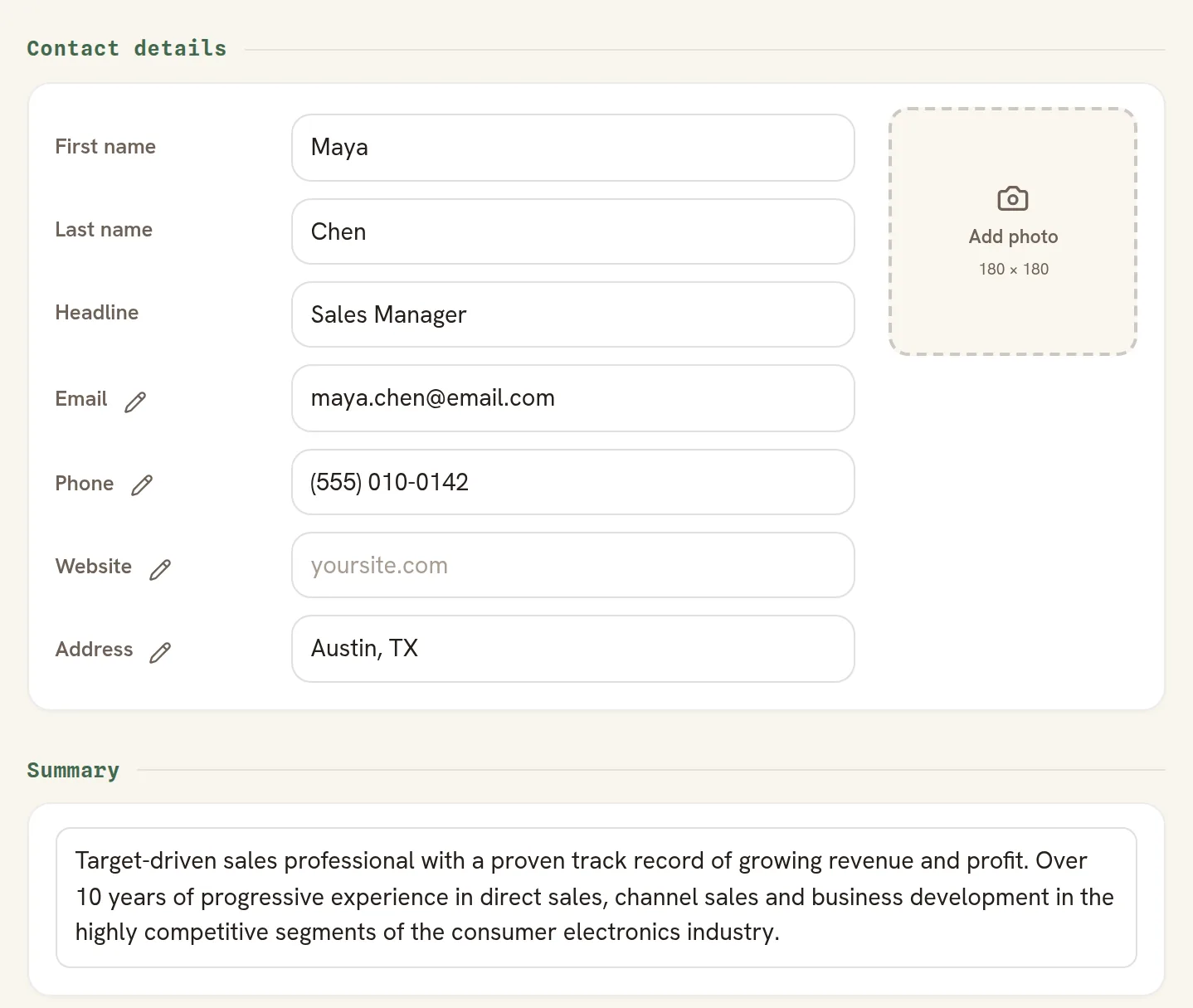
Write your summary at the topType two or three lines into the Summary box, which sits at the top of your resume in the Resumonk editor.
Build your resume
How do you write a resume summary with no experience?
A resume summary with no work experience leans on your degree, internships and skills that carry over to the job. The same goes for people changing careers: name the skills from your old field that the new job needs.
Example for a new graduate:
- New graduate with a BA in business management. Internship experience with architectural firm in project management. Noted for skills in meeting deadlines, time management, accurate research and effective problem-solving.
Should a resume summary show your personality?
A resume summary can show your personality when the job depends on it, as in care, teaching or client work. Name the trait, then back it with experience.
Example for a certified nursing assistant:
- Compassionate, reliable, certified nursing assistant with 7 years of experience in caring for disabled, elderly and memory impaired individuals. Excellent client care with great interpersonal communication skills. Flexible work hours, available on weekends and holidays as well.
Example for a paralegal:
- Paralegal with over four years of experience in legal firms working with attorneys and clients on sensitive cases regarding disability, foreclosure, family and juvenile and civil rights. Sociable and empathetic with a focus on the bigger picture, highly efficient with client and professional relationship building and communication. Experience working with multiple attorneys and their clients, with bilingual proficiency in Spanish.
A paralegal deals with clients all day, so this summary balances the professional side with the personal one.
Which keywords belong in a resume summary?
The keywords that belong in a resume summary are the job titles, skills and tools your field and the job post use. Use the short forms people in your field know, such as CAD for computer-aided design. Do not stuff the summary with them.
Example for a CAD technician:
- Detail-oriented CAD technician, BTEC-qualified, with recognized skills in engineering drawing in 2D and 3D, developing designs on teams and as a freelancer for a wide range of clients for the last 15 years.
Example for a software engineer:
- Senior Software Engineer with 6+ years of experience in creating scalable web applications using Java. Proficient with Hadoop and Python. Algorithms and Machine Learning Enthusiast.
Write numbers as digits, as in "15 years of experience" rather than "fifteen years". Digits are easier to spot when the reader skims.
Common questions about resume summaries
What is the one guideline to follow when writing a summary?
The one guideline to follow when writing a resume summary is to use active verbs to highlight accomplishments. A fancy font, personal pronouns and a long account of every qualification all work against a short summary.
Should a resume summary use "I" or "my"?
A resume summary leaves out "I" and "my". It starts with your title or a strength, as in "Paralegal with over four years of experience". The reader knows the resume is about you.
What makes a great resume summary?
A great resume summary is specific to the job, names your title and years, and gives at least one result. Read yours as a busy hiring manager would: if it does not answer what the company needs, rewrite it.
Where does the summary go on a resume?
The summary goes at the top of the resume, just under your name and contact details. That makes it the first thing the reader sees.
Does a resume need a conclusion?
A resume does not need a conclusion; it ends with its last section, such as Education or Skills. The summary at the top does the job of pulling your story together.
This post was written in collaboration with Sarah Landrum, Founder of Punched Clocks.
Keep reading
job hunting.
Resumonk polishes your resume, discovers matching jobs and finds connections inside companies.
Get started free- Indeed
- Greenhouse
- + more
This article was originally published on our blog on Apr 19 2017 and authored by Aditya Babbar. It was edited and republished in its present form by Team Resumonk on Sep 15 2025.