The 12-Step Plan to a Successful Career Change

A successful career change starts from what you enjoy and can do, then moves to research, a decision and a plan. After that come the other steps: a new resume, networking, training, a mentor and the job hunt, often at entry level.
The 12 steps below are in the order most people take them.
In short
- A career change starts with a list of what you enjoy, what you dislike and what you are good at.
- The careers on your list are worth researching before you decide, more so for a big switch.
- A written action plan has goals, tasks and dates, such as courses to take and people to meet.
- A resume for a career change puts transferable skills first and names the new field.
- Most career changers start lower than their old job, and that is normal.
How do you plan a career change?
Planning a career change takes the first five steps. You find what you want and careers that fit, research them, decide and write a plan.
Step 1: Find out what you truly enjoy
Finding out what you enjoy keeps you from switching into a field you do not like either. List your likes, dislikes, values and interests.
Then name exactly what makes you want to leave your current job, and avoid careers with the same problem. Two questions help:
- "What do I get excited about doing?"
- "What do I spend my free time thinking about or doing?"
For some people this is the hardest step, after years of ignoring what they enjoy.
Step 2: List careers that fit your interests and skills
Careers worth listing use both your interests and the skills you already have. Liking dogs does not give you the skills of a veterinarian.
With skills in marketing, writing and design, you could be a marketing specialist for an animal protection group or a dog kennel. Combine your skills with your interests, and go from there.
Step 3: Research the careers on your list
Researching each career on your list helps you make an informed choice. The bigger the change, the more research you need.
- Read job posts in the field to see what employers ask for.
- Talk to people who do the job now about a normal week.
- Check the usual pay at the level where you would start.
Learn as much as you can before you start applying.
Step 4: Make the decision
Making the decision means picking one industry or career to aim for. Until you pick one, the rest of the plan has no clear goal.
Step 5: Write an action plan
A career change action plan is a written list of measurable goals, tasks and a timeline. It usually covers three things:
- New skills to learn, and how you will learn them.
- People in the field to meet.
- Work to finish at your current job before you leave.
A change of career is a big move. The more detailed the plan, the sooner you are likely to reach the goal.
How do you get into a new field?
Getting into a new field takes steps 6 to 9: a new resume, a network, the right training and a mentor.
Step 6: Adjust your resume and personal brand
Your resume, cover letter and online portfolio should show the field you are moving into, not the one you are leaving. Someone who reads them should see at once that you are committed.
A functional or skills-based resume often suits a career change. It puts the transferable skills from your old job first and shows how they apply to the new one:
- Open with a short objective that names the new field.
- Rename your Skills section, for example to "Transferable Skills", and move it above Work Experience.
- Keep old jobs, but choose the bullet points that matter to the new field.
A career change objective for the marketing specialist in step 2 could read:
- Marketing specialist with experience in writing, design and campaign planning, moving into fundraising for an animal protection group.
You can start a resume in Resumonk from your LinkedIn profile, then rename and reorder its sections as above.
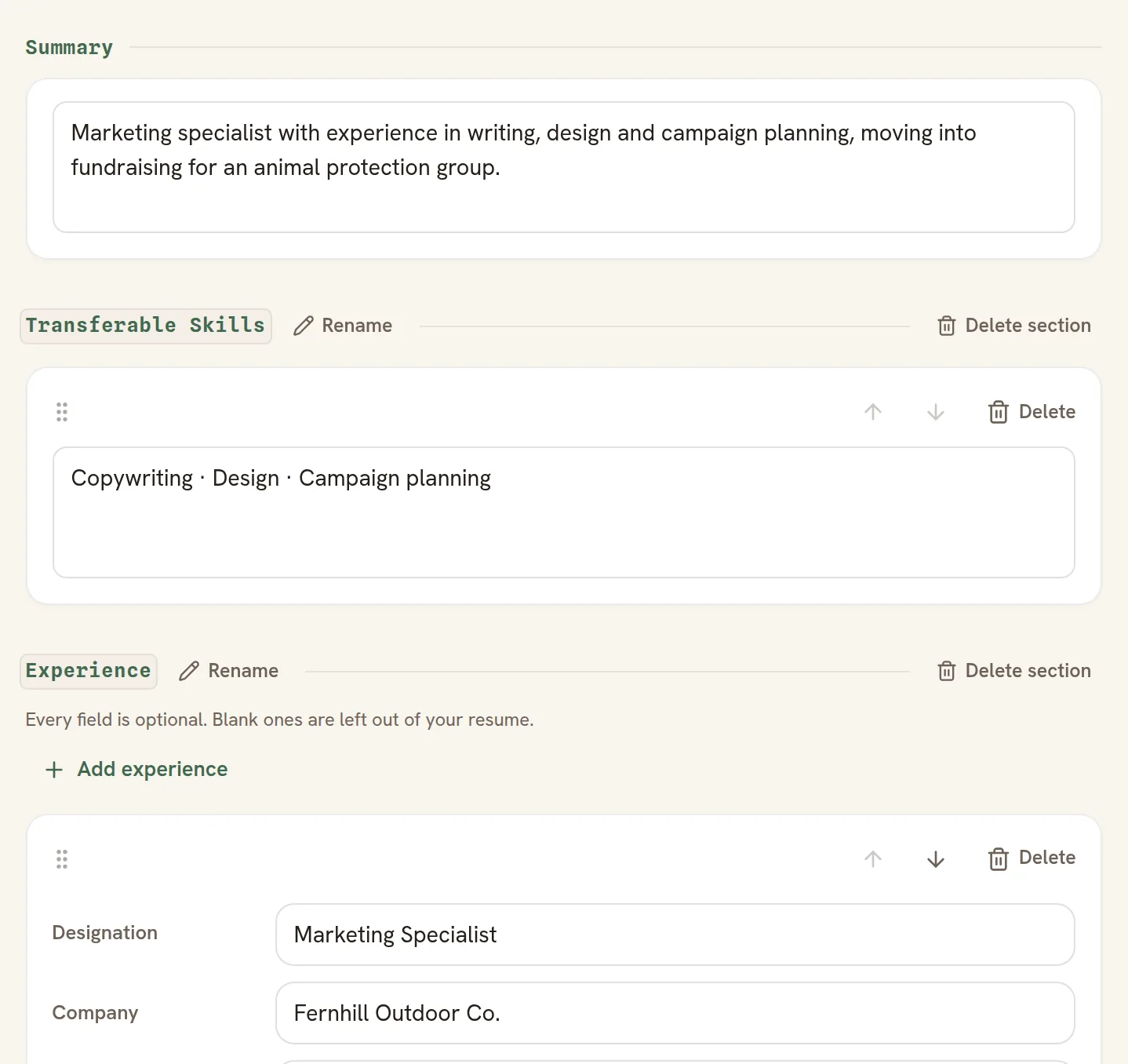
Rewrite your resume for the new fieldBring in your LinkedIn profile, then rename and reorder sections so your transferable skills come first.
Build your resume
Step 7: Start networking in your new field
Networking in your new field matters because who you know counts as much as what you know. Go to events in the industry and meet as many people as you can.
Introduce yourself and say you are starting out in the field. Then ask people with years in it how they got in, and what they would do in your place.
Step 8: Update your training
Updating your training may mean a course or two, not a new degree. Start slowly, one or two courses at a time, so you can manage them next to your job.
A first course also tests whether you really like the field. If the field does not require a degree or certification, a few courses may be enough to catch up.
Step 9: Find a mentor
A mentor keeps you on track when the change gets stressful and reminds you why you started. Your mentor does not need to be famous or rich, but experience in your new industry helps.
How do you find a job in your new career?
Finding a job in your new career takes the last three steps. They are the job hunt, more learning while you wait, and starting lower.
Step 10: Begin the job hunt
Begin the job hunt with the basics: a cover letter for each job, interview practice and a plan for talking about pay. Resumonk's cover letter templates come with its paid plans.
Research each company before you apply, before you interview, and above all before you accept an offer. A job hunt takes time, so expect it to run for a while.
Step 11: Keep learning about your new field
Learning while you wait for replies keeps you busy and helps once you start. The more you know on the first day, the less you have to adjust.
Step 12: Be ready to start lower
Starting lower is common in a new field, even after ten or more years of work. Be ready to take an entry-level job, above all if the switch is a big one.
Be flexible, eager and willing to begin again.
Common questions about changing careers
What is a career change strategy?
A career change strategy is the order of your moves: choose the field, build the skills, meet people, then apply. The 12 steps above are one such strategy.
How do you write a career change objective?
A career change objective is one or two sentences at the top of a resume. It names your old field, the new one and the skills that carry over. Use it in place of a summary when your experience does not yet match the new job.
Do you need a new degree to change careers?
A new degree is needed only when the new field requires one, such as nursing or law. For many fields, a few courses or a certificate are enough to start.
Should you leave your job before you change careers?
Keeping your current job while you train and network is usually safer, because it pays the bills during the change. Leave once you have an offer, or a plan you can afford.
How do you explain a career change on a resume?
A career change is explained on a resume by the objective at the top and by bullets chosen for the new field. The cover letter can add one or two sentences on why you are moving. If the post asks for a motivation letter, see how to write a motivation letter.
Keep reading
- 17 Best Work From Home Jobs (And Where To Find Them)
- 8 Best Career Assessment and Personality Tests to Help You Find the Right Job
- What is a Virtual Internship And Why You Should Consider Doing One
- How to Network Your Way to a New Job
Next step: browse remote jobs.
job hunting.
Resumonk polishes your resume, discovers matching jobs and finds connections inside companies.
Get started free- Indeed
- Greenhouse
- + more
This article was originally published on our blog on Aug 08 2017 and authored by Sarah Landrum. It was edited and republished in its present form by Team Resumonk on Sep 15 2025.