15 Soft Skills You Should Never Use on Your Resume
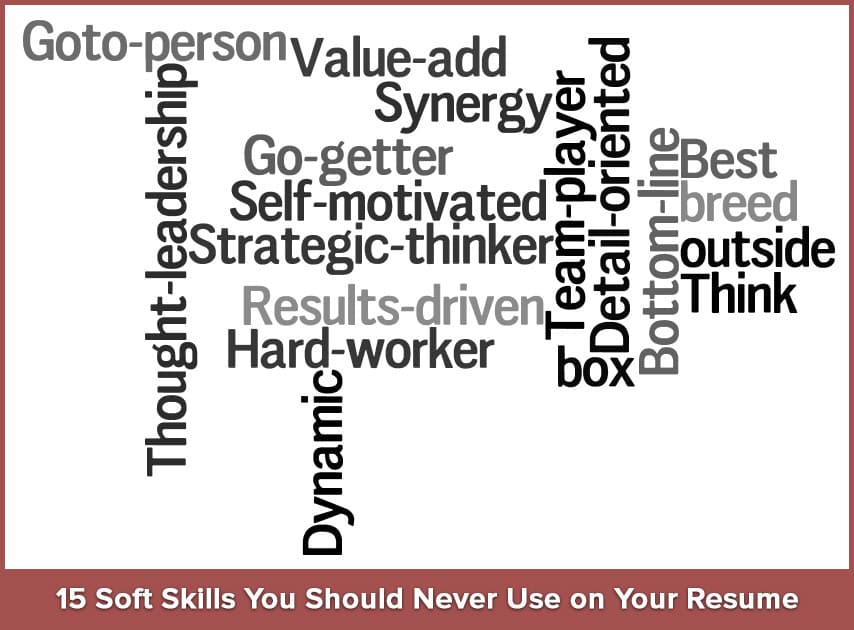
The soft skills you should never use on a resume are empty labels like "team player", which anyone can claim. Use the soft skills keywords from the job post instead, and prove each one with a result in your experience lines.
Below are the 15 words to drop, the soft skills employers do look for, and lines that show them.
In short
- Soft skills are the ways you work with people and tasks, such as communication, teamwork, leadership and problem-solving.
- Employers do look for soft skills, and many job posts name the ones they want.
- A bare soft skill word such as "team player" proves nothing, because every applicant can write it.
- Soft skills keywords are the job post's own words for those skills: use them for skills you really have.
- A soft skill is shown best by a result, such as "Trained four new cashiers" for leadership.
Which 15 soft skills should you never use on a resume?
These 15 words and phrases are so common on resumes that they say nothing about you. Some are soft skills stated with no proof; others are office jargon. Each one, with what to write instead:
Best of breed: jargon. Name the award, ranking or result that made you the best.Go-getter: say what you went and got, such as new clients or a project finished early.Think outside of the box: describe the new idea and what it changed.Synergy: name the teams that worked together and what they produced.Go-to person: say what people came to you for, and how often.Thought leadership: list the talks, articles or training you gave.Value add: state the value, in money, time or customers.Team player: say who you worked with and what the team achieved.Results-driven: give the results themselves, with numbers.Bottom-line: name the figure you improved, such as costs or sales.Hard worker: show the workload, such as orders handled a day.Strategic thinker: describe a plan you made and how it turned out.Self-motivated: mention something you learned or started without being asked.Dynamic: cut it. No result needs this word.Detail-oriented: point to accuracy you can measure, such as error-free reports.
Do employers look for soft skills on a resume?
Employers do look for soft skills on a resume, and many job posts name them, such as "strong communication skills". The problem is the bare word, not the skill.
A reader cannot check a word like "team player". A line about a project your team finished on time can be checked, so it is believed.
What are skills keywords and soft skills keywords?
Skills keywords are the words a job post uses for the skills the employer wants. They come in two kinds:
- Hard skills keywords: tools, methods and knowledge, such as Excel, bookkeeping, Python or forklift operation.
- Soft skills keywords: how you work with people and tasks, such as communication, collaboration or time management.
To find them, read three or four posts for the job you want and mark the skills they repeat. Use the employer's exact words for the skills you have.
Which soft skills keywords do employers look for?
The soft skills keywords employers look for fall into six groups. Job posts use words like these:
- Communication: written communication, presenting, active listening, negotiation, report writing.
- Teamwork: collaboration, cross-team work, mentoring, conflict resolution.
- Leadership: team leadership, coaching, delegation, decision-making.
- Problem-solving: critical thinking, analysis, troubleshooting, creativity.
- Work habits: time management, organization, adaptability, reliability, accuracy.
- Customer focus: customer service, client relations, empathy, patience.
Pick the ones the job post names, and only the ones you can back with an example.
How do you show a soft skill with a result?
A soft skill is shown with a result by writing what you did, for whom, and what changed. Start with an action verb and add a number where you can:
- Teamwork. Weak: "Team player." Better: "Worked with design and sales to launch a new product page in three weeks."
- Communication. Weak: "Excellent communication skills." Better: "Wrote the weekly client update for 40 account managers."
- Leadership. Weak: "Natural leader." Better: "Trained four new cashiers and planned their shifts for the holiday season."
- Problem-solving. Weak: "Thinks outside the box." Better: "Found a billing error that overcharged 30 customers, and set up a monthly check for it."
- Work habits. Weak: "Self-motivated hard worker." Better: "Finished an evening course in bookkeeping while working full time."
- Accuracy. Weak: "Detail-oriented." Better: "Checked 300 invoices a week with no errors found in the year-end audit."
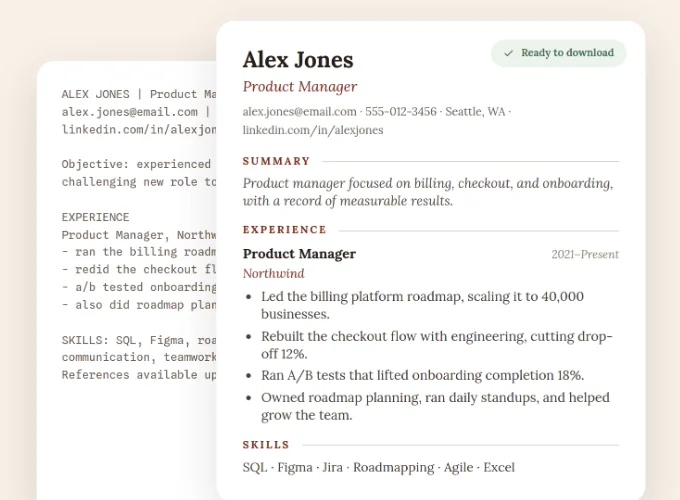
These result lines are the bullet points of your experience. In the Resumonk editor, they go in the Details box of each entry in the Experience section.

Replace vague words with real skillsList concrete skills in your Skills section and show the soft ones through your work lines.
Build your resume
Where do skill keywords go on a resume?
Skill keywords go in three places on a resume, each with its own job:
- The skills section: mostly hard skills, in the job post's words. Our guide to the resume skills section shows how to group them.
- The summary: two or three of the skills the job needs most, in one or two sentences.
- The experience lines: soft skills, proved by results like the ones above.
A soft skill named in the summary or skills section should also appear, with proof, in an experience line.
What else should you not put on a resume?
Besides the 15 empty words, leave these off a resume:
- Skills the job does not need, which push the useful ones down the page.
- Skills you could not explain or show in an interview.
- Personal details such as age, marital status or a photo, unless the country or job expects them.
- The line "References available upon request".
- Past salaries, unless the employer asks for them.
Common questions about soft skills on a resume
Should soft skills go in the skills section?
Soft skills can go in the skills section when the job post names them, but keep it to two or three. Each one should also be proved by a result in your experience lines.
Are hard skills or soft skills more important on a resume?
Hard skills and soft skills both matter, but hard skills are easier to prove on paper. Most resumes lead with hard skills and show soft skills through results.
Can you mention soft skills in a cover letter or interview?
Soft skills can be named in a cover letter or interview when a short story backs them. Tell what happened, what you did and how it ended.
Should you use the same skill keywords for every job?
Skill keywords should change with each job post. Read each post again and swap in its words for the skills you have.
Keep reading
job hunting.
Resumonk polishes your resume, discovers matching jobs and finds connections inside companies.
Get started free- Indeed
- Greenhouse
- + more
This article was originally published on our blog on Apr 16 2014 and authored by Jessica Holbrook Hernandez. It was edited and republished in its present form by Team Resumonk on Sep 15 2025.