Program Manager Resume Example (with Tips and Best Practices)
Introduction
You're applying for Program Manager roles, and you know that what you do is fundamentally different from what a Project Manager does - even though recruiters sometimes conflate the two, and even though your non-PM friends glaze over when you try to explain the distinction.
You're the person who orchestrates multiple interconnected projects simultaneously, who aligns disparate initiatives with strategic business objectives, who operates at an altitude above task management. You're managing complexity, dependencies, and cross-functional ecosystems, not just timelines and deliverables. This is typically a mid-to-senior level role requiring 7-12+ years of progressive experience, and your resume needs to reflect that scope and sophistication immediately.
Here's what we're going to cover in this guide, and why it matters specifically for someone at your level applying for Program Manager positions. We'll start with the resume format question - why reverse-chronological is your strongest strategic choice when you need to demonstrate progressive responsibility and increasing complexity. Then we'll dive deep into the work experience section, which is where you'll win or lose the opportunity, showing you exactly how to write accomplishment statements that demonstrate program-level thinking rather than project-level execution. We'll tackle the skills section with the nuance it deserves, helping you distinguish between competencies that differentiate Program Managers from Project Managers versus generic capabilities that don't move the needle.
From there, we'll explore specific considerations that matter uniquely for Program Manager resumes - how to demonstrate scale and complexity, how to show strategic influence rather than just tactical delivery, how to handle the title inconsistencies across companies where "Program Manager" means vastly different things, and how to position yourself if you're transitioning from Project Manager to Program Manager or moving between industries. We'll also cover education requirements (and why they matter less than you might think at this level), whether awards and publications belong on your resume, how to approach the cover letter as a demonstration of the communication skills central to your role, and finally, how to handle references in a way that validates your stakeholder management capabilities.
If you're reading this, you're likely in one of several situations. Maybe you've been doing program-level work but your title says something else, and you need to frame your experience appropriately. Maybe you're a Project Manager ready to make the leap to program management and you need to emphasize the right aspects of your background. Maybe you're a Program Manager looking to move to a larger company, a different industry, or a more senior role, and you need your resume to reflect readiness for that next level of complexity. Whatever your specific circumstances, this guide will show you how to build a Program Manager resume that immediately communicates your capability to handle ambiguity, influence without authority, and deliver strategic value through coordinated execution across organizational boundaries.
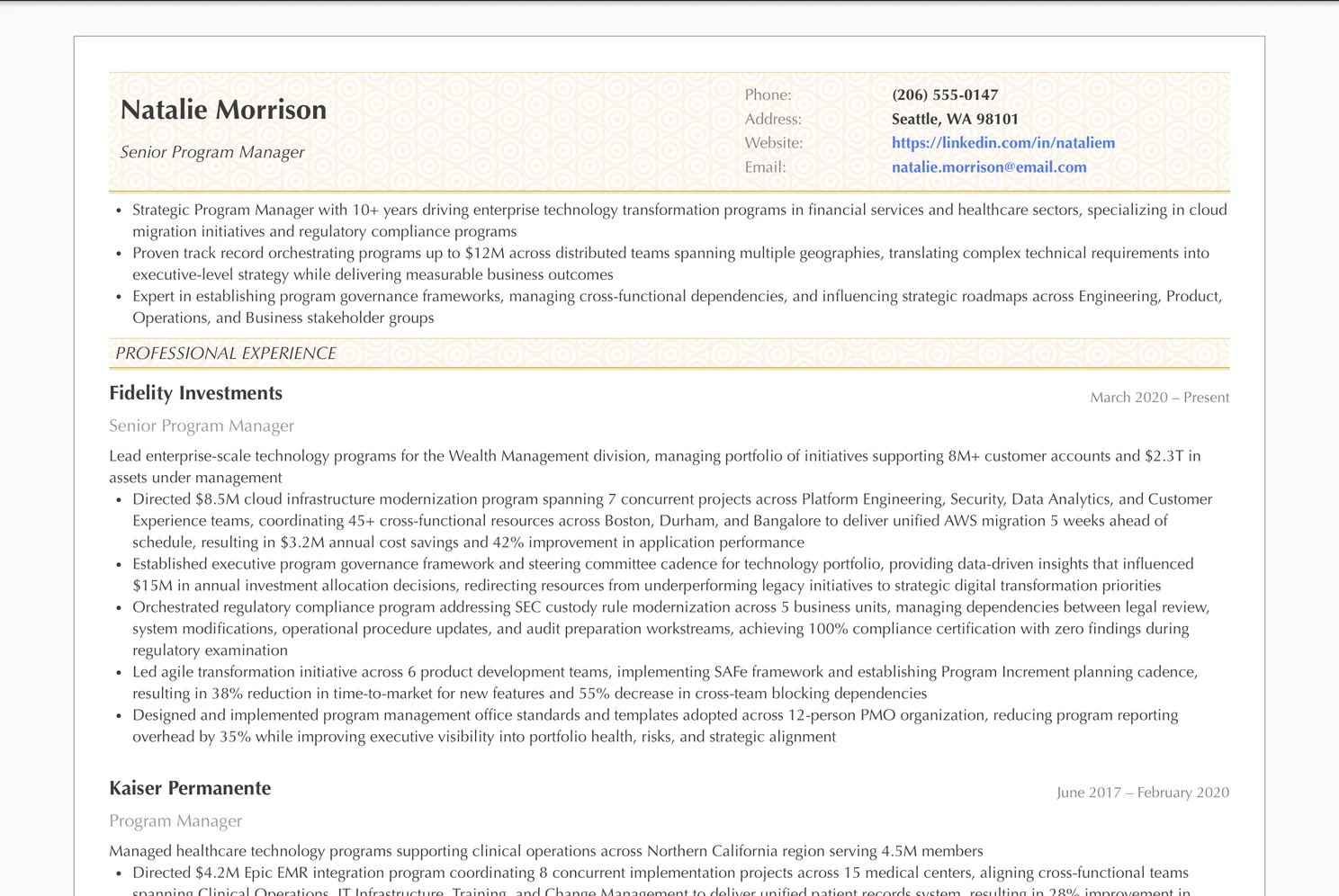
The Best Program Manager Resume Example/Sample
https://www.resumonk.com/program-managerProgram ManagerResume Format to Follow for Program Manager Resume
Given this context, let's talk about the format that will serve you best.
The reverse-chronological format is your strongest ally here, and I'll tell you exactly why. Program Management is fundamentally about demonstrating progressive responsibility, strategic thinking capacity, and the ability to handle increasing complexity. Hiring managers looking at Program Manager candidates want to see a clear trajectory - how you've grown from managing smaller initiatives to coordinating multi-million dollar programs with cross-functional dependencies. The reverse-chronological format puts your most impressive, most recent accomplishments front and center, which is exactly where they need to be.
Why Reverse-Chronological Works for Program Managers
Think about what happens when a hiring manager opens your resume.
They're likely reviewing dozens of candidates, and they need to quickly assess whether you can handle the scope and scale of their program needs. By leading with your most recent role, you immediately answer their most pressing questions - what's the size of programs you've managed lately? What methodologies have you deployed? What stakeholder levels have you interfaced with? Your latest role is your proof of current capability, and burying it beneath a skills summary or functional grouping would be strategic malpractice.
The reverse-chronological format also allows you to tell a compelling story of evolution. Perhaps you started as a Project Coordinator, moved into Project Manager territory, then took on your first multi-project Program Manager role, and now you're handling portfolio-level responsibilities.
This progression isn't just career movement - it's evidence of expanding trust, growing strategic input, and demonstrated ability to operate at higher altitudes of organizational complexity.
Structuring Your Program Manager Resume
Your resume should open with a strong header containing your contact information, followed immediately by a professional summary (2-4 lines maximum) that encapsulates your program management value proposition. Then move directly into your work experience section, which will be the heavyweight section of your resume. Following that, you'll include your Skills section, Education, and any relevant Certifications (PMP, PgMP, SAFe, etc.)
If you have notable achievements or awards specifically related to program delivery, consider a brief section for those as well.
Here's where many Program Manager candidates stumble - they treat their resume like a project plan, listing every methodology and framework they've touched. Your resume isn't a competency matrix. It's a strategic document designed to secure interviews by demonstrating business impact through program leadership. The reverse-chronological format keeps you honest and focused on outcomes, not just activities.
Length Considerations for Your Level
Given that Program Manager is typically a mid-to-senior role (usually requiring 7-12+ years of experience), a two-page resume is not only acceptable but often necessary to adequately capture your scope of impact. If you're earlier in your program management journey with perhaps 5-7 years of relevant experience, you might contain everything meaningfully on one page, but don't artificially constrain yourself if doing so means sacrificing important context about program scale, stakeholder complexity, or strategic outcomes.
For candidates in the UK, Canada, and Australia, the same principles apply, though be mindful that the term "CV" and "resume" may be used interchangeably in your markets. The content strategy remains identical - lead with your strongest, most recent evidence of program management capability.
Work Experience on Program Manager Resume
When you write about your program management experience, you're answering several simultaneous questions in the hiring manager's mind. Can you handle ambiguity? Can you influence without authority? Can you see around corners and anticipate dependencies that haven't materialized yet? Can you translate between technical teams and executive stakeholders? Can you keep multiple plates spinning while building the table they're spinning on?
Your work experience section needs to demonstrate all of this, and it needs to do it with specificity and measurable impact.
The Anatomy of a Program Manager Work Experience Entry
Each role you list should follow this structure: Job Title, Company Name, Location, and Dates of Employment on the first line.
Immediately below, include a brief contextual sentence (optional but highly valuable for Program Managers) that describes the company, your business unit, and the scale of programs you managed. This context-setting is crucial because "Program Manager at a tech startup" means something entirely different from "Program Manager at a Fortune 500 manufacturing enterprise."
After this context-setter, you'll list 4-6 bullet points that capture your key accomplishments and responsibilities. Notice I said accomplishments first, responsibilities second. Here's the framework that works: lead with the outcome or impact, then describe the program/initiative that created that outcome, then indicate the complexity factors (budget size, team size, cross-functional dependencies, geographic distribution, etc.).
Writing Accomplishment Statements That Demonstrate Program-Level Thinking
This is where most Program Manager resumes fall apart. Candidates write bullets that sound like Project Manager bullets - focused on delivering individual initiatives on time and under budget. That's table stakes for program management.
What hiring managers want to see is how you optimized across multiple projects, how you made strategic trade-offs between competing initiatives, how you influenced roadmaps, how you identified and mitigated portfolio-level risks, and how you drove standardization or process improvements that elevated capability across multiple teams.
Let me show you the difference:
❌ Don't write project-level bullets when you're a Program Manager:
Managed the CRM implementation project from initiation to closure, delivering on time and within budget
✅ Do write program-level bullets that show orchestration of multiple initiatives:
Directed a $4.2M digital transformation program spanning 5 concurrent projects (CRM, data migration, API integration, training, change management), aligning cross-functional teams across Engineering, Sales, Marketing, and Customer Success to deliver unified customer experience platform 3 weeks ahead of schedule, resulting in 34% improvement in customer onboarding time
See the difference? The second example shows the interconnected nature of the work, the cross-functional orchestration, the business outcome, and the scale of complexity. It answers the question "what does program management actually mean in this context?"
Demonstrating Strategic Influence
Program Managers at the mid-to-senior level aren't order-takers - they're strategic partners who shape what gets built and when.
Your work experience should include at least one or two bullets per role that demonstrate your influence on strategy, prioritization, or organizational capability. These are the bullets that separate good Program Manager candidates from great ones.
❌ Don't just describe administrative program management activities:
Created program status reports and presented them to leadership on a weekly basis
✅ Do show how you influenced decision-making and drove strategic outcomes:
Established program governance framework and executive steering committee cadence, providing data-driven insights that influenced $8M in portfolio reallocation decisions, redirecting resources from underperforming initiatives to high-impact strategic priorities
Quantification and Metrics That Matter
You've heard that you should quantify everything on your resume, but for Program Managers, the type of numbers you include matters enormously.
Yes, include budget sizes, team sizes, and timeline metrics. But go deeper. Include metrics that demonstrate program-level impact: percentage improvement in delivery velocity across the portfolio, reduction in cross-team dependencies, improvement in resource utilization, reduction in escalations, increase in stakeholder satisfaction scores, business metrics that moved as a result of your program (revenue impact, cost savings, customer acquisition, retention improvements, etc.)
If you managed programs in specific methodologies, weave that in naturally through your descriptions rather than just listing it.
✅ For example:
Led agile transformation program across 8 product teams, implementing SAFe framework and establishing Program Increment planning cadence, resulting in 45% reduction in time-to-market for new features and 60% decrease in cross-team blocking dependencies
This bullet demonstrates methodology knowledge (SAFe, PI planning) while keeping the focus on the business and operational improvements you drove.
Addressing Career Progression Within Your Work Experience
If you've been promoted within the same company or if you've held multiple program management roles of increasing scope, make this progression visible. For promotions within the same company, list each role separately with its own set of bullets, even if you stay under the same company header.
This visual progression reinforces your growth trajectory and helps hiring managers understand how your responsibilities evolved.
For candidates transitioning into Program Management from Project Management or other roles, your most recent role should emphasize the program-level aspects of your work, even if your title doesn't say "Program Manager." Focus on the times you coordinated multiple projects, aligned cross-functional roadmaps, or operated at a strategic level above individual project execution.
Skills to Show on Program Manager Resume
Here's what's happening when someone reviews your skills: they're not checking boxes on a list of requirements. They're assessing whether you understand what actually matters in program management versus what sounds impressive but delivers little value. They're looking for signal-to-noise ratio.
A bloated skills section stuffed with every project management tool, methodology, and buzzword you've encountered suggests someone who hasn't yet developed the discernment to distinguish between core competencies and peripheral knowledge.
Categories of Skills for Program Managers
Your Skills section should reflect the three-dimensional nature of program management work. Think about organizing your skills (either explicitly with subheadings or implicitly through your ordering) into these categories: Program Management Methodologies and Frameworks, Technical and Platform Proficiencies, Strategic and Business Acumen, and Leadership and Stakeholder Management capabilities.
Let's break these down. For Methodologies and Frameworks, you're including things like Agile/Scrum, SAFe, Waterfall, Hybrid approaches, Risk Management frameworks, Change Management methodologies (ADKAR, Prosci, etc.), and Portfolio Management approaches. These signal your ability to adapt your approach to organizational context rather than being a one-trick pony who only knows how to run programs one way.
For Technical and Platform Proficiencies, this is where you list program management tools (Jira, Azure DevOps, Monday.com, Smartsheet, MS Project, etc.), collaboration platforms, and any domain-specific technical knowledge relevant to the programs you manage. If you're a Program Manager in software development, some technical literacy (cloud platforms, development methodologies, architecture concepts) adds credibility. If you're in manufacturing, supply chain systems knowledge matters.
Tailor this to your industry context.
The Skills That Actually Differentiate Program Managers
Here's where we separate Program Managers from Project Managers on your resume.
Include skills that speak to the program-level competencies: Portfolio optimization, Cross-functional alignment, Strategic roadmapping, Dependency management, Resource capacity planning, Executive stakeholder management, Business case development, Vendor and partner management, Program governance, and Organizational change leadership. These aren't just fancy words - they represent the actual work that distinguishes running a program from running a project.
Many candidates make the mistake of listing skills that are fundamental table stakes for any professional role (communication, problem-solving, teamwork). While these are important, they don't differentiate you at the Program Manager level.
Your skills should reflect capabilities that require seniority, experience, and strategic thinking to execute well.
Certifications Within Your Skills Section
If you hold relevant certifications like PMP (Project Management Professional), PgMP (Program Management Professional), SAFe Program Consultant, CSM (Certified Scrum Master), or similar credentials, you have options for where to include them. Many candidates create a separate Certifications section, which works well if you have multiple credentials. However, if you have one or two key certifications, you can incorporate them into your Skills section or into a combined "Skills & Certifications" section.
The placement matters less than ensuring they're visible, as certifications like PgMP specifically validate your program-level expertise.
What Not to Include in Your Skills Section
Resist the temptation to list every tool you've ever opened or every framework you've ever heard about.
If you've taken one introductory workshop on Lean Six Sigma, don't list it unless you've actually applied it in program delivery. If you used Jira once in a previous role but your primary program management toolset is now different, leave it off unless it's specifically mentioned in the job description you're targeting.
Also, avoid soft skills unless you can tie them to program-specific outcomes. Instead of listing "Leadership" as a skill, demonstrate leadership through your work experience bullets. Instead of listing "Communication," show it through your stakeholder management accomplishments.
The exception is program-specific soft skills like "Executive Presence," "Influence Without Authority," or "Change Leadership" - these are specific enough to be meaningful in a program management context.
Industry-Specific Skills Considerations
The skills that matter for a Program Manager in financial services differ from those in healthcare, technology, manufacturing, or government contracting. A technology Program Manager should show familiarity with software development lifecycle, cloud platforms, and technical architecture concepts. A pharmaceutical Program Manager needs to demonstrate knowledge of regulatory compliance (FDA, GxP), clinical trial management, and quality systems.
A defense contracting Program Manager needs to show understanding of earned value management, government contracting regulations, and security clearance protocols.
Don't try to be all things to all industries. If you're applying within a specific sector, make sure your skills reflect the domain knowledge that will help you effectively manage programs in that context.
Hiring managers can spot generic, industry-agnostic skill lists, and they raise questions about your depth of relevant experience.
Skills Section Formatting
Keep your skills section clean and scannable. You can use a simple comma-separated list, or you can group related skills together under subheadings if you have enough breadth to warrant categorization. Aim for 15-25 skills total - enough to show comprehensive capability without becoming overwhelming.
Order them strategically, either by importance (putting your strongest differentiators first) or by category grouping.
Example of a well-structured skills presentation:
1. Program Management: SAFe Program Management, Agile/Scrum, Portfolio Optimization, Cross-functional Program Delivery, Risk & Issue Management, Dependency Mapping, Program Governance, Stakeholder Management
2. Tools & Platforms: Jira, Azure DevOps, Smartsheet, MS Project, Confluence, Tableau, PowerBI
3. Business & Strategy: Business Case Development, Financial Analysis, Vendor Management, Change Management (Prosci), Strategic Roadmapping, OKR Framework
4. Certifications: PgMP (Program Management Professional), PMP, SAFe Program Consultant (SPC)
This structure immediately communicates depth in program-specific competencies, practical tool proficiency, strategic business capability, and validated credentials - exactly what a hiring manager wants to see from a Program Manager candidate.
Specific Considerations and Tips for Program Manager Resume
Now we get to the nuanced territory - the considerations that specifically matter for Program Manager resumes that might not apply to other roles. These are the subtleties that someone who truly understands program management will recognize, and they're the elements that can elevate your resume from "qualified candidate" to "we need to talk to this person immediately."
Distinguishing Yourself from Project Managers
This is perhaps the most critical challenge for Program Manager resumes, especially if your title has been "Project Manager" but your work has been program-level, or if you're making the transition from project to program management.
The distinction isn't just semantic - it's fundamental to how hiring managers will assess your fit for their role. Throughout your resume, you need to emphasize the orchestration, the multi-project coordination, the strategic alignment, and the cross-functional complexity that characterize program work.
Every bullet point in your work experience should pass this test: does this describe coordinating across multiple initiatives, or does it describe delivering a single initiative? If it's the latter, either reframe it to show the program context or consider whether it belongs on your resume at all. Program Managers operate at a different altitude than Project Managers, and your resume must consistently reflect that elevation.
Even in your language choices, opt for program-level terminology. You "directed programs," not "managed projects." You "aligned cross-functional roadmaps," not "coordinated project schedules."
You "established governance frameworks," not "ran status meetings." These aren't just word games - they signal your understanding of the role's scope.
Addressing the Scale and Complexity Question
Hiring managers evaluating Program Managers are intensely focused on scale and complexity. They want to know: what's the most complex thing you've successfully orchestrated? How many moving pieces can you hold in your head simultaneously? What's your track record of delivery in ambiguous, high-stakes environments?
Your resume needs to explicitly address these questions, and vague statements won't cut it.
When describing programs, include the metrics that communicate complexity: number of concurrent projects within the program, number of cross-functional teams involved, geographic distribution (if applicable), budget size, program duration, number of stakeholder groups, regulatory or compliance considerations, and organizational change impact. These details aren't fluff - they're the evidence that you can handle the complexity the hiring organization is dealing with.
❌ Don't leave complexity implied or vague:
Led digital transformation program for the organization, working with multiple teams to deliver technology improvements
✅ Do explicitly quantify the scale and complexity:
Orchestrated 18-month, $6.5M digital transformation program across 12 concurrent initiatives spanning 7 business units and 4 geographic regions, coordinating 60+ cross-functional team members and managing dependencies between legacy system decommissioning, cloud migration, new platform implementation, and organizational change management workstreams
The second version leaves no doubt about the scale of complexity you've managed, and it creates a vivid picture of what you're capable of handling.
Demonstrating Business Acumen and Strategic Partnership
At the program level, you're not in the delivery weeds - you're operating as a strategic partner to business leaders.
Your resume needs to show that you understand business outcomes, not just delivery metrics. Include bullets that demonstrate your contribution to business strategy, your involvement in prioritization decisions, your influence on investment allocation, and your role in shaping what gets built, not just how it gets delivered.
Program Managers who only focus on execution ("delivered on time, on budget") miss the point of why the role exists. You exist to translate strategic objectives into delivered value, and your resume should show both ends of that equation. For each major program you describe, ask yourself: what business problem were we solving? What strategic objective were we advancing? What business metric improved as a result? If you can't answer these questions about your programs, you're not operating at the strategic level expected of the role.
Handling Career Transitions and Title Inconsistencies
Program Manager titles are notoriously inconsistent across companies.
In some organizations, "Program Manager" is a senior role managing multi-million dollar strategic initiatives. In others (particularly in tech companies), "Program Manager" might be more of a senior Project Manager or Technical Project Manager role. Meanwhile, some companies use "Portfolio Manager," "Initiative Lead," or "Transformation Lead" for what others would call Program Manager. Your resume needs to navigate this complexity.
If your title doesn't say "Program Manager" but your work absolutely is program management, you have options. You can include a parenthetical clarification in your title line, or you can ensure your description and bullets clearly convey the program-level scope. For example: "Senior Project Manager (Program-level delivery)" or "Technical Lead (Multi-project program coordination)." This isn't about misrepresenting your title - it's about providing context that helps hiring managers accurately assess your experience.
Conversely, if you've held a "Program Manager" title but the work was really project-level (perhaps in a company where terminology was used loosely), be thoughtful about how you present this. Focus your bullets on any program-like aspects of the work - times you coordinated multiple efforts, influenced broader strategy, or worked across organizational boundaries.
But be prepared to honestly discuss the scope in interviews.
Industry and Domain Expertise Signals
Program Managers are rarely successful as generalists parachuting into unfamiliar domains. Deep industry knowledge enables you to anticipate risks, understand stakeholder concerns, translate between technical and business languages, and make informed trade-off decisions.
Your resume should make your domain expertise unmistakably clear.
This doesn't mean you can't transition industries - many program management competencies are transferable. But it does mean you need to be strategic about how you position your experience. If you're moving from financial services to healthcare, emphasize the transferable aspects: regulatory program management, risk management, stakeholder complexity, organizational change.
If you're staying within an industry, lean into the domain-specific elements: use industry terminology, reference relevant standards and frameworks, mention specific types of programs that are unique to that sector.
Geographic and Cultural Considerations
For Program Managers in the UK, Europe, Australia, and Canada, the role expectations are largely similar to the US, but there are some nuances worth noting. UK and European hiring managers may place even greater emphasis on formal qualifications and certifications (PRINCE2, MSP, etc.) than US employers. If you hold these certifications, make them prominent.
In Australia and Canada, the public sector and government contracting space has specific program management frameworks and methodologies - if you've worked in these contexts, make that clear.
If you've managed programs across multiple countries or regions, this is valuable complexity to highlight. Global program management requires navigating time zones, cultural differences, regulatory variations, and distributed team dynamics - all of which demonstrate advanced program management capability. Don't bury this international experience; make it a prominent feature of your complexity narrative.
The Executive Summary or Professional Summary Question
Given that Program Manager is a mid-to-senior level role, the question of whether to include a professional summary at the top of your resume is worth considering. Unlike early-career candidates where a summary can feel presumptuous or redundant, for Program Managers it can serve a valuable purpose: it's your elevator pitch that immediately positions you at the right level and in the right context.
If you include a summary, keep it concise (2-4 lines maximum) and make it strategic. Don't use it to list skills or repeat what's in your experience section. Use it to position your specific brand of program management: your industry focus, your scale of delivery, your strategic orientation. For example:
Senior Program Manager with 10+ years driving technology transformation programs in financial services, specializing in regulatory compliance initiatives and enterprise-scale cloud migrations. Proven track record managing programs up to $15M with distributed teams across multiple geographies, translating complex technical requirements into executive-level strategy and delivering measurable business value.
This summary immediately communicates industry (financial services), domain (technology/regulatory), scale ($15M, distributed teams), and value orientation (business outcomes, executive partnership). A hiring manager reads this and instantly knows if you're in the right ballpark for what they need.
The Certification Priority Question
For Program Managers, certain certifications carry significant weight: PgMP (Program Management Professional) from PMI is the gold standard specifically for program management, while PMP signals project management foundation, and various agile certifications (SAFe SPC, RTE, etc.) demonstrate methodology expertise in agile environments. If you hold PgMP, make it prominent - it's one of the few certifications that specifically validates program-level expertise as opposed to project-level.
However, don't let lack of certification paralyze you. While certifications add credibility, program management success is ultimately proven through delivery track record and business impact. If you don't have formal certifications but you have strong delivery results, lead with your results. If you're actively pursuing certification, you can include "PgMP Candidate" or "Pursuing PgMP Certification" in your skills or certifications area, though only do this if you're genuinely in process (exam scheduled or study program enrolled).
Tailoring for Specific Program Management Contexts
The final consideration is recognizing that "Program Manager" manifests differently across contexts, and your resume should reflect the specific flavor of program management you practice.
An IT Program Manager managing software delivery programs emphasizes technical coordination, development methodology, and cross-functional technical dependencies. A Construction Program Manager emphasizes contractor coordination, safety compliance, regulatory approvals, and physical delivery logistics. A Change Management Program Manager emphasizes organizational transformation, adoption metrics, and cultural change leadership.
Review your bullets and ask: would someone in my specific program management context recognize themselves in this resume? Or does it read like a generic program management resume that could apply to any industry or context? The most compelling resumes have clear point of view and domain specificity. Don't try to be everything to everyone.
Be unmistakably excellent in your specific program management domain, and let that clarity attract the right opportunities.
Education Requirements for a Program Manager Resume
Given this context, your education section needs to strike a delicate balance. It needs to establish credibility without overshadowing your experience. After all, hiring managers care far more about the programs you've successfully delivered than where you got your degree.
But that doesn't mean you should phone it in either.
The Fundamental Structure: What to Include and Where
On a Program Manager resume, your education section typically belongs near the bottom, after your work experience and skills.
Why? Because by this point in your career, you've probably been managing programs for 3-7 years, and those real-world battle scars matter infinitely more than your undergraduate thesis topic. The exception to this rule: if you've recently completed a highly relevant master's degree or MBA, especially from a prestigious institution, you might consider placing it higher to draw attention to this fresh credential.
At minimum, include your degree title, major, institution name, and graduation year. For a Program Manager position, relevant degrees include Bachelor's or Master's in Business Administration, Project Management, Computer Science (especially for technical program management roles), Engineering, or related fields.
If you graduated more than 10-15 years ago, you can safely drop the graduation year to avoid age bias, though opinions vary on this practice between the US and other regions like the UK or Australia where age discrimination laws differ.
Strategic Additions That Actually Matter
Here's where most people either overdo it or underdo it.
Let me walk you through what deserves space on your resume versus what doesn't. Your GPA? Only include it if you graduated within the last 3-5 years AND it's above 3.5 (US), or equivalent First Class Honours (UK/Australia). Otherwise, it's just taking up valuable real estate. Relevant coursework? Skip it unless you're transitioning from a completely different field and need to demonstrate foundational knowledge in program management, business operations, or technical domains relevant to the role.
What absolutely deserves inclusion: relevant certifications. PMP (Project Management Professional), PgMP (Program Management Professional), PRINCE2, Certified Scrum Master, or Agile certifications aren't just alphabet soup after your name. For Program Managers, they're often the difference between getting interviewed and getting passed over. These credentials signal that you understand standardized methodologies, that you've invested in professional development, and that you can speak the language of program governance.
Formatting Examples That Work
Let's look at how to actually structure this information. The reverse-chronological format works best, with your most recent education listed first.
❌ Don't write education like this:
Education:
College - 2015
Degree in Business
This tells the hiring manager almost nothing and looks frankly lazy. It doesn't specify the institution's full name, the degree type, or provide any context about relevant focus areas or achievements.
✅ Do structure it like this:
Master of Business Administration (MBA)
- University of Michigan, Ross School of Business
- Graduated: May 2019
- Concentration: Operations and Technology Management

Bachelor of Science in Industrial Engineering
- Georgia Institute of Technology
- Graduated: May 2015
- Honors: Cum Laude (GPA: 3.7/4.0)
Notice how this version immediately communicates credibility. The specific school names matter (Ross and Georgia Tech both have strong reputations in operations and technical management), the concentrations show intentional career development, and the honors provide concrete evidence of academic achievement during the relevant time period.
Handling Common Education Scenarios
Maybe you're reading this thinking, "But I don't have an MBA, and I don't have a technical degree.
I studied English Literature and somehow ended up managing programs." First off, you're not alone. Many successful Program Managers come from non-traditional backgrounds. The key is framing your education to highlight transferable skills and complementing it with certifications and professional development.
For career changers or non-traditional backgrounds:
Bachelor of Arts in English Literature
University of Toronto
Graduated: 2014
Professional Development:
- Project Management Professional (PMP), PMI - 2020
- Agile Certified Practitioner (PMI-ACP), PMI - 2021
- Program Management Certificate, Cornell University - 2019
This approach acknowledges your educational background while immediately redirecting attention to relevant credentials you've earned. It tells a story of intentional professional development and commitment to the program management craft.
International Qualifications and Regional Differences
If you're applying in a different country than where you studied, clarity becomes paramount.
A "First Class Honours" degree from a UK university needs context for US hiring managers. A Canadian three-year bachelor's degree might require explanation for Australian employers unfamiliar with that system. When in doubt, add a brief clarification in parentheses or include the equivalent grading scale information. For instance, "(equivalent to 4.0 GPA)" or "(top 5% of graduating class)" provides immediate context.
What About Incomplete Degrees?
Life happens.
Maybe you started a Master's program but your career took off and you never finished. Or perhaps you're currently pursuing additional education while working as a Program Manager. Both scenarios can strengthen your resume if presented correctly. For in-progress education, clearly indicate expected completion date. For incomplete degrees, only include them if you completed substantial coursework (typically 50% or more) and it's directly relevant to program management. Otherwise, it raises more questions than it answers.
Master of Science in Information Systems (In Progress) | Boston University
- Expected Completion: December 2024
- Completed coursework: Agile Project Management, Systems Analysis, Business Process Management
This example shows commitment to growth while being transparent about current status. It also highlights specific courses that directly relate to program management responsibilities, turning an incomplete credential into a demonstration of active professional development.
Awards and Publications on a Program Manager Resume
The reality is that Program Managers live in the messy middle of organizations. You're coordinating cross-functional teams, managing stakeholder expectations, keeping budgets on track, and somehow delivering complex initiatives on time. That work often goes unrecognized externally, but when it IS recognized, it deserves prominent placement on your resume.
Similarly, if you've contributed thought leadership through articles, presentations, or case studies, that demonstrates a level of expertise beyond simply executing someone else's vision.
Understanding What Counts as an Award
First, let's calibrate expectations.
An "award" in the Program Manager context isn't necessarily a glittering trophy or a keynote speech at a major conference (though if you have those, definitely include them). Awards worth listing include company-level recognition like Employee of the Year, departmental awards for project excellence, client appreciation awards, innovation awards, or successful program completion honors. Many organizations have quarterly or annual recognition programs, spot bonuses for exceptional work, or peer-nominated awards that absolutely merit inclusion.
Industry certifications with distinction also qualify. If you achieved PMP certification on your first attempt (only about 60-70% pass), or if you scored exceptionally high, that's noteworthy.
If you won a hackathon, led a team to a major client win, or received recognition for change management excellence, these all tell the story of a Program Manager who doesn't just meet expectations but exceeds them.
The "Why" Behind Including Awards
Including awards serves multiple strategic purposes. First, awards provide third-party validation of your capabilities. It's one thing for you to say "I'm an excellent Program Manager who delivers results." It's entirely different when your organization, your clients, or your industry peers have formally recognized that excellence.
Awards also break up the monotony of job descriptions and achievement bullets, giving hiring managers a quick visual signal that you're someone who stands out.
More subtly, awards reveal cultural fit and values alignment. An award for mentoring junior team members suggests you're collaborative and invested in team development. A client satisfaction award indicates you're externally focused and relationship-oriented. An innovation award signals creative problem-solving. Choose which awards to highlight based on what qualities the target role values most.
Formatting Awards on Your Resume
You have two main options for placement: a dedicated "Awards and Recognition" section, or integrating awards into your work experience bullets.
The dedicated section works best if you have 3+ significant awards or if they span multiple employers. Integration works better for single awards directly tied to specific programs or projects.
For a dedicated section, place it after your experience but before education, or immediately after your summary if the awards are particularly prestigious. Use reverse-chronological order, most recent first.
❌ Don't list awards vaguely like this:
Awards:
- Employee of the Year
- Project Award
- Excellence Award
This format raises more questions than it answers. Employee of the Year at a 10-person startup or a Fortune 500 company? Project Award for what kind of project? Excellence in what area? Context matters enormously.
✅ Do provide specific context like this:
Awards and Recognition:
1. Program Excellence Award, Accenture | 2023
- Recognized among top 5% of program managers globally for delivering the Cloud Migration Program three months ahead of schedule, resulting in $2.4M cost savings

2. Client Partnership Award, Microsoft Federal Division | 2022
- Honored for exceptional stakeholder management on DOD contract, achieving 98% client satisfaction score across 18-month engagement

3. Innovation Champion Award, General Electric | 2021
- Awarded for implementing new program governance framework that reduced reporting overhead by 40% while improving visibility
See the difference? Each award includes the granting organization, the year, and most critically, the context explaining why you received it and what impact it recognized.
This transforms a simple list into a compelling narrative of consistent high performance.
Publications and Thought Leadership for Program Managers
Now, about publications.
Unless you're in academia or specialized research, you probably haven't published in peer-reviewed journals. But that doesn't mean you haven't contributed to the body of knowledge in program management. Publications for Program Managers might include articles on Medium or LinkedIn about lessons learned from major programs, contributions to company blogs or case studies, white papers on program management methodologies, presentations at PMI chapter meetings or industry conferences, or even substantive contributions to internal knowledge bases that got recognized.
The "why" here is about positioning yourself as a strategic thinker, not just a tactical executor. Publications demonstrate that you can abstract lessons from specific experiences, articulate best practices, and contribute to the broader professional community.
This is especially valuable if you're trying to move from Program Manager to Senior Program Manager or into Program Director roles where thought leadership becomes increasingly important.
How to List Publications
Use standard citation format adapted for resume brevity. Include the publication title, where it was published, date, and if applicable, impact metrics like views, downloads, or citations.
❌ Don't be vague about publications:
Publications:
- Article about agile programs
- Conference presentation
- Blog posts
This tells the reader nothing about your actual expertise or the quality of your thought leadership.
✅ Do specify with proper context:
Publications and Speaking:
1. "Scaling Agile Across Distributed Teams: Lessons from a Global ERP Implementation"
PMI Project Management Journal, March 2023 | 2,400+ downloads

2. "Managing Stakeholder Expectations in Complex Technical Programs"
- Keynote presentation, PMI Global Summit, Seattle | May 2022 | Audience: 300+ attendees

3. "The Hidden Cost of Poor Program Governance"
- LinkedIn Article Series (3 parts), January 2023 | 15,000+ views, featured in PMI newsletter
This format immediately establishes credibility. You're not just managing programs; you're contributing to how the discipline evolves.
The inclusion of impact metrics (downloads, audience size, views) provides social proof that your insights resonated with others.
When to Skip This Section Entirely
Here's the uncomfortable truth: if you don't have awards or publications that are genuinely impressive or relevant, don't create this section just to have one. A section with one minor internal award from five years ago doesn't help you.
It actually hurts by making your resume look padded and by taking up space that could showcase stronger content like additional achievements or technical skills.
The threshold question: does this award or publication strengthen the case that I'm an exceptional Program Manager? If the answer is "not really" or "maybe," leave it out.
If the answer is "absolutely," include it with full context that helps the hiring manager understand why it matters.
Regional and Industry Variations
In the US, including awards and recognition is generally viewed positively and seen as factual documentation of achievement.
In some UK and Australian contexts, there can be a cultural preference for more understated presentation, though this is rapidly changing in competitive job markets. In Canada, the approach tends to mirror US practices. Regardless of region, the key is letting the facts speak for themselves without excessive self-promotion. The award title and context should do the heavy lifting; you don't need to add phrases like "proudly received" or "honored to have been selected."
Industry context matters too. In government contracting or heavily regulated industries, awards from major clients or for compliance excellence carry significant weight. In tech or startup environments, hackathon wins, patents, or innovation awards may resonate more strongly.
Tailor your selection to what the target industry and specific employer value most.
Listing References on a Program Manager Resume
First, the most important thing to understand about references in the modern job search: they matter enormously for Program Manager roles, perhaps more than many other positions.
Why? Because program management is fundamentally about relationships, influence, and stakeholder trust. A hiring manager can verify your technical skills through interviews and assessments, but they can't easily verify your stakeholder management abilities, your communication effectiveness under pressure, or your reliability during long, complex initiatives. That's exactly what references provide: third-party validation of the soft skills that make or break Program Managers.
Should References Appear on Your Resume?
The short answer: no, not on the resume itself.
The longer answer: it depends on specific circumstances, but the default should be to prepare a separate references document. Here's the reasoning: your resume real estate is precious, and listing 3-4 references with contact information takes up significant space that could showcase your accomplishments instead. Additionally, you want to control when and how your references are contacted. If you list them directly on a resume that gets uploaded to job boards or shared widely, they might receive unexpected calls, which is inconsiderate and unprofessional.
The phrase "References available upon request" at the bottom of your resume? Skip it entirely. It's understood in modern hiring that you have references; stating the obvious wastes space and makes your resume look dated.
Instead, prepare a separate, well-formatted references document that you can provide when specifically requested, typically after initial interviews when you're a serious candidate.
Who Should Be Your References?
This is where Program Managers need to think strategically. The ideal reference portfolio tells a story about your capabilities from multiple perspectives. You want a mix that demonstrates your ability to manage up, collaborate across, and sometimes lead down.
Here's the optimal combination:
1. Reference One: A Former or Current Manager - This person can speak to your overall performance, reliability, growth trajectory, and how you handle challenges. They can address questions like "How does this person respond to feedback?" and "Would you hire them again?" For Program Managers, a manager who can speak to your ability to handle ambiguity, manage multiple competing priorities, and communicate effectively with executives is gold.
2. Reference Two: A Peer or Cross-Functional Partner - Program management is inherently collaborative. A colleague from Engineering, Product, Marketing, or Operations who worked closely with you on a major program can speak to your teamwork, communication style, and ability to influence without authority. This reference validates that you're not difficult to work with and can build productive relationships across organizational boundaries.
3. Reference Three: A Senior Stakeholder or Client - If possible, include someone you supported who was more senior than you, or an external client if you managed client-facing programs. This person validates your ability to manage up, communicate at executive levels, and deliver value that stakeholders recognize. For Program Managers looking to move into Senior PM or Director roles, this reference is particularly valuable because it shows you can operate at higher organizational altitudes.
4. Optional Reference Four: A Team Member You Managed or Mentored - If the role you're applying for involves people management or team leadership, including someone who reported to you (even informally) demonstrates your leadership capabilities and investment in developing others.
Who Should NOT Be Your References?
Let's be equally clear about who doesn't make a strong reference. Personal friends or family members, no matter how impressive their titles, lack the professional working relationship context that hiring managers seek. Academic references from professors are generally irrelevant unless you're very recently graduated or transitioning from academia. References from more than 7-10 years ago often raise red flags about why you don't have more recent advocates.
And references from companies or roles completely unrelated to program management dilute the relevance of the feedback they can provide.
The one exception to the recency rule: if you had a long tenure at a major company and worked with someone highly respected in your industry, an older reference might be strategically valuable despite the time gap, especially if that person has moved into a prominent role. Use judgment based on the specific situation.
How to Actually Ask Someone to Be Your Reference
This is where people get anxious, but it shouldn't be awkward if you approach it professionally. First, only ask people who you genuinely believe will give you a strong recommendation. If you're not sure, don't ask.
Second, give them context and make it easy to say yes (or no).
The ask should happen via email or direct conversation, not a LinkedIn message or text. Here's a framework that works:
Explain what you're doing: "I'm actively exploring new Program Manager opportunities, specifically in [industry/domain]."
Explain why you're asking them specifically: "Given our work together on the [specific program], I think you could speak effectively to my stakeholder management and delivery track record."
Make it easy and bounded: "I would love to list you as a reference, which typically means a 15-20 minute phone call with a hiring manager later in the interview process. I'd give you advance notice before sharing your contact information, and I'd provide context on the role so you know what skills they're most interested in hearing about."
Give them an out: "I completely understand if timing doesn't work or if you'd prefer not to. No pressure either way."
This approach is respectful, clear, and demonstrates the same communication skills that make you a good Program Manager. Most people are happy to serve as references if asked professionally and given appropriate context.
How to Format Your References Document
When you prepare your separate references document, maintain the same visual formatting and header as your resume for consistency and professionalism. Then list each reference with complete information.
❌ Don't provide incomplete or unclear reference information:
References:
John Smith
Manager
[email protected]
Sarah Jones
Former colleague
555-1234
This format raises more questions than it answers. John Smith was your manager where? When? What program or context? What's his phone number? Sarah Jones worked with you in what capacity? What's her email? What's her current title and company?
✅ Do provide complete, contextual information:
REFERENCES

1. Michael Chen
- Senior Director, Program Management Office | Adobe Systems
- Email: [email protected] | Phone: +1 (415) 555-0123
- Relationship: Direct manager from 2020-2023, oversaw my work on Creative Cloud infrastructure programs
- Available: Weekdays 9am-5pm PT, prefers email for initial contact

2. Jennifer Rodriguez, PMP
- Principal Product Manager | Salesforce
- Email:[email protected] | Phone: +1 (206) 555-0198
- Relationship: Cross-functional partner on Sales Cloud modernization program (2022-2023), worked together for 18 months
- Available: Weekdays, flexible; fine with phone or email

3. David Park
- VP of Engineering | Microsoft
- Email: [email protected] | Phone: +1 (425) 555-0176
- Relationship: Senior stakeholder on Azure migration program (2021-2022), I reported program status to him monthly
- Available: Limited availability; prefers scheduled calls; contact via email with 48-hour notice
This format provides everything a hiring manager needs: full name, current title and company (which provides context about the reference's credibility), contact information (both email and phone), a clear explanation of the working relationship and timeframe, and even practical details about availability and contact preferences. It's thorough, professional, and demonstrates the organizational skills you'd bring to the Program Manager role.
When to Actually Provide Your References
Timing matters.
Don't send your references document with your initial application unless specifically requested. Doing so can seem presumptuous and may result in your references being contacted before you're a serious candidate, which wastes their time. Instead, wait until you're asked, which typically happens in one of these scenarios:
After a strong first or second interview when they indicate you're advancing in the process. When you reach the final interview stage and they're deciding between final candidates. When they extend a verbal offer and want to check references before formalizing it. When the online application system explicitly requests references as part of the initial submission.
Before providing your references document, give each reference a heads-up email or call. Tell them which company is likely to contact them, what role you're interviewing for, and what key themes or experiences would be most valuable for them to emphasize. This isn't about scripting their responses; it's about giving them context so they can provide relevant, helpful information. Most references appreciate this preparation because it helps them give a stronger recommendation.
What If You Have a Complicated Reference Situation?
Let's address the elephant in the room: what if you left your last job on bad terms? What if you were laid off? What if your former manager was the problem and you know they won't give you a glowing reference?
These situations are more common than you think, and there are professional ways to navigate them.
If you left a role due to a difficult relationship with your direct manager, you can potentially use a skip-level manager, a peer manager from a different team who knows your work, or a senior stakeholder instead. Frame it appropriately when providing references: "My direct manager at that role was Jane Smith, but I'm providing John Doe, the Director of Engineering, as a reference because he had direct visibility into the programs I managed and can speak more comprehensively to the cross-functional impact of my work." This is honest and doesn't raise red flags as long as you can provide other strong references.
If you were laid off as part of a broader organizational reduction, most reasonable hiring managers understand this is about business conditions, not your performance. In fact, many managers who have to lay people off are willing to serve as references precisely because they want to help those employees land well. Don't assume someone won't be a good reference just because the separation was involuntary.
If you genuinely have a situation where a former employer might provide a negative reference, be strategic about building a strong portfolio of other advocates who can speak to your capabilities. Focus on references from earlier roles, clients, cross-functional partners, or more recent consulting or contract work. If the concern is significant, you might even consider addressing it proactively in late-stage interviews: "I should mention that my relationship with my manager at X Company ended poorly due to [brief, professional explanation]. I don't believe she would provide a strong reference, which is why I'm offering these three other colleagues who can speak to my program management capabilities." This level of transparency, while uncomfortable, often builds trust and prevents surprises.
International and Regional Considerations for References
Reference practices vary somewhat by region. In the United States, references are standard practice, though employers must be careful about what they say due to legal liability. Many US companies have policies limiting official references to confirming employment dates and titles only, which is why personal manager references who can speak more freely are particularly valuable. In the UK and Australia, reference checks are equally standard but often more comprehensive, with employers expecting detailed written references in addition to phone calls. In Canada, practices mirror the US closely.
In some European countries, formal written recommendations are more common than phone reference checks.
If you're applying internationally, research the norms for that specific country and industry. When providing references to international employers, consider including a note about time zones and best contact methods to make the process easier for everyone involved.
The Final Word on References
Here's what often gets lost in the anxiety about references: if you've been a solid Program Manager who communicates well, delivers results, and treats people professionally, finding good references shouldn't be difficult.
The people who've worked with you and seen your capabilities will generally be happy to vouch for you. If you're struggling to identify strong references, that's useful feedback about how you might need to invest more in relationship-building and stakeholder management in your current role.
Think of references not as a hurdle to overcome but as the final piece of evidence in your case for being hired. Your resume shows what you've done. Your interviews show how you think and communicate. Your references show who you are to work with over time. All three need to tell a consistent, compelling story about your capabilities as a Program Manager. Invest the time to cultivate strong working relationships throughout your career, ask for references professionally and early, prepare them properly when they're about to be contacted, and document them thoroughly.
Do these things well, and references become one more advantage in your job search rather than a source of stress.
Cover Letter Tips for Program Manager Resumes
For Program Managers specifically, the cover letter serves a purpose that's particularly important: it demonstrates your communication skills in action. Think about it. Your entire job revolves around communicating complex information to diverse stakeholders, writing status reports, crafting executive summaries, and articulating risks and dependencies. Your cover letter is a live demonstration of your ability to do exactly that. A poorly written, generic cover letter from a Program Manager is like a software developer submitting buggy code with their application.
It directly contradicts the core competency the role requires.
Do You Actually Need a Cover Letter?
Let's address this head-on, because the internet is full of conflicting advice. The honest answer: it depends, but when in doubt, include one. Here's the nuance: if the job posting explicitly requests a cover letter, not including one essentially disqualifies you. It signals you can't follow basic instructions, which is a terrible look for a Program Manager. If the posting doesn't mention it but the application system provides a space for one, include it.
If you're applying through a recruiter or networking contact, ask them directly whether it's expected.
The times to definitely include a cover letter: when you're changing industries (you need to explain the transition), when you're moving from a smaller to much larger company or vice versa (scale matters in program management), when there's an employment gap to address, when you're relocating (especially internationally), or when you have a specific connection to the company or program that's not obvious from your resume.
The reality is that many hiring managers won't read your cover letter, but some will, and you can't predict which camp they're in. A strong cover letter can only help you; a missing one might hurt you.
The cost-benefit analysis favors writing one.
The Structure That Actually Works
Forget the formal business letter format your career counselor taught you in college. You're a Program Manager, not writing a legal brief. The modern cover letter for a Program Manager role should be concise (3-4 paragraphs maximum), direct, and focused on value proposition rather than autobiography.
Here's the framework that consistently works:
1. Paragraph One: The Hook - Open with why you're excited about THIS specific role at THIS specific company. Not "I am writing to apply for the Program Manager position" (they know that; they got your application). Instead, demonstrate you've done your research and have a genuine reason for applying. Maybe they just launched a new product line that aligns with your experience. Maybe they're undergoing a digital transformation and you've led three such transformations. Maybe their stated value of cross-functional collaboration resonates with your management philosophy. Be specific.
2. Paragraph Two: The Evidence - This is where you bridge your experience to their needs. Pick 2-3 key requirements from the job description and provide concrete examples of how you've delivered exactly that. Don't just repeat your resume bullets; add context, tell the story, explain the "so what." This is your chance to connect dots that might not be obvious from your resume alone.
3. Paragraph Three (Optional): The Difference - If there's something that needs explaining (career transition, gap, relocation) or if there's a unique angle to your candidacy (you worked at a competitor, you have rare specialized experience, you have a personal connection to their mission), this is where you address it. Skip this paragraph if everything is straightforward.
4. Final Paragraph: The Close - Brief statement of enthusiasm and clear call to action. Express interest in discussing how you can contribute to specific initiatives or challenges they face.
Make it easy for them to imagine the next step.
What This Looks Like in Practice
Let's look at concrete examples of opening paragraphs, since that's where most people stumble.
❌ Don't open with generic statements like this:
I am writing to express my interest in the Program Manager position at your company. I am a highly motivated professional with five years of experience in program management and I believe I would be a great fit for your team. I have strong communication skills and a proven track record of success.
This could be sent to literally any company for any Program Manager role. It's the cover letter equivalent of "To Whom It May Concern." It demonstrates zero research, zero genuine interest, and zero understanding of what makes this particular opportunity unique.
✅ Do open with specific, researched context like this:
When I read about Salesforce's recent announcement of the Healthcare Cloud expansion, I immediately thought of the two years I spent managing the Epic EMR integration program at Kaiser Permanente. The challenge of bringing enterprise software into heavily regulated, patient-safety-critical environments requires a unique combination of technical program management and stakeholder empathy. I'd love to bring that experience to your team as you scale Healthcare Cloud across new markets.
This opener accomplishes several things simultaneously: it demonstrates knowledge of the company's current strategic initiatives, it immediately establishes relevant domain expertise, it shows understanding of the unique challenges inherent in the role, and it positions the candidate as someone who can contribute from day one. The hiring manager reading this knows you didn't just spam 50 companies with the same letter.
Connecting Your Experience to Their Needs
The middle paragraph is where you need to be strategic.
Pull up the job description and identify the 2-3 requirements that are most critical and most aligned with your strongest experiences. Then craft mini-stories that demonstrate your capability in those exact areas.
❌ Don't just restate your resume:
In my current role at ABC Company, I manage multiple programs and work with cross-functional teams. I have experience with Agile methodologies and have successfully delivered projects on time and under budget. I am skilled at stakeholder management and communication.
This adds zero new information beyond what's already in your resume. It's vague, generic, and doesn't help the hiring manager visualize you in their specific context.
✅ Do provide specific, contextual examples that connect to their needs:
The job description emphasizes experience managing programs across distributed global teams. In my current role at TechCorp, I led a 14-month cloud infrastructure modernization program spanning teams in San Francisco, Bangalore, and Berlin across eight time zones. The challenge wasn't just technical coordination; it was building trust and communication rhythms across cultures and working hours. We implemented a "follow-the-sun" status update system and established clear decision-making protocols that reduced cross-team blockers by 60%. That program came in on schedule despite the complexity largely because we invested early in communication infrastructure.
This paragraph tells a story that demonstrates several Program Manager competencies at once: managing distributed teams, cultural intelligence, process innovation, and delivering results in complex environments. More importantly, it directly addresses a stated requirement from the job description, making it easy for the hiring manager to check that box.
Addressing the Tricky Situations
Career transition?
Employment gap? Relocation? These need addressing, but briefly and framed positively. The worst thing you can do is ignore an obvious question the hiring manager will have.
✅ For career transitions:
You might notice my background is primarily in financial services while Spotify operates in media streaming. However, program management fundamentals transcend industry: defining scope, managing dependencies, communicating with stakeholders, and delivering value. More specifically, my experience managing regulatory compliance programs in banking translates directly to the data privacy and content licensing challenges inherent in streaming media. Both require navigating complex legal frameworks while keeping technical programs moving forward.
✅ For employment gaps:
You'll see a six-month gap in my employment history in early 2023. I took that time to care for a family health situation, which is now fully resolved. During that period, I also completed my PMP certification and took advanced courses in stakeholder management and business analysis. I'm ready to fully commit to the right opportunity, and this role at Adobe aligns perfectly with my background in enterprise software programs.
✅ For relocation:
I'm currently based in Austin but am actively relocating to Seattle for family reasons. The move is definite and self-funded; I'm not seeking relocation assistance. I have family in the area and will be in Seattle full-time by your stated start date. In fact, I'll be in town the week of March 15-19 if you'd like to meet in person during the interview process.
Notice how each of these briefly acknowledges the potential concern, provides context, and immediately pivots to why it's not a problem. You're anticipating objections and removing barriers to the "yes" decision.
The Closing That Invites Action
Your closing paragraph should be brief and action-oriented. Reiterate genuine enthusiasm and make it easy for them to envision the next step.
❌ Don't end with passive, generic closings:
Thank you for considering my application. I look forward to hearing from you soon. Please feel free to contact me at your convenience if you need any additional information.
This is fine, but it's utterly forgettable and puts all the agency on the hiring manager.
✅ Do end with specific enthusiasm and confident next steps:
I'm genuinely excited about the possibility of bringing my healthcare program management experience to Salesforce as you scale Healthcare Cloud. I'd welcome the opportunity to discuss how my experience managing Epic integrations and HIPAA compliance programs could accelerate your go-to-market initiatives. I'm available for a conversation at your convenience and can provide references from both technical and clinical stakeholders from previous programs.
This closing references specific aspects of the role and company, expresses authentic enthusiasm, and projects confidence while remaining professional. It also subtly signals that you have strong references available, adding credibility.
Length, Tone, and Format Considerations
Your cover letter should be no more than one page, ideally 3-4 concise paragraphs totaling 250-400 words.
Hiring managers are busy; respect their time. Use the same header as your resume (name, contact info) for visual consistency and professional presentation. Write in first person and use active voice throughout. Avoid jargon unless it's industry-standard terminology that demonstrates expertise (using "critical path analysis" or "RACI matrix" appropriately shows you speak the language).
Tone-wise, aim for professionally conversational. You're not writing academic prose, but you're also not texting a friend. Strike the balance between approachable and competent. Use concrete examples and specific details rather than generic claims about being "detail-oriented" or a "team player." Show, don't tell.
Every claim should be backed by a specific example or piece of evidence.
The One Thing Most Program Managers Forget
Here's what separates good cover letters from great ones for Program Manager roles: demonstrate that you understand the business context, not just the project mechanics. Don't just talk about delivering programs on time and under budget. Talk about why those programs mattered. What business outcome did they enable? What strategic initiative did they support?
What stakeholder problem did they solve?
Program Managers who get promoted to Senior or Director levels are those who think beyond Gantt charts and can articulate program value in business terms. Your cover letter is the perfect place to demonstrate that strategic thinking.
Connect your program execution experience to business outcomes, and you'll immediately stand out from candidates who only understand the tactical elements of the role.
Key Takeaways
Let's distill everything we've covered into the essential principles you need to remember as you build your Program Manager resume:
- Use reverse-chronological format to showcase progressive responsibility - This format puts your most impressive, recent accomplishments front and center while clearly demonstrating your evolution from managing smaller initiatives to coordinating complex, multi-million dollar programs with cross-functional dependencies.
- Write program-level accomplishments, not project-level tasks - Every bullet should demonstrate orchestration across multiple initiatives, strategic influence, cross-functional complexity, and business outcomes. Show how you optimized across projects, made strategic trade-offs, influenced roadmaps, and drove capability improvements.
- Quantify scale and complexity explicitly - Include metrics that communicate program-level impact: number of concurrent projects, cross-functional teams involved, budget size, geographic distribution, stakeholder complexity, and business results (revenue impact, cost savings, efficiency improvements).
- Distinguish yourself from Project Managers through language and scope - Use program-level terminology consistently (directed programs, aligned cross-functional roadmaps, established governance frameworks) and emphasize the strategic, multi-project coordination aspects that define program management.
- Curate your skills section strategically - Focus on competencies that differentiate program management: portfolio optimization, cross-functional alignment, strategic roadmapping, dependency management, executive stakeholder management, and program governance. Avoid generic soft skills and bloated tool lists.
- Demonstrate business acumen and strategic partnership - Show how you influenced strategy, shaped prioritization decisions, contributed to investment allocation, and drove business outcomes beyond simply delivering on time and budget.
- Tailor for your specific program management context - Whether you're in technology, manufacturing, healthcare, financial services, or another domain, make your industry expertise and relevant domain knowledge unmistakably clear through appropriate terminology and context.
- Use your cover letter to demonstrate communication capabilities - This is your live demonstration of the strategic communication skills central to program management. Connect your experience to their specific needs, address any career transitions or gaps professionally, and show you understand their business context.
- Prepare a strong reference portfolio that tells a complete story - Include a former manager who can speak to your overall performance, a cross-functional peer who can validate your collaboration skills, and a senior stakeholder who can confirm your ability to operate at executive levels.
- Keep it concise but comprehensive for your level - Two pages is appropriate for the mid-to-senior experience level typical of Program Manager roles. Use this space to adequately capture scope of impact without including irrelevant early-career details or generic responsibilities.
Building a compelling Program Manager resume on Resumonk gives you the tools to implement all of these principles effectively. Our platform offers beautifully designed templates that maintain the clean, professional aesthetic hiring managers expect while providing the structural flexibility you need to showcase complex program accomplishments. The AI-powered recommendations help you strengthen your bullet points to emphasize program-level impact rather than project-level tasks, suggest relevant skills based on your experience and target roles, and ensure your formatting remains consistent and scannable. You can easily create variations of your resume tailored to different industries or specific opportunities, maintain a separate references document with matching formatting, and export in multiple formats optimized for both human readers and application systems.
Ready to create your Program Manager resume?
Start building on Resumonk today with access to professional templates, AI-powered content recommendations, and all the tools you need to showcase your program management expertise effectively.
Get started now and transform your experience into a resume that opens doors to your next program leadership opportunity.
More Management resume examples
See all Management resume examples, or browse every category.
Resume writing tips
You're applying for Program Manager roles, and you know that what you do is fundamentally different from what a Project Manager does - even though recruiters sometimes conflate the two, and even though your non-PM friends glaze over when you try to explain the distinction.
You're the person who orchestrates multiple interconnected projects simultaneously, who aligns disparate initiatives with strategic business objectives, who operates at an altitude above task management. You're managing complexity, dependencies, and cross-functional ecosystems, not just timelines and deliverables. This is typically a mid-to-senior level role requiring 7-12+ years of progressive experience, and your resume needs to reflect that scope and sophistication immediately.
Here's what we're going to cover in this guide, and why it matters specifically for someone at your level applying for Program Manager positions. We'll start with the resume format question - why reverse-chronological is your strongest strategic choice when you need to demonstrate progressive responsibility and increasing complexity. Then we'll dive deep into the work experience section, which is where you'll win or lose the opportunity, showing you exactly how to write accomplishment statements that demonstrate program-level thinking rather than project-level execution. We'll tackle the skills section with the nuance it deserves, helping you distinguish between competencies that differentiate Program Managers from Project Managers versus generic capabilities that don't move the needle.
From there, we'll explore specific considerations that matter uniquely for Program Manager resumes - how to demonstrate scale and complexity, how to show strategic influence rather than just tactical delivery, how to handle the title inconsistencies across companies where "Program Manager" means vastly different things, and how to position yourself if you're transitioning from Project Manager to Program Manager or moving between industries. We'll also cover education requirements (and why they matter less than you might think at this level), whether awards and publications belong on your resume, how to approach the cover letter as a demonstration of the communication skills central to your role, and finally, how to handle references in a way that validates your stakeholder management capabilities.
If you're reading this, you're likely in one of several situations. Maybe you've been doing program-level work but your title says something else, and you need to frame your experience appropriately. Maybe you're a Project Manager ready to make the leap to program management and you need to emphasize the right aspects of your background. Maybe you're a Program Manager looking to move to a larger company, a different industry, or a more senior role, and you need your resume to reflect readiness for that next level of complexity. Whatever your specific circumstances, this guide will show you how to build a Program Manager resume that immediately communicates your capability to handle ambiguity, influence without authority, and deliver strategic value through coordinated execution across organizational boundaries.
The Best Program Manager Resume Example/Sample
https://www.resumonk.com/program-managerProgram ManagerResume Format to Follow for Program Manager Resume
Given this context, let's talk about the format that will serve you best.
The reverse-chronological format is your strongest ally here, and I'll tell you exactly why. Program Management is fundamentally about demonstrating progressive responsibility, strategic thinking capacity, and the ability to handle increasing complexity. Hiring managers looking at Program Manager candidates want to see a clear trajectory - how you've grown from managing smaller initiatives to coordinating multi-million dollar programs with cross-functional dependencies. The reverse-chronological format puts your most impressive, most recent accomplishments front and center, which is exactly where they need to be.
Why Reverse-Chronological Works for Program Managers
Think about what happens when a hiring manager opens your resume.
They're likely reviewing dozens of candidates, and they need to quickly assess whether you can handle the scope and scale of their program needs. By leading with your most recent role, you immediately answer their most pressing questions - what's the size of programs you've managed lately? What methodologies have you deployed? What stakeholder levels have you interfaced with? Your latest role is your proof of current capability, and burying it beneath a skills summary or functional grouping would be strategic malpractice.
The reverse-chronological format also allows you to tell a compelling story of evolution. Perhaps you started as a Project Coordinator, moved into Project Manager territory, then took on your first multi-project Program Manager role, and now you're handling portfolio-level responsibilities.
This progression isn't just career movement - it's evidence of expanding trust, growing strategic input, and demonstrated ability to operate at higher altitudes of organizational complexity.
Structuring Your Program Manager Resume
Your resume should open with a strong header containing your contact information, followed immediately by a professional summary (2-4 lines maximum) that encapsulates your program management value proposition. Then move directly into your work experience section, which will be the heavyweight section of your resume. Following that, you'll include your Skills section, Education, and any relevant Certifications (PMP, PgMP, SAFe, etc.)
If you have notable achievements or awards specifically related to program delivery, consider a brief section for those as well.
Here's where many Program Manager candidates stumble - they treat their resume like a project plan, listing every methodology and framework they've touched. Your resume isn't a competency matrix. It's a strategic document designed to secure interviews by demonstrating business impact through program leadership. The reverse-chronological format keeps you honest and focused on outcomes, not just activities.
Length Considerations for Your Level
Given that Program Manager is typically a mid-to-senior role (usually requiring 7-12+ years of experience), a two-page resume is not only acceptable but often necessary to adequately capture your scope of impact. If you're earlier in your program management journey with perhaps 5-7 years of relevant experience, you might contain everything meaningfully on one page, but don't artificially constrain yourself if doing so means sacrificing important context about program scale, stakeholder complexity, or strategic outcomes.
For candidates in the UK, Canada, and Australia, the same principles apply, though be mindful that the term "CV" and "resume" may be used interchangeably in your markets. The content strategy remains identical - lead with your strongest, most recent evidence of program management capability.
Work Experience on Program Manager Resume
When you write about your program management experience, you're answering several simultaneous questions in the hiring manager's mind. Can you handle ambiguity? Can you influence without authority? Can you see around corners and anticipate dependencies that haven't materialized yet? Can you translate between technical teams and executive stakeholders? Can you keep multiple plates spinning while building the table they're spinning on?
Your work experience section needs to demonstrate all of this, and it needs to do it with specificity and measurable impact.
The Anatomy of a Program Manager Work Experience Entry
Each role you list should follow this structure: Job Title, Company Name, Location, and Dates of Employment on the first line.
Immediately below, include a brief contextual sentence (optional but highly valuable for Program Managers) that describes the company, your business unit, and the scale of programs you managed. This context-setting is crucial because "Program Manager at a tech startup" means something entirely different from "Program Manager at a Fortune 500 manufacturing enterprise."
After this context-setter, you'll list 4-6 bullet points that capture your key accomplishments and responsibilities. Notice I said accomplishments first, responsibilities second. Here's the framework that works: lead with the outcome or impact, then describe the program/initiative that created that outcome, then indicate the complexity factors (budget size, team size, cross-functional dependencies, geographic distribution, etc.).
Writing Accomplishment Statements That Demonstrate Program-Level Thinking
This is where most Program Manager resumes fall apart. Candidates write bullets that sound like Project Manager bullets - focused on delivering individual initiatives on time and under budget. That's table stakes for program management.
What hiring managers want to see is how you optimized across multiple projects, how you made strategic trade-offs between competing initiatives, how you influenced roadmaps, how you identified and mitigated portfolio-level risks, and how you drove standardization or process improvements that elevated capability across multiple teams.
Let me show you the difference:
❌ Don't write project-level bullets when you're a Program Manager:
Managed the CRM implementation project from initiation to closure, delivering on time and within budget
✅ Do write program-level bullets that show orchestration of multiple initiatives:
Directed a $4.2M digital transformation program spanning 5 concurrent projects (CRM, data migration, API integration, training, change management), aligning cross-functional teams across Engineering, Sales, Marketing, and Customer Success to deliver unified customer experience platform 3 weeks ahead of schedule, resulting in 34% improvement in customer onboarding time
See the difference? The second example shows the interconnected nature of the work, the cross-functional orchestration, the business outcome, and the scale of complexity. It answers the question "what does program management actually mean in this context?"
Demonstrating Strategic Influence
Program Managers at the mid-to-senior level aren't order-takers - they're strategic partners who shape what gets built and when.
Your work experience should include at least one or two bullets per role that demonstrate your influence on strategy, prioritization, or organizational capability. These are the bullets that separate good Program Manager candidates from great ones.
❌ Don't just describe administrative program management activities:
Created program status reports and presented them to leadership on a weekly basis
✅ Do show how you influenced decision-making and drove strategic outcomes:
Established program governance framework and executive steering committee cadence, providing data-driven insights that influenced $8M in portfolio reallocation decisions, redirecting resources from underperforming initiatives to high-impact strategic priorities
Quantification and Metrics That Matter
You've heard that you should quantify everything on your resume, but for Program Managers, the type of numbers you include matters enormously.
Yes, include budget sizes, team sizes, and timeline metrics. But go deeper. Include metrics that demonstrate program-level impact: percentage improvement in delivery velocity across the portfolio, reduction in cross-team dependencies, improvement in resource utilization, reduction in escalations, increase in stakeholder satisfaction scores, business metrics that moved as a result of your program (revenue impact, cost savings, customer acquisition, retention improvements, etc.)
If you managed programs in specific methodologies, weave that in naturally through your descriptions rather than just listing it.
✅ For example:
Led agile transformation program across 8 product teams, implementing SAFe framework and establishing Program Increment planning cadence, resulting in 45% reduction in time-to-market for new features and 60% decrease in cross-team blocking dependencies
This bullet demonstrates methodology knowledge (SAFe, PI planning) while keeping the focus on the business and operational improvements you drove.
Addressing Career Progression Within Your Work Experience
If you've been promoted within the same company or if you've held multiple program management roles of increasing scope, make this progression visible. For promotions within the same company, list each role separately with its own set of bullets, even if you stay under the same company header.
This visual progression reinforces your growth trajectory and helps hiring managers understand how your responsibilities evolved.
For candidates transitioning into Program Management from Project Management or other roles, your most recent role should emphasize the program-level aspects of your work, even if your title doesn't say "Program Manager." Focus on the times you coordinated multiple projects, aligned cross-functional roadmaps, or operated at a strategic level above individual project execution.
Skills to Show on Program Manager Resume
Here's what's happening when someone reviews your skills: they're not checking boxes on a list of requirements. They're assessing whether you understand what actually matters in program management versus what sounds impressive but delivers little value. They're looking for signal-to-noise ratio.
A bloated skills section stuffed with every project management tool, methodology, and buzzword you've encountered suggests someone who hasn't yet developed the discernment to distinguish between core competencies and peripheral knowledge.
Categories of Skills for Program Managers
Your Skills section should reflect the three-dimensional nature of program management work. Think about organizing your skills (either explicitly with subheadings or implicitly through your ordering) into these categories: Program Management Methodologies and Frameworks, Technical and Platform Proficiencies, Strategic and Business Acumen, and Leadership and Stakeholder Management capabilities.
Let's break these down. For Methodologies and Frameworks, you're including things like Agile/Scrum, SAFe, Waterfall, Hybrid approaches, Risk Management frameworks, Change Management methodologies (ADKAR, Prosci, etc.), and Portfolio Management approaches. These signal your ability to adapt your approach to organizational context rather than being a one-trick pony who only knows how to run programs one way.
For Technical and Platform Proficiencies, this is where you list program management tools (Jira, Azure DevOps, Monday.com, Smartsheet, MS Project, etc.), collaboration platforms, and any domain-specific technical knowledge relevant to the programs you manage. If you're a Program Manager in software development, some technical literacy (cloud platforms, development methodologies, architecture concepts) adds credibility. If you're in manufacturing, supply chain systems knowledge matters.
Tailor this to your industry context.
The Skills That Actually Differentiate Program Managers
Here's where we separate Program Managers from Project Managers on your resume.
Include skills that speak to the program-level competencies: Portfolio optimization, Cross-functional alignment, Strategic roadmapping, Dependency management, Resource capacity planning, Executive stakeholder management, Business case development, Vendor and partner management, Program governance, and Organizational change leadership. These aren't just fancy words - they represent the actual work that distinguishes running a program from running a project.
Many candidates make the mistake of listing skills that are fundamental table stakes for any professional role (communication, problem-solving, teamwork). While these are important, they don't differentiate you at the Program Manager level.
Your skills should reflect capabilities that require seniority, experience, and strategic thinking to execute well.
Certifications Within Your Skills Section
If you hold relevant certifications like PMP (Project Management Professional), PgMP (Program Management Professional), SAFe Program Consultant, CSM (Certified Scrum Master), or similar credentials, you have options for where to include them. Many candidates create a separate Certifications section, which works well if you have multiple credentials. However, if you have one or two key certifications, you can incorporate them into your Skills section or into a combined "Skills & Certifications" section.
The placement matters less than ensuring they're visible, as certifications like PgMP specifically validate your program-level expertise.
What Not to Include in Your Skills Section
Resist the temptation to list every tool you've ever opened or every framework you've ever heard about.
If you've taken one introductory workshop on Lean Six Sigma, don't list it unless you've actually applied it in program delivery. If you used Jira once in a previous role but your primary program management toolset is now different, leave it off unless it's specifically mentioned in the job description you're targeting.
Also, avoid soft skills unless you can tie them to program-specific outcomes. Instead of listing "Leadership" as a skill, demonstrate leadership through your work experience bullets. Instead of listing "Communication," show it through your stakeholder management accomplishments.
The exception is program-specific soft skills like "Executive Presence," "Influence Without Authority," or "Change Leadership" - these are specific enough to be meaningful in a program management context.
Industry-Specific Skills Considerations
The skills that matter for a Program Manager in financial services differ from those in healthcare, technology, manufacturing, or government contracting. A technology Program Manager should show familiarity with software development lifecycle, cloud platforms, and technical architecture concepts. A pharmaceutical Program Manager needs to demonstrate knowledge of regulatory compliance (FDA, GxP), clinical trial management, and quality systems.
A defense contracting Program Manager needs to show understanding of earned value management, government contracting regulations, and security clearance protocols.
Don't try to be all things to all industries. If you're applying within a specific sector, make sure your skills reflect the domain knowledge that will help you effectively manage programs in that context.
Hiring managers can spot generic, industry-agnostic skill lists, and they raise questions about your depth of relevant experience.
Skills Section Formatting
Keep your skills section clean and scannable. You can use a simple comma-separated list, or you can group related skills together under subheadings if you have enough breadth to warrant categorization. Aim for 15-25 skills total - enough to show comprehensive capability without becoming overwhelming.
Order them strategically, either by importance (putting your strongest differentiators first) or by category grouping.
Example of a well-structured skills presentation:
1. Program Management: SAFe Program Management, Agile/Scrum, Portfolio Optimization, Cross-functional Program Delivery, Risk & Issue Management, Dependency Mapping, Program Governance, Stakeholder Management
2. Tools & Platforms: Jira, Azure DevOps, Smartsheet, MS Project, Confluence, Tableau, PowerBI
3. Business & Strategy: Business Case Development, Financial Analysis, Vendor Management, Change Management (Prosci), Strategic Roadmapping, OKR Framework
4. Certifications: PgMP (Program Management Professional), PMP, SAFe Program Consultant (SPC)
This structure immediately communicates depth in program-specific competencies, practical tool proficiency, strategic business capability, and validated credentials - exactly what a hiring manager wants to see from a Program Manager candidate.
Specific Considerations and Tips for Program Manager Resume
Now we get to the nuanced territory - the considerations that specifically matter for Program Manager resumes that might not apply to other roles. These are the subtleties that someone who truly understands program management will recognize, and they're the elements that can elevate your resume from "qualified candidate" to "we need to talk to this person immediately."
Distinguishing Yourself from Project Managers
This is perhaps the most critical challenge for Program Manager resumes, especially if your title has been "Project Manager" but your work has been program-level, or if you're making the transition from project to program management.
The distinction isn't just semantic - it's fundamental to how hiring managers will assess your fit for their role. Throughout your resume, you need to emphasize the orchestration, the multi-project coordination, the strategic alignment, and the cross-functional complexity that characterize program work.
Every bullet point in your work experience should pass this test: does this describe coordinating across multiple initiatives, or does it describe delivering a single initiative? If it's the latter, either reframe it to show the program context or consider whether it belongs on your resume at all. Program Managers operate at a different altitude than Project Managers, and your resume must consistently reflect that elevation.
Even in your language choices, opt for program-level terminology. You "directed programs," not "managed projects." You "aligned cross-functional roadmaps," not "coordinated project schedules."
You "established governance frameworks," not "ran status meetings." These aren't just word games - they signal your understanding of the role's scope.
Addressing the Scale and Complexity Question
Hiring managers evaluating Program Managers are intensely focused on scale and complexity. They want to know: what's the most complex thing you've successfully orchestrated? How many moving pieces can you hold in your head simultaneously? What's your track record of delivery in ambiguous, high-stakes environments?
Your resume needs to explicitly address these questions, and vague statements won't cut it.
When describing programs, include the metrics that communicate complexity: number of concurrent projects within the program, number of cross-functional teams involved, geographic distribution (if applicable), budget size, program duration, number of stakeholder groups, regulatory or compliance considerations, and organizational change impact. These details aren't fluff - they're the evidence that you can handle the complexity the hiring organization is dealing with.
❌ Don't leave complexity implied or vague:
Led digital transformation program for the organization, working with multiple teams to deliver technology improvements
✅ Do explicitly quantify the scale and complexity:
Orchestrated 18-month, $6.5M digital transformation program across 12 concurrent initiatives spanning 7 business units and 4 geographic regions, coordinating 60+ cross-functional team members and managing dependencies between legacy system decommissioning, cloud migration, new platform implementation, and organizational change management workstreams
The second version leaves no doubt about the scale of complexity you've managed, and it creates a vivid picture of what you're capable of handling.
Demonstrating Business Acumen and Strategic Partnership
At the program level, you're not in the delivery weeds - you're operating as a strategic partner to business leaders.
Your resume needs to show that you understand business outcomes, not just delivery metrics. Include bullets that demonstrate your contribution to business strategy, your involvement in prioritization decisions, your influence on investment allocation, and your role in shaping what gets built, not just how it gets delivered.
Program Managers who only focus on execution ("delivered on time, on budget") miss the point of why the role exists. You exist to translate strategic objectives into delivered value, and your resume should show both ends of that equation. For each major program you describe, ask yourself: what business problem were we solving? What strategic objective were we advancing? What business metric improved as a result? If you can't answer these questions about your programs, you're not operating at the strategic level expected of the role.
Handling Career Transitions and Title Inconsistencies
Program Manager titles are notoriously inconsistent across companies.
In some organizations, "Program Manager" is a senior role managing multi-million dollar strategic initiatives. In others (particularly in tech companies), "Program Manager" might be more of a senior Project Manager or Technical Project Manager role. Meanwhile, some companies use "Portfolio Manager," "Initiative Lead," or "Transformation Lead" for what others would call Program Manager. Your resume needs to navigate this complexity.
If your title doesn't say "Program Manager" but your work absolutely is program management, you have options. You can include a parenthetical clarification in your title line, or you can ensure your description and bullets clearly convey the program-level scope. For example: "Senior Project Manager (Program-level delivery)" or "Technical Lead (Multi-project program coordination)." This isn't about misrepresenting your title - it's about providing context that helps hiring managers accurately assess your experience.
Conversely, if you've held a "Program Manager" title but the work was really project-level (perhaps in a company where terminology was used loosely), be thoughtful about how you present this. Focus your bullets on any program-like aspects of the work - times you coordinated multiple efforts, influenced broader strategy, or worked across organizational boundaries.
But be prepared to honestly discuss the scope in interviews.
Industry and Domain Expertise Signals
Program Managers are rarely successful as generalists parachuting into unfamiliar domains. Deep industry knowledge enables you to anticipate risks, understand stakeholder concerns, translate between technical and business languages, and make informed trade-off decisions.
Your resume should make your domain expertise unmistakably clear.
This doesn't mean you can't transition industries - many program management competencies are transferable. But it does mean you need to be strategic about how you position your experience. If you're moving from financial services to healthcare, emphasize the transferable aspects: regulatory program management, risk management, stakeholder complexity, organizational change.
If you're staying within an industry, lean into the domain-specific elements: use industry terminology, reference relevant standards and frameworks, mention specific types of programs that are unique to that sector.
Geographic and Cultural Considerations
For Program Managers in the UK, Europe, Australia, and Canada, the role expectations are largely similar to the US, but there are some nuances worth noting. UK and European hiring managers may place even greater emphasis on formal qualifications and certifications (PRINCE2, MSP, etc.) than US employers. If you hold these certifications, make them prominent.
In Australia and Canada, the public sector and government contracting space has specific program management frameworks and methodologies - if you've worked in these contexts, make that clear.
If you've managed programs across multiple countries or regions, this is valuable complexity to highlight. Global program management requires navigating time zones, cultural differences, regulatory variations, and distributed team dynamics - all of which demonstrate advanced program management capability. Don't bury this international experience; make it a prominent feature of your complexity narrative.
The Executive Summary or Professional Summary Question
Given that Program Manager is a mid-to-senior level role, the question of whether to include a professional summary at the top of your resume is worth considering. Unlike early-career candidates where a summary can feel presumptuous or redundant, for Program Managers it can serve a valuable purpose: it's your elevator pitch that immediately positions you at the right level and in the right context.
If you include a summary, keep it concise (2-4 lines maximum) and make it strategic. Don't use it to list skills or repeat what's in your experience section. Use it to position your specific brand of program management: your industry focus, your scale of delivery, your strategic orientation. For example:
Senior Program Manager with 10+ years driving technology transformation programs in financial services, specializing in regulatory compliance initiatives and enterprise-scale cloud migrations. Proven track record managing programs up to $15M with distributed teams across multiple geographies, translating complex technical requirements into executive-level strategy and delivering measurable business value.
This summary immediately communicates industry (financial services), domain (technology/regulatory), scale ($15M, distributed teams), and value orientation (business outcomes, executive partnership). A hiring manager reads this and instantly knows if you're in the right ballpark for what they need.
The Certification Priority Question
For Program Managers, certain certifications carry significant weight: PgMP (Program Management Professional) from PMI is the gold standard specifically for program management, while PMP signals project management foundation, and various agile certifications (SAFe SPC, RTE, etc.) demonstrate methodology expertise in agile environments. If you hold PgMP, make it prominent - it's one of the few certifications that specifically validates program-level expertise as opposed to project-level.
However, don't let lack of certification paralyze you. While certifications add credibility, program management success is ultimately proven through delivery track record and business impact. If you don't have formal certifications but you have strong delivery results, lead with your results. If you're actively pursuing certification, you can include "PgMP Candidate" or "Pursuing PgMP Certification" in your skills or certifications area, though only do this if you're genuinely in process (exam scheduled or study program enrolled).
Tailoring for Specific Program Management Contexts
The final consideration is recognizing that "Program Manager" manifests differently across contexts, and your resume should reflect the specific flavor of program management you practice.
An IT Program Manager managing software delivery programs emphasizes technical coordination, development methodology, and cross-functional technical dependencies. A Construction Program Manager emphasizes contractor coordination, safety compliance, regulatory approvals, and physical delivery logistics. A Change Management Program Manager emphasizes organizational transformation, adoption metrics, and cultural change leadership.
Review your bullets and ask: would someone in my specific program management context recognize themselves in this resume? Or does it read like a generic program management resume that could apply to any industry or context? The most compelling resumes have clear point of view and domain specificity. Don't try to be everything to everyone.
Be unmistakably excellent in your specific program management domain, and let that clarity attract the right opportunities.
Education Requirements for a Program Manager Resume
Given this context, your education section needs to strike a delicate balance. It needs to establish credibility without overshadowing your experience. After all, hiring managers care far more about the programs you've successfully delivered than where you got your degree.
But that doesn't mean you should phone it in either.
The Fundamental Structure: What to Include and Where
On a Program Manager resume, your education section typically belongs near the bottom, after your work experience and skills.
Why? Because by this point in your career, you've probably been managing programs for 3-7 years, and those real-world battle scars matter infinitely more than your undergraduate thesis topic. The exception to this rule: if you've recently completed a highly relevant master's degree or MBA, especially from a prestigious institution, you might consider placing it higher to draw attention to this fresh credential.
At minimum, include your degree title, major, institution name, and graduation year. For a Program Manager position, relevant degrees include Bachelor's or Master's in Business Administration, Project Management, Computer Science (especially for technical program management roles), Engineering, or related fields.
If you graduated more than 10-15 years ago, you can safely drop the graduation year to avoid age bias, though opinions vary on this practice between the US and other regions like the UK or Australia where age discrimination laws differ.
Strategic Additions That Actually Matter
Here's where most people either overdo it or underdo it.
Let me walk you through what deserves space on your resume versus what doesn't. Your GPA? Only include it if you graduated within the last 3-5 years AND it's above 3.5 (US), or equivalent First Class Honours (UK/Australia). Otherwise, it's just taking up valuable real estate. Relevant coursework? Skip it unless you're transitioning from a completely different field and need to demonstrate foundational knowledge in program management, business operations, or technical domains relevant to the role.
What absolutely deserves inclusion: relevant certifications. PMP (Project Management Professional), PgMP (Program Management Professional), PRINCE2, Certified Scrum Master, or Agile certifications aren't just alphabet soup after your name. For Program Managers, they're often the difference between getting interviewed and getting passed over. These credentials signal that you understand standardized methodologies, that you've invested in professional development, and that you can speak the language of program governance.
Formatting Examples That Work
Let's look at how to actually structure this information. The reverse-chronological format works best, with your most recent education listed first.
❌ Don't write education like this:
Education:
College - 2015
Degree in Business
This tells the hiring manager almost nothing and looks frankly lazy. It doesn't specify the institution's full name, the degree type, or provide any context about relevant focus areas or achievements.
✅ Do structure it like this:
Master of Business Administration (MBA)
- University of Michigan, Ross School of Business
- Graduated: May 2019
- Concentration: Operations and Technology Management

Bachelor of Science in Industrial Engineering
- Georgia Institute of Technology
- Graduated: May 2015
- Honors: Cum Laude (GPA: 3.7/4.0)
Notice how this version immediately communicates credibility. The specific school names matter (Ross and Georgia Tech both have strong reputations in operations and technical management), the concentrations show intentional career development, and the honors provide concrete evidence of academic achievement during the relevant time period.
Handling Common Education Scenarios
Maybe you're reading this thinking, "But I don't have an MBA, and I don't have a technical degree.
I studied English Literature and somehow ended up managing programs." First off, you're not alone. Many successful Program Managers come from non-traditional backgrounds. The key is framing your education to highlight transferable skills and complementing it with certifications and professional development.
For career changers or non-traditional backgrounds:
Bachelor of Arts in English Literature
University of Toronto
Graduated: 2014
Professional Development:
- Project Management Professional (PMP), PMI - 2020
- Agile Certified Practitioner (PMI-ACP), PMI - 2021
- Program Management Certificate, Cornell University - 2019
This approach acknowledges your educational background while immediately redirecting attention to relevant credentials you've earned. It tells a story of intentional professional development and commitment to the program management craft.
International Qualifications and Regional Differences
If you're applying in a different country than where you studied, clarity becomes paramount.
A "First Class Honours" degree from a UK university needs context for US hiring managers. A Canadian three-year bachelor's degree might require explanation for Australian employers unfamiliar with that system. When in doubt, add a brief clarification in parentheses or include the equivalent grading scale information. For instance, "(equivalent to 4.0 GPA)" or "(top 5% of graduating class)" provides immediate context.
What About Incomplete Degrees?
Life happens.
Maybe you started a Master's program but your career took off and you never finished. Or perhaps you're currently pursuing additional education while working as a Program Manager. Both scenarios can strengthen your resume if presented correctly. For in-progress education, clearly indicate expected completion date. For incomplete degrees, only include them if you completed substantial coursework (typically 50% or more) and it's directly relevant to program management. Otherwise, it raises more questions than it answers.
Master of Science in Information Systems (In Progress) | Boston University
- Expected Completion: December 2024
- Completed coursework: Agile Project Management, Systems Analysis, Business Process Management
This example shows commitment to growth while being transparent about current status. It also highlights specific courses that directly relate to program management responsibilities, turning an incomplete credential into a demonstration of active professional development.
Awards and Publications on a Program Manager Resume
The reality is that Program Managers live in the messy middle of organizations. You're coordinating cross-functional teams, managing stakeholder expectations, keeping budgets on track, and somehow delivering complex initiatives on time. That work often goes unrecognized externally, but when it IS recognized, it deserves prominent placement on your resume.
Similarly, if you've contributed thought leadership through articles, presentations, or case studies, that demonstrates a level of expertise beyond simply executing someone else's vision.
Understanding What Counts as an Award
First, let's calibrate expectations.
An "award" in the Program Manager context isn't necessarily a glittering trophy or a keynote speech at a major conference (though if you have those, definitely include them). Awards worth listing include company-level recognition like Employee of the Year, departmental awards for project excellence, client appreciation awards, innovation awards, or successful program completion honors. Many organizations have quarterly or annual recognition programs, spot bonuses for exceptional work, or peer-nominated awards that absolutely merit inclusion.
Industry certifications with distinction also qualify. If you achieved PMP certification on your first attempt (only about 60-70% pass), or if you scored exceptionally high, that's noteworthy.
If you won a hackathon, led a team to a major client win, or received recognition for change management excellence, these all tell the story of a Program Manager who doesn't just meet expectations but exceeds them.
The "Why" Behind Including Awards
Including awards serves multiple strategic purposes. First, awards provide third-party validation of your capabilities. It's one thing for you to say "I'm an excellent Program Manager who delivers results." It's entirely different when your organization, your clients, or your industry peers have formally recognized that excellence.
Awards also break up the monotony of job descriptions and achievement bullets, giving hiring managers a quick visual signal that you're someone who stands out.
More subtly, awards reveal cultural fit and values alignment. An award for mentoring junior team members suggests you're collaborative and invested in team development. A client satisfaction award indicates you're externally focused and relationship-oriented. An innovation award signals creative problem-solving. Choose which awards to highlight based on what qualities the target role values most.
Formatting Awards on Your Resume
You have two main options for placement: a dedicated "Awards and Recognition" section, or integrating awards into your work experience bullets.
The dedicated section works best if you have 3+ significant awards or if they span multiple employers. Integration works better for single awards directly tied to specific programs or projects.
For a dedicated section, place it after your experience but before education, or immediately after your summary if the awards are particularly prestigious. Use reverse-chronological order, most recent first.
❌ Don't list awards vaguely like this:
Awards:
- Employee of the Year
- Project Award
- Excellence Award
This format raises more questions than it answers. Employee of the Year at a 10-person startup or a Fortune 500 company? Project Award for what kind of project? Excellence in what area? Context matters enormously.
✅ Do provide specific context like this:
Awards and Recognition:
1. Program Excellence Award, Accenture | 2023
- Recognized among top 5% of program managers globally for delivering the Cloud Migration Program three months ahead of schedule, resulting in $2.4M cost savings

2. Client Partnership Award, Microsoft Federal Division | 2022
- Honored for exceptional stakeholder management on DOD contract, achieving 98% client satisfaction score across 18-month engagement

3. Innovation Champion Award, General Electric | 2021
- Awarded for implementing new program governance framework that reduced reporting overhead by 40% while improving visibility
See the difference? Each award includes the granting organization, the year, and most critically, the context explaining why you received it and what impact it recognized.
This transforms a simple list into a compelling narrative of consistent high performance.
Publications and Thought Leadership for Program Managers
Now, about publications.
Unless you're in academia or specialized research, you probably haven't published in peer-reviewed journals. But that doesn't mean you haven't contributed to the body of knowledge in program management. Publications for Program Managers might include articles on Medium or LinkedIn about lessons learned from major programs, contributions to company blogs or case studies, white papers on program management methodologies, presentations at PMI chapter meetings or industry conferences, or even substantive contributions to internal knowledge bases that got recognized.
The "why" here is about positioning yourself as a strategic thinker, not just a tactical executor. Publications demonstrate that you can abstract lessons from specific experiences, articulate best practices, and contribute to the broader professional community.
This is especially valuable if you're trying to move from Program Manager to Senior Program Manager or into Program Director roles where thought leadership becomes increasingly important.
How to List Publications
Use standard citation format adapted for resume brevity. Include the publication title, where it was published, date, and if applicable, impact metrics like views, downloads, or citations.
❌ Don't be vague about publications:
Publications:
- Article about agile programs
- Conference presentation
- Blog posts
This tells the reader nothing about your actual expertise or the quality of your thought leadership.
✅ Do specify with proper context:
Publications and Speaking:
1. "Scaling Agile Across Distributed Teams: Lessons from a Global ERP Implementation"
PMI Project Management Journal, March 2023 | 2,400+ downloads

2. "Managing Stakeholder Expectations in Complex Technical Programs"
- Keynote presentation, PMI Global Summit, Seattle | May 2022 | Audience: 300+ attendees

3. "The Hidden Cost of Poor Program Governance"
- LinkedIn Article Series (3 parts), January 2023 | 15,000+ views, featured in PMI newsletter
This format immediately establishes credibility. You're not just managing programs; you're contributing to how the discipline evolves.
The inclusion of impact metrics (downloads, audience size, views) provides social proof that your insights resonated with others.
When to Skip This Section Entirely
Here's the uncomfortable truth: if you don't have awards or publications that are genuinely impressive or relevant, don't create this section just to have one. A section with one minor internal award from five years ago doesn't help you.
It actually hurts by making your resume look padded and by taking up space that could showcase stronger content like additional achievements or technical skills.
The threshold question: does this award or publication strengthen the case that I'm an exceptional Program Manager? If the answer is "not really" or "maybe," leave it out.
If the answer is "absolutely," include it with full context that helps the hiring manager understand why it matters.
Regional and Industry Variations
In the US, including awards and recognition is generally viewed positively and seen as factual documentation of achievement.
In some UK and Australian contexts, there can be a cultural preference for more understated presentation, though this is rapidly changing in competitive job markets. In Canada, the approach tends to mirror US practices. Regardless of region, the key is letting the facts speak for themselves without excessive self-promotion. The award title and context should do the heavy lifting; you don't need to add phrases like "proudly received" or "honored to have been selected."
Industry context matters too. In government contracting or heavily regulated industries, awards from major clients or for compliance excellence carry significant weight. In tech or startup environments, hackathon wins, patents, or innovation awards may resonate more strongly.
Tailor your selection to what the target industry and specific employer value most.
Listing References on a Program Manager Resume
First, the most important thing to understand about references in the modern job search: they matter enormously for Program Manager roles, perhaps more than many other positions.
Why? Because program management is fundamentally about relationships, influence, and stakeholder trust. A hiring manager can verify your technical skills through interviews and assessments, but they can't easily verify your stakeholder management abilities, your communication effectiveness under pressure, or your reliability during long, complex initiatives. That's exactly what references provide: third-party validation of the soft skills that make or break Program Managers.
Should References Appear on Your Resume?
The short answer: no, not on the resume itself.
The longer answer: it depends on specific circumstances, but the default should be to prepare a separate references document. Here's the reasoning: your resume real estate is precious, and listing 3-4 references with contact information takes up significant space that could showcase your accomplishments instead. Additionally, you want to control when and how your references are contacted. If you list them directly on a resume that gets uploaded to job boards or shared widely, they might receive unexpected calls, which is inconsiderate and unprofessional.
The phrase "References available upon request" at the bottom of your resume? Skip it entirely. It's understood in modern hiring that you have references; stating the obvious wastes space and makes your resume look dated.
Instead, prepare a separate, well-formatted references document that you can provide when specifically requested, typically after initial interviews when you're a serious candidate.
Who Should Be Your References?
This is where Program Managers need to think strategically. The ideal reference portfolio tells a story about your capabilities from multiple perspectives. You want a mix that demonstrates your ability to manage up, collaborate across, and sometimes lead down.
Here's the optimal combination:
1. Reference One: A Former or Current Manager - This person can speak to your overall performance, reliability, growth trajectory, and how you handle challenges. They can address questions like "How does this person respond to feedback?" and "Would you hire them again?" For Program Managers, a manager who can speak to your ability to handle ambiguity, manage multiple competing priorities, and communicate effectively with executives is gold.
2. Reference Two: A Peer or Cross-Functional Partner - Program management is inherently collaborative. A colleague from Engineering, Product, Marketing, or Operations who worked closely with you on a major program can speak to your teamwork, communication style, and ability to influence without authority. This reference validates that you're not difficult to work with and can build productive relationships across organizational boundaries.
3. Reference Three: A Senior Stakeholder or Client - If possible, include someone you supported who was more senior than you, or an external client if you managed client-facing programs. This person validates your ability to manage up, communicate at executive levels, and deliver value that stakeholders recognize. For Program Managers looking to move into Senior PM or Director roles, this reference is particularly valuable because it shows you can operate at higher organizational altitudes.
4. Optional Reference Four: A Team Member You Managed or Mentored - If the role you're applying for involves people management or team leadership, including someone who reported to you (even informally) demonstrates your leadership capabilities and investment in developing others.
Who Should NOT Be Your References?
Let's be equally clear about who doesn't make a strong reference. Personal friends or family members, no matter how impressive their titles, lack the professional working relationship context that hiring managers seek. Academic references from professors are generally irrelevant unless you're very recently graduated or transitioning from academia. References from more than 7-10 years ago often raise red flags about why you don't have more recent advocates.
And references from companies or roles completely unrelated to program management dilute the relevance of the feedback they can provide.
The one exception to the recency rule: if you had a long tenure at a major company and worked with someone highly respected in your industry, an older reference might be strategically valuable despite the time gap, especially if that person has moved into a prominent role. Use judgment based on the specific situation.
How to Actually Ask Someone to Be Your Reference
This is where people get anxious, but it shouldn't be awkward if you approach it professionally. First, only ask people who you genuinely believe will give you a strong recommendation. If you're not sure, don't ask.
Second, give them context and make it easy to say yes (or no).
The ask should happen via email or direct conversation, not a LinkedIn message or text. Here's a framework that works:
Explain what you're doing: "I'm actively exploring new Program Manager opportunities, specifically in [industry/domain]."
Explain why you're asking them specifically: "Given our work together on the [specific program], I think you could speak effectively to my stakeholder management and delivery track record."
Make it easy and bounded: "I would love to list you as a reference, which typically means a 15-20 minute phone call with a hiring manager later in the interview process. I'd give you advance notice before sharing your contact information, and I'd provide context on the role so you know what skills they're most interested in hearing about."
Give them an out: "I completely understand if timing doesn't work or if you'd prefer not to. No pressure either way."
This approach is respectful, clear, and demonstrates the same communication skills that make you a good Program Manager. Most people are happy to serve as references if asked professionally and given appropriate context.
How to Format Your References Document
When you prepare your separate references document, maintain the same visual formatting and header as your resume for consistency and professionalism. Then list each reference with complete information.
❌ Don't provide incomplete or unclear reference information:
References:
John Smith
Manager
[email protected]
Sarah Jones
Former colleague
555-1234
This format raises more questions than it answers. John Smith was your manager where? When? What program or context? What's his phone number? Sarah Jones worked with you in what capacity? What's her email? What's her current title and company?
✅ Do provide complete, contextual information:
REFERENCES

1. Michael Chen
- Senior Director, Program Management Office | Adobe Systems
- Email: [email protected] | Phone: +1 (415) 555-0123
- Relationship: Direct manager from 2020-2023, oversaw my work on Creative Cloud infrastructure programs
- Available: Weekdays 9am-5pm PT, prefers email for initial contact

2. Jennifer Rodriguez, PMP
- Principal Product Manager | Salesforce
- Email:[email protected] | Phone: +1 (206) 555-0198
- Relationship: Cross-functional partner on Sales Cloud modernization program (2022-2023), worked together for 18 months
- Available: Weekdays, flexible; fine with phone or email

3. David Park
- VP of Engineering | Microsoft
- Email: [email protected] | Phone: +1 (425) 555-0176
- Relationship: Senior stakeholder on Azure migration program (2021-2022), I reported program status to him monthly
- Available: Limited availability; prefers scheduled calls; contact via email with 48-hour notice
This format provides everything a hiring manager needs: full name, current title and company (which provides context about the reference's credibility), contact information (both email and phone), a clear explanation of the working relationship and timeframe, and even practical details about availability and contact preferences. It's thorough, professional, and demonstrates the organizational skills you'd bring to the Program Manager role.
When to Actually Provide Your References
Timing matters.
Don't send your references document with your initial application unless specifically requested. Doing so can seem presumptuous and may result in your references being contacted before you're a serious candidate, which wastes their time. Instead, wait until you're asked, which typically happens in one of these scenarios:
After a strong first or second interview when they indicate you're advancing in the process. When you reach the final interview stage and they're deciding between final candidates. When they extend a verbal offer and want to check references before formalizing it. When the online application system explicitly requests references as part of the initial submission.
Before providing your references document, give each reference a heads-up email or call. Tell them which company is likely to contact them, what role you're interviewing for, and what key themes or experiences would be most valuable for them to emphasize. This isn't about scripting their responses; it's about giving them context so they can provide relevant, helpful information. Most references appreciate this preparation because it helps them give a stronger recommendation.
What If You Have a Complicated Reference Situation?
Let's address the elephant in the room: what if you left your last job on bad terms? What if you were laid off? What if your former manager was the problem and you know they won't give you a glowing reference?
These situations are more common than you think, and there are professional ways to navigate them.
If you left a role due to a difficult relationship with your direct manager, you can potentially use a skip-level manager, a peer manager from a different team who knows your work, or a senior stakeholder instead. Frame it appropriately when providing references: "My direct manager at that role was Jane Smith, but I'm providing John Doe, the Director of Engineering, as a reference because he had direct visibility into the programs I managed and can speak more comprehensively to the cross-functional impact of my work." This is honest and doesn't raise red flags as long as you can provide other strong references.
If you were laid off as part of a broader organizational reduction, most reasonable hiring managers understand this is about business conditions, not your performance. In fact, many managers who have to lay people off are willing to serve as references precisely because they want to help those employees land well. Don't assume someone won't be a good reference just because the separation was involuntary.
If you genuinely have a situation where a former employer might provide a negative reference, be strategic about building a strong portfolio of other advocates who can speak to your capabilities. Focus on references from earlier roles, clients, cross-functional partners, or more recent consulting or contract work. If the concern is significant, you might even consider addressing it proactively in late-stage interviews: "I should mention that my relationship with my manager at X Company ended poorly due to [brief, professional explanation]. I don't believe she would provide a strong reference, which is why I'm offering these three other colleagues who can speak to my program management capabilities." This level of transparency, while uncomfortable, often builds trust and prevents surprises.
International and Regional Considerations for References
Reference practices vary somewhat by region. In the United States, references are standard practice, though employers must be careful about what they say due to legal liability. Many US companies have policies limiting official references to confirming employment dates and titles only, which is why personal manager references who can speak more freely are particularly valuable. In the UK and Australia, reference checks are equally standard but often more comprehensive, with employers expecting detailed written references in addition to phone calls. In Canada, practices mirror the US closely.
In some European countries, formal written recommendations are more common than phone reference checks.
If you're applying internationally, research the norms for that specific country and industry. When providing references to international employers, consider including a note about time zones and best contact methods to make the process easier for everyone involved.
The Final Word on References
Here's what often gets lost in the anxiety about references: if you've been a solid Program Manager who communicates well, delivers results, and treats people professionally, finding good references shouldn't be difficult.
The people who've worked with you and seen your capabilities will generally be happy to vouch for you. If you're struggling to identify strong references, that's useful feedback about how you might need to invest more in relationship-building and stakeholder management in your current role.
Think of references not as a hurdle to overcome but as the final piece of evidence in your case for being hired. Your resume shows what you've done. Your interviews show how you think and communicate. Your references show who you are to work with over time. All three need to tell a consistent, compelling story about your capabilities as a Program Manager. Invest the time to cultivate strong working relationships throughout your career, ask for references professionally and early, prepare them properly when they're about to be contacted, and document them thoroughly.
Do these things well, and references become one more advantage in your job search rather than a source of stress.
Cover Letter Tips for Program Manager Resumes
For Program Managers specifically, the cover letter serves a purpose that's particularly important: it demonstrates your communication skills in action. Think about it. Your entire job revolves around communicating complex information to diverse stakeholders, writing status reports, crafting executive summaries, and articulating risks and dependencies. Your cover letter is a live demonstration of your ability to do exactly that. A poorly written, generic cover letter from a Program Manager is like a software developer submitting buggy code with their application.
It directly contradicts the core competency the role requires.
Do You Actually Need a Cover Letter?
Let's address this head-on, because the internet is full of conflicting advice. The honest answer: it depends, but when in doubt, include one. Here's the nuance: if the job posting explicitly requests a cover letter, not including one essentially disqualifies you. It signals you can't follow basic instructions, which is a terrible look for a Program Manager. If the posting doesn't mention it but the application system provides a space for one, include it.
If you're applying through a recruiter or networking contact, ask them directly whether it's expected.
The times to definitely include a cover letter: when you're changing industries (you need to explain the transition), when you're moving from a smaller to much larger company or vice versa (scale matters in program management), when there's an employment gap to address, when you're relocating (especially internationally), or when you have a specific connection to the company or program that's not obvious from your resume.
The reality is that many hiring managers won't read your cover letter, but some will, and you can't predict which camp they're in. A strong cover letter can only help you; a missing one might hurt you.
The cost-benefit analysis favors writing one.
The Structure That Actually Works
Forget the formal business letter format your career counselor taught you in college. You're a Program Manager, not writing a legal brief. The modern cover letter for a Program Manager role should be concise (3-4 paragraphs maximum), direct, and focused on value proposition rather than autobiography.
Here's the framework that consistently works:
1. Paragraph One: The Hook - Open with why you're excited about THIS specific role at THIS specific company. Not "I am writing to apply for the Program Manager position" (they know that; they got your application). Instead, demonstrate you've done your research and have a genuine reason for applying. Maybe they just launched a new product line that aligns with your experience. Maybe they're undergoing a digital transformation and you've led three such transformations. Maybe their stated value of cross-functional collaboration resonates with your management philosophy. Be specific.
2. Paragraph Two: The Evidence - This is where you bridge your experience to their needs. Pick 2-3 key requirements from the job description and provide concrete examples of how you've delivered exactly that. Don't just repeat your resume bullets; add context, tell the story, explain the "so what." This is your chance to connect dots that might not be obvious from your resume alone.
3. Paragraph Three (Optional): The Difference - If there's something that needs explaining (career transition, gap, relocation) or if there's a unique angle to your candidacy (you worked at a competitor, you have rare specialized experience, you have a personal connection to their mission), this is where you address it. Skip this paragraph if everything is straightforward.
4. Final Paragraph: The Close - Brief statement of enthusiasm and clear call to action. Express interest in discussing how you can contribute to specific initiatives or challenges they face.
Make it easy for them to imagine the next step.
What This Looks Like in Practice
Let's look at concrete examples of opening paragraphs, since that's where most people stumble.
❌ Don't open with generic statements like this:
I am writing to express my interest in the Program Manager position at your company. I am a highly motivated professional with five years of experience in program management and I believe I would be a great fit for your team. I have strong communication skills and a proven track record of success.
This could be sent to literally any company for any Program Manager role. It's the cover letter equivalent of "To Whom It May Concern." It demonstrates zero research, zero genuine interest, and zero understanding of what makes this particular opportunity unique.
✅ Do open with specific, researched context like this:
When I read about Salesforce's recent announcement of the Healthcare Cloud expansion, I immediately thought of the two years I spent managing the Epic EMR integration program at Kaiser Permanente. The challenge of bringing enterprise software into heavily regulated, patient-safety-critical environments requires a unique combination of technical program management and stakeholder empathy. I'd love to bring that experience to your team as you scale Healthcare Cloud across new markets.
This opener accomplishes several things simultaneously: it demonstrates knowledge of the company's current strategic initiatives, it immediately establishes relevant domain expertise, it shows understanding of the unique challenges inherent in the role, and it positions the candidate as someone who can contribute from day one. The hiring manager reading this knows you didn't just spam 50 companies with the same letter.
Connecting Your Experience to Their Needs
The middle paragraph is where you need to be strategic.
Pull up the job description and identify the 2-3 requirements that are most critical and most aligned with your strongest experiences. Then craft mini-stories that demonstrate your capability in those exact areas.
❌ Don't just restate your resume:
In my current role at ABC Company, I manage multiple programs and work with cross-functional teams. I have experience with Agile methodologies and have successfully delivered projects on time and under budget. I am skilled at stakeholder management and communication.
This adds zero new information beyond what's already in your resume. It's vague, generic, and doesn't help the hiring manager visualize you in their specific context.
✅ Do provide specific, contextual examples that connect to their needs:
The job description emphasizes experience managing programs across distributed global teams. In my current role at TechCorp, I led a 14-month cloud infrastructure modernization program spanning teams in San Francisco, Bangalore, and Berlin across eight time zones. The challenge wasn't just technical coordination; it was building trust and communication rhythms across cultures and working hours. We implemented a "follow-the-sun" status update system and established clear decision-making protocols that reduced cross-team blockers by 60%. That program came in on schedule despite the complexity largely because we invested early in communication infrastructure.
This paragraph tells a story that demonstrates several Program Manager competencies at once: managing distributed teams, cultural intelligence, process innovation, and delivering results in complex environments. More importantly, it directly addresses a stated requirement from the job description, making it easy for the hiring manager to check that box.
Addressing the Tricky Situations
Career transition?
Employment gap? Relocation? These need addressing, but briefly and framed positively. The worst thing you can do is ignore an obvious question the hiring manager will have.
✅ For career transitions:
You might notice my background is primarily in financial services while Spotify operates in media streaming. However, program management fundamentals transcend industry: defining scope, managing dependencies, communicating with stakeholders, and delivering value. More specifically, my experience managing regulatory compliance programs in banking translates directly to the data privacy and content licensing challenges inherent in streaming media. Both require navigating complex legal frameworks while keeping technical programs moving forward.
✅ For employment gaps:
You'll see a six-month gap in my employment history in early 2023. I took that time to care for a family health situation, which is now fully resolved. During that period, I also completed my PMP certification and took advanced courses in stakeholder management and business analysis. I'm ready to fully commit to the right opportunity, and this role at Adobe aligns perfectly with my background in enterprise software programs.
✅ For relocation:
I'm currently based in Austin but am actively relocating to Seattle for family reasons. The move is definite and self-funded; I'm not seeking relocation assistance. I have family in the area and will be in Seattle full-time by your stated start date. In fact, I'll be in town the week of March 15-19 if you'd like to meet in person during the interview process.
Notice how each of these briefly acknowledges the potential concern, provides context, and immediately pivots to why it's not a problem. You're anticipating objections and removing barriers to the "yes" decision.
The Closing That Invites Action
Your closing paragraph should be brief and action-oriented. Reiterate genuine enthusiasm and make it easy for them to envision the next step.
❌ Don't end with passive, generic closings:
Thank you for considering my application. I look forward to hearing from you soon. Please feel free to contact me at your convenience if you need any additional information.
This is fine, but it's utterly forgettable and puts all the agency on the hiring manager.
✅ Do end with specific enthusiasm and confident next steps:
I'm genuinely excited about the possibility of bringing my healthcare program management experience to Salesforce as you scale Healthcare Cloud. I'd welcome the opportunity to discuss how my experience managing Epic integrations and HIPAA compliance programs could accelerate your go-to-market initiatives. I'm available for a conversation at your convenience and can provide references from both technical and clinical stakeholders from previous programs.
This closing references specific aspects of the role and company, expresses authentic enthusiasm, and projects confidence while remaining professional. It also subtly signals that you have strong references available, adding credibility.
Length, Tone, and Format Considerations
Your cover letter should be no more than one page, ideally 3-4 concise paragraphs totaling 250-400 words.
Hiring managers are busy; respect their time. Use the same header as your resume (name, contact info) for visual consistency and professional presentation. Write in first person and use active voice throughout. Avoid jargon unless it's industry-standard terminology that demonstrates expertise (using "critical path analysis" or "RACI matrix" appropriately shows you speak the language).
Tone-wise, aim for professionally conversational. You're not writing academic prose, but you're also not texting a friend. Strike the balance between approachable and competent. Use concrete examples and specific details rather than generic claims about being "detail-oriented" or a "team player." Show, don't tell.
Every claim should be backed by a specific example or piece of evidence.
The One Thing Most Program Managers Forget
Here's what separates good cover letters from great ones for Program Manager roles: demonstrate that you understand the business context, not just the project mechanics. Don't just talk about delivering programs on time and under budget. Talk about why those programs mattered. What business outcome did they enable? What strategic initiative did they support?
What stakeholder problem did they solve?
Program Managers who get promoted to Senior or Director levels are those who think beyond Gantt charts and can articulate program value in business terms. Your cover letter is the perfect place to demonstrate that strategic thinking.
Connect your program execution experience to business outcomes, and you'll immediately stand out from candidates who only understand the tactical elements of the role.
Key Takeaways
Let's distill everything we've covered into the essential principles you need to remember as you build your Program Manager resume:
- Use reverse-chronological format to showcase progressive responsibility - This format puts your most impressive, recent accomplishments front and center while clearly demonstrating your evolution from managing smaller initiatives to coordinating complex, multi-million dollar programs with cross-functional dependencies.
- Write program-level accomplishments, not project-level tasks - Every bullet should demonstrate orchestration across multiple initiatives, strategic influence, cross-functional complexity, and business outcomes. Show how you optimized across projects, made strategic trade-offs, influenced roadmaps, and drove capability improvements.
- Quantify scale and complexity explicitly - Include metrics that communicate program-level impact: number of concurrent projects, cross-functional teams involved, budget size, geographic distribution, stakeholder complexity, and business results (revenue impact, cost savings, efficiency improvements).
- Distinguish yourself from Project Managers through language and scope - Use program-level terminology consistently (directed programs, aligned cross-functional roadmaps, established governance frameworks) and emphasize the strategic, multi-project coordination aspects that define program management.
- Curate your skills section strategically - Focus on competencies that differentiate program management: portfolio optimization, cross-functional alignment, strategic roadmapping, dependency management, executive stakeholder management, and program governance. Avoid generic soft skills and bloated tool lists.
- Demonstrate business acumen and strategic partnership - Show how you influenced strategy, shaped prioritization decisions, contributed to investment allocation, and drove business outcomes beyond simply delivering on time and budget.
- Tailor for your specific program management context - Whether you're in technology, manufacturing, healthcare, financial services, or another domain, make your industry expertise and relevant domain knowledge unmistakably clear through appropriate terminology and context.
- Use your cover letter to demonstrate communication capabilities - This is your live demonstration of the strategic communication skills central to program management. Connect your experience to their specific needs, address any career transitions or gaps professionally, and show you understand their business context.
- Prepare a strong reference portfolio that tells a complete story - Include a former manager who can speak to your overall performance, a cross-functional peer who can validate your collaboration skills, and a senior stakeholder who can confirm your ability to operate at executive levels.
- Keep it concise but comprehensive for your level - Two pages is appropriate for the mid-to-senior experience level typical of Program Manager roles. Use this space to adequately capture scope of impact without including irrelevant early-career details or generic responsibilities.
Building a compelling Program Manager resume on Resumonk gives you the tools to implement all of these principles effectively. Our platform offers beautifully designed templates that maintain the clean, professional aesthetic hiring managers expect while providing the structural flexibility you need to showcase complex program accomplishments. The AI-powered recommendations help you strengthen your bullet points to emphasize program-level impact rather than project-level tasks, suggest relevant skills based on your experience and target roles, and ensure your formatting remains consistent and scannable. You can easily create variations of your resume tailored to different industries or specific opportunities, maintain a separate references document with matching formatting, and export in multiple formats optimized for both human readers and application systems.
Ready to create your Program Manager resume?
Start building on Resumonk today with access to professional templates, AI-powered content recommendations, and all the tools you need to showcase your program management expertise effectively.
Get started now and transform your experience into a resume that opens doors to your next program leadership opportunity.
More Management resume examples
See all Management resume examples, or browse every category.
Resume writing tips