Teacher Resume Example and Tips
Introduction
Use this teacher resume example to write a resume for a K-12 classroom job. It covers the format, the license line, skills, objective lines and the cover letter, with lines you can adapt.
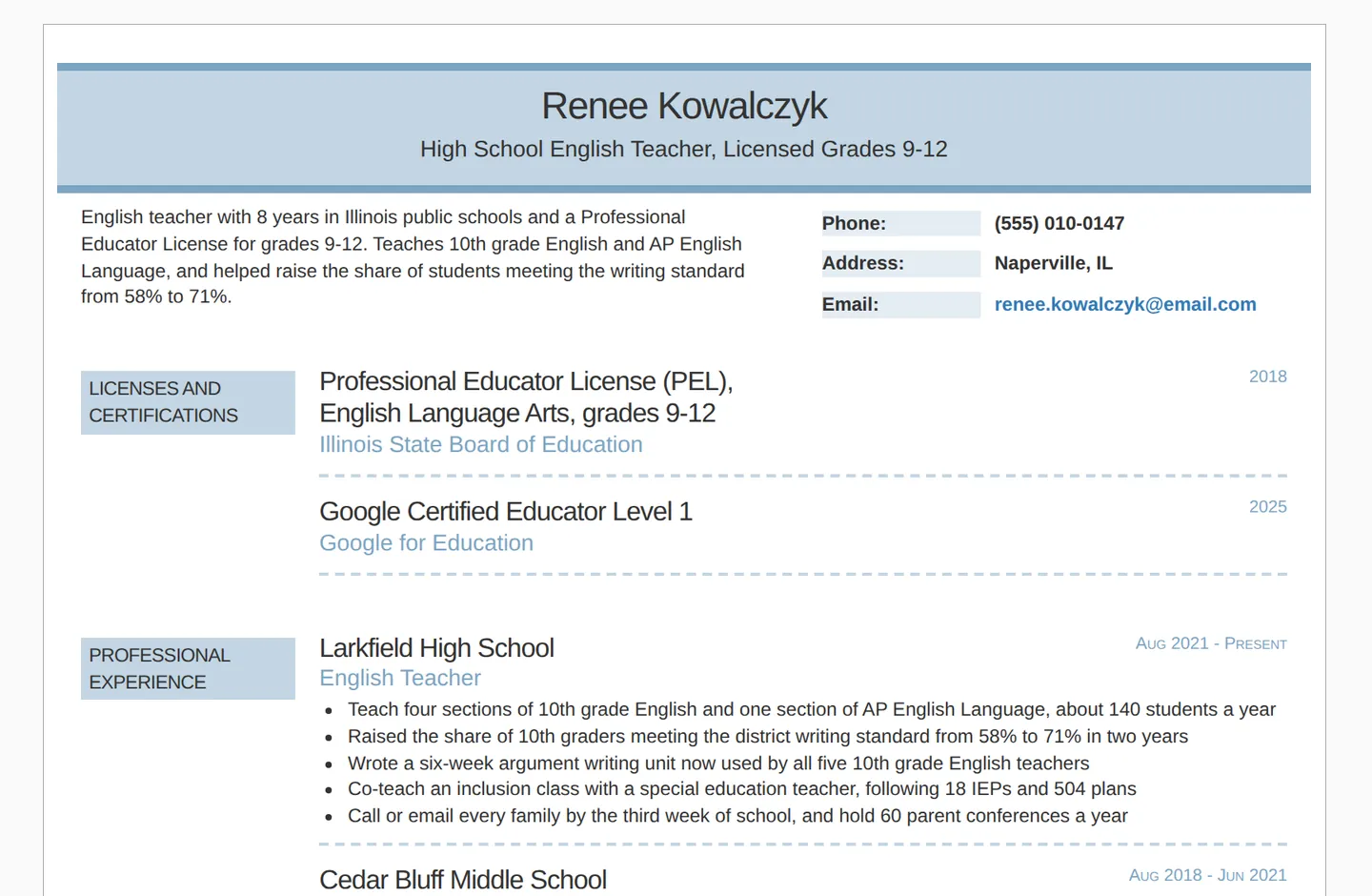
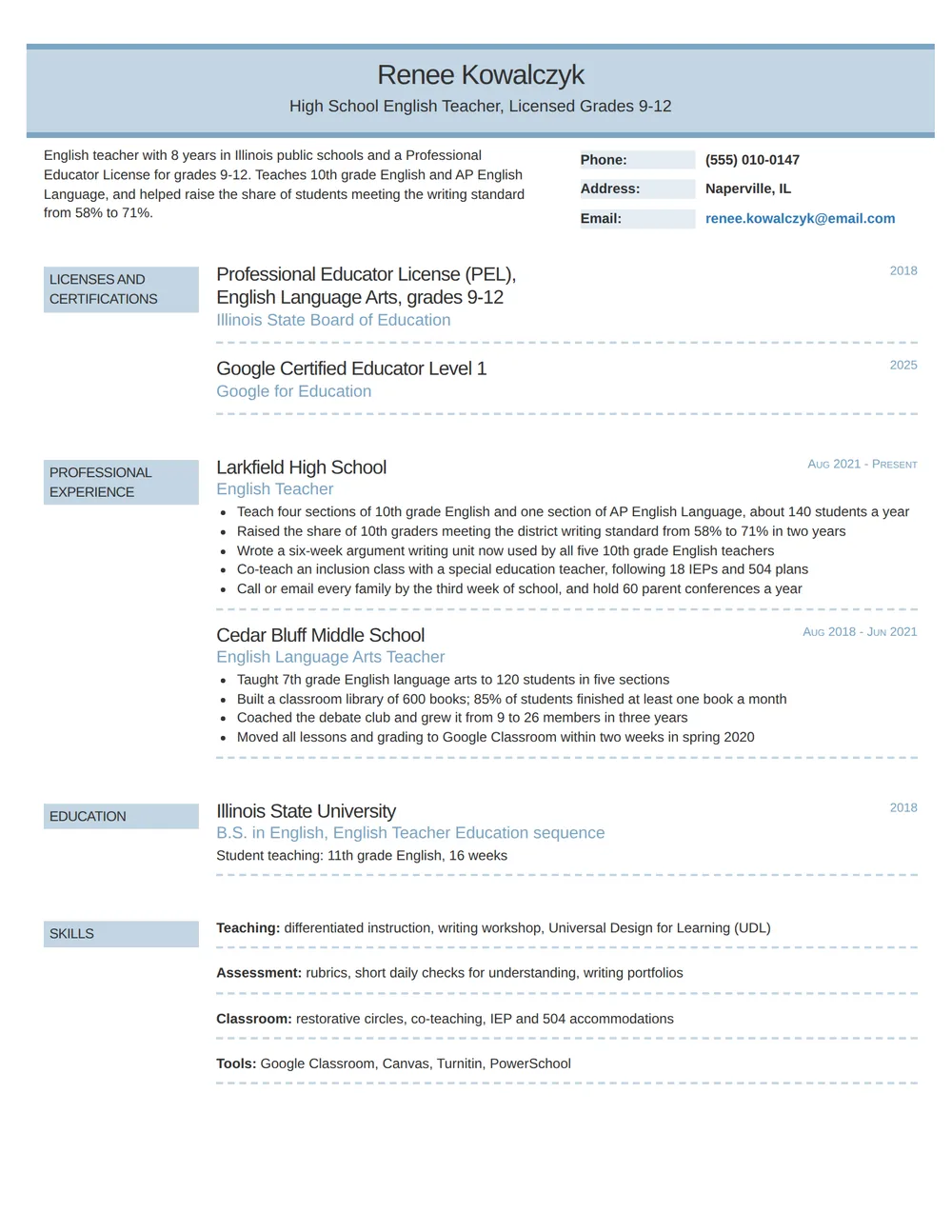
The sample belongs to Renee Kowalczyk, a high school English teacher in Illinois with eight years in two schools. Her license sits at the top, above her classroom results. Every bullet starts with what she did and for how many students.
An English teacher's resume, license on top
https://www.resumonk.com/teacher-resumeTeacherTeacher resume format and template
Put your subject, your grade levels and your license in the headline and the first section. A principal can then match you to the opening at a glance.
This is the order the sample uses:
- Name, contact details and a headline with your subject and grade levels.
- Two or three summary lines on what you teach.
- License and certifications.
- Experience, newest school first.
- Education; new teachers add student teaching here.
- Skills.
How long should a teacher resume be?
One page for most teachers, two for a long career. The second page earns its place with coaching, department lead roles or curriculum work, not with old part-time jobs.
Hiring teams often read stacks of applications for one opening. A first page that holds your subject, grades, license and best result does the most work.
Can a teacher resume use a Canva template?
Yes, if the text stays easy to read and the photo comes off, since US schools do not expect one. Many Canva teacher templates have color blocks and a photo; pick one with clear headings and one or two columns.
Art teacher resume: what changes
Art teachers use the same format. Add a portfolio link next to your email, and name the media you teach, such as ceramics, printmaking or digital design. Student shows and murals go under experience, with the number of students who took part.
What to leave off a teacher resume
- Student names, photos of students, or anything that could identify a child.
- A list of every lesson you taught during student teaching.
- One-day workshops that led to no certificate or endorsement.
- Your GPA once you have taught for a few years.
- Jobs from before college, unless they involved children or tutoring.
- Salary history, unless the application form asks for it.
Classroom experience, newest school first
One line in the sample does most of the work:
Raised the share of 10th graders meeting the district writing standard from 58% to 71% in two years
It names the grade, the measure and the time, so a principal can picture the class.
Write each school as a heading line: your title, the school, and the dates. Under it, three to five bullets.
What to say about each school
- Grade and subject. "7th grade English language arts" says more than "middle school teacher".
- How many students. Give sections and students a year, such as five sections and 120 students.
- Programs you used. Name the curriculum, the reading program or the learning platform.
- Students with plans. Say if you taught an inclusion class and followed IEPs or 504 plans.
- Families. Conferences, newsletters, or calls home, with a number.
Resume ideas for teachers: lines to adapt
Six example lines from different grades and subjects. Change the numbers to your own.
- Taught 3rd grade to 24 students; 19 read at grade level by May, up from 12 in September
- Planned lessons to the state science standards for five sections of 8th grade science
- Ran after-school tutoring twice a week for 15 students in Algebra 1
- Led the 6th grade team of four teachers and set the shared grading calendar
- Sent a weekly newsletter to 28 families in English and Spanish
- Trained 12 colleagues on Google Classroom during the move to remote teaching
Coaching, clubs and duties outside class
Put them under the school where you did them, as one bullet each. The sample adds its debate club this way, with the growth from 9 to 26 members.
Teacher job duties to pick from for a resume
If you need lines for a teacher position resume, start from the duties you really held. Turn each into a bullet with a number:
- Planned daily lessons and units to the state standards for each class.
- Graded work and gave written feedback within a set number of days.
- Kept attendance, grades and behavior notes in the school information system.
- Adapted lessons and tests for students with IEPs, 504 plans and English learners.
- Met with families at conferences and by phone when a student fell behind.
- Covered hallway, lunch or bus duty on a rotating schedule.
- Worked with grade or department teams on shared tests and pacing.
Teacher skills in four short lines
The sample groups its skills under four labels: Teaching, Assessment, Classroom and Tools. Each line names methods or products, not traits.
Pick the ones you can talk about in an interview:
- Teaching: differentiated instruction, small-group reading, writing workshop, project-based learning, co-teaching.
- Assessment: rubrics, exit tickets, common unit tests, writing portfolios, state test data.
- Classroom: classroom management plans, restorative circles, IEP and 504 accommodations.
- Tools: Google Classroom, Canvas, Schoology, Seesaw, PowerSchool.
How can a teacher resume show patience and other soft skills?
Put the trait inside a bullet, with a number that proves it. Three example lines:
- Met weekly with six students reading two grades below level; four caught up by spring
- Called home with good news for every student at least once each quarter
- Calmed a class of 31 after a fire drill by starting a routine students knew by heart
A second language is worth its own line if you can use it with families.
Which keywords should a teacher resume include?
Use the words the posting uses, as long as you have done the work. Common ones in teaching posts:
- Instruction: differentiated instruction, data-driven instruction, small-group instruction.
- Standards: Common Core State Standards, Next Generation Science Standards, or your state standards by name.
- Support systems: MTSS, PBIS, RTI, IEP and 504 accommodations.
- English learners: ELL, ESL, SIOP, sheltered instruction.
Write a short form in full once if the posting does, for example "Positive Behavioral Interventions and Supports (PBIS)".
Objective and summary lines for a teacher resume
An objective suits a new teacher; a summary suits one with years in the classroom. Use one of them, not both.
Objective ideas for a teacher resume
A career objective names the position, the subject and grades, and what you bring. Three examples to adapt:
- Newly licensed social studies teacher with 16 weeks of student teaching in 11th grade U.S. history, seeking a high school position.
- Former lab chemist with a new science teaching license, seeking a high school chemistry teacher job.
- Teacher returning after four years at home, licensed for grades 6-12 math, seeking a full-time post in a middle school.
A summary for an experienced teacher
Two sentences are enough: years, subject, license, then one result. The sample's summary does this with 8 years, the license for grades 9-12, and the rise from 58% to 71%.
Change the summary for each vacancy. If the posting asks for AP or honors classes, put them in the first sentence.
Two more summaries to adapt, for different stages:
Summary, elementary teacher with five years
Licensed K-6 teacher with five years in 2nd and 3rd grade classrooms. Runs guided reading groups and moved 14 of 22 students to grade level in one year.

Summary, veteran math teacher
Middle school math teacher with 12 years in two districts and a grades 5-9 license. Leads the math department and coaches two new teachers each year.
How do I show a career change into teaching on a resume?
Put the new license and your student teaching at the top, then rewrite the old job in classroom terms. Training adults, explaining hard ideas and planning projects all carry over.
- Trained 30 new lab technicians a year in safety steps, with a written test at the end
- Explained loan options to about 15 customers a day in plain words
- Planned and ran a six-week project for a team of eight
If you came in through an alternative certification program, name it on the license line. Many states run such programs, under different names.
How do I explain a gap in a teaching career?
One line in your objective is enough, as in the returning teacher example above. Check that your license is still active, or say on the license line when it will be renewed.
Degree, student teaching and license
List your degree, the college and the year. New teachers add student teaching under it, with the grade, subject and weeks, as the sample does.
The license line
Teaching licenses differ by state, and so do their names. Copy the exact name from your license, then the subject and grades it covers, then the state agency that issued it.
If your license is still in process, list it with the word "expected" and the month. Many states use Praxis tests from ETS; you may list recent passing tests until the license arrives.
Add a master's degree above the bachelor's. Workshops go here only when they lead to an endorsement or a certificate.
How do I write a first-year teacher resume with no experience?
Treat student teaching as your first teaching job. Give it a heading line and three bullets, like any other job:
Student Teacher, Grade 4, Brookhollow Elementary | Jan 2026 - May 2026
- Taught all subjects to 25 students for the last eight weeks of the placement
- Planned a two-week fractions unit with hands-on stations, reviewed by my mentor teacher
- Ran a daily reading group for five students and tracked their progress each week
Under it, list other work with children: tutoring, summer camp, coaching or after-school programs. Each one shows you can run a group.
Where does National Board Certification go?
List it in the certifications section, right under your state license, with the certificate area and the year. The National Board for Professional Teaching Standards awards it, and holders are called National Board Certified Teachers.
Awards, grants and committee work
Many teachers have no awards to list, and this section can stay short. A small grant for your class is worth one line. So is a seat on a curriculum committee, listed under the school where it happened.
A district or state Teacher of the Year nomination counts too: name the district or state and the year.
Principals and mentors as references
Ask a principal or department head who has watched you teach, and the mentor from your student teaching. Put three of them on a separate sheet with phone numbers, and hand it over when the district asks.
Cover letter or cover page for a teaching post
Many districts ask for a cover letter with the online application. A posting that asks for a "cover page" often means the same letter.
Keep it to three short paragraphs:
- The position, the subject and grades, and your license.
- One or two results from your classroom, with numbers.
- Why this school: a program, a grade team or a club you would help with.
Address it to the principal or the hiring contact named in the posting. Send it as a PDF with your resume, unless the online application gives a text box for it.
What should the first paragraph of a teacher cover letter say?
Name the position, then give one thing you did in a classroom. An opening to adapt:
I am applying for the 5th grade teacher position at Willow Park Elementary. In my three years at Hartwell Elementary, I moved 17 of my 23 students to grade-level reading by spring. I hold an active K-6 license and would welcome a role on your literacy team.
Match each teacher vacancy to your resume
Read the vacancy notice next to your draft. Each part of the notice has a place on your page:
- Subject and grades: your headline and your license line.
- The license asked for: the first section, under its exact state name.
- Programs the district names: a bullet under the school where you used them.
- Duties beyond class: coaching or a club, one bullet each.
- A start date: your cover letter, if you can start mid-year.
If the notice asks for something you do not have, leave it off the resume.
Start from your LinkedIn profile or an old resume file, then pick a template. Build your teacher resume
More Teaching resume examples
- Kindergarten Teacher resume example
- Preschool Teacher resume example
- Early Childhood Teacher resume example
See all Teaching resume examples, or browse every category.
Resume writing tips
- How to Write Resume Bullet Points (With Examples)
- How to Write a Skills Section That Actually Gets Noticed
- How to Write a Powerful Resume Summary (10 Best Examples)
Worried about AI? Read will AI replace teachers.