Paralegal Resume Example, Guide and Tips
Introduction
You're sitting at your desk, maybe for the hundredth time this week, staring at that blank document titled "Resume.docx" and wondering how to capture everything you are - everything you could be - in the rigid confines of professional formatting. As an aspiring paralegal, you're not just changing jobs; you're stepping into a world where every comma matters, where missed deadlines can topple cases, and where your ability to transform legal chaos into organized brilliance makes you indispensable. The legal field doesn't just want another administrative professional - it needs someone who can think like a lawyer while maintaining the practical efficiency that keeps law firms running.
Perhaps you're transitioning from years of administrative work, where you've been the unofficial keeper of impossible filing systems and the person everyone turns to when they need something found yesterday. Or maybe you're fresh from your paralegal certificate program, legal terminology still buzzing in your head, eager to apply your knowledge of civil procedure and legal research to real cases that affect real people. Either way, you're here because you want more than just a job - you want to be part of the legal process, to contribute to justice, even if you're not the one standing before the judge.
This guide will walk you through every element of crafting a paralegal resume that speaks the language of law firms and legal departments. We'll start with understanding the resume format that best showcases your journey into the legal field - the reverse-chronological structure that mirrors how legal professionals think about career progression. Then we'll dive deep into presenting your work experience in ways that highlight legally-relevant skills, even if you've never held the official paralegal title. You'll learn how to showcase your technical competencies with legal software alongside the soft skills that make you trustworthy with confidential information.
We'll also address the unique considerations that set paralegal resumes apart - how to demonstrate your understanding of the attorney-paralegal relationship, ways to show your grasp of billable hours and legal economics, and strategies for highlighting the specialized education that qualifies you for this role. From crafting compelling cover letters that serve as your first writing sample to selecting references who can vouch for your ability to handle sensitive legal matters, this guide covers every aspect of your paralegal job application. We'll even tackle those often-overlooked sections like awards and publications, showing you how that dean's list recognition or legal writing award carries real weight in a profession that values excellence and precision above all else.
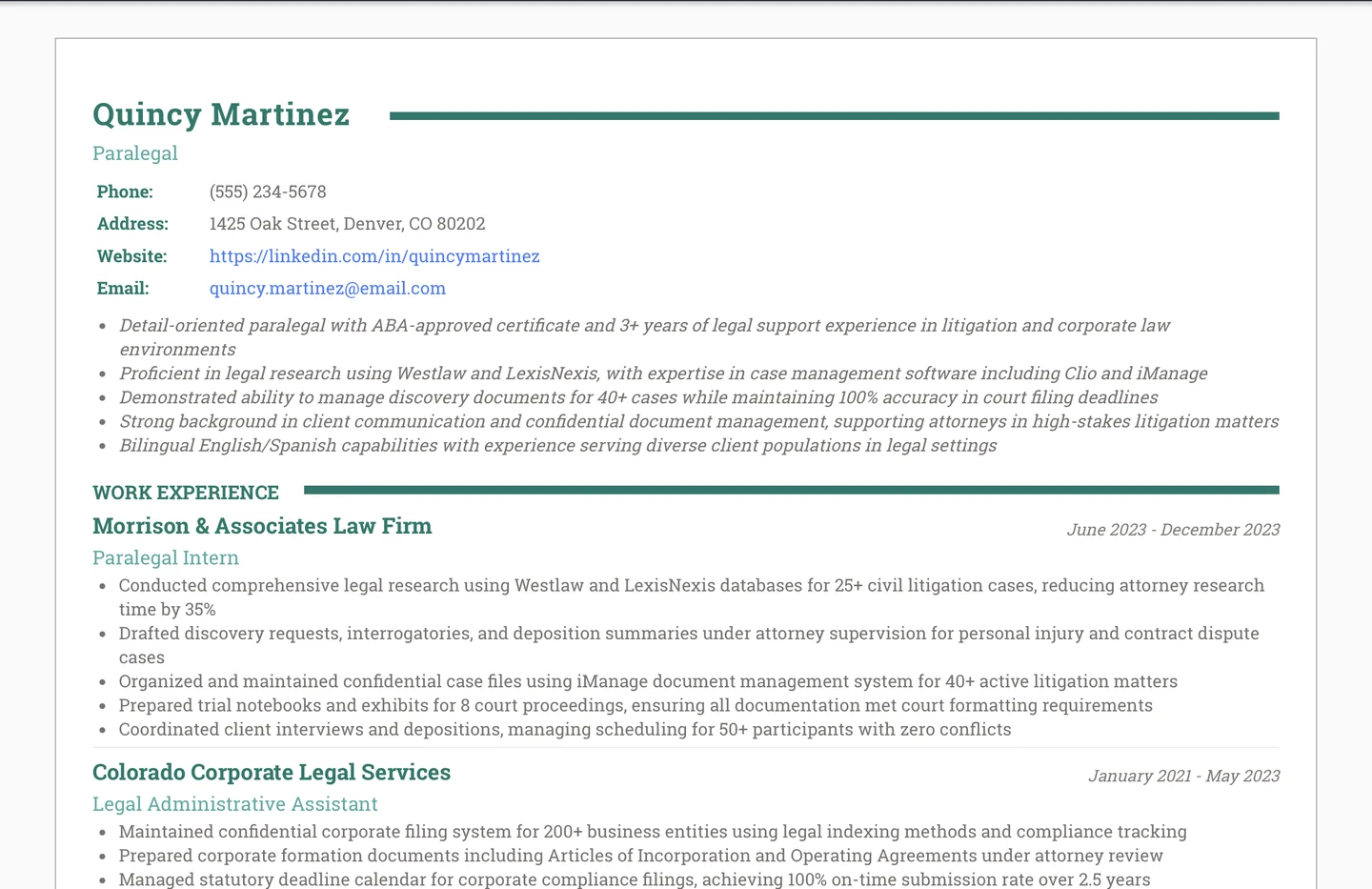
The Best Paralegal Resume Example/Sample
https://www.resumonk.com/paralegalParalegalResume Format for Paralegal Positions - Building Your Legal Foundation
The reverse-chronological format stands as your strongest ally when crafting a paralegal resume.
Why? Because law firms and legal departments think in timelines - cases have chronologies, statutes have effective dates, and your career progression tells a story they need to quickly understand. This format places your most recent experience at the top, allowing hiring attorneys and HR managers to immediately see your current capabilities and recent accomplishments.
The Structure That Speaks Legal Language
Your paralegal resume should mirror the precision you'll bring to legal documents.
Start with a professional summary that acts like an opening statement - concise, compelling, and directly addressing what you bring to the legal team. Follow this with your work experience section (your evidence), education and certifications (your credentials), and skills section (your legal toolkit).
For those entering the field from related backgrounds - perhaps you've been a legal secretary, court reporter, or even worked in insurance claims - the reverse-chronological format helps you draw clear connections between your past roles and your paralegal aspirations. It shows progression, growth, and the accumulation of relevant skills over time.
Regional Formatting Considerations
In the United States, keep your paralegal resume to 1-2 pages maximum, with one page being ideal for entry-level positions. Canadian paralegal resumes can extend slightly longer if you're including both English and French proficiency details.
UK paralegal applications often require a CV format which can be more detailed, while Australian paralegal resumes typically follow the American model but may include a brief career objective statement.
Remember that paralegals bridge the gap between administrative efficiency and legal expertise. Your resume format should reflect this dual nature - organized enough to show your administrative capabilities, yet sophisticated enough to demonstrate your understanding of legal complexity.
Work Experience on Your Paralegal Resume - Proving Your Legal Mettle
You've spent months, maybe years, building skills that matter in the legal world.
Perhaps you've been the one organizing complex filing systems, managing impossible deadlines, or researching information with detective-like precision. Now it's time to translate these experiences into the language that law firms understand - results, accuracy, and efficiency.
Crafting Compelling Experience Entries
Each work experience entry on your paralegal resume should read like a brief case study of your capabilities. Start with strong action verbs that convey legal competency - words like "researched," "drafted," "organized," "maintained," and "assisted" carry weight in legal circles.
The challenge many aspiring paralegals face is showing relevant experience when they haven't held the official title yet. Here's where strategic presentation becomes crucial. That administrative assistant role where you maintained confidential files? That's document management experience. The customer service position where you explained complex policies? That's client communication skills.
❌ Don't write vague descriptions that could apply to any office job:
Administrative Assistant | ABC Company | 2021-2023
- Handled office duties and filing
- Answered phones and emails
- Helped with various projects
✅ Do write specific, legally-relevant accomplishments:
Administrative Assistant | ABC Company | 2021-2023
- Maintained confidential filing system for 500+ client records using legal indexing methods
- Drafted correspondence for executive review, ensuring compliance with company legal guidelines
- Researched and compiled data for quarterly compliance reports submitted to regulatory bodies
- Coordinated scheduling for 15+ depositions and client meetings with zero conflicts
Quantifying Your Legal Support Impact
Law firms run on billable hours and case loads.
Show them you understand this reality by quantifying your contributions. Did you help organize discovery documents for 50 cases? Did you reduce document retrieval time by 30%? These numbers tell the story of efficiency that every legal team craves.
For those with actual paralegal experience, focus on the complexity and variety of your work. Mention specific areas of law you've supported - litigation, real estate, corporate, family law - as specialization matters greatly in legal careers. Include any direct attorney support you've provided, cases you've helped prepare for trial, or legal research projects you've completed independently.
Essential Skills for Your Paralegal Resume - Your Legal Toolkit
The modern paralegal operates at the intersection of traditional legal knowledge and cutting-edge technology. You're not just someone who understands legal terminology - you're a tech-savvy professional who can navigate complex case management software while maintaining the meticulous attention to detail that prevents costly legal errors.
Technical Proficiencies That Matter
Legal technology skills have become non-negotiable in today's paralegal roles. Your familiarity with specific legal software shows you can hit the ground running. List your proficiency with platforms like Westlaw, LexisNexis, PACER, or Clio.
Include your expertise with document management systems, e-discovery tools, and legal billing software.
❌ Don't list generic computer skills:
Skills:
- Microsoft Office
- Internet research
- Good communication
- Team player
✅ Do showcase specific legal competencies:
Technical Skills:
- Legal Research: Westlaw, LexisNexis, PACER database navigation
- Document Management: iManage, NetDocuments, Adobe Acrobat Pro (Bates numbering, redaction)
- Case Management: Clio, MyCase, PracticePanther
- E-Discovery: Relativity, Concordance database management
- Transcription: 70 WPM typing speed, legal transcription software proficiency
Soft Skills With Legal Application
Beyond technology, certain soft skills carry special weight in paralegal positions. Your ability to maintain confidentiality isn't just a nice trait - it's an ethical requirement.
Your organizational skills don't just keep desks tidy - they ensure critical deadlines are met and cases aren't lost on technicalities.
Frame these soft skills within legal contexts. Instead of simply stating "attention to detail," specify "meticulous proofreading of legal documents for accuracy and compliance."
Rather than "multitasking," write "simultaneous management of multiple case files while maintaining accuracy and meeting court deadlines."
Certifications and Continuing Education
The legal field respects credentials. Include your paralegal certificate prominently, along with any specialized training.
NALA (National Association of Legal Assistants) certification, state-specific paralegal certifications, or specialized course completions in areas like intellectual property or immigration law demonstrate your commitment to professional development.
Specific Considerations for Paralegal Resumes - Standing Out in the Legal Arena
Here's what most paralegal resume guides won't tell you - law firms receive dozens of resumes from candidates who all have similar educational backgrounds and claim the same basic skills. You're competing with other certificate holders, other detail-oriented professionals, other Microsoft Office experts.
So what makes your resume rise to the top of that stack?
The Geographic and Practice Area Reality
Paralegal work varies dramatically based on location and specialty.
A paralegal supporting a solo practitioner in family law operates in a completely different world from one working in a large firm's corporate merger department. Your resume needs to signal that you understand these distinctions.
Research your target firms before tailoring your resume. Small firms value versatility - highlight your ability to handle diverse tasks independently. Large firms prize specialization - emphasize depth of knowledge in specific practice areas.
Government positions require understanding of public sector protocols - showcase any experience with regulatory compliance or government documentation.
The Unspoken Hierarchy Navigation
As a paralegal, you occupy a unique position - you're not administrative staff, but you're not an attorney either. Your resume should demonstrate that you understand this positioning.
Show respect for the attorney-paralegal relationship while also highlighting your ability to work independently within appropriate boundaries.
❌ Don't overstate your role or blur professional boundaries:
- Provided legal advice to clients regarding their cases
- Made strategic decisions on case direction
- Negotiated settlements with opposing counsel
✅ Do accurately represent the paralegal's supportive yet substantial role:
- Prepared comprehensive case summaries for attorney review before client meetings
- Conducted initial client interviews to gather facts under attorney supervision
- Drafted settlement documentation based on attorney-negotiated terms
The Deadline-Driven Detail
Every paralegal knows the stomach-dropping feeling of a missed deadline.
Your resume should breathe reliability. Include specific examples of deadline management, especially if you've handled statute of limitations tracking, court filing deadlines, or discovery response timelines.
One missed deadline can destroy a case - showing your track record of reliability is crucial.
The Billing and Business Awareness
Understanding that law firms are businesses sets sophisticated paralegal candidates apart.
If you've tracked billable hours, helped with client billing, or found ways to improve efficiency, include these experiences. Show that you understand the economic realities of legal practice - that your efficiency directly impacts the firm's profitability and client satisfaction.
Finally, remember that the legal profession values tradition while slowly embracing innovation. Your resume should strike this balance - professional and conservative in its presentation, yet demonstrating your readiness to adapt to legal technology advances and evolving practice management approaches. You're not just applying to process paperwork - you're positioning yourself as an indispensable member of a legal team that serves justice while running a successful practice.
Education to List on Paralegal Resume
As someone stepping into the legal world as a paralegal, you're entering a profession where your educational background carries significant weight - perhaps more than you initially realized.
Unlike many entry-level positions where education is just a checkbox, paralegal roles demand specific qualifications that demonstrate your understanding of legal procedures, documentation, and research methodologies. You're not just someone who studied law; you're someone who has trained specifically to support attorneys in their practice.
The Educational Foundation That Matters
Your journey to becoming a paralegal likely took one of several paths - maybe you completed a paralegal certificate program after your bachelor's degree, or perhaps you pursued an associate degree in paralegal studies directly. Some of you might even have a four-year degree in legal studies.
The key is understanding that law firms and corporate legal departments are looking for concrete evidence of your legal training, not just general education.
When positioning your education on your resume, lead with your most relevant legal qualification. If you have a Paralegal Certificate from an ABA-approved program, that often carries more weight than a general bachelor's degree, even if the certificate came later.
Structuring Your Education Section
The way you present your educational credentials can make the difference between landing an interview and being overlooked. Start with your most recent and relevant legal education, then work backwards.
Include your graduation date (or expected graduation date), the institution name, and any relevant coursework that directly applies to the paralegal position you're seeking.
❌ Don't write vaguely about your education:
 Bachelor's Degree - State University
Various legal courses
✅ Do provide specific, relevant details:
Paralegal Certificate - ABA Approved Program
University of California, Los Angeles Extension | June 2023
- Relevant Coursework: Legal Research & Writing, Civil Litigation, Corporate Law, Family Law, Real Estate Transactions
- GPA: 3.8/4.0
Highlighting Specialized Training
The paralegal field values specialized knowledge.
If you've taken courses in e-discovery, legal technology platforms like Westlaw or LexisNexis, or specific areas of law relevant to your target position, these deserve prominent placement. Remember, you're competing with other candidates who might have similar baseline qualifications, so your specialized training becomes your differentiator.
For those transitioning from other fields into paralegal work, your previous education still matters - especially if it's relevant to a specialized legal area. A nursing degree paired with paralegal training makes you invaluable for medical malpractice firms.
An accounting background combined with paralegal certification positions you perfectly for tax law or corporate compliance roles.
Regional Considerations
In the United States, ABA-approved paralegal programs carry significant weight, while in Canada, provincial law societies often have specific educational requirements.
UK paralegal positions might value CILEx qualifications, and Australian employers often look for TAFE certifications in legal services. Make sure you're highlighting the credentials that matter most in your geographic market.
Awards and Publications on Paralegal Resume
You might be thinking - "I'm applying for an entry-level paralegal position, what awards or publications could I possibly have?" But here's the thing about the legal field: it values academic excellence, attention to detail, and written communication skills above almost everything else.
Those dean's list recognitions, that legal writing award from your paralegal program, or even that article you wrote for your school's pre-law society newsletter - they all matter more than you think.
Why Awards Matter for Paralegals
The legal profession is inherently competitive and detail-oriented. When attorneys are reviewing paralegal resumes, they're looking for evidence that you can handle the pressure, maintain high standards, and produce quality work consistently. Awards demonstrate these qualities in a way that simple job descriptions cannot.
They show you've been recognized by others for excellence - exactly the kind of validation busy attorneys appreciate when making hiring decisions.
Academic awards are particularly relevant for paralegal positions. That "Best Legal Research Project" award from your paralegal program directly translates to the research tasks you'll handle daily.
Even general academic honors like summa cum laude or Phi Beta Kappa membership signal your ability to manage complex information and maintain high performance standards.
Publications That Position You as a Standout Candidate
Publications demonstrate something crucial for paralegals - the ability to write clearly and accurately about legal matters. You don't need to have published in the Harvard Law Review; even contributions to your paralegal program's newsletter, blog posts about legal topics, or case summaries you've written show initiative and communication skills.
❌ Don't list irrelevant or poorly described achievements:
Won some awards in college
Wrote stuff for school
✅ Do provide context and relevance:
1. Academic Recognition & Publications
Dean's List - Paralegal Studies Program | Fall 2022, Spring 2023
- Maintained 3.9 GPA while completing full-time coursework
"Understanding Client Privilege in Digital Communications"
- Article published in State Community College Legal Review, March 2023
- Researched and analyzed recent case law regarding electronic discovery
2. Excellence in Legal Writing Award | May 2023
- Recognized for superior brief writing in Advanced Legal Research course
Making Non-Legal Achievements Relevant
Perhaps you're transitioning into paralegal work from another field.
Your previous achievements still count if you frame them correctly. That employee of the month award from your administrative role? It demonstrates reliability and excellence in support functions - exactly what attorneys need. Published articles in your previous field? They showcase your research and writing abilities, both essential paralegal skills.
The key is connecting these achievements to paralegal competencies. Focus on awards that highlight organization, attention to detail, research capabilities, or client service excellence. These translate directly to paralegal responsibilities.
Listing References for Paralegal Resume
As someone entering the paralegal field, you're stepping into a profession where trust and credibility are everything.
Attorneys are essentially handing over significant portions of their cases to you - their reputation, their clients' interests, and potentially millions of dollars in outcomes rest partly on your shoulders. This is why references for paralegal positions carry more weight than in many other entry-level roles. They're not just confirming you showed up to work; they're vouching for your ability to handle confidential information, meet strict deadlines, and maintain professional standards.
Choosing References Who Understand Legal Standards
Your reference selection strategy needs to be more thoughtful than simply listing three people who like you. Ideally, at least one reference should have direct knowledge of your legal capabilities - perhaps a professor from your paralegal program who can speak to your research and writing abilities, or a supervising attorney from an internship who witnessed your performance under pressure.
If you're transitioning from another field, choose references who can speak to transferable skills crucial for paralegal work. That office manager who watched you reorganize the filing system? They can attest to your organizational abilities. The supervisor who saw you handle difficult customers?
They can vouch for your ability to work with demanding clients.
Preparing Your References for Legal Industry Expectations
The legal field has specific concerns when checking references.
Your references should be prepared to address questions about confidentiality, attention to detail, ability to work independently, and performance under deadline pressure. Brief them on the position you're applying for and remind them of specific examples that demonstrate these qualities.
❌ Don't list references without context or preparation:
References available upon request OR John Smith - Former Manager - 555-1234
✅ Do provide properly formatted, relevant references:
Professional References
1. Professor Sarah Martinez, J.D. - Director, Paralegal Studies Program | State University College of Legal Studies
- Contact details: [email protected] | (555) 234-5678
- Relationship: Paralegal Program Instructor - Legal Research & Writing
2. Robert Chen, Esq. - Senior Associate | Johnson, Smith & Associates LLP
- Contact details: [email protected] | (555) 345-6789
- Relationship: Supervising Attorney during Paralegal Internship
The Reference List as a Strategic Document
Your reference list should tell a story about your readiness for paralegal work.
Include a mix of academic and professional references if possible. If you volunteered at a legal aid clinic or participated in a pro bono project, those supervisors make excellent references because they've seen you handle real legal work.
Format your reference list as professionally as your resume itself. Include full names with professional titles, current organizations, email addresses, and phone numbers. Add a brief note about your relationship to provide context. This attention to detail itself demonstrates paralegal-level organizational skills.
International Considerations for References
Reference expectations vary globally.
In the United States, references are typically contacted after an interview, and having them "available upon request" is acceptable initially. UK employers often want written references upfront and may contact previous employers directly for verification. Canadian firms frequently request both professional and character references. Australian employers often conduct thorough reference checks and may require references from your most recent supervisor, regardless of field.
Remember that in the legal field, your references might be contacted by a paralegal or HR professional who understands the specific requirements of the role. They'll ask targeted questions about your ability to handle legal research, maintain confidentiality, and manage multiple deadlines. Choose and prepare your references accordingly - they're not just confirming your employment; they're validating your potential to succeed in the precise, demanding world of legal support.
Cover Letter Tips for Paralegal Resume
Let's address the elephant in the room - you're probably wondering if anyone even reads cover letters anymore. In the legal field, the answer is a resounding yes. Law firms and legal departments are built on written communication, and your cover letter is your first writing sample.
It's your chance to demonstrate that you can construct a compelling argument, organize information logically, and communicate professionally - all essential paralegal skills.
Understanding Your Audience
Your cover letter will likely be read by either a senior paralegal, an office manager, or an attorney - sometimes all three.
Each brings different perspectives. The senior paralegal wants to know if you can handle the workload and fit the team. The office manager needs assurance you're reliable and professional. The attorney wants confidence that you understand legal procedures and can reduce their workload, not add to it.
This means your cover letter needs to speak to practical capabilities while demonstrating legal knowledge. You're not writing a legal brief, but you are showing you understand the precision and professionalism the legal field demands.
Structure That Shows Legal Thinking
Approach your cover letter like you would a legal document - with clear structure, supporting evidence, and a compelling conclusion.
Open with a strong statement about why you're interested in that specific firm or legal department. The middle paragraphs should present evidence of your qualifications, using specific examples. Close with a clear call to action.
❌ Don't write generic, unfocused content:
I am writing to apply for the paralegal position. I have a paralegal certificate and I think I would be good at this job. I am hardworking and detail-oriented.
✅ Do write specifically and compellingly:
Your firm's focus on intellectual property litigation aligns perfectly with my specialized training in patent research and my technical background in computer science. During my paralegal internship at Smith & Associates, I managed discovery documents for three patent infringement cases, creating organizational systems that reduced document retrieval time by 40%.
Demonstrating Understanding of the Role
Unlike many entry-level positions where enthusiasm might be enough, paralegal positions require you to demonstrate understanding of what the job actually entails.
Reference specific tasks you're prepared to handle - drafting pleadings, managing discovery, conducting legal research, maintaining case files. Show familiarity with the tools of the trade, whether it's case management software, e-filing systems, or legal research databases.
If you're applying to a specialized practice area, demonstrate knowledge of that field. Applying to a family law firm? Mention your understanding of custody documentation requirements. Corporate law position?
Reference your knowledge of corporate formation documents and compliance calendars.
Regional and Firm-Specific Considerations
Cover letter expectations vary by region and firm size. Large firms in major cities often expect more formal, traditional cover letters. Smaller firms might appreciate a slightly more personal approach that shows understanding of their local practice. In the UK, cover letters tend to be more formal and structured. Australian firms often appreciate directness and clarity.
Canadian employers typically expect bilingual capabilities to be highlighted if relevant.
Key Takeaways
After diving deep into the intricacies of paralegal resume writing, let's crystallize the essential strategies that will transform your application from another document in the pile to the resume that lands you an interview at that law firm you've been eyeing.
- Use reverse-chronological format consistently - Law firms think in timelines and want to see your most recent, relevant experience first
- Translate all experience into legal language - Transform "filed documents" into "maintained confidential case files using legal indexing systems"
- Quantify your impact with legal-specific metrics - Reference case loads, document volumes, deadline success rates, and efficiency improvements
- Showcase technical legal competencies prominently - List specific legal software proficiencies like Westlaw, LexisNexis, and case management systems
- Lead with ABA-approved or recognized paralegal education - Your specialized legal training often matters more than general degrees
- Demonstrate understanding of the paralegal role's boundaries - Show you can support attorneys effectively without overstepping professional limits
- Include legal writing samples or awards when possible - These serve as proof of your communication and research abilities
- Tailor your resume to firm size and practice area - Small family law firms need versatility; large corporate firms want specialization
- Prepare references who understand legal industry standards - Brief them on confidentiality, deadline management, and attention to detail questions they'll face
- Write cover letters as professional writing samples - Structure them like legal documents with clear arguments and supporting evidence
Creating a paralegal resume that captures your potential while meeting the exacting standards of the legal profession requires more than just listing your qualifications - it demands strategic presentation and deep understanding of what law firms actually need. This is where Resumonk becomes your strategic partner in crafting that perfect paralegal resume. With professionally designed templates that understand the conservative yet modern aesthetic law firms prefer, and AI-powered recommendations that help you articulate your experience in legally-relevant terms, Resumonk transforms the daunting task of resume writing into a streamlined process. You can focus on highlighting your legal knowledge and skills while the platform ensures your formatting is impeccable and your content is optimized for the legal industry's unique requirements.
Ready to build your paralegal resume with confidence?
Our AI-powered content suggestions ensure your paralegal qualifications shine through clearly and professionally.
Start Building Your Paralegal Resume with Resumonk →
More Administrative resume examples
- Executive Assistant resume example
- Administrative Assistant resume example
- Virtual Assistant resume example
- Personal Assistant resume example
See all Administrative resume examples, or browse every category.
Resume writing tips
You're sitting at your desk, maybe for the hundredth time this week, staring at that blank document titled "Resume.docx" and wondering how to capture everything you are - everything you could be - in the rigid confines of professional formatting. As an aspiring paralegal, you're not just changing jobs; you're stepping into a world where every comma matters, where missed deadlines can topple cases, and where your ability to transform legal chaos into organized brilliance makes you indispensable. The legal field doesn't just want another administrative professional - it needs someone who can think like a lawyer while maintaining the practical efficiency that keeps law firms running.
Perhaps you're transitioning from years of administrative work, where you've been the unofficial keeper of impossible filing systems and the person everyone turns to when they need something found yesterday. Or maybe you're fresh from your paralegal certificate program, legal terminology still buzzing in your head, eager to apply your knowledge of civil procedure and legal research to real cases that affect real people. Either way, you're here because you want more than just a job - you want to be part of the legal process, to contribute to justice, even if you're not the one standing before the judge.
This guide will walk you through every element of crafting a paralegal resume that speaks the language of law firms and legal departments. We'll start with understanding the resume format that best showcases your journey into the legal field - the reverse-chronological structure that mirrors how legal professionals think about career progression. Then we'll dive deep into presenting your work experience in ways that highlight legally-relevant skills, even if you've never held the official paralegal title. You'll learn how to showcase your technical competencies with legal software alongside the soft skills that make you trustworthy with confidential information.
We'll also address the unique considerations that set paralegal resumes apart - how to demonstrate your understanding of the attorney-paralegal relationship, ways to show your grasp of billable hours and legal economics, and strategies for highlighting the specialized education that qualifies you for this role. From crafting compelling cover letters that serve as your first writing sample to selecting references who can vouch for your ability to handle sensitive legal matters, this guide covers every aspect of your paralegal job application. We'll even tackle those often-overlooked sections like awards and publications, showing you how that dean's list recognition or legal writing award carries real weight in a profession that values excellence and precision above all else.
The Best Paralegal Resume Example/Sample
https://www.resumonk.com/paralegalParalegalResume Format for Paralegal Positions - Building Your Legal Foundation
The reverse-chronological format stands as your strongest ally when crafting a paralegal resume.
Why? Because law firms and legal departments think in timelines - cases have chronologies, statutes have effective dates, and your career progression tells a story they need to quickly understand. This format places your most recent experience at the top, allowing hiring attorneys and HR managers to immediately see your current capabilities and recent accomplishments.
The Structure That Speaks Legal Language
Your paralegal resume should mirror the precision you'll bring to legal documents.
Start with a professional summary that acts like an opening statement - concise, compelling, and directly addressing what you bring to the legal team. Follow this with your work experience section (your evidence), education and certifications (your credentials), and skills section (your legal toolkit).
For those entering the field from related backgrounds - perhaps you've been a legal secretary, court reporter, or even worked in insurance claims - the reverse-chronological format helps you draw clear connections between your past roles and your paralegal aspirations. It shows progression, growth, and the accumulation of relevant skills over time.
Regional Formatting Considerations
In the United States, keep your paralegal resume to 1-2 pages maximum, with one page being ideal for entry-level positions. Canadian paralegal resumes can extend slightly longer if you're including both English and French proficiency details.
UK paralegal applications often require a CV format which can be more detailed, while Australian paralegal resumes typically follow the American model but may include a brief career objective statement.
Remember that paralegals bridge the gap between administrative efficiency and legal expertise. Your resume format should reflect this dual nature - organized enough to show your administrative capabilities, yet sophisticated enough to demonstrate your understanding of legal complexity.
Work Experience on Your Paralegal Resume - Proving Your Legal Mettle
You've spent months, maybe years, building skills that matter in the legal world.
Perhaps you've been the one organizing complex filing systems, managing impossible deadlines, or researching information with detective-like precision. Now it's time to translate these experiences into the language that law firms understand - results, accuracy, and efficiency.
Crafting Compelling Experience Entries
Each work experience entry on your paralegal resume should read like a brief case study of your capabilities. Start with strong action verbs that convey legal competency - words like "researched," "drafted," "organized," "maintained," and "assisted" carry weight in legal circles.
The challenge many aspiring paralegals face is showing relevant experience when they haven't held the official title yet. Here's where strategic presentation becomes crucial. That administrative assistant role where you maintained confidential files? That's document management experience. The customer service position where you explained complex policies? That's client communication skills.
❌ Don't write vague descriptions that could apply to any office job:
Administrative Assistant | ABC Company | 2021-2023
- Handled office duties and filing
- Answered phones and emails
- Helped with various projects
✅ Do write specific, legally-relevant accomplishments:
Administrative Assistant | ABC Company | 2021-2023
- Maintained confidential filing system for 500+ client records using legal indexing methods
- Drafted correspondence for executive review, ensuring compliance with company legal guidelines
- Researched and compiled data for quarterly compliance reports submitted to regulatory bodies
- Coordinated scheduling for 15+ depositions and client meetings with zero conflicts
Quantifying Your Legal Support Impact
Law firms run on billable hours and case loads.
Show them you understand this reality by quantifying your contributions. Did you help organize discovery documents for 50 cases? Did you reduce document retrieval time by 30%? These numbers tell the story of efficiency that every legal team craves.
For those with actual paralegal experience, focus on the complexity and variety of your work. Mention specific areas of law you've supported - litigation, real estate, corporate, family law - as specialization matters greatly in legal careers. Include any direct attorney support you've provided, cases you've helped prepare for trial, or legal research projects you've completed independently.
Essential Skills for Your Paralegal Resume - Your Legal Toolkit
The modern paralegal operates at the intersection of traditional legal knowledge and cutting-edge technology. You're not just someone who understands legal terminology - you're a tech-savvy professional who can navigate complex case management software while maintaining the meticulous attention to detail that prevents costly legal errors.
Technical Proficiencies That Matter
Legal technology skills have become non-negotiable in today's paralegal roles. Your familiarity with specific legal software shows you can hit the ground running. List your proficiency with platforms like Westlaw, LexisNexis, PACER, or Clio.
Include your expertise with document management systems, e-discovery tools, and legal billing software.
❌ Don't list generic computer skills:
Skills:
- Microsoft Office
- Internet research
- Good communication
- Team player
✅ Do showcase specific legal competencies:
Technical Skills:
- Legal Research: Westlaw, LexisNexis, PACER database navigation
- Document Management: iManage, NetDocuments, Adobe Acrobat Pro (Bates numbering, redaction)
- Case Management: Clio, MyCase, PracticePanther
- E-Discovery: Relativity, Concordance database management
- Transcription: 70 WPM typing speed, legal transcription software proficiency
Soft Skills With Legal Application
Beyond technology, certain soft skills carry special weight in paralegal positions. Your ability to maintain confidentiality isn't just a nice trait - it's an ethical requirement.
Your organizational skills don't just keep desks tidy - they ensure critical deadlines are met and cases aren't lost on technicalities.
Frame these soft skills within legal contexts. Instead of simply stating "attention to detail," specify "meticulous proofreading of legal documents for accuracy and compliance."
Rather than "multitasking," write "simultaneous management of multiple case files while maintaining accuracy and meeting court deadlines."
Certifications and Continuing Education
The legal field respects credentials. Include your paralegal certificate prominently, along with any specialized training.
NALA (National Association of Legal Assistants) certification, state-specific paralegal certifications, or specialized course completions in areas like intellectual property or immigration law demonstrate your commitment to professional development.
Specific Considerations for Paralegal Resumes - Standing Out in the Legal Arena
Here's what most paralegal resume guides won't tell you - law firms receive dozens of resumes from candidates who all have similar educational backgrounds and claim the same basic skills. You're competing with other certificate holders, other detail-oriented professionals, other Microsoft Office experts.
So what makes your resume rise to the top of that stack?
The Geographic and Practice Area Reality
Paralegal work varies dramatically based on location and specialty.
A paralegal supporting a solo practitioner in family law operates in a completely different world from one working in a large firm's corporate merger department. Your resume needs to signal that you understand these distinctions.
Research your target firms before tailoring your resume. Small firms value versatility - highlight your ability to handle diverse tasks independently. Large firms prize specialization - emphasize depth of knowledge in specific practice areas.
Government positions require understanding of public sector protocols - showcase any experience with regulatory compliance or government documentation.
The Unspoken Hierarchy Navigation
As a paralegal, you occupy a unique position - you're not administrative staff, but you're not an attorney either. Your resume should demonstrate that you understand this positioning.
Show respect for the attorney-paralegal relationship while also highlighting your ability to work independently within appropriate boundaries.
❌ Don't overstate your role or blur professional boundaries:
- Provided legal advice to clients regarding their cases
- Made strategic decisions on case direction
- Negotiated settlements with opposing counsel
✅ Do accurately represent the paralegal's supportive yet substantial role:
- Prepared comprehensive case summaries for attorney review before client meetings
- Conducted initial client interviews to gather facts under attorney supervision
- Drafted settlement documentation based on attorney-negotiated terms
The Deadline-Driven Detail
Every paralegal knows the stomach-dropping feeling of a missed deadline.
Your resume should breathe reliability. Include specific examples of deadline management, especially if you've handled statute of limitations tracking, court filing deadlines, or discovery response timelines.
One missed deadline can destroy a case - showing your track record of reliability is crucial.
The Billing and Business Awareness
Understanding that law firms are businesses sets sophisticated paralegal candidates apart.
If you've tracked billable hours, helped with client billing, or found ways to improve efficiency, include these experiences. Show that you understand the economic realities of legal practice - that your efficiency directly impacts the firm's profitability and client satisfaction.
Finally, remember that the legal profession values tradition while slowly embracing innovation. Your resume should strike this balance - professional and conservative in its presentation, yet demonstrating your readiness to adapt to legal technology advances and evolving practice management approaches. You're not just applying to process paperwork - you're positioning yourself as an indispensable member of a legal team that serves justice while running a successful practice.
Education to List on Paralegal Resume
As someone stepping into the legal world as a paralegal, you're entering a profession where your educational background carries significant weight - perhaps more than you initially realized.
Unlike many entry-level positions where education is just a checkbox, paralegal roles demand specific qualifications that demonstrate your understanding of legal procedures, documentation, and research methodologies. You're not just someone who studied law; you're someone who has trained specifically to support attorneys in their practice.
The Educational Foundation That Matters
Your journey to becoming a paralegal likely took one of several paths - maybe you completed a paralegal certificate program after your bachelor's degree, or perhaps you pursued an associate degree in paralegal studies directly. Some of you might even have a four-year degree in legal studies.
The key is understanding that law firms and corporate legal departments are looking for concrete evidence of your legal training, not just general education.
When positioning your education on your resume, lead with your most relevant legal qualification. If you have a Paralegal Certificate from an ABA-approved program, that often carries more weight than a general bachelor's degree, even if the certificate came later.
Structuring Your Education Section
The way you present your educational credentials can make the difference between landing an interview and being overlooked. Start with your most recent and relevant legal education, then work backwards.
Include your graduation date (or expected graduation date), the institution name, and any relevant coursework that directly applies to the paralegal position you're seeking.
❌ Don't write vaguely about your education:
 Bachelor's Degree - State University
Various legal courses
✅ Do provide specific, relevant details:
Paralegal Certificate - ABA Approved Program
University of California, Los Angeles Extension | June 2023
- Relevant Coursework: Legal Research & Writing, Civil Litigation, Corporate Law, Family Law, Real Estate Transactions
- GPA: 3.8/4.0
Highlighting Specialized Training
The paralegal field values specialized knowledge.
If you've taken courses in e-discovery, legal technology platforms like Westlaw or LexisNexis, or specific areas of law relevant to your target position, these deserve prominent placement. Remember, you're competing with other candidates who might have similar baseline qualifications, so your specialized training becomes your differentiator.
For those transitioning from other fields into paralegal work, your previous education still matters - especially if it's relevant to a specialized legal area. A nursing degree paired with paralegal training makes you invaluable for medical malpractice firms.
An accounting background combined with paralegal certification positions you perfectly for tax law or corporate compliance roles.
Regional Considerations
In the United States, ABA-approved paralegal programs carry significant weight, while in Canada, provincial law societies often have specific educational requirements.
UK paralegal positions might value CILEx qualifications, and Australian employers often look for TAFE certifications in legal services. Make sure you're highlighting the credentials that matter most in your geographic market.
Awards and Publications on Paralegal Resume
You might be thinking - "I'm applying for an entry-level paralegal position, what awards or publications could I possibly have?" But here's the thing about the legal field: it values academic excellence, attention to detail, and written communication skills above almost everything else.
Those dean's list recognitions, that legal writing award from your paralegal program, or even that article you wrote for your school's pre-law society newsletter - they all matter more than you think.
Why Awards Matter for Paralegals
The legal profession is inherently competitive and detail-oriented. When attorneys are reviewing paralegal resumes, they're looking for evidence that you can handle the pressure, maintain high standards, and produce quality work consistently. Awards demonstrate these qualities in a way that simple job descriptions cannot.
They show you've been recognized by others for excellence - exactly the kind of validation busy attorneys appreciate when making hiring decisions.
Academic awards are particularly relevant for paralegal positions. That "Best Legal Research Project" award from your paralegal program directly translates to the research tasks you'll handle daily.
Even general academic honors like summa cum laude or Phi Beta Kappa membership signal your ability to manage complex information and maintain high performance standards.
Publications That Position You as a Standout Candidate
Publications demonstrate something crucial for paralegals - the ability to write clearly and accurately about legal matters. You don't need to have published in the Harvard Law Review; even contributions to your paralegal program's newsletter, blog posts about legal topics, or case summaries you've written show initiative and communication skills.
❌ Don't list irrelevant or poorly described achievements:
Won some awards in college
Wrote stuff for school
✅ Do provide context and relevance:
1. Academic Recognition & Publications
Dean's List - Paralegal Studies Program | Fall 2022, Spring 2023
- Maintained 3.9 GPA while completing full-time coursework
"Understanding Client Privilege in Digital Communications"
- Article published in State Community College Legal Review, March 2023
- Researched and analyzed recent case law regarding electronic discovery
2. Excellence in Legal Writing Award | May 2023
- Recognized for superior brief writing in Advanced Legal Research course
Making Non-Legal Achievements Relevant
Perhaps you're transitioning into paralegal work from another field.
Your previous achievements still count if you frame them correctly. That employee of the month award from your administrative role? It demonstrates reliability and excellence in support functions - exactly what attorneys need. Published articles in your previous field? They showcase your research and writing abilities, both essential paralegal skills.
The key is connecting these achievements to paralegal competencies. Focus on awards that highlight organization, attention to detail, research capabilities, or client service excellence. These translate directly to paralegal responsibilities.
Listing References for Paralegal Resume
As someone entering the paralegal field, you're stepping into a profession where trust and credibility are everything.
Attorneys are essentially handing over significant portions of their cases to you - their reputation, their clients' interests, and potentially millions of dollars in outcomes rest partly on your shoulders. This is why references for paralegal positions carry more weight than in many other entry-level roles. They're not just confirming you showed up to work; they're vouching for your ability to handle confidential information, meet strict deadlines, and maintain professional standards.
Choosing References Who Understand Legal Standards
Your reference selection strategy needs to be more thoughtful than simply listing three people who like you. Ideally, at least one reference should have direct knowledge of your legal capabilities - perhaps a professor from your paralegal program who can speak to your research and writing abilities, or a supervising attorney from an internship who witnessed your performance under pressure.
If you're transitioning from another field, choose references who can speak to transferable skills crucial for paralegal work. That office manager who watched you reorganize the filing system? They can attest to your organizational abilities. The supervisor who saw you handle difficult customers?
They can vouch for your ability to work with demanding clients.
Preparing Your References for Legal Industry Expectations
The legal field has specific concerns when checking references.
Your references should be prepared to address questions about confidentiality, attention to detail, ability to work independently, and performance under deadline pressure. Brief them on the position you're applying for and remind them of specific examples that demonstrate these qualities.
❌ Don't list references without context or preparation:
References available upon request OR John Smith - Former Manager - 555-1234
✅ Do provide properly formatted, relevant references:
Professional References
1. Professor Sarah Martinez, J.D. - Director, Paralegal Studies Program | State University College of Legal Studies
- Contact details: [email protected] | (555) 234-5678
- Relationship: Paralegal Program Instructor - Legal Research & Writing
2. Robert Chen, Esq. - Senior Associate | Johnson, Smith & Associates LLP
- Contact details: [email protected] | (555) 345-6789
- Relationship: Supervising Attorney during Paralegal Internship
The Reference List as a Strategic Document
Your reference list should tell a story about your readiness for paralegal work.
Include a mix of academic and professional references if possible. If you volunteered at a legal aid clinic or participated in a pro bono project, those supervisors make excellent references because they've seen you handle real legal work.
Format your reference list as professionally as your resume itself. Include full names with professional titles, current organizations, email addresses, and phone numbers. Add a brief note about your relationship to provide context. This attention to detail itself demonstrates paralegal-level organizational skills.
International Considerations for References
Reference expectations vary globally.
In the United States, references are typically contacted after an interview, and having them "available upon request" is acceptable initially. UK employers often want written references upfront and may contact previous employers directly for verification. Canadian firms frequently request both professional and character references. Australian employers often conduct thorough reference checks and may require references from your most recent supervisor, regardless of field.
Remember that in the legal field, your references might be contacted by a paralegal or HR professional who understands the specific requirements of the role. They'll ask targeted questions about your ability to handle legal research, maintain confidentiality, and manage multiple deadlines. Choose and prepare your references accordingly - they're not just confirming your employment; they're validating your potential to succeed in the precise, demanding world of legal support.
Cover Letter Tips for Paralegal Resume
Let's address the elephant in the room - you're probably wondering if anyone even reads cover letters anymore. In the legal field, the answer is a resounding yes. Law firms and legal departments are built on written communication, and your cover letter is your first writing sample.
It's your chance to demonstrate that you can construct a compelling argument, organize information logically, and communicate professionally - all essential paralegal skills.
Understanding Your Audience
Your cover letter will likely be read by either a senior paralegal, an office manager, or an attorney - sometimes all three.
Each brings different perspectives. The senior paralegal wants to know if you can handle the workload and fit the team. The office manager needs assurance you're reliable and professional. The attorney wants confidence that you understand legal procedures and can reduce their workload, not add to it.
This means your cover letter needs to speak to practical capabilities while demonstrating legal knowledge. You're not writing a legal brief, but you are showing you understand the precision and professionalism the legal field demands.
Structure That Shows Legal Thinking
Approach your cover letter like you would a legal document - with clear structure, supporting evidence, and a compelling conclusion.
Open with a strong statement about why you're interested in that specific firm or legal department. The middle paragraphs should present evidence of your qualifications, using specific examples. Close with a clear call to action.
❌ Don't write generic, unfocused content:
I am writing to apply for the paralegal position. I have a paralegal certificate and I think I would be good at this job. I am hardworking and detail-oriented.
✅ Do write specifically and compellingly:
Your firm's focus on intellectual property litigation aligns perfectly with my specialized training in patent research and my technical background in computer science. During my paralegal internship at Smith & Associates, I managed discovery documents for three patent infringement cases, creating organizational systems that reduced document retrieval time by 40%.
Demonstrating Understanding of the Role
Unlike many entry-level positions where enthusiasm might be enough, paralegal positions require you to demonstrate understanding of what the job actually entails.
Reference specific tasks you're prepared to handle - drafting pleadings, managing discovery, conducting legal research, maintaining case files. Show familiarity with the tools of the trade, whether it's case management software, e-filing systems, or legal research databases.
If you're applying to a specialized practice area, demonstrate knowledge of that field. Applying to a family law firm? Mention your understanding of custody documentation requirements. Corporate law position?
Reference your knowledge of corporate formation documents and compliance calendars.
Regional and Firm-Specific Considerations
Cover letter expectations vary by region and firm size. Large firms in major cities often expect more formal, traditional cover letters. Smaller firms might appreciate a slightly more personal approach that shows understanding of their local practice. In the UK, cover letters tend to be more formal and structured. Australian firms often appreciate directness and clarity.
Canadian employers typically expect bilingual capabilities to be highlighted if relevant.
Key Takeaways
After diving deep into the intricacies of paralegal resume writing, let's crystallize the essential strategies that will transform your application from another document in the pile to the resume that lands you an interview at that law firm you've been eyeing.
- Use reverse-chronological format consistently - Law firms think in timelines and want to see your most recent, relevant experience first
- Translate all experience into legal language - Transform "filed documents" into "maintained confidential case files using legal indexing systems"
- Quantify your impact with legal-specific metrics - Reference case loads, document volumes, deadline success rates, and efficiency improvements
- Showcase technical legal competencies prominently - List specific legal software proficiencies like Westlaw, LexisNexis, and case management systems
- Lead with ABA-approved or recognized paralegal education - Your specialized legal training often matters more than general degrees
- Demonstrate understanding of the paralegal role's boundaries - Show you can support attorneys effectively without overstepping professional limits
- Include legal writing samples or awards when possible - These serve as proof of your communication and research abilities
- Tailor your resume to firm size and practice area - Small family law firms need versatility; large corporate firms want specialization
- Prepare references who understand legal industry standards - Brief them on confidentiality, deadline management, and attention to detail questions they'll face
- Write cover letters as professional writing samples - Structure them like legal documents with clear arguments and supporting evidence
Creating a paralegal resume that captures your potential while meeting the exacting standards of the legal profession requires more than just listing your qualifications - it demands strategic presentation and deep understanding of what law firms actually need. This is where Resumonk becomes your strategic partner in crafting that perfect paralegal resume. With professionally designed templates that understand the conservative yet modern aesthetic law firms prefer, and AI-powered recommendations that help you articulate your experience in legally-relevant terms, Resumonk transforms the daunting task of resume writing into a streamlined process. You can focus on highlighting your legal knowledge and skills while the platform ensures your formatting is impeccable and your content is optimized for the legal industry's unique requirements.
Ready to build your paralegal resume with confidence?
Our AI-powered content suggestions ensure your paralegal qualifications shine through clearly and professionally.
Start Building Your Paralegal Resume with Resumonk →
More Administrative resume examples
- Executive Assistant resume example
- Administrative Assistant resume example
- Virtual Assistant resume example
- Personal Assistant resume example
See all Administrative resume examples, or browse every category.
Resume writing tips