Product Manager Resume Example (with Expert Advice and Tips)
Introduction
You're staring at your laptop at some odd hour, toggling between the job description for a Product Manager role at a company you actually care about and a blank document that's supposed to become your resume.
Maybe you've been a PM for a few years now and you know your work is solid - you've shipped products, moved metrics, navigated the impossible alignment meetings between engineering and sales - but somehow translating all of that into a document that will convince a stranger you're worth interviewing feels like an entirely different product challenge. Or perhaps you're trying to break into product management from engineering, consulting, or design, and you're trying to figure out how to frame your background in PM language without sounding like you're reaching. Either way, you're here because you need to create a Product Manager resume that actually works.
Here's what you need to understand right away. Product Manager is not a generic title. It means something very specific in today's tech-forward economy - you're the person who sits at the intersection of engineering, design, business, and customer needs, driving product strategy and execution without traditional hierarchical authority. This is typically a mid-level to senior individual contributor role requiring 3-7 years of experience, though some companies hire Associate or Junior PMs for entry-level positions. You're not managing people in the traditional sense (that's what Directors and VPs of Product do), you're managing a product's lifecycle, roadmap, and the complex web of cross-functional collaboration required to ship something users actually want. This distinction matters enormously for how you structure your resume.
In this guide, we're walking through everything you need to build a Product Manager resume that demonstrates strategic thinking, execution excellence, and measurable impact - the three things every PM hiring manager is scanning for. We'll start with the fundamental format question and why reverse-chronological structure works best for PM roles, then dig deep into crafting your work experience section with accomplishment-driven bullet points that showcase product thinking rather than generic responsibilities. We'll cover how to present your skills in a way that's specific and credible rather than buzzword-laden, and we'll explore the nuanced considerations unique to product management - how to demonstrate cross-functional leadership without authority, how to show both strategy and execution, how to frame product pivots or failures constructively, and how to position yourself whether you're moving between B2B and B2C, startup and enterprise, or transitioning from an adjacent role.
We'll also address the supporting elements that complete your application - how to position your education and certifications (spoiler: your work experience matters far more, but context determines where education should sit on your resume), whether awards and publications strengthen your candidacy (they can, if you have meaningful ones), how to write a cover letter that demonstrates product thinking rather than just summarizing your resume, and how to handle references strategically when the time comes. By the end, you'll have a clear framework for creating a resume that positions you as a credible Product Manager candidate for the specific roles you're targeting, with enough flexibility to adapt for different company sizes, product types, and seniority levels.
The Best Product Manager Resume Example/Sample
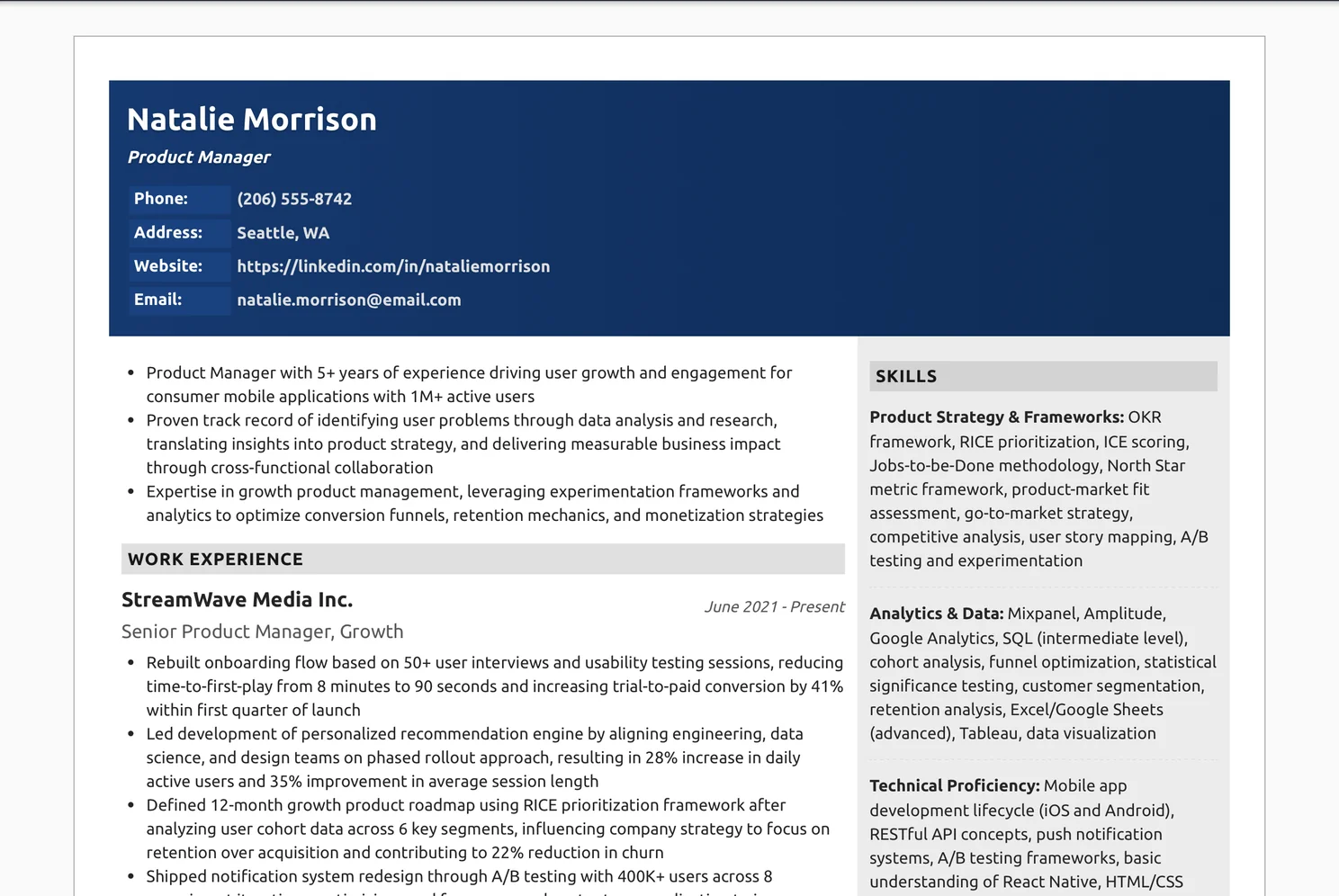
https://www.resumonk.com/product-managerProduct ManagerResume Format to Follow for Product Manager Resume
Given this context, the format of your resume needs to immediately communicate strategic thinking, impact measurement, and cross-functional leadership.
The reverse-chronological format is unequivocally your best choice here. Why? Because hiring managers and fellow PMs reviewing your resume want to see a clear trajectory of increasing responsibility, product complexity, and measurable impact. They want to trace your evolution from perhaps a business analyst or associate PM role into someone who can independently drive product strategy and execution.
Why Reverse-Chronological Works Best for Product Manager Resumes
Your career progression tells a story, and in product management, that story matters enormously.
Unlike roles where skills can be more portable or generic, product management expertise compounds over time. Each product you've shipped, each roadmap you've built, each stakeholder alignment challenge you've navigated adds to your credibility. A functional or skills-based resume would obscure this narrative, making it harder for readers to understand how you've grown in product thinking and execution.
The reverse-chronological format also allows you to demonstrate something critical for PMs - context switching ability and domain expertise accumulation. If you moved from a fintech product to a B2B SaaS product to a consumer mobile app, that diversity becomes visible and valuable. Conversely, if you've gone deep in one domain (say, healthcare technology products), that specialization becomes immediately apparent.
Structuring Your Product Manager Resume
Start with a brief professional summary or headline (2-3 lines maximum) that positions your PM focus area.
This isn't about being flowery but rather about immediate clarity. Follow this with your work experience section, which will be the longest and most detailed part of your resume. After work experience, include your skills section, then education, and finally any relevant certifications or additional sections like "Products Shipped" or "Speaking Engagements" if applicable.
Here's what your contact information and header section should look like - clean and professional:
Sarah Chen
Product Manager | B2B SaaS & Enterprise Solutions
San Francisco, CA | [email protected] | (555) 123-4567 | linkedin.com/in/sarahchen
Notice how this immediately tells the reader what kind of PM you are. Product management is vast - someone specializing in growth products has a different skill set than someone building developer tools or managing IoT device ecosystems.
Length and Visual Hierarchy Considerations
For Product Manager roles, a two-page resume is not only acceptable but often necessary if you have 5+ years of experience.
You need space to detail your product launches, metrics, and strategic initiatives. However, every word must earn its place. The first page should contain your most recent and impactful role, ensuring that if someone only reads page one, they understand your caliber.
Use clear section headings and consistent formatting. Product managers are expected to create clear documentation and communicate complex information simply - your resume is your first product document. If it's cluttered, poorly organized, or hard to scan, you're inadvertently signaling that your PRDs and strategy documents might be similarly unclear.
Work Experience on Product Manager Resume
Your work experience entries need to function as mini case studies of your product work.
Each role should tell the story of what product challenge existed, what you did about it, and what measurable outcome resulted. This isn't about listing your daily responsibilities ("worked with engineering teams" or "gathered customer requirements") - these are table stakes that every PM does. Instead, you're demonstrating how you moved specific metrics, shipped specific products, and solved specific business problems.
Structuring Each Work Experience Entry
Start with your job title, company name, location, and dates.
But here's a nuance many candidates miss - if you worked on a specific product or product line, include it in your title line or immediately below. Product management is product-specific, and context matters enormously.
Senior Product Manager, Growth
Fintech Startup Inc. | New York, NY | March 2021 - Present
Product: Mobile banking app (2M+ active users)
This immediately tells the reader what kind of products you've managed, the scale you've operated at, and the domain you know. It sets up the context for everything that follows.
Writing Accomplishment-Driven Bullet Points
Each bullet point should follow a loose structure of: Action you took + Context/Challenge + Measurable Result. Product managers live and die by metrics, so your resume must reflect this quantitative orientation.
However, the metrics need to be business metrics (revenue, engagement, retention, conversion, user growth) or product metrics (feature adoption, time-to-value, NPS scores), not process metrics (number of meetings attended or user stories written).
Let's look at what doesn't work versus what does:
❌ Don't write vague responsibility statements:
Managed product roadmap and prioritized features based on stakeholder input and customer feedback
✅ Do write specific impact statements:
Rebuilt onboarding flow based on 40+ customer interviews and usability testing, reducing time-to-first-value from 14 days to 3 days and increasing trial-to-paid conversion by 34%
The second version tells a complete story. You did discovery work (customer interviews), you made a specific product decision (rebuilt onboarding), and you achieved measurable results (reduced time metric, increased conversion metric). This is what hiring managers want to see.
❌ Don't use generic PM language without specifics:
Collaborated with cross-functional teams to deliver features on time and within scope
✅ Do show how you navigated real product challenges:
Aligned engineering, design, and sales teams on API product strategy, negotiating timeline trade-offs that enabled Q4 launch while maintaining technical quality, resulting in $2.3M in new enterprise contracts within 6 months
The improved version shows political savvy, strategic decision-making, and business impact. You navigated competing priorities (timeline vs. quality), you brought alignment across functions, and you delivered revenue results.
Showing Product Strategy vs. Execution
Your bullets should balance strategic work (vision, roadmap, market analysis) with execution work (shipping features, working with teams, iterating based on data). More senior PM roles should skew toward strategy, while earlier-career roles naturally show more execution. If you're applying for a Senior PM or Lead PM role but your resume only shows execution, you'll appear too junior.
Conversely, if you're applying for an Associate PM role but only talk about strategy, you'll seem disconnected from hands-on work.
Strategic bullet example:
Defined 18-month product vision for payments platform after conducting competitive analysis of 8 market players and TAM assessment, influencing company's strategic pivot from B2C to B2B focus
Execution bullet example:
Shipped 12 customer-facing features across 6 sprints, maintaining 95% on-time delivery rate while reducing backlog of critical bugs by 60% through improved triage processes
Both are valuable, but they demonstrate different aspects of PM competency. Your resume should have both types.
Quantifying Impact When You Don't Have Perfect Metrics
Here's a common anxiety for PMs writing resumes - what if you don't have access to exact metrics, or what if your product was B2B enterprise where you can't share customer names? You can still be specific using ranges, percentages, or comparative statements.
Instead of saying:
Improved user engagement significantly
You can say:
Increased daily active users by approximately 40% quarter-over-quarter through implementation of personalized content recommendations
Or if you truly cannot share numbers:
Led redesign of enterprise dashboard that became the top-requested feature in customer feedback, adopted by majority of enterprise clients within first quarter of launch
The key is specificity about what you did and the nature of the impact, even if the exact numbers are unavailable.
Addressing Career Transitions and Non-Linear Paths
Many product managers come from non-traditional backgrounds - engineering, design, consulting, marketing, or business development.
If you're transitioning into PM or if your earlier roles weren't titled "Product Manager," don't hide this. Instead, frame your previous experience through a product lens by highlighting product-relevant responsibilities.
If you were a software engineer before becoming a PM:
Software Engineer | TechCorp | 2018 - 2020
• Collaborated with PM team on feature scoping and technical feasibility for 3 major releases, often acting as technical liaison between engineering and business stakeholders
• Proposed and led development of internal analytics tool that reduced data analysis time by 50%, later adopted across 4 product teams (demonstrating product thinking)
If you came from consulting:
Business Analyst | Consulting Firm | 2019 - 2021
• Led digital transformation initiative for retail client, defining product requirements for customer loyalty app that increased repeat purchases by 28%
• Conducted market research and competitive analysis for fintech client's new product launch, synthesizing findings into actionable product recommendations
Notice how these frame past roles through product outcomes and PM-relevant skills like requirements definition, stakeholder management, and data-driven decision making.
Skills to Show on Product Manager Resume
The fundamental challenge is this: many PM skills sound generic when listed out of context ("communication," "stakeholder management," "prioritization"). The trick is being specific about what kinds of product work you can do, what methodologies you know, what tools you can use, and what domains you understand.
Categories of Skills to Include
Your skills section should span several categories that together paint a picture of a well-rounded PM. These include: product strategy frameworks, technical competencies, analytical and data skills, domain expertise, and tools/platforms.
Let's break down each category.
Product Strategy and Methodology Skills
These demonstrate that you know how to think about products systematically, not in an ad-hoc way.
If you've used specific frameworks in your product work, mention them. This might include things like Jobs-to-be-Done (JTBD), OKRs, RICE prioritization, ICE scoring, Kano model, opportunity solution trees, or North Star metric frameworks.
❌ Don't write generic phrases:
Skills: Product Strategy, Roadmapping, Prioritization
✅ Do be specific about frameworks and approaches:
Product Strategy & Planning: OKR framework, RICE prioritization, Jobs-to-be-Done methodology, competitive analysis, product-market fit assessment, go-to-market strategy
The specific version tells a hiring manager that you don't work in a vacuum - you use established frameworks that other PMs will recognize and that demonstrate systematic thinking.
Technical and Development Skills
Product managers don't need to code (though it can help), but you need to understand technical concepts well enough to have credibility with engineers and make informed trade-off decisions. Your technical skills section should honestly represent your capabilities - don't claim to "know Python" if you took one online course.
But do highlight technical literacy that's relevant to the products you've managed.
For a PM working on API products:
Technical Proficiency: RESTful API concepts, SQL for data analysis, basic understanding of microservices architecture, API documentation standards, authentication protocols (OAuth, JWT)
For a PM working on mobile products:
Technical Proficiency: iOS and Android development lifecycle, mobile app analytics, push notification systems, A/B testing frameworks, basic understanding of React Native
Notice how these are tailored to the actual product context. A PM working on developer tools will have different technical skills than a PM working on consumer e-commerce products, and that's expected.
Data and Analytics Skills
Modern product management is increasingly data-informed (though not data-driven - there's a difference). You need to show that you can work with data, derive insights, and measure impact.
This section should include both tools and statistical/analytical concepts you're comfortable with.
Analytics & Data: Google Analytics, Mixpanel, Amplitude, SQL (intermediate level), cohort analysis, funnel optimization, statistical significance testing, customer segmentation, Excel/Google Sheets (advanced), data visualization (Tableau)
The key here is honesty about proficiency levels. If you can write complex SQL queries, say "advanced SQL." If you can read queries and do basic analysis, say "SQL for data analysis" or "intermediate SQL."
Hiring managers often test analytics skills in interviews, so don't overstate.
Domain Expertise and Industry Knowledge
If you've spent significant time in a particular industry or product category, this becomes a valuable differentiator. Domain expertise is often what gets you past the resume screen for specialized PM roles.
Healthcare products, fintech, enterprise SaaS, developer tools, marketplace products, hardware/IoT - these all have unique considerations and accumulated knowledge matters.
Domain Expertise: B2B SaaS, enterprise software, payment systems and fintech regulations, subscription business models, PLG (product-led growth) strategies
This tells a hiring manager that you won't need months to understand the business model, regulatory environment, or go-to-market motion of their product.
Tools and Software
Finally, list the actual tools you use day-to-day. This is the most straightforward category, but context matters. Don't list 20 tools you've touched once.
Focus on tools you've genuinely used for extended periods in product work.
Product Management Tools: Jira, Confluence, Productboard, Figma (for design collaboration), Miro, Notion, Slack, Intercom (customer communication)
Different companies use different PM tool stacks, but showing familiarity with common ones reduces perceived ramp-up time. However, most PMs can learn new tools quickly, so this is the least critical category - don't stress if you haven't used a company's specific tool before.
What Not to Include in Your PM Skills Section
Avoid listing soft skills like "communication," "leadership," or "teamwork" in your skills section. These should be demonstrated through your work experience bullet points, not listed as keywords.
Also avoid overly broad skills like "product management" or "agile" without specificity - these say nothing meaningful.
❌ Don't list generic soft skills:
Skills: Communication, Leadership, Problem-solving, Teamwork, Critical Thinking
✅ Do list tangible frameworks, tools, and methodologies:
1. Product Skills: User story mapping, sprint planning, design thinking workshops, usability testing, customer development interviews
2. Tools: Jira, Asana, Figma, Heap Analytics, Notion
3. Technical: SQL, HTML/CSS basics, API fundamentals, mobile app architecture
Tailoring Your Skills Section
Here's an advanced move - subtly tailor your skills section for different types of PM roles.
If you're applying to a highly technical product (developer tools, infrastructure, data products), emphasize your technical skills more. If you're applying to a growth PM role, emphasize analytics, experimentation, and optimization frameworks. If you're applying to a 0-to-1 product role at a startup, emphasize customer discovery, MVPs, and lean methodology.
You're not lying or fabricating skills - you're choosing which genuine skills to highlight based on relevance.
Specific Considerations and Tips for Product Manager Resume
Now we get to the nuanced territory - the things that separate good PM resumes from great ones, and the considerations that are unique to product management roles specifically. These aren't about formatting or structure but about how you position yourself in a highly competitive, context-dependent role.
The "Product Sense" Problem
One of the hardest things to convey on a resume is product sense - that intuitive understanding of what makes products successful, how users think, and what features matter. Hiring managers try to assess this during interviews, but your resume can hint at it.
The way to do this is by showing user-centric thinking in your bullet points rather than company-centric thinking.
❌ Company-centric framing:
Launched new feature to meet Q3 roadmap commitments and align with company's strategic objectives
✅ User-centric framing:
Identified through user research that 65% of customers abandoned onboarding at payment step; designed and shipped simplified payment flow that reduced abandonment by 42%
The second version shows you start with user problems, not business mandates. This is product sense in action.
Demonstrating Cross-Functional Leadership Without Authority
PMs lead without authority - you don't manage the engineers, designers, or marketers you work with, yet you need to drive alignment and decisions. This is a unique challenge to convey on a resume.
Use language that shows influence and orchestration rather than command-and-control.
❌ Implies hierarchical authority:
Managed team of 6 engineers and 2 designers to deliver product features
✅ Shows cross-functional leadership:
Led cross-functional team of 6 engineers, 2 designers, and marketing stakeholders through discovery, design, and launch of payment infrastructure, navigating competing priorities and building consensus on phased rollout approach
The language here - "led," "navigating," "building consensus" - shows the reality of PM work: getting people aligned without having them report to you.
Product vs. Project Management Distinction
One fatal mistake on PM resumes is sounding like a project manager rather than a product manager.
Project managers focus on on-time delivery, resource allocation, and process. Product managers focus on solving user problems, driving business outcomes, and making strategic trade-offs. Make sure your resume reflects the latter.
❌ Sounds like project management:
Successfully delivered 12 features across 4 quarters, maintaining 90% on-time delivery rate and managing stakeholder expectations
✅ Sounds like product management:
Prioritized feature roadmap based on customer impact analysis and revenue potential, resulting in 12 strategic releases that collectively increased MRR by $450K and improved customer retention by 18%
Notice how the PM version emphasizes decision-making criteria (customer impact, revenue) and business outcomes (MRR, retention) rather than delivery mechanics.
Addressing B2B vs. B2C Product Differences
If you're transitioning between B2B and B2C products, or if the role you're applying to is in a different category than your experience, address this thoughtfully. B2B and B2C product management have different cadences, stakeholders, and success metrics.
Show that you understand these differences by using the right language for your experience.
For B2B PM experience:
Conducted discovery with 25+ enterprise customers across 3 verticals, synthesizing feedback into product roadmap that addressed compliance requirements and integration needs, leading to 40% increase in enterprise deal closure rate
For B2C PM experience:
Ran A/B tests on checkout flow with 500K+ users, iterating weekly based on conversion data and user session recordings, ultimately increasing purchase completion rate by 23%
The B2B example shows longer sales cycles, compliance considerations, and deal-focused metrics. The B2C example shows rapid iteration, large user volumes, and conversion optimization. Use the vocabulary appropriate to your actual experience.
How to Present Product Failures and Pivots
Here's something most resume advice ignores - PMs often work on products that fail, get sunset, or require major pivots. This is normal and expected in product work, but you need to frame it correctly.
Don't hide the product that failed, but do focus on what you learned and how you responded.
❌ Hiding or being vague about a failed product:
Worked on various product initiatives in the social commerce space
✅ Framing a pivot or failure constructively:
Led initial launch of social commerce feature that underperformed adoption targets (8% vs. 20% goal); conducted failure analysis through user interviews and analytics deep-dive, identifying fundamental value prop misalignment; pivoted to simplified sharing feature that achieved 35% adoption within 3 months
This shows resilience, analytical thinking, and ability to course-correct - all valuable PM traits. You don't hide the failure, but you show how you handled it professionally.
Certifications and Education Considerations
Product management doesn't have a standard educational path like medicine or law. Your education section matters, but your work experience matters far more. A few nuances: if you have an MBA, it's relevant for PM roles (especially at larger companies), but it's not required. If you have a technical degree (computer science, engineering), this adds credibility for technical PM roles.
If you have neither, don't worry - plenty of successful PMs come from diverse educational backgrounds.
Regarding PM certifications (Pragmatic Institute, Product School, Reforge programs), these can be valuable for career switchers or early-career PMs to show commitment and foundational knowledge, but they're not a substitute for actual product experience. List them in a certifications section if you have them, but don't expect them to carry significant weight.
Education:
- Bachelor of Science in Computer Science, University of Washington, 2017

Certifications:
- Certified Scrum Product Owner (CSPO), 2020
- Reforge Product Strategy Program, 2022
Side Projects and Portfolio Considerations
Unlike designers who need portfolios or engineers who benefit from GitHub profiles, PMs have a murkier relationship with showcasing work. You often can't share detailed product specs due to confidentiality, and case studies can sound self-aggrandizing.
However, if you have relevant side projects, a product blog, or have spoken at product conferences, these can differentiate you - include them in an additional section.
Additional:
• Speaker, ProductCon 2023: "Building Payment Products for Emerging Markets"
• Creator, PM Reading newsletter (2,000+ subscribers) analyzing product strategy trends
• Advisor, early-stage fintech startup focused on SMB lending products
These signal thought leadership and genuine passion for product work beyond your 9-to-5 responsibilities.
The Geographic and Company Size Context
Finally, understand that "Product Manager" can mean very different things at a 50-person startup versus a 10,000-person enterprise company.
At startups, PMs often wear multiple hats - customer support, marketing, even some design. At large companies, PMs work within more defined swim lanes with specialized support functions. Tailor your resume to show you understand the context you're applying into. If you're moving from big company to startup, emphasize your scrappiness, full-stack product thinking, and comfort with ambiguity. If you're moving from startup to big company, emphasize your ability to work with established processes, influence across organizations, and drive alignment at scale.
Remember, your resume isn't a comprehensive document of everything you've ever done - it's a strategic marketing document designed to get you to the interview. For product managers specifically, it should demonstrate three things above all else: you can identify important problems, you can drive solutions through organizations, and you can deliver measurable business impact.
Everything else is supporting evidence for those three core capabilities.
Education Requirements for Product Manager Resumes
First, let's establish what we're dealing with. Product Manager is typically a mid-level to senior individual contributor role (sometimes senior-level management, depending on the company), which means hiring managers expect you to have completed your formal education and possibly pursued additional certifications or specialized training. Unlike entry-level positions where your education might be your strongest selling point, your work experience will do most of the heavy lifting here.
But that doesn't mean your education section is just a formality to tick off.
Positioning Your Degree Strategically
The conventional wisdom says to list education in reverse-chronological order, with your most recent degree first.
For Product Manager roles, this matters because the relevance of your education to the position significantly impacts where this section should live on your resume. If you have an MBA from a recognized business school or a technical degree (Computer Science, Engineering, Information Systems) that directly relates to the products you'll be managing, your education carries weight. However, if you graduated seven years ago with a degree in an unrelated field and have since built your PM career through experience, your education section should sit near the bottom of your resume, after your work experience and skills.
Here's what to include for each degree: the degree name, your major/field of study, the institution name, location (city and state/country), and graduation year. For Product Managers, adding relevant coursework can be valuable, but only if it genuinely relates to product management competencies and you're earlier in your career (within 3-5 years of graduation).
When Your Degree Actually Matters
If you're applying to product management roles at highly technical companies (think enterprise software, developer tools, artificial intelligence, or deep tech), your technical education background becomes a legitimate qualification.
A BS in Computer Science or Engineering tells hiring managers you can speak the language of your engineering team, understand technical constraints, and make informed trade-off decisions. Similarly, if you're targeting PM roles at financial services companies or healthcare organizations, relevant degrees in those domains signal that you won't need months to understand the industry landscape.
For these scenarios, you might enhance your education entry with relevant details:
Bachelor of Science in Computer Science | University of Washington, Seattle, WA | Graduated: May 2018
- Relevant Coursework: Human-Computer Interaction, Database Systems, Software Engineering, Machine Learning
- Senior Project: Developed an iOS application for campus resource scheduling, adopted by 3,000+ students
Notice how this includes a concrete project outcome? That's the Product Manager mindset showing up even in your education section.
The MBA Question
Let's address the MBA situation head-on, because it's complicated in product management.
An MBA is neither required nor automatically impressive for PM roles. What matters is the story it tells. If you pursued an MBA to formalize business knowledge after spending years as an engineer, that's a coherent narrative. If your MBA came from a top-tier program known for producing product leaders (Stanford GSB, Harvard Business School, Wharton, MIT Sloan), it carries networking and brand value. But if you got your MBA simply because you thought it was the next step, hiring managers might wonder why you spent two years and significant money on something that doesn't directly translate to shipping better products.
When listing an MBA, include any product-management-specific concentrations, relevant projects, or achievements:
Master of Business Administration (MBA)
- Northwestern University - Kellogg School of Management, Evanston, IL | Graduated: June 2021
- Concentration: Technology and Product Management
- Notable Project: Led cross-functional team of 5 MBA students to develop go-to-market strategy for early-stage SaaS startup, resulting in $500K seed investment
Certifications That Actually Count
The product management world is flooded with certification programs, and here's the uncomfortable truth: most hiring managers don't care about them as much as the certification providers want you to believe. A Certified Scrum Product Owner (CSPO) or a certificate from a reputable PM training program can be useful if you're transitioning into product management from another field, but they won't compensate for lack of actual product experience.
That said, technical certifications can legitimately strengthen your profile. AWS certifications for cloud product managers, Google Analytics certifications for consumer product managers, or specialized domain certifications (like HIPAA compliance for healthcare products) demonstrate commitment to understanding the space you're operating in.
List these either in your education section or in a separate "Certifications" section if you have multiple:
Certifications
• AWS Certified Solutions Architect – Associate, Amazon Web Services, 2022
• Pragmatic Marketing Certified – Level III, Pragmatic Institute, 2021
• Google Analytics Individual Qualification, Google, 2020
What to Leave Out
Here's where we need to talk about what doesn't belong. Your high school information? Gone, unless you're in Australia or the UK where specific qualifications like A-Levels might be referenced. Your GPA? Only include it if you graduated within the last three years AND it's above 3.5 (or equivalent in your country's system). Even then, it's optional.
The hiring manager cares far more about that product you shipped that increased user engagement by 40% than your grade in Economics 101.
Also skip the exhaustive list of every course you took. "Relevant coursework" means 3-5 courses maximum, and only if they directly relate to the PM role you're targeting.
Special Circumstances: Non-Traditional Paths
What if you don't have a four-year degree?
The product management field is actually more open to non-traditional paths than many other careers at this level, though it varies by company. If you completed a coding bootcamp, an intensive PM fellowship, or built relevant skills through online learning platforms, you can list these in your education section. The key is framing them properly and ensuring your work experience demonstrates you can do the job:
1. Product Management Certificate | Product School, Online | Completed: August 2020
- 12-week intensive program covering product strategy, roadmapping, user research, and data analytics

2. Self-Directed Technical Education
- Completed 15+ courses in SQL, Python, and data analytics through Coursera and DataCamp (2019-2021)
- Applied skills directly to analytics-driven product decisions in current role
The second example works because it immediately connects the learning to practical application, which is what Product Managers do: they learn what they need to know and apply it to solve problems.
International Education Considerations
If you earned your degree outside the country where you're applying, include the country name clearly and consider adding a brief explanation if your degree title might not be immediately clear.
For example, a "B. Tech" is well-understood in India but might need clarification for US employers. Similarly, UK applicants should note that degrees are classified (First Class, Upper Second Class, etc.), and including your classification if it's strong makes sense.
For candidates educated in non-English-speaking countries applying to English-speaking markets, you might add:
Bachelor of Engineering in Software Engineering
Technical University of Munich, Munich, Germany | Graduated: July 2017 (First Class Honours equivalent)
Coursework conducted in English
Showcasing Awards and Publications on Your Product Manager Resume
Product Management is fundamentally a role about influence without authority, about making decisions that affect countless users, engineers, designers, and business outcomes. When you list meaningful awards and publications, you're telling hiring managers: "Other people, beyond just my direct manager, have recognized that I know what I'm doing."
That's powerful.
What Actually Counts as an Award
Let's establish what belongs here.
You're looking for recognition that validates your product thinking, leadership, execution, or domain expertise. This could include company-wide performance awards (Employee of the Year, President's Club), product-specific recognition (Product of the Year awards from industry organizations), hackathon victories where you led a team, patent awards for product innovations, or industry recognition (30 Under 30 lists, PM awards from professional organizations).
What doesn't belong: generic participation certificates, internal team social awards, college honors from a decade ago (unless they're genuinely exceptional like Rhodes Scholar or Fulbright Fellow), or anything that doesn't connect to your capabilities as a Product Manager.
Here's the difference:
❌ Don't list awards that don't demonstrate product impact:
Perfect Attendance Award, ABC Company, 2021
✅ Do list awards that validate your product leadership:
Innovation Excellence Award, ABC Company, 2021
Recognized for leading development of AI-powered recommendation engine that increased user engagement by 35% and generated $2M in additional annual revenue
Notice the difference? The second example doesn't just name-drop an award, it explains why you received it and quantifies the impact.
That's the Product Manager showing their work.
Patents: Your Product Innovation Proof
If you've been named on a patent (whether pending or granted), this absolutely belongs on your Product Manager resume, especially for technical PM roles. Patents demonstrate that you've worked on innovations substantial enough to warrant intellectual property protection.
They signal technical depth and inventive thinking, two qualities that hiring managers value.
When listing patents, include the patent number (if granted), the title, your role (inventor or co-inventor), and the year. If it's pending, note that status:
Patent: "System and Method for Predictive User Interface Adaptation Based on Behavioral Patterns"
Co-Inventor | US Patent No. 11,234,567 | Granted: March 2022
Developed during tenure at TechCorp, implemented in flagship mobile application used by 5M+ users
For pending patents where details are confidential, you can be more general:
Patent Pending: Machine learning application for personalization engine (confidential)
Lead Inventor | Filed: January 2023
Publications That Demonstrate Thought Leadership
Now let's tackle publications, because this is where Product Managers often undersell themselves.
You don't need to have published in an academic journal to have valuable publications. The product management community values practical knowledge-sharing, and there are numerous legitimate venues where your published work counts:
- Articles in recognized industry publications (Harvard Business Review, TechCrunch, Built In, Mind the Product)
- Substantial posts on professional platforms (Medium publications with significant readership, your company's engineering or product blog)
- Speaking engagements that were recorded or transcribed (conference talks, podcast appearances, webinar presentations)
- Case studies published by reputable organizations (SVPG, Reforge, Product School)
- Contributions to product management books or research reports
What typically doesn't count: personal blog posts with minimal readership, LinkedIn posts (unless they went genuinely viral and led to speaking opportunities), or internal company documents never shared externally.
Here's how to list publications effectively:
"Building Products for Emerging Markets: Lessons from Expanding into Southeast Asia"
Published in Mind the Product, October 2022
Article viewed 15,000+ times, cited in Product Management Today newsletter
The view count and citation add credibility. If your publication led to tangible opportunities (speaking invitations, consulting work, job offers), that's worth mentioning in your cover letter even if not on the resume itself.
Speaking Engagements as Social Proof
If you've spoken at industry conferences, meetups, or company events about product management topics, this fits naturally into an awards and recognition section (or you might title it "Awards, Publications & Speaking"). Speaking engagements demonstrate that you're recognized enough in the community to be invited to share your expertise.
For Product Managers, this is particularly valuable because communication and presentation skills are core to the role.
List speaking engagements with the talk title, event name, location, and date:
"From Insight to Impact: Using Qualitative Research to Drive Product Decisions"
ProductCon, New York, NY | April 2023
Keynote presentation to 500+ product professionals, 4.8/5 audience rating
If you've spoken at multiple events, list the most impressive or recent 3-5. You can add a line like "Selected speaking engagements" to indicate there are others.
How to Structure This Section
The structural question: should this be one section or multiple?
If you have publications AND awards AND patents, you might split them. More commonly, Product Managers combine these into a single section titled "Awards & Recognition" or "Awards, Publications & Patents." This section typically appears after your work experience and skills, but before education.
Within the section, list items in reverse-chronological order by date. If you have both publications and awards, you might create subsections:
Awards & Recognition
Awards
1. Product Excellence Award, XYZ Corp, 2023
- Recognized for successful launch of enterprise analytics platform, achieving 150% of year-one revenue targets
2. Best New Product, SaaS Innovation Awards, 2022
- Industry recognition for AI-powered customer support tool
Publications
• "Balancing Technical Debt with Feature Development: A Framework for Product Decisions" | Product Management Today, January 2023
• "Three Metrics That Actually Matter for SaaS Product-Market Fit" | First Round Review, August 2022
When You Don't Have Awards or Publications
Here's the reality: many excellent Product Managers don't have awards or publications, and that's completely fine.
This section is optional. Don't invent or inflate recognition just to have something here. However, if you're reading this and thinking "I should probably start building this aspect of my profile," here's the practical path forward: start writing about your product work (with appropriate confidentiality), volunteer to speak at local product meetups, and focus on doing work worthy of recognition. The awards and publications will follow naturally from excellent execution and community engagement.
If you're early in your PM career (first 2-3 years), the absence of this section is expected. If you're a senior Product Manager or aiming for leadership roles, having at least some external validation becomes increasingly valuable, though still not mandatory if your work history speaks for itself.
Regional Differences in Awards and Recognition
In the United States and Canada, including awards and recognition is common and expected if you have them.
In the UK and much of Europe, there's a cultural tendency toward modesty, but including genuine achievements is still appropriate and valuable. In Australia, striking a balance between confidence and humility works well - list the recognition but let the facts speak for themselves without excessive self-promotion. Across all regions, the key is authenticity - only list recognition you genuinely received and can speak to if asked.
How to List References on Your Product Manager Resume
Let's address something that confuses many Product Manager candidates: what to do about references on your resume. You've probably seen the phrase "References available upon request" at the bottom of countless resume examples, and you might be wondering if you should include it, or if you should actually list out your references with their contact information right there on your resume. The short answer is: in almost all cases, you should do neither of these things on your resume itself. But that doesn't mean references don't matter for Product Manager roles.
They matter quite a bit, you just need to handle them strategically.
Why "References Available Upon Request" Is Outdated
First, let's deal with that "References available upon request" line. This phrase was common on resumes decades ago when it wasn't obvious that candidates would provide references if asked. Today, it's completely understood that you'll provide references when requested, making this line redundant and a waste of valuable resume space.
For Product Managers especially, where you're already trying to fit substantial work experience, technical skills, and impact metrics into a tight format, using a line to state the obvious doesn't make sense.
Think about it from a hiring manager's perspective. They assume you have references. They assume you'll provide them when asked. That line tells them nothing and takes up space that could be used for an additional achievement or skill.
Simply leave it off entirely.
Should You Ever List References Directly on Your Resume?
The only scenario where you might list actual references with contact information on your resume is if the job posting explicitly requests it as part of the application.
This is relatively rare for Product Manager positions but does occasionally happen, particularly with government positions, academic institutions, or some international companies. When this is requested, you typically create a separate "References" document rather than cramming them onto your resume, maintaining the focus of your resume on your qualifications rather than your references' contact details.
If you do need to provide references as part of your application, format them cleanly on a separate page with the same header design as your resume for consistency:
References for [Your Name]
1. Sarah Chen, Director of Product, DataCorp
- Email: [email protected] | Phone: (555) 123-4567
- Relationship: Direct manager at DataCorp (2020-2023)

2. Michael Rodriguez, Senior Engineering Manager, TechStartup
- Email: [email protected] | Phone: (555) 234-5678
- Relationship: Cross-functional partner at TechStartup (2018-2020)

3. Jennifer Kim, VP of Product, AnalyticsCo
- Email: [email protected] | Phone: (555) 345-6789
- Relationship: Leadership mentor and former colleague at AnalyticsCo (2016-2018)
Notice how each reference includes their relationship to you? This context is essential because it tells the hiring manager what perspective this person can offer on your work.
The Strategic Importance of References for Product Managers
Here's what you need to understand about references in the context of Product Manager roles. Product Management is intensely collaborative and your success depends on your ability to work effectively with diverse stakeholders. Because of this, reference checks for PM positions often go deeper than for other roles.
Hiring managers aren't just verifying that you worked where you said you worked, they're trying to understand how you navigate ambiguity, how you handle conflict, how you influence without authority, and whether engineers and designers actually enjoy working with you.
For senior Product Manager roles especially, expect thorough reference checks that include both your direct managers and your cross-functional partners. Some companies even do "back-channel references" where they reach out to people in their network who've worked with you, even if you didn't list them as official references. This isn't meant to be sneaky, it's the reality of hiring for roles where interpersonal dynamics are critical to success.
Choosing the Right References for PM Roles
When the time comes to provide references (typically after you've had initial interviews and the company is seriously considering you), you want to strategically select people who can speak to different aspects of your Product Manager capabilities. The ideal reference list includes:
A direct manager who can speak to your results and growth: This person should be able to discuss the products you owned, the impact you delivered, and how you developed as a PM under their leadership. If you've had multiple PM managers, choose the one who saw your most impressive work or the most recent one if that relationship was strong.
A cross-functional partner, ideally from engineering: Since Product Managers spend enormous amounts of time working with engineering teams, having an engineering manager or tech lead vouch for your technical credibility, communication style, and respect for engineering constraints is incredibly valuable. This reference addresses the question every hiring manager has: "Will my engineering team respect and want to work with this PM?"
A senior stakeholder or skip-level leader: Someone who can speak to your strategic thinking, communication with leadership, and ability to operate at a higher level. This is particularly important if you're applying for senior PM roles.
Optionally, you might include a designer you've worked closely with, a customer success or sales leader who can speak to how your product decisions impacted the business, or someone from a product you shipped that had significant impact. The key is diversity of perspective.
Don't list three people who all know you in the same capacity.
What to Do When Your References Are Complicated
Let's address some awkward but common situations. What if you're currently employed and can't let your current manager know you're job searching? This is completely normal and understood. You can note on your reference list or when asked: "Current manager available upon offer." Hiring managers understand this constraint and won't hold it against you.
Just make sure you have other strong references from your current company (if possible) or recent past roles.
What if you left a previous role on less-than-ideal terms? First, don't list that person as a reference. Second, if the relationship with your former manager was difficult but there were others at the company who thought highly of your work, see if you can use them instead. Third, be prepared to address this situation honestly but professionally if it comes up. Product Managers sometimes make difficult prioritization calls or push back on unrealistic demands, and good hiring managers understand that not every work relationship will be perfect.
What if you're earlier in your PM career and don't have multiple PM managers to reference? You can include a manager from before you transitioned into product management, provided they can speak to relevant skills like analytical thinking, stakeholder management, or leadership. You might also include a senior Product Manager who mentored you, even if they weren't your direct manager. Just be clear about the nature of the relationship.
Preparing Your References Properly
Here's something many candidates get wrong: they wait until a company asks for references, frantically text their former manager, and hope for the best.
This approach risks getting a lukewarm reference or, worse, catching your reference off-guard when the call comes. Do this instead:
When you start seriously job searching, reach out to your potential references and ask if they'd be willing to serve as a reference for PM roles you're pursuing. This is best done via email or a conversation, not just a text. Explain what types of roles you're targeting and ask if they feel they can speak positively about your work. Most people will say yes, and this advance warning allows them to mentally prepare.
When you reach the stage where a specific company will be checking references, send each reference a brief message with context about the role, the company, and what aspects of your experience might be most relevant for them to emphasize. For example:
Hi Michael,
The Product Manager role at FinanceApp is moving to reference checks, so they'll likely be reaching out to you this week. The role focuses heavily on cross-functional leadership and working with engineering teams on complex technical products, so anything you can share about our collaboration on the payment processing rebuild at TechStartup would be especially relevant.
Thank you again for being willing to speak on my behalf. Here's the job description for your reference: [link]
I'll let you know how things progress!
This preparation dramatically increases the quality and relevance of the reference conversation. Your references appreciate the context, and the hiring manager gets more useful information.
Professional References vs. Personal References
For Product Manager roles, you want professional references, people who've worked with you in a business context.
Personal references (friends, family, clergy, neighbors) are not appropriate for PM positions unless very specifically requested, which is rare. Even academic references are less relevant unless you're newly graduated or transitioning from research into product management.
The one exception might be if you've done significant volunteer product work for a nonprofit or led a product-related community initiative. If that work demonstrates PM skills and the person overseeing it can speak credibly to your abilities, it could work as a supplementary reference.
International Considerations for References
Reference practices vary by country. In the United States and Canada, reference checks are standard and expected for Product Manager roles. In the United Kingdom and much of Europe, references are also common, though sometimes handled more formally through written reference letters. In Australia, verbal reference checks are standard practice.
Regardless of location, the key is having people who can authentically speak to your product management capabilities and work style.
If you're applying internationally and your references are in a different time zone, mention this when providing their contact information and suggest email as an initial contact method if helpful. Professional references understand that people pursue international opportunities.
When Reference Checks Actually Happen
Finally, understand the timing.
For most Product Manager positions, references are checked late in the process, typically after you've completed multiple rounds of interviews and the company is seriously considering making you an offer. Some companies check references before the final interview, others after. A few check them post-offer as a formality (though finding significant issues can result in rescinded offers). The key point: you don't need to worry about references at the application stage. Focus on your resume and cover letter first, and prepare your references when you're deeper into the interview process.
Writing an Effective Cover Letter for Product Manager Applications
For Product Manager roles, a cover letter matters more than you might think. Here's why.
Product Management is fundamentally about communication, prioritization, and strategic thinking. A cover letter is your first opportunity to demonstrate all three. When a hiring manager reads your cover letter, they're not just learning about your background, they're evaluating how you think, how you communicate complex ideas, and whether you can make a compelling case for why you're the right person for this specific role. Sound familiar? It's exactly what you do when you write product requirement documents, present roadmaps to stakeholders, or pitch new features to executives.
The Strategic Purpose of Your PM Cover Letter
Let's establish what a cover letter for a Product Manager position needs to accomplish.
First, it needs to connect your specific experience to the specific company and product you'd be working on. Generic cover letters die quick deaths in PM hiring processes because they signal that you're spray-and-applying rather than being genuinely interested in this particular opportunity. Second, your cover letter needs to demonstrate product thinking. This means showing that you understand the company's products, market position, and challenges. Third, it needs to reveal something about how you work that your resume cannot convey, your collaborative approach, your product philosophy, or how you handle the inevitable ambiguity of product decisions.
Think of your cover letter as a mini product brief for the most important product you'll ever pitch: yourself. You're identifying the problem (this company needs a Product Manager who can deliver X), proposing a solution (you), and providing evidence for why this solution will work (your relevant experience and approach).
Structure That Works for Product Manager Cover Letters
The most effective PM cover letters follow a clear structure that respects the reader's time while delivering strategic information.
You're writing for someone who probably reviews dozens of applications and can spot a templated cover letter within seconds. Here's the structure that consistently works:
Opening paragraph: State the specific position you're applying for and immediately establish why you're interested in this particular company and product. This is where many candidates fail, they write generic openings about "being excited to apply" without demonstrating any actual knowledge of the company. Don't do that.
❌ Don't write generic openings that could apply to any company:
I am writing to express my interest in the Product Manager position at your company. I am a passionate product manager with strong leadership skills and a track record of success.
✅ Do write specific openings that demonstrate genuine interest and knowledge:
I'm applying for the Product Manager role for your B2B analytics platform because I've spent the last three years solving precisely the problem your product addresses: helping marketing teams make sense of fragmented customer data. When I saw your Series B announcement and read about your expansion into predictive analytics, I immediately thought of how my experience building similar capabilities at DataCorp could accelerate your roadmap.
Notice how the second example immediately establishes relevance, demonstrates that the candidate has done research, and hints at specific value they could bring?
The Body: Making Your Case with Product Thinking
The middle section of your cover letter (typically two paragraphs) is where you make your case by highlighting 2-3 highly relevant experiences from your background. This is not a rehash of your resume.
Instead, you're selecting specific experiences that align with what this role needs and providing context or outcomes that your resume couldn't fully capture.
Here's the framework: identify what the role needs (from the job description and your research about the company's stage and challenges), then select experiences that demonstrate you've successfully navigated similar situations. For each experience, briefly describe the situation, your approach, and the outcome, but with a focus on your product thinking process.
For example, if you're applying to a company that's struggling with product-market fit (you might know this from their blog, news articles, or the job description emphasizing customer discovery), you might write:
At TechStartup, I inherited a product that had been in market for 18 months with minimal traction. Rather than jumping to feature development, I spent my first month conducting 40+ customer interviews and analyzing usage data to understand the disconnect between our product and market needs. What I discovered was that we were building for the wrong persona entirely. I repositioned the product toward a different segment, prioritized three core workflows over our scattered feature set, and worked with marketing to reframe our positioning. Within six months, we achieved product-market fit indicators we'd been chasing for over a year: 40% month-over-month growth, 60% improvement in retention, and our first seven five-figure contracts.
This paragraph works because it shows the candidate's diagnostic approach, their willingness to challenge assumptions, their ability to influence strategy beyond just features, and their focus on measurable outcomes. These are all core PM competencies.
Addressing the "Why This Company" Question
Every hiring manager wants to know: why us? Why this product? Why now? Your cover letter needs to answer this convincingly, and "I'm passionate about your mission" doesn't cut it unless you can back it up with substance.
The most compelling answers demonstrate that you understand the company's strategic position and have specific ideas about the opportunity ahead.
This doesn't mean you should write detailed product suggestions (unsolicited advice can come across as presumptuous), but you should show that you've thought deeply about their market. For example:
I'm particularly drawn to FinanceApp's position at the intersection of consumer fintech and embedded banking. Having launched payment products at RetailCorp, I've seen firsthand how companies in adjacent industries want financial capabilities but lack the expertise to build them. Your API-first approach and focus on developer experience creates a massive opportunity, especially as more software companies look to monetize through embedded financial services. The challenge of balancing developer needs with end-user experience while navigating complex regulatory requirements is exactly the type of product complexity I'm energized by.
This demonstrates industry knowledge, strategic thinking, and an understanding of the specific challenges the company faces. It shows you're not just looking for any PM job, you're interested in this particular problem space.
Showcasing Your Collaboration and Leadership Style
Product Managers don't build products in isolation, you work with engineering, design, marketing, sales, customer success, and executive stakeholders. Your cover letter should give a glimpse into how you collaborate, especially if the job description emphasizes cross-functional leadership or if you're applying to a company with a strong culture (which you should research).
Rather than claiming "I'm a great collaborator," show it through a specific example:
One of my core beliefs as a PM is that the best product decisions emerge from diverse perspectives, not top-down mandates. When we were designing our enterprise onboarding flow at SaaSCo, I facilitated a week-long design sprint that included engineers, customer success team members who'd watched dozens of actual onboarding sessions, and three customer participants. The solution we arrived at was far better than my initial concept, and more importantly, the entire team was invested in its success because they'd helped shape it. That product launch had the smoothest implementation phase of anything I'd shipped at the company.
This example reveals the candidate's leadership philosophy, their ego-free approach to product development, and their understanding that successful launches require team buy-in. These are insights a resume can't easily convey.
The Closing: Clear and Confident
Your closing paragraph should be brief and action-oriented.
Reaffirm your interest, make it easy for them to take the next step, and end confidently. Avoid weak closings like "I hope to hear from you" or overly formal language that doesn't match how Product Managers actually communicate.
❌ Don't write passive, generic closings:
Thank you for considering my application. I look forward to hearing from you at your earliest convenience. Please feel free to contact me if you need any additional information.
✅ Do write confident, specific closings:
I'd welcome the opportunity to discuss how my experience scaling B2B products from early traction to significant revenue could support AnalyticsCo's next growth phase. I'm available for a conversation whenever works for your calendar. Thank you for considering my application.
What Not to Include in Your PM Cover Letter
Let's talk about what doesn't belong. Don't rehash your entire career history, your resume does that. Don't apologize for gaps in experience or things you haven't done. Don't include salary expectations unless specifically requested. Don't write more than one page (three to four paragraphs is ideal). Don't use overly technical jargon or buzzwords without substance behind them.
And absolutely don't send a cover letter with another company's name in it (this happens more often than you'd think and is an instant rejection).
Also, avoid the trap of trying to be overly creative or casual in your tone unless you're applying to a company where that's clearly part of the culture. Product Managers need to adapt their communication style to their audience, and the cover letter is your first demonstration of that ability.
Professional but personable is the right tone for most PM applications.
When You Can Skip the Cover Letter
Here's the pragmatic truth: if the application explicitly says the cover letter is optional, you need to make a judgment call based on how much you want the role and how competitive you expect the process to be.
For highly competitive positions at top companies, submitting a strong cover letter when others don't gives you an advantage. For more standard opportunities where your resume clearly demonstrates fit, you might skip it if time is limited.
However, if you're making any kind of career transition (moving from technical roles into PM, changing industries, or stepping up in seniority), a cover letter becomes essential to frame your candidacy and preempt concerns.
Regional Variations in Cover Letter Expectations
Cover letter norms vary globally.
In the United States and Canada, cover letters are common but increasingly optional for many roles. However, for Product Manager positions, they're still valued. In the United Kingdom and much of Europe, cover letters remain more standard and expected. In Australia, they're common but often called "applications" or "letters of interest."
Regardless of region, the content principles remain the same: be specific, demonstrate product thinking, and make a clear case for your fit with the role and company.
Key Takeaways
Let's distill everything we've covered into the essential points you should keep with you as you build your Product Manager resume:
- Use reverse-chronological format to show your product career trajectory. Hiring managers want to see your evolution from perhaps an associate role or adjacent position into someone who can independently drive product strategy and execution. This format makes your growth in product thinking immediately visible.
- Your work experience section is where you win or lose the interview. Write accomplishment-driven bullet points that follow the structure: Action + Context/Challenge + Measurable Result. Focus on business metrics (revenue, engagement, retention, conversion) rather than process metrics (meetings attended, stories written).
- Demonstrate product thinking, not project management. Show how you identified user problems, made strategic trade-offs, and delivered business impact - not just that you delivered features on time. Your bullets should reveal your decision-making process and strategic judgment.
- Balance strategic work with execution. Senior PM roles should emphasize product vision, roadmap, and market analysis alongside execution. Earlier-career roles naturally show more hands-on execution. Make sure your resume reflects the right balance for the level you're targeting.
- Quantify impact whenever possible. Product managers live by metrics. Use specific numbers for user growth, revenue impact, conversion improvements, engagement increases, or retention changes. If exact numbers aren't available, use ranges, percentages, or comparative statements.
- Show cross-functional leadership without authority. Use language that demonstrates influence and orchestration - "aligned engineering and design teams," "navigated competing priorities," "built consensus" - rather than command-and-control phrasing that implies hierarchical management.
- Be specific in your skills section. List concrete frameworks (OKRs, RICE prioritization, Jobs-to-be-Done), tools (Jira, Mixpanel, Figma), technical competencies relevant to your products (API concepts, SQL, mobile architecture), and domain expertise. Avoid generic soft skills like "communication" or "leadership."
- Tailor your resume for product context. B2B and B2C product management require different language and metrics. Technical products need different emphasis than consumer products. Show you understand these nuances by using vocabulary appropriate to your actual experience.
- Address career transitions transparently. If you're coming from engineering, design, consulting, or another field, frame your previous experience through a product lens by highlighting product-relevant responsibilities and outcomes.
- Keep your resume to 1-2 pages. If you have 5+ years of PM experience, two pages is acceptable and often necessary. But every word must earn its place. Your first page should contain your most impressive work.
- Write a cover letter that demonstrates product thinking. Don't rehash your resume. Show you understand the company's products and market position, connect specific experiences to their needs, and reveal your collaboration style through concrete examples.
- Prepare references strategically. Don't list them on your resume. Have 3-4 professional references ready - ideally including a former manager, an engineering partner, and a senior stakeholder - and brief them with context when companies will be checking references.
- Your resume is your first product document. If it's cluttered, poorly organized, or hard to scan, you're signaling that your PRDs and strategy documents might be similarly unclear. Make it clean, well-structured, and easy to parse quickly.
Building a compelling Product Manager resume on Resumonk gives you the structure and flexibility to implement everything we've covered in this guide. You can create your resume from scratch with our clean, professionally designed templates that let your product impact shine through without distracting formatting. Our AI-powered recommendations help you strengthen your bullet points to better showcase measurable outcomes and strategic thinking. You can easily adjust your resume for different PM roles - emphasizing technical skills for developer tool positions, highlighting growth metrics for consumer product roles, or showcasing enterprise experience for B2B SaaS opportunities. The platform makes it simple to maintain multiple versions tailored to different contexts while keeping your core achievements and experience consistent.
Ready to create your Product Manager resume?
Whether you're an experienced PM or transitioning into product management, our tools help you create a resume that demonstrates the strategic thinking and execution excellence hiring managers are looking for.
Get started with Resumonk today and transform your product experience into a resume that wins interviews.
More Product Management resume examples
See all Product Management resume examples, or browse every category.
Resume writing tips
You're staring at your laptop at some odd hour, toggling between the job description for a Product Manager role at a company you actually care about and a blank document that's supposed to become your resume.
Maybe you've been a PM for a few years now and you know your work is solid - you've shipped products, moved metrics, navigated the impossible alignment meetings between engineering and sales - but somehow translating all of that into a document that will convince a stranger you're worth interviewing feels like an entirely different product challenge. Or perhaps you're trying to break into product management from engineering, consulting, or design, and you're trying to figure out how to frame your background in PM language without sounding like you're reaching. Either way, you're here because you need to create a Product Manager resume that actually works.
Here's what you need to understand right away. Product Manager is not a generic title. It means something very specific in today's tech-forward economy - you're the person who sits at the intersection of engineering, design, business, and customer needs, driving product strategy and execution without traditional hierarchical authority. This is typically a mid-level to senior individual contributor role requiring 3-7 years of experience, though some companies hire Associate or Junior PMs for entry-level positions. You're not managing people in the traditional sense (that's what Directors and VPs of Product do), you're managing a product's lifecycle, roadmap, and the complex web of cross-functional collaboration required to ship something users actually want. This distinction matters enormously for how you structure your resume.
In this guide, we're walking through everything you need to build a Product Manager resume that demonstrates strategic thinking, execution excellence, and measurable impact - the three things every PM hiring manager is scanning for. We'll start with the fundamental format question and why reverse-chronological structure works best for PM roles, then dig deep into crafting your work experience section with accomplishment-driven bullet points that showcase product thinking rather than generic responsibilities. We'll cover how to present your skills in a way that's specific and credible rather than buzzword-laden, and we'll explore the nuanced considerations unique to product management - how to demonstrate cross-functional leadership without authority, how to show both strategy and execution, how to frame product pivots or failures constructively, and how to position yourself whether you're moving between B2B and B2C, startup and enterprise, or transitioning from an adjacent role.
We'll also address the supporting elements that complete your application - how to position your education and certifications (spoiler: your work experience matters far more, but context determines where education should sit on your resume), whether awards and publications strengthen your candidacy (they can, if you have meaningful ones), how to write a cover letter that demonstrates product thinking rather than just summarizing your resume, and how to handle references strategically when the time comes. By the end, you'll have a clear framework for creating a resume that positions you as a credible Product Manager candidate for the specific roles you're targeting, with enough flexibility to adapt for different company sizes, product types, and seniority levels.
The Best Product Manager Resume Example/Sample
https://www.resumonk.com/product-managerProduct ManagerResume Format to Follow for Product Manager Resume
Given this context, the format of your resume needs to immediately communicate strategic thinking, impact measurement, and cross-functional leadership.
The reverse-chronological format is unequivocally your best choice here. Why? Because hiring managers and fellow PMs reviewing your resume want to see a clear trajectory of increasing responsibility, product complexity, and measurable impact. They want to trace your evolution from perhaps a business analyst or associate PM role into someone who can independently drive product strategy and execution.
Why Reverse-Chronological Works Best for Product Manager Resumes
Your career progression tells a story, and in product management, that story matters enormously.
Unlike roles where skills can be more portable or generic, product management expertise compounds over time. Each product you've shipped, each roadmap you've built, each stakeholder alignment challenge you've navigated adds to your credibility. A functional or skills-based resume would obscure this narrative, making it harder for readers to understand how you've grown in product thinking and execution.
The reverse-chronological format also allows you to demonstrate something critical for PMs - context switching ability and domain expertise accumulation. If you moved from a fintech product to a B2B SaaS product to a consumer mobile app, that diversity becomes visible and valuable. Conversely, if you've gone deep in one domain (say, healthcare technology products), that specialization becomes immediately apparent.
Structuring Your Product Manager Resume
Start with a brief professional summary or headline (2-3 lines maximum) that positions your PM focus area.
This isn't about being flowery but rather about immediate clarity. Follow this with your work experience section, which will be the longest and most detailed part of your resume. After work experience, include your skills section, then education, and finally any relevant certifications or additional sections like "Products Shipped" or "Speaking Engagements" if applicable.
Here's what your contact information and header section should look like - clean and professional:
Sarah Chen
Product Manager | B2B SaaS & Enterprise Solutions
San Francisco, CA | [email protected] | (555) 123-4567 | linkedin.com/in/sarahchen
Notice how this immediately tells the reader what kind of PM you are. Product management is vast - someone specializing in growth products has a different skill set than someone building developer tools or managing IoT device ecosystems.
Length and Visual Hierarchy Considerations
For Product Manager roles, a two-page resume is not only acceptable but often necessary if you have 5+ years of experience.
You need space to detail your product launches, metrics, and strategic initiatives. However, every word must earn its place. The first page should contain your most recent and impactful role, ensuring that if someone only reads page one, they understand your caliber.
Use clear section headings and consistent formatting. Product managers are expected to create clear documentation and communicate complex information simply - your resume is your first product document. If it's cluttered, poorly organized, or hard to scan, you're inadvertently signaling that your PRDs and strategy documents might be similarly unclear.
Work Experience on Product Manager Resume
Your work experience entries need to function as mini case studies of your product work.
Each role should tell the story of what product challenge existed, what you did about it, and what measurable outcome resulted. This isn't about listing your daily responsibilities ("worked with engineering teams" or "gathered customer requirements") - these are table stakes that every PM does. Instead, you're demonstrating how you moved specific metrics, shipped specific products, and solved specific business problems.
Structuring Each Work Experience Entry
Start with your job title, company name, location, and dates.
But here's a nuance many candidates miss - if you worked on a specific product or product line, include it in your title line or immediately below. Product management is product-specific, and context matters enormously.
Senior Product Manager, Growth
Fintech Startup Inc. | New York, NY | March 2021 - Present
Product: Mobile banking app (2M+ active users)
This immediately tells the reader what kind of products you've managed, the scale you've operated at, and the domain you know. It sets up the context for everything that follows.
Writing Accomplishment-Driven Bullet Points
Each bullet point should follow a loose structure of: Action you took + Context/Challenge + Measurable Result. Product managers live and die by metrics, so your resume must reflect this quantitative orientation.
However, the metrics need to be business metrics (revenue, engagement, retention, conversion, user growth) or product metrics (feature adoption, time-to-value, NPS scores), not process metrics (number of meetings attended or user stories written).
Let's look at what doesn't work versus what does:
❌ Don't write vague responsibility statements:
Managed product roadmap and prioritized features based on stakeholder input and customer feedback
✅ Do write specific impact statements:
Rebuilt onboarding flow based on 40+ customer interviews and usability testing, reducing time-to-first-value from 14 days to 3 days and increasing trial-to-paid conversion by 34%
The second version tells a complete story. You did discovery work (customer interviews), you made a specific product decision (rebuilt onboarding), and you achieved measurable results (reduced time metric, increased conversion metric). This is what hiring managers want to see.
❌ Don't use generic PM language without specifics:
Collaborated with cross-functional teams to deliver features on time and within scope
✅ Do show how you navigated real product challenges:
Aligned engineering, design, and sales teams on API product strategy, negotiating timeline trade-offs that enabled Q4 launch while maintaining technical quality, resulting in $2.3M in new enterprise contracts within 6 months
The improved version shows political savvy, strategic decision-making, and business impact. You navigated competing priorities (timeline vs. quality), you brought alignment across functions, and you delivered revenue results.
Showing Product Strategy vs. Execution
Your bullets should balance strategic work (vision, roadmap, market analysis) with execution work (shipping features, working with teams, iterating based on data). More senior PM roles should skew toward strategy, while earlier-career roles naturally show more execution. If you're applying for a Senior PM or Lead PM role but your resume only shows execution, you'll appear too junior.
Conversely, if you're applying for an Associate PM role but only talk about strategy, you'll seem disconnected from hands-on work.
Strategic bullet example:
Defined 18-month product vision for payments platform after conducting competitive analysis of 8 market players and TAM assessment, influencing company's strategic pivot from B2C to B2B focus
Execution bullet example:
Shipped 12 customer-facing features across 6 sprints, maintaining 95% on-time delivery rate while reducing backlog of critical bugs by 60% through improved triage processes
Both are valuable, but they demonstrate different aspects of PM competency. Your resume should have both types.
Quantifying Impact When You Don't Have Perfect Metrics
Here's a common anxiety for PMs writing resumes - what if you don't have access to exact metrics, or what if your product was B2B enterprise where you can't share customer names? You can still be specific using ranges, percentages, or comparative statements.
Instead of saying:
Improved user engagement significantly
You can say:
Increased daily active users by approximately 40% quarter-over-quarter through implementation of personalized content recommendations
Or if you truly cannot share numbers:
Led redesign of enterprise dashboard that became the top-requested feature in customer feedback, adopted by majority of enterprise clients within first quarter of launch
The key is specificity about what you did and the nature of the impact, even if the exact numbers are unavailable.
Addressing Career Transitions and Non-Linear Paths
Many product managers come from non-traditional backgrounds - engineering, design, consulting, marketing, or business development.
If you're transitioning into PM or if your earlier roles weren't titled "Product Manager," don't hide this. Instead, frame your previous experience through a product lens by highlighting product-relevant responsibilities.
If you were a software engineer before becoming a PM:
Software Engineer | TechCorp | 2018 - 2020
• Collaborated with PM team on feature scoping and technical feasibility for 3 major releases, often acting as technical liaison between engineering and business stakeholders
• Proposed and led development of internal analytics tool that reduced data analysis time by 50%, later adopted across 4 product teams (demonstrating product thinking)
If you came from consulting:
Business Analyst | Consulting Firm | 2019 - 2021
• Led digital transformation initiative for retail client, defining product requirements for customer loyalty app that increased repeat purchases by 28%
• Conducted market research and competitive analysis for fintech client's new product launch, synthesizing findings into actionable product recommendations
Notice how these frame past roles through product outcomes and PM-relevant skills like requirements definition, stakeholder management, and data-driven decision making.
Skills to Show on Product Manager Resume
The fundamental challenge is this: many PM skills sound generic when listed out of context ("communication," "stakeholder management," "prioritization"). The trick is being specific about what kinds of product work you can do, what methodologies you know, what tools you can use, and what domains you understand.
Categories of Skills to Include
Your skills section should span several categories that together paint a picture of a well-rounded PM. These include: product strategy frameworks, technical competencies, analytical and data skills, domain expertise, and tools/platforms.
Let's break down each category.
Product Strategy and Methodology Skills
These demonstrate that you know how to think about products systematically, not in an ad-hoc way.
If you've used specific frameworks in your product work, mention them. This might include things like Jobs-to-be-Done (JTBD), OKRs, RICE prioritization, ICE scoring, Kano model, opportunity solution trees, or North Star metric frameworks.
❌ Don't write generic phrases:
Skills: Product Strategy, Roadmapping, Prioritization
✅ Do be specific about frameworks and approaches:
Product Strategy & Planning: OKR framework, RICE prioritization, Jobs-to-be-Done methodology, competitive analysis, product-market fit assessment, go-to-market strategy
The specific version tells a hiring manager that you don't work in a vacuum - you use established frameworks that other PMs will recognize and that demonstrate systematic thinking.
Technical and Development Skills
Product managers don't need to code (though it can help), but you need to understand technical concepts well enough to have credibility with engineers and make informed trade-off decisions. Your technical skills section should honestly represent your capabilities - don't claim to "know Python" if you took one online course.
But do highlight technical literacy that's relevant to the products you've managed.
For a PM working on API products:
Technical Proficiency: RESTful API concepts, SQL for data analysis, basic understanding of microservices architecture, API documentation standards, authentication protocols (OAuth, JWT)
For a PM working on mobile products:
Technical Proficiency: iOS and Android development lifecycle, mobile app analytics, push notification systems, A/B testing frameworks, basic understanding of React Native
Notice how these are tailored to the actual product context. A PM working on developer tools will have different technical skills than a PM working on consumer e-commerce products, and that's expected.
Data and Analytics Skills
Modern product management is increasingly data-informed (though not data-driven - there's a difference). You need to show that you can work with data, derive insights, and measure impact.
This section should include both tools and statistical/analytical concepts you're comfortable with.
Analytics & Data: Google Analytics, Mixpanel, Amplitude, SQL (intermediate level), cohort analysis, funnel optimization, statistical significance testing, customer segmentation, Excel/Google Sheets (advanced), data visualization (Tableau)
The key here is honesty about proficiency levels. If you can write complex SQL queries, say "advanced SQL." If you can read queries and do basic analysis, say "SQL for data analysis" or "intermediate SQL."
Hiring managers often test analytics skills in interviews, so don't overstate.
Domain Expertise and Industry Knowledge
If you've spent significant time in a particular industry or product category, this becomes a valuable differentiator. Domain expertise is often what gets you past the resume screen for specialized PM roles.
Healthcare products, fintech, enterprise SaaS, developer tools, marketplace products, hardware/IoT - these all have unique considerations and accumulated knowledge matters.
Domain Expertise: B2B SaaS, enterprise software, payment systems and fintech regulations, subscription business models, PLG (product-led growth) strategies
This tells a hiring manager that you won't need months to understand the business model, regulatory environment, or go-to-market motion of their product.
Tools and Software
Finally, list the actual tools you use day-to-day. This is the most straightforward category, but context matters. Don't list 20 tools you've touched once.
Focus on tools you've genuinely used for extended periods in product work.
Product Management Tools: Jira, Confluence, Productboard, Figma (for design collaboration), Miro, Notion, Slack, Intercom (customer communication)
Different companies use different PM tool stacks, but showing familiarity with common ones reduces perceived ramp-up time. However, most PMs can learn new tools quickly, so this is the least critical category - don't stress if you haven't used a company's specific tool before.
What Not to Include in Your PM Skills Section
Avoid listing soft skills like "communication," "leadership," or "teamwork" in your skills section. These should be demonstrated through your work experience bullet points, not listed as keywords.
Also avoid overly broad skills like "product management" or "agile" without specificity - these say nothing meaningful.
❌ Don't list generic soft skills:
Skills: Communication, Leadership, Problem-solving, Teamwork, Critical Thinking
✅ Do list tangible frameworks, tools, and methodologies:
1. Product Skills: User story mapping, sprint planning, design thinking workshops, usability testing, customer development interviews
2. Tools: Jira, Asana, Figma, Heap Analytics, Notion
3. Technical: SQL, HTML/CSS basics, API fundamentals, mobile app architecture
Tailoring Your Skills Section
Here's an advanced move - subtly tailor your skills section for different types of PM roles.
If you're applying to a highly technical product (developer tools, infrastructure, data products), emphasize your technical skills more. If you're applying to a growth PM role, emphasize analytics, experimentation, and optimization frameworks. If you're applying to a 0-to-1 product role at a startup, emphasize customer discovery, MVPs, and lean methodology.
You're not lying or fabricating skills - you're choosing which genuine skills to highlight based on relevance.
Specific Considerations and Tips for Product Manager Resume
Now we get to the nuanced territory - the things that separate good PM resumes from great ones, and the considerations that are unique to product management roles specifically. These aren't about formatting or structure but about how you position yourself in a highly competitive, context-dependent role.
The "Product Sense" Problem
One of the hardest things to convey on a resume is product sense - that intuitive understanding of what makes products successful, how users think, and what features matter. Hiring managers try to assess this during interviews, but your resume can hint at it.
The way to do this is by showing user-centric thinking in your bullet points rather than company-centric thinking.
❌ Company-centric framing:
Launched new feature to meet Q3 roadmap commitments and align with company's strategic objectives
✅ User-centric framing:
Identified through user research that 65% of customers abandoned onboarding at payment step; designed and shipped simplified payment flow that reduced abandonment by 42%
The second version shows you start with user problems, not business mandates. This is product sense in action.
Demonstrating Cross-Functional Leadership Without Authority
PMs lead without authority - you don't manage the engineers, designers, or marketers you work with, yet you need to drive alignment and decisions. This is a unique challenge to convey on a resume.
Use language that shows influence and orchestration rather than command-and-control.
❌ Implies hierarchical authority:
Managed team of 6 engineers and 2 designers to deliver product features
✅ Shows cross-functional leadership:
Led cross-functional team of 6 engineers, 2 designers, and marketing stakeholders through discovery, design, and launch of payment infrastructure, navigating competing priorities and building consensus on phased rollout approach
The language here - "led," "navigating," "building consensus" - shows the reality of PM work: getting people aligned without having them report to you.
Product vs. Project Management Distinction
One fatal mistake on PM resumes is sounding like a project manager rather than a product manager.
Project managers focus on on-time delivery, resource allocation, and process. Product managers focus on solving user problems, driving business outcomes, and making strategic trade-offs. Make sure your resume reflects the latter.
❌ Sounds like project management:
Successfully delivered 12 features across 4 quarters, maintaining 90% on-time delivery rate and managing stakeholder expectations
✅ Sounds like product management:
Prioritized feature roadmap based on customer impact analysis and revenue potential, resulting in 12 strategic releases that collectively increased MRR by $450K and improved customer retention by 18%
Notice how the PM version emphasizes decision-making criteria (customer impact, revenue) and business outcomes (MRR, retention) rather than delivery mechanics.
Addressing B2B vs. B2C Product Differences
If you're transitioning between B2B and B2C products, or if the role you're applying to is in a different category than your experience, address this thoughtfully. B2B and B2C product management have different cadences, stakeholders, and success metrics.
Show that you understand these differences by using the right language for your experience.
For B2B PM experience:
Conducted discovery with 25+ enterprise customers across 3 verticals, synthesizing feedback into product roadmap that addressed compliance requirements and integration needs, leading to 40% increase in enterprise deal closure rate
For B2C PM experience:
Ran A/B tests on checkout flow with 500K+ users, iterating weekly based on conversion data and user session recordings, ultimately increasing purchase completion rate by 23%
The B2B example shows longer sales cycles, compliance considerations, and deal-focused metrics. The B2C example shows rapid iteration, large user volumes, and conversion optimization. Use the vocabulary appropriate to your actual experience.
How to Present Product Failures and Pivots
Here's something most resume advice ignores - PMs often work on products that fail, get sunset, or require major pivots. This is normal and expected in product work, but you need to frame it correctly.
Don't hide the product that failed, but do focus on what you learned and how you responded.
❌ Hiding or being vague about a failed product:
Worked on various product initiatives in the social commerce space
✅ Framing a pivot or failure constructively:
Led initial launch of social commerce feature that underperformed adoption targets (8% vs. 20% goal); conducted failure analysis through user interviews and analytics deep-dive, identifying fundamental value prop misalignment; pivoted to simplified sharing feature that achieved 35% adoption within 3 months
This shows resilience, analytical thinking, and ability to course-correct - all valuable PM traits. You don't hide the failure, but you show how you handled it professionally.
Certifications and Education Considerations
Product management doesn't have a standard educational path like medicine or law. Your education section matters, but your work experience matters far more. A few nuances: if you have an MBA, it's relevant for PM roles (especially at larger companies), but it's not required. If you have a technical degree (computer science, engineering), this adds credibility for technical PM roles.
If you have neither, don't worry - plenty of successful PMs come from diverse educational backgrounds.
Regarding PM certifications (Pragmatic Institute, Product School, Reforge programs), these can be valuable for career switchers or early-career PMs to show commitment and foundational knowledge, but they're not a substitute for actual product experience. List them in a certifications section if you have them, but don't expect them to carry significant weight.
Education:
- Bachelor of Science in Computer Science, University of Washington, 2017

Certifications:
- Certified Scrum Product Owner (CSPO), 2020
- Reforge Product Strategy Program, 2022
Side Projects and Portfolio Considerations
Unlike designers who need portfolios or engineers who benefit from GitHub profiles, PMs have a murkier relationship with showcasing work. You often can't share detailed product specs due to confidentiality, and case studies can sound self-aggrandizing.
However, if you have relevant side projects, a product blog, or have spoken at product conferences, these can differentiate you - include them in an additional section.
Additional:
• Speaker, ProductCon 2023: "Building Payment Products for Emerging Markets"
• Creator, PM Reading newsletter (2,000+ subscribers) analyzing product strategy trends
• Advisor, early-stage fintech startup focused on SMB lending products
These signal thought leadership and genuine passion for product work beyond your 9-to-5 responsibilities.
The Geographic and Company Size Context
Finally, understand that "Product Manager" can mean very different things at a 50-person startup versus a 10,000-person enterprise company.
At startups, PMs often wear multiple hats - customer support, marketing, even some design. At large companies, PMs work within more defined swim lanes with specialized support functions. Tailor your resume to show you understand the context you're applying into. If you're moving from big company to startup, emphasize your scrappiness, full-stack product thinking, and comfort with ambiguity. If you're moving from startup to big company, emphasize your ability to work with established processes, influence across organizations, and drive alignment at scale.
Remember, your resume isn't a comprehensive document of everything you've ever done - it's a strategic marketing document designed to get you to the interview. For product managers specifically, it should demonstrate three things above all else: you can identify important problems, you can drive solutions through organizations, and you can deliver measurable business impact.
Everything else is supporting evidence for those three core capabilities.
Education Requirements for Product Manager Resumes
First, let's establish what we're dealing with. Product Manager is typically a mid-level to senior individual contributor role (sometimes senior-level management, depending on the company), which means hiring managers expect you to have completed your formal education and possibly pursued additional certifications or specialized training. Unlike entry-level positions where your education might be your strongest selling point, your work experience will do most of the heavy lifting here.
But that doesn't mean your education section is just a formality to tick off.
Positioning Your Degree Strategically
The conventional wisdom says to list education in reverse-chronological order, with your most recent degree first.
For Product Manager roles, this matters because the relevance of your education to the position significantly impacts where this section should live on your resume. If you have an MBA from a recognized business school or a technical degree (Computer Science, Engineering, Information Systems) that directly relates to the products you'll be managing, your education carries weight. However, if you graduated seven years ago with a degree in an unrelated field and have since built your PM career through experience, your education section should sit near the bottom of your resume, after your work experience and skills.
Here's what to include for each degree: the degree name, your major/field of study, the institution name, location (city and state/country), and graduation year. For Product Managers, adding relevant coursework can be valuable, but only if it genuinely relates to product management competencies and you're earlier in your career (within 3-5 years of graduation).
When Your Degree Actually Matters
If you're applying to product management roles at highly technical companies (think enterprise software, developer tools, artificial intelligence, or deep tech), your technical education background becomes a legitimate qualification.
A BS in Computer Science or Engineering tells hiring managers you can speak the language of your engineering team, understand technical constraints, and make informed trade-off decisions. Similarly, if you're targeting PM roles at financial services companies or healthcare organizations, relevant degrees in those domains signal that you won't need months to understand the industry landscape.
For these scenarios, you might enhance your education entry with relevant details:
Bachelor of Science in Computer Science | University of Washington, Seattle, WA | Graduated: May 2018
- Relevant Coursework: Human-Computer Interaction, Database Systems, Software Engineering, Machine Learning
- Senior Project: Developed an iOS application for campus resource scheduling, adopted by 3,000+ students
Notice how this includes a concrete project outcome? That's the Product Manager mindset showing up even in your education section.
The MBA Question
Let's address the MBA situation head-on, because it's complicated in product management.
An MBA is neither required nor automatically impressive for PM roles. What matters is the story it tells. If you pursued an MBA to formalize business knowledge after spending years as an engineer, that's a coherent narrative. If your MBA came from a top-tier program known for producing product leaders (Stanford GSB, Harvard Business School, Wharton, MIT Sloan), it carries networking and brand value. But if you got your MBA simply because you thought it was the next step, hiring managers might wonder why you spent two years and significant money on something that doesn't directly translate to shipping better products.
When listing an MBA, include any product-management-specific concentrations, relevant projects, or achievements:
Master of Business Administration (MBA)
- Northwestern University - Kellogg School of Management, Evanston, IL | Graduated: June 2021
- Concentration: Technology and Product Management
- Notable Project: Led cross-functional team of 5 MBA students to develop go-to-market strategy for early-stage SaaS startup, resulting in $500K seed investment
Certifications That Actually Count
The product management world is flooded with certification programs, and here's the uncomfortable truth: most hiring managers don't care about them as much as the certification providers want you to believe. A Certified Scrum Product Owner (CSPO) or a certificate from a reputable PM training program can be useful if you're transitioning into product management from another field, but they won't compensate for lack of actual product experience.
That said, technical certifications can legitimately strengthen your profile. AWS certifications for cloud product managers, Google Analytics certifications for consumer product managers, or specialized domain certifications (like HIPAA compliance for healthcare products) demonstrate commitment to understanding the space you're operating in.
List these either in your education section or in a separate "Certifications" section if you have multiple:
Certifications
• AWS Certified Solutions Architect – Associate, Amazon Web Services, 2022
• Pragmatic Marketing Certified – Level III, Pragmatic Institute, 2021
• Google Analytics Individual Qualification, Google, 2020
What to Leave Out
Here's where we need to talk about what doesn't belong. Your high school information? Gone, unless you're in Australia or the UK where specific qualifications like A-Levels might be referenced. Your GPA? Only include it if you graduated within the last three years AND it's above 3.5 (or equivalent in your country's system). Even then, it's optional.
The hiring manager cares far more about that product you shipped that increased user engagement by 40% than your grade in Economics 101.
Also skip the exhaustive list of every course you took. "Relevant coursework" means 3-5 courses maximum, and only if they directly relate to the PM role you're targeting.
Special Circumstances: Non-Traditional Paths
What if you don't have a four-year degree?
The product management field is actually more open to non-traditional paths than many other careers at this level, though it varies by company. If you completed a coding bootcamp, an intensive PM fellowship, or built relevant skills through online learning platforms, you can list these in your education section. The key is framing them properly and ensuring your work experience demonstrates you can do the job:
1. Product Management Certificate | Product School, Online | Completed: August 2020
- 12-week intensive program covering product strategy, roadmapping, user research, and data analytics

2. Self-Directed Technical Education
- Completed 15+ courses in SQL, Python, and data analytics through Coursera and DataCamp (2019-2021)
- Applied skills directly to analytics-driven product decisions in current role
The second example works because it immediately connects the learning to practical application, which is what Product Managers do: they learn what they need to know and apply it to solve problems.
International Education Considerations
If you earned your degree outside the country where you're applying, include the country name clearly and consider adding a brief explanation if your degree title might not be immediately clear.
For example, a "B. Tech" is well-understood in India but might need clarification for US employers. Similarly, UK applicants should note that degrees are classified (First Class, Upper Second Class, etc.), and including your classification if it's strong makes sense.
For candidates educated in non-English-speaking countries applying to English-speaking markets, you might add:
Bachelor of Engineering in Software Engineering
Technical University of Munich, Munich, Germany | Graduated: July 2017 (First Class Honours equivalent)
Coursework conducted in English
Showcasing Awards and Publications on Your Product Manager Resume
Product Management is fundamentally a role about influence without authority, about making decisions that affect countless users, engineers, designers, and business outcomes. When you list meaningful awards and publications, you're telling hiring managers: "Other people, beyond just my direct manager, have recognized that I know what I'm doing."
That's powerful.
What Actually Counts as an Award
Let's establish what belongs here.
You're looking for recognition that validates your product thinking, leadership, execution, or domain expertise. This could include company-wide performance awards (Employee of the Year, President's Club), product-specific recognition (Product of the Year awards from industry organizations), hackathon victories where you led a team, patent awards for product innovations, or industry recognition (30 Under 30 lists, PM awards from professional organizations).
What doesn't belong: generic participation certificates, internal team social awards, college honors from a decade ago (unless they're genuinely exceptional like Rhodes Scholar or Fulbright Fellow), or anything that doesn't connect to your capabilities as a Product Manager.
Here's the difference:
❌ Don't list awards that don't demonstrate product impact:
Perfect Attendance Award, ABC Company, 2021
✅ Do list awards that validate your product leadership:
Innovation Excellence Award, ABC Company, 2021
Recognized for leading development of AI-powered recommendation engine that increased user engagement by 35% and generated $2M in additional annual revenue
Notice the difference? The second example doesn't just name-drop an award, it explains why you received it and quantifies the impact.
That's the Product Manager showing their work.
Patents: Your Product Innovation Proof
If you've been named on a patent (whether pending or granted), this absolutely belongs on your Product Manager resume, especially for technical PM roles. Patents demonstrate that you've worked on innovations substantial enough to warrant intellectual property protection.
They signal technical depth and inventive thinking, two qualities that hiring managers value.
When listing patents, include the patent number (if granted), the title, your role (inventor or co-inventor), and the year. If it's pending, note that status:
Patent: "System and Method for Predictive User Interface Adaptation Based on Behavioral Patterns"
Co-Inventor | US Patent No. 11,234,567 | Granted: March 2022
Developed during tenure at TechCorp, implemented in flagship mobile application used by 5M+ users
For pending patents where details are confidential, you can be more general:
Patent Pending: Machine learning application for personalization engine (confidential)
Lead Inventor | Filed: January 2023
Publications That Demonstrate Thought Leadership
Now let's tackle publications, because this is where Product Managers often undersell themselves.
You don't need to have published in an academic journal to have valuable publications. The product management community values practical knowledge-sharing, and there are numerous legitimate venues where your published work counts:
- Articles in recognized industry publications (Harvard Business Review, TechCrunch, Built In, Mind the Product)
- Substantial posts on professional platforms (Medium publications with significant readership, your company's engineering or product blog)
- Speaking engagements that were recorded or transcribed (conference talks, podcast appearances, webinar presentations)
- Case studies published by reputable organizations (SVPG, Reforge, Product School)
- Contributions to product management books or research reports
What typically doesn't count: personal blog posts with minimal readership, LinkedIn posts (unless they went genuinely viral and led to speaking opportunities), or internal company documents never shared externally.
Here's how to list publications effectively:
"Building Products for Emerging Markets: Lessons from Expanding into Southeast Asia"
Published in Mind the Product, October 2022
Article viewed 15,000+ times, cited in Product Management Today newsletter
The view count and citation add credibility. If your publication led to tangible opportunities (speaking invitations, consulting work, job offers), that's worth mentioning in your cover letter even if not on the resume itself.
Speaking Engagements as Social Proof
If you've spoken at industry conferences, meetups, or company events about product management topics, this fits naturally into an awards and recognition section (or you might title it "Awards, Publications & Speaking"). Speaking engagements demonstrate that you're recognized enough in the community to be invited to share your expertise.
For Product Managers, this is particularly valuable because communication and presentation skills are core to the role.
List speaking engagements with the talk title, event name, location, and date:
"From Insight to Impact: Using Qualitative Research to Drive Product Decisions"
ProductCon, New York, NY | April 2023
Keynote presentation to 500+ product professionals, 4.8/5 audience rating
If you've spoken at multiple events, list the most impressive or recent 3-5. You can add a line like "Selected speaking engagements" to indicate there are others.
How to Structure This Section
The structural question: should this be one section or multiple?
If you have publications AND awards AND patents, you might split them. More commonly, Product Managers combine these into a single section titled "Awards & Recognition" or "Awards, Publications & Patents." This section typically appears after your work experience and skills, but before education.
Within the section, list items in reverse-chronological order by date. If you have both publications and awards, you might create subsections:
Awards & Recognition
Awards
1. Product Excellence Award, XYZ Corp, 2023
- Recognized for successful launch of enterprise analytics platform, achieving 150% of year-one revenue targets
2. Best New Product, SaaS Innovation Awards, 2022
- Industry recognition for AI-powered customer support tool
Publications
• "Balancing Technical Debt with Feature Development: A Framework for Product Decisions" | Product Management Today, January 2023
• "Three Metrics That Actually Matter for SaaS Product-Market Fit" | First Round Review, August 2022
When You Don't Have Awards or Publications
Here's the reality: many excellent Product Managers don't have awards or publications, and that's completely fine.
This section is optional. Don't invent or inflate recognition just to have something here. However, if you're reading this and thinking "I should probably start building this aspect of my profile," here's the practical path forward: start writing about your product work (with appropriate confidentiality), volunteer to speak at local product meetups, and focus on doing work worthy of recognition. The awards and publications will follow naturally from excellent execution and community engagement.
If you're early in your PM career (first 2-3 years), the absence of this section is expected. If you're a senior Product Manager or aiming for leadership roles, having at least some external validation becomes increasingly valuable, though still not mandatory if your work history speaks for itself.
Regional Differences in Awards and Recognition
In the United States and Canada, including awards and recognition is common and expected if you have them.
In the UK and much of Europe, there's a cultural tendency toward modesty, but including genuine achievements is still appropriate and valuable. In Australia, striking a balance between confidence and humility works well - list the recognition but let the facts speak for themselves without excessive self-promotion. Across all regions, the key is authenticity - only list recognition you genuinely received and can speak to if asked.
How to List References on Your Product Manager Resume
Let's address something that confuses many Product Manager candidates: what to do about references on your resume. You've probably seen the phrase "References available upon request" at the bottom of countless resume examples, and you might be wondering if you should include it, or if you should actually list out your references with their contact information right there on your resume. The short answer is: in almost all cases, you should do neither of these things on your resume itself. But that doesn't mean references don't matter for Product Manager roles.
They matter quite a bit, you just need to handle them strategically.
Why "References Available Upon Request" Is Outdated
First, let's deal with that "References available upon request" line. This phrase was common on resumes decades ago when it wasn't obvious that candidates would provide references if asked. Today, it's completely understood that you'll provide references when requested, making this line redundant and a waste of valuable resume space.
For Product Managers especially, where you're already trying to fit substantial work experience, technical skills, and impact metrics into a tight format, using a line to state the obvious doesn't make sense.
Think about it from a hiring manager's perspective. They assume you have references. They assume you'll provide them when asked. That line tells them nothing and takes up space that could be used for an additional achievement or skill.
Simply leave it off entirely.
Should You Ever List References Directly on Your Resume?
The only scenario where you might list actual references with contact information on your resume is if the job posting explicitly requests it as part of the application.
This is relatively rare for Product Manager positions but does occasionally happen, particularly with government positions, academic institutions, or some international companies. When this is requested, you typically create a separate "References" document rather than cramming them onto your resume, maintaining the focus of your resume on your qualifications rather than your references' contact details.
If you do need to provide references as part of your application, format them cleanly on a separate page with the same header design as your resume for consistency:
References for [Your Name]
1. Sarah Chen, Director of Product, DataCorp
- Email: [email protected] | Phone: (555) 123-4567
- Relationship: Direct manager at DataCorp (2020-2023)

2. Michael Rodriguez, Senior Engineering Manager, TechStartup
- Email: [email protected] | Phone: (555) 234-5678
- Relationship: Cross-functional partner at TechStartup (2018-2020)

3. Jennifer Kim, VP of Product, AnalyticsCo
- Email: [email protected] | Phone: (555) 345-6789
- Relationship: Leadership mentor and former colleague at AnalyticsCo (2016-2018)
Notice how each reference includes their relationship to you? This context is essential because it tells the hiring manager what perspective this person can offer on your work.
The Strategic Importance of References for Product Managers
Here's what you need to understand about references in the context of Product Manager roles. Product Management is intensely collaborative and your success depends on your ability to work effectively with diverse stakeholders. Because of this, reference checks for PM positions often go deeper than for other roles.
Hiring managers aren't just verifying that you worked where you said you worked, they're trying to understand how you navigate ambiguity, how you handle conflict, how you influence without authority, and whether engineers and designers actually enjoy working with you.
For senior Product Manager roles especially, expect thorough reference checks that include both your direct managers and your cross-functional partners. Some companies even do "back-channel references" where they reach out to people in their network who've worked with you, even if you didn't list them as official references. This isn't meant to be sneaky, it's the reality of hiring for roles where interpersonal dynamics are critical to success.
Choosing the Right References for PM Roles
When the time comes to provide references (typically after you've had initial interviews and the company is seriously considering you), you want to strategically select people who can speak to different aspects of your Product Manager capabilities. The ideal reference list includes:
A direct manager who can speak to your results and growth: This person should be able to discuss the products you owned, the impact you delivered, and how you developed as a PM under their leadership. If you've had multiple PM managers, choose the one who saw your most impressive work or the most recent one if that relationship was strong.
A cross-functional partner, ideally from engineering: Since Product Managers spend enormous amounts of time working with engineering teams, having an engineering manager or tech lead vouch for your technical credibility, communication style, and respect for engineering constraints is incredibly valuable. This reference addresses the question every hiring manager has: "Will my engineering team respect and want to work with this PM?"
A senior stakeholder or skip-level leader: Someone who can speak to your strategic thinking, communication with leadership, and ability to operate at a higher level. This is particularly important if you're applying for senior PM roles.
Optionally, you might include a designer you've worked closely with, a customer success or sales leader who can speak to how your product decisions impacted the business, or someone from a product you shipped that had significant impact. The key is diversity of perspective.
Don't list three people who all know you in the same capacity.
What to Do When Your References Are Complicated
Let's address some awkward but common situations. What if you're currently employed and can't let your current manager know you're job searching? This is completely normal and understood. You can note on your reference list or when asked: "Current manager available upon offer." Hiring managers understand this constraint and won't hold it against you.
Just make sure you have other strong references from your current company (if possible) or recent past roles.
What if you left a previous role on less-than-ideal terms? First, don't list that person as a reference. Second, if the relationship with your former manager was difficult but there were others at the company who thought highly of your work, see if you can use them instead. Third, be prepared to address this situation honestly but professionally if it comes up. Product Managers sometimes make difficult prioritization calls or push back on unrealistic demands, and good hiring managers understand that not every work relationship will be perfect.
What if you're earlier in your PM career and don't have multiple PM managers to reference? You can include a manager from before you transitioned into product management, provided they can speak to relevant skills like analytical thinking, stakeholder management, or leadership. You might also include a senior Product Manager who mentored you, even if they weren't your direct manager. Just be clear about the nature of the relationship.
Preparing Your References Properly
Here's something many candidates get wrong: they wait until a company asks for references, frantically text their former manager, and hope for the best.
This approach risks getting a lukewarm reference or, worse, catching your reference off-guard when the call comes. Do this instead:
When you start seriously job searching, reach out to your potential references and ask if they'd be willing to serve as a reference for PM roles you're pursuing. This is best done via email or a conversation, not just a text. Explain what types of roles you're targeting and ask if they feel they can speak positively about your work. Most people will say yes, and this advance warning allows them to mentally prepare.
When you reach the stage where a specific company will be checking references, send each reference a brief message with context about the role, the company, and what aspects of your experience might be most relevant for them to emphasize. For example:
Hi Michael,
The Product Manager role at FinanceApp is moving to reference checks, so they'll likely be reaching out to you this week. The role focuses heavily on cross-functional leadership and working with engineering teams on complex technical products, so anything you can share about our collaboration on the payment processing rebuild at TechStartup would be especially relevant.
Thank you again for being willing to speak on my behalf. Here's the job description for your reference: [link]
I'll let you know how things progress!
This preparation dramatically increases the quality and relevance of the reference conversation. Your references appreciate the context, and the hiring manager gets more useful information.
Professional References vs. Personal References
For Product Manager roles, you want professional references, people who've worked with you in a business context.
Personal references (friends, family, clergy, neighbors) are not appropriate for PM positions unless very specifically requested, which is rare. Even academic references are less relevant unless you're newly graduated or transitioning from research into product management.
The one exception might be if you've done significant volunteer product work for a nonprofit or led a product-related community initiative. If that work demonstrates PM skills and the person overseeing it can speak credibly to your abilities, it could work as a supplementary reference.
International Considerations for References
Reference practices vary by country. In the United States and Canada, reference checks are standard and expected for Product Manager roles. In the United Kingdom and much of Europe, references are also common, though sometimes handled more formally through written reference letters. In Australia, verbal reference checks are standard practice.
Regardless of location, the key is having people who can authentically speak to your product management capabilities and work style.
If you're applying internationally and your references are in a different time zone, mention this when providing their contact information and suggest email as an initial contact method if helpful. Professional references understand that people pursue international opportunities.
When Reference Checks Actually Happen
Finally, understand the timing.
For most Product Manager positions, references are checked late in the process, typically after you've completed multiple rounds of interviews and the company is seriously considering making you an offer. Some companies check references before the final interview, others after. A few check them post-offer as a formality (though finding significant issues can result in rescinded offers). The key point: you don't need to worry about references at the application stage. Focus on your resume and cover letter first, and prepare your references when you're deeper into the interview process.
Writing an Effective Cover Letter for Product Manager Applications
For Product Manager roles, a cover letter matters more than you might think. Here's why.
Product Management is fundamentally about communication, prioritization, and strategic thinking. A cover letter is your first opportunity to demonstrate all three. When a hiring manager reads your cover letter, they're not just learning about your background, they're evaluating how you think, how you communicate complex ideas, and whether you can make a compelling case for why you're the right person for this specific role. Sound familiar? It's exactly what you do when you write product requirement documents, present roadmaps to stakeholders, or pitch new features to executives.
The Strategic Purpose of Your PM Cover Letter
Let's establish what a cover letter for a Product Manager position needs to accomplish.
First, it needs to connect your specific experience to the specific company and product you'd be working on. Generic cover letters die quick deaths in PM hiring processes because they signal that you're spray-and-applying rather than being genuinely interested in this particular opportunity. Second, your cover letter needs to demonstrate product thinking. This means showing that you understand the company's products, market position, and challenges. Third, it needs to reveal something about how you work that your resume cannot convey, your collaborative approach, your product philosophy, or how you handle the inevitable ambiguity of product decisions.
Think of your cover letter as a mini product brief for the most important product you'll ever pitch: yourself. You're identifying the problem (this company needs a Product Manager who can deliver X), proposing a solution (you), and providing evidence for why this solution will work (your relevant experience and approach).
Structure That Works for Product Manager Cover Letters
The most effective PM cover letters follow a clear structure that respects the reader's time while delivering strategic information.
You're writing for someone who probably reviews dozens of applications and can spot a templated cover letter within seconds. Here's the structure that consistently works:
Opening paragraph: State the specific position you're applying for and immediately establish why you're interested in this particular company and product. This is where many candidates fail, they write generic openings about "being excited to apply" without demonstrating any actual knowledge of the company. Don't do that.
❌ Don't write generic openings that could apply to any company:
I am writing to express my interest in the Product Manager position at your company. I am a passionate product manager with strong leadership skills and a track record of success.
✅ Do write specific openings that demonstrate genuine interest and knowledge:
I'm applying for the Product Manager role for your B2B analytics platform because I've spent the last three years solving precisely the problem your product addresses: helping marketing teams make sense of fragmented customer data. When I saw your Series B announcement and read about your expansion into predictive analytics, I immediately thought of how my experience building similar capabilities at DataCorp could accelerate your roadmap.
Notice how the second example immediately establishes relevance, demonstrates that the candidate has done research, and hints at specific value they could bring?
The Body: Making Your Case with Product Thinking
The middle section of your cover letter (typically two paragraphs) is where you make your case by highlighting 2-3 highly relevant experiences from your background. This is not a rehash of your resume.
Instead, you're selecting specific experiences that align with what this role needs and providing context or outcomes that your resume couldn't fully capture.
Here's the framework: identify what the role needs (from the job description and your research about the company's stage and challenges), then select experiences that demonstrate you've successfully navigated similar situations. For each experience, briefly describe the situation, your approach, and the outcome, but with a focus on your product thinking process.
For example, if you're applying to a company that's struggling with product-market fit (you might know this from their blog, news articles, or the job description emphasizing customer discovery), you might write:
At TechStartup, I inherited a product that had been in market for 18 months with minimal traction. Rather than jumping to feature development, I spent my first month conducting 40+ customer interviews and analyzing usage data to understand the disconnect between our product and market needs. What I discovered was that we were building for the wrong persona entirely. I repositioned the product toward a different segment, prioritized three core workflows over our scattered feature set, and worked with marketing to reframe our positioning. Within six months, we achieved product-market fit indicators we'd been chasing for over a year: 40% month-over-month growth, 60% improvement in retention, and our first seven five-figure contracts.
This paragraph works because it shows the candidate's diagnostic approach, their willingness to challenge assumptions, their ability to influence strategy beyond just features, and their focus on measurable outcomes. These are all core PM competencies.
Addressing the "Why This Company" Question
Every hiring manager wants to know: why us? Why this product? Why now? Your cover letter needs to answer this convincingly, and "I'm passionate about your mission" doesn't cut it unless you can back it up with substance.
The most compelling answers demonstrate that you understand the company's strategic position and have specific ideas about the opportunity ahead.
This doesn't mean you should write detailed product suggestions (unsolicited advice can come across as presumptuous), but you should show that you've thought deeply about their market. For example:
I'm particularly drawn to FinanceApp's position at the intersection of consumer fintech and embedded banking. Having launched payment products at RetailCorp, I've seen firsthand how companies in adjacent industries want financial capabilities but lack the expertise to build them. Your API-first approach and focus on developer experience creates a massive opportunity, especially as more software companies look to monetize through embedded financial services. The challenge of balancing developer needs with end-user experience while navigating complex regulatory requirements is exactly the type of product complexity I'm energized by.
This demonstrates industry knowledge, strategic thinking, and an understanding of the specific challenges the company faces. It shows you're not just looking for any PM job, you're interested in this particular problem space.
Showcasing Your Collaboration and Leadership Style
Product Managers don't build products in isolation, you work with engineering, design, marketing, sales, customer success, and executive stakeholders. Your cover letter should give a glimpse into how you collaborate, especially if the job description emphasizes cross-functional leadership or if you're applying to a company with a strong culture (which you should research).
Rather than claiming "I'm a great collaborator," show it through a specific example:
One of my core beliefs as a PM is that the best product decisions emerge from diverse perspectives, not top-down mandates. When we were designing our enterprise onboarding flow at SaaSCo, I facilitated a week-long design sprint that included engineers, customer success team members who'd watched dozens of actual onboarding sessions, and three customer participants. The solution we arrived at was far better than my initial concept, and more importantly, the entire team was invested in its success because they'd helped shape it. That product launch had the smoothest implementation phase of anything I'd shipped at the company.
This example reveals the candidate's leadership philosophy, their ego-free approach to product development, and their understanding that successful launches require team buy-in. These are insights a resume can't easily convey.
The Closing: Clear and Confident
Your closing paragraph should be brief and action-oriented.
Reaffirm your interest, make it easy for them to take the next step, and end confidently. Avoid weak closings like "I hope to hear from you" or overly formal language that doesn't match how Product Managers actually communicate.
❌ Don't write passive, generic closings:
Thank you for considering my application. I look forward to hearing from you at your earliest convenience. Please feel free to contact me if you need any additional information.
✅ Do write confident, specific closings:
I'd welcome the opportunity to discuss how my experience scaling B2B products from early traction to significant revenue could support AnalyticsCo's next growth phase. I'm available for a conversation whenever works for your calendar. Thank you for considering my application.
What Not to Include in Your PM Cover Letter
Let's talk about what doesn't belong. Don't rehash your entire career history, your resume does that. Don't apologize for gaps in experience or things you haven't done. Don't include salary expectations unless specifically requested. Don't write more than one page (three to four paragraphs is ideal). Don't use overly technical jargon or buzzwords without substance behind them.
And absolutely don't send a cover letter with another company's name in it (this happens more often than you'd think and is an instant rejection).
Also, avoid the trap of trying to be overly creative or casual in your tone unless you're applying to a company where that's clearly part of the culture. Product Managers need to adapt their communication style to their audience, and the cover letter is your first demonstration of that ability.
Professional but personable is the right tone for most PM applications.
When You Can Skip the Cover Letter
Here's the pragmatic truth: if the application explicitly says the cover letter is optional, you need to make a judgment call based on how much you want the role and how competitive you expect the process to be.
For highly competitive positions at top companies, submitting a strong cover letter when others don't gives you an advantage. For more standard opportunities where your resume clearly demonstrates fit, you might skip it if time is limited.
However, if you're making any kind of career transition (moving from technical roles into PM, changing industries, or stepping up in seniority), a cover letter becomes essential to frame your candidacy and preempt concerns.
Regional Variations in Cover Letter Expectations
Cover letter norms vary globally.
In the United States and Canada, cover letters are common but increasingly optional for many roles. However, for Product Manager positions, they're still valued. In the United Kingdom and much of Europe, cover letters remain more standard and expected. In Australia, they're common but often called "applications" or "letters of interest."
Regardless of region, the content principles remain the same: be specific, demonstrate product thinking, and make a clear case for your fit with the role and company.
Key Takeaways
Let's distill everything we've covered into the essential points you should keep with you as you build your Product Manager resume:
- Use reverse-chronological format to show your product career trajectory. Hiring managers want to see your evolution from perhaps an associate role or adjacent position into someone who can independently drive product strategy and execution. This format makes your growth in product thinking immediately visible.
- Your work experience section is where you win or lose the interview. Write accomplishment-driven bullet points that follow the structure: Action + Context/Challenge + Measurable Result. Focus on business metrics (revenue, engagement, retention, conversion) rather than process metrics (meetings attended, stories written).
- Demonstrate product thinking, not project management. Show how you identified user problems, made strategic trade-offs, and delivered business impact - not just that you delivered features on time. Your bullets should reveal your decision-making process and strategic judgment.
- Balance strategic work with execution. Senior PM roles should emphasize product vision, roadmap, and market analysis alongside execution. Earlier-career roles naturally show more hands-on execution. Make sure your resume reflects the right balance for the level you're targeting.
- Quantify impact whenever possible. Product managers live by metrics. Use specific numbers for user growth, revenue impact, conversion improvements, engagement increases, or retention changes. If exact numbers aren't available, use ranges, percentages, or comparative statements.
- Show cross-functional leadership without authority. Use language that demonstrates influence and orchestration - "aligned engineering and design teams," "navigated competing priorities," "built consensus" - rather than command-and-control phrasing that implies hierarchical management.
- Be specific in your skills section. List concrete frameworks (OKRs, RICE prioritization, Jobs-to-be-Done), tools (Jira, Mixpanel, Figma), technical competencies relevant to your products (API concepts, SQL, mobile architecture), and domain expertise. Avoid generic soft skills like "communication" or "leadership."
- Tailor your resume for product context. B2B and B2C product management require different language and metrics. Technical products need different emphasis than consumer products. Show you understand these nuances by using vocabulary appropriate to your actual experience.
- Address career transitions transparently. If you're coming from engineering, design, consulting, or another field, frame your previous experience through a product lens by highlighting product-relevant responsibilities and outcomes.
- Keep your resume to 1-2 pages. If you have 5+ years of PM experience, two pages is acceptable and often necessary. But every word must earn its place. Your first page should contain your most impressive work.
- Write a cover letter that demonstrates product thinking. Don't rehash your resume. Show you understand the company's products and market position, connect specific experiences to their needs, and reveal your collaboration style through concrete examples.
- Prepare references strategically. Don't list them on your resume. Have 3-4 professional references ready - ideally including a former manager, an engineering partner, and a senior stakeholder - and brief them with context when companies will be checking references.
- Your resume is your first product document. If it's cluttered, poorly organized, or hard to scan, you're signaling that your PRDs and strategy documents might be similarly unclear. Make it clean, well-structured, and easy to parse quickly.
Building a compelling Product Manager resume on Resumonk gives you the structure and flexibility to implement everything we've covered in this guide. You can create your resume from scratch with our clean, professionally designed templates that let your product impact shine through without distracting formatting. Our AI-powered recommendations help you strengthen your bullet points to better showcase measurable outcomes and strategic thinking. You can easily adjust your resume for different PM roles - emphasizing technical skills for developer tool positions, highlighting growth metrics for consumer product roles, or showcasing enterprise experience for B2B SaaS opportunities. The platform makes it simple to maintain multiple versions tailored to different contexts while keeping your core achievements and experience consistent.
Ready to create your Product Manager resume?
Whether you're an experienced PM or transitioning into product management, our tools help you create a resume that demonstrates the strategic thinking and execution excellence hiring managers are looking for.
Get started with Resumonk today and transform your product experience into a resume that wins interviews.
More Product Management resume examples
See all Product Management resume examples, or browse every category.
Resume writing tips