Supply Chain Manager Resume Example (with Tips and Best Practices)
Introduction
You're staring at a blank page, trying to figure out how to compress years of coordinating shipments, negotiating with vendors, optimizing inventory levels, and putting out a thousand logistical fires into a document that somehow gets you into that next role. A Supply Chain Manager position sits in an interesting middle ground - you're past the coordinator and analyst stages, but you're not yet the Director or VP calling the strategic shots.
You're the operational backbone, the person who makes sure theory turns into delivered goods, and your resume needs to reflect that gravitational center of expertise.
This is where the search for the right resume example becomes critical. You're not looking for generic templates that could apply to any business role. You need something that speaks the language of supply chain management - that understands the difference between managing a procurement budget and simply processing purchase orders, between optimizing a distribution network and just coordinating shipments. You're looking for guidance that recognizes you're being hired to solve complex operational problems, lead cross-functional initiatives, and deliver measurable improvements to cost, service, and efficiency metrics. The resume you build needs to communicate all of this clearly and convincingly to hiring managers who are evaluating dozens of candidates with similar-looking experience.
In this guide, we'll walk through everything you need to create a compelling Supply Chain Manager resume that positions you at exactly the right level. We'll start with the foundational question of resume format - why the reverse-chronological approach works best for this mid-level management role and how to structure your document for maximum impact. Then we'll dive deep into your work experience section, showing you how to move beyond task descriptions to demonstrate the strategic and managerial capabilities that distinguish manager-level work from coordinator or analyst roles. You'll see specific examples of how to quantify your accomplishments in ways that resonate with supply chain decision-makers, from inventory optimization and cost reduction to supplier relationship management and process improvement.
We'll also cover the critical skills section, helping you balance technical proficiency with systems like SAP, Oracle, or specialized supply chain platforms against the leadership and cross-functional capabilities that make you effective as a manager. You'll learn how to present your education and certifications appropriately for this career stage, where proven results matter more than coursework but credentials like APICS CPIM or CSCP add significant credibility. We'll address specific considerations unique to supply chain management - how to demonstrate crisis management and resilience in an era of unprecedented disruption, how to showcase digital and analytical sophistication as the field becomes increasingly data-driven, and how to quantify scope and scale so hiring managers can quickly calibrate your experience against their needs. Finally, we'll tackle the supporting elements that complete your application package - crafting cover letters that demonstrate you understand specific business challenges, managing references strategically, and knowing when awards or publications strengthen your candidacy. By the end, you'll have a clear roadmap for creating a Supply Chain Manager resume that opens doors.
The Ultimate Supply Chain Manager Resume Example/Sample
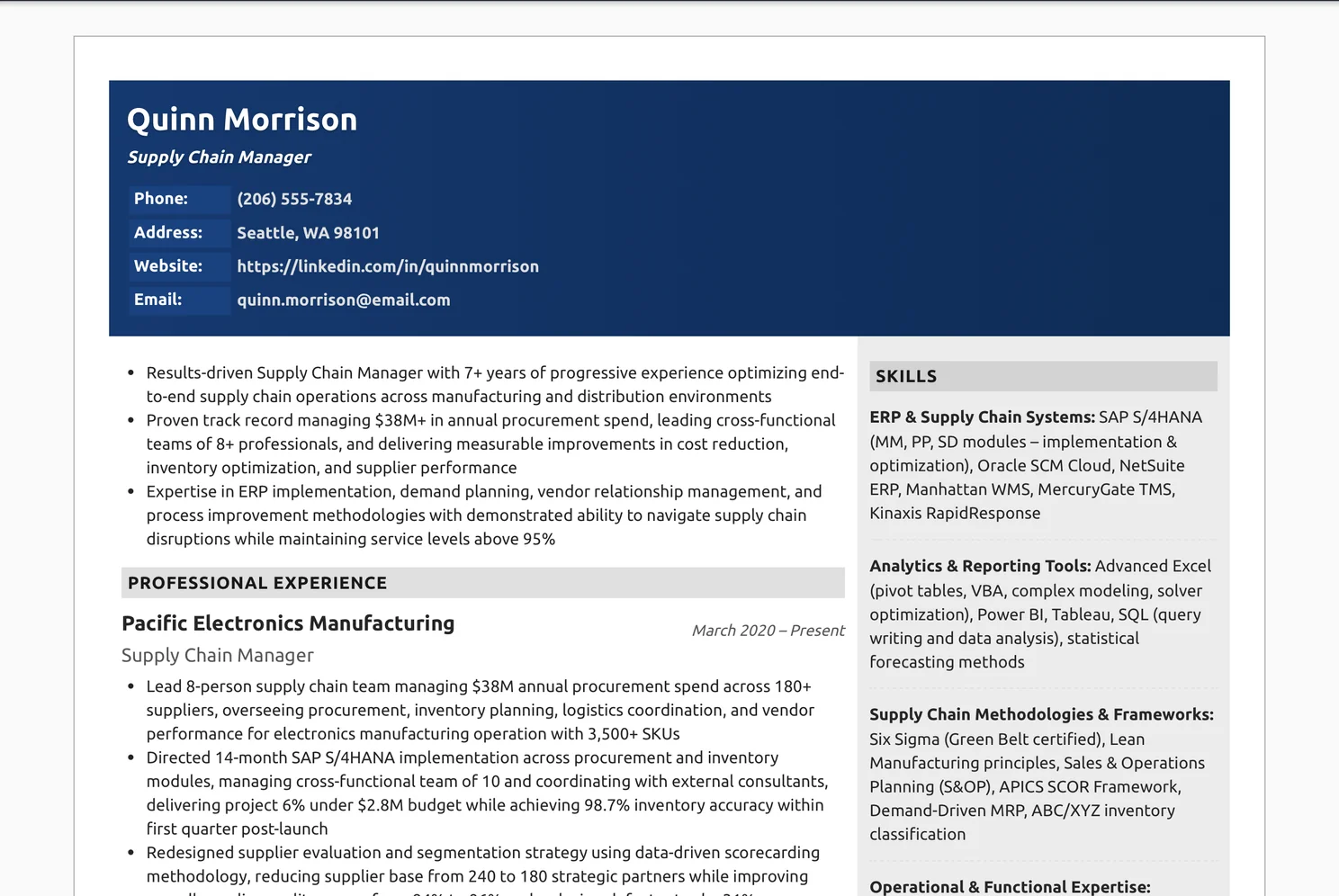
https://www.resumonk.com/supply-chain-managerSupply Chain ManagerResume Format to Follow for Supply Chain Manager Resume
The reverse-chronological format is your strongest ally here. This format lists your most recent position first and works backward through your career history, and it's particularly powerful for Supply Chain Manager roles because hiring managers want to see your progression through increasingly complex operational challenges.
They want to understand how you moved from managing a single warehouse to overseeing multi-site distribution, or how you evolved from handling domestic logistics to coordinating international freight operations.
Why Reverse-Chronological Works for Your Career Stage
At the Supply Chain Manager level, you typically have 5-10 years of experience under your belt.
You've likely moved through roles like Supply Chain Analyst, Logistics Coordinator, or Procurement Specialist before landing in management territory. The reverse-chronological format showcases this upward trajectory beautifully. It demonstrates that you didn't just land in a management role - you earned it through progressively responsible positions where you proved you could handle vendor negotiations, lead process improvements, and manage both systems and people.
This format also speaks to the nature of supply chain work itself. When you're interviewing for a Supply Chain Manager role, the hiring team wants to know what you've accomplished lately, what systems you're currently familiar with (SAP? Oracle? NetSuite?), and what modern challenges you've tackled (pandemic-related disruptions, sustainability initiatives, digital transformation). Starting with your most recent role ensures they see your current capabilities first, not the purchase order processing you did as a junior analyst seven years ago.
Structuring Your Supply Chain Manager Resume
Your resume should open with a brief professional summary (2-3 sentences maximum) that positions you clearly at the manager level - not as someone still doing primarily analytical work, and not as a senior executive setting enterprise-wide strategy. Following this, your work experience section should be substantial and detailed, as this is where you prove your operational management chops.
After work experience, include a skills section that demonstrates both your technical proficiency (supply chain software, methodologies like Six Sigma or Lean) and your managerial capabilities.
Education follows your skills section. By this career stage, unless you have a very recent MBA or specialized supply chain certification from a top program, your education is less important than your proven track record.
However, certifications like APICS CPIM, CSCP, or CLTD should be prominently displayed, as they're highly valued in supply chain roles and demonstrate continued professional development.
Length and Density Considerations
At the Supply Chain Manager level, a two-page resume is not just acceptable but often necessary to properly showcase your experience.
You're not entry-level where everything fits on one page, but you're also not a C-suite executive with a multi-page CV. Those two pages give you room to detail 3-4 substantial roles with meaningful accomplishments under each.
The key is ensuring every line earns its place - this isn't about padding, it's about providing enough context for decision-makers to understand the scale and complexity of what you've managed.
Work Experience on Supply Chain Manager Resume
Here's where the rubber meets the road. Your work experience section isn't just a list of where you've been - it's a narrative of increasingly complex problems you've solved, larger teams or budgets you've managed, and measurable improvements you've driven. Remember, as a Supply Chain Manager, you're being hired to make operations run smoother, faster, and cheaper while maintaining quality.
Every bullet point should whisper (or shout) that promise.
The Anatomy of a Strong Supply Chain Manager Work Entry
Each position you list should start with the basics: job title, company name, location, and dates of employment.
But here's where many supply chain professionals stumble - they list their job title without providing context about the operation they managed. "Supply Chain Manager" at a regional distributor handling 50 SKUs is vastly different from the same title at a manufacturer coordinating global procurement of 10,000+ components. Provide that context immediately after your title or in your first bullet point.
After establishing scope, your bullet points should follow a pattern: challenge or responsibility, action you took, and quantifiable result. Supply chain is beautifully measurable - you have inventory turns, carrying costs, on-time delivery rates, cost savings, lead time reductions, and countless other metrics. Use them religiously. A hiring manager reading your resume should be able to quickly assess whether you've managed operations at a similar scale and complexity to what they need.
Demonstrating the Manager-Level Difference
What separates a Supply Chain Manager from an analyst or coordinator?
You're not just executing tasks - you're designing processes, leading teams, negotiating strategic relationships, and making decisions that affect the bottom line. Your resume needs to show this elevation in responsibility.
❌ Don't write coordinator-level descriptions when you're applying for manager roles:
Processed purchase orders and tracked shipments for accuracy
✅ Do demonstrate the strategic and managerial nature of your work:
Led 6-person procurement team managing $45M annual spend across 200+ vendors, implementing category management strategy that reduced material costs by 12% while improving supplier quality scores from 87% to 94%
See the difference? The second example shows team leadership, budget responsibility, strategic initiative, and multiple measurable outcomes.
It positions you as someone who manages both people and processes to drive business results.
Showcasing Cross-Functional Impact
Supply Chain Managers live at the intersection of multiple departments.
You work with sales to forecast demand, with finance to manage working capital, with operations to optimize production schedules, with quality to resolve supplier issues, and with senior leadership to align supply chain strategy with business goals. Your resume should demonstrate this cross-functional influence.
❌ Don't write in a vacuum:
Managed inventory levels for the distribution center
✅ Do show how your work connected to broader business outcomes:
Collaborated with sales and finance teams to develop S&OP process, optimizing inventory investment and reducing stockouts by 35% while decreasing overall inventory carrying costs by $2.1M annually
Addressing Different Supply Chain Domains
Supply chain is a broad field, and your experience might emphasize different areas - procurement, logistics, warehousing, demand planning, or integrated end-to-end management. Structure your bullet points to lead with your strongest, most relevant domain expertise. If you're applying to a role focused on procurement transformation, lead with your vendor management and sourcing accomplishments.
If it's a logistics-heavy role, emphasize your distribution network optimization and freight management wins.
For your most recent role, aim for 6-8 bullet points covering the breadth of your responsibilities. For previous positions, 4-6 bullets are sufficient, focusing on the most impressive or relevant accomplishments.
As you go further back in your career history, reduce the detail - your early analyst role might warrant just 2-3 bullets highlighting skills that remain relevant.
Project Leadership and Implementations
By the manager level, you've likely led or heavily contributed to significant projects - ERP implementations, warehouse management system deployments, network optimization studies, or supplier consolidation initiatives. These deserve prominent placement in your work experience because they demonstrate your ability to drive change and manage complexity.
✅ When describing major projects, include timeline, budget (if you managed it), team size, and specific outcomes:
Directed 18-month implementation of Oracle Cloud SCM across 4 manufacturing sites, managing cross-functional team of 12 and coordinating with external consultants, delivering project on time and 8% under $3. 2M budget while achieving 99.1% inventory accuracy within first quarter post-launch
Skills to Show on Supply Chain Manager Resume
Walk into any supply chain manager interview, and you'll quickly discover that the hiring team is assessing two parallel skill tracks: your technical capabilities with systems and methodologies, and your ability to lead, influence, and drive organizational change. Your skills section needs to reflect this duality without becoming a sprawling list of every piece of software you've ever touched or every buzzword you've heard at a conference.
Technical and Systems Proficiency
Supply chain management has become increasingly technology-dependent. You're expected to be fluent in ERP systems, and often specialized supply chain software as well. But here's the nuance - at the manager level, you're not just a power user. You've likely been involved in system selection, implementation, or optimization.
Your skills section should list the systems, but your work experience section should prove you know how to leverage them for business outcomes.
Create a clear "Technical Skills" or "Systems & Tools" subsection that includes your ERP experience (SAP, Oracle, Microsoft Dynamics, etc.), supply chain planning tools (Kinaxis, Blue Yonder, o9 Solutions), warehouse management systems, transportation management systems, and relevant analytical tools (Advanced Excel, Tableau, Power BI). Be honest about your proficiency levels - if you've deeply implemented and configured SAP MM and PP modules, that's different from having used SAP in a previous role with limited exposure.
❌ Don't create an undifferentiated list:
SAP, Excel, Oracle, Supply Chain Management, Logistics, ERP Systems, Microsoft Office
✅ Do organize logically and demonstrate depth:
1. ERP & Supply Chain Systems: SAP (MM, PP, SD modules - implementation & optimization), Oracle SCM Cloud, Manhattan WMS, MercuryGate TMS
2. Analytics & Reporting: Advanced Excel (pivot tables, VBA, complex modeling), Tableau, Power BI, SQL (query writing)
3. Methodologies: Six Sigma (Green Belt), Lean Manufacturing, S&OP, APICS SCOR Framework
Operational and Functional Expertise
Beyond systems, you have domain expertise in specific supply chain functions. This might include procurement and strategic sourcing, demand planning and forecasting, inventory optimization, logistics and transportation management, warehousing and distribution, or supplier relationship management.
These aren't just keywords - they represent areas where you can walk in and add value from day one.
The key is matching your skills emphasis to the role you're targeting. Review the job description carefully. If it emphasizes procurement and supplier management, ensure those capabilities are prominent and supported by strong examples in your work experience.
If it's focused on logistics network optimization, lead with those skills.
Managerial and Leadership Capabilities
Here's where many supply chain professionals undersell themselves.
You're not an individual contributor anymore - you've managed teams, led cross-functional initiatives, influenced stakeholders without direct authority, and navigated organizational politics to get things done. These leadership capabilities are often what differentiate a good candidate from a great one at the manager level.
Include a section for "Leadership & Business Skills" that captures capabilities like team development and mentoring, cross-functional collaboration, change management, vendor negotiation, budget management, and project leadership. These shouldn't be vague claims - they should connect directly to examples in your work experience.
Certifications and Methodologies
Supply chain certifications carry significant weight in this field.
APICS certifications (CPIM, CSCP, CLTD) are industry-standard credentials that demonstrate your theoretical foundation and commitment to the profession. Six Sigma certifications (Green Belt or Black Belt) show you can drive process improvement with rigor. If you're working in specialized industries, certifications like C-TPAT (customs security) or HAZMAT handling might be relevant.
List these prominently, either in your skills section or in a dedicated certifications section. Include the full name of the certification, the issuing organization, and the year obtained if it's recent.
If you're currently pursuing a certification, you can note it as "in progress" with an expected completion date.
Industry-Specific Knowledge
Supply chain practices vary significantly across industries. Managing automotive supply chains with their complex tiering, JIT requirements, and quality standards is different from consumer packaged goods with their retailer demands and promotional complexity, which differs from pharmaceutical supply chains with their regulatory requirements and cold chain considerations.
If you have deep experience in a specific industry, make it clear in your skills section, as this expertise is often highly valued by employers in the same sector.
Specific Considerations and Tips for Supply Chain Manager Resume
You're operating in a field that's been thrust into the spotlight over the past few years. Supply chain went from being the behind-the-scenes function that nobody thought about to front-page news during pandemic disruptions, to a strategic priority for organizations trying to build resilience and agility.
This context matters for your resume because hiring managers are looking for people who've proven they can navigate complexity, ambiguity, and rapid change.
Emphasizing Crisis Management and Resilience
If you've been working in supply chain over the past 3-5 years, you've dealt with extraordinary disruptions - pandemic impacts, component shortages, logistics bottlenecks, supplier failures, port congestion, and more.
Don't shy away from these challenges in your resume. In fact, explicitly calling out how you navigated crisis situations demonstrates exactly the kind of adaptive leadership organizations want. Did you establish dual sourcing to mitigate risk? Pivot to alternate transportation modes when ocean freight became impossible? Implement improved visibility tools to anticipate disruptions? These experiences are gold.
✅ Frame disruption management as a positive differentiator:
Navigated 2021-2022 supply crisis by diversifying supplier base across 3 geographic regions, establishing safety stock protocols for critical components, and implementing weekly cross-functional risk reviews, maintaining 96% on-time delivery despite industry-wide disruptions
Balancing Cost and Service
Every supply chain manager lives with tension between competing objectives - reduce costs while improving service, minimize inventory while preventing stockouts, optimize for efficiency while building in resilience. Your resume should demonstrate that you understand this complexity and can make smart tradeoffs.
Avoid bullet points that claim you improved everything simultaneously without acknowledging constraints or difficult decisions.
❌ Don't make unrealistic claims:
Reduced inventory by 40% while improving customer service levels to 99%
✅ Do show strategic decision-making and nuanced thinking:
Redesigned inventory strategy using ABC analysis and service-level differentiation, reducing overall inventory investment by 22% while strategically increasing safety stock for A-items, improving fill rate for top customers from 94% to 98% while accepting 89% fill rate for C-items
Demonstrating Digital and Analytical Sophistication
Supply chain is becoming increasingly data-driven and technology-enabled. At the manager level, you're expected to be comfortable with analytics - not just reviewing dashboards, but asking good questions, identifying patterns, and making data-informed decisions.
If you've worked with advanced analytics, predictive modeling, machine learning applications, or automation/robotics in logistics operations, these experiences differentiate you significantly.
Similarly, awareness of emerging supply chain technologies shows you're forward-thinking. Have you explored or implemented IoT sensors for real-time tracking? Used control tower platforms for supply chain visibility? Leveraged RPA to automate routine transactions? Piloted blockchain for supply chain traceability?
Even if these aren't mature implementations, demonstrating awareness and experimental mindset matters.
Quantifying Scope and Scale Appropriately
Supply chain roles vary enormously in scope, and hiring managers need to quickly understand whether you've managed operations at a similar scale.
Throughout your resume, provide clear indicators of scope: annual spend managed, number of SKUs or products, number of vendors or suppliers, size of team supervised, number of facilities or sites, geographic coverage, order volume, inventory value, or fleet size. These contextual details help calibrate your experience against the role requirements.
If you're applying to larger organizations from a smaller company background, emphasize the breadth of your responsibilities (wearing multiple hats, end-to-end ownership) and your ability to build processes from scratch. If you're moving from a large corporate environment to a smaller company, highlight your ability to drive results without unlimited resources and your comfort with strategic ambiguity.
Addressing International vs. Domestic Experience
Global supply chain experience is valuable but requires different capabilities than domestic operations - managing customs and compliance, navigating international payment terms and currency fluctuations, coordinating across time zones and cultural contexts, and understanding regional logistics infrastructure.
If the role you're targeting involves international operations and you have this experience, make it prominent. If you don't have international experience but the role requires it, emphasize transferable skills like complexity management and vendor relationship building.
Sustainability and ESG Considerations
Sustainability has moved from nice-to-have to business imperative for many organizations.
If you've worked on carbon footprint reduction, circular supply chain initiatives, sustainable sourcing programs, packaging optimization, or supply chain transparency for ESG reporting, include these accomplishments. They demonstrate strategic awareness and alignment with current business priorities.
Handling Career Transitions Within Supply Chain
Many supply chain professionals start in one domain (like procurement) and gradually broaden into integrated supply chain management, or they move from industry to industry.
If your career shows this evolution, frame it as intentional capability building rather than random job hopping. Use your professional summary or cover letter to connect the dots, showing how each move added complementary skills that make you a stronger end-to-end supply chain manager.
Regional Considerations
Supply chain terminology and certifications vary somewhat by region. In North America, APICS certifications (now part of ASCM) are standard. In Europe, CIPS (Chartered Institute of Procurement & Supply) credentials are common for procurement-focused roles. In the UK, you might see more emphasis on "supply chain director" or "head of supply chain" rather than VP-level titles common in the US. In Australia, experience with regional logistics challenges (longer distances, smaller market) should be highlighted when relevant.
Tailor your resume language and emphasis to match regional norms of where you're applying.
Final Polish
Your resume represents your attention to detail - a critical capability in supply chain where one decimal point or wrong unit of measure can cost thousands. Proofread relentlessly. Have someone else review it. Ensure consistency in date formatting, verb tense (past tense for previous roles, present tense for current role), and bullet point structure.
Check that every quantified claim is accurate - supply chain people deal in facts and figures, and credibility is everything.
Education Credentials for Your Supply Chain Manager Resume
Here's the thing about education on your Supply Chain Manager resume: it matters, but probably not in the way you think it does. Unlike entry-level supply chain coordinator roles where your degree is scrutinized heavily, or executive director positions where your MBA from a top-tier school carries significant weight, the Supply Chain Manager position sits in this interesting middle ground.
Hiring managers are looking for a blend - they want to see you have the foundational knowledge, but they're far more interested in what you've done with it.
Positioning Your Degree Strategically
Most Supply Chain Managers come from one of several educational backgrounds: Business Administration with a focus on Operations, Industrial Engineering, Logistics and Supply Chain Management, or sometimes even unexpected fields like Mathematics or Economics. The reality is that unless you're fresh out of school (in which case, you're probably not quite ready for a manager-level role yet), your education section should appear after your professional experience on your resume.
The reverse-chronological format works best here. List your most recent or highest degree first, followed by earlier qualifications. But here's where Supply Chain Management differs from other fields: certifications often carry equal or greater weight than your bachelor's degree. That APICS CPIM or CSCP certification? That ISM CPSM designation?
Those aren't just letters after your name - they're proof you've invested in specialized knowledge that directly applies to supply chain optimization.
What to Include and What to Skip
For each educational entry, you need the degree name, the institution, location, and graduation year.
But there's nuance here depending on where you are in your career trajectory. If you graduated within the last five years, including your GPA (if it's above 3.5) and relevant coursework or academic projects can strengthen your candidacy. If you completed a capstone project on supplier risk assessment or wrote a thesis on demand forecasting models, that's relevant context.
However, if you've been in the workforce for seven or more years and have managed multi-million dollar procurement budgets or led cross-functional teams through a warehouse management system implementation, nobody cares that you took "Introduction to Operations Research" in your sophomore year. Your experience speaks louder.
The Certification Question
Here's where Supply Chain Manager resumes get interesting. You might create a separate "Certifications" subsection within your Education section, or depending on how many you have, a standalone section altogether. Certifications like APICS CPIM (Certified in Production and Inventory Management), APICS CSCP (Certified Supply Chain Professional), ISM's CPSM (Certified Professional in Supply Management), or even Six Sigma Green Belt or Black Belt certifications are industry gold standards.
They demonstrate you're not just managing by gut instinct but by proven methodologies.
When listing certifications, include the full name (not everyone knows acronyms), the issuing organization, and the year obtained or your credential ID if relevant. If you're currently pursuing a certification, that's worth mentioning too.
❌ Don't write vague education entries:
Bachelor's Degree
State University
2015
✅ Do provide complete, relevant details:
Bachelor of Science in Supply Chain Management | Arizona State University, Tempe, AZ
- Graduated: May 2015
- Relevant Coursework: Global Logistics, Procurement Strategy, Demand Planning
International Degree Considerations
If you earned your degree outside the country where you're applying, this requires some additional thought.
In the United States, employers generally understand international degrees if you include the equivalent (for example, "Bachelor of Commerce - equivalent to U.S. Bachelor of Science in Business Administration"). For Canada, the UK, and Australia, the Bologna Process and mutual recognition agreements mean most degrees translate fairly directly, but it never hurts to clarify if your degree title might be unfamiliar.
The MBA Decision Point
Many Supply Chain Managers pursue or possess an MBA, often with a concentration in Operations or Supply Chain Management.
If you have one, it absolutely belongs on your resume, but position it thoughtfully. An MBA from a well-regarded program (not necessarily Harvard, but a solid regional school with a strong supply chain program like Michigan State or Penn State) adds credibility to your strategic thinking capabilities. However, if you have an MBA but it's in an unrelated field like Marketing or Finance, you can still list it - just don't expect it to carry the same weight as domain-specific graduate education.
Ongoing Education and Professional Development
Supply chain management evolves rapidly. What worked five years ago for inventory optimization might be obsolete with today's AI-driven forecasting tools. If you've taken recent professional development courses - perhaps in supply chain analytics, blockchain in logistics, or sustainable sourcing - these demonstrate you're keeping pace with industry evolution.
You might include a brief "Professional Development" subsection listing recent, relevant training, especially if it's from recognized organizations like APICS, ISM, or industry-specific providers.
One final thought: if you're transitioning from a related field into Supply Chain Management (perhaps you were a procurement specialist or a logistics coordinator stepping up), your education section can help bridge that gap. Highlighting relevant coursework or projects that demonstrate your understanding of end-to-end supply chain principles can reassure hiring managers that you understand the bigger picture, not just your previous specialized function.
Showcasing Awards and Publications on Your Supply Chain Manager Resume
Awards and publications can look like extras, yet here's the paradox: at the Supply Chain Manager level, distinguishing yourself from other qualified candidates often comes down to these "extra" accomplishments. You're competing against people who also have five to eight years of experience, who also understand the difference between push and pull inventory systems, who also know how to read a supply chain network map.
Awards and publications aren't just ego boosters - they're evidence that you've contributed to the field beyond your day-to-day responsibilities.
Understanding What Counts as an Award
In supply chain management, awards come in several flavors, and they're not all created equal. There are internal company awards (Employee of the Quarter, Operations Excellence Award, Innovation Champion), professional organization recognition (APICS Chapter awards, industry-specific honors), and broader business awards (sometimes companies enter supply chain projects into business excellence competitions).
The key question is relevance and credibility. That "Perfect Attendance" award from 2019? Skip it. But if you received your company's "Operational Excellence Award" for leading a project that reduced logistics costs by 18% while improving delivery times, that absolutely belongs on your resume.
It's third-party validation (even if internal) of your impact.
How to List Awards Effectively
You have options for where to place awards on your Supply Chain Manager resume.
If you have only one or two significant awards, you can incorporate them directly into your work experience section, contextualizing them within the achievements that earned you the recognition. If you have three or more substantial awards, create a dedicated "Awards & Recognition" section, typically placed after your work experience but before education.
When you list an award, provide three key pieces of information: the award name, the granting organization or company, and the year received. But don't stop there. The "why" matters enormously. A single sentence explaining what you did to earn this recognition transforms it from a name-drop into a credibility builder.
❌ Don't list awards without context:
Supply Chain Excellence Award, 2022
Cost Savings Champion, 2021
✅ Do explain the significance and your achievement:
1. Supply Chain Excellence Award, GlobalTech Industries, 2022
- Recognized for redesigning the supplier evaluation process, resulting in a 24% reduction in quality defects and improved on-time delivery rates from 87% to 96% across a network of 35 vendors.
2. Cost Savings Champion Award, GlobalTech Industries, 2021
- Honored for negotiating multi-year contracts with strategic suppliers that achieved $340,000 in annual cost reductions while maintaining quality standards.
The Publications Landscape for Supply Chain Managers
Here's where things get interesting, because unlike academic researchers or C-level executives, Supply Chain Managers aren't typically publishing peer-reviewed journal articles. But that doesn't mean publications are irrelevant - it just means we need to expand our definition of what "counts" as a publication in your field.
Have you written articles for industry publications like Supply Chain Management Review, Inbound Logistics, or Logistics Management? Have you contributed to your company's blog or internal knowledge base with case studies on successful projects? Have you been quoted as a subject matter expert in trade publications? Have you presented at industry conferences (conference proceedings often count as publications)? These all demonstrate thought leadership and deep expertise.
For Supply Chain Managers specifically, the most common publications are: case studies detailing successful implementations or process improvements, articles on best practices or emerging trends (perhaps about supply chain resilience or sustainable sourcing), white papers for vendor partners or industry associations, and conference presentations or webinar content.
When Publications Actually Matter
Let's be practical. If you're applying to a traditional manufacturing company for a Supply Chain Manager role focused on day-to-day operations, publications are nice-to-have but not essential.
However, if you're aiming for roles at consulting firms, technology companies building supply chain solutions, or positions with a strong strategic component, publications signal that you're not just a doer but a thinker - someone who can analyze problems, synthesize solutions, and communicate complex ideas.
Publications also matter when you're making a vertical move. If you're currently a Supply Chain Manager but aiming for a Senior Supply Chain Manager or Director-level role, publications demonstrate that you're operating at a strategic level, contributing to industry knowledge rather than just applying it.
How to Format Publications
If you have publications worth listing, create a dedicated section on your resume. Use a consistent citation format - it doesn't need to be APA or MLA perfect, but it should be professional and include the publication title (in quotes), the name of the journal or venue (italics if you're using rich text, or just clear formatting if plain text), date, and your role (author, co-author, contributor).
❌ Don't list vague or unverifiable publications:
Article about supply chain, 2023
Conference talk on inventory management
✅ Do provide complete, credible citations:
1. "Building Supply Chain Resilience Through Supplier Diversification: A Case Study" - Supply Chain Management Review, March 2023
- Co-authored with Sarah Chen, detailed a 14-month project reducing single-source dependencies from 40% to 12% of critical components."Implementing Demand-Driven Inventory Optimization in Mid-Sized Manufacturing"2. APICS Annual Conference, October 2022
- Presented findings from a successful implementation that reduced inventory carrying costs by $280,000 annually while improving service levels.
The Reality Check
Here's the truth: most Supply Chain Managers won't have a robust publications section, and that's completely fine.
This isn't academia where publish-or-perish rules apply. If you have no publications, don't invent some or pad this section with irrelevant content. A resume without a publications section is perfectly acceptable and won't hurt your candidacy for the vast majority of Supply Chain Manager positions.
However, if you do have legitimate awards and publications, failing to include them is leaving credibility on the table. They're proof points that you're recognized by others - your company, your industry, your peers - as someone who delivers results and contributes meaningfully to the field. In a competitive job market where multiple candidates have similar experience and qualifications, these distinguishers can be the deciding factor.
Building Toward Future Awards and Publications
If you're reading this and thinking "I don't have any of these," consider it a forward-looking opportunity. Volunteer to present at your local APICS or ISM chapter meeting about a project you've led. Write an article for an industry publication sharing lessons learned from a successful (or failed) implementation. Document your successes in ways that could be recognized internally.
These aren't distractions from your work - they're extensions of it that build your professional reputation and create opportunities for career advancement.
Managing References for Your Supply Chain Manager Application
Let's clear up the confusion and approach this systematically, because that's what supply chain professionals do best.
Should References Appear on Your Resume?
The short answer is no - not the actual references themselves.
The phrase "References available upon request" that used to appear at the bottom of resumes is now considered outdated and unnecessary. Hiring managers assume you have references. Using valuable resume real estate to state the obvious doesn't add value, and in a field where you're trying to demonstrate efficiency and optimization skills, wasting space sends the wrong message.
However, there's a critical difference between including references on your resume and being prepared with a well-organized reference list when asked. The latter is essential. Many Supply Chain Manager candidates lose momentum in the hiring process because they're scrambling to contact potential references at the last minute, or worse, they provide references who aren't properly prepared and give lukewarm or unfocused feedback.
Timing and the Reference Request
For Supply Chain Manager positions, references typically come into play at one of two stages: either just before a final interview (when the company has narrowed to two or three candidates), or between the final interview and the offer (as a final validation before extending an offer). Some organizations, particularly larger corporations with formal HR processes, make reference checks a standard part of their process for all candidates who reach the final round.
Understanding this timing helps you prepare strategically. You should have your reference list ready from the moment you start seriously interviewing, but you likely won't be asked for it until you've already had at least one substantive conversation with the hiring manager.
Who Makes a Strong Reference for Supply Chain Manager Roles?
This is where context matters enormously. The strongest references are people who can speak credibly to your capabilities in areas directly relevant to supply chain management: your ability to manage vendor relationships, optimize processes, collaborate cross-functionally, solve complex logistics challenges, and (if the role involves it) lead teams.
Ideal references typically include: your direct supervisor from your current or most recent role (though if you're confidentially job searching, this may not be possible until later), a senior leader you've worked closely with (perhaps a Director of Operations or VP of Supply Chain who can speak to your strategic impact), cross-functional partners who can discuss your collaboration skills (a Manufacturing Manager, Sales Director, or Finance Controller who worked with you on projects), and for team leadership roles, potentially someone you managed or mentored who can speak to your leadership approach.
What hiring managers want to hear from your references is specific examples of your work, concrete results you achieved, and insights into how you operate under pressure or solve complex problems. Generic praise ("She was great to work with") doesn't carry much weight.
Specific stories ("When we faced a critical supplier failure, he identified and qualified an alternative source within 72 hours, maintaining our production schedule") are gold.
Preparing Your References Properly
Here's where many candidates stumble.
They identify people who would be willing to serve as references, but they don't actually prepare them properly. Your references should never be surprised by a call from a potential employer. Proper preparation involves several steps.
First, ask permission explicitly and explain the type of role you're pursuing. Don't assume that because someone said three years ago they'd be a reference, they're still willing and available. People change companies, take on new responsibilities, or have personal circumstances that affect availability.
Second, provide context about the role you're pursuing and what you hope they'll emphasize. If you're applying for a Supply Chain Manager role heavily focused on supplier quality management, and one of your references worked with you extensively on a supplier quality improvement project, let them know that's particularly relevant. You're not coaching them to be dishonest - you're helping them understand what aspects of your work together are most relevant to highlight.
Third, refresh their memory about your accomplishments, especially if you haven't worked together recently. Send a brief email outlining key projects you worked on together and results you achieved.
This isn't about putting words in their mouth - it's about ensuring they can speak knowledgeably and specifically rather than offering vague generalities.
Creating Your Reference List Document
When you're asked to provide references, you should have a polished, professional document ready to send immediately.
This should be a separate document from your resume, formatted consistently with your resume for visual cohesion (same header, font choices, etc.), but clearly labeled "References for [Your Name]."
For each reference, include: their full name, their job title and company, their relationship to you (Former Direct Supervisor, Cross-Functional Partner, etc.), their contact information (phone number and email - confirm these are current and that they prefer to be contacted this way), and optionally, a single sentence describing your working relationship or what they can speak to.
Aim for three to four references. Three is standard and sufficient for most Supply Chain Manager roles. Four gives some backup if one reference proves difficult to reach.
More than four seems excessive and may not all be contacted anyway.
❌ Don't create a minimal, unclear reference list:
References:
John Smith - (555) 123-4567
Mary Johnson - [email protected]
Bob Williams - Former Manager
✅ Do provide complete, professional reference information:
References for [Your Name]
1.David Chen, Operations Director, GlobalTech Manufacturing
- Former Direct Supervisor (2020-2023)
- Phone: (555) 123-4567 | Email: [email protected]
- Can speak to vendor management capabilities, cost reduction initiatives, and cross-functional leadership
2. Sarah Martinez, Senior Procurement Manager, GlobalTech Manufacturing
- Cross-Functional Partner (2019-2023)
- Phone: (555) 234-5678 | Email: [email protected]
- Can speak to collaboration on supplier diversification projects and contract negotiation
3. Michael O'Brien, Director of Supply Chain, Midwest Distribution Inc.
- Former Supervisor (2018-2020)
- Phone: (555) 345-6789 | Email: [email protected]
- Can speak to inventory optimization work and team leadership experience
Special Circumstances and How to Handle Them
What if you're currently employed and can't use your current supervisor as a reference because you're confidentially job searching?
This is common and completely understandable. You can address this proactively when asked for references by noting that you're conducting a confidential search and would prefer your current employer not be contacted until an offer stage. Then provide former supervisors or, if possible, senior leaders at your current company who you trust with confidentiality (though this requires careful judgment).
What if you've been with your current company for many years and most of your references are from the same organization? That's fine, as long as they represent different perspectives on your work - a supervisor, a cross-functional partner, perhaps someone from a different business unit or someone you led. The diversity of perspective matters more than diversity of companies.
What if you left a previous position on less-than-ideal terms and worry about a negative reference? First, you're not required to include that person as a reference. Choose people who can speak positively and credibly about your work. Second, if you know a particular reference might be problematic, consider addressing it proactively in interviews if it comes up (without badmouthing anyone).
Most hiring managers understand that not every professional relationship ends perfectly.
Regional and Industry Variations
Reference practices vary somewhat by region. In the United States and Canada, reference checks are standard practice for professional roles like Supply Chain Manager, typically conducted by phone. In the UK and Australia, written references (sometimes called "testimonials") are more common, though phone references are increasingly used as well.
Know the norms in your region and be prepared accordingly.
Some industries or companies have formal reference check processes with standardized questions. Government contractors or companies in regulated industries (pharmaceuticals, aerospace, etc.) may have more extensive reference requirements. Larger corporations often outsource reference checks to third-party firms.
Be prepared for various formats, and ensure your references know they might be contacted via an online form, by phone, or even by a third-party service.
Following Up After Your References Are Contacted
Professional courtesy dictates that you follow up with your references after they've been contacted, regardless of the outcome.
If you get the job, let them know and thank them for their support. If you don't, still thank them and let them know you may ask for their support again in future job searches.
Maintaining these relationships is part of professional network management, and supply chain management is often a surprisingly small world - you'll likely work with some of these people again, or at minimum, cross paths at industry events.
The Bottom Line on References
References are validation, not persuasion. By the time a company is checking your references, they're already interested in you - they're just confirming what they already believe.
Your job is to make that confirmation process as smooth and positive as possible by providing well-prepared, credible references who can speak specifically and positively about your capabilities.
Don't leave this to the last minute. Don't assume people remember your accomplishments as clearly as you do. Don't provide references without preparing them. And absolutely don't lie or exaggerate - reference fraud is easily discovered and career-ending.
Approach references with the same systematic, thoughtful planning you'd apply to a complex supply chain problem, because in a sense, that's exactly what it is: optimizing a process to achieve a desired outcome with quality inputs and clear execution.
Crafting an Effective Cover Letter for Your Supply Chain Manager Application
Here's what you need to understand about cover letters for Supply Chain Manager positions: they matter more than you think, but not for the reasons you might assume. Hiring managers aren't reading your cover letter to learn where you went to school (that's on your resume) or even necessarily to gauge your enthusiasm (everyone claims to be enthusiastic).
They're reading it to answer one specific question: Does this person understand what we actually need, and can they solve our specific problems?
Why Supply Chain Manager Cover Letters Are Different
Supply chain management is fundamentally about understanding systems, identifying bottlenecks, and implementing solutions. A good cover letter for this role demonstrates exactly those capabilities - you've analyzed what the company needs (based on the job description, company research, and industry context), you've identified where your experience aligns with those needs, and you're proposing yourself as the solution.
Unlike creative roles where your cover letter might showcase personality and storytelling, or executive roles where it might emphasize vision and leadership philosophy, a Supply Chain Manager cover letter should be strategic, specific, and solutions-oriented. Think of it as a mini-case study with you as the central resource.
The Opening: Skip the Platitudes
Most cover letters start with some variation of "I am writing to express my strong interest in the Supply Chain Manager position." This is wasted real estate. The hiring manager knows why you're writing - you want the job.
Instead, open with something that demonstrates you understand their business context or challenges.
Research the company. Are they expanding into new markets? Did they recently announce a sustainability initiative? Are they in an industry facing supply chain disruption (semiconductors, pharmaceuticals, consumer goods)?
Reference something specific that shows you've done your homework, then connect it to your relevant experience.
❌ Don't write generic, obvious openings:
I am writing to apply for the Supply Chain Manager position at ABC Corporation. I have five years of experience in supply chain management and believe I would be a great fit for your team.
✅ Do demonstrate research and relevant insight:
ABC Corporation's recent expansion into Southeast Asian markets presents complex supply chain challenges that I've successfully navigated in my current role. Over the past three years, I've managed supplier onboarding and logistics coordination across Vietnam, Thailand, and Malaysia, reducing average lead times by 22% while maintaining quality standards across a culturally and operationally diverse supplier base.
The Body: Connect Your Experience to Their Needs
The job description is your roadmap.
Read it carefully and identify the three to four most critical requirements. These might be things like "vendor management experience," "inventory optimization," "cross-functional collaboration," or "ERP system implementation." Your cover letter body should address these specific needs with concrete examples from your experience.
This is where Supply Chain Manager candidates often stumble. They list responsibilities they've had rather than outcomes they've achieved. Remember, the hiring manager doesn't just want to know you've "managed vendor relationships" - they want to know you've improved them, optimized them, or solved problems through them.
Structure this section with clear, concise paragraphs, each addressing a key requirement. Use specific metrics and outcomes wherever possible. Supply chain is a quantitative field, so numbers give credibility. Reduced costs by what percentage? Improved on-time delivery from what baseline to what result?
Managed how many SKUs or how large an inventory value?
Addressing the Specific Challenges
If the job description mentions specific challenges or projects (like implementing a new WMS, transitioning to a demand-driven supply chain model, or establishing nearshoring relationships), address these directly. Describe similar challenges you've faced and how you approached them.
This isn't about claiming you have all the answers - it's about demonstrating relevant problem-solving experience.
For instance, if the role involves managing a team (many Supply Chain Manager positions oversee 2-5 direct reports like buyers, planners, or coordinators), discuss your leadership experience. If it involves heavy cross-functional collaboration with sales, operations, and finance, share specific examples of how you've successfully navigated competing priorities and organizational complexity.
❌ Don't make vague claims without evidence:
I am an experienced supply chain professional with strong vendor management skills and a proven track record of success. I work well in team environments and am highly motivated to achieve results.
✅ Do provide specific, quantified examples:
In my current role at XYZ Manufacturing, I manage relationships with 28 strategic suppliers across raw materials and components. When our primary steel supplier faced capacity constraints in early 2023, I led a cross-functional team including Engineering, Quality, and Finance to qualify and onboard two alternative suppliers within six weeks, avoiding a potential production shutdown that would have cost $45,000 per day in lost output.
The Cultural and Operational Fit
Supply chain roles exist in vastly different contexts. A Supply Chain Manager at a fast-growth e-commerce company operates in a completely different environment than one at an established automotive manufacturer. The former might prize agility, rapid decision-making, and comfort with ambiguity.
The latter might value process discipline, risk management, and systematic improvement.
Your cover letter should signal you understand and fit the operational culture. If you're applying to a startup or high-growth company, emphasize examples where you've built processes from scratch, adapted to rapid change, or worn multiple hats. If you're applying to a large, established corporation, emphasize your experience with structured systems, compliance, and continuous improvement methodologies.
Regional Variations That Matter
Cover letter expectations vary by region. In the United States, cover letters for Supply Chain Manager roles are typically one page, direct, and results-focused. Canadian expectations are similar, though slightly more formal in tone. In the United Kingdom and Australia, cover letters might be slightly longer (up to 1.5 pages) and can include more context about your career progression and motivation.
For all regions, avoid overly casual language, but equally avoid corporate jargon that says nothing ("synergistic approach to value-added supply chain optimization"). Write like a competent professional speaking to another competent professional about solving real business problems.
The Closing: Clear and Action-Oriented
Your closing paragraph should do three things: briefly reinforce why you're a strong fit, express genuine interest in discussing the role further, and provide clear next steps. Avoid passive constructions like "I look forward to hearing from you" in favor of more active language.
❌ Don't end passively or presumptuously:
I look forward to hearing from you soon. I am available to start immediately.
I am confident I am the best candidate for this position and look forward to your call.
✅ Do close with confidence and clarity:
The combination of vendor management expertise, inventory optimization experience, and cross-functional leadership I've developed over the past six years directly addresses the challenges outlined in your job description. I'd welcome the opportunity to discuss how my approach to building resilient, cost-effective supply chains could contribute to ABC Corporation's continued growth in Southeast Asian markets. I'm available for a conversation at your convenience and can be reached at (555) 123-4567 or [email protected].
The Practical Realities
Here's something nobody tells you: not every hiring manager will read your entire cover letter.
Some will skim it in thirty seconds. Some won't read it at all if your resume doesn't immediately interest them. But many will read it carefully, especially when choosing between several qualified candidates. And in those situations, a well-crafted cover letter can be the difference between getting an interview and being passed over.
So write it well, but don't agonize over every word for hours. Spend 60-90 minutes researching the company, identifying the key requirements, and crafting specific, relevant examples. Then move on. A good cover letter doesn't need to be perfect - it needs to be professional, specific, and convincing.
What Not to Include
Don't rehash your entire resume.
Don't explain why you're leaving your current job (unless there's a very compelling, positive reason like relocation for family or seeking larger scale). Don't apologize for perceived weaknesses ("Although I don't have experience with Oracle ERP specifically..."). Don't use generic templates that could apply to any role. And please, don't rely on AI to write it without heavily customizing - hiring managers can spot generic AI-generated cover letters, and they create the impression that you couldn't be bothered to invest effort in the application.
Your cover letter is a strategic document. Treat it that way, and it becomes a powerful tool in your job search.
Key Takeaways
Creating an effective Supply Chain Manager resume requires understanding exactly what distinguishes this mid-level management role from both entry-level coordination work and senior executive strategy. As you build your resume, keep these essential principles in mind:
- Use the reverse-chronological format to showcase your progression through increasingly complex operational challenges, starting with your most recent and relevant experience first.
- Position yourself clearly at the manager level by demonstrating not just task execution but strategic process design, team leadership, vendor negotiation, and decision-making authority that affects business outcomes.
- Quantify relentlessly throughout your work experience using the metrics that matter in supply chain - cost savings, inventory turns, on-time delivery rates, lead time reductions, quality improvements, and the scope of budgets or teams you've managed.
- Demonstrate cross-functional impact by showing how your work connected to broader business objectives, involving collaboration with sales, finance, operations, quality, and leadership.
- Balance technical and leadership capabilities in your skills section, showcasing both your proficiency with systems and methodologies (ERP platforms, supply chain software, Six Sigma, Lean) and your managerial abilities (team development, stakeholder management, change leadership).
- Provide context about operational scope throughout your resume - annual spend managed, number of SKUs, vendor count, team size, facility coverage, geographic reach - so hiring managers can calibrate your experience against their requirements.
- Address current supply chain realities including crisis management and resilience-building, digital transformation and analytical sophistication, and sustainability initiatives that reflect the field's evolution.
- Tailor your emphasis to the specific role by leading with domain expertise most relevant to the position - whether that's procurement, logistics, warehousing, demand planning, or integrated supply chain management.
- Keep certifications prominent as credentials like APICS CPIM, CSCP, or Six Sigma carry significant weight in demonstrating your commitment to professional development and mastery of supply chain methodologies.
- Support your resume with a targeted cover letter that demonstrates you understand the company's specific challenges and can connect your experience directly to their needs with concrete, relevant examples.
Creating your Supply Chain Manager resume doesn't have to be an isolated struggle with formatting, layout concerns, or wondering whether you've struck the right tone. Resumonk provides an intuitive platform where you can build a professionally designed resume that showcases your supply chain expertise effectively. With AI-powered recommendations tailored to your experience level and industry, you'll receive intelligent suggestions for strengthening your accomplishments, quantifying your impact, and positioning yourself appropriately for manager-level roles. Choose from beautifully designed templates that maintain visual professionalism while letting your operational achievements take center stage, and easily customize sections to emphasize procurement, logistics, inventory management, or whichever supply chain domains matter most for your target roles.
Ready to create a Supply Chain Manager resume that gets you interviews?
Start building your professional resume on Resumonk today with AI-powered guidance, proven templates, and intuitive tools designed for experienced professionals like you.
Get started now and take the next step in your supply chain career.
More Transportation & Logistics resume examples
- Warehouse Worker resume example
- Truck Driver resume example
- UPS Package Handler resume example
- Flight Attendant resume example
See all Transportation & Logistics resume examples, or browse every category.
Resume writing tips
You're staring at a blank page, trying to figure out how to compress years of coordinating shipments, negotiating with vendors, optimizing inventory levels, and putting out a thousand logistical fires into a document that somehow gets you into that next role. A Supply Chain Manager position sits in an interesting middle ground - you're past the coordinator and analyst stages, but you're not yet the Director or VP calling the strategic shots.
You're the operational backbone, the person who makes sure theory turns into delivered goods, and your resume needs to reflect that gravitational center of expertise.
This is where the search for the right resume example becomes critical. You're not looking for generic templates that could apply to any business role. You need something that speaks the language of supply chain management - that understands the difference between managing a procurement budget and simply processing purchase orders, between optimizing a distribution network and just coordinating shipments. You're looking for guidance that recognizes you're being hired to solve complex operational problems, lead cross-functional initiatives, and deliver measurable improvements to cost, service, and efficiency metrics. The resume you build needs to communicate all of this clearly and convincingly to hiring managers who are evaluating dozens of candidates with similar-looking experience.
In this guide, we'll walk through everything you need to create a compelling Supply Chain Manager resume that positions you at exactly the right level. We'll start with the foundational question of resume format - why the reverse-chronological approach works best for this mid-level management role and how to structure your document for maximum impact. Then we'll dive deep into your work experience section, showing you how to move beyond task descriptions to demonstrate the strategic and managerial capabilities that distinguish manager-level work from coordinator or analyst roles. You'll see specific examples of how to quantify your accomplishments in ways that resonate with supply chain decision-makers, from inventory optimization and cost reduction to supplier relationship management and process improvement.
We'll also cover the critical skills section, helping you balance technical proficiency with systems like SAP, Oracle, or specialized supply chain platforms against the leadership and cross-functional capabilities that make you effective as a manager. You'll learn how to present your education and certifications appropriately for this career stage, where proven results matter more than coursework but credentials like APICS CPIM or CSCP add significant credibility. We'll address specific considerations unique to supply chain management - how to demonstrate crisis management and resilience in an era of unprecedented disruption, how to showcase digital and analytical sophistication as the field becomes increasingly data-driven, and how to quantify scope and scale so hiring managers can quickly calibrate your experience against their needs. Finally, we'll tackle the supporting elements that complete your application package - crafting cover letters that demonstrate you understand specific business challenges, managing references strategically, and knowing when awards or publications strengthen your candidacy. By the end, you'll have a clear roadmap for creating a Supply Chain Manager resume that opens doors.
The Ultimate Supply Chain Manager Resume Example/Sample
https://www.resumonk.com/supply-chain-managerSupply Chain ManagerResume Format to Follow for Supply Chain Manager Resume
The reverse-chronological format is your strongest ally here. This format lists your most recent position first and works backward through your career history, and it's particularly powerful for Supply Chain Manager roles because hiring managers want to see your progression through increasingly complex operational challenges.
They want to understand how you moved from managing a single warehouse to overseeing multi-site distribution, or how you evolved from handling domestic logistics to coordinating international freight operations.
Why Reverse-Chronological Works for Your Career Stage
At the Supply Chain Manager level, you typically have 5-10 years of experience under your belt.
You've likely moved through roles like Supply Chain Analyst, Logistics Coordinator, or Procurement Specialist before landing in management territory. The reverse-chronological format showcases this upward trajectory beautifully. It demonstrates that you didn't just land in a management role - you earned it through progressively responsible positions where you proved you could handle vendor negotiations, lead process improvements, and manage both systems and people.
This format also speaks to the nature of supply chain work itself. When you're interviewing for a Supply Chain Manager role, the hiring team wants to know what you've accomplished lately, what systems you're currently familiar with (SAP? Oracle? NetSuite?), and what modern challenges you've tackled (pandemic-related disruptions, sustainability initiatives, digital transformation). Starting with your most recent role ensures they see your current capabilities first, not the purchase order processing you did as a junior analyst seven years ago.
Structuring Your Supply Chain Manager Resume
Your resume should open with a brief professional summary (2-3 sentences maximum) that positions you clearly at the manager level - not as someone still doing primarily analytical work, and not as a senior executive setting enterprise-wide strategy. Following this, your work experience section should be substantial and detailed, as this is where you prove your operational management chops.
After work experience, include a skills section that demonstrates both your technical proficiency (supply chain software, methodologies like Six Sigma or Lean) and your managerial capabilities.
Education follows your skills section. By this career stage, unless you have a very recent MBA or specialized supply chain certification from a top program, your education is less important than your proven track record.
However, certifications like APICS CPIM, CSCP, or CLTD should be prominently displayed, as they're highly valued in supply chain roles and demonstrate continued professional development.
Length and Density Considerations
At the Supply Chain Manager level, a two-page resume is not just acceptable but often necessary to properly showcase your experience.
You're not entry-level where everything fits on one page, but you're also not a C-suite executive with a multi-page CV. Those two pages give you room to detail 3-4 substantial roles with meaningful accomplishments under each.
The key is ensuring every line earns its place - this isn't about padding, it's about providing enough context for decision-makers to understand the scale and complexity of what you've managed.
Work Experience on Supply Chain Manager Resume
Here's where the rubber meets the road. Your work experience section isn't just a list of where you've been - it's a narrative of increasingly complex problems you've solved, larger teams or budgets you've managed, and measurable improvements you've driven. Remember, as a Supply Chain Manager, you're being hired to make operations run smoother, faster, and cheaper while maintaining quality.
Every bullet point should whisper (or shout) that promise.
The Anatomy of a Strong Supply Chain Manager Work Entry
Each position you list should start with the basics: job title, company name, location, and dates of employment.
But here's where many supply chain professionals stumble - they list their job title without providing context about the operation they managed. "Supply Chain Manager" at a regional distributor handling 50 SKUs is vastly different from the same title at a manufacturer coordinating global procurement of 10,000+ components. Provide that context immediately after your title or in your first bullet point.
After establishing scope, your bullet points should follow a pattern: challenge or responsibility, action you took, and quantifiable result. Supply chain is beautifully measurable - you have inventory turns, carrying costs, on-time delivery rates, cost savings, lead time reductions, and countless other metrics. Use them religiously. A hiring manager reading your resume should be able to quickly assess whether you've managed operations at a similar scale and complexity to what they need.
Demonstrating the Manager-Level Difference
What separates a Supply Chain Manager from an analyst or coordinator?
You're not just executing tasks - you're designing processes, leading teams, negotiating strategic relationships, and making decisions that affect the bottom line. Your resume needs to show this elevation in responsibility.
❌ Don't write coordinator-level descriptions when you're applying for manager roles:
Processed purchase orders and tracked shipments for accuracy
✅ Do demonstrate the strategic and managerial nature of your work:
Led 6-person procurement team managing $45M annual spend across 200+ vendors, implementing category management strategy that reduced material costs by 12% while improving supplier quality scores from 87% to 94%
See the difference? The second example shows team leadership, budget responsibility, strategic initiative, and multiple measurable outcomes.
It positions you as someone who manages both people and processes to drive business results.
Showcasing Cross-Functional Impact
Supply Chain Managers live at the intersection of multiple departments.
You work with sales to forecast demand, with finance to manage working capital, with operations to optimize production schedules, with quality to resolve supplier issues, and with senior leadership to align supply chain strategy with business goals. Your resume should demonstrate this cross-functional influence.
❌ Don't write in a vacuum:
Managed inventory levels for the distribution center
✅ Do show how your work connected to broader business outcomes:
Collaborated with sales and finance teams to develop S&OP process, optimizing inventory investment and reducing stockouts by 35% while decreasing overall inventory carrying costs by $2.1M annually
Addressing Different Supply Chain Domains
Supply chain is a broad field, and your experience might emphasize different areas - procurement, logistics, warehousing, demand planning, or integrated end-to-end management. Structure your bullet points to lead with your strongest, most relevant domain expertise. If you're applying to a role focused on procurement transformation, lead with your vendor management and sourcing accomplishments.
If it's a logistics-heavy role, emphasize your distribution network optimization and freight management wins.
For your most recent role, aim for 6-8 bullet points covering the breadth of your responsibilities. For previous positions, 4-6 bullets are sufficient, focusing on the most impressive or relevant accomplishments.
As you go further back in your career history, reduce the detail - your early analyst role might warrant just 2-3 bullets highlighting skills that remain relevant.
Project Leadership and Implementations
By the manager level, you've likely led or heavily contributed to significant projects - ERP implementations, warehouse management system deployments, network optimization studies, or supplier consolidation initiatives. These deserve prominent placement in your work experience because they demonstrate your ability to drive change and manage complexity.
✅ When describing major projects, include timeline, budget (if you managed it), team size, and specific outcomes:
Directed 18-month implementation of Oracle Cloud SCM across 4 manufacturing sites, managing cross-functional team of 12 and coordinating with external consultants, delivering project on time and 8% under $3. 2M budget while achieving 99.1% inventory accuracy within first quarter post-launch
Skills to Show on Supply Chain Manager Resume
Walk into any supply chain manager interview, and you'll quickly discover that the hiring team is assessing two parallel skill tracks: your technical capabilities with systems and methodologies, and your ability to lead, influence, and drive organizational change. Your skills section needs to reflect this duality without becoming a sprawling list of every piece of software you've ever touched or every buzzword you've heard at a conference.
Technical and Systems Proficiency
Supply chain management has become increasingly technology-dependent. You're expected to be fluent in ERP systems, and often specialized supply chain software as well. But here's the nuance - at the manager level, you're not just a power user. You've likely been involved in system selection, implementation, or optimization.
Your skills section should list the systems, but your work experience section should prove you know how to leverage them for business outcomes.
Create a clear "Technical Skills" or "Systems & Tools" subsection that includes your ERP experience (SAP, Oracle, Microsoft Dynamics, etc.), supply chain planning tools (Kinaxis, Blue Yonder, o9 Solutions), warehouse management systems, transportation management systems, and relevant analytical tools (Advanced Excel, Tableau, Power BI). Be honest about your proficiency levels - if you've deeply implemented and configured SAP MM and PP modules, that's different from having used SAP in a previous role with limited exposure.
❌ Don't create an undifferentiated list:
SAP, Excel, Oracle, Supply Chain Management, Logistics, ERP Systems, Microsoft Office
✅ Do organize logically and demonstrate depth:
1. ERP & Supply Chain Systems: SAP (MM, PP, SD modules - implementation & optimization), Oracle SCM Cloud, Manhattan WMS, MercuryGate TMS
2. Analytics & Reporting: Advanced Excel (pivot tables, VBA, complex modeling), Tableau, Power BI, SQL (query writing)
3. Methodologies: Six Sigma (Green Belt), Lean Manufacturing, S&OP, APICS SCOR Framework
Operational and Functional Expertise
Beyond systems, you have domain expertise in specific supply chain functions. This might include procurement and strategic sourcing, demand planning and forecasting, inventory optimization, logistics and transportation management, warehousing and distribution, or supplier relationship management.
These aren't just keywords - they represent areas where you can walk in and add value from day one.
The key is matching your skills emphasis to the role you're targeting. Review the job description carefully. If it emphasizes procurement and supplier management, ensure those capabilities are prominent and supported by strong examples in your work experience.
If it's focused on logistics network optimization, lead with those skills.
Managerial and Leadership Capabilities
Here's where many supply chain professionals undersell themselves.
You're not an individual contributor anymore - you've managed teams, led cross-functional initiatives, influenced stakeholders without direct authority, and navigated organizational politics to get things done. These leadership capabilities are often what differentiate a good candidate from a great one at the manager level.
Include a section for "Leadership & Business Skills" that captures capabilities like team development and mentoring, cross-functional collaboration, change management, vendor negotiation, budget management, and project leadership. These shouldn't be vague claims - they should connect directly to examples in your work experience.
Certifications and Methodologies
Supply chain certifications carry significant weight in this field.
APICS certifications (CPIM, CSCP, CLTD) are industry-standard credentials that demonstrate your theoretical foundation and commitment to the profession. Six Sigma certifications (Green Belt or Black Belt) show you can drive process improvement with rigor. If you're working in specialized industries, certifications like C-TPAT (customs security) or HAZMAT handling might be relevant.
List these prominently, either in your skills section or in a dedicated certifications section. Include the full name of the certification, the issuing organization, and the year obtained if it's recent.
If you're currently pursuing a certification, you can note it as "in progress" with an expected completion date.
Industry-Specific Knowledge
Supply chain practices vary significantly across industries. Managing automotive supply chains with their complex tiering, JIT requirements, and quality standards is different from consumer packaged goods with their retailer demands and promotional complexity, which differs from pharmaceutical supply chains with their regulatory requirements and cold chain considerations.
If you have deep experience in a specific industry, make it clear in your skills section, as this expertise is often highly valued by employers in the same sector.
Specific Considerations and Tips for Supply Chain Manager Resume
You're operating in a field that's been thrust into the spotlight over the past few years. Supply chain went from being the behind-the-scenes function that nobody thought about to front-page news during pandemic disruptions, to a strategic priority for organizations trying to build resilience and agility.
This context matters for your resume because hiring managers are looking for people who've proven they can navigate complexity, ambiguity, and rapid change.
Emphasizing Crisis Management and Resilience
If you've been working in supply chain over the past 3-5 years, you've dealt with extraordinary disruptions - pandemic impacts, component shortages, logistics bottlenecks, supplier failures, port congestion, and more.
Don't shy away from these challenges in your resume. In fact, explicitly calling out how you navigated crisis situations demonstrates exactly the kind of adaptive leadership organizations want. Did you establish dual sourcing to mitigate risk? Pivot to alternate transportation modes when ocean freight became impossible? Implement improved visibility tools to anticipate disruptions? These experiences are gold.
✅ Frame disruption management as a positive differentiator:
Navigated 2021-2022 supply crisis by diversifying supplier base across 3 geographic regions, establishing safety stock protocols for critical components, and implementing weekly cross-functional risk reviews, maintaining 96% on-time delivery despite industry-wide disruptions
Balancing Cost and Service
Every supply chain manager lives with tension between competing objectives - reduce costs while improving service, minimize inventory while preventing stockouts, optimize for efficiency while building in resilience. Your resume should demonstrate that you understand this complexity and can make smart tradeoffs.
Avoid bullet points that claim you improved everything simultaneously without acknowledging constraints or difficult decisions.
❌ Don't make unrealistic claims:
Reduced inventory by 40% while improving customer service levels to 99%
✅ Do show strategic decision-making and nuanced thinking:
Redesigned inventory strategy using ABC analysis and service-level differentiation, reducing overall inventory investment by 22% while strategically increasing safety stock for A-items, improving fill rate for top customers from 94% to 98% while accepting 89% fill rate for C-items
Demonstrating Digital and Analytical Sophistication
Supply chain is becoming increasingly data-driven and technology-enabled. At the manager level, you're expected to be comfortable with analytics - not just reviewing dashboards, but asking good questions, identifying patterns, and making data-informed decisions.
If you've worked with advanced analytics, predictive modeling, machine learning applications, or automation/robotics in logistics operations, these experiences differentiate you significantly.
Similarly, awareness of emerging supply chain technologies shows you're forward-thinking. Have you explored or implemented IoT sensors for real-time tracking? Used control tower platforms for supply chain visibility? Leveraged RPA to automate routine transactions? Piloted blockchain for supply chain traceability?
Even if these aren't mature implementations, demonstrating awareness and experimental mindset matters.
Quantifying Scope and Scale Appropriately
Supply chain roles vary enormously in scope, and hiring managers need to quickly understand whether you've managed operations at a similar scale.
Throughout your resume, provide clear indicators of scope: annual spend managed, number of SKUs or products, number of vendors or suppliers, size of team supervised, number of facilities or sites, geographic coverage, order volume, inventory value, or fleet size. These contextual details help calibrate your experience against the role requirements.
If you're applying to larger organizations from a smaller company background, emphasize the breadth of your responsibilities (wearing multiple hats, end-to-end ownership) and your ability to build processes from scratch. If you're moving from a large corporate environment to a smaller company, highlight your ability to drive results without unlimited resources and your comfort with strategic ambiguity.
Addressing International vs. Domestic Experience
Global supply chain experience is valuable but requires different capabilities than domestic operations - managing customs and compliance, navigating international payment terms and currency fluctuations, coordinating across time zones and cultural contexts, and understanding regional logistics infrastructure.
If the role you're targeting involves international operations and you have this experience, make it prominent. If you don't have international experience but the role requires it, emphasize transferable skills like complexity management and vendor relationship building.
Sustainability and ESG Considerations
Sustainability has moved from nice-to-have to business imperative for many organizations.
If you've worked on carbon footprint reduction, circular supply chain initiatives, sustainable sourcing programs, packaging optimization, or supply chain transparency for ESG reporting, include these accomplishments. They demonstrate strategic awareness and alignment with current business priorities.
Handling Career Transitions Within Supply Chain
Many supply chain professionals start in one domain (like procurement) and gradually broaden into integrated supply chain management, or they move from industry to industry.
If your career shows this evolution, frame it as intentional capability building rather than random job hopping. Use your professional summary or cover letter to connect the dots, showing how each move added complementary skills that make you a stronger end-to-end supply chain manager.
Regional Considerations
Supply chain terminology and certifications vary somewhat by region. In North America, APICS certifications (now part of ASCM) are standard. In Europe, CIPS (Chartered Institute of Procurement & Supply) credentials are common for procurement-focused roles. In the UK, you might see more emphasis on "supply chain director" or "head of supply chain" rather than VP-level titles common in the US. In Australia, experience with regional logistics challenges (longer distances, smaller market) should be highlighted when relevant.
Tailor your resume language and emphasis to match regional norms of where you're applying.
Final Polish
Your resume represents your attention to detail - a critical capability in supply chain where one decimal point or wrong unit of measure can cost thousands. Proofread relentlessly. Have someone else review it. Ensure consistency in date formatting, verb tense (past tense for previous roles, present tense for current role), and bullet point structure.
Check that every quantified claim is accurate - supply chain people deal in facts and figures, and credibility is everything.
Education Credentials for Your Supply Chain Manager Resume
Here's the thing about education on your Supply Chain Manager resume: it matters, but probably not in the way you think it does. Unlike entry-level supply chain coordinator roles where your degree is scrutinized heavily, or executive director positions where your MBA from a top-tier school carries significant weight, the Supply Chain Manager position sits in this interesting middle ground.
Hiring managers are looking for a blend - they want to see you have the foundational knowledge, but they're far more interested in what you've done with it.
Positioning Your Degree Strategically
Most Supply Chain Managers come from one of several educational backgrounds: Business Administration with a focus on Operations, Industrial Engineering, Logistics and Supply Chain Management, or sometimes even unexpected fields like Mathematics or Economics. The reality is that unless you're fresh out of school (in which case, you're probably not quite ready for a manager-level role yet), your education section should appear after your professional experience on your resume.
The reverse-chronological format works best here. List your most recent or highest degree first, followed by earlier qualifications. But here's where Supply Chain Management differs from other fields: certifications often carry equal or greater weight than your bachelor's degree. That APICS CPIM or CSCP certification? That ISM CPSM designation?
Those aren't just letters after your name - they're proof you've invested in specialized knowledge that directly applies to supply chain optimization.
What to Include and What to Skip
For each educational entry, you need the degree name, the institution, location, and graduation year.
But there's nuance here depending on where you are in your career trajectory. If you graduated within the last five years, including your GPA (if it's above 3.5) and relevant coursework or academic projects can strengthen your candidacy. If you completed a capstone project on supplier risk assessment or wrote a thesis on demand forecasting models, that's relevant context.
However, if you've been in the workforce for seven or more years and have managed multi-million dollar procurement budgets or led cross-functional teams through a warehouse management system implementation, nobody cares that you took "Introduction to Operations Research" in your sophomore year. Your experience speaks louder.
The Certification Question
Here's where Supply Chain Manager resumes get interesting. You might create a separate "Certifications" subsection within your Education section, or depending on how many you have, a standalone section altogether. Certifications like APICS CPIM (Certified in Production and Inventory Management), APICS CSCP (Certified Supply Chain Professional), ISM's CPSM (Certified Professional in Supply Management), or even Six Sigma Green Belt or Black Belt certifications are industry gold standards.
They demonstrate you're not just managing by gut instinct but by proven methodologies.
When listing certifications, include the full name (not everyone knows acronyms), the issuing organization, and the year obtained or your credential ID if relevant. If you're currently pursuing a certification, that's worth mentioning too.
❌ Don't write vague education entries:
Bachelor's Degree
State University
2015
✅ Do provide complete, relevant details:
Bachelor of Science in Supply Chain Management | Arizona State University, Tempe, AZ
- Graduated: May 2015
- Relevant Coursework: Global Logistics, Procurement Strategy, Demand Planning
International Degree Considerations
If you earned your degree outside the country where you're applying, this requires some additional thought.
In the United States, employers generally understand international degrees if you include the equivalent (for example, "Bachelor of Commerce - equivalent to U.S. Bachelor of Science in Business Administration"). For Canada, the UK, and Australia, the Bologna Process and mutual recognition agreements mean most degrees translate fairly directly, but it never hurts to clarify if your degree title might be unfamiliar.
The MBA Decision Point
Many Supply Chain Managers pursue or possess an MBA, often with a concentration in Operations or Supply Chain Management.
If you have one, it absolutely belongs on your resume, but position it thoughtfully. An MBA from a well-regarded program (not necessarily Harvard, but a solid regional school with a strong supply chain program like Michigan State or Penn State) adds credibility to your strategic thinking capabilities. However, if you have an MBA but it's in an unrelated field like Marketing or Finance, you can still list it - just don't expect it to carry the same weight as domain-specific graduate education.
Ongoing Education and Professional Development
Supply chain management evolves rapidly. What worked five years ago for inventory optimization might be obsolete with today's AI-driven forecasting tools. If you've taken recent professional development courses - perhaps in supply chain analytics, blockchain in logistics, or sustainable sourcing - these demonstrate you're keeping pace with industry evolution.
You might include a brief "Professional Development" subsection listing recent, relevant training, especially if it's from recognized organizations like APICS, ISM, or industry-specific providers.
One final thought: if you're transitioning from a related field into Supply Chain Management (perhaps you were a procurement specialist or a logistics coordinator stepping up), your education section can help bridge that gap. Highlighting relevant coursework or projects that demonstrate your understanding of end-to-end supply chain principles can reassure hiring managers that you understand the bigger picture, not just your previous specialized function.
Showcasing Awards and Publications on Your Supply Chain Manager Resume
Awards and publications can look like extras, yet here's the paradox: at the Supply Chain Manager level, distinguishing yourself from other qualified candidates often comes down to these "extra" accomplishments. You're competing against people who also have five to eight years of experience, who also understand the difference between push and pull inventory systems, who also know how to read a supply chain network map.
Awards and publications aren't just ego boosters - they're evidence that you've contributed to the field beyond your day-to-day responsibilities.
Understanding What Counts as an Award
In supply chain management, awards come in several flavors, and they're not all created equal. There are internal company awards (Employee of the Quarter, Operations Excellence Award, Innovation Champion), professional organization recognition (APICS Chapter awards, industry-specific honors), and broader business awards (sometimes companies enter supply chain projects into business excellence competitions).
The key question is relevance and credibility. That "Perfect Attendance" award from 2019? Skip it. But if you received your company's "Operational Excellence Award" for leading a project that reduced logistics costs by 18% while improving delivery times, that absolutely belongs on your resume.
It's third-party validation (even if internal) of your impact.
How to List Awards Effectively
You have options for where to place awards on your Supply Chain Manager resume.
If you have only one or two significant awards, you can incorporate them directly into your work experience section, contextualizing them within the achievements that earned you the recognition. If you have three or more substantial awards, create a dedicated "Awards & Recognition" section, typically placed after your work experience but before education.
When you list an award, provide three key pieces of information: the award name, the granting organization or company, and the year received. But don't stop there. The "why" matters enormously. A single sentence explaining what you did to earn this recognition transforms it from a name-drop into a credibility builder.
❌ Don't list awards without context:
Supply Chain Excellence Award, 2022
Cost Savings Champion, 2021
✅ Do explain the significance and your achievement:
1. Supply Chain Excellence Award, GlobalTech Industries, 2022
- Recognized for redesigning the supplier evaluation process, resulting in a 24% reduction in quality defects and improved on-time delivery rates from 87% to 96% across a network of 35 vendors.
2. Cost Savings Champion Award, GlobalTech Industries, 2021
- Honored for negotiating multi-year contracts with strategic suppliers that achieved $340,000 in annual cost reductions while maintaining quality standards.
The Publications Landscape for Supply Chain Managers
Here's where things get interesting, because unlike academic researchers or C-level executives, Supply Chain Managers aren't typically publishing peer-reviewed journal articles. But that doesn't mean publications are irrelevant - it just means we need to expand our definition of what "counts" as a publication in your field.
Have you written articles for industry publications like Supply Chain Management Review, Inbound Logistics, or Logistics Management? Have you contributed to your company's blog or internal knowledge base with case studies on successful projects? Have you been quoted as a subject matter expert in trade publications? Have you presented at industry conferences (conference proceedings often count as publications)? These all demonstrate thought leadership and deep expertise.
For Supply Chain Managers specifically, the most common publications are: case studies detailing successful implementations or process improvements, articles on best practices or emerging trends (perhaps about supply chain resilience or sustainable sourcing), white papers for vendor partners or industry associations, and conference presentations or webinar content.
When Publications Actually Matter
Let's be practical. If you're applying to a traditional manufacturing company for a Supply Chain Manager role focused on day-to-day operations, publications are nice-to-have but not essential.
However, if you're aiming for roles at consulting firms, technology companies building supply chain solutions, or positions with a strong strategic component, publications signal that you're not just a doer but a thinker - someone who can analyze problems, synthesize solutions, and communicate complex ideas.
Publications also matter when you're making a vertical move. If you're currently a Supply Chain Manager but aiming for a Senior Supply Chain Manager or Director-level role, publications demonstrate that you're operating at a strategic level, contributing to industry knowledge rather than just applying it.
How to Format Publications
If you have publications worth listing, create a dedicated section on your resume. Use a consistent citation format - it doesn't need to be APA or MLA perfect, but it should be professional and include the publication title (in quotes), the name of the journal or venue (italics if you're using rich text, or just clear formatting if plain text), date, and your role (author, co-author, contributor).
❌ Don't list vague or unverifiable publications:
Article about supply chain, 2023
Conference talk on inventory management
✅ Do provide complete, credible citations:
1. "Building Supply Chain Resilience Through Supplier Diversification: A Case Study" - Supply Chain Management Review, March 2023
- Co-authored with Sarah Chen, detailed a 14-month project reducing single-source dependencies from 40% to 12% of critical components."Implementing Demand-Driven Inventory Optimization in Mid-Sized Manufacturing"2. APICS Annual Conference, October 2022
- Presented findings from a successful implementation that reduced inventory carrying costs by $280,000 annually while improving service levels.
The Reality Check
Here's the truth: most Supply Chain Managers won't have a robust publications section, and that's completely fine.
This isn't academia where publish-or-perish rules apply. If you have no publications, don't invent some or pad this section with irrelevant content. A resume without a publications section is perfectly acceptable and won't hurt your candidacy for the vast majority of Supply Chain Manager positions.
However, if you do have legitimate awards and publications, failing to include them is leaving credibility on the table. They're proof points that you're recognized by others - your company, your industry, your peers - as someone who delivers results and contributes meaningfully to the field. In a competitive job market where multiple candidates have similar experience and qualifications, these distinguishers can be the deciding factor.
Building Toward Future Awards and Publications
If you're reading this and thinking "I don't have any of these," consider it a forward-looking opportunity. Volunteer to present at your local APICS or ISM chapter meeting about a project you've led. Write an article for an industry publication sharing lessons learned from a successful (or failed) implementation. Document your successes in ways that could be recognized internally.
These aren't distractions from your work - they're extensions of it that build your professional reputation and create opportunities for career advancement.
Managing References for Your Supply Chain Manager Application
Let's clear up the confusion and approach this systematically, because that's what supply chain professionals do best.
Should References Appear on Your Resume?
The short answer is no - not the actual references themselves.
The phrase "References available upon request" that used to appear at the bottom of resumes is now considered outdated and unnecessary. Hiring managers assume you have references. Using valuable resume real estate to state the obvious doesn't add value, and in a field where you're trying to demonstrate efficiency and optimization skills, wasting space sends the wrong message.
However, there's a critical difference between including references on your resume and being prepared with a well-organized reference list when asked. The latter is essential. Many Supply Chain Manager candidates lose momentum in the hiring process because they're scrambling to contact potential references at the last minute, or worse, they provide references who aren't properly prepared and give lukewarm or unfocused feedback.
Timing and the Reference Request
For Supply Chain Manager positions, references typically come into play at one of two stages: either just before a final interview (when the company has narrowed to two or three candidates), or between the final interview and the offer (as a final validation before extending an offer). Some organizations, particularly larger corporations with formal HR processes, make reference checks a standard part of their process for all candidates who reach the final round.
Understanding this timing helps you prepare strategically. You should have your reference list ready from the moment you start seriously interviewing, but you likely won't be asked for it until you've already had at least one substantive conversation with the hiring manager.
Who Makes a Strong Reference for Supply Chain Manager Roles?
This is where context matters enormously. The strongest references are people who can speak credibly to your capabilities in areas directly relevant to supply chain management: your ability to manage vendor relationships, optimize processes, collaborate cross-functionally, solve complex logistics challenges, and (if the role involves it) lead teams.
Ideal references typically include: your direct supervisor from your current or most recent role (though if you're confidentially job searching, this may not be possible until later), a senior leader you've worked closely with (perhaps a Director of Operations or VP of Supply Chain who can speak to your strategic impact), cross-functional partners who can discuss your collaboration skills (a Manufacturing Manager, Sales Director, or Finance Controller who worked with you on projects), and for team leadership roles, potentially someone you managed or mentored who can speak to your leadership approach.
What hiring managers want to hear from your references is specific examples of your work, concrete results you achieved, and insights into how you operate under pressure or solve complex problems. Generic praise ("She was great to work with") doesn't carry much weight.
Specific stories ("When we faced a critical supplier failure, he identified and qualified an alternative source within 72 hours, maintaining our production schedule") are gold.
Preparing Your References Properly
Here's where many candidates stumble.
They identify people who would be willing to serve as references, but they don't actually prepare them properly. Your references should never be surprised by a call from a potential employer. Proper preparation involves several steps.
First, ask permission explicitly and explain the type of role you're pursuing. Don't assume that because someone said three years ago they'd be a reference, they're still willing and available. People change companies, take on new responsibilities, or have personal circumstances that affect availability.
Second, provide context about the role you're pursuing and what you hope they'll emphasize. If you're applying for a Supply Chain Manager role heavily focused on supplier quality management, and one of your references worked with you extensively on a supplier quality improvement project, let them know that's particularly relevant. You're not coaching them to be dishonest - you're helping them understand what aspects of your work together are most relevant to highlight.
Third, refresh their memory about your accomplishments, especially if you haven't worked together recently. Send a brief email outlining key projects you worked on together and results you achieved.
This isn't about putting words in their mouth - it's about ensuring they can speak knowledgeably and specifically rather than offering vague generalities.
Creating Your Reference List Document
When you're asked to provide references, you should have a polished, professional document ready to send immediately.
This should be a separate document from your resume, formatted consistently with your resume for visual cohesion (same header, font choices, etc.), but clearly labeled "References for [Your Name]."
For each reference, include: their full name, their job title and company, their relationship to you (Former Direct Supervisor, Cross-Functional Partner, etc.), their contact information (phone number and email - confirm these are current and that they prefer to be contacted this way), and optionally, a single sentence describing your working relationship or what they can speak to.
Aim for three to four references. Three is standard and sufficient for most Supply Chain Manager roles. Four gives some backup if one reference proves difficult to reach.
More than four seems excessive and may not all be contacted anyway.
❌ Don't create a minimal, unclear reference list:
References:
John Smith - (555) 123-4567
Mary Johnson - [email protected]
Bob Williams - Former Manager
✅ Do provide complete, professional reference information:
References for [Your Name]
1.David Chen, Operations Director, GlobalTech Manufacturing
- Former Direct Supervisor (2020-2023)
- Phone: (555) 123-4567 | Email: [email protected]
- Can speak to vendor management capabilities, cost reduction initiatives, and cross-functional leadership
2. Sarah Martinez, Senior Procurement Manager, GlobalTech Manufacturing
- Cross-Functional Partner (2019-2023)
- Phone: (555) 234-5678 | Email: [email protected]
- Can speak to collaboration on supplier diversification projects and contract negotiation
3. Michael O'Brien, Director of Supply Chain, Midwest Distribution Inc.
- Former Supervisor (2018-2020)
- Phone: (555) 345-6789 | Email: [email protected]
- Can speak to inventory optimization work and team leadership experience
Special Circumstances and How to Handle Them
What if you're currently employed and can't use your current supervisor as a reference because you're confidentially job searching?
This is common and completely understandable. You can address this proactively when asked for references by noting that you're conducting a confidential search and would prefer your current employer not be contacted until an offer stage. Then provide former supervisors or, if possible, senior leaders at your current company who you trust with confidentiality (though this requires careful judgment).
What if you've been with your current company for many years and most of your references are from the same organization? That's fine, as long as they represent different perspectives on your work - a supervisor, a cross-functional partner, perhaps someone from a different business unit or someone you led. The diversity of perspective matters more than diversity of companies.
What if you left a previous position on less-than-ideal terms and worry about a negative reference? First, you're not required to include that person as a reference. Choose people who can speak positively and credibly about your work. Second, if you know a particular reference might be problematic, consider addressing it proactively in interviews if it comes up (without badmouthing anyone).
Most hiring managers understand that not every professional relationship ends perfectly.
Regional and Industry Variations
Reference practices vary somewhat by region. In the United States and Canada, reference checks are standard practice for professional roles like Supply Chain Manager, typically conducted by phone. In the UK and Australia, written references (sometimes called "testimonials") are more common, though phone references are increasingly used as well.
Know the norms in your region and be prepared accordingly.
Some industries or companies have formal reference check processes with standardized questions. Government contractors or companies in regulated industries (pharmaceuticals, aerospace, etc.) may have more extensive reference requirements. Larger corporations often outsource reference checks to third-party firms.
Be prepared for various formats, and ensure your references know they might be contacted via an online form, by phone, or even by a third-party service.
Following Up After Your References Are Contacted
Professional courtesy dictates that you follow up with your references after they've been contacted, regardless of the outcome.
If you get the job, let them know and thank them for their support. If you don't, still thank them and let them know you may ask for their support again in future job searches.
Maintaining these relationships is part of professional network management, and supply chain management is often a surprisingly small world - you'll likely work with some of these people again, or at minimum, cross paths at industry events.
The Bottom Line on References
References are validation, not persuasion. By the time a company is checking your references, they're already interested in you - they're just confirming what they already believe.
Your job is to make that confirmation process as smooth and positive as possible by providing well-prepared, credible references who can speak specifically and positively about your capabilities.
Don't leave this to the last minute. Don't assume people remember your accomplishments as clearly as you do. Don't provide references without preparing them. And absolutely don't lie or exaggerate - reference fraud is easily discovered and career-ending.
Approach references with the same systematic, thoughtful planning you'd apply to a complex supply chain problem, because in a sense, that's exactly what it is: optimizing a process to achieve a desired outcome with quality inputs and clear execution.
Crafting an Effective Cover Letter for Your Supply Chain Manager Application
Here's what you need to understand about cover letters for Supply Chain Manager positions: they matter more than you think, but not for the reasons you might assume. Hiring managers aren't reading your cover letter to learn where you went to school (that's on your resume) or even necessarily to gauge your enthusiasm (everyone claims to be enthusiastic).
They're reading it to answer one specific question: Does this person understand what we actually need, and can they solve our specific problems?
Why Supply Chain Manager Cover Letters Are Different
Supply chain management is fundamentally about understanding systems, identifying bottlenecks, and implementing solutions. A good cover letter for this role demonstrates exactly those capabilities - you've analyzed what the company needs (based on the job description, company research, and industry context), you've identified where your experience aligns with those needs, and you're proposing yourself as the solution.
Unlike creative roles where your cover letter might showcase personality and storytelling, or executive roles where it might emphasize vision and leadership philosophy, a Supply Chain Manager cover letter should be strategic, specific, and solutions-oriented. Think of it as a mini-case study with you as the central resource.
The Opening: Skip the Platitudes
Most cover letters start with some variation of "I am writing to express my strong interest in the Supply Chain Manager position." This is wasted real estate. The hiring manager knows why you're writing - you want the job.
Instead, open with something that demonstrates you understand their business context or challenges.
Research the company. Are they expanding into new markets? Did they recently announce a sustainability initiative? Are they in an industry facing supply chain disruption (semiconductors, pharmaceuticals, consumer goods)?
Reference something specific that shows you've done your homework, then connect it to your relevant experience.
❌ Don't write generic, obvious openings:
I am writing to apply for the Supply Chain Manager position at ABC Corporation. I have five years of experience in supply chain management and believe I would be a great fit for your team.
✅ Do demonstrate research and relevant insight:
ABC Corporation's recent expansion into Southeast Asian markets presents complex supply chain challenges that I've successfully navigated in my current role. Over the past three years, I've managed supplier onboarding and logistics coordination across Vietnam, Thailand, and Malaysia, reducing average lead times by 22% while maintaining quality standards across a culturally and operationally diverse supplier base.
The Body: Connect Your Experience to Their Needs
The job description is your roadmap.
Read it carefully and identify the three to four most critical requirements. These might be things like "vendor management experience," "inventory optimization," "cross-functional collaboration," or "ERP system implementation." Your cover letter body should address these specific needs with concrete examples from your experience.
This is where Supply Chain Manager candidates often stumble. They list responsibilities they've had rather than outcomes they've achieved. Remember, the hiring manager doesn't just want to know you've "managed vendor relationships" - they want to know you've improved them, optimized them, or solved problems through them.
Structure this section with clear, concise paragraphs, each addressing a key requirement. Use specific metrics and outcomes wherever possible. Supply chain is a quantitative field, so numbers give credibility. Reduced costs by what percentage? Improved on-time delivery from what baseline to what result?
Managed how many SKUs or how large an inventory value?
Addressing the Specific Challenges
If the job description mentions specific challenges or projects (like implementing a new WMS, transitioning to a demand-driven supply chain model, or establishing nearshoring relationships), address these directly. Describe similar challenges you've faced and how you approached them.
This isn't about claiming you have all the answers - it's about demonstrating relevant problem-solving experience.
For instance, if the role involves managing a team (many Supply Chain Manager positions oversee 2-5 direct reports like buyers, planners, or coordinators), discuss your leadership experience. If it involves heavy cross-functional collaboration with sales, operations, and finance, share specific examples of how you've successfully navigated competing priorities and organizational complexity.
❌ Don't make vague claims without evidence:
I am an experienced supply chain professional with strong vendor management skills and a proven track record of success. I work well in team environments and am highly motivated to achieve results.
✅ Do provide specific, quantified examples:
In my current role at XYZ Manufacturing, I manage relationships with 28 strategic suppliers across raw materials and components. When our primary steel supplier faced capacity constraints in early 2023, I led a cross-functional team including Engineering, Quality, and Finance to qualify and onboard two alternative suppliers within six weeks, avoiding a potential production shutdown that would have cost $45,000 per day in lost output.
The Cultural and Operational Fit
Supply chain roles exist in vastly different contexts. A Supply Chain Manager at a fast-growth e-commerce company operates in a completely different environment than one at an established automotive manufacturer. The former might prize agility, rapid decision-making, and comfort with ambiguity.
The latter might value process discipline, risk management, and systematic improvement.
Your cover letter should signal you understand and fit the operational culture. If you're applying to a startup or high-growth company, emphasize examples where you've built processes from scratch, adapted to rapid change, or worn multiple hats. If you're applying to a large, established corporation, emphasize your experience with structured systems, compliance, and continuous improvement methodologies.
Regional Variations That Matter
Cover letter expectations vary by region. In the United States, cover letters for Supply Chain Manager roles are typically one page, direct, and results-focused. Canadian expectations are similar, though slightly more formal in tone. In the United Kingdom and Australia, cover letters might be slightly longer (up to 1.5 pages) and can include more context about your career progression and motivation.
For all regions, avoid overly casual language, but equally avoid corporate jargon that says nothing ("synergistic approach to value-added supply chain optimization"). Write like a competent professional speaking to another competent professional about solving real business problems.
The Closing: Clear and Action-Oriented
Your closing paragraph should do three things: briefly reinforce why you're a strong fit, express genuine interest in discussing the role further, and provide clear next steps. Avoid passive constructions like "I look forward to hearing from you" in favor of more active language.
❌ Don't end passively or presumptuously:
I look forward to hearing from you soon. I am available to start immediately.
I am confident I am the best candidate for this position and look forward to your call.
✅ Do close with confidence and clarity:
The combination of vendor management expertise, inventory optimization experience, and cross-functional leadership I've developed over the past six years directly addresses the challenges outlined in your job description. I'd welcome the opportunity to discuss how my approach to building resilient, cost-effective supply chains could contribute to ABC Corporation's continued growth in Southeast Asian markets. I'm available for a conversation at your convenience and can be reached at (555) 123-4567 or [email protected].
The Practical Realities
Here's something nobody tells you: not every hiring manager will read your entire cover letter.
Some will skim it in thirty seconds. Some won't read it at all if your resume doesn't immediately interest them. But many will read it carefully, especially when choosing between several qualified candidates. And in those situations, a well-crafted cover letter can be the difference between getting an interview and being passed over.
So write it well, but don't agonize over every word for hours. Spend 60-90 minutes researching the company, identifying the key requirements, and crafting specific, relevant examples. Then move on. A good cover letter doesn't need to be perfect - it needs to be professional, specific, and convincing.
What Not to Include
Don't rehash your entire resume.
Don't explain why you're leaving your current job (unless there's a very compelling, positive reason like relocation for family or seeking larger scale). Don't apologize for perceived weaknesses ("Although I don't have experience with Oracle ERP specifically..."). Don't use generic templates that could apply to any role. And please, don't rely on AI to write it without heavily customizing - hiring managers can spot generic AI-generated cover letters, and they create the impression that you couldn't be bothered to invest effort in the application.
Your cover letter is a strategic document. Treat it that way, and it becomes a powerful tool in your job search.
Key Takeaways
Creating an effective Supply Chain Manager resume requires understanding exactly what distinguishes this mid-level management role from both entry-level coordination work and senior executive strategy. As you build your resume, keep these essential principles in mind:
- Use the reverse-chronological format to showcase your progression through increasingly complex operational challenges, starting with your most recent and relevant experience first.
- Position yourself clearly at the manager level by demonstrating not just task execution but strategic process design, team leadership, vendor negotiation, and decision-making authority that affects business outcomes.
- Quantify relentlessly throughout your work experience using the metrics that matter in supply chain - cost savings, inventory turns, on-time delivery rates, lead time reductions, quality improvements, and the scope of budgets or teams you've managed.
- Demonstrate cross-functional impact by showing how your work connected to broader business objectives, involving collaboration with sales, finance, operations, quality, and leadership.
- Balance technical and leadership capabilities in your skills section, showcasing both your proficiency with systems and methodologies (ERP platforms, supply chain software, Six Sigma, Lean) and your managerial abilities (team development, stakeholder management, change leadership).
- Provide context about operational scope throughout your resume - annual spend managed, number of SKUs, vendor count, team size, facility coverage, geographic reach - so hiring managers can calibrate your experience against their requirements.
- Address current supply chain realities including crisis management and resilience-building, digital transformation and analytical sophistication, and sustainability initiatives that reflect the field's evolution.
- Tailor your emphasis to the specific role by leading with domain expertise most relevant to the position - whether that's procurement, logistics, warehousing, demand planning, or integrated supply chain management.
- Keep certifications prominent as credentials like APICS CPIM, CSCP, or Six Sigma carry significant weight in demonstrating your commitment to professional development and mastery of supply chain methodologies.
- Support your resume with a targeted cover letter that demonstrates you understand the company's specific challenges and can connect your experience directly to their needs with concrete, relevant examples.
Creating your Supply Chain Manager resume doesn't have to be an isolated struggle with formatting, layout concerns, or wondering whether you've struck the right tone. Resumonk provides an intuitive platform where you can build a professionally designed resume that showcases your supply chain expertise effectively. With AI-powered recommendations tailored to your experience level and industry, you'll receive intelligent suggestions for strengthening your accomplishments, quantifying your impact, and positioning yourself appropriately for manager-level roles. Choose from beautifully designed templates that maintain visual professionalism while letting your operational achievements take center stage, and easily customize sections to emphasize procurement, logistics, inventory management, or whichever supply chain domains matter most for your target roles.
Ready to create a Supply Chain Manager resume that gets you interviews?
Start building your professional resume on Resumonk today with AI-powered guidance, proven templates, and intuitive tools designed for experienced professionals like you.
Get started now and take the next step in your supply chain career.
More Transportation & Logistics resume examples
- Warehouse Worker resume example
- Truck Driver resume example
- UPS Package Handler resume example
- Flight Attendant resume example
See all Transportation & Logistics resume examples, or browse every category.
Resume writing tips