Financial Analyst Resume Example (with Expert Advice and Tips)
Introduction
Picture yourself at 2 AM, surrounded by empty energy drink cans and three monitors displaying Bloomberg terminals, Excel models, and that half-finished DCF analysis you've been perfecting. You're either that recent finance grad who lived in the library during finals week, building LBO models while your roommates were at parties, or you're the junior analyst who's ready to move beyond formatting PowerPoints to actually building the models that drive million-dollar decisions.
Either way, you're hunting for that Financial Analyst role - not the entry-level "Financial Services Executive" position at a retail bank that your parents keep forwarding you, but an actual analytical position where you'll dissect financial statements, build valuation models, and present insights that make CFOs lean forward in their chairs.
The Financial Analyst position sits in that sweet spot of corporate hierarchy - it's professional enough that you're taken seriously in meetings, yet hands-on enough that you're still building models rather than just reviewing them. Whether you're targeting corporate finance at a Fortune 500, equity research at an investment firm, or FP&A at a high-growth startup, your resume needs to demonstrate both technical prowess and business acumen. It needs to show that you can not only build a three-statement model that links perfectly but also explain why EBITDA margins are deteriorating to executives who last opened Excel in 2015.
This guide walks you through every element of crafting a Financial Analyst resume that actually lands interviews. We'll start with choosing the right format - spoiler alert, it's reverse-chronological, because finance managers want to see your most recent analytical victories first, not that internship from sophomore year. Then we'll dive deep into structuring your work experience to showcase real analytical impact, not just responsibilities. We'll tackle the skills section strategically, distinguishing between the technical capabilities that get you past the first screen and the soft skills that actually matter in finance.
You'll learn how to position your education beyond just listing your degree, including how to leverage relevant coursework, certifications like the CFA, and even those academic projects where you valued Netflix using five different methodologies. We'll explore the nuances of awards and publications, showing you how to transform that "Dean's List" mention into proof of analytical excellence. We'll even cover the often-overlooked elements like cover letter strategies that demonstrate your ability to craft compelling narratives from data, and reference strategies that ensure your professors and internship supervisors can speak to your specific technical competencies.
Throughout this journey, we'll address the specific considerations that make Financial Analyst resumes unique - from the geographic differences between Wall Street and corporate America applications, to the eternal debate about one-page versus two-page resumes when you have substantial modeling experience to showcase. By the end, you'll have a resume that doesn't just list your qualifications but tells the story of an analyst who can transform raw data into actionable business insights. Because ultimately, if you can't effectively analyze and present your own career trajectory, how can you be trusted to analyze a company's financial performance?
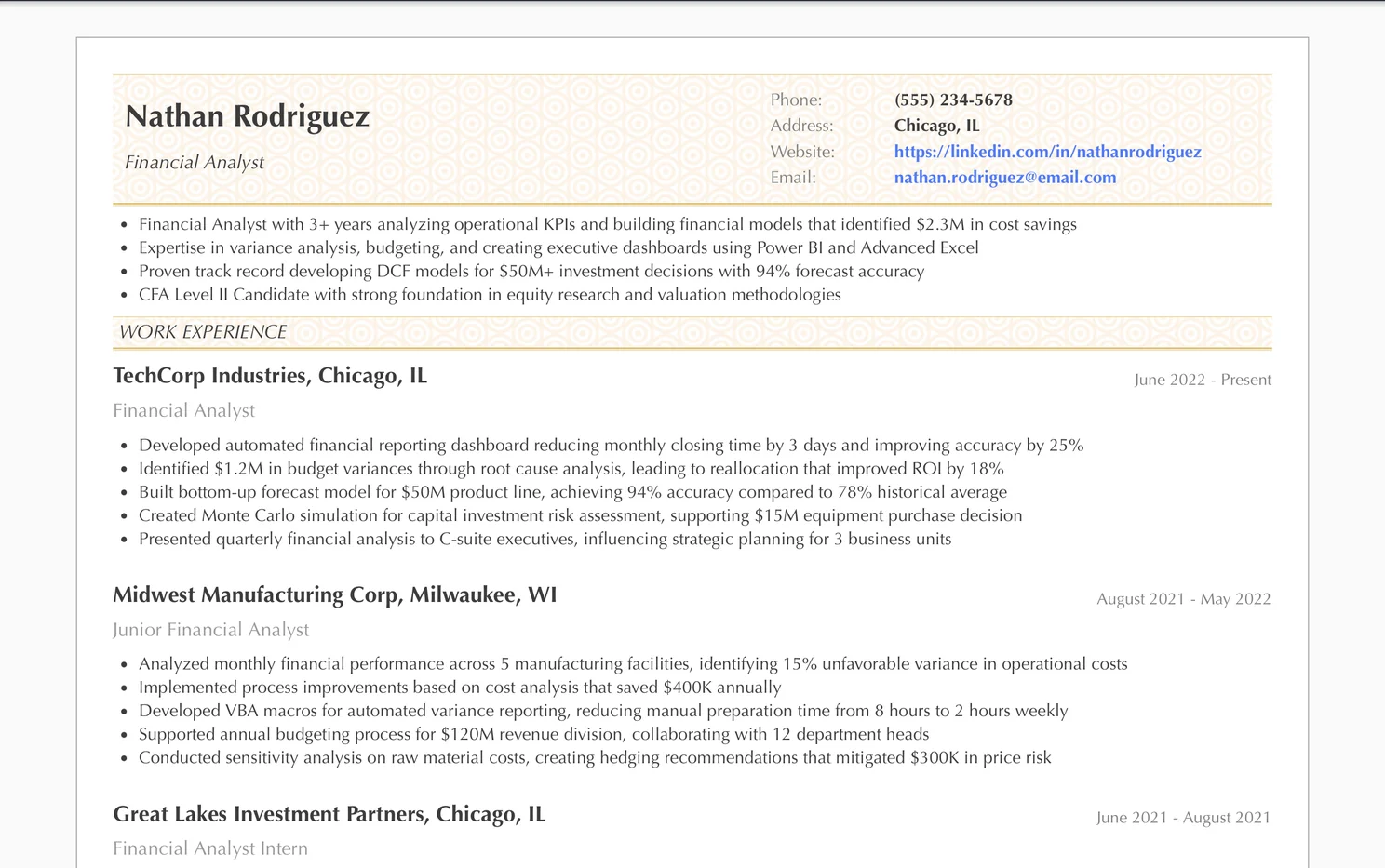
The Best Financial Analyst Resume Example/Sample
https://www.resumonk.com/financial-analyst-resumeFinancial AnalystResume Format for Financial Analyst Resume - Setting the Foundation Right
For Financial Analysts, the reverse-chronological format reigns supreme, and there's solid reasoning behind this choice.
Finance hiring managers want to see your progression, your most recent analytical victories, and how you've grown your technical capabilities over time. They're looking at your career trajectory the same way you'd analyze a company's revenue growth - most recent quarters matter most.
Why Reverse-Chronological Works Best
The financial services industry values predictability and clear progression.
When a hiring manager picks up your resume, they want to immediately understand where you've been applying your analytical skills most recently. Have you been working with financial statements at a Big Four firm? Running variance analysis at a Fortune 500? Or perhaps you've been developing financial models at a boutique investment firm?
Your most recent experience tells the story of your current capabilities.
Structuring Your Financial Analyst Resume
Start with a professional summary that captures your analytical DNA.
This isn't the place for generic statements about being "detail-oriented" - every Financial Analyst claims that. Instead, lead with your specific expertise and quantifiable impact.
❌ Don't write a vague summary:
Dedicated financial professional seeking analyst position. Strong analytical skills and attention to detail.
✅ Do write a targeted, specific summary:
Financial Analyst with 3+ years analyzing operational KPIs and building financial models that identified $2.3M in cost savings.
Expertise in variance analysis, budgeting, and creating executive dashboards using Power BI and Advanced Excel.
Following your summary, your work experience should take center stage. This is where you showcase your analytical prowess, not just list your job duties. Think of each bullet point as a mini case study - what was the problem, what analysis did you perform, and what was the quantifiable outcome?
Education follows work experience for experienced analysts, but fresh graduates or those with less than two years of experience should consider placing education higher, especially if you have a strong academic background from a target school or relevant certifications like CFA Level 1.
Work Experience on Financial Analyst Resume - Your Analytical Story
Remember your first day working with real financial data?
Maybe it was during an internship where you finally got to apply those classroom theories to actual P&L statements, or perhaps it was your first full-time role where you discovered that variance analysis involves a lot more stakeholder management than your textbooks suggested. Your work experience section needs to capture not just what you did, but the analytical thinking and business impact behind your actions.
Crafting Bullet Points That Demonstrate Analytical Impact
Financial Analysts live in the world of numbers, but ironically, many forget to quantify their own achievements. Every bullet point should tell a story of analysis leading to insight, and insight leading to action.
You're not just "analyzing financial data" - you're uncovering trends that drive million-dollar decisions.
❌ Don't write passive, duty-based descriptions:
• Responsible for monthly financial reports
• Analyzed budget variances
• Assisted with forecasting activities
✅ Do write achievement-focused, quantified bullets:
• Developed automated financial reporting dashboard reducing monthly closing time by 3 days and improving accuracy by 25%
• Identified $1.2M in budget variances through root cause analysis, leading to reallocation that improved ROI by 18%
• Built bottom-up forecast model for $50M product line, achieving 94% accuracy compared to 78% historical average
Demonstrating Technical Depth Without Overwhelming
Your work experience should showcase your technical capabilities within context.
Mentioning that you use Excel is like a chef mentioning they use knives - it's expected. Instead, highlight advanced applications and the business problems they solved. Did you build a Monte Carlo simulation to assess risk? Create a three-statement model for an acquisition? These details matter.
For entry-level analysts or recent graduates, internships and academic projects can fill this section powerfully. That equity research project where you valued Tesla using comparable company analysis? That's real analytical work. The internship where you automated a weekly report using VBA? That shows initiative and technical capability.
Tailoring for Different Financial Analyst Roles
The Financial Analyst title spans across industries, and your experience bullets should reflect this.
A Financial Analyst at an investment bank focuses heavily on valuation models and deal support, while one at a manufacturing company might emphasize cost analysis and operational metrics. Consider your target industry when selecting which experiences to highlight.
In the UK and European markets, be prepared to include more detail about your analytical methodologies, as technical depth is particularly valued. American resumes tend to focus more on business impact and results, while Canadian employers often look for a balance between technical skills and stakeholder management experience.
Skills to Show on Financial Analyst Resume - Your Technical Arsenal
Think back to the last time you solved a complex financial problem. Maybe you were staring at a massive dataset, trying to identify why margins were declining. You probably fired up Excel, pulled data from SAP, created pivot tables, ran regression analysis, and then packaged it all into a PowerPoint that actually made sense to non-finance executives.
Each tool and technique you used represents a skill that deserves strategic placement on your resume.
Technical Skills - The Non-Negotiables
Financial Analysts operate in a technical ecosystem, and hiring managers scan for specific capabilities. Your Excel skills should go beyond "proficient" - specify your expertise in financial modeling, VBA, Power Query, or advanced formulas.
These aren't just buzzwords; they're the difference between taking three days to build a model and three hours.
❌ Don't list generic, unexplained skills:
Skills: Excel, PowerPoint, Communication, Analysis, Teamwork
✅ Do showcase specific, relevant technical capabilities:
Technical Skills: Financial Modeling (DCF, LBO, Comparable Company Analysis), Advanced Excel (VBA, Macros,
Power Query), SQL, Python for Financial Analysis, Power BI, SAP, Oracle Hyperion

Analytical Skills: Variance Analysis, Forecasting & Budgeting, Scenario Planning, Statistical Analysis,
Risk Assessment, Cost-Benefit Analysis
Analytical Methodologies as Skills
Beyond software, your skills section should reflect your analytical toolkit.
Can you perform regression analysis to forecast revenue? Do you understand activity-based costing? Have you conducted sensitivity analysis on capital investments? These methodologies are skills that differentiate you from someone who just knows how to use the tools.
For those early in their careers, relevant coursework can substitute for professional experience. That financial derivatives course where you learned Black-Scholes modeling? That's a skill. The case competition where you valued a distressed company?
That demonstrates analytical capability.
Soft Skills That Actually Matter
While technical skills get you in the door, Financial Analysts who progress understand that translating complex analysis into actionable business insights is equally crucial. Stakeholder management, presentation skills, and the ability to influence decision-making through data storytelling are skills worth highlighting, but only with context.
Rather than listing "communication skills," demonstrate it through your achievements. Did you present monthly results to C-suite executives? Did you train junior team members on financial modeling?
These contexts give weight to soft skills that might otherwise seem generic.
Specific Considerations and Tips for Financial Analyst Resume
Here's something most resume guides won't tell you about Financial Analyst positions - hiring managers often spend less than 30 seconds scanning for specific indicators of analytical rigor.
They're not just looking for someone who can build models; they're looking for someone who thinks like an analyst even when writing their resume. This means every claim needs supporting evidence, every number needs context, and every achievement needs to tie back to business value.
The Certification Question - Strategic Positioning
If you're pursuing or have completed CFA levels, CPA, or FRM certifications, positioning matters tremendously.
Active candidates should list their expected completion date, not just "CFA Candidate." The difference between "CFA Level II Candidate" and "CFA Level II Candidate (Sitting June 2024)" shows commitment and planning - qualities every Financial Analyst needs.
For those without formal certifications, relevant online courses from recognized platforms (Wall Street Prep, CFI, Breaking Into Wall Street) can demonstrate continued learning, but only include them if they're directly relevant to your target role. A Financial Modeling certification carries weight; a generic "Introduction to Finance" course does not.
The Portfolio Problem - Showing Your Work
Unlike designers or developers, Financial Analysts can't easily showcase their work due to confidentiality. However, you can describe your analytical approaches and methodologies without revealing sensitive data. Consider creating sanitized examples of your work - a financial model with fictional data, an investment thesis for a public company, or a published analysis on LinkedIn. Include a line in your contact section: "Financial modeling samples available upon request."
Geographic and Industry Nuances
Wall Street Financial Analysts face different expectations than those in corporate finance.
Investment banking analysts should emphasize deal experience and technical modeling skills, while corporate Financial Analysts should highlight cross-functional collaboration and operational improvements. In European markets, particularly Germany and Switzerland, including your proficiency level in financial regulations and compliance frameworks can set you apart.
For Australian and Canadian markets, sustainability and ESG (Environmental, Social, Governance) analysis capabilities are increasingly valuable. If you've worked on sustainability reporting or integrated ESG factors into financial models, these deserve prominence.
The One-Page Dilemma
Traditional wisdom says keep it to one page, but Financial Analysts with 5+ years of experience shouldn't sacrifice substantive achievements for arbitrary length restrictions. If you've managed multiple budget cycles, led system implementations, and developed novel analytical frameworks, a two-page resume is acceptable - but every line must earn its space.
Avoiding the Common Pitfalls
The biggest mistake Financial Analysts make is writing their resume like a job description instead of an impact report. You're not "responsible for" analysis - you "drove decisions through" analysis.
You didn't "help with" budgeting - you "identified opportunities" through budget analysis.
❌ Don't write in passive, responsibility-focused language:
Responsible for reviewing monthly financial statements and reporting variances to management
✅ Do write in active, achievement-focused language:
Analyzed monthly financial performance, identifying 15% unfavorable variance in operational costs,
leading to process improvements that saved $400K annually
Remember, your resume is itself a financial document - it's an investment proposal where you're the asset. Every line should contribute to your ROI story, showing potential employers not just that you can do the job, but that you'll add measurable value from day one. After all, as a Financial Analyst, if you can't quantify your own value proposition, how can you be trusted to evaluate others?
Education Requirements for Financial Analyst Resume
The Financial Analyst role sits at that sweet spot where technical prowess meets business acumen.
Unlike the "Financial Executive" roles that might sound fancy but are actually entry-level positions in retail banking, a Financial Analyst is typically a professional role requiring 0-3 years of experience in corporate finance, investment analysis, or financial planning. Your education section needs to scream "I can handle complex financial modeling AND explain it to your CEO."
The Non-Negotiable Degree Requirements
Let's be brutally honest here - most Financial Analyst positions require at least a bachelor's degree. The hiring manager wants to see that beautiful piece of paper that says you survived four years of supply and demand curves, present value calculations, and that one professor who insisted on doing everything by hand before allowing calculator use.
When listing your education, lead with your highest relevant degree and work backwards.
❌ Don't write vaguely about your education:
Bachelor's Degree
State University
Business Studies
✅ Do provide comprehensive details that showcase relevance:
Bachelor of Science in Finance, GPA: 3.7/4.0
State University, New York, NY
Graduated: May 2023
Relevant Coursework: Financial Modeling, Investment Analysis, Corporate Finance,
Derivatives & Risk Management, Financial Statement Analysis
Making Your Coursework Count
Remember those nights you spent building DCF models for your Corporate Finance class?
Or that semester-long project where you analyzed Tesla's financial statements and predicted their cash flow for the next five years? This is where that pain pays off. Financial Analyst roles are technical, and hiring managers want evidence that you've wrestled with the concepts you'll use daily.
Include relevant coursework, but be strategic - list only courses that directly relate to financial analysis, not that mandatory English Literature class (no matter how much you loved it).
The CFA Factor and Other Certifications
Ah, the CFA program - the Mount Everest of financial certifications.
If you're currently enrolled in Level I or have passed it, this is your golden ticket. Place it prominently in your education section. Even stating "CFA Level I Candidate" shows commitment to the field that makes hiring managers' hearts skip a beat.
The same goes for other relevant certifications like FRM, FMVA, or even advanced Excel certifications.
CFA Level I Candidate - Exam scheduled for February 2024
Financial Modeling & Valuation Analyst (FMVA) Certification - In Progress
Corporate Finance Institute, Expected Completion: March 2024
Geographic Differences in Education Presentation
For our friends across the pond in the UK, remember that your "first-class honours" designation carries weight - include it.
Australian candidates should note their HD (High Distinction) or D (Distinction) grades if achieved. Canadian applicants often benefit from highlighting co-op programs or internships within their education section, as these programs are highly regarded. In the USA, that GPA matters more than you think - if it's above 3.5, flaunt it like it's nobody's business.
Awards and Publications on Financial Analyst Resume
So you won the "Best Financial Analysis Project" award in your senior year.
Or maybe you co-authored a paper on cryptocurrency valuation methods that got published in your university's finance journal. These aren't just nice-to-haves - they're concrete proof that you don't just understand finance, you excel at it. For a Financial Analyst position, awards and publications serve as third-party validation of your analytical prowess and your ability to communicate complex financial concepts.
Why Awards Matter More Than You Think
Think about it from the hiring manager's perspective.
They're looking at 200 resumes, all claiming proficiency in financial modeling. But you? You won the Bloomberg Trading Challenge at your university. Or received the Dean's Award for Excellence in Financial Analysis. These awards instantly differentiate you from the sea of "proficient in Excel" candidates. They show you've been recognized by others for the exact skills the employer needs.
When listing awards, context is everything. A hiring manager might not know what the "Golden Bull Award" means at your university, but they'll definitely understand "First Place - University Stock Pitch Competition (competed against 50 teams, presented buy recommendation for NVIDIA based on proprietary valuation model)."
❌ Don't list awards without context:
Dean's List - 2022
Finance Society Award - 2023
Academic Excellence - 2021
✅ Do provide meaningful detail that showcases relevance:
Dean's List - 4 consecutive semesters (2021-2023)
Maintained 3.8+ GPA while serving as Finance Society Treasurer

CFA Institute Research Challenge - Regional Finalist (2023)
Led 4-person team in equity research report on Microsoft; presented to panel
of portfolio managers

Bloomberg Market Concepts Certification - Distinction (2022)
Scored in top 10% globally across all four modules
The Publication Predicament
Now, let's talk about publications.
You're not applying for a PhD position, so that 50-page thesis on behavioral finance might not need its own line. However, any published work that demonstrates your analytical abilities or industry knowledge is pure gold. Did you write an article for your university's finance publication analyzing the GameStop short squeeze? Did your capstone project on ESG investing metrics get published in an undergraduate research journal? These show initiative and the ability to conduct independent analysis - exactly what you'll do as a Financial Analyst.
Remember to format publications properly. Use a consistent citation style, and if it's available online, mention that it can be provided upon request (but don't include URLs in your resume).
"Machine Learning Applications in Credit Risk Assessment"
University Finance Review, Spring 2023
Co-authored research paper analyzing 10,000+ loan applications using Python;
developed model with 89% prediction accuracy
The Strategic Placement Decision
If you have multiple relevant awards or publications, create a dedicated section. If you have just one or two stellar achievements, consider incorporating them into your education or experience sections where they'll have more context.
The key is ensuring they don't get lost in the shuffle while also not overstating their importance if you only have participation certificates from mandatory class presentations.
Reference Strategy for Financial Analyst Resume
Here's something they don't teach you in your Financial Analysis courses - references can make or break your application, especially when you're competing against candidates with similar GPAs and internship experiences. For Financial Analyst positions, references aren't just character witnesses; they're people who can vouch for your ability to work with complex data, meet tight deadlines, and explain complicated financial concepts to people who think EBITDA is a new cryptocurrency.
The "References Available Upon Request" Debate
Old school wisdom says to write "References available upon request" at the bottom of your resume. Modern wisdom says that's wasting valuable resume real estate. Here's the Financial Analyst perspective - that space could be used for another technical skill or achievement. Unless specifically requested in the job posting, don't include references on your resume.
Instead, have a separate, polished references document ready to deploy faster than you can calculate a quick ratio.
Choosing Your Financial Advocates
Your reference lineup for a Financial Analyst position should read like a who's who of people who've seen you work magic with spreadsheets and financial models.
Priority goes to supervisors from finance-related internships, professors who taught your advanced finance courses, or mentors from finance clubs or competitions. That manager from your summer job at the coffee shop? They can vouch for your work ethic, sure, but save them for your backup list.
The ideal reference can speak to specific technical competencies. When reaching out to potential references, remind them of specific projects you worked on together. "Professor Smith, I was hoping you could speak to the equity valuation project where I identified an undervalued REIT using comparative analysis" is much better than "Can you be my reference?"
❌ Don't list references without context or permission:
References:
John Smith - (555) 123-4567
Jane Doe - [email protected]
Bob Johnson - Former Manager
✅ Do create a professional reference sheet with full context:
PROFESSIONAL REFERENCES

Dr. Sarah Mitchell, CFA
Professor of Finance, State University
Relationship: Advanced Financial Modeling instructor; Thesis advisor
Contact: [email protected] | (555) 234-5678
Can speak to: Financial modeling expertise, equity research capabilities, presentation skills

Michael Chen
Senior Financial Analyst, ABC Corporation
Relationship: Direct supervisor during Summer 2023 internship
Contact: [email protected] | (555) 345-6789
Can speak to: Financial analysis skills, Excel/Python proficiency, ability to meet deadlines
The Reference Preparation Protocol
Think like the analyst you're training to become - prepare your references with the same thoroughness you'd prepare for an earnings call.
Send each reference the job description, your updated resume, and a brief reminder of your key accomplishments under their supervision. If you built a killer DCF model during your internship, remind your supervisor about it. If you aced the derivatives final when everyone else struggled, remind your professor.
Create a simple tracking spreadsheet (because of course you would) noting when you last contacted each reference, which positions they've been listed for, and any feedback they've provided. This isn't just organization - it's professional courtesy.
No one wants to be caught off-guard by a reference call.
The International Reference Challenge
Different countries have different reference expectations.
In the UK, written references from previous employers are often expected and can be quite detailed. In Australia, verbal reference checks are standard, and referees expect phone calls. Canadian employers often want to speak to direct supervisors specifically. In the USA, many companies now only confirm employment dates and titles due to legal concerns, so academic references might carry more weight for entry-level positions.
Managing the Reference Timeline
Here's a pro tip from the trenches - references are typically contacted after your first or second interview, not immediately after you apply.
This means you have time to prep them properly. When you land that interview, shoot your references a quick email: "Hi Dr. Mitchell, I wanted to let you know that I've interviewed for a Financial Analyst position with XYZ Corp, and I've listed you as a reference. They may be calling this week." This heads-up is professional courtesy that your references will appreciate and remember.
Remember, as a Financial Analyst, you'll be managing stakeholder relationships constantly. How you manage your references is a preview of how you'll manage professional relationships in your career. Treat them with respect, keep them informed, and always, always send a thank you note after they've served as a reference - whether you get the job or not.
Cover Letter Strategies for Financial Analyst Applications
Let's address the elephant in the room - you probably think cover letters are as outdated as using a physical calculator when Excel exists. But here's the thing about Financial Analyst positions: they're not just about crunching numbers. They're about telling the story behind those numbers. And your cover letter?
That's your first chance to prove you can craft a compelling narrative from data - except this time, the data is your own experience.
The Opening Hook - Making Numbers Personal
Forget the generic "I am writing to apply for the Financial Analyst position" opening. You're applying for a role where attention to detail and analytical thinking are paramount. Your opening should demonstrate both.
Start with a specific insight about the company's recent financial performance, a trend you've noticed in their industry, or a genuine connection to their business model.
❌ Don't write generic openings:
Dear Hiring Manager,

I am excited to apply for the Financial Analyst position at your company.
I have a degree in Finance and am passionate about financial analysis.
✅ Do demonstrate industry awareness and genuine interest:
Dear Ms. Johnson,

While analyzing Q3 earnings reports for my portfolio management class, I noticed ABC Corp's impressive 23% increase in operational efficiency despite industry-wide supply chain challenges. This strategic resilience aligns perfectly with my analytical approach and passion for identifying value in complex market conditions.
The Body - Quantifying Your Story
As someone targeting a Financial Analyst role, you understand the power of numbers.
Your cover letter should be peppered with specific metrics and achievements. Did your internship analysis help identify cost savings? Quantify it. Did your academic project involve building financial models? Mention the scope. The hiring manager reading your cover letter is likely a Senior Financial Analyst or Finance Manager - they think in numbers, so speak their language.
But here's where it gets interesting - you need to balance the quantitative with the qualitative. Yes, mention that you built a DCF model that valued a company at $2.3 billion, but also explain how you presented these findings to non-finance stakeholders and influenced decision-making.
Financial Analysts don't work in isolation; they're the bridge between raw data and business strategy.
The Unique Value Proposition
Every candidate applying for this Financial Analyst position knows Excel.
They all claim to understand financial statements. So what makes you different? Maybe it's your coding skills in Python that can automate repetitive analysis. Perhaps it's your internship at a startup where you wore multiple hats and understand both the operational and financial sides of business.
Or it could be your experience as treasurer of the investment club where you managed a real $50,000 portfolio.
Beyond traditional financial analysis skills, I bring a unique combination of Python programming expertise and practical investment experience. During my internship at XYZ Ventures, I automated their monthly reporting process using Python, reducing preparation time from 3 days to 4 hours while eliminating manual errors. This efficiency gain allowed the team to focus on deeper strategic analysis rather than data compilation.
Industry and Geographic Nuances
If you're applying in the UK, your cover letter can be slightly longer and more formal in tone - they appreciate thoroughness.
Canadian employers often value collaborative experiences, so emphasize team projects. In the USA, keep it punchy and achievement-focused - one page maximum.
Australian employers appreciate directness, so don't bury your key achievements in flowery language.
The Closing - Clear Next Steps
End with confidence, not desperation.
You're a soon-to-be Financial Analyst who makes logical, data-driven recommendations. Your closing should reflect that same clarity and confidence.
State your interest clearly, mention your availability for interviews, and if appropriate, reference any additional materials you're including (like a financial modeling sample or investment thesis).
Key Takeaways
After diving deep into the intricacies of building a compelling Financial Analyst resume, let's crystallize the essential strategies that will transform your application from another Excel-proficient candidate to a must-interview analytical powerhouse. These are the non-negotiables - your checklist for resume success:
- Use reverse-chronological format exclusively - Finance hiring managers want to see your most recent analytical victories first, showing clear career progression
- Quantify everything with specific metrics - Replace "analyzed financial data" with "identified $1.2M in cost savings through variance analysis, improving margins by 15%"
- Lead with a targeted professional summary - Skip generic statements and specify your expertise, like "Financial Analyst with 3+ years building DCF models that influenced $10M+ investment decisions"
- Showcase technical depth strategically - Don't just list "Excel proficiency"; specify "Advanced Excel (VBA, Power Query, Pivot Tables)" and tie it to business outcomes
- Include relevant certifications prominently - CFA candidacy, FMVA, or even advanced Excel certifications belong in your education section with expected completion dates
- Transform job duties into analytical achievements - You didn't "assist with budgeting"; you "developed bottom-up forecast model achieving 94% accuracy versus 78% historical average"
- Tailor for your target industry - Investment banking analysts emphasize deal experience and valuation models; corporate analysts highlight cross-functional collaboration and operational improvements
- Position education based on experience level - Recent grads lead with education and relevant coursework; experienced analysts place it after work experience
- Include analytical methodologies as skills - List specific techniques like DCF modeling, sensitivity analysis, and Monte Carlo simulations, not just software proficiency
- Prepare a separate, detailed reference sheet - Include context for each reference, specifying what technical competencies they can address
Now that you're armed with these insights, it's time to transform your analytical expertise into a compelling career narrative. Resumonk makes this transformation seamless with intelligent AI recommendations that understand the nuances of Financial Analyst positions. Our platform doesn't just format your resume beautifully - it helps you articulate your analytical achievements with the precision that finance managers expect. Whether you're crafting bullets that quantify your modeling expertise or organizing your technical skills to highlight advanced capabilities, Resumonk's templates are specifically optimized for the analytical rigor that Financial Analyst roles demand.
Ready to Build Your Financial Analyst Resume?
Stop wrestling with formatting and focus on what matters - showcasing your analytical prowess. Resumonk's AI-powered platform understands the language of finance and helps you create a resume that speaks directly to hiring managers. From quantifying achievements to highlighting technical skills, we'll ensure your Financial Analyst resume makes the right impact.
Start Building Your Financial Analyst Resume with Resumonk →
More Banking & Finance resume examples
- Financial Advisor resume example
- Bank Teller resume example
- Mortgage Loan Officer resume example
- Banker resume example
See all Banking & Finance resume examples, or browse every category.
Resume writing tips
Picture yourself at 2 AM, surrounded by empty energy drink cans and three monitors displaying Bloomberg terminals, Excel models, and that half-finished DCF analysis you've been perfecting. You're either that recent finance grad who lived in the library during finals week, building LBO models while your roommates were at parties, or you're the junior analyst who's ready to move beyond formatting PowerPoints to actually building the models that drive million-dollar decisions.
Either way, you're hunting for that Financial Analyst role - not the entry-level "Financial Services Executive" position at a retail bank that your parents keep forwarding you, but an actual analytical position where you'll dissect financial statements, build valuation models, and present insights that make CFOs lean forward in their chairs.
The Financial Analyst position sits in that sweet spot of corporate hierarchy - it's professional enough that you're taken seriously in meetings, yet hands-on enough that you're still building models rather than just reviewing them. Whether you're targeting corporate finance at a Fortune 500, equity research at an investment firm, or FP&A at a high-growth startup, your resume needs to demonstrate both technical prowess and business acumen. It needs to show that you can not only build a three-statement model that links perfectly but also explain why EBITDA margins are deteriorating to executives who last opened Excel in 2015.
This guide walks you through every element of crafting a Financial Analyst resume that actually lands interviews. We'll start with choosing the right format - spoiler alert, it's reverse-chronological, because finance managers want to see your most recent analytical victories first, not that internship from sophomore year. Then we'll dive deep into structuring your work experience to showcase real analytical impact, not just responsibilities. We'll tackle the skills section strategically, distinguishing between the technical capabilities that get you past the first screen and the soft skills that actually matter in finance.
You'll learn how to position your education beyond just listing your degree, including how to leverage relevant coursework, certifications like the CFA, and even those academic projects where you valued Netflix using five different methodologies. We'll explore the nuances of awards and publications, showing you how to transform that "Dean's List" mention into proof of analytical excellence. We'll even cover the often-overlooked elements like cover letter strategies that demonstrate your ability to craft compelling narratives from data, and reference strategies that ensure your professors and internship supervisors can speak to your specific technical competencies.
Throughout this journey, we'll address the specific considerations that make Financial Analyst resumes unique - from the geographic differences between Wall Street and corporate America applications, to the eternal debate about one-page versus two-page resumes when you have substantial modeling experience to showcase. By the end, you'll have a resume that doesn't just list your qualifications but tells the story of an analyst who can transform raw data into actionable business insights. Because ultimately, if you can't effectively analyze and present your own career trajectory, how can you be trusted to analyze a company's financial performance?
The Best Financial Analyst Resume Example/Sample
https://www.resumonk.com/financial-analyst-resumeFinancial AnalystResume Format for Financial Analyst Resume - Setting the Foundation Right
For Financial Analysts, the reverse-chronological format reigns supreme, and there's solid reasoning behind this choice.
Finance hiring managers want to see your progression, your most recent analytical victories, and how you've grown your technical capabilities over time. They're looking at your career trajectory the same way you'd analyze a company's revenue growth - most recent quarters matter most.
Why Reverse-Chronological Works Best
The financial services industry values predictability and clear progression.
When a hiring manager picks up your resume, they want to immediately understand where you've been applying your analytical skills most recently. Have you been working with financial statements at a Big Four firm? Running variance analysis at a Fortune 500? Or perhaps you've been developing financial models at a boutique investment firm?
Your most recent experience tells the story of your current capabilities.
Structuring Your Financial Analyst Resume
Start with a professional summary that captures your analytical DNA.
This isn't the place for generic statements about being "detail-oriented" - every Financial Analyst claims that. Instead, lead with your specific expertise and quantifiable impact.
❌ Don't write a vague summary:
Dedicated financial professional seeking analyst position. Strong analytical skills and attention to detail.
✅ Do write a targeted, specific summary:
Financial Analyst with 3+ years analyzing operational KPIs and building financial models that identified $2.3M in cost savings.
Expertise in variance analysis, budgeting, and creating executive dashboards using Power BI and Advanced Excel.
Following your summary, your work experience should take center stage. This is where you showcase your analytical prowess, not just list your job duties. Think of each bullet point as a mini case study - what was the problem, what analysis did you perform, and what was the quantifiable outcome?
Education follows work experience for experienced analysts, but fresh graduates or those with less than two years of experience should consider placing education higher, especially if you have a strong academic background from a target school or relevant certifications like CFA Level 1.
Work Experience on Financial Analyst Resume - Your Analytical Story
Remember your first day working with real financial data?
Maybe it was during an internship where you finally got to apply those classroom theories to actual P&L statements, or perhaps it was your first full-time role where you discovered that variance analysis involves a lot more stakeholder management than your textbooks suggested. Your work experience section needs to capture not just what you did, but the analytical thinking and business impact behind your actions.
Crafting Bullet Points That Demonstrate Analytical Impact
Financial Analysts live in the world of numbers, but ironically, many forget to quantify their own achievements. Every bullet point should tell a story of analysis leading to insight, and insight leading to action.
You're not just "analyzing financial data" - you're uncovering trends that drive million-dollar decisions.
❌ Don't write passive, duty-based descriptions:
• Responsible for monthly financial reports
• Analyzed budget variances
• Assisted with forecasting activities
✅ Do write achievement-focused, quantified bullets:
• Developed automated financial reporting dashboard reducing monthly closing time by 3 days and improving accuracy by 25%
• Identified $1.2M in budget variances through root cause analysis, leading to reallocation that improved ROI by 18%
• Built bottom-up forecast model for $50M product line, achieving 94% accuracy compared to 78% historical average
Demonstrating Technical Depth Without Overwhelming
Your work experience should showcase your technical capabilities within context.
Mentioning that you use Excel is like a chef mentioning they use knives - it's expected. Instead, highlight advanced applications and the business problems they solved. Did you build a Monte Carlo simulation to assess risk? Create a three-statement model for an acquisition? These details matter.
For entry-level analysts or recent graduates, internships and academic projects can fill this section powerfully. That equity research project where you valued Tesla using comparable company analysis? That's real analytical work. The internship where you automated a weekly report using VBA? That shows initiative and technical capability.
Tailoring for Different Financial Analyst Roles
The Financial Analyst title spans across industries, and your experience bullets should reflect this.
A Financial Analyst at an investment bank focuses heavily on valuation models and deal support, while one at a manufacturing company might emphasize cost analysis and operational metrics. Consider your target industry when selecting which experiences to highlight.
In the UK and European markets, be prepared to include more detail about your analytical methodologies, as technical depth is particularly valued. American resumes tend to focus more on business impact and results, while Canadian employers often look for a balance between technical skills and stakeholder management experience.
Skills to Show on Financial Analyst Resume - Your Technical Arsenal
Think back to the last time you solved a complex financial problem. Maybe you were staring at a massive dataset, trying to identify why margins were declining. You probably fired up Excel, pulled data from SAP, created pivot tables, ran regression analysis, and then packaged it all into a PowerPoint that actually made sense to non-finance executives.
Each tool and technique you used represents a skill that deserves strategic placement on your resume.
Technical Skills - The Non-Negotiables
Financial Analysts operate in a technical ecosystem, and hiring managers scan for specific capabilities. Your Excel skills should go beyond "proficient" - specify your expertise in financial modeling, VBA, Power Query, or advanced formulas.
These aren't just buzzwords; they're the difference between taking three days to build a model and three hours.
❌ Don't list generic, unexplained skills:
Skills: Excel, PowerPoint, Communication, Analysis, Teamwork
✅ Do showcase specific, relevant technical capabilities:
Technical Skills: Financial Modeling (DCF, LBO, Comparable Company Analysis), Advanced Excel (VBA, Macros,
Power Query), SQL, Python for Financial Analysis, Power BI, SAP, Oracle Hyperion

Analytical Skills: Variance Analysis, Forecasting & Budgeting, Scenario Planning, Statistical Analysis,
Risk Assessment, Cost-Benefit Analysis
Analytical Methodologies as Skills
Beyond software, your skills section should reflect your analytical toolkit.
Can you perform regression analysis to forecast revenue? Do you understand activity-based costing? Have you conducted sensitivity analysis on capital investments? These methodologies are skills that differentiate you from someone who just knows how to use the tools.
For those early in their careers, relevant coursework can substitute for professional experience. That financial derivatives course where you learned Black-Scholes modeling? That's a skill. The case competition where you valued a distressed company?
That demonstrates analytical capability.
Soft Skills That Actually Matter
While technical skills get you in the door, Financial Analysts who progress understand that translating complex analysis into actionable business insights is equally crucial. Stakeholder management, presentation skills, and the ability to influence decision-making through data storytelling are skills worth highlighting, but only with context.
Rather than listing "communication skills," demonstrate it through your achievements. Did you present monthly results to C-suite executives? Did you train junior team members on financial modeling?
These contexts give weight to soft skills that might otherwise seem generic.
Specific Considerations and Tips for Financial Analyst Resume
Here's something most resume guides won't tell you about Financial Analyst positions - hiring managers often spend less than 30 seconds scanning for specific indicators of analytical rigor.
They're not just looking for someone who can build models; they're looking for someone who thinks like an analyst even when writing their resume. This means every claim needs supporting evidence, every number needs context, and every achievement needs to tie back to business value.
The Certification Question - Strategic Positioning
If you're pursuing or have completed CFA levels, CPA, or FRM certifications, positioning matters tremendously.
Active candidates should list their expected completion date, not just "CFA Candidate." The difference between "CFA Level II Candidate" and "CFA Level II Candidate (Sitting June 2024)" shows commitment and planning - qualities every Financial Analyst needs.
For those without formal certifications, relevant online courses from recognized platforms (Wall Street Prep, CFI, Breaking Into Wall Street) can demonstrate continued learning, but only include them if they're directly relevant to your target role. A Financial Modeling certification carries weight; a generic "Introduction to Finance" course does not.
The Portfolio Problem - Showing Your Work
Unlike designers or developers, Financial Analysts can't easily showcase their work due to confidentiality. However, you can describe your analytical approaches and methodologies without revealing sensitive data. Consider creating sanitized examples of your work - a financial model with fictional data, an investment thesis for a public company, or a published analysis on LinkedIn. Include a line in your contact section: "Financial modeling samples available upon request."
Geographic and Industry Nuances
Wall Street Financial Analysts face different expectations than those in corporate finance.
Investment banking analysts should emphasize deal experience and technical modeling skills, while corporate Financial Analysts should highlight cross-functional collaboration and operational improvements. In European markets, particularly Germany and Switzerland, including your proficiency level in financial regulations and compliance frameworks can set you apart.
For Australian and Canadian markets, sustainability and ESG (Environmental, Social, Governance) analysis capabilities are increasingly valuable. If you've worked on sustainability reporting or integrated ESG factors into financial models, these deserve prominence.
The One-Page Dilemma
Traditional wisdom says keep it to one page, but Financial Analysts with 5+ years of experience shouldn't sacrifice substantive achievements for arbitrary length restrictions. If you've managed multiple budget cycles, led system implementations, and developed novel analytical frameworks, a two-page resume is acceptable - but every line must earn its space.
Avoiding the Common Pitfalls
The biggest mistake Financial Analysts make is writing their resume like a job description instead of an impact report. You're not "responsible for" analysis - you "drove decisions through" analysis.
You didn't "help with" budgeting - you "identified opportunities" through budget analysis.
❌ Don't write in passive, responsibility-focused language:
Responsible for reviewing monthly financial statements and reporting variances to management
✅ Do write in active, achievement-focused language:
Analyzed monthly financial performance, identifying 15% unfavorable variance in operational costs,
leading to process improvements that saved $400K annually
Remember, your resume is itself a financial document - it's an investment proposal where you're the asset. Every line should contribute to your ROI story, showing potential employers not just that you can do the job, but that you'll add measurable value from day one. After all, as a Financial Analyst, if you can't quantify your own value proposition, how can you be trusted to evaluate others?
Education Requirements for Financial Analyst Resume
The Financial Analyst role sits at that sweet spot where technical prowess meets business acumen.
Unlike the "Financial Executive" roles that might sound fancy but are actually entry-level positions in retail banking, a Financial Analyst is typically a professional role requiring 0-3 years of experience in corporate finance, investment analysis, or financial planning. Your education section needs to scream "I can handle complex financial modeling AND explain it to your CEO."
The Non-Negotiable Degree Requirements
Let's be brutally honest here - most Financial Analyst positions require at least a bachelor's degree. The hiring manager wants to see that beautiful piece of paper that says you survived four years of supply and demand curves, present value calculations, and that one professor who insisted on doing everything by hand before allowing calculator use.
When listing your education, lead with your highest relevant degree and work backwards.
❌ Don't write vaguely about your education:
Bachelor's Degree
State University
Business Studies
✅ Do provide comprehensive details that showcase relevance:
Bachelor of Science in Finance, GPA: 3.7/4.0
State University, New York, NY
Graduated: May 2023
Relevant Coursework: Financial Modeling, Investment Analysis, Corporate Finance,
Derivatives & Risk Management, Financial Statement Analysis
Making Your Coursework Count
Remember those nights you spent building DCF models for your Corporate Finance class?
Or that semester-long project where you analyzed Tesla's financial statements and predicted their cash flow for the next five years? This is where that pain pays off. Financial Analyst roles are technical, and hiring managers want evidence that you've wrestled with the concepts you'll use daily.
Include relevant coursework, but be strategic - list only courses that directly relate to financial analysis, not that mandatory English Literature class (no matter how much you loved it).
The CFA Factor and Other Certifications
Ah, the CFA program - the Mount Everest of financial certifications.
If you're currently enrolled in Level I or have passed it, this is your golden ticket. Place it prominently in your education section. Even stating "CFA Level I Candidate" shows commitment to the field that makes hiring managers' hearts skip a beat.
The same goes for other relevant certifications like FRM, FMVA, or even advanced Excel certifications.
CFA Level I Candidate - Exam scheduled for February 2024
Financial Modeling & Valuation Analyst (FMVA) Certification - In Progress
Corporate Finance Institute, Expected Completion: March 2024
Geographic Differences in Education Presentation
For our friends across the pond in the UK, remember that your "first-class honours" designation carries weight - include it.
Australian candidates should note their HD (High Distinction) or D (Distinction) grades if achieved. Canadian applicants often benefit from highlighting co-op programs or internships within their education section, as these programs are highly regarded. In the USA, that GPA matters more than you think - if it's above 3.5, flaunt it like it's nobody's business.
Awards and Publications on Financial Analyst Resume
So you won the "Best Financial Analysis Project" award in your senior year.
Or maybe you co-authored a paper on cryptocurrency valuation methods that got published in your university's finance journal. These aren't just nice-to-haves - they're concrete proof that you don't just understand finance, you excel at it. For a Financial Analyst position, awards and publications serve as third-party validation of your analytical prowess and your ability to communicate complex financial concepts.
Why Awards Matter More Than You Think
Think about it from the hiring manager's perspective.
They're looking at 200 resumes, all claiming proficiency in financial modeling. But you? You won the Bloomberg Trading Challenge at your university. Or received the Dean's Award for Excellence in Financial Analysis. These awards instantly differentiate you from the sea of "proficient in Excel" candidates. They show you've been recognized by others for the exact skills the employer needs.
When listing awards, context is everything. A hiring manager might not know what the "Golden Bull Award" means at your university, but they'll definitely understand "First Place - University Stock Pitch Competition (competed against 50 teams, presented buy recommendation for NVIDIA based on proprietary valuation model)."
❌ Don't list awards without context:
Dean's List - 2022
Finance Society Award - 2023
Academic Excellence - 2021
✅ Do provide meaningful detail that showcases relevance:
Dean's List - 4 consecutive semesters (2021-2023)
Maintained 3.8+ GPA while serving as Finance Society Treasurer

CFA Institute Research Challenge - Regional Finalist (2023)
Led 4-person team in equity research report on Microsoft; presented to panel
of portfolio managers

Bloomberg Market Concepts Certification - Distinction (2022)
Scored in top 10% globally across all four modules
The Publication Predicament
Now, let's talk about publications.
You're not applying for a PhD position, so that 50-page thesis on behavioral finance might not need its own line. However, any published work that demonstrates your analytical abilities or industry knowledge is pure gold. Did you write an article for your university's finance publication analyzing the GameStop short squeeze? Did your capstone project on ESG investing metrics get published in an undergraduate research journal? These show initiative and the ability to conduct independent analysis - exactly what you'll do as a Financial Analyst.
Remember to format publications properly. Use a consistent citation style, and if it's available online, mention that it can be provided upon request (but don't include URLs in your resume).
"Machine Learning Applications in Credit Risk Assessment"
University Finance Review, Spring 2023
Co-authored research paper analyzing 10,000+ loan applications using Python;
developed model with 89% prediction accuracy
The Strategic Placement Decision
If you have multiple relevant awards or publications, create a dedicated section. If you have just one or two stellar achievements, consider incorporating them into your education or experience sections where they'll have more context.
The key is ensuring they don't get lost in the shuffle while also not overstating their importance if you only have participation certificates from mandatory class presentations.
Reference Strategy for Financial Analyst Resume
Here's something they don't teach you in your Financial Analysis courses - references can make or break your application, especially when you're competing against candidates with similar GPAs and internship experiences. For Financial Analyst positions, references aren't just character witnesses; they're people who can vouch for your ability to work with complex data, meet tight deadlines, and explain complicated financial concepts to people who think EBITDA is a new cryptocurrency.
The "References Available Upon Request" Debate
Old school wisdom says to write "References available upon request" at the bottom of your resume. Modern wisdom says that's wasting valuable resume real estate. Here's the Financial Analyst perspective - that space could be used for another technical skill or achievement. Unless specifically requested in the job posting, don't include references on your resume.
Instead, have a separate, polished references document ready to deploy faster than you can calculate a quick ratio.
Choosing Your Financial Advocates
Your reference lineup for a Financial Analyst position should read like a who's who of people who've seen you work magic with spreadsheets and financial models.
Priority goes to supervisors from finance-related internships, professors who taught your advanced finance courses, or mentors from finance clubs or competitions. That manager from your summer job at the coffee shop? They can vouch for your work ethic, sure, but save them for your backup list.
The ideal reference can speak to specific technical competencies. When reaching out to potential references, remind them of specific projects you worked on together. "Professor Smith, I was hoping you could speak to the equity valuation project where I identified an undervalued REIT using comparative analysis" is much better than "Can you be my reference?"
❌ Don't list references without context or permission:
References:
John Smith - (555) 123-4567
Jane Doe - [email protected]
Bob Johnson - Former Manager
✅ Do create a professional reference sheet with full context:
PROFESSIONAL REFERENCES

Dr. Sarah Mitchell, CFA
Professor of Finance, State University
Relationship: Advanced Financial Modeling instructor; Thesis advisor
Contact: [email protected] | (555) 234-5678
Can speak to: Financial modeling expertise, equity research capabilities, presentation skills

Michael Chen
Senior Financial Analyst, ABC Corporation
Relationship: Direct supervisor during Summer 2023 internship
Contact: [email protected] | (555) 345-6789
Can speak to: Financial analysis skills, Excel/Python proficiency, ability to meet deadlines
The Reference Preparation Protocol
Think like the analyst you're training to become - prepare your references with the same thoroughness you'd prepare for an earnings call.
Send each reference the job description, your updated resume, and a brief reminder of your key accomplishments under their supervision. If you built a killer DCF model during your internship, remind your supervisor about it. If you aced the derivatives final when everyone else struggled, remind your professor.
Create a simple tracking spreadsheet (because of course you would) noting when you last contacted each reference, which positions they've been listed for, and any feedback they've provided. This isn't just organization - it's professional courtesy.
No one wants to be caught off-guard by a reference call.
The International Reference Challenge
Different countries have different reference expectations.
In the UK, written references from previous employers are often expected and can be quite detailed. In Australia, verbal reference checks are standard, and referees expect phone calls. Canadian employers often want to speak to direct supervisors specifically. In the USA, many companies now only confirm employment dates and titles due to legal concerns, so academic references might carry more weight for entry-level positions.
Managing the Reference Timeline
Here's a pro tip from the trenches - references are typically contacted after your first or second interview, not immediately after you apply.
This means you have time to prep them properly. When you land that interview, shoot your references a quick email: "Hi Dr. Mitchell, I wanted to let you know that I've interviewed for a Financial Analyst position with XYZ Corp, and I've listed you as a reference. They may be calling this week." This heads-up is professional courtesy that your references will appreciate and remember.
Remember, as a Financial Analyst, you'll be managing stakeholder relationships constantly. How you manage your references is a preview of how you'll manage professional relationships in your career. Treat them with respect, keep them informed, and always, always send a thank you note after they've served as a reference - whether you get the job or not.
Cover Letter Strategies for Financial Analyst Applications
Let's address the elephant in the room - you probably think cover letters are as outdated as using a physical calculator when Excel exists. But here's the thing about Financial Analyst positions: they're not just about crunching numbers. They're about telling the story behind those numbers. And your cover letter?
That's your first chance to prove you can craft a compelling narrative from data - except this time, the data is your own experience.
The Opening Hook - Making Numbers Personal
Forget the generic "I am writing to apply for the Financial Analyst position" opening. You're applying for a role where attention to detail and analytical thinking are paramount. Your opening should demonstrate both.
Start with a specific insight about the company's recent financial performance, a trend you've noticed in their industry, or a genuine connection to their business model.
❌ Don't write generic openings:
Dear Hiring Manager,

I am excited to apply for the Financial Analyst position at your company.
I have a degree in Finance and am passionate about financial analysis.
✅ Do demonstrate industry awareness and genuine interest:
Dear Ms. Johnson,

While analyzing Q3 earnings reports for my portfolio management class, I noticed ABC Corp's impressive 23% increase in operational efficiency despite industry-wide supply chain challenges. This strategic resilience aligns perfectly with my analytical approach and passion for identifying value in complex market conditions.
The Body - Quantifying Your Story
As someone targeting a Financial Analyst role, you understand the power of numbers.
Your cover letter should be peppered with specific metrics and achievements. Did your internship analysis help identify cost savings? Quantify it. Did your academic project involve building financial models? Mention the scope. The hiring manager reading your cover letter is likely a Senior Financial Analyst or Finance Manager - they think in numbers, so speak their language.
But here's where it gets interesting - you need to balance the quantitative with the qualitative. Yes, mention that you built a DCF model that valued a company at $2.3 billion, but also explain how you presented these findings to non-finance stakeholders and influenced decision-making.
Financial Analysts don't work in isolation; they're the bridge between raw data and business strategy.
The Unique Value Proposition
Every candidate applying for this Financial Analyst position knows Excel.
They all claim to understand financial statements. So what makes you different? Maybe it's your coding skills in Python that can automate repetitive analysis. Perhaps it's your internship at a startup where you wore multiple hats and understand both the operational and financial sides of business.
Or it could be your experience as treasurer of the investment club where you managed a real $50,000 portfolio.
Beyond traditional financial analysis skills, I bring a unique combination of Python programming expertise and practical investment experience. During my internship at XYZ Ventures, I automated their monthly reporting process using Python, reducing preparation time from 3 days to 4 hours while eliminating manual errors. This efficiency gain allowed the team to focus on deeper strategic analysis rather than data compilation.
Industry and Geographic Nuances
If you're applying in the UK, your cover letter can be slightly longer and more formal in tone - they appreciate thoroughness.
Canadian employers often value collaborative experiences, so emphasize team projects. In the USA, keep it punchy and achievement-focused - one page maximum.
Australian employers appreciate directness, so don't bury your key achievements in flowery language.
The Closing - Clear Next Steps
End with confidence, not desperation.
You're a soon-to-be Financial Analyst who makes logical, data-driven recommendations. Your closing should reflect that same clarity and confidence.
State your interest clearly, mention your availability for interviews, and if appropriate, reference any additional materials you're including (like a financial modeling sample or investment thesis).
Key Takeaways
After diving deep into the intricacies of building a compelling Financial Analyst resume, let's crystallize the essential strategies that will transform your application from another Excel-proficient candidate to a must-interview analytical powerhouse. These are the non-negotiables - your checklist for resume success:
- Use reverse-chronological format exclusively - Finance hiring managers want to see your most recent analytical victories first, showing clear career progression
- Quantify everything with specific metrics - Replace "analyzed financial data" with "identified $1.2M in cost savings through variance analysis, improving margins by 15%"
- Lead with a targeted professional summary - Skip generic statements and specify your expertise, like "Financial Analyst with 3+ years building DCF models that influenced $10M+ investment decisions"
- Showcase technical depth strategically - Don't just list "Excel proficiency"; specify "Advanced Excel (VBA, Power Query, Pivot Tables)" and tie it to business outcomes
- Include relevant certifications prominently - CFA candidacy, FMVA, or even advanced Excel certifications belong in your education section with expected completion dates
- Transform job duties into analytical achievements - You didn't "assist with budgeting"; you "developed bottom-up forecast model achieving 94% accuracy versus 78% historical average"
- Tailor for your target industry - Investment banking analysts emphasize deal experience and valuation models; corporate analysts highlight cross-functional collaboration and operational improvements
- Position education based on experience level - Recent grads lead with education and relevant coursework; experienced analysts place it after work experience
- Include analytical methodologies as skills - List specific techniques like DCF modeling, sensitivity analysis, and Monte Carlo simulations, not just software proficiency
- Prepare a separate, detailed reference sheet - Include context for each reference, specifying what technical competencies they can address
Now that you're armed with these insights, it's time to transform your analytical expertise into a compelling career narrative. Resumonk makes this transformation seamless with intelligent AI recommendations that understand the nuances of Financial Analyst positions. Our platform doesn't just format your resume beautifully - it helps you articulate your analytical achievements with the precision that finance managers expect. Whether you're crafting bullets that quantify your modeling expertise or organizing your technical skills to highlight advanced capabilities, Resumonk's templates are specifically optimized for the analytical rigor that Financial Analyst roles demand.
Ready to Build Your Financial Analyst Resume?
Stop wrestling with formatting and focus on what matters - showcasing your analytical prowess. Resumonk's AI-powered platform understands the language of finance and helps you create a resume that speaks directly to hiring managers. From quantifying achievements to highlighting technical skills, we'll ensure your Financial Analyst resume makes the right impact.
Start Building Your Financial Analyst Resume with Resumonk →
More Banking & Finance resume examples
- Financial Advisor resume example
- Bank Teller resume example
- Mortgage Loan Officer resume example
- Banker resume example
See all Banking & Finance resume examples, or browse every category.
Resume writing tips