UX Designer Resume Example (with Tips and Best Practices)
Introduction
Envision this moment - you've spent countless hours perfecting wireframes, conducting user interviews, and crafting pixel-perfect prototypes. Now you're staring at a blank document, wondering how to translate your design thinking into a resume that actually lands interviews. As a UX Designer, you're essentially a storyteller for user experiences, but telling your own professional story?
That's where things get tricky.
Whether you're a recent bootcamp graduate with a psychology degree trying to break into tech, or a seasoned designer looking to level up from your current role, the challenge remains the same - how do you capture the essence of your user-centered approach in a document that hiring managers will scan for mere seconds? You know you can redesign entire user journeys and increase conversion rates, but conveying that impact through bullet points feels like trying to explain color to someone who's never seen it.
That's exactly why we've crafted this comprehensive guide. We'll walk you through every element of creating a compelling UX Designer resume, starting with choosing the perfect format that mirrors good information architecture. You'll learn how to transform your work experience from a bland list of responsibilities into compelling stories of problems solved and impact created. We'll dive deep into which skills actually matter (spoiler alert - listing "Figma" isn't enough anymore), and how to handle those tricky sections like education when you've taken a non-traditional path into UX.
We'll also tackle the unique challenges UX Designers face - from the eternal portfolio link dilemma to striking the right visual balance in your resume design. You'll discover how to adapt your resume for different industries, whether you're eyeing a role at a cutting-edge fintech startup or a healthcare company focused on accessibility. By the end, you'll have a clear roadmap for creating a resume that works as seamlessly as the interfaces you design, complete with tips for that often-dreaded cover letter and strategies for managing references in our collaborative field.
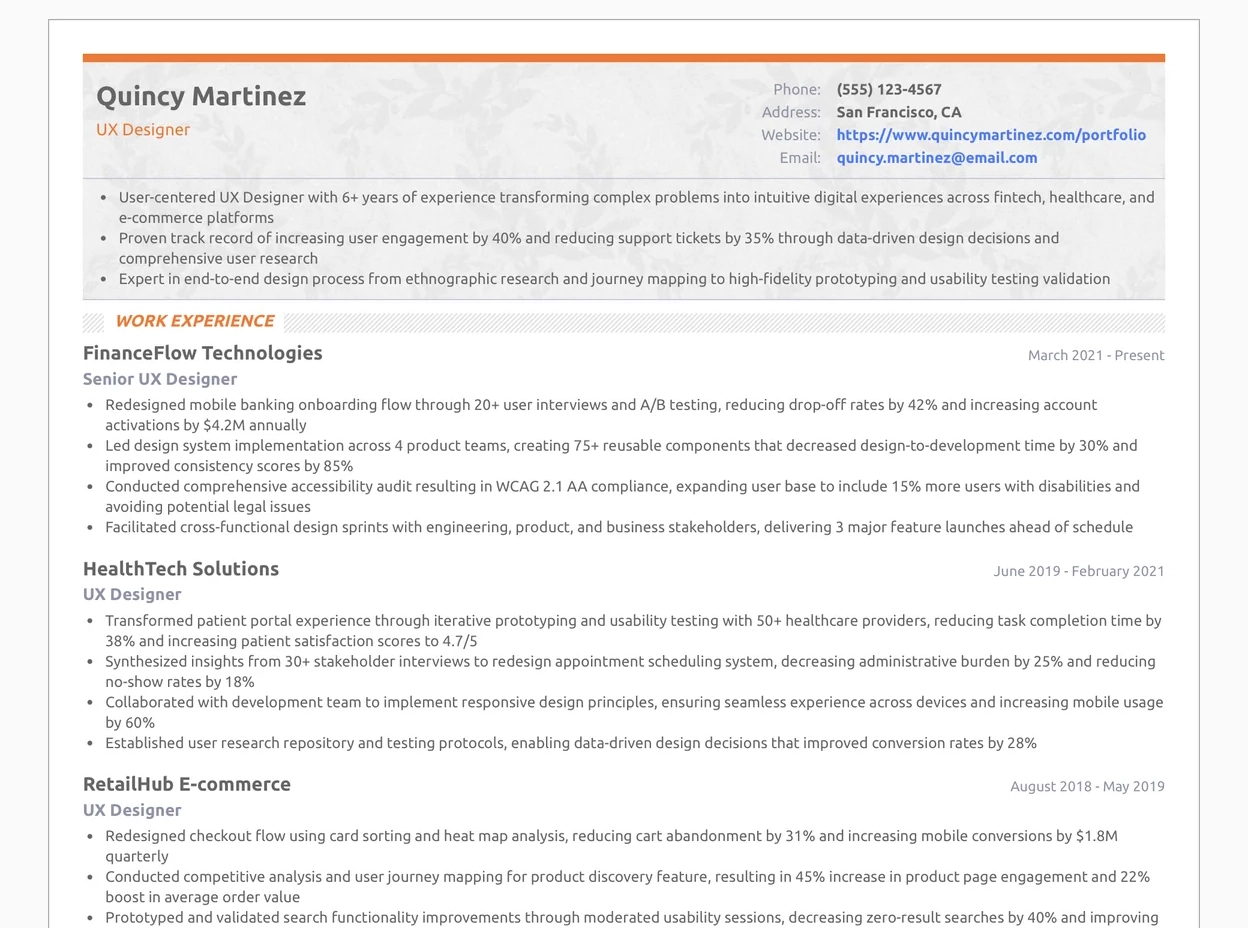
The Ultimate UX Designer Resume Example/Sample
https://www.resumonk.com/ux-designer-resumeUX DesignerResume Format to Follow for UX Designer Resume
The reverse-chronological format is your best friend here.
Why? Because hiring managers want to see your most recent design work first - they're interested in whether you're up-to-date with current design trends, tools, and methodologies. Your latest projects likely showcase your most refined skills and sophisticated problem-solving approaches.
Structure Your UX Designer Resume Like a User Journey
Think of your resume as a user interface where the hiring manager is your primary user.
Their goal? To quickly understand if you can solve their design problems. Your resume should guide them through this journey effortlessly.
Start with a compelling professional summary that acts like a hero section on a landing page. This 2-3 line introduction should immediately communicate your design philosophy and core strengths. Follow this with your work experience in reverse-chronological order, then skills, education, and finally, a link to your portfolio (because let's be honest, that's where the magic really happens).
The One-Page vs. Two-Page Debate
Here's the truth - if you have less than 10 years of experience, stick to one page.
You're not writing a novel; you're creating a scannable interface. Senior UX Designers with extensive experience can stretch to two pages, but remember, every pixel (or in this case, every word) should serve a purpose. Just like in design, white space is your friend - it makes your resume breathable and scannable.
Work Experience on UX Designer Resume
Remember that time you redesigned a checkout flow and increased conversions by 23%? Or when you conducted usability testing that revealed a critical navigation issue? These are the stories that make hiring managers lean forward in their chairs.
Your work experience section isn't just a list of job duties - it's a showcase of problems you've solved and impact you've created.
Crafting Compelling Experience Bullets
Each role should start with your job title, company name, location, and dates.
But here's where many UX Designers stumble - they list responsibilities instead of achievements. You designed wireframes? So does every UX Designer. What made YOUR wireframes special?
Structure your bullets using the problem-solution-result framework. Start with the challenge, explain your design process, and quantify the impact whenever possible.
❌ Don't write vague responsibility statements:
• Designed wireframes and prototypes for mobile applications
• Conducted user research and testing
• Collaborated with developers and stakeholders
✅ Do write specific, impact-driven achievements:
• Redesigned e-commerce checkout flow through iterative prototyping, reducing cart abandonment by 31% and increasing mobile conversions by $2.3M annually
• Led 15+ user interviews and usability tests to identify pain points in onboarding process, resulting in 40% reduction in support tickets
• Established design system with 50+ reusable components, cutting design-to-development time by 25% across 3 product teams
Showcasing Your Design Process
UX Design is as much about process as it is about pixels. Use action verbs that demonstrate your methodological approach - "synthesized," "iterated," "validated," "prototyped." Show how you move from research to ideation to testing to implementation.
For junior designers with limited professional experience, don't panic. Include relevant internships, freelance projects, or even substantial academic projects. That redesign you did for your local coffee shop's ordering app?
If you followed proper UX methodology, it counts.
Skills to Show on UX Designer Resume
Here's a reality check - listing "Figma" and "Sketch" on your resume is like a chef listing "knows how to use a knife." These are table stakes.
The skills section of your UX Designer resume needs to paint a complete picture of your capabilities, from technical prowess to the soft skills that make you a design thinking powerhouse.
Technical Skills That Matter
Organize your technical skills strategically. Start with your primary design tools, but be specific about your proficiency level.
Include prototyping tools, user research methodologies, and any coding knowledge (HTML/CSS can be a huge plus).
Consider categorizing your skills for better scannability:
✅ Do organize skills logically:
Design & Prototyping: Figma, Adobe XD, Sketch, Principle, Framer
User Research: Usability Testing, A/B Testing, Card Sorting, Journey Mapping
Development: HTML5, CSS3, Basic JavaScript, Responsive Design Principles
Analytics: Google Analytics, Hotjar, Mixpanel, Amplitude
The Soft Skills That Set You Apart
UX Design is inherently collaborative. You're the bridge between users, developers, product managers, and stakeholders.
Highlight soft skills that demonstrate your ability to navigate these relationships - stakeholder management, workshop facilitation, design critique leadership, and cross-functional collaboration.
But here's the catch - don't just list these soft skills. Weave them into your work experience bullets. Instead of writing "strong communication skills," show how you "facilitated design thinking workshops with 20+ stakeholders to align on product vision."
Emerging Skills to Consider
The UX field evolves rapidly. Including emerging skills shows you're forward-thinking. Consider adding experience with voice interface design, AR/VR prototyping, design systems, or accessibility standards (WCAG compliance).
If you've worked with AI-powered design tools or have experience designing for emerging platforms, definitely include these.
Specific Considerations and Tips for UX Designer Resume
Now let's talk about the elephant in the room - your portfolio. As a UX Designer, your resume is essentially a teaser trailer for your portfolio.
While other professionals might debate whether to include a photo or objective statement, you're wondering how to balance showcasing your visual design skills without turning your resume into a design playground.
The Portfolio Link Dilemma
Your portfolio URL should be prominently displayed - ideally in your header alongside your contact information.
But here's what many miss - create a custom portfolio page or password-protected section specifically for each application. Why? It shows attention to detail and allows you to curate projects most relevant to that specific role.
❌ Don't use a generic portfolio link:
Portfolio: www.johnsmith.com
✅ Do create targeted portfolio experiences:
Portfolio: www.johnsmith.com/spotify-senior-ux
Case Studies: [Featured] Music Discovery Redesign | Enterprise Dashboard | Mobile Banking App
The Visual Design Balance
Your resume should be clean and well-designed, but resist the urge to over-design it.
That intricate infographic resume might look stunning in your portfolio, but it could be problematic when printed or viewed on different devices. Stick to strong typography, clear hierarchy, and subtle design elements that enhance readability rather than distract from content.
Industry-Specific Adaptations
Applying to a fintech startup requires different emphasis than applying to a healthcare company. For fintech, highlight any experience with complex data visualization or financial workflows. For healthcare, emphasize accessibility compliance and experience designing for diverse user groups.
Research the company's design language and subtly echo their principles in how you describe your work.
The Case Study Question
Should you include mini case studies on your resume? Generally, no - save the detailed process documentation for your portfolio. However, you can hint at your process within your bullets. For example: "Transformed user retention by 45% through ethnographic research (12 participants), rapid prototyping (3 iterations), and data-driven design decisions."
Geographic Considerations
If you're applying internationally, be aware of regional differences. US companies often prefer concise, achievement-focused resumes. UK companies might expect slightly more detail about your design process. Australian and Canadian markets often value a balance between technical skills and cultural fit indicators.
Regardless of location, your portfolio remains your most powerful tool - ensure it's accessible across different time zones and connection speeds.
Remember, as a UX Designer, you understand the importance of iteration. Your resume isn't a static document - it's a living design project that should evolve based on feedback (interview invitations or lack thereof) and changing industry standards. Test it like you would any design - gather feedback, analyze results, and continuously refine.
Education to List on UX Designer Resume
Here's the truth - unlike traditional fields where education follows a predictable path, UX design attracts talent from everywhere.
Psychology majors who discovered they love wireframing. Graphic designers who fell in love with user research. Engineers who realized they care more about how people use technology than how it's built. This diversity is UX's superpower, but it also means there's no one-size-fits-all approach to listing education.
The Hierarchy That Actually Matters
For UX designers, the education section follows a unique priority system. Your most relevant qualification goes first, regardless of when you earned it.
That expensive MBA might have been your parents' proudest moment, but if you completed a UX certification last month, guess which one hiring managers care about more?
❌ Don't - List education purely by date without considering relevance:
MBA, Business Administration - Harvard University (2018)
BA, English Literature - State University (2014)
UX Design Certificate - Google (2024)
✅ Do - Prioritize UX-relevant education first:
UX Design Certificate - Google (2024)
MBA, Business Administration - Harvard University (2018)
 • Relevant Coursework: Design Thinking, Consumer Behavior
BA, English Literature - State University (2014)
 • Thesis: "Digital Storytelling in Modern User Interfaces"
Making Non-UX Degrees Work for You
That psychology degree? It's gold for user research. Engineering background? You understand technical constraints. Liberal arts? You bring empathy and storytelling. The trick is highlighting the connection.
Don't just list your degree - show how it makes you a better UX designer.
For degrees that seem unrelated, add a bullet point explaining the relevance. This transforms a potential weakness into a unique strength that sets you apart from cookie-cutter candidates.
The Bootcamp and Self-Taught Reality
Let's address the elephant in the room - many successful UX designers are self-taught or bootcamp graduates.
If this is you, own it. List your bootcamp prominently, including specific projects and methodologies learned. Self-taught? Create an "Education & Professional Development" section that includes online courses, workshops, and certifications.
❌ Don't - Hide or minimize non-traditional education:
Education: Various online courses
✅ Do - Detail your learning journey:
UX/UI Design Immersive - General Assembly (2024)
 • 500+ hours of hands-on design projects
 • Redesigned mobile app for local nonprofit, increasing donations by 40%

Professional Development:
 • Interaction Design Specialization - UC San Diego/Coursera (2023)
 • Design Sprint Masterclass - AJ&Smart (2023)
Geographic Considerations
In the US, GPAs matter only if they're exceptional (3.5+) and you're early-career. UK employers often expect degree classifications (First Class Honours, 2:1, etc.). Canadian resumes typically include both the degree and the institution's location. Australian employers appreciate additional certifications from recognized bodies like IXDA.
Remember - in UX, your portfolio speaks louder than your pedigree. But a well-crafted education section shows you're committed to continuous learning, which in a field that evolves as rapidly as UX design, might just be the most important qualification of all.
Awards and Publications on UX Designer Resume
For UX designers, this section serves a unique purpose. Unlike developers who can point to concrete metrics or salespeople with revenue numbers, UX impact often feels intangible. Awards and publications provide that third-party validation that says, "Yes, this person's work matters."
Awards That Actually Move the Needle
Not all awards are created equal in the UX world. An Awwwards Site of the Day carries more weight than "Employee of the Month" (unless you work at Apple). Industry-recognized awards like Red Dot, iF Design Awards, or Webby Awards immediately signal that your work meets international standards.
But don't discount smaller, meaningful recognitions - a local accessibility award might resonate perfectly with a company prioritizing inclusive design.
❌ Don't - List awards without context:
Design Award Winner (2023)
Best Website (2022)
✅ Do - Provide context and impact:
Webby Awards Honoree - Best User Experience (2023)
 • Redesigned checkout flow for e-commerce platform
 • Reduced cart abandonment by 32%

IXDA Interaction Awards - Shortlisted, Connecting Category (2022)
 • Mobile app connecting elderly users with local volunteers
The Publication Paradox
Here's where UX designers face a unique challenge.
You might not have academic papers like researchers, but you likely have Medium articles, case studies, or conference talks. These absolutely count as publications, especially if they demonstrate thought leadership or innovative approaches to design challenges.
Your Medium article about designing for colorblind users that got 10K claps? That's a publication. Your case study featured on UX Collective? Definitely include it. Speaking at a local UX meetup about microinteractions?
That shows community involvement and expertise.
Strategic Placement and Prioritization
If you have multiple awards or publications, organize them strategically. Group similar items together and lead with the most impressive or relevant to the role. Applying for a role focused on accessibility?
That WCAG compliance award goes first, even if your Red Dot came later.
❌ Don't - Create a wall of text with every minor recognition:
Awards: Winner of company hackathon 2021, Second place in company hackathon 2020, Participant in design challenge 2019, Mentioned in boss's LinkedIn post 2022, Certificate of completion for UX course...
✅ Do - Curate meaningfully:
Selected Recognition:
 • A' Design Award Bronze - Digital Design Category (2023)
 • "Designing for Trust in FinTech" - Published in UX Planet (50K+ reads)
 • Speaker, "Inclusive Design Systems" - UX Australia Conference (2022)
When You Don't Have Any (Yet)
Early in your career? Don't force this section. Instead, focus on making your project work award-worthy. Submit your best projects to design competitions. Write about your design process. Present at local meetups.
The UX community is remarkably supportive of newcomers sharing their perspectives.
Remember, in UX design, awards and publications serve as social proof in a field where success metrics can be subjective. They show you're not just creating in a vacuum - you're contributing to the broader conversation about what good design means.
And in an industry that changes as fast as ours, staying part of that conversation matters almost as much as the work itself.
Listing References for UX Designer Resume
Here's what makes references tricky for UX designers - our work is collaborative by nature.
That winning redesign? You probably worked with developers, product managers, stakeholders, and actual users. So when it comes to references, you're not just choosing people who liked working with you; you're strategically selecting voices that can speak to different facets of your UX expertise.
The Modern Reality - "References Available Upon Request"
Let's start with the elephant in the room - most contemporary UX resumes don't list references directly anymore. That valuable real estate is better used for portfolio links or key achievements.
The standard practice now is simply stating "References available upon request" at the bottom of your resume, if anything at all.
However, having a separate reference sheet ready to go is crucial. This document should match your resume's design (you're a UX designer, after all - consistency matters) and be ready to send immediately when requested.
Choosing References That Tell Your UX Story
The best reference lineup for a UX designer reads like a user journey map - each person represents a different touchpoint in your design process. Consider this strategic mix:
❌ Don't - List only peers or only supervisors:
References:
- John Smith, Fellow UX Designer
- Jane Doe, Another UX Designer
- Bob Johnson, UI Designer
✅ Do - Showcase different perspectives on your work:
Professional References:

Sarah Martinez
Product Manager, TechCorp
Relationship: Collaborated on 3 major product launches (2021-2023)
Email: [email protected] | Phone: (555) 123-4567

David Chen
Engineering Lead, StartupXYZ
Relationship: Partnered on design system implementation (2022)
Email: [email protected] | Phone: (555) 234-5678

Dr. Rebecca Thompson
User Research Lead, DesignLab
Relationship: Supervised my user research initiatives (2020-2021)
Email: [email protected] | Phone: (555) 345-6789
The Pre-Game Strategy
Before you list anyone, have an actual conversation. Send them the job description, remind them of specific projects you collaborated on, and suggest key points they might emphasize. A product manager might speak to your ability to balance user needs with business goals. A developer could highlight your feasible designs and clear documentation.
A research lead might emphasize your methodology and insight generation.
This isn't manipulation - it's good UX. You're helping your references provide relevant, useful information to their "users" (the hiring managers).
International Considerations
Reference expectations vary globally.
US employers typically check references only after making a provisional offer. UK companies often request references earlier in the process. Australian employers frequently want written references upfront. Canadian organizations may ask for a mix of professional and character references.
In some European countries, formal reference letters from previous employers are standard.
The Client Conundrum
Freelance UX designers face a unique challenge - client references can be incredibly powerful but also delicate to manage. If you include client references, ensure you have explicit permission and that any NDAs allow for it.
A glowing reference from a Fortune 500 client can outweigh three references from full-time positions.
When References Go Digital
LinkedIn recommendations can supplement traditional references, especially for UX roles. A public recommendation from a respected industry figure or a detailed endorsement describing a specific project success can provide social proof before anyone picks up the phone.
Remember, in UX, we obsess over reducing friction in user journeys. Apply the same principle to your references - make it easy for hiring managers to verify your excellence. Prepare your references with context, ensure their contact information is current, and give them a heads up when you're actively interviewing. Because the best reference is one that's prepared to sing your praises with specific, relevant examples - just like the best UX solution is one that anticipates user needs before they have to ask.
Cover Letter Tips for UX Designer Resume
Here's the thing about UX cover letters: they're actually a gift in disguise.
While your portfolio shows what you can design and your resume lists what you've done, your cover letter reveals how you think. And for a role that's fundamentally about understanding people and solving their problems, showing your thought process is pure gold.
The UX Cover Letter Isn't About You (Surprise!)
The biggest mistake UX designers make? Writing cover letters like they're designing for themselves instead of their users.
In this case, your user is a hiring manager who's probably reviewed 50 portfolios today and is wondering if anyone actually understands their company's unique challenges.
Your cover letter should demonstrate the same user-centered thinking you'd apply to any design project. Research the company's current products, identify pain points in their user experience, and position yourself as someone who's already thinking about solutions.
❌ Don't - Make it all about your journey:
I am writing to apply for the UX Designer position. I have always been passionate about design, starting from my childhood when I would rearrange my room constantly. I graduated with a degree in Psychology and then discovered UX design...
✅ Do - Lead with their needs:
While exploring your recent launch of the mobile banking feature, I noticed an opportunity to reduce the 4-step authentication process that users are discussing in app store reviews. As a UX Designer who's helped three fintech startups improve their onboarding completion rates by an average of 45%, I'm excited about the possibility of tackling similar challenges at [Company].
Show, Don't Just Tell
Every UX designer claims to be "user-centered" and "data-driven."
Instead of stating these buzzwords, demonstrate them through specific examples. Pick one project that aligns with the company's challenges and walk through your thinking - briefly. This isn't a case study; it's a teaser that makes them want to see more.
Structure your examples using the situation-action-result format, but with a UX twist - include the user problem you identified, your design process insight, and the measurable impact. This shows you think beyond pretty interfaces to actual business outcomes.
The Art of the Connection
The best UX cover letters create a narrative thread between your experience and the company's needs.
Maybe you redesigned a checkout flow for an e-commerce site, and they're a retail company expanding online. Perhaps you've worked on enterprise software, and they're trying to simplify their B2B products.
❌ Don't - List skills without context:
I am proficient in Figma, Sketch, and Adobe XD. I have experience with user research, wireframing, and prototyping. I am also familiar with design systems and have worked in agile environments.
✅ Do - Connect skills to their specific context:
Your recent Medium article about transitioning to a unified design system resonated with my experience leading a similar initiative at [Previous Company]. Using Figma's component libraries, I helped reduce design inconsistencies by 60% while cutting development time for new features in half. I'm particularly intrigued by your mention of balancing brand evolution with system stability - a challenge I navigated when...
Regional Differences That Matter
US cover letters can be bold and achievement-focused.
UK versions tend toward understated confidence. Australian employers appreciate a conversational tone. Canadian cover letters often benefit from emphasizing collaborative experiences. Regardless of region, keep it to one page - you're a UX designer, you understand the value of conciseness.
The Close That Opens Doors
End with specificity, not generic enthusiasm. Reference something concrete about the role or company that excites you, and suggest a specific way you could contribute.
This transforms your cover letter from a formality into the beginning of a conversation.
Remember, your cover letter is often the first design problem you'll solve for a potential employer - how do you communicate complex information (your value) to a busy user (hiring manager) in a way that motivates action (getting an interview)? Approach it like any other UX challenge, and you'll create something that stands out in all the right ways.
Key Takeaways
Essential Points to Remember:
- Use reverse-chronological format - Your most recent and refined work should appear first, showing you're current with design trends and methodologies
- Focus on impact, not responsibilities - Replace generic duties with specific achievements using the problem-solution-result framework
- Customize your portfolio link - Create targeted portfolio pages for each application rather than using a generic URL
- Balance design with readability - Your resume should be well-designed but not over-designed; clarity trumps creativity
- Prioritize relevant education - List UX-specific training first, regardless of when earned, and connect non-UX degrees to design skills
- Include varied skill categories - Organize technical skills, soft skills, and emerging capabilities to show your full range
- Curate awards and publications strategically - Quality over quantity; include context and impact for each recognition
- Write user-centered cover letters - Focus on the company's needs and challenges, not your personal journey
- Prepare references thoughtfully - Choose people who can speak to different aspects of your UX expertise
Creating a standout UX Designer resume doesn't have to feel like designing in the dark without user feedback. With Resumonk, you can build a professionally crafted resume that captures your unique design journey while maintaining the clean, user-friendly aesthetic that hiring managers expect. Our AI-powered suggestions help you articulate your impact with precision, while our beautifully designed templates ensure your resume looks as polished as the interfaces you create - no over-designing required.
Ready to design your career-changing resume?
Join thousands of UX Designers who've successfully landed their dream roles using Resumonk. Start building your perfectly crafted UX Designer resume today.
Start Creating Your UX Designer Resume →
More Design resume examples
See all Design resume examples, or browse every category.
Resume writing tips
Envision this moment - you've spent countless hours perfecting wireframes, conducting user interviews, and crafting pixel-perfect prototypes. Now you're staring at a blank document, wondering how to translate your design thinking into a resume that actually lands interviews. As a UX Designer, you're essentially a storyteller for user experiences, but telling your own professional story?
That's where things get tricky.
Whether you're a recent bootcamp graduate with a psychology degree trying to break into tech, or a seasoned designer looking to level up from your current role, the challenge remains the same - how do you capture the essence of your user-centered approach in a document that hiring managers will scan for mere seconds? You know you can redesign entire user journeys and increase conversion rates, but conveying that impact through bullet points feels like trying to explain color to someone who's never seen it.
That's exactly why we've crafted this comprehensive guide. We'll walk you through every element of creating a compelling UX Designer resume, starting with choosing the perfect format that mirrors good information architecture. You'll learn how to transform your work experience from a bland list of responsibilities into compelling stories of problems solved and impact created. We'll dive deep into which skills actually matter (spoiler alert - listing "Figma" isn't enough anymore), and how to handle those tricky sections like education when you've taken a non-traditional path into UX.
We'll also tackle the unique challenges UX Designers face - from the eternal portfolio link dilemma to striking the right visual balance in your resume design. You'll discover how to adapt your resume for different industries, whether you're eyeing a role at a cutting-edge fintech startup or a healthcare company focused on accessibility. By the end, you'll have a clear roadmap for creating a resume that works as seamlessly as the interfaces you design, complete with tips for that often-dreaded cover letter and strategies for managing references in our collaborative field.
The Ultimate UX Designer Resume Example/Sample
https://www.resumonk.com/ux-designer-resumeUX DesignerResume Format to Follow for UX Designer Resume
The reverse-chronological format is your best friend here.
Why? Because hiring managers want to see your most recent design work first - they're interested in whether you're up-to-date with current design trends, tools, and methodologies. Your latest projects likely showcase your most refined skills and sophisticated problem-solving approaches.
Structure Your UX Designer Resume Like a User Journey
Think of your resume as a user interface where the hiring manager is your primary user.
Their goal? To quickly understand if you can solve their design problems. Your resume should guide them through this journey effortlessly.
Start with a compelling professional summary that acts like a hero section on a landing page. This 2-3 line introduction should immediately communicate your design philosophy and core strengths. Follow this with your work experience in reverse-chronological order, then skills, education, and finally, a link to your portfolio (because let's be honest, that's where the magic really happens).
The One-Page vs. Two-Page Debate
Here's the truth - if you have less than 10 years of experience, stick to one page.
You're not writing a novel; you're creating a scannable interface. Senior UX Designers with extensive experience can stretch to two pages, but remember, every pixel (or in this case, every word) should serve a purpose. Just like in design, white space is your friend - it makes your resume breathable and scannable.
Work Experience on UX Designer Resume
Remember that time you redesigned a checkout flow and increased conversions by 23%? Or when you conducted usability testing that revealed a critical navigation issue? These are the stories that make hiring managers lean forward in their chairs.
Your work experience section isn't just a list of job duties - it's a showcase of problems you've solved and impact you've created.
Crafting Compelling Experience Bullets
Each role should start with your job title, company name, location, and dates.
But here's where many UX Designers stumble - they list responsibilities instead of achievements. You designed wireframes? So does every UX Designer. What made YOUR wireframes special?
Structure your bullets using the problem-solution-result framework. Start with the challenge, explain your design process, and quantify the impact whenever possible.
❌ Don't write vague responsibility statements:
• Designed wireframes and prototypes for mobile applications
• Conducted user research and testing
• Collaborated with developers and stakeholders
✅ Do write specific, impact-driven achievements:
• Redesigned e-commerce checkout flow through iterative prototyping, reducing cart abandonment by 31% and increasing mobile conversions by $2.3M annually
• Led 15+ user interviews and usability tests to identify pain points in onboarding process, resulting in 40% reduction in support tickets
• Established design system with 50+ reusable components, cutting design-to-development time by 25% across 3 product teams
Showcasing Your Design Process
UX Design is as much about process as it is about pixels. Use action verbs that demonstrate your methodological approach - "synthesized," "iterated," "validated," "prototyped." Show how you move from research to ideation to testing to implementation.
For junior designers with limited professional experience, don't panic. Include relevant internships, freelance projects, or even substantial academic projects. That redesign you did for your local coffee shop's ordering app?
If you followed proper UX methodology, it counts.
Skills to Show on UX Designer Resume
Here's a reality check - listing "Figma" and "Sketch" on your resume is like a chef listing "knows how to use a knife." These are table stakes.
The skills section of your UX Designer resume needs to paint a complete picture of your capabilities, from technical prowess to the soft skills that make you a design thinking powerhouse.
Technical Skills That Matter
Organize your technical skills strategically. Start with your primary design tools, but be specific about your proficiency level.
Include prototyping tools, user research methodologies, and any coding knowledge (HTML/CSS can be a huge plus).
Consider categorizing your skills for better scannability:
✅ Do organize skills logically:
Design & Prototyping: Figma, Adobe XD, Sketch, Principle, Framer
User Research: Usability Testing, A/B Testing, Card Sorting, Journey Mapping
Development: HTML5, CSS3, Basic JavaScript, Responsive Design Principles
Analytics: Google Analytics, Hotjar, Mixpanel, Amplitude
The Soft Skills That Set You Apart
UX Design is inherently collaborative. You're the bridge between users, developers, product managers, and stakeholders.
Highlight soft skills that demonstrate your ability to navigate these relationships - stakeholder management, workshop facilitation, design critique leadership, and cross-functional collaboration.
But here's the catch - don't just list these soft skills. Weave them into your work experience bullets. Instead of writing "strong communication skills," show how you "facilitated design thinking workshops with 20+ stakeholders to align on product vision."
Emerging Skills to Consider
The UX field evolves rapidly. Including emerging skills shows you're forward-thinking. Consider adding experience with voice interface design, AR/VR prototyping, design systems, or accessibility standards (WCAG compliance).
If you've worked with AI-powered design tools or have experience designing for emerging platforms, definitely include these.
Specific Considerations and Tips for UX Designer Resume
Now let's talk about the elephant in the room - your portfolio. As a UX Designer, your resume is essentially a teaser trailer for your portfolio.
While other professionals might debate whether to include a photo or objective statement, you're wondering how to balance showcasing your visual design skills without turning your resume into a design playground.
The Portfolio Link Dilemma
Your portfolio URL should be prominently displayed - ideally in your header alongside your contact information.
But here's what many miss - create a custom portfolio page or password-protected section specifically for each application. Why? It shows attention to detail and allows you to curate projects most relevant to that specific role.
❌ Don't use a generic portfolio link:
Portfolio: www.johnsmith.com
✅ Do create targeted portfolio experiences:
Portfolio: www.johnsmith.com/spotify-senior-ux
Case Studies: [Featured] Music Discovery Redesign | Enterprise Dashboard | Mobile Banking App
The Visual Design Balance
Your resume should be clean and well-designed, but resist the urge to over-design it.
That intricate infographic resume might look stunning in your portfolio, but it could be problematic when printed or viewed on different devices. Stick to strong typography, clear hierarchy, and subtle design elements that enhance readability rather than distract from content.
Industry-Specific Adaptations
Applying to a fintech startup requires different emphasis than applying to a healthcare company. For fintech, highlight any experience with complex data visualization or financial workflows. For healthcare, emphasize accessibility compliance and experience designing for diverse user groups.
Research the company's design language and subtly echo their principles in how you describe your work.
The Case Study Question
Should you include mini case studies on your resume? Generally, no - save the detailed process documentation for your portfolio. However, you can hint at your process within your bullets. For example: "Transformed user retention by 45% through ethnographic research (12 participants), rapid prototyping (3 iterations), and data-driven design decisions."
Geographic Considerations
If you're applying internationally, be aware of regional differences. US companies often prefer concise, achievement-focused resumes. UK companies might expect slightly more detail about your design process. Australian and Canadian markets often value a balance between technical skills and cultural fit indicators.
Regardless of location, your portfolio remains your most powerful tool - ensure it's accessible across different time zones and connection speeds.
Remember, as a UX Designer, you understand the importance of iteration. Your resume isn't a static document - it's a living design project that should evolve based on feedback (interview invitations or lack thereof) and changing industry standards. Test it like you would any design - gather feedback, analyze results, and continuously refine.
Education to List on UX Designer Resume
Here's the truth - unlike traditional fields where education follows a predictable path, UX design attracts talent from everywhere.
Psychology majors who discovered they love wireframing. Graphic designers who fell in love with user research. Engineers who realized they care more about how people use technology than how it's built. This diversity is UX's superpower, but it also means there's no one-size-fits-all approach to listing education.
The Hierarchy That Actually Matters
For UX designers, the education section follows a unique priority system. Your most relevant qualification goes first, regardless of when you earned it.
That expensive MBA might have been your parents' proudest moment, but if you completed a UX certification last month, guess which one hiring managers care about more?
❌ Don't - List education purely by date without considering relevance:
MBA, Business Administration - Harvard University (2018)
BA, English Literature - State University (2014)
UX Design Certificate - Google (2024)
✅ Do - Prioritize UX-relevant education first:
UX Design Certificate - Google (2024)
MBA, Business Administration - Harvard University (2018)
 • Relevant Coursework: Design Thinking, Consumer Behavior
BA, English Literature - State University (2014)
 • Thesis: "Digital Storytelling in Modern User Interfaces"
Making Non-UX Degrees Work for You
That psychology degree? It's gold for user research. Engineering background? You understand technical constraints. Liberal arts? You bring empathy and storytelling. The trick is highlighting the connection.
Don't just list your degree - show how it makes you a better UX designer.
For degrees that seem unrelated, add a bullet point explaining the relevance. This transforms a potential weakness into a unique strength that sets you apart from cookie-cutter candidates.
The Bootcamp and Self-Taught Reality
Let's address the elephant in the room - many successful UX designers are self-taught or bootcamp graduates.
If this is you, own it. List your bootcamp prominently, including specific projects and methodologies learned. Self-taught? Create an "Education & Professional Development" section that includes online courses, workshops, and certifications.
❌ Don't - Hide or minimize non-traditional education:
Education: Various online courses
✅ Do - Detail your learning journey:
UX/UI Design Immersive - General Assembly (2024)
 • 500+ hours of hands-on design projects
 • Redesigned mobile app for local nonprofit, increasing donations by 40%

Professional Development:
 • Interaction Design Specialization - UC San Diego/Coursera (2023)
 • Design Sprint Masterclass - AJ&Smart (2023)
Geographic Considerations
In the US, GPAs matter only if they're exceptional (3.5+) and you're early-career. UK employers often expect degree classifications (First Class Honours, 2:1, etc.). Canadian resumes typically include both the degree and the institution's location. Australian employers appreciate additional certifications from recognized bodies like IXDA.
Remember - in UX, your portfolio speaks louder than your pedigree. But a well-crafted education section shows you're committed to continuous learning, which in a field that evolves as rapidly as UX design, might just be the most important qualification of all.
Awards and Publications on UX Designer Resume
For UX designers, this section serves a unique purpose. Unlike developers who can point to concrete metrics or salespeople with revenue numbers, UX impact often feels intangible. Awards and publications provide that third-party validation that says, "Yes, this person's work matters."
Awards That Actually Move the Needle
Not all awards are created equal in the UX world. An Awwwards Site of the Day carries more weight than "Employee of the Month" (unless you work at Apple). Industry-recognized awards like Red Dot, iF Design Awards, or Webby Awards immediately signal that your work meets international standards.
But don't discount smaller, meaningful recognitions - a local accessibility award might resonate perfectly with a company prioritizing inclusive design.
❌ Don't - List awards without context:
Design Award Winner (2023)
Best Website (2022)
✅ Do - Provide context and impact:
Webby Awards Honoree - Best User Experience (2023)
 • Redesigned checkout flow for e-commerce platform
 • Reduced cart abandonment by 32%

IXDA Interaction Awards - Shortlisted, Connecting Category (2022)
 • Mobile app connecting elderly users with local volunteers
The Publication Paradox
Here's where UX designers face a unique challenge.
You might not have academic papers like researchers, but you likely have Medium articles, case studies, or conference talks. These absolutely count as publications, especially if they demonstrate thought leadership or innovative approaches to design challenges.
Your Medium article about designing for colorblind users that got 10K claps? That's a publication. Your case study featured on UX Collective? Definitely include it. Speaking at a local UX meetup about microinteractions?
That shows community involvement and expertise.
Strategic Placement and Prioritization
If you have multiple awards or publications, organize them strategically. Group similar items together and lead with the most impressive or relevant to the role. Applying for a role focused on accessibility?
That WCAG compliance award goes first, even if your Red Dot came later.
❌ Don't - Create a wall of text with every minor recognition:
Awards: Winner of company hackathon 2021, Second place in company hackathon 2020, Participant in design challenge 2019, Mentioned in boss's LinkedIn post 2022, Certificate of completion for UX course...
✅ Do - Curate meaningfully:
Selected Recognition:
 • A' Design Award Bronze - Digital Design Category (2023)
 • "Designing for Trust in FinTech" - Published in UX Planet (50K+ reads)
 • Speaker, "Inclusive Design Systems" - UX Australia Conference (2022)
When You Don't Have Any (Yet)
Early in your career? Don't force this section. Instead, focus on making your project work award-worthy. Submit your best projects to design competitions. Write about your design process. Present at local meetups.
The UX community is remarkably supportive of newcomers sharing their perspectives.
Remember, in UX design, awards and publications serve as social proof in a field where success metrics can be subjective. They show you're not just creating in a vacuum - you're contributing to the broader conversation about what good design means.
And in an industry that changes as fast as ours, staying part of that conversation matters almost as much as the work itself.
Listing References for UX Designer Resume
Here's what makes references tricky for UX designers - our work is collaborative by nature.
That winning redesign? You probably worked with developers, product managers, stakeholders, and actual users. So when it comes to references, you're not just choosing people who liked working with you; you're strategically selecting voices that can speak to different facets of your UX expertise.
The Modern Reality - "References Available Upon Request"
Let's start with the elephant in the room - most contemporary UX resumes don't list references directly anymore. That valuable real estate is better used for portfolio links or key achievements.
The standard practice now is simply stating "References available upon request" at the bottom of your resume, if anything at all.
However, having a separate reference sheet ready to go is crucial. This document should match your resume's design (you're a UX designer, after all - consistency matters) and be ready to send immediately when requested.
Choosing References That Tell Your UX Story
The best reference lineup for a UX designer reads like a user journey map - each person represents a different touchpoint in your design process. Consider this strategic mix:
❌ Don't - List only peers or only supervisors:
References:
- John Smith, Fellow UX Designer
- Jane Doe, Another UX Designer
- Bob Johnson, UI Designer
✅ Do - Showcase different perspectives on your work:
Professional References:

Sarah Martinez
Product Manager, TechCorp
Relationship: Collaborated on 3 major product launches (2021-2023)
Email: [email protected] | Phone: (555) 123-4567

David Chen
Engineering Lead, StartupXYZ
Relationship: Partnered on design system implementation (2022)
Email: [email protected] | Phone: (555) 234-5678

Dr. Rebecca Thompson
User Research Lead, DesignLab
Relationship: Supervised my user research initiatives (2020-2021)
Email: [email protected] | Phone: (555) 345-6789
The Pre-Game Strategy
Before you list anyone, have an actual conversation. Send them the job description, remind them of specific projects you collaborated on, and suggest key points they might emphasize. A product manager might speak to your ability to balance user needs with business goals. A developer could highlight your feasible designs and clear documentation.
A research lead might emphasize your methodology and insight generation.
This isn't manipulation - it's good UX. You're helping your references provide relevant, useful information to their "users" (the hiring managers).
International Considerations
Reference expectations vary globally.
US employers typically check references only after making a provisional offer. UK companies often request references earlier in the process. Australian employers frequently want written references upfront. Canadian organizations may ask for a mix of professional and character references.
In some European countries, formal reference letters from previous employers are standard.
The Client Conundrum
Freelance UX designers face a unique challenge - client references can be incredibly powerful but also delicate to manage. If you include client references, ensure you have explicit permission and that any NDAs allow for it.
A glowing reference from a Fortune 500 client can outweigh three references from full-time positions.
When References Go Digital
LinkedIn recommendations can supplement traditional references, especially for UX roles. A public recommendation from a respected industry figure or a detailed endorsement describing a specific project success can provide social proof before anyone picks up the phone.
Remember, in UX, we obsess over reducing friction in user journeys. Apply the same principle to your references - make it easy for hiring managers to verify your excellence. Prepare your references with context, ensure their contact information is current, and give them a heads up when you're actively interviewing. Because the best reference is one that's prepared to sing your praises with specific, relevant examples - just like the best UX solution is one that anticipates user needs before they have to ask.
Cover Letter Tips for UX Designer Resume
Here's the thing about UX cover letters: they're actually a gift in disguise.
While your portfolio shows what you can design and your resume lists what you've done, your cover letter reveals how you think. And for a role that's fundamentally about understanding people and solving their problems, showing your thought process is pure gold.
The UX Cover Letter Isn't About You (Surprise!)
The biggest mistake UX designers make? Writing cover letters like they're designing for themselves instead of their users.
In this case, your user is a hiring manager who's probably reviewed 50 portfolios today and is wondering if anyone actually understands their company's unique challenges.
Your cover letter should demonstrate the same user-centered thinking you'd apply to any design project. Research the company's current products, identify pain points in their user experience, and position yourself as someone who's already thinking about solutions.
❌ Don't - Make it all about your journey:
I am writing to apply for the UX Designer position. I have always been passionate about design, starting from my childhood when I would rearrange my room constantly. I graduated with a degree in Psychology and then discovered UX design...
✅ Do - Lead with their needs:
While exploring your recent launch of the mobile banking feature, I noticed an opportunity to reduce the 4-step authentication process that users are discussing in app store reviews. As a UX Designer who's helped three fintech startups improve their onboarding completion rates by an average of 45%, I'm excited about the possibility of tackling similar challenges at [Company].
Show, Don't Just Tell
Every UX designer claims to be "user-centered" and "data-driven."
Instead of stating these buzzwords, demonstrate them through specific examples. Pick one project that aligns with the company's challenges and walk through your thinking - briefly. This isn't a case study; it's a teaser that makes them want to see more.
Structure your examples using the situation-action-result format, but with a UX twist - include the user problem you identified, your design process insight, and the measurable impact. This shows you think beyond pretty interfaces to actual business outcomes.
The Art of the Connection
The best UX cover letters create a narrative thread between your experience and the company's needs.
Maybe you redesigned a checkout flow for an e-commerce site, and they're a retail company expanding online. Perhaps you've worked on enterprise software, and they're trying to simplify their B2B products.
❌ Don't - List skills without context:
I am proficient in Figma, Sketch, and Adobe XD. I have experience with user research, wireframing, and prototyping. I am also familiar with design systems and have worked in agile environments.
✅ Do - Connect skills to their specific context:
Your recent Medium article about transitioning to a unified design system resonated with my experience leading a similar initiative at [Previous Company]. Using Figma's component libraries, I helped reduce design inconsistencies by 60% while cutting development time for new features in half. I'm particularly intrigued by your mention of balancing brand evolution with system stability - a challenge I navigated when...
Regional Differences That Matter
US cover letters can be bold and achievement-focused.
UK versions tend toward understated confidence. Australian employers appreciate a conversational tone. Canadian cover letters often benefit from emphasizing collaborative experiences. Regardless of region, keep it to one page - you're a UX designer, you understand the value of conciseness.
The Close That Opens Doors
End with specificity, not generic enthusiasm. Reference something concrete about the role or company that excites you, and suggest a specific way you could contribute.
This transforms your cover letter from a formality into the beginning of a conversation.
Remember, your cover letter is often the first design problem you'll solve for a potential employer - how do you communicate complex information (your value) to a busy user (hiring manager) in a way that motivates action (getting an interview)? Approach it like any other UX challenge, and you'll create something that stands out in all the right ways.
Key Takeaways
Essential Points to Remember:
- Use reverse-chronological format - Your most recent and refined work should appear first, showing you're current with design trends and methodologies
- Focus on impact, not responsibilities - Replace generic duties with specific achievements using the problem-solution-result framework
- Customize your portfolio link - Create targeted portfolio pages for each application rather than using a generic URL
- Balance design with readability - Your resume should be well-designed but not over-designed; clarity trumps creativity
- Prioritize relevant education - List UX-specific training first, regardless of when earned, and connect non-UX degrees to design skills
- Include varied skill categories - Organize technical skills, soft skills, and emerging capabilities to show your full range
- Curate awards and publications strategically - Quality over quantity; include context and impact for each recognition
- Write user-centered cover letters - Focus on the company's needs and challenges, not your personal journey
- Prepare references thoughtfully - Choose people who can speak to different aspects of your UX expertise
Creating a standout UX Designer resume doesn't have to feel like designing in the dark without user feedback. With Resumonk, you can build a professionally crafted resume that captures your unique design journey while maintaining the clean, user-friendly aesthetic that hiring managers expect. Our AI-powered suggestions help you articulate your impact with precision, while our beautifully designed templates ensure your resume looks as polished as the interfaces you create - no over-designing required.
Ready to design your career-changing resume?
Join thousands of UX Designers who've successfully landed their dream roles using Resumonk. Start building your perfectly crafted UX Designer resume today.
Start Creating Your UX Designer Resume →
More Design resume examples
See all Design resume examples, or browse every category.
Resume writing tips