Cyber Security Resume Example (with Expert Advice and Tips)
Introduction
You've been living and breathing cybersecurity - maybe through late-night TryHackMe sessions where you finally cracked that privilege escalation challenge at 3 AM, or perhaps through your day job where you've been the unofficial "security person" who keeps reminding everyone about phishing emails. Now you're staring at job postings for "Cyber Security Executive" positions, knowing full well that despite the fancy "executive" title, this is your entry point into the professional security world - the role where you'll be executing security operations, not executing strategic decisions from a corner office.
The path that brought you here is uniquely yours. Maybe you're transitioning from IT support, where every password reset made you wonder about better authentication methods. Perhaps you're fresh from a computer science program, your head spinning with cryptographic algorithms and network protocols. Or you could be making a complete career pivot, bringing analytical skills from finance or attention to detail from quality assurance into the digital defense realm. Whatever your journey, you're now faced with the challenge of crafting a resume that proves you belong in that Security Operations Center, even if you've never officially worked in one.
This comprehensive guide walks you through every element of building a cyber security resume that actually lands interviews. We'll start with choosing the right format - specifically, why the reverse-chronological approach works best for security roles and how to structure it for maximum impact. Then we'll dive deep into crafting your work experience section, showing you how to mine even non-security roles for relevant achievements that demonstrate your security mindset. You'll learn exactly which technical skills to highlight (and which to leave off), how to present your education and certifications strategically, and the specific considerations that set security resumes apart from generic IT resumes.
We'll also cover the often-overlooked elements that can make or break your application - how to leverage your home lab experiences, present your bug bounty achievements, write a cover letter that demonstrates security thinking, and choose references who can vouch for both your technical abilities and your trustworthiness. By the end of this guide, you'll have everything you need to create a resume that speaks fluently to hiring managers in the language of risk, threats, and defensive strategies, positioning yourself as the security-conscious professional they need on their team.
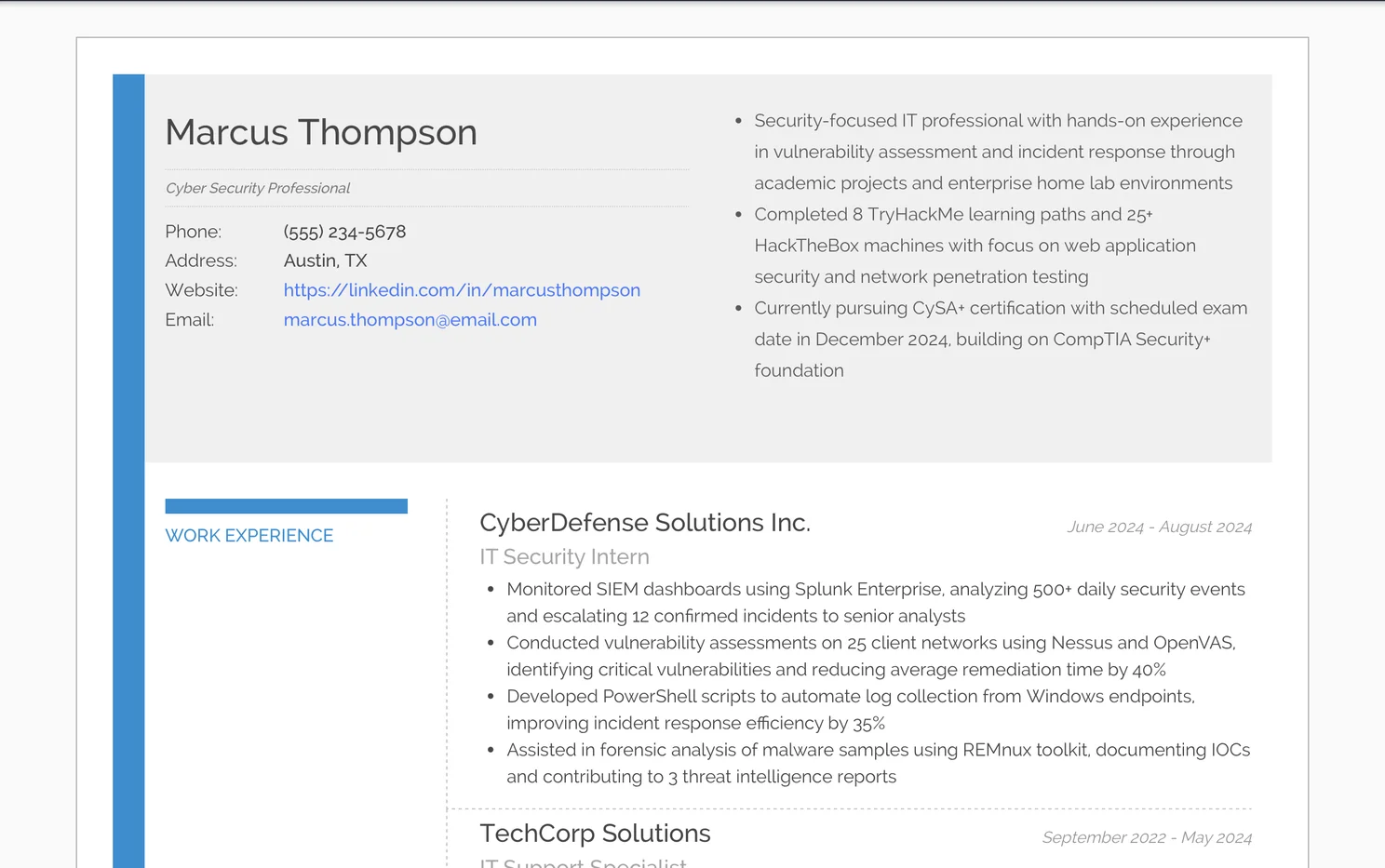
The Ultimate Cyber Security Resume Example/Sample
https://www.resumonk.com/cyber-security-resumeCyber SecurityResume Format for Cyber Security Resume
The reverse-chronological format is your best friend here, and there's a solid reason why.
Cybersecurity is a field that evolves faster than malware variants - what you did six months ago matters infinitely more than what you did six years ago. Hiring managers want to see your most recent exposure to current threats, tools, and technologies right up front.
Why Reverse-Chronological Works for Entry-Level Cyber Security
Think about it - you're applying for an entry-level position where you'll be monitoring security dashboards, responding to alerts, and implementing security protocols. The person reviewing your resume wants to immediately see if you've touched a SIEM system recently, not whether you built websites five years ago (though that experience still has value, just not headline value).
Your resume should flow like this - contact information at the top, followed by a brief professional summary (2-3 lines maximum), then dive straight into your work experience starting with your most recent role. Even if your most recent role was that internship where you mostly shadowed the SOC team, it goes first.
After work experience comes your education section, followed by technical skills, and finally certifications.
The Professional Summary That Actually Works
Here's where many entry-level cyber security professionals stumble.
They either oversell themselves or undersell their genuine passion for security. Your summary should acknowledge your entry-level status while highlighting your readiness to contribute.
❌ Don't write a generic, buzzword-filled summary:
Passionate cybersecurity professional seeking to leverage skills in a dynamic environment to protect organizational assets and ensure compliance.
✅ Do write a specific, achievement-focused summary:
Security-focused IT professional with hands-on experience in vulnerability assessment and incident response through academic projects and home lab environments. Completed 3 TryHackMe learning paths and currently pursuing Security+ certification.
Structuring Sections for Maximum Impact
The beauty of the reverse-chronological format for cyber security resumes lies in its ability to tell your security journey as a story. Maybe you started in IT support and gradually took on more security responsibilities - that progression should be crystal clear.
Or perhaps you're transitioning from software development and bringing valuable coding skills to security - that narrative needs to shine through your format choices.
For those in the UK or Australia, you might be tempted to include a photograph or personal details - resist this urge. Cyber security is about protecting information, and demonstrating good OpSec starts with your own resume. Keep personal information minimal across all regions.
Work Experience on Cyber Security Resume
Here's the uncomfortable truth - you're competing against people who might have been configuring firewalls while you were still figuring out what a subnet mask was. But that doesn't mean your work experience section should apologize for your journey.
Every role you've held has security-relevant aspects if you know how to frame them.
Mining Your Non-Security Roles for Gold
Let's say you've been working in IT support for the past two years. On the surface, it seems like you've just been resetting passwords and imaging laptops. But dig deeper - every password reset was an opportunity to educate users about security. Every laptop you configured followed security baselines.
Every ticket you handled required you to verify user identity.
The key is translating your everyday tasks into security-conscious achievements. You weren't just "providing technical support" - you were the first line of defense against social engineering attempts.
❌ Don't write vague job descriptions:
IT Support Specialist - TechCorp Inc.
• Provided technical support to 200+ users
• Resolved hardware and software issues
• Maintained inventory of IT equipment
✅ Do highlight security-relevant accomplishments:
IT Support Specialist - TechCorp Inc.
• Implemented secure onboarding procedures for 50+ new employees, ensuring proper access controls and MFA setup
• Identified and reported 3 potential security incidents through unusual user behavior patterns
• Developed PowerShell scripts to automate security patch deployment, reducing vulnerability window by 60%
Quantifying Your Security Impact
Numbers tell stories in cybersecurity. Maybe you haven't prevented a major breach yet, but you've certainly contributed to your organization's security posture. Think about metrics like - How many systems did you patch? How many security awareness training sessions did you complete?
What was your average incident response time during your internship?
For those fresh out of university or bootcamps, your academic projects are legitimate work experience. That capstone project where you built a honeypot? That's hands-on security work. The penetration testing lab where you exploited vulnerable machines?
That demonstrates practical skills.
Addressing Employment Gaps or Career Transitions
Perhaps you took six months off to study for certifications, or you're transitioning from a completely different field.
Own it. The cyber security field respects continuous learning and diverse backgrounds. A former accountant brings forensic thinking. A former teacher brings the ability to explain complex concepts simply - crucial for security awareness training.
Career Development Break (January 2024 - June 2024)
• Completed CompTIA Security+ and Network+ certifications
• Built home lab environment with pfSense, Security Onion, and Splunk
• Participated in 15 Capture The Flag competitions, ranking in top 20% in 3 events
Remember that in Canada and the US, employers particularly value hands-on experience, even if it's self-directed. Your home lab adventures and HackTheBox achievements belong in this section if you don't have traditional employment to showcase.
Skills to Show on Cyber Security Resume
Your skills section is where the rubber meets the road in a cyber security resume. This isn't the place for "Microsoft Office" or "Team Player" - hiring managers want to see specific tools, frameworks, and methodologies that prove you can hit the ground running on day one.
Technical Skills - The Non-Negotiables
Start with the tools you'll actually use in an entry-level role. SIEM platforms are huge - if you've touched Splunk, even in a free fundamentals course, that goes on your resume.
Security scanning tools like Nmap, Wireshark for packet analysis, and vulnerability scanners like Nessus or OpenVAS show you understand the basics of security assessment.
But here's where many candidates mess up - they list every tool they've ever heard of, creating a skills section that reads like a vendor catalog. If you can't answer basic questions about a tool, it doesn't belong on your resume.
❌ Don't create a kitchen-sink skills list:
Skills: Python, Java, C++, Ruby, Perl, Splunk, QRadar, ArcSight, Nessus, Qualys,
Rapid7, Metasploit, Burp Suite, OWASP ZAP, Wireshark, tcpdump, pfSense,
Cisco ASA, Palo Alto, Fortinet, Check Point...
✅ Do organize skills by proficiency and relevance:
Security Tools: Splunk (SIEM) - 6 months experience | Nmap - Regular use | Wireshark - Packet analysis
Scripting: Python - Automation scripts | Bash - System administration | PowerShell - Windows security
Frameworks: NIST Cybersecurity Framework | MITRE ATT&CK - Familiar
The Soft Skills That Actually Matter in Cyber Security
Yes, soft skills matter, but not in the way you think. "Communication skills" is meaningless.
"Ability to write clear incident reports for non-technical stakeholders" shows you understand that security isn't just about finding vulnerabilities - it's about conveying risk in business terms.
Documentation abilities are huge in cyber security. You'll be writing runbooks, creating security policies, and documenting incidents.
Analytical thinking isn't just a buzzword when you can demonstrate it through specific examples of how you've approached problem-solving.
Certifications and Continuous Learning
In the cyber security world, professional certifications are currency, but they're also a double-edged sword.
Having Security+ shows foundational knowledge. Having every entry-level cert under the sun might signal you're a perpetual student who never applies knowledge practically.
List your certifications strategically. Current certifications go in your skills section. In-progress certifications can be mentioned if you have a concrete test date scheduled. And please, for the love of all that is secure, don't list expired certifications unless you're actively renewing them.
Certifications:
• CompTIA Security+ (SY0-601) - Obtained June 2024
• CompTIA Network+ - Obtained March 2024
• Pursuing: CySA+ (Scheduled for September 2024)
For those applying in the UK or European markets, GDPR knowledge is almost mandatory now. In Australia, understanding the Privacy Act and Notifiable Data Breaches scheme shows regional awareness.
These region-specific compliance knowledge points can set you apart from candidates using generic resumes.
Specific Considerations and Tips for Cyber Security Resume
Now we get to the insider knowledge - the stuff that separates a cyber security resume from any other IT resume. You're not just another IT professional; you're aspiring to join the ranks of digital defenders, and your resume needs to reflect that unique positioning.
Demonstrating the Security Mindset
Every line of your resume should breathe security consciousness.
When you describe any achievement, think about its security implications. Did you improve a process? Frame it as reducing attack surface. Did you train colleagues? That's security awareness education. Did you automate something? You reduced human error - a major security vulnerability.
The hiring manager reading your resume is likely paranoid by profession - they think in terms of risks, threats, and vulnerabilities. Speak their language. Instead of "Improved system performance," write "Optimized system performance while maintaining security baselines and compliance requirements."
The Home Lab Advantage
Unlike many fields, cyber security rewards the tinkerers and the curious.
Your home lab isn't just a hobby - it's proof of genuine interest and self-directed learning. But describing it requires finesse.
❌ Don't undersell your home lab:
Interests: Running a home lab for learning purposes
✅ Do detail your home lab like a professional environment:
Security Lab Environment:
• Architected isolated virtual network with 15+ VMs simulating enterprise environment
• Deployed Security Onion for network monitoring and configured custom Sigma rules
• Created automated incident response playbooks using SOAR principles
• Documented 10+ attack scenarios and defensive strategies in personal knowledge base
The GitHub Repository Factor
Your GitHub isn't just for developers anymore.
Security professionals who can code are gold, and your repositories tell a story. Maybe you've written Python scripts to automate security tasks, created detection rules, or contributed to open-source security tools. Include your GitHub profile, but curate it first - archive or make private those half-finished projects from three years ago.
Consider creating a security-focused repository specifically for your job search. Include things like custom YARA rules you've written, security automation scripts, or even write-ups from CTF challenges (being careful not to spoil active challenges, of course).
Addressing the Clearance Question
In the US especially, many cyber security positions require or prefer security clearances. If you have one, it goes right at the top of your resume, just under your contact information. If you don't, but you're eligible (US citizen, clean background), mention "Eligible for security clearance" in your professional summary.
For positions requiring active clearances, don't waste anyone's time if you're not eligible - focus on private sector opportunities instead.
The Bug Bounty and CTF Differentiator
Participation in bug bounty programs and Capture The Flag competitions isn't just a hobby - it's practical experience that many traditional candidates lack. If you've found vulnerabilities through bug bounty programs (even if unpaid), that's real-world security testing experience.
If you regularly participate in CTFs, you're demonstrating continuous learning and competitive drive.
Additional Security Engagement:
• Active bug bounty participant on HackerOne - Reported 3 valid vulnerabilities
• PicoCTF 2024 - Completed 45/50 challenges, specializing in web exploitation
• TryHackMe profile - Top 5% ranking with 15 completed learning paths
The Regional Nuances That Matter
If you're applying in the financial sector in the UK, mentioning familiarity with FCA regulations shows awareness. In healthcare in the US, HIPAA knowledge is crucial. In Canada, experience with the Canadian Centre for Cyber Security's guidelines can set you apart.
Don't just list these as acronyms - demonstrate understanding through your experience descriptions.
Finally, remember that cyber security hiring managers often have a healthy dose of skepticism. They've seen too many resumes claiming "expert-level" skills from people who can't explain what a three-way handshake is. Be honest about your skill levels, but confident about your potential. Show that you understand that in cyber security, the learning never stops - and you wouldn't have it any other way.
Education to List on Cyber Security Executive Resume
Now, let's picture a scenario - you're fresh out of college with your Computer Science degree, or maybe you've just completed that intensive bootcamp on ethical hacking. You're eyeing that Cyber Security Executive position (yes, the entry-level one where "executive" means you'll be executing security tasks, not managing teams), and you're wondering how to make your educational background stand out.
The truth is, in the cybersecurity world, your education section needs to demonstrate not just what you learned, but how ready you are to defend digital fortresses from day one.
The Foundation Matters More Than You Think
For entry-level cyber security roles, recruiters scrutinize your education section like they're performing a security audit.
They're looking for specific coursework, certifications, and practical applications that signal you understand both the theoretical and hands-on aspects of information security. Your traditional four-year degree is valuable, but in this field, it's what you've done beyond the classroom that often catches attention.
When listing your education, start with your highest degree and work backwards in reverse-chronological order. But here's where it gets interesting for cyber security candidates - your certifications might actually deserve equal billing with your formal degrees. CompTIA Security+, CEH, or CISSP Associate credentials aren't just nice-to-haves; they're often the difference between getting an interview and getting overlooked.
Crafting Your Education Section for Maximum Impact
The key is to highlight relevant coursework that directly relates to cybersecurity responsibilities. Network Security, Cryptography, Digital Forensics - these aren't just classes you took; they're proof points of your readiness to tackle real-world security challenges.
❌ Don't write your education like this:
Bachelor of Science in Computer Science
State University, 2023
GPA: 3.5
✅ Do write it like this:
Bachelor of Science in Computer Science | State University | May 2023
GPA: 3.5/4.0
Relevant Coursework: Network Security, Cryptography, Digital Forensics,
Ethical Hacking, Security Risk Management
Capstone Project: Developed intrusion detection system using Python and Snort
Certifications - Your Secret Weapon
In the cybersecurity field, certifications often carry more weight than degrees for entry-level positions.
List them prominently, including the certification number and expiration date where applicable. If you're currently pursuing a certification, include it with an expected completion date - it shows initiative and continuous learning, both crucial traits for security professionals.
Certifications:
CompTIA Security+ (SY0-601) | Issued: March 2023 | Expires: March 2026
Certified Ethical Hacker (CEH) | In Progress | Expected: December 2023
Awards and Publications on Cyber Security Executive Resume
You might be thinking - "I'm applying for an entry-level position; what awards could I possibly have?"
But here's the thing about cybersecurity - it's a field where passionate newcomers often distinguish themselves through capture-the-flag competitions, bug bounty programs, and security research projects long before landing their first official role. These achievements aren't just resume fillers; they're evidence of your genuine interest in security and your ability to think like both an attacker and defender.
Why Awards Matter in Cybersecurity
The cybersecurity community values practical skills and initiative above almost everything else.
That third-place finish in your university's CTF competition? That's real-world problem-solving experience. The acknowledgment you received from a major tech company's bug bounty program? That's proof you can find vulnerabilities that others miss. These achievements tell employers you're not just learning about security in theory - you're actively practicing it.
When listing awards, be specific about what you accomplished and the skills you demonstrated. Context matters enormously in security-related achievements.
❌ Don't list awards vaguely:
Winner - University Hackathon 2023
Published research paper on cybersecurity
✅ Do provide context and relevance:
2nd Place - University Cyber Defense Competition 2023
- Led 4-person team in defending simulated corporate network against red team attacks
- Successfully identified and mitigated 15 critical vulnerabilities in 8-hour competition

Bug Bounty Recognition - Microsoft Security Response Center | September 2023
- Discovered XSS vulnerability in Office 365 web application
- Awarded $2,000 bounty and public acknowledgment
Publications and Research - Building Your Security Credibility
Publications on a cybersecurity resume don't have to mean peer-reviewed academic papers (though those are great too). Blog posts about security vulnerabilities you've discovered, write-ups of CTF challenges you've solved, or contributions to security tools on GitHub all count as publications that demonstrate your expertise and communication skills - both essential for a security professional who needs to explain complex threats to non-technical stakeholders.
If you've written security-related content, whether it's a Medium article about OWASP Top 10 or a detailed GitHub repository documenting your penetration testing methodology, include it. Format these entries to highlight both the technical depth and the impact of your work.
Publications and Research:
"Exploiting JWT Implementation Flaws in Modern Web Applications"
Personal Security Blog | August 2023
- Analyzed 50+ web applications for JWT vulnerabilities
- Article received 5,000+ views and cited by SANS Internet Storm Center

Contributing Author - OWASP Testing Guide v5 | June 2023
- Contributed 3 sections on API security testing methodologies
Listing References for Cyber Security Executive Resume
Here's something that might surprise you about references in the cybersecurity field - they're often checked more thoroughly than in other IT roles. Why? Because you're asking for access to an organization's most sensitive assets and vulnerabilities.
Trust is paramount, and your references are essentially character witnesses vouching that you can be trusted with the digital keys to the kingdom.
Who Makes the Best References for Security Roles
Your reference list for a cyber security position should ideally include people who can speak to both your technical abilities and your integrity.
That professor who supervised your network security lab? Perfect. The CISO from your internship who watched you handle sensitive incident response data? Even better. The key is choosing references who can articulate specific examples of your security mindset and ethical behavior.
Unlike some fields where references are an afterthought, in cybersecurity, they're often contacted early in the process. Security teams want to know - Can this person handle confidential information? How do they respond to pressure?
Have they demonstrated ethical decision-making when faced with sensitive data?
Formatting Your References Section
For cyber security positions, it's increasingly common to provide references proactively rather than waiting to be asked. This shows transparency - a quality highly valued in security professionals.
Create a separate references document that matches your resume's formatting.
❌ Don't list references without context:
John Smith
Professor
University Name
[email protected]
✅ Do provide relevant context:
Dr. John Smith, CISSP
Professor of Information Security | University Name
Relationship: Supervised my senior thesis on ransomware detection using ML
Contact: [email protected] | (555) 123-4567
Can speak to: Security research abilities, ethical hacking methodology,
and leadership in cybersecurity club activities
The LinkedIn Strategy for Security Professionals
In the cybersecurity community, LinkedIn recommendations carry significant weight. Before you start applying, reach out to your references and ask them to write LinkedIn recommendations that specifically mention your security-related skills and projects.
These public endorsements serve as pre-verification and show you're comfortable with transparency - crucial in a field where background checks are standard.
Additionally, consider including one non-traditional reference - perhaps someone from a bug bounty program you've participated in or a moderator from a security forum where you've contributed valuable research. These references can provide unique perspectives on your practical skills and community involvement.
Remember to always inform your references when you're actively job hunting and provide them with the job description. For security roles, your references might be asked specific technical questions about your abilities, so giving them context helps them prepare relevant examples.
In the UK and Australia, written references are often preferred, while in the US and Canada, phone references are more common - prepare your references accordingly based on where you're applying.
Cover Letter Tips for Cyber Security Executive Resume
Let's address the elephant in the room - you're probably wondering if anyone actually reads cover letters for technical positions.
In cybersecurity, the answer is a resounding yes, but not for the reasons you might think. Your cover letter isn't just about rehashing your resume; it's your opportunity to demonstrate the analytical thinking and communication skills that are absolutely critical when you're explaining why a seemingly innocuous configuration change could open the door to a massive breach.
The Security Mindset on Paper
Your cover letter for a cyber security executive position needs to accomplish something specific - it must show that you think like a security professional. This means demonstrating paranoid optimism (expecting the worst while working toward the best), showing awareness of current threat landscapes, and proving you understand that security isn't just about technology - it's about people and processes too.
Start your cover letter with a hook that shows you understand the company's security challenges. Did they recently migrate to cloud? Mention your AWS security knowledge. Are they in healthcare? Reference your understanding of HIPAA compliance.
This targeted approach shows you've done your reconnaissance - a fundamental security skill.
Structure That Shows Security Thinking
The middle paragraph should bridge your experience to their needs. Remember, as an entry-level candidate, you're not expected to have saved Fortune 500 companies from ransomware attacks.
What you should demonstrate is your learning agility and practical application of security concepts.
❌ Don't write generic statements:
"I am passionate about cybersecurity and would love to work for your company.
I have studied various security concepts and am eager to learn more."
✅ Do write specific, security-focused content:
"While analyzing your company's public-facing assets during my research, I noticed your recent expansion into cloud services. My capstone project on AWS security misconfigurations, where I identified and documented 30+ common vulnerabilities in S3 bucket policies, directly aligns with the challenges your team likely faces in securing cloud infrastructure."
Closing with Confidence and Clarity
Your closing paragraph should reinforce your understanding of the role's responsibilities while showing enthusiasm for the specific challenges. Mention your relevant certifications one more time, but frame them as tools you'll use to contribute immediately, not just credentials you've collected.
For different regions, adjust your tone accordingly. US cover letters tend to be more direct and achievement-focused, UK letters slightly more formal and modest, while Canadian and Australian letters fall somewhere in between.
However, regardless of location, technical competence and security awareness should shine through.
Key Takeaways
- Use reverse-chronological format - Your most recent experience matters most in the rapidly evolving cybersecurity field, so lead with your latest roles, projects, and certifications
- Frame everything through a security lens - Every role you've held has security-relevant aspects; translate IT support tasks into security achievements by highlighting access controls, incident identification, and security awareness contributions
- Quantify your security impact - Use specific metrics like number of vulnerabilities identified, patches deployed, or incident response times rather than vague descriptions
- Showcase practical experience - Home labs, CTF competitions, bug bounties, and GitHub repositories are legitimate experience for entry-level positions and should be detailed professionally
- List technical skills strategically - Organize security tools by proficiency level and actual usage, avoiding the temptation to list every tool you've heard of
- Certifications are currency - CompTIA Security+, Network+, and other relevant certifications should be prominently displayed with certification numbers and expiration dates
- Include relevant coursework and projects - For recent graduates, detail security-specific coursework, capstone projects, and research that demonstrate practical application of security concepts
- Don't forget compliance knowledge - Understanding of GDPR, HIPAA, or regional privacy regulations can set you apart, especially for industry-specific roles
- Awards and publications matter - CTF placements, bug bounty acknowledgments, and security blog posts are valuable proof of your skills and passion
- Choose references who understand security - Select references who can speak to both your technical abilities and your trustworthiness with sensitive information
Creating a compelling cyber security resume requires more than just listing your skills and experience - it demands strategically presenting your journey into security in a way that resonates with hiring managers who think in terms of threats, vulnerabilities, and risk mitigation. Whether you're transitioning from another IT role or entering the field fresh from education, the key is demonstrating that you already think like a security professional and are ready to defend digital assets from day one.
With Resumonk, you can build your cyber security resume using professionally designed templates that showcase your technical expertise while maintaining the clean, organized structure that security professionals appreciate. Our AI-powered suggestions help you identify and articulate the security-relevant aspects of your experience, while our intuitive editor ensures your certifications, technical skills, and security projects are presented in the most impactful way. The platform understands the unique requirements of security resumes, helping you highlight everything from your home lab configurations to your bug bounty achievements in a format that gets noticed.
Ready to build your cyber security resume that opens doors to SOCs and security teams?
Start crafting your professional cyber security resume with Resumonk's specialized templates and AI-powered recommendations. Your journey into professional cybersecurity starts with a resume that speaks the language of security.
Get started with Resumonk today →
More Information Technology (IT) resume examples
- Technical Support resume example
- IT Project Manager resume example
- Entry Level Help Desk resume example
- AWS resume example
See all Information Technology (IT) resume examples, or browse every category.
Resume writing tips
You've been living and breathing cybersecurity - maybe through late-night TryHackMe sessions where you finally cracked that privilege escalation challenge at 3 AM, or perhaps through your day job where you've been the unofficial "security person" who keeps reminding everyone about phishing emails. Now you're staring at job postings for "Cyber Security Executive" positions, knowing full well that despite the fancy "executive" title, this is your entry point into the professional security world - the role where you'll be executing security operations, not executing strategic decisions from a corner office.
The path that brought you here is uniquely yours. Maybe you're transitioning from IT support, where every password reset made you wonder about better authentication methods. Perhaps you're fresh from a computer science program, your head spinning with cryptographic algorithms and network protocols. Or you could be making a complete career pivot, bringing analytical skills from finance or attention to detail from quality assurance into the digital defense realm. Whatever your journey, you're now faced with the challenge of crafting a resume that proves you belong in that Security Operations Center, even if you've never officially worked in one.
This comprehensive guide walks you through every element of building a cyber security resume that actually lands interviews. We'll start with choosing the right format - specifically, why the reverse-chronological approach works best for security roles and how to structure it for maximum impact. Then we'll dive deep into crafting your work experience section, showing you how to mine even non-security roles for relevant achievements that demonstrate your security mindset. You'll learn exactly which technical skills to highlight (and which to leave off), how to present your education and certifications strategically, and the specific considerations that set security resumes apart from generic IT resumes.
We'll also cover the often-overlooked elements that can make or break your application - how to leverage your home lab experiences, present your bug bounty achievements, write a cover letter that demonstrates security thinking, and choose references who can vouch for both your technical abilities and your trustworthiness. By the end of this guide, you'll have everything you need to create a resume that speaks fluently to hiring managers in the language of risk, threats, and defensive strategies, positioning yourself as the security-conscious professional they need on their team.
The Ultimate Cyber Security Resume Example/Sample
https://www.resumonk.com/cyber-security-resumeCyber SecurityResume Format for Cyber Security Resume
The reverse-chronological format is your best friend here, and there's a solid reason why.
Cybersecurity is a field that evolves faster than malware variants - what you did six months ago matters infinitely more than what you did six years ago. Hiring managers want to see your most recent exposure to current threats, tools, and technologies right up front.
Why Reverse-Chronological Works for Entry-Level Cyber Security
Think about it - you're applying for an entry-level position where you'll be monitoring security dashboards, responding to alerts, and implementing security protocols. The person reviewing your resume wants to immediately see if you've touched a SIEM system recently, not whether you built websites five years ago (though that experience still has value, just not headline value).
Your resume should flow like this - contact information at the top, followed by a brief professional summary (2-3 lines maximum), then dive straight into your work experience starting with your most recent role. Even if your most recent role was that internship where you mostly shadowed the SOC team, it goes first.
After work experience comes your education section, followed by technical skills, and finally certifications.
The Professional Summary That Actually Works
Here's where many entry-level cyber security professionals stumble.
They either oversell themselves or undersell their genuine passion for security. Your summary should acknowledge your entry-level status while highlighting your readiness to contribute.
❌ Don't write a generic, buzzword-filled summary:
Passionate cybersecurity professional seeking to leverage skills in a dynamic environment to protect organizational assets and ensure compliance.
✅ Do write a specific, achievement-focused summary:
Security-focused IT professional with hands-on experience in vulnerability assessment and incident response through academic projects and home lab environments. Completed 3 TryHackMe learning paths and currently pursuing Security+ certification.
Structuring Sections for Maximum Impact
The beauty of the reverse-chronological format for cyber security resumes lies in its ability to tell your security journey as a story. Maybe you started in IT support and gradually took on more security responsibilities - that progression should be crystal clear.
Or perhaps you're transitioning from software development and bringing valuable coding skills to security - that narrative needs to shine through your format choices.
For those in the UK or Australia, you might be tempted to include a photograph or personal details - resist this urge. Cyber security is about protecting information, and demonstrating good OpSec starts with your own resume. Keep personal information minimal across all regions.
Work Experience on Cyber Security Resume
Here's the uncomfortable truth - you're competing against people who might have been configuring firewalls while you were still figuring out what a subnet mask was. But that doesn't mean your work experience section should apologize for your journey.
Every role you've held has security-relevant aspects if you know how to frame them.
Mining Your Non-Security Roles for Gold
Let's say you've been working in IT support for the past two years. On the surface, it seems like you've just been resetting passwords and imaging laptops. But dig deeper - every password reset was an opportunity to educate users about security. Every laptop you configured followed security baselines.
Every ticket you handled required you to verify user identity.
The key is translating your everyday tasks into security-conscious achievements. You weren't just "providing technical support" - you were the first line of defense against social engineering attempts.
❌ Don't write vague job descriptions:
IT Support Specialist - TechCorp Inc.
• Provided technical support to 200+ users
• Resolved hardware and software issues
• Maintained inventory of IT equipment
✅ Do highlight security-relevant accomplishments:
IT Support Specialist - TechCorp Inc.
• Implemented secure onboarding procedures for 50+ new employees, ensuring proper access controls and MFA setup
• Identified and reported 3 potential security incidents through unusual user behavior patterns
• Developed PowerShell scripts to automate security patch deployment, reducing vulnerability window by 60%
Quantifying Your Security Impact
Numbers tell stories in cybersecurity. Maybe you haven't prevented a major breach yet, but you've certainly contributed to your organization's security posture. Think about metrics like - How many systems did you patch? How many security awareness training sessions did you complete?
What was your average incident response time during your internship?
For those fresh out of university or bootcamps, your academic projects are legitimate work experience. That capstone project where you built a honeypot? That's hands-on security work. The penetration testing lab where you exploited vulnerable machines?
That demonstrates practical skills.
Addressing Employment Gaps or Career Transitions
Perhaps you took six months off to study for certifications, or you're transitioning from a completely different field.
Own it. The cyber security field respects continuous learning and diverse backgrounds. A former accountant brings forensic thinking. A former teacher brings the ability to explain complex concepts simply - crucial for security awareness training.
Career Development Break (January 2024 - June 2024)
• Completed CompTIA Security+ and Network+ certifications
• Built home lab environment with pfSense, Security Onion, and Splunk
• Participated in 15 Capture The Flag competitions, ranking in top 20% in 3 events
Remember that in Canada and the US, employers particularly value hands-on experience, even if it's self-directed. Your home lab adventures and HackTheBox achievements belong in this section if you don't have traditional employment to showcase.
Skills to Show on Cyber Security Resume
Your skills section is where the rubber meets the road in a cyber security resume. This isn't the place for "Microsoft Office" or "Team Player" - hiring managers want to see specific tools, frameworks, and methodologies that prove you can hit the ground running on day one.
Technical Skills - The Non-Negotiables
Start with the tools you'll actually use in an entry-level role. SIEM platforms are huge - if you've touched Splunk, even in a free fundamentals course, that goes on your resume.
Security scanning tools like Nmap, Wireshark for packet analysis, and vulnerability scanners like Nessus or OpenVAS show you understand the basics of security assessment.
But here's where many candidates mess up - they list every tool they've ever heard of, creating a skills section that reads like a vendor catalog. If you can't answer basic questions about a tool, it doesn't belong on your resume.
❌ Don't create a kitchen-sink skills list:
Skills: Python, Java, C++, Ruby, Perl, Splunk, QRadar, ArcSight, Nessus, Qualys,
Rapid7, Metasploit, Burp Suite, OWASP ZAP, Wireshark, tcpdump, pfSense,
Cisco ASA, Palo Alto, Fortinet, Check Point...
✅ Do organize skills by proficiency and relevance:
Security Tools: Splunk (SIEM) - 6 months experience | Nmap - Regular use | Wireshark - Packet analysis
Scripting: Python - Automation scripts | Bash - System administration | PowerShell - Windows security
Frameworks: NIST Cybersecurity Framework | MITRE ATT&CK - Familiar
The Soft Skills That Actually Matter in Cyber Security
Yes, soft skills matter, but not in the way you think. "Communication skills" is meaningless.
"Ability to write clear incident reports for non-technical stakeholders" shows you understand that security isn't just about finding vulnerabilities - it's about conveying risk in business terms.
Documentation abilities are huge in cyber security. You'll be writing runbooks, creating security policies, and documenting incidents.
Analytical thinking isn't just a buzzword when you can demonstrate it through specific examples of how you've approached problem-solving.
Certifications and Continuous Learning
In the cyber security world, professional certifications are currency, but they're also a double-edged sword.
Having Security+ shows foundational knowledge. Having every entry-level cert under the sun might signal you're a perpetual student who never applies knowledge practically.
List your certifications strategically. Current certifications go in your skills section. In-progress certifications can be mentioned if you have a concrete test date scheduled. And please, for the love of all that is secure, don't list expired certifications unless you're actively renewing them.
Certifications:
• CompTIA Security+ (SY0-601) - Obtained June 2024
• CompTIA Network+ - Obtained March 2024
• Pursuing: CySA+ (Scheduled for September 2024)
For those applying in the UK or European markets, GDPR knowledge is almost mandatory now. In Australia, understanding the Privacy Act and Notifiable Data Breaches scheme shows regional awareness.
These region-specific compliance knowledge points can set you apart from candidates using generic resumes.
Specific Considerations and Tips for Cyber Security Resume
Now we get to the insider knowledge - the stuff that separates a cyber security resume from any other IT resume. You're not just another IT professional; you're aspiring to join the ranks of digital defenders, and your resume needs to reflect that unique positioning.
Demonstrating the Security Mindset
Every line of your resume should breathe security consciousness.
When you describe any achievement, think about its security implications. Did you improve a process? Frame it as reducing attack surface. Did you train colleagues? That's security awareness education. Did you automate something? You reduced human error - a major security vulnerability.
The hiring manager reading your resume is likely paranoid by profession - they think in terms of risks, threats, and vulnerabilities. Speak their language. Instead of "Improved system performance," write "Optimized system performance while maintaining security baselines and compliance requirements."
The Home Lab Advantage
Unlike many fields, cyber security rewards the tinkerers and the curious.
Your home lab isn't just a hobby - it's proof of genuine interest and self-directed learning. But describing it requires finesse.
❌ Don't undersell your home lab:
Interests: Running a home lab for learning purposes
✅ Do detail your home lab like a professional environment:
Security Lab Environment:
• Architected isolated virtual network with 15+ VMs simulating enterprise environment
• Deployed Security Onion for network monitoring and configured custom Sigma rules
• Created automated incident response playbooks using SOAR principles
• Documented 10+ attack scenarios and defensive strategies in personal knowledge base
The GitHub Repository Factor
Your GitHub isn't just for developers anymore.
Security professionals who can code are gold, and your repositories tell a story. Maybe you've written Python scripts to automate security tasks, created detection rules, or contributed to open-source security tools. Include your GitHub profile, but curate it first - archive or make private those half-finished projects from three years ago.
Consider creating a security-focused repository specifically for your job search. Include things like custom YARA rules you've written, security automation scripts, or even write-ups from CTF challenges (being careful not to spoil active challenges, of course).
Addressing the Clearance Question
In the US especially, many cyber security positions require or prefer security clearances. If you have one, it goes right at the top of your resume, just under your contact information. If you don't, but you're eligible (US citizen, clean background), mention "Eligible for security clearance" in your professional summary.
For positions requiring active clearances, don't waste anyone's time if you're not eligible - focus on private sector opportunities instead.
The Bug Bounty and CTF Differentiator
Participation in bug bounty programs and Capture The Flag competitions isn't just a hobby - it's practical experience that many traditional candidates lack. If you've found vulnerabilities through bug bounty programs (even if unpaid), that's real-world security testing experience.
If you regularly participate in CTFs, you're demonstrating continuous learning and competitive drive.
Additional Security Engagement:
• Active bug bounty participant on HackerOne - Reported 3 valid vulnerabilities
• PicoCTF 2024 - Completed 45/50 challenges, specializing in web exploitation
• TryHackMe profile - Top 5% ranking with 15 completed learning paths
The Regional Nuances That Matter
If you're applying in the financial sector in the UK, mentioning familiarity with FCA regulations shows awareness. In healthcare in the US, HIPAA knowledge is crucial. In Canada, experience with the Canadian Centre for Cyber Security's guidelines can set you apart.
Don't just list these as acronyms - demonstrate understanding through your experience descriptions.
Finally, remember that cyber security hiring managers often have a healthy dose of skepticism. They've seen too many resumes claiming "expert-level" skills from people who can't explain what a three-way handshake is. Be honest about your skill levels, but confident about your potential. Show that you understand that in cyber security, the learning never stops - and you wouldn't have it any other way.
Education to List on Cyber Security Executive Resume
Now, let's picture a scenario - you're fresh out of college with your Computer Science degree, or maybe you've just completed that intensive bootcamp on ethical hacking. You're eyeing that Cyber Security Executive position (yes, the entry-level one where "executive" means you'll be executing security tasks, not managing teams), and you're wondering how to make your educational background stand out.
The truth is, in the cybersecurity world, your education section needs to demonstrate not just what you learned, but how ready you are to defend digital fortresses from day one.
The Foundation Matters More Than You Think
For entry-level cyber security roles, recruiters scrutinize your education section like they're performing a security audit.
They're looking for specific coursework, certifications, and practical applications that signal you understand both the theoretical and hands-on aspects of information security. Your traditional four-year degree is valuable, but in this field, it's what you've done beyond the classroom that often catches attention.
When listing your education, start with your highest degree and work backwards in reverse-chronological order. But here's where it gets interesting for cyber security candidates - your certifications might actually deserve equal billing with your formal degrees. CompTIA Security+, CEH, or CISSP Associate credentials aren't just nice-to-haves; they're often the difference between getting an interview and getting overlooked.
Crafting Your Education Section for Maximum Impact
The key is to highlight relevant coursework that directly relates to cybersecurity responsibilities. Network Security, Cryptography, Digital Forensics - these aren't just classes you took; they're proof points of your readiness to tackle real-world security challenges.
❌ Don't write your education like this:
Bachelor of Science in Computer Science
State University, 2023
GPA: 3.5
✅ Do write it like this:
Bachelor of Science in Computer Science | State University | May 2023
GPA: 3.5/4.0
Relevant Coursework: Network Security, Cryptography, Digital Forensics,
Ethical Hacking, Security Risk Management
Capstone Project: Developed intrusion detection system using Python and Snort
Certifications - Your Secret Weapon
In the cybersecurity field, certifications often carry more weight than degrees for entry-level positions.
List them prominently, including the certification number and expiration date where applicable. If you're currently pursuing a certification, include it with an expected completion date - it shows initiative and continuous learning, both crucial traits for security professionals.
Certifications:
CompTIA Security+ (SY0-601) | Issued: March 2023 | Expires: March 2026
Certified Ethical Hacker (CEH) | In Progress | Expected: December 2023
Awards and Publications on Cyber Security Executive Resume
You might be thinking - "I'm applying for an entry-level position; what awards could I possibly have?"
But here's the thing about cybersecurity - it's a field where passionate newcomers often distinguish themselves through capture-the-flag competitions, bug bounty programs, and security research projects long before landing their first official role. These achievements aren't just resume fillers; they're evidence of your genuine interest in security and your ability to think like both an attacker and defender.
Why Awards Matter in Cybersecurity
The cybersecurity community values practical skills and initiative above almost everything else.
That third-place finish in your university's CTF competition? That's real-world problem-solving experience. The acknowledgment you received from a major tech company's bug bounty program? That's proof you can find vulnerabilities that others miss. These achievements tell employers you're not just learning about security in theory - you're actively practicing it.
When listing awards, be specific about what you accomplished and the skills you demonstrated. Context matters enormously in security-related achievements.
❌ Don't list awards vaguely:
Winner - University Hackathon 2023
Published research paper on cybersecurity
✅ Do provide context and relevance:
2nd Place - University Cyber Defense Competition 2023
- Led 4-person team in defending simulated corporate network against red team attacks
- Successfully identified and mitigated 15 critical vulnerabilities in 8-hour competition

Bug Bounty Recognition - Microsoft Security Response Center | September 2023
- Discovered XSS vulnerability in Office 365 web application
- Awarded $2,000 bounty and public acknowledgment
Publications and Research - Building Your Security Credibility
Publications on a cybersecurity resume don't have to mean peer-reviewed academic papers (though those are great too). Blog posts about security vulnerabilities you've discovered, write-ups of CTF challenges you've solved, or contributions to security tools on GitHub all count as publications that demonstrate your expertise and communication skills - both essential for a security professional who needs to explain complex threats to non-technical stakeholders.
If you've written security-related content, whether it's a Medium article about OWASP Top 10 or a detailed GitHub repository documenting your penetration testing methodology, include it. Format these entries to highlight both the technical depth and the impact of your work.
Publications and Research:
"Exploiting JWT Implementation Flaws in Modern Web Applications"
Personal Security Blog | August 2023
- Analyzed 50+ web applications for JWT vulnerabilities
- Article received 5,000+ views and cited by SANS Internet Storm Center

Contributing Author - OWASP Testing Guide v5 | June 2023
- Contributed 3 sections on API security testing methodologies
Listing References for Cyber Security Executive Resume
Here's something that might surprise you about references in the cybersecurity field - they're often checked more thoroughly than in other IT roles. Why? Because you're asking for access to an organization's most sensitive assets and vulnerabilities.
Trust is paramount, and your references are essentially character witnesses vouching that you can be trusted with the digital keys to the kingdom.
Who Makes the Best References for Security Roles
Your reference list for a cyber security position should ideally include people who can speak to both your technical abilities and your integrity.
That professor who supervised your network security lab? Perfect. The CISO from your internship who watched you handle sensitive incident response data? Even better. The key is choosing references who can articulate specific examples of your security mindset and ethical behavior.
Unlike some fields where references are an afterthought, in cybersecurity, they're often contacted early in the process. Security teams want to know - Can this person handle confidential information? How do they respond to pressure?
Have they demonstrated ethical decision-making when faced with sensitive data?
Formatting Your References Section
For cyber security positions, it's increasingly common to provide references proactively rather than waiting to be asked. This shows transparency - a quality highly valued in security professionals.
Create a separate references document that matches your resume's formatting.
❌ Don't list references without context:
John Smith
Professor
University Name
[email protected]
✅ Do provide relevant context:
Dr. John Smith, CISSP
Professor of Information Security | University Name
Relationship: Supervised my senior thesis on ransomware detection using ML
Contact: [email protected] | (555) 123-4567
Can speak to: Security research abilities, ethical hacking methodology,
and leadership in cybersecurity club activities
The LinkedIn Strategy for Security Professionals
In the cybersecurity community, LinkedIn recommendations carry significant weight. Before you start applying, reach out to your references and ask them to write LinkedIn recommendations that specifically mention your security-related skills and projects.
These public endorsements serve as pre-verification and show you're comfortable with transparency - crucial in a field where background checks are standard.
Additionally, consider including one non-traditional reference - perhaps someone from a bug bounty program you've participated in or a moderator from a security forum where you've contributed valuable research. These references can provide unique perspectives on your practical skills and community involvement.
Remember to always inform your references when you're actively job hunting and provide them with the job description. For security roles, your references might be asked specific technical questions about your abilities, so giving them context helps them prepare relevant examples.
In the UK and Australia, written references are often preferred, while in the US and Canada, phone references are more common - prepare your references accordingly based on where you're applying.
Cover Letter Tips for Cyber Security Executive Resume
Let's address the elephant in the room - you're probably wondering if anyone actually reads cover letters for technical positions.
In cybersecurity, the answer is a resounding yes, but not for the reasons you might think. Your cover letter isn't just about rehashing your resume; it's your opportunity to demonstrate the analytical thinking and communication skills that are absolutely critical when you're explaining why a seemingly innocuous configuration change could open the door to a massive breach.
The Security Mindset on Paper
Your cover letter for a cyber security executive position needs to accomplish something specific - it must show that you think like a security professional. This means demonstrating paranoid optimism (expecting the worst while working toward the best), showing awareness of current threat landscapes, and proving you understand that security isn't just about technology - it's about people and processes too.
Start your cover letter with a hook that shows you understand the company's security challenges. Did they recently migrate to cloud? Mention your AWS security knowledge. Are they in healthcare? Reference your understanding of HIPAA compliance.
This targeted approach shows you've done your reconnaissance - a fundamental security skill.
Structure That Shows Security Thinking
The middle paragraph should bridge your experience to their needs. Remember, as an entry-level candidate, you're not expected to have saved Fortune 500 companies from ransomware attacks.
What you should demonstrate is your learning agility and practical application of security concepts.
❌ Don't write generic statements:
"I am passionate about cybersecurity and would love to work for your company.
I have studied various security concepts and am eager to learn more."
✅ Do write specific, security-focused content:
"While analyzing your company's public-facing assets during my research, I noticed your recent expansion into cloud services. My capstone project on AWS security misconfigurations, where I identified and documented 30+ common vulnerabilities in S3 bucket policies, directly aligns with the challenges your team likely faces in securing cloud infrastructure."
Closing with Confidence and Clarity
Your closing paragraph should reinforce your understanding of the role's responsibilities while showing enthusiasm for the specific challenges. Mention your relevant certifications one more time, but frame them as tools you'll use to contribute immediately, not just credentials you've collected.
For different regions, adjust your tone accordingly. US cover letters tend to be more direct and achievement-focused, UK letters slightly more formal and modest, while Canadian and Australian letters fall somewhere in between.
However, regardless of location, technical competence and security awareness should shine through.
Key Takeaways
- Use reverse-chronological format - Your most recent experience matters most in the rapidly evolving cybersecurity field, so lead with your latest roles, projects, and certifications
- Frame everything through a security lens - Every role you've held has security-relevant aspects; translate IT support tasks into security achievements by highlighting access controls, incident identification, and security awareness contributions
- Quantify your security impact - Use specific metrics like number of vulnerabilities identified, patches deployed, or incident response times rather than vague descriptions
- Showcase practical experience - Home labs, CTF competitions, bug bounties, and GitHub repositories are legitimate experience for entry-level positions and should be detailed professionally
- List technical skills strategically - Organize security tools by proficiency level and actual usage, avoiding the temptation to list every tool you've heard of
- Certifications are currency - CompTIA Security+, Network+, and other relevant certifications should be prominently displayed with certification numbers and expiration dates
- Include relevant coursework and projects - For recent graduates, detail security-specific coursework, capstone projects, and research that demonstrate practical application of security concepts
- Don't forget compliance knowledge - Understanding of GDPR, HIPAA, or regional privacy regulations can set you apart, especially for industry-specific roles
- Awards and publications matter - CTF placements, bug bounty acknowledgments, and security blog posts are valuable proof of your skills and passion
- Choose references who understand security - Select references who can speak to both your technical abilities and your trustworthiness with sensitive information
Creating a compelling cyber security resume requires more than just listing your skills and experience - it demands strategically presenting your journey into security in a way that resonates with hiring managers who think in terms of threats, vulnerabilities, and risk mitigation. Whether you're transitioning from another IT role or entering the field fresh from education, the key is demonstrating that you already think like a security professional and are ready to defend digital assets from day one.
With Resumonk, you can build your cyber security resume using professionally designed templates that showcase your technical expertise while maintaining the clean, organized structure that security professionals appreciate. Our AI-powered suggestions help you identify and articulate the security-relevant aspects of your experience, while our intuitive editor ensures your certifications, technical skills, and security projects are presented in the most impactful way. The platform understands the unique requirements of security resumes, helping you highlight everything from your home lab configurations to your bug bounty achievements in a format that gets noticed.
Ready to build your cyber security resume that opens doors to SOCs and security teams?
Start crafting your professional cyber security resume with Resumonk's specialized templates and AI-powered recommendations. Your journey into professional cybersecurity starts with a resume that speaks the language of security.
Get started with Resumonk today →
More Information Technology (IT) resume examples
- Technical Support resume example
- IT Project Manager resume example
- Entry Level Help Desk resume example
- AWS resume example
See all Information Technology (IT) resume examples, or browse every category.
Resume writing tips