Digital Marketing Resume Example, Guide and Tips
Introduction
You're staring at a blank document, cursor blinking, trying to figure out how to turn a six-month internship, some freelance Instagram management for your cousin's boutique, and that one college marketing project into a resume that will actually get you hired as a Digital Marketing Executive. Let's be clear about what you're up against here - this isn't a leadership role despite what the "Executive" title might suggest to someone unfamiliar with how entry-level marketing positions are named in many markets.
You're applying for a ground-floor position where you'll be the person actually doing the work: scheduling posts, monitoring campaign metrics at odd hours, testing email subject lines, adjusting targeting parameters in Facebook Ads Manager, and learning through practice whether that carousel post really does perform better than a single image.
This matters because your resume needs to reflect that reality. You're not pitching yourself as a strategic visionary who'll reimagine someone's entire marketing approach - you're demonstrating that you can execute digital campaigns competently, that you understand how the tools work, that you know what metrics matter, and that you've actually gotten your hands dirty with the platforms. The hiring manager reading your resume isn't looking for evidence of marketing genius; they're looking for proof that you won't need three weeks of handholding to schedule a week's worth of Instagram content or set up a basic email automation sequence. They want someone who's already made the beginner mistakes on someone else's budget (or their own practice projects) and learned from them.
That's exactly what this guide is built to help you showcase. We're going to walk through the complete anatomy of a Digital Marketing Executive resume that actually works for entry-level positions - starting with choosing the right format that highlights your recent, relevant platform experience over older, less applicable work. You'll see how to structure each section strategically: leading with a contact header that includes your portfolio link (because digital marketing is a show-your-work field), followed by work experience that's dense with specific tools, platforms, and metrics rather than vague responsibilities. We'll cover how to present internships, freelance projects, and even volunteer marketing work so they demonstrate genuine capability rather than just padding. You'll learn which skills to list and how to list them in ways that are credible for your experience level, what education details matter and which ones waste space, and how to handle the specific challenges that come with limited professional history in a fast-moving field where six-month-old experience can already feel outdated.
Throughout each section, we'll address the real circumstances you're likely facing - the gaps in your timeline while you've been job hunting, the question of whether that social media work you did for free actually counts, how to frame the two-month internship where you learned a ton but didn't get impressive-sounding results, and how to demonstrate currency in platforms that evolve constantly. By the end, you'll understand not just what to include in your Digital Marketing Executive resume, but why each element matters to the person deciding whether to interview you. We'll close with key takeaways you can reference as you build or refine your resume, and show you how tools like Resumonk can help you pull it all together into a document that's clean, professional, and focused on what actually gets entry-level digital marketing candidates into interview rooms.
The Best Digital Marketing Resume Example/Sample
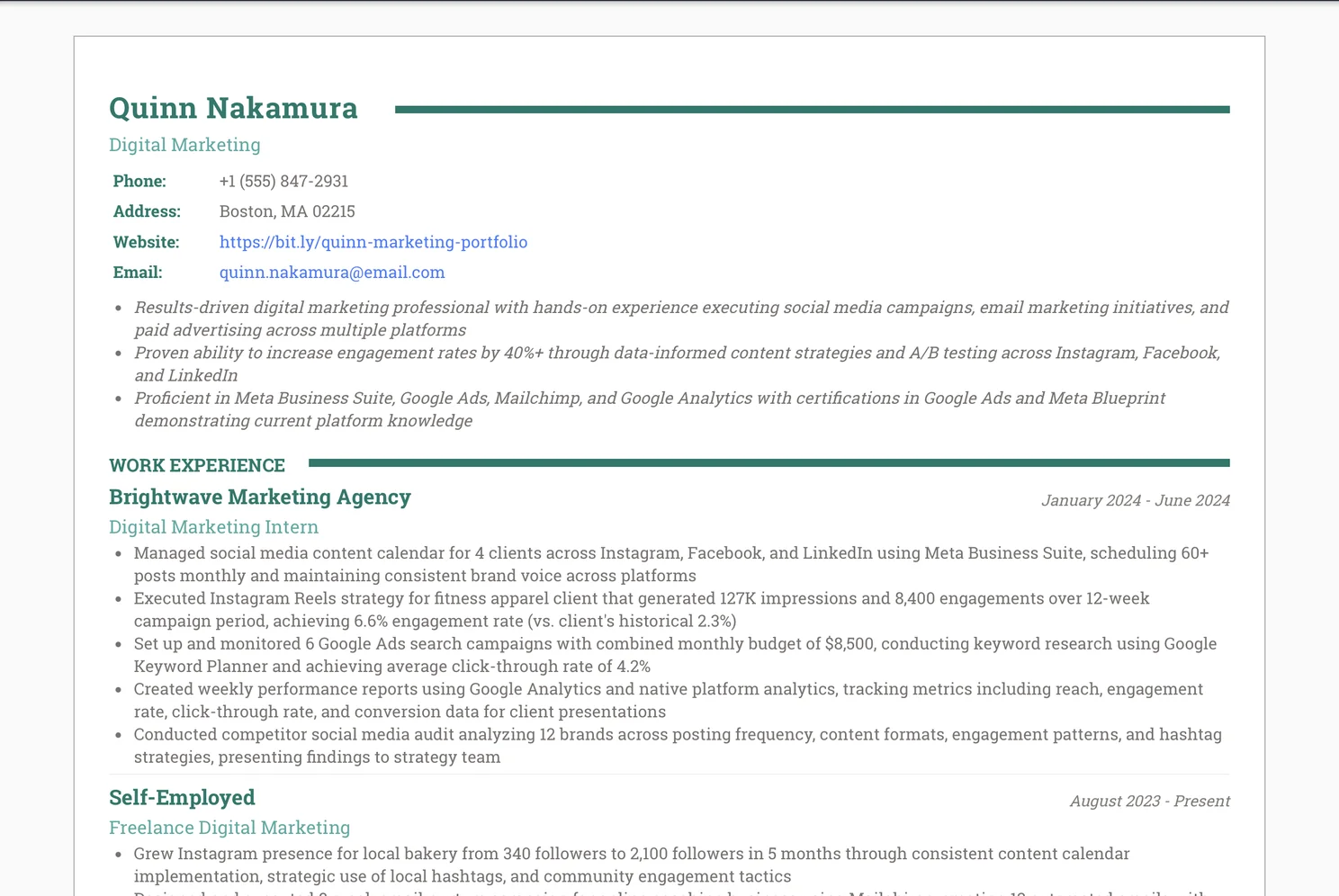
https://www.resumonk.com/digital-marketingDigital MarketingResume Format to Follow for Digital Marketing Executive Resume
Let's start with something that might surprise you - when you're applying for a Digital Marketing Executive position, you're entering at the ground floor of what could be an incredibly dynamic career. In most markets (especially in India, the UK, and parts of Asia), "Executive" doesn't mean corner office and C-suite; it means you're the person who's going to be scheduling social media posts at 11 PM, A/B testing email subject lines, and learning the difference between CPM and CPC while actually running campaigns.
Understanding this context matters because it fundamentally shapes how your resume should look.
The Reverse-Chronological Format Is Your Best Friend
For a Digital Marketing Executive role, the reverse-chronological format is almost always your optimal choice.
This format lists your most recent experience first and works backward through time. Why does this matter for you specifically? Because hiring managers for entry-level digital marketing positions want to see one critical thing - recent, relevant exposure to digital tools and platforms. The Instagram algorithm from 2019 is ancient history. The Google Ads interface has changed three times in the past two years. Your most recent internship, freelance project, or even that college society event you promoted online is significantly more valuable than anything you did three years ago.
Think about what the person reading your resume cares about. They're probably a Digital Marketing Manager or a Marketing Head at a growing company. They need someone who can hit the ground running with Facebook Ads Manager, understand what engagement rate means on Instagram, and maybe pull together a basic campaign report. They're scanning dozens of resumes from fresh graduates and people with 1-2 years of experience. Your resume needs to immediately communicate "I've actually done this work recently" rather than "I learned about marketing theory in 2020."
Structure That Works for Entry-Level Digital Marketing
Your resume should follow this structural hierarchy: Contact Information at the top (with your LinkedIn profile and any relevant portfolio links - we'll come back to why this matters), followed immediately by a brief Professional Summary or Objective (2-3 lines maximum), then your Work Experience section, followed by Education, Skills, and finally Certifications.
Notice that Work Experience comes before Education? That's deliberate. Even if you've only got internships or freelance projects, leading with what you've actually done in the digital marketing space signals that you're practitioner-first.
Here's something important about the single-page rule. For a Digital Marketing Executive position, your resume should absolutely be one page. You're not a seasoned professional with a decade of campaign management under your belt. You might have 6-12 months of internship experience, maybe some freelance social media management, perhaps a college marketing club role. One page forces you to be ruthlessly selective about what you include, and that selectivity is actually a demonstration of a core digital marketing skill - knowing what message to prioritize when you have limited space and limited attention.
The Portfolio Link Consideration
Unlike many other entry-level positions, your Digital Marketing Executive resume should include a link to tangible work. This might be a simple Google Drive folder with campaign screenshots, a Behance portfolio if you've handled content creation, or even a personal website showcasing campaigns you've worked on (with appropriate confidentiality considerations). Place this link prominently near your contact information. Why? Because digital marketing is a show-your-work field. Anyone can write "Managed social media accounts" on a resume.
Showing a content calendar you created, or analytics demonstrating how your posts performed, immediately differentiates you.
Work Experience on Digital Marketing Executive Resume
Here's the uncomfortable truth about writing work experience for an entry-level digital marketing role - you're probably looking at a somewhat sparse professional history and wondering how to make it substantial without lying or overselling. Maybe you have one proper internship, some freelance work for a local business, and that time you ran Instagram for your college fest. The question isn't whether this experience "counts" - it absolutely does.
The question is how to present it so that it demonstrates genuine digital marketing capability rather than just busywork you did while learning.
What Actually Counts as Relevant Work Experience
For a Digital Marketing Executive position, relevant work experience includes any role where you were responsible for elements of digital promotion, content distribution, campaign execution, or analytics tracking. This explicitly includes internships (even unpaid ones), freelance projects, volunteer work for NGOs or causes, campus ambassador roles, social media management for college societies, and even well-structured personal projects where you promoted something online with measurable outcomes.
What matters isn't the prestige of the organization but whether you were hands-on with digital marketing tools and processes.
The hiring manager reading your resume knows you're entry-level. They're not expecting you to have "Led a team of 5 marketers in executing a $100K campaign." What they want to see is that you understand the basic rhythm of digital marketing work - planning content, executing it on platforms, measuring what happened, and ideally, adjusting based on results.
Your work experience section needs to tell that story, even if the scale was small.
The Metric-Driven Bullet Point Approach
Every bullet point under each work experience entry should follow this mental model: Action verb + Specific task + Tool/platform used + Measurable outcome (wherever possible). Digital marketing is inherently measurable, which is your advantage.
Even if your internship involved relatively simple tasks, you can nearly always attach numbers to demonstrate impact.
Let's look at how this plays out in practice:
❌ Don't write vague, responsibility-focused descriptions:
Managed social media accounts for the company
Helped with email marketing campaigns
Created content for various platforms
✅ Do write specific, outcome-focused descriptions:
- Scheduled and published 45+ posts across Instagram and Facebook using Buffer, maintaining consistent 3x weekly posting frequency that increased follower count by 23% over 3 months
- Designed and deployed 8 email campaigns via Mailchimp for product launches, achieving average open rate of 28% (vs. industry benchmark of 21%)
- Created 15 carousel posts and 10 reels for Instagram focused on product education, generating average engagement rate of 6.2%
Notice the difference? The second set tells a story of someone who actually did the work, used real tools, and tracked whether it worked. Even if the numbers seem small to you, they're meaningful because they demonstrate measurement discipline.
Handling Limited or Non-Traditional Experience
If your work experience section feels thin, you need to get creative about what you include, but strategic about how you present it. A "Digital Marketing Intern" title at a no-name startup where you genuinely ran campaigns is more valuable than a "Marketing Intern" title at a prestigious company where you mostly made PowerPoint slides.
Lead with impact and actual digital work, not brand names.
For freelance work, create an entry titled "Freelance Digital Marketing" or "Digital Marketing Consultant" (if you worked with multiple clients) with the date range. Then use bullet points to describe different client projects, treating each as a mini-case study:
✅ Strong freelance experience presentation:
Freelance Digital Marketing | Self-Employed | June 2023 - Present
• Managed end-to-end social media presence for local bakery (Instagram, Facebook), growing followers from 200 to 1,100 in 4 months through content calendar implementation and local hashtag strategy
• Set up and optimized Google My Business listing for home decor consultant, resulting in 34 direction requests and 12 phone calls in first month
• Executed Facebook Ads campaign for online coaching business with ₹15,000 budget, generating 67 leads at ₹224 cost per lead
If you're a recent graduate with limited professional experience, your college projects and society work matter more than you think - but only if you present them with professional rigor. Instead of listing "Marketing Head, College Festival" and leaving it at that, break down what you actually did in digital marketing terms.
The Chronology and Relevance Balance
List your experiences in reverse-chronological order, most recent first.
However, if you have one highly relevant digital marketing internship from 10 months ago and a more recent but irrelevant retail job you took for income, you have options. You can either list both in true chronological order (retail job first, then internship) and keep the retail job description to a single line, or create a "Relevant Experience" section highlighting your digital marketing work and a brief "Additional Experience" section below it. The key is transparency about dates - never obscure timeline gaps or misrepresent when you held a position.
Describing Internship Experience Authentically
Many Digital Marketing Executive candidates have internship experience that felt like a mixed bag - some genuine responsibility, some coffee-fetching, some observing senior team members. Your resume should reflect what you actually did, not what the internship was supposed to be in the job description.
Focus ruthlessly on the 20% of your internship where you had genuine ownership, even if limited.
If your internship was primarily observational but you did contribute to one campaign, your bullet points might look like this:
✅ Honest but impact-focused internship description:
Digital Marketing Intern | XYZ Marketing Agency | Jan 2024 - April 2024
• Conducted competitor social media audit across 8 brands, analyzing posting frequency, content types, and engagement patterns, presenting findings to strategy team
• Assisted in execution of Instagram campaign for FMCG client by creating content calendar, sourcing 25+ stock images, and drafting 15 caption options
• Monitored and compiled daily social media metrics using native analytics tools, creating weekly performance summary reports tracking reach, engagement, and follower growth
Notice how these bullets acknowledge the supportive nature of the role (assisted, compiled, monitored) while still demonstrating hands-on tool use and contribution to real campaigns.
Skills to Show on Digital Marketing Executive Resume
Your Skills section is where many Digital Marketing Executive candidates either undersell themselves dramatically or overpromise in ways that become obvious within the first week of a new job. The challenge with digital marketing skills specifically is that the field spans an enormous range - from technical abilities like running Google Ads to creative capabilities like copywriting to analytical skills like interpreting campaign data.
You need to signal competence across this spectrum while being honest about your proficiency level, all within a compact resume section.
The Two-Category Framework: Technical Tools and Marketing Competencies
Structure your skills section into two clear categories, either as separate subsections or as one integrated list that naturally groups related skills.
The first category is "Digital Marketing Tools & Platforms" - these are the specific software applications and advertising platforms you can navigate. The second category is "Marketing Competencies" - these are the strategic and creative capabilities that transcend any single tool.
For Technical Tools, be specific about what you've actually used, not what you've heard of. There's a massive difference between "I've created and published Google Ads campaigns, even if only with a small test budget" and "I've watched a tutorial about Google Ads." The hiring manager will find out quickly which one is true.
❌ Don't list tools you've barely touched:
Skills: Google Ads, Facebook Ads, SEO, Content Marketing, Email Marketing, Analytics, Social Media Marketing, Influencer Marketing, Marketing Automation, Affiliate Marketing
This reads like you copied a list of digital marketing buzzwords. It's not credible for an entry-level candidate and doesn't differentiate you.
✅ Do list specific tools with honest proficiency:
Digital Marketing Tools & Platforms:
• Social Media Management: Meta Business Suite, Buffer, Canva for content creation
• Email Marketing: Mailchimp (campaign creation, list segmentation, basic automation)
• Analytics: Google Analytics (traffic analysis, goal tracking), native platform analytics (Instagram Insights, Facebook Analytics)
• Advertising Platforms: Facebook Ads Manager (campaign setup, audience targeting, basic optimization), Google Ads (search campaigns, keyword research)
• SEO Tools: Google Search Console, Ubersuggest, Yoast SEO
• Content Creation: Canva, basic Adobe Photoshop, Capcut for video editing
Notice how this version includes parenthetical clarifications about what you can actually do with each tool? That's strategic honesty. You're not claiming to be a Google Ads expert, but you're clearly stating you can set up and run search campaigns, which is exactly what a Digital Marketing Executive role requires.
Marketing Competencies Beyond Tools
The second category should highlight your marketing thinking skills - the abilities that demonstrate you understand how digital marketing actually works, beyond clicking buttons in advertising platforms. These include things like audience research, content strategy, copywriting, campaign planning, performance analysis, and A/B testing.
These competencies are harder to verify on a resume but become credible when they're reinforced by your work experience bullet points.
✅ Well-articulated marketing competencies:
Marketing Competencies:
• Social Media Strategy: Content calendar planning, platform-specific content optimization, community engagement
• Campaign Execution: End-to-end campaign coordination from briefing through post-campaign analysis
• Performance Analysis: Metrics tracking, basic data interpretation, reporting campaign outcomes
• Content Development: Social media copywriting, blog content writing, brand voice adaptation
• Audience Targeting: Customer persona development, demographic and interest-based targeting for paid campaigns
The Certification Signal
Digital marketing has an unusual characteristic compared to many fields - there are numerous free or low-cost certifications available from the actual platforms (Google, Facebook/Meta, HubSpot, Semrush).
If you've completed relevant certifications, they can either go in your Skills section (as proof of tool competency) or in a separate Certifications section. For an entry-level role, certifications carry meaningful weight because they signal proactive learning and baseline platform knowledge.
List certifications with the issuing organization and completion date:
✅ Effective certification listing:
Certifications:
• Google Ads Search Certification - Google Skillshop (2024)
• Meta Certified Digital Marketing Associate - Meta Blueprint (2024)
• Content Marketing Certification - HubSpot Academy (2023)
• Google Analytics Individual Qualification - Google Analytics Academy (2024)
These certifications are free, widely recognized, and demonstrate that you've invested time in structured learning. They're particularly valuable if your hands-on work experience is limited because they show initiative and foundational knowledge.
The Proficiency Honesty Principle
Here's something important as you build your Skills section - digital marketing hiring managers can spot inflated skills claims almost immediately. If you list "Advanced Google Ads" and you've only ever run one small campaign with a ₹5,000 budget, that discrepancy will emerge in the interview or, worse, in your first week on the job.
Conversely, if you undersell yourself by not listing a platform you've genuinely used (even in a learning context), you might not get the interview at all.
The sweet spot is specific honesty. Instead of rating yourself (Beginner/Intermediate/Advanced, which is subjective and often deflating), simply list what you can do with each tool or describe the context in which you've used it. "Facebook Ads Manager (campaign creation and monitoring for 3-month internship project)" is far more informative and credible than "Facebook Ads Manager - Intermediate."
Specific Considerations and Tips for Digital Marketing Executive Resume
Now we get to the nuances that separate a Digital Marketing Executive resume that gets interviews from one that gets overlooked - the specific considerations that matter uniquely for this entry-level role in this particular field. These aren't general resume tips that apply to any position; these are the tactical and strategic elements that speak directly to what hiring managers in digital marketing are actually evaluating when they review your application.
The Portfolio Link Is Non-Negotiable
Unlike most entry-level roles, your Digital Marketing Executive resume must be accompanied by proof of work. This isn't optional - it's table stakes. But here's where candidates often fumble: they either don't include any portfolio link, or they link to a poorly organized folder of random screenshots that doesn't tell a story. Your portfolio doesn't need to be elaborate, but it needs to exist and be accessible. Create a simple Google Drive folder (with view permissions set correctly) or a basic website using Wix, WordPress, or even Notion. Include 3-5 examples of work you're proud of: social media campaigns with before/after metrics, content you created, ad creatives you designed, or email campaigns you built.
Add brief context for each example explaining your role, the objective, and the outcome.
Place this portfolio link directly under your email and phone number in the contact section, formatted clearly:
✅ Clear portfolio link presentation:
Email: [email protected] | Phone: +91-XXXXXXXXXX
Portfolio: www.yourportfolio.com or bit.ly/yourname-marketing-work
Quantification Is Expected, Not Optional
In many fields, adding metrics to your resume bullet points is a nice-to-have enhancement.
In digital marketing, it's the baseline expectation because digital marketing is inherently measurable. If you're describing any campaign work, social media management, email marketing, or paid advertising experience without numbers, you're immediately signaling that you either didn't track results (concerning) or don't have access to the data (which means you weren't really owning the work). Almost every action in digital marketing generates a metric: follower growth, engagement rate, click-through rate, cost per click, conversion rate, email open rate, website traffic increase. Your resume should be dense with these numbers.
When you genuinely don't have metrics (perhaps for a project where you created content but didn't have analytics access), acknowledge the deliverable scope instead:
✅ Quantifying deliverables when outcome metrics aren't available:
Developed content library of 30 Instagram posts and 15 email templates for product launch, adhering to brand guidelines and campaign messaging framework
Tool Specificity Over Generic Marketing Claims
Generic marketing statements make you sound like someone who learned about digital marketing from a textbook rather than someone who's actually done it. Your resume should name specific tools, platforms, and even features within those platforms. Don't write "managed social media" - write "scheduled content via Buffer and analyzed performance using Instagram Insights." Don't write "email marketing" - write "built email campaigns in Mailchimp using drag-and-drop editor and segmented lists based on user behavior."
This specificity immediately signals hands-on experience rather than theoretical knowledge.
Campaign Thinking Over Task Listing
Entry-level candidates often list tasks they performed: "Posted on Instagram," "Sent emails," "Created graphics." What separates a strong Digital Marketing Executive resume is demonstrating that you understand campaigns - meaning you grasp that digital marketing isn't random tasks but coordinated efforts toward specific goals.
Even if you were executing someone else's strategy, frame your contributions in campaign context.
❌ Task-focused description that misses the bigger picture:
• Posted 3 times per week on Instagram
• Created graphics in Canva
• Responded to comments and messages
✅ Campaign-focused description showing strategic understanding:
Executed 8-week Instagram awareness campaign promoting new product line through 24 feed posts and 12 stories, maintaining consistent visual theme and messaging focused on sustainability angle, resulting in 34% increase in profile visits and 156 direct inquiries via DM
Notice how the second version tells a story? There was a campaign (8 weeks, awareness goal), specific deliverables (24 posts, 12 stories), a strategic angle (sustainability messaging), and measurable outcomes. You're showing that you understand how digital marketing actually works.
The Internship Date Recency Problem
Many Digital Marketing Executive candidates face this specific challenge: your most relevant experience is an internship that ended 6-12 months ago, and you've been job hunting, doing freelance work, or in an unrelated job since then.
This gap is concerning to hiring managers in digital marketing specifically because the field moves fast - a 12-month-old internship means you learned on versions of platforms that have since changed significantly. Address this proactively in two ways: First, if you've done any freelance digital marketing work, personal projects, or even maintained your own social media presence strategically during this period, include it on your resume as ongoing work. Second, ensure your certifications are current - if you got a Google Ads certification 18 months ago, retake it so you can list a 2024 date. This signals you've stayed current even without formal employment.
The Breadth Versus Depth Dilemma
Digital marketing encompasses an enormous range: social media organic, social media paid, search advertising, display advertising, email marketing, content marketing, SEO, affiliate marketing, influencer marketing, marketing automation, and more.
As an entry-level candidate, you likely have shallow experience across several of these areas rather than deep expertise in any one. That's expected, but how you present this matters. Don't try to claim competence in everything - it's not credible. Instead, be clear about where you have genuine hands-on experience (even if limited) versus where you have conceptual knowledge.
Structure your resume to lead with your 2-3 strongest areas, typically social media management and one form of paid advertising or email marketing.
The Agency Versus Brand Context
If you're applying to a digital marketing role at an agency, your resume should emphasize versatility, adaptability to different brand voices, and experience working across multiple projects or clients (even if those were different projects within one internship).
If you're applying to an in-house brand role, emphasize depth in understanding one brand's audience, consistency in maintaining brand voice, and the ability to see campaigns through from start to finish. Read the job description carefully to understand which context you're applying to, and adjust your bullet points accordingly. This might mean reordering your bullet points to lead with the most relevant experience for that specific opportunity.
The Content Creation Proof Point
Nearly every Digital Marketing Executive role involves creating content in some form - social media posts, email copy, ad copy, blog posts.
Your resume should demonstrate this capability, and ideally, your portfolio should show it. If you've written blogs, include a link to published articles (even if on Medium or LinkedIn). If you've created social media content, your portfolio should show examples. If you've written ad copy, include screenshots of ads that ran. This matters because hiring managers want to quickly assess your writing quality and creative judgment, and they can't do that from your resume alone. A portfolio link that shows actual content you've created is enormously valuable.
Keywords That Matter for Digital Marketing Executive Roles
While we don't optimize for algorithms, human hiring managers in digital marketing do mentally scan for certain terms that signal relevant experience.
Make sure your resume naturally includes: specific platform names (Facebook Ads Manager, Google Ads, Instagram, LinkedIn), metric terms (engagement rate, click-through rate, conversion rate, cost per acquisition, reach, impressions), tool names (Mailchimp, Buffer, Hootsuite, Canva, Google Analytics), and strategic terms (campaign planning, audience targeting, A/B testing, content calendar, performance analysis). These shouldn't feel stuffed in, but they should appear naturally throughout your work experience descriptions because they reflect the actual work you've done.
The Education Section Positioning
For most Digital Marketing Executive roles, your education matters less than your demonstrated ability to execute digital campaigns. Unless you're a recent graduate (within 6 months of graduation) or you attended a particularly prestigious institution, your Education section should come after your Work Experience and Skills sections. List your degree, institution, and graduation year. If you're still in your final year of college, note "Expected graduation: Month Year." You don't need to include your GPA unless it's exceptionally high (above 3.7 or 75%) or specifically requested in the job posting.
If you completed any marketing-specific coursework or projects during your degree that are directly relevant, you can include a brief "Relevant Coursework" or "Academic Projects" subsection, but only if the work was genuinely hands-on - a theoretical paper about digital marketing strategy doesn't add value, but a project where you actually ran ads or managed a social media campaign for a college event does.
The Platform Evolution Awareness
Digital marketing platforms change constantly - features are added, interfaces are redesigned, best practices evolve. Your resume should subtly signal that you're aware of current platform realities, not past ones. For instance, if you mention Facebook marketing, acknowledge the current reality that organic reach on Facebook is minimal and most Facebook marketing is paid. If you mention Instagram, reference current formats like Reels prominently since that's what the algorithm currently favors. If you mention email marketing, mentioning concepts like segmentation and automation (not blasting the same email to everyone) shows current understanding.
These small details signal that your knowledge is current, which matters immensely for an entry-level role where you're expected to be digitally native.
The Personal Brand Consideration
Here's something that matters uniquely for digital marketing roles: your own personal digital presence is part of your candidacy.
Hiring managers often Google candidates, and for digital marketing roles specifically, they're looking at your LinkedIn profile, and potentially your other social media. Make sure your LinkedIn profile is comprehensive and professional. If you have a personal Instagram or Twitter account with a substantial following or particularly well-executed content, consider whether it's appropriate to reference. If you maintain a blog, YouTube channel, or newsletter that demonstrates your understanding of content and audience building, including it can differentiate you significantly. This isn't about having thousands of followers - it's about demonstrating that you practice what you'd be preaching professionally. A small but engaged following built through consistent, strategic effort is impressive evidence of digital marketing understanding.
Education to List on Your Digital Marketing Resume
The key question for your digital marketing resume isn't "do I have the right degree?" but rather "how do I present my educational background to show I understand the digital landscape?"
Remember, you're applying for an entry-level or junior position, so hiring managers expect to see recent education paired with demonstrated interest in the field through certifications, projects, or relevant coursework.
Structuring Your Education Section
Place your education section after your work experience if you have relevant internships or jobs, but if you're fresh out of university with limited professional experience, it's perfectly acceptable to position education higher on your resume. Use reverse-chronological order, starting with your most recent qualification.
For each entry, include your degree type, major or field of study, institution name, location (city and state/country), and graduation date (or expected graduation date if you're still studying). If your GPA is above 3.5 on a 4.0 scale (or equivalent in your country's system), include it.
Below that threshold, leave it off unless the job posting specifically requests it.
Highlighting Relevant Coursework and Projects
This is where you can really make your education section work harder for you.
If you took courses directly applicable to digital marketing - think Social Media Strategy, Consumer Behavior, Data Analytics, Content Marketing, or Web Design - list 4-5 of the most relevant ones. This immediately signals to hiring managers that you've got foundational knowledge, even if your degree title doesn't scream "digital marketing."
Even better than just listing courses? Mentioning specific projects that demonstrate practical application. Did you run a social media campaign for a class project? Conduct keyword research and create an SEO strategy? Build a website?
These belong in your education section if you don't have enough professional experience to fill out your work history.
❌ Don't write it like this:
Bachelor of Arts in Communications
State University, May 2023
✅ Do write it with relevant details:
Bachelor of Arts in Communications
State University, Boston, MA | May 2023 | GPA: 3.7/4.0
Relevant Coursework: Digital Media Strategy, Marketing Analytics, Content Creation, Consumer Psychology
Capstone Project: Developed and executed a 3-month Instagram marketing campaign for local nonprofit, resulting in 45% increase in follower engagement and 200+ event registrations
The Certification Question
Digital marketing certifications deserve their own subsection within your education area, especially Google Analytics, Google Ads, HubSpot Inbound Marketing, Facebook Blueprint, or Hootsuite Social Marketing certifications. These cost little to nothing but demonstrate initiative and current knowledge of industry tools.
Unlike some industries where certifications might be viewed as "nice to have," in digital marketing they're often the differentiator between candidates at the entry level.
Create a separate "Certifications" subsection under your education heading. List the certification name, issuing organization, and date obtained.
If certifications need renewal, make sure you note the validity period.
✅ Format certifications like this:
Certifications:
• Google Analytics Individual Qualification (GAIQ) - Google, 2024
• Content Marketing Certification - HubSpot Academy, 2023
• Social Media Marketing Specialization - Coursera/Northwestern University, 2023
International Qualifications and Degree Equivalencies
If you completed your education outside the country where you're applying for jobs, consider adding brief clarification about your qualification level. A hiring manager in the US might not immediately recognize what a "First Class Honours" degree from the UK means, or how a European bachelor's program differs in structure.
For UK candidates applying internationally, you might note: "Bachelor of Science (equivalent to US 4-year undergraduate degree)" or include your degree classification if it's a First or Upper Second. For Canadian candidates, if you completed a college diploma rather than a university degree, explain the program's focus and duration. Australian candidates should note whether they completed a standard 3-year bachelor's or an honours year.
What If Your Degree Isn't Marketing-Related?
Maybe you studied biology, history, or music. First, don't panic. Second, use your education section strategically to bridge the gap. If you took any electives that touch on business, communications, technology, or analytics, list them.
If you wrote a thesis or major paper that required research, data analysis, or presentation skills, mention it with a focus on transferable skills.
More importantly, this is where your certifications become crucial. Stack 3-4 relevant digital marketing certifications in your education section, and you've effectively demonstrated that while your formal education went in a different direction, you've since invested time in building marketing-specific knowledge.
Recent Graduates: The Education Sweet Spot
If you graduated within the last 2-3 years, your education section can be more detailed and prominent. This is your moment to leverage academic achievements, relevant projects, and coursework while it's still fresh and relevant.
Include academic honors (Dean's List, scholarships, honor societies), leadership in student organizations (especially if you managed their social media or marketing), and substantive projects.
After you've been working for 3-5 years, you'll pare this section down significantly, but right now, your education is one of your strongest assets - treat it accordingly.
Awards and Publications on Your Digital Marketing Resume
Many digital marketers have no awards or publications to list, and that's fine. If you do have relevant recognition or published work, this section can be a powerful differentiator. The mistake many candidates make is either inflating minor achievements to seem more impressive (which comes across as inauthentic) or completely omitting legitimate accomplishments because they don't seem "important enough."
The sweet spot is presenting genuine achievements with appropriate context.
What Counts as an Award for Digital Marketing Roles?
At the entry level, awards worth including span several categories. Academic honors demonstrate strong performance and work ethic - Dean's List, departmental awards, scholarships based on merit, or graduation honors (cum laude, etc.) all belong here if you're within a few years of graduation.
More valuable are awards specifically related to marketing, digital work, or competition victories. Did you win or place in a marketing case competition? Receive recognition for a student advertising campaign? Win a hackathon where you built a digital product? Earn a contest prize for social media content creation, blog writing, or video production? These directly demonstrate skills you'll use in digital marketing.
Don't overlook internal recognition either. If you were employee of the month at a retail job where you also managed the store's Instagram, that's relevant. If you won an internal pitch competition at your internship, include it. If your university newspaper named you "Blogger of the Year" or your YouTube channel won a local content creator award, these matter.
How to Format Your Awards
Create an "Awards & Recognition" section (or "Honors & Awards") if you have 2-3+ items worth listing.
Place it after your education section or work experience, depending on which is stronger. Format each award with the award name, granting organization, date, and a brief explanation if the award title isn't self-evident.
❌ Don't list awards without context:
Social Media Excellence Award, 2023
Dean's List
Marketing Challenge Winner
✅ Do provide meaningful context:
Awards & Recognition:
Regional Social Media Excellence Award - American Marketing Association, 2023
Recognized for student campaign generating 50K+ impressions and 12% engagement rate for nonprofit client
Dean's List - Fall 2022, Spring 2023
Achieved GPA of 3.8+ in both semesters while managing university's student activities Instagram account
1st Place, Digital Marketing Case Competition - State University Business School, 2023
Led 4-person team in developing comprehensive digital strategy for local business, selected from 15 competing teams
The Publications Question for Digital Marketers
Here's where digital marketing gets interesting compared to traditional fields.
"Publications" in academia or journalism means peer-reviewed papers or articles in established outlets. But in digital marketing, published content takes many forms, and the platforms matter as much as the traditional prestige markers.
If you've written guest posts for marketing blogs, contributed articles to industry websites, or had your content featured on established platforms - even if they're not household names - these count. Did you write for your university's marketing blog? Contribute to Medium publications focused on social media or content marketing? Guest post on a local business blog? Have a case study featured by a brand or tool you used?
Your own blog or content channels can qualify too, but with a caveat: they need to demonstrate meaningful reach or engagement. A personal blog with 15 posts and no audience doesn't strengthen your resume.
But a blog that consistently attracts 500+ monthly readers, or a LinkedIn profile where your articles regularly earn comments and shares, or a YouTube channel with 2,000 subscribers focused on marketing topics - these demonstrate your ability to build an audience and create engaging content, which is exactly what digital marketing requires.
Formatting Your Publications
If you have formal publications, format them with the article/content title, publication name, date, and optionally a link (if submitting a digital resume) or brief description of impact.
✅ Format publications like this:
Publications & Content:
"5 SEO Mistakes Small Businesses Make (And How to Fix Them)" - Marketing Today, March 2024
Guest article published on industry blog with 50K+ monthly readers
"Building Brand Voice on TikTok: A Guide for Beginners" - Personal Blog, January 2024
Tutorial article that generated 1,200+ views and was shared by 3 marketing influencers
Content Creator - Digital Marketing Insights, 2023-Present
Maintain blog covering social media trends and analytics; grown to 500+ monthly readers through organic search
When to Skip This Section Entirely
If you don't have relevant awards or publications, don't force it.
A resume without this section is completely normal and acceptable for entry-level digital marketing positions. Don't include your high school awards if you're a university graduate. Don't list publications that aren't relevant to marketing or professional communication. And definitely don't include that "participation certificate" from attending a marketing webinar - that's not an award.
Use the space instead to strengthen your experience section, add more detail to your projects, or expand your skills section. A strong resume is about making strategic choices with limited space, and an Awards section with weak entries actually diminishes your overall presentation.
Industry-Specific Notes
For UK candidates, if you received university honors like First Class Honours or specific departmental prizes, these carry weight and should be included. In Canada and Australia, if you received scholarships or bursaries, list them with their value if substantial (e.g., "Merit Scholarship - $5,000").
In the US, Greek honor societies relevant to your field (Phi Beta Kappa for liberal arts, for example) can be listed if you're within 3-4 years of graduation.
Listing References on Your Digital Marketing Resume
Understanding when and how to present references is particularly important for entry-level marketing positions because your references serve a specific purpose - they validate that you can execute the skills you've claimed, work collaboratively (since marketing is highly team-oriented), meet deadlines, and take feedback well. These professional soft skills are harder to assess in an interview, which is exactly why reference checks matter.
Who Makes a Strong Reference for Digital Marketing Roles?
Your ideal reference lineup includes 3-4 people who can speak to different aspects of your capabilities. For digital marketing positions at the entry level, prioritize these types of references in order of impact:
First, direct supervisors from internships, part-time jobs, or volunteer positions where you did marketing-related work. A marketing manager who oversaw your social media internship is gold. Even if your official role was "social media intern," if you were creating content, analyzing metrics, or managing campaigns, that supervisor can speak directly to your marketing capabilities.
Second, professors or academic advisors who supervised substantial projects related to marketing. The key word here is "substantial" - a professor who taught you in a 200-person lecture hall and graded your multiple-choice exams can't say much about you personally. But a professor who advised your capstone marketing project, supervised your independent study on content marketing, or mentored you through a semester-long campaign simulation can provide meaningful insight into your analytical thinking, creativity, and work quality.
Third, supervisors from any employment where you demonstrated transferable skills, even if the job wasn't marketing-focused. The retail manager who can attest to your customer service skills, reliability, and ability to learn quickly is valuable. The restaurant supervisor who watched you handle high-pressure situations and collaborate with team members provides relevant character testimony.
Fourth, consider clients or organizational leaders if you've done freelance marketing work or managed marketing for student organizations. If you ran social media for a student club and the organization's president can speak to the growth and engagement you drove, that's a legitimate reference. If you did freelance content writing and a client can discuss your professionalism and quality, include them.
Who Not to Use as References
Avoid family members, friends, or anyone who can't speak to your professional or academic capabilities.
Personal references ("character references") are rarely appropriate for marketing positions unless specifically requested. Also avoid listing references who haven't seen your work recently - a supervisor from a high school job you held five years ago has limited value if you've completed university and internships since then.
Don't use professors who don't remember you or can't speak specifically to your work. If you're considering asking a professor, ask yourself honestly whether they could write more than two sentences about you beyond confirming you took their class.
If not, choose someone else.
Formatting Your Reference List
Create a separate document titled "References" with your name and contact information at the top, matching the header style of your resume for visual consistency. This isn't a document you submit with your initial application - it's a document you bring to interviews or send when specifically requested.
For each reference, include their full name, job title, organization, relationship to you (e.g., "Direct Supervisor," "Academic Advisor," "Client"), phone number, and email address.
Add one brief line explaining the context of your relationship if it's not obvious from the title.
✅ Format references like this:
REFERENCES
1. Sarah Martinez, Digital Marketing Manager, ABC Marketing Agency
- Relationship: Direct Supervisor during Social Media Internship
- January - August 2023
- Phone: (555) 123-4567 | Email: [email protected]
2. Dr. James Chen, Associate Professor of Marketing, State University School of Business
- Relationship: Academic Advisor and Capstone Project Supervisor
- Phone: (555) 234-5678 | Email: [email protected]
3. Michelle Rodriguez, Owner, Local Nonprofit Organization
- Relationship: Client for Volunteer Social Media Management
- September 2022 - May 2023
- Phone: (555) 345-6789 | Email: [email protected]
The Critical Step: Ask Permission First
Never list someone as a reference without asking their permission first. This seems obvious, but it's surprisingly common for candidates to list references who aren't expecting calls, which leads to awkward conversations and lukewarm recommendations.
When you ask someone to serve as a reference, do it thoughtfully. Send an email or have a conversation explaining that you're actively job searching in digital marketing, briefly remind them of your accomplishments and the work you did together (especially if some time has passed), and ask if they'd be comfortable serving as a reference. This refreshes their memory and gives them an opportunity to decline if they don't feel they can provide a strong recommendation.
When they agree, follow up by sending them your current resume and a brief summary of the types of positions you're applying for. You might even highlight 2-3 skills or experiences you'd appreciate them emphasizing if contacted. This isn't coaching them to be dishonest - it's helping them understand what aspects of your work together are most relevant to your current goals.
International Variations in Reference Practices
Reference practices vary somewhat by country, and if you're applying internationally for digital marketing positions, these nuances matter.
In the United States, references are typically checked by phone or email late in the hiring process, often just before an offer is extended. Employers may ask references to confirm employment dates, describe your responsibilities, and comment on your strengths and areas for development.
In the United Kingdom, references are often more formal and frequently submitted in writing. Some UK employers request references earlier in the process and may contact references before interviews. It's also more common in the UK to use "referee" rather than "reference" as the term for the person providing the recommendation.
In Australia and Canada, reference practices are similar to the US, with checks typically happening later in the process. However, Australian employers may place particular emphasis on references being able to speak to your ability to work in diverse teams, given the country's multicultural workplace environment.
For Canadian applications, especially for positions requiring bilingual skills (English/French), ensure at least one reference can speak to your language capabilities if relevant to the role.
Maintaining Your Reference Relationships
Your references are doing you a significant favor by vouching for you professionally.
Treat them accordingly. After someone agrees to be a reference, keep them updated occasionally on your job search progress. When you do get a job, let them know and thank them for their support - even if you don't know whether they were actually contacted.
If your job search extends over several months, check in with your references periodically to ensure they're still comfortable serving in that role and to update them on any new relevant experiences. Don't let the first contact in six months be "by the way, someone will be calling you tomorrow for a reference."
What If You Don't Have Professional References?
If you're entering the job market with limited professional experience - perhaps you're a recent graduate without internships, or you're making a career change into digital marketing - you may struggle to identify professional references.
In this situation, lean more heavily on academic references who can speak to relevant skills and projects. Consider supervisors from volunteer work, leaders of organizations where you contributed, or even clients if you've done any freelance work (writing, graphic design, social media management, even informally).
What you're trying to demonstrate through references is reliability, quality of work, and ability to work with others. While marketing-specific references are ideal, references who can speak to these broader professional qualities are acceptable when you're just starting out. Just be strategic about which qualities each reference emphasizes in relation to the digital marketing role you're pursuing.
Cover Letter Tips for Your Digital Marketing Resume
Digital marketing is fundamentally about communication - understanding audiences, crafting messages, choosing the right channels, and driving action.
Your cover letter is your first marketing campaign, and you are the product. If you can't write a compelling cover letter that makes someone want to meet you, how will you write compelling ad copy, email campaigns, or social media content?
The Opening: Ditch the Generic Introduction
Most cover letters for digital marketing positions start with some variation of "I am writing to express my interest in the Digital Marketing position at Company X."
The hiring manager has now learned absolutely nothing about you except that you know which job you're applying for - information they already had. You've wasted your opening, which is prime real estate.
Instead, open with something that immediately establishes your understanding of the company or demonstrates relevant enthusiasm. Reference a specific campaign they ran, mention a challenge facing their industry, or lead with a micro-story that illustrates your marketing instincts.
❌ Don't open generically:
Dear Hiring Manager,
I am writing to apply for the Digital Marketing position posted on your website. I recently graduated with a degree in Marketing and am very interested in this opportunity. I believe my skills would be a great fit for your team.
✅ Do open with specific engagement:
Dear Hiring Manager,
When I saw your brand's "Real Stories" Instagram campaign last month, I spent an embarrassing amount of time analyzing why it worked so well - the user-generated content approach, the authentic testimonial format, the way you leveraged Story highlights for permanence. That campaign is exactly why I'm drawn to digital marketing: the intersection of creativity, psychology, and measurable impact. I'm excited to apply for your Digital Marketing position and bring that same analytical enthusiasm to your team.
The Body: Connect Your Experience to Their Needs
The middle section of your cover letter should accomplish two things - demonstrate that you understand what the role actually requires, and provide evidence that you can deliver on those requirements. This means you need to actually read the job posting carefully and identify 2-3 key priorities.
Are they emphasizing social media management? Talk about your experience growing engagement on specific platforms. Do they mention email marketing? Discuss campaigns you've created and the metrics you tracked. Are they looking for content creation? Provide examples of content you've produced and the results it generated.
The crucial element here is specificity. Entry-level candidates often write in vague generalities: "I have experience with social media marketing and content creation."
Instead, write like a marketer who understands that specific details and concrete results matter.
✅ Write with specific evidence:
In my internship at XYZ Agency, I managed social media for three small business clients, creating 15-20 posts weekly across Instagram, Facebook, and LinkedIn. For one client, I developed a carousel post series explaining their services through customer stories, which generated a 34% higher engagement rate than their previous content and led to 12 direct inquiries. This experience taught me that successful social content isn't just about posting consistently - it's about understanding what makes your specific audience stop scrolling.
Addressing the Experience Gap
One of the hardest parts of writing a cover letter for entry-level digital marketing positions is confronting the experience gap. The job posting lists desired experience you don't have, or asks for proficiency in tools you've only dabbled with, or wants someone who's "hit the ground running."
You're probably feeling that tension between honesty and competitiveness.
Here's the approach that works: acknowledge what you're still learning, but frame it in terms of demonstrated ability to learn quickly and translate knowledge into results. Don't apologize for being entry-level, but do show self-awareness about the learning curve and enthusiasm for climbing it.
If the job posting mentions specific tools or platforms you haven't used extensively, you might write something like: "While I haven't yet used HubSpot in a professional capacity, I've completed their Content Marketing certification and worked extensively with similar platforms like Mailchimp for email campaigns. I'm confident in my ability to quickly master new marketing tools, as I demonstrated when I taught myself Google Analytics and implemented event tracking within two weeks of starting my last internship."
Showing You Understand Digital Marketing
A surprisingly common mistake in digital marketing cover letters is that they don't actually demonstrate understanding of digital marketing as a discipline. They might talk about "marketing" generally, or show enthusiasm for "social media," but they don't reveal awareness of how digital marketing actually functions - the metrics that matter, the testing mindset, the multi-channel approach, the balance between creativity and data.
Weave in language that shows you think like a digital marketer. Mention A/B testing when discussing how you'd approach email campaigns. Reference conversion funnels when talking about content strategy. Discuss engagement metrics, click-through rates, or audience segmentation.
These aren't just buzzwords - they're indications that you understand the analytical, results-driven nature of the work.
The Closing: End With Confidence and a Call to Action
Your closing paragraph should accomplish three things quickly - reiterate your enthusiasm for this specific opportunity, express confidence in what you'd bring to the role, and make it easy for them to take the next step. Avoid weak, passive closes like "I hope to hear from you soon" or "Thank you for your consideration."
✅ Close with confidence:
I'm genuinely excited about the possibility of bringing my content creation skills, analytical mindset, and enthusiasm for testing new approaches to your marketing team. I'd love to discuss how my experience growing social engagement and creating data-informed campaigns could contribute to your upcoming product launch. I'm available for a conversation at your convenience and can be reached at [phone] or [email].
Length and Format Considerations
Keep your cover letter to one page - approximately 300-400 words across three to four paragraphs.
Use standard business letter formatting with your contact information at the top, the date, the employer's information, and a professional greeting. If you're submitting electronically (which is most common for digital marketing roles), you can format it as a PDF or paste it directly into the email body, depending on application instructions.
For UK applications, maintain slightly more formal language than you might in US applications. In Australia and Canada, the tone can be warmer and slightly less formal. Regardless of location, proofread meticulously - a typo in a cover letter for a communication-focused role like digital marketing is particularly damaging.
When You Don't Need a Cover Letter
If the application explicitly says "no cover letter" or the system doesn't provide a way to submit one, don't force it.
Some companies genuinely don't want them. However, if the cover letter is optional, write one.
It's an opportunity to differentiate yourself that most candidates will skip, which means yours will actually get read.
Key Takeaways
You've just worked through the complete anatomy of a Digital Marketing Executive resume built specifically for entry-level positions in a field that values demonstrated execution over theoretical knowledge. Before you dive into creating or refining your own resume, here are the critical points to keep with you:
- Format with reverse-chronological structure - Lead with your most recent experience because currency matters enormously in digital marketing. Platforms, algorithms, and best practices change constantly, so your recent work is significantly more valuable than anything from several years ago.
- Include a portfolio link prominently - Digital marketing is a show-your-work field. Place a link to examples of campaigns, content, or projects you've worked on directly in your contact section. A simple Google Drive folder or basic website with 3-5 examples and context is sufficient and often decisive.
- Write metric-dense work experience bullets - Every campaign, project, or marketing task generates measurable outcomes. Your bullet points should include specific numbers: engagement rates, follower growth percentages, click-through rates, email open rates, cost per lead, reach, impressions. Quantification isn't optional in digital marketing resumes.
- Name specific tools and platforms - Replace generic statements like "managed social media" with "scheduled content via Buffer and analyzed performance using Instagram Insights." Tool specificity immediately signals hands-on experience rather than theoretical knowledge.
- Frame experience as campaigns, not tasks - Show you understand that digital marketing isn't random activities but coordinated efforts toward goals. Even when describing execution work, connect it to campaign context, objectives, and outcomes.
- List skills with honest specificity - Don't claim "Advanced Google Ads" if you've run one small test campaign. Instead, describe what you can actually do: "Google Ads (search campaign setup, keyword research, basic optimization)." Specific honesty is more credible than vague expertise claims.
- Lead with digital marketing certifications - Google Analytics, Google Ads, Meta Blueprint, HubSpot certifications carry real weight for entry-level roles. They're free or low-cost, demonstrate initiative, and validate baseline platform knowledge. List them prominently with dates.
- Keep it to one page - With limited professional experience, a single page forces strategic selectivity about what matters most. This constraint actually demonstrates a core marketing skill: prioritizing key messages when space and attention are limited.
- Present education strategically - If you have relevant work experience, education comes after it. Include relevant coursework and projects only if they involved actual hands-on digital marketing work, not just theory. Certifications often matter more than degree specifics for entry-level digital roles.
- Address the recency challenge proactively - If your most relevant experience ended months ago, bridge the gap with current certifications (retake them to show 2024 dates), freelance work, personal projects, or ongoing skill development. Digital marketing moves fast, and recency signals currency.
- Customize for agency versus brand contexts - Agency roles value versatility across clients and projects; brand roles value depth in understanding one company's audience. Read the job description to understand which context you're entering, and adjust your bullet point emphasis accordingly.
- Remember your personal digital presence matters - Hiring managers will Google you and check your LinkedIn. For digital marketing roles specifically, your own professional social presence is part of your candidacy. Make sure your LinkedIn is comprehensive and consider whether a well-executed personal blog, newsletter, or content channel strengthens your case.
Creating a resume that effectively showcases your digital marketing capabilities doesn't have to mean starting from scratch or wrestling with formatting issues. Resumonk is built specifically to help candidates like you translate your experience into clean, professional resumes that hiring managers in digital marketing actually want to read. With AI-powered recommendations that understand what matters for entry-level marketing roles, a library of professionally designed templates that keep the focus on your content rather than distracting design, and tools that make it easy to create targeted versions of your resume for different opportunities, Resumonk handles the technical side so you can focus on articulating your digital marketing story effectively. The platform understands that your portfolio link needs prominence, that your metrics need to stand out, and that your skills section needs strategic organization - all the specific considerations we've covered throughout this guide.
Ready to build your Digital Marketing Executive resume?
Start creating a resume that showcases your campaigns, metrics, and platform expertise with Resumonk's intuitive builder and professional templates designed for marketing roles.
Get started now and transform your digital marketing experience into interviews.
More Marketing resume examples
- Community Manager resume example
- Marketing Manager resume example
- Social Media Marketing resume example
- Marketing Assistant resume example
See all Marketing resume examples, or browse every category.
Resume writing tips
You're staring at a blank document, cursor blinking, trying to figure out how to turn a six-month internship, some freelance Instagram management for your cousin's boutique, and that one college marketing project into a resume that will actually get you hired as a Digital Marketing Executive. Let's be clear about what you're up against here - this isn't a leadership role despite what the "Executive" title might suggest to someone unfamiliar with how entry-level marketing positions are named in many markets.
You're applying for a ground-floor position where you'll be the person actually doing the work: scheduling posts, monitoring campaign metrics at odd hours, testing email subject lines, adjusting targeting parameters in Facebook Ads Manager, and learning through practice whether that carousel post really does perform better than a single image.
This matters because your resume needs to reflect that reality. You're not pitching yourself as a strategic visionary who'll reimagine someone's entire marketing approach - you're demonstrating that you can execute digital campaigns competently, that you understand how the tools work, that you know what metrics matter, and that you've actually gotten your hands dirty with the platforms. The hiring manager reading your resume isn't looking for evidence of marketing genius; they're looking for proof that you won't need three weeks of handholding to schedule a week's worth of Instagram content or set up a basic email automation sequence. They want someone who's already made the beginner mistakes on someone else's budget (or their own practice projects) and learned from them.
That's exactly what this guide is built to help you showcase. We're going to walk through the complete anatomy of a Digital Marketing Executive resume that actually works for entry-level positions - starting with choosing the right format that highlights your recent, relevant platform experience over older, less applicable work. You'll see how to structure each section strategically: leading with a contact header that includes your portfolio link (because digital marketing is a show-your-work field), followed by work experience that's dense with specific tools, platforms, and metrics rather than vague responsibilities. We'll cover how to present internships, freelance projects, and even volunteer marketing work so they demonstrate genuine capability rather than just padding. You'll learn which skills to list and how to list them in ways that are credible for your experience level, what education details matter and which ones waste space, and how to handle the specific challenges that come with limited professional history in a fast-moving field where six-month-old experience can already feel outdated.
Throughout each section, we'll address the real circumstances you're likely facing - the gaps in your timeline while you've been job hunting, the question of whether that social media work you did for free actually counts, how to frame the two-month internship where you learned a ton but didn't get impressive-sounding results, and how to demonstrate currency in platforms that evolve constantly. By the end, you'll understand not just what to include in your Digital Marketing Executive resume, but why each element matters to the person deciding whether to interview you. We'll close with key takeaways you can reference as you build or refine your resume, and show you how tools like Resumonk can help you pull it all together into a document that's clean, professional, and focused on what actually gets entry-level digital marketing candidates into interview rooms.
The Best Digital Marketing Resume Example/Sample
https://www.resumonk.com/digital-marketingDigital MarketingResume Format to Follow for Digital Marketing Executive Resume
Let's start with something that might surprise you - when you're applying for a Digital Marketing Executive position, you're entering at the ground floor of what could be an incredibly dynamic career. In most markets (especially in India, the UK, and parts of Asia), "Executive" doesn't mean corner office and C-suite; it means you're the person who's going to be scheduling social media posts at 11 PM, A/B testing email subject lines, and learning the difference between CPM and CPC while actually running campaigns.
Understanding this context matters because it fundamentally shapes how your resume should look.
The Reverse-Chronological Format Is Your Best Friend
For a Digital Marketing Executive role, the reverse-chronological format is almost always your optimal choice.
This format lists your most recent experience first and works backward through time. Why does this matter for you specifically? Because hiring managers for entry-level digital marketing positions want to see one critical thing - recent, relevant exposure to digital tools and platforms. The Instagram algorithm from 2019 is ancient history. The Google Ads interface has changed three times in the past two years. Your most recent internship, freelance project, or even that college society event you promoted online is significantly more valuable than anything you did three years ago.
Think about what the person reading your resume cares about. They're probably a Digital Marketing Manager or a Marketing Head at a growing company. They need someone who can hit the ground running with Facebook Ads Manager, understand what engagement rate means on Instagram, and maybe pull together a basic campaign report. They're scanning dozens of resumes from fresh graduates and people with 1-2 years of experience. Your resume needs to immediately communicate "I've actually done this work recently" rather than "I learned about marketing theory in 2020."
Structure That Works for Entry-Level Digital Marketing
Your resume should follow this structural hierarchy: Contact Information at the top (with your LinkedIn profile and any relevant portfolio links - we'll come back to why this matters), followed immediately by a brief Professional Summary or Objective (2-3 lines maximum), then your Work Experience section, followed by Education, Skills, and finally Certifications.
Notice that Work Experience comes before Education? That's deliberate. Even if you've only got internships or freelance projects, leading with what you've actually done in the digital marketing space signals that you're practitioner-first.
Here's something important about the single-page rule. For a Digital Marketing Executive position, your resume should absolutely be one page. You're not a seasoned professional with a decade of campaign management under your belt. You might have 6-12 months of internship experience, maybe some freelance social media management, perhaps a college marketing club role. One page forces you to be ruthlessly selective about what you include, and that selectivity is actually a demonstration of a core digital marketing skill - knowing what message to prioritize when you have limited space and limited attention.
The Portfolio Link Consideration
Unlike many other entry-level positions, your Digital Marketing Executive resume should include a link to tangible work. This might be a simple Google Drive folder with campaign screenshots, a Behance portfolio if you've handled content creation, or even a personal website showcasing campaigns you've worked on (with appropriate confidentiality considerations). Place this link prominently near your contact information. Why? Because digital marketing is a show-your-work field. Anyone can write "Managed social media accounts" on a resume.
Showing a content calendar you created, or analytics demonstrating how your posts performed, immediately differentiates you.
Work Experience on Digital Marketing Executive Resume
Here's the uncomfortable truth about writing work experience for an entry-level digital marketing role - you're probably looking at a somewhat sparse professional history and wondering how to make it substantial without lying or overselling. Maybe you have one proper internship, some freelance work for a local business, and that time you ran Instagram for your college fest. The question isn't whether this experience "counts" - it absolutely does.
The question is how to present it so that it demonstrates genuine digital marketing capability rather than just busywork you did while learning.
What Actually Counts as Relevant Work Experience
For a Digital Marketing Executive position, relevant work experience includes any role where you were responsible for elements of digital promotion, content distribution, campaign execution, or analytics tracking. This explicitly includes internships (even unpaid ones), freelance projects, volunteer work for NGOs or causes, campus ambassador roles, social media management for college societies, and even well-structured personal projects where you promoted something online with measurable outcomes.
What matters isn't the prestige of the organization but whether you were hands-on with digital marketing tools and processes.
The hiring manager reading your resume knows you're entry-level. They're not expecting you to have "Led a team of 5 marketers in executing a $100K campaign." What they want to see is that you understand the basic rhythm of digital marketing work - planning content, executing it on platforms, measuring what happened, and ideally, adjusting based on results.
Your work experience section needs to tell that story, even if the scale was small.
The Metric-Driven Bullet Point Approach
Every bullet point under each work experience entry should follow this mental model: Action verb + Specific task + Tool/platform used + Measurable outcome (wherever possible). Digital marketing is inherently measurable, which is your advantage.
Even if your internship involved relatively simple tasks, you can nearly always attach numbers to demonstrate impact.
Let's look at how this plays out in practice:
❌ Don't write vague, responsibility-focused descriptions:
Managed social media accounts for the company
Helped with email marketing campaigns
Created content for various platforms
✅ Do write specific, outcome-focused descriptions:
- Scheduled and published 45+ posts across Instagram and Facebook using Buffer, maintaining consistent 3x weekly posting frequency that increased follower count by 23% over 3 months
- Designed and deployed 8 email campaigns via Mailchimp for product launches, achieving average open rate of 28% (vs. industry benchmark of 21%)
- Created 15 carousel posts and 10 reels for Instagram focused on product education, generating average engagement rate of 6.2%
Notice the difference? The second set tells a story of someone who actually did the work, used real tools, and tracked whether it worked. Even if the numbers seem small to you, they're meaningful because they demonstrate measurement discipline.
Handling Limited or Non-Traditional Experience
If your work experience section feels thin, you need to get creative about what you include, but strategic about how you present it. A "Digital Marketing Intern" title at a no-name startup where you genuinely ran campaigns is more valuable than a "Marketing Intern" title at a prestigious company where you mostly made PowerPoint slides.
Lead with impact and actual digital work, not brand names.
For freelance work, create an entry titled "Freelance Digital Marketing" or "Digital Marketing Consultant" (if you worked with multiple clients) with the date range. Then use bullet points to describe different client projects, treating each as a mini-case study:
✅ Strong freelance experience presentation:
Freelance Digital Marketing | Self-Employed | June 2023 - Present
• Managed end-to-end social media presence for local bakery (Instagram, Facebook), growing followers from 200 to 1,100 in 4 months through content calendar implementation and local hashtag strategy
• Set up and optimized Google My Business listing for home decor consultant, resulting in 34 direction requests and 12 phone calls in first month
• Executed Facebook Ads campaign for online coaching business with ₹15,000 budget, generating 67 leads at ₹224 cost per lead
If you're a recent graduate with limited professional experience, your college projects and society work matter more than you think - but only if you present them with professional rigor. Instead of listing "Marketing Head, College Festival" and leaving it at that, break down what you actually did in digital marketing terms.
The Chronology and Relevance Balance
List your experiences in reverse-chronological order, most recent first.
However, if you have one highly relevant digital marketing internship from 10 months ago and a more recent but irrelevant retail job you took for income, you have options. You can either list both in true chronological order (retail job first, then internship) and keep the retail job description to a single line, or create a "Relevant Experience" section highlighting your digital marketing work and a brief "Additional Experience" section below it. The key is transparency about dates - never obscure timeline gaps or misrepresent when you held a position.
Describing Internship Experience Authentically
Many Digital Marketing Executive candidates have internship experience that felt like a mixed bag - some genuine responsibility, some coffee-fetching, some observing senior team members. Your resume should reflect what you actually did, not what the internship was supposed to be in the job description.
Focus ruthlessly on the 20% of your internship where you had genuine ownership, even if limited.
If your internship was primarily observational but you did contribute to one campaign, your bullet points might look like this:
✅ Honest but impact-focused internship description:
Digital Marketing Intern | XYZ Marketing Agency | Jan 2024 - April 2024
• Conducted competitor social media audit across 8 brands, analyzing posting frequency, content types, and engagement patterns, presenting findings to strategy team
• Assisted in execution of Instagram campaign for FMCG client by creating content calendar, sourcing 25+ stock images, and drafting 15 caption options
• Monitored and compiled daily social media metrics using native analytics tools, creating weekly performance summary reports tracking reach, engagement, and follower growth
Notice how these bullets acknowledge the supportive nature of the role (assisted, compiled, monitored) while still demonstrating hands-on tool use and contribution to real campaigns.
Skills to Show on Digital Marketing Executive Resume
Your Skills section is where many Digital Marketing Executive candidates either undersell themselves dramatically or overpromise in ways that become obvious within the first week of a new job. The challenge with digital marketing skills specifically is that the field spans an enormous range - from technical abilities like running Google Ads to creative capabilities like copywriting to analytical skills like interpreting campaign data.
You need to signal competence across this spectrum while being honest about your proficiency level, all within a compact resume section.
The Two-Category Framework: Technical Tools and Marketing Competencies
Structure your skills section into two clear categories, either as separate subsections or as one integrated list that naturally groups related skills.
The first category is "Digital Marketing Tools & Platforms" - these are the specific software applications and advertising platforms you can navigate. The second category is "Marketing Competencies" - these are the strategic and creative capabilities that transcend any single tool.
For Technical Tools, be specific about what you've actually used, not what you've heard of. There's a massive difference between "I've created and published Google Ads campaigns, even if only with a small test budget" and "I've watched a tutorial about Google Ads." The hiring manager will find out quickly which one is true.
❌ Don't list tools you've barely touched:
Skills: Google Ads, Facebook Ads, SEO, Content Marketing, Email Marketing, Analytics, Social Media Marketing, Influencer Marketing, Marketing Automation, Affiliate Marketing
This reads like you copied a list of digital marketing buzzwords. It's not credible for an entry-level candidate and doesn't differentiate you.
✅ Do list specific tools with honest proficiency:
Digital Marketing Tools & Platforms:
• Social Media Management: Meta Business Suite, Buffer, Canva for content creation
• Email Marketing: Mailchimp (campaign creation, list segmentation, basic automation)
• Analytics: Google Analytics (traffic analysis, goal tracking), native platform analytics (Instagram Insights, Facebook Analytics)
• Advertising Platforms: Facebook Ads Manager (campaign setup, audience targeting, basic optimization), Google Ads (search campaigns, keyword research)
• SEO Tools: Google Search Console, Ubersuggest, Yoast SEO
• Content Creation: Canva, basic Adobe Photoshop, Capcut for video editing
Notice how this version includes parenthetical clarifications about what you can actually do with each tool? That's strategic honesty. You're not claiming to be a Google Ads expert, but you're clearly stating you can set up and run search campaigns, which is exactly what a Digital Marketing Executive role requires.
Marketing Competencies Beyond Tools
The second category should highlight your marketing thinking skills - the abilities that demonstrate you understand how digital marketing actually works, beyond clicking buttons in advertising platforms. These include things like audience research, content strategy, copywriting, campaign planning, performance analysis, and A/B testing.
These competencies are harder to verify on a resume but become credible when they're reinforced by your work experience bullet points.
✅ Well-articulated marketing competencies:
Marketing Competencies:
• Social Media Strategy: Content calendar planning, platform-specific content optimization, community engagement
• Campaign Execution: End-to-end campaign coordination from briefing through post-campaign analysis
• Performance Analysis: Metrics tracking, basic data interpretation, reporting campaign outcomes
• Content Development: Social media copywriting, blog content writing, brand voice adaptation
• Audience Targeting: Customer persona development, demographic and interest-based targeting for paid campaigns
The Certification Signal
Digital marketing has an unusual characteristic compared to many fields - there are numerous free or low-cost certifications available from the actual platforms (Google, Facebook/Meta, HubSpot, Semrush).
If you've completed relevant certifications, they can either go in your Skills section (as proof of tool competency) or in a separate Certifications section. For an entry-level role, certifications carry meaningful weight because they signal proactive learning and baseline platform knowledge.
List certifications with the issuing organization and completion date:
✅ Effective certification listing:
Certifications:
• Google Ads Search Certification - Google Skillshop (2024)
• Meta Certified Digital Marketing Associate - Meta Blueprint (2024)
• Content Marketing Certification - HubSpot Academy (2023)
• Google Analytics Individual Qualification - Google Analytics Academy (2024)
These certifications are free, widely recognized, and demonstrate that you've invested time in structured learning. They're particularly valuable if your hands-on work experience is limited because they show initiative and foundational knowledge.
The Proficiency Honesty Principle
Here's something important as you build your Skills section - digital marketing hiring managers can spot inflated skills claims almost immediately. If you list "Advanced Google Ads" and you've only ever run one small campaign with a ₹5,000 budget, that discrepancy will emerge in the interview or, worse, in your first week on the job.
Conversely, if you undersell yourself by not listing a platform you've genuinely used (even in a learning context), you might not get the interview at all.
The sweet spot is specific honesty. Instead of rating yourself (Beginner/Intermediate/Advanced, which is subjective and often deflating), simply list what you can do with each tool or describe the context in which you've used it. "Facebook Ads Manager (campaign creation and monitoring for 3-month internship project)" is far more informative and credible than "Facebook Ads Manager - Intermediate."
Specific Considerations and Tips for Digital Marketing Executive Resume
Now we get to the nuances that separate a Digital Marketing Executive resume that gets interviews from one that gets overlooked - the specific considerations that matter uniquely for this entry-level role in this particular field. These aren't general resume tips that apply to any position; these are the tactical and strategic elements that speak directly to what hiring managers in digital marketing are actually evaluating when they review your application.
The Portfolio Link Is Non-Negotiable
Unlike most entry-level roles, your Digital Marketing Executive resume must be accompanied by proof of work. This isn't optional - it's table stakes. But here's where candidates often fumble: they either don't include any portfolio link, or they link to a poorly organized folder of random screenshots that doesn't tell a story. Your portfolio doesn't need to be elaborate, but it needs to exist and be accessible. Create a simple Google Drive folder (with view permissions set correctly) or a basic website using Wix, WordPress, or even Notion. Include 3-5 examples of work you're proud of: social media campaigns with before/after metrics, content you created, ad creatives you designed, or email campaigns you built.
Add brief context for each example explaining your role, the objective, and the outcome.
Place this portfolio link directly under your email and phone number in the contact section, formatted clearly:
✅ Clear portfolio link presentation:
Email: [email protected] | Phone: +91-XXXXXXXXXX
Portfolio: www.yourportfolio.com or bit.ly/yourname-marketing-work
Quantification Is Expected, Not Optional
In many fields, adding metrics to your resume bullet points is a nice-to-have enhancement.
In digital marketing, it's the baseline expectation because digital marketing is inherently measurable. If you're describing any campaign work, social media management, email marketing, or paid advertising experience without numbers, you're immediately signaling that you either didn't track results (concerning) or don't have access to the data (which means you weren't really owning the work). Almost every action in digital marketing generates a metric: follower growth, engagement rate, click-through rate, cost per click, conversion rate, email open rate, website traffic increase. Your resume should be dense with these numbers.
When you genuinely don't have metrics (perhaps for a project where you created content but didn't have analytics access), acknowledge the deliverable scope instead:
✅ Quantifying deliverables when outcome metrics aren't available:
Developed content library of 30 Instagram posts and 15 email templates for product launch, adhering to brand guidelines and campaign messaging framework
Tool Specificity Over Generic Marketing Claims
Generic marketing statements make you sound like someone who learned about digital marketing from a textbook rather than someone who's actually done it. Your resume should name specific tools, platforms, and even features within those platforms. Don't write "managed social media" - write "scheduled content via Buffer and analyzed performance using Instagram Insights." Don't write "email marketing" - write "built email campaigns in Mailchimp using drag-and-drop editor and segmented lists based on user behavior."
This specificity immediately signals hands-on experience rather than theoretical knowledge.
Campaign Thinking Over Task Listing
Entry-level candidates often list tasks they performed: "Posted on Instagram," "Sent emails," "Created graphics." What separates a strong Digital Marketing Executive resume is demonstrating that you understand campaigns - meaning you grasp that digital marketing isn't random tasks but coordinated efforts toward specific goals.
Even if you were executing someone else's strategy, frame your contributions in campaign context.
❌ Task-focused description that misses the bigger picture:
• Posted 3 times per week on Instagram
• Created graphics in Canva
• Responded to comments and messages
✅ Campaign-focused description showing strategic understanding:
Executed 8-week Instagram awareness campaign promoting new product line through 24 feed posts and 12 stories, maintaining consistent visual theme and messaging focused on sustainability angle, resulting in 34% increase in profile visits and 156 direct inquiries via DM
Notice how the second version tells a story? There was a campaign (8 weeks, awareness goal), specific deliverables (24 posts, 12 stories), a strategic angle (sustainability messaging), and measurable outcomes. You're showing that you understand how digital marketing actually works.
The Internship Date Recency Problem
Many Digital Marketing Executive candidates face this specific challenge: your most relevant experience is an internship that ended 6-12 months ago, and you've been job hunting, doing freelance work, or in an unrelated job since then.
This gap is concerning to hiring managers in digital marketing specifically because the field moves fast - a 12-month-old internship means you learned on versions of platforms that have since changed significantly. Address this proactively in two ways: First, if you've done any freelance digital marketing work, personal projects, or even maintained your own social media presence strategically during this period, include it on your resume as ongoing work. Second, ensure your certifications are current - if you got a Google Ads certification 18 months ago, retake it so you can list a 2024 date. This signals you've stayed current even without formal employment.
The Breadth Versus Depth Dilemma
Digital marketing encompasses an enormous range: social media organic, social media paid, search advertising, display advertising, email marketing, content marketing, SEO, affiliate marketing, influencer marketing, marketing automation, and more.
As an entry-level candidate, you likely have shallow experience across several of these areas rather than deep expertise in any one. That's expected, but how you present this matters. Don't try to claim competence in everything - it's not credible. Instead, be clear about where you have genuine hands-on experience (even if limited) versus where you have conceptual knowledge.
Structure your resume to lead with your 2-3 strongest areas, typically social media management and one form of paid advertising or email marketing.
The Agency Versus Brand Context
If you're applying to a digital marketing role at an agency, your resume should emphasize versatility, adaptability to different brand voices, and experience working across multiple projects or clients (even if those were different projects within one internship).
If you're applying to an in-house brand role, emphasize depth in understanding one brand's audience, consistency in maintaining brand voice, and the ability to see campaigns through from start to finish. Read the job description carefully to understand which context you're applying to, and adjust your bullet points accordingly. This might mean reordering your bullet points to lead with the most relevant experience for that specific opportunity.
The Content Creation Proof Point
Nearly every Digital Marketing Executive role involves creating content in some form - social media posts, email copy, ad copy, blog posts.
Your resume should demonstrate this capability, and ideally, your portfolio should show it. If you've written blogs, include a link to published articles (even if on Medium or LinkedIn). If you've created social media content, your portfolio should show examples. If you've written ad copy, include screenshots of ads that ran. This matters because hiring managers want to quickly assess your writing quality and creative judgment, and they can't do that from your resume alone. A portfolio link that shows actual content you've created is enormously valuable.
Keywords That Matter for Digital Marketing Executive Roles
While we don't optimize for algorithms, human hiring managers in digital marketing do mentally scan for certain terms that signal relevant experience.
Make sure your resume naturally includes: specific platform names (Facebook Ads Manager, Google Ads, Instagram, LinkedIn), metric terms (engagement rate, click-through rate, conversion rate, cost per acquisition, reach, impressions), tool names (Mailchimp, Buffer, Hootsuite, Canva, Google Analytics), and strategic terms (campaign planning, audience targeting, A/B testing, content calendar, performance analysis). These shouldn't feel stuffed in, but they should appear naturally throughout your work experience descriptions because they reflect the actual work you've done.
The Education Section Positioning
For most Digital Marketing Executive roles, your education matters less than your demonstrated ability to execute digital campaigns. Unless you're a recent graduate (within 6 months of graduation) or you attended a particularly prestigious institution, your Education section should come after your Work Experience and Skills sections. List your degree, institution, and graduation year. If you're still in your final year of college, note "Expected graduation: Month Year." You don't need to include your GPA unless it's exceptionally high (above 3.7 or 75%) or specifically requested in the job posting.
If you completed any marketing-specific coursework or projects during your degree that are directly relevant, you can include a brief "Relevant Coursework" or "Academic Projects" subsection, but only if the work was genuinely hands-on - a theoretical paper about digital marketing strategy doesn't add value, but a project where you actually ran ads or managed a social media campaign for a college event does.
The Platform Evolution Awareness
Digital marketing platforms change constantly - features are added, interfaces are redesigned, best practices evolve. Your resume should subtly signal that you're aware of current platform realities, not past ones. For instance, if you mention Facebook marketing, acknowledge the current reality that organic reach on Facebook is minimal and most Facebook marketing is paid. If you mention Instagram, reference current formats like Reels prominently since that's what the algorithm currently favors. If you mention email marketing, mentioning concepts like segmentation and automation (not blasting the same email to everyone) shows current understanding.
These small details signal that your knowledge is current, which matters immensely for an entry-level role where you're expected to be digitally native.
The Personal Brand Consideration
Here's something that matters uniquely for digital marketing roles: your own personal digital presence is part of your candidacy.
Hiring managers often Google candidates, and for digital marketing roles specifically, they're looking at your LinkedIn profile, and potentially your other social media. Make sure your LinkedIn profile is comprehensive and professional. If you have a personal Instagram or Twitter account with a substantial following or particularly well-executed content, consider whether it's appropriate to reference. If you maintain a blog, YouTube channel, or newsletter that demonstrates your understanding of content and audience building, including it can differentiate you significantly. This isn't about having thousands of followers - it's about demonstrating that you practice what you'd be preaching professionally. A small but engaged following built through consistent, strategic effort is impressive evidence of digital marketing understanding.
Education to List on Your Digital Marketing Resume
The key question for your digital marketing resume isn't "do I have the right degree?" but rather "how do I present my educational background to show I understand the digital landscape?"
Remember, you're applying for an entry-level or junior position, so hiring managers expect to see recent education paired with demonstrated interest in the field through certifications, projects, or relevant coursework.
Structuring Your Education Section
Place your education section after your work experience if you have relevant internships or jobs, but if you're fresh out of university with limited professional experience, it's perfectly acceptable to position education higher on your resume. Use reverse-chronological order, starting with your most recent qualification.
For each entry, include your degree type, major or field of study, institution name, location (city and state/country), and graduation date (or expected graduation date if you're still studying). If your GPA is above 3.5 on a 4.0 scale (or equivalent in your country's system), include it.
Below that threshold, leave it off unless the job posting specifically requests it.
Highlighting Relevant Coursework and Projects
This is where you can really make your education section work harder for you.
If you took courses directly applicable to digital marketing - think Social Media Strategy, Consumer Behavior, Data Analytics, Content Marketing, or Web Design - list 4-5 of the most relevant ones. This immediately signals to hiring managers that you've got foundational knowledge, even if your degree title doesn't scream "digital marketing."
Even better than just listing courses? Mentioning specific projects that demonstrate practical application. Did you run a social media campaign for a class project? Conduct keyword research and create an SEO strategy? Build a website?
These belong in your education section if you don't have enough professional experience to fill out your work history.
❌ Don't write it like this:
Bachelor of Arts in Communications
State University, May 2023
✅ Do write it with relevant details:
Bachelor of Arts in Communications
State University, Boston, MA | May 2023 | GPA: 3.7/4.0
Relevant Coursework: Digital Media Strategy, Marketing Analytics, Content Creation, Consumer Psychology
Capstone Project: Developed and executed a 3-month Instagram marketing campaign for local nonprofit, resulting in 45% increase in follower engagement and 200+ event registrations
The Certification Question
Digital marketing certifications deserve their own subsection within your education area, especially Google Analytics, Google Ads, HubSpot Inbound Marketing, Facebook Blueprint, or Hootsuite Social Marketing certifications. These cost little to nothing but demonstrate initiative and current knowledge of industry tools.
Unlike some industries where certifications might be viewed as "nice to have," in digital marketing they're often the differentiator between candidates at the entry level.
Create a separate "Certifications" subsection under your education heading. List the certification name, issuing organization, and date obtained.
If certifications need renewal, make sure you note the validity period.
✅ Format certifications like this:
Certifications:
• Google Analytics Individual Qualification (GAIQ) - Google, 2024
• Content Marketing Certification - HubSpot Academy, 2023
• Social Media Marketing Specialization - Coursera/Northwestern University, 2023
International Qualifications and Degree Equivalencies
If you completed your education outside the country where you're applying for jobs, consider adding brief clarification about your qualification level. A hiring manager in the US might not immediately recognize what a "First Class Honours" degree from the UK means, or how a European bachelor's program differs in structure.
For UK candidates applying internationally, you might note: "Bachelor of Science (equivalent to US 4-year undergraduate degree)" or include your degree classification if it's a First or Upper Second. For Canadian candidates, if you completed a college diploma rather than a university degree, explain the program's focus and duration. Australian candidates should note whether they completed a standard 3-year bachelor's or an honours year.
What If Your Degree Isn't Marketing-Related?
Maybe you studied biology, history, or music. First, don't panic. Second, use your education section strategically to bridge the gap. If you took any electives that touch on business, communications, technology, or analytics, list them.
If you wrote a thesis or major paper that required research, data analysis, or presentation skills, mention it with a focus on transferable skills.
More importantly, this is where your certifications become crucial. Stack 3-4 relevant digital marketing certifications in your education section, and you've effectively demonstrated that while your formal education went in a different direction, you've since invested time in building marketing-specific knowledge.
Recent Graduates: The Education Sweet Spot
If you graduated within the last 2-3 years, your education section can be more detailed and prominent. This is your moment to leverage academic achievements, relevant projects, and coursework while it's still fresh and relevant.
Include academic honors (Dean's List, scholarships, honor societies), leadership in student organizations (especially if you managed their social media or marketing), and substantive projects.
After you've been working for 3-5 years, you'll pare this section down significantly, but right now, your education is one of your strongest assets - treat it accordingly.
Awards and Publications on Your Digital Marketing Resume
Many digital marketers have no awards or publications to list, and that's fine. If you do have relevant recognition or published work, this section can be a powerful differentiator. The mistake many candidates make is either inflating minor achievements to seem more impressive (which comes across as inauthentic) or completely omitting legitimate accomplishments because they don't seem "important enough."
The sweet spot is presenting genuine achievements with appropriate context.
What Counts as an Award for Digital Marketing Roles?
At the entry level, awards worth including span several categories. Academic honors demonstrate strong performance and work ethic - Dean's List, departmental awards, scholarships based on merit, or graduation honors (cum laude, etc.) all belong here if you're within a few years of graduation.
More valuable are awards specifically related to marketing, digital work, or competition victories. Did you win or place in a marketing case competition? Receive recognition for a student advertising campaign? Win a hackathon where you built a digital product? Earn a contest prize for social media content creation, blog writing, or video production? These directly demonstrate skills you'll use in digital marketing.
Don't overlook internal recognition either. If you were employee of the month at a retail job where you also managed the store's Instagram, that's relevant. If you won an internal pitch competition at your internship, include it. If your university newspaper named you "Blogger of the Year" or your YouTube channel won a local content creator award, these matter.
How to Format Your Awards
Create an "Awards & Recognition" section (or "Honors & Awards") if you have 2-3+ items worth listing.
Place it after your education section or work experience, depending on which is stronger. Format each award with the award name, granting organization, date, and a brief explanation if the award title isn't self-evident.
❌ Don't list awards without context:
Social Media Excellence Award, 2023
Dean's List
Marketing Challenge Winner
✅ Do provide meaningful context:
Awards & Recognition:
Regional Social Media Excellence Award - American Marketing Association, 2023
Recognized for student campaign generating 50K+ impressions and 12% engagement rate for nonprofit client
Dean's List - Fall 2022, Spring 2023
Achieved GPA of 3.8+ in both semesters while managing university's student activities Instagram account
1st Place, Digital Marketing Case Competition - State University Business School, 2023
Led 4-person team in developing comprehensive digital strategy for local business, selected from 15 competing teams
The Publications Question for Digital Marketers
Here's where digital marketing gets interesting compared to traditional fields.
"Publications" in academia or journalism means peer-reviewed papers or articles in established outlets. But in digital marketing, published content takes many forms, and the platforms matter as much as the traditional prestige markers.
If you've written guest posts for marketing blogs, contributed articles to industry websites, or had your content featured on established platforms - even if they're not household names - these count. Did you write for your university's marketing blog? Contribute to Medium publications focused on social media or content marketing? Guest post on a local business blog? Have a case study featured by a brand or tool you used?
Your own blog or content channels can qualify too, but with a caveat: they need to demonstrate meaningful reach or engagement. A personal blog with 15 posts and no audience doesn't strengthen your resume.
But a blog that consistently attracts 500+ monthly readers, or a LinkedIn profile where your articles regularly earn comments and shares, or a YouTube channel with 2,000 subscribers focused on marketing topics - these demonstrate your ability to build an audience and create engaging content, which is exactly what digital marketing requires.
Formatting Your Publications
If you have formal publications, format them with the article/content title, publication name, date, and optionally a link (if submitting a digital resume) or brief description of impact.
✅ Format publications like this:
Publications & Content:
"5 SEO Mistakes Small Businesses Make (And How to Fix Them)" - Marketing Today, March 2024
Guest article published on industry blog with 50K+ monthly readers
"Building Brand Voice on TikTok: A Guide for Beginners" - Personal Blog, January 2024
Tutorial article that generated 1,200+ views and was shared by 3 marketing influencers
Content Creator - Digital Marketing Insights, 2023-Present
Maintain blog covering social media trends and analytics; grown to 500+ monthly readers through organic search
When to Skip This Section Entirely
If you don't have relevant awards or publications, don't force it.
A resume without this section is completely normal and acceptable for entry-level digital marketing positions. Don't include your high school awards if you're a university graduate. Don't list publications that aren't relevant to marketing or professional communication. And definitely don't include that "participation certificate" from attending a marketing webinar - that's not an award.
Use the space instead to strengthen your experience section, add more detail to your projects, or expand your skills section. A strong resume is about making strategic choices with limited space, and an Awards section with weak entries actually diminishes your overall presentation.
Industry-Specific Notes
For UK candidates, if you received university honors like First Class Honours or specific departmental prizes, these carry weight and should be included. In Canada and Australia, if you received scholarships or bursaries, list them with their value if substantial (e.g., "Merit Scholarship - $5,000").
In the US, Greek honor societies relevant to your field (Phi Beta Kappa for liberal arts, for example) can be listed if you're within 3-4 years of graduation.
Listing References on Your Digital Marketing Resume
Understanding when and how to present references is particularly important for entry-level marketing positions because your references serve a specific purpose - they validate that you can execute the skills you've claimed, work collaboratively (since marketing is highly team-oriented), meet deadlines, and take feedback well. These professional soft skills are harder to assess in an interview, which is exactly why reference checks matter.
Who Makes a Strong Reference for Digital Marketing Roles?
Your ideal reference lineup includes 3-4 people who can speak to different aspects of your capabilities. For digital marketing positions at the entry level, prioritize these types of references in order of impact:
First, direct supervisors from internships, part-time jobs, or volunteer positions where you did marketing-related work. A marketing manager who oversaw your social media internship is gold. Even if your official role was "social media intern," if you were creating content, analyzing metrics, or managing campaigns, that supervisor can speak directly to your marketing capabilities.
Second, professors or academic advisors who supervised substantial projects related to marketing. The key word here is "substantial" - a professor who taught you in a 200-person lecture hall and graded your multiple-choice exams can't say much about you personally. But a professor who advised your capstone marketing project, supervised your independent study on content marketing, or mentored you through a semester-long campaign simulation can provide meaningful insight into your analytical thinking, creativity, and work quality.
Third, supervisors from any employment where you demonstrated transferable skills, even if the job wasn't marketing-focused. The retail manager who can attest to your customer service skills, reliability, and ability to learn quickly is valuable. The restaurant supervisor who watched you handle high-pressure situations and collaborate with team members provides relevant character testimony.
Fourth, consider clients or organizational leaders if you've done freelance marketing work or managed marketing for student organizations. If you ran social media for a student club and the organization's president can speak to the growth and engagement you drove, that's a legitimate reference. If you did freelance content writing and a client can discuss your professionalism and quality, include them.
Who Not to Use as References
Avoid family members, friends, or anyone who can't speak to your professional or academic capabilities.
Personal references ("character references") are rarely appropriate for marketing positions unless specifically requested. Also avoid listing references who haven't seen your work recently - a supervisor from a high school job you held five years ago has limited value if you've completed university and internships since then.
Don't use professors who don't remember you or can't speak specifically to your work. If you're considering asking a professor, ask yourself honestly whether they could write more than two sentences about you beyond confirming you took their class.
If not, choose someone else.
Formatting Your Reference List
Create a separate document titled "References" with your name and contact information at the top, matching the header style of your resume for visual consistency. This isn't a document you submit with your initial application - it's a document you bring to interviews or send when specifically requested.
For each reference, include their full name, job title, organization, relationship to you (e.g., "Direct Supervisor," "Academic Advisor," "Client"), phone number, and email address.
Add one brief line explaining the context of your relationship if it's not obvious from the title.
✅ Format references like this:
REFERENCES
1. Sarah Martinez, Digital Marketing Manager, ABC Marketing Agency
- Relationship: Direct Supervisor during Social Media Internship
- January - August 2023
- Phone: (555) 123-4567 | Email: [email protected]
2. Dr. James Chen, Associate Professor of Marketing, State University School of Business
- Relationship: Academic Advisor and Capstone Project Supervisor
- Phone: (555) 234-5678 | Email: [email protected]
3. Michelle Rodriguez, Owner, Local Nonprofit Organization
- Relationship: Client for Volunteer Social Media Management
- September 2022 - May 2023
- Phone: (555) 345-6789 | Email: [email protected]
The Critical Step: Ask Permission First
Never list someone as a reference without asking their permission first. This seems obvious, but it's surprisingly common for candidates to list references who aren't expecting calls, which leads to awkward conversations and lukewarm recommendations.
When you ask someone to serve as a reference, do it thoughtfully. Send an email or have a conversation explaining that you're actively job searching in digital marketing, briefly remind them of your accomplishments and the work you did together (especially if some time has passed), and ask if they'd be comfortable serving as a reference. This refreshes their memory and gives them an opportunity to decline if they don't feel they can provide a strong recommendation.
When they agree, follow up by sending them your current resume and a brief summary of the types of positions you're applying for. You might even highlight 2-3 skills or experiences you'd appreciate them emphasizing if contacted. This isn't coaching them to be dishonest - it's helping them understand what aspects of your work together are most relevant to your current goals.
International Variations in Reference Practices
Reference practices vary somewhat by country, and if you're applying internationally for digital marketing positions, these nuances matter.
In the United States, references are typically checked by phone or email late in the hiring process, often just before an offer is extended. Employers may ask references to confirm employment dates, describe your responsibilities, and comment on your strengths and areas for development.
In the United Kingdom, references are often more formal and frequently submitted in writing. Some UK employers request references earlier in the process and may contact references before interviews. It's also more common in the UK to use "referee" rather than "reference" as the term for the person providing the recommendation.
In Australia and Canada, reference practices are similar to the US, with checks typically happening later in the process. However, Australian employers may place particular emphasis on references being able to speak to your ability to work in diverse teams, given the country's multicultural workplace environment.
For Canadian applications, especially for positions requiring bilingual skills (English/French), ensure at least one reference can speak to your language capabilities if relevant to the role.
Maintaining Your Reference Relationships
Your references are doing you a significant favor by vouching for you professionally.
Treat them accordingly. After someone agrees to be a reference, keep them updated occasionally on your job search progress. When you do get a job, let them know and thank them for their support - even if you don't know whether they were actually contacted.
If your job search extends over several months, check in with your references periodically to ensure they're still comfortable serving in that role and to update them on any new relevant experiences. Don't let the first contact in six months be "by the way, someone will be calling you tomorrow for a reference."
What If You Don't Have Professional References?
If you're entering the job market with limited professional experience - perhaps you're a recent graduate without internships, or you're making a career change into digital marketing - you may struggle to identify professional references.
In this situation, lean more heavily on academic references who can speak to relevant skills and projects. Consider supervisors from volunteer work, leaders of organizations where you contributed, or even clients if you've done any freelance work (writing, graphic design, social media management, even informally).
What you're trying to demonstrate through references is reliability, quality of work, and ability to work with others. While marketing-specific references are ideal, references who can speak to these broader professional qualities are acceptable when you're just starting out. Just be strategic about which qualities each reference emphasizes in relation to the digital marketing role you're pursuing.
Cover Letter Tips for Your Digital Marketing Resume
Digital marketing is fundamentally about communication - understanding audiences, crafting messages, choosing the right channels, and driving action.
Your cover letter is your first marketing campaign, and you are the product. If you can't write a compelling cover letter that makes someone want to meet you, how will you write compelling ad copy, email campaigns, or social media content?
The Opening: Ditch the Generic Introduction
Most cover letters for digital marketing positions start with some variation of "I am writing to express my interest in the Digital Marketing position at Company X."
The hiring manager has now learned absolutely nothing about you except that you know which job you're applying for - information they already had. You've wasted your opening, which is prime real estate.
Instead, open with something that immediately establishes your understanding of the company or demonstrates relevant enthusiasm. Reference a specific campaign they ran, mention a challenge facing their industry, or lead with a micro-story that illustrates your marketing instincts.
❌ Don't open generically:
Dear Hiring Manager,
I am writing to apply for the Digital Marketing position posted on your website. I recently graduated with a degree in Marketing and am very interested in this opportunity. I believe my skills would be a great fit for your team.
✅ Do open with specific engagement:
Dear Hiring Manager,
When I saw your brand's "Real Stories" Instagram campaign last month, I spent an embarrassing amount of time analyzing why it worked so well - the user-generated content approach, the authentic testimonial format, the way you leveraged Story highlights for permanence. That campaign is exactly why I'm drawn to digital marketing: the intersection of creativity, psychology, and measurable impact. I'm excited to apply for your Digital Marketing position and bring that same analytical enthusiasm to your team.
The Body: Connect Your Experience to Their Needs
The middle section of your cover letter should accomplish two things - demonstrate that you understand what the role actually requires, and provide evidence that you can deliver on those requirements. This means you need to actually read the job posting carefully and identify 2-3 key priorities.
Are they emphasizing social media management? Talk about your experience growing engagement on specific platforms. Do they mention email marketing? Discuss campaigns you've created and the metrics you tracked. Are they looking for content creation? Provide examples of content you've produced and the results it generated.
The crucial element here is specificity. Entry-level candidates often write in vague generalities: "I have experience with social media marketing and content creation."
Instead, write like a marketer who understands that specific details and concrete results matter.
✅ Write with specific evidence:
In my internship at XYZ Agency, I managed social media for three small business clients, creating 15-20 posts weekly across Instagram, Facebook, and LinkedIn. For one client, I developed a carousel post series explaining their services through customer stories, which generated a 34% higher engagement rate than their previous content and led to 12 direct inquiries. This experience taught me that successful social content isn't just about posting consistently - it's about understanding what makes your specific audience stop scrolling.
Addressing the Experience Gap
One of the hardest parts of writing a cover letter for entry-level digital marketing positions is confronting the experience gap. The job posting lists desired experience you don't have, or asks for proficiency in tools you've only dabbled with, or wants someone who's "hit the ground running."
You're probably feeling that tension between honesty and competitiveness.
Here's the approach that works: acknowledge what you're still learning, but frame it in terms of demonstrated ability to learn quickly and translate knowledge into results. Don't apologize for being entry-level, but do show self-awareness about the learning curve and enthusiasm for climbing it.
If the job posting mentions specific tools or platforms you haven't used extensively, you might write something like: "While I haven't yet used HubSpot in a professional capacity, I've completed their Content Marketing certification and worked extensively with similar platforms like Mailchimp for email campaigns. I'm confident in my ability to quickly master new marketing tools, as I demonstrated when I taught myself Google Analytics and implemented event tracking within two weeks of starting my last internship."
Showing You Understand Digital Marketing
A surprisingly common mistake in digital marketing cover letters is that they don't actually demonstrate understanding of digital marketing as a discipline. They might talk about "marketing" generally, or show enthusiasm for "social media," but they don't reveal awareness of how digital marketing actually functions - the metrics that matter, the testing mindset, the multi-channel approach, the balance between creativity and data.
Weave in language that shows you think like a digital marketer. Mention A/B testing when discussing how you'd approach email campaigns. Reference conversion funnels when talking about content strategy. Discuss engagement metrics, click-through rates, or audience segmentation.
These aren't just buzzwords - they're indications that you understand the analytical, results-driven nature of the work.
The Closing: End With Confidence and a Call to Action
Your closing paragraph should accomplish three things quickly - reiterate your enthusiasm for this specific opportunity, express confidence in what you'd bring to the role, and make it easy for them to take the next step. Avoid weak, passive closes like "I hope to hear from you soon" or "Thank you for your consideration."
✅ Close with confidence:
I'm genuinely excited about the possibility of bringing my content creation skills, analytical mindset, and enthusiasm for testing new approaches to your marketing team. I'd love to discuss how my experience growing social engagement and creating data-informed campaigns could contribute to your upcoming product launch. I'm available for a conversation at your convenience and can be reached at [phone] or [email].
Length and Format Considerations
Keep your cover letter to one page - approximately 300-400 words across three to four paragraphs.
Use standard business letter formatting with your contact information at the top, the date, the employer's information, and a professional greeting. If you're submitting electronically (which is most common for digital marketing roles), you can format it as a PDF or paste it directly into the email body, depending on application instructions.
For UK applications, maintain slightly more formal language than you might in US applications. In Australia and Canada, the tone can be warmer and slightly less formal. Regardless of location, proofread meticulously - a typo in a cover letter for a communication-focused role like digital marketing is particularly damaging.
When You Don't Need a Cover Letter
If the application explicitly says "no cover letter" or the system doesn't provide a way to submit one, don't force it.
Some companies genuinely don't want them. However, if the cover letter is optional, write one.
It's an opportunity to differentiate yourself that most candidates will skip, which means yours will actually get read.
Key Takeaways
You've just worked through the complete anatomy of a Digital Marketing Executive resume built specifically for entry-level positions in a field that values demonstrated execution over theoretical knowledge. Before you dive into creating or refining your own resume, here are the critical points to keep with you:
- Format with reverse-chronological structure - Lead with your most recent experience because currency matters enormously in digital marketing. Platforms, algorithms, and best practices change constantly, so your recent work is significantly more valuable than anything from several years ago.
- Include a portfolio link prominently - Digital marketing is a show-your-work field. Place a link to examples of campaigns, content, or projects you've worked on directly in your contact section. A simple Google Drive folder or basic website with 3-5 examples and context is sufficient and often decisive.
- Write metric-dense work experience bullets - Every campaign, project, or marketing task generates measurable outcomes. Your bullet points should include specific numbers: engagement rates, follower growth percentages, click-through rates, email open rates, cost per lead, reach, impressions. Quantification isn't optional in digital marketing resumes.
- Name specific tools and platforms - Replace generic statements like "managed social media" with "scheduled content via Buffer and analyzed performance using Instagram Insights." Tool specificity immediately signals hands-on experience rather than theoretical knowledge.
- Frame experience as campaigns, not tasks - Show you understand that digital marketing isn't random activities but coordinated efforts toward goals. Even when describing execution work, connect it to campaign context, objectives, and outcomes.
- List skills with honest specificity - Don't claim "Advanced Google Ads" if you've run one small test campaign. Instead, describe what you can actually do: "Google Ads (search campaign setup, keyword research, basic optimization)." Specific honesty is more credible than vague expertise claims.
- Lead with digital marketing certifications - Google Analytics, Google Ads, Meta Blueprint, HubSpot certifications carry real weight for entry-level roles. They're free or low-cost, demonstrate initiative, and validate baseline platform knowledge. List them prominently with dates.
- Keep it to one page - With limited professional experience, a single page forces strategic selectivity about what matters most. This constraint actually demonstrates a core marketing skill: prioritizing key messages when space and attention are limited.
- Present education strategically - If you have relevant work experience, education comes after it. Include relevant coursework and projects only if they involved actual hands-on digital marketing work, not just theory. Certifications often matter more than degree specifics for entry-level digital roles.
- Address the recency challenge proactively - If your most relevant experience ended months ago, bridge the gap with current certifications (retake them to show 2024 dates), freelance work, personal projects, or ongoing skill development. Digital marketing moves fast, and recency signals currency.
- Customize for agency versus brand contexts - Agency roles value versatility across clients and projects; brand roles value depth in understanding one company's audience. Read the job description to understand which context you're entering, and adjust your bullet point emphasis accordingly.
- Remember your personal digital presence matters - Hiring managers will Google you and check your LinkedIn. For digital marketing roles specifically, your own professional social presence is part of your candidacy. Make sure your LinkedIn is comprehensive and consider whether a well-executed personal blog, newsletter, or content channel strengthens your case.
Creating a resume that effectively showcases your digital marketing capabilities doesn't have to mean starting from scratch or wrestling with formatting issues. Resumonk is built specifically to help candidates like you translate your experience into clean, professional resumes that hiring managers in digital marketing actually want to read. With AI-powered recommendations that understand what matters for entry-level marketing roles, a library of professionally designed templates that keep the focus on your content rather than distracting design, and tools that make it easy to create targeted versions of your resume for different opportunities, Resumonk handles the technical side so you can focus on articulating your digital marketing story effectively. The platform understands that your portfolio link needs prominence, that your metrics need to stand out, and that your skills section needs strategic organization - all the specific considerations we've covered throughout this guide.
Ready to build your Digital Marketing Executive resume?
Start creating a resume that showcases your campaigns, metrics, and platform expertise with Resumonk's intuitive builder and professional templates designed for marketing roles.
Get started now and transform your digital marketing experience into interviews.
More Marketing resume examples
- Community Manager resume example
- Marketing Manager resume example
- Social Media Marketing resume example
- Marketing Assistant resume example
See all Marketing resume examples, or browse every category.
Resume writing tips