How Long is a Resume Supposed To Be? 10 Tips For the Right Length

A resume is supposed to be one page for students, new graduates and people early in their careers. Most people with about ten or more years of relevant work need two pages, and only executives and academics usually need more.
Below is the right resume length for each career stage, how far back to go, and ten tips to get there.
In short
- Most resumes are one or two pages long.
- A one-page resume suits students, new graduates and people with a few years of work.
- A two-page resume suits most people with about ten or more years of relevant experience.
- Three pages are for senior executives and some academic, research or medical roles.
- A resume usually covers the last 10 to 15 years of work in detail.
- An academic CV has no page limit, because it lists every publication and grant.
How long should a resume be at each career stage?
The ideal resume length depends mostly on how much relevant experience you have. The usual guide by career stage:
- Student or new graduate: one page.
- Early career, up to about five years: one page.
- Mid-career, about five to ten years: one page, or two if your relevant work does not fit.
- Ten or more years: two pages.
- Senior executive: two pages, sometimes three.
- Academia, research or medicine: a CV of as many pages as your record needs.
A one-page resume is the safe default when you are unsure. A second page is fine only when it holds relevant work, never filler.
New graduates and early career: one page
A new graduate resume fits on one page and puts the weight on these sections:
- Education
- Internships
- Projects
- Skills
- Entry-level work experience
Put education near the top if it relates to the job. Use bullet points for what you did in internships or early jobs. If you have little paid work, see how freshers can write the experience section.
For a finished example, see this recent college graduate resume.
Mid-career: one page, or two when the work fits
A mid-career resume, after about five years of work, often outgrows one page. Your recent roles need room for projects and results, while early jobs can shrink to a title, a company and dates.
Put your most recent and relevant roles first and in the most detail. If the field values skills, a short skills list at the top helps.
Ten or more years: two pages
A resume with ten or more years of experience is usually two pages long. The extra page holds your main roles, results and specialized skills, while early roles get one line each.
Two pages are still enough with 20 or 30 years of experience, because only the last 10 to 15 years need detail. Whether a two-page resume is right for you, and how to lay out page two, has its own guide.
Senior executives: two pages, sometimes three
An executive resume can run beyond two pages, but only with care. It leads with a short summary of the main results, then shows leadership with numbers, such as:
- Revenue growth
- Cost savings
- Successful product launches
Keep roles older than about ten years short. A third page can list board memberships, publications and major talks.
Academia and research: a CV of several pages
An academic or research CV is often many pages long, because it gives a full record of your work:
- Publications, with full citations
- Research projects
- Grants
- Teaching experience
- Conference presentations and patents
- Professional memberships and awards
Order the CV by sections such as Education, Research, Publications, Teaching and Awards. Plain formatting keeps a long document easy to read.
How long is too long for a resume?
A resume is too long when it runs past two pages without being an executive resume or an academic CV. A resume is also too long when old jobs, long paragraphs or unneeded sections push a one-page career onto two pages.
A long resume is not a problem by itself. A second page full of relevant results is better than one crowded page in small type. If yours runs over, there are step-by-step ways to shorten a resume without losing the parts that matter.
How many words should a resume be?
A resume has no set word count. A one-page resume usually holds about 400 to 700 words, and two pages about twice that. The exact number depends on your font, margins and how many sections you have, so the page count is the better guide.
How far back should a resume go?
A resume should usually cover the last 10 to 15 years of work. How far back your resume goes also decides much of its length. Three reasons for the limit:
- Recent jobs show your current skills. For a sales job, your account executive role from two years ago says more than a telesales job from 20 years ago.
- The resume stays short. Every job you have ever held makes a long document few people read in full.
- Recent roles hold your biggest results. A mid-level manager has more to show from the last three jobs than from the first entry-level one.
When should a resume go back more than 15 years?
A resume can go back more than 15 years when that older work is your only experience in the field. In that case, listing it is better than leaving the gap.
Older work also stays when it is highly relevant to the job. The same goes for a senior post held long ago, such as running a major company.
Get your resume to the right lengthRemove or shorten sections in the editor, then download the PDF to check its length.
Build your resume
10 tips to get your resume to the right length
These ten tips help a resume reach the right length, both when you first write it and when it runs long.
- Start from a template that fits the page. In Resumonk you can start a resume from a blank page, an old resume file or a LinkedIn profile. Then pick one of its 21 templates and check the page count before you download.
- Keep three to five bullet points per job. If two bullets both describe project management, merge them into one.
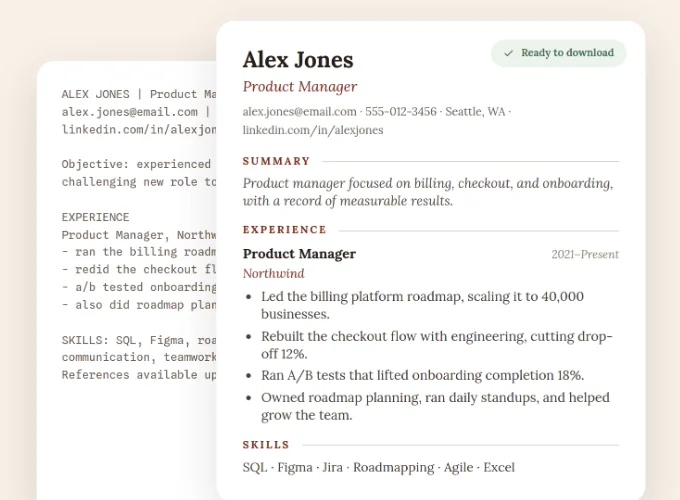
- Write results, not duties. For example, replace "managed project timelines" with
Led a cross-functional team to complete a project two weeks ahead of schedule, saving $10,000. - Use active verbs and drop filler words. "Coordinated and led weekly team meetings" is shorter and clearer than "was responsible for coordinating and leading team meetings." A list of action verbs for a resume helps here.
- Include only relevant experience. For a senior role, early entry-level jobs that do not support your application can go. If cutting a job would leave an unexplained gap, keep it as one line instead.
- Use the words of the job post. Put the main skills from the posting in your summary, skills list and bullets. Leave out skills the job does not need.
- Remove the references section. Employers do not need references with an application, and "references available upon request" only takes space. Keep a separate list for when you are asked.
- Skip hobbies unless they relate to the job. Hobbies and interests can make you memorable, but they rarely earn the space when the page is tight.
- Leave out graphics, logos and a photo. They take room that your experience could use, and most US employers do not expect a photo.
- Change the resume for every job. Reread each line against the job post and cut what does not fit that role, even if it is impressive.
Common questions about resume length
How long should a resume summary be?
A resume summary should be two to four sentences, or about three to five lines. A resume objective, for someone with little work history, should be shorter still: one or two sentences.
How long should bullet points be on a resume?
Resume bullet points should be one or two lines each. A bullet that runs to three lines usually holds two ideas and can be split or cut.
How long should a CV be?
A CV in the UK and much of Europe is usually two pages long. An academic CV has no limit and grows with your publications, grants and teaching.
Is a resume supposed to be one page?
A resume is supposed to be one page only for students and people early in their careers; experienced people often need two. If you are aiming for one page, here is how to make a one-page resume.
How long does it take to write a resume?
Writing a first resume from scratch often takes a few hours, and updating an existing one takes much less. Some people speed up the first draft with a chat assistant. Here is how to use AI to create a resume, checking every line it writes.
How long should each job description be on a resume?
Each job on a resume needs three to five bullet points for recent roles, and one or two for older ones. A job from more than 15 years ago can be a single line with the title, company and dates.
Keep reading
- Resume Formats Guide - How to Format a Resume
- How to Name a Resume File (with Tips from Experts)
- Should You Put a Photo on Your CV?
- How to Write a Functional or Skills-Based Resume (With an Example)
Next step: pick a resume template.
job hunting.
Resumonk polishes your resume, discovers matching jobs and finds connections inside companies.
Get started free- Indeed
- Greenhouse
- + more
This article was originally published on our blog on Oct 30 2024 and authored by Team Resumonk. It was edited and republished in its present form by Team Resumonk on Sep 15 2025.