Should You Put a Photo on Your CV?
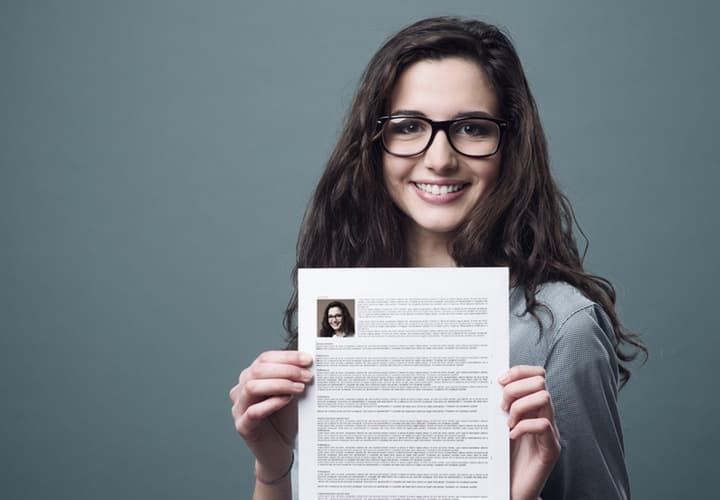
Leave the photo off your CV or resume in the US, UK, Canada and Australia, unless the job post asks for one. In much of continental Europe and parts of Asia, a photo is more common, so check what is usual where you apply.
Below is when to add a photo, how to choose one, and where it goes on the page.
In short
- In the US, the UK, Canada and Australia, most CVs and resumes have no photo.
- In many countries of continental Europe, and in parts of Asia and the Middle East, a CV photo is common.
- A photo belongs on a CV when the job post asks for one, or when the job is in acting or modeling.
- A good CV photo is a recent, clear headshot of you alone, in work clothes, against a plain background.
- A CV photo goes in the top corner beside your name, at about the size of a passport photo.
Should you put a photo on your CV?
A photo on your CV depends mostly on the country you apply in. The habits differ widely:
- US, Canada, the UK and Australia: leave it off. Most employers there do not expect a photo, and many prefer not to see one.
- Much of continental Europe: a photo has long been common, for example in Germany. Habits are changing, so look at how local CVs are done.
- Parts of Asia and the Middle East: a photo is often included. Check what is usual where you apply.
- Any country: if the job post asks for a photo, add one.
When you are not sure, look at a few CVs from people in that country and field. Or ask someone who hires there. A CV without a photo is rarely turned down for that reason alone.
Does a CV need a photo?
A CV does not need a photo in most cases. A photo is necessary only when the job post or the country's usual practice asks for one.
Jobs where a picture is part of the application include acting and modeling. There, a headshot is usually sent as a separate photo, not printed on the resume.
Why do many employers prefer a resume without a photo?
Many employers prefer a resume without a photo because a photo invites judgments about looks, age, gender or race. Those things have nothing to do with the job.
To keep hiring fair, many companies in the US and the UK ask that resumes come without photos. Some remove photos before a hiring manager sees the resume.
A photo also takes space that your skills and experience could use. On a one-page resume, that space matters.
Is it professional to put a picture on your resume?
A picture on your resume looks professional only where photos are usual and the photo is a good one. In the US or the UK, it can look out of place even when the photo is good.
A casual photo hurts you anywhere. Leave out selfies, holiday pictures, group shots that are cropped, and blurry or dark images.
A LinkedIn profile is different. A photo there is normal, so hiring managers who look you up will see your face anyway.
Where do you put a photo on a resume?
A photo goes at the top of the resume, in the left or right corner beside your name and contact details. That is where readers expect it in countries where photos are common.
- Keep it about the size of a passport photo. In the US, that is 2 by 2 inches.
- Line it up with your name, so it does not push your experience down the page.
- Use the same photo on every page only if the template does that for you. One photo is enough.
How do you add a photo to your CV?
A photo is added to a CV in Word by choosing Insert, then Pictures, and picking the file. Then drag it to the top corner and resize it.
Resumonk has templates with a photo and templates without one. The photo CV maker shows the ones with a photo:
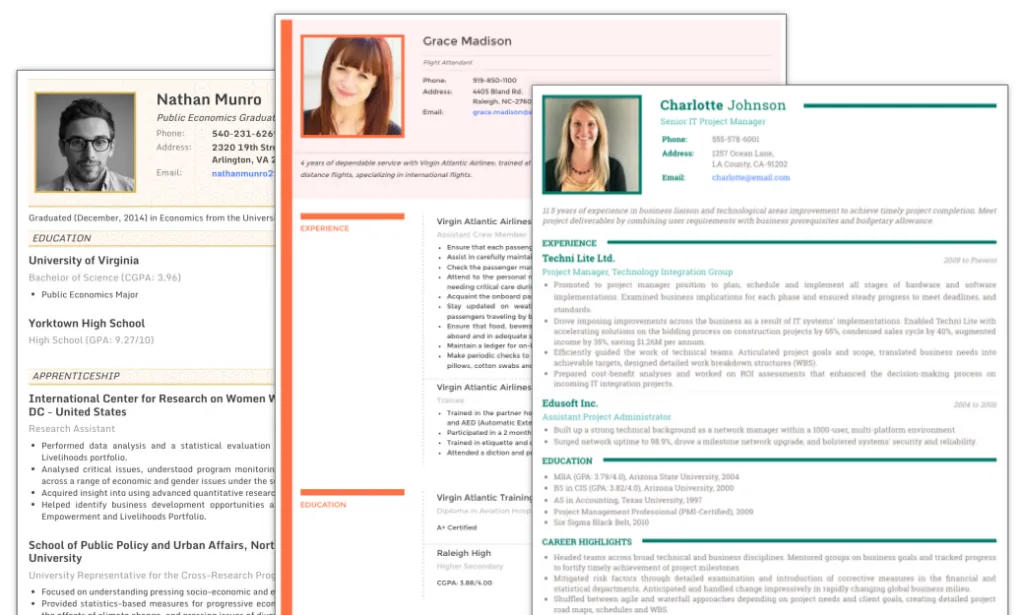
Pick a template for your CVResumonk has templates with a photo and templates without one, so pick the kind that suits where you apply.
Build your resume
How do you take a good CV photo?
A good CV photograph is a recent headshot that looks like you today. Take it like this:
- Use a photo from the last few years, so the interviewer recognizes you.
- Make it a photo of you alone. Your face and shoulders should fill a little more than half the picture.
- Wear what you would wear to the job. A plain shirt is better than a tank top.
- Stand in front of a plain, light wall, facing a window for soft light.
- Look at the camera with a relaxed, friendly face.
- Take several shots and pick the clearest one.
A professional photographer helps, but a friend with a phone can take a good photo at home. If you print your CV, check that the photo is still clear in black and white.
Common questions about photos on a CV
Should you put a photo on your CV in the UK?
A CV in the UK should not have a photo, unless the job post asks for one. UK employers do not expect it, and many prefer CVs without photos.
Does a photo make a resume look cheap?
A photo can make a resume look cheap when it is a selfie, blurry or too large. A small, clear headshot in a template made for photos looks fine where photos are usual.
Can you use your LinkedIn photo on your CV?
Your LinkedIn photo can go on your CV if it is a clear, recent headshot. Using the same picture helps a hiring manager know they found the right profile.
Is it better to have a picture on your resume or not?
Having no picture is the better choice for most resumes in English-speaking countries. A picture adds little there, and it takes space and can invite bias.
Should you put a photo on a resume when applying abroad?
A resume for a job abroad follows the habits of that country, not yours. Look at local CVs or the job post, and add a photo only if it is usual there.
Keep reading
- Resume Formats Guide - How to Format a Resume
- How to Name a Resume File (with Tips from Experts)
- How to Write a Functional or Skills-Based Resume (With an Example)
- A Complete Guide On How To Write A One-Page Resume (With Templates)
Next step: make a CV with your photo.
job hunting.
Resumonk polishes your resume, discovers matching jobs and finds connections inside companies.
Get started free- Indeed
- Greenhouse
- + more
This article was originally published on our blog on May 23 2017 and authored by Sarah Landrum. It was edited and republished in its present form by Team Resumonk on Sep 15 2025.