Acting Resume Example and Tips
Introduction
An acting resume lists your credits, training, union status and special skills on one page that fits the back of a headshot. This actor resume example shows that form, then explains each part in plain steps.
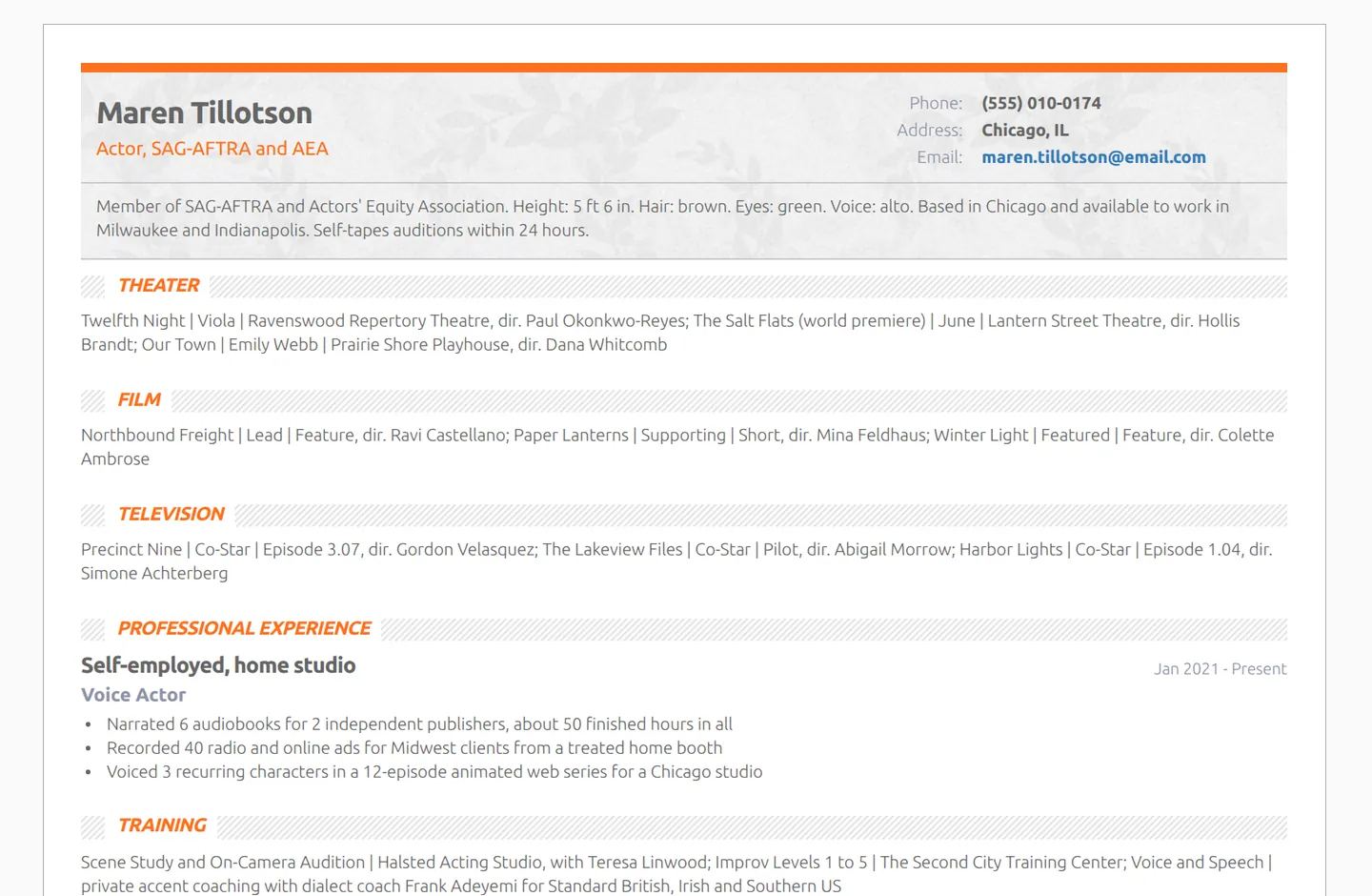
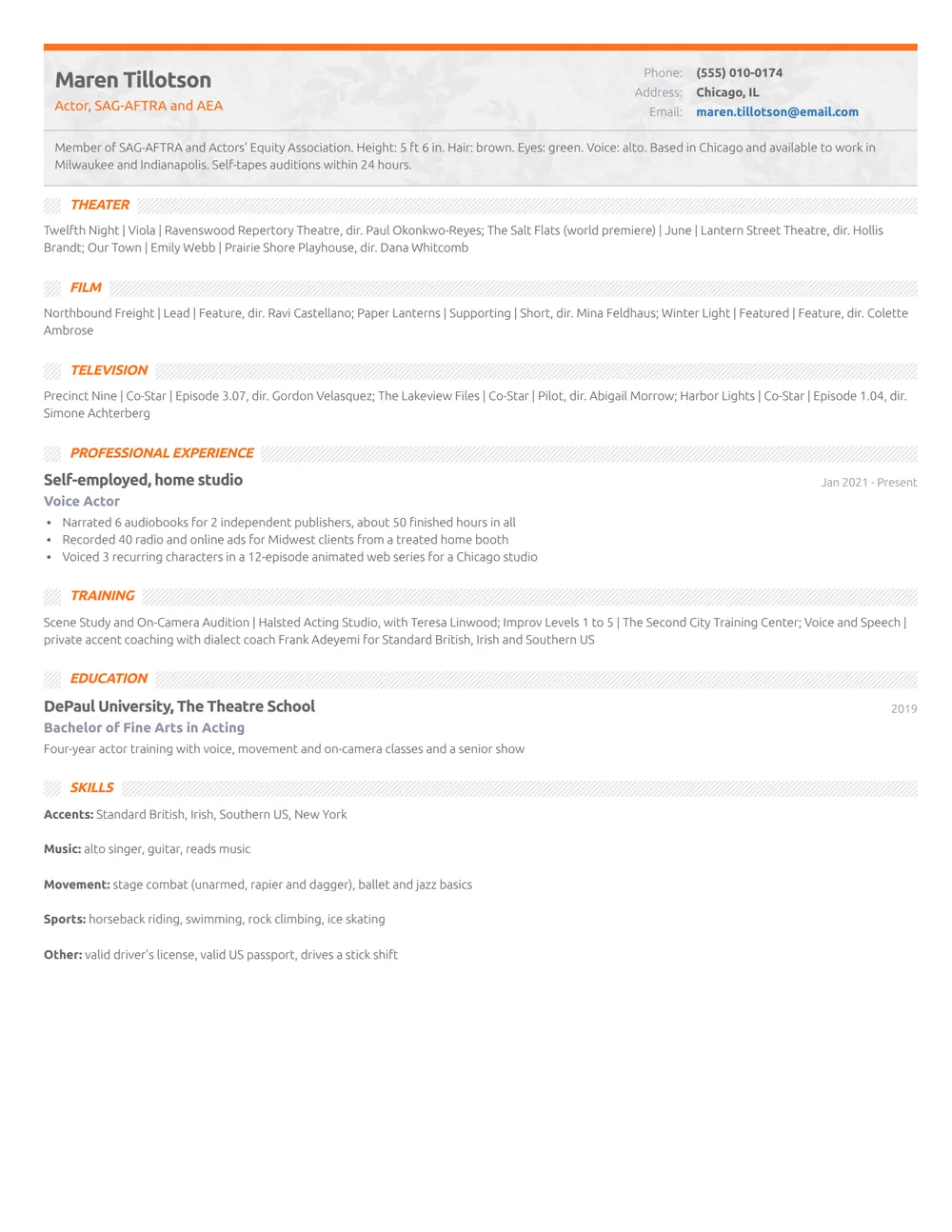
The sample belongs to Maren Tillotson, a Chicago stage and screen actor in SAG-AFTRA and AEA. Her credits sit in three groups, Theater, Film and Television, followed by her voice acting work, training and special skills.
Acting resume of a Chicago stage and screen actor
https://www.resumonk.com/actor-resumeActorActing resume format: one page, 8 by 10 inches
Fit your acting resume to 8 by 10 inches, the size of a headshot. The two go to casting together.
What does an acting resume look like?
A single sheet with your name and union status at the top, then credits in short columns, then training and special skills. It reads more like a list than a story.
A little color suits a creative job. The sample's design puts an orange bar above the name and sets each section name in orange. The credits stay in plain gray text.
How to make an acting resume, top to bottom
To create an acting resume, work down the page in this order:
- Name in large type, then union status: SAG-AFTRA, AEA, both, SAG-AFTRA eligible, or none.
- Contact: your agent or manager if you have one, otherwise your own phone and email. Add your website or reel link here.
- Stats: height, hair color and eye color. Leave off age and weight.
- Credits in groups for film, television and theater, with the medium you work in most at the top.
- Training: studios, classes, teachers, then your degree.
- Special skills: accents, music, sports and anything you can do on cue.
The sample opens with Theater because Maren works mostly on stage. Her union status and stats sit in the short block under her name, where other resumes put a summary. An acting resume has no objective.
Do you put dates on an acting resume?
Usually not. The role and the company say more than the year, and dates make a quiet year look longer than it was.
Acting resume template in Word, Google Docs or Canva
Any actor resume template in Word, Google Docs or Canva works if it lines credits up in columns. On a letter-size page, keep the text inside an 8 by 10 inch area so the trim does not cut it.
- Use one plain font at 10 to 11 points for credits, and a larger size only for your name.
- Export a PDF for casting sites such as Actors Access, Casting Networks and Backstage.
- Print on plain white paper for auditions.
Actor credits for film, TV and theater, in columns
Project, role, and who made it: every credit line has those three parts. The columns change by medium:
- Film: title, billing (Lead, Supporting or Featured), director.
- Television: show, billing (Series Regular, Recurring, Guest Star or Co-Star), network or director.
- Theater: play, the character's name, theater and director.
The sample's first two film credits follow that form:
Northbound Freight | Lead | Feature, dir. Ravi Castellano
Paper Lanterns | Supporting | Short, dir. Mina Feldhaus
Order inside each group
Put your biggest roles first, not your newest. A lead in a small feature goes above a featured part in a larger one.
Mark new plays. The sample adds world premiere to The Salt Flats, since no earlier production exists.
For Broadway, Off-Broadway or a national tour, name the tier on the line, such as "National Tour" after the company. In musicals, list the character as you would in a play. Your voice type goes in the block under your name, as the sample's alto does.
How do you list commercials on an acting resume?
Write one line under its own heading: Commercials, list upon request.
An ad can tie you to one brand for a time. So the full list goes to your agent and casting, not onto the page.
Do you put background work on an acting resume?
No. Background or extra work stays off, even on a well-known show. Also leave off:
- Day jobs outside acting. Voice work, teaching artist work and stunt work can stay.
- A credit you cannot name a company or director for.
- Roles you understudied but never went on for, unless you mark them as understudy.
Most acting resumes have no job section at all. The sample keeps one entry, for voice work, because it is paid acting work that has no stage or screen column.
It carries numbers: 6 audiobooks and 40 ads. A voice credits group in the same columns as the others works too.
Special skills on an actor resume
List special skills a director could ask for on set and you could do that same day. The sample has five lines: Accents, Music, Movement, Sports and Other.
Special skills for an acting resume, by kind
- Accents and dialects: name each one, such as Standard British, Irish, New York or Southern US.
- Music: your voice type, instruments, and whether you read music.
- Movement: dance styles, stage combat, gymnastics, juggling.
- Sports: horseback riding, skating, swimming, martial arts.
- Languages: only those you can play a scene in.
- Licenses: driver's license, motorcycle license, a passport for travel.
- On-camera work: teleprompter reading, improv, self-taping at home.
Be ready to do any listed skill in the audition room.
Can you list a skill you are still learning?
Yes, with its level written next to it: "Spanish (conversational)", "tap (beginner)". A level keeps you from being cast for a scene you cannot play yet.
Leave out traits such as hard-working or creative. Casting cannot put a trait on camera.
Beginner, professional and voice actor resumes
How do I make an acting resume with no experience?
If you are just beginning, list what you have done under the same groups. Put Training above credits while it is your strongest section. School plays, community theater and student films all count, with the company named.
A beginner's credits might read like this example:
Theater
Into the Woods | Baker's Wife | Elm Hollow Community Players
Romeo and Juliet | Nurse | Westfield High School

Film
Last Bus Home | Lead | Student short, Columbia College Chicago
With little experience, build credits this way:
- Audition for student films at local film schools. They cast often and credit every role.
- Join a community theater season, onstage or as an understudy.
- Take one class with a named teacher, so Training has a real line.
- Record a short self-tape reel once you have two scenes you are proud of.
Never list a credit you did not do.
Student and teen actors
A teen actor lists a parent's or guardian's phone and email as the contact. School shows go under Theater with the school's name, and a drama camp goes under Training.
Professional actor resume
Once you sign with an agent, the agency's name and phone number go at the top in place of yours. Drop student credits as professional ones replace them.
If you also model, add a short Print and Runway group under the acting credits. Give the client and the kind of shoot.
Voice actor resume
A voice acting resume drops the stats and adds a demo reel link. Group credits by kind: commercial, animation, audiobook, video game, narration.
Name your home studio in one line, such as the microphone and recording software. The sample's voice job gives the output in numbers: 6 audiobooks, 40 ads and 3 recurring characters.
An acting manager or acting supervisor is a different thing: someone filling in for a boss. On an ordinary resume, write it as its own title under that employer, with the dates you covered.
Training, classes and theater degrees
Training tells casting who taught you and what. List the studio or school, the kind of class, and the teacher.
The sample lists three: scene study at Halsted Acting Studio, improv at The Second City Training Center, and private accent coaching. Her Bachelor of Fine Arts in Acting from DePaul University sits below them.
Does an actor need a degree?
No degree is required to work as an actor. A BFA or an MFA in acting is one kind of training. Studio classes and private coaching are others, and all of them go here.
Workshops count when a named teacher or casting director ran them. A one-day class can go on a beginner's resume and come off later. Mark a class you are still taking as ongoing.
Festival prizes and theater award nominations
Add an Awards line for real recognition, such as a film festival prize. A nomination from a local theater award, such as Chicago's Jeff Awards, counts too. Put the year next to it.
A short note to agents and casting directors
A note to an agent goes with your headshot, resume and reel. Auditions booked through casting sites rarely ask for one.
What goes in a note to an acting agent?
- Who you are, where you are based, and your union status.
- One or two recent credits, or the training you just finished.
- What you are asking for: a meeting, or a look at your reel.
Dear Ms. Bergstrom,

I am a Chicago actor, a member of SAG-AFTRA and AEA, and I am looking for theatrical representation. This spring I played Viola in Twelfth Night at Ravenswood Repertory Theatre.

My headshot, resume and a two-minute reel are attached. I would welcome a short meeting.
Headshot and resume as one sheet
Your resume and headshot travel together, so prepare them as one piece:
- Size: trim the resume so no paper sticks out past the photo.
- Attach: staple it at the corners, or print it on the back of the headshot.
- Match: the same name spelling and union status on both sides.
- Update: add a credit the day you book it, and reprint before your next audition.
- Online: upload the same resume as a PDF to each casting site profile.
Already have a resume? Upload the file and start from it. Build your actor resume
More Arts resume examples
- Stage Manager resume example
- Music Producer resume example
- Artist resume example
- Arts Administrator resume example
See all Arts resume examples, or browse every category.
Resume writing tips