Artist Resume Example (with Tips and Best Practices)
Introduction
You're an artist.
Maybe you're emerging from art school with paint still under your fingernails and a head full of conceptual frameworks. Perhaps you're mid-career, juggling studio time with teaching gigs, or you're transitioning from another field entirely, finally ready to pursue what you've always loved. Regardless of your path, you've arrived at this moment - staring at a blank document, wondering how to capture years of creative exploration in a format that feels antithetical to everything art represents.
Here's what nobody tells you about being an Artist (and let's be clear - we're talking about the creative professional who produces original works, not a leadership position despite what the word might suggest in other industries). Your resume isn't meant to replace your portfolio; it's meant to provide the professional framework that helps galleries, collectors, and institutions understand not just what you create, but how you've built a sustainable practice around your creativity. It's the document that proves you're not just talented - you're professional, reliable, and ready for whatever opportunity comes next.
In this comprehensive guide, we'll walk you through every element of crafting an artist resume that honors both your creative spirit and professional ambitions. We'll start with choosing the right format - spoiler alert, it's reverse-chronological for most artists - then dive into how to present your exhibition history, artistic experience, and education in ways that resonate with art world expectations. You'll learn the crucial differences between listing work experience as an artist versus traditional employment, how to articulate your technical and conceptual skills, and navigate the unique considerations that come with different geographic markets and institutional expectations.
We'll also tackle the often-overlooked elements that can make or break your application - from crafting a cover letter that captures your artistic voice without sacrificing professionalism, to understanding how awards and publications create credibility in a field where subjective judgment reigns supreme. By the time you finish reading, you'll have a clear roadmap for creating a resume that works as hard as you do, whether you're applying for gallery representation in New York, a residency in rural Scotland, or a teaching position at your local art center. Most importantly, you'll understand how to adapt our templates and advice to your unique circumstances - because if there's one thing we know about artists, it's that no two careers look exactly alike.
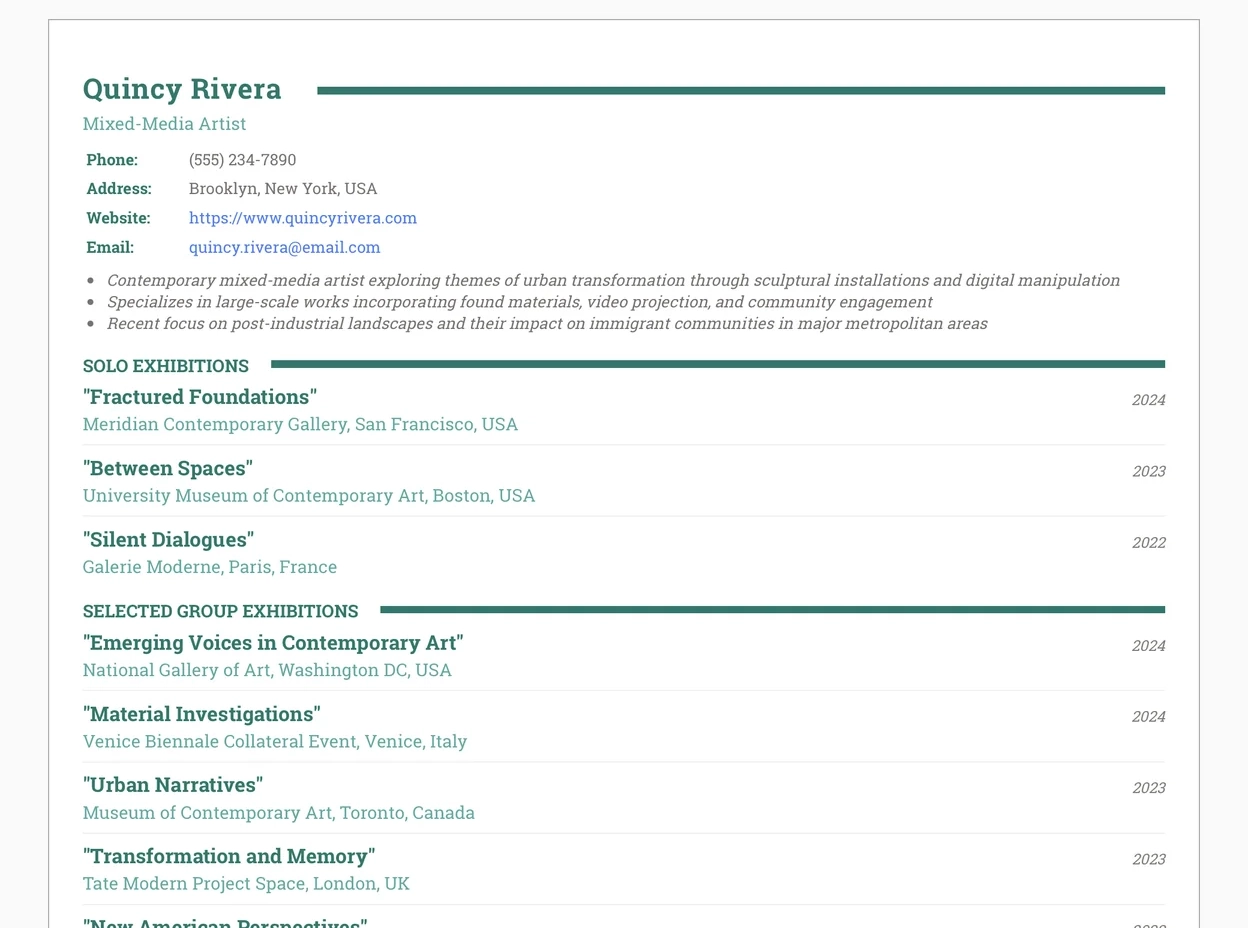
The Ultimate Artist Resume Example/Sample
https://www.resumonk.com/artist-resumeArtistArtist Resume Format - Choosing the Structure That Showcases Your Creative Journey
For artists, the reverse-chronological resume format serves as your canvas of choice. This format places your most recent exhibitions, commissions, or artistic positions at the top, working backward through time. Why does this work particularly well for artists?
Because the art world moves quickly - galleries want to know what you've been creating lately, not what you painted five years ago (unless it was exceptionally noteworthy).
The Artist's Resume Architecture
Start with your contact information positioned cleanly at the top. Include your name, professional email, phone number, location (city and country suffice), and crucially - links to your online portfolio or website.
Remember, you're an artist; your work needs to be accessible with one click.
Follow this with a brief artist statement or professional summary - think of it as the wall text next to your artwork. This 2-3 sentence introduction should capture your artistic focus, medium, and what makes your perspective unique.
❌ Don't write a generic summary:
"Experienced artist seeking opportunities to display work."
✅ Do write something that captures your artistic identity:
"Mixed-media artist exploring urban decay through found objects and digital manipulation,
with recent exhibitions focusing on post-industrial transformation in major European cities."
Organizing Your Artistic Journey
After your summary, structure your resume into clear sections - Exhibitions (solo and group shows listed separately), Artistic Experience (residencies, commissions, teaching positions), Education (including workshops and masterclasses), and Awards/Grants. This organization helps gallery directors, curators, and collectors quickly find the information they're seeking.
For emerging artists fresh from art school, you might lead with your education section if it includes prestigious institutions or notable mentors. Mid-career artists should prioritize exhibitions and professional experience.
Remember, in the art world, your exhibition history often carries more weight than traditional employment.
Work Experience on Artist Resume - Documenting Your Creative Professional Life
Your work experience section tells the story of how you've sustained yourself as an artist while developing your practice. This isn't just about listing jobs - it's about demonstrating your commitment to art as a profession, whether through gallery representation, commissioned works, teaching positions, or even the day jobs that funded your artistic pursuits.
Structuring Your Artistic Experience
Begin each entry with the role title, organization or venue name, location, and dates. For artists, "work experience" encompasses a broader range than traditional employment.
Include artist residencies, workshop facilitation, commissioned projects, and ongoing gallery representations.
When describing each experience, focus on tangible outcomes and artistic development. Use active language that conveys both your creative process and professional achievements. Quantify where possible - number of pieces created, exhibition visitors, sales figures (if impressive), or students taught.
❌ Don't write vague descriptions:
Artist in Residence - Mountain View Art Center, 2023
- Created artwork
- Participated in community events
- Worked in studio
✅ Do provide specific, impactful details:
Artist in Residence - Mountain View Art Center, 2023
- Produced 15-piece series exploring climate change through large-scale installations
- Led 4 community workshops engaging 120+ participants in collaborative mural project
- Culminated residency with solo exhibition attracting 500+ visitors over 3 weeks
Including Non-Art Employment
Many artists support themselves through other work - there's no shame in this reality.
If you've worked in galleries, museums, or arts administration, these roles directly support your artistic credibility. Even seemingly unrelated jobs can demonstrate valuable skills. That bartending job? It shows you can work under pressure and manage multiple tasks. Teaching yoga? It demonstrates your ability to guide and inspire others.
The key is connecting these experiences to skills valuable in the art world - project management, public speaking, budget handling, or community engagement. Frame these experiences to show how they've informed your artistic practice or professional capabilities.
Skills to Showcase on Your Artist Resume - The Technical and Conceptual Toolkit
Think of your skills section as the materials list for your artistic practice - it tells viewers what mediums you command, what techniques you've mastered, and what conceptual territories you navigate. This section bridges the gap between your creative vision and your technical capabilities.
Technical Proficiencies That Matter
Start with your primary artistic mediums and techniques.
Be specific - instead of just "painting," specify "oil painting, acrylic, watercolor, mixed media." Include any specialized techniques you've developed or are known for. Digital artists should list relevant software proficiencies (Photoshop, Illustrator, Procreate, 3D modeling programs).
Don't forget about the business side of art. Skills like grant writing, exhibition planning, art handling, and documentation photography are highly valuable.
If you've managed your own exhibitions or sales, include skills like budget management, marketing, and client relations.
❌ Don't create a generic skills dump:
Skills: Drawing, Painting, Creativity, Hard-working, Team player
✅ Do organize skills strategically:
Artistic Techniques: Oil painting (classical and contemporary), Printmaking (etching, lithography),
 Large-scale installation, Video art and projection mapping

Digital Tools: Adobe Creative Suite, Blender 3D, Final Cut Pro, Digital archival practices

Professional Skills: Grant proposal writing, Exhibition curation, Workshop facilitation,
 Bilingual (English/Spanish) for international exhibitions
Balancing Hard and Soft Skills
While technical skills form your foundation, don't underestimate the importance of conceptual and interpersonal abilities. Include skills like "conceptual development," "critical analysis," or "cross-cultural collaboration" if they're central to your practice.
These softer skills often distinguish artists who can articulate their vision and work successfully with galleries, collectors, and communities.
Consider organizing your skills into categories that make sense for your artistic practice. A sculptor might separate "Materials & Techniques" from "Fabrication Tools," while a conceptual artist might include "Research Methodologies" as a category.
Specific Considerations and Tips for Artist Resumes - The Gallery-Ready Details
Creating an artist resume requires navigating unique considerations that don't apply to other professions. You're not just listing qualifications - you're presenting a professional document that complements your portfolio while respecting art world conventions.
The Exhibition History Hierarchy
In the art world, your exhibition history carries tremendous weight.
Always separate solo exhibitions from group shows, listing solo shows first as they represent greater recognition. Within each category, maintain reverse-chronological order. Include the exhibition title (in italics), venue name, city, and country. For traveling exhibitions, list all venues.
International exhibitions deserve special mention, as do shows at prestigious venues. If you've exhibited at museums, biennials, or well-known galleries, these should appear prominently.
Don't pad this section with every coffee shop display - quality trumps quantity.
❌ Don't mix exhibition types:
Exhibitions:
2024 - Group Show, City Gallery
2023 - Solo Exhibition, University Space
2023 - Art Fair Booth, Local Convention Center
✅ Do organize hierarchically:
Solo Exhibitions:
2023 "Temporal Fragments," University Museum of Contemporary Art, Boston, USA
2022 "Silent Dialogues," Galerie Moderne, Paris, France

Selected Group Exhibitions:
2024 "Emerging Voices," National Gallery of Art, Washington DC, USA
2023 "Material Investigations," Venice Biennale Collateral Event, Venice, Italy
Geographic and Cultural Considerations
The art world operates internationally, but resume conventions vary by region. In the United States, keep your resume concise - typically 1-2 pages unless you're an established artist with extensive exhibition history.
Include prices or sales information only if specifically requested.
European artist resumes (particularly in the UK and Germany) often run longer and may include more detailed exhibition information, press coverage, and bibliography sections. Australian and Canadian formats tend to fall between American brevity and European comprehensiveness.
Always list locations with city and country for international clarity. If you've exhibited primarily in one country but are applying internationally, emphasize any international experience you do have.
The Portfolio Connection
Your resume should work in harmony with your portfolio - think of them as exhibition partners.
While your resume provides the professional framework, it should compel readers to view your actual work. Include your website or portfolio link prominently, and ensure any work mentioned in your resume (commissioned pieces, exhibition highlights) can be viewed in your portfolio.
Never include images directly in your resume unless specifically requested. The resume should remain a clean, professional document that stands alone while pointing toward your visual work. Some artists create a separate "CV" (longer, more detailed) and "resume" (shorter, targeted) - know which is appropriate for each opportunity.
Staying Current in a Dynamic Field
The art world evolves rapidly. Update your resume immediately after each exhibition, award, or significant achievement.
Remove older, less significant exhibitions as you accumulate stronger credentials - your resume should represent your current professional standing, not serve as a complete archive.
Finally, remember that authenticity matters in the art world. Don't inflate your achievements or use ambiguous language to make opportunities seem more prestigious than they were. The art community is surprisingly small, and reputation travels quickly. Let your genuine accomplishments and unique artistic voice shine through in every line of your resume.
Education to List on Artist Resume
Here's the thing about being an Artist - and let's be clear, we're talking about the creative professional who produces original works in visual arts, performing arts, or multimedia, not an executive-level position - your education section needs to tell a story that complements your portfolio, not overshadow it.
The Hierarchy of Artistic Education
Unlike traditional corporate roles where education follows a predictable pattern, artists come from wonderfully diverse educational backgrounds.
You might have a Master of Fine Arts from Yale, or you might be entirely self-taught with a biology degree. Both paths are valid, but they require different presentation strategies.
For formally trained artists, list your degrees in reverse-chronological order, but here's the twist - include relevant coursework, specialized techniques, or notable professors only if they directly enhance your artistic narrative. Remember, galleries and clients care more about what you create than where you studied, but the right educational credentials can open doors.
❌ Don't - List every single art class you've ever taken:
Education:
- Life Drawing 101
- Color Theory
- Introduction to Sculpture
- Basic Photography
- Art History Survey
✅ Do - Present cohesive educational experiences that support your artistic identity:
Master of Fine Arts in Sculpture
Rhode Island School of Design, 2022
Concentration: Large-scale Installation Art
Thesis: "Urban Decay and Renewal Through Found Materials"
Workshops, Residencies, and Alternative Learning
As an artist, your education extends far beyond traditional degrees. Those intensive workshops with renowned artists? That month-long residency in rural Vermont?
These experiences often shape your artistic practice more profoundly than formal schooling.
Create a subsection called "Artistic Development" or "Specialized Training" to showcase these experiences. This approach acknowledges that artistic education is ongoing and multifaceted.
Include the year, location, and focus of each experience, especially if it resulted in new work or techniques that appear in your portfolio.
International Considerations
For artists applying in the UK, emphasize any training at recognized institutions like the Royal College of Art or Slade School.
In Canada, highlight connections to provincial arts councils or training programs. Australian artists should note any TAFE qualifications alongside university degrees. US artists benefit from listing both accredited programs and prestigious non-degree workshops.
Awards and Publications on Artist Resume
You know that moment when someone asks about your achievements as an artist, and you're not sure whether to mention the local art fair ribbon or focus on that group exhibition review? Let's untangle this together.
The Currency of Artistic Recognition
In the art world, awards and publications serve as external validation of what you already know - that your work has merit. But unlike other professions where awards might be nice-to-haves, for artists, they're often make-or-break credentials that determine gallery representation, grant eligibility, and collector interest.
Start with the most prestigious recognitions and work your way down. International awards trump national ones, which trump regional ones. But context matters - a best-in-show at a small but highly respected juried exhibition might carry more weight than participation in a large, pay-to-play international show.
❌ Don't - List every honorable mention without context:
Awards:
- Winner, Art Show 2023
- Honorable Mention 2022
- Best in Category 2021
- Participant Award 2020
✅ Do - Provide meaningful context that demonstrates the award's significance:
Selected Awards:
2023 Pollock-Krasner Foundation Grant ($30,000)
2022 Best Emerging Artist, ArtPrize (juried from 1,200+ entries)
2021 Artist Residency Award, MacDowell Colony
Publications - Your Work in Print and Pixels
Publications about your work serve a dual purpose - they document your artistic journey and provide third-party perspectives on your practice. Include exhibition catalogs, art criticism, feature articles, and even substantial blog posts from recognized art writers.
When listing publications, differentiate between those that feature your work prominently versus mere mentions. A full-page review in Artforum carries different weight than a group show listing in a local paper, though both have their place.
The Digital Age Consideration
Today's artists must navigate both traditional and digital recognition.
Online features, podcast interviews, and viral social media moments can be just as valuable as print publications. Create a balanced representation that shows you're engaged with contemporary platforms while respecting traditional venues.
Listing References for Artist Resume
In the art world, references are your creative family tree - they map out your connections, validate your journey, and vouch for your character when you're not in the room. But choosing references as an artist requires more nuance than simply listing three former bosses.
The Art World's Unwritten Rules
Your references tell a story about where you've been and where you're going. A well-curated reference list might include a former professor who witnessed your artistic breakthrough, a gallery director who successfully sold your work, and a fellow artist who's collaborated with you on installations.
Each reference serves a different purpose - academic credibility, commercial viability, and peer respect.
Unlike traditional job applications where you might list "References available upon request," artists often benefit from including references directly, especially when applying for residencies, grants, or gallery representation. The art world is small, and name recognition can open doors.
❌ Don't - List references without context or permission:
References:
John Smith - 555-1234
Jane Doe - 555-5678
Bob Johnson - 555-9012
✅ Do - Provide complete information with relationship context:
Professional References:

Dr. Maria Rodriguez
Director of Graduate Studies, UCLA Department of Art
[email protected] | (310) 555-1234
Relationship: MFA Thesis Advisor, 2019-2021

Chen Liu
Owner/Director, Meridian Contemporary Gallery
[email protected] | (415) 555-5678
Relationship: Represented artist, 2021-present
Strategic Reference Selection
Choose references who can speak to different aspects of your practice.
If you're applying for a teaching position, include someone who's observed your educational abilities. For commercial opportunities, prioritize those who can discuss your professionalism and sales history.
For experimental or institutional opportunities, select references who understand your conceptual framework.
Maintaining Reference Relationships
Remember that being an artist often means maintaining relationships over decades.
Keep your references updated on your career progress, send them exhibition announcements, and thank them when they've provided support. The curator who wrote you a recommendation letter today might be directing a major museum tomorrow.
Always ask permission before listing someone as a reference, and give them context about the opportunity. A quick email explaining the position and why you think you're a good fit helps them tailor their recommendation. In the collaborative ecosystem of the art world, these courtesies matter more than you might think.
Cover Letter Tips for Artist Resume
Ah, the artist's cover letter - that peculiar document where you must translate visual language into words, where you explain why someone should care about your practice without sounding pretentious or desperate. It's like describing a sunset to someone who's never seen color.
Finding Your Written Voice
Your cover letter needs to accomplish what your portfolio cannot - it must convey your personality, your passion, and your professionalism in equal measure. Unlike cover letters for corporate positions that follow rigid formulas, an artist's cover letter should reflect your creative voice while maintaining professional standards.
Start by researching your audience thoroughly. A cover letter for a commercial gallery differs vastly from one for a museum position or a teaching opportunity.
Your tone should match their aesthetic - edgy and contemporary for cutting-edge galleries, scholarly and thoughtful for academic positions.
❌ Don't - Write generic, interchangeable content:
Dear Gallery,
I am an artist seeking representation. I make paintings that explore various themes.
Please see my attached portfolio.
✅ Do - Craft specific, engaging narratives that connect your work to their vision:
Dear Ms. Chen,
Your recent exhibition "Borders and Boundaries" resonated deeply with my practice of using textile installations to explore immigrant narratives. Having followed Blue Door Gallery's commitment to socially engaged art for three years, I believe my work aligns with your mission to amplify marginalized voices through contemporary craft.
The Three-Paragraph Sweet Spot
Think of your cover letter as a triptych - three panels that work together to create a complete picture. First paragraph: the hook that establishes connection and context. Second paragraph: the meat where you articulate your artistic practice and relevant achievements.
Third paragraph: the future-facing close that suggests possibilities for collaboration.
Region-Specific Approaches
American galleries often appreciate directness and confidence. British institutions tend to favor understated eloquence. Canadian organizations frequently value community engagement aspects. Australian venues often look for environmental or social consciousness.
Adjust your tone accordingly without sacrificing authenticity.
Key Takeaways
- Format matters - Use reverse-chronological format to highlight your most recent and relevant exhibitions, with clear sections separating solo shows from group exhibitions
- Work experience goes beyond employment - Include residencies, commissions, teaching positions, and even non-art jobs that demonstrate valuable skills, always connecting them back to your artistic practice
- Skills should balance technical and conceptual - List specific mediums and techniques alongside professional capabilities like grant writing and exhibition planning
- Education tells your development story - Include formal degrees, workshops, and specialized training that shaped your artistic voice, presented in a way that complements rather than overshadows your portfolio
- Geographic context is crucial - Adapt your resume length, detail level, and emphasis based on whether you're applying in the US, Europe, Australia, or elsewhere
- Awards and publications provide external validation - List these strategically, providing context for significance and including both traditional and digital recognition
- Your cover letter is your written artist statement - Use it to translate visual language into words, connecting your practice to specific opportunities with authentic voice
- References are your creative family tree - Choose references who can speak to different aspects of your practice and maintain these relationships throughout your career
- Authenticity trumps inflation - The art world is small and reputation matters - be honest about your achievements and let your unique voice shine through
Creating an artist resume might feel like forcing your creative spirit into a corporate box, but it doesn't have to be that way. With Resumonk, you can build a professional resume that honors your artistic identity while meeting industry expectations. Our AI-powered recommendations understand the unique needs of creative professionals, suggesting powerful action verbs and achievement-focused language that captures the impact of your artistic practice. Choose from beautifully designed templates that provide clean, gallery-ready presentation while leaving room for your individuality to shine through.
Ready to create an artist resume that opens doors to galleries, residencies, and creative opportunities?
Start building your professional artist resume with Resumonk's intuitive platform, designed to help creative professionals present their unique journey with clarity and style. Begin crafting your artist resume today and let your professional story complement the powerful work in your portfolio.
More Arts resume examples
See all Arts resume examples, or browse every category.
Resume writing tips
You're an artist.
Maybe you're emerging from art school with paint still under your fingernails and a head full of conceptual frameworks. Perhaps you're mid-career, juggling studio time with teaching gigs, or you're transitioning from another field entirely, finally ready to pursue what you've always loved. Regardless of your path, you've arrived at this moment - staring at a blank document, wondering how to capture years of creative exploration in a format that feels antithetical to everything art represents.
Here's what nobody tells you about being an Artist (and let's be clear - we're talking about the creative professional who produces original works, not a leadership position despite what the word might suggest in other industries). Your resume isn't meant to replace your portfolio; it's meant to provide the professional framework that helps galleries, collectors, and institutions understand not just what you create, but how you've built a sustainable practice around your creativity. It's the document that proves you're not just talented - you're professional, reliable, and ready for whatever opportunity comes next.
In this comprehensive guide, we'll walk you through every element of crafting an artist resume that honors both your creative spirit and professional ambitions. We'll start with choosing the right format - spoiler alert, it's reverse-chronological for most artists - then dive into how to present your exhibition history, artistic experience, and education in ways that resonate with art world expectations. You'll learn the crucial differences between listing work experience as an artist versus traditional employment, how to articulate your technical and conceptual skills, and navigate the unique considerations that come with different geographic markets and institutional expectations.
We'll also tackle the often-overlooked elements that can make or break your application - from crafting a cover letter that captures your artistic voice without sacrificing professionalism, to understanding how awards and publications create credibility in a field where subjective judgment reigns supreme. By the time you finish reading, you'll have a clear roadmap for creating a resume that works as hard as you do, whether you're applying for gallery representation in New York, a residency in rural Scotland, or a teaching position at your local art center. Most importantly, you'll understand how to adapt our templates and advice to your unique circumstances - because if there's one thing we know about artists, it's that no two careers look exactly alike.
The Ultimate Artist Resume Example/Sample
https://www.resumonk.com/artist-resumeArtistArtist Resume Format - Choosing the Structure That Showcases Your Creative Journey
For artists, the reverse-chronological resume format serves as your canvas of choice. This format places your most recent exhibitions, commissions, or artistic positions at the top, working backward through time. Why does this work particularly well for artists?
Because the art world moves quickly - galleries want to know what you've been creating lately, not what you painted five years ago (unless it was exceptionally noteworthy).
The Artist's Resume Architecture
Start with your contact information positioned cleanly at the top. Include your name, professional email, phone number, location (city and country suffice), and crucially - links to your online portfolio or website.
Remember, you're an artist; your work needs to be accessible with one click.
Follow this with a brief artist statement or professional summary - think of it as the wall text next to your artwork. This 2-3 sentence introduction should capture your artistic focus, medium, and what makes your perspective unique.
❌ Don't write a generic summary:
"Experienced artist seeking opportunities to display work."
✅ Do write something that captures your artistic identity:
"Mixed-media artist exploring urban decay through found objects and digital manipulation,
with recent exhibitions focusing on post-industrial transformation in major European cities."
Organizing Your Artistic Journey
After your summary, structure your resume into clear sections - Exhibitions (solo and group shows listed separately), Artistic Experience (residencies, commissions, teaching positions), Education (including workshops and masterclasses), and Awards/Grants. This organization helps gallery directors, curators, and collectors quickly find the information they're seeking.
For emerging artists fresh from art school, you might lead with your education section if it includes prestigious institutions or notable mentors. Mid-career artists should prioritize exhibitions and professional experience.
Remember, in the art world, your exhibition history often carries more weight than traditional employment.
Work Experience on Artist Resume - Documenting Your Creative Professional Life
Your work experience section tells the story of how you've sustained yourself as an artist while developing your practice. This isn't just about listing jobs - it's about demonstrating your commitment to art as a profession, whether through gallery representation, commissioned works, teaching positions, or even the day jobs that funded your artistic pursuits.
Structuring Your Artistic Experience
Begin each entry with the role title, organization or venue name, location, and dates. For artists, "work experience" encompasses a broader range than traditional employment.
Include artist residencies, workshop facilitation, commissioned projects, and ongoing gallery representations.
When describing each experience, focus on tangible outcomes and artistic development. Use active language that conveys both your creative process and professional achievements. Quantify where possible - number of pieces created, exhibition visitors, sales figures (if impressive), or students taught.
❌ Don't write vague descriptions:
Artist in Residence - Mountain View Art Center, 2023
- Created artwork
- Participated in community events
- Worked in studio
✅ Do provide specific, impactful details:
Artist in Residence - Mountain View Art Center, 2023
- Produced 15-piece series exploring climate change through large-scale installations
- Led 4 community workshops engaging 120+ participants in collaborative mural project
- Culminated residency with solo exhibition attracting 500+ visitors over 3 weeks
Including Non-Art Employment
Many artists support themselves through other work - there's no shame in this reality.
If you've worked in galleries, museums, or arts administration, these roles directly support your artistic credibility. Even seemingly unrelated jobs can demonstrate valuable skills. That bartending job? It shows you can work under pressure and manage multiple tasks. Teaching yoga? It demonstrates your ability to guide and inspire others.
The key is connecting these experiences to skills valuable in the art world - project management, public speaking, budget handling, or community engagement. Frame these experiences to show how they've informed your artistic practice or professional capabilities.
Skills to Showcase on Your Artist Resume - The Technical and Conceptual Toolkit
Think of your skills section as the materials list for your artistic practice - it tells viewers what mediums you command, what techniques you've mastered, and what conceptual territories you navigate. This section bridges the gap between your creative vision and your technical capabilities.
Technical Proficiencies That Matter
Start with your primary artistic mediums and techniques.
Be specific - instead of just "painting," specify "oil painting, acrylic, watercolor, mixed media." Include any specialized techniques you've developed or are known for. Digital artists should list relevant software proficiencies (Photoshop, Illustrator, Procreate, 3D modeling programs).
Don't forget about the business side of art. Skills like grant writing, exhibition planning, art handling, and documentation photography are highly valuable.
If you've managed your own exhibitions or sales, include skills like budget management, marketing, and client relations.
❌ Don't create a generic skills dump:
Skills: Drawing, Painting, Creativity, Hard-working, Team player
✅ Do organize skills strategically:
Artistic Techniques: Oil painting (classical and contemporary), Printmaking (etching, lithography),
 Large-scale installation, Video art and projection mapping

Digital Tools: Adobe Creative Suite, Blender 3D, Final Cut Pro, Digital archival practices

Professional Skills: Grant proposal writing, Exhibition curation, Workshop facilitation,
 Bilingual (English/Spanish) for international exhibitions
Balancing Hard and Soft Skills
While technical skills form your foundation, don't underestimate the importance of conceptual and interpersonal abilities. Include skills like "conceptual development," "critical analysis," or "cross-cultural collaboration" if they're central to your practice.
These softer skills often distinguish artists who can articulate their vision and work successfully with galleries, collectors, and communities.
Consider organizing your skills into categories that make sense for your artistic practice. A sculptor might separate "Materials & Techniques" from "Fabrication Tools," while a conceptual artist might include "Research Methodologies" as a category.
Specific Considerations and Tips for Artist Resumes - The Gallery-Ready Details
Creating an artist resume requires navigating unique considerations that don't apply to other professions. You're not just listing qualifications - you're presenting a professional document that complements your portfolio while respecting art world conventions.
The Exhibition History Hierarchy
In the art world, your exhibition history carries tremendous weight.
Always separate solo exhibitions from group shows, listing solo shows first as they represent greater recognition. Within each category, maintain reverse-chronological order. Include the exhibition title (in italics), venue name, city, and country. For traveling exhibitions, list all venues.
International exhibitions deserve special mention, as do shows at prestigious venues. If you've exhibited at museums, biennials, or well-known galleries, these should appear prominently.
Don't pad this section with every coffee shop display - quality trumps quantity.
❌ Don't mix exhibition types:
Exhibitions:
2024 - Group Show, City Gallery
2023 - Solo Exhibition, University Space
2023 - Art Fair Booth, Local Convention Center
✅ Do organize hierarchically:
Solo Exhibitions:
2023 "Temporal Fragments," University Museum of Contemporary Art, Boston, USA
2022 "Silent Dialogues," Galerie Moderne, Paris, France

Selected Group Exhibitions:
2024 "Emerging Voices," National Gallery of Art, Washington DC, USA
2023 "Material Investigations," Venice Biennale Collateral Event, Venice, Italy
Geographic and Cultural Considerations
The art world operates internationally, but resume conventions vary by region. In the United States, keep your resume concise - typically 1-2 pages unless you're an established artist with extensive exhibition history.
Include prices or sales information only if specifically requested.
European artist resumes (particularly in the UK and Germany) often run longer and may include more detailed exhibition information, press coverage, and bibliography sections. Australian and Canadian formats tend to fall between American brevity and European comprehensiveness.
Always list locations with city and country for international clarity. If you've exhibited primarily in one country but are applying internationally, emphasize any international experience you do have.
The Portfolio Connection
Your resume should work in harmony with your portfolio - think of them as exhibition partners.
While your resume provides the professional framework, it should compel readers to view your actual work. Include your website or portfolio link prominently, and ensure any work mentioned in your resume (commissioned pieces, exhibition highlights) can be viewed in your portfolio.
Never include images directly in your resume unless specifically requested. The resume should remain a clean, professional document that stands alone while pointing toward your visual work. Some artists create a separate "CV" (longer, more detailed) and "resume" (shorter, targeted) - know which is appropriate for each opportunity.
Staying Current in a Dynamic Field
The art world evolves rapidly. Update your resume immediately after each exhibition, award, or significant achievement.
Remove older, less significant exhibitions as you accumulate stronger credentials - your resume should represent your current professional standing, not serve as a complete archive.
Finally, remember that authenticity matters in the art world. Don't inflate your achievements or use ambiguous language to make opportunities seem more prestigious than they were. The art community is surprisingly small, and reputation travels quickly. Let your genuine accomplishments and unique artistic voice shine through in every line of your resume.
Education to List on Artist Resume
Here's the thing about being an Artist - and let's be clear, we're talking about the creative professional who produces original works in visual arts, performing arts, or multimedia, not an executive-level position - your education section needs to tell a story that complements your portfolio, not overshadow it.
The Hierarchy of Artistic Education
Unlike traditional corporate roles where education follows a predictable pattern, artists come from wonderfully diverse educational backgrounds.
You might have a Master of Fine Arts from Yale, or you might be entirely self-taught with a biology degree. Both paths are valid, but they require different presentation strategies.
For formally trained artists, list your degrees in reverse-chronological order, but here's the twist - include relevant coursework, specialized techniques, or notable professors only if they directly enhance your artistic narrative. Remember, galleries and clients care more about what you create than where you studied, but the right educational credentials can open doors.
❌ Don't - List every single art class you've ever taken:
Education:
- Life Drawing 101
- Color Theory
- Introduction to Sculpture
- Basic Photography
- Art History Survey
✅ Do - Present cohesive educational experiences that support your artistic identity:
Master of Fine Arts in Sculpture
Rhode Island School of Design, 2022
Concentration: Large-scale Installation Art
Thesis: "Urban Decay and Renewal Through Found Materials"
Workshops, Residencies, and Alternative Learning
As an artist, your education extends far beyond traditional degrees. Those intensive workshops with renowned artists? That month-long residency in rural Vermont?
These experiences often shape your artistic practice more profoundly than formal schooling.
Create a subsection called "Artistic Development" or "Specialized Training" to showcase these experiences. This approach acknowledges that artistic education is ongoing and multifaceted.
Include the year, location, and focus of each experience, especially if it resulted in new work or techniques that appear in your portfolio.
International Considerations
For artists applying in the UK, emphasize any training at recognized institutions like the Royal College of Art or Slade School.
In Canada, highlight connections to provincial arts councils or training programs. Australian artists should note any TAFE qualifications alongside university degrees. US artists benefit from listing both accredited programs and prestigious non-degree workshops.
Awards and Publications on Artist Resume
You know that moment when someone asks about your achievements as an artist, and you're not sure whether to mention the local art fair ribbon or focus on that group exhibition review? Let's untangle this together.
The Currency of Artistic Recognition
In the art world, awards and publications serve as external validation of what you already know - that your work has merit. But unlike other professions where awards might be nice-to-haves, for artists, they're often make-or-break credentials that determine gallery representation, grant eligibility, and collector interest.
Start with the most prestigious recognitions and work your way down. International awards trump national ones, which trump regional ones. But context matters - a best-in-show at a small but highly respected juried exhibition might carry more weight than participation in a large, pay-to-play international show.
❌ Don't - List every honorable mention without context:
Awards:
- Winner, Art Show 2023
- Honorable Mention 2022
- Best in Category 2021
- Participant Award 2020
✅ Do - Provide meaningful context that demonstrates the award's significance:
Selected Awards:
2023 Pollock-Krasner Foundation Grant ($30,000)
2022 Best Emerging Artist, ArtPrize (juried from 1,200+ entries)
2021 Artist Residency Award, MacDowell Colony
Publications - Your Work in Print and Pixels
Publications about your work serve a dual purpose - they document your artistic journey and provide third-party perspectives on your practice. Include exhibition catalogs, art criticism, feature articles, and even substantial blog posts from recognized art writers.
When listing publications, differentiate between those that feature your work prominently versus mere mentions. A full-page review in Artforum carries different weight than a group show listing in a local paper, though both have their place.
The Digital Age Consideration
Today's artists must navigate both traditional and digital recognition.
Online features, podcast interviews, and viral social media moments can be just as valuable as print publications. Create a balanced representation that shows you're engaged with contemporary platforms while respecting traditional venues.
Listing References for Artist Resume
In the art world, references are your creative family tree - they map out your connections, validate your journey, and vouch for your character when you're not in the room. But choosing references as an artist requires more nuance than simply listing three former bosses.
The Art World's Unwritten Rules
Your references tell a story about where you've been and where you're going. A well-curated reference list might include a former professor who witnessed your artistic breakthrough, a gallery director who successfully sold your work, and a fellow artist who's collaborated with you on installations.
Each reference serves a different purpose - academic credibility, commercial viability, and peer respect.
Unlike traditional job applications where you might list "References available upon request," artists often benefit from including references directly, especially when applying for residencies, grants, or gallery representation. The art world is small, and name recognition can open doors.
❌ Don't - List references without context or permission:
References:
John Smith - 555-1234
Jane Doe - 555-5678
Bob Johnson - 555-9012
✅ Do - Provide complete information with relationship context:
Professional References:

Dr. Maria Rodriguez
Director of Graduate Studies, UCLA Department of Art
[email protected] | (310) 555-1234
Relationship: MFA Thesis Advisor, 2019-2021

Chen Liu
Owner/Director, Meridian Contemporary Gallery
[email protected] | (415) 555-5678
Relationship: Represented artist, 2021-present
Strategic Reference Selection
Choose references who can speak to different aspects of your practice.
If you're applying for a teaching position, include someone who's observed your educational abilities. For commercial opportunities, prioritize those who can discuss your professionalism and sales history.
For experimental or institutional opportunities, select references who understand your conceptual framework.
Maintaining Reference Relationships
Remember that being an artist often means maintaining relationships over decades.
Keep your references updated on your career progress, send them exhibition announcements, and thank them when they've provided support. The curator who wrote you a recommendation letter today might be directing a major museum tomorrow.
Always ask permission before listing someone as a reference, and give them context about the opportunity. A quick email explaining the position and why you think you're a good fit helps them tailor their recommendation. In the collaborative ecosystem of the art world, these courtesies matter more than you might think.
Cover Letter Tips for Artist Resume
Ah, the artist's cover letter - that peculiar document where you must translate visual language into words, where you explain why someone should care about your practice without sounding pretentious or desperate. It's like describing a sunset to someone who's never seen color.
Finding Your Written Voice
Your cover letter needs to accomplish what your portfolio cannot - it must convey your personality, your passion, and your professionalism in equal measure. Unlike cover letters for corporate positions that follow rigid formulas, an artist's cover letter should reflect your creative voice while maintaining professional standards.
Start by researching your audience thoroughly. A cover letter for a commercial gallery differs vastly from one for a museum position or a teaching opportunity.
Your tone should match their aesthetic - edgy and contemporary for cutting-edge galleries, scholarly and thoughtful for academic positions.
❌ Don't - Write generic, interchangeable content:
Dear Gallery,
I am an artist seeking representation. I make paintings that explore various themes.
Please see my attached portfolio.
✅ Do - Craft specific, engaging narratives that connect your work to their vision:
Dear Ms. Chen,
Your recent exhibition "Borders and Boundaries" resonated deeply with my practice of using textile installations to explore immigrant narratives. Having followed Blue Door Gallery's commitment to socially engaged art for three years, I believe my work aligns with your mission to amplify marginalized voices through contemporary craft.
The Three-Paragraph Sweet Spot
Think of your cover letter as a triptych - three panels that work together to create a complete picture. First paragraph: the hook that establishes connection and context. Second paragraph: the meat where you articulate your artistic practice and relevant achievements.
Third paragraph: the future-facing close that suggests possibilities for collaboration.
Region-Specific Approaches
American galleries often appreciate directness and confidence. British institutions tend to favor understated eloquence. Canadian organizations frequently value community engagement aspects. Australian venues often look for environmental or social consciousness.
Adjust your tone accordingly without sacrificing authenticity.
Key Takeaways
- Format matters - Use reverse-chronological format to highlight your most recent and relevant exhibitions, with clear sections separating solo shows from group exhibitions
- Work experience goes beyond employment - Include residencies, commissions, teaching positions, and even non-art jobs that demonstrate valuable skills, always connecting them back to your artistic practice
- Skills should balance technical and conceptual - List specific mediums and techniques alongside professional capabilities like grant writing and exhibition planning
- Education tells your development story - Include formal degrees, workshops, and specialized training that shaped your artistic voice, presented in a way that complements rather than overshadows your portfolio
- Geographic context is crucial - Adapt your resume length, detail level, and emphasis based on whether you're applying in the US, Europe, Australia, or elsewhere
- Awards and publications provide external validation - List these strategically, providing context for significance and including both traditional and digital recognition
- Your cover letter is your written artist statement - Use it to translate visual language into words, connecting your practice to specific opportunities with authentic voice
- References are your creative family tree - Choose references who can speak to different aspects of your practice and maintain these relationships throughout your career
- Authenticity trumps inflation - The art world is small and reputation matters - be honest about your achievements and let your unique voice shine through
Creating an artist resume might feel like forcing your creative spirit into a corporate box, but it doesn't have to be that way. With Resumonk, you can build a professional resume that honors your artistic identity while meeting industry expectations. Our AI-powered recommendations understand the unique needs of creative professionals, suggesting powerful action verbs and achievement-focused language that captures the impact of your artistic practice. Choose from beautifully designed templates that provide clean, gallery-ready presentation while leaving room for your individuality to shine through.
Ready to create an artist resume that opens doors to galleries, residencies, and creative opportunities?
Start building your professional artist resume with Resumonk's intuitive platform, designed to help creative professionals present their unique journey with clarity and style. Begin crafting your artist resume today and let your professional story complement the powerful work in your portfolio.
More Arts resume examples
See all Arts resume examples, or browse every category.
Resume writing tips