Music Producer Resume Example (with Expert Advice and Tips)
Introduction
You're sitting in front of your DAW at 3 AM, the glow of the screen illuminating empty coffee cups and crumpled notebook pages filled with chord progressions.
The track you've been working on for the past twelve hours finally sounds like something special - that perfect marriage of sonic texture and emotional resonance that makes people stop scrolling and actually listen. You've built this sound from nothing, sculpted frequencies like a master craftsman, and somewhere between the third revision of that bridge and the fifteenth take of the vocal comp, it hits you. You need to translate this same attention to detail, this same creative precision, into something decidedly less exciting but equally important - your music producer resume.
The journey that brought you here probably doesn't fit neatly into corporate boxes. Maybe you started making beats in your dorm room, or perhaps you spent years as a session musician before sliding into the producer's chair. You might have formal training from a prestigious music school, or maybe YouTube University and countless hours of experimentation were your professors. Regardless of your path, you now face the challenge of condensing your sonic fingerprint - that unique combination of technical skill, creative vision, and professional experience - into a document that speaks to studios, labels, and artists who need someone exactly like you.
This comprehensive guide walks you through every element of crafting a music producer resume that resonates with industry professionals. We'll start with choosing the perfect format that showcases your production journey, then dive deep into articulating your work experience in ways that demonstrate both creative excellence and commercial viability. You'll learn how to present your technical arsenal and creative skills, navigate the unique challenges of production credits and collaborations, and handle everything from education sections that respect non-traditional learning paths to award listings that properly frame your achievements. We'll explore strategic approaches to cover letters that capture your unique production voice, and discuss how references work in an industry built on relationships and reputation.
Whether you're a bedroom producer ready to go pro, a seasoned engineer transitioning to production, or an established producer targeting new markets, this guide addresses your specific situation. We understand that music production isn't just a job - it's a craft that demands both technical mastery and artistic intuition, business acumen and creative risk-taking. Your resume needs to reflect all these dimensions while speaking the language of an industry that values proven results, professional relationships, and that indefinable quality that makes someone trust you with their sound. Let's build a resume that opens the right doors and gets your music exactly where it needs to be heard.
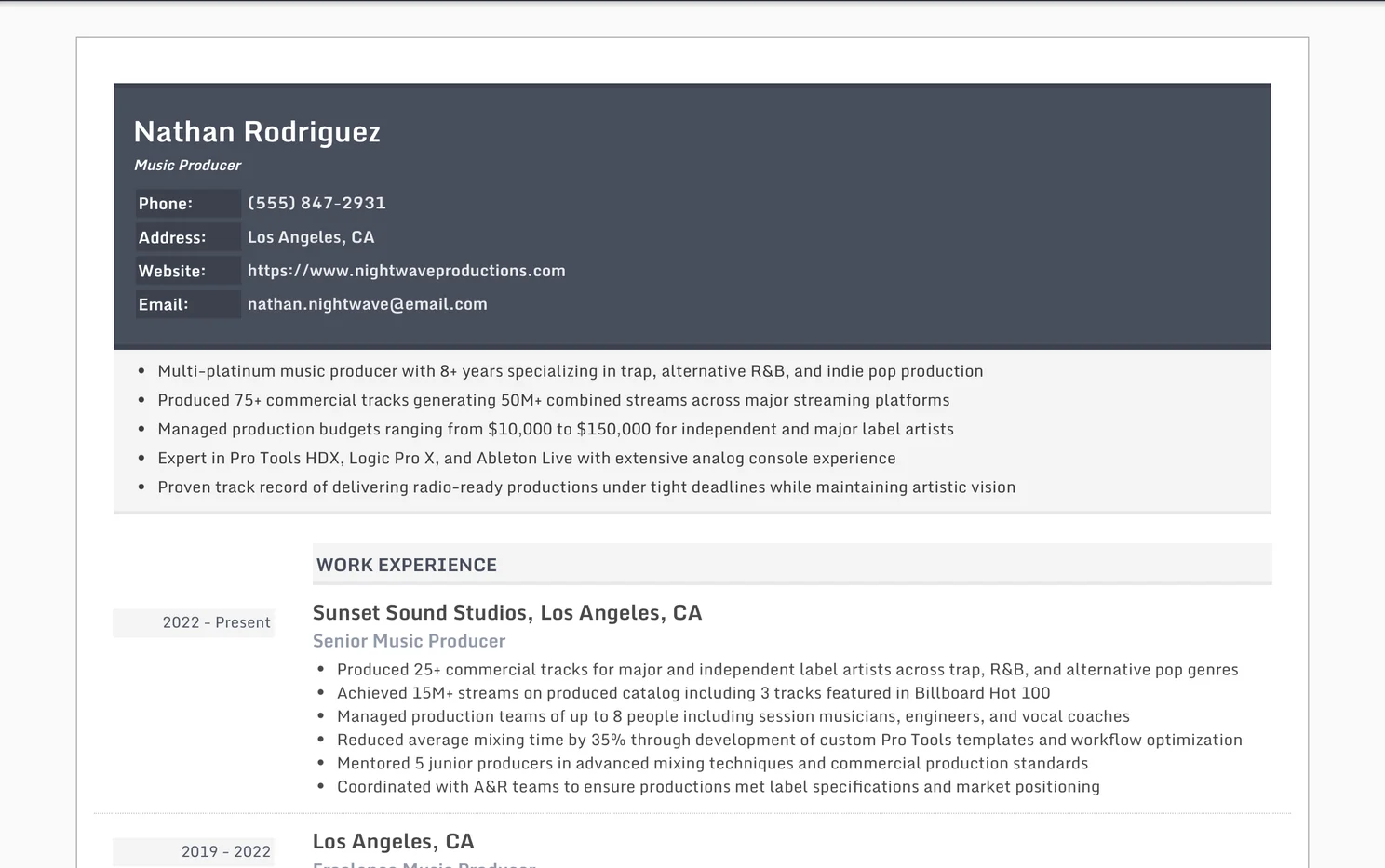
The Ultimate Music Producer Resume Example/Sample
https://www.resumonk.com/music-producer-resumeMusic ProducerResume Format for Music Producer Resume - Striking the Right Chord
As a Music Producer, you exist in a unique professional space - part artist, part technician, part business manager. Your resume needs to reflect this multifaceted reality, and the reverse-chronological format serves as your best ally here.
This format places your most recent production work at the top, immediately showcasing your current sound, style evolution, and technical capabilities.
Why Reverse-Chronological Works for Producers
The music industry moves at breakneck speed.
That trap-influenced pop production you did three years ago? It might as well be ancient history. Labels, artists, and studios want to know what you're creating now, what software you've mastered recently, and which artists trust you today. The reverse-chronological format delivers this information instantly.
Structuring Your Producer Resume
Start with a compelling header that includes your professional name (yes, your producer alias counts if that's how you're known in the industry), location, and contact information. Follow this with a brief professional summary - think of it as your elevator pitch, but on paper.
Next comes your production experience, listed from most recent backward. Each entry should highlight specific projects, notable collaborations, and quantifiable achievements. After experience, include your technical skills section, education (if relevant), and any additional certifications or achievements.
For those producers who've worked primarily as freelancers or on a project basis - which, let's face it, is most of us - group similar projects under broader categories or time periods. This prevents your resume from looking like a scattered mixtape of random gigs.
❌ Don't write your experience like this:
2023 - Made some beats
2022 - Worked with various artists
2021 - Did music production
✅ Do structure it professionally:
2023-2024 - Freelance Music Producer
• Produced and mixed 15 commercial tracks for independent artists
• Collaborated with Sony Music on 3 pop singles, achieving 2M+ streams
• Specialized in trap, R&B, and alternative pop production
Work Experience on Music Producer Resume - Your Production Credits Matter
Remember your first real production credit?
That moment when you saw your name on Spotify, knowing that thousands of people were hearing your sonic fingerprint? That's the energy you need to capture in your work experience section. But here's where many producers stumble - they list their work like a discography instead of demonstrating their professional value.
Crafting Your Production Story
Your work experience isn't just a list of songs you've touched - it's the narrative of your growth as a sonic architect.
Each position or project period should tell a story of challenges overcome, artistic visions realized, and tangible results delivered. Studios and labels don't just want to know what you did; they want to understand the impact you made.
When describing your production work, focus on the complete scope of your involvement. Did you handle pre-production? Were you responsible for budget management? Did you coordinate session musicians? These details paint you as a complete producer, not just someone who knows their way around a DAW.
Quantifying Creative Success
Numbers might seem antithetical to art, but in the business of music production, they speak volumes.
Stream counts, chart positions, budget sizes, and timeline achievements all matter. They transform you from "someone who makes music" to "a professional who delivers measurable results."
❌ Don't write vague descriptions:
Music Producer at XYZ Studios
• Produced music for various clients
• Used Pro Tools and other software
• Worked on different genres
✅ Do provide specific, impactful details:
Music Producer at XYZ Studios (2022-2024)
• Produced 30+ commercial tracks across hip-hop, pop, and R&B genres
• Managed production budgets ranging from $5,000 to $50,000 per project
• Achieved 10M+ combined streams across produced catalog
• Reduced mixing time by 40% through customized template development
• Mentored 3 junior engineers in advanced mixing techniques
Highlighting Different Production Roles
The term "Music Producer" encompasses various responsibilities depending on your specific niche.
If you've worn multiple hats - beatmaker, mixing engineer, executive producer, vocal producer - make these distinctions clear. Each role demonstrates different competencies that might be exactly what a potential employer seeks.
For international applications, be aware that production credits and roles might be understood differently. In the UK, a "producer" might be more hands-on with the technical aspects, while in the USA, the role might lean more toward creative direction and project management. Adjust your descriptions accordingly.
Skills to Show on Music Producer Resume - Your Technical and Creative Arsenal
Close your eyes and imagine your dream studio setup.
Now think about everything you know how to operate in that room, every piece of software you've mastered, every production technique you've perfected over countless late-night sessions. That mental inventory? That's the foundation of your skills section, but presenting it effectively requires more finesse than a perfectly automated filter sweep.
Technical Skills - Your Digital and Analog Toolkit
Your DAW proficiency forms the backbone of your technical skills.
But listing "Pro Tools" isn't enough anymore - everyone claims that. Instead, showcase your depth of knowledge. Are you certified? Can you handle large post-production sessions? Do you know advanced MIDI programming? These distinctions matter.
Beyond software, highlight your hardware knowledge. Understanding signal flow, microphone techniques, and analog equipment shows you're not just a "bedroom producer" but someone who can handle professional studio environments. Include your knowledge of specific plugins, virtual instruments, and production techniques that set you apart.
Creative and Soft Skills - The Human Element
Production isn't just about technical prowess - it's about managing artists' emotions, meeting impossible deadlines, and translating vague creative visions into sonic reality. Your ability to communicate with artists, manage studio sessions, and maintain creative vision under pressure are skills that separate professional producers from hobbyists.
❌ Don't create a generic skill dump:
Skills:
Pro Tools, Logic Pro, Ableton, Mixing, Mastering, Recording,
Music Theory, Communication, Team Work, Creative
✅ Do organize and specify your expertise:
Technical Skills:
• DAWs: Pro Tools (Expert, HDX Certified), Logic Pro X (8 years), Ableton Live (Live performance integration)
• Mixing/Mastering: Waves Mercury Bundle, FabFilter Suite, iZotope RX Advanced
• Hardware: SSL Console Operation, Neve Preamps, UAD Apollo Systems
• Programming: Max/MSP for custom production tools, Basic Python for workflow automation

Creative Skills:
• Genre Expertise: Trap, Alternative R&B, Indie Pop, Lo-fi Hip Hop
• Arrangement & Orchestration for 20+ piece ensembles
• Vocal Production and Comping
• Sound Design for Film/TV synchronization

Professional Skills:
• Session Management for groups up to 15 people
• Budget Planning and Resource Allocation
• Artist Development and A&R Consultation
• Remote Collaboration via Source Connect and Audiomovers
Adapting Skills for Different Markets
If you're applying internationally, understand that certain skills carry different weight in different markets. Nashville values traditional recording techniques and country/rock production. Los Angeles prioritizes pop and urban music capabilities. London might focus more on electronic and grime influences.
Tailor your skills emphasis accordingly.
Specific Considerations and Tips for Music Producer Resume - The Final Mix
Here's something they don't teach in production school - your resume needs the same attention to detail as your final mix. Just as you wouldn't send a client a track with muddy low-mids, you shouldn't send out a resume that doesn't properly represent your professional frequency spectrum.
Let's dive into the nuanced considerations that make a Music Producer resume truly resonate.
The Portfolio Paradox
Unlike other professions where the resume stands alone, yours exists in conversation with your portfolio.
Include a clean, professional link to your production reel or website, but here's the crucial part - your resume should make someone want to listen to your work, not just list it. Use your resume to provide context that your SoundCloud or portfolio website cannot - the story behind the production, the challenges overcome, the creative decisions that led to success.
Consider creating a QR code (for physical copies) or shortened URL that leads directly to a curated playlist of your best work. But remember - quality over quantity. Five stellar productions trump fifty mediocre ones.
Credits and Collaboration - The Name Game
The music industry runs on relationships and reputation.
When listing collaborations, be strategic about name-dropping. If you've worked with notable artists, absolutely include them, but avoid making your resume look like a celebrity gossip column. Focus on the professional relationship and results rather than star power alone.
❌ Don't oversell connections:
Worked with Grammy-winning artist's cousin's friend on various projects
✅ Do highlight legitimate collaborations:
Co-produced 'Track Name' with [Artist Name] - 5M Spotify streams,
featured on Billboard's R&B/Hip-Hop Airplay chart
Genre Versatility vs. Specialization
Here's a dilemma unique to producers - should you present yourself as a versatile multi-genre producer or a specialist?
The answer depends on your target opportunity. Major studios often value versatility, while artist-specific roles or label positions might prefer deep expertise in a particular sound. Consider creating multiple resume versions that emphasize different aspects of your production personality.
The Ghost Production Dilemma
Many producers have significant work they can't explicitly claim due to ghost production agreements. Navigate this carefully by using phrases like "Contributed to multiple Top 40 releases under NDA" or "Ghost production for major label artists (references available upon request)."
This acknowledges your experience while respecting contractual obligations.
Educational Background - When It Matters
Unlike traditional fields, formal education in music production isn't always necessary or valued. If you attended Berklee, Full Sail, or have a relevant degree, include it. If you're self-taught, that's equally valid - focus instead on masterclasses, workshops, or mentorships with established producers.
The industry respects hustle and proven results over degrees.
Remote Production Capabilities
Post-2020, remote production capability isn't optional - it's essential. Highlight your remote collaboration tools, your home studio specifications, and your experience managing virtual sessions. Include your internet speed if it's impressive, your acoustic treatment situation, and your professional monitoring setup.
These details show you can deliver professional results regardless of location.
The Metrics That Matter
Different sectors of the music industry value different metrics.
Streaming numbers matter for pop and hip-hop productions. Sync placements matter for TV/Film work. Sales figures still matter for certain genres and markets. Understand what metrics your target employer values and emphasize those. If applying to a sync library, your Netflix placement matters more than your SoundCloud plays.
Cultural and Regional Considerations
Production styles and preferences vary globally. If applying to UK positions, emphasize your understanding of British music culture - from grime to drum and bass. For Nashville positions, highlight any country or americana work. Los Angeles applications should showcase your understanding of the entertainment industry ecosystem beyond just music.
Demonstrate that you're not just a producer, but someone who understands the cultural context of the music you create.
Remember, your resume is like your production signature - it should be clean, professional, and unmistakably yours. Just as you wouldn't submit a mix without checking it on multiple systems, don't send out your resume without having industry peers review it.
The perfect resume, like the perfect mix, takes time, iteration, and attention to detail - but when you nail it, it opens doors to exactly the opportunities you've been chasing.
Education Requirements for Music Producer Resume
Here's the thing: education still matters on your resume, just not in the way traditional industries think about it.
As a music producer, you're the creative architect behind the sound, the person who transforms raw talent into polished tracks, manages studio sessions, and often bridges the gap between artistic vision and commercial viability. Your education section needs to reflect not just formal schooling, but the diverse learning journey that brought you here.
Formal Education - When It Helps and How to List It
If you have a degree in music production, audio engineering, music technology, or even music business, absolutely lead with it. These programs have become increasingly sophisticated, offering hands-on experience with industry-standard equipment and software that hiring studios and labels recognize.
Even a general music degree or unrelated bachelor's shows you can commit to and complete long-term projects - a valuable trait when you're asking someone to trust you with their album.
When listing formal education, focus on the practical elements that translate to production work:
❌ Don't write generic education entries:
Bachelor of Music
University of Southern California, 2020
GPA: 3.8
✅ Do highlight production-relevant coursework and projects:
Bachelor of Music, Music Production
University of Southern California, 2020
• Specialized in multi-track recording and mixing techniques
• Produced 12 original tracks across jazz, hip-hop, and electronic genres
• Trained on Pro Tools, Logic Pro X, and analog mixing consoles
Alternative Education Pathways That Matter
Now, if you're like many successful producers who took the non-traditional route, your education section becomes even more interesting.
Maybe you learned through YouTube tutorials, masterclasses, mentorships, or specialized production workshops. The key is presenting these experiences as legitimate educational credentials - because in the music world, they absolutely are.
Production bootcamps, online certifications from platforms like Berklee Online or Point Blank Music School, and workshops with established producers all deserve space in your education section. These show you're actively investing in your craft and staying current with industry trends.
❌ Don't dismiss informal learning:
Self-taught music producer
✅ Do document your learning journey professionally:
Music Production Certification Program
Point Blank Music School (Online), 2022
• Completed 150+ hours of production technique training
• Specialized modules in electronic music production and sound design

Private Mentorship Program
Under Grammy-winning producer Rick Rubin, 2021
• 6-month intensive study of production philosophy and technique
• Assisted on 3 commercial releases
Regional Considerations and Industry Expectations
In the US market, the emphasis on formal education varies drastically by genre and context.
Nashville's country music scene might value a Belmont or MTSU degree more than LA's hip-hop community, where street credibility and proven hits matter more. The UK electronic music scene particularly values technical certifications from institutions like SAE Institute or Abbey Road Institute. In Canada, programs from schools like Metalworks Institute carry weight, while Australia's music industry often recognizes AFTRS or JMC Academy credentials.
Remember, if you're applying to work with established labels or studios, they're often looking for some educational foundation that suggests you understand music theory, copyright law, and professional studio etiquette - even if you learned these outside traditional classrooms.
Awards and Publications for Music Producer Resume
The music industry has its own hierarchy of recognition, and understanding where your achievements fit is crucial.
A Grammy nomination obviously goes at the top, but what about that "Best Local Producer" award from your city's music magazine? Or the technical article you wrote for Sound on Sound? These all have their place, and when presented correctly, they paint a picture of a well-rounded professional who's both creatively accomplished and industry-engaged.
Industry Awards - From Grammys to Grassroots
Let's start with the obvious - if you have major industry awards or nominations (Grammys, BRIT Awards, ARIA Awards, Juno Awards, or their electronic/urban equivalents like the Electronic Music Awards), these go first.
But most of us aren't there yet, and that's fine. Regional awards, genre-specific recognitions, and even streaming milestones count as awards in our industry.
What matters is how you frame them. Context is everything - a "Best Hip-Hop Producer" award from your state's music awards might mean more than you think, especially if you're applying to work with regional artists or labels.
❌ Don't list awards without context:
Best Producer Award - 2023
Various streaming achievements
✅ Do provide specific, impressive details:
Colorado Music Awards - Best Hip-Hop Producer, 2023
• Recognized for work on 3 charting albums in regional markets
• Competed against 50+ nominated producers statewide

Spotify Streaming Milestone Achievement, 2022
• Produced tracks accumulating 10M+ streams across 5 artists
• "Night Drive" (Artist: Luna Keys) featured in 4 official Spotify playlists
Publications and Media Features
Here's where producers often undersell themselves.
That interview in DJ Mag? The production breakdown you did for Ableton's blog? The YouTube tutorial that got 100K views? These are publications, and they matter because they show you're not just creating music - you're contributing to the broader conversation about music production.
Technical articles and tutorials demonstrate expertise, while features and interviews show industry recognition. Even if you haven't written anything yourself, being featured or quoted positions you as an authority in your field.
❌ Don't undervalue media presence:
Featured in various music blogs
✅ Do specify your media footprint:
"The Psychology of Bass Design" - Sound on Sound Magazine, March 2023
• Technical article on psychoacoustic principles in electronic music production
• Reached 50,000+ readers, republished in 3 industry publications

Production Masterclass Series - YouTube/Personal Channel, 2022-Present
• 12-part series on mixing techniques with 500K+ total views
• Featured by Native Instruments in their producer spotlight series
Chart Positions and Commercial Success
Numbers talk in the music business, but they need translation for maximum impact. A #1 on Beatport's Tech House chart might not mean much to someone outside electronic music, but frame it as "achieved #1 position in genre-specific international sales chart, competing against major label releases" and suddenly it carries weight.
Include streaming numbers, sync placements (TV, film, advertising), and any commercial success metrics. These aren't traditional "awards," but in our industry, they're often more valuable than trophies.
References Strategy for Music Producer Resume
Think about how you got your last few gigs. Chances are, someone recommended you, or someone knew someone who'd worked with you. That's how the music industry operates - it's a network of trust where your reputation travels faster than your resume.
Your references aren't just character witnesses; they're your professional validators in an industry where credits and connections matter more than credentials.
Choosing Your Reference Power Players
The ideal reference list for a music producer reads like a production credit roll - it should include people from different aspects of your work. You want the artist who can vouch for your creative vision, the studio manager who can confirm your technical proficiency, and maybe the label A&R who can attest to your commercial sensibilities.
Each reference serves a different purpose, painting a complete picture of your capabilities.
Priority goes to names that carry weight in your target market. The Grammy-winning artist is obvious, but sometimes the respected local studio owner or the well-connected music supervisor might actually be more valuable, depending on where you're applying.
❌ Don't list references without context:
References:
John Smith - 555-0123
Jane Doe - 555-0456
Mike Johnson - 555-0789
✅ Do provide relevant professional context:
Professional References:

Marcus "Wavelength" Thompson
Grammy-nominated Artist/Producer
Worked together: 2021-2023 (5 album projects)
Contact: [email protected] | 555-0123
Relationship: Lead Producer on "Midnight Sessions" (Gold certified)

Sarah Chen
Studio Manager, Electric Lady Studios
Worked together: 2020-Present (50+ sessions)
Contact: [email protected] | 555-0456
Relationship: Regular freelance producer, specialized in hip-hop/R&B sessions
Managing Reference Relationships
Here's something they don't teach in music school - your references need maintenance.
That artist you produced for two years ago? They might not remember the specific session details that made you shine. Before listing anyone, reach out and refresh their memory about your work together. Send them a brief reminder of your key achievements and let them know what types of positions you're pursuing.
Also, consider the politics. If you're applying to Sony Music, maybe don't lead with your reference from Universal unless the relationship transcends label loyalty. The music industry can be tribal, and you need to be strategic about which relationships you highlight for which opportunities.
The "Available Upon Request" Debate
In the corporate world, "References available upon request" is standard. In music production, it can signal you're hiding something or don't have strong industry connections. If you have solid references, list them. It shows confidence and transparency.
However, if you're still building your network or your best references are for projects under NDA, the "upon request" approach gives you control over the narrative.
For different markets - In the US, listing 3-4 references is standard. The UK industry often prefers the "upon request" approach initially. Australia and Canada tend to fall somewhere between, often depending on whether you're applying to major labels (more formal) or independent studios (more casual).
Alternative Reference Formats
Consider modern alternatives to traditional references. LinkedIn recommendations from industry professionals, credited testimonials on your website, or even social media endorsements can supplement your formal reference list.
Some producers include a "Recent Collaborators" section instead of traditional references, listing current projects and letting the work speak for itself.
❌ Don't rely solely on traditional formats:
References available upon request
✅ Do consider hybrid approaches:
Industry Endorsements:

"One of the most innovative producers I've worked with in 20 years"
- Rick Stevens, A&R Director, Atlantic Records

"Consistently delivers radio-ready mixes under the tightest deadlines"
- Maria Rodriguez, Music Supervisor, Netflix Original Content

Full references with contact details available upon request
Recent collaborator list and testimonials at: www.yourproducername.com/credits
Remember, in music production, your references aren't just confirming your employment history - they're vouching for your ears, your vibe in the studio, your ability to handle pressure, and your creative vision. Choose and present them accordingly, because in this industry, who vouches for you often matters as much as what you've produced.
Cover Letter Strategies for Music Producer Resume
The challenge with music producer cover letters is that you're often writing to people who receive dozens of applications from bedroom producers claiming they're the next Timbaland. Your cover letter needs to cut through that noise by being specific, professional, and showing you understand the actual job - not the fantasy of hanging out with celebrities in million-dollar studios.
Opening With Your Signature Sound
Forget the standard "I am writing to apply for the position of Music Producer" opening.
The person reading this already knows what job you want. Instead, open with what makes you unique as a producer. Are you the person who brings analog warmth to digital productions? The producer who can work across genres?
The one who consistently delivers radio-ready mixes under tight deadlines?
❌ Don't open with generic enthusiasm:
Dear Hiring Manager,

I am extremely passionate about music and would love to work as a Music Producer at your company. I have been making beats since I was 15 and music is my life.
✅ Do lead with specific value:
Dear [Studio Manager/A&R Director/Name],

Last month, I transformed a singer-songwriter's iPhone voice memo into a fully produced track that secured a sync placement with Netflix within two weeks. This is what I do - I see the commercial potential in raw ideas and know exactly how to realize it within budget and deadline constraints.
Demonstrating Industry Understanding
Your cover letter needs to show you understand the business side of production. Whether you're applying to a commercial studio, a label, or a production house, they need to know you grasp concepts like budgets, deadlines, client management, and the difference between creative vision and commercial viability.
This is especially important if you're transitioning from independent work to a staff position.
Address the specific needs of the organization. If they work primarily with emerging artists, talk about your experience developing new talent. If they're known for quick turnarounds on commercial projects, emphasize your efficiency and technical proficiency.
❌ Don't ignore the business context:
I have produced many different types of music and worked with various artists.
I am creative and hard-working.
✅ Do show business acumen:
Having produced 30+ commercial releases in the past two years, I understand the delicate balance between artistic integrity and market demands. My recent work with emerging R&B artists has resulted in three label signings and multiple playlist placements, achieved while maintaining project budgets 20% under industry average.
The Technical-Creative Balance
Music production is one of those rare fields that demands both deep technical knowledge and creative intuition. Your cover letter should demonstrate both. Mention specific equipment or software proficiencies when relevant, but always in the context of creative outcomes.
Nobody cares that you know Pro Tools unless you can explain how that knowledge helps you deliver better results faster.
If the position has specific technical requirements - maybe they're an Ableton Live house, or they work exclusively in surround sound - address these directly. But always bring it back to the music. You're not applying to be a technician; you're applying to be a creative professional who happens to be technically proficient.
Closing With Concrete Next Steps
End your cover letter with something more actionable than "I look forward to hearing from you." Offer to send additional work samples, suggest a specific type of project you could tackle, or mention your availability for a studio visit.
Make it easy for them to take the next step.
❌ Don't close passively:
Thank you for considering my application. I hope to hear from you soon.
✅ Do propose specific action:
I have three recent productions that align perfectly with your label's evolving sound -
I'd welcome the opportunity to play them for you during a brief studio visit next week.
I'm also prepared to complete a trial production project to demonstrate how I'd fit into your team's workflow.
Key Takeaways
- Use reverse-chronological format to showcase your most recent and relevant production work first - the music industry moves fast and employers want to see your current capabilities
- Quantify your production achievements with specific metrics like stream counts, chart positions, number of tracks produced, and budget sizes managed
- Balance technical proficiency with creative storytelling - list your DAW expertise and equipment knowledge, but frame them within successful project outcomes
- Organize skills into clear categories - separate technical skills (software, hardware), creative skills (genre expertise, arrangement), and professional skills (session management, budgeting)
- Include portfolio links strategically - provide curated playlists or demo reels that complement your resume narrative, not just raw SoundCloud dumps
- Address ghost production work carefully using NDA-appropriate language that acknowledges experience while respecting contracts
- Present education flexibly - formal degrees, online certifications, masterclasses, and mentorships all count as valuable education in music production
- Frame awards and achievements with context - explain what that Beatport #1 or regional award means in terms of competition and commercial success
- Craft cover letters that demonstrate business understanding - show you grasp budgets, deadlines, and the balance between creative vision and commercial needs
- List references strategically with full context - include their role, your working relationship, and specific projects you collaborated on
- Adapt your resume for different markets - emphasize genre expertise, technical skills, or industry connections based on whether you're applying in Nashville, LA, London, or elsewhere
- Highlight remote production capabilities - include your home studio specs, collaboration tools, and experience managing virtual sessions in our post-2020 industry
Creating a standout music producer resume requires the same meticulous attention to detail you bring to your productions. Just as you wouldn't bounce a final mix without checking it on multiple systems, your resume needs careful crafting, review, and refinement to ensure it hits the right notes with potential employers. The music industry respects authenticity, proven results, and professional presentation - your resume should deliver all three.
Ready to compose your professional story with the same precision you bring to your productions? Resumonk provides the perfect platform to create your music producer resume with intelligent AI recommendations that understand the nuances of the music industry, beautifully designed templates that reflect professional polish, and formatting that ensures your unique journey as a producer is presented clearly and compellingly. Our tools help you structure your experience, skills, and achievements in ways that resonate with studios, labels, and artists looking for their next collaborator.
Start crafting your music producer resume today and let your professional story hit all the right notes.
Join hundreds of creative professionals who trust Resumonk to translate their artistic journey into career opportunities.
Start your resume for free and see how the right resume can amplify your production career.
More Arts resume examples
See all Arts resume examples, or browse every category.
Resume writing tips
You're sitting in front of your DAW at 3 AM, the glow of the screen illuminating empty coffee cups and crumpled notebook pages filled with chord progressions.
The track you've been working on for the past twelve hours finally sounds like something special - that perfect marriage of sonic texture and emotional resonance that makes people stop scrolling and actually listen. You've built this sound from nothing, sculpted frequencies like a master craftsman, and somewhere between the third revision of that bridge and the fifteenth take of the vocal comp, it hits you. You need to translate this same attention to detail, this same creative precision, into something decidedly less exciting but equally important - your music producer resume.
The journey that brought you here probably doesn't fit neatly into corporate boxes. Maybe you started making beats in your dorm room, or perhaps you spent years as a session musician before sliding into the producer's chair. You might have formal training from a prestigious music school, or maybe YouTube University and countless hours of experimentation were your professors. Regardless of your path, you now face the challenge of condensing your sonic fingerprint - that unique combination of technical skill, creative vision, and professional experience - into a document that speaks to studios, labels, and artists who need someone exactly like you.
This comprehensive guide walks you through every element of crafting a music producer resume that resonates with industry professionals. We'll start with choosing the perfect format that showcases your production journey, then dive deep into articulating your work experience in ways that demonstrate both creative excellence and commercial viability. You'll learn how to present your technical arsenal and creative skills, navigate the unique challenges of production credits and collaborations, and handle everything from education sections that respect non-traditional learning paths to award listings that properly frame your achievements. We'll explore strategic approaches to cover letters that capture your unique production voice, and discuss how references work in an industry built on relationships and reputation.
Whether you're a bedroom producer ready to go pro, a seasoned engineer transitioning to production, or an established producer targeting new markets, this guide addresses your specific situation. We understand that music production isn't just a job - it's a craft that demands both technical mastery and artistic intuition, business acumen and creative risk-taking. Your resume needs to reflect all these dimensions while speaking the language of an industry that values proven results, professional relationships, and that indefinable quality that makes someone trust you with their sound. Let's build a resume that opens the right doors and gets your music exactly where it needs to be heard.
The Ultimate Music Producer Resume Example/Sample
https://www.resumonk.com/music-producer-resumeMusic ProducerResume Format for Music Producer Resume - Striking the Right Chord
As a Music Producer, you exist in a unique professional space - part artist, part technician, part business manager. Your resume needs to reflect this multifaceted reality, and the reverse-chronological format serves as your best ally here.
This format places your most recent production work at the top, immediately showcasing your current sound, style evolution, and technical capabilities.
Why Reverse-Chronological Works for Producers
The music industry moves at breakneck speed.
That trap-influenced pop production you did three years ago? It might as well be ancient history. Labels, artists, and studios want to know what you're creating now, what software you've mastered recently, and which artists trust you today. The reverse-chronological format delivers this information instantly.
Structuring Your Producer Resume
Start with a compelling header that includes your professional name (yes, your producer alias counts if that's how you're known in the industry), location, and contact information. Follow this with a brief professional summary - think of it as your elevator pitch, but on paper.
Next comes your production experience, listed from most recent backward. Each entry should highlight specific projects, notable collaborations, and quantifiable achievements. After experience, include your technical skills section, education (if relevant), and any additional certifications or achievements.
For those producers who've worked primarily as freelancers or on a project basis - which, let's face it, is most of us - group similar projects under broader categories or time periods. This prevents your resume from looking like a scattered mixtape of random gigs.
❌ Don't write your experience like this:
2023 - Made some beats
2022 - Worked with various artists
2021 - Did music production
✅ Do structure it professionally:
2023-2024 - Freelance Music Producer
• Produced and mixed 15 commercial tracks for independent artists
• Collaborated with Sony Music on 3 pop singles, achieving 2M+ streams
• Specialized in trap, R&B, and alternative pop production
Work Experience on Music Producer Resume - Your Production Credits Matter
Remember your first real production credit?
That moment when you saw your name on Spotify, knowing that thousands of people were hearing your sonic fingerprint? That's the energy you need to capture in your work experience section. But here's where many producers stumble - they list their work like a discography instead of demonstrating their professional value.
Crafting Your Production Story
Your work experience isn't just a list of songs you've touched - it's the narrative of your growth as a sonic architect.
Each position or project period should tell a story of challenges overcome, artistic visions realized, and tangible results delivered. Studios and labels don't just want to know what you did; they want to understand the impact you made.
When describing your production work, focus on the complete scope of your involvement. Did you handle pre-production? Were you responsible for budget management? Did you coordinate session musicians? These details paint you as a complete producer, not just someone who knows their way around a DAW.
Quantifying Creative Success
Numbers might seem antithetical to art, but in the business of music production, they speak volumes.
Stream counts, chart positions, budget sizes, and timeline achievements all matter. They transform you from "someone who makes music" to "a professional who delivers measurable results."
❌ Don't write vague descriptions:
Music Producer at XYZ Studios
• Produced music for various clients
• Used Pro Tools and other software
• Worked on different genres
✅ Do provide specific, impactful details:
Music Producer at XYZ Studios (2022-2024)
• Produced 30+ commercial tracks across hip-hop, pop, and R&B genres
• Managed production budgets ranging from $5,000 to $50,000 per project
• Achieved 10M+ combined streams across produced catalog
• Reduced mixing time by 40% through customized template development
• Mentored 3 junior engineers in advanced mixing techniques
Highlighting Different Production Roles
The term "Music Producer" encompasses various responsibilities depending on your specific niche.
If you've worn multiple hats - beatmaker, mixing engineer, executive producer, vocal producer - make these distinctions clear. Each role demonstrates different competencies that might be exactly what a potential employer seeks.
For international applications, be aware that production credits and roles might be understood differently. In the UK, a "producer" might be more hands-on with the technical aspects, while in the USA, the role might lean more toward creative direction and project management. Adjust your descriptions accordingly.
Skills to Show on Music Producer Resume - Your Technical and Creative Arsenal
Close your eyes and imagine your dream studio setup.
Now think about everything you know how to operate in that room, every piece of software you've mastered, every production technique you've perfected over countless late-night sessions. That mental inventory? That's the foundation of your skills section, but presenting it effectively requires more finesse than a perfectly automated filter sweep.
Technical Skills - Your Digital and Analog Toolkit
Your DAW proficiency forms the backbone of your technical skills.
But listing "Pro Tools" isn't enough anymore - everyone claims that. Instead, showcase your depth of knowledge. Are you certified? Can you handle large post-production sessions? Do you know advanced MIDI programming? These distinctions matter.
Beyond software, highlight your hardware knowledge. Understanding signal flow, microphone techniques, and analog equipment shows you're not just a "bedroom producer" but someone who can handle professional studio environments. Include your knowledge of specific plugins, virtual instruments, and production techniques that set you apart.
Creative and Soft Skills - The Human Element
Production isn't just about technical prowess - it's about managing artists' emotions, meeting impossible deadlines, and translating vague creative visions into sonic reality. Your ability to communicate with artists, manage studio sessions, and maintain creative vision under pressure are skills that separate professional producers from hobbyists.
❌ Don't create a generic skill dump:
Skills:
Pro Tools, Logic Pro, Ableton, Mixing, Mastering, Recording,
Music Theory, Communication, Team Work, Creative
✅ Do organize and specify your expertise:
Technical Skills:
• DAWs: Pro Tools (Expert, HDX Certified), Logic Pro X (8 years), Ableton Live (Live performance integration)
• Mixing/Mastering: Waves Mercury Bundle, FabFilter Suite, iZotope RX Advanced
• Hardware: SSL Console Operation, Neve Preamps, UAD Apollo Systems
• Programming: Max/MSP for custom production tools, Basic Python for workflow automation

Creative Skills:
• Genre Expertise: Trap, Alternative R&B, Indie Pop, Lo-fi Hip Hop
• Arrangement & Orchestration for 20+ piece ensembles
• Vocal Production and Comping
• Sound Design for Film/TV synchronization

Professional Skills:
• Session Management for groups up to 15 people
• Budget Planning and Resource Allocation
• Artist Development and A&R Consultation
• Remote Collaboration via Source Connect and Audiomovers
Adapting Skills for Different Markets
If you're applying internationally, understand that certain skills carry different weight in different markets. Nashville values traditional recording techniques and country/rock production. Los Angeles prioritizes pop and urban music capabilities. London might focus more on electronic and grime influences.
Tailor your skills emphasis accordingly.
Specific Considerations and Tips for Music Producer Resume - The Final Mix
Here's something they don't teach in production school - your resume needs the same attention to detail as your final mix. Just as you wouldn't send a client a track with muddy low-mids, you shouldn't send out a resume that doesn't properly represent your professional frequency spectrum.
Let's dive into the nuanced considerations that make a Music Producer resume truly resonate.
The Portfolio Paradox
Unlike other professions where the resume stands alone, yours exists in conversation with your portfolio.
Include a clean, professional link to your production reel or website, but here's the crucial part - your resume should make someone want to listen to your work, not just list it. Use your resume to provide context that your SoundCloud or portfolio website cannot - the story behind the production, the challenges overcome, the creative decisions that led to success.
Consider creating a QR code (for physical copies) or shortened URL that leads directly to a curated playlist of your best work. But remember - quality over quantity. Five stellar productions trump fifty mediocre ones.
Credits and Collaboration - The Name Game
The music industry runs on relationships and reputation.
When listing collaborations, be strategic about name-dropping. If you've worked with notable artists, absolutely include them, but avoid making your resume look like a celebrity gossip column. Focus on the professional relationship and results rather than star power alone.
❌ Don't oversell connections:
Worked with Grammy-winning artist's cousin's friend on various projects
✅ Do highlight legitimate collaborations:
Co-produced 'Track Name' with [Artist Name] - 5M Spotify streams,
featured on Billboard's R&B/Hip-Hop Airplay chart
Genre Versatility vs. Specialization
Here's a dilemma unique to producers - should you present yourself as a versatile multi-genre producer or a specialist?
The answer depends on your target opportunity. Major studios often value versatility, while artist-specific roles or label positions might prefer deep expertise in a particular sound. Consider creating multiple resume versions that emphasize different aspects of your production personality.
The Ghost Production Dilemma
Many producers have significant work they can't explicitly claim due to ghost production agreements. Navigate this carefully by using phrases like "Contributed to multiple Top 40 releases under NDA" or "Ghost production for major label artists (references available upon request)."
This acknowledges your experience while respecting contractual obligations.
Educational Background - When It Matters
Unlike traditional fields, formal education in music production isn't always necessary or valued. If you attended Berklee, Full Sail, or have a relevant degree, include it. If you're self-taught, that's equally valid - focus instead on masterclasses, workshops, or mentorships with established producers.
The industry respects hustle and proven results over degrees.
Remote Production Capabilities
Post-2020, remote production capability isn't optional - it's essential. Highlight your remote collaboration tools, your home studio specifications, and your experience managing virtual sessions. Include your internet speed if it's impressive, your acoustic treatment situation, and your professional monitoring setup.
These details show you can deliver professional results regardless of location.
The Metrics That Matter
Different sectors of the music industry value different metrics.
Streaming numbers matter for pop and hip-hop productions. Sync placements matter for TV/Film work. Sales figures still matter for certain genres and markets. Understand what metrics your target employer values and emphasize those. If applying to a sync library, your Netflix placement matters more than your SoundCloud plays.
Cultural and Regional Considerations
Production styles and preferences vary globally. If applying to UK positions, emphasize your understanding of British music culture - from grime to drum and bass. For Nashville positions, highlight any country or americana work. Los Angeles applications should showcase your understanding of the entertainment industry ecosystem beyond just music.
Demonstrate that you're not just a producer, but someone who understands the cultural context of the music you create.
Remember, your resume is like your production signature - it should be clean, professional, and unmistakably yours. Just as you wouldn't submit a mix without checking it on multiple systems, don't send out your resume without having industry peers review it.
The perfect resume, like the perfect mix, takes time, iteration, and attention to detail - but when you nail it, it opens doors to exactly the opportunities you've been chasing.
Education Requirements for Music Producer Resume
Here's the thing: education still matters on your resume, just not in the way traditional industries think about it.
As a music producer, you're the creative architect behind the sound, the person who transforms raw talent into polished tracks, manages studio sessions, and often bridges the gap between artistic vision and commercial viability. Your education section needs to reflect not just formal schooling, but the diverse learning journey that brought you here.
Formal Education - When It Helps and How to List It
If you have a degree in music production, audio engineering, music technology, or even music business, absolutely lead with it. These programs have become increasingly sophisticated, offering hands-on experience with industry-standard equipment and software that hiring studios and labels recognize.
Even a general music degree or unrelated bachelor's shows you can commit to and complete long-term projects - a valuable trait when you're asking someone to trust you with their album.
When listing formal education, focus on the practical elements that translate to production work:
❌ Don't write generic education entries:
Bachelor of Music
University of Southern California, 2020
GPA: 3.8
✅ Do highlight production-relevant coursework and projects:
Bachelor of Music, Music Production
University of Southern California, 2020
• Specialized in multi-track recording and mixing techniques
• Produced 12 original tracks across jazz, hip-hop, and electronic genres
• Trained on Pro Tools, Logic Pro X, and analog mixing consoles
Alternative Education Pathways That Matter
Now, if you're like many successful producers who took the non-traditional route, your education section becomes even more interesting.
Maybe you learned through YouTube tutorials, masterclasses, mentorships, or specialized production workshops. The key is presenting these experiences as legitimate educational credentials - because in the music world, they absolutely are.
Production bootcamps, online certifications from platforms like Berklee Online or Point Blank Music School, and workshops with established producers all deserve space in your education section. These show you're actively investing in your craft and staying current with industry trends.
❌ Don't dismiss informal learning:
Self-taught music producer
✅ Do document your learning journey professionally:
Music Production Certification Program
Point Blank Music School (Online), 2022
• Completed 150+ hours of production technique training
• Specialized modules in electronic music production and sound design

Private Mentorship Program
Under Grammy-winning producer Rick Rubin, 2021
• 6-month intensive study of production philosophy and technique
• Assisted on 3 commercial releases
Regional Considerations and Industry Expectations
In the US market, the emphasis on formal education varies drastically by genre and context.
Nashville's country music scene might value a Belmont or MTSU degree more than LA's hip-hop community, where street credibility and proven hits matter more. The UK electronic music scene particularly values technical certifications from institutions like SAE Institute or Abbey Road Institute. In Canada, programs from schools like Metalworks Institute carry weight, while Australia's music industry often recognizes AFTRS or JMC Academy credentials.
Remember, if you're applying to work with established labels or studios, they're often looking for some educational foundation that suggests you understand music theory, copyright law, and professional studio etiquette - even if you learned these outside traditional classrooms.
Awards and Publications for Music Producer Resume
The music industry has its own hierarchy of recognition, and understanding where your achievements fit is crucial.
A Grammy nomination obviously goes at the top, but what about that "Best Local Producer" award from your city's music magazine? Or the technical article you wrote for Sound on Sound? These all have their place, and when presented correctly, they paint a picture of a well-rounded professional who's both creatively accomplished and industry-engaged.
Industry Awards - From Grammys to Grassroots
Let's start with the obvious - if you have major industry awards or nominations (Grammys, BRIT Awards, ARIA Awards, Juno Awards, or their electronic/urban equivalents like the Electronic Music Awards), these go first.
But most of us aren't there yet, and that's fine. Regional awards, genre-specific recognitions, and even streaming milestones count as awards in our industry.
What matters is how you frame them. Context is everything - a "Best Hip-Hop Producer" award from your state's music awards might mean more than you think, especially if you're applying to work with regional artists or labels.
❌ Don't list awards without context:
Best Producer Award - 2023
Various streaming achievements
✅ Do provide specific, impressive details:
Colorado Music Awards - Best Hip-Hop Producer, 2023
• Recognized for work on 3 charting albums in regional markets
• Competed against 50+ nominated producers statewide

Spotify Streaming Milestone Achievement, 2022
• Produced tracks accumulating 10M+ streams across 5 artists
• "Night Drive" (Artist: Luna Keys) featured in 4 official Spotify playlists
Publications and Media Features
Here's where producers often undersell themselves.
That interview in DJ Mag? The production breakdown you did for Ableton's blog? The YouTube tutorial that got 100K views? These are publications, and they matter because they show you're not just creating music - you're contributing to the broader conversation about music production.
Technical articles and tutorials demonstrate expertise, while features and interviews show industry recognition. Even if you haven't written anything yourself, being featured or quoted positions you as an authority in your field.
❌ Don't undervalue media presence:
Featured in various music blogs
✅ Do specify your media footprint:
"The Psychology of Bass Design" - Sound on Sound Magazine, March 2023
• Technical article on psychoacoustic principles in electronic music production
• Reached 50,000+ readers, republished in 3 industry publications

Production Masterclass Series - YouTube/Personal Channel, 2022-Present
• 12-part series on mixing techniques with 500K+ total views
• Featured by Native Instruments in their producer spotlight series
Chart Positions and Commercial Success
Numbers talk in the music business, but they need translation for maximum impact. A #1 on Beatport's Tech House chart might not mean much to someone outside electronic music, but frame it as "achieved #1 position in genre-specific international sales chart, competing against major label releases" and suddenly it carries weight.
Include streaming numbers, sync placements (TV, film, advertising), and any commercial success metrics. These aren't traditional "awards," but in our industry, they're often more valuable than trophies.
References Strategy for Music Producer Resume
Think about how you got your last few gigs. Chances are, someone recommended you, or someone knew someone who'd worked with you. That's how the music industry operates - it's a network of trust where your reputation travels faster than your resume.
Your references aren't just character witnesses; they're your professional validators in an industry where credits and connections matter more than credentials.
Choosing Your Reference Power Players
The ideal reference list for a music producer reads like a production credit roll - it should include people from different aspects of your work. You want the artist who can vouch for your creative vision, the studio manager who can confirm your technical proficiency, and maybe the label A&R who can attest to your commercial sensibilities.
Each reference serves a different purpose, painting a complete picture of your capabilities.
Priority goes to names that carry weight in your target market. The Grammy-winning artist is obvious, but sometimes the respected local studio owner or the well-connected music supervisor might actually be more valuable, depending on where you're applying.
❌ Don't list references without context:
References:
John Smith - 555-0123
Jane Doe - 555-0456
Mike Johnson - 555-0789
✅ Do provide relevant professional context:
Professional References:

Marcus "Wavelength" Thompson
Grammy-nominated Artist/Producer
Worked together: 2021-2023 (5 album projects)
Contact: [email protected] | 555-0123
Relationship: Lead Producer on "Midnight Sessions" (Gold certified)

Sarah Chen
Studio Manager, Electric Lady Studios
Worked together: 2020-Present (50+ sessions)
Contact: [email protected] | 555-0456
Relationship: Regular freelance producer, specialized in hip-hop/R&B sessions
Managing Reference Relationships
Here's something they don't teach in music school - your references need maintenance.
That artist you produced for two years ago? They might not remember the specific session details that made you shine. Before listing anyone, reach out and refresh their memory about your work together. Send them a brief reminder of your key achievements and let them know what types of positions you're pursuing.
Also, consider the politics. If you're applying to Sony Music, maybe don't lead with your reference from Universal unless the relationship transcends label loyalty. The music industry can be tribal, and you need to be strategic about which relationships you highlight for which opportunities.
The "Available Upon Request" Debate
In the corporate world, "References available upon request" is standard. In music production, it can signal you're hiding something or don't have strong industry connections. If you have solid references, list them. It shows confidence and transparency.
However, if you're still building your network or your best references are for projects under NDA, the "upon request" approach gives you control over the narrative.
For different markets - In the US, listing 3-4 references is standard. The UK industry often prefers the "upon request" approach initially. Australia and Canada tend to fall somewhere between, often depending on whether you're applying to major labels (more formal) or independent studios (more casual).
Alternative Reference Formats
Consider modern alternatives to traditional references. LinkedIn recommendations from industry professionals, credited testimonials on your website, or even social media endorsements can supplement your formal reference list.
Some producers include a "Recent Collaborators" section instead of traditional references, listing current projects and letting the work speak for itself.
❌ Don't rely solely on traditional formats:
References available upon request
✅ Do consider hybrid approaches:
Industry Endorsements:

"One of the most innovative producers I've worked with in 20 years"
- Rick Stevens, A&R Director, Atlantic Records

"Consistently delivers radio-ready mixes under the tightest deadlines"
- Maria Rodriguez, Music Supervisor, Netflix Original Content

Full references with contact details available upon request
Recent collaborator list and testimonials at: www.yourproducername.com/credits
Remember, in music production, your references aren't just confirming your employment history - they're vouching for your ears, your vibe in the studio, your ability to handle pressure, and your creative vision. Choose and present them accordingly, because in this industry, who vouches for you often matters as much as what you've produced.
Cover Letter Strategies for Music Producer Resume
The challenge with music producer cover letters is that you're often writing to people who receive dozens of applications from bedroom producers claiming they're the next Timbaland. Your cover letter needs to cut through that noise by being specific, professional, and showing you understand the actual job - not the fantasy of hanging out with celebrities in million-dollar studios.
Opening With Your Signature Sound
Forget the standard "I am writing to apply for the position of Music Producer" opening.
The person reading this already knows what job you want. Instead, open with what makes you unique as a producer. Are you the person who brings analog warmth to digital productions? The producer who can work across genres?
The one who consistently delivers radio-ready mixes under tight deadlines?
❌ Don't open with generic enthusiasm:
Dear Hiring Manager,

I am extremely passionate about music and would love to work as a Music Producer at your company. I have been making beats since I was 15 and music is my life.
✅ Do lead with specific value:
Dear [Studio Manager/A&R Director/Name],

Last month, I transformed a singer-songwriter's iPhone voice memo into a fully produced track that secured a sync placement with Netflix within two weeks. This is what I do - I see the commercial potential in raw ideas and know exactly how to realize it within budget and deadline constraints.
Demonstrating Industry Understanding
Your cover letter needs to show you understand the business side of production. Whether you're applying to a commercial studio, a label, or a production house, they need to know you grasp concepts like budgets, deadlines, client management, and the difference between creative vision and commercial viability.
This is especially important if you're transitioning from independent work to a staff position.
Address the specific needs of the organization. If they work primarily with emerging artists, talk about your experience developing new talent. If they're known for quick turnarounds on commercial projects, emphasize your efficiency and technical proficiency.
❌ Don't ignore the business context:
I have produced many different types of music and worked with various artists.
I am creative and hard-working.
✅ Do show business acumen:
Having produced 30+ commercial releases in the past two years, I understand the delicate balance between artistic integrity and market demands. My recent work with emerging R&B artists has resulted in three label signings and multiple playlist placements, achieved while maintaining project budgets 20% under industry average.
The Technical-Creative Balance
Music production is one of those rare fields that demands both deep technical knowledge and creative intuition. Your cover letter should demonstrate both. Mention specific equipment or software proficiencies when relevant, but always in the context of creative outcomes.
Nobody cares that you know Pro Tools unless you can explain how that knowledge helps you deliver better results faster.
If the position has specific technical requirements - maybe they're an Ableton Live house, or they work exclusively in surround sound - address these directly. But always bring it back to the music. You're not applying to be a technician; you're applying to be a creative professional who happens to be technically proficient.
Closing With Concrete Next Steps
End your cover letter with something more actionable than "I look forward to hearing from you." Offer to send additional work samples, suggest a specific type of project you could tackle, or mention your availability for a studio visit.
Make it easy for them to take the next step.
❌ Don't close passively:
Thank you for considering my application. I hope to hear from you soon.
✅ Do propose specific action:
I have three recent productions that align perfectly with your label's evolving sound -
I'd welcome the opportunity to play them for you during a brief studio visit next week.
I'm also prepared to complete a trial production project to demonstrate how I'd fit into your team's workflow.
Key Takeaways
- Use reverse-chronological format to showcase your most recent and relevant production work first - the music industry moves fast and employers want to see your current capabilities
- Quantify your production achievements with specific metrics like stream counts, chart positions, number of tracks produced, and budget sizes managed
- Balance technical proficiency with creative storytelling - list your DAW expertise and equipment knowledge, but frame them within successful project outcomes
- Organize skills into clear categories - separate technical skills (software, hardware), creative skills (genre expertise, arrangement), and professional skills (session management, budgeting)
- Include portfolio links strategically - provide curated playlists or demo reels that complement your resume narrative, not just raw SoundCloud dumps
- Address ghost production work carefully using NDA-appropriate language that acknowledges experience while respecting contracts
- Present education flexibly - formal degrees, online certifications, masterclasses, and mentorships all count as valuable education in music production
- Frame awards and achievements with context - explain what that Beatport #1 or regional award means in terms of competition and commercial success
- Craft cover letters that demonstrate business understanding - show you grasp budgets, deadlines, and the balance between creative vision and commercial needs
- List references strategically with full context - include their role, your working relationship, and specific projects you collaborated on
- Adapt your resume for different markets - emphasize genre expertise, technical skills, or industry connections based on whether you're applying in Nashville, LA, London, or elsewhere
- Highlight remote production capabilities - include your home studio specs, collaboration tools, and experience managing virtual sessions in our post-2020 industry
Creating a standout music producer resume requires the same meticulous attention to detail you bring to your productions. Just as you wouldn't bounce a final mix without checking it on multiple systems, your resume needs careful crafting, review, and refinement to ensure it hits the right notes with potential employers. The music industry respects authenticity, proven results, and professional presentation - your resume should deliver all three.
Ready to compose your professional story with the same precision you bring to your productions? Resumonk provides the perfect platform to create your music producer resume with intelligent AI recommendations that understand the nuances of the music industry, beautifully designed templates that reflect professional polish, and formatting that ensures your unique journey as a producer is presented clearly and compellingly. Our tools help you structure your experience, skills, and achievements in ways that resonate with studios, labels, and artists looking for their next collaborator.
Start crafting your music producer resume today and let your professional story hit all the right notes.
Join hundreds of creative professionals who trust Resumonk to translate their artistic journey into career opportunities.
Start your resume for free and see how the right resume can amplify your production career.
More Arts resume examples
See all Arts resume examples, or browse every category.
Resume writing tips