Arts Administrator Resume Example (with Tips and Best Practices)
Introduction
Picture yourself at 11 PM on a Thursday, sitting in the barely-lit office of a community theater, surrounded by grant applications, season brochures, and a whiteboard covered in budget calculations that would make your business school friends dizzy.
You're an Arts Administrator - or aspiring to be one - which means you're that rare breed who gets equally excited about a groundbreaking art installation and a perfectly balanced spreadsheet. You're the person who ensures the show goes on, literally and financially, working tirelessly behind the scenes to keep our cultural institutions alive and thriving.
As an Arts Administrator, you occupy a unique position in the cultural ecosystem. You're not the artist on stage or the curator selecting pieces - you're the conductor of a complex orchestra of logistics, finances, and relationships. Entry-level to mid-level Arts Administrator roles typically involve coordinating exhibitions, managing databases, writing grants, organizing fundraising events, and serving as the vital link between artists, audiences, and the business side of cultural institutions. Whether you're transitioning from a pure arts background and discovering your organizational superpowers, or coming from the business world with a deep love for culture, this role demands a resume that captures your unique duality.
In this comprehensive guide, we'll walk you through every element of crafting the perfect Arts Administrator resume. We'll start with selecting the ideal resume format - spoiler alert, it's reverse-chronological - and explain why this structure best showcases your journey from passionate volunteer to professional administrator. We'll dive deep into presenting your work experience, whether it's a patchwork of part-time positions, volunteer roles, or traditional employment, showing you how to quantify the unquantifiable and make your impact tangible. You'll learn which skills to highlight, from database management to stakeholder communication, and how to present them in ways that resonate with arts organizations.
We'll also address the unique considerations that set arts administration resumes apart - from the portfolio question to the delicate dance of mission alignment. You'll discover how to present your education effectively, regardless of whether you studied arts management specifically or arrived here through a wonderfully winding path. We'll cover strategic approaches to showcasing awards and publications, crafting compelling cover letters that demonstrate your dual expertise, and managing references in this closely connected field. By the end of this guide, you'll have all the tools to create a resume that not only opens doors but shows hiring managers that you understand the beautiful complexity of keeping cultural institutions thriving in today's world.
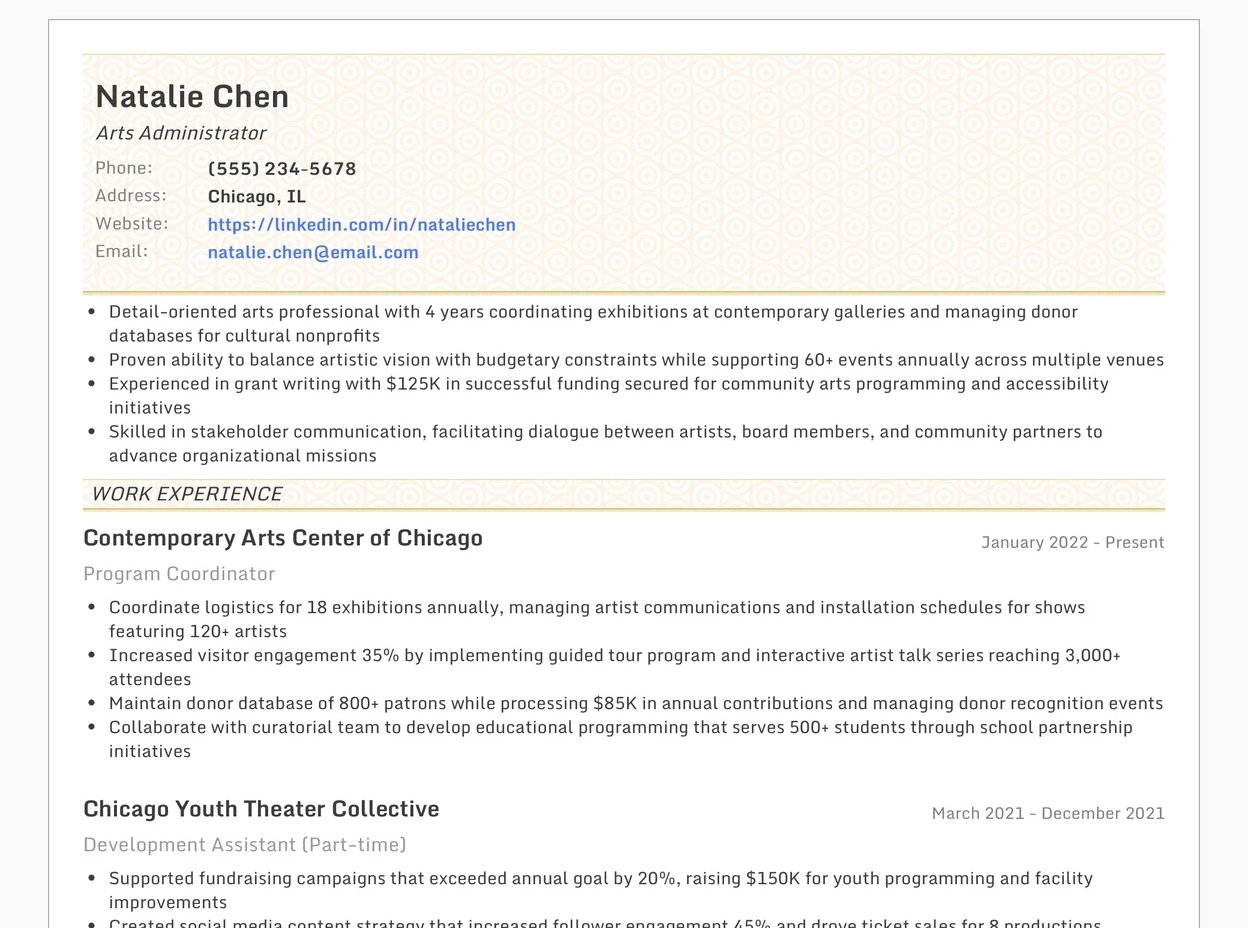
The Best Arts Administrator Resume Example/Sample
https://www.resumonk.com/arts-administrator-resumeArts AdministratorResume Format for Arts Administrator Resume - Finding Your Creative-Professional Balance
The reverse-chronological resume format is your golden ticket here.
Why? Because Arts Administrator positions (which typically sit at the coordinator or assistant manager level in most organizations) require you to demonstrate a clear progression of responsibility and achievement. Whether you've been volunteering at local galleries, interning at theaters, or working in adjacent fields like event planning or nonprofit administration, this format lets your journey shine through in a logical, compelling narrative.
Structure That Sings
Your resume should flow like a well-curated exhibition - each section building upon the last.
Start with a professional summary that captures your unique blend of artistic sensibility and administrative prowess. Think of it as your 30-second elevator pitch to the Executive Director who just happens to be riding up with you.
❌ Don't write a generic objective:
Seeking an Arts Administrator position where I can use my skills and grow professionally.
✅ Do craft a compelling summary:
Detail-oriented arts professional with 3 years coordinating exhibitions at contemporary galleries
and managing donor databases for cultural nonprofits. Proven ability to balance artistic
vision with budgetary constraints while supporting 50+ events annually.
After your summary, prioritize your experience section, followed by education, then skills, and finally, a carefully curated section for relevant volunteer work or board positions. Remember, in the arts world, your unpaid contributions often carry as much weight as your paid positions - that weekend you spent helping install the community theater's new lighting system? That counts.
The One-Page vs. Two-Page Debate
For Arts Administrator roles, stick to one page if you have less than 5 years of relevant experience. However, if you've been coordinating festivals, managing gallery operations, or handling grant applications for several years, a two-page resume is perfectly acceptable.
The key is ensuring every line earns its place - just like every piece in a thoughtfully curated show.
Work Experience on Arts Administrator Resume - Turning Passion Projects into Professional Proof
Here's where your story truly unfolds.
Maybe you started as that eager volunteer who showed up every Saturday to help catalog the museum's new acquisitions. Or perhaps you were the theater major who ended up running box office operations because someone had to do it, and you discovered you were actually good at it. Your work experience section needs to capture not just what you did, but how you bridged the creative and administrative worlds.
Quantifying the Unquantifiable
The challenge with arts administration is that success isn't always measured in simple metrics.
How do you quantify the smooth opening of an experimental art installation? The secret lies in finding the numbers hidden within the narrative.
Every event has attendance figures, every program has a budget, and every initiative has stakeholders.
❌ Don't be vague about your contributions:
Gallery Assistant - Local Art Space
• Helped with exhibitions
• Assisted visitors
• Did administrative tasks
✅ Do paint a picture with specifics:
Gallery Assistant - Local Art Space
• Coordinated logistics for 12 exhibitions annually, managing artist communications
 and installation schedules for shows featuring 80+ artists
• Increased visitor engagement 30% by implementing guided tour program and
 interactive artist talk series
• Maintained donor database of 500+ patrons while processing $50K in annual contributions
The Part-Time Puzzle
Many Arts Administrators juggle multiple part-time roles - you might be coordinating education programs at the museum three days a week while managing social media for a dance company on the side. Rather than apologizing for this patchwork, embrace it. It shows versatility and deep commitment to the arts sector.
List these positions separately but note if they're concurrent:
Education Program Coordinator (Part-time) - City Museum of Art Jan 2022 - Present
Social Media Manager - Contemporary Dance Collective Mar 2022 - Present
Volunteer Work - Your Secret Weapon
In the arts world, volunteer experience often provides the most substantial responsibilities. That summer you volunteered as Festival Coordinator for the indie film fest? That belongs prominently in your experience section, especially if your paid work has been in unrelated fields.
Just clearly indicate it was a volunteer role:
Festival Coordinator (Volunteer) - Independent Film Festival Jun - Aug 2023
• Managed logistics for 3-day event showcasing 45 films to 2,000+ attendees
• Coordinated 30 volunteers across venue management, ticketing, and artist hospitality
• Secured $15K in local sponsorships through targeted outreach campaign
Skills to Show on Arts Administrator Resume - The Swiss Army Knife Approach
Imagine you're backstage during a performance, and suddenly the lighting board crashes, a major donor arrives unexpectedly, and the lead artist needs to discuss contract modifications - all in the span of five minutes. This scenario isn't far from reality in arts administration, where your skill set needs to be as diverse as the exhibitions you'll coordinate.
The Technical Backbone
Gone are the days when arts organizations could survive on passion alone.
Today's Arts Administrator needs technical skills that would make a corporate project manager nod in approval. Database management isn't just helpful - it's essential when you're tracking donor information, maintaining artist contracts, and managing inventory for the gift shop.
Technical Skills:
• Database Management - Raiser's Edge, Salesforce, Tessitura
• Financial Software - QuickBooks, Excel (advanced formulas, pivot tables)
• Design Programs - Adobe Creative Suite, Canva
• Project Management - Asana, Monday.com, Microsoft Project
• Web Platforms - WordPress, Mailchimp, Eventbrite
The Soft Skills That Aren't So Soft
In arts administration, "soft skills" carry serious weight. You're the diplomat who mediates between the temperamental artist and the practical facilities manager. You're the translator who helps the board understand why that avant-garde installation requires a $10,000 climate control system.
These skills deserve prominent placement:
❌ Don't list generic soft skills:
• Good communication
• Team player
• Organized
✅ Do showcase specific applications:
• Stakeholder Communication - Facilitate dialogue between artists, donors, and board members
• Cultural Sensitivity - Experience working with diverse communities and international artists
• Crisis Management - Resolved last-minute venue changes for 300-person gala
• Grant Writing - Secured $75K in funding through successful NEA and state arts council proposals
The Regional Variations
Different regions prioritize different skills. In the UK, emphasize your knowledge of Arts Council England funding structures and Gift Aid schemes. For Canadian positions, highlight familiarity with Canada Council for the Arts grants and bilingual capabilities if applicable.
US positions often value fundraising expertise and knowledge of 501(c)(3) regulations, while Australian roles might prioritize experience with Creative Australia (formerly Australia Council) processes.
Specific Considerations and Tips for Arts Administrator Resume - The Inside Track
Let's talk about the unspoken rules - the things that make arts administration resumes different from their corporate cousins. You're applying to organizations where the person reading your resume might be an artist-turned-administrator who values authenticity over corporate speak, or a seasoned arts professional who can spot padding from a mile away.
The Portfolio Question
Unlike purely creative roles, Arts Administrators don't typically need extensive portfolios. However, a simple one-page addendum showcasing successful events you've coordinated can set you apart. Include professional photos from exhibitions you've managed, press coverage of festivals you've coordinated, or screenshots of successful social media campaigns.
Keep it subtle - you're demonstrating your ability to present artists' work professionally, not competing with them.
The Name-Drop Dilemma
In the arts world, connections matter, but there's a fine line between networking and name-dropping. If you've worked with recognized artists or institutions, mention them, but always in context of your achievements:
❌ Don't just list famous names:
Worked with Famous Artist and Another Famous Artist
✅ Do provide meaningful context:
Coordinated logistics for Marina Abramović retrospective, managing installation of
15 performance pieces while maintaining artist's specific environmental requirements
The Salary History Dance
Arts organizations often operate on tighter budgets than corporate entities.
If you're transitioning from a higher-paying sector, be prepared to address this diplomatically. Your resume should emphasize passion and relevant skills rather than previous compensation.
Similarly, if you're moving up from entry-level positions, highlight increasing responsibilities rather than titles, which can vary wildly across organizations.
The Mission Alignment Message
Every arts organization has its unique mission - from making art accessible to underserved communities to preserving traditional crafts.
Your resume should subtly reflect alignment with these values. If applying to a community-focused organization, emphasize your outreach experience.
For contemporary galleries, highlight your knowledge of current art movements and emerging artists.
The Reference Revolution
In arts administration, references carry unusual weight.
Board members, established artists, and respected arts administrators can open doors. Include "References available upon request" and be ready with a diverse list that includes both supervisors and artists you've worked with. Make sure to prep your references - they should be able to speak to both your administrative competence and your understanding of artistic processes.
Remember, your resume is essentially the first exhibition you're curating for your potential employer. It should be clean, compelling, and leave them wanting to experience more.
Just as a good Arts Administrator knows when to step back and let the art speak for itself, your resume should strike that perfect balance between showcasing your skills and maintaining the understated professionalism that lets you support the creative vision of others.
Education Requirements and Listing Tips for Arts Administrator Resume
As an Arts Administrator, you're not the artist on stage or the curator selecting pieces - you're the backbone that makes everything possible.
You're the one who ensures grants are submitted on time, budgets balance, and marketing campaigns reach the right audiences. This entry-level to mid-level position requires a unique blend of business acumen and artistic appreciation, and your education section needs to reflect this duality.
The Educational Foundation That Matters
Unlike becoming a doctor or lawyer, there's no single prescribed path to becoming an Arts Administrator. Some of you might have studied arts management specifically, while others might have arrived here with a business degree and a passion for the arts, or an arts degree with a knack for organization.
The beauty of this field is that it welcomes diverse educational backgrounds - the key is presenting your education in a way that highlights its relevance to the role.
Structuring Your Education Section
Start with your highest degree and work backward in reverse-chronological order.
For Arts Administrator positions, employers want to see not just what you studied, but how it prepared you for the multifaceted nature of arts administration. Include relevant coursework, projects, or thesis work that demonstrates your understanding of both arts and administration.
❌ Don't write your education like this:
Bachelor of Arts in Art History
State University, 2022
✅ Do enhance it with relevant details:
Bachelor of Arts in Art History | Minor in Business Administration
State University, May 2022
Relevant Coursework: Arts Management, Grant Writing, Non-Profit Accounting,
Museum Studies, Digital Marketing
Senior Thesis: "Sustainable Funding Models for Community Arts Organizations"
Making Non-Traditional Paths Shine
Perhaps you studied English Literature but spent your summers interning at music festivals.
Maybe you have a degree in Communications but wrote your dissertation on public art initiatives. These connections aren't always obvious to employers, so make them clear. If your degree doesn't immediately scream "arts administration," use your education section to bridge that gap.
For those with business or management degrees, emphasize any arts-related projects or electives. For those with pure arts degrees, highlight any administrative, organizational, or business-related coursework or activities. Remember, Arts Administrators need to speak both languages fluently.
Professional Development and Continuing Education
The arts sector values lifelong learning, and many successful Arts Administrators continue their education through certificates, workshops, and professional development programs.
Include relevant certifications like Grant Writing, Fundraising Management, or Arts Marketing. Online courses from platforms focusing on non-profit management or arts administration also deserve a mention if they're substantial and relevant.
❌ Don't list every workshop you've ever attended:
Attended various arts workshops 2020-2023
✅ Do be specific about relevant professional development:
Certificate in Non-Profit Financial Management
Arts Management Institute, September 2023

Grant Writing for the Arts Professional Development Series
National Endowment for the Arts, June 2023
Showcasing Awards and Publications on Your Arts Administrator Resume
Arts Administrator positions, even at entry level, often attract candidates from varied backgrounds. What separates you from the philosophy major who also loves theater, or the business graduate who frequents galleries? Often, it's your demonstrated commitment to and recognition within the arts sector.
Awards and publications serve as third-party validation of your skills and dedication.
What Counts as Relevant Awards for Arts Administrators?
Think beyond traditional "Employee of the Month" recognitions.
In arts administration, awards might include grants you've written that were funded, recognition for successful fundraising campaigns, awards for innovative programming, or acknowledgment for community engagement initiatives. Even academic awards related to arts management, non-profit studies, or cultural policy demonstrate your excellence in relevant areas.
Publications don't have to mean peer-reviewed journals (though those certainly count!). Have you written blog posts for your organization about accessibility in the arts? Contributed to newsletters about upcoming exhibitions? Written program notes for performances?
These all demonstrate your ability to communicate about the arts - a crucial skill for any Arts Administrator.
Strategic Presentation of Your Achievements
When listing awards and publications, context is everything. An Arts Administrator needs to show impact and relevance.
Don't just list the award - briefly explain what it recognized and why it matters to your potential role.
❌ Don't present awards without context:
Dean's List - 2021, 2022
Published in University Journal - 2023
✅ Do provide meaningful context:
Excellence in Arts Advocacy Award - State Arts Council, 2023
Recognized for developing youth mentorship program that increased diverse
participation in local arts programs by 45%

"Breaking Barriers: Making Theater Accessible to All" - Arts Management
Quarterly, Spring 2023
Featured article on implementing sensory-friendly performances and
reducing financial barriers to arts access
Creating an Awards Section When You Don't Have Formal Awards
Not everyone has a trophy shelf, and that's perfectly fine.
Early-career Arts Administrators can highlight other forms of recognition: successful projects, positive media coverage of events you organized, or even quantifiable achievements from volunteer work. Did you organize a fundraiser that exceeded its goal? Did your social media campaign for a gallery opening result in record attendance?
Remember, publications can include internal documents too. If you created a volunteer handbook that's still being used, or developed a donor database system that improved efficiency, these demonstrate your ability to create lasting value for arts organizations.
Balancing Modesty with Self-Promotion
The arts world often attracts humble individuals who prefer to spotlight the artists rather than themselves.
However, your resume is not the place for excessive modesty. If you played a key role in securing a major grant or organizing a successful festival, own that achievement.
Quantify your impact where possible - numbers speak volumes in administrative roles.
Strategic Reference Selection for Your Arts Administrator Resume
References in arts administration aren't just about confirming employment dates - they're about validating your ability to balance artistic vision with operational excellence, your skill in working with diverse stakeholders from artists to donors, and your commitment to the cultural sector's unique mission-driven environment.
Who Makes the Ideal Reference?
The best references for an Arts Administrator position are those who have witnessed your ability to navigate the multifaceted nature of the role. This might include supervisors who've seen you manage budgets while supporting artistic programming, board members who've observed your professional communication skills, or partner organization leaders who've collaborated with you on community initiatives.
Consider including a mix of references that can speak to different aspects of your capabilities - someone who can attest to your financial management skills, another who can discuss your success with donor relations or grant writing, and perhaps someone who has seen your ability to work effectively with artists and creative teams. This well-rounded approach shows that you can handle the diverse responsibilities of arts administration.
The When and How of Providing References
Unlike some fields where references are automatically included on resumes, arts administration follows the more contemporary practice of providing references upon request. This respects your references' time and maintains their privacy until necessary.
❌ Don't list references directly on your resume:
References:
Jane Smith - Director, City Gallery - (555) 123-4567
John Doe - Board President, Theater Group - (555) 987-6543
✅ Do indicate availability professionally:
Professional references available upon request
Preparing Your References for Success
Once you're asked for references, preparation becomes crucial. Arts Administrator positions often involve specific requirements - perhaps the organization needs someone with capital campaign experience, or they're looking for expertise in education programming.
Brief your references on the specific position and what aspects of your experience would be most relevant to highlight.
Create a separate reference sheet that includes not just contact information, but context about your relationship with each reference. This helps the hiring manager understand what perspective each reference brings.
✅ Do format your reference sheet professionally:
Sarah Thompson
Executive Director, Regional Arts Council
Email: [email protected]
Phone: (555) 234-5678
Relationship: Direct supervisor during my role as Program Coordinator
(2021-2023), oversaw my management of $500K in grant distributions
and community partnership development
Special Considerations for International Differences
Reference practices vary globally. In the US and Canada, it's standard to provide references only when requested. The UK and Australia sometimes expect references to be available earlier in the process, though not necessarily on the resume itself. European organizations might request formal reference letters rather than contact information.
Research the specific expectations of your target country and organization.
Managing References from Volunteer or Internship Experiences
For those early in their arts administration careers, don't underestimate the value of references from substantial volunteer experiences or internships. That board member from the community arts center where you volunteered as festival coordinator? They might provide powerful testimony about your dedication and abilities. The development director who supervised your fundraising internship?
They can speak to your potential for growth in the field.
Maintaining Your Reference Network
In the arts world, where professionals often wear multiple hats and organizations frequently collaborate, maintaining positive relationships with potential references is crucial.
Keep your references updated on your career progress - send them a note when you complete a major project or achieve a significant milestone. This not only maintains the relationship but ensures they can speak knowledgeably about your recent accomplishments when called upon.
Remember, strong references have launched many careers in arts administration. They're not just confirming your past - they're helping to open doors to your future in this rewarding field where business acumen meets creative passion.
Crafting a Compelling Cover Letter for Your Arts Administrator Application
A cover letter for an Arts Administrator position isn't just a formality - it's your chance to demonstrate the very skills the job requires. Can you communicate compellingly about the arts? Can you write persuasively (a skill you'll need for those grant applications)?
Can you show that you understand both the mission-driven nature of arts organizations and the practical realities of keeping them running?
Understanding Your Audience
Your cover letter might be read by various stakeholders - the Executive Director who needs someone to handle daily operations so they can focus on vision and fundraising, the Development Director looking for someone who understands donor relations, or the Board Chair wanting assurance that you can maintain professional standards while embracing creative culture. Write with all these readers in mind.
The Opening That Hooks
Skip the generic openings. Arts organizations receive numerous applications from people who "love the arts." What makes you different?
Start with a specific connection to their organization or a brief anecdote that demonstrates your understanding of arts administration's unique challenges.
❌ Don't open with clichés:
I am writing to apply for the Arts Administrator position at your organization. I have always loved the arts and would enjoy working in this field.
✅ Do open with specific enthusiasm and knowledge:
Last month, I stood in the back of your packed theater during the community performance of "Our Town," watching families who had never attended a play before experience live theater for the first time.
This is why I'm passionate about the Arts Administrator role at Community Theater Company - you're not just producing shows, you're building bridges.
Demonstrating Your Dual Expertise
Arts administration requires a rare combination: someone who can appreciate artistic vision while managing spreadsheets, who can speak passionately to donors about cultural impact while ensuring compliance with grant requirements.
Your cover letter should demonstrate both sides of this coin. Share specific examples of when you've successfully navigated between these worlds.
Maybe you helped a small gallery develop their first real budget system while preserving their experimental spirit. Perhaps you created a donor recognition program that increased giving while maintaining the organization's artistic integrity.
These stories show you understand the delicate balance required in arts administration.
Addressing the Elephant in the Room - Limited Resources
Every arts organization operates with limited resources. Show that you understand this reality and, more importantly, that you see it as a creative challenge rather than a limitation. Discuss times when you've maximized impact with minimal budgets, leveraged community partnerships, or found innovative funding solutions.
This demonstrates that you're not just aware of the challenges - you're ready to tackle them.
The UK/US/Canada/Australia Difference
Cover letter conventions vary by country.
US cover letters tend to be more direct about achievements and can be up to one page. UK and Australian cover letters often adopt a slightly more modest tone but should still confidently present your qualifications. Canadian cover letters fall somewhere in between.
In all cases, research the organization's culture - a cutting-edge contemporary art space might appreciate a more creative approach than a traditional symphony orchestra.
Closing with Commitment
End your cover letter by reiterating not just your interest in the position, but your understanding of what it entails.
Express enthusiasm for specific aspects of their mission or upcoming projects. Show that you've done your homework and that you're ready to contribute to their specific goals, not just any arts organization.
Key Takeaways
- Use reverse-chronological format to showcase your progression from volunteer/intern to professional administrator, allowing your journey in arts administration to unfold logically
- Quantify your impact by finding hidden numbers in your arts experience - attendance figures, budget sizes, number of artists supported, donor database growth, and successful grant amounts
- Embrace diverse experiences including part-time positions, volunteer roles, and internships, presenting them as valuable demonstrations of your commitment to the arts sector
- Balance technical and soft skills by highlighting both your proficiency with databases, financial software, and project management tools alongside your ability to communicate with diverse stakeholders
- Tailor your education section to show relevance regardless of your degree, emphasizing coursework, projects, or experiences that bridge arts and administration
- Include meaningful context for awards and publications, showing how they demonstrate your impact on arts accessibility, community engagement, or organizational efficiency
- Craft cover letters that demonstrate dual expertise, showing you understand both the mission-driven nature of arts organizations and the practical realities of operations
- Prepare references strategically from supervisors, board members, and collaborators who can speak to different facets of your arts administration capabilities
- Keep it to one page if you have less than 5 years of experience, but don't hesitate to use two pages if you have extensive relevant background to showcase
- Show mission alignment subtly throughout your resume, demonstrating understanding of the specific organization's values and goals
Creating a compelling Arts Administrator resume requires careful attention to both the creative and practical aspects of this unique role. You need to demonstrate that you can speak the language of artists while managing budgets, writing grants, and coordinating complex logistics. The examples and strategies outlined in this guide will help you craft a resume that captures your ability to thrive at the intersection of art and administration.
Ready to transform your passion for the arts and talent for organization into a professional resume that opens doors? Resumonk makes it easy to create a beautifully designed Arts Administrator resume with AI-powered recommendations that help you highlight your unique blend of creative understanding and administrative expertise. Our templates are specifically designed to showcase the diverse experiences and skills that make you the perfect candidate to support and sustain cultural institutions.
Start building your Arts Administrator resume today!
Join thousands of arts professionals who've successfully landed their dream roles with Resumonk's intuitive platform and expert guidance. Get started with Resumonk →
More Arts resume examples
See all Arts resume examples, or browse every category.
Resume writing tips
Picture yourself at 11 PM on a Thursday, sitting in the barely-lit office of a community theater, surrounded by grant applications, season brochures, and a whiteboard covered in budget calculations that would make your business school friends dizzy.
You're an Arts Administrator - or aspiring to be one - which means you're that rare breed who gets equally excited about a groundbreaking art installation and a perfectly balanced spreadsheet. You're the person who ensures the show goes on, literally and financially, working tirelessly behind the scenes to keep our cultural institutions alive and thriving.
As an Arts Administrator, you occupy a unique position in the cultural ecosystem. You're not the artist on stage or the curator selecting pieces - you're the conductor of a complex orchestra of logistics, finances, and relationships. Entry-level to mid-level Arts Administrator roles typically involve coordinating exhibitions, managing databases, writing grants, organizing fundraising events, and serving as the vital link between artists, audiences, and the business side of cultural institutions. Whether you're transitioning from a pure arts background and discovering your organizational superpowers, or coming from the business world with a deep love for culture, this role demands a resume that captures your unique duality.
In this comprehensive guide, we'll walk you through every element of crafting the perfect Arts Administrator resume. We'll start with selecting the ideal resume format - spoiler alert, it's reverse-chronological - and explain why this structure best showcases your journey from passionate volunteer to professional administrator. We'll dive deep into presenting your work experience, whether it's a patchwork of part-time positions, volunteer roles, or traditional employment, showing you how to quantify the unquantifiable and make your impact tangible. You'll learn which skills to highlight, from database management to stakeholder communication, and how to present them in ways that resonate with arts organizations.
We'll also address the unique considerations that set arts administration resumes apart - from the portfolio question to the delicate dance of mission alignment. You'll discover how to present your education effectively, regardless of whether you studied arts management specifically or arrived here through a wonderfully winding path. We'll cover strategic approaches to showcasing awards and publications, crafting compelling cover letters that demonstrate your dual expertise, and managing references in this closely connected field. By the end of this guide, you'll have all the tools to create a resume that not only opens doors but shows hiring managers that you understand the beautiful complexity of keeping cultural institutions thriving in today's world.
The Best Arts Administrator Resume Example/Sample
https://www.resumonk.com/arts-administrator-resumeArts AdministratorResume Format for Arts Administrator Resume - Finding Your Creative-Professional Balance
The reverse-chronological resume format is your golden ticket here.
Why? Because Arts Administrator positions (which typically sit at the coordinator or assistant manager level in most organizations) require you to demonstrate a clear progression of responsibility and achievement. Whether you've been volunteering at local galleries, interning at theaters, or working in adjacent fields like event planning or nonprofit administration, this format lets your journey shine through in a logical, compelling narrative.
Structure That Sings
Your resume should flow like a well-curated exhibition - each section building upon the last.
Start with a professional summary that captures your unique blend of artistic sensibility and administrative prowess. Think of it as your 30-second elevator pitch to the Executive Director who just happens to be riding up with you.
❌ Don't write a generic objective:
Seeking an Arts Administrator position where I can use my skills and grow professionally.
✅ Do craft a compelling summary:
Detail-oriented arts professional with 3 years coordinating exhibitions at contemporary galleries
and managing donor databases for cultural nonprofits. Proven ability to balance artistic
vision with budgetary constraints while supporting 50+ events annually.
After your summary, prioritize your experience section, followed by education, then skills, and finally, a carefully curated section for relevant volunteer work or board positions. Remember, in the arts world, your unpaid contributions often carry as much weight as your paid positions - that weekend you spent helping install the community theater's new lighting system? That counts.
The One-Page vs. Two-Page Debate
For Arts Administrator roles, stick to one page if you have less than 5 years of relevant experience. However, if you've been coordinating festivals, managing gallery operations, or handling grant applications for several years, a two-page resume is perfectly acceptable.
The key is ensuring every line earns its place - just like every piece in a thoughtfully curated show.
Work Experience on Arts Administrator Resume - Turning Passion Projects into Professional Proof
Here's where your story truly unfolds.
Maybe you started as that eager volunteer who showed up every Saturday to help catalog the museum's new acquisitions. Or perhaps you were the theater major who ended up running box office operations because someone had to do it, and you discovered you were actually good at it. Your work experience section needs to capture not just what you did, but how you bridged the creative and administrative worlds.
Quantifying the Unquantifiable
The challenge with arts administration is that success isn't always measured in simple metrics.
How do you quantify the smooth opening of an experimental art installation? The secret lies in finding the numbers hidden within the narrative.
Every event has attendance figures, every program has a budget, and every initiative has stakeholders.
❌ Don't be vague about your contributions:
Gallery Assistant - Local Art Space
• Helped with exhibitions
• Assisted visitors
• Did administrative tasks
✅ Do paint a picture with specifics:
Gallery Assistant - Local Art Space
• Coordinated logistics for 12 exhibitions annually, managing artist communications
 and installation schedules for shows featuring 80+ artists
• Increased visitor engagement 30% by implementing guided tour program and
 interactive artist talk series
• Maintained donor database of 500+ patrons while processing $50K in annual contributions
The Part-Time Puzzle
Many Arts Administrators juggle multiple part-time roles - you might be coordinating education programs at the museum three days a week while managing social media for a dance company on the side. Rather than apologizing for this patchwork, embrace it. It shows versatility and deep commitment to the arts sector.
List these positions separately but note if they're concurrent:
Education Program Coordinator (Part-time) - City Museum of Art Jan 2022 - Present
Social Media Manager - Contemporary Dance Collective Mar 2022 - Present
Volunteer Work - Your Secret Weapon
In the arts world, volunteer experience often provides the most substantial responsibilities. That summer you volunteered as Festival Coordinator for the indie film fest? That belongs prominently in your experience section, especially if your paid work has been in unrelated fields.
Just clearly indicate it was a volunteer role:
Festival Coordinator (Volunteer) - Independent Film Festival Jun - Aug 2023
• Managed logistics for 3-day event showcasing 45 films to 2,000+ attendees
• Coordinated 30 volunteers across venue management, ticketing, and artist hospitality
• Secured $15K in local sponsorships through targeted outreach campaign
Skills to Show on Arts Administrator Resume - The Swiss Army Knife Approach
Imagine you're backstage during a performance, and suddenly the lighting board crashes, a major donor arrives unexpectedly, and the lead artist needs to discuss contract modifications - all in the span of five minutes. This scenario isn't far from reality in arts administration, where your skill set needs to be as diverse as the exhibitions you'll coordinate.
The Technical Backbone
Gone are the days when arts organizations could survive on passion alone.
Today's Arts Administrator needs technical skills that would make a corporate project manager nod in approval. Database management isn't just helpful - it's essential when you're tracking donor information, maintaining artist contracts, and managing inventory for the gift shop.
Technical Skills:
• Database Management - Raiser's Edge, Salesforce, Tessitura
• Financial Software - QuickBooks, Excel (advanced formulas, pivot tables)
• Design Programs - Adobe Creative Suite, Canva
• Project Management - Asana, Monday.com, Microsoft Project
• Web Platforms - WordPress, Mailchimp, Eventbrite
The Soft Skills That Aren't So Soft
In arts administration, "soft skills" carry serious weight. You're the diplomat who mediates between the temperamental artist and the practical facilities manager. You're the translator who helps the board understand why that avant-garde installation requires a $10,000 climate control system.
These skills deserve prominent placement:
❌ Don't list generic soft skills:
• Good communication
• Team player
• Organized
✅ Do showcase specific applications:
• Stakeholder Communication - Facilitate dialogue between artists, donors, and board members
• Cultural Sensitivity - Experience working with diverse communities and international artists
• Crisis Management - Resolved last-minute venue changes for 300-person gala
• Grant Writing - Secured $75K in funding through successful NEA and state arts council proposals
The Regional Variations
Different regions prioritize different skills. In the UK, emphasize your knowledge of Arts Council England funding structures and Gift Aid schemes. For Canadian positions, highlight familiarity with Canada Council for the Arts grants and bilingual capabilities if applicable.
US positions often value fundraising expertise and knowledge of 501(c)(3) regulations, while Australian roles might prioritize experience with Creative Australia (formerly Australia Council) processes.
Specific Considerations and Tips for Arts Administrator Resume - The Inside Track
Let's talk about the unspoken rules - the things that make arts administration resumes different from their corporate cousins. You're applying to organizations where the person reading your resume might be an artist-turned-administrator who values authenticity over corporate speak, or a seasoned arts professional who can spot padding from a mile away.
The Portfolio Question
Unlike purely creative roles, Arts Administrators don't typically need extensive portfolios. However, a simple one-page addendum showcasing successful events you've coordinated can set you apart. Include professional photos from exhibitions you've managed, press coverage of festivals you've coordinated, or screenshots of successful social media campaigns.
Keep it subtle - you're demonstrating your ability to present artists' work professionally, not competing with them.
The Name-Drop Dilemma
In the arts world, connections matter, but there's a fine line between networking and name-dropping. If you've worked with recognized artists or institutions, mention them, but always in context of your achievements:
❌ Don't just list famous names:
Worked with Famous Artist and Another Famous Artist
✅ Do provide meaningful context:
Coordinated logistics for Marina Abramović retrospective, managing installation of
15 performance pieces while maintaining artist's specific environmental requirements
The Salary History Dance
Arts organizations often operate on tighter budgets than corporate entities.
If you're transitioning from a higher-paying sector, be prepared to address this diplomatically. Your resume should emphasize passion and relevant skills rather than previous compensation.
Similarly, if you're moving up from entry-level positions, highlight increasing responsibilities rather than titles, which can vary wildly across organizations.
The Mission Alignment Message
Every arts organization has its unique mission - from making art accessible to underserved communities to preserving traditional crafts.
Your resume should subtly reflect alignment with these values. If applying to a community-focused organization, emphasize your outreach experience.
For contemporary galleries, highlight your knowledge of current art movements and emerging artists.
The Reference Revolution
In arts administration, references carry unusual weight.
Board members, established artists, and respected arts administrators can open doors. Include "References available upon request" and be ready with a diverse list that includes both supervisors and artists you've worked with. Make sure to prep your references - they should be able to speak to both your administrative competence and your understanding of artistic processes.
Remember, your resume is essentially the first exhibition you're curating for your potential employer. It should be clean, compelling, and leave them wanting to experience more.
Just as a good Arts Administrator knows when to step back and let the art speak for itself, your resume should strike that perfect balance between showcasing your skills and maintaining the understated professionalism that lets you support the creative vision of others.
Education Requirements and Listing Tips for Arts Administrator Resume
As an Arts Administrator, you're not the artist on stage or the curator selecting pieces - you're the backbone that makes everything possible.
You're the one who ensures grants are submitted on time, budgets balance, and marketing campaigns reach the right audiences. This entry-level to mid-level position requires a unique blend of business acumen and artistic appreciation, and your education section needs to reflect this duality.
The Educational Foundation That Matters
Unlike becoming a doctor or lawyer, there's no single prescribed path to becoming an Arts Administrator. Some of you might have studied arts management specifically, while others might have arrived here with a business degree and a passion for the arts, or an arts degree with a knack for organization.
The beauty of this field is that it welcomes diverse educational backgrounds - the key is presenting your education in a way that highlights its relevance to the role.
Structuring Your Education Section
Start with your highest degree and work backward in reverse-chronological order.
For Arts Administrator positions, employers want to see not just what you studied, but how it prepared you for the multifaceted nature of arts administration. Include relevant coursework, projects, or thesis work that demonstrates your understanding of both arts and administration.
❌ Don't write your education like this:
Bachelor of Arts in Art History
State University, 2022
✅ Do enhance it with relevant details:
Bachelor of Arts in Art History | Minor in Business Administration
State University, May 2022
Relevant Coursework: Arts Management, Grant Writing, Non-Profit Accounting,
Museum Studies, Digital Marketing
Senior Thesis: "Sustainable Funding Models for Community Arts Organizations"
Making Non-Traditional Paths Shine
Perhaps you studied English Literature but spent your summers interning at music festivals.
Maybe you have a degree in Communications but wrote your dissertation on public art initiatives. These connections aren't always obvious to employers, so make them clear. If your degree doesn't immediately scream "arts administration," use your education section to bridge that gap.
For those with business or management degrees, emphasize any arts-related projects or electives. For those with pure arts degrees, highlight any administrative, organizational, or business-related coursework or activities. Remember, Arts Administrators need to speak both languages fluently.
Professional Development and Continuing Education
The arts sector values lifelong learning, and many successful Arts Administrators continue their education through certificates, workshops, and professional development programs.
Include relevant certifications like Grant Writing, Fundraising Management, or Arts Marketing. Online courses from platforms focusing on non-profit management or arts administration also deserve a mention if they're substantial and relevant.
❌ Don't list every workshop you've ever attended:
Attended various arts workshops 2020-2023
✅ Do be specific about relevant professional development:
Certificate in Non-Profit Financial Management
Arts Management Institute, September 2023

Grant Writing for the Arts Professional Development Series
National Endowment for the Arts, June 2023
Showcasing Awards and Publications on Your Arts Administrator Resume
Arts Administrator positions, even at entry level, often attract candidates from varied backgrounds. What separates you from the philosophy major who also loves theater, or the business graduate who frequents galleries? Often, it's your demonstrated commitment to and recognition within the arts sector.
Awards and publications serve as third-party validation of your skills and dedication.
What Counts as Relevant Awards for Arts Administrators?
Think beyond traditional "Employee of the Month" recognitions.
In arts administration, awards might include grants you've written that were funded, recognition for successful fundraising campaigns, awards for innovative programming, or acknowledgment for community engagement initiatives. Even academic awards related to arts management, non-profit studies, or cultural policy demonstrate your excellence in relevant areas.
Publications don't have to mean peer-reviewed journals (though those certainly count!). Have you written blog posts for your organization about accessibility in the arts? Contributed to newsletters about upcoming exhibitions? Written program notes for performances?
These all demonstrate your ability to communicate about the arts - a crucial skill for any Arts Administrator.
Strategic Presentation of Your Achievements
When listing awards and publications, context is everything. An Arts Administrator needs to show impact and relevance.
Don't just list the award - briefly explain what it recognized and why it matters to your potential role.
❌ Don't present awards without context:
Dean's List - 2021, 2022
Published in University Journal - 2023
✅ Do provide meaningful context:
Excellence in Arts Advocacy Award - State Arts Council, 2023
Recognized for developing youth mentorship program that increased diverse
participation in local arts programs by 45%

"Breaking Barriers: Making Theater Accessible to All" - Arts Management
Quarterly, Spring 2023
Featured article on implementing sensory-friendly performances and
reducing financial barriers to arts access
Creating an Awards Section When You Don't Have Formal Awards
Not everyone has a trophy shelf, and that's perfectly fine.
Early-career Arts Administrators can highlight other forms of recognition: successful projects, positive media coverage of events you organized, or even quantifiable achievements from volunteer work. Did you organize a fundraiser that exceeded its goal? Did your social media campaign for a gallery opening result in record attendance?
Remember, publications can include internal documents too. If you created a volunteer handbook that's still being used, or developed a donor database system that improved efficiency, these demonstrate your ability to create lasting value for arts organizations.
Balancing Modesty with Self-Promotion
The arts world often attracts humble individuals who prefer to spotlight the artists rather than themselves.
However, your resume is not the place for excessive modesty. If you played a key role in securing a major grant or organizing a successful festival, own that achievement.
Quantify your impact where possible - numbers speak volumes in administrative roles.
Strategic Reference Selection for Your Arts Administrator Resume
References in arts administration aren't just about confirming employment dates - they're about validating your ability to balance artistic vision with operational excellence, your skill in working with diverse stakeholders from artists to donors, and your commitment to the cultural sector's unique mission-driven environment.
Who Makes the Ideal Reference?
The best references for an Arts Administrator position are those who have witnessed your ability to navigate the multifaceted nature of the role. This might include supervisors who've seen you manage budgets while supporting artistic programming, board members who've observed your professional communication skills, or partner organization leaders who've collaborated with you on community initiatives.
Consider including a mix of references that can speak to different aspects of your capabilities - someone who can attest to your financial management skills, another who can discuss your success with donor relations or grant writing, and perhaps someone who has seen your ability to work effectively with artists and creative teams. This well-rounded approach shows that you can handle the diverse responsibilities of arts administration.
The When and How of Providing References
Unlike some fields where references are automatically included on resumes, arts administration follows the more contemporary practice of providing references upon request. This respects your references' time and maintains their privacy until necessary.
❌ Don't list references directly on your resume:
References:
Jane Smith - Director, City Gallery - (555) 123-4567
John Doe - Board President, Theater Group - (555) 987-6543
✅ Do indicate availability professionally:
Professional references available upon request
Preparing Your References for Success
Once you're asked for references, preparation becomes crucial. Arts Administrator positions often involve specific requirements - perhaps the organization needs someone with capital campaign experience, or they're looking for expertise in education programming.
Brief your references on the specific position and what aspects of your experience would be most relevant to highlight.
Create a separate reference sheet that includes not just contact information, but context about your relationship with each reference. This helps the hiring manager understand what perspective each reference brings.
✅ Do format your reference sheet professionally:
Sarah Thompson
Executive Director, Regional Arts Council
Email: [email protected]
Phone: (555) 234-5678
Relationship: Direct supervisor during my role as Program Coordinator
(2021-2023), oversaw my management of $500K in grant distributions
and community partnership development
Special Considerations for International Differences
Reference practices vary globally. In the US and Canada, it's standard to provide references only when requested. The UK and Australia sometimes expect references to be available earlier in the process, though not necessarily on the resume itself. European organizations might request formal reference letters rather than contact information.
Research the specific expectations of your target country and organization.
Managing References from Volunteer or Internship Experiences
For those early in their arts administration careers, don't underestimate the value of references from substantial volunteer experiences or internships. That board member from the community arts center where you volunteered as festival coordinator? They might provide powerful testimony about your dedication and abilities. The development director who supervised your fundraising internship?
They can speak to your potential for growth in the field.
Maintaining Your Reference Network
In the arts world, where professionals often wear multiple hats and organizations frequently collaborate, maintaining positive relationships with potential references is crucial.
Keep your references updated on your career progress - send them a note when you complete a major project or achieve a significant milestone. This not only maintains the relationship but ensures they can speak knowledgeably about your recent accomplishments when called upon.
Remember, strong references have launched many careers in arts administration. They're not just confirming your past - they're helping to open doors to your future in this rewarding field where business acumen meets creative passion.
Crafting a Compelling Cover Letter for Your Arts Administrator Application
A cover letter for an Arts Administrator position isn't just a formality - it's your chance to demonstrate the very skills the job requires. Can you communicate compellingly about the arts? Can you write persuasively (a skill you'll need for those grant applications)?
Can you show that you understand both the mission-driven nature of arts organizations and the practical realities of keeping them running?
Understanding Your Audience
Your cover letter might be read by various stakeholders - the Executive Director who needs someone to handle daily operations so they can focus on vision and fundraising, the Development Director looking for someone who understands donor relations, or the Board Chair wanting assurance that you can maintain professional standards while embracing creative culture. Write with all these readers in mind.
The Opening That Hooks
Skip the generic openings. Arts organizations receive numerous applications from people who "love the arts." What makes you different?
Start with a specific connection to their organization or a brief anecdote that demonstrates your understanding of arts administration's unique challenges.
❌ Don't open with clichés:
I am writing to apply for the Arts Administrator position at your organization. I have always loved the arts and would enjoy working in this field.
✅ Do open with specific enthusiasm and knowledge:
Last month, I stood in the back of your packed theater during the community performance of "Our Town," watching families who had never attended a play before experience live theater for the first time.
This is why I'm passionate about the Arts Administrator role at Community Theater Company - you're not just producing shows, you're building bridges.
Demonstrating Your Dual Expertise
Arts administration requires a rare combination: someone who can appreciate artistic vision while managing spreadsheets, who can speak passionately to donors about cultural impact while ensuring compliance with grant requirements.
Your cover letter should demonstrate both sides of this coin. Share specific examples of when you've successfully navigated between these worlds.
Maybe you helped a small gallery develop their first real budget system while preserving their experimental spirit. Perhaps you created a donor recognition program that increased giving while maintaining the organization's artistic integrity.
These stories show you understand the delicate balance required in arts administration.
Addressing the Elephant in the Room - Limited Resources
Every arts organization operates with limited resources. Show that you understand this reality and, more importantly, that you see it as a creative challenge rather than a limitation. Discuss times when you've maximized impact with minimal budgets, leveraged community partnerships, or found innovative funding solutions.
This demonstrates that you're not just aware of the challenges - you're ready to tackle them.
The UK/US/Canada/Australia Difference
Cover letter conventions vary by country.
US cover letters tend to be more direct about achievements and can be up to one page. UK and Australian cover letters often adopt a slightly more modest tone but should still confidently present your qualifications. Canadian cover letters fall somewhere in between.
In all cases, research the organization's culture - a cutting-edge contemporary art space might appreciate a more creative approach than a traditional symphony orchestra.
Closing with Commitment
End your cover letter by reiterating not just your interest in the position, but your understanding of what it entails.
Express enthusiasm for specific aspects of their mission or upcoming projects. Show that you've done your homework and that you're ready to contribute to their specific goals, not just any arts organization.
Key Takeaways
- Use reverse-chronological format to showcase your progression from volunteer/intern to professional administrator, allowing your journey in arts administration to unfold logically
- Quantify your impact by finding hidden numbers in your arts experience - attendance figures, budget sizes, number of artists supported, donor database growth, and successful grant amounts
- Embrace diverse experiences including part-time positions, volunteer roles, and internships, presenting them as valuable demonstrations of your commitment to the arts sector
- Balance technical and soft skills by highlighting both your proficiency with databases, financial software, and project management tools alongside your ability to communicate with diverse stakeholders
- Tailor your education section to show relevance regardless of your degree, emphasizing coursework, projects, or experiences that bridge arts and administration
- Include meaningful context for awards and publications, showing how they demonstrate your impact on arts accessibility, community engagement, or organizational efficiency
- Craft cover letters that demonstrate dual expertise, showing you understand both the mission-driven nature of arts organizations and the practical realities of operations
- Prepare references strategically from supervisors, board members, and collaborators who can speak to different facets of your arts administration capabilities
- Keep it to one page if you have less than 5 years of experience, but don't hesitate to use two pages if you have extensive relevant background to showcase
- Show mission alignment subtly throughout your resume, demonstrating understanding of the specific organization's values and goals
Creating a compelling Arts Administrator resume requires careful attention to both the creative and practical aspects of this unique role. You need to demonstrate that you can speak the language of artists while managing budgets, writing grants, and coordinating complex logistics. The examples and strategies outlined in this guide will help you craft a resume that captures your ability to thrive at the intersection of art and administration.
Ready to transform your passion for the arts and talent for organization into a professional resume that opens doors? Resumonk makes it easy to create a beautifully designed Arts Administrator resume with AI-powered recommendations that help you highlight your unique blend of creative understanding and administrative expertise. Our templates are specifically designed to showcase the diverse experiences and skills that make you the perfect candidate to support and sustain cultural institutions.
Start building your Arts Administrator resume today!
Join thousands of arts professionals who've successfully landed their dream roles with Resumonk's intuitive platform and expert guidance. Get started with Resumonk →
More Arts resume examples
See all Arts resume examples, or browse every category.
Resume writing tips