Resume Writing Tips

The best resume writing tips come down to one idea: help a busy reader see quickly that you fit the job. Keep it to one or two pages, put your most relevant work at the top, and show your results with numbers.
Below are 10 resume tips and strategies, each with what to do and why.
In short
- A resume should be one or two pages, holding only what the job needs.
- The top third of the first page should carry your most relevant experience.
- Bullet points are easier to skim than paragraphs: three to five for each recent job.
- Achievements with numbers say more than a list of duties.
- A resume should be checked for typos by you and by one other person before you send it.
What are the best resume writing tips?
The best resume writing tips are these ten, each explained below:
- Cut the resume to what this job needs.
- Put your best information at the top.
- Use the words of the job post.
- Write in bullet points.
- Show achievements, not just duties.
- Pick the right resume format.
- Choose a clean font and size.
- Look at resume examples from your field.
- Change the resume for each job.
- Proofread, and ask someone to read it.
How do you make a resume easy to skim?
A resume is easy to skim when the reader finds what they need in its first lines. The first four tips do that.
1. Cut the resume to what this job needs
A resume is a short summary for one job, not a comprehensive record of everything you have done. That makes it different from an academic CV, which lists it all.
- Keep the resume to one or two pages. One page is better if you can fit it without cutting anything important.
- Read the job post, then remove whatever does not help with that job.
- If you are still over two pages, cut repeated points, then shorten long sentences.
- Shrink margins and headings only as a last step.
An older job that has little to do with the new role can shrink to one line. That keeps your history whole without gaps in your employment history.
2. Put your best information at the top
The top third of the first page is what every reader sees, so put your most relevant experience or summary there. Keep your name and contact details to two or three short lines.
On a US resume, leave out personal details such as your gender, age, nationality or race. They do not help an employer judge your work.
3. Use the words of the job post
The words of the job post tell you what the employer looks for. Use the same words for the skills and tasks you really have, such as "budget forecasting" or "patient intake".
These words are often called keywords. Add the usual terms of your industry too. Use them only where they are true: a resume stuffed with terms reads badly.
4. Write in bullet points
Bullet points are easier to skim than long paragraphs. Under each job, a sentence or two can sum up the role; after that, list what you did.
Give each recent job three to five bullet points, and no more than six.
How do you write a great resume?
A great resume shows what you achieved and fits the way your career has gone. The writing techniques in tips five and six cover both.
5. Show achievements, not just duties
Achievements show what you did with a job, which duties alone cannot. Pick three or four for each job, with numbers where you have them:
- By how much did you beat your targets?
- How much money did a project bring in or save?
- How many people, customers or orders did you handle?
If some jobs have more results than others, add a short "Selected Achievements" section near the top. Do not put it at the bottom, where it is easy to miss.
6. Pick the right resume format
The right resume format depends on how well your recent jobs match the new one. Our guide to resume formats compares them in full:
- Reverse chronological: your newest job first. It suits most people, and especially those whose recent jobs fit the new role.
- Functional, or skills-based: your skills first, for a career change where recent jobs are less relevant.
- Hybrid: skills first, then your jobs in date order, for people with long experience and a wide set of skills.
How do you make a resume look professional?
A professional resume looks clean, reads well on a screen and follows the habits of its field. Tips seven and eight help with both.
7. Choose a clean font and size
A clean, simple font makes a resume quick to read, and most employers read it on a screen. Fonts often used for resumes include Raleway, Roboto, Montserrat and Lato.
- Keep body text between 10 and 12 points.
- Use one font for the whole resume.
- Leave enough white space to read easily, but not so much that the page looks empty.
8. Look at resume examples from your field
Resume examples and samples from your field show which words, format and sections are usual there. Resumonk has resume examples for many jobs to look through.
Use an example as a guide, not a form to fill. The job post still decides what goes in.
In Resumonk, you can try your resume in each of the resume templates in the Preview & Download view.
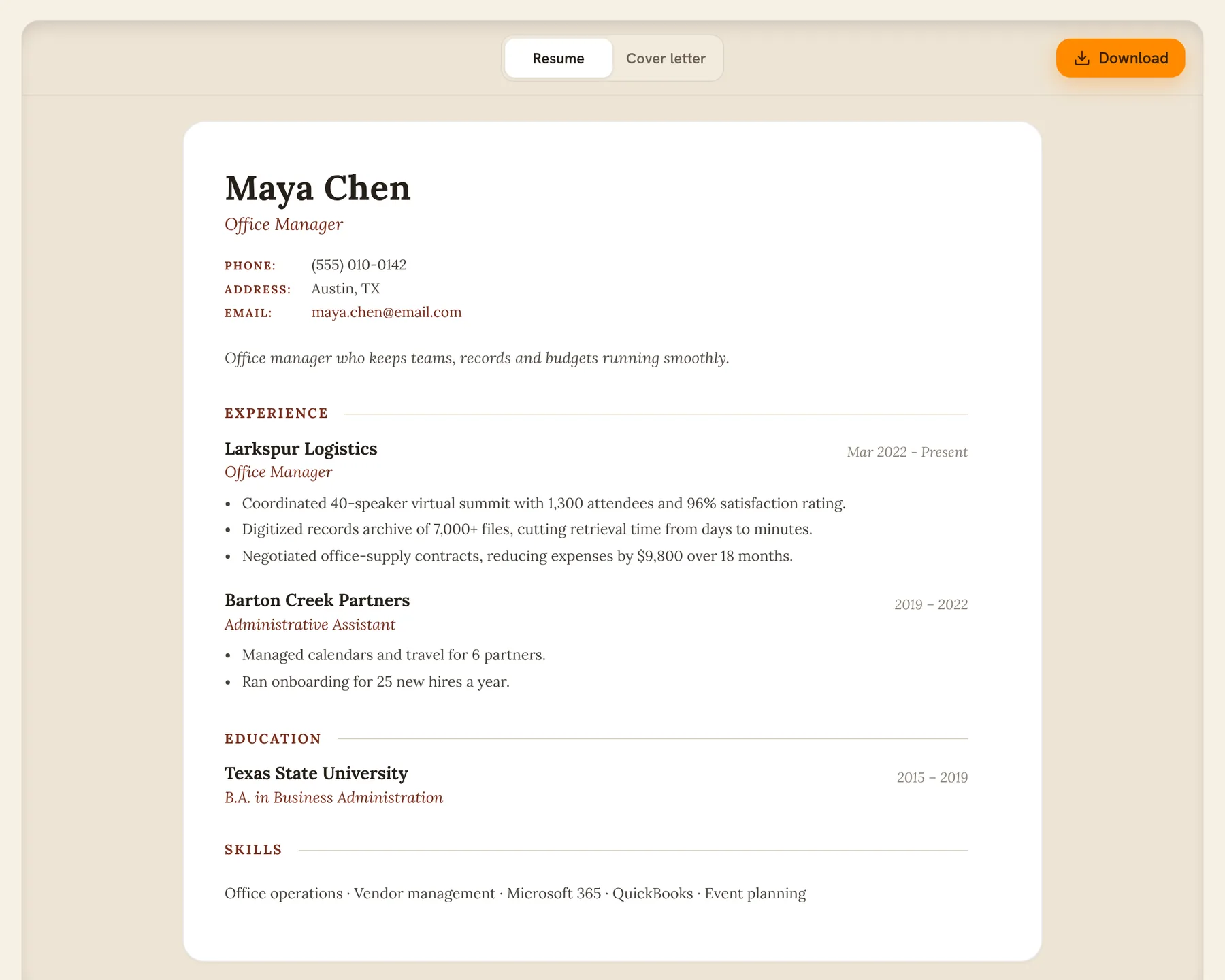
Use these tips on your own resumeTry each tip as you go in a resume that is free to start, with no account needed at first.
Build your resume
How do you get a resume ready to send?
A resume is ready to send once it fits this job and has no mistakes. The last two tips are about that.
9. Change the resume for each job
Each job post asks for something slightly different, so change your resume a little for each one. Reorder your bullet points, swap in the post's words and drop what does not fit.
A referral from someone inside the company can get your resume straight to the hiring manager. If you know someone there, ask them first.
10. Proofread, and ask someone to read it
Proofreading catches the typos and repeated points that you stop seeing after a while. Read the resume aloud once, slowly.
Then ask for guidance from someone else, ideally a person who works in the field you want to join. A second reader spots gaps you cannot see.
What should you leave off a resume?
A resume should leave out anything that does not help the reader decide you fit the job:
- Long paragraphs where bullet points would do.
- Jobs and courses that have nothing to do with the role, once you have related experience.
- Personal details such as age, gender or marital status on a US resume.
- Repeated points, and the same skill listed in three sections.
- Phrases such as "responsible for" with no result after them.
Common questions about resume writing
How do you write a perfect resume?
No trick makes a resume perfect, but an effective one fits the job, fits on one or two pages and shows results. Follow the ten tips above, then change it for each application.
Where can you learn to write a resume?
You can learn resume writing from free online guides and tutorials, examples from your field and advice from people who hire. Start by reading three resume examples for the job you want, then write your own.
Do these tips work for a CV (curriculum vitae)?
Most of these tips work for a CV too: put the best first, use the job's words and show results. An academic CV is the exception, because it lists your full record.
Should you bold the words the employer looks for?
Bolding a few words the employer is looking for can help them stand in view while someone skims. Bold only a handful per page, or nothing stands out.
What is the most important resume tip?
The most important resume tip is to write it for one job at a time. A resume that matches the job post beats a general one that tries to fit every role.
Keep reading
- How to Make a Resume
- What is a Resume?
- How to Fix My Resume and Improve It Before a Job Search
- Fresher Resume Guide: How to Write a Resume If You Have No Experience
Next step: start your resume from your LinkedIn profile.
