Resume vs Curriculum Vitae (CV): What's the Difference?
A resume is a one- or two-page summary of your work, while a CV is a complete record of your academic career. In the US and Canada, employers ask for a resume, and universities and research jobs ask for a CV.
Below are the differences side by side, what each holds, which one to send, and how the words change by country.
In short
- A resume is short, usually one or two pages, and you change it for each job.
- A CV, or curriculum vitae, has no page limit and lists every publication, grant, talk and course taught.
- Academic, research, fellowship and many medical applications ask for a CV.
- In the UK, Ireland and much of Europe, "CV" is the normal name for the short job document too.
- When a form says "Resume/CV", it accepts either, so send the one that fits the job.
What is the difference between a resume and a CV?
The difference between a resume and a CV is length, purpose and how much you change it. Here is a resume versus a CV, side by side:
- Length: a resume is one or two pages. A CV starts at about two pages and grows through a career.
- Purpose: a resume wins an interview for one job. A CV records your whole academic and research life.
- What it holds: a resume keeps only what fits the job. A CV keeps everything: degrees, research, teaching, publications, grants, awards and talks.
- Changing it: you rewrite a resume for each job. One CV can serve many applications, with new items added as they happen.
- Order: a resume leads with work experience for most people. A CV usually leads with education and research.
- Where it is used: a resume for most jobs in North America. A CV for academia, research and medicine.
- Format: a resume uses short bullet points. A CV groups items under many headings, often listed in full.
What is a resume?
A resume is a brief, selective account of your jobs, studies and abilities, aimed at one opening. Employers often get many applications for one opening, so a resume has to be quick to read.
A resume should not be more than about two pages, and most fit on one. It usually holds:
- Your name and contact details
- A summary at the top, two or three lines long
- Work experience, with the most relevant jobs and results
- Education
- Skills
A resume changes with the job. Being editor of your university newspaper may help a writing application. It matters less when you apply to teach science at a high school.
What is a CV (curriculum vitae)?
A CV, or curriculum vitae, is a long document that lists all your academic work, with no limit on pages. The Latin words mean "course of life", which explains why it keeps everything.
A CV is the standard document for academic jobs, master's and PhD applications, fellowships, grants and research posts. Doctors and medical researchers use one too.
An academic CV usually holds these sections:
- Education and degrees
- Research completed
- Teaching experience
- Publications
- Presentations
- Grants
- Fellowships and scholarships
- Awards
- Professional association memberships and licenses
An entry-level CV can run to two pages, and a senior one to many more. Group the items under clear headings, with the most recent first in each.
Should you send a resume or a CV?
Send a resume or a CV by following the job post: use the word it uses. If the post does not say, decide by the job and the country:
- A job at a company in the US or Canada: a resume.
- A university post, research job, fellowship or grant: a CV.
- A medical residency or a doctor's post: a CV.
- A job in the UK or Europe: a CV, kept to about two pages like a resume.
If you apply for both kinds of role, keep both documents ready, so you can send whichever one is asked for.
How do you turn a resume into a CV?
Turning a resume into a CV means adding sections. Turning a CV back into a resume means cutting it to what one job needs.
From resume to CV:
- Move education and research to the top.
- Add sections for publications, presentations, teaching, grants and awards.
- List items in full rather than as short results.
- Drop the page limit, but keep each section in date order.
From CV to resume:
- Keep the jobs and projects that match the post.
- Write a short summary for the top.
- Turn long entries into bullet points with results.
- Cut until it fits on one or two pages.
In Resumonk, Add section offers a ready-made Publications section. You can add a custom section such as Grants when a CV is needed. The same resume templates suit both documents.
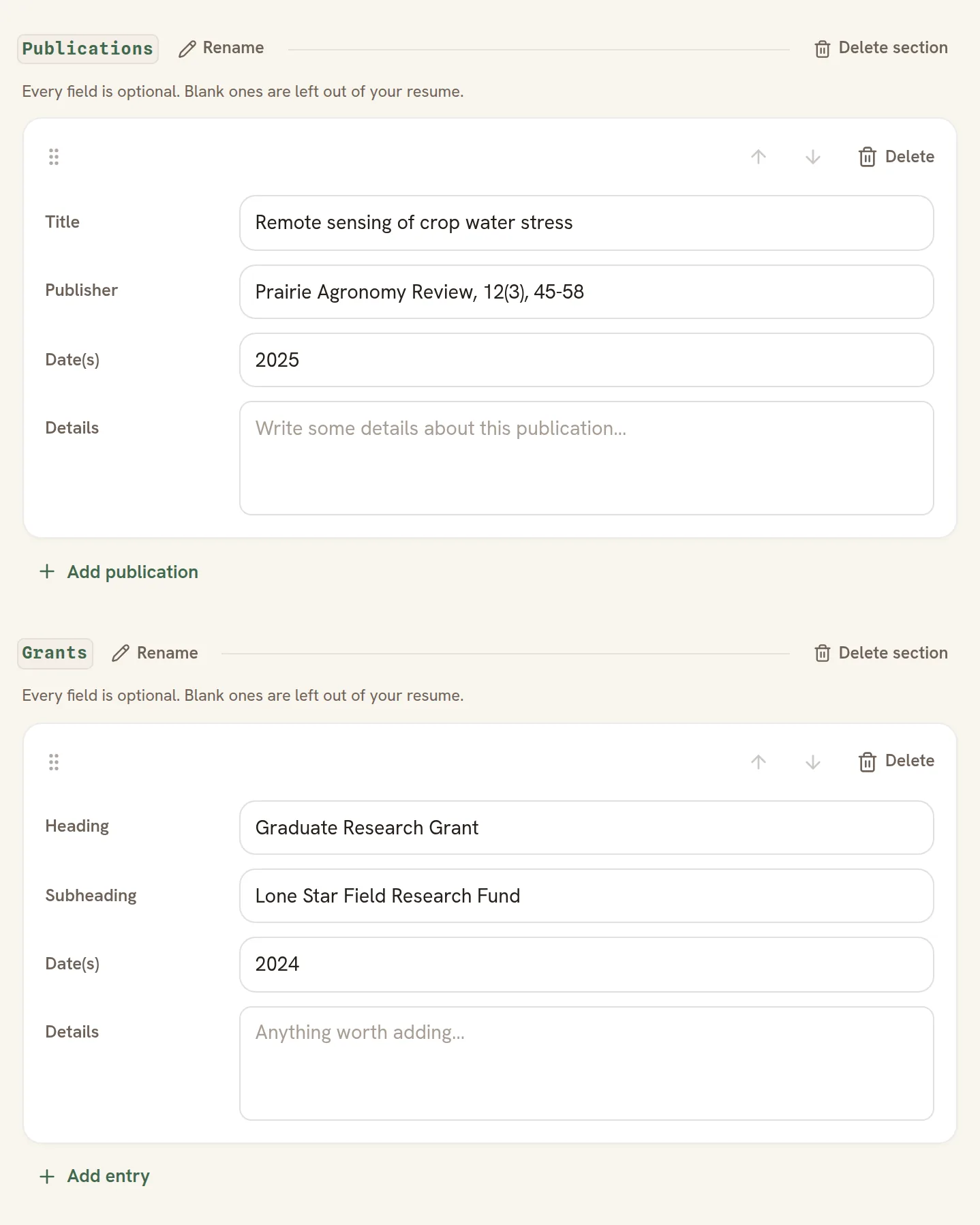
Make the document they asked forStart with a resume in Resumonk, then add Publications and custom sections such as Grants when a CV is needed.
Build your resume
Is a CV the same as a resume?
A CV is not the same as a resume in the US and Canada, where a CV means the long academic document. Elsewhere the two words often name the same thing.
- UK, Ireland, New Zealand and most of Europe: "CV" is the word for any job application document, usually two pages.
- India, Australia and South Africa: both words are used, often for the same document.
- US and Canada: "resume" for most jobs, "CV" only for academic, research and medical posts.
What is the meaning of "Resume/CV" on a job application?
"Resume/CV" on a job application means the employer will accept either document. Send a resume for most jobs, and a CV for an academic or research role.
Common questions about resumes and CVs
What does curriculum vitae mean?
Curriculum vitae is Latin for "course of life". In the US, academics also shorten it to "vita".
Is a CV longer than a resume?
A CV is longer than a resume in academic use, often several pages. A CV for an ordinary job outside North America is about the same length as a resume, around two pages.
Can you use the same document as a resume and a CV?
You can use one document as both a resume and a CV only where the two words mean the same. For a US academic post, a two-page resume leaves out what a CV must show.
Do you send a cover letter with a CV?
A cover letter goes with a CV as it does with a resume, unless the post says not to send one. Many employers ask for both.
Can you make a resume or CV for free?
Yes, Resumonk is free to start: Free Plan resumes download as PDFs with a small Resumonk line at the bottom. Paid plans add cover letters and a Word download. You can read what members say in their reviews.
Keep reading
- Resume Formats Guide - How to Format a Resume
- How to Name a Resume File (with Tips from Experts)
- Should You Put a Photo on Your CV?
- How to Write a Functional or Skills-Based Resume (With an Example)
Next step: pick a resume template.

This article was originally published on our blog on Aug 22 2017 and authored by Sarah Landrum. It was edited and republished in its present form by Team Resumonk on Sep 15 2025.