35 Most Common Interview Questions and How to Answer Them

The most common interview questions ask about you, why you want the job and how you work, like "Tell me about yourself". Prepare a short, true answer to each, backed by one real example, and you will be ready for most interviews.
Below are the 35 most commonly asked interview questions, each with how to answer it. These popular questions range from simple openers to hard ones about mistakes and pressure.
In short
- Most job interviews open with "Tell me about yourself", which takes a one- or two-minute answer about your work.
- Questions about strengths and weaknesses are best answered with one real example each.
- A question that starts "Tell me about a time" is a behavioral question, answered with the situation, your action and the result.
- Research the company before the interview, so you can say why you want to work there.
- Never speak badly of a current or past employer in an interview.
- Have two or three questions of your own ready for the end of the interview.
1. Tell me about yourself
Answer "Tell me about yourself" with a short summary of your work: where you are now and what you are proudest of. End with why this job is next, and keep it to a minute or two.
Example answer: "I have spent three years in customer support at a software company, where I now train new hires. I want a role where I can build that training full time."
Interviewers normally ask this first, as a warm-up. The most frequent follow-up is "Walk me through your resume", which follows your jobs in order.
2. What made you apply for this position?
"What made you apply?" is answered with two or three specific reasons this job appeals to you. Employers want people who chose this job, not any job.
3. What do you know about our company?
"What do you know about our company?" checks that you did your homework. Read the company's website and recent news, and prepare a few points about what it does and why that interests you.
4. How did you hear about this position?
"How did you hear about this position?" needs a plain, true answer: a referral, a job board, or following the company. If you name a person who referred you, say how you know them.
5. What makes you qualified for this position?
"What makes you qualified?" is answered by matching your experience to the main duties in the job post. Pick two or three duties and give one example for each.
6. Why should we hire you?
"Why should we hire you?" calls for a short pitch. Name the skills the job needs, the proof that you have them, and what you would bring.
Example answer: "You need someone who can cut the support backlog. At my last job I brought our reply time from two days to six hours."
7. What are your biggest weaknesses?
Answer "What are your biggest weaknesses?" with a real weakness you are working on, and what you are doing about it. Avoid a disguised strength such as "I work too hard".
Example answer: "Public speaking made me nervous, so I joined a speaking club and now present our monthly team update."
8. What are your biggest strengths?
Answer "What are your biggest strengths?" with two or three strengths that matter for this job, each backed by a short example. Say them plainly, without false modesty.
9. Are you interviewing with any other companies?
"Are you interviewing elsewhere?" can be answered honestly without naming companies. Say you are talking to a few, and that this role is the one you want most, if it is.
10. What is your ideal work environment?
"What is your ideal work environment?" helps the interviewer judge your fit. Describe what helps you do your best work, honestly but realistically, and connect it to what you know of this workplace.
11. Tell me about a time you worked as a team
"Tell me about a time you worked as a team" is a behavioral interview question, best answered with one real example. Describe the team's goal, your part in it and how it turned out.
12. Why do you want this job?
"Why do you want this job?" is best answered with what draws you to this company and this role. Pay may be a real reason, but lead with the work itself.
13. When was a time you made a mistake at work?
"When did you make a mistake?" is about how you fixed it. Choose a small, real mistake, then explain what you did to put it right and what you changed afterward.
14. Where do you see yourself in five years?
"Where do you see yourself in five years?" checks that your plans fit the job. Name the skills or responsibility you hope to grow into, and how this role helps.
Example answer: "In five years I would like to lead a small team. This job would give me the project experience to get there."
15. Tell me about your dream job
"Tell me about your dream job" is answered by describing the kind of work you love, then linking it to this role. An answer about a very different field can make the interviewer think you will leave.
16. Tell me about your ideal workday
"Tell me about your ideal workday" shows whether the job's rhythm suits you. Describe a realistic day, with the tasks you enjoy most, that this job could actually offer.
17. Why are you leaving your current position?
"Why are you leaving?" is answered with what the new job offers that your current one cannot, such as growth. Never criticize your current employer or manager.
More on this in how to explain your reasons for leaving a job.
18. Tell me about your management style
"Tell me about your management style" comes up for management roles. Give an honest answer with an example of how you lead, and how it suits the company's way of working.
19. How would your managers and coworkers describe you?
"How would your coworkers describe you?" is best answered with words they have really used, from reviews or feedback. Stay honest, since the interviewer may ask your references.
20. What is your most notable professional accomplishment?
"What is your biggest accomplishment?" does not need an award. Describe one result you are proud of, what you did to get it and why it mattered.
21. What makes you different from other applicants?
"What makes you different?" asks what you bring that others may not. List a skill, experience or way of working that is unusual, and relate it to the job.
22. Tell me about a time you went above and beyond
"Tell me about a time you went above and beyond" looks for effort past the basics. Describe a task where you did more than asked, and what it changed.
23. How do you handle disagreements with your boss?
"How do you handle disagreements with your boss?" is about calm, respectful talk. Give an example where you raised a concern in private, listened, and agreed on a way forward.
24. Where are you in the job-search process?
"Where are you in your job search?" deserves a short, honest answer. Say how long you have been looking and whether you have other interviews. Add that you are looking for the right fit.
25. What do you do for fun?
"What do you do for fun?" lets the interviewer see you outside work. Name one or two real hobbies or interests, keeping the answer professional.
26. Do you have any leadership experience?
"Do you have any leadership experience?" can be answered even without a manager's title. Describe a time you led a team, a project or a group, at work, at school or as a volunteer.
27. What would you expect out of management?
"What would you expect from management?" checks how you work with a manager. Say honestly what helps you, such as clear goals and regular feedback.
28. What motivates you?
"What motivates you?" is answered with what drives you beyond the paycheck: solving problems, learning, helping people, or seeing results. Give an example from your work.
29. What are your favorite parts about working in your industry?
"What do you like about your industry?" shows how much you care about your field. Prepare two or three things you enjoy, and why.
30. What are the biggest challenges you have with your industry?
"What are the challenges in your industry?" checks that you see problems clearly. Name one or two real challenges, and what you are doing to handle them.
31. What do you hope to accomplish in this position?
"What do you hope to accomplish here?" shows you have pictured yourself in the job. Link a goal or two from the job post to your own career plans.
32. How do you deal with pressure?
"How do you deal with pressure?" is answered with what you actually do when work gets stressful. For example, you make a list and tackle the most urgent task first. Back it with a short example.
33. What professional areas would you like to improve?
"What areas would you like to improve?" asks where you want to grow. Name a skill that would help your career, and the steps you are already taking.
34. What are your expectations for this position?
"What are your expectations for this position?" checks that you and the company want the same things. Use what you know of the job and the company to name a few fair expectations.
35. What questions do you have for us?
"What questions do you have for us?" always needs an answer. Ask two or three questions about the work, the team or what success looks like. See the best questions to ask at the end of an interview.
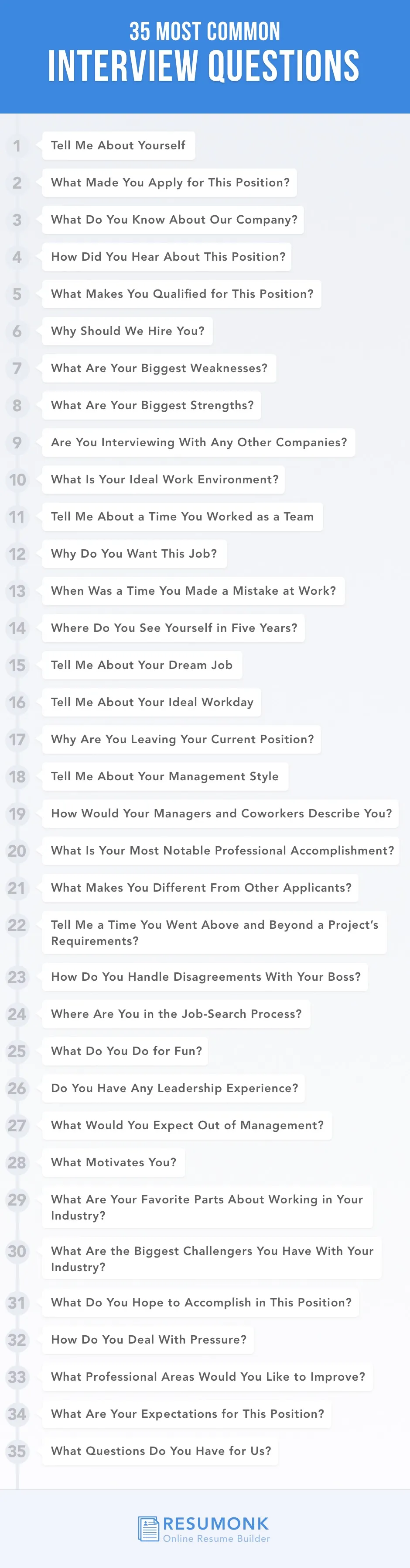
All 35 questions in one list:
How do you get your resume ready for the interview?
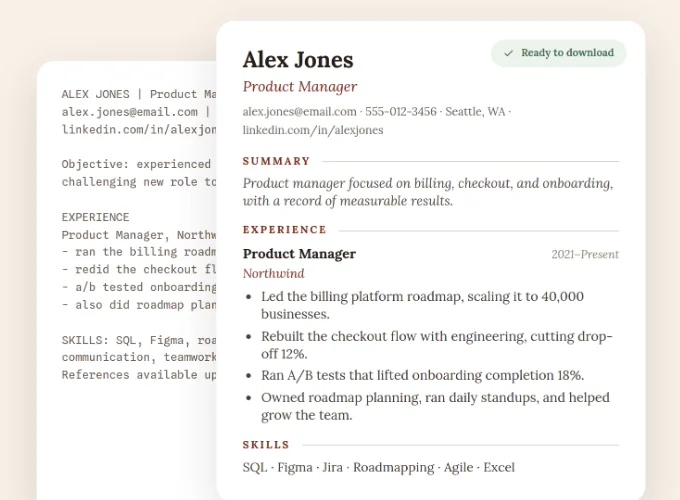
Get your resume ready by reading it again the day before, because many interview questions come from it. Be ready to explain each job, each date and any gap in a sentence or two.
Bring two or three printed copies, in case the interviewer or a second person on the panel wants one.
Bring a clean resume to the interviewBuild it in Resumonk for free and download a PDF you can print and take with you.
Build your resume
Common questions about job interviews
What are the top 7 most common interview questions?
The top seven most common interview questions are usually these:
- Tell me about yourself.
- Why do you want this job?
- Why should we hire you?
- What are your strengths?
- What are your weaknesses?
- Where do you see yourself in five years?
- Why are you leaving your current job?
What questions do interviewers ask about your resume?
Interviewers often ask you to walk them through your resume, or to explain a job change or a gap. They may also ask for the story behind a bullet. Know every line well enough to talk about it for a minute.
How do you answer behavioral interview questions?
Answer behavioral interview questions with one real story: the situation, what you had to do, what you did, and the result. Keep each story under two minutes.
How should you prepare for common interview questions?
Prepare for common interview questions by writing a few points for each answer, not a script. Then practice saying them aloud, so they sound natural on the day.
List possible questions from the job post too, such as one about each main duty.
Are the questions different for experienced candidates?
Experienced candidates get the same common questions, with more about leadership, results and hard decisions. Prepare examples with numbers from your recent jobs.
Are phone interview questions different?
Phone interview questions are mostly the same, but shorter and often about your background and pay. The phone interview tips cover how to prepare.
What should you do after the interview?
After the interview, send a short thank-you email within a day. The thank-you email guide has samples, and the salary negotiation guide helps once an offer comes.
Keep reading
- How to Decline a Job Offer Professionally (Without Burning Bridges)
- How to Write the Perfect Thank-You Email After an Interview
- How to Answer - "Walk Me Through Your Resume"
- 12 Startup Founders reveal their favorite interview question(s)
- 11 Phone Interview Tips to Help You Get the Job
- How to Explain Your Reasons for Leaving a Job (Without Sounding Negative)
- 9 Best Questions to Ask at the End of the Interview
- How to Negotiate Your Salary
Next step: browse remote jobs.
job hunting.
Resumonk polishes your resume, discovers matching jobs and finds connections inside companies.
Get started free- Indeed
- Greenhouse
- + more
This article was originally published on our blog on Feb 21 2017 and authored by Sarah Landrum. It was edited and republished in its present form by Team Resumonk on Sep 15 2025.