Complete List of Behavioral Interview Questions

Behavioral interview questions ask you to describe how you handled a real situation at work, such as a conflict or a mistake. Most start with "Tell me about a time when...", since past actions show how you may act in the new job.
Below are 41 behavioral questions in six groups, then how to prepare and how to answer them.
In short
- Behavioral questions ask for a real example from your past, not what you would do in theory.
- The six common types cover teamwork, communication, time management, client service, initiative and leadership.
- The skills listed in the job post show which types of questions you are most likely to get.
- A good answer follows the STAR method: the situation, your task, the action you took and the result.
- Five or six prepared stories can cover most behavioral questions, because one story often fits several.
What are behavioral interview questions?
Behavioral interview questions are questions about what you actually did in a past situation. The interviewer wants to see how you might react to situations the new job will bring.
Besides checking your skills, these questions show how your personality fits the team and the company. They sit alongside the common interview questions most employers ask, such as "Tell me about yourself".
What types of behavioral interview questions are there?
Behavioral interview questions fall into six common types: teamwork, communication, time management, client-facing skills, initiative and leadership. The 41 questions below are grouped by type.
Teamwork questions
Teamwork questions ask how you have worked with coworkers, including difficult ones. Most interviews include at least one.
- Give an example of a time when you had to work closely with someone whose personality was very different from yours.
- Talk about a time when you faced a conflict while working with a team. How did you handle it?
- Tell me about an experience working with a team that you found rewarding.
- Give me an example of a time you had to deal with a difficult coworker.
- Talk about a time when you were on a team with someone who was not doing their share of the work. How did you handle it?
- What do you think is the most difficult part of being a team member rather than its leader? Why? How do you deal with it?
- Have you had to be the mediator to settle an issue between two team members? What happened? How did you resolve the dispute?
Communication questions
Communication questions ask you to back up a claim of being a good communicator with clear examples, spoken and written.
- Tell me about a successful presentation you gave and why it went over so well.
- Give an example of when you used written communication to get your ideas across to someone.
- How would you explain complex ideas in simpler terms to a frustrated client?
- Have you had a boss in the past that you had difficulties communicating with? How did you handle this?
- Describe how you have developed relationships with coworkers, supervisors and others at a new workplace.
- Give an example of a time when you successfully communicated with someone you did not like or who did not like you.
- Talk about a time when you had to give a presentation on the spot or with little preparation. What were the challenges? How did you handle them?
Time management questions
Time management questions check that you can juggle more than one assignment and still meet deadlines.
- Tell me about a time you had to juggle multiple responsibilities. How did you handle it?
- Sometimes it is impossible to get everything done. What did you do during a time when your responsibilities got overwhelming?
- Give me an example of how you have handled interruptions or distractions at work when you were on a tight deadline.
- How did you keep everything running smoothly and on time with a project you managed recently?
- Think of a recent goal you have met. How did you make sure you met it? What was your process?
- When has something you organized not gone according to plan? What happened? Why? What did you do to fix it?
Client-facing questions
Client-facing questions ask how you handle customers, since almost every industry involves some customer service. Employers want repeat business, so they look for people who keep clients happy.
- Describe a time when you had to deal with a difficult customer or client. What did you do to handle the situation?
- Give an example of a time when you gave a client great customer service.
- Tell me about a time you failed to meet a customer's expectations. What happened?
- How would you show a client you are focused on and interested in their case or project? Why do you think that approach works?
- When you are overwhelmed with customers, how do you prioritize their needs?
- Describe a time when you took over a customer from someone else. How did you build a relationship with them when they were used to working with a coworker or a competitor? How did you earn their trust?
- Have you ever taken the customer's side over the company's? What happened?
Initiative questions
Initiative questions look for someone self-motivated, who keeps trying after hitting a wall. They also cover setbacks and failures.
- Describe a project or idea that was put into place because of your efforts. What was your role, and how did it end up?
- Talk about a time, at work or outside it, when your initiative caused a change to happen.
- Give an example of a setback you have had at work. How did you handle it?
- Describe a time at work when you failed. How did you overcome it?
- Give an example of a time when you saw a problem and used it as an opportunity instead. What did you do, and what happened as a result? Would you do anything differently?
- Tell us about a time when your company or team was going through a lot of change. What impact did it have on you? How did you adapt?
- Describe a time when you started a project or a change at your workplace. What did you do, and how did it turn out? Were you happy with how it ended?
Leadership questions
Leadership questions come up in interviews for supervisor jobs, and often in others too, when the job could lead to a promotion. You can answer them even without a formal leadership role.
- Describe a time when you showed leadership skills.
- Tell us about a time you took the lead on a project or in a situation.
- Have you ever helped someone with their work so that they could succeed?
- Tell us about a time you led by example.
- Talk about a leadership role you have had outside of work. Why did you choose to give your time to it? How did you handle obstacles?
- What was the hardest group or team you have had to lead? Why? How did you handle difficult members or situations?
- How do you balance your duties when you lead a team and also do the same work as your team members?
How do you prepare for behavioral interview questions?
Preparing for behavioral interview questions starts with the job posting. The skills it lists are a good guide to the questions you will get.
- Write down the four or five skills the job post asks for most, such as teamwork or handling customers.
- For each skill, pick a real example from a job, an internship, volunteer work or school.
- Write each example out in the STAR order described below, in a few lines.
- Check that each example matches a job on your resume, so your stories and your resume agree.
- Practice saying the stories out loud until they take about two minutes each.
You cannot predict the exact questions, but a few prepared stories can be adapted to most of them. One story about a project that ran late, for example, can answer a time management question or a teamwork question.
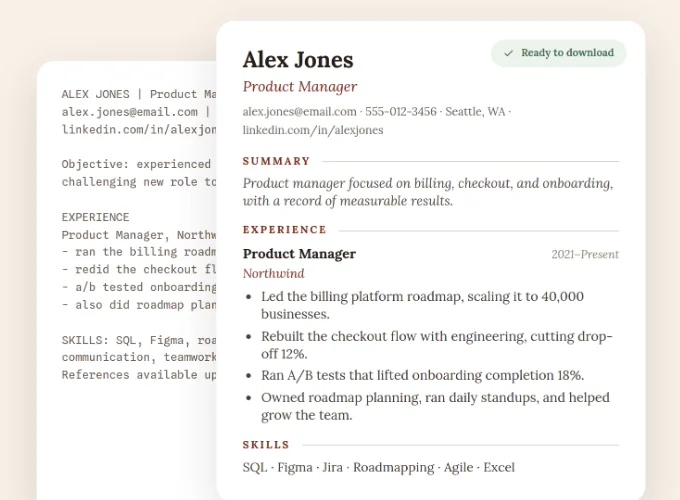
Match your stories to your resumeIn Resumonk, check that each story you plan to tell appears under the right job in Experience.
Build your resume
How do you answer a behavioral interview question?
Answer a behavioral interview question with one real example, told in the STAR order:
- Situation: where you were and what was happening, in a sentence or two.
- Task: what you were responsible for.
- Action: what you did, step by step. Say "I", not "we", for your own part.
- Result: what happened, with a number if you have one, and what you learned.
Here is a sample answer to "Give me an example of a time you had to deal with a difficult coworker":
- "At the hardware store where I worked, a coworker on the closing shift often left the restocking unfinished. I opened the next morning, so I had to restock before customers came in. I asked him for ten minutes after a shift instead of complaining to our manager. It turned out the delivery came late on his shifts, so he could not finish. We asked the manager to move his break, and he restocked first. For the rest of the year, the store opened fully stocked."
Spend most of the answer on the action and the result. Keep the whole answer to about two minutes, and do not blame others in it.
Common questions about behavioral interviews
What is the difference between behavioral and situational questions?
A behavioral question asks what you did in a past situation. A situational question asks what you would do in an imagined one, such as "What would you do if...?" Some interviews mix both.
What if you have no example for a behavioral question?
If you have no work example for a behavioral question, use one from school, volunteer work or a sport. If you have none at all, say so honestly and explain how you would handle the situation.
How many behavioral questions are asked in an interview?
The number of behavioral questions varies by employer. Some interviews are made up mostly of behavioral questions, while others include only one or two.
Can you use the same story for more than one question?
You can use the same story for different questions, when it truly fits each one. Within one interview, though, try to give a different example each time.
Keep reading
- 35 Most Common Interview Questions and How to Answer Them
- How to Decline a Job Offer Professionally (Without Burning Bridges)
- How to Write the Perfect Thank-You Email After an Interview
- How to Answer - "Walk Me Through Your Resume"
Next step: browse remote jobs.
job hunting.
Resumonk polishes your resume, discovers matching jobs and finds connections inside companies.
Get started free- Indeed
- Greenhouse
- + more
This article was originally published on our blog on Jul 20 2017 and authored by Sarah Landrum. It was edited and republished in its present form by Team Resumonk on Sep 15 2025.