9 Best Questions to Ask at the End of the Interview

The best questions to ask at the end of a job interview are open questions about the job and the team. Ask about the daily tasks, what success looks like in the first year, the company's culture and the next steps in hiring.
Below are nine closing questions to ask the employer, what each one tells you, and how to choose yours.
In short
- Questions at the end of an interview show the interviewer you have thought seriously about the job.
- The answers also tell you whether the job and the company suit you.
- Prepare at least two questions and no more than five.
- Open questions, which cannot be answered with yes or no, get you the most information.
- Salary and benefits are usually better left for a later stage of the hiring process.
You will spend most of the interview answering common interview questions. The last few minutes are your turn, and these nine questions make good use of them.
1. What are the day-to-day tasks for this job?
Asking about the day-to-day tasks shows you what you would really spend your time on. Job descriptions rarely list the small, routine work that fills a normal day.
A role that looks like a match on paper may turn out to be mostly phone calls and email. It is better to learn that before you accept an offer.
2. What are your expectations for the job over the next month, six months and year?
Asking about expectations over a month, six months and a year tells you what the employer wants from the person they hire. It also shows you are already thinking about doing the job well.
Compare the answer with your own goals. If you want to move up quickly, or want long-term security, check that the employer's plans fit.
3. What can you tell me about the company culture?
Asking about the company culture tells you whether you would be comfortable working there every day. Culture covers how people work together, how decisions are made, the dress code and even how the office is laid out.
If the culture does not suit you, the job is unlikely to make you happy, however good the work is.
4. Where do you see the company in five years?
Asking where the company will be in five years shows you are thinking long term. The hiring manager may not know every plan, but should know the company's main goals.
Even if you do not expect to stay five years, you want a company you can grow with.
5. What challenges and opportunities do you see facing the company or department?
Asking about challenges and opportunities tells you what problems you would be hired to help with. It helps you judge whether you can handle them before you commit.
The question also shows that you are ready to help the team, which leaves a good impression.
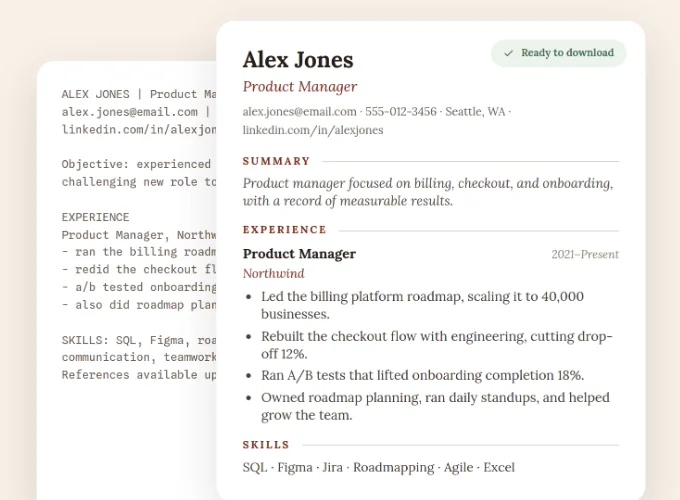
Have your resume ready for the next interviewUpdate your resume in Resumonk after each interview, so the next application goes out current.
Build your resume
6. What is your favorite thing about working for the company?
Asking the interviewer what they like most about the company gives you a personal view of the place. Their answer often shows what the company values most.
A quick, warm answer is a good sign. A long pause may tell you something too.
7. What career path does someone in this role typically follow?
Asking about the usual career path shows you how people in this role move up. It tells you whether the job fits your long-term plans.
A clear answer suggests the company promotes from within. If the interviewer has no answer, promotions may be rare, which matters if you want to advance.
8. What qualities must someone have to succeed in this role?
Asking what qualities it takes to succeed tells you what the hiring manager is really looking for. Job descriptions do not always say.
The answer helps you in the moment, too. If a quality you have comes up, mention a short example of it before the interview ends.
9. What are the next steps in the interview process?
Asking about the next steps tells you what to expect after you leave. Some companies reply to every candidate, while others contact only the people they want to see again.
Ask when you should hear back and when they hope the new hire will start. The question also shows you want to move forward.
How do you choose your end-of-interview questions?
Choose end-of-interview questions based on what the interview has not already covered. Prepare more than you need, then ask the ones still open.
- Research the company before the interview, so you do not ask something its website answers.
- Prefer open questions to yes-or-no questions; they lead to a conversation.
- Pick questions about things that matter to your decision, such as the work, the team and growth.
- If you have more than five, ask some of them during the interview instead of at the end.
Common questions about end-of-interview questions
How many questions should you ask at the end of an interview?
Ask two to five questions at the end of an interview. Fewer can look uninterested, and more can make the interview run too long.
Is it bad to have no questions to ask?
Having no questions at the end of an interview can suggest you are not very interested in the job. Bring a few prepared questions so you always have one left.
What if your questions were already answered?
If your questions were answered during the interview, say so and ask a follow-up on one of the answers. For example, ask for more detail about a project the interviewer mentioned.
Should you ask about salary at the end of a first interview?
Salary is usually better left out of the questions at the end of a first interview. Pay and benefits tend to be discussed later, often once an offer is close, unless the interviewer brings them up.
What questions should you not ask at the end of an interview?
Avoid questions the company's website already answers, yes-or-no questions, and questions about time off or perks in a first interview. They suggest you have not prepared or care more about the extras than the job.
Keep reading
- 35 Most Common Interview Questions and How to Answer Them
- How to Decline a Job Offer Professionally (Without Burning Bridges)
- How to Write the Perfect Thank-You Email After an Interview
- How to Answer - "Walk Me Through Your Resume"
Next step: browse remote jobs.
job hunting.
Resumonk polishes your resume, discovers matching jobs and finds connections inside companies.
Get started free- Indeed
- Greenhouse
- + more
This article was originally published on our blog on May 04 2018 and authored by Sarah Landrum. It was edited and republished in its present form by Team Resumonk on Sep 15 2025.