How to Negotiate Your Salary

To negotiate your salary, research what the job pays and pick a specific number near the top of that range. Then ask for it calmly, with your results as the reason, and know the lowest figure you would accept before you start.
The steps below work for a new job offer, a promotion or a yearly review, and include a counteroffer to copy.
In short
- Most employers expect some negotiation on a job offer, so asking politely rarely costs you the offer.
- A salary request should rest on research into what similar jobs pay, not on what you need.
- A specific number near the top of your range sounds more prepared than a broad range.
- Your walk-away point is the lowest salary you would accept, decided before the conversation.
- A counteroffer thanks the employer, names your number and gives one or two reasons for it.
- If the salary cannot move, vacation time, remote work or an early review can still be negotiated.
How do you research what a job should pay?
To research what a job should pay, look up salary ranges for the same title, level and city. Salary surveys, job posts that list pay, and government wage data are good places to start.
If you cannot find enough online, talk to recruiters or to people who do the same job. From what you learn, set a range you would be comfortable with.
Should you ask for a range or a specific number?
Ask for a specific number rather than a range, because a range invites the employer to pick its bottom. Choose a figure near the top of the range you researched.
A precise number, such as $70,500 rather than $70,000, can show that you worked it out rather than guessed.
What is a walk-away point in a salary negotiation?
A walk-away point is the lowest salary you would accept. Decide it before the conversation, so you do not have to work it out while the employer waits.
Base it on your living costs, your financial needs and what your work is worth on the market. It is never easy to turn down a job offer. Still, taking far less than you need will hurt you in the long run.
How do you prepare talking points for a salary negotiation?
Prepare talking points by writing every reason you deserve the salary on one page. Nerves make people forget their best points, and a list keeps them in front of you.
- If you already work at the company: list projects you led or helped with, and what your work changed, with numbers.
- If you are joining a new company: list your achievements, awards and certifications that fit the job.
Then rehearse the conversation aloud a few times. A friend or family member can play the manager, which helps more than practicing alone.
If your resume is in Resumonk, add the same results to each job's Details box in the Experience section. Your resume and your talking points then match.
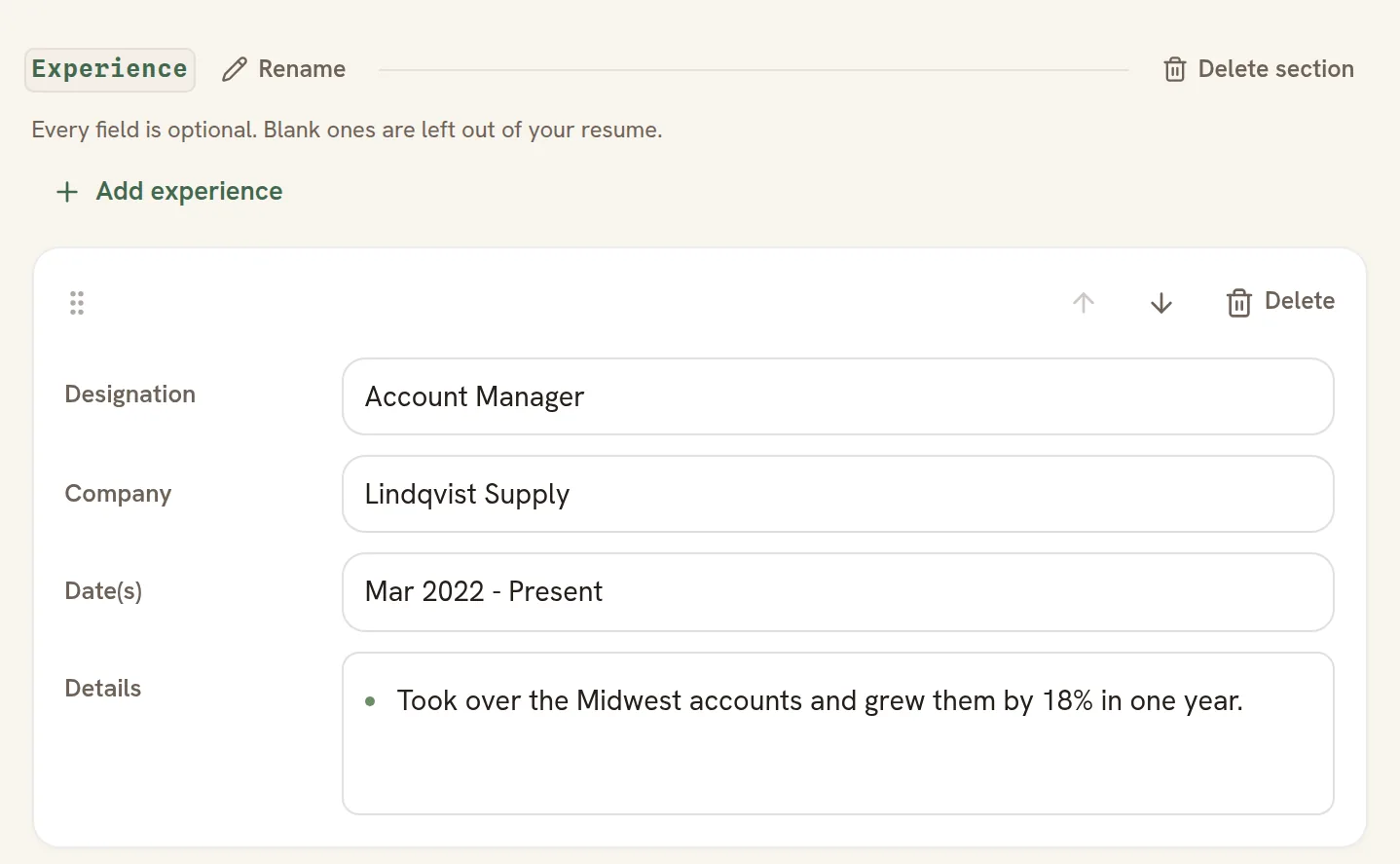
List the wins you will negotiate withPut your results, with numbers, under each job in the Experience section of Resumonk before the talk.
Build your resume
What should you say when you're negotiating your salary?
When you're negotiating your salary, start with what you have done and will do for the company, then name your number. An employer pays more to get more, so spell out the value instead of assuming they see it.
Keep your tone calm, positive and firm. These are sample lines you can adapt:
- On a job offer: "Thank you for the offer, I am excited about the role. Based on what similar roles pay here and my experience, I was hoping for $70,500. Is there flexibility?"
- On a raise: "In the past year I took over the Midwest accounts and grew them by 18%. I would like to discuss raising my salary to $82,000 to reflect that."
- When the salary cannot move: "I understand. Could we look at an extra week of vacation, or a salary review in six months?"
- When you need time: "Thank you, that is helpful. Could I take a day to think it over and get back to you?"
How do you write a counteroffer for a salary?
A salary counteroffer is a short, polite reply to a job offer that asks for a higher number. It thanks the employer, names the salary you want and gives one or two reasons.
Send it by email when the offer came in writing, or use it as your script for a call. Here is a template; replace each part in square brackets:
Subject: [Job Title] offer, [Your Name]
Dear [Hiring Manager's Name],
Thank you for offering me the [Job Title] position at [Company Name]. I am excited about the role and the team.
Before I accept, I would like to discuss the base salary. Based on [your reason, such as pay for similar roles or your experience], I am asking for [Salary You Want].
[One or two sentences on a result from your last job that matters for this one.]
I am confident we can agree on a figure that works for both of us. I am also happy to talk by phone.
Thank you again,
[Your Name]
Here is the same counteroffer filled in:
Subject: Marketing Analyst offer, Marcus Hale
Dear Ms. Okafor,
Thank you for offering me the Marketing Analyst position at Ostrander Foods. I am excited about the role and the team.
Before I accept, I would like to discuss the base salary. Based on pay for similar roles in Columbus and my four years of experience, I am asking for $70,500.
At my last job, I built a weekly sales report that cut our reporting time from two days to half a day.
I am confident we can agree on a figure that works for both of us. I am also happy to talk by phone.
Thank you again,
Marcus Hale
How do you negotiate more money in a job offer?
To negotiate more money in a job offer, reply with a specific counter before you accept, and rank what you ask for. Most employers expect some back and forth, but pushing too hard can make you look like a difficult hire.
- Rank your requests. Put the most important item first, usually the salary, then benefits or vacation time.
- Take time to think. You do not have to answer a counter on the spot. Asking for a day is normal.
- Get the final terms in writing before you resign from your current job.
An employer can withdraw an offer, though that is rare when you ask politely. Keep the tone friendly, and stop negotiating once you have a figure you can accept.
How do you negotiate a raise or a promotion?
Negotiating a raise or a promotion works best when you lead with what you have achieved at the company. A review or a new role is the natural time to raise it.
Listen before you argue. If your manager hints that the budget is fixed, more pushing on salary will get you nowhere. Ask instead for other benefits, such as more vacation, remote work or a date for the next review.
Do not open a conversation with "I need a raise." Invite your manager to say why they think you do or do not deserve one, and answer with your results.
What should you avoid in a salary negotiation?
In a salary negotiation, avoid anything that makes the talk about pressure instead of value:
- Personal needs. Rent or debts are real reasons, but they do not persuade an employer. Explain why you deserve more, not why you need more.
- Threats. Saying you will leave without a raise can reflect badly on you, and word travels between managers and recruiters.
- Demands. Being firm is fine; refusing to hear the other side is not.
- Rushing. Accepting a number you are unhappy with because you felt pressured is worse than asking for a day.
Negotiating gets easier with practice, and you will do it many times in a career.
Common questions about negotiating salary
Who should name a salary number first?
In a raise talk, naming your number first is often wise, because the first figure sets the starting point. For a new job, the employer usually makes the first offer, and your counter follows.
Should you negotiate salary by email or by phone?
Salary can be negotiated by email or by phone. Email gives you time to choose your words; a call is quicker and warmer. Many people send a written counter and then talk it through.
What if the employer says no to your counteroffer?
If the employer says no to your counteroffer, ask whether anything else can move. A signing bonus, vacation or an early salary review may be possible. Then decide whether the offer still meets your walk-away point.
Should your salary go on your resume?
Your salary does not go on your resume, so there is nothing to update there after a raise. Update the job title and your results instead. If an application asks for them, answer in the form or, when asked, with salary requirements in a cover letter.
How long can you take to answer a job offer?
A day or two to answer a job offer is normal, and a few days is usually fine if you ask. Say when you will reply, and keep to it.
Keep reading
- 35 Most Common Interview Questions and How to Answer Them
- How to Decline a Job Offer Professionally (Without Burning Bridges)
- How to Write the Perfect Thank-You Email After an Interview
- How to Answer - "Walk Me Through Your Resume"
Next step: browse remote jobs.
job hunting.
Resumonk polishes your resume, discovers matching jobs and finds connections inside companies.
Get started free- Indeed
- Greenhouse
- + more
This article was originally published on our blog on Mar 07 2017 and authored by Sarah Landrum. It was edited and republished in its present form by Team Resumonk on Sep 15 2025.