How to Put Volunteer Work on Your Resume (With Real-World Examples)

List volunteer work on a resume like a paid job, with the organization, your role, the dates and two or three results. Give it its own Volunteer Experience section, or add it to Work Experience with "(Volunteer)" after your role title.
Below are examples to copy, where the section goes, how to describe the work, and volunteering on a CV.
In short
- Volunteer work belongs on a resume when it shows a skill the job needs or fills a gap in your work history.
- A volunteer entry has the organization, your role, the place, the dates and bullet points with results.
- A separate "Volunteer Experience" section suits most resumes, while a role close to the job can sit in Work Experience.
- Numbers make a volunteer entry believable: people served, money raised, volunteers led.
- Volunteer work counts as experience, but it is always labeled as volunteer, never passed off as paid.
Should you put volunteer work on your resume?
Volunteer work is worth putting on your resume when it proves a skill the job needs. It helps most in five cases:
- Career changers: volunteer work in the new field shows hands-on experience before your first paid job in it.
- Recent graduates: campus or community roles fill a thin work history with real results.
- Employment gaps: volunteering during time away shows you kept your skills in use.
- Paid jobs in another field: volunteer roles can show the skills your jobs do not.
- A cause you want to work for: volunteering for an environmental group shows a real interest before you apply to one.
A volunteer role that shows nothing the job needs can stay off, or take one line at the end of the page.
Where do you put volunteer work on a resume?
Volunteer work goes in a separate Volunteer Experience section on most resumes. When an unpaid role matches the job you want, it can go in your Work Experience section instead.
A Volunteer Experience section of its own
A Volunteer Experience section suits volunteer roles that differ from the job you want. It also suits leadership your paid jobs do not show, such as chairing a nonprofit board.
The section usually sits after Work Experience.
Volunteer work inside Work Experience
Volunteer work goes in Work Experience when the unpaid duties match the job. Managing logistics for a festival, for example, is project management.
List the role with your other jobs, and put "(Volunteer)" after the title, as in "Project Lead (Volunteer)". The reader then sees it as direct experience, with nothing hidden.
Where volunteer work goes at each career stage
- Students and new graduates: Education first, then Volunteer Experience, then any paid work.
- Experienced workers: Work Experience first, with volunteer work after it.
- Career changers: relevant volunteer roles inside Work Experience, near the top.
How do you list volunteer experience on a resume?
Volunteer experience is listed in the same format as a job. Put the organization and role first, then the place and dates, then two or three bullet points. Here is an example:
- Eastside Food Share, Logistics Coordinator (Volunteer), Los Angeles, CA | Jan 2023-Present
- Directed 25 volunteers to redistribute 12 tons of surplus produce to 15 shelters weekly
- Negotiated partnerships with 3 local grocers, cutting supply costs by 18%
- Implemented real-time tracking system that reduced spoilage by 30%
Use the same font, date style and bullet style as your paid jobs, so the unpaid role looks just as professional.
What can you call the volunteer section?
The volunteer section is best called "Volunteer Experience", a plain title every reader understands. Other clear words for volunteer work on a resume:
- Volunteer Work
- Community Involvement
- Community Service
- Community Leadership
- Pro Bono Work, for professional skills given free
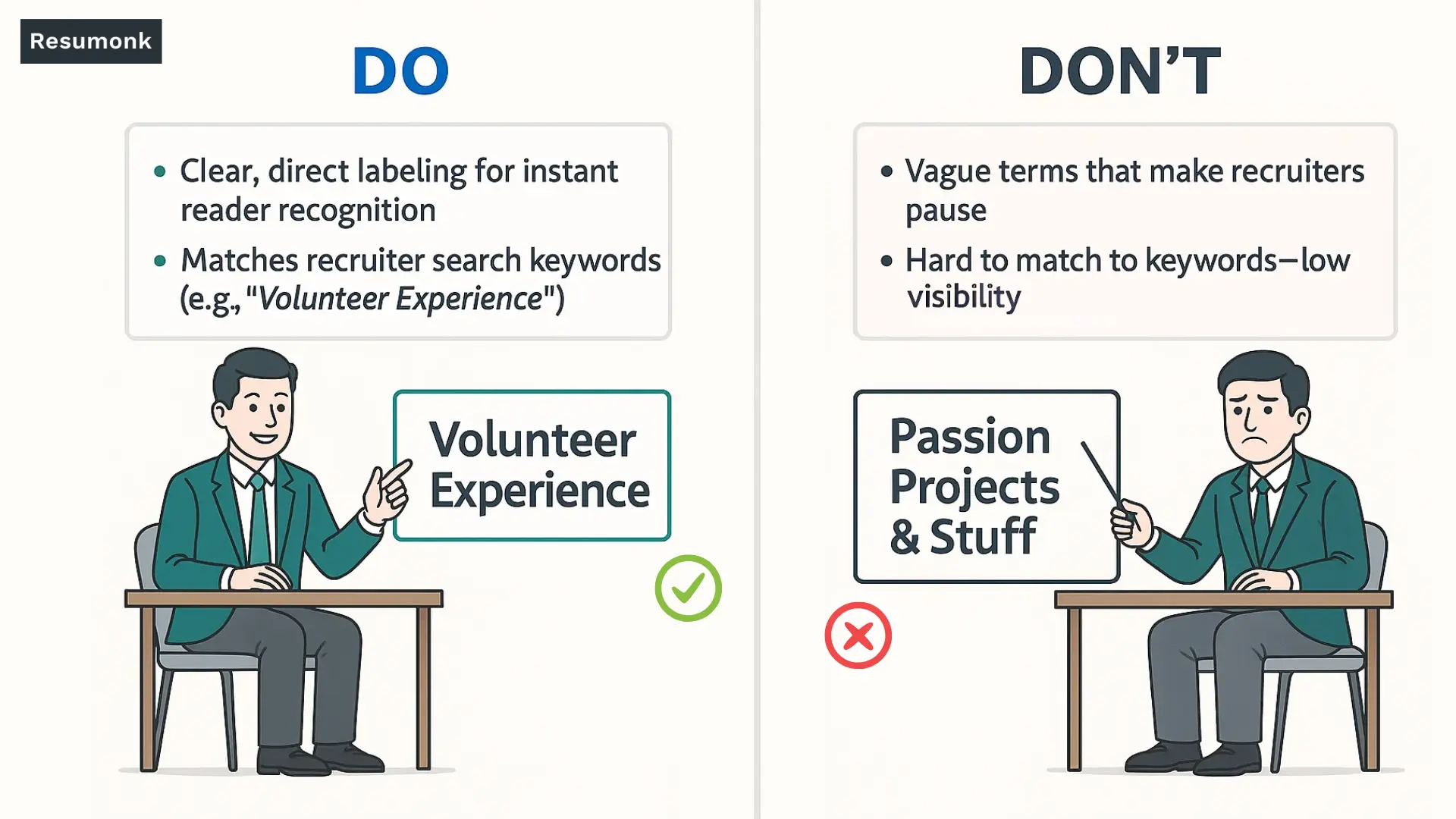
Skip playful titles such as "Passion Projects". A reader skimming the page may not see what is in them.
How much should you write for each volunteer role?
Each volunteer role gets as much space as it earns for this job:
- Recent and relevant: three bullet points.
- Relevant but older: two bullet points at most.
- Not related to the job: one line in an "Additional" section, or leave it out.
In the Resumonk editor, a volunteer role goes in the Experience section like any job. You can also add a custom section and name it Volunteer Experience.
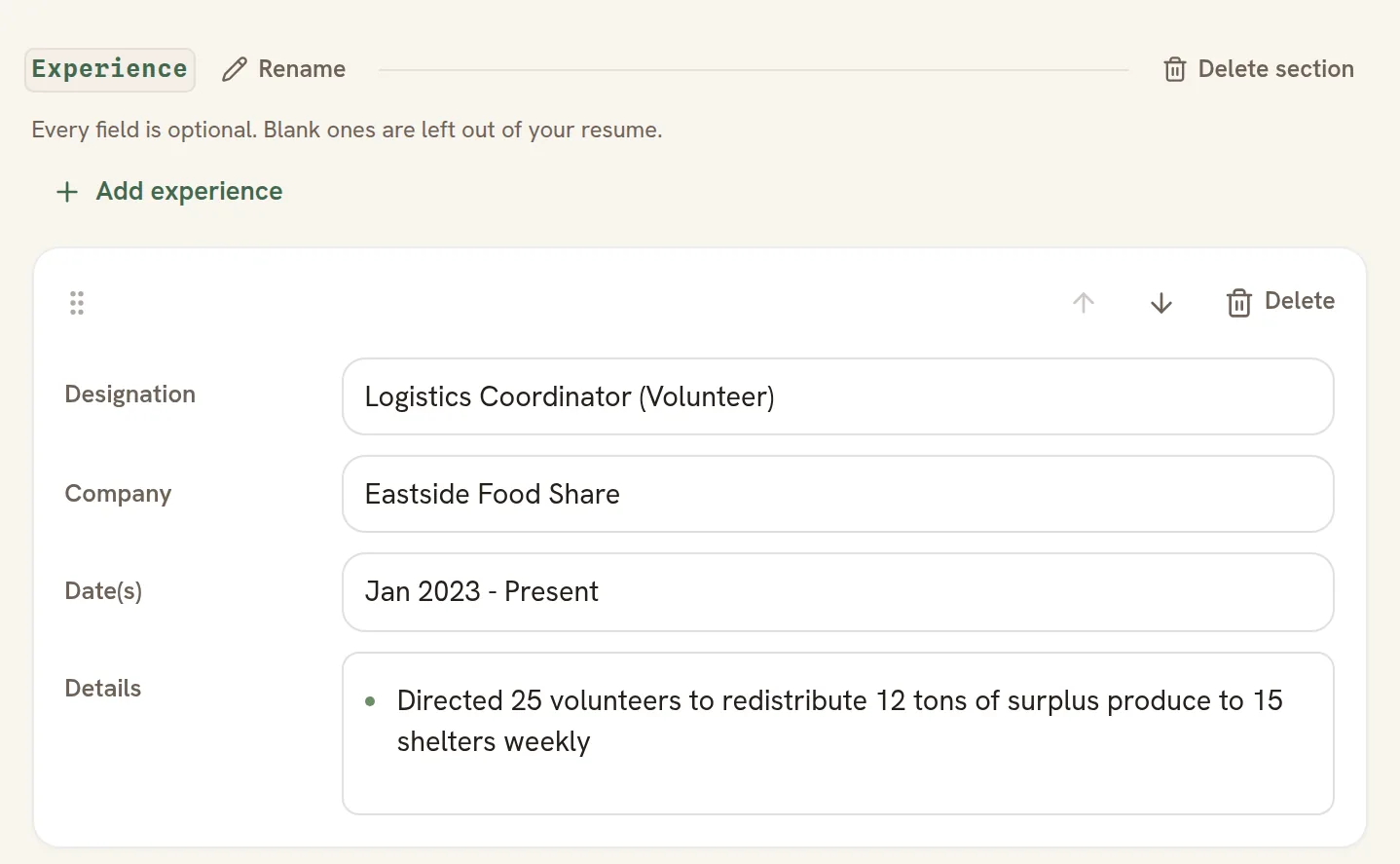
Add your volunteer rolesList them in Work Experience or in their own custom section, with the group, your role and the dates.
Build your resume
How do you describe volunteer work on a resume?
Volunteer work is described by what changed because of you, not by the tasks you were given. Start each bullet with an action verb, and add a number where you can.
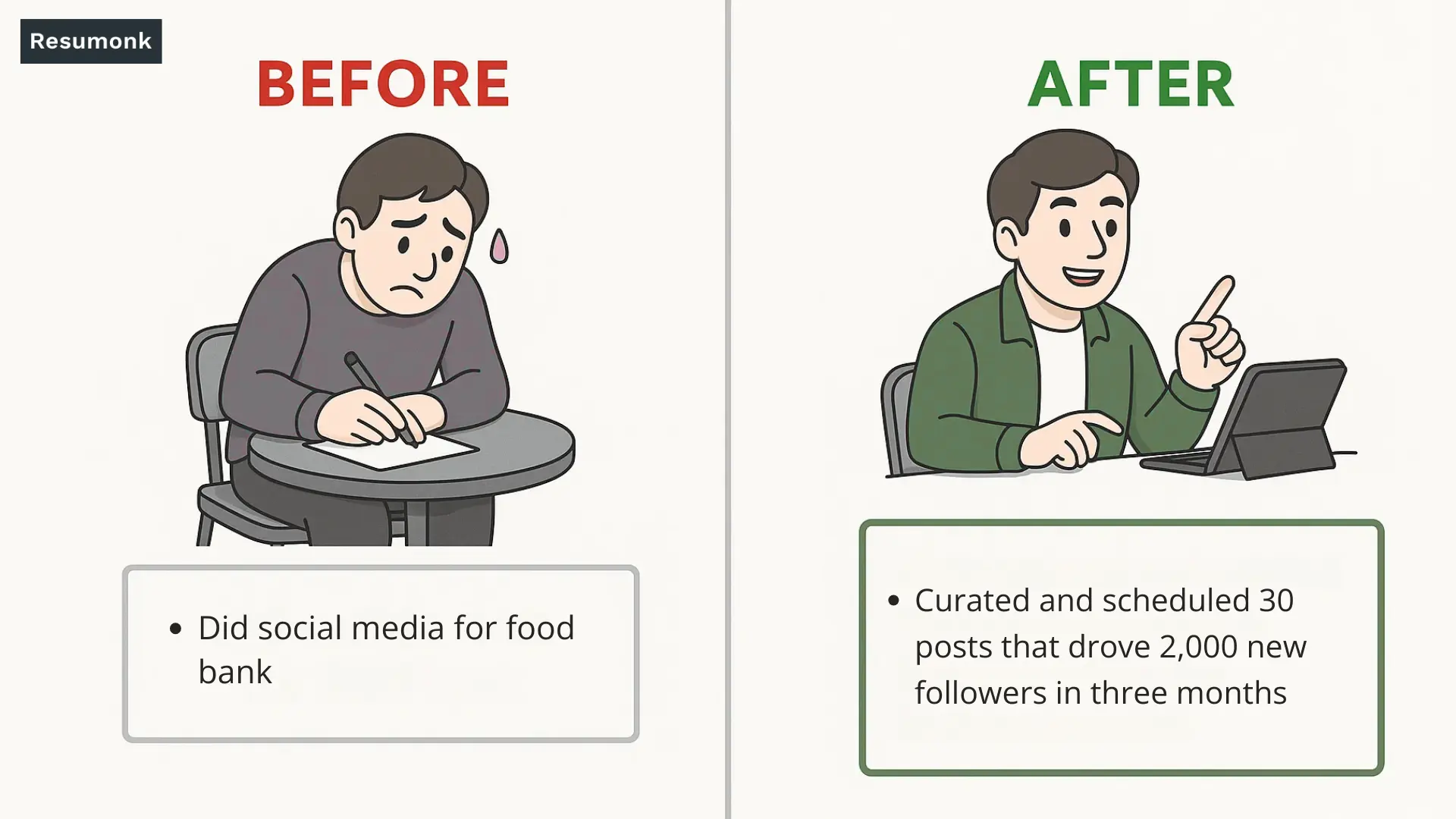
A bullet like "Helped run event" says little. "Coordinated 60 volunteers, cutting set-up time by 25%" shows what you did and what came of it. More examples of weak and strong versions:
| Weak Description | Stronger, Action-Packed Version |
|---|---|
| Did social media for food bank | Curated and scheduled 30 posts that drove 2k new followers in three months |
| Helped plan local 5k | Coordinated 60 volunteers, cutting set-up time by 25% and boosting registrations 18% |
| Worked with seniors | Mentored 12 older adults in basic digital banking, raising online adoption to 75% |
How do you put numbers on volunteer work?
Numbers for volunteer work come from what you can count: hours given, money raised, people served, volunteers led.
Independent Sector estimates the dollar value of a volunteer hour each year. That figure turns your hours into a sum, as in "Saved the shelter an estimated $6,700 in staffing costs".
If a volunteer role has nothing to count, describe one clear result instead, or keep the entry to one line.
How do you turn volunteer tasks into job skills?
Volunteer tasks turn into job skills when you name the skill an employer would use. Some examples:
- Ran a neighborhood food drive: supply chain coordination and working with partners.
- Served on the PTA finance committee: budget oversight and financial reporting.
- Organized a beach clean-up: project management.
Pick the words the job description uses, and keep the "(Volunteer)" label visible.
Volunteer work examples for a resume
These volunteer work examples and resume samples cover four situations. Copy the one closest to yours and change the details.
Volunteer examples for an entry-level resume
Example 1, a tutor:
- Community Literacy Tutor (Volunteer), Baltimore, MD | 2024-Present
- Coached 15 students; 9 advanced one reading level within a semester
- Designed phonics games that cut lesson-prep time 20%
Example 2, a student:
- Campus Sustainability Ambassador, Portland, OR | 2023
- Led dorm recycling drive, diverting 2 tons of waste in 8 weeks
- Presented results to Facilities VP; program expanded campus-wide
Volunteer example for a career changer
This example shows a teacher moving into project management, before and after:
- ❌ Before: Managed school science fair
- ✅ After: Ran a 12-team STEM fair on a $3k budget, with every project delivered on time
Volunteer example for a senior resume
For a board role, use verbs of oversight, as in this example:
- Board Trustee, City Arts Council (Volunteer) | 2021-Present
- Oversaw $1.2M operating budget; instituted quarterly risk reviews
- Secured corporate sponsorship that boosted annual funding by 27%
Volunteer examples by industry
Each example bullet below ties a volunteer result to the field:
- Healthcare: "Administered 120 flu shots at free clinic; cut patient wait times 30%."
- Technology: "Built open-source app that matched 500 seniors with tele-health mentors."
- Finance: "Audited micro-grant program, identifying $45k in reclaimable funds."
- Community service: "Distributed 8k meals" says more than "Volunteered at soup kitchen".
What kinds of volunteer work can go on a resume?
Any kind of volunteer work can go on a resume if it shows a skill or a result. The main kinds are:
- Community service: food banks, housing builds, charity runs. Lead with the numbers that show the effect.
- Professional volunteering: building a website or keeping the books for a nonprofit, unpaid. It shows you can already do the job.
- Teaching and mentoring: tutoring students or coaching a robotics team shows leadership, communication and patience.
- One-off events and projects: a park clean-up or a six-week fundraiser still counts when you can name what it achieved.
How do you put volunteering on a CV?
Volunteering goes on a CV the same way as on a resume: role, organization, dates and results. Name the section "Volunteering" or "Volunteer Experience".
On a UK CV, trustee roles and charity governance often get their own heading, such as "Trustee Roles". The rest of the advice here applies to a CV unchanged.
How do you write a resume for volunteer work?
A resume for a volunteer position is written like a resume for a paid job, kept to one page. Lead with what that role needs:
- A short summary of why you want to volunteer there and what you bring.
- Past volunteer roles first, then paid work.
- The skills the role lists, such as first aid, languages or working with children.
- Your availability, if the organization asks for it.
Here is an example summary for a voluntary worker resume:
- "Reliable volunteer with three years at a food bank and first aid training, looking to help at Riverside Animal Shelter on weekends."
Nonprofits may ask for a motivation letter. See how to write a motivation letter.
What mistakes should you avoid with volunteer work on a resume?
The most common volunteer work mistake is a vague entry. "Helped at fundraiser" tells the reader nothing; "Negotiated $25k in in-kind donations" does. Avoid these too:
- Too much volunteer work: the page should not read like a nonprofit's annual report. Lead with paid roles unless the volunteer work is closer to the job.
- A different layout: mixed fonts or date styles make the page look careless.
- Hiding that it was unpaid: always keep "(Volunteer)" in the entry.
- Political or religious causes: you choose whether to name them. If you would rather not, describe the skill, such as "community outreach", and leave the cause out.
Common questions about volunteer work on a resume
Does volunteer work count as work experience?
Volunteer work counts as work experience on a resume when the duties are real and relevant to the job. Label it "(Volunteer)", and it can sit with your paid jobs.
Is there a resume template for volunteer work?
Volunteer work needs no special resume template. Any template works: add a section called "Volunteer Experience" and use the same format as your jobs.
How do students list volunteer experience?
Students list volunteer experience in its own section, right after Education, with a result for each role. Campus clubs, tutoring and community service all count.
How do you list community service on a resume?
Community service goes on a resume in a "Community Service" or "Volunteer Experience" section. Give the organization, your role, the dates and what you achieved, as in "Distributed 8k meals".
Should you list volunteer work from long ago?
Old volunteer work stays on your resume only if it still shows something the job needs. Otherwise, keep your most recent roles and drop the rest.
Keep reading
job hunting.
Resumonk polishes your resume, discovers matching jobs and finds connections inside companies.
Get started free- Indeed
- Greenhouse
- + more