Product Owner Resume Example and Tips
Introduction
Product owners are hired for the backlog they ran and what shipped from it. This product owner resume example shows the responsibilities, skills, keywords and Scrum certifications to list. Summary lines cover junior to senior roles.
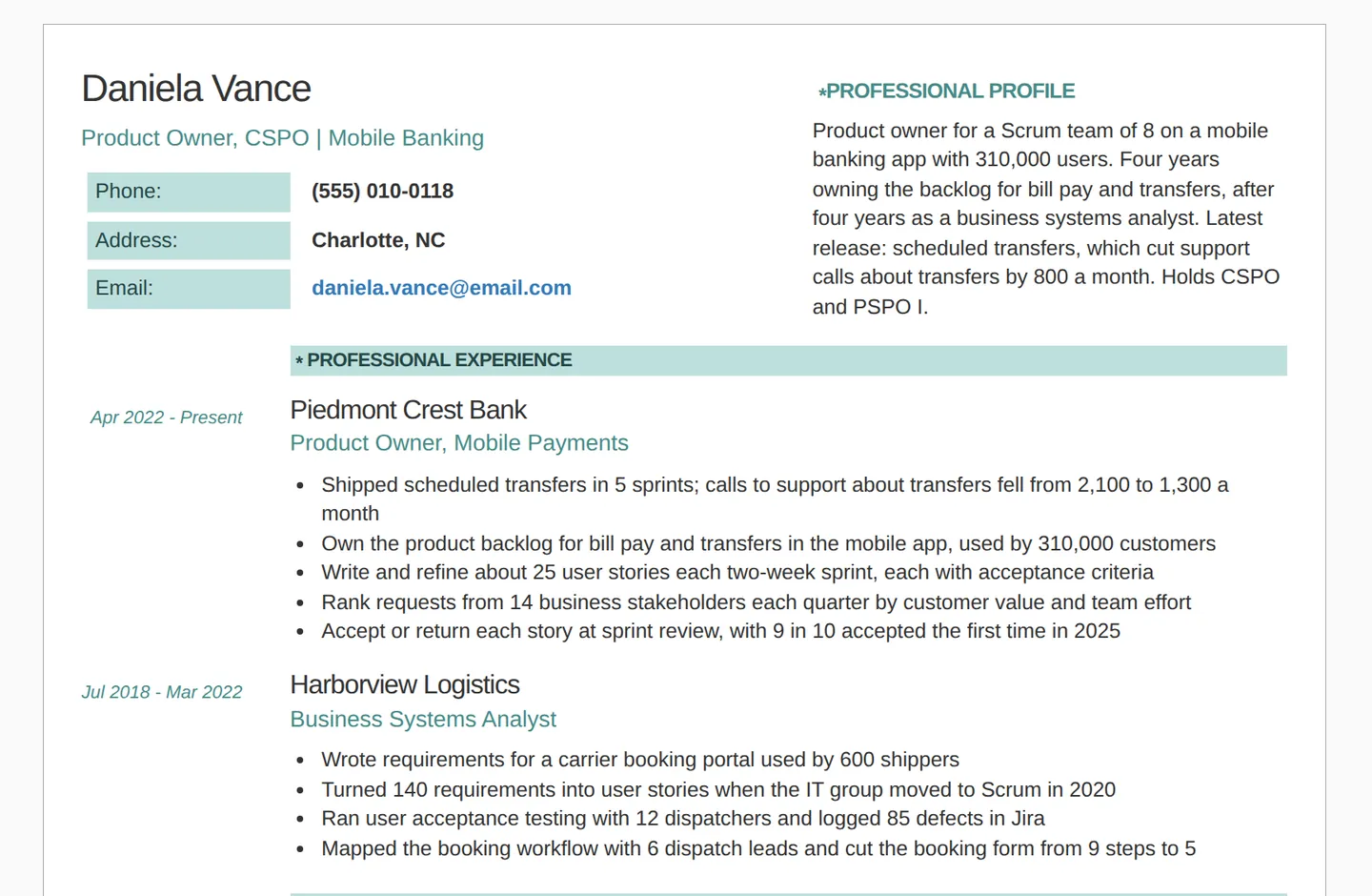
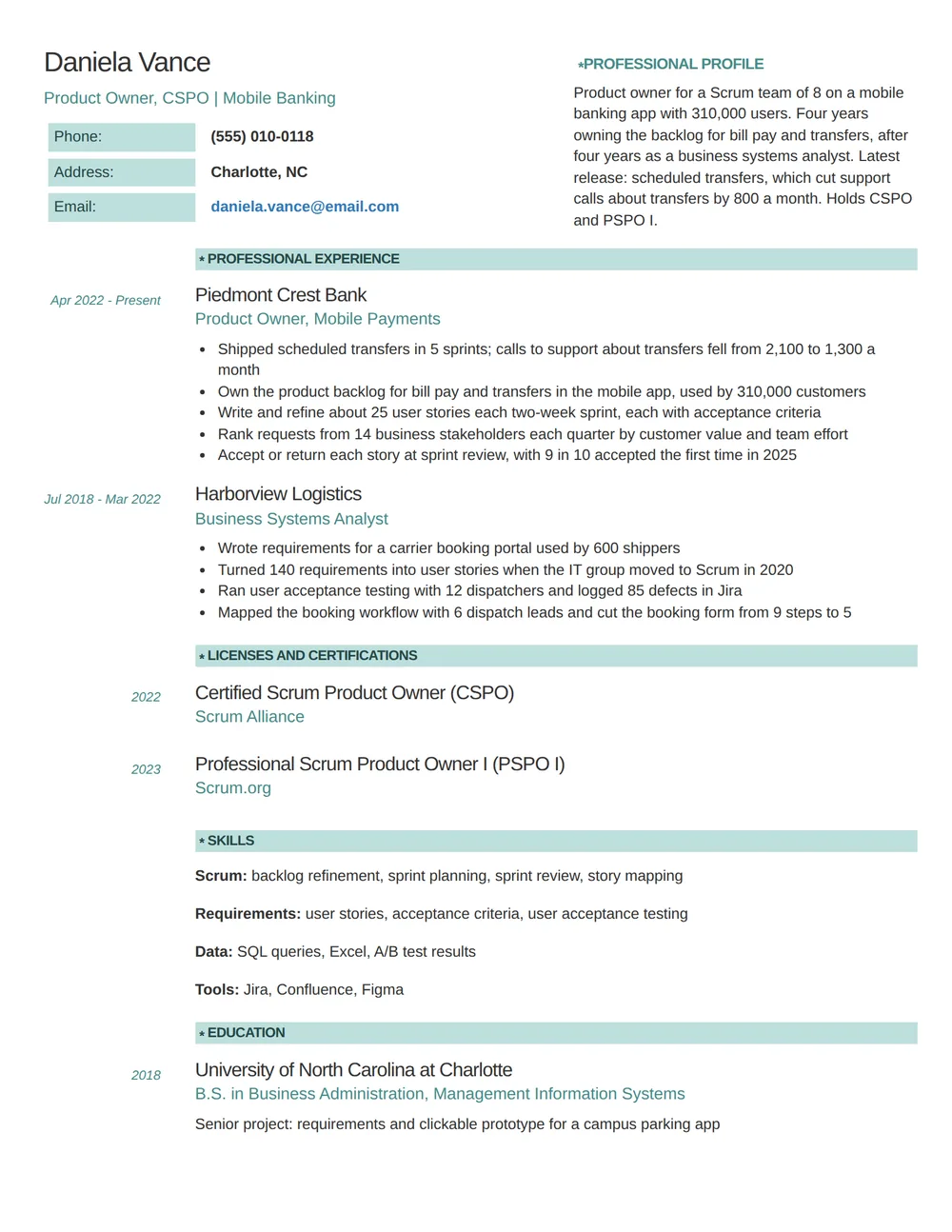
The sample belongs to Daniela Vance, who owns bill pay and transfers in a mobile banking app with 310,000 users. Her two jobs come first, then her CSPO and PSPO I. Each bullet ties a backlog task to a number, such as support calls falling from 2,100 to 1,300 a month.
A Scrum product owner on a mobile banking team
https://www.resumonk.com/product-owner-resumeProduct OwnerProduct owner resume template and layout
Use a one-page, one-column layout with work experience right under the summary. A product owner's proof sits in the shipped work, so the sample puts both jobs above the certifications.
Send the file as a PDF unless the posting asks for a Word file.
How do you describe a product owner role on a resume?
Name the product, its users, your team and what you own, in one line under the job title. The bullets then show what shipped.
Product Owner, Member Portal | Fairmont Mutual | 2023 - Present
Own the backlog for claims and billing pages used by 85,000 members, with one Scrum team of 7
Can I call myself a product owner if it was not my title?
Keep the title your employer used, and show the product owner work in the bullets. If you held the role on top of your job, a note in parentheses is honest: Business Analyst (acting product owner, 2024).
Should a business analyst and product owner resume use both titles?
Use both only when your employer used both, such as Business Analyst / Product Owner. Then split the bullets: requirements and testing work first, backlog ownership and releases after.
Should my LinkedIn headline match my product owner resume?
Yes, and the same goes for an Indeed profile. Use the same title and product area on each, such as Product Owner, Mobile Banking. A recruiter who reads one and then the other should find the same releases and numbers.
Backlog work, shipped features and the numbers behind them
Own, write, rank, accept: those four verbs cover most of a product owner's week. The sample uses each of them once, in its first job.
Product owner job description and responsibilities
The Scrum Guide makes the product owner accountable for the product goal and for ordering the product backlog. Turn each duty you did into a bullet with a number:
- Set the product goal and explain it to the team and stakeholders.
- Write product backlog items, usually as user stories with acceptance criteria.
- Order the backlog by value, risk and effort, and say no to what does not fit.
- Run backlog refinement with the developers before sprint planning.
- Answer questions during the sprint and accept or return work at the sprint review.
- Track release results after launch, such as usage, support calls or revenue.
Product owner bullet points to adapt
Example lines. Swap in your own product and numbers:
- Cut a 40-item backlog to 18 items the team could finish in two quarters
- Split an online checkout epic into 22 stories and released the first version in 3 sprints
- Added saved payment cards, used by 46,000 customers within six months
- Ran a story mapping workshop with 9 stakeholders to plan the next release
- Replaced weekly status emails with a public Jira roadmap for 30 stakeholders
How is a product owner resume different from a Scrum Master or product manager one?
A product owner resume is about what got built and why. Lines about running standups or removing blockers belong to a Scrum Master. Lines about pricing, market research or a full profit and loss belong to a product manager, unless you truly did that work.
How do I show results when a release has no revenue number?
Count what changed for the people who use it. For internal tools and platforms, these work:
- Cut the time to approve a vendor invoice from 6 days to 2 after a workflow release
- Moved 11 internal teams onto a shared login service in two quarters
- Reduced defects found after release from 30 a quarter to 12 by tightening acceptance criteria
- Retired 3 spreadsheets the finance team kept by hand, after a reporting page went live
Scrum skills and product owner resume keywords
Scrum, requirements, data and tools are the four lines in the sample's skills. Name Scrum events and artifacts exactly as the Scrum Guide does.
Product owner skills for a resume
- Scrum: product backlog, backlog refinement, sprint planning, sprint review, product goal.
- Requirements: user stories, acceptance criteria, story mapping, user acceptance testing.
- Data: SQL queries, Excel, A/B test results, funnel reports.
- Tools: Jira, Confluence, Azure DevOps, Figma, Miro.
Keywords from product owner postings
Postings repeat a small set of terms. Use the ones that are true for you, in the same words:
- backlog prioritization and ordering
- stakeholder management
- minimum viable product (MVP)
- release planning and roadmaps
- Scaled Agile Framework (SAFe), if the company runs it
Put each keyword inside a bullet as well, next to the result it led to.
Do product owners need technical skills on the resume?
Enough to talk with developers about trade-offs. Reading an API document, writing a simple SQL query and following a system diagram are common asks. A technical product owner adds the platforms in use, such as AWS or Azure, only where they really worked in them.
Lines a product owner can drop
- Velocity as a result: story points mean different things on each team, so the number does not travel.
- Ticket counts: stories written is effort, not a result. Keep it to one bullet, as the sample does.
- Agile slogans: "worked in an agile environment" says nothing a reader can check.
- Every tool in the company: list what you used each sprint.
Agile, technical and junior product owner resumes
Product owner titles hide very different jobs. Name your kind of product in the headline, the way the sample adds Mobile Banking.
Agile product owner resume summary examples
- Agile product owner with CSPO and four years on two Scrum teams, owning checkout and returns for an online retailer.
- Technical product owner for a payments API used by 140 partner companies, with a computer science degree and PSPO I.
- Senior product owner leading three Scrum teams on a member portal, with a product goal set each quarter.
Technical product owner resume
Name the systems: APIs, data pipelines, cloud services or internal platforms. Your users may be other developers, so count partners, calls or teams served.
A digital product owner names the channel, such as a website, app or customer portal. A Salesforce product owner names the clouds owned, such as Sales Cloud or Service Cloud. Add any Salesforce certification by its exact name.
Example lines for these three kinds of product owner:
- Technical: Wrote acceptance criteria for 18 API endpoints and cut partner support tickets by a third after launch
- Digital: Owned the booking pages of a retail website with 2 million monthly visits and released online booking in 4 sprints
- Salesforce: Owned the Service Cloud backlog for a 120-agent contact center and moved case routing off shared email
Junior or entry-level product owner resume
Many junior product owners move over from business analysis, testing, support or project coordination. Write an objective that names the move:
- Business analyst with three years of user stories and acceptance testing, seeking a junior product owner role on a Scrum team.
- Software tester with PSPO I, two years writing test cases from user stories. Seeking an entry-level product owner role on a web team.
- Customer support lead who logged and ranked 300 feature requests a year. Seeking a junior product owner role on a help desk product.
Then show backlog work you already did, even under another title, as the sample does with its analyst bullets.
Senior product owner resume
Show scope: how many teams, how many backlogs, and the product goal you set. Add any product owners you coached.
A senior summary example:
- Senior product owner with 9 years in insurance software. Sets the product goal for three Scrum teams on a claims platform and coached 2 new product owners.
CSPO, PSPO I and your degree
List each Scrum certification by its full name and the body that issues it, as the sample does:
- Certified Scrum Product Owner (CSPO): from Scrum Alliance, after a course with a Certified Scrum Trainer. It renews every two years.
- Professional Scrum Product Owner I (PSPO I): from Scrum.org, after passing an online assessment. It does not expire.
- Certified SAFe Product Owner/Product Manager (POPM): from Scaled Agile, for companies that run SAFe. It renews every year.
A certified scrum product owner resume should not shorten CSPO to a vague line like Scrum certified. Your degree goes below, with any subject.
Is CSPO or PSPO I better on a product owner resume?
Neither outranks the other, and postings name both. CSPO shows you took a course with a trainer; PSPO I shows you passed a test. List the one you hold, or both, as the sample does.
What if my CSPO has lapsed?
Renew it through Scrum Alliance, or take it off until it is active again. Your Scrum Alliance profile shows the expiry date, so check it before you apply.
Does a product owner need a degree?
Many postings list a bachelor's degree, often in business or computer science, but shipped work counts for more in interviews. List your degree in any subject, with a senior project if it involved requirements or design, as the sample does.
Stakeholders and Scrum teammates as references
A business stakeholder you worked with each sprint and a Scrum Master or engineering lead make a good pair. Keep their names on a separate list and share it when the company asks, often near the end of the interviews.
Should a developer on my team be a reference?
Yes, a senior developer or tech lead is a good third name. They can speak to how clear your stories were and how you handled trade-offs.
A short letter when the posting asks for one
Many product owner postings do not ask for a cover letter. When one is asked for, open with a release you owned and what changed after it.
Then name the product area you are applying to. Keep it to three short paragraphs.
What can a product owner cover letter open with?
A release, its users and the number that moved. An opening built from the sample's first job:
This year my team shipped scheduled transfers in our mobile banking app. Support calls about transfers fell from 2,100 to 1,300 a month. I am applying for your Product Owner role on the payments team.
Order your bullets the way you order a backlog
A backlog puts the highest-value item on top. Give each job's bullets the same treatment:
- The release with the clearest result for customers or the business.
- The size of what you own: users, teams, stakeholders.
- How you write and refine stories.
- How you rank requests and say no.
- Anything left over, or cut it.
The sample's first job follows this order: shipped scheduled transfers first, then the backlog it owns and the stories it writes.
Pick a template first
Pick one of the free templates and download your resume as a PDF. Build your product owner resume
More Product Management resume examples
- Product Manager resume example
- Associate Product Manager resume example
- Senior Product Manager resume example
See all Product Management resume examples, or browse every category.
Resume writing tips