Senior Product Manager Resume Example (with Expert Advice and Tips)
Introduction
You're sitting at your desk, maybe for the third time this week past 7 PM, orchestrating yet another cross-functional sync between engineering, design, and that particularly demanding stakeholder from sales. The Slack notifications won't stop, your roadmap presentation for next week's executive review is half-done, and somewhere in between all this, you're mentoring that eager junior PM who reminds you of yourself five years ago. You've been in the product game long enough now - maybe you've climbed from Associate PM to Product Manager, or perhaps you've made that fascinating leap from engineering or consulting into product. Either way, you know you're ready for more.
You're ready for that Senior Product Manager role where you'll own entire product lines, influence company strategy, and yes, finally get that seat at the table where the real decisions happen.
The Senior Product Manager position is that compelling middle ground in the product hierarchy - you're not quite Director level with multiple teams reporting to you, but you're well past needing someone to review your PRDs or approve your experimentation plans. Companies hiring Senior PMs are looking for autonomous leaders who can navigate ambiguity, drive significant business impact, and mentor the next generation of product talent. They need someone who can speak fluently with engineers about technical debt, present confidently to C-suite executives about market opportunities, and still maintain enough customer empathy to spot that crucial user pain point everyone else missed.
Creating a resume that captures this unique blend of strategic thinking and hands-on execution requires more than just listing your achievements - it demands a carefully crafted narrative that demonstrates your evolution as a product leader. Throughout this guide, we'll walk you through every element of building that perfect Senior Product Manager resume, from choosing the right format that showcases your progression, to crafting work experience bullets that speak to P&L impact rather than just feature delivery. We'll explore which skills differentiate senior-level candidates from mid-level PMs, how to position your educational background when you have years of real-world wins, and even whether those industry awards and Medium articles you've published deserve precious resume space.
We'll also address the unique challenges you might face - perhaps you're transitioning from a different industry and need to bridge that experience gap, or maybe you're in a market like London or Sydney where resume expectations differ from Silicon Valley norms. We'll cover how to handle that delicate balance of showing domain expertise while demonstrating adaptability, and yes, we'll even tackle the often-overlooked but critically important elements like references and cover letters that can make or break your senior-level candidacy. By the end of this guide, you'll have a comprehensive blueprint for creating a Senior Product Manager resume that doesn't just list what you've done, but powerfully communicates why you're ready to take on the strategic challenges and organizational influence that come with that coveted senior title.
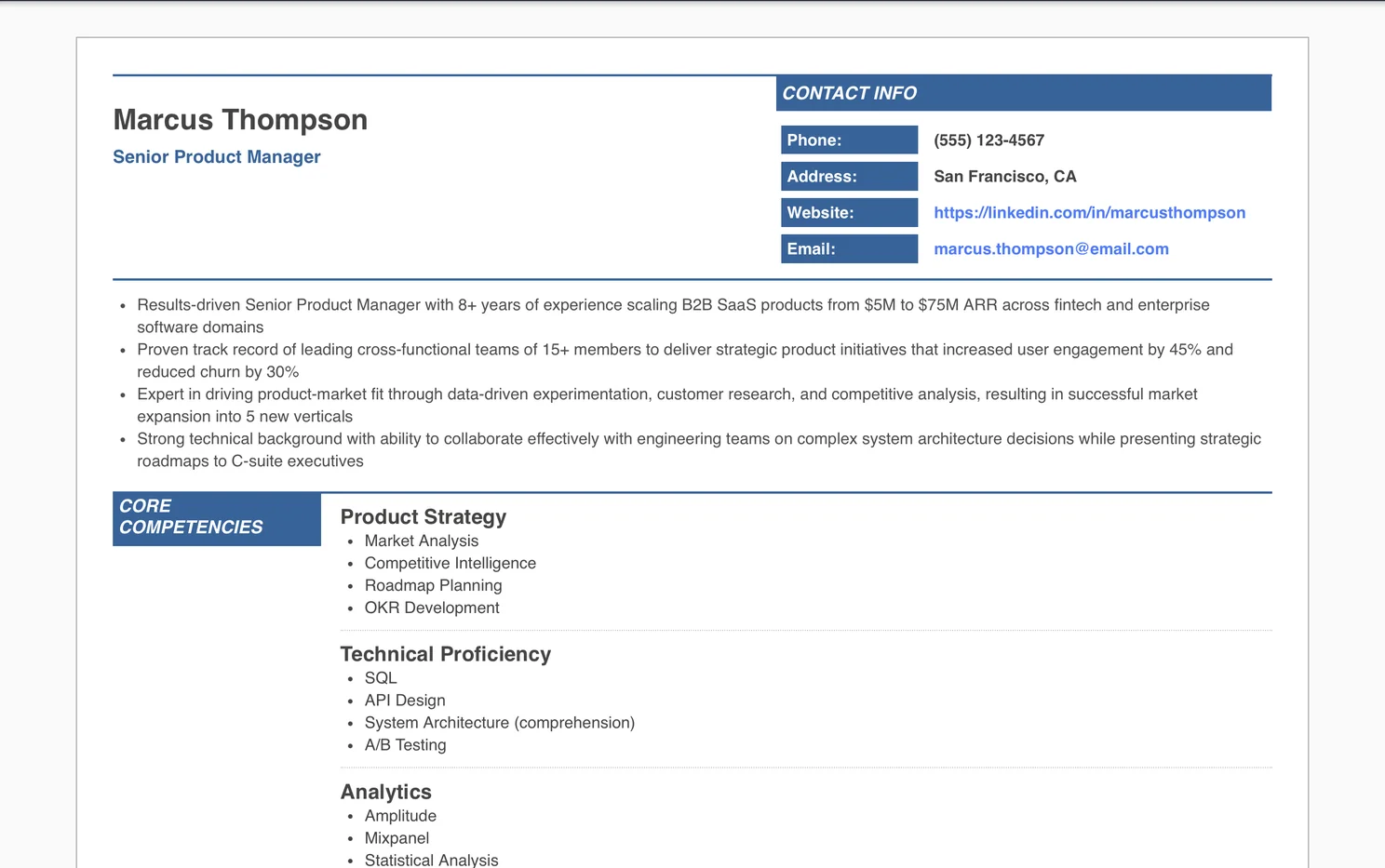
The Ultimate Senior Product Manager Resume Example/Sample
https://www.resumonk.com/senior-product-manager-resumeSenior Product ManagerResume Format for Senior Product Manager Resume
The Senior Product Manager position sits at that sweet spot between individual contribution and leadership - you're not quite at Director level, but you're certainly past the point of needing daily guidance.
Companies expect you to own entire product lines, drive cross-functional initiatives, and sometimes manage junior PMs. This context is crucial for choosing your resume format.
The Reverse-Chronological Format - Your Strategic Choice
For a Senior Product Manager position, the reverse-chronological format becomes your most powerful ally.
Why? Because hiring managers for senior roles need to see your progression story immediately. They want to understand how you've grown from handling single features to owning entire product ecosystems. This format places your most recent and presumably most impressive achievements at the top, where they command attention.
Your resume should open with a compelling Professional Summary - think of it as your elevator pitch for why you're ready for senior-level product leadership. This isn't the place for objectives or what you hope to achieve; it's about what you've already accomplished and the value you bring.
Structuring Your Senior PM Resume
The anatomy of your resume should follow this hierarchy:
- Professional Summary (3-4 lines of impact-driven narrative)
- Core Competencies (a strategic selection of 8-10 key skills)
- Professional Experience (the meat of your story)
- Education and Certifications
- Notable Projects or Products (optional but powerful for senior roles)
Remember, as a senior professional, you might have 10-15 years of experience, but your resume should still maintain focus. The two-page format works perfectly for Senior Product Manager resumes - it provides enough space to showcase depth without overwhelming the reader.
Work Experience on Senior Product Manager Resume
Your work experience section is where you transform from a candidate into a compelling narrative. As someone pursuing a Senior PM role, you're likely coming from one of several backgrounds - maybe you've been a Product Manager for 4-5 years and are ready for that senior title, or perhaps you're transitioning from a technical lead or business strategy role.
Either way, your experience needs to tell a story of increasing responsibility and measurable impact.
Crafting Impact-Driven Bullet Points
The difference between a Product Manager resume and a Senior Product Manager resume lies in the scope and depth of impact. While a PM might focus on feature delivery, a Senior PM demonstrates market influence, revenue impact, and strategic thinking.
Each role should include 4-6 bullet points that follow the CAR method - Context, Action, Result. But for senior roles, add a fourth element - Strategic Impact.
Here's how this transforms your bullet points:
❌ Don't write vague responsibility statements:
Managed product roadmap and worked with engineering team to deliver features
✅ Do write impact-focused achievements:
Orchestrated product strategy for $50M revenue line, leading cross-functional team of 15 to deliver
3 major releases that increased user engagement by 40% and reduced churn by 25%
Demonstrating Progressive Leadership
Your experience section should clearly show your evolution. If you're currently a Product Manager, highlight instances where you've operated at a senior level - maybe you mentored junior PMs, led strategic initiatives, or owned P&L responsibility.
These senior-level behaviors matter more than your current title.
For each role, consider including one bullet point that demonstrates:
- Revenue or cost impact (with specific numbers)
- User/customer impact (engagement, satisfaction, retention metrics)
- Team leadership or mentorship
- Strategic initiative ownership
- Cross-functional influence
❌ Don't underplay your strategic contributions:
Worked with marketing team on go-to-market strategy
✅ Do emphasize your leadership and results:
Spearheaded go-to-market strategy with marketing and sales, resulting in 150% of first-quarter
revenue target and successful expansion into 3 new market segments
Handling Career Transitions
If you're transitioning from engineering, consulting, or another field into senior product management, your work experience needs careful framing.
Highlight the product-minded aspects of your previous roles - the times you influenced product direction, worked with customers, or drove business outcomes. Your technical or business acumen is an asset, not a liability, when positioned correctly.
Skills to Include on Senior Product Manager Resume
The skills section of a Senior Product Manager resume requires surgical precision.
You're not just listing capabilities - you're strategically positioning yourself as someone who operates at the intersection of business strategy, technical understanding, and people leadership. The hiring manager scanning your resume needs to quickly identify that you possess both the hard skills to drive product success and the soft skills to influence without authority.
Technical and Business Skill Balance
Unlike entry-level PM roles where technical skills might be optional, Senior Product Managers need to demonstrate fluency in both technical and business domains. You're expected to have meaningful conversations with engineering about architectural decisions while also presenting to C-suite executives about market opportunities.
Your technical skills should reflect modern product management tools and methodologies:
- Analytics platforms (Amplitude, Mixpanel, Google Analytics)
- Product management tools (JIRA, ProductPlan, Aha!)
- Data querying capabilities (SQL, basic Python for data analysis)
- API and integration understanding
- A/B testing and experimentation frameworks
But here's where seniority shows - you don't just list tools, you group them strategically:
❌ Don't create a random skill dump:
Skills: JIRA, SQL, Agile, Leadership, Roadmapping, Excel, Communication, Figma
✅ Do organize skills by category with context:
Product Strategy: Market Analysis, Competitive Intelligence, Roadmap Planning, OKR Development
Technical Proficiency: SQL, API Design, System Architecture (comprehension), A/B Testing
Analytics: Amplitude, Mixpanel, Statistical Analysis, Cohort Analysis, User Segmentation
Leadership: Team Mentorship, Stakeholder Management, Executive Presentation, Change Management
The Senior PM Differentiators
What separates senior skills from standard PM skills?
It's the strategic and leadership layer. Include skills that demonstrate your ability to operate at a higher altitude:
- P&L Management
- Market Sizing and TAM Analysis
- Pricing Strategy
- Partnership Development
- Team Building and Mentorship
- Executive Stakeholder Management
Industry-Specific Considerations
Your skill set should also reflect the specific domain you're targeting. A Senior PM in fintech needs to show understanding of regulatory compliance and financial systems. A Senior PM in B2B SaaS should demonstrate enterprise sales cycle knowledge and integration complexity management.
Don't assume these are obvious - spell them out.
For different markets, adjust accordingly. In the UK and Europe, GDPR compliance and data privacy expertise carry weight. In the US market, understanding of SOC2, HIPAA (for healthcare), or PCI compliance (for payments) might be crucial.
Australian markets often value experience with local payment systems and regulatory frameworks.
Critical Considerations for Senior Product Manager Resume
Here's what most Senior PM candidates miss - your resume isn't just about showing you can do the job; it's about demonstrating you can navigate the unique challenges of senior product leadership. You're being hired not just to manage products, but to shape product culture, influence company strategy, and sometimes save struggling product lines.
The Leadership Without Authority Challenge
Senior Product Managers occupy a unique position - you need to show you can lead without direct reports, influence without organizational power, and drive results through persuasion and vision. Your resume should include specific examples of how you've navigated organizational complexity.
Include a "Key Achievement" or "Notable Project" section that tells a complete story:
Key Achievement: Product Turnaround Initiative
Inherited underperforming B2B product line with 30% YoY decline. Conducted 50+ customer interviews,
identified market-fit gaps, pivoted positioning, and rebuilt roadmap. Result: 40% revenue growth
in 12 months and NPS improvement from -10 to +35.
This shows strategic thinking, customer focus, and measurable business impact - the trifecta of senior PM success.
The Metrics That Matter at Senior Level
While junior PMs might celebrate feature launches, Senior PMs need to speak the language of business impact. Your resume should emphasize:
- Revenue generated or protected
- Market share captured
- Customer lifetime value improvements
- Churn reduction percentages
- Time-to-market acceleration
- Team productivity improvements
But here's the nuance - don't just list metrics, show the strategic thinking behind them:
❌ Don't just state outcomes:
Increased revenue by 50%
✅ Do connect strategy to results:
Identified underserved enterprise segment through market analysis, developed targeted feature set
and pricing strategy, resulting in 50% revenue increase and entry into Gartner Magic Quadrant
Addressing the Senior PM Paradox
Many Senior PM roles require domain expertise, yet companies also value fresh perspectives. Address this paradox by showing both depth and adaptability.
If you're switching industries, create a brief "Domain Expertise" section that bridges your experience to the new sector:
Domain Translation: Healthcare Technology
- Led HIPAA-compliant product development in previous fintech role (similar regulatory complexity)
- Managed integration with 20+ third-party systems (applicable to EMR integrations)
- Built products for risk-averse enterprise buyers (parallel to hospital system sales cycles)
The Geographic and Cultural Nuances
Senior PM roles vary significantly by region.
In Silicon Valley, emphasis on rapid scaling and venture metrics matters. In European markets, sustainable growth and regulatory compliance take precedence. For Canadian markets, bilingual capabilities and understanding of provincial differences can be differentiators. Tailor your achievements accordingly - a successful product launch in highly-regulated Germany carries different weight than one in the more flexible US market.
Finally, remember that Senior Product Manager resumes get more scrutiny than junior roles. Every claim needs substantiation, every metric needs context, and every achievement needs to ladder up to business impact.
You're not just showing you can manage products - you're demonstrating you can be trusted with the company's strategic bets.
Education Section for Senior Product Manager Resume
Here's the reality: at the senior PM level, your education section becomes the supporting actor, not the lead.
Recruiters and hiring managers are far more interested in the products you've shipped and the impact you've created. But that doesn't mean education becomes irrelevant - it just needs to be positioned strategically.
Where to Place Your Education
For Senior Product Manager roles, your education typically sits near the bottom of your resume, after your professional experience and key achievements. The exception? If you recently completed an executive MBA, a specialized product management certification from a prestigious institution, or a relevant advanced degree that directly enhances your product leadership credentials.
In these cases, you might position education higher, especially if the role specifically values such qualifications.
What Educational Background to Highlight
Senior PM roles often attract candidates from diverse educational backgrounds - computer science, business, psychology, design, even liberal arts. The key is showing how your educational foundation supports your product thinking.
Include your degree, university, and graduation year (though you can skip the year if you graduated more than 15 years ago to avoid potential age bias).
❌ Don't write vague educational entries:
Bachelor of Science
State University
Various coursework in business and technology
✅ Do write specific, relevant educational entries:
B.S. Computer Science, Minor in Business Administration
University of California, Berkeley
Relevant Coursework: Human-Computer Interaction, Data Structures, Strategic Management
Including Certifications and Continuous Learning
The product management field evolves rapidly, and Senior PMs are expected to stay current. Including recent certifications shows you're committed to continuous learning - a crucial trait when you're responsible for product strategy in fast-changing markets.
Focus on recognized certifications like Pragmatic Marketing, Product School, or specialized technical certifications relevant to your product domain.
When listing certifications, include the issuing organization and completion date. For ongoing education, you can create a separate "Professional Development" subsection within education to highlight recent courses, bootcamps, or executive programs.
❌ Don't list every online course you've ever taken:
Certifications:
- Various Coursera courses
- Multiple Udemy certificates
- LinkedIn Learning badges
✅ Do list strategic, recognized certifications:
Professional Certifications:
- Certified Scrum Product Owner (CSPO), Scrum Alliance, 2023
- Pragmatic Marketing Certified - Level III (PMC-III), 2022
- AWS Certified Cloud Practitioner, Amazon Web Services, 2023
Academic Achievements Worth Mentioning
At the senior level, only include academic honors if they're truly exceptional or directly relevant to the role. Summa cum laude, valedictorian status, or relevant thesis work that connects to your current product domain might be worth including. However, that college club presidency from 15 years ago? It's time to let it go.
Your recent product launches speak louder than dated academic achievements.
Awards and Publications on Senior Product Manager Resume
As a Senior Product Manager, you're expected to be more than just an executor - you're a thought leader, an innovator, and someone who elevates the entire product organization. Awards and publications demonstrate exactly that.
Industry Awards That Matter
Not all awards are created equal in the product management world.
Focus on recognition that demonstrates your impact on business metrics, user experience, or innovation. Product excellence awards, industry recognition for specific product launches, or company-wide honors for cross-functional leadership all reinforce your senior-level capabilities.
When listing awards, include the awarding organization, year, and a brief context about why it matters. Remember, the person reading your resume might not know that winning the "Product Excellence Award" at your company means you beat out 200 other product managers globally.
❌ Don't list awards without context:
Awards:
- Innovation Award, 2023
- Best Product, 2022
- Employee of the Quarter
✅ Do provide meaningful context for awards:
Industry Recognition:
- TechCrunch Top 100 Products Award, 2023
 Led the product team that launched AI-powered analytics dashboard,
 recognized for innovation in B2B SaaS

- Company Innovation Award, Google, 2022
 Selected from 500+ product managers for driving 40% user engagement increase
Publications and Thought Leadership
Senior PMs are often expected to represent their companies at conferences, contribute to product strategy discussions, and share insights with the broader product community. Publications - whether blog posts on Medium, articles in industry publications, or white papers - demonstrate your ability to think strategically and communicate complex ideas.
Include publications that showcase your expertise in areas relevant to the role you're targeting. If you're applying for a Senior PM role in fintech, that article you wrote about API monetization strategies is gold.
The key is quality over quantity - three thoughtful pieces in respected publications trump twenty random blog posts.
Patents and Intellectual Property
If you've been involved in patent applications or have contributed to significant intellectual property development, this can be particularly valuable for Senior PM roles in technical or innovative companies. Include patent numbers, co-inventors if relevant, and a brief description of the innovation's impact.
❌ Don't use technical jargon without explanation:
Patents:
- US Patent #10,123,456 - System and method for algorithmic processing
✅ Do explain the business impact:
Patents:
- US Patent #10,123,456: "Real-time Personalization Engine" (2023)
 Co-inventor of recommendation system now serving 10M+ daily active users,
 driving 25% increase in user engagement
Listing References for Senior Product Manager Resume
The approach to references has evolved significantly in recent years, particularly for senior positions. Gone are the days of simply listing "References available upon request" at the bottom of your resume.
Today's Senior PM candidates need a more sophisticated strategy.
To List or Not to List on Your Resume
Here's the general rule for Senior Product Manager positions: don't include references directly on your resume unless specifically requested. Your resume real estate is too valuable, and you need every line to showcase your product wins and leadership impact.
However, having a separate, polished references document ready to deploy shows preparation and professionalism.
The exception varies by geography. In the UK and Australia, it's more common to include "References available upon request" at the bottom of your CV.
In the US and Canada, even this line is often considered redundant - of course you have references; you're a Senior PM with years of experience.
Choosing Your Reference Portfolio
For a Senior PM role, your references should represent different perspectives on your work. The ideal portfolio includes: a former direct manager who can speak to your strategic thinking and execution, a peer from engineering or design who can attest to your collaborative skills, and potentially a former direct report who can validate your mentorship and team-building abilities.
Consider including someone from a different functional area - perhaps a sales leader you've worked with on go-to-market strategies, or a customer success director who's seen how your products impact users. This demonstrates the cross-functional influence expected at the senior level.
❌ Don't list references without context:
References:
- John Smith - [email protected] - 555-0123
- Jane Doe - [email protected] - 555-0456
- Bob Johnson - [email protected] - 555-0789
✅ Do provide strategic reference context:
Professional References:

Sarah Chen
VP of Product, Stripe (Former Direct Manager at Square)
Relationship: Reported directly to Sarah for 3 years while scaling Square Cash from
1M to 15M users
Email: [email protected] | LinkedIn: linkedin.com/in/sarahchen

Marcus Williams
Principal Engineer, Netflix (Former Engineering Partner at Uber)
Relationship: Co-led the Uber Eats recommendation engine project, resulting in
30% increase in order frequency
Email: [email protected] | Phone: Available upon request
Preparing Your References for Success
At the senior level, reference checks often go beyond basic verification.
Expect detailed discussions about your leadership style, decision-making process, and ability to navigate organizational complexity. Prepare your references by sending them the job description, reminding them of specific projects you'd like them to highlight, and giving them context about the company culture.
Create a reference briefing document that includes key achievements you've listed on your resume, challenges the new company is facing, and specific examples that demonstrate your fit for the role. Your references are busy senior professionals too - make it easy for them to advocate for you effectively.
The LinkedIn Strategy
While not a replacement for traditional references, LinkedIn recommendations from credible sources add weight to your candidacy. For Senior PM roles, quality trumps quantity.
Three thoughtful recommendations from recognized industry leaders or former colleagues now in senior positions carry more weight than twenty generic endorsements.
Time these strategically. If you're actively job searching, reach out to key connections for fresh recommendations that speak to your recent work. A recommendation from 2015 about your junior PM skills doesn't reinforce your senior-level capabilities.
Managing Reference Timing
Never list someone as a reference without their explicit, recent permission. For Senior PM roles, the reference check often happens late in the process, sometimes weeks after you've provided the list.
Check in with your references when you reach the final rounds, giving them a heads-up about potential timing and any specific areas the employer might explore.
Remember, at the senior level, your references might know people at the company you're applying to - the product leadership world isn't that large. This can work in your favor if managed well, but it also means maintaining strong professional relationships throughout your career is crucial. That PM you mentored five years ago might now be a Director at your dream company.
Cover Letter Tips for Senior Product Manager Resume
For Senior Product Manager positions, your cover letter serves a different purpose than it did when you were breaking into product management.
It's not about proving you can do the job - your resume already does that. It's about demonstrating strategic thinking, cultural fit, and most importantly, why this specific role at this specific company excites you enough to leave your current senior position.
The Strategic Narrative Approach
Your cover letter should tell a story that your resume can't. While your resume lists achievements, your cover letter connects the dots between your experience and the company's current challenges. Research the company's recent product launches, read their engineering blog, understand their competitive landscape.
Then, position yourself as the Senior PM who's uniquely equipped to tackle their specific challenges.
Start with a hook that shows you understand their business. Maybe they just announced a platform pivot, or they're struggling with user retention in a specific segment.
Lead with insight, not introduction.
❌ Don't start with generic introductions:
"Dear Hiring Manager,
I am writing to express my interest in the Senior Product Manager position at your company. With 8 years of experience in product management, I believe I would be a great fit for this role."
✅ Do start with strategic insight:
"Dear [Specific Name],
Spotify's recent pivot toward podcast monetization reminds me of when I led YouTube's creator economy transformation - the challenge isn't just building features, it's reimagining an entire ecosystem while maintaining core user trust."
Demonstrating Leadership Without Saying "Leader"
Senior PM roles require leadership across three dimensions - upward to executives, horizontally across engineering and design, and downward to junior team members.
Your cover letter should subtly demonstrate all three without resorting to buzzwords. Share a brief story about influencing without authority, or describe how you've built product culture in previous organizations.
The Three-Paragraph Power Structure
Keep it concise - hiring managers for senior roles are even busier than you are. Use a three-paragraph structure: First, establish credibility and show market understanding. Second, highlight one or two specific achievements that directly relate to their needs.
Third, articulate your vision for the role and next steps.
For companies in different regions, adjust your tone accordingly. US companies often appreciate bold, metric-driven narratives. UK firms might prefer a more understated approach with emphasis on collaborative achievements.
Canadian and Australian companies often value a balance - confident but not aggressive, metric-driven but also team-focused.
Addressing the Elephant: Why You're Leaving
As a Senior PM, you likely have a good role already. The cover letter should subtly address why you're making a move without badmouthing your current situation.
Focus on growth, new challenges, or specific aspects of the new company's mission that resonate with your career trajectory.
❌ Don't focus on what you're running from:
"I'm looking to leave my current role due to limited growth opportunities and organizational challenges."
✅ Do focus on what you're running toward:
"Your recent Series C funding and expansion into enterprise markets aligns perfectly with my experience scaling B2B products from $10M to $100M ARR."
Key Takeaways
After diving deep into crafting the perfect Senior Product Manager resume, here are the essential points to remember as you build yours:
- Use reverse-chronological format exclusively - Your progression story from individual contributor to senior leader needs to be immediately visible, with your most impressive and recent achievements commanding attention at the top
- Lead with business impact, not feature delivery - Every bullet point should connect to revenue, user engagement, retention, or strategic market positioning rather than just listing what you shipped
- Demonstrate the "senior" through scope and influence - Show how you've mentored teams, influenced without authority, owned P&L responsibility, and driven cross-functional initiatives that span beyond single product features
- Balance technical fluency with business acumen - Include both technical tools (SQL, analytics platforms, A/B testing) and business skills (market analysis, pricing strategy, stakeholder management) to show you operate effectively at the intersection
- Keep it to two pages maximum - Even with 10-15 years of experience, focus on the most relevant and impactful achievements rather than creating an exhaustive career history
- Position education strategically - Unless you have a recent executive MBA or highly relevant certification, place education after experience and keep it concise but meaningful
- Include metrics with context - Don't just say you increased revenue by 50%; explain the strategic thinking and market insight that drove those results
- Prepare a separate references document - Don't waste resume space on references, but have a polished document ready with strategic choices including former managers, cross-functional peers, and even former direct reports
- Tailor for geographic and industry nuances - Adjust your approach based on whether you're targeting Silicon Valley growth companies, regulated European markets, or specific domains like fintech or healthcare
Ready to transform these insights into your own compelling Senior Product Manager resume? Resumonk makes it seamless to create a professional, polished resume that captures your senior-level product leadership. With AI-powered recommendations that understand the nuances of senior PM roles, beautifully designed templates that present your experience with the sophistication expected at this level, and smart formatting that ensures your strategic achievements shine through, you can build a resume that truly reflects your readiness for that next senior product challenge.
Ready to craft your Senior Product Manager resume?
Join thousands of senior product leaders who've successfully landed their next role with Resumonk. Our platform understands the unique requirements of Senior PM positions and helps you create a resume that showcases your strategic impact and leadership capabilities.
Start Building Your Senior PM Resume with Resumonk →
More Product Management resume examples
See all Product Management resume examples, or browse every category.
Resume writing tips
You're sitting at your desk, maybe for the third time this week past 7 PM, orchestrating yet another cross-functional sync between engineering, design, and that particularly demanding stakeholder from sales. The Slack notifications won't stop, your roadmap presentation for next week's executive review is half-done, and somewhere in between all this, you're mentoring that eager junior PM who reminds you of yourself five years ago. You've been in the product game long enough now - maybe you've climbed from Associate PM to Product Manager, or perhaps you've made that fascinating leap from engineering or consulting into product. Either way, you know you're ready for more.
You're ready for that Senior Product Manager role where you'll own entire product lines, influence company strategy, and yes, finally get that seat at the table where the real decisions happen.
The Senior Product Manager position is that compelling middle ground in the product hierarchy - you're not quite Director level with multiple teams reporting to you, but you're well past needing someone to review your PRDs or approve your experimentation plans. Companies hiring Senior PMs are looking for autonomous leaders who can navigate ambiguity, drive significant business impact, and mentor the next generation of product talent. They need someone who can speak fluently with engineers about technical debt, present confidently to C-suite executives about market opportunities, and still maintain enough customer empathy to spot that crucial user pain point everyone else missed.
Creating a resume that captures this unique blend of strategic thinking and hands-on execution requires more than just listing your achievements - it demands a carefully crafted narrative that demonstrates your evolution as a product leader. Throughout this guide, we'll walk you through every element of building that perfect Senior Product Manager resume, from choosing the right format that showcases your progression, to crafting work experience bullets that speak to P&L impact rather than just feature delivery. We'll explore which skills differentiate senior-level candidates from mid-level PMs, how to position your educational background when you have years of real-world wins, and even whether those industry awards and Medium articles you've published deserve precious resume space.
We'll also address the unique challenges you might face - perhaps you're transitioning from a different industry and need to bridge that experience gap, or maybe you're in a market like London or Sydney where resume expectations differ from Silicon Valley norms. We'll cover how to handle that delicate balance of showing domain expertise while demonstrating adaptability, and yes, we'll even tackle the often-overlooked but critically important elements like references and cover letters that can make or break your senior-level candidacy. By the end of this guide, you'll have a comprehensive blueprint for creating a Senior Product Manager resume that doesn't just list what you've done, but powerfully communicates why you're ready to take on the strategic challenges and organizational influence that come with that coveted senior title.
The Ultimate Senior Product Manager Resume Example/Sample
https://www.resumonk.com/senior-product-manager-resumeSenior Product ManagerResume Format for Senior Product Manager Resume
The Senior Product Manager position sits at that sweet spot between individual contribution and leadership - you're not quite at Director level, but you're certainly past the point of needing daily guidance.
Companies expect you to own entire product lines, drive cross-functional initiatives, and sometimes manage junior PMs. This context is crucial for choosing your resume format.
The Reverse-Chronological Format - Your Strategic Choice
For a Senior Product Manager position, the reverse-chronological format becomes your most powerful ally.
Why? Because hiring managers for senior roles need to see your progression story immediately. They want to understand how you've grown from handling single features to owning entire product ecosystems. This format places your most recent and presumably most impressive achievements at the top, where they command attention.
Your resume should open with a compelling Professional Summary - think of it as your elevator pitch for why you're ready for senior-level product leadership. This isn't the place for objectives or what you hope to achieve; it's about what you've already accomplished and the value you bring.
Structuring Your Senior PM Resume
The anatomy of your resume should follow this hierarchy:
- Professional Summary (3-4 lines of impact-driven narrative)
- Core Competencies (a strategic selection of 8-10 key skills)
- Professional Experience (the meat of your story)
- Education and Certifications
- Notable Projects or Products (optional but powerful for senior roles)
Remember, as a senior professional, you might have 10-15 years of experience, but your resume should still maintain focus. The two-page format works perfectly for Senior Product Manager resumes - it provides enough space to showcase depth without overwhelming the reader.
Work Experience on Senior Product Manager Resume
Your work experience section is where you transform from a candidate into a compelling narrative. As someone pursuing a Senior PM role, you're likely coming from one of several backgrounds - maybe you've been a Product Manager for 4-5 years and are ready for that senior title, or perhaps you're transitioning from a technical lead or business strategy role.
Either way, your experience needs to tell a story of increasing responsibility and measurable impact.
Crafting Impact-Driven Bullet Points
The difference between a Product Manager resume and a Senior Product Manager resume lies in the scope and depth of impact. While a PM might focus on feature delivery, a Senior PM demonstrates market influence, revenue impact, and strategic thinking.
Each role should include 4-6 bullet points that follow the CAR method - Context, Action, Result. But for senior roles, add a fourth element - Strategic Impact.
Here's how this transforms your bullet points:
❌ Don't write vague responsibility statements:
Managed product roadmap and worked with engineering team to deliver features
✅ Do write impact-focused achievements:
Orchestrated product strategy for $50M revenue line, leading cross-functional team of 15 to deliver
3 major releases that increased user engagement by 40% and reduced churn by 25%
Demonstrating Progressive Leadership
Your experience section should clearly show your evolution. If you're currently a Product Manager, highlight instances where you've operated at a senior level - maybe you mentored junior PMs, led strategic initiatives, or owned P&L responsibility.
These senior-level behaviors matter more than your current title.
For each role, consider including one bullet point that demonstrates:
- Revenue or cost impact (with specific numbers)
- User/customer impact (engagement, satisfaction, retention metrics)
- Team leadership or mentorship
- Strategic initiative ownership
- Cross-functional influence
❌ Don't underplay your strategic contributions:
Worked with marketing team on go-to-market strategy
✅ Do emphasize your leadership and results:
Spearheaded go-to-market strategy with marketing and sales, resulting in 150% of first-quarter
revenue target and successful expansion into 3 new market segments
Handling Career Transitions
If you're transitioning from engineering, consulting, or another field into senior product management, your work experience needs careful framing.
Highlight the product-minded aspects of your previous roles - the times you influenced product direction, worked with customers, or drove business outcomes. Your technical or business acumen is an asset, not a liability, when positioned correctly.
Skills to Include on Senior Product Manager Resume
The skills section of a Senior Product Manager resume requires surgical precision.
You're not just listing capabilities - you're strategically positioning yourself as someone who operates at the intersection of business strategy, technical understanding, and people leadership. The hiring manager scanning your resume needs to quickly identify that you possess both the hard skills to drive product success and the soft skills to influence without authority.
Technical and Business Skill Balance
Unlike entry-level PM roles where technical skills might be optional, Senior Product Managers need to demonstrate fluency in both technical and business domains. You're expected to have meaningful conversations with engineering about architectural decisions while also presenting to C-suite executives about market opportunities.
Your technical skills should reflect modern product management tools and methodologies:
- Analytics platforms (Amplitude, Mixpanel, Google Analytics)
- Product management tools (JIRA, ProductPlan, Aha!)
- Data querying capabilities (SQL, basic Python for data analysis)
- API and integration understanding
- A/B testing and experimentation frameworks
But here's where seniority shows - you don't just list tools, you group them strategically:
❌ Don't create a random skill dump:
Skills: JIRA, SQL, Agile, Leadership, Roadmapping, Excel, Communication, Figma
✅ Do organize skills by category with context:
Product Strategy: Market Analysis, Competitive Intelligence, Roadmap Planning, OKR Development
Technical Proficiency: SQL, API Design, System Architecture (comprehension), A/B Testing
Analytics: Amplitude, Mixpanel, Statistical Analysis, Cohort Analysis, User Segmentation
Leadership: Team Mentorship, Stakeholder Management, Executive Presentation, Change Management
The Senior PM Differentiators
What separates senior skills from standard PM skills?
It's the strategic and leadership layer. Include skills that demonstrate your ability to operate at a higher altitude:
- P&L Management
- Market Sizing and TAM Analysis
- Pricing Strategy
- Partnership Development
- Team Building and Mentorship
- Executive Stakeholder Management
Industry-Specific Considerations
Your skill set should also reflect the specific domain you're targeting. A Senior PM in fintech needs to show understanding of regulatory compliance and financial systems. A Senior PM in B2B SaaS should demonstrate enterprise sales cycle knowledge and integration complexity management.
Don't assume these are obvious - spell them out.
For different markets, adjust accordingly. In the UK and Europe, GDPR compliance and data privacy expertise carry weight. In the US market, understanding of SOC2, HIPAA (for healthcare), or PCI compliance (for payments) might be crucial.
Australian markets often value experience with local payment systems and regulatory frameworks.
Critical Considerations for Senior Product Manager Resume
Here's what most Senior PM candidates miss - your resume isn't just about showing you can do the job; it's about demonstrating you can navigate the unique challenges of senior product leadership. You're being hired not just to manage products, but to shape product culture, influence company strategy, and sometimes save struggling product lines.
The Leadership Without Authority Challenge
Senior Product Managers occupy a unique position - you need to show you can lead without direct reports, influence without organizational power, and drive results through persuasion and vision. Your resume should include specific examples of how you've navigated organizational complexity.
Include a "Key Achievement" or "Notable Project" section that tells a complete story:
Key Achievement: Product Turnaround Initiative
Inherited underperforming B2B product line with 30% YoY decline. Conducted 50+ customer interviews,
identified market-fit gaps, pivoted positioning, and rebuilt roadmap. Result: 40% revenue growth
in 12 months and NPS improvement from -10 to +35.
This shows strategic thinking, customer focus, and measurable business impact - the trifecta of senior PM success.
The Metrics That Matter at Senior Level
While junior PMs might celebrate feature launches, Senior PMs need to speak the language of business impact. Your resume should emphasize:
- Revenue generated or protected
- Market share captured
- Customer lifetime value improvements
- Churn reduction percentages
- Time-to-market acceleration
- Team productivity improvements
But here's the nuance - don't just list metrics, show the strategic thinking behind them:
❌ Don't just state outcomes:
Increased revenue by 50%
✅ Do connect strategy to results:
Identified underserved enterprise segment through market analysis, developed targeted feature set
and pricing strategy, resulting in 50% revenue increase and entry into Gartner Magic Quadrant
Addressing the Senior PM Paradox
Many Senior PM roles require domain expertise, yet companies also value fresh perspectives. Address this paradox by showing both depth and adaptability.
If you're switching industries, create a brief "Domain Expertise" section that bridges your experience to the new sector:
Domain Translation: Healthcare Technology
- Led HIPAA-compliant product development in previous fintech role (similar regulatory complexity)
- Managed integration with 20+ third-party systems (applicable to EMR integrations)
- Built products for risk-averse enterprise buyers (parallel to hospital system sales cycles)
The Geographic and Cultural Nuances
Senior PM roles vary significantly by region.
In Silicon Valley, emphasis on rapid scaling and venture metrics matters. In European markets, sustainable growth and regulatory compliance take precedence. For Canadian markets, bilingual capabilities and understanding of provincial differences can be differentiators. Tailor your achievements accordingly - a successful product launch in highly-regulated Germany carries different weight than one in the more flexible US market.
Finally, remember that Senior Product Manager resumes get more scrutiny than junior roles. Every claim needs substantiation, every metric needs context, and every achievement needs to ladder up to business impact.
You're not just showing you can manage products - you're demonstrating you can be trusted with the company's strategic bets.
Education Section for Senior Product Manager Resume
Here's the reality: at the senior PM level, your education section becomes the supporting actor, not the lead.
Recruiters and hiring managers are far more interested in the products you've shipped and the impact you've created. But that doesn't mean education becomes irrelevant - it just needs to be positioned strategically.
Where to Place Your Education
For Senior Product Manager roles, your education typically sits near the bottom of your resume, after your professional experience and key achievements. The exception? If you recently completed an executive MBA, a specialized product management certification from a prestigious institution, or a relevant advanced degree that directly enhances your product leadership credentials.
In these cases, you might position education higher, especially if the role specifically values such qualifications.
What Educational Background to Highlight
Senior PM roles often attract candidates from diverse educational backgrounds - computer science, business, psychology, design, even liberal arts. The key is showing how your educational foundation supports your product thinking.
Include your degree, university, and graduation year (though you can skip the year if you graduated more than 15 years ago to avoid potential age bias).
❌ Don't write vague educational entries:
Bachelor of Science
State University
Various coursework in business and technology
✅ Do write specific, relevant educational entries:
B.S. Computer Science, Minor in Business Administration
University of California, Berkeley
Relevant Coursework: Human-Computer Interaction, Data Structures, Strategic Management
Including Certifications and Continuous Learning
The product management field evolves rapidly, and Senior PMs are expected to stay current. Including recent certifications shows you're committed to continuous learning - a crucial trait when you're responsible for product strategy in fast-changing markets.
Focus on recognized certifications like Pragmatic Marketing, Product School, or specialized technical certifications relevant to your product domain.
When listing certifications, include the issuing organization and completion date. For ongoing education, you can create a separate "Professional Development" subsection within education to highlight recent courses, bootcamps, or executive programs.
❌ Don't list every online course you've ever taken:
Certifications:
- Various Coursera courses
- Multiple Udemy certificates
- LinkedIn Learning badges
✅ Do list strategic, recognized certifications:
Professional Certifications:
- Certified Scrum Product Owner (CSPO), Scrum Alliance, 2023
- Pragmatic Marketing Certified - Level III (PMC-III), 2022
- AWS Certified Cloud Practitioner, Amazon Web Services, 2023
Academic Achievements Worth Mentioning
At the senior level, only include academic honors if they're truly exceptional or directly relevant to the role. Summa cum laude, valedictorian status, or relevant thesis work that connects to your current product domain might be worth including. However, that college club presidency from 15 years ago? It's time to let it go.
Your recent product launches speak louder than dated academic achievements.
Awards and Publications on Senior Product Manager Resume
As a Senior Product Manager, you're expected to be more than just an executor - you're a thought leader, an innovator, and someone who elevates the entire product organization. Awards and publications demonstrate exactly that.
Industry Awards That Matter
Not all awards are created equal in the product management world.
Focus on recognition that demonstrates your impact on business metrics, user experience, or innovation. Product excellence awards, industry recognition for specific product launches, or company-wide honors for cross-functional leadership all reinforce your senior-level capabilities.
When listing awards, include the awarding organization, year, and a brief context about why it matters. Remember, the person reading your resume might not know that winning the "Product Excellence Award" at your company means you beat out 200 other product managers globally.
❌ Don't list awards without context:
Awards:
- Innovation Award, 2023
- Best Product, 2022
- Employee of the Quarter
✅ Do provide meaningful context for awards:
Industry Recognition:
- TechCrunch Top 100 Products Award, 2023
 Led the product team that launched AI-powered analytics dashboard,
 recognized for innovation in B2B SaaS

- Company Innovation Award, Google, 2022
 Selected from 500+ product managers for driving 40% user engagement increase
Publications and Thought Leadership
Senior PMs are often expected to represent their companies at conferences, contribute to product strategy discussions, and share insights with the broader product community. Publications - whether blog posts on Medium, articles in industry publications, or white papers - demonstrate your ability to think strategically and communicate complex ideas.
Include publications that showcase your expertise in areas relevant to the role you're targeting. If you're applying for a Senior PM role in fintech, that article you wrote about API monetization strategies is gold.
The key is quality over quantity - three thoughtful pieces in respected publications trump twenty random blog posts.
Patents and Intellectual Property
If you've been involved in patent applications or have contributed to significant intellectual property development, this can be particularly valuable for Senior PM roles in technical or innovative companies. Include patent numbers, co-inventors if relevant, and a brief description of the innovation's impact.
❌ Don't use technical jargon without explanation:
Patents:
- US Patent #10,123,456 - System and method for algorithmic processing
✅ Do explain the business impact:
Patents:
- US Patent #10,123,456: "Real-time Personalization Engine" (2023)
 Co-inventor of recommendation system now serving 10M+ daily active users,
 driving 25% increase in user engagement
Listing References for Senior Product Manager Resume
The approach to references has evolved significantly in recent years, particularly for senior positions. Gone are the days of simply listing "References available upon request" at the bottom of your resume.
Today's Senior PM candidates need a more sophisticated strategy.
To List or Not to List on Your Resume
Here's the general rule for Senior Product Manager positions: don't include references directly on your resume unless specifically requested. Your resume real estate is too valuable, and you need every line to showcase your product wins and leadership impact.
However, having a separate, polished references document ready to deploy shows preparation and professionalism.
The exception varies by geography. In the UK and Australia, it's more common to include "References available upon request" at the bottom of your CV.
In the US and Canada, even this line is often considered redundant - of course you have references; you're a Senior PM with years of experience.
Choosing Your Reference Portfolio
For a Senior PM role, your references should represent different perspectives on your work. The ideal portfolio includes: a former direct manager who can speak to your strategic thinking and execution, a peer from engineering or design who can attest to your collaborative skills, and potentially a former direct report who can validate your mentorship and team-building abilities.
Consider including someone from a different functional area - perhaps a sales leader you've worked with on go-to-market strategies, or a customer success director who's seen how your products impact users. This demonstrates the cross-functional influence expected at the senior level.
❌ Don't list references without context:
References:
- John Smith - [email protected] - 555-0123
- Jane Doe - [email protected] - 555-0456
- Bob Johnson - [email protected] - 555-0789
✅ Do provide strategic reference context:
Professional References:

Sarah Chen
VP of Product, Stripe (Former Direct Manager at Square)
Relationship: Reported directly to Sarah for 3 years while scaling Square Cash from
1M to 15M users
Email: [email protected] | LinkedIn: linkedin.com/in/sarahchen

Marcus Williams
Principal Engineer, Netflix (Former Engineering Partner at Uber)
Relationship: Co-led the Uber Eats recommendation engine project, resulting in
30% increase in order frequency
Email: [email protected] | Phone: Available upon request
Preparing Your References for Success
At the senior level, reference checks often go beyond basic verification.
Expect detailed discussions about your leadership style, decision-making process, and ability to navigate organizational complexity. Prepare your references by sending them the job description, reminding them of specific projects you'd like them to highlight, and giving them context about the company culture.
Create a reference briefing document that includes key achievements you've listed on your resume, challenges the new company is facing, and specific examples that demonstrate your fit for the role. Your references are busy senior professionals too - make it easy for them to advocate for you effectively.
The LinkedIn Strategy
While not a replacement for traditional references, LinkedIn recommendations from credible sources add weight to your candidacy. For Senior PM roles, quality trumps quantity.
Three thoughtful recommendations from recognized industry leaders or former colleagues now in senior positions carry more weight than twenty generic endorsements.
Time these strategically. If you're actively job searching, reach out to key connections for fresh recommendations that speak to your recent work. A recommendation from 2015 about your junior PM skills doesn't reinforce your senior-level capabilities.
Managing Reference Timing
Never list someone as a reference without their explicit, recent permission. For Senior PM roles, the reference check often happens late in the process, sometimes weeks after you've provided the list.
Check in with your references when you reach the final rounds, giving them a heads-up about potential timing and any specific areas the employer might explore.
Remember, at the senior level, your references might know people at the company you're applying to - the product leadership world isn't that large. This can work in your favor if managed well, but it also means maintaining strong professional relationships throughout your career is crucial. That PM you mentored five years ago might now be a Director at your dream company.
Cover Letter Tips for Senior Product Manager Resume
For Senior Product Manager positions, your cover letter serves a different purpose than it did when you were breaking into product management.
It's not about proving you can do the job - your resume already does that. It's about demonstrating strategic thinking, cultural fit, and most importantly, why this specific role at this specific company excites you enough to leave your current senior position.
The Strategic Narrative Approach
Your cover letter should tell a story that your resume can't. While your resume lists achievements, your cover letter connects the dots between your experience and the company's current challenges. Research the company's recent product launches, read their engineering blog, understand their competitive landscape.
Then, position yourself as the Senior PM who's uniquely equipped to tackle their specific challenges.
Start with a hook that shows you understand their business. Maybe they just announced a platform pivot, or they're struggling with user retention in a specific segment.
Lead with insight, not introduction.
❌ Don't start with generic introductions:
"Dear Hiring Manager,
I am writing to express my interest in the Senior Product Manager position at your company. With 8 years of experience in product management, I believe I would be a great fit for this role."
✅ Do start with strategic insight:
"Dear [Specific Name],
Spotify's recent pivot toward podcast monetization reminds me of when I led YouTube's creator economy transformation - the challenge isn't just building features, it's reimagining an entire ecosystem while maintaining core user trust."
Demonstrating Leadership Without Saying "Leader"
Senior PM roles require leadership across three dimensions - upward to executives, horizontally across engineering and design, and downward to junior team members.
Your cover letter should subtly demonstrate all three without resorting to buzzwords. Share a brief story about influencing without authority, or describe how you've built product culture in previous organizations.
The Three-Paragraph Power Structure
Keep it concise - hiring managers for senior roles are even busier than you are. Use a three-paragraph structure: First, establish credibility and show market understanding. Second, highlight one or two specific achievements that directly relate to their needs.
Third, articulate your vision for the role and next steps.
For companies in different regions, adjust your tone accordingly. US companies often appreciate bold, metric-driven narratives. UK firms might prefer a more understated approach with emphasis on collaborative achievements.
Canadian and Australian companies often value a balance - confident but not aggressive, metric-driven but also team-focused.
Addressing the Elephant: Why You're Leaving
As a Senior PM, you likely have a good role already. The cover letter should subtly address why you're making a move without badmouthing your current situation.
Focus on growth, new challenges, or specific aspects of the new company's mission that resonate with your career trajectory.
❌ Don't focus on what you're running from:
"I'm looking to leave my current role due to limited growth opportunities and organizational challenges."
✅ Do focus on what you're running toward:
"Your recent Series C funding and expansion into enterprise markets aligns perfectly with my experience scaling B2B products from $10M to $100M ARR."
Key Takeaways
After diving deep into crafting the perfect Senior Product Manager resume, here are the essential points to remember as you build yours:
- Use reverse-chronological format exclusively - Your progression story from individual contributor to senior leader needs to be immediately visible, with your most impressive and recent achievements commanding attention at the top
- Lead with business impact, not feature delivery - Every bullet point should connect to revenue, user engagement, retention, or strategic market positioning rather than just listing what you shipped
- Demonstrate the "senior" through scope and influence - Show how you've mentored teams, influenced without authority, owned P&L responsibility, and driven cross-functional initiatives that span beyond single product features
- Balance technical fluency with business acumen - Include both technical tools (SQL, analytics platforms, A/B testing) and business skills (market analysis, pricing strategy, stakeholder management) to show you operate effectively at the intersection
- Keep it to two pages maximum - Even with 10-15 years of experience, focus on the most relevant and impactful achievements rather than creating an exhaustive career history
- Position education strategically - Unless you have a recent executive MBA or highly relevant certification, place education after experience and keep it concise but meaningful
- Include metrics with context - Don't just say you increased revenue by 50%; explain the strategic thinking and market insight that drove those results
- Prepare a separate references document - Don't waste resume space on references, but have a polished document ready with strategic choices including former managers, cross-functional peers, and even former direct reports
- Tailor for geographic and industry nuances - Adjust your approach based on whether you're targeting Silicon Valley growth companies, regulated European markets, or specific domains like fintech or healthcare
Ready to transform these insights into your own compelling Senior Product Manager resume? Resumonk makes it seamless to create a professional, polished resume that captures your senior-level product leadership. With AI-powered recommendations that understand the nuances of senior PM roles, beautifully designed templates that present your experience with the sophistication expected at this level, and smart formatting that ensures your strategic achievements shine through, you can build a resume that truly reflects your readiness for that next senior product challenge.
Ready to craft your Senior Product Manager resume?
Join thousands of senior product leaders who've successfully landed their next role with Resumonk. Our platform understands the unique requirements of Senior PM positions and helps you create a resume that showcases your strategic impact and leadership capabilities.
Start Building Your Senior PM Resume with Resumonk →
More Product Management resume examples
See all Product Management resume examples, or browse every category.
Resume writing tips