Dear Software Engineer - This is why your resume was rejected

A software engineer's resume is most often rejected because it was sent cold, with no referral, or not changed for the job. Bullets that list duties instead of results, missing links to your code, a messy layout and typos sink many more.
Below are the 13 most common reasons, and how to fix each one.
In short
- Many software engineer resumes are rejected for reasons the applicant can fix, not for a lack of skill.
- A referral from someone inside the company gets a resume read sooner than an application sent cold.
- A software engineer resume should change for each job, using the job post's words for skills you really have.
- Resume bullets that start with a verb and give a number show results, not just duties.
- Links to GitHub, a personal site or a blog let an employer see your work before the interview.
- One page is enough for most software engineers, and two pages is the limit for a long career.
Why was your software engineer resume rejected?
A software engineer resume is usually rejected for one or more of these 13 reasons:
- You applied without a referral.
- You sent the same resume to every job.
- Your resume has no links to your code or writing.
- You skipped the cover letter.
- Your bullets list duties instead of achievements.
- Your achievements have no numbers.
- Your projects are missing or do not fit the job.
- Your resume does not use the words of the job post.
- The layout is dense or hard to read.
- The resume is too long.
- It is full of fluff and cliches.
- It has typos or grammar mistakes.
- It lists certifications that do not matter for the job.
Each one is explained below, with what to do instead.
What should a software engineering resume include?
A software engineering resume should include these sections, in roughly this order:
- Contact details: your name, a headline with your role, email, phone, and links to GitHub, LinkedIn or your site.
- A short summary: two or three lines on your level, your main languages and what you want to work on.
- Experience: each job with bullets about what you built and what it changed.
- Projects: side projects, open source work or freelance work that fits the job.
- Skills: languages, frameworks and tools, grouped so they are easy to scan.
- Education: your degree, or a bootcamp or other training.
A recent graduate can put Education above Experience. With a few years of work behind you, Experience goes first.
How do you get a referral for a software engineering job?
A referral for a software engineering job comes from someone at the company who passes your resume to the hiring team. Applications that come through networking and referrals are usually read sooner than those sent through a job board.
Ways to get referred:
- Apply to companies where a friend or a former colleague works, and ask them to refer you.
- Find an engineer at the company on LinkedIn and send a short, polite email about their work.
- Get noticed through the product itself: fix an issue in the company's open source code, or report a bug clearly.
Here is a cold email template for the second option, with blanks in square brackets to fill in:
Hi [Name],
I saw your talk at [Conference] last year on YouTube. I liked what you did with [Technology], in particular [a detail that shows you know the topic]. I am also a [Technology] developer.
I noticed that your company is hiring for [Role], and I would love to be part of your team. Do you have a few minutes to chat on Thursday about what your team is working on?
Thanks,
[Your Name]
[Your website or a public profile link]
Should you change your resume for each job?
A software engineer resume should change for each job, even if most of it stays the same. The headline and summary at the top are the easiest parts to change.
Use them to show your fit for that role, and move the most relevant skills to the front. Here is the same engineer's header written for two different jobs:


The first version leads with architecture for a senior role. The second leads with languages and side interests for a hands-on developer job.
Fix your engineering resumePaste a job post into Resumonk, and it writes a version of your resume for that job.
Build your resume
Which links should a software engineer resume include?
A software engineer resume should include links that let an employer see your work. Add GitHub, a personal website or blog, and Stack Overflow if you are active there. At the very least, add your LinkedIn profile.
A blog shows what you know and how clearly you write, which matters in any engineering team. Most engineers have more to write about than they think. Good topics come from everyday work:
- An email you wrote to a coworker explaining a strange bug.
- A long comment in your code explaining a concept.
- A comparison you made when choosing a tool or library.
Write out each link in full, not as a word with a link behind it. A printed resume cannot be clicked.
Do software engineers need a cover letter?
A cover letter helps a software engineer most when applying without a referral, through an online posting. Keep it short: say what role you want, why you fit and one or two things you have built.
Resumonk's software engineer sample resume comes with a software engineer cover letter example to read for length and tone.
How do you turn duties into achievements?
Turn a duty into an achievement by starting the bullet with an action verb. Say what you did, not what you were responsible for. Compare these two lines:
- Instead of: Was responsible for fetching the market quotes for equity derivatives from top 6 exchanges
- Write: Implemented a new algorithm to fetch the derivatives quotes with minimum market lag
Leave out "I" and "me", and start each bullet with the verb. Here is how a full experience entry reads:
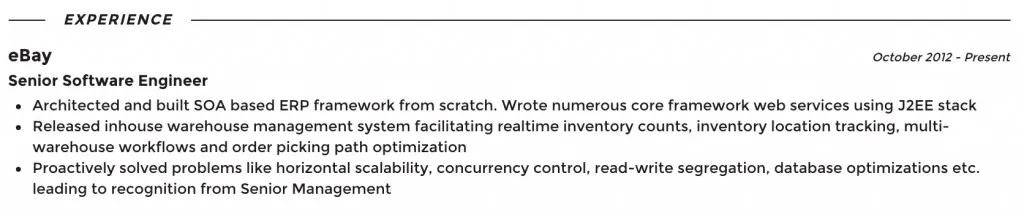
How do you quantify impact on a resume?
Quantify impact on a resume by adding the number that shows the result: time saved, speed, users, revenue or team size. The bullet above reads better with one:
- Implemented a new algorithm to fetch the derivatives quotes that reduced the market lag by 65%
- Helped increase affiliate revenue by 75% in 2 months
- Led a team of 3 students to revamp the annual magazine of our college and improved the circulation by 40%
Use only numbers you can explain in an interview.
Which projects belong on a software engineer resume?
The projects that belong on a software engineer resume are the ones that fit the job and that you built by choice. Personal projects show that you code for interest, not only for a paycheck.
- An expense-sharing app you built for your friends.
- A budget app you wrote for a family member.
- Open source contributions, freelance work or a side project with real users.
Projects matter most when your current job does not match the one you want. An enterprise developer at a bank who applies to a consumer tech company can show the fit through projects.
Read the job post first and pick the projects that match it. Cut old school projects to make room. If you have none that fit, build one before you apply.
Which keywords should a software engineer resume use?
A software engineer resume should use the words of the job post for the skills, tools and titles you really have. Recruiters search and skim for those words, so "Hadoop" on the post should read "Hadoop" on your resume.
This job post, for example, says Big Data and Hadoop experience is a must:
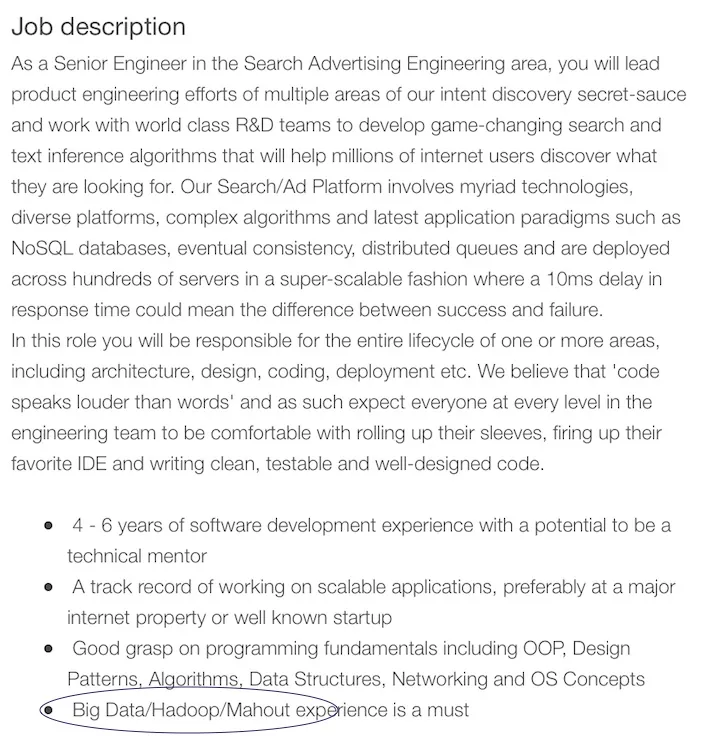
If you have that experience, put "Big Data" and "Hadoop" in your skills section and in the bullets where you used them. A grouped skills section looks like this:

How should a software engineer resume be formatted?
A software engineer resume should be easy to read on screen and on paper. Avoid dense paragraphs anywhere on the page.
- Use bullet points for your work.
- Keep the spacing even: too much wastes space, too little makes the page hard to read.
- Keep dates, titles and company names lined up the same way in every entry.
- Print the final version and check how it looks on paper.
To save space, list internships and research jobs under one Experience section instead of separate ones.
Resumonk's resume templates keep the alignment and spacing even for you. If you want to work from home, Resumonk also lists remote software development jobs gathered from across the web.
How long should a software engineer resume be?
A software engineer resume should be one page for most people, and two pages at most for a long career. Writing briefly is a skill employers look for too.
Instead of asking how to fit everything in, ask what is important enough to make the first page.
What counts as fluff on a resume?
Fluff on a resume is any phrase that tells the reader what to think instead of showing what you did. Cut cliches such as "out of the box thinker" or "thought leader".
Describe the work and its result, and let the interviewer reach the conclusion. That is why action verbs and numbers matter.
Typos and grammar mistakes
Typos and grammar mistakes leave a bad impression even on a strong candidate. Ask someone else to proofread your resume before you send it.
Watch for the common mix-ups: their and there, its and it's, write and right, than and then.
Should you list certifications on a software engineer resume?
List a certification on a software engineer resume only when the job asks for it or it is clearly relevant. Few hiring managers are swayed by a general one, such as an old Java programmer certification (SCJP).
Your skill with a technology should show in your projects, not in a count of certificates. A networking certificate such as CCNA does help for a network engineering role that works on Cisco switches and routers.
Anything that does not help your case for this job can come out.
Common questions about software engineer resumes
Why is my CV rejected instantly for programming jobs?
An instant rejection for a programming job usually comes from the application form, not from a person reading your CV. Answers about work authorization, location or years of experience can reject an application automatically when they do not match the post.
Check those answers, and apply where you meet the must-have requirements.
Should you write "I" on a software engineer resume?
A software engineer resume leaves out "I" and "me". Start each bullet with a verb, such as "Built", "Reduced" or "Led".
Do side projects count as experience on a resume?
Side projects count as experience when they are real work, but they go in a Projects section, not under a job title. Freelance work for paying clients can go under Experience.
How do you show open source contributions on a resume?
Open source contributions go under Projects, with the project's name, what you added and a link to your work. A merged change to a well-used project says more than a list of repositories.
What does a sample resume of a Google engineer look like?
A sample resume of a Google engineer looks like any strong software engineer resume. It is short, gives results with numbers, lists the languages the team uses and links to real code.
No special format is needed for one company. What changes from job to job is which projects and skills you put first.
Should you leave old technologies off your resume?
Leave old technologies off your resume when the job does not use them and they crowd out current skills. Keep one only if the post mentions it or it explains a large part of your experience.
Keep reading
- How to Make a Resume
- What is a Resume?
- How to Fix My Resume and Improve It Before a Job Search
- Fresher Resume Guide: How to Write a Resume If You Have No Experience
Next step: start your resume from your LinkedIn profile.
job hunting.
Resumonk polishes your resume, discovers matching jobs and finds connections inside companies.
Get started free- Indeed
- Greenhouse
- + more
This article was originally published on our blog on Mar 12 2016 and authored by Nistha Tripathi. It was edited and republished in its present form by Team Resumonk on Sep 15 2025.