Vice President Resume Example, Guide and Tips
Introduction
You've been in that Senior Director role for three years now. Maybe five. The view from here is good - you've got a solid team, your initiatives are landing well, and the C-suite knows your name. But every time you sit in those executive meetings, you can feel it - that gravitational pull toward the seat at the main table, where decisions aren't just implemented but actually made.
The Vice President title isn't just another rung on the ladder; it's your entry into true executive leadership, where you'll own P&L responsibility in the tens of millions, where your strategic vision shapes entire divisions, and where your decisions echo through quarterly earnings calls.
The thing about applying for VP roles is that you're not competing against hundreds of applicants anymore - you're in a pool of maybe ten, fifteen highly qualified executives who all look impressive on paper. Everyone has managed large teams. Everyone has delivered growth. Everyone uses the word "transformational" (probably too much). Your resume isn't just proving competence anymore; it's demonstrating that specific brand of executive presence that makes board members nod approvingly when your name comes up. This means every line of your resume needs to operate at strategic altitude while still proving you can execute in the trenches when needed.
What we're about to walk through isn't your typical resume guide filled with generic advice about action verbs and formatting. This is an executive-level playbook for crafting a VP resume that commands attention from executive recruiters and hiring committees. We'll start with the optimal reverse-chronological format that tells your progressive leadership story, then dive deep into structuring your work experience to showcase strategic impact rather than operational tasks. You'll learn how to position your skills as executive competencies, not just abilities, and we'll explore the nuanced considerations that separate VP contenders from VP selections - from industry-specific requirements to the subtle art of telegraphing cultural fit.
We'll also tackle the complexities unique to VP-level applications - how to handle 20+ years of experience without writing a novel, when that MBA from 15 years ago still matters (and when it doesn't), why industry awards and thought leadership suddenly become differentiators, and how to craft a cover letter that speaks to board-level concerns rather than HR checkboxes. By the time you finish reading, you'll understand how to position education and executive development, leverage publications and speaking engagements as proof of thought leadership, and strategically manage references who can speak to your ability to operate at true executive levels. Whether you're making your first leap to VP, transitioning industries at the executive level, or moving from consulting to corporate leadership, this guide addresses the specific challenges and opportunities of your situation.
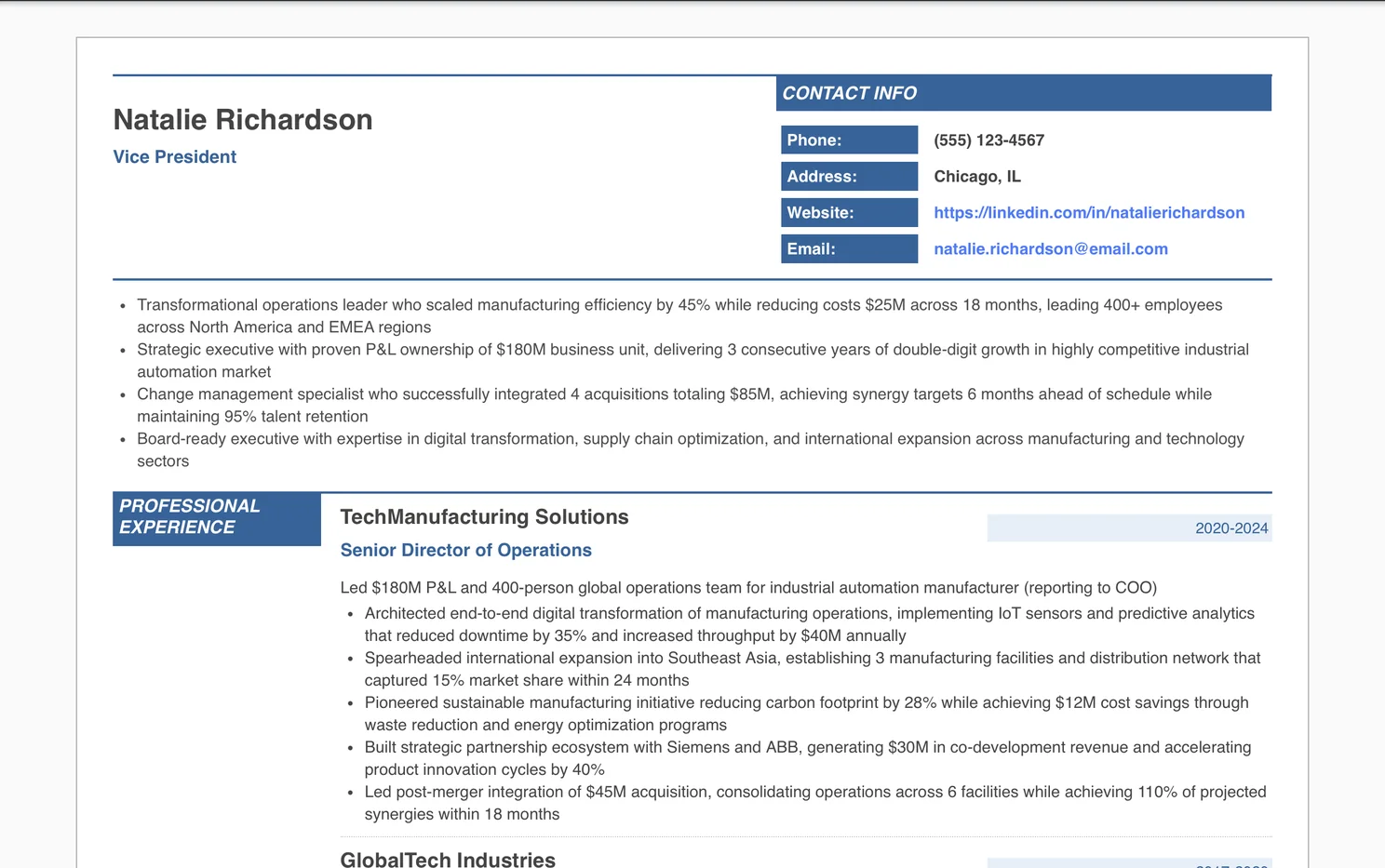
The Ultimate Vice President Resume Example/Sample
https://www.resumonk.com/vice-president-resumeVice PresidentResume Format for Vice President Resume
You've climbed the corporate mountain for years, maybe decades.
From analyst to manager, from director to senior director, and now you're eyeing that coveted VP seat - where strategy meetings replace status updates, where your decisions ripple across entire divisions, and where the buck genuinely starts stopping with you. The Vice President role, sitting firmly in upper management just below C-suite executives, demands a resume that mirrors this executive presence. Unlike entry-level positions where "executive" might mean you execute tasks, as a VP candidate, you're the one setting the course others will execute.
The Reverse-Chronological Format - Your Executive Story
For VP positions, the reverse-chronological format isn't just recommended - it's essentially mandatory.
Your most recent role, presumably at Director or Senior Director level, needs to shine immediately. Hiring committees and executive recruiters spending mere seconds on initial reviews want to see your current strategic impact, not what you did as a junior manager fifteen years ago.
This format naturally creates a narrative arc of progressive leadership that VP selection committees expect to see.
The Executive Summary - Not Optional Anymore
Replace that outdated objective statement with a powerful 3-4 line executive summary. This isn't where you state you're "seeking a challenging VP role" - they know that already.
This is where you crystallize your unique value proposition.
❌ Don't write generic aspirations:
Experienced professional seeking Vice President position to utilize
leadership skills and contribute to organizational growth.
✅ Do showcase quantified executive impact:
Transformational sales leader who grew B2B revenue from $45M to $180M
across 3 years while building high-performance teams across 5 countries.
Specialist in SaaS market penetration and strategic partnership development.
Length and Density Considerations
That one-page rule you followed as a fresh graduate?
Ancient history now. VP resumes typically run 2-3 pages, with two pages being the sweet spot for most industries. Investment banking and consulting might tolerate three pages if you've led multiple major deals or transformations. However, in tech startups where brevity is valued, even VPs might stick closer to two pages.
The UK and European markets tend to accept slightly longer formats than the US, while Canadian employers often prefer the concise American approach.
Work Experience on Vice President Resume
Your work experience section transforms from a duty list into a strategic impact portfolio at the VP level.
Each role you've held becomes a chapter in your leadership story, demonstrating not just what you managed, but how you transformed organizations. The selection committee isn't wondering if you can handle responsibility - they're evaluating whether your specific brand of leadership aligns with their organizational challenges.
Structuring Each Role - The Strategic Framework
Start each position with context-setting.
A VP candidate needs to show they understand scope and scale. Include the company size, your reporting structure, budget responsibility, and team size upfront.
Then move into achievements, focusing on strategic initiatives rather than operational tasks.
❌ Don't bury the scope in vague descriptions:
Senior Director of Marketing | TechCorp | 2019-2023
• Led marketing team to achieve various goals
• Managed budget and implemented campaigns
• Worked with sales team on alignment initiatives
✅ Do front-load the strategic context:
Senior Director of Marketing | TechCorp | 2019-2023
Led $12M marketing budget and 35-person team across US/EMEA for $200M
B2B software company (reporting to CMO)
• Architected digital transformation reducing CAC by 43% while scaling
 lead generation 3x through AI-powered marketing automation
• Pioneered account-based marketing strategy penetrating Fortune 500,
 securing 8 enterprise clients worth $30M ARR
• Built partnership ecosystem with Microsoft and Salesforce, generating
 25% of new pipeline through co-marketing initiatives
The 10+ Year Dilemma
As a VP candidate, you likely have 15-20 years of experience. The challenge becomes what to exclude. Roles from over 10 years ago should be condensed unless they're extraordinarily relevant. That project manager position from 2008? A single line will suffice.
Your focus should be on the last 7-10 years where you've operated at senior levels.
Addressing Different Paths to VP
Not everyone follows the traditional corporate ladder.
If you're jumping industries (like moving from VP at a startup to VP at a Fortune 500), emphasize transferable strategic wins. If you're making the consultant-to-corporate leap, translate your client engagements into internal transformation language.
For those stepping up from Senior Director to VP for the first time, focus on VP-level responsibilities you've already assumed - board presentations, P&L ownership, or cross-functional leadership.
Skills to Showcase on Vice President Resume
At the VP level, technical skills take a backseat to strategic capabilities. The skills section morphs from a keyword repository into a strategic competency showcase. You're not listing Microsoft Office anymore - that's assumed.
Instead, you're highlighting the unique intersection of leadership capabilities, industry expertise, and strategic tools that make you the right VP for this specific organization.
The Three-Tier Skill Architecture
Structure your skills into three distinct categories that tell your complete leadership story. First, your strategic leadership competencies - these are the VP-level capabilities that transcend industries. Second, your domain expertise - the industry-specific knowledge that makes you valuable immediately.
Third, your technical/digital leadership skills - showing you can guide organizations through modern challenges.
Strategic Leadership Competencies
These aren't soft skills anymore - they're executive capabilities that directly impact organizational success. Focus on measurable leadership dimensions.
❌ Don't list generic leadership traits:
Skills: Leadership, Communication, Strategic Thinking, Team Building,
Problem Solving, Decision Making
✅ Do specify executive-level competencies:
Strategic Leadership: P&L Management ($50M+) | M&A Integration |
Digital Transformation | Board Reporting | Stakeholder Management |
Change Leadership | Global Team Development (500+ employees)
Industry and Functional Expertise
VP roles often require deep domain knowledge. Your skills should reflect both functional mastery and industry fluency.
If you're applying for VP of Sales in SaaS, your skills should speak the language of that specific ecosystem.
Domain Expertise: Enterprise SaaS Sales | Channel Partner Development |
Sales Methodology (MEDDIC, Challenger) | CRM Strategy (Salesforce, HubSpot) |
Contract Negotiation ($1M+ deals) | Revenue Operations | Customer Success Integration
Balancing Breadth with Depth
The VP paradox - you need to show both specialized expertise and cross-functional capability.
In the US market, VPs often have deeper functional specialization. In European markets, particularly in smaller countries, VPs frequently wear multiple hats. Adjust your skills presentation accordingly. An Australian VP of Operations might emphasize broader business acumen, while a Silicon Valley VP of Engineering would focus on deep technical leadership.
Specific Considerations and Tips for Vice President Resume
The VP resume game has unwritten rules that nobody tells you about until you're already in the arena. These aren't the generic tips about proofreading or using action verbs - these are the nuanced differentiators that separate VP contenders from VP selections.
Your resume isn't just competing against other candidates anymore; it's being evaluated against the ghost of the previous VP and the shadow of what the organization hopes you'll become.
The Board-Ready Presentation Test
Here's what most VP candidates miss - your resume might be the basis for how you're introduced to the board of directors. Every line should pass the "board introduction test." Would the CEO feel confident reading this achievement to board members? This means moving beyond internal metrics to business impact. Instead of "improved team productivity," you write "accelerated product launch cycles by 30%, capturing $15M market opportunity ahead of competitors."
The Subtle Art of Political Navigation
VP positions are inherently political, and your resume should demonstrate political sophistication without saying it explicitly.
When describing achievements, show how you've navigated complex stakeholder environments. Use phrases that signal diplomatic wins.
❌ Don't ignore the political dimension:
Implemented new procurement process resulting in cost savings
✅ Do showcase stakeholder alignment:
Aligned CFO, COO, and procurement teams to redesign vendor management
process, achieving 22% cost reduction while maintaining quality standards
and vendor relationships
The Cultural Fit Telegraphing
Unlike mid-level roles where cultural fit is evaluated during interviews, VP candidates need to telegraph cultural alignment from the resume itself.
If applying to a rapid-growth startup, emphasize velocity and iteration. For established enterprises, highlight governance and risk management.
Study the company's recent press releases and earnings calls - the language they use should subtly influence your phrasing.
Industry-Specific VP Nuances
Financial services VPs need to mention regulatory experience (SOX, Basel III, MiFID II for European roles).
Healthcare VPs must reference compliance frameworks (HIPAA, FDA processes). Tech VPs should demonstrate platform thinking and ecosystem building. Manufacturing VPs need operational excellence metrics (Six Sigma, Lean).
These aren't just skills - they're table stakes that, if missing, immediately disqualify you.
The Failure Success Story
Every VP has presided over at least one significant failure.
The question is whether you'll control that narrative. Include one "turnaround" or "recovery" story that shows resilience and learning. This preempts the inevitable "tell me about a time you failed" while demonstrating the maturity expected at VP level.
Inherited underperforming APAC division (40% below target); conducted 90-day
diagnostic revealing structural issues; restructured operations and replaced
30% of leadership team; achieved 15% growth within 12 months and 35% by year two
The External Validation Layer
VP candidates need third-party credibility more than any other level. Include board positions (even advisory boards), industry speaking engagements, published thought leadership, or executive education from recognized institutions. These aren't vanity metrics - they're proof points that external stakeholders take you seriously. For UK and European markets, professional chartered status (like Chartered Director from IoD) carries significant weight.
In the US, emphasis on elite MBA programs or executive programs from Wharton, Stanford, or Harvard still matters.
The Compensation Philosophy Signal
Without stating salary expectations, your resume should signal that you understand VP-level compensation structures. Mention equity events you've navigated ("Led organization through Series C funding raising $100M"), incentive programs you've designed ("Restructured sales compensation driving 40% revenue increase"), or value creation you've delivered ("Improved EBITDA by $25M contributing to successful PE exit at 12x multiple").
This shows you speak the language of VP compensation - base, bonus, equity, and long-term incentives.
Education Requirements for Vice President Resume
You've climbed the corporate ladder for years, maybe decades. You've led teams through mergers, navigated market downturns, and delivered results that made board members smile. Now you're eyeing that Vice President role - that coveted C-suite adjacent position where strategy meets execution. But here's the thing about education on a VP resume: it's not about proving you went to college anymore.
It's about demonstrating intellectual horsepower that matches your professional achievements.
The MBA Question - Strategic Placement Matters
At the VP level, your education section typically migrates toward the bottom of your resume. Your 15-20 years of progressive leadership experience takes center stage now.
However, if you hold an MBA from a top-tier institution or have a particularly relevant advanced degree, you might consider keeping it more prominent - especially if the job posting specifically mentions it as preferred.
Here's how positioning changes based on your educational credentials:
❌ Don't lead with education just because you have an impressive degree:
EDUCATION
Harvard Business School, MBA, 2005
University of Michigan, BA Economics, 2000

EXPERIENCE
Director of Operations, ABC Corp (2018-Present)
✅ Do lead with your executive experience and place education strategically:
EXECUTIVE EXPERIENCE
Senior Director of Strategic Operations, ABC Corp (2018-Present)
[Achievements and responsibilities]

EDUCATION
MBA, Finance & Strategy - Harvard Business School
BA, Economics - University of Michigan
Executive Education and Continuous Learning
What truly distinguishes VP-level education sections is the inclusion of executive education programs. That week you spent at Wharton's Executive Leadership Program? That matters now. The Stanford Executive Program you completed last year? Absolutely include it.
These demonstrate that you're not resting on laurels from two decades ago - you're actively sharpening your leadership toolkit.
Format your executive education to show recency and relevance:
EDUCATION & EXECUTIVE DEVELOPMENT

MBA, Strategic Management - Northwestern Kellogg School of Management

Executive Leadership Program - Wharton Executive Education, 2023
Digital Transformation Strategy - MIT Sloan Executive Education, 2022
Advanced Management Program - Harvard Business School, 2021
International Considerations and Industry Variations
If you're applying for VP roles in different countries, education formatting varies significantly. In the UK, you'll typically list your degree classification if it's a First or 2:1. In Canada, including both English and French institution names might be relevant for certain markets. For US positions, GPA becomes irrelevant after your first decade of experience - unless it's a perfect 4.0 from a prestigious institution and you're in a highly academic field like biotechnology or engineering.
Industry matters too. A VP role at a tech startup might value your computer science degree from 20 years ago paired with recent certifications in cloud architecture.
A VP position at a traditional financial institution might care more about your CFA designation than your undergraduate major.
Awards and Publications for Vice President Resume
Picture this scenario - you're competing against five other candidates for a VP of Marketing role. Everyone has led large teams, everyone has managed eight-figure budgets, everyone has "transformed" something. But you were named CMO of the Year by Marketing Week. Suddenly, you're not just another experienced executive; you're an industry-recognized leader.
That's the power of strategically presenting awards and publications at the VP level.
Industry Recognition vs Internal Awards
At this stage of your career, you've probably accumulated drawers full of "Employee of the Month" certificates and "Top Performer" plaques. Leave them in the drawer. VP-level resumes demand industry-wide recognition that positions you as a thought leader in your field.
Focus on awards that your future board members would recognize and respect.
Here's how to prioritize your awards:
❌ Don't list every internal recognition from your 20-year career:
AWARDS
• Q3 2019 Sales Excellence Award - ABC Corp
• Team Player Award - XYZ Company, 2018
• President's Club Member - 2016, 2017, 2018
• Employee of the Month - March 2015
✅ Do showcase industry-level recognition and strategic impact:
INDUSTRY RECOGNITION
• Technology Executive of the Year - TechLeaders Magazine, 2023
• Top 50 CMOs to Watch - Marketing Weekly, 2022
• Innovation in Digital Transformation Award - Industry Association, 2021
 Project: Led enterprise-wide digital overhaul resulting in 40% efficiency gain
Publications That Position You as a Thought Leader
Publications at the VP level aren't about quantity - they're about establishing your voice in industry conversations.
That article you wrote for Harvard Business Review about supply chain resilience? That positions you as someone who doesn't just execute strategy but shapes it. Your regular column in Industry Week? That shows you can translate complex business concepts for broader audiences - a crucial VP skill.
Consider creating a hybrid section that combines thought leadership activities:
THOUGHT LEADERSHIP & PUBLICATIONS

Featured Publications:
• "Redefining Customer Experience in the AI Era" - Harvard Business Review, 2023
• "Beyond Digital: The Human Element in Transformation" - MIT Sloan Review, 2022
• Monthly columnist on leadership strategy - Forbes.com (2021-Present)

Speaking Engagements:
• Keynote Speaker - Global Finance Summit, London 2023
• Panel Moderator - "Future of Work" - World Economic Forum, Davos 2022
Regional and Industry Nuances
If you're targeting VP roles in academia-adjacent industries like pharmaceuticals or biotechnology, peer-reviewed publications carry significant weight. In contrast, a VP role at a media company might value your op-eds in major newspapers more highly.
European companies often place higher value on multilingual publications, while Asian markets might prioritize awards from regional business associations you've never heard of but that carry tremendous local prestige.
Managing References for Vice President Resume
You're sitting across from the CEO, and the conversation is going well.
Then comes the question - "Can you provide references?" At the VP level, this isn't about proving you're not lying about your employment history. This is about having industry heavyweights vouch for your ability to deliver transformational results. Your references at this level aren't just contacts - they're your professional board of directors.
The Strategic Reference Portfolio
Forget the "References Available Upon Request" line - that's amateur hour.
By the VP level, you need a curated portfolio of references ready to deploy strategically. Think of it like this - you need someone who can speak to your strategic vision (probably a current or former CEO), someone who can vouch for your execution ability (perhaps a board member you've presented to), and someone who can confirm you're not impossible to work with (maybe a peer VP from a cross-functional team).
Structure your reference list with strategic intent:
EXECUTIVE REFERENCES

Jennifer Walsh
CEO, GlobalTech Solutions | Former: President, Innovation Dynamics
Relationship: Reported directly to Jennifer for 4 years during TechCorp transformation
Contact: Available upon mutual interest
Context: Can speak to strategic planning and execution of $50M digital transformation

Michael Chen
Board Member, Fortune 500 Company | Managing Partner, Premier Ventures
Relationship: Collaborated on three successful acquisitions totaling $200M
Contact: Via executive search firm
Context: Can address M&A leadership and post-merger integration expertise
The Reference Preparation Protocol
At the VP level, surprising your references with a phone call from a potential employer is career sabotage. You need to brief your references like you're preparing them for a board presentation. Send them the job description, your resume, and a brief note about why this role aligns with your strategic career vision. Give them talking points about specific achievements they witnessed.
Remember, your references are doing you a favor that could be worth millions in compensation over your tenure - treat the ask accordingly.
❌ Don't send generic reference requests:
Hi John,
I'm applying for a new VP role. Can I list you as a reference?
Thanks,
Sarah
✅ Do provide strategic context and preparation:
John,

I'm in discussions for the VP of Strategic Operations role at GlobalCorp - the one
focused on their Asia-Pacific expansion we discussed at the conference last month.

Given your firsthand knowledge of how I led our Southeast Asian market entry
(resulting in $30M revenue within 18 months), your perspective would be invaluable.

I've attached the role description and my tailored resume. The CEO is particularly
interested in candidates who can balance aggressive growth with operational efficiency
- exactly what we achieved together in Singapore.

Could we schedule a brief call this week to discuss?

Best regards,
Sarah
International Reference Protocols
Reference practices vary dramatically across borders. In the UK, many companies still require written references on company letterhead - yes, even for VP roles. German companies might request "Arbeitszeugnis," formal employment certificates that follow specific legal formats.
American companies often conduct reference checks via phone, expecting 20-30 minute conversations about your leadership style and strategic thinking.
If you're applying internationally, consider having at least one reference from that geographic market. A VP role in London carries more weight with a reference from someone known in UK business circles. Similarly, breaking into Silicon Valley from traditional industry is easier when a known tech leader can vouch for your ability to adapt to that culture.
The most sophisticated VP candidates maintain different reference lists for different scenarios - board-level references for C-suite adjacent roles, operational leaders for hands-on VP positions, and industry luminaries for roles requiring immediate market credibility. Think of it as your professional advisory board, ready to advocate for your next executive move.
Cover Letter Strategies for Vice President Resume
Here's an uncomfortable truth about writing VP-level cover letters - half the time, they're being read by someone who reports to someone who would report to you.
The recruiter scanning your application might be 25 years old, trying to determine if you're worth the CEO's time. Your cover letter isn't just a formality anymore; it's your executive summary, your elevator pitch, and your strategic vision rolled into 400 carefully chosen words.
The Executive Narrative Approach
Forget everything you learned about cover letters when you were a manager.
At the VP level, you're not explaining why you want the job - you're articulating how you'll solve the board's biggest headache. Start with their problem, not your interest. What's keeping the CEO up at night? That's your opening paragraph.
❌ Don't open with generic enthusiasm:
Dear Hiring Manager,

I am excited to apply for the Vice President of Operations position at your company.
With over 20 years of experience in operations management, I believe I would be a great fit for this role.
✅ Do lead with strategic insight:
Dear Ms. Richardson,

Your recent earnings call highlighted supply chain resilience as a critical priority for GlobalTech's 2024 expansion into Southeast Asian markets. Having recently led a similar geographic expansion that reduced logistics costs by 30% while improving delivery times, I understand the complexity of this challenge - and more importantly,
I know how to solve it.
The Three-Paragraph Power Structure
Your VP cover letter needs exactly three paragraphs. First, you demonstrate market insight and strategic alignment. Second, you provide one - maximum two - specific examples of comparable victories.
Third, you propose next steps with the confidence of someone who's already picturing their name on the office door.
The middle paragraph should read like a mini case study. You're not listing responsibilities; you're telling a boardroom-ready story about transformation, turnaround, or tremendous growth. Use numbers that make CFOs pay attention - percentages, millions, market share points.
Cultural Calibration and Regional Variations
American VP cover letters can be bold, almost aggressive in tone.
You're selling transformation. British executives expect more understated confidence - think "considerable experience" rather than "unparalleled expertise." Canadian markets appreciate a blend of American ambition with British restraint. Australian VP applications often benefit from a more direct, less formal approach - they appreciate straight shooters who can "cut through the noise."
For VP roles in traditional industries like banking or law, maintain formal address protocols. For tech companies or startups, even at the VP level, a slightly more casual tone might resonate better - though never casual enough to forget you're asking for a six-figure salary and stock options.
Key Takeaways
After diving deep into the complexities of crafting an executive-level resume, here are the critical points every VP candidate needs to remember:
- Use reverse-chronological format exclusively - Your most recent senior leadership role needs immediate visibility, creating a clear narrative of progressive executive growth
- Replace objective statements with executive summaries - 3-4 lines that crystallize your unique value proposition with quantified strategic impact, not generic aspirations
- Embrace the 2-page standard - VP resumes run 2-3 pages, with two being optimal for most industries (one-page rules died with your manager title)
- Front-load strategic context in every role - Include company size, budget responsibility, team scope, and reporting structure before diving into achievements
- Focus on transformation over tasks - Every bullet point should demonstrate strategic impact that would impress a board of directors, not just operational excellence
- Structure skills in three tiers - Strategic leadership competencies, domain expertise, and technical/digital leadership capabilities that position you for modern VP challenges
- Apply the "board introduction test" - Every achievement should be something a CEO would confidently share when introducing you to board members
- Include one failure-to-success story - Demonstrate resilience and learning through a turnaround narrative that preempts inevitable questions about handling adversity
- Position education strategically - Lead with experience, but highlight executive education programs and continuous learning that show you're still sharpening your tools
- Prioritize industry recognition over internal awards - Focus on thought leadership, publications in recognized outlets, and speaking engagements that establish your executive voice
- Craft cover letters that solve board-level problems - Start with their strategic challenge, not your interest, and demonstrate market insight from your first sentence
- Curate your reference portfolio strategically - Maintain relationships with C-suite executives, board members, and industry leaders who can vouch for your transformational impact
Creating a VP-level resume that captures your executive presence while demonstrating hands-on leadership capability requires more than just listing your impressive achievements. It demands strategic thinking about every element - from the narrative arc of your career progression to the specific language that resonates with board-level decision makers. This is where Resumonk becomes your strategic partner in executive resume development. Our platform understands the nuances of VP-level positioning, offering intelligently designed templates that convey executive presence while maintaining the sophistication expected at senior levels. The AI-powered recommendations help you articulate strategic impact in language that resonates with C-suite executives and board members, while our formatting tools ensure your 20 years of experience is presented in a compelling, readable narrative that commands attention without overwhelming.
Ready to craft a Vice President resume that opens doors to the executive suite?
Transform your senior leadership experience into a compelling executive narrative with Resumonk's intelligent resume builder. Our VP-optimized templates and strategic recommendations help you articulate the kind of transformational impact that gets you invited to the final interview.
Start building your Vice President resume today and position yourself for the VP role you've been preparing for your entire career.
More Executive resume examples
- Business Owner resume example
- Change Management Executive resume example
- COO resume example
- Corporate Executive resume example
See all Executive resume examples, or browse every category.
Resume writing tips
You've been in that Senior Director role for three years now. Maybe five. The view from here is good - you've got a solid team, your initiatives are landing well, and the C-suite knows your name. But every time you sit in those executive meetings, you can feel it - that gravitational pull toward the seat at the main table, where decisions aren't just implemented but actually made.
The Vice President title isn't just another rung on the ladder; it's your entry into true executive leadership, where you'll own P&L responsibility in the tens of millions, where your strategic vision shapes entire divisions, and where your decisions echo through quarterly earnings calls.
The thing about applying for VP roles is that you're not competing against hundreds of applicants anymore - you're in a pool of maybe ten, fifteen highly qualified executives who all look impressive on paper. Everyone has managed large teams. Everyone has delivered growth. Everyone uses the word "transformational" (probably too much). Your resume isn't just proving competence anymore; it's demonstrating that specific brand of executive presence that makes board members nod approvingly when your name comes up. This means every line of your resume needs to operate at strategic altitude while still proving you can execute in the trenches when needed.
What we're about to walk through isn't your typical resume guide filled with generic advice about action verbs and formatting. This is an executive-level playbook for crafting a VP resume that commands attention from executive recruiters and hiring committees. We'll start with the optimal reverse-chronological format that tells your progressive leadership story, then dive deep into structuring your work experience to showcase strategic impact rather than operational tasks. You'll learn how to position your skills as executive competencies, not just abilities, and we'll explore the nuanced considerations that separate VP contenders from VP selections - from industry-specific requirements to the subtle art of telegraphing cultural fit.
We'll also tackle the complexities unique to VP-level applications - how to handle 20+ years of experience without writing a novel, when that MBA from 15 years ago still matters (and when it doesn't), why industry awards and thought leadership suddenly become differentiators, and how to craft a cover letter that speaks to board-level concerns rather than HR checkboxes. By the time you finish reading, you'll understand how to position education and executive development, leverage publications and speaking engagements as proof of thought leadership, and strategically manage references who can speak to your ability to operate at true executive levels. Whether you're making your first leap to VP, transitioning industries at the executive level, or moving from consulting to corporate leadership, this guide addresses the specific challenges and opportunities of your situation.
The Ultimate Vice President Resume Example/Sample
https://www.resumonk.com/vice-president-resumeVice PresidentResume Format for Vice President Resume
You've climbed the corporate mountain for years, maybe decades.
From analyst to manager, from director to senior director, and now you're eyeing that coveted VP seat - where strategy meetings replace status updates, where your decisions ripple across entire divisions, and where the buck genuinely starts stopping with you. The Vice President role, sitting firmly in upper management just below C-suite executives, demands a resume that mirrors this executive presence. Unlike entry-level positions where "executive" might mean you execute tasks, as a VP candidate, you're the one setting the course others will execute.
The Reverse-Chronological Format - Your Executive Story
For VP positions, the reverse-chronological format isn't just recommended - it's essentially mandatory.
Your most recent role, presumably at Director or Senior Director level, needs to shine immediately. Hiring committees and executive recruiters spending mere seconds on initial reviews want to see your current strategic impact, not what you did as a junior manager fifteen years ago.
This format naturally creates a narrative arc of progressive leadership that VP selection committees expect to see.
The Executive Summary - Not Optional Anymore
Replace that outdated objective statement with a powerful 3-4 line executive summary. This isn't where you state you're "seeking a challenging VP role" - they know that already.
This is where you crystallize your unique value proposition.
❌ Don't write generic aspirations:
Experienced professional seeking Vice President position to utilize
leadership skills and contribute to organizational growth.
✅ Do showcase quantified executive impact:
Transformational sales leader who grew B2B revenue from $45M to $180M
across 3 years while building high-performance teams across 5 countries.
Specialist in SaaS market penetration and strategic partnership development.
Length and Density Considerations
That one-page rule you followed as a fresh graduate?
Ancient history now. VP resumes typically run 2-3 pages, with two pages being the sweet spot for most industries. Investment banking and consulting might tolerate three pages if you've led multiple major deals or transformations. However, in tech startups where brevity is valued, even VPs might stick closer to two pages.
The UK and European markets tend to accept slightly longer formats than the US, while Canadian employers often prefer the concise American approach.
Work Experience on Vice President Resume
Your work experience section transforms from a duty list into a strategic impact portfolio at the VP level.
Each role you've held becomes a chapter in your leadership story, demonstrating not just what you managed, but how you transformed organizations. The selection committee isn't wondering if you can handle responsibility - they're evaluating whether your specific brand of leadership aligns with their organizational challenges.
Structuring Each Role - The Strategic Framework
Start each position with context-setting.
A VP candidate needs to show they understand scope and scale. Include the company size, your reporting structure, budget responsibility, and team size upfront.
Then move into achievements, focusing on strategic initiatives rather than operational tasks.
❌ Don't bury the scope in vague descriptions:
Senior Director of Marketing | TechCorp | 2019-2023
• Led marketing team to achieve various goals
• Managed budget and implemented campaigns
• Worked with sales team on alignment initiatives
✅ Do front-load the strategic context:
Senior Director of Marketing | TechCorp | 2019-2023
Led $12M marketing budget and 35-person team across US/EMEA for $200M
B2B software company (reporting to CMO)
• Architected digital transformation reducing CAC by 43% while scaling
 lead generation 3x through AI-powered marketing automation
• Pioneered account-based marketing strategy penetrating Fortune 500,
 securing 8 enterprise clients worth $30M ARR
• Built partnership ecosystem with Microsoft and Salesforce, generating
 25% of new pipeline through co-marketing initiatives
The 10+ Year Dilemma
As a VP candidate, you likely have 15-20 years of experience. The challenge becomes what to exclude. Roles from over 10 years ago should be condensed unless they're extraordinarily relevant. That project manager position from 2008? A single line will suffice.
Your focus should be on the last 7-10 years where you've operated at senior levels.
Addressing Different Paths to VP
Not everyone follows the traditional corporate ladder.
If you're jumping industries (like moving from VP at a startup to VP at a Fortune 500), emphasize transferable strategic wins. If you're making the consultant-to-corporate leap, translate your client engagements into internal transformation language.
For those stepping up from Senior Director to VP for the first time, focus on VP-level responsibilities you've already assumed - board presentations, P&L ownership, or cross-functional leadership.
Skills to Showcase on Vice President Resume
At the VP level, technical skills take a backseat to strategic capabilities. The skills section morphs from a keyword repository into a strategic competency showcase. You're not listing Microsoft Office anymore - that's assumed.
Instead, you're highlighting the unique intersection of leadership capabilities, industry expertise, and strategic tools that make you the right VP for this specific organization.
The Three-Tier Skill Architecture
Structure your skills into three distinct categories that tell your complete leadership story. First, your strategic leadership competencies - these are the VP-level capabilities that transcend industries. Second, your domain expertise - the industry-specific knowledge that makes you valuable immediately.
Third, your technical/digital leadership skills - showing you can guide organizations through modern challenges.
Strategic Leadership Competencies
These aren't soft skills anymore - they're executive capabilities that directly impact organizational success. Focus on measurable leadership dimensions.
❌ Don't list generic leadership traits:
Skills: Leadership, Communication, Strategic Thinking, Team Building,
Problem Solving, Decision Making
✅ Do specify executive-level competencies:
Strategic Leadership: P&L Management ($50M+) | M&A Integration |
Digital Transformation | Board Reporting | Stakeholder Management |
Change Leadership | Global Team Development (500+ employees)
Industry and Functional Expertise
VP roles often require deep domain knowledge. Your skills should reflect both functional mastery and industry fluency.
If you're applying for VP of Sales in SaaS, your skills should speak the language of that specific ecosystem.
Domain Expertise: Enterprise SaaS Sales | Channel Partner Development |
Sales Methodology (MEDDIC, Challenger) | CRM Strategy (Salesforce, HubSpot) |
Contract Negotiation ($1M+ deals) | Revenue Operations | Customer Success Integration
Balancing Breadth with Depth
The VP paradox - you need to show both specialized expertise and cross-functional capability.
In the US market, VPs often have deeper functional specialization. In European markets, particularly in smaller countries, VPs frequently wear multiple hats. Adjust your skills presentation accordingly. An Australian VP of Operations might emphasize broader business acumen, while a Silicon Valley VP of Engineering would focus on deep technical leadership.
Specific Considerations and Tips for Vice President Resume
The VP resume game has unwritten rules that nobody tells you about until you're already in the arena. These aren't the generic tips about proofreading or using action verbs - these are the nuanced differentiators that separate VP contenders from VP selections.
Your resume isn't just competing against other candidates anymore; it's being evaluated against the ghost of the previous VP and the shadow of what the organization hopes you'll become.
The Board-Ready Presentation Test
Here's what most VP candidates miss - your resume might be the basis for how you're introduced to the board of directors. Every line should pass the "board introduction test." Would the CEO feel confident reading this achievement to board members? This means moving beyond internal metrics to business impact. Instead of "improved team productivity," you write "accelerated product launch cycles by 30%, capturing $15M market opportunity ahead of competitors."
The Subtle Art of Political Navigation
VP positions are inherently political, and your resume should demonstrate political sophistication without saying it explicitly.
When describing achievements, show how you've navigated complex stakeholder environments. Use phrases that signal diplomatic wins.
❌ Don't ignore the political dimension:
Implemented new procurement process resulting in cost savings
✅ Do showcase stakeholder alignment:
Aligned CFO, COO, and procurement teams to redesign vendor management
process, achieving 22% cost reduction while maintaining quality standards
and vendor relationships
The Cultural Fit Telegraphing
Unlike mid-level roles where cultural fit is evaluated during interviews, VP candidates need to telegraph cultural alignment from the resume itself.
If applying to a rapid-growth startup, emphasize velocity and iteration. For established enterprises, highlight governance and risk management.
Study the company's recent press releases and earnings calls - the language they use should subtly influence your phrasing.
Industry-Specific VP Nuances
Financial services VPs need to mention regulatory experience (SOX, Basel III, MiFID II for European roles).
Healthcare VPs must reference compliance frameworks (HIPAA, FDA processes). Tech VPs should demonstrate platform thinking and ecosystem building. Manufacturing VPs need operational excellence metrics (Six Sigma, Lean).
These aren't just skills - they're table stakes that, if missing, immediately disqualify you.
The Failure Success Story
Every VP has presided over at least one significant failure.
The question is whether you'll control that narrative. Include one "turnaround" or "recovery" story that shows resilience and learning. This preempts the inevitable "tell me about a time you failed" while demonstrating the maturity expected at VP level.
Inherited underperforming APAC division (40% below target); conducted 90-day
diagnostic revealing structural issues; restructured operations and replaced
30% of leadership team; achieved 15% growth within 12 months and 35% by year two
The External Validation Layer
VP candidates need third-party credibility more than any other level. Include board positions (even advisory boards), industry speaking engagements, published thought leadership, or executive education from recognized institutions. These aren't vanity metrics - they're proof points that external stakeholders take you seriously. For UK and European markets, professional chartered status (like Chartered Director from IoD) carries significant weight.
In the US, emphasis on elite MBA programs or executive programs from Wharton, Stanford, or Harvard still matters.
The Compensation Philosophy Signal
Without stating salary expectations, your resume should signal that you understand VP-level compensation structures. Mention equity events you've navigated ("Led organization through Series C funding raising $100M"), incentive programs you've designed ("Restructured sales compensation driving 40% revenue increase"), or value creation you've delivered ("Improved EBITDA by $25M contributing to successful PE exit at 12x multiple").
This shows you speak the language of VP compensation - base, bonus, equity, and long-term incentives.
Education Requirements for Vice President Resume
You've climbed the corporate ladder for years, maybe decades. You've led teams through mergers, navigated market downturns, and delivered results that made board members smile. Now you're eyeing that Vice President role - that coveted C-suite adjacent position where strategy meets execution. But here's the thing about education on a VP resume: it's not about proving you went to college anymore.
It's about demonstrating intellectual horsepower that matches your professional achievements.
The MBA Question - Strategic Placement Matters
At the VP level, your education section typically migrates toward the bottom of your resume. Your 15-20 years of progressive leadership experience takes center stage now.
However, if you hold an MBA from a top-tier institution or have a particularly relevant advanced degree, you might consider keeping it more prominent - especially if the job posting specifically mentions it as preferred.
Here's how positioning changes based on your educational credentials:
❌ Don't lead with education just because you have an impressive degree:
EDUCATION
Harvard Business School, MBA, 2005
University of Michigan, BA Economics, 2000

EXPERIENCE
Director of Operations, ABC Corp (2018-Present)
✅ Do lead with your executive experience and place education strategically:
EXECUTIVE EXPERIENCE
Senior Director of Strategic Operations, ABC Corp (2018-Present)
[Achievements and responsibilities]

EDUCATION
MBA, Finance & Strategy - Harvard Business School
BA, Economics - University of Michigan
Executive Education and Continuous Learning
What truly distinguishes VP-level education sections is the inclusion of executive education programs. That week you spent at Wharton's Executive Leadership Program? That matters now. The Stanford Executive Program you completed last year? Absolutely include it.
These demonstrate that you're not resting on laurels from two decades ago - you're actively sharpening your leadership toolkit.
Format your executive education to show recency and relevance:
EDUCATION & EXECUTIVE DEVELOPMENT

MBA, Strategic Management - Northwestern Kellogg School of Management

Executive Leadership Program - Wharton Executive Education, 2023
Digital Transformation Strategy - MIT Sloan Executive Education, 2022
Advanced Management Program - Harvard Business School, 2021
International Considerations and Industry Variations
If you're applying for VP roles in different countries, education formatting varies significantly. In the UK, you'll typically list your degree classification if it's a First or 2:1. In Canada, including both English and French institution names might be relevant for certain markets. For US positions, GPA becomes irrelevant after your first decade of experience - unless it's a perfect 4.0 from a prestigious institution and you're in a highly academic field like biotechnology or engineering.
Industry matters too. A VP role at a tech startup might value your computer science degree from 20 years ago paired with recent certifications in cloud architecture.
A VP position at a traditional financial institution might care more about your CFA designation than your undergraduate major.
Awards and Publications for Vice President Resume
Picture this scenario - you're competing against five other candidates for a VP of Marketing role. Everyone has led large teams, everyone has managed eight-figure budgets, everyone has "transformed" something. But you were named CMO of the Year by Marketing Week. Suddenly, you're not just another experienced executive; you're an industry-recognized leader.
That's the power of strategically presenting awards and publications at the VP level.
Industry Recognition vs Internal Awards
At this stage of your career, you've probably accumulated drawers full of "Employee of the Month" certificates and "Top Performer" plaques. Leave them in the drawer. VP-level resumes demand industry-wide recognition that positions you as a thought leader in your field.
Focus on awards that your future board members would recognize and respect.
Here's how to prioritize your awards:
❌ Don't list every internal recognition from your 20-year career:
AWARDS
• Q3 2019 Sales Excellence Award - ABC Corp
• Team Player Award - XYZ Company, 2018
• President's Club Member - 2016, 2017, 2018
• Employee of the Month - March 2015
✅ Do showcase industry-level recognition and strategic impact:
INDUSTRY RECOGNITION
• Technology Executive of the Year - TechLeaders Magazine, 2023
• Top 50 CMOs to Watch - Marketing Weekly, 2022
• Innovation in Digital Transformation Award - Industry Association, 2021
 Project: Led enterprise-wide digital overhaul resulting in 40% efficiency gain
Publications That Position You as a Thought Leader
Publications at the VP level aren't about quantity - they're about establishing your voice in industry conversations.
That article you wrote for Harvard Business Review about supply chain resilience? That positions you as someone who doesn't just execute strategy but shapes it. Your regular column in Industry Week? That shows you can translate complex business concepts for broader audiences - a crucial VP skill.
Consider creating a hybrid section that combines thought leadership activities:
THOUGHT LEADERSHIP & PUBLICATIONS

Featured Publications:
• "Redefining Customer Experience in the AI Era" - Harvard Business Review, 2023
• "Beyond Digital: The Human Element in Transformation" - MIT Sloan Review, 2022
• Monthly columnist on leadership strategy - Forbes.com (2021-Present)

Speaking Engagements:
• Keynote Speaker - Global Finance Summit, London 2023
• Panel Moderator - "Future of Work" - World Economic Forum, Davos 2022
Regional and Industry Nuances
If you're targeting VP roles in academia-adjacent industries like pharmaceuticals or biotechnology, peer-reviewed publications carry significant weight. In contrast, a VP role at a media company might value your op-eds in major newspapers more highly.
European companies often place higher value on multilingual publications, while Asian markets might prioritize awards from regional business associations you've never heard of but that carry tremendous local prestige.
Managing References for Vice President Resume
You're sitting across from the CEO, and the conversation is going well.
Then comes the question - "Can you provide references?" At the VP level, this isn't about proving you're not lying about your employment history. This is about having industry heavyweights vouch for your ability to deliver transformational results. Your references at this level aren't just contacts - they're your professional board of directors.
The Strategic Reference Portfolio
Forget the "References Available Upon Request" line - that's amateur hour.
By the VP level, you need a curated portfolio of references ready to deploy strategically. Think of it like this - you need someone who can speak to your strategic vision (probably a current or former CEO), someone who can vouch for your execution ability (perhaps a board member you've presented to), and someone who can confirm you're not impossible to work with (maybe a peer VP from a cross-functional team).
Structure your reference list with strategic intent:
EXECUTIVE REFERENCES

Jennifer Walsh
CEO, GlobalTech Solutions | Former: President, Innovation Dynamics
Relationship: Reported directly to Jennifer for 4 years during TechCorp transformation
Contact: Available upon mutual interest
Context: Can speak to strategic planning and execution of $50M digital transformation

Michael Chen
Board Member, Fortune 500 Company | Managing Partner, Premier Ventures
Relationship: Collaborated on three successful acquisitions totaling $200M
Contact: Via executive search firm
Context: Can address M&A leadership and post-merger integration expertise
The Reference Preparation Protocol
At the VP level, surprising your references with a phone call from a potential employer is career sabotage. You need to brief your references like you're preparing them for a board presentation. Send them the job description, your resume, and a brief note about why this role aligns with your strategic career vision. Give them talking points about specific achievements they witnessed.
Remember, your references are doing you a favor that could be worth millions in compensation over your tenure - treat the ask accordingly.
❌ Don't send generic reference requests:
Hi John,
I'm applying for a new VP role. Can I list you as a reference?
Thanks,
Sarah
✅ Do provide strategic context and preparation:
John,

I'm in discussions for the VP of Strategic Operations role at GlobalCorp - the one
focused on their Asia-Pacific expansion we discussed at the conference last month.

Given your firsthand knowledge of how I led our Southeast Asian market entry
(resulting in $30M revenue within 18 months), your perspective would be invaluable.

I've attached the role description and my tailored resume. The CEO is particularly
interested in candidates who can balance aggressive growth with operational efficiency
- exactly what we achieved together in Singapore.

Could we schedule a brief call this week to discuss?

Best regards,
Sarah
International Reference Protocols
Reference practices vary dramatically across borders. In the UK, many companies still require written references on company letterhead - yes, even for VP roles. German companies might request "Arbeitszeugnis," formal employment certificates that follow specific legal formats.
American companies often conduct reference checks via phone, expecting 20-30 minute conversations about your leadership style and strategic thinking.
If you're applying internationally, consider having at least one reference from that geographic market. A VP role in London carries more weight with a reference from someone known in UK business circles. Similarly, breaking into Silicon Valley from traditional industry is easier when a known tech leader can vouch for your ability to adapt to that culture.
The most sophisticated VP candidates maintain different reference lists for different scenarios - board-level references for C-suite adjacent roles, operational leaders for hands-on VP positions, and industry luminaries for roles requiring immediate market credibility. Think of it as your professional advisory board, ready to advocate for your next executive move.
Cover Letter Strategies for Vice President Resume
Here's an uncomfortable truth about writing VP-level cover letters - half the time, they're being read by someone who reports to someone who would report to you.
The recruiter scanning your application might be 25 years old, trying to determine if you're worth the CEO's time. Your cover letter isn't just a formality anymore; it's your executive summary, your elevator pitch, and your strategic vision rolled into 400 carefully chosen words.
The Executive Narrative Approach
Forget everything you learned about cover letters when you were a manager.
At the VP level, you're not explaining why you want the job - you're articulating how you'll solve the board's biggest headache. Start with their problem, not your interest. What's keeping the CEO up at night? That's your opening paragraph.
❌ Don't open with generic enthusiasm:
Dear Hiring Manager,

I am excited to apply for the Vice President of Operations position at your company.
With over 20 years of experience in operations management, I believe I would be a great fit for this role.
✅ Do lead with strategic insight:
Dear Ms. Richardson,

Your recent earnings call highlighted supply chain resilience as a critical priority for GlobalTech's 2024 expansion into Southeast Asian markets. Having recently led a similar geographic expansion that reduced logistics costs by 30% while improving delivery times, I understand the complexity of this challenge - and more importantly,
I know how to solve it.
The Three-Paragraph Power Structure
Your VP cover letter needs exactly three paragraphs. First, you demonstrate market insight and strategic alignment. Second, you provide one - maximum two - specific examples of comparable victories.
Third, you propose next steps with the confidence of someone who's already picturing their name on the office door.
The middle paragraph should read like a mini case study. You're not listing responsibilities; you're telling a boardroom-ready story about transformation, turnaround, or tremendous growth. Use numbers that make CFOs pay attention - percentages, millions, market share points.
Cultural Calibration and Regional Variations
American VP cover letters can be bold, almost aggressive in tone.
You're selling transformation. British executives expect more understated confidence - think "considerable experience" rather than "unparalleled expertise." Canadian markets appreciate a blend of American ambition with British restraint. Australian VP applications often benefit from a more direct, less formal approach - they appreciate straight shooters who can "cut through the noise."
For VP roles in traditional industries like banking or law, maintain formal address protocols. For tech companies or startups, even at the VP level, a slightly more casual tone might resonate better - though never casual enough to forget you're asking for a six-figure salary and stock options.
Key Takeaways
After diving deep into the complexities of crafting an executive-level resume, here are the critical points every VP candidate needs to remember:
- Use reverse-chronological format exclusively - Your most recent senior leadership role needs immediate visibility, creating a clear narrative of progressive executive growth
- Replace objective statements with executive summaries - 3-4 lines that crystallize your unique value proposition with quantified strategic impact, not generic aspirations
- Embrace the 2-page standard - VP resumes run 2-3 pages, with two being optimal for most industries (one-page rules died with your manager title)
- Front-load strategic context in every role - Include company size, budget responsibility, team scope, and reporting structure before diving into achievements
- Focus on transformation over tasks - Every bullet point should demonstrate strategic impact that would impress a board of directors, not just operational excellence
- Structure skills in three tiers - Strategic leadership competencies, domain expertise, and technical/digital leadership capabilities that position you for modern VP challenges
- Apply the "board introduction test" - Every achievement should be something a CEO would confidently share when introducing you to board members
- Include one failure-to-success story - Demonstrate resilience and learning through a turnaround narrative that preempts inevitable questions about handling adversity
- Position education strategically - Lead with experience, but highlight executive education programs and continuous learning that show you're still sharpening your tools
- Prioritize industry recognition over internal awards - Focus on thought leadership, publications in recognized outlets, and speaking engagements that establish your executive voice
- Craft cover letters that solve board-level problems - Start with their strategic challenge, not your interest, and demonstrate market insight from your first sentence
- Curate your reference portfolio strategically - Maintain relationships with C-suite executives, board members, and industry leaders who can vouch for your transformational impact
Creating a VP-level resume that captures your executive presence while demonstrating hands-on leadership capability requires more than just listing your impressive achievements. It demands strategic thinking about every element - from the narrative arc of your career progression to the specific language that resonates with board-level decision makers. This is where Resumonk becomes your strategic partner in executive resume development. Our platform understands the nuances of VP-level positioning, offering intelligently designed templates that convey executive presence while maintaining the sophistication expected at senior levels. The AI-powered recommendations help you articulate strategic impact in language that resonates with C-suite executives and board members, while our formatting tools ensure your 20 years of experience is presented in a compelling, readable narrative that commands attention without overwhelming.
Ready to craft a Vice President resume that opens doors to the executive suite?
Transform your senior leadership experience into a compelling executive narrative with Resumonk's intelligent resume builder. Our VP-optimized templates and strategic recommendations help you articulate the kind of transformational impact that gets you invited to the final interview.
Start building your Vice President resume today and position yourself for the VP role you've been preparing for your entire career.
More Executive resume examples
- Business Owner resume example
- Change Management Executive resume example
- COO resume example
- Corporate Executive resume example
See all Executive resume examples, or browse every category.
Resume writing tips