Ultrasound Technician Resume Example, Guide and Tips
Introduction
You're staring at a blank document, cursor blinking mockingly, and somewhere in the back of your mind there's this gnawing thought: "How do I possibly fit two years of diagnostic medical sonography school, countless clinical rotation hours, that ARDMS certification you studied so hard for, and all those abdomen, OB, and vascular scans you've performed into a single page?"
Maybe you're a recent graduate from a CAAHEP-accredited program, still feeling the muscle memory of holding a transducer for hours while your clinical preceptor looked over your shoulder. Or maybe you've been working as a sonographer for three years in a busy hospital imaging department, and you're ready to move into a specialty position focusing on high-risk obstetrics or vascular technology, but you're not quite sure how to translate "I scan 15-20 patients a day and somehow keep them all calm while getting diagnostic-quality images" into resume language that actually lands interviews.
Here's what makes writing an ultrasound technician resume particularly tricky. You're working in a credential-heavy, technically demanding healthcare profession where your RDMS or RVT certification isn't just a nice-to-have but often a legal requirement for employment. Your technical competencies span complex anatomical knowledge, ultrasound physics, patient positioning, equipment operation, and real-time clinical judgment about whether that grainy image on the screen shows normal anatomy or something a radiologist needs to see immediately. You're equal parts healthcare provider, imaging technologist, and patient educator. And somehow you need to communicate all of this in a format that gets past the initial resume screening and into the hands of the imaging director or radiology manager who actually understands what "achieved 98% adequacy rate on first-attempt examinations" really means.
This guide is going to walk you through exactly how to build an ultrasound technician resume that works for your specific situation, whether you're fresh out of school with more clinical externship hours than paid employment, whether you're a generalist sonographer who can rotate through abdomen, OB, and vascular in a single shift, or whether you're a specialist in echocardiography or maternal-fetal medicine looking to leverage that expertise. We'll start with the structural foundation (why the reverse-chronological format serves diagnostic medical sonographers better than any alternative), then move through each resume section in detail. You'll see exactly how to present your work experience in ways that demonstrate both technical proficiency and clinical value, not just duty-listing. We'll dig into which skills actually matter to hiring managers and how to list them credibly, what to do with your education and certifications (spoiler: they need prominent placement, not an afterthought at the bottom), and how to handle the nuanced situations that come up (career gaps, specialty transitions, new graduate status, cross-training between modalities).
By the time you finish reading, you'll understand not just what to include on your ultrasound technician resume, but why certain choices work better than others in healthcare hiring contexts. You'll see real examples of strong versus weak ways to describe your scanning experience, your equipment proficiencies, and your patient care abilities. We'll cover the optional-but-potentially-powerful sections like awards and publications (yes, even for clinical sonographers), the strategic thinking behind cover letters for this profession, and the practical reality of how references work in healthcare hiring. Whether you're applying to large hospital systems, small specialty clinics, mobile imaging companies, or outpatient women's health centers, you'll have a clear framework for presenting yourself as the credentialed, competent, patient-focused imaging professional you actually are.
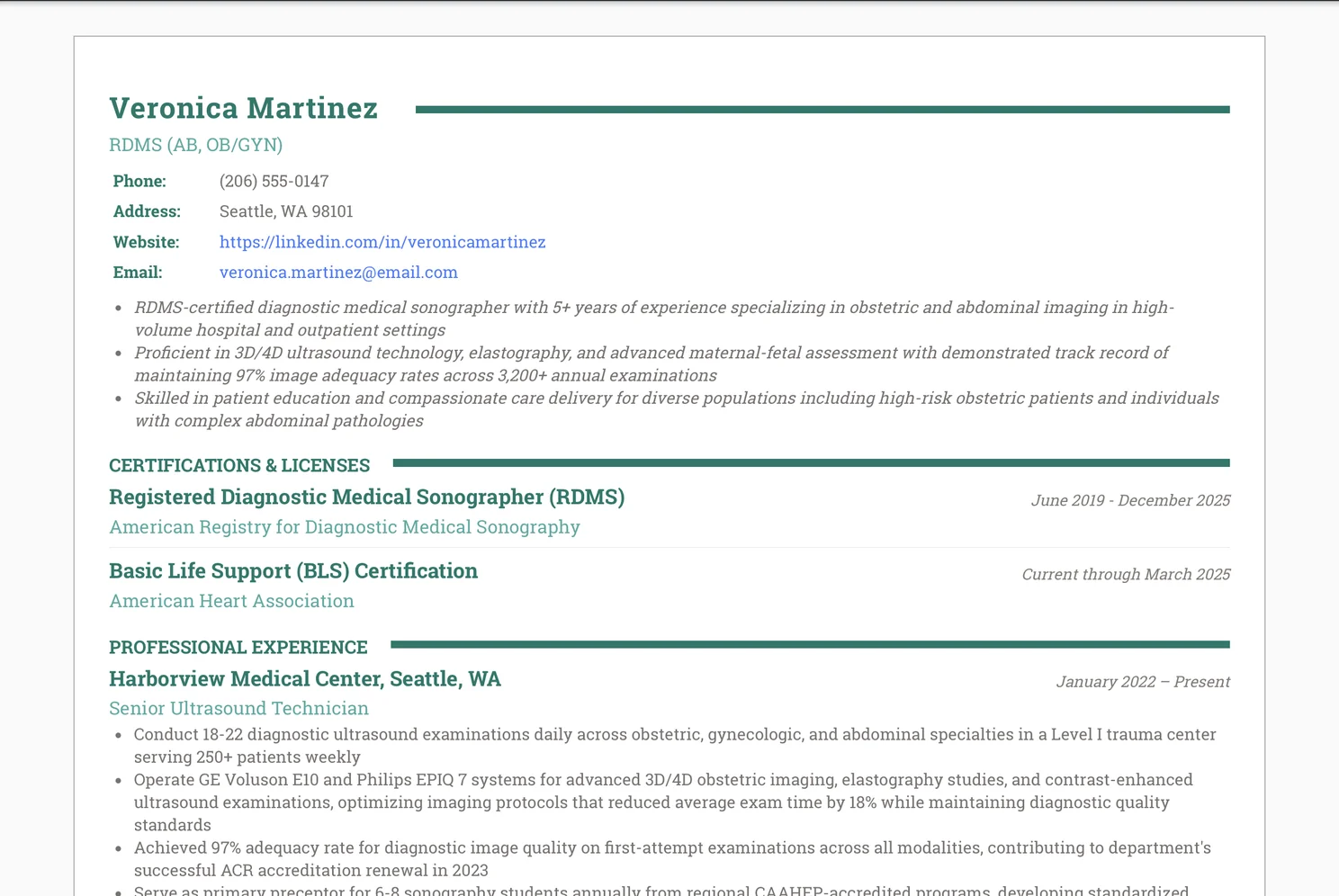
The Ultimate Ultrasound Technician Resume Example/Sample
https://www.resumonk.com/ultrasound-technicianUltrasound TechnicianResume Format for Ultrasound Technician Positions
The reverse-chronological format means listing your most recent experience first and working backward through time. For ultrasound technicians, this format immediately showcases your current competencies with the latest ultrasound technology and protocols. Healthcare facilities care deeply about recency because ultrasound technology evolves rapidly - the 3D/4D imaging capabilities, elastography techniques, and contrast-enhanced ultrasound methods you're using today are dramatically different from even five years ago.
Hiring managers want to see that your hands-on experience is current and relevant.
Why Other Formats Don't Serve You Well
You might be tempted by a functional or skills-based format, especially if you're transitioning from a different healthcare role or have gaps in your employment.
Resist this urge. Healthcare recruiters and department managers are notoriously suspicious of functional formats because they obscure the timeline of your experience. In a field where patient safety and diagnostic accuracy are paramount, they need to see exactly where you performed abdominopelvic scans, when you gained your obstetric ultrasound experience, and how recently you've been conducting vascular studies.
If you're a recent graduate from a diagnostic medical sonography program, the reverse-chronological format still works beautifully. You'll lead with your clinical externship or practicum experience, which functions as legitimate work experience in the eyes of healthcare employers.
They understand that your 800-1,200 hours of clinical training provided you with real patient contact and supervised scanning experience across multiple specialties.
Structuring Your Ultrasound Technician Resume
Your resume should open with a clear header containing your name, credentials (RDMS, RVT, RDCS, etc.), phone number, email, and location. Immediately after, include a brief professional summary - two to three sentences that capture your specialization areas and years of experience.
This isn't about being clever or creative; it's about instant clarity.
Following your summary, your certification and licensure section should appear prominently. Unlike many professions where certifications can be buried at the bottom, your ARDMS, CCI, or ARRT credentials are often mandatory requirements. Placing them high on the page, right after your summary or even integrated into your header, ensures they're immediately visible.
Then comes your work experience section in reverse-chronological order, followed by your education (which includes your Associate's or Bachelor's degree in Diagnostic Medical Sonography or related field), and finally a skills section that we'll discuss in detail later. Some ultrasound technicians also benefit from including a "Clinical Competencies" section that lists the specific types of examinations you're qualified to perform, particularly if you have expertise across multiple specialties like abdominal, obstetric, vascular, and echocardiography.
Presenting Work Experience on Your Ultrasound Technician Resume
Your work experience section is where you translate the reality of your day-to-day work into language that demonstrates both your technical proficiency and your value to a healthcare facility. Here's what many ultrasound technicians get wrong: they list their job duties as if reading from a job description rather than showcasing what they actually accomplished and how they performed.
The Anatomy of Strong Ultrasound Technician Experience Entries
Each position you list should include your job title, the healthcare facility name, location, and dates of employment. Under each role, you'll include bullet points that describe your responsibilities and achievements, but the way you write these bullets makes all the difference between a resume that gets you interviews and one that disappears into the void.
Think about what you do on a typical shift. You're not simply "performing ultrasounds." You're operating sophisticated diagnostic equipment worth hundreds of thousands of dollars, making real-time decisions about image quality and anatomical visualization, communicating with patients who are often anxious or in pain, collaborating with physicians to clarify clinical questions, and maintaining meticulous documentation that becomes part of the permanent medical record. Your resume needs to reflect this complexity.
Writing Achievement-Oriented Bullet Points
Strong bullet points for ultrasound technicians typically follow a pattern: action verb + specific procedure or responsibility + context or outcome. The context or outcome is what elevates your experience from mere duty-listing to value demonstration.
❌ Don't write generic duty statements like this:
Performed ultrasound examinations on patients
✅ Do provide specific context about volume, specialties, and setting:
Conducted 15-20 diagnostic ultrasound examinations daily across obstetric, gynecologic, and abdominal specialties in a high-volume outpatient imaging center serving 200+ patients weekly
❌ Don't leave your technical skills vague:
Used ultrasound equipment and technology
✅ Do specify the equipment and applications you've mastered:
Operated GE Voluson E10 and Philips EPIQ systems for 3D/4D obstetric imaging, elastography, and contrast-enhanced ultrasound studies, optimizing imaging protocols to reduce exam time by 15% while maintaining diagnostic quality
Quantifying Your Impact
Numbers matter tremendously in healthcare settings.
Whenever possible, include metrics that demonstrate your efficiency, accuracy, productivity, or contribution to departmental goals. Consider including: the number of examinations you performed daily or monthly, the variety of exam types in your scope of practice, patient satisfaction scores if available, your rate of technically adequate studies (when images require minimal repeats), time savings you've achieved through protocol optimization, or your role in department accreditation processes.
If you participated in reducing repeat examination rates, training new sonographers, implementing new imaging protocols, or contributed to achieving ACR accreditation, these are powerful accomplishments that demonstrate you're not merely a technician but a thinking professional who improves departmental operations.
❌ Don't write vague statements about quality:
Maintained high standards of image quality
✅ Do quantify your quality metrics when possible:
Achieved 98% adequacy rate for diagnostic image quality on first-attempt examinations, reducing patient callback rates and contributing to department's ACR accreditation renewal
Addressing Different Career Stages
If you're a newly credentialed sonographer, your clinical externship experience deserves substantial real estate on your resume. Don't simply list it as "Clinical Rotation" with one line. Break down the different rotations you completed, the facilities where you trained, and the approximate number of examinations you performed in each specialty.
This demonstrates the breadth of your foundation.
For experienced ultrasound technicians, consider how you've progressed in your career. Have you taken on lead or senior sonographer responsibilities? Do you train students or orient new hires? Have you specialized in particular complex examinations like fetal echocardiography or carotid duplex scanning? Your progression tells a story about your professional development and ambition.
Mid-career sonographers often have experience across multiple healthcare settings - hospital-based imaging departments, physician offices, outpatient imaging centers, mobile ultrasound services, or specialized clinics. Each setting brings different challenges and demonstrates different competencies. A hospital-based sonographer might emphasize their ability to perform portable exams in ICU settings or handle stat emergency examinations, while an outpatient center sonographer might highlight their high patient volume and customer service excellence.
Essential Skills for Your Ultrasound Technician Resume
The skills section of your ultrasound technician resume requires a delicate balance. You're working in a field where technical proficiency is absolutely non-negotiable, yet interpersonal abilities and clinical judgment separate adequate sonographers from exceptional ones.
The challenge is communicating both dimensions of your competency in a way that's scannable and credible.
Technical and Clinical Competencies
Your technical skills should be specific and honest. Rather than simply writing "ultrasound imaging," break down your competencies by specialty area and examination type. Hiring managers are looking for particular capabilities that match their departmental needs. A facility that primarily serves obstetric patients needs sonographers proficient in first-trimester dating scans, detailed fetal anatomical surveys, and biophysical profiles.
A vascular lab needs expertise in carotid duplex, lower extremity venous studies, and perhaps arterial mapping for bypass grafts.
List the specific examination types within your scope of practice. These might include: abdominal and retroperitoneal imaging, obstetric and gynecologic ultrasound, breast ultrasound, small parts imaging (thyroid, scrotum, soft tissue masses), vascular studies (carotid, lower extremity arterial and venous, renal), echocardiography if you're cross-trained, musculoskeletal ultrasound, pediatric imaging, or interventional ultrasound guidance for procedures like biopsies, paracentesis, or thoracentesis.
Equipment and Technology Proficiencies
Ultrasound technology varies significantly by manufacturer, and while the underlying physics remains constant, the interface and optimization controls differ substantially. If you have experience with specific ultrasound systems, list them. Common platforms include GE Healthcare (LOGIQ, Voluson series), Philips (EPIQ, Affiniti), Siemens Healthineers (Acuson), Canon Medical (Aplio), and Mindray systems.
Mentioning your familiarity with these platforms demonstrates you can hit the ground running with minimal retraining time.
Also consider listing advanced imaging techniques you're trained in: 3D/4D ultrasound, elastography (shear wave or strain), contrast-enhanced ultrasound (CEUS), fusion imaging, or automated breast ultrasound (ABUS). These specialized capabilities can set you apart from other candidates.
Software and Documentation Systems
Modern sonography is deeply integrated with healthcare IT systems.
Your familiarity with PACS (Picture Archiving and Communication Systems), RIS (Radiology Information Systems), and electronic health records (EHR) matters to hiring managers who need you to document examinations efficiently and accurately. If you have experience with specific systems like Epic, Cerner, Meditech, or GE Centricity, include them.
❌ Don't create a generic, vague skills list:
Skills: Ultrasound, Patient Care, Computer Skills, Communication, Medical Equipment
✅ Do create a specific, credible skills section:
Clinical Competencies:
• Abdominal & Retroperitoneal Imaging
• Obstetric Ultrasound (All Trimesters)
• Gynecologic & Pelvic Imaging
• Small Parts (Thyroid, Breast, Scrotum)
• Vascular Studies (Carotid, LE Venous)
Technical Proficiencies:
• GE LOGIQ & Voluson Systems
• Philips EPIQ Platform
• 3D/4D Imaging & Elastography
• PACS/RIS Systems (GE Centricity)
• Epic EHR Documentation
Interpersonal and Professional Capabilities
The human dimension of sonography cannot be overstated.
You work with patients during vulnerable moments - pregnant women anxiously awaiting reassurance about their baby's health, individuals facing potential cancer diagnoses, emergency patients in acute distress. Your ability to provide compassionate, clear communication while obtaining diagnostic-quality images is a genuine skill that deserves recognition on your resume.
Rather than listing soft skills as single words ("communication," "empathy," "teamwork"), consider integrating them into your work experience bullet points where they're demonstrated through context. However, some professional capabilities are worth listing explicitly: patient education and counseling, pediatric patient handling, communication with non-English speaking patients (if you're multilingual, definitely highlight this), collaboration with radiologists and referring physicians, infection control and patient safety protocols, and HIPAA compliance.
Regulatory and Quality Assurance Knowledge
Your understanding of regulatory standards, safety protocols, and quality assurance procedures represents another layer of professional competency. Familiarity with ACR (American College of Radiology) standards, AIUM (American Institute of Ultrasound in Medicine) guidelines, and ALARA (As Low As Reasonably Achievable) principles demonstrates your commitment to professional standards.
If you've participated in ACR accreditation processes, quality assurance programs, or safety committees, this knowledge is valuable to potential employers.
Specific Considerations and Tips for Ultrasound Technician Resumes
The ultrasound technician profession has unique characteristics that require thoughtful attention when crafting your resume. Understanding these nuances can significantly strengthen your application and help you stand out in a competitive healthcare job market.
Credentials Front and Center
Unlike many professions where credentials are nice-to-have additions, your ARDMS (American Registry for Diagnostic Medical Sonography) or equivalent credentials are often legal and regulatory requirements for employment. The specific credentials you hold - whether RDMS (Registered Diagnostic Medical Sonographer), RVT (Registered Vascular Technologist), RDCS (Registered Diagnostic Cardiac Sonographer), or RMSKS (Registered Musculoskeletal Sonographer) - define your scope of practice and directly impact which positions you're eligible for.
These credentials should appear immediately after your name in your resume header, and the full certification details (including specialty areas and registration numbers if requested) should appear in a prominent certifications section. Don't bury them. If you hold multiple credentials or specialty certifications within a credential (like having RDMS with both abdomen and obstetrics/gynecology specialties), list all of them clearly.
If you're a recent graduate who has completed your program but is awaiting credential examination results, be honest about your status. You can indicate "ARDMS eligible" or "Scheduled for RDMS examination [date]" to show you're on track for full credentialing.
Addressing Specialty Focus vs. Generalist Capability
The ultrasound field has an interesting tension between specialization and versatility.
Some facilities desperately need generalist sonographers who can rotate through multiple exam types in a given day - switching from obstetric patients to abdominal studies to vascular examinations. Others need specialists who focus exclusively on echocardiography or high-risk obstetrics. Your resume should clearly communicate where you fall on this spectrum.
If you're a generalist, emphasize the breadth of your experience across multiple specialties and your adaptability to varying clinical needs. If you're a specialist, highlight the depth of your expertise and any advanced training or complex case experience you bring. Neither approach is superior - it depends entirely on what the hiring facility needs - but being clear about your profile helps ensure you're matched with appropriate opportunities.
The Clinical Judgment Factor
Ultrasound is operator-dependent in a way that distinguishes it from other imaging modalities like CT or X-ray. Your ability to recognize normal versus abnormal anatomy in real-time, to adjust scanning approaches based on patient body habitus or clinical presentation, and to capture the images that answer the specific clinical question separates adequate technicians from excellent ones.
This clinical judgment is difficult to convey on a resume, but it's worth attempting.
When describing your experience, include instances where your clinical observation skills contributed to patient care. Perhaps you identified an unexpected finding that changed patient management, or recognized a life-threatening condition like an ectopic pregnancy or abdominal aortic aneurysm during a routine scan. These examples demonstrate that you're not simply following protocols mechanically but engaging your clinical judgment throughout each examination.
❌ Don't write bland technical descriptions:
Performed obstetric ultrasounds according to department protocols
✅ Do illustrate your clinical acumen:
Conducted comprehensive obstetric anatomical surveys with attention to subtle markers of chromosomal abnormalities and structural defects, appropriately escalating complex cases to maternal-fetal medicine specialists and maintaining clear communication with anxious expectant parents throughout the examination
Physical Demands and Ergonomic Awareness
While you wouldn't typically address the physical demands of sonography directly on your resume, understanding this aspect of the profession can inform how you present your experience. Sonography is physically demanding - you're standing for hours, applying pressure through a transducer, positioning patients, and working in awkward postures.
Demonstrating longevity and high patient volume in your work history implicitly communicates your physical capability and stamina.
If you've been trained in or advocate for proper scanning ergonomics, or if you've helped implement departmental changes to reduce work-related musculoskeletal injuries, this shows professional maturity and concern for long-term career sustainability. This might appear as a bullet point about participating in ergonomic assessments or training colleagues on injury prevention techniques.
Continuing Education and Professional Development
The ARDMS and other credentialing bodies require continuing medical education (CME) to maintain your credentials. Your commitment to continuing education demonstrates professional currency and dedication to maintaining competency as the field evolves.
While you don't need to list every CME credit on your resume, highlighting significant training, workshops, or conferences you've attended adds depth to your professional profile.
Have you attended the AIUM Annual Convention? Completed specialized training in emerging techniques like lung ultrasound or point-of-care ultrasound? Taken advanced courses in 3D/4D imaging or elastography?
These educational experiences signal that you're staying ahead of the curve rather than merely meeting minimum requirements.
Cross-Training and Flexibility
Healthcare facilities increasingly value sonographers who can work across multiple specialties or who have cross-trained in related modalities.
If you're cross-trained between ultrasound specialties (for example, holding both RDMS and RVT credentials), or if you have additional credentials in other imaging modalities like radiography or mammography, this versatility is extremely valuable. It allows facilities to deploy you where needs are greatest and provides you with scheduling flexibility.
Similarly, if you have experience working in multiple healthcare settings - inpatient, outpatient, mobile imaging, or even international medical mission work - this demonstrates adaptability. Each environment has distinct workflows, patient populations, and clinical challenges, and navigating them successfully shows professional maturity.
Regional and International Considerations
If you're applying for positions in different countries or regions, be aware that credentialing and scope of practice vary.
In the United States, ARDMS credentials are the gold standard, while Canada recognizes Sonography Canada credentials, the United Kingdom uses the CASE (Consortium for the Accreditation of Sonographic Education) system, and Australia has the ASA (Australasian Sonographers Association) credentialing. If you hold international credentials or have experience working in different healthcare systems, make this clear as it may open opportunities others don't have access to.
Additionally, terminology varies regionally. What Americans call ultrasound technicians or sonographers are called sonographers or medical imaging professionals in other countries. Tailoring your job title and terminology to match the region where you're applying demonstrates cultural awareness and attention to detail.
Addressing Employment Gaps or Career Transitions
Healthcare careers sometimes involve gaps due to family obligations, personal health issues, relocation, or professional burnout. If you have an employment gap, the reverse-chronological format doesn't hide it, but you can address it strategically.
If you maintained your credentials during the gap, completed continuing education, or performed any per diem or volunteer work, include these details to show you remained connected to the field.
If you're transitioning from a different healthcare role into sonography (perhaps you were a nurse, radiologic technologist, or other allied health professional who later completed a sonography program), your resume should tell this story coherently. Your previous healthcare experience isn't irrelevant - it demonstrates clinical judgment, patient care skills, and understanding of healthcare systems. Frame your earlier experience as foundational to your current sonography expertise rather than unrelated career history.
The Profile Summary: Your Elevator Pitch
While not mandatory, a brief professional summary at the top of your resume can immediately orient the reader to your professional identity and value proposition. This is particularly useful if you have a specific specialty focus or unique combination of skills.
Keep it concise - two to three sentences maximum - and focus on what makes you specifically valuable as an ultrasound technician.
❌ Don't write generic, meaningless summaries:
Dedicated healthcare professional seeking opportunities to utilize my skills and grow in a challenging environment
✅ Do write specific, credential-focused summaries:
RDMS-certified diagnostic medical sonographer with 6+ years of experience specializing in high-risk obstetrics and gynecologic imaging. Proficient in 3D/4D ultrasound technology and advanced maternal-fetal assessment, with a track record of maintaining 98%+ image adequacy rates in a busy tertiary care center performing 2,500+ obstetric scans annually.
References and Professional Associations
While you don't need to include references directly on your resume, having strong professional references ready is particularly important in healthcare hiring.
Radiologists you've worked closely with, department managers, or clinical instructors from your training program who can speak to your technical skills and clinical judgment are ideal references. Prepare them in advance and let them know when you're actively job searching.
Membership in professional organizations like SDMS (Society of Diagnostic Medical Sonography), AIUM, or SVU (Society for Vascular Ultrasound) demonstrates professional engagement beyond your day-to-day work. If you hold leadership positions in these organizations or have presented at conferences, this elevates your professional profile significantly and deserves mention on your resume.
Education Requirements for an Ultrasound Technician Resume
The education section on your ultrasound technician resume deserves strategic placement and thoughtful formatting. Unlike roles where experience might overshadow academic credentials, diagnostic medical sonography is a licensed profession in many states, making your educational background a critical screening factor.
Where Education Should Sit on Your Resume
If you're a recent graduate from a CAAHEP-accredited sonography program, your education section should appear immediately after your summary or objective statement.
You've just spent 18-24 months (or longer if you did a four-year program) intensively studying anatomy, physiology, patient care, and ultrasound physics - that's your strongest selling point right now. However, if you've been working as a sonographer for five years, your professional experience takes priority, and education moves below your work history.
The reverse-chronological format works beautifully here because it naturally highlights what matters most at your career stage.
What to Include in Each Education Entry
Your degree or diploma title matters enormously. Be specific. Don't leave hiring managers guessing whether you completed an Associate of Applied Science in Diagnostic Medical Sonography or just took some anatomy courses at a community college.
Here's what each entry needs:
- Full degree name (Associate of Applied Science, Bachelor of Science, Certificate, etc.)
- Major or program concentration (Diagnostic Medical Sonography, Cardiovascular Sonography, Vascular Technology)
- Institution name and location (city, state/province)
- Graduation date or expected graduation date
- Accreditation status if it's CAAHEP or CMA-accredited
Let me show you what this looks like in practice:
❌ Don't write it vaguely like this:
Degree in Ultrasound
Community College, 2023
✅ Do write it specifically like this:
Associate of Applied Science in Diagnostic Medical Sonography
Portland Community College, Portland, OR
Graduated: May 2023
CAAHEP-Accredited Program
Specialized Concentrations and Clinical Rotations
Not all sonography programs are created equal, and not all ultrasound technician positions require the same specialization. If you completed concentrated coursework or extensive clinical hours in a specific modality, list it.
A cardiovascular lab looking for an echocardiography tech needs to know you spent 200 clinical hours specifically in cardiac imaging, not just general abdominal scanning.
Consider adding a subsection under your degree for relevant coursework or clinical specialties if they align with the job description:
Specialized Training:
- Obstetric and Gynecological Sonography (320 clinical hours)
- Abdominal Sonography (280 clinical hours)
- Vascular Technology (160 clinical hours)
- Advanced Ultrasound Physics and Instrumentation
Certifications Versus Education
Here's where candidates often stumble: they conflate their ARDMS or CCI certification with their educational credentials.
Your RDMS (Registered Diagnostic Medical Sonographer) or RVT (Registered Vascular Technologist) certification is not the same as your degree. Create a separate "Certifications and Licenses" section for those credentials.
Your education section is specifically for formal academic programs - the Associate degree from Bellevue College, the Bachelor's from Oregon Tech, the certificate program from a hospital-based school.
If You Took an Unconventional Path
Maybe you started as a radiologic technologist and cross-trained into sonography.
Maybe you have a Bachelor's degree in Biology and then completed a 12-month certificate program in sonography. Maybe you trained internationally. These paths are more common than you'd think, and they need clear explanation.
List both educational backgrounds in reverse-chronological order, but emphasize the sonography-specific training:
1. Post-Graduate Certificate in Diagnostic Medical Sonography
Johns Hopkins University, Baltimore, MD
Completed: December 2022
2. Bachelor of Science in Biology
University of Maryland, College Park, MD
Graduated: May 2019
GPA and Academic Honors
Should you include your GPA? The honest answer: only if it strengthens your application. If you graduated with a 3.7 or higher, particularly from a competitive program, include it. If you graduated summa cum laude or made the Dean's List, absolutely mention it. These distinctions signal that you didn't just scrape through your physics and anatomy courses - you mastered the foundational knowledge that makes a competent sonographer. However, if you're five years into your career, your GPA becomes increasingly irrelevant.
Your registry credentials and work experience speak louder.
Ongoing Education and Training
The ultrasound field evolves constantly.
New imaging techniques emerge, equipment upgrades, protocols change. If you've completed recent continuing education units (CEUs) required for credential renewal, or if you've taken specialized workshops in emerging areas like musculoskeletal sonography or contrast-enhanced ultrasound, you might create a subsection called "Continuing Professional Education" under your main education heading.
This demonstrates commitment to staying current, which matters in a technology-dependent field where a three-year-old graduate might know more about emerging techniques than a 15-year veteran who stopped learning.
International Credentials
If you trained outside the United States, Canada, Australia, or the UK, you face additional complexity. Many countries have excellent sonography training programs, but credential recognition varies. If you completed your Diploma of Medical Sonography in Australia and you're now applying for positions in Canada, clearly indicate your credential evaluation status.
Organizations like the American Registry for Diagnostic Medical Sonography (ARDMS) accept international candidates, but you need to show you've met equivalency requirements:
Bachelor of Applied Science in Medical Ultrasound
Queensland University of Technology, Brisbane, Australia
Graduated: November 2020
Credential evaluation completed by NACES-approved agency (2022)
The education section of your ultrasound technician resume does heavy lifting in the early stages of your career and provides essential credibility throughout. Format it clearly, be specific about accreditation and specialization, and ensure it tells employers exactly what they need to know: that you've received proper training to do this highly technical, patient-facing, medically significant work safely and competently.
Showcasing Awards and Publications on Your Ultrasound Technician Resume
Here's what I've learned from reviewing hundreds of sonographer resumes: the candidates who thoughtfully include relevant achievements, recognitions, and any form of professional contribution absolutely stand out. Not because these items are expected, but precisely because they're unexpected.
They signal something beyond basic competency.
Why Awards and Publications Matter (Even for Clinical Roles)
Healthcare employers are drowning in qualified applicants.
In major metropolitan areas, a single ultrasound technician posting might attract 50+ applicants with similar credentials: ARDMS certification, an accredited degree, 2-5 years of experience in obstetrics or vascular imaging. When resume screeners review this pile, what makes someone memorable? It's the unexpected distinctions. It's the sonographer who received their hospital's "Excellence in Patient Care" award. It's the tech who contributed to a case study presentation at a regional conference. It's the applicant who served on their facility's safety committee and helped reduce patient falls by 30%.
These recognitions serve as third-party validation of your skills. Anyone can write "excellent patient communication skills" in their summary.
But when your resume shows you received your department's "Patient Satisfaction Award" two years running, that's proof, not assertion.
What Qualifies as an Award for an Ultrasound Technician?
You might be thinking, "But I've never won anything."
Let me expand your definition. Awards aren't just plaques and trophies. In the context of a sonographer's resume, consider these:
- Employee of the Month/Quarter/Year recognitions
- Departmental or hospital-wide service awards
- Patient satisfaction or patient experience awards
- Safety recognition (participation in successful safety initiatives)
- Preceptor or clinical instructor recognitions
- Academic honors from your sonography program (Dean's List, academic achievement awards)
- Scholarship recipients during your education
- Quality improvement project recognitions
- Perfect attendance or reliability awards (these matter more than you think in healthcare)
If you received any of these, they belong on your resume. Create a dedicated section called "Awards & Recognition" or "Professional Honors" if you have three or more items. If you only have one or two, you can incorporate them into your work experience bullet points as achievements.
How to Format Awards on Your Resume
Keep the formatting clean and the descriptions brief but contextual. Hiring managers need to understand what the award represents without lengthy explanation:
❌ Don't list awards without context:
Employee of the Month, 2023
Excellence Award
✅ Do provide clear context and issuing organization:
1. Employee of the Month - June 2023
- St. Mary's Medical Center, Department of Diagnostic Imaging
- Recognized for exceptional patient care and maintaining 98% patient satisfaction scores

2. Clinical Preceptor Excellence Award - 2022
- Society of Diagnostic Medical Sonography, Oregon Chapter
- Awarded for outstanding mentorship of sonography students during clinical rotations
Publications and Presentations: The Reality for Sonographers
Here's the truth: most ultrasound technicians will never publish a research paper in the Journal of Diagnostic Medical Sonography, and that's completely normal.
You're not expected to. However, there are realistic ways sonographers contribute to professional knowledge-sharing, and if you've participated in any of these, absolutely include them:
- Case study presentations at hospital grand rounds or departmental meetings
- Poster presentations at SDMS conferences or regional meetings
- Co-authorship on clinical case reports (even if you were the sonographer who performed the imaging)
- Contributions to protocol development or departmental procedure manuals
- Educational materials you created for patients or for training new staff
- Blog posts or articles in professional society newsletters
If you participated in any interesting case - maybe you were the first sonographer in your facility to perform contrast-enhanced ultrasound, or you identified a rare fetal abnormality that became a teaching case - and this was presented or discussed in any formal capacity, that's worth noting.
Formatting Publications and Presentations
Use a modified version of academic citation format, but make it readable. You're not submitting to a journal; you're showing professional engagement:
Presentations:
"Identifying Placenta Accreta in First Trimester: A Case Study"
- Co-presenter, Northwest Regional SDMS Conference, Seattle, WA (October 2023)

"Improving Workflow Efficiency in High-Volume OB Ultrasound"
- Poster presentation, St. Vincent's Hospital Quality Improvement Symposium (March 2022)
When You Have Nothing to List
If you're a new graduate or early in your career without awards or publications, don't invent a section just to fill space. It's far better to have no awards section than to stretch credibility by listing your high school honor society membership. Instead, focus on building this section over time. Volunteer to precept students, participate in hospital committees, pursue opportunities to present interesting cases at staff meetings.
These experiences will naturally generate recognitions you can add to future resume versions.
Regional and National Recognition
If you've received recognition from professional organizations like SDMS (Society of Diagnostic Medical Sonography), ARDMS (American Registry for Diagnostic Medical Sonography), or specialty-specific groups like the American Society of Echocardiography, these carry substantial weight.
They indicate you're engaged beyond your immediate workplace, that you're connected to the broader professional community. Format these prominently:
1. SDMS Outstanding Student Award - 2021
- Society of Diagnostic Medical Sonography
- National recognition for academic excellence and clinical skill demonstration

2. Rising Star Award - 2023
- American Institute of Ultrasound in Medicine, Midwest Chapter
- Awarded to early-career sonographers demonstrating exceptional clinical competency
Quality Improvement and Research Participation
Even if you weren't the lead researcher, participation in quality improvement initiatives or clinical research studies demonstrates engagement beyond routine scanning. If your department conducted a study on reducing exam times without compromising image quality, and you were part of the implementation team, mention it. If you participated as a sonographer in a clinical trial evaluating new contrast agents, include it.
Frame these as contributions to advancing practice:
Research Participation:

1. Sonographer team member for "Multi-Center Study on Elastography Reliability in Liver Disease Assessment" (2022-2023)
- Performed standardized scanning protocols for 47 study participants; contributed to data collection resulting in publication in Journal of Ultrasound in Medicine
The awards and publications section of your ultrasound technician resume is optional but powerful. It won't make or break your application, but it can absolutely elevate you from qualified candidate to memorable candidate. If you have genuine recognitions, present them clearly and contextually. If you don't yet, focus on building experience and seeking opportunities to contribute to your department and profession.
The awards will follow.
Including References on Your Ultrasound Technician Resume
References themselves matter enormously for ultrasound technicians, just not on your resume in the way you might expect.
Why References Don't Belong on Your Resume (Usually)
Here's the reality of modern hiring: space on your resume is premium real estate.
Every single line should communicate your qualifications, credentials, experience, or achievements. A line that says "References available upon request" communicates nothing except that you're using resume templates from the previous millennium. Of course your references are available upon request - that's assumed. No hiring manager looks at a resume without that line and thinks, "Oh no, this candidate probably refuses to provide references. Pass."
More importantly, you shouldn't provide references until you're asked for them, which typically happens later in the interview process, not at the initial application stage. Why? Because each time a potential employer contacts your references, you're asking those people to spend 15-20 minutes on a phone call on your behalf. If you're applying to 20 positions and you list three references on every application, you're potentially subjecting your former chief sonographer to 60 reference calls.
That's not respectful of their time, and it dilutes the impact when you really need them to advocate strongly for you at a facility you genuinely want to join.
The Exception: When References DO Go on Your Resume
Now, having said all that, there's one scenario where including references directly on your resume makes strategic sense: when the job posting explicitly requests them.
Some healthcare facilities, particularly smaller clinics, rural hospitals, or specialty practices, will specifically state "Please include three professional references with your application." In this case, follow instructions. Create a dedicated references section on your resume or, better yet, create a separate "References" document that matches your resume formatting and submit both.
Additionally, if you're a new graduate with limited work experience, and one of your references is particularly impressive - say, the program director of your CAAHEP-accredited sonography program who has 25 years of clinical experience and is well-known in regional professional circles - you might strategically include that reference directly on your resume. It serves as borrowed credibility.
Who Makes a Strong Reference for an Ultrasound Technician?
Not all references carry equal weight.
A hiring manager at a hospital imaging department wants to hear from people who can speak credibly about your clinical competency, technical skills, reliability, and patient interaction. The best references for sonographers typically fall into these categories:
- Direct supervisors from clinical positions - Your lead sonographer, imaging manager, or radiology director who directly observed your work
- Radiologists you worked closely with - Physicians who reviewed your images and can attest to your technical quality
- Clinical preceptors from your training program - The experienced sonographers who supervised your clinical rotations and evaluated your competency
- Program directors or clinical coordinators - Academic leaders from your sonography program who can speak to both your technical abilities and professional character
- Charge nurses or department directors - Healthcare leaders who observed your teamwork and patient care approach
Notice what's not on this list? Your college roommate. Your pastor. Your family friend who happens to be a dentist. These people might write glowing character references, but they can't speak to whether you can properly image a fetal heart or identify the difference between an artery and vein on a Doppler study.
How to Format a References Page
When you do need to provide references - whether requested upfront or after an initial interview - create a separate document, not a section at the bottom of your resume.
This document should match your resume's visual formatting (same font, same header style) to maintain a cohesive, professional appearance. Here's what to include for each reference:
References for Maria Santos, RDMS

1. Dr. James Chen, MD
- Chief of Radiology, Mercy General Hospital
- Email: [email protected] | Phone: (555) 234-5678
- Relationship: Direct supervisor, 2021-2024
- Dr. Chen supervised my work as a general sonographer in the radiology department and can speak to my technical imaging skills, clinical judgment, and patient communication abilities.

2. Jennifer Williams, RDMS, RVT
- Lead Vascular Sonographer Northwest Vascular Institute
- Email: [email protected] | Phone: (555) 345-6789
- Relationship: Clinical preceptor and colleague, 2020-present
- Jennifer served as my primary preceptor during clinical training and later became my colleague when I joined Northwest Vascular Institute. She can speak to my technical competency in vascular ultrasound and my professional growth from student to practicing sonographer.

3. Patricia O'Connor, MS, RDMS
Program Director, Diagnostic Medical Sonography, Portland Community College
- Email: [email protected] | Phone: (555) 456-7890
- Relationship: Program director during my sonography education, 2018-2020
- Ms. O'Connor directed the CAAHEP-accredited program where I completed my Associate of Applied Science in Diagnostic Medical Sonography and can speak to my academic performance and clinical skills development.
See how each entry provides complete contact information, clarifies the professional relationship, and briefly explains what aspects of your work that person can speak to? This makes it easy for hiring managers to select the most relevant reference for their specific concerns.
How Many References Should You Prepare?
Prepare at least three to five professional references, but you don't need to list all five every time. Three solid references are typically sufficient for most applications. Think strategically about which three to provide based on the specific position. If you're applying for a cardiac sonography role and one of your references is an echocardiography lab supervisor, definitely include that person.
If you're applying to a women's imaging center, prioritize the OB/GYN practice manager who supervised your work.
Critical Step: Always Ask Permission First
Here's a mistake that can torpedo an otherwise strong application: listing someone as a reference without asking them first. This is shockingly common and deeply unprofessional. Before you include anyone as a reference, reach out to them - via email or phone, not text message - and ask if they're willing to serve as a reference for your job search.
Give them context about the types of positions you're pursuing and, ideally, share your resume so they can speak knowledgeably about your current qualifications.
This conversation sounds like:
Subject: Reference Request for Job Search
Hi Dr. Martinez,
I hope you're doing well. I'm beginning to explore new career opportunities in obstetric sonography, specifically looking for positions that focus on high-risk pregnancies and maternal-fetal medicine. Would you be willing to serve as a professional reference for me? During my three years working under your supervision in the Women's Imaging Center, you had the opportunity to observe my technical scanning abilities and patient care approach, and I believe you could speak credibly about my qualifications.
I've attached my current resume for your reference. If you're comfortable with this, I'll provide your contact information to potential employers. Of course, I'll give you a heads-up before any specific facility is likely to reach out.
Thank you for considering this, and for the mentorship you've provided throughout my time at Women's Imaging.
Best regards,
Rachel Thompson, RDMS
Most people are happy to serve as references when asked respectfully and given proper notice. If someone seems hesitant or doesn't respond, take the hint and move on to someone else. You want references who will speak enthusiastically about your work, not lukewarm contacts who agreed reluctantly.
Keep Your References Updated
Here's something that happens more often than it should: a hiring manager tries to contact your reference, but the phone number is disconnected or the email bounces because your former supervisor changed jobs eight months ago. This looks careless on your part. Every few months, particularly when you're actively job searching, touch base with your references to confirm their current contact information and let them know you're still using them as references. A brief email - "Hi Sarah, just wanted to confirm I can still use you as a reference and that your contact info is still..." - takes two minutes and prevents embarrassing situations.
What If You Have Difficult Reference Situations?
Sometimes reference situations are complicated.
Maybe you left your last position under less-than-ideal circumstances. Maybe your former supervisor was genuinely difficult and you're worried what they might say. Maybe your most recent clinical experience was three years ago and you're concerned the reference feels stale.
First, understand that in the United States, most healthcare organizations have policies limiting what they'll disclose about former employees. Many will only confirm dates of employment and job title, nothing more, specifically to avoid defamation liability. If you're genuinely concerned that a former supervisor might provide a negative reference, you can strategically provide other references from the same time period - perhaps a peer colleague who became a lead tech, or a physician you worked with regularly, or a clinical educator who observed your work.
Second, if you've been out of clinical practice for a period, you can use references from volunteer work, professional organization involvement, or recent continuing education instructors - anyone who can speak to your current professional capabilities and character, even if it's not direct employment.
Regional Considerations
Reference expectations vary slightly by region and healthcare setting.
In Canada, providing references slightly earlier in the process is more common. In the UK, "referees" are expected, and candidates often include them directly on CVs. In Australia, providing contact information for at least two references with your application is standard practice. In the United States, the trend has shifted toward providing references later in the process.
Research norms for your specific region and follow local convention.
The "References Available Upon Request" Debate
I mentioned earlier that this phrase is outdated and wastes space. However, if you're an early-career sonographer and your resume is only reaching three-quarters down the page even after including all relevant information, and you feel uncomfortable with white space at the bottom, you can include this line. It's not harmful, just unnecessary. Format it simply centered at the bottom of your resume: "Professional references available upon request."
But honestly, your space is better used expanding your clinical competencies section or adding another achievement bullet point.
Digital References and LinkedIn
We're increasingly living in a digital professional world.
LinkedIn recommendations can supplement (but not replace) traditional references. If you have strong LinkedIn recommendations from radiologists, former supervisors, or clinical preceptors, make sure your LinkedIn profile is polished and mentioned on your resume (include the URL in your contact header). Hiring managers often review candidates' LinkedIn profiles, and seeing recommendations there adds credibility even before formal references are checked.
The references component of your ultrasound technician job search is less about what appears on your resume and more about the professional relationships you've built and maintained throughout your education and career. Cultivate strong working relationships with supervisors, physicians, and clinical mentors. Maintain those connections even after you change positions. When the time comes to provide references, you'll have credible advocates ready to vouch for your clinical competency, technical skills, reliability, and patient care approach.
And except in specific circumstances where they're explicitly requested, keep references off your actual resume document and prepare them as a separate, polished reference sheet ready to provide when the hiring process advances.
Cover Letter Strategy for Your Ultrasound Technician Resume
Most applicants for clinical roles send a generic cover letter or none at all. This is simultaneously the worst news and the best news for you.
The worst because it reflects how commoditized the hiring process has become for clinical positions. The best because it means a well-crafted cover letter gives you an immediate competitive advantage. You're swimming in a different lane than 80% of other applicants.
Do You Actually Need a Cover Letter?
Let's be practical about this. The answer depends on where you're applying and what stage you're at in your career. If you're applying through an automated hospital system portal that doesn't even have a field for uploading a cover letter, you're off the hook. Don't force it.
But if you're emailing your application directly to a radiology manager, responding to a recruiter, applying to a specialty clinic, or trying to transition into a new modality (say, you've done vascular work for three years and want to move into cardiac), a cover letter isn't just helpful - it's essential.
Here's why: your resume shows what you've done and what credentials you hold. Your cover letter explains why you're the right fit for this specific position at this specific facility. It provides context your resume can't. It answers questions like: Why are you interested in women's imaging when your background is in vascular? Why are you relocating from Chicago to Phoenix?
Why do you want to leave a large hospital system for a small orthopedic clinic?
What Makes a Strong Ultrasound Technician Cover Letter Different
Generic cover letters are worse than no cover letter.
You know the ones: "Dear Hiring Manager, I am writing to express my strong interest in the ultrasound technician position at your facility. I am a dedicated healthcare professional with excellent skills..." This tells the reader absolutely nothing they couldn't infer from seeing your resume in the pile.
An effective cover letter for an ultrasound technician position does three specific things: it demonstrates you understand the specific clinical environment you're applying to, it highlights directly relevant experience or specialization, and it shows you're someone who thinks beyond just performing scans.
Let me show you the difference:
❌ Don't write generic opening paragraphs:
Dear Hiring Manager,
I am writing to apply for the Ultrasound Technician position. I have three years of experience performing ultrasounds and am RDMS certified. I am a hard worker who is passionate about patient care and would be a great addition to your team.
✅ Do write specific, contextual opening paragraphs:
Dear Ms. Richardson,
When I learned that Valley Women's Health is expanding its maternal-fetal medicine services to include specialized consultations for high-risk pregnancies, I immediately knew this aligned perfectly with my clinical background and professional goals. For the past three years at Metro Health Hospital, I've specialized in obstetric sonography with a focus on fetal anomaly detection, performing detailed anatomical surveys for patients with complicated pregnancies including multiples, gestational diabetes, and suspected genetic abnormalities.
See the difference? The second version shows you actually read the job posting, you understand what the facility does, and you're connecting your specific experience to their specific needs. This isn't about being a "hard worker" - it's about being the right technical specialist for their clinical requirements.
Structure That Works: Opening Strong
Your opening paragraph needs to accomplish something in about three sentences: identify the position you're applying for, demonstrate you know something specific about their facility or department, and hint at why you're a strong match. If you have a connection to the organization - maybe you completed clinical rotations there, or you're referred by a current employee, or you've been following their transition to a new imaging system - mention it immediately.
Healthcare is relationship-driven, and name-dropping (when legitimate) matters.
The Middle Section: Connecting Your Experience to Their Needs
This is where most cover letters fall apart.
Candidates simply rehash their resume in paragraph form. "At Hospital X, I performed general ultrasounds including abdomen, pelvis, and small parts. At Clinic Y, I performed vascular studies including carotid dopplers and venous reflux exams." This is just your resume in sentences instead of bullets. It's redundant.
Instead, use this space to tell a story that your resume can't. Maybe explain the breadth of your experience in context. Perhaps you worked in a small community hospital where you were the only evening sonographer, meaning you had to be competent across all modalities, troubleshoot equipment issues independently, and make judgment calls about when to call in a radiologist for unusual findings. Or maybe you worked in a high-volume women's imaging center where you developed exceptional efficiency, averaging 12 obstetric scans per day while maintaining patient satisfaction scores above 95%. These narratives give texture to your resume's bullet points.
Here's how this looks in practice:
In my current role at Riverside Regional Medical Center, I'm one of two sonographers who staff our Level II trauma center during weekend shifts. This has required me to develop strong clinical judgment and composure under pressure - whether I'm performing a FAST exam on a motor vehicle accident victim at 2 AM or conducting a detailed fetal anatomy scan on a patient with concerning genetic screening results. This environment taught me to work efficiently without sacrificing accuracy, to communicate clearly with emergency physicians who need immediate answers, and to provide compassionate care to patients experiencing frightening medical situations.
This paragraph tells the hiring manager something substantial about your capabilities and work environment. It gives context to the bullet point on your resume that says "Performed urgent and emergent sonographic examinations in Level II trauma center."
Addressing the Elephant: Career Transitions and Gaps
Your cover letter is the appropriate place to briefly address anything that might raise questions. If you're a new graduate, acknowledge it and emphasize your clinical training and eagerness to continue learning. If you're returning to sonography after a break to raise children or deal with a family situation, a sentence or two provides helpful context. If you're relocating, mention why (partner's job, family, lifestyle preference).
If you're transitioning between specialties, explain your motivation.
Keep these explanations brief and forward-focused:
After taking a two-year career pause to care for my father during his cancer treatment, I'm eager to return to obstetric sonography, the specialty I'm most passionate about. During this time, I maintained my RDMS certification through CME activities and stayed current with evolving protocols by attending the virtual SDMS annual conference.
This demonstrates responsibility, professionalism, and continued engagement with the field. It turns a potential red flag into a non-issue.
Specialty-Specific Elements
If you're applying for a specialized position - cardiac sonography, vascular technology, maternal-fetal medicine, musculoskeletal ultrasound - your cover letter should demonstrate familiarity with the specific technical demands.
You might mention particular protocols you're experienced with, specialized equipment you've used, or challenging cases you've successfully imaged. This is especially important if you're trying to break into a specialty:
While my primary experience has been in general sonography, I've actively pursued additional training in echocardiography, completing a 40-hour intensive course in adult transthoracic echo last fall and volunteering for cardiac cases whenever possible at my current facility. I'm preparing to sit for the Registered Cardiac Sonographer exam this December and am specifically seeking a position where I can develop this specialization under experienced cardiac sonographers.
This shows initiative, clear career goals, and realistic understanding that you'll need mentorship as you develop this specialty competency.
The Closing: Clear and Actionable
Don't end your cover letter with weak, passive language like "I hope to hear from you soon" or "Thank you for your consideration." You're a credentialed healthcare professional with valuable skills.
Close confidently by restating your interest and suggesting next steps:
I'm genuinely excited about the possibility of joining the imaging team at Northside Medical Center, particularly given your reputation for comprehensive women's health services and investment in cutting-edge ultrasound technology. I'd welcome the opportunity to discuss how my obstetric and gynecologic imaging experience aligns with your needs. I'm available for a phone conversation or in-person interview at your convenience and can be reached at (555) 123-4567 or [email protected].
This demonstrates enthusiasm without desperation, provides clear contact information, and positions you as someone ready to move forward in the process.
Technical Details That Matter
Keep your cover letter to a single page - about three to four paragraphs totaling 250-400 words. Match the formatting style to your resume (same font, same header if you've created a branded header with your contact information). Address it to a specific person whenever possible. If the job posting lists "Sarah Martinez, Imaging Director" as the contact, address your letter to her.
If no name is provided, "Dear Hiring Manager" is acceptable, though "Dear Imaging Department Director" or "Dear Radiology Manager" is slightly more specific.
Common Mistakes to Avoid
Don't apologize for lacking certain qualifications.
If the posting asks for five years of experience and you have three, don't write "Although I only have three years of experience..." Just emphasize what you do have. Don't list salary requirements unless explicitly requested. Don't mention that you're applying to multiple facilities - keep the focus on this specific opportunity. Don't use emotionally manipulative language like "I've dreamed of working in ultrasound since I was a child" unless it's genuinely true and you have a compelling story.
Most importantly, don't submit a cover letter with typos, grammatical errors, or the wrong facility name (yes, this happens constantly when people are mass-applying).
When to Skip the Cover Letter
If the application system explicitly says "no cover letters" or doesn't provide any mechanism to submit one, don't try to force it into the resume document. If you're applying to a very large hospital system with a highly automated HR process, your cover letter may never be read, and that's okay - focus your energy on optimizing your resume instead.
If you're working with a healthcare staffing agency, ask your recruiter whether the facility typically reviews cover letters before you spend time crafting one.
The cover letter for your ultrasound technician resume is a strategic tool, not a mandatory checkbox. When used appropriately - for direct applications, specialty positions, career transitions, or situations requiring context - it can significantly strengthen your candidacy. When you're mass-applying to dozens of similar positions, your energy is better spent tailoring your resume.
Judge each application individually and deploy your cover letter where it will have genuine impact.
Key Takeaways
You've just absorbed a substantial amount of detailed guidance about crafting an ultrasound technician resume that actually works in real healthcare hiring environments. Before you dive into building or revising your own resume, here are the essential points to keep with you:
- The reverse-chronological format is your best choice because it immediately showcases your current competencies with evolving ultrasound technology and protocols. Healthcare facilities care deeply about recency of experience, and this format delivers that clarity instantly.
- Your credentials deserve prominent placement - RDMS, RVT, RDCS, or other ARDMS certifications should appear after your name in the header and in a dedicated certifications section. These aren't optional decorations; they're often mandatory requirements that determine whether you're even eligible for consideration.
- Quantify your experience whenever possible - include specifics like the number of examinations you perform daily, your image adequacy rates, patient satisfaction scores, or the variety of exam types in your scope of practice. Numbers transform vague claims into credible evidence.
- Write achievement-oriented bullet points, not duty descriptions - instead of "performed ultrasounds," describe the context, volume, specialties, and outcomes of your work. Show the complexity of what you do and the value you bring to a department.
- Be specific about your technical competencies - break down your skills by specialty area (obstetric, abdominal, vascular, etc.) and list the specific ultrasound equipment platforms you're proficient with (GE, Philips, Siemens, etc.). Generic skills lists don't differentiate you from other qualified candidates.
- Address your career stage appropriately - new graduates should emphasize clinical externship experience with substantial detail about rotations and examination volumes. Experienced sonographers should highlight progression, specialization, and any leadership or training responsibilities they've taken on.
- Create a separate document for references - don't waste resume space with "references available upon request," but do maintain a polished reference sheet ready to provide when requested later in the hiring process. Always ask permission before listing someone as a reference.
- Include awards and recognitions when you have them - Employee of the Month, patient satisfaction awards, preceptor recognitions, or academic honors provide third-party validation of your capabilities and help you stand out from other qualified applicants.
- Deploy cover letters strategically - use them for direct applications, specialty positions, career transitions, or situations requiring context. Skip them for automated application systems that don't support them or for mass applications to similar positions.
- Tailor your resume to match the position - a generalist sonographer applying to a women's imaging center should emphasize OB/GYN experience. A vascular specialist applying to a cardiac lab should highlight transferable Doppler skills. Match your strongest qualifications to their specific clinical needs.
Creating a strong ultrasound technician resume doesn't require design wizardry or creative writing genius. It requires clear, honest presentation of your credentials, thoughtful organization of your clinical experience, and specific evidence of your technical capabilities and patient care approach. With Resumonk, you can build exactly this kind of resume using professionally designed templates specifically structured for healthcare professionals, AI-powered recommendations that help you write stronger bullet points and identify gaps in your content, and flexible formatting that lets you emphasize your certifications, clinical competencies, and specialized training in ways that match how healthcare hiring managers actually review sonographer applications.
Ready to create your ultrasound technician resume?
Start building with Resumonk's healthcare-optimized templates and AI guidance that helps you present your diagnostic medical sonography credentials and clinical experience with the clarity and professionalism that gets you interviews.
Get started today and take the next step in your sonography career.
More Medical resume examples
- Pharmacist resume example
- Dentist resume example
- Optician resume example
- Retail Pharmacist resume example
See all Medical resume examples, or browse every category.
Resume writing tips
You're staring at a blank document, cursor blinking mockingly, and somewhere in the back of your mind there's this gnawing thought: "How do I possibly fit two years of diagnostic medical sonography school, countless clinical rotation hours, that ARDMS certification you studied so hard for, and all those abdomen, OB, and vascular scans you've performed into a single page?"
Maybe you're a recent graduate from a CAAHEP-accredited program, still feeling the muscle memory of holding a transducer for hours while your clinical preceptor looked over your shoulder. Or maybe you've been working as a sonographer for three years in a busy hospital imaging department, and you're ready to move into a specialty position focusing on high-risk obstetrics or vascular technology, but you're not quite sure how to translate "I scan 15-20 patients a day and somehow keep them all calm while getting diagnostic-quality images" into resume language that actually lands interviews.
Here's what makes writing an ultrasound technician resume particularly tricky. You're working in a credential-heavy, technically demanding healthcare profession where your RDMS or RVT certification isn't just a nice-to-have but often a legal requirement for employment. Your technical competencies span complex anatomical knowledge, ultrasound physics, patient positioning, equipment operation, and real-time clinical judgment about whether that grainy image on the screen shows normal anatomy or something a radiologist needs to see immediately. You're equal parts healthcare provider, imaging technologist, and patient educator. And somehow you need to communicate all of this in a format that gets past the initial resume screening and into the hands of the imaging director or radiology manager who actually understands what "achieved 98% adequacy rate on first-attempt examinations" really means.
This guide is going to walk you through exactly how to build an ultrasound technician resume that works for your specific situation, whether you're fresh out of school with more clinical externship hours than paid employment, whether you're a generalist sonographer who can rotate through abdomen, OB, and vascular in a single shift, or whether you're a specialist in echocardiography or maternal-fetal medicine looking to leverage that expertise. We'll start with the structural foundation (why the reverse-chronological format serves diagnostic medical sonographers better than any alternative), then move through each resume section in detail. You'll see exactly how to present your work experience in ways that demonstrate both technical proficiency and clinical value, not just duty-listing. We'll dig into which skills actually matter to hiring managers and how to list them credibly, what to do with your education and certifications (spoiler: they need prominent placement, not an afterthought at the bottom), and how to handle the nuanced situations that come up (career gaps, specialty transitions, new graduate status, cross-training between modalities).
By the time you finish reading, you'll understand not just what to include on your ultrasound technician resume, but why certain choices work better than others in healthcare hiring contexts. You'll see real examples of strong versus weak ways to describe your scanning experience, your equipment proficiencies, and your patient care abilities. We'll cover the optional-but-potentially-powerful sections like awards and publications (yes, even for clinical sonographers), the strategic thinking behind cover letters for this profession, and the practical reality of how references work in healthcare hiring. Whether you're applying to large hospital systems, small specialty clinics, mobile imaging companies, or outpatient women's health centers, you'll have a clear framework for presenting yourself as the credentialed, competent, patient-focused imaging professional you actually are.
The Ultimate Ultrasound Technician Resume Example/Sample
https://www.resumonk.com/ultrasound-technicianUltrasound TechnicianResume Format for Ultrasound Technician Positions
The reverse-chronological format means listing your most recent experience first and working backward through time. For ultrasound technicians, this format immediately showcases your current competencies with the latest ultrasound technology and protocols. Healthcare facilities care deeply about recency because ultrasound technology evolves rapidly - the 3D/4D imaging capabilities, elastography techniques, and contrast-enhanced ultrasound methods you're using today are dramatically different from even five years ago.
Hiring managers want to see that your hands-on experience is current and relevant.
Why Other Formats Don't Serve You Well
You might be tempted by a functional or skills-based format, especially if you're transitioning from a different healthcare role or have gaps in your employment.
Resist this urge. Healthcare recruiters and department managers are notoriously suspicious of functional formats because they obscure the timeline of your experience. In a field where patient safety and diagnostic accuracy are paramount, they need to see exactly where you performed abdominopelvic scans, when you gained your obstetric ultrasound experience, and how recently you've been conducting vascular studies.
If you're a recent graduate from a diagnostic medical sonography program, the reverse-chronological format still works beautifully. You'll lead with your clinical externship or practicum experience, which functions as legitimate work experience in the eyes of healthcare employers.
They understand that your 800-1,200 hours of clinical training provided you with real patient contact and supervised scanning experience across multiple specialties.
Structuring Your Ultrasound Technician Resume
Your resume should open with a clear header containing your name, credentials (RDMS, RVT, RDCS, etc.), phone number, email, and location. Immediately after, include a brief professional summary - two to three sentences that capture your specialization areas and years of experience.
This isn't about being clever or creative; it's about instant clarity.
Following your summary, your certification and licensure section should appear prominently. Unlike many professions where certifications can be buried at the bottom, your ARDMS, CCI, or ARRT credentials are often mandatory requirements. Placing them high on the page, right after your summary or even integrated into your header, ensures they're immediately visible.
Then comes your work experience section in reverse-chronological order, followed by your education (which includes your Associate's or Bachelor's degree in Diagnostic Medical Sonography or related field), and finally a skills section that we'll discuss in detail later. Some ultrasound technicians also benefit from including a "Clinical Competencies" section that lists the specific types of examinations you're qualified to perform, particularly if you have expertise across multiple specialties like abdominal, obstetric, vascular, and echocardiography.
Presenting Work Experience on Your Ultrasound Technician Resume
Your work experience section is where you translate the reality of your day-to-day work into language that demonstrates both your technical proficiency and your value to a healthcare facility. Here's what many ultrasound technicians get wrong: they list their job duties as if reading from a job description rather than showcasing what they actually accomplished and how they performed.
The Anatomy of Strong Ultrasound Technician Experience Entries
Each position you list should include your job title, the healthcare facility name, location, and dates of employment. Under each role, you'll include bullet points that describe your responsibilities and achievements, but the way you write these bullets makes all the difference between a resume that gets you interviews and one that disappears into the void.
Think about what you do on a typical shift. You're not simply "performing ultrasounds." You're operating sophisticated diagnostic equipment worth hundreds of thousands of dollars, making real-time decisions about image quality and anatomical visualization, communicating with patients who are often anxious or in pain, collaborating with physicians to clarify clinical questions, and maintaining meticulous documentation that becomes part of the permanent medical record. Your resume needs to reflect this complexity.
Writing Achievement-Oriented Bullet Points
Strong bullet points for ultrasound technicians typically follow a pattern: action verb + specific procedure or responsibility + context or outcome. The context or outcome is what elevates your experience from mere duty-listing to value demonstration.
❌ Don't write generic duty statements like this:
Performed ultrasound examinations on patients
✅ Do provide specific context about volume, specialties, and setting:
Conducted 15-20 diagnostic ultrasound examinations daily across obstetric, gynecologic, and abdominal specialties in a high-volume outpatient imaging center serving 200+ patients weekly
❌ Don't leave your technical skills vague:
Used ultrasound equipment and technology
✅ Do specify the equipment and applications you've mastered:
Operated GE Voluson E10 and Philips EPIQ systems for 3D/4D obstetric imaging, elastography, and contrast-enhanced ultrasound studies, optimizing imaging protocols to reduce exam time by 15% while maintaining diagnostic quality
Quantifying Your Impact
Numbers matter tremendously in healthcare settings.
Whenever possible, include metrics that demonstrate your efficiency, accuracy, productivity, or contribution to departmental goals. Consider including: the number of examinations you performed daily or monthly, the variety of exam types in your scope of practice, patient satisfaction scores if available, your rate of technically adequate studies (when images require minimal repeats), time savings you've achieved through protocol optimization, or your role in department accreditation processes.
If you participated in reducing repeat examination rates, training new sonographers, implementing new imaging protocols, or contributed to achieving ACR accreditation, these are powerful accomplishments that demonstrate you're not merely a technician but a thinking professional who improves departmental operations.
❌ Don't write vague statements about quality:
Maintained high standards of image quality
✅ Do quantify your quality metrics when possible:
Achieved 98% adequacy rate for diagnostic image quality on first-attempt examinations, reducing patient callback rates and contributing to department's ACR accreditation renewal
Addressing Different Career Stages
If you're a newly credentialed sonographer, your clinical externship experience deserves substantial real estate on your resume. Don't simply list it as "Clinical Rotation" with one line. Break down the different rotations you completed, the facilities where you trained, and the approximate number of examinations you performed in each specialty.
This demonstrates the breadth of your foundation.
For experienced ultrasound technicians, consider how you've progressed in your career. Have you taken on lead or senior sonographer responsibilities? Do you train students or orient new hires? Have you specialized in particular complex examinations like fetal echocardiography or carotid duplex scanning? Your progression tells a story about your professional development and ambition.
Mid-career sonographers often have experience across multiple healthcare settings - hospital-based imaging departments, physician offices, outpatient imaging centers, mobile ultrasound services, or specialized clinics. Each setting brings different challenges and demonstrates different competencies. A hospital-based sonographer might emphasize their ability to perform portable exams in ICU settings or handle stat emergency examinations, while an outpatient center sonographer might highlight their high patient volume and customer service excellence.
Essential Skills for Your Ultrasound Technician Resume
The skills section of your ultrasound technician resume requires a delicate balance. You're working in a field where technical proficiency is absolutely non-negotiable, yet interpersonal abilities and clinical judgment separate adequate sonographers from exceptional ones.
The challenge is communicating both dimensions of your competency in a way that's scannable and credible.
Technical and Clinical Competencies
Your technical skills should be specific and honest. Rather than simply writing "ultrasound imaging," break down your competencies by specialty area and examination type. Hiring managers are looking for particular capabilities that match their departmental needs. A facility that primarily serves obstetric patients needs sonographers proficient in first-trimester dating scans, detailed fetal anatomical surveys, and biophysical profiles.
A vascular lab needs expertise in carotid duplex, lower extremity venous studies, and perhaps arterial mapping for bypass grafts.
List the specific examination types within your scope of practice. These might include: abdominal and retroperitoneal imaging, obstetric and gynecologic ultrasound, breast ultrasound, small parts imaging (thyroid, scrotum, soft tissue masses), vascular studies (carotid, lower extremity arterial and venous, renal), echocardiography if you're cross-trained, musculoskeletal ultrasound, pediatric imaging, or interventional ultrasound guidance for procedures like biopsies, paracentesis, or thoracentesis.
Equipment and Technology Proficiencies
Ultrasound technology varies significantly by manufacturer, and while the underlying physics remains constant, the interface and optimization controls differ substantially. If you have experience with specific ultrasound systems, list them. Common platforms include GE Healthcare (LOGIQ, Voluson series), Philips (EPIQ, Affiniti), Siemens Healthineers (Acuson), Canon Medical (Aplio), and Mindray systems.
Mentioning your familiarity with these platforms demonstrates you can hit the ground running with minimal retraining time.
Also consider listing advanced imaging techniques you're trained in: 3D/4D ultrasound, elastography (shear wave or strain), contrast-enhanced ultrasound (CEUS), fusion imaging, or automated breast ultrasound (ABUS). These specialized capabilities can set you apart from other candidates.
Software and Documentation Systems
Modern sonography is deeply integrated with healthcare IT systems.
Your familiarity with PACS (Picture Archiving and Communication Systems), RIS (Radiology Information Systems), and electronic health records (EHR) matters to hiring managers who need you to document examinations efficiently and accurately. If you have experience with specific systems like Epic, Cerner, Meditech, or GE Centricity, include them.
❌ Don't create a generic, vague skills list:
Skills: Ultrasound, Patient Care, Computer Skills, Communication, Medical Equipment
✅ Do create a specific, credible skills section:
Clinical Competencies:
• Abdominal & Retroperitoneal Imaging
• Obstetric Ultrasound (All Trimesters)
• Gynecologic & Pelvic Imaging
• Small Parts (Thyroid, Breast, Scrotum)
• Vascular Studies (Carotid, LE Venous)
Technical Proficiencies:
• GE LOGIQ & Voluson Systems
• Philips EPIQ Platform
• 3D/4D Imaging & Elastography
• PACS/RIS Systems (GE Centricity)
• Epic EHR Documentation
Interpersonal and Professional Capabilities
The human dimension of sonography cannot be overstated.
You work with patients during vulnerable moments - pregnant women anxiously awaiting reassurance about their baby's health, individuals facing potential cancer diagnoses, emergency patients in acute distress. Your ability to provide compassionate, clear communication while obtaining diagnostic-quality images is a genuine skill that deserves recognition on your resume.
Rather than listing soft skills as single words ("communication," "empathy," "teamwork"), consider integrating them into your work experience bullet points where they're demonstrated through context. However, some professional capabilities are worth listing explicitly: patient education and counseling, pediatric patient handling, communication with non-English speaking patients (if you're multilingual, definitely highlight this), collaboration with radiologists and referring physicians, infection control and patient safety protocols, and HIPAA compliance.
Regulatory and Quality Assurance Knowledge
Your understanding of regulatory standards, safety protocols, and quality assurance procedures represents another layer of professional competency. Familiarity with ACR (American College of Radiology) standards, AIUM (American Institute of Ultrasound in Medicine) guidelines, and ALARA (As Low As Reasonably Achievable) principles demonstrates your commitment to professional standards.
If you've participated in ACR accreditation processes, quality assurance programs, or safety committees, this knowledge is valuable to potential employers.
Specific Considerations and Tips for Ultrasound Technician Resumes
The ultrasound technician profession has unique characteristics that require thoughtful attention when crafting your resume. Understanding these nuances can significantly strengthen your application and help you stand out in a competitive healthcare job market.
Credentials Front and Center
Unlike many professions where credentials are nice-to-have additions, your ARDMS (American Registry for Diagnostic Medical Sonography) or equivalent credentials are often legal and regulatory requirements for employment. The specific credentials you hold - whether RDMS (Registered Diagnostic Medical Sonographer), RVT (Registered Vascular Technologist), RDCS (Registered Diagnostic Cardiac Sonographer), or RMSKS (Registered Musculoskeletal Sonographer) - define your scope of practice and directly impact which positions you're eligible for.
These credentials should appear immediately after your name in your resume header, and the full certification details (including specialty areas and registration numbers if requested) should appear in a prominent certifications section. Don't bury them. If you hold multiple credentials or specialty certifications within a credential (like having RDMS with both abdomen and obstetrics/gynecology specialties), list all of them clearly.
If you're a recent graduate who has completed your program but is awaiting credential examination results, be honest about your status. You can indicate "ARDMS eligible" or "Scheduled for RDMS examination [date]" to show you're on track for full credentialing.
Addressing Specialty Focus vs. Generalist Capability
The ultrasound field has an interesting tension between specialization and versatility.
Some facilities desperately need generalist sonographers who can rotate through multiple exam types in a given day - switching from obstetric patients to abdominal studies to vascular examinations. Others need specialists who focus exclusively on echocardiography or high-risk obstetrics. Your resume should clearly communicate where you fall on this spectrum.
If you're a generalist, emphasize the breadth of your experience across multiple specialties and your adaptability to varying clinical needs. If you're a specialist, highlight the depth of your expertise and any advanced training or complex case experience you bring. Neither approach is superior - it depends entirely on what the hiring facility needs - but being clear about your profile helps ensure you're matched with appropriate opportunities.
The Clinical Judgment Factor
Ultrasound is operator-dependent in a way that distinguishes it from other imaging modalities like CT or X-ray. Your ability to recognize normal versus abnormal anatomy in real-time, to adjust scanning approaches based on patient body habitus or clinical presentation, and to capture the images that answer the specific clinical question separates adequate technicians from excellent ones.
This clinical judgment is difficult to convey on a resume, but it's worth attempting.
When describing your experience, include instances where your clinical observation skills contributed to patient care. Perhaps you identified an unexpected finding that changed patient management, or recognized a life-threatening condition like an ectopic pregnancy or abdominal aortic aneurysm during a routine scan. These examples demonstrate that you're not simply following protocols mechanically but engaging your clinical judgment throughout each examination.
❌ Don't write bland technical descriptions:
Performed obstetric ultrasounds according to department protocols
✅ Do illustrate your clinical acumen:
Conducted comprehensive obstetric anatomical surveys with attention to subtle markers of chromosomal abnormalities and structural defects, appropriately escalating complex cases to maternal-fetal medicine specialists and maintaining clear communication with anxious expectant parents throughout the examination
Physical Demands and Ergonomic Awareness
While you wouldn't typically address the physical demands of sonography directly on your resume, understanding this aspect of the profession can inform how you present your experience. Sonography is physically demanding - you're standing for hours, applying pressure through a transducer, positioning patients, and working in awkward postures.
Demonstrating longevity and high patient volume in your work history implicitly communicates your physical capability and stamina.
If you've been trained in or advocate for proper scanning ergonomics, or if you've helped implement departmental changes to reduce work-related musculoskeletal injuries, this shows professional maturity and concern for long-term career sustainability. This might appear as a bullet point about participating in ergonomic assessments or training colleagues on injury prevention techniques.
Continuing Education and Professional Development
The ARDMS and other credentialing bodies require continuing medical education (CME) to maintain your credentials. Your commitment to continuing education demonstrates professional currency and dedication to maintaining competency as the field evolves.
While you don't need to list every CME credit on your resume, highlighting significant training, workshops, or conferences you've attended adds depth to your professional profile.
Have you attended the AIUM Annual Convention? Completed specialized training in emerging techniques like lung ultrasound or point-of-care ultrasound? Taken advanced courses in 3D/4D imaging or elastography?
These educational experiences signal that you're staying ahead of the curve rather than merely meeting minimum requirements.
Cross-Training and Flexibility
Healthcare facilities increasingly value sonographers who can work across multiple specialties or who have cross-trained in related modalities.
If you're cross-trained between ultrasound specialties (for example, holding both RDMS and RVT credentials), or if you have additional credentials in other imaging modalities like radiography or mammography, this versatility is extremely valuable. It allows facilities to deploy you where needs are greatest and provides you with scheduling flexibility.
Similarly, if you have experience working in multiple healthcare settings - inpatient, outpatient, mobile imaging, or even international medical mission work - this demonstrates adaptability. Each environment has distinct workflows, patient populations, and clinical challenges, and navigating them successfully shows professional maturity.
Regional and International Considerations
If you're applying for positions in different countries or regions, be aware that credentialing and scope of practice vary.
In the United States, ARDMS credentials are the gold standard, while Canada recognizes Sonography Canada credentials, the United Kingdom uses the CASE (Consortium for the Accreditation of Sonographic Education) system, and Australia has the ASA (Australasian Sonographers Association) credentialing. If you hold international credentials or have experience working in different healthcare systems, make this clear as it may open opportunities others don't have access to.
Additionally, terminology varies regionally. What Americans call ultrasound technicians or sonographers are called sonographers or medical imaging professionals in other countries. Tailoring your job title and terminology to match the region where you're applying demonstrates cultural awareness and attention to detail.
Addressing Employment Gaps or Career Transitions
Healthcare careers sometimes involve gaps due to family obligations, personal health issues, relocation, or professional burnout. If you have an employment gap, the reverse-chronological format doesn't hide it, but you can address it strategically.
If you maintained your credentials during the gap, completed continuing education, or performed any per diem or volunteer work, include these details to show you remained connected to the field.
If you're transitioning from a different healthcare role into sonography (perhaps you were a nurse, radiologic technologist, or other allied health professional who later completed a sonography program), your resume should tell this story coherently. Your previous healthcare experience isn't irrelevant - it demonstrates clinical judgment, patient care skills, and understanding of healthcare systems. Frame your earlier experience as foundational to your current sonography expertise rather than unrelated career history.
The Profile Summary: Your Elevator Pitch
While not mandatory, a brief professional summary at the top of your resume can immediately orient the reader to your professional identity and value proposition. This is particularly useful if you have a specific specialty focus or unique combination of skills.
Keep it concise - two to three sentences maximum - and focus on what makes you specifically valuable as an ultrasound technician.
❌ Don't write generic, meaningless summaries:
Dedicated healthcare professional seeking opportunities to utilize my skills and grow in a challenging environment
✅ Do write specific, credential-focused summaries:
RDMS-certified diagnostic medical sonographer with 6+ years of experience specializing in high-risk obstetrics and gynecologic imaging. Proficient in 3D/4D ultrasound technology and advanced maternal-fetal assessment, with a track record of maintaining 98%+ image adequacy rates in a busy tertiary care center performing 2,500+ obstetric scans annually.
References and Professional Associations
While you don't need to include references directly on your resume, having strong professional references ready is particularly important in healthcare hiring.
Radiologists you've worked closely with, department managers, or clinical instructors from your training program who can speak to your technical skills and clinical judgment are ideal references. Prepare them in advance and let them know when you're actively job searching.
Membership in professional organizations like SDMS (Society of Diagnostic Medical Sonography), AIUM, or SVU (Society for Vascular Ultrasound) demonstrates professional engagement beyond your day-to-day work. If you hold leadership positions in these organizations or have presented at conferences, this elevates your professional profile significantly and deserves mention on your resume.
Education Requirements for an Ultrasound Technician Resume
The education section on your ultrasound technician resume deserves strategic placement and thoughtful formatting. Unlike roles where experience might overshadow academic credentials, diagnostic medical sonography is a licensed profession in many states, making your educational background a critical screening factor.
Where Education Should Sit on Your Resume
If you're a recent graduate from a CAAHEP-accredited sonography program, your education section should appear immediately after your summary or objective statement.
You've just spent 18-24 months (or longer if you did a four-year program) intensively studying anatomy, physiology, patient care, and ultrasound physics - that's your strongest selling point right now. However, if you've been working as a sonographer for five years, your professional experience takes priority, and education moves below your work history.
The reverse-chronological format works beautifully here because it naturally highlights what matters most at your career stage.
What to Include in Each Education Entry
Your degree or diploma title matters enormously. Be specific. Don't leave hiring managers guessing whether you completed an Associate of Applied Science in Diagnostic Medical Sonography or just took some anatomy courses at a community college.
Here's what each entry needs:
- Full degree name (Associate of Applied Science, Bachelor of Science, Certificate, etc.)
- Major or program concentration (Diagnostic Medical Sonography, Cardiovascular Sonography, Vascular Technology)
- Institution name and location (city, state/province)
- Graduation date or expected graduation date
- Accreditation status if it's CAAHEP or CMA-accredited
Let me show you what this looks like in practice:
❌ Don't write it vaguely like this:
Degree in Ultrasound
Community College, 2023
✅ Do write it specifically like this:
Associate of Applied Science in Diagnostic Medical Sonography
Portland Community College, Portland, OR
Graduated: May 2023
CAAHEP-Accredited Program
Specialized Concentrations and Clinical Rotations
Not all sonography programs are created equal, and not all ultrasound technician positions require the same specialization. If you completed concentrated coursework or extensive clinical hours in a specific modality, list it.
A cardiovascular lab looking for an echocardiography tech needs to know you spent 200 clinical hours specifically in cardiac imaging, not just general abdominal scanning.
Consider adding a subsection under your degree for relevant coursework or clinical specialties if they align with the job description:
Specialized Training:
- Obstetric and Gynecological Sonography (320 clinical hours)
- Abdominal Sonography (280 clinical hours)
- Vascular Technology (160 clinical hours)
- Advanced Ultrasound Physics and Instrumentation
Certifications Versus Education
Here's where candidates often stumble: they conflate their ARDMS or CCI certification with their educational credentials.
Your RDMS (Registered Diagnostic Medical Sonographer) or RVT (Registered Vascular Technologist) certification is not the same as your degree. Create a separate "Certifications and Licenses" section for those credentials.
Your education section is specifically for formal academic programs - the Associate degree from Bellevue College, the Bachelor's from Oregon Tech, the certificate program from a hospital-based school.
If You Took an Unconventional Path
Maybe you started as a radiologic technologist and cross-trained into sonography.
Maybe you have a Bachelor's degree in Biology and then completed a 12-month certificate program in sonography. Maybe you trained internationally. These paths are more common than you'd think, and they need clear explanation.
List both educational backgrounds in reverse-chronological order, but emphasize the sonography-specific training:
1. Post-Graduate Certificate in Diagnostic Medical Sonography
Johns Hopkins University, Baltimore, MD
Completed: December 2022
2. Bachelor of Science in Biology
University of Maryland, College Park, MD
Graduated: May 2019
GPA and Academic Honors
Should you include your GPA? The honest answer: only if it strengthens your application. If you graduated with a 3.7 or higher, particularly from a competitive program, include it. If you graduated summa cum laude or made the Dean's List, absolutely mention it. These distinctions signal that you didn't just scrape through your physics and anatomy courses - you mastered the foundational knowledge that makes a competent sonographer. However, if you're five years into your career, your GPA becomes increasingly irrelevant.
Your registry credentials and work experience speak louder.
Ongoing Education and Training
The ultrasound field evolves constantly.
New imaging techniques emerge, equipment upgrades, protocols change. If you've completed recent continuing education units (CEUs) required for credential renewal, or if you've taken specialized workshops in emerging areas like musculoskeletal sonography or contrast-enhanced ultrasound, you might create a subsection called "Continuing Professional Education" under your main education heading.
This demonstrates commitment to staying current, which matters in a technology-dependent field where a three-year-old graduate might know more about emerging techniques than a 15-year veteran who stopped learning.
International Credentials
If you trained outside the United States, Canada, Australia, or the UK, you face additional complexity. Many countries have excellent sonography training programs, but credential recognition varies. If you completed your Diploma of Medical Sonography in Australia and you're now applying for positions in Canada, clearly indicate your credential evaluation status.
Organizations like the American Registry for Diagnostic Medical Sonography (ARDMS) accept international candidates, but you need to show you've met equivalency requirements:
Bachelor of Applied Science in Medical Ultrasound
Queensland University of Technology, Brisbane, Australia
Graduated: November 2020
Credential evaluation completed by NACES-approved agency (2022)
The education section of your ultrasound technician resume does heavy lifting in the early stages of your career and provides essential credibility throughout. Format it clearly, be specific about accreditation and specialization, and ensure it tells employers exactly what they need to know: that you've received proper training to do this highly technical, patient-facing, medically significant work safely and competently.
Showcasing Awards and Publications on Your Ultrasound Technician Resume
Here's what I've learned from reviewing hundreds of sonographer resumes: the candidates who thoughtfully include relevant achievements, recognitions, and any form of professional contribution absolutely stand out. Not because these items are expected, but precisely because they're unexpected.
They signal something beyond basic competency.
Why Awards and Publications Matter (Even for Clinical Roles)
Healthcare employers are drowning in qualified applicants.
In major metropolitan areas, a single ultrasound technician posting might attract 50+ applicants with similar credentials: ARDMS certification, an accredited degree, 2-5 years of experience in obstetrics or vascular imaging. When resume screeners review this pile, what makes someone memorable? It's the unexpected distinctions. It's the sonographer who received their hospital's "Excellence in Patient Care" award. It's the tech who contributed to a case study presentation at a regional conference. It's the applicant who served on their facility's safety committee and helped reduce patient falls by 30%.
These recognitions serve as third-party validation of your skills. Anyone can write "excellent patient communication skills" in their summary.
But when your resume shows you received your department's "Patient Satisfaction Award" two years running, that's proof, not assertion.
What Qualifies as an Award for an Ultrasound Technician?
You might be thinking, "But I've never won anything."
Let me expand your definition. Awards aren't just plaques and trophies. In the context of a sonographer's resume, consider these:
- Employee of the Month/Quarter/Year recognitions
- Departmental or hospital-wide service awards
- Patient satisfaction or patient experience awards
- Safety recognition (participation in successful safety initiatives)
- Preceptor or clinical instructor recognitions
- Academic honors from your sonography program (Dean's List, academic achievement awards)
- Scholarship recipients during your education
- Quality improvement project recognitions
- Perfect attendance or reliability awards (these matter more than you think in healthcare)
If you received any of these, they belong on your resume. Create a dedicated section called "Awards & Recognition" or "Professional Honors" if you have three or more items. If you only have one or two, you can incorporate them into your work experience bullet points as achievements.
How to Format Awards on Your Resume
Keep the formatting clean and the descriptions brief but contextual. Hiring managers need to understand what the award represents without lengthy explanation:
❌ Don't list awards without context:
Employee of the Month, 2023
Excellence Award
✅ Do provide clear context and issuing organization:
1. Employee of the Month - June 2023
- St. Mary's Medical Center, Department of Diagnostic Imaging
- Recognized for exceptional patient care and maintaining 98% patient satisfaction scores

2. Clinical Preceptor Excellence Award - 2022
- Society of Diagnostic Medical Sonography, Oregon Chapter
- Awarded for outstanding mentorship of sonography students during clinical rotations
Publications and Presentations: The Reality for Sonographers
Here's the truth: most ultrasound technicians will never publish a research paper in the Journal of Diagnostic Medical Sonography, and that's completely normal.
You're not expected to. However, there are realistic ways sonographers contribute to professional knowledge-sharing, and if you've participated in any of these, absolutely include them:
- Case study presentations at hospital grand rounds or departmental meetings
- Poster presentations at SDMS conferences or regional meetings
- Co-authorship on clinical case reports (even if you were the sonographer who performed the imaging)
- Contributions to protocol development or departmental procedure manuals
- Educational materials you created for patients or for training new staff
- Blog posts or articles in professional society newsletters
If you participated in any interesting case - maybe you were the first sonographer in your facility to perform contrast-enhanced ultrasound, or you identified a rare fetal abnormality that became a teaching case - and this was presented or discussed in any formal capacity, that's worth noting.
Formatting Publications and Presentations
Use a modified version of academic citation format, but make it readable. You're not submitting to a journal; you're showing professional engagement:
Presentations:
"Identifying Placenta Accreta in First Trimester: A Case Study"
- Co-presenter, Northwest Regional SDMS Conference, Seattle, WA (October 2023)

"Improving Workflow Efficiency in High-Volume OB Ultrasound"
- Poster presentation, St. Vincent's Hospital Quality Improvement Symposium (March 2022)
When You Have Nothing to List
If you're a new graduate or early in your career without awards or publications, don't invent a section just to fill space. It's far better to have no awards section than to stretch credibility by listing your high school honor society membership. Instead, focus on building this section over time. Volunteer to precept students, participate in hospital committees, pursue opportunities to present interesting cases at staff meetings.
These experiences will naturally generate recognitions you can add to future resume versions.
Regional and National Recognition
If you've received recognition from professional organizations like SDMS (Society of Diagnostic Medical Sonography), ARDMS (American Registry for Diagnostic Medical Sonography), or specialty-specific groups like the American Society of Echocardiography, these carry substantial weight.
They indicate you're engaged beyond your immediate workplace, that you're connected to the broader professional community. Format these prominently:
1. SDMS Outstanding Student Award - 2021
- Society of Diagnostic Medical Sonography
- National recognition for academic excellence and clinical skill demonstration

2. Rising Star Award - 2023
- American Institute of Ultrasound in Medicine, Midwest Chapter
- Awarded to early-career sonographers demonstrating exceptional clinical competency
Quality Improvement and Research Participation
Even if you weren't the lead researcher, participation in quality improvement initiatives or clinical research studies demonstrates engagement beyond routine scanning. If your department conducted a study on reducing exam times without compromising image quality, and you were part of the implementation team, mention it. If you participated as a sonographer in a clinical trial evaluating new contrast agents, include it.
Frame these as contributions to advancing practice:
Research Participation:

1. Sonographer team member for "Multi-Center Study on Elastography Reliability in Liver Disease Assessment" (2022-2023)
- Performed standardized scanning protocols for 47 study participants; contributed to data collection resulting in publication in Journal of Ultrasound in Medicine
The awards and publications section of your ultrasound technician resume is optional but powerful. It won't make or break your application, but it can absolutely elevate you from qualified candidate to memorable candidate. If you have genuine recognitions, present them clearly and contextually. If you don't yet, focus on building experience and seeking opportunities to contribute to your department and profession.
The awards will follow.
Including References on Your Ultrasound Technician Resume
References themselves matter enormously for ultrasound technicians, just not on your resume in the way you might expect.
Why References Don't Belong on Your Resume (Usually)
Here's the reality of modern hiring: space on your resume is premium real estate.
Every single line should communicate your qualifications, credentials, experience, or achievements. A line that says "References available upon request" communicates nothing except that you're using resume templates from the previous millennium. Of course your references are available upon request - that's assumed. No hiring manager looks at a resume without that line and thinks, "Oh no, this candidate probably refuses to provide references. Pass."
More importantly, you shouldn't provide references until you're asked for them, which typically happens later in the interview process, not at the initial application stage. Why? Because each time a potential employer contacts your references, you're asking those people to spend 15-20 minutes on a phone call on your behalf. If you're applying to 20 positions and you list three references on every application, you're potentially subjecting your former chief sonographer to 60 reference calls.
That's not respectful of their time, and it dilutes the impact when you really need them to advocate strongly for you at a facility you genuinely want to join.
The Exception: When References DO Go on Your Resume
Now, having said all that, there's one scenario where including references directly on your resume makes strategic sense: when the job posting explicitly requests them.
Some healthcare facilities, particularly smaller clinics, rural hospitals, or specialty practices, will specifically state "Please include three professional references with your application." In this case, follow instructions. Create a dedicated references section on your resume or, better yet, create a separate "References" document that matches your resume formatting and submit both.
Additionally, if you're a new graduate with limited work experience, and one of your references is particularly impressive - say, the program director of your CAAHEP-accredited sonography program who has 25 years of clinical experience and is well-known in regional professional circles - you might strategically include that reference directly on your resume. It serves as borrowed credibility.
Who Makes a Strong Reference for an Ultrasound Technician?
Not all references carry equal weight.
A hiring manager at a hospital imaging department wants to hear from people who can speak credibly about your clinical competency, technical skills, reliability, and patient interaction. The best references for sonographers typically fall into these categories:
- Direct supervisors from clinical positions - Your lead sonographer, imaging manager, or radiology director who directly observed your work
- Radiologists you worked closely with - Physicians who reviewed your images and can attest to your technical quality
- Clinical preceptors from your training program - The experienced sonographers who supervised your clinical rotations and evaluated your competency
- Program directors or clinical coordinators - Academic leaders from your sonography program who can speak to both your technical abilities and professional character
- Charge nurses or department directors - Healthcare leaders who observed your teamwork and patient care approach
Notice what's not on this list? Your college roommate. Your pastor. Your family friend who happens to be a dentist. These people might write glowing character references, but they can't speak to whether you can properly image a fetal heart or identify the difference between an artery and vein on a Doppler study.
How to Format a References Page
When you do need to provide references - whether requested upfront or after an initial interview - create a separate document, not a section at the bottom of your resume.
This document should match your resume's visual formatting (same font, same header style) to maintain a cohesive, professional appearance. Here's what to include for each reference:
References for Maria Santos, RDMS

1. Dr. James Chen, MD
- Chief of Radiology, Mercy General Hospital
- Email: [email protected] | Phone: (555) 234-5678
- Relationship: Direct supervisor, 2021-2024
- Dr. Chen supervised my work as a general sonographer in the radiology department and can speak to my technical imaging skills, clinical judgment, and patient communication abilities.

2. Jennifer Williams, RDMS, RVT
- Lead Vascular Sonographer Northwest Vascular Institute
- Email: [email protected] | Phone: (555) 345-6789
- Relationship: Clinical preceptor and colleague, 2020-present
- Jennifer served as my primary preceptor during clinical training and later became my colleague when I joined Northwest Vascular Institute. She can speak to my technical competency in vascular ultrasound and my professional growth from student to practicing sonographer.

3. Patricia O'Connor, MS, RDMS
Program Director, Diagnostic Medical Sonography, Portland Community College
- Email: [email protected] | Phone: (555) 456-7890
- Relationship: Program director during my sonography education, 2018-2020
- Ms. O'Connor directed the CAAHEP-accredited program where I completed my Associate of Applied Science in Diagnostic Medical Sonography and can speak to my academic performance and clinical skills development.
See how each entry provides complete contact information, clarifies the professional relationship, and briefly explains what aspects of your work that person can speak to? This makes it easy for hiring managers to select the most relevant reference for their specific concerns.
How Many References Should You Prepare?
Prepare at least three to five professional references, but you don't need to list all five every time. Three solid references are typically sufficient for most applications. Think strategically about which three to provide based on the specific position. If you're applying for a cardiac sonography role and one of your references is an echocardiography lab supervisor, definitely include that person.
If you're applying to a women's imaging center, prioritize the OB/GYN practice manager who supervised your work.
Critical Step: Always Ask Permission First
Here's a mistake that can torpedo an otherwise strong application: listing someone as a reference without asking them first. This is shockingly common and deeply unprofessional. Before you include anyone as a reference, reach out to them - via email or phone, not text message - and ask if they're willing to serve as a reference for your job search.
Give them context about the types of positions you're pursuing and, ideally, share your resume so they can speak knowledgeably about your current qualifications.
This conversation sounds like:
Subject: Reference Request for Job Search
Hi Dr. Martinez,
I hope you're doing well. I'm beginning to explore new career opportunities in obstetric sonography, specifically looking for positions that focus on high-risk pregnancies and maternal-fetal medicine. Would you be willing to serve as a professional reference for me? During my three years working under your supervision in the Women's Imaging Center, you had the opportunity to observe my technical scanning abilities and patient care approach, and I believe you could speak credibly about my qualifications.
I've attached my current resume for your reference. If you're comfortable with this, I'll provide your contact information to potential employers. Of course, I'll give you a heads-up before any specific facility is likely to reach out.
Thank you for considering this, and for the mentorship you've provided throughout my time at Women's Imaging.
Best regards,
Rachel Thompson, RDMS
Most people are happy to serve as references when asked respectfully and given proper notice. If someone seems hesitant or doesn't respond, take the hint and move on to someone else. You want references who will speak enthusiastically about your work, not lukewarm contacts who agreed reluctantly.
Keep Your References Updated
Here's something that happens more often than it should: a hiring manager tries to contact your reference, but the phone number is disconnected or the email bounces because your former supervisor changed jobs eight months ago. This looks careless on your part. Every few months, particularly when you're actively job searching, touch base with your references to confirm their current contact information and let them know you're still using them as references. A brief email - "Hi Sarah, just wanted to confirm I can still use you as a reference and that your contact info is still..." - takes two minutes and prevents embarrassing situations.
What If You Have Difficult Reference Situations?
Sometimes reference situations are complicated.
Maybe you left your last position under less-than-ideal circumstances. Maybe your former supervisor was genuinely difficult and you're worried what they might say. Maybe your most recent clinical experience was three years ago and you're concerned the reference feels stale.
First, understand that in the United States, most healthcare organizations have policies limiting what they'll disclose about former employees. Many will only confirm dates of employment and job title, nothing more, specifically to avoid defamation liability. If you're genuinely concerned that a former supervisor might provide a negative reference, you can strategically provide other references from the same time period - perhaps a peer colleague who became a lead tech, or a physician you worked with regularly, or a clinical educator who observed your work.
Second, if you've been out of clinical practice for a period, you can use references from volunteer work, professional organization involvement, or recent continuing education instructors - anyone who can speak to your current professional capabilities and character, even if it's not direct employment.
Regional Considerations
Reference expectations vary slightly by region and healthcare setting.
In Canada, providing references slightly earlier in the process is more common. In the UK, "referees" are expected, and candidates often include them directly on CVs. In Australia, providing contact information for at least two references with your application is standard practice. In the United States, the trend has shifted toward providing references later in the process.
Research norms for your specific region and follow local convention.
The "References Available Upon Request" Debate
I mentioned earlier that this phrase is outdated and wastes space. However, if you're an early-career sonographer and your resume is only reaching three-quarters down the page even after including all relevant information, and you feel uncomfortable with white space at the bottom, you can include this line. It's not harmful, just unnecessary. Format it simply centered at the bottom of your resume: "Professional references available upon request."
But honestly, your space is better used expanding your clinical competencies section or adding another achievement bullet point.
Digital References and LinkedIn
We're increasingly living in a digital professional world.
LinkedIn recommendations can supplement (but not replace) traditional references. If you have strong LinkedIn recommendations from radiologists, former supervisors, or clinical preceptors, make sure your LinkedIn profile is polished and mentioned on your resume (include the URL in your contact header). Hiring managers often review candidates' LinkedIn profiles, and seeing recommendations there adds credibility even before formal references are checked.
The references component of your ultrasound technician job search is less about what appears on your resume and more about the professional relationships you've built and maintained throughout your education and career. Cultivate strong working relationships with supervisors, physicians, and clinical mentors. Maintain those connections even after you change positions. When the time comes to provide references, you'll have credible advocates ready to vouch for your clinical competency, technical skills, reliability, and patient care approach.
And except in specific circumstances where they're explicitly requested, keep references off your actual resume document and prepare them as a separate, polished reference sheet ready to provide when the hiring process advances.
Cover Letter Strategy for Your Ultrasound Technician Resume
Most applicants for clinical roles send a generic cover letter or none at all. This is simultaneously the worst news and the best news for you.
The worst because it reflects how commoditized the hiring process has become for clinical positions. The best because it means a well-crafted cover letter gives you an immediate competitive advantage. You're swimming in a different lane than 80% of other applicants.
Do You Actually Need a Cover Letter?
Let's be practical about this. The answer depends on where you're applying and what stage you're at in your career. If you're applying through an automated hospital system portal that doesn't even have a field for uploading a cover letter, you're off the hook. Don't force it.
But if you're emailing your application directly to a radiology manager, responding to a recruiter, applying to a specialty clinic, or trying to transition into a new modality (say, you've done vascular work for three years and want to move into cardiac), a cover letter isn't just helpful - it's essential.
Here's why: your resume shows what you've done and what credentials you hold. Your cover letter explains why you're the right fit for this specific position at this specific facility. It provides context your resume can't. It answers questions like: Why are you interested in women's imaging when your background is in vascular? Why are you relocating from Chicago to Phoenix?
Why do you want to leave a large hospital system for a small orthopedic clinic?
What Makes a Strong Ultrasound Technician Cover Letter Different
Generic cover letters are worse than no cover letter.
You know the ones: "Dear Hiring Manager, I am writing to express my strong interest in the ultrasound technician position at your facility. I am a dedicated healthcare professional with excellent skills..." This tells the reader absolutely nothing they couldn't infer from seeing your resume in the pile.
An effective cover letter for an ultrasound technician position does three specific things: it demonstrates you understand the specific clinical environment you're applying to, it highlights directly relevant experience or specialization, and it shows you're someone who thinks beyond just performing scans.
Let me show you the difference:
❌ Don't write generic opening paragraphs:
Dear Hiring Manager,
I am writing to apply for the Ultrasound Technician position. I have three years of experience performing ultrasounds and am RDMS certified. I am a hard worker who is passionate about patient care and would be a great addition to your team.
✅ Do write specific, contextual opening paragraphs:
Dear Ms. Richardson,
When I learned that Valley Women's Health is expanding its maternal-fetal medicine services to include specialized consultations for high-risk pregnancies, I immediately knew this aligned perfectly with my clinical background and professional goals. For the past three years at Metro Health Hospital, I've specialized in obstetric sonography with a focus on fetal anomaly detection, performing detailed anatomical surveys for patients with complicated pregnancies including multiples, gestational diabetes, and suspected genetic abnormalities.
See the difference? The second version shows you actually read the job posting, you understand what the facility does, and you're connecting your specific experience to their specific needs. This isn't about being a "hard worker" - it's about being the right technical specialist for their clinical requirements.
Structure That Works: Opening Strong
Your opening paragraph needs to accomplish something in about three sentences: identify the position you're applying for, demonstrate you know something specific about their facility or department, and hint at why you're a strong match. If you have a connection to the organization - maybe you completed clinical rotations there, or you're referred by a current employee, or you've been following their transition to a new imaging system - mention it immediately.
Healthcare is relationship-driven, and name-dropping (when legitimate) matters.
The Middle Section: Connecting Your Experience to Their Needs
This is where most cover letters fall apart.
Candidates simply rehash their resume in paragraph form. "At Hospital X, I performed general ultrasounds including abdomen, pelvis, and small parts. At Clinic Y, I performed vascular studies including carotid dopplers and venous reflux exams." This is just your resume in sentences instead of bullets. It's redundant.
Instead, use this space to tell a story that your resume can't. Maybe explain the breadth of your experience in context. Perhaps you worked in a small community hospital where you were the only evening sonographer, meaning you had to be competent across all modalities, troubleshoot equipment issues independently, and make judgment calls about when to call in a radiologist for unusual findings. Or maybe you worked in a high-volume women's imaging center where you developed exceptional efficiency, averaging 12 obstetric scans per day while maintaining patient satisfaction scores above 95%. These narratives give texture to your resume's bullet points.
Here's how this looks in practice:
In my current role at Riverside Regional Medical Center, I'm one of two sonographers who staff our Level II trauma center during weekend shifts. This has required me to develop strong clinical judgment and composure under pressure - whether I'm performing a FAST exam on a motor vehicle accident victim at 2 AM or conducting a detailed fetal anatomy scan on a patient with concerning genetic screening results. This environment taught me to work efficiently without sacrificing accuracy, to communicate clearly with emergency physicians who need immediate answers, and to provide compassionate care to patients experiencing frightening medical situations.
This paragraph tells the hiring manager something substantial about your capabilities and work environment. It gives context to the bullet point on your resume that says "Performed urgent and emergent sonographic examinations in Level II trauma center."
Addressing the Elephant: Career Transitions and Gaps
Your cover letter is the appropriate place to briefly address anything that might raise questions. If you're a new graduate, acknowledge it and emphasize your clinical training and eagerness to continue learning. If you're returning to sonography after a break to raise children or deal with a family situation, a sentence or two provides helpful context. If you're relocating, mention why (partner's job, family, lifestyle preference).
If you're transitioning between specialties, explain your motivation.
Keep these explanations brief and forward-focused:
After taking a two-year career pause to care for my father during his cancer treatment, I'm eager to return to obstetric sonography, the specialty I'm most passionate about. During this time, I maintained my RDMS certification through CME activities and stayed current with evolving protocols by attending the virtual SDMS annual conference.
This demonstrates responsibility, professionalism, and continued engagement with the field. It turns a potential red flag into a non-issue.
Specialty-Specific Elements
If you're applying for a specialized position - cardiac sonography, vascular technology, maternal-fetal medicine, musculoskeletal ultrasound - your cover letter should demonstrate familiarity with the specific technical demands.
You might mention particular protocols you're experienced with, specialized equipment you've used, or challenging cases you've successfully imaged. This is especially important if you're trying to break into a specialty:
While my primary experience has been in general sonography, I've actively pursued additional training in echocardiography, completing a 40-hour intensive course in adult transthoracic echo last fall and volunteering for cardiac cases whenever possible at my current facility. I'm preparing to sit for the Registered Cardiac Sonographer exam this December and am specifically seeking a position where I can develop this specialization under experienced cardiac sonographers.
This shows initiative, clear career goals, and realistic understanding that you'll need mentorship as you develop this specialty competency.
The Closing: Clear and Actionable
Don't end your cover letter with weak, passive language like "I hope to hear from you soon" or "Thank you for your consideration." You're a credentialed healthcare professional with valuable skills.
Close confidently by restating your interest and suggesting next steps:
I'm genuinely excited about the possibility of joining the imaging team at Northside Medical Center, particularly given your reputation for comprehensive women's health services and investment in cutting-edge ultrasound technology. I'd welcome the opportunity to discuss how my obstetric and gynecologic imaging experience aligns with your needs. I'm available for a phone conversation or in-person interview at your convenience and can be reached at (555) 123-4567 or [email protected].
This demonstrates enthusiasm without desperation, provides clear contact information, and positions you as someone ready to move forward in the process.
Technical Details That Matter
Keep your cover letter to a single page - about three to four paragraphs totaling 250-400 words. Match the formatting style to your resume (same font, same header if you've created a branded header with your contact information). Address it to a specific person whenever possible. If the job posting lists "Sarah Martinez, Imaging Director" as the contact, address your letter to her.
If no name is provided, "Dear Hiring Manager" is acceptable, though "Dear Imaging Department Director" or "Dear Radiology Manager" is slightly more specific.
Common Mistakes to Avoid
Don't apologize for lacking certain qualifications.
If the posting asks for five years of experience and you have three, don't write "Although I only have three years of experience..." Just emphasize what you do have. Don't list salary requirements unless explicitly requested. Don't mention that you're applying to multiple facilities - keep the focus on this specific opportunity. Don't use emotionally manipulative language like "I've dreamed of working in ultrasound since I was a child" unless it's genuinely true and you have a compelling story.
Most importantly, don't submit a cover letter with typos, grammatical errors, or the wrong facility name (yes, this happens constantly when people are mass-applying).
When to Skip the Cover Letter
If the application system explicitly says "no cover letters" or doesn't provide any mechanism to submit one, don't try to force it into the resume document. If you're applying to a very large hospital system with a highly automated HR process, your cover letter may never be read, and that's okay - focus your energy on optimizing your resume instead.
If you're working with a healthcare staffing agency, ask your recruiter whether the facility typically reviews cover letters before you spend time crafting one.
The cover letter for your ultrasound technician resume is a strategic tool, not a mandatory checkbox. When used appropriately - for direct applications, specialty positions, career transitions, or situations requiring context - it can significantly strengthen your candidacy. When you're mass-applying to dozens of similar positions, your energy is better spent tailoring your resume.
Judge each application individually and deploy your cover letter where it will have genuine impact.
Key Takeaways
You've just absorbed a substantial amount of detailed guidance about crafting an ultrasound technician resume that actually works in real healthcare hiring environments. Before you dive into building or revising your own resume, here are the essential points to keep with you:
- The reverse-chronological format is your best choice because it immediately showcases your current competencies with evolving ultrasound technology and protocols. Healthcare facilities care deeply about recency of experience, and this format delivers that clarity instantly.
- Your credentials deserve prominent placement - RDMS, RVT, RDCS, or other ARDMS certifications should appear after your name in the header and in a dedicated certifications section. These aren't optional decorations; they're often mandatory requirements that determine whether you're even eligible for consideration.
- Quantify your experience whenever possible - include specifics like the number of examinations you perform daily, your image adequacy rates, patient satisfaction scores, or the variety of exam types in your scope of practice. Numbers transform vague claims into credible evidence.
- Write achievement-oriented bullet points, not duty descriptions - instead of "performed ultrasounds," describe the context, volume, specialties, and outcomes of your work. Show the complexity of what you do and the value you bring to a department.
- Be specific about your technical competencies - break down your skills by specialty area (obstetric, abdominal, vascular, etc.) and list the specific ultrasound equipment platforms you're proficient with (GE, Philips, Siemens, etc.). Generic skills lists don't differentiate you from other qualified candidates.
- Address your career stage appropriately - new graduates should emphasize clinical externship experience with substantial detail about rotations and examination volumes. Experienced sonographers should highlight progression, specialization, and any leadership or training responsibilities they've taken on.
- Create a separate document for references - don't waste resume space with "references available upon request," but do maintain a polished reference sheet ready to provide when requested later in the hiring process. Always ask permission before listing someone as a reference.
- Include awards and recognitions when you have them - Employee of the Month, patient satisfaction awards, preceptor recognitions, or academic honors provide third-party validation of your capabilities and help you stand out from other qualified applicants.
- Deploy cover letters strategically - use them for direct applications, specialty positions, career transitions, or situations requiring context. Skip them for automated application systems that don't support them or for mass applications to similar positions.
- Tailor your resume to match the position - a generalist sonographer applying to a women's imaging center should emphasize OB/GYN experience. A vascular specialist applying to a cardiac lab should highlight transferable Doppler skills. Match your strongest qualifications to their specific clinical needs.
Creating a strong ultrasound technician resume doesn't require design wizardry or creative writing genius. It requires clear, honest presentation of your credentials, thoughtful organization of your clinical experience, and specific evidence of your technical capabilities and patient care approach. With Resumonk, you can build exactly this kind of resume using professionally designed templates specifically structured for healthcare professionals, AI-powered recommendations that help you write stronger bullet points and identify gaps in your content, and flexible formatting that lets you emphasize your certifications, clinical competencies, and specialized training in ways that match how healthcare hiring managers actually review sonographer applications.
Ready to create your ultrasound technician resume?
Start building with Resumonk's healthcare-optimized templates and AI guidance that helps you present your diagnostic medical sonography credentials and clinical experience with the clarity and professionalism that gets you interviews.
Get started today and take the next step in your sonography career.
More Medical resume examples
- Pharmacist resume example
- Dentist resume example
- Optician resume example
- Retail Pharmacist resume example
See all Medical resume examples, or browse every category.
Resume writing tips