Social Media Marketing Resume Example, Guide and Tips
Introduction
You're here because you searched for some variation of "social media marketing resume example," and you're probably feeling a specific kind of pressure right now. Maybe you just finished your degree in marketing or communications and you're staring at job listings that all seem to want "2-3 years of experience" for what they're calling entry-level roles. Or perhaps you've been managing your college's Instagram account, freelancing for a few small businesses, or even building a modest following of your own, and now you need to translate all of that into a document that convinces someone to actually pay you to do this work.
The problem is, you're not entirely sure what "this work" even looks like on a resume when your days involve everything from responding to DMs at odd hours to analyzing why a Tuesday post flopped to jumping on trends before they become irrelevant.
Let's clear something up immediately, because it matters for everything that follows in this guide. When we talk about "Social Media Marketing" roles, we're talking about entry-level positions - the people in the trenches doing the daily work of content creation, scheduling, community management, and analytics reporting. These roles go by various titles like Social Media Marketing Executive, Social Media Coordinator, Junior Social Media Manager, or Social Media Specialist. Despite what that "Executive" suffix might suggest to your relatives, this isn't a leadership position. It's the starting point of a social media marketing career, where you're executing strategy rather than setting it, learning platforms inside and out, and proving you can turn engagement metrics into something meaningful. Understanding this context matters because it directly shapes how you should position yourself on your resume.
This guide is going to walk you through creating a resume that actually reflects what social media marketing work looks like and what hiring managers are genuinely looking for when they're trying to fill these roles. We'll start with the fundamental question of resume format and why the reverse-chronological structure works specifically for social media positions where recency matters more than in almost any other field. Then we'll dig into the work experience section, where you'll learn how to translate everything from internships to freelance gigs to that time you helped your aunt's bakery with Instagram into compelling bullet points with metrics that prove impact. We'll cover the skills section in detail, because there's a massive difference between using Instagram personally and understanding Instagram professionally, and your resume needs to demonstrate the latter. You'll get specific guidance on education requirements, whether certifications actually matter, how to showcase any awards or publications you have, and how to think about references strategically rather than just listing them because you think you're supposed to.
Throughout this guide, you'll find concrete examples of what works and what doesn't, with specific attention to the unique circumstances you might be facing. Maybe you're switching careers from something completely different. Maybe your experience is a patchwork of freelance projects rather than traditional employment. Maybe you've got a strong personal brand but aren't sure if that belongs on a professional resume. Maybe you're applying to remote positions across different markets and need to understand how to position yourself for each. We'll address all of these situations with practical, honest advice that respects where you actually are in your career journey. By the end, you'll understand not just what to put on your social media marketing resume, but why each element matters and how to customize your approach based on the specific roles you're targeting.
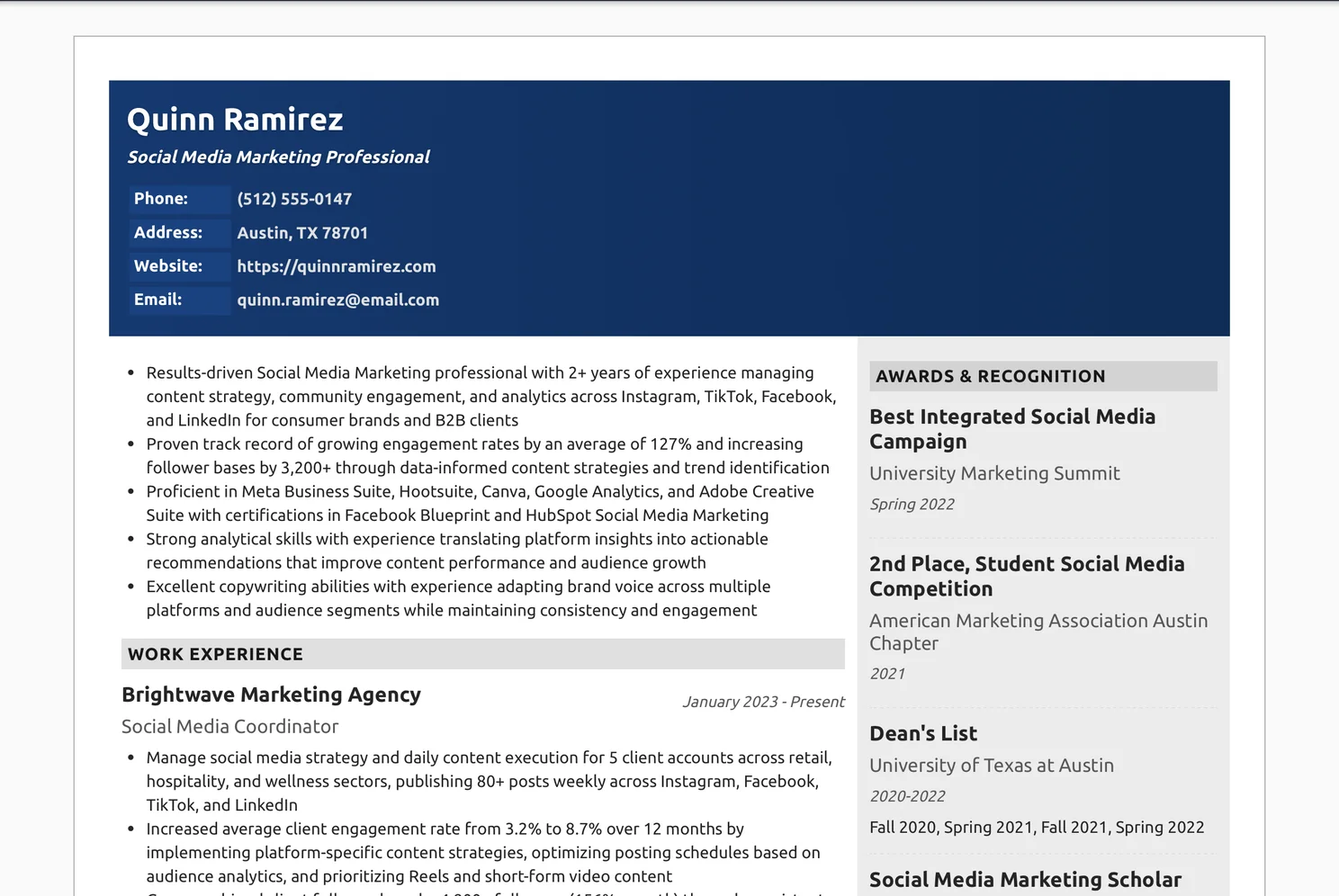
The Ultimate Social Media Marketing Resume Example/Sample
https://www.resumonk.com/social-media-marketingSocial Media MarketingResume Format to Follow for Social Media Marketing Resume
Social Media Marketing roles at the entry level involve the daily grind of content scheduling, community management, analytics tracking, and campaign execution. You're the person who spots trending hashtags at 7 AM, responds to customer comments throughout the day, and analyzes why that Tuesday afternoon post got triple the engagement.
Understanding this context matters because it directly influences how you should structure your resume.
The Reverse-Chronological Format is Your Best Friend
For a Social Media Marketing position, you want to use a reverse-chronological resume format.
This means listing your most recent experience first and working backwards. Why does this matter specifically for you? Because social media changes faster than any other marketing discipline. What worked in 2020 doesn't work now. Hiring managers want to see immediately that you understand the current landscape - the Instagram Reels revolution, the evolution of TikTok for business, the changes in Twitter engagement patterns, LinkedIn's creator economy push.
When your most recent experience sits at the top, you're essentially saying "Here's proof I know what's happening right now in social media." If you buried your 2024 internship where you managed Instagram content below your 2021 college club presidency, you're making the recruiter dig for relevance. They won't dig.
They'll move to the next resume.
Structure That Speaks to Entry-Level Reality
Your resume should follow this hierarchy from top to bottom: Contact Information, Professional Summary or Objective, Work Experience, Education, Skills, and then any relevant Certifications or Projects. Notice that Work Experience comes before Education? This is intentional.
Even if your work experience consists of internships, freelance gigs, or managing social media for your university's student organization, leading with it signals that you understand this is a practical, hands-on role.
However, if you're truly at the beginning - perhaps still in your final semester with limited professional experience - you can flex this structure slightly. In that case, consider placing a robust Projects or Portfolio section right after your summary, then Education, then any work experience you do have.
The key is showing evidence of doing the work, even if it wasn't in a traditional employment setting.
Length and Visual Breathing Room
Keep your resume to one page.
This isn't arbitrary gatekeeping - it's about respecting the reality of how social media marketing resumes get reviewed. The hiring manager reading your resume probably has 50-100 others to review, and they're doing it between meetings about Q4 campaign performance and content calendar approvals. A concise, well-organized single page demonstrates that you understand attention spans and information hierarchy, which are literally core competencies for social media work.
Within that single page, use white space strategically. Social media professionals understand visual communication, so your resume should reflect this. Adequate margins, clear section breaks, and bullet points with breathing room between them show design sensibility without needing to be overly creative.
Remember, creativity belongs in your portfolio; clarity belongs in your resume.
Work Experience on Social Media Marketing Resume
Does your work experience need to come from a big-name brand to count? The answer is more nuanced than yes or no. What matters isn't the prestige of where you worked - it's how you frame what you accomplished and whether it demonstrates the core competencies of social media marketing.
Let's break down exactly how to do this.
Identifying Relevant Experience (Even When It Doesn't Look Relevant)
Social media marketing at the entry level requires several key capabilities: content creation, community engagement, data analysis, trend awareness, cross-functional collaboration, and project management. If you've done any of these things in any context, you have relevant experience.
Did you work in customer service? You were managing community engagement and brand voice. Were you a student ambassador? You were creating content and building audience awareness. Did you run social media for a student organization? That's literally the job, even if you weren't paid for it. The trick is translating these experiences into the language hiring managers expect.
The Anatomy of a Strong Social Media Work Experience Entry
Each position you list should include: Job Title, Company/Organization Name, Location, and Dates (Month and Year format). Below this, you'll have 3-5 bullet points that describe your responsibilities and achievements.
Notice the word "achievements" - this is critical.
The weakest social media resume bullets simply describe tasks you were assigned. The strongest ones demonstrate impact through metrics and outcomes. Social media is beautifully measurable, which means you should almost always have numbers to include. Engagement rates, follower growth, reach, impressions, click-through rates, conversion rates - these are your resume currency.
Let's look at how this works in practice:
❌ Don't write task-based bullets without context or results:
Posted content on Instagram and Facebook daily
Responded to comments and messages
Created graphics for social media
✅ Do write achievement-focused bullets with metrics and context:
- Developed and executed content calendar across Instagram and Facebook, publishing 25+ posts weekly that increased overall engagement rate by 34% over 3 months
- Managed community engagement by responding to 50+ daily comments and DMs within 2-hour response time, contributing to 4.2/5.0 customer satisfaction rating
- Designed 100+ branded graphics using Canva and Adobe Spark, maintaining visual consistency across platforms while adapting content for algorithm preferences on each channel
The Action Verb Matters More Than You Think
How you start each bullet point sets the tone for everything that follows. Weak verbs like "Helped with" or "Responsible for" make you sound passive and uncertain.
Strong verbs like "Managed," "Developed," "Analyzed," "Executed," "Optimized," and "Collaborated" position you as someone who takes initiative.
But there's a subtlety here specific to social media roles. You want to balance execution verbs with strategic verbs. If every bullet starts with "Posted" or "Scheduled," you sound like a robot with access to Buffer. Mix in verbs that show thinking: "Analyzed," "Identified," "Recommended," "Optimized." This demonstrates that you're not simply pushing content into the void; you're making informed decisions based on data.
Handling Gaps and Non-Traditional Experience
Maybe you're coming from a different field entirely, or perhaps you took time off, or you've been freelancing informally. The reverse-chronological format can feel intimidating when your path hasn't been linear.
Here's how to handle it.
If you've been freelancing or doing social media work informally, create a position entry called "Freelance Social Media Consultant" or "Independent Social Media Specialist" and list it with date ranges just like any other job. Under this heading, you can describe various projects as bullet points, or if you've worked extensively with one or two clients, list them as sub-entries.
❌ Don't leave informal work off your resume entirely:
(Nothing listed between January 2023 and August 2024)
✅ Do structure freelance and informal work professionally:
Freelance Social Media Manager - Self-Employed - Remote
January 2023 - August 2024
• Managed social media strategy and execution for 3 small business clients in retail and hospitality sectors
• Grew combined follower base across clients by 2,400+ followers through targeted content strategy and community engagement
• Produced analytics reports monthly, translating platform insights into actionable recommendations that improved average post engagement by 28%
If you're transitioning from a completely different field, include your previous work experience but mine it specifically for transferable skills. Were you in hospitality? Highlight customer service and fast-paced multitasking. Retail? Talk about brand representation and customer engagement. Teaching? Content creation and communication skills are directly relevant.
Internship Experience Deserves Full Treatment
A common mistake among entry-level candidates is minimizing internship experience with language like "just an intern" in interviews, or by giving internship entries fewer bullet points than "real jobs." Stop this immediately.
An internship where you managed Instagram content, analyzed engagement metrics, and collaborated with the marketing team is more relevant than a full-time position doing something unrelated.
Give your social media internships the same robust treatment you'd give any position. Use all 3-5 bullet points. Include metrics. Demonstrate growth and impact.
The hiring manager doesn't care that you were "only" an intern - they care that you have demonstrable experience doing the work they're hiring for.
Skills to Show on Social Media Marketing Resume
The Skills section of your resume needs to walk a careful line. It must demonstrate genuine professional competency while remaining honest about your entry-level status.
Claiming expertise in areas where you have surface-level knowledge will backfire spectacularly when you can't execute in the role.
Platform Proficiency vs. Platform Presence
Having a personal TikTok account with 500 followers is not the same as understanding TikTok's algorithm, analytics dashboard, business account features, advertising platform, and content strategy best practices. The former is platform presence; the latter is platform proficiency.
When you list platforms in your Skills section, you're implicitly claiming professional competency with them. This means understanding not the user-facing experience but the business-facing side. For Instagram, this includes familiarity with Meta Business Suite, Instagram Insights, content scheduling, hashtag strategy, Stories vs. Reels vs. Feed optimization, and the nuances of the algorithm. For LinkedIn, it means understanding company pages, LinkedIn Analytics, article publishing, employee advocacy, and B2B engagement patterns.
❌ Don't list platforms without genuine business-side experience:
Skills: Instagram, TikTok, Twitter, Facebook, Snapchat, Pinterest, LinkedIn
✅ Do list platforms where you have demonstrable professional experience, with context if needed:
Social Media Platforms:
- Instagram (content strategy, Reels optimization, Stories engagement)
- Facebook (Meta Business Suite, Ads Manager basics, community management)
- LinkedIn (company page management, content publishing, B2B engagement)
- TikTok (trend analysis, content creation, analytics interpretation)
Technical Tools and Software
Social media marketing requires a toolkit of software beyond the platforms themselves.
Scheduling tools, design software, analytics platforms, and project management systems are part of your daily work. List the ones you've actually used in a professional or semi-professional context.
Common tools worth mentioning include: scheduling platforms (Hootsuite, Buffer, Later, Sprout Social), design tools (Canva, Adobe Creative Suite, Figma), analytics tools (Google Analytics, platform-native analytics), and collaboration tools (Asana, Trello, Monday, Slack). However, the critical word is "used." If you took a 30-minute tutorial on Hootsuite once, you don't have Hootsuite as a skill.
If you've scheduled hundreds of posts across multiple accounts using Hootsuite, you do.
Hard Skills That Differentiate You
At the entry level, certain hard skills elevate you above other candidates because they demonstrate initiative and depth. These include:
- Content Creation: Copywriting, graphic design, basic video editing, photography
- Analytics and Reporting: Data analysis, Excel/Google Sheets proficiency, metrics interpretation, report creation
- Paid Social Basics: Facebook Ads Manager, LinkedIn Campaign Manager, basic understanding of ad targeting and budgeting
- SEO and Hashtag Strategy: Keyword research, SEO fundamentals, hashtag analysis
- Community Management: Customer service, crisis communication basics, brand voice maintenance
Notice how specific these are? "Content creation" alone is vague.
Breaking it down into copywriting, graphic design, and video editing gives a hiring manager concrete understanding of what you can do from day one.
Soft Skills (But Make Them Credible)
Every resume in the pile will claim "excellent communication skills" and "attention to detail." These phrases have been rendered meaningless through overuse.
If you include soft skills, you need to either demonstrate them through your work experience bullets or phrase them in ways specific to social media marketing.
Instead of listing "Communication Skills," consider "Brand Voice Adaptation" or "Cross-Platform Content Translation." Instead of "Creativity," try "Trend Identification and Application" or "Visual Storytelling." These reframings take generic soft skills and contextualize them for your specific role.
Better yet, let your work experience section prove your soft skills rather than claiming them in a list. If your bullet points demonstrate that you managed competing priorities, analyzed data to inform decisions, and collaborated across teams, you don't need to separately list "Time Management," "Analytical Thinking," and "Teamwork."
Certifications Worth Mentioning
The social media marketing field is full of professional certifications, and their value varies wildly.
Some genuinely demonstrate competency; others are pay-for-certificate schemes with minimal educational value. As a general rule, certifications from the platforms themselves (Facebook Blueprint, Google Analytics Individual Qualification, Hootsuite Social Marketing Certification) carry weight because they demonstrate platform-specific knowledge.
Industry-recognized certifications like HubSpot's Social Media Marketing Certification or content marketing certifications can also add credibility, especially when you're light on work experience. However, don't stuff your resume with every free certificate you've collected. List 2-3 meaningful ones at most, either in your Skills section or in a separate Certifications section if you have enough to warrant it.
What Not to Include
Resist the urge to list skills that are expected baseline competencies. "Proficient in Microsoft Word" or "Internet Research" sound ridiculous on a social media marketing resume. You're applying for a digital-native role; basic computer literacy is assumed.
Similarly, don't list soft skills like "Passionate about social media" - your passion should be evident through your experience and accomplishments, not claimed as a skill.
Also avoid rating your skills with bars, percentages, or descriptors like "Expert" or "Advanced." These ratings are subjective and meaningless without context. What one person considers "expert" another considers "intermediate."
Hiring managers discount these ratings entirely, so you're wasting precious resume space on visual elements that add no value.
Specific Considerations and Tips for Social Media Marketing Resume
Now we arrive at the nuances that separate social media marketing resumes from every other type of resume out there.
You're applying for a role that exists in a uniquely fast-paced, constantly-evolving space where what was true six months ago might already be outdated. Your resume needs to reflect this reality.
The Portfolio Link is Non-Negotiable
Unlike most entry-level positions where a portfolio is optional or merely suggested, for social media marketing it's essentially required.
Your resume describes what you've done; your portfolio proves it. Include a link to your portfolio, personal website, or even a well-curated LinkedIn profile right in your contact information section at the top of your resume.
This portfolio should showcase actual social media content you've created, campaigns you've contributed to, and results you've driven. Screenshots of high-performing posts, before-and-after growth metrics, examples of content calendars, brand voice guidelines you've developed - these tangible artifacts make your resume claims concrete and verifiable.
If you don't have professional work to showcase yet, create spec work. Choose 2-3 brands you admire and develop mock social media strategies for them. Create sample content calendars. Design example posts. Write copy in different brand voices.
This demonstrates initiative and gives hiring managers something to evaluate beyond your bullet points.
Recency Matters More Here Than Anywhere Else
A software engineer's experience from five years ago remains largely relevant because programming fundamentals don't change.
Your social media experience from two years ago is significantly less valuable because the platforms themselves have fundamentally changed. Instagram's algorithm priorities shifted. TikTok matured from a lip-sync app to a legitimate marketing channel. Twitter became X and underwent massive changes. LinkedIn evolved into a content creation platform.
This means you should weight your resume heavily toward recent experience. If you have social media work from 2021 and 2024, spend more bullet points and detail on the 2024 experience. The hiring manager needs to know you understand the current landscape, not that you were successful in a landscape that no longer exists.
Additionally, if you've taken courses, earned certifications, or completed projects recently, mention the dates. A "Google Analytics Certification - 2024" signals current knowledge. An undated certification could have been earned when dinosaurs roamed the earth for all the hiring manager knows.
Numbers, Numbers, Numbers (But Make Them Honest)
Social media is gloriously measurable, which means your resume should be rich with metrics. However, there's a specific art to presenting social media metrics on a resume without misleading or cherry-picking data that creates false impressions.
Context matters enormously. "Grew Instagram following by 500 followers" sounds impressive if the account started at 200 but underwhelming if it started at 50,000. "Achieved 8% engagement rate" is exceptional for some platforms and industries but mediocre for others. When you include metrics, provide enough context for them to be meaningful.
❌ Don't present metrics without context or in ways that could mislead:
Increased Instagram engagement by 300%
Grew Facebook page by 1,000 followers
Generated 50,000 impressions on Twitter
✅ Do provide context that makes metrics meaningful and honest:
- Increased Instagram engagement rate from 2.1% to 8.4% over 6 months through strategic Reels focus and community interaction protocols
- Grew Facebook page from 450 to 1,450 followers (222% growth) through consistent content strategy and local community partnership promotion
- Generated 50,000+ impressions monthly on Twitter (up from 12,000 baseline) through trend participation and optimized posting schedule based on audience analytics
Address Multi-Platform Experience Strategically
Very few entry-level social media marketing roles focus on a single platform, but some industries or companies emphasize certain platforms more heavily.
If you're applying to a B2B SaaS company, your LinkedIn and Twitter experience matters more than your TikTok prowess. If you're applying to a beauty brand, Instagram and TikTok are your showcase platforms.
Research each company you're applying to and understand their social media presence. Then, within the constraints of honesty, emphasize your experience with the platforms they prioritize. This doesn't mean lying about experience you don't have - it means structuring your bullets to lead with your most relevant experience for that particular application.
If you're creating multiple versions of your resume for different types of companies (which you should be), the work experience facts stay the same but the emphasis and ordering of bullet points might shift to highlight different aspects of your experience.
The Personal Brand Question
Should you mention your personal social media following if you have one? This is surprisingly controversial, and the answer is: it depends.
If you have a genuinely substantial and engaged following that demonstrates your understanding of audience building, content strategy, and community management, it can be worth mentioning, especially if it's in a relevant niche.
A travel influencer account with 15,000 engaged followers demonstrates real social media skills. A personal account with 800 followers where most are friends and family does not. Be honest with yourself about whether your personal social media presence demonstrates professional competency or simply personal popularity.
If you do mention personal social media success, frame it professionally and include metrics that matter to marketers: engagement rate, audience demographics, content strategy, and any collaborations or partnerships you've secured. Follower count alone means little without context about engagement and audience quality.
Trends, Virality, and Crisis Management
If you've had experience with trending content, viral posts, or managing challenging situations on social media, these are worth highlighting specifically. The ability to identify and capitalize on trends is valuable.
Experience managing negative feedback or crisis situations demonstrates maturity beyond typical entry-level expectations.
Frame these experiences with specific details that prove your involvement wasn't accidental. Anyone can have a post go viral through luck. Not everyone can explain why it worked and replicate the conditions that led to success.
❌ Don't claim trend success without demonstrating understanding:
- Created viral TikTok that got 100K views
✅ Do show strategic thinking behind trend participation:
- Identified and adapted trending audio format on TikTok within 24-hour relevance window, resulting in 100K+ views (10x account average) and 350 new followers by aligning brand messaging with trend's emotional context
Geographic Considerations for Remote vs. Local Roles
Social media marketing has a higher proportion of remote opportunities than many entry-level fields, but not all roles are location-flexible. If you're applying for remote positions, emphasize any experience you have with remote collaboration, self-directed work, and asynchronous communication.
Mention specific tools you've used for remote teamwork.
Conversely, if you're applying for local positions that require in-office presence, emphasize any experience you have with in-person collaboration, local market knowledge, or location-specific content creation. Some social media roles involve attending events, coordinating with local teams, or creating location-specific content, and demonstrating understanding of this adds value.
The Candidate They're Actually Looking For
Here's something hiring managers won't tell you directly: for entry-level social media marketing positions, they're often more interested in your potential and your demonstrated learning ability than your existing expertise.
They expect to train you on their specific tools, voice, and processes. What they can't easily teach is curiosity, initiative, analytical thinking, and genuine interest in the work.
Your resume should demonstrate these qualities through your choices and accomplishments. Did you take initiative to learn new platforms? Did you analyze data and adjust strategy based on what you learned? Did you go beyond assigned tasks to improve results? These indicators of potential matter more than you might think.
This doesn't mean downplaying your skills or experience - it means framing them in ways that show you're someone who learns, adapts, and improves. Social media platforms will change. Trends will come and go. The candidate who demonstrates they can learn and evolve will outlast the candidate who knows today's landscape perfectly but lacks adaptability.
The Cover Letter Connection
While this guide focuses on your resume, it's worth noting that social media marketing is one of the fields where a strong cover letter can significantly boost your application. Your resume shows what you've done; your cover letter can demonstrate how you think about social media strategy, what you notice about the company's current social presence, and your genuine interest in their specific brand and audience.
Consider your resume and cover letter as an integrated package. Your resume provides the facts and figures; your cover letter provides the strategic thinking and personality.
Together, they should paint a picture of someone who has both the technical competency and the creative thinking required for social media marketing success.
Education Requirements and Formatting for Your Social Media Marketing Resume
Let's talk about how to present your educational background in a way that supports your candidacy without overselling or underselling it.
Standard Education Formatting for Social Media Marketing Roles
Your education section should appear after your work experience if you have any relevant professional experience (even internships count). If you're a recent graduate with limited work history, place education near the top, right after your summary or objective.
Use reverse-chronological order, listing your most recent degree first.
The basic structure should include your degree type, major, institution name, location, and graduation date. For social media marketing specifically, if you took relevant coursework that directly applies to the role, list it. Things like Digital Marketing Strategy, Social Media Analytics, Content Creation, Consumer Behavior, or Data Analytics actually mean something to hiring managers in this field.
✅ Here's how to format it effectively:
Bachelor of Arts in Marketing | University of Texas at Austin, Austin, TX
- Graduated: May 2023
- Relevant Coursework: Social Media Strategy, Digital Content Creation, Marketing Analytics, Consumer Psychology
If you maintained a strong GPA (3.5 or above), include it. In the United States, this is standard practice for recent graduates. In the UK, include your degree classification (First Class Honours, Upper Second Class, etc.). Australian candidates should list their GPA if it's strong, though many employers focus more on your portfolio work. Canadian conventions follow similar patterns to the US.
What If Your Degree Isn't Marketing-Related?
Maybe you studied English, Psychology, Graphic Design, or even something completely unrelated like Biology. Don't panic. Social media marketing is one of those fields where your demonstrated skills and portfolio often matter more than your major.
The key is contextualizing your education to show its relevance.
If you have an English degree, emphasize coursework in writing, rhetoric, or digital communication. Psychology majors can highlight consumer behavior and research methods. The principle here is simple: connect the dots for the hiring manager so they don't have to.
✅ Here's a great example of how to do this:
Bachelor of Science in Psychology | Boston University, Boston, MA
- Graduated: December 2022
- Relevant Coursework: Consumer Behavior, Research Methods & Statistics, Persuasion & Influence
GPA: 3.7/4.0
Certifications and Additional Training
This is where your education section can really work for you in social media marketing. Unlike many fields where formal degrees reign supreme, social media marketing values platform-specific knowledge and tool proficiency.
If you've completed certifications from Google Analytics, HubSpot, Facebook Blueprint, Hootsuite, or similar programs, list them in your education section or create a separate "Certifications" section.
These certifications signal that you're current with industry tools and committed to professional development. Since social media platforms update their algorithms and features constantly, showing you've invested time in structured learning beyond your degree demonstrates adaptability.
Certifications:
1. Google Analytics Individual Qualification (GAIQ) - 2023
2. HubSpot Social Media Marketing Certification - 2023
3. Facebook Certified Digital Marketing Associate - 2024
When to Include or Exclude Certain Details
Once you're three to five years into your career, your GPA becomes irrelevant unless it was truly exceptional (3.9+). Remove graduation dates if you're concerned about age discrimination, though for social media marketing roles which tend to skew younger, this is less of an issue than in other fields. Never include high school information once you have a college degree.
The one exception might be if you attended a prestigious high school and are applying to companies in the same geographic area where that school carries networking weight, but even then, it's questionable.
If you didn't complete your degree, you can still list your educational experience, but be honest about it:
Coursework in Digital Communications | Arizona State University, Tempe, AZ | 2020-2022
- 60 credits completed
For international candidates applying to US positions or vice versa, clarify your degree equivalency if there might be confusion. A UK reader won't be puzzled by "BA Hons," but a US hiring manager might need context.
Showcasing Awards and Publications on Your Social Media Marketing Resume
The question isn't whether you have awards and publications worth mentioning. The question is whether you're recognizing what counts as an award or publication in the social media marketing context.
What Qualifies as an Award for Social Media Marketing Professionals?
Traditional awards absolutely count - if you won a marketing competition, received a scholarship for academic excellence in communications, or earned recognition from a professional organization like the American Marketing Association, include it. But social media marketing has its own ecosystem of recognition that matters just as much, if not more.
Did you win a student competition for creating a social media campaign? Did your college newspaper or marketing club recognize your work? Were you selected for a competitive program or fellowship related to digital marketing? Did a campaign you worked on receive any industry recognition, even if you weren't personally named? These all belong on your resume.
✅ Here's what effective award listings look like:
Awards:
1. "Best Social Media Campaign" - University Marketing Summit, 2023
2. Dean's List - Fall 2021, Spring 2022, Fall 2022
3. Social Media Marketing Scholar - Digital Marketing Institute, 2023
4. 2nd Place, National Student Advertising Competition (NSAC) - American Advertising Federation, 2023
The key is being specific. Don't just write "Marketing Award Winner."
Explain what you won, from whom, and when. Context matters because it helps hiring managers gauge the prestige and relevance of the recognition.
Publications in a Social Media Marketing Context
When most people think "publications," they imagine academic journals or books. For social media marketers, the definition expands considerably. Have you contributed guest posts to marketing blogs? Written articles for your university's marketing publication? Been featured or quoted in articles about social media trends? Created case studies that were published on a company blog?
These all count.
The social media marketing industry values thought leadership and content creation ability. If you've had bylines anywhere - even Medium, LinkedIn articles, or industry blogs - that demonstrates both your expertise and your ability to create compelling content, which is literally the job.
✅ Here's how to format publications effectively:
Publications:
1. "How Gen Z is Reshaping Instagram Marketing" - Digital Marketing Insights Blog, March 2024"
2. 5 Common Social Media Mistakes Small Businesses Make" - Small Biz Marketing Magazine, January 2024
3. Featured Expert: "Student Perspectives on TikTok Advertising" - Marketing Week, November 2023
Notice the format: article title in quotes, publication name in plain text, and the date.
If the publication is online, you might consider including the URL, though this is optional depending on your resume formatting.
When This Section Makes Sense (And When It Doesn't)
Here's the reality check: if you have one minor award from freshman year and nothing else, don't create a whole section for it.
Resume real estate is precious, and a sparse "Awards and Publications" section can actually make you look less impressive than having no section at all. Incorporate that single award into your education section instead.
However, if you have two or more substantial items, create the section. It demonstrates that you're not just going through the motions but actively excelling and contributing to the field.
For early-career social media marketers, this section can compensate for limited work experience by showing initiative, recognition, and industry involvement.
How to Position This Section on Your Resume
Placement matters.
If your awards and publications are impressive and recent, position this section prominently, perhaps after your work experience but before your skills section. If they're less central to your candidacy, place them near the bottom, after skills or certifications.
The strategic question to ask yourself: does this section strengthen my narrative as a social media marketing professional, or is it filler? If your publication is "How to Train Your Dog" on a personal blog and has nothing to do with marketing, leave it off.
Every element on your resume should either demonstrate relevant skills or build your credibility in social media marketing.
Social Media Metrics as Informal Recognition
Here's an unconventional thought: if you've built a significant social media following yourself (10K+ followers with genuine engagement), or if content you've created has gone viral in a relevant way, consider whether this belongs in an "Awards and Recognition" section. A tweet with 50K retweets about marketing trends, a LinkedIn post that generated substantial industry discussion, or a TikTok series about social media tips that gained traction - these demonstrate practical expertise.
However, tread carefully here. This only works if the content is professionally relevant and the metrics are genuinely impressive. Don't list your personal Instagram with 800 followers. But if you've demonstrated actual social media success in a professional context, it's worth considering:
Notable Work:
Creator of "Marketing Myth Mondays" LinkedIn series - Generated 500K+ impressions and featured by LinkedIn Marketing Blog, 2023-2024
The line between an award, a publication, and a professional achievement blurs in social media marketing, and that's actually to your advantage. Use this section to showcase anything that proves you understand the medium, create compelling content, and get recognized for your work.
Understanding References on Your Social Media Marketing Resume
You don't need a references section on your resume, but that doesn't mean references don't matter. They absolutely do, especially in social media marketing where you're often working cross-functionally with teams, managing brand reputation, and needing to prove you're trustworthy with a company's public voice.
You just need to handle them strategically rather than dedicating resume space to them.
Why References Matter Specifically for Social Media Marketing Roles
Social media marketing sits at an interesting intersection of creativity, analytics, communication, and brand management. When hiring managers check your references for these roles, they're trying to verify specific things: Can you work independently and meet deadlines? Are you responsive and communicative? Do you handle feedback well? Can you maintain professionalism when managing a brand's public presence?
Do you collaborate effectively with content creators, designers, and marketing leadership?
These soft skills matter enormously in social media marketing because you're often the voice of the brand to thousands or millions of people. A bad hire in this role can damage brand reputation quickly.
References help employers feel confident you won't create PR nightmares or ghost them during a product launch week.
Who Should Be Your References for Social Media Marketing Positions
The best references for social media marketing roles are people who directly supervised your marketing work or collaborated closely with you on social media projects. This might include:
- Your supervisor from a marketing internship or previous social media role - this person can speak to your technical skills, work ethic, and ability to meet deadlines. They can verify the metrics you claimed on your resume and discuss how you handled challenges.
- A marketing professor who oversaw your capstone project or independent study - if you're early in your career with limited work experience, academic references can be valuable, especially if the professor supervised applied work rather than just grading your tests. Choose professors who know your work quality, not just those who gave you an A.
- A client or stakeholder from freelance social media work - if you've done freelance social media management, a satisfied client can be an excellent reference. They can speak to your communication skills, reliability, and results.
- A colleague from a cross-functional team where you led social media efforts - sometimes lateral references (peers rather than supervisors) can provide valuable perspective on your collaboration and communication skills, though you should also have at least one supervisory reference.
Who Should Not Be Your References
Avoid using family friends, personal friends, or people who know you socially but haven't worked with you professionally.
"I've known Sarah since she was five and she's a great person" tells hiring managers nothing relevant.
Also avoid using references from non-marketing contexts unless you have absolutely no other option - your manager from your retail job in high school has limited ability to speak to your social media marketing capabilities.
Don't use professors who don't remember you well. If you have to remind them who you are when you ask for a reference, they're not going to give a compelling recommendation.
And never, ever list someone as a reference without asking their permission first. This should be obvious, but it's surprisingly common and can backfire spectacularly if a hiring manager calls someone who isn't expecting the call.
How to Prepare Your References
Once you've identified your references, actually prepare them. This means having a conversation where you:
Ask explicitly if they're comfortable serving as a reference and if they can speak positively about your work. Give them an easy out - you want enthusiastic references, not lukewarm ones.
Provide them with context about the role you're applying for, including the job description and details about the company. Send them your current resume so they can refresh their memory about what you did and when.
Remind them of specific projects or accomplishments they can mention. Their memory isn't perfect - jog it by saying something like, "You might remember I increased our Instagram engagement by 120% during Q4 by implementing that user-generated content campaign. That's the kind of result I'm hoping to emphasize for this role."
Let them know when they might expect calls or emails from potential employers. Nobody likes surprise reference checks, and giving them a heads-up ensures they'll be responsive and prepared.
The Reference Sheet Document
Instead of putting references on your resume, create a separate "References" document that matches your resume's formatting and header. This document should include three to four references (three is standard, four gives them options), and for each reference, include:
- Reference Name
- Title/Position
- Company/Organization
- Relationship to you (e.g., "Direct Supervisor at XYZ Company")
- Phone number
- Email address
- Brief note (optional): "Supervised my work on Instagram growth campaign that achieved 150% engagement increase"
This format gives hiring managers everything they need while also providing context about your relationship to each reference. The optional brief note can be particularly helpful in reminding the hiring manager why this person's perspective is valuable.
When and How to Provide References
In the United States, Canada, and Australia, standard practice is to bring your reference sheet to interviews and provide it when asked, or submit it when you've advanced to later stages of the interview process.
Don't send it with your initial application unless specifically requested. In the UK, employers may request references earlier in the process, sometimes even before the first interview, so be prepared to provide them sooner.
Some job applications specifically request references upfront, with fields to fill in their information. In these cases, obviously provide what they're asking for. But if the application doesn't require it, hold your reference sheet until they request it or until you're in the final stages of consideration.
Why hold back? First, it maintains some leverage - once you've made it to the reference-checking stage, you're a serious candidate, which is a good position to be in. Second, it prevents your references from getting contacted for jobs you're not seriously in contention for, which preserves their goodwill. Third, it gives you a reason to follow up - you can send a thank-you email after an interview and mention, "I have a list of references prepared whenever you'd like to move forward with that step."
What If Your References Aren't Perfect?
Maybe you left a previous role on less-than-ideal terms, or you don't have many professional connections yet, or your best references are from work that's not directly marketing-related. Here's how to handle common reference challenges:
If you have limited professional experience, supplement with academic references but position them strategically. Instead of just listing your Marketing 101 professor, list the professor who advised your capstone project where you created a social media strategy for a real client. The applied work component makes the reference more credible.
If you left a job on bad terms with your direct supervisor, go one level up or lateral. Perhaps your supervisor's manager saw your work and can speak to it, or maybe you collaborated closely with someone in another department. Explain the situation honestly if asked why you're not using your direct supervisor as a reference.
If your references are from non-marketing roles, frame them carefully. Your manager from your restaurant job can still speak to your reliability, communication skills, and ability to handle high-pressure situations - all relevant to social media marketing when a post goes wrong and you need to manage crisis response.
Just make sure you have at least one reference who can speak to marketing-specific capabilities, even if it's a professor or volunteer experience.
Following Up With References After the Job Search
Professional courtesy that many candidates forget: let your references know how your job search turns out.
If you get the job, send them a thank-you note telling them you got the position and thanking them for their support. If the hiring manager tells you they received a glowing reference from someone, definitely follow up with that person specifically to express gratitude.
This isn't just about being polite (though it is polite). It's about maintaining professional relationships that you'll need throughout your career. The social media marketing world is smaller than you think, and today's reference might be tomorrow's colleague or connection to your next opportunity.
Treat these relationships with care, and they'll continue to benefit you throughout your career.
Crafting an Effective Cover Letter for Your Social Media Marketing Application
If you submit a generic, lifeless cover letter, you've essentially told the hiring manager you can't write engaging content. That's a problem when writing engaging content is the job.
The Purpose of Your Cover Letter in Social Media Marketing
Your resume shows what you've done. Your cover letter shows how you think and whether you can write. For social media marketing roles, hiring managers want to see: Can you capture attention quickly? Do you understand tone and audience? Can you make a compelling case in limited space?
These are exactly the skills you need to write a good tweet, Instagram caption, or LinkedIn post.
Your cover letter should accomplish three things: demonstrate you understand the company's brand and social media presence, show you have the skills and experience they need, and prove you can write crisp, engaging copy. Notice that all three of these are interrelated and speak directly to the core competencies of social media marketing.
Research Before You Write
Before you type a single word, spend 30 minutes researching the company's social media presence.
Follow them on the platforms they're active on. Read through their recent posts. Note their tone, their content strategy, their engagement patterns. Are they playful or professional? Do they use humor? How do they interact with comments? What seems to be working for them, and where are the gaps?
This research serves two purposes: it helps you customize your letter effectively, and it gives you concrete examples to reference. The difference between a mediocre cover letter and a great one often comes down to specificity.
❌ Don't write something generic like this:
"I am writing to apply for the Social Media Marketing position at your company. I have experience with social media and am passionate about digital marketing. I believe I would be a great fit for your team."
✅ Do write something specific like this:
"I've been following Glossier's Instagram strategy for the past year, and your approach to user-generated content is exactly the kind of authentic community-building I want to be part of. When your recent "Skin First" campaign generated 40% more engagement than your typical posts, I noticed it was because you shifted from product features to customer transformations - letting your community tell the story."
Structure That Works for Social Media Marketing Cover Letters
Open with a hook.
Not "I am writing to apply for" - that's wasted words that tell them nothing they don't already know. Start with why you're genuinely interested in this specific role at this specific company, ideally tied to something concrete about their social media presence or recent campaign.
Your first paragraph should accomplish what a good social media post accomplishes: grab attention, establish relevance, and make the reader want to keep going. Think of your opening line the way you'd think of the first line of a LinkedIn post - if it's boring, people stop reading.
The middle section (one to two paragraphs) should connect your experience to their needs. This isn't about listing everything on your resume. It's about selecting the two or three most relevant examples that prove you can do what they need. Use specific metrics where possible, because social media marketing is a metrics-driven field.
Instead of saying "I managed social media accounts," say "I grew Instagram engagement by 145% over six months by implementing a consistent posting schedule and user-generated content strategy." The difference is specificity and outcomes, both of which matter immensely in social media marketing roles.
Showing Versus Telling in Your Cover Letter
Anyone can write "I'm creative and analytical."
Those words mean nothing without evidence. Social media marketing requires both creative content development and data-driven decision making. Show you have both by describing specific situations where you demonstrated these skills.
❌ Don't make empty claims:
I am a creative social media marketer with strong analytical skills. I am passionate about creating engaging content and understand the importance of data in social media strategy.
✅ Do provide specific evidence:
When I noticed our TikTok engagement dropping in Q3, I analyzed our top-performing posts from the previous quarter and identified that educational content outperformed entertainment content by 3x. I shifted our strategy toward tips and tutorials, which brought our engagement rate back up from 2.1% to 4.7% within six weeks.
Notice how the second example tells a mini-story with a problem, action, and result.
This is what hiring managers want to see: evidence that you can identify issues, form hypotheses, take action, and measure outcomes.
Addressing the Tone Challenge
One of the trickiest aspects of writing cover letters for social media marketing roles is calibrating your tone. You want to show personality (because social media is about personality), but you can't be so casual that you seem unprofessional.
The sweet spot is professionally conversational - like you're having a business conversation with someone you respect but not someone who intimidates you.
The tone should match the company culture as reflected in their social media. If they're a buttoned-up B2B SaaS company with a formal LinkedIn presence, keep your letter more professional. If they're a DTC brand with a playful Instagram voice, you have more room to inject personality. But never cross into overly casual - no "Hey there!" openings or emoji usage, even if the brand uses those on social media. Your cover letter is a professional document, just one that can have warmth and personality.
The Closing That Creates Action
Your closing paragraph should do three things: reiterate your enthusiasm for this specific opportunity, include a subtle call to action, and thank them for their consideration. This is also where you can mention your availability for an interview and reference that you'd love to discuss your ideas for their social media strategy.
That last part is subtle but powerful. It shifts the frame from "please hire me" to "I have ideas that could help you," which positions you as a strategic thinker rather than just an applicant.
I'd love the opportunity to discuss how my experience growing engagement for consumer brands could support [Company]'s goals for expanding your TikTok presence. I'm available for a conversation at your convenience and would be excited to share some initial ideas I've been developing after studying your current social strategy.
Thank you for considering my application. I look forward to hearing from you.
Best regards,
[Your Name]
Technical Considerations for Cover Letter Submission
Keep your cover letter to one page.
Social media marketing hiring managers are busy people who value concision - if you can't make your case in one page, you're not demonstrating the editing skills the role requires. Use standard business letter formatting with your contact information at the top, the date, and the employer's information.
Save your file as a PDF with a clear naming convention like "FirstName_LastName_CoverLetter_CompanyName.pdf" - this shows attention to detail and makes it easy for them to find your materials. If you're submitting through an application system, follow their instructions exactly. Some systems have specific fields for cover letters; others want everything in one document.
For UK applications, the format is similar but ensure you use British English spelling and conventions. Australian and Canadian applications follow similar structures to US applications, though Canadian applications sometimes include slightly more formal language.
Regardless of location, the core principle remains: demonstrate you understand their brand, prove you have relevant skills, and show you can write compelling copy.
Key Takeaways
Creating a standout social media marketing resume requires understanding both the technical requirements of resume writing and the specific realities of entry-level social media roles. Here are the essential points to remember as you build your resume:
- Use reverse-chronological format to emphasize your most recent experience first, because social media changes rapidly and hiring managers need to see immediately that you understand the current landscape of platforms, algorithms, and best practices.
- Lead with metrics and outcomes in your work experience bullets rather than just listing tasks. Social media is measurably driven, so quantify your impact with engagement rates, follower growth, reach, impressions, and conversion data wherever possible, always providing context that makes these numbers meaningful.
- Include all relevant experience even if it doesn't look traditional, from internships and freelance work to managing social media for student organizations or small businesses. Frame these experiences professionally with proper job titles, date ranges, and achievement-focused descriptions.
- Be specific about platform proficiency in your skills section. Understanding Instagram's business tools is different from having a personal Instagram account. List only platforms where you have genuine professional experience with analytics, strategy, and business features, not just user-facing familiarity.
- Showcase technical tools and certifications that demonstrate current knowledge. Scheduling platforms, design software, analytics tools, and certifications from Google, Facebook, HubSpot, or Hootsuite prove you can hit the ground running with industry-standard tools.
- Include a portfolio link prominently in your contact information. Your resume describes what you've done; your portfolio proves it with visual examples of content, campaigns, and results. If you lack professional work, create spec projects that demonstrate your strategic thinking.
- Emphasize recency and currency by weighting recent experience more heavily and including dates on certifications and projects. What worked in social media two years ago may not be relevant now, so prove you understand today's platform dynamics.
- Customize for each application by researching the company's social media presence and emphasizing your experience with the platforms they prioritize. B2B companies care more about LinkedIn; consumer brands focus on Instagram and TikTok.
- Keep everything to one page that demonstrates both your writing ability and understanding of information hierarchy. If you can't make your case concisely, you're not showing the editing skills required for effective social media content.
- Write an integrated cover letter that showcases your ability to write compelling copy while demonstrating you've researched their social presence and have specific ideas about their strategy. Your cover letter is a content sample that proves you can write.
- Prepare references strategically by choosing people who can speak to your marketing work specifically, preparing them with context about roles you're applying for, and creating a separate reference sheet rather than taking up resume space with "references available upon request."
Building your social media marketing resume doesn't have to be overwhelming when you have the right framework and examples to follow. Resumonk makes this process even easier with AI-powered recommendations that help you articulate your experience effectively, beautifully designed templates that maintain professionalism while letting your content shine, and intuitive formatting tools that let you create a polished, one-page resume without fighting with document formatting. Whether you're translating your first internship into compelling bullet points, showcasing freelance work, or positioning a career transition into social media marketing, Resumonk's platform gives you the structure and guidance to build a resume that actually reflects your capabilities and catches hiring managers' attention.
Ready to create your social media marketing resume?
Start building with Resumonk's professionally designed templates and AI-powered content suggestions that help you articulate your experience with the metrics and language hiring managers are looking for.
Get started today and turn your social media experience into a resume that opens doors.
More Marketing resume examples
- Community Manager resume example
- Marketing Manager resume example
- Marketing Assistant resume example
- Digital Marketing resume example
See all Marketing resume examples, or browse every category.
Resume writing tips
You're here because you searched for some variation of "social media marketing resume example," and you're probably feeling a specific kind of pressure right now. Maybe you just finished your degree in marketing or communications and you're staring at job listings that all seem to want "2-3 years of experience" for what they're calling entry-level roles. Or perhaps you've been managing your college's Instagram account, freelancing for a few small businesses, or even building a modest following of your own, and now you need to translate all of that into a document that convinces someone to actually pay you to do this work.
The problem is, you're not entirely sure what "this work" even looks like on a resume when your days involve everything from responding to DMs at odd hours to analyzing why a Tuesday post flopped to jumping on trends before they become irrelevant.
Let's clear something up immediately, because it matters for everything that follows in this guide. When we talk about "Social Media Marketing" roles, we're talking about entry-level positions - the people in the trenches doing the daily work of content creation, scheduling, community management, and analytics reporting. These roles go by various titles like Social Media Marketing Executive, Social Media Coordinator, Junior Social Media Manager, or Social Media Specialist. Despite what that "Executive" suffix might suggest to your relatives, this isn't a leadership position. It's the starting point of a social media marketing career, where you're executing strategy rather than setting it, learning platforms inside and out, and proving you can turn engagement metrics into something meaningful. Understanding this context matters because it directly shapes how you should position yourself on your resume.
This guide is going to walk you through creating a resume that actually reflects what social media marketing work looks like and what hiring managers are genuinely looking for when they're trying to fill these roles. We'll start with the fundamental question of resume format and why the reverse-chronological structure works specifically for social media positions where recency matters more than in almost any other field. Then we'll dig into the work experience section, where you'll learn how to translate everything from internships to freelance gigs to that time you helped your aunt's bakery with Instagram into compelling bullet points with metrics that prove impact. We'll cover the skills section in detail, because there's a massive difference between using Instagram personally and understanding Instagram professionally, and your resume needs to demonstrate the latter. You'll get specific guidance on education requirements, whether certifications actually matter, how to showcase any awards or publications you have, and how to think about references strategically rather than just listing them because you think you're supposed to.
Throughout this guide, you'll find concrete examples of what works and what doesn't, with specific attention to the unique circumstances you might be facing. Maybe you're switching careers from something completely different. Maybe your experience is a patchwork of freelance projects rather than traditional employment. Maybe you've got a strong personal brand but aren't sure if that belongs on a professional resume. Maybe you're applying to remote positions across different markets and need to understand how to position yourself for each. We'll address all of these situations with practical, honest advice that respects where you actually are in your career journey. By the end, you'll understand not just what to put on your social media marketing resume, but why each element matters and how to customize your approach based on the specific roles you're targeting.
The Ultimate Social Media Marketing Resume Example/Sample
https://www.resumonk.com/social-media-marketingSocial Media MarketingResume Format to Follow for Social Media Marketing Resume
Social Media Marketing roles at the entry level involve the daily grind of content scheduling, community management, analytics tracking, and campaign execution. You're the person who spots trending hashtags at 7 AM, responds to customer comments throughout the day, and analyzes why that Tuesday afternoon post got triple the engagement.
Understanding this context matters because it directly influences how you should structure your resume.
The Reverse-Chronological Format is Your Best Friend
For a Social Media Marketing position, you want to use a reverse-chronological resume format.
This means listing your most recent experience first and working backwards. Why does this matter specifically for you? Because social media changes faster than any other marketing discipline. What worked in 2020 doesn't work now. Hiring managers want to see immediately that you understand the current landscape - the Instagram Reels revolution, the evolution of TikTok for business, the changes in Twitter engagement patterns, LinkedIn's creator economy push.
When your most recent experience sits at the top, you're essentially saying "Here's proof I know what's happening right now in social media." If you buried your 2024 internship where you managed Instagram content below your 2021 college club presidency, you're making the recruiter dig for relevance. They won't dig.
They'll move to the next resume.
Structure That Speaks to Entry-Level Reality
Your resume should follow this hierarchy from top to bottom: Contact Information, Professional Summary or Objective, Work Experience, Education, Skills, and then any relevant Certifications or Projects. Notice that Work Experience comes before Education? This is intentional.
Even if your work experience consists of internships, freelance gigs, or managing social media for your university's student organization, leading with it signals that you understand this is a practical, hands-on role.
However, if you're truly at the beginning - perhaps still in your final semester with limited professional experience - you can flex this structure slightly. In that case, consider placing a robust Projects or Portfolio section right after your summary, then Education, then any work experience you do have.
The key is showing evidence of doing the work, even if it wasn't in a traditional employment setting.
Length and Visual Breathing Room
Keep your resume to one page.
This isn't arbitrary gatekeeping - it's about respecting the reality of how social media marketing resumes get reviewed. The hiring manager reading your resume probably has 50-100 others to review, and they're doing it between meetings about Q4 campaign performance and content calendar approvals. A concise, well-organized single page demonstrates that you understand attention spans and information hierarchy, which are literally core competencies for social media work.
Within that single page, use white space strategically. Social media professionals understand visual communication, so your resume should reflect this. Adequate margins, clear section breaks, and bullet points with breathing room between them show design sensibility without needing to be overly creative.
Remember, creativity belongs in your portfolio; clarity belongs in your resume.
Work Experience on Social Media Marketing Resume
Does your work experience need to come from a big-name brand to count? The answer is more nuanced than yes or no. What matters isn't the prestige of where you worked - it's how you frame what you accomplished and whether it demonstrates the core competencies of social media marketing.
Let's break down exactly how to do this.
Identifying Relevant Experience (Even When It Doesn't Look Relevant)
Social media marketing at the entry level requires several key capabilities: content creation, community engagement, data analysis, trend awareness, cross-functional collaboration, and project management. If you've done any of these things in any context, you have relevant experience.
Did you work in customer service? You were managing community engagement and brand voice. Were you a student ambassador? You were creating content and building audience awareness. Did you run social media for a student organization? That's literally the job, even if you weren't paid for it. The trick is translating these experiences into the language hiring managers expect.
The Anatomy of a Strong Social Media Work Experience Entry
Each position you list should include: Job Title, Company/Organization Name, Location, and Dates (Month and Year format). Below this, you'll have 3-5 bullet points that describe your responsibilities and achievements.
Notice the word "achievements" - this is critical.
The weakest social media resume bullets simply describe tasks you were assigned. The strongest ones demonstrate impact through metrics and outcomes. Social media is beautifully measurable, which means you should almost always have numbers to include. Engagement rates, follower growth, reach, impressions, click-through rates, conversion rates - these are your resume currency.
Let's look at how this works in practice:
❌ Don't write task-based bullets without context or results:
Posted content on Instagram and Facebook daily
Responded to comments and messages
Created graphics for social media
✅ Do write achievement-focused bullets with metrics and context:
- Developed and executed content calendar across Instagram and Facebook, publishing 25+ posts weekly that increased overall engagement rate by 34% over 3 months
- Managed community engagement by responding to 50+ daily comments and DMs within 2-hour response time, contributing to 4.2/5.0 customer satisfaction rating
- Designed 100+ branded graphics using Canva and Adobe Spark, maintaining visual consistency across platforms while adapting content for algorithm preferences on each channel
The Action Verb Matters More Than You Think
How you start each bullet point sets the tone for everything that follows. Weak verbs like "Helped with" or "Responsible for" make you sound passive and uncertain.
Strong verbs like "Managed," "Developed," "Analyzed," "Executed," "Optimized," and "Collaborated" position you as someone who takes initiative.
But there's a subtlety here specific to social media roles. You want to balance execution verbs with strategic verbs. If every bullet starts with "Posted" or "Scheduled," you sound like a robot with access to Buffer. Mix in verbs that show thinking: "Analyzed," "Identified," "Recommended," "Optimized." This demonstrates that you're not simply pushing content into the void; you're making informed decisions based on data.
Handling Gaps and Non-Traditional Experience
Maybe you're coming from a different field entirely, or perhaps you took time off, or you've been freelancing informally. The reverse-chronological format can feel intimidating when your path hasn't been linear.
Here's how to handle it.
If you've been freelancing or doing social media work informally, create a position entry called "Freelance Social Media Consultant" or "Independent Social Media Specialist" and list it with date ranges just like any other job. Under this heading, you can describe various projects as bullet points, or if you've worked extensively with one or two clients, list them as sub-entries.
❌ Don't leave informal work off your resume entirely:
(Nothing listed between January 2023 and August 2024)
✅ Do structure freelance and informal work professionally:
Freelance Social Media Manager - Self-Employed - Remote
January 2023 - August 2024
• Managed social media strategy and execution for 3 small business clients in retail and hospitality sectors
• Grew combined follower base across clients by 2,400+ followers through targeted content strategy and community engagement
• Produced analytics reports monthly, translating platform insights into actionable recommendations that improved average post engagement by 28%
If you're transitioning from a completely different field, include your previous work experience but mine it specifically for transferable skills. Were you in hospitality? Highlight customer service and fast-paced multitasking. Retail? Talk about brand representation and customer engagement. Teaching? Content creation and communication skills are directly relevant.
Internship Experience Deserves Full Treatment
A common mistake among entry-level candidates is minimizing internship experience with language like "just an intern" in interviews, or by giving internship entries fewer bullet points than "real jobs." Stop this immediately.
An internship where you managed Instagram content, analyzed engagement metrics, and collaborated with the marketing team is more relevant than a full-time position doing something unrelated.
Give your social media internships the same robust treatment you'd give any position. Use all 3-5 bullet points. Include metrics. Demonstrate growth and impact.
The hiring manager doesn't care that you were "only" an intern - they care that you have demonstrable experience doing the work they're hiring for.
Skills to Show on Social Media Marketing Resume
The Skills section of your resume needs to walk a careful line. It must demonstrate genuine professional competency while remaining honest about your entry-level status.
Claiming expertise in areas where you have surface-level knowledge will backfire spectacularly when you can't execute in the role.
Platform Proficiency vs. Platform Presence
Having a personal TikTok account with 500 followers is not the same as understanding TikTok's algorithm, analytics dashboard, business account features, advertising platform, and content strategy best practices. The former is platform presence; the latter is platform proficiency.
When you list platforms in your Skills section, you're implicitly claiming professional competency with them. This means understanding not the user-facing experience but the business-facing side. For Instagram, this includes familiarity with Meta Business Suite, Instagram Insights, content scheduling, hashtag strategy, Stories vs. Reels vs. Feed optimization, and the nuances of the algorithm. For LinkedIn, it means understanding company pages, LinkedIn Analytics, article publishing, employee advocacy, and B2B engagement patterns.
❌ Don't list platforms without genuine business-side experience:
Skills: Instagram, TikTok, Twitter, Facebook, Snapchat, Pinterest, LinkedIn
✅ Do list platforms where you have demonstrable professional experience, with context if needed:
Social Media Platforms:
- Instagram (content strategy, Reels optimization, Stories engagement)
- Facebook (Meta Business Suite, Ads Manager basics, community management)
- LinkedIn (company page management, content publishing, B2B engagement)
- TikTok (trend analysis, content creation, analytics interpretation)
Technical Tools and Software
Social media marketing requires a toolkit of software beyond the platforms themselves.
Scheduling tools, design software, analytics platforms, and project management systems are part of your daily work. List the ones you've actually used in a professional or semi-professional context.
Common tools worth mentioning include: scheduling platforms (Hootsuite, Buffer, Later, Sprout Social), design tools (Canva, Adobe Creative Suite, Figma), analytics tools (Google Analytics, platform-native analytics), and collaboration tools (Asana, Trello, Monday, Slack). However, the critical word is "used." If you took a 30-minute tutorial on Hootsuite once, you don't have Hootsuite as a skill.
If you've scheduled hundreds of posts across multiple accounts using Hootsuite, you do.
Hard Skills That Differentiate You
At the entry level, certain hard skills elevate you above other candidates because they demonstrate initiative and depth. These include:
- Content Creation: Copywriting, graphic design, basic video editing, photography
- Analytics and Reporting: Data analysis, Excel/Google Sheets proficiency, metrics interpretation, report creation
- Paid Social Basics: Facebook Ads Manager, LinkedIn Campaign Manager, basic understanding of ad targeting and budgeting
- SEO and Hashtag Strategy: Keyword research, SEO fundamentals, hashtag analysis
- Community Management: Customer service, crisis communication basics, brand voice maintenance
Notice how specific these are? "Content creation" alone is vague.
Breaking it down into copywriting, graphic design, and video editing gives a hiring manager concrete understanding of what you can do from day one.
Soft Skills (But Make Them Credible)
Every resume in the pile will claim "excellent communication skills" and "attention to detail." These phrases have been rendered meaningless through overuse.
If you include soft skills, you need to either demonstrate them through your work experience bullets or phrase them in ways specific to social media marketing.
Instead of listing "Communication Skills," consider "Brand Voice Adaptation" or "Cross-Platform Content Translation." Instead of "Creativity," try "Trend Identification and Application" or "Visual Storytelling." These reframings take generic soft skills and contextualize them for your specific role.
Better yet, let your work experience section prove your soft skills rather than claiming them in a list. If your bullet points demonstrate that you managed competing priorities, analyzed data to inform decisions, and collaborated across teams, you don't need to separately list "Time Management," "Analytical Thinking," and "Teamwork."
Certifications Worth Mentioning
The social media marketing field is full of professional certifications, and their value varies wildly.
Some genuinely demonstrate competency; others are pay-for-certificate schemes with minimal educational value. As a general rule, certifications from the platforms themselves (Facebook Blueprint, Google Analytics Individual Qualification, Hootsuite Social Marketing Certification) carry weight because they demonstrate platform-specific knowledge.
Industry-recognized certifications like HubSpot's Social Media Marketing Certification or content marketing certifications can also add credibility, especially when you're light on work experience. However, don't stuff your resume with every free certificate you've collected. List 2-3 meaningful ones at most, either in your Skills section or in a separate Certifications section if you have enough to warrant it.
What Not to Include
Resist the urge to list skills that are expected baseline competencies. "Proficient in Microsoft Word" or "Internet Research" sound ridiculous on a social media marketing resume. You're applying for a digital-native role; basic computer literacy is assumed.
Similarly, don't list soft skills like "Passionate about social media" - your passion should be evident through your experience and accomplishments, not claimed as a skill.
Also avoid rating your skills with bars, percentages, or descriptors like "Expert" or "Advanced." These ratings are subjective and meaningless without context. What one person considers "expert" another considers "intermediate."
Hiring managers discount these ratings entirely, so you're wasting precious resume space on visual elements that add no value.
Specific Considerations and Tips for Social Media Marketing Resume
Now we arrive at the nuances that separate social media marketing resumes from every other type of resume out there.
You're applying for a role that exists in a uniquely fast-paced, constantly-evolving space where what was true six months ago might already be outdated. Your resume needs to reflect this reality.
The Portfolio Link is Non-Negotiable
Unlike most entry-level positions where a portfolio is optional or merely suggested, for social media marketing it's essentially required.
Your resume describes what you've done; your portfolio proves it. Include a link to your portfolio, personal website, or even a well-curated LinkedIn profile right in your contact information section at the top of your resume.
This portfolio should showcase actual social media content you've created, campaigns you've contributed to, and results you've driven. Screenshots of high-performing posts, before-and-after growth metrics, examples of content calendars, brand voice guidelines you've developed - these tangible artifacts make your resume claims concrete and verifiable.
If you don't have professional work to showcase yet, create spec work. Choose 2-3 brands you admire and develop mock social media strategies for them. Create sample content calendars. Design example posts. Write copy in different brand voices.
This demonstrates initiative and gives hiring managers something to evaluate beyond your bullet points.
Recency Matters More Here Than Anywhere Else
A software engineer's experience from five years ago remains largely relevant because programming fundamentals don't change.
Your social media experience from two years ago is significantly less valuable because the platforms themselves have fundamentally changed. Instagram's algorithm priorities shifted. TikTok matured from a lip-sync app to a legitimate marketing channel. Twitter became X and underwent massive changes. LinkedIn evolved into a content creation platform.
This means you should weight your resume heavily toward recent experience. If you have social media work from 2021 and 2024, spend more bullet points and detail on the 2024 experience. The hiring manager needs to know you understand the current landscape, not that you were successful in a landscape that no longer exists.
Additionally, if you've taken courses, earned certifications, or completed projects recently, mention the dates. A "Google Analytics Certification - 2024" signals current knowledge. An undated certification could have been earned when dinosaurs roamed the earth for all the hiring manager knows.
Numbers, Numbers, Numbers (But Make Them Honest)
Social media is gloriously measurable, which means your resume should be rich with metrics. However, there's a specific art to presenting social media metrics on a resume without misleading or cherry-picking data that creates false impressions.
Context matters enormously. "Grew Instagram following by 500 followers" sounds impressive if the account started at 200 but underwhelming if it started at 50,000. "Achieved 8% engagement rate" is exceptional for some platforms and industries but mediocre for others. When you include metrics, provide enough context for them to be meaningful.
❌ Don't present metrics without context or in ways that could mislead:
Increased Instagram engagement by 300%
Grew Facebook page by 1,000 followers
Generated 50,000 impressions on Twitter
✅ Do provide context that makes metrics meaningful and honest:
- Increased Instagram engagement rate from 2.1% to 8.4% over 6 months through strategic Reels focus and community interaction protocols
- Grew Facebook page from 450 to 1,450 followers (222% growth) through consistent content strategy and local community partnership promotion
- Generated 50,000+ impressions monthly on Twitter (up from 12,000 baseline) through trend participation and optimized posting schedule based on audience analytics
Address Multi-Platform Experience Strategically
Very few entry-level social media marketing roles focus on a single platform, but some industries or companies emphasize certain platforms more heavily.
If you're applying to a B2B SaaS company, your LinkedIn and Twitter experience matters more than your TikTok prowess. If you're applying to a beauty brand, Instagram and TikTok are your showcase platforms.
Research each company you're applying to and understand their social media presence. Then, within the constraints of honesty, emphasize your experience with the platforms they prioritize. This doesn't mean lying about experience you don't have - it means structuring your bullets to lead with your most relevant experience for that particular application.
If you're creating multiple versions of your resume for different types of companies (which you should be), the work experience facts stay the same but the emphasis and ordering of bullet points might shift to highlight different aspects of your experience.
The Personal Brand Question
Should you mention your personal social media following if you have one? This is surprisingly controversial, and the answer is: it depends.
If you have a genuinely substantial and engaged following that demonstrates your understanding of audience building, content strategy, and community management, it can be worth mentioning, especially if it's in a relevant niche.
A travel influencer account with 15,000 engaged followers demonstrates real social media skills. A personal account with 800 followers where most are friends and family does not. Be honest with yourself about whether your personal social media presence demonstrates professional competency or simply personal popularity.
If you do mention personal social media success, frame it professionally and include metrics that matter to marketers: engagement rate, audience demographics, content strategy, and any collaborations or partnerships you've secured. Follower count alone means little without context about engagement and audience quality.
Trends, Virality, and Crisis Management
If you've had experience with trending content, viral posts, or managing challenging situations on social media, these are worth highlighting specifically. The ability to identify and capitalize on trends is valuable.
Experience managing negative feedback or crisis situations demonstrates maturity beyond typical entry-level expectations.
Frame these experiences with specific details that prove your involvement wasn't accidental. Anyone can have a post go viral through luck. Not everyone can explain why it worked and replicate the conditions that led to success.
❌ Don't claim trend success without demonstrating understanding:
- Created viral TikTok that got 100K views
✅ Do show strategic thinking behind trend participation:
- Identified and adapted trending audio format on TikTok within 24-hour relevance window, resulting in 100K+ views (10x account average) and 350 new followers by aligning brand messaging with trend's emotional context
Geographic Considerations for Remote vs. Local Roles
Social media marketing has a higher proportion of remote opportunities than many entry-level fields, but not all roles are location-flexible. If you're applying for remote positions, emphasize any experience you have with remote collaboration, self-directed work, and asynchronous communication.
Mention specific tools you've used for remote teamwork.
Conversely, if you're applying for local positions that require in-office presence, emphasize any experience you have with in-person collaboration, local market knowledge, or location-specific content creation. Some social media roles involve attending events, coordinating with local teams, or creating location-specific content, and demonstrating understanding of this adds value.
The Candidate They're Actually Looking For
Here's something hiring managers won't tell you directly: for entry-level social media marketing positions, they're often more interested in your potential and your demonstrated learning ability than your existing expertise.
They expect to train you on their specific tools, voice, and processes. What they can't easily teach is curiosity, initiative, analytical thinking, and genuine interest in the work.
Your resume should demonstrate these qualities through your choices and accomplishments. Did you take initiative to learn new platforms? Did you analyze data and adjust strategy based on what you learned? Did you go beyond assigned tasks to improve results? These indicators of potential matter more than you might think.
This doesn't mean downplaying your skills or experience - it means framing them in ways that show you're someone who learns, adapts, and improves. Social media platforms will change. Trends will come and go. The candidate who demonstrates they can learn and evolve will outlast the candidate who knows today's landscape perfectly but lacks adaptability.
The Cover Letter Connection
While this guide focuses on your resume, it's worth noting that social media marketing is one of the fields where a strong cover letter can significantly boost your application. Your resume shows what you've done; your cover letter can demonstrate how you think about social media strategy, what you notice about the company's current social presence, and your genuine interest in their specific brand and audience.
Consider your resume and cover letter as an integrated package. Your resume provides the facts and figures; your cover letter provides the strategic thinking and personality.
Together, they should paint a picture of someone who has both the technical competency and the creative thinking required for social media marketing success.
Education Requirements and Formatting for Your Social Media Marketing Resume
Let's talk about how to present your educational background in a way that supports your candidacy without overselling or underselling it.
Standard Education Formatting for Social Media Marketing Roles
Your education section should appear after your work experience if you have any relevant professional experience (even internships count). If you're a recent graduate with limited work history, place education near the top, right after your summary or objective.
Use reverse-chronological order, listing your most recent degree first.
The basic structure should include your degree type, major, institution name, location, and graduation date. For social media marketing specifically, if you took relevant coursework that directly applies to the role, list it. Things like Digital Marketing Strategy, Social Media Analytics, Content Creation, Consumer Behavior, or Data Analytics actually mean something to hiring managers in this field.
✅ Here's how to format it effectively:
Bachelor of Arts in Marketing | University of Texas at Austin, Austin, TX
- Graduated: May 2023
- Relevant Coursework: Social Media Strategy, Digital Content Creation, Marketing Analytics, Consumer Psychology
If you maintained a strong GPA (3.5 or above), include it. In the United States, this is standard practice for recent graduates. In the UK, include your degree classification (First Class Honours, Upper Second Class, etc.). Australian candidates should list their GPA if it's strong, though many employers focus more on your portfolio work. Canadian conventions follow similar patterns to the US.
What If Your Degree Isn't Marketing-Related?
Maybe you studied English, Psychology, Graphic Design, or even something completely unrelated like Biology. Don't panic. Social media marketing is one of those fields where your demonstrated skills and portfolio often matter more than your major.
The key is contextualizing your education to show its relevance.
If you have an English degree, emphasize coursework in writing, rhetoric, or digital communication. Psychology majors can highlight consumer behavior and research methods. The principle here is simple: connect the dots for the hiring manager so they don't have to.
✅ Here's a great example of how to do this:
Bachelor of Science in Psychology | Boston University, Boston, MA
- Graduated: December 2022
- Relevant Coursework: Consumer Behavior, Research Methods & Statistics, Persuasion & Influence
GPA: 3.7/4.0
Certifications and Additional Training
This is where your education section can really work for you in social media marketing. Unlike many fields where formal degrees reign supreme, social media marketing values platform-specific knowledge and tool proficiency.
If you've completed certifications from Google Analytics, HubSpot, Facebook Blueprint, Hootsuite, or similar programs, list them in your education section or create a separate "Certifications" section.
These certifications signal that you're current with industry tools and committed to professional development. Since social media platforms update their algorithms and features constantly, showing you've invested time in structured learning beyond your degree demonstrates adaptability.
Certifications:
1. Google Analytics Individual Qualification (GAIQ) - 2023
2. HubSpot Social Media Marketing Certification - 2023
3. Facebook Certified Digital Marketing Associate - 2024
When to Include or Exclude Certain Details
Once you're three to five years into your career, your GPA becomes irrelevant unless it was truly exceptional (3.9+). Remove graduation dates if you're concerned about age discrimination, though for social media marketing roles which tend to skew younger, this is less of an issue than in other fields. Never include high school information once you have a college degree.
The one exception might be if you attended a prestigious high school and are applying to companies in the same geographic area where that school carries networking weight, but even then, it's questionable.
If you didn't complete your degree, you can still list your educational experience, but be honest about it:
Coursework in Digital Communications | Arizona State University, Tempe, AZ | 2020-2022
- 60 credits completed
For international candidates applying to US positions or vice versa, clarify your degree equivalency if there might be confusion. A UK reader won't be puzzled by "BA Hons," but a US hiring manager might need context.
Showcasing Awards and Publications on Your Social Media Marketing Resume
The question isn't whether you have awards and publications worth mentioning. The question is whether you're recognizing what counts as an award or publication in the social media marketing context.
What Qualifies as an Award for Social Media Marketing Professionals?
Traditional awards absolutely count - if you won a marketing competition, received a scholarship for academic excellence in communications, or earned recognition from a professional organization like the American Marketing Association, include it. But social media marketing has its own ecosystem of recognition that matters just as much, if not more.
Did you win a student competition for creating a social media campaign? Did your college newspaper or marketing club recognize your work? Were you selected for a competitive program or fellowship related to digital marketing? Did a campaign you worked on receive any industry recognition, even if you weren't personally named? These all belong on your resume.
✅ Here's what effective award listings look like:
Awards:
1. "Best Social Media Campaign" - University Marketing Summit, 2023
2. Dean's List - Fall 2021, Spring 2022, Fall 2022
3. Social Media Marketing Scholar - Digital Marketing Institute, 2023
4. 2nd Place, National Student Advertising Competition (NSAC) - American Advertising Federation, 2023
The key is being specific. Don't just write "Marketing Award Winner."
Explain what you won, from whom, and when. Context matters because it helps hiring managers gauge the prestige and relevance of the recognition.
Publications in a Social Media Marketing Context
When most people think "publications," they imagine academic journals or books. For social media marketers, the definition expands considerably. Have you contributed guest posts to marketing blogs? Written articles for your university's marketing publication? Been featured or quoted in articles about social media trends? Created case studies that were published on a company blog?
These all count.
The social media marketing industry values thought leadership and content creation ability. If you've had bylines anywhere - even Medium, LinkedIn articles, or industry blogs - that demonstrates both your expertise and your ability to create compelling content, which is literally the job.
✅ Here's how to format publications effectively:
Publications:
1. "How Gen Z is Reshaping Instagram Marketing" - Digital Marketing Insights Blog, March 2024"
2. 5 Common Social Media Mistakes Small Businesses Make" - Small Biz Marketing Magazine, January 2024
3. Featured Expert: "Student Perspectives on TikTok Advertising" - Marketing Week, November 2023
Notice the format: article title in quotes, publication name in plain text, and the date.
If the publication is online, you might consider including the URL, though this is optional depending on your resume formatting.
When This Section Makes Sense (And When It Doesn't)
Here's the reality check: if you have one minor award from freshman year and nothing else, don't create a whole section for it.
Resume real estate is precious, and a sparse "Awards and Publications" section can actually make you look less impressive than having no section at all. Incorporate that single award into your education section instead.
However, if you have two or more substantial items, create the section. It demonstrates that you're not just going through the motions but actively excelling and contributing to the field.
For early-career social media marketers, this section can compensate for limited work experience by showing initiative, recognition, and industry involvement.
How to Position This Section on Your Resume
Placement matters.
If your awards and publications are impressive and recent, position this section prominently, perhaps after your work experience but before your skills section. If they're less central to your candidacy, place them near the bottom, after skills or certifications.
The strategic question to ask yourself: does this section strengthen my narrative as a social media marketing professional, or is it filler? If your publication is "How to Train Your Dog" on a personal blog and has nothing to do with marketing, leave it off.
Every element on your resume should either demonstrate relevant skills or build your credibility in social media marketing.
Social Media Metrics as Informal Recognition
Here's an unconventional thought: if you've built a significant social media following yourself (10K+ followers with genuine engagement), or if content you've created has gone viral in a relevant way, consider whether this belongs in an "Awards and Recognition" section. A tweet with 50K retweets about marketing trends, a LinkedIn post that generated substantial industry discussion, or a TikTok series about social media tips that gained traction - these demonstrate practical expertise.
However, tread carefully here. This only works if the content is professionally relevant and the metrics are genuinely impressive. Don't list your personal Instagram with 800 followers. But if you've demonstrated actual social media success in a professional context, it's worth considering:
Notable Work:
Creator of "Marketing Myth Mondays" LinkedIn series - Generated 500K+ impressions and featured by LinkedIn Marketing Blog, 2023-2024
The line between an award, a publication, and a professional achievement blurs in social media marketing, and that's actually to your advantage. Use this section to showcase anything that proves you understand the medium, create compelling content, and get recognized for your work.
Understanding References on Your Social Media Marketing Resume
You don't need a references section on your resume, but that doesn't mean references don't matter. They absolutely do, especially in social media marketing where you're often working cross-functionally with teams, managing brand reputation, and needing to prove you're trustworthy with a company's public voice.
You just need to handle them strategically rather than dedicating resume space to them.
Why References Matter Specifically for Social Media Marketing Roles
Social media marketing sits at an interesting intersection of creativity, analytics, communication, and brand management. When hiring managers check your references for these roles, they're trying to verify specific things: Can you work independently and meet deadlines? Are you responsive and communicative? Do you handle feedback well? Can you maintain professionalism when managing a brand's public presence?
Do you collaborate effectively with content creators, designers, and marketing leadership?
These soft skills matter enormously in social media marketing because you're often the voice of the brand to thousands or millions of people. A bad hire in this role can damage brand reputation quickly.
References help employers feel confident you won't create PR nightmares or ghost them during a product launch week.
Who Should Be Your References for Social Media Marketing Positions
The best references for social media marketing roles are people who directly supervised your marketing work or collaborated closely with you on social media projects. This might include:
- Your supervisor from a marketing internship or previous social media role - this person can speak to your technical skills, work ethic, and ability to meet deadlines. They can verify the metrics you claimed on your resume and discuss how you handled challenges.
- A marketing professor who oversaw your capstone project or independent study - if you're early in your career with limited work experience, academic references can be valuable, especially if the professor supervised applied work rather than just grading your tests. Choose professors who know your work quality, not just those who gave you an A.
- A client or stakeholder from freelance social media work - if you've done freelance social media management, a satisfied client can be an excellent reference. They can speak to your communication skills, reliability, and results.
- A colleague from a cross-functional team where you led social media efforts - sometimes lateral references (peers rather than supervisors) can provide valuable perspective on your collaboration and communication skills, though you should also have at least one supervisory reference.
Who Should Not Be Your References
Avoid using family friends, personal friends, or people who know you socially but haven't worked with you professionally.
"I've known Sarah since she was five and she's a great person" tells hiring managers nothing relevant.
Also avoid using references from non-marketing contexts unless you have absolutely no other option - your manager from your retail job in high school has limited ability to speak to your social media marketing capabilities.
Don't use professors who don't remember you well. If you have to remind them who you are when you ask for a reference, they're not going to give a compelling recommendation.
And never, ever list someone as a reference without asking their permission first. This should be obvious, but it's surprisingly common and can backfire spectacularly if a hiring manager calls someone who isn't expecting the call.
How to Prepare Your References
Once you've identified your references, actually prepare them. This means having a conversation where you:
Ask explicitly if they're comfortable serving as a reference and if they can speak positively about your work. Give them an easy out - you want enthusiastic references, not lukewarm ones.
Provide them with context about the role you're applying for, including the job description and details about the company. Send them your current resume so they can refresh their memory about what you did and when.
Remind them of specific projects or accomplishments they can mention. Their memory isn't perfect - jog it by saying something like, "You might remember I increased our Instagram engagement by 120% during Q4 by implementing that user-generated content campaign. That's the kind of result I'm hoping to emphasize for this role."
Let them know when they might expect calls or emails from potential employers. Nobody likes surprise reference checks, and giving them a heads-up ensures they'll be responsive and prepared.
The Reference Sheet Document
Instead of putting references on your resume, create a separate "References" document that matches your resume's formatting and header. This document should include three to four references (three is standard, four gives them options), and for each reference, include:
- Reference Name
- Title/Position
- Company/Organization
- Relationship to you (e.g., "Direct Supervisor at XYZ Company")
- Phone number
- Email address
- Brief note (optional): "Supervised my work on Instagram growth campaign that achieved 150% engagement increase"
This format gives hiring managers everything they need while also providing context about your relationship to each reference. The optional brief note can be particularly helpful in reminding the hiring manager why this person's perspective is valuable.
When and How to Provide References
In the United States, Canada, and Australia, standard practice is to bring your reference sheet to interviews and provide it when asked, or submit it when you've advanced to later stages of the interview process.
Don't send it with your initial application unless specifically requested. In the UK, employers may request references earlier in the process, sometimes even before the first interview, so be prepared to provide them sooner.
Some job applications specifically request references upfront, with fields to fill in their information. In these cases, obviously provide what they're asking for. But if the application doesn't require it, hold your reference sheet until they request it or until you're in the final stages of consideration.
Why hold back? First, it maintains some leverage - once you've made it to the reference-checking stage, you're a serious candidate, which is a good position to be in. Second, it prevents your references from getting contacted for jobs you're not seriously in contention for, which preserves their goodwill. Third, it gives you a reason to follow up - you can send a thank-you email after an interview and mention, "I have a list of references prepared whenever you'd like to move forward with that step."
What If Your References Aren't Perfect?
Maybe you left a previous role on less-than-ideal terms, or you don't have many professional connections yet, or your best references are from work that's not directly marketing-related. Here's how to handle common reference challenges:
If you have limited professional experience, supplement with academic references but position them strategically. Instead of just listing your Marketing 101 professor, list the professor who advised your capstone project where you created a social media strategy for a real client. The applied work component makes the reference more credible.
If you left a job on bad terms with your direct supervisor, go one level up or lateral. Perhaps your supervisor's manager saw your work and can speak to it, or maybe you collaborated closely with someone in another department. Explain the situation honestly if asked why you're not using your direct supervisor as a reference.
If your references are from non-marketing roles, frame them carefully. Your manager from your restaurant job can still speak to your reliability, communication skills, and ability to handle high-pressure situations - all relevant to social media marketing when a post goes wrong and you need to manage crisis response.
Just make sure you have at least one reference who can speak to marketing-specific capabilities, even if it's a professor or volunteer experience.
Following Up With References After the Job Search
Professional courtesy that many candidates forget: let your references know how your job search turns out.
If you get the job, send them a thank-you note telling them you got the position and thanking them for their support. If the hiring manager tells you they received a glowing reference from someone, definitely follow up with that person specifically to express gratitude.
This isn't just about being polite (though it is polite). It's about maintaining professional relationships that you'll need throughout your career. The social media marketing world is smaller than you think, and today's reference might be tomorrow's colleague or connection to your next opportunity.
Treat these relationships with care, and they'll continue to benefit you throughout your career.
Crafting an Effective Cover Letter for Your Social Media Marketing Application
If you submit a generic, lifeless cover letter, you've essentially told the hiring manager you can't write engaging content. That's a problem when writing engaging content is the job.
The Purpose of Your Cover Letter in Social Media Marketing
Your resume shows what you've done. Your cover letter shows how you think and whether you can write. For social media marketing roles, hiring managers want to see: Can you capture attention quickly? Do you understand tone and audience? Can you make a compelling case in limited space?
These are exactly the skills you need to write a good tweet, Instagram caption, or LinkedIn post.
Your cover letter should accomplish three things: demonstrate you understand the company's brand and social media presence, show you have the skills and experience they need, and prove you can write crisp, engaging copy. Notice that all three of these are interrelated and speak directly to the core competencies of social media marketing.
Research Before You Write
Before you type a single word, spend 30 minutes researching the company's social media presence.
Follow them on the platforms they're active on. Read through their recent posts. Note their tone, their content strategy, their engagement patterns. Are they playful or professional? Do they use humor? How do they interact with comments? What seems to be working for them, and where are the gaps?
This research serves two purposes: it helps you customize your letter effectively, and it gives you concrete examples to reference. The difference between a mediocre cover letter and a great one often comes down to specificity.
❌ Don't write something generic like this:
"I am writing to apply for the Social Media Marketing position at your company. I have experience with social media and am passionate about digital marketing. I believe I would be a great fit for your team."
✅ Do write something specific like this:
"I've been following Glossier's Instagram strategy for the past year, and your approach to user-generated content is exactly the kind of authentic community-building I want to be part of. When your recent "Skin First" campaign generated 40% more engagement than your typical posts, I noticed it was because you shifted from product features to customer transformations - letting your community tell the story."
Structure That Works for Social Media Marketing Cover Letters
Open with a hook.
Not "I am writing to apply for" - that's wasted words that tell them nothing they don't already know. Start with why you're genuinely interested in this specific role at this specific company, ideally tied to something concrete about their social media presence or recent campaign.
Your first paragraph should accomplish what a good social media post accomplishes: grab attention, establish relevance, and make the reader want to keep going. Think of your opening line the way you'd think of the first line of a LinkedIn post - if it's boring, people stop reading.
The middle section (one to two paragraphs) should connect your experience to their needs. This isn't about listing everything on your resume. It's about selecting the two or three most relevant examples that prove you can do what they need. Use specific metrics where possible, because social media marketing is a metrics-driven field.
Instead of saying "I managed social media accounts," say "I grew Instagram engagement by 145% over six months by implementing a consistent posting schedule and user-generated content strategy." The difference is specificity and outcomes, both of which matter immensely in social media marketing roles.
Showing Versus Telling in Your Cover Letter
Anyone can write "I'm creative and analytical."
Those words mean nothing without evidence. Social media marketing requires both creative content development and data-driven decision making. Show you have both by describing specific situations where you demonstrated these skills.
❌ Don't make empty claims:
I am a creative social media marketer with strong analytical skills. I am passionate about creating engaging content and understand the importance of data in social media strategy.
✅ Do provide specific evidence:
When I noticed our TikTok engagement dropping in Q3, I analyzed our top-performing posts from the previous quarter and identified that educational content outperformed entertainment content by 3x. I shifted our strategy toward tips and tutorials, which brought our engagement rate back up from 2.1% to 4.7% within six weeks.
Notice how the second example tells a mini-story with a problem, action, and result.
This is what hiring managers want to see: evidence that you can identify issues, form hypotheses, take action, and measure outcomes.
Addressing the Tone Challenge
One of the trickiest aspects of writing cover letters for social media marketing roles is calibrating your tone. You want to show personality (because social media is about personality), but you can't be so casual that you seem unprofessional.
The sweet spot is professionally conversational - like you're having a business conversation with someone you respect but not someone who intimidates you.
The tone should match the company culture as reflected in their social media. If they're a buttoned-up B2B SaaS company with a formal LinkedIn presence, keep your letter more professional. If they're a DTC brand with a playful Instagram voice, you have more room to inject personality. But never cross into overly casual - no "Hey there!" openings or emoji usage, even if the brand uses those on social media. Your cover letter is a professional document, just one that can have warmth and personality.
The Closing That Creates Action
Your closing paragraph should do three things: reiterate your enthusiasm for this specific opportunity, include a subtle call to action, and thank them for their consideration. This is also where you can mention your availability for an interview and reference that you'd love to discuss your ideas for their social media strategy.
That last part is subtle but powerful. It shifts the frame from "please hire me" to "I have ideas that could help you," which positions you as a strategic thinker rather than just an applicant.
I'd love the opportunity to discuss how my experience growing engagement for consumer brands could support [Company]'s goals for expanding your TikTok presence. I'm available for a conversation at your convenience and would be excited to share some initial ideas I've been developing after studying your current social strategy.
Thank you for considering my application. I look forward to hearing from you.
Best regards,
[Your Name]
Technical Considerations for Cover Letter Submission
Keep your cover letter to one page.
Social media marketing hiring managers are busy people who value concision - if you can't make your case in one page, you're not demonstrating the editing skills the role requires. Use standard business letter formatting with your contact information at the top, the date, and the employer's information.
Save your file as a PDF with a clear naming convention like "FirstName_LastName_CoverLetter_CompanyName.pdf" - this shows attention to detail and makes it easy for them to find your materials. If you're submitting through an application system, follow their instructions exactly. Some systems have specific fields for cover letters; others want everything in one document.
For UK applications, the format is similar but ensure you use British English spelling and conventions. Australian and Canadian applications follow similar structures to US applications, though Canadian applications sometimes include slightly more formal language.
Regardless of location, the core principle remains: demonstrate you understand their brand, prove you have relevant skills, and show you can write compelling copy.
Key Takeaways
Creating a standout social media marketing resume requires understanding both the technical requirements of resume writing and the specific realities of entry-level social media roles. Here are the essential points to remember as you build your resume:
- Use reverse-chronological format to emphasize your most recent experience first, because social media changes rapidly and hiring managers need to see immediately that you understand the current landscape of platforms, algorithms, and best practices.
- Lead with metrics and outcomes in your work experience bullets rather than just listing tasks. Social media is measurably driven, so quantify your impact with engagement rates, follower growth, reach, impressions, and conversion data wherever possible, always providing context that makes these numbers meaningful.
- Include all relevant experience even if it doesn't look traditional, from internships and freelance work to managing social media for student organizations or small businesses. Frame these experiences professionally with proper job titles, date ranges, and achievement-focused descriptions.
- Be specific about platform proficiency in your skills section. Understanding Instagram's business tools is different from having a personal Instagram account. List only platforms where you have genuine professional experience with analytics, strategy, and business features, not just user-facing familiarity.
- Showcase technical tools and certifications that demonstrate current knowledge. Scheduling platforms, design software, analytics tools, and certifications from Google, Facebook, HubSpot, or Hootsuite prove you can hit the ground running with industry-standard tools.
- Include a portfolio link prominently in your contact information. Your resume describes what you've done; your portfolio proves it with visual examples of content, campaigns, and results. If you lack professional work, create spec projects that demonstrate your strategic thinking.
- Emphasize recency and currency by weighting recent experience more heavily and including dates on certifications and projects. What worked in social media two years ago may not be relevant now, so prove you understand today's platform dynamics.
- Customize for each application by researching the company's social media presence and emphasizing your experience with the platforms they prioritize. B2B companies care more about LinkedIn; consumer brands focus on Instagram and TikTok.
- Keep everything to one page that demonstrates both your writing ability and understanding of information hierarchy. If you can't make your case concisely, you're not showing the editing skills required for effective social media content.
- Write an integrated cover letter that showcases your ability to write compelling copy while demonstrating you've researched their social presence and have specific ideas about their strategy. Your cover letter is a content sample that proves you can write.
- Prepare references strategically by choosing people who can speak to your marketing work specifically, preparing them with context about roles you're applying for, and creating a separate reference sheet rather than taking up resume space with "references available upon request."
Building your social media marketing resume doesn't have to be overwhelming when you have the right framework and examples to follow. Resumonk makes this process even easier with AI-powered recommendations that help you articulate your experience effectively, beautifully designed templates that maintain professionalism while letting your content shine, and intuitive formatting tools that let you create a polished, one-page resume without fighting with document formatting. Whether you're translating your first internship into compelling bullet points, showcasing freelance work, or positioning a career transition into social media marketing, Resumonk's platform gives you the structure and guidance to build a resume that actually reflects your capabilities and catches hiring managers' attention.
Ready to create your social media marketing resume?
Start building with Resumonk's professionally designed templates and AI-powered content suggestions that help you articulate your experience with the metrics and language hiring managers are looking for.
Get started today and turn your social media experience into a resume that opens doors.
More Marketing resume examples
- Community Manager resume example
- Marketing Manager resume example
- Marketing Assistant resume example
- Digital Marketing resume example
See all Marketing resume examples, or browse every category.
Resume writing tips