Security Officer Resume Example, Guide and Tips
Introduction
You're looking at job postings for Security Officer positions, and you know what you need to do next. You need a resume that gets you in the door, gets you the interview, and ultimately gets you the job protecting the places and people that matter. But here's the thing about writing a Security Officer resume - it's not like writing a resume for a marketing role or a software developer position. You're not showcasing creative campaigns or listing programming languages.
You're demonstrating something more fundamental and, in many ways, more critical - that you can be trusted with responsibility, that you'll show up when you're supposed to, that you can stay alert when nothing's happening and respond effectively when something does, and that you understand the specific demands of keeping facilities, assets, and people safe.
Maybe you're coming from another Security Officer position and looking to move to a better site, better hours, or better pay. Maybe you're transitioning from military service or law enforcement into civilian security work. Maybe this is your entry point into the security field, and you're trying to figure out how to present your reliability, your attention to detail, and your ability to handle responsibility even though your previous jobs were in retail, hospitality, or another field entirely. Whatever your situation, you're here because you need to know how to translate your experience and capabilities into a resume that security hiring managers will actually read, trust, and respond to.
This guide walks you through everything you need to build a Security Officer resume that works. We'll start with choosing the right resume format - and for Security Officers, there's a clear winner that serves the specific way security hiring happens. Then we'll dig into how to write about your work experience in ways that demonstrate competence without overstating your authority, how to quantify security work that often involves preventing things from happening rather than making things happen, and how to present the range of responsibilities from monitoring cameras to writing incident reports to providing customer service. We'll cover the essential skills that matter for security work, both the technical competencies like operating surveillance systems and the interpersonal abilities like de-escalation and professional communication. You'll learn how to handle common situations like employment gaps, multiple concurrent part-time positions, or transitions between different security environments. We'll address education and certification requirements, which matter differently in security than in many other fields. And we'll cover everything from cover letters to references with specific attention to what security hiring managers actually care about when they're deciding who to trust with their facility's protection.
By the time you finish reading this guide, you'll understand not just what to put on your Security Officer resume, but why each element matters and how to present yourself as someone who gets what this work actually requires. Whether you're applying to corporate offices, hospitals, retail centers, residential complexes, or industrial sites, the principles we cover will help you build a resume that opens doors. Let's get started.
The Best Security Officer Resume Example/Sample
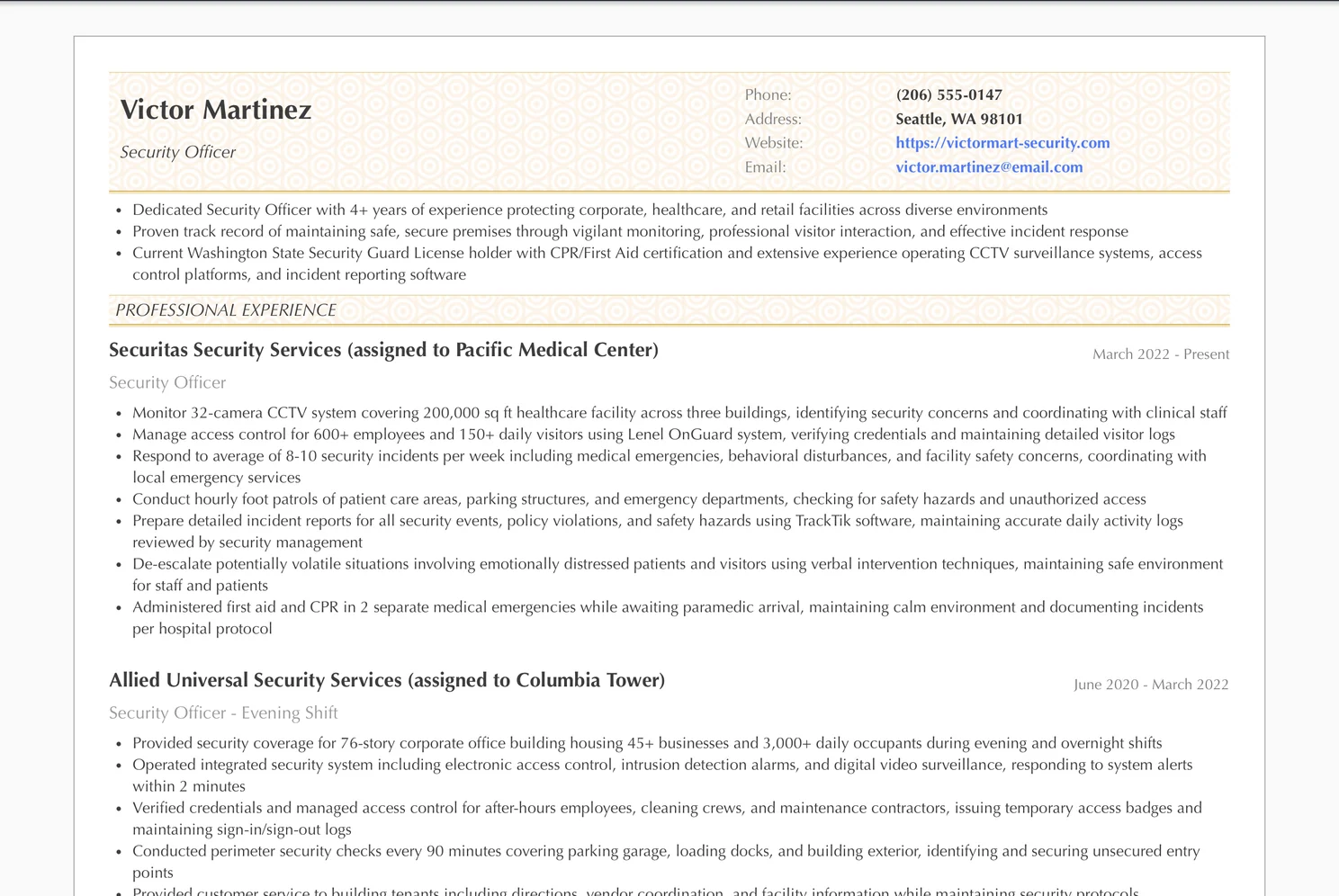
https://www.resumonk.com/security-officerSecurity OfficerChoosing the Right Resume Format for Your Security Officer Resume
The reverse-chronological resume format is your strongest ally here, and it's not even a close call. This format lists your most recent work experience first, then works backward through your employment history. Why does this matter so much for a Security Officer position? Because hiring managers and security supervisors need to see immediately what you've been doing lately. If you've been working third shift at a corporate office building for the past two years, that recent, continuous experience speaks volumes.
If you spent the last year monitoring CCTV systems at a hospital, that's fresh, relevant expertise that belongs right at the top where eyes land first.
Why Reverse-Chronological Works for Security Roles
Security Officer positions exist across a spectrum of environments - retail stores, hospitals, corporate campuses, residential complexes, construction sites, museums, and government facilities. Each environment has its own security protocols, threats, and required certifications. A reverse-chronological format allows you to showcase how your experience has built progressively, demonstrating not just that you can do security work, but that you understand different security contexts. Perhaps you started in retail loss prevention, moved to hospital security where you learned de-escalation with emotionally distressed individuals, and then transitioned to corporate security where access control systems became your forte.
This progression tells a story of growing competence and adaptability.
There's another critical reason this format dominates in security hiring. Many Security Officer positions require specific licensing, certifications, and background checks. Employers need to verify continuous employment history with minimal gaps, as unexplained breaks in employment can raise flags during the security clearance process.
The reverse-chronological format makes your employment timeline crystal clear, allowing hiring managers to quickly assess whether you've maintained the continuous work history and clean record that security work demands.
When Alternative Formats Might Apply
There are limited scenarios where you might consider a functional or combination resume format, but they're genuinely rare for Security Officer positions.
If you're transitioning from military service where your job title was "Military Police" or "Security Forces" but your actual duties align perfectly with civilian Security Officer work, a combination format might help you translate military experience into civilian terms more effectively. Similarly, if you're moving from law enforcement into private security, you might use a combination format to emphasize transferable skills like surveillance, report writing, and emergency response.
However, even in these transition scenarios, I'd encourage you to lean heavily toward reverse-chronological structure with a robust skills section rather than abandoning the format entirely. The security industry values straightforward communication and clear timelines above creative resume formatting.
Structural Elements Your Format Should Include
Your Security Officer resume should follow this structural hierarchy: contact information at the top, followed by a brief professional summary (2-3 sentences maximum), then your work experience section as the centerpiece, followed by your education and certifications, and finally a skills section. Notice that certifications might actually deserve prominent placement - possibly even near the top or integrated into your summary - because credentials like your security license number, CPR/First Aid certification, or specialized training (NFPA 1081, HAZMAT awareness, etc.) are often mandatory requirements, not nice-to-haves.
The visual hierarchy matters here too. Security work requires attention to detail, and a cluttered, poorly organized resume suggests you might miss important details on the job. Use clear section headings, consistent formatting, and adequate white space. Your resume should be as easy to scan as a visitor log - information should be findable within seconds.
Detailing Work Experience on Your Security Officer Resume
Here's the reality of writing about security work on a resume - your actual job often involves long stretches of vigilant observation punctuated by moments of critical action. You might spend forty hours a week where "nothing happened," which is actually the sign you did your job perfectly. The challenge lies in translating this preventive, watchful work into concrete accomplishments that demonstrate your value.
You're not describing boredom; you're describing deterrence, prevention, and readiness.
Structuring Each Work Experience Entry
Each position in your work experience section should follow this format: Job Title, Company Name, Location (City, State), and Dates of Employment (Month/Year to Month/Year).
For Security Officers, the company name should include what type of facility you protected when it's not obvious. There's a significant difference between working security at a Fortune 500 corporate headquarters versus working security at a nightclub versus working security at a pharmaceutical research facility. If you worked through a security contractor like Allied Universal, Securitas, or G4S, list both the security company and the client site in your description.
Here's how this looks in practice:
Security Officer
Allied Universal Security Services (assigned to Memorial Hospital Medical Center)
Chicago, IL
June 2021 - Present
This immediately tells the hiring manager three valuable things: you work for a reputable security contractor, you have healthcare facility experience, and you're currently employed (which generally signals reliability).
Writing Bullet Points That Demonstrate Security Competence
Your bullet points need to accomplish something specific - they need to show that you don't just occupy space in a uniform, but that you actively contribute to a safer environment. The most effective security resume bullets follow this pattern: action verb + specific duty + context or outcome. You're trying to answer the questions: What did you do? Where or when did you do it?
What was the result or scope?
Let's look at the difference between weak and strong bullet points:
❌ Don't write vague, passive descriptions:
Responsible for security duties
✅ Do write specific, active descriptions:
Monitored 24-camera CCTV system covering 150,000 sq ft retail facility during evening shifts, identifying and reporting suspicious activity to law enforcement
❌ Don't simply list tasks without context:
Checked IDs and controlled access
✅ Do provide scope and detail:
Verified credentials and managed access control for 400+ employees and 50+ daily visitors at corporate office building, maintaining detailed visitor logs and issuing temporary access badges
Quantifying Your Security Experience
Numbers transform security work from abstract to concrete.
How large was the facility you protected? How many people moved through your checkpoint daily? How many incident reports did you file? How many security patrols did you complete per shift? These metrics matter because they indicate the scale and complexity of your responsibilities.
Consider these quantified examples:
- Conducted foot patrols of 8-building apartment complex housing 300+ residents every 2 hours, checking for safety hazards, unauthorized access, and maintenance issues
- Responded to average of 12-15 security incidents per week including medical emergencies, domestic disturbances, and property damage, coordinating with local police and emergency services
- Maintained 99.8% accuracy in employee access control system across 6-month period with zero security breaches
Highlighting Different Types of Security Responsibilities
Security Officer work encompasses several distinct skill areas, and your bullets should touch on this range: physical security and patrols, technology and systems monitoring, customer service and communication, emergency response, documentation and reporting, and collaboration with law enforcement or other agencies. A well-rounded work experience section demonstrates you can handle all these facets.
For physical security and patrols:
Performed perimeter security checks of construction site during overnight shifts, identifying and securing unsecured entry points and documenting equipment inventory
For technology and systems:
Operated integrated security system including electronic access control, intrusion detection alarms, and digital video surveillance, responding to system alerts within 2 minutes
For emergency response:
Administered first aid and CPR in 3 separate medical emergencies while awaiting paramedic arrival, maintaining calm environment and documenting incidents per company protocol
For documentation:
Prepared detailed incident reports for all security events, policy violations, and safety hazards, maintaining accurate daily activity logs reviewed by security management
Addressing Employment Gaps or Short-Term Positions
Security work sometimes involves contract positions, seasonal assignments, or temporary postings that last a few months rather than years. This is normal in the industry, particularly when you work through staffing agencies or cover special events. Don't hide short-term positions - include them, but be strategic about how you present them.
If you worked multiple short-term contracts for the same security company at different client sites, consider grouping them under one employer heading with separate sub-entries for each assignment.
If you have a gap in employment, don't leave it unexplained if it's significant (more than 3-4 months). Security clearance processes often require explanation of gaps.
If you were pursuing additional training, dealing with a family situation, or dealing with an injury, a brief line can acknowledge this without oversharing.
Essential Skills to Highlight on Your Security Officer Resume
When you think about what makes an effective Security Officer, you're really thinking about a specific combination of vigilance, judgment, composure, and technical competence.
The skills section of your resume needs to reflect this combination, but here's the trap many candidates fall into - they list "attention to detail" and "good communication" and think they're done. These phrases have been photocopied onto so many security resumes that they've lost all meaning. Your skills section needs to be more specific and more strategic.
Hard Skills That Demonstrate Technical Competence
Security Officer positions increasingly require technical proficiency with various systems and equipment. These hard skills are often the difference between getting an interview and getting passed over, because many of them can't be quickly taught on the job.
If you have experience with specific security technologies, access control systems, or monitoring equipment, these belong prominently in your skills section.
Effective hard skills for Security Officers include specific systems and certifications:
- CCTV/DVR surveillance systems operation
- Access control systems (Lenel, AMAG, Software House)
- Radio communication and 10-code protocols
- Metal detector and X-ray machine operation
- Incident reporting software (TrackTik, Silvertrac, Officer Reports)
- Fire alarm and life safety systems
- First Aid/CPR/AED certified
- State Security Officer License (#[relevant if listing])
- OSHA safety training completion
- Restraint and handcuffing techniques
- Parking enforcement and citation systems
Notice how these skills are specific rather than generic. Don't write "surveillance systems" when you can write "CCTV/DVR surveillance systems operation." Don't write "computer skills" when you can name the actual incident reporting software you've used. The specificity signals real experience rather than aspirational padding.
Soft Skills That Reflect Security Officer Competencies
Soft skills matter enormously in security work, but they need to be framed in security-relevant terms.
You're not listing "teamwork" - you're demonstrating "coordination with law enforcement and emergency responders." You're not listing "stress management" - you're showing "de-escalation and conflict resolution in high-pressure situations."
Here's how to present soft skills with security context:
- Conflict de-escalation and verbal intervention
- Crisis response and emergency situation management
- Security threat assessment and risk identification
- Professional demeanor with diverse populations
- Clear written documentation and report preparation
- Observation and surveillance techniques
- Crowd control and traffic direction
- Calm decision-making under pressure
- Confidentiality and discretion with sensitive information
The difference between weak and strong soft skills presentation:
❌ Don't use generic, unsubstantiated claims:
Skills: Hard worker, reliable, good with people, detail-oriented
✅ Do use specific, role-relevant competencies:
Skills: Patrol and surveillance procedures | Emergency response coordination | Incident documentation and reporting | Access control and visitor management | Conflict de-escalation techniques
Certifications and Credentials as Skills
For Security Officers, certifications often blur the line between skills and qualifications.
Depending on your state or country, certain certifications aren't optional - they're licensing requirements. Others represent specialized training that makes you more valuable. These deserve prominence, potentially even in both your skills section and a dedicated certifications section.
Critical certifications for Security Officers include:
- State Security Officer License (required in most US states)
- CPR/First Aid/AED Certification (American Red Cross or American Heart Association)
- FEMA Emergency Management certifications (IS-100, IS-200, IS-700)
- Certified Protection Officer (CPO) designation
- Physical Security Professional (PSP) certification
- Alcohol Intervention Training (for hospitality/event security)
- Active Shooter Response Training
- Bloodborne Pathogens Training
- Defensive Tactics Certification
- Taser or Pepper Spray Certification (if applicable to role)
One important note - only list weapons certifications or armed security credentials if you're applying for armed Security Officer positions. If you're applying for unarmed positions, featuring firearms training prominently can sometimes work against you, as it may signal you're seeking a different type of role.
Organizing Your Skills Section Strategically
You have a few options for organizing your skills section, and the right choice depends on your experience level and the specific job posting. If you're responding to a job description that lists specific required skills, your skills section should mirror that language (assuming you genuinely possess those skills).
If the posting requires "experience with access control systems and CCTV monitoring," those exact phrases should appear in your skills section.
Consider organizing skills into categories if you have extensive experience:
1. Security Systems & Technology: CCTV surveillance, access control systems (Lenel OnGuard), intrusion detection, alarm monitoring, radio communication
2. Safety & Emergency Response: CPR/First Aid certified, fire safety protocols, emergency evacuation procedures, hazardous material awareness, incident command system
3. Documentation & Procedures: Incident report preparation, daily activity logs, chain of custody procedures, security policy enforcement, visitor management systems
This categorical approach works particularly well if you're transitioning between security contexts (retail to corporate, for example) because it highlights transferable skill clusters.
Regional Variations in Security Skills and Licensing
Security Officer requirements vary significantly by location, and your skills section should reflect the specific credentials required in your region.
In the United States, each state has different licensing requirements - some require minimal training, while others mandate 40+ hours of instruction before you can work. In the UK, you need an SIA (Security Industry Authority) license. In Canada, licensing varies by province. In Australia, security licensing is managed at the state level.
Make sure your skills section includes your relevant jurisdiction's license:
- Illinois PERC Security Officer License (#123-456789)
- SIA Door Supervision License (UK)
- Ontario Security Guard License
- Queensland Security Provider License (Class 1)
Including your license number (where appropriate and safe to do so on an application resume) demonstrates you're immediately employable without waiting for licensing approval.
Specific Considerations and Strategic Tips for Your Security Officer Resume
Now we arrive at the nuanced territory - the considerations that don't fit neatly into format guidelines or skills lists, but that can determine whether your Security Officer resume opens doors or gets filed away. These are the strategic choices that reflect understanding of how security hiring actually works, the concerns that keep security managers up at night, and the subtle signals that separate candidates who understand the profession from those who see it as a placeholder job.
Addressing the Reliability and Trustworthiness Question
Here's an uncomfortable truth about security hiring - the hiring manager's primary fear isn't that you lack skills; it's that you might be unreliable, cause problems, or represent a security risk yourself.
Security Officers have access to facilities, property, and sometimes sensitive information. You're often working with minimal supervision. The subtext of every security hiring decision is: "Can I trust this person to show up, stay alert, follow protocols, and not create problems?"
Your resume needs to address this trust question indirectly but clearly. Longevity in previous positions speaks to reliability - if you worked the same security post for two years without incident, that tells a story about dependability. Perfect attendance or recognition for reliability should be mentioned if you have it:
Maintained 100% on-time attendance record over 18-month period, covering additional shifts when colleagues were unavailable
Recognized by management for reliability during severe weather events, consistently reporting for scheduled shifts despite challenging conditions
If you've held positions requiring higher levels of clearance or trust (government facility security, financial institution security, hospital security with access to controlled substances areas), highlighting these roles signals that you've already been vetted and trusted by previous employers.
Military and Law Enforcement Transitions
If you're transitioning from military service or law enforcement into Security Officer roles, you bring valuable experience, but you face a translation challenge. Military occupational specialties and law enforcement roles often carry authority, arrest powers, and use-of-force options that civilian Security Officers don't have.
Your resume needs to emphasize the transferable elements - observation, reporting, patrolling, emergency response - while being clear about the context difference.
The translation from military/law enforcement to Security Officer language:
❌ Don't use language that overstates civilian security authority:
Detained suspects and conducted searches during law enforcement operations
✅ Do emphasize observation, reporting, and coordination:
Monitored facility for security threats and policy violations, documenting incidents and coordinating with law enforcement when criminal activity was observed
Military veterans should translate rank and unit information into civilian context:
❌ Don't assume civilian readers understand military structure:
E-5 Security Forces, 23rd SFS, Nellis AFB
✅ Do explain role in civilian terms:
Military Police Officer (Sergeant), United States Air Force
Conducted security operations for military installation including access control, vehicle inspections, patrol operations, and incident response
The Part-Time, Multiple-Job Reality
Many Security Officers work multiple part-time positions simultaneously or pick up extra shifts across different sites.
This is common in the industry, particularly for officers who work through staffing agencies. The question is how to present this on your resume without it looking scattered or unfocused. The key is to present concurrent positions clearly, using date ranges that make the simultaneity obvious:
1. Security Officer - Weekend Shifts
Retail Mall Security, Various Locations
March 2022 - Present
2. Security Officer - Weeknight Shifts
Downtown Office Complex
January 2022 - Present
This approach shows you're actively employed in multiple security contexts, which can actually demonstrate versatility and strong work ethic rather than instability.
Handling Incident History and Challenging Situations
One of the most delicate resume considerations for Security Officers is how to discuss serious incidents you've responded to or been involved in. You want to demonstrate that you can handle difficult situations, but you need to be careful about confidentiality, legal sensitivity, and the tone you strike.
The rule of thumb is: describe your professional response and actions, not sensational details or outcomes that might be under legal consideration.
Appropriate ways to reference serious incidents:
Responded to medical emergencies, security breaches, and facility safety incidents, providing immediate intervention and coordinating with emergency services
De-escalated potentially violent confrontations using verbal intervention techniques, maintaining safe environment for staff and visitors
What to avoid - specific details that could breach confidentiality or sound like you're glorifying confrontation:
❌ Don't provide details that breach confidentiality or sound aggressive:
Physically restrained intoxicated individual who assaulted hospital staff, preventing further violence
✅ Do focus on professional response and procedure:
Responded to behavioral disturbances and aggressive incidents using approved de-escalation protocols, coordinating with facility staff and law enforcement per emergency procedures
The Customer Service Dimension
Modern Security Officer roles increasingly emphasize customer service alongside traditional security duties, particularly in corporate, retail, and hospitality settings.
You're often the first person visitors encounter, you provide directions, you assist with lockouts, you help with minor problems. This customer-facing dimension of security work deserves explicit mention on your resume, because employers want Security Officers who enhance their organization's image rather than creating an intimidating atmosphere.
Provided customer service to building tenants and visitors including directions, vendor coordination, and facility information while maintaining security protocols
Served as first point of contact for 200+ daily visitors, balancing friendly, professional service with thorough security screening procedures
This is particularly important if you're moving between security contexts - from industrial or construction security (where customer service matters less) to corporate or retail security (where it matters enormously).
Education Section Considerations
For Security Officer positions, education requirements are typically minimal - most positions require a high school diploma or equivalent, though some specialized or higher-level security roles may prefer some college coursework or an associate degree in criminal justice or related fields. Your education section should be straightforward and shouldn't take up substantial resume space unless you have relevant college education.
If you have a high school diploma or GED and limited additional education:
High School Diploma
Lincoln High School, Springfield, IL
Graduated 2019
If you have some college coursework relevant to security, criminal justice, or emergency management, include it even if you haven't completed a degree:
Associate of Applied Science in Criminal Justice (in progress, 45 credits completed)
Community College of Philadelphia
Expected completion: 2025
What matters more than formal education for Security Officer roles is relevant training and certification, which should be featured prominently either in a dedicated certifications section or integrated into your skills section.
Tailoring for Different Security Environments
A final strategic consideration - Security Officer work varies dramatically based on environment, and the resume that works for hospital security won't necessarily work for construction site security. If you're applying to a specific security context, your resume should emphasize the most relevant elements of your background.
For healthcare security roles, emphasize:
- Experience with medical emergencies and patient behavior incidents
- De-escalation and mental health crisis intervention
- HIPAA awareness and patient confidentiality
- Collaboration with clinical staff
For retail security roles, emphasize:
- Loss prevention and theft deterrence
- Customer service orientation
- Surveillance and observation techniques
- Coordination with store management
For corporate/office security roles, emphasize:
- Access control and visitor management systems
- Professional appearance and communication
- Technology systems proficiency
- Confidentiality and discretion
For event security roles, emphasize:
- Crowd management and high-volume traffic control
- Coordination with event staff and vendors
- Flexibility and adaptability
- Alcohol-related incident management
This tailoring doesn't mean fabricating experience you don't have - it means strategically emphasizing the aspects of your genuine experience that best match the specific security environment you're pursuing. Your resume is not a comprehensive autobiography; it's a strategic marketing document that positions you as the solution to a specific employer's security needs.
Education Requirements for Security Officer Resumes
You're entering a field where your high school diploma or GED is typically the baseline requirement. Maybe you've got some college credits but never finished the degree. Maybe you went straight into security work after high school, or perhaps you're transitioning from military service or law enforcement.
Whatever your educational background looks like, the key is presenting it in a way that reinforces your qualifications for this specific role rather than just checking a box.
What Educational Credentials Actually Matter
Security officer positions sit at the frontline of physical security.
You're the person businesses trust to protect their assets, employees, and visitors. While you don't need a master's degree, employers want to see that you've invested in the specific knowledge this work requires. Your education section should include your basic educational qualification first, followed by any security-specific training or certifications.
Start with your high school diploma or GED. If you have some college coursework, include it even if you didn't complete the degree. For this role, relevant coursework in criminal justice, security management, or public safety can demonstrate your commitment to the field. Here's how to format it properly:
High School Diploma
Lincoln High School, Portland, OR
Graduated: June 2018
If you have some college education without completing a degree:
Associate of Arts in Criminal Justice (In Progress), Portland Community College, Portland, OR
- Completed 45 credits | Expected completion: December 2024
- Relevant Coursework: Introduction to Criminal Justice, Security Management, Emergency Response Procedures
Security-Specific Training and Certifications
Here's where your education section gets interesting for security officer roles. The certifications and specialized training you've completed often carry more weight than traditional academic credentials.
Think about it: a hiring manager would rather see that you're certified in CPR and First Aid than that you took Philosophy 101.
List these after your formal education, and be specific about the certifying organization and the date you obtained them. Active certifications matter enormously because they demonstrate current knowledge and your commitment to staying qualified.
❌ Don't write generic certification listings:
Security Training - 2023
✅ Do provide complete certification details:
Guard Card Certification
Bureau of Security and Investigative Services, California
Issued: March 2023 | Valid through: March 2025
CPR and First Aid Certified
American Red Cross
Issued: January 2024 | Valid through: January 2026
Ordering Your Educational Credentials
Use reverse-chronological order, meaning your most recent educational achievement goes first. However, there's a strategic consideration here: if your most impressive credential is a specialized security certification rather than your high school diploma, you might consider creating two separate sections - one for "Education" and another for "Certifications & Training" - placing the certifications section higher on your resume if those credentials are more relevant and recent.
For security officers, relevant certifications often include: state-required security guard licenses, firearms permits (if applicable to the position), OSHA safety training, defensive tactics training, access control system training, or specialized certifications like Certified Protection Officer (CPO) from IFPO.
What to Include and What to Skip
You might be wondering whether to include your graduation date, especially if you graduated many years ago. Here's the practical answer: for high school, you can omit the graduation year if you're concerned about age discrimination, though this is less critical for security officer positions than for corporate roles.
For certifications, always include dates because validity periods matter critically in this field.
Don't inflate your education. If you attended college but didn't complete a degree, don't claim you did. Instead, frame it positively by showing the credits you completed and relevant coursework.
Hiring managers verify educational credentials, and misrepresentation can disqualify you immediately.
❌ Don't misrepresent incomplete education:
Bachelor's Degree in Criminal Justice
State University, 2019-2021
✅ Do accurately describe your educational status:
Criminal Justice Studies
State University, Denver, CO
Completed 60 credits toward Bachelor's degree (2019-2021)
Relevant Coursework: Crime Prevention, Legal Aspects of Security, Crisis Management
International Education Considerations
If you completed your education outside the country where you're applying, include this information but be prepared to provide credential evaluation documentation. In the United States, for example, you might note "equivalent to U.S. High School Diploma" if you completed secondary education abroad.
For Canada, the UK, or Australia, similar transparency helps hiring managers understand your qualifications without requiring them to research foreign educational systems.
Awards and Publications on Security Officer Resumes
Now we're getting into territory that might feel less familiar. You're probably thinking: "Awards and publications? I'm applying to stand post and monitor surveillance cameras, not accepting a Nobel Prize." And you're right to question whether this section belongs on your resume at all.
But here's what you need to understand: if you have genuine recognition or published work related to security, safety, or your professional performance, including it can significantly differentiate you from other candidates.
Understanding What Counts as an Award
Let's get real about what "awards" means in the context of security officer work. We're not talking about academic honors or industry innovation prizes. We're talking about recognition you've received for excellence in security work, safety performance, reliability, or going above and beyond in your duties.
These are often internal company awards, but they're legitimate and valuable.
Maybe you were named "Security Officer of the Month" at your previous employer. Maybe you received recognition for perfect attendance over a two-year period. Perhaps you were commended by local law enforcement for your handling of a critical incident. Maybe you received a certificate of appreciation from building management for preventing a theft.
These all count, and they all tell hiring managers something important: you're not just competent, you're exceptional.
When to Include an Awards Section
Here's the decision framework: if you have two or more meaningful recognitions, create a dedicated awards section. If you have only one, incorporate it into your work experience section under the relevant employer. Don't create an awards section with a single entry like "Employee of the Month, March 2022."
That can actually work against you by making your resume look padded.
When you do create this section, place it after your work experience but before your education section. This positioning acknowledges that your hands-on performance matters more than academic credentials in security work, while keeping your actual job experience as the primary focus.
❌ Don't list trivial or irrelevant recognition:
Awards
Perfect Attendance Award - Elementary School, 2008
Participant Certificate - Community Basketball League, 2019
✅ Do highlight professionally relevant recognition:
Professional Recognition
1. Security Officer of the Quarter - Titan Security Services, Q2 2023
- Recognized for exceptional vigilance resulting in prevention of three unauthorized access attempts

2. Commendation for Excellence - Downtown Plaza Management, November 2022
- Received formal commendation for professional response during medical emergency, potentially saving patron's life

3. Zero-Incident Safety Award - Regional Security Conference, 2021
- Acknowledged for maintaining 18-month record without reportable safety incidents at assigned facility
What About Publications for Security Officers?
Now, publications might seem even more unusual for a security officer resume.
You're probably not publishing research papers or writing books. But let me expand your thinking about what "publications" can mean in your context. Have you contributed to your security company's newsletter about best practices? Did you write a post-incident report that was used as a training document for other officers? Have you contributed to online security forums or professional groups with written insights about patrol procedures or threat assessment?
Most security officers won't have anything to list here, and that's completely fine. This isn't a requirement for the role. However, if you've contributed written content that demonstrates your expertise, analytical thinking, or commitment to professional development, it's worth including. This is especially relevant if you're applying for senior security officer roles, shift supervisor positions, or jobs at facilities that value documentation and reporting skills.
Military Commendations and Law Enforcement Recognition
If you're transitioning from military service or law enforcement, you may have formal commendations, medals, or letters of appreciation that absolutely belong on your security officer resume. These carry significant weight because they're issued by established institutions and often relate directly to security, protection, and safety - core competencies for security work.
Translate military awards into language civilian hiring managers will understand. Don't assume they know what "Army Achievement Medal" means in practical terms.
❌ Don't use unexplained military jargon:
AAM, Camp Pendleton, 2020
✅ Do explain the achievement in civilian terms:
Army Achievement Medal - United States Army, 2020
Awarded for exemplary performance in security operations including access control and threat detection during 12-month deployment
Certifications vs. Awards: Know the Difference
Don't confuse certifications with awards.
Your CPR certification, guard card, or firearms permit are not awards - they're credentials that belong in your education or certifications section. Awards recognize exceptional performance or achievement beyond the baseline requirements of your role. If you're uncertain whether something qualifies as an award, ask yourself: "Did I receive this for meeting a standard requirement, or for exceeding expectations?" If it's the former, it's probably a certification.
If it's the latter, it's an award.
Listing References on Security Officer Resumes
Let's talk about references, and let's start with what you're probably wondering: should you actually list references on your security officer resume, or use that "References available upon request" line you've seen on resume templates? Here's the straight answer: for security officer positions, having your references ready and strategically presented matters more than in many other fields, but how and when you present them requires some thought.
Why References Are Critical in Security Work
You need to understand something fundamental about security officer hiring: you're being entrusted with physical access to facilities, sometimes valuable assets, and often the safety of people.
You're going to undergo a background check, that's a given. But beyond the formal background screening, hiring managers want to hear from people who've directly supervised you or worked alongside you that you're reliable, trustworthy, and capable of handling responsibility.
In security work, references aren't just about confirming you worked where you said you worked. They're about verifying your character, your dependability, and your judgment under pressure. A hiring manager might want to know: Does this person actually show up for their shifts, or do they call out frequently? Can they stay alert during long, monotonous hours? How do they handle conflict? Do they follow procedures or cut corners?
These are questions that references answer.
The "References Available Upon Request" Debate
That standard line you see on resume templates - "References available upon request" - it's not wrong, but it's also not necessary. It's understood that if an employer wants references, you'll provide them.
Using that line doesn't hurt you, but it also doesn't help you, and it takes up valuable space on your resume that could be used for more impactful content.
Here's the better approach: don't list references directly on your resume, but prepare a separate reference sheet that matches your resume's formatting. Have this ready to provide immediately when requested, either during the interview or when you submit your application if the job posting specifically asks for references upfront.
Creating Your Reference Sheet
Your reference sheet should include three to four professional references - people who can speak credibly about your work performance, reliability, and character. The header of your reference sheet should match your resume exactly (same name, contact information, and formatting) so it's clearly part of your application package.
For each reference, include their full name, their professional title, their organization, their phone number, their email address, and a brief phrase explaining your relationship (for example: "Direct Supervisor at Acme Security, 2021-2023"). This context helps the hiring manager understand the relevance of each reference's perspective.
❌ Don't provide incomplete or unclear reference information:
References
John Davis - (555) 123-4567
Sarah Miller - Former boss, [email protected]
Mike - Security Supervisor
✅ Do provide complete, professional reference information:
Professional References for Robert Chen
1. John Davis, Security Operations Manager, Titan Security Services
- Phone: (555) 123-4567 | Email: [email protected]
- Relationship: Direct supervisor, 2021-2023
2. Sarah Miller, Facilities Director, Westfield Corporate Center
- Phone: (555) 234-5678 | Email: [email protected]
- Relationship: Client contact and indirect supervisor, 2022-2023
3. Michael Rodriguez, Senior Security Officer, Titan Security Services
- Phone: (555) 345-6789 | Email: [email protected]
- Relationship: Senior colleague and training officer, 2021-2023
Choosing the Right References
Your references should be people who've directly observed your work in security or closely related fields. The strongest reference is always a direct supervisor who can speak to your day-to-day performance, reliability, and problem-solving abilities.
If you're currently employed and haven't told your current employer you're job searching, it's acceptable to note on your application that you prefer your current employer not be contacted until later in the hiring process.
Other strong references include clients you've worked with (like a building manager at a site you guarded), senior colleagues who worked alongside you, or supervisors from related fields like military service, law enforcement, or customer service roles that involved safety or security responsibilities. If you're entering security work for the first time, references from any professional context who can speak to your reliability, integrity, and ability to follow procedures are valuable.
Avoid using personal references like friends, family members, or clergy unless you have no professional work history at all. These references carry less weight because they can't speak objectively about your work performance.
The exception might be character references for entry-level positions if you're new to the workforce, but even then, try to include at least one reference from a work context, even if it's from part-time or volunteer work.
The Critical Step Most People Skip
Here's what separates candidates who get strong reference checks from those who don't: actually asking your references for permission and preparing them for potential calls. Don't just list someone's name and number and hope for the best.
Reach out to each person, confirm they're willing to serve as a reference, tell them what kind of positions you're applying for, and remind them of specific projects or achievements from your time working together.
This conversation might sound like: "Hi John, I'm applying for security officer positions at several hospitals in the area. Would you be comfortable serving as a reference? The hiring managers will likely ask about my reliability, how I handled the night shift, and maybe about that incident where I coordinated with police during the break-in attempt. I really appreciated your mentorship during my time at Titan." This does two things: it confirms they'll give you a positive reference, and it primes them with specific talking points.
When to Provide References
Don't send your reference sheet with your initial application unless the job posting specifically requests it. Instead, bring printed copies to your interview and have a digital copy ready to email if requested. When a hiring manager asks, "Can you provide references?", you want to be able to say, "Yes, I have a reference sheet prepared. Would you like me to email it to you now, or I can provide a printed copy?"
This preparedness signals professionalism and organizational skills - qualities that matter significantly in security work where you're expected to maintain logs, write reports, and handle documentation accurately.
Special Considerations for Security Officer References
For security positions specifically, consider whether any of your references can speak to specific relevant competencies: your ability to stay alert during long shifts, your attention to detail in following procedures, your communication skills when writing reports or interacting with visitors, your judgment in deciding when to intervene or escalate situations, and your reliability in showing up for scheduled shifts.
If you have law enforcement, military, or security industry references, these carry particular weight because they understand the specific demands and expectations of security work. If you're transitioning from another field, choose references who can draw parallels between your previous work and security requirements, even if they're not from the security industry directly.
What If Your References Are Outdated?
If you've been out of the workforce for a while, or if your most recent supervisors are no longer reachable, you have options. Reach back further to previous roles where you can still contact supervisors or colleagues. Be prepared to explain gaps in employment or why you're not using more recent references.
It's better to have older but strong, reachable references than recent ones you've lost touch with or who might not remember you clearly.
Keep your reference list updated as you progress in your career. After completing a contract or changing employers (on good terms), ask your supervisor if they'd be willing to serve as a future reference and get their current contact information while the relationship is still fresh.
Regional Differences in Reference Practices
In the United States, it's standard to provide three references, and employers typically check them before making a final offer. In Canada, reference checks are similarly standard and thorough. In the UK, references (often called "referees") are almost always required, and some employers may request written references rather than just conducting phone calls. In Australia, two to three references are typical, and reference checks are a standard part of the hiring process.
Regardless of region, for security positions specifically, expect that references will be checked thoroughly due to the trust-based nature of the work.
Cover Letter Tips for Security Officer Resumes
Alright, let's address the question you're probably asking yourself: "Do I really need a cover letter for a security officer position?"
I get it. You might be thinking that your resume, with its list of posts you've guarded and certifications you've earned, should speak for itself. You might assume that hiring managers are just looking at whether you have the required license and can work the graveyard shift. But here's the reality that might surprise you: a well-crafted cover letter can be the difference between your resume getting a genuine read-through and it being skimmed for thirty seconds before moving to the next candidate.
Why Cover Letters Matter in Security Work
Security officer positions attract a lot of applicants.
The barrier to entry is relatively low - you need a high school diploma, a clean background check, and in most jurisdictions, a guard card. This means hiring managers are often sorting through dozens or even hundreds of applications for a single position. Your resume lists your qualifications, but your cover letter is your chance to demonstrate something that's absolutely critical in security work and hard to convey through bullet points alone: your judgment, your communication skills, and your understanding of what the role actually requires.
Think about what a security officer actually does. Yes, you monitor premises and control access. But you're also the first point of contact for visitors, you're writing incident reports that might end up in legal proceedings, you're making split-second decisions about when to intervene and when to observe. A cover letter lets you show that you understand these nuances and that you can communicate clearly and professionally - skills that matter enormously when you're the face of security for a facility.
Structure Your Cover Letter for Maximum Impact
Your cover letter should be no longer than one page - three to four paragraphs that quickly establish why you're a strong candidate for this specific position. Start with a direct opening that immediately states the position you're applying for and how you learned about it.
Security managers are busy people who value directness.
❌ Don't open with generic filler:
Dear Hiring Manager,
I am writing to express my strong interest in employment opportunities at your esteemed organization. As a highly motivated individual with a passion for helping others, I believe I would be an excellent addition to any team.
✅ Do open with specific, relevant information:
Dear Mr. Richardson,
I am applying for the Security Officer position at Metropolitan Hospital (Job ID: SEC-447) as posted on your careers page. With three years of experience in healthcare facility security and current certifications in CPR, First Aid, and Crisis Intervention, I am prepared to contribute immediately to your security team's mission of maintaining a safe environment for patients, staff, and visitors.
Demonstrate Your Understanding of the Specific Role
In your second paragraph, show that you've done your homework about this particular employer and position. Generic cover letters are obvious and ineffective. If you're applying to a hospital, address healthcare security challenges. If it's a corporate office building, mention access control and executive protection. If it's a retail environment, discuss loss prevention and customer interaction.
This isn't about making things up - it's about showing you understand what this specific security officer position will require.
Connect your past experience to their specific needs. Don't just repeat your resume; instead, expand on one or two relevant experiences that directly relate to what this employer needs. Use concrete examples with outcomes.
❌ Don't write vague generalities:
I have extensive experience in security work. I am good at watching cameras and walking patrols. I am reliable and always show up on time. I work well with others and can also work independently.
✅ Do provide specific, relevant examples:
During my two years at Riverside Office Park, I managed access control for a facility with over 800 daily visitors while maintaining detailed visitor logs and conducting regular perimeter patrols. When I identified a pattern of unauthorized access attempts in a loading dock area, I collaborated with the security supervisor to implement enhanced monitoring procedures that eliminated these incidents entirely. This experience has prepared me well for the high-volume access control responsibilities outlined in your position description.
Address Your Availability and Practical Considerations
Security work often involves overnight shifts, weekends, and holidays. Your cover letter is the place to address this directly and positively.
Don't wait for the interview to clarify that you can only work certain shifts or can't work weekends - that information needs to be transparent from the start if it's a limitation, or it should be highlighted as a strength if you're flexible.
If the job posting mentions specific requirements like bilingual skills, firearms certification, or experience with particular security systems, address these directly. Don't make hiring managers hunt through your resume to confirm you meet key requirements.
Close With a Clear Call to Action
Your final paragraph should express genuine interest in the position (not just "a job") and clearly state that you're looking forward to discussing how your experience aligns with their needs. Include your phone number in the closing paragraph even though it's also on your resume - make it easy for them to contact you.
❌ Don't end passively or presumptuously:
Thank you for your consideration. I look forward to hearing from you.
OR
I look forward to starting work on your team and contributing to your organization's success.
✅ Do end with professional confidence and clear contact information:
I would welcome the opportunity to discuss how my experience in corporate facility security and my commitment to professional vigilance would benefit Metropolitan Tower's security operations. I am available for an interview at your convenience and can be reached at (555) 123-4567. Thank you for considering my application.
Cover Letter Format and Presentation
Use a professional business letter format with your contact information at the top, the date, and the employer's contact information. If you're submitting electronically (which is almost always the case), save it as a PDF with a clear filename like "John_Smith_Security_Officer_Cover_Letter.pdf" rather than something generic like "coverletter.pdf".
Match the visual style of your cover letter to your resume. Use the same font, similar margins, and consistent formatting. This creates a cohesive application package that looks professional and thoughtful. Remember, attention to detail is a core competency for security work, and your application documents are your first opportunity to demonstrate this skill.
Regional Variations in Cover Letter Expectations
In the United States, cover letters are often optional for security officer positions, but including a strong one gives you an advantage. In Canada, cover letters are more commonly expected across all job levels. In the UK and Australia, cover letters are standard practice, and not including one might be interpreted as lack of interest or effort.
When in doubt, include one - it can only help, never hurt, if it's well-written.
Key Takeaways
You've just worked through a comprehensive guide to building a Security Officer resume that actually gets results. Let's distill the most important points into a reference list you can keep with you as you create or refine your own resume.
- Use reverse-chronological format - List your most recent security experience first and work backward. This format works best for Security Officer positions because hiring managers need to see your current, relevant experience immediately and verify continuous employment history.
- Quantify your security responsibilities - Include specific numbers like facility size, number of daily visitors, patrol frequency, incident response times, and scope of responsibilities. Numbers transform abstract security work into concrete, verifiable competence.
- Write action-focused bullet points - Use the pattern of action verb + specific duty + context or outcome. Avoid passive language like "responsible for" and instead show what you actively did and accomplished.
- Emphasize reliability and trustworthiness indirectly - Highlight longevity in positions, perfect attendance records, recognition for dependability, and continuous employment. Security hiring is fundamentally about trust, and your resume should address this through evidence rather than claims.
- List specific technical systems and certifications - Name actual surveillance systems, access control platforms, and incident reporting software you've used. Include all current certifications with issue and expiration dates, especially state licenses, CPR/First Aid, and specialized training.
- Tailor for different security environments - Emphasize the aspects of your experience most relevant to the specific type of facility you're applying to, whether healthcare, corporate, retail, residential, or industrial security.
- Address military or law enforcement transitions carefully - Translate specialized experience into civilian security context, emphasizing observation, reporting, coordination, and procedure-following rather than law enforcement authority you won't have as a Security Officer.
- Present concurrent positions clearly - If you work multiple part-time security jobs simultaneously (common in the industry), use date ranges that make this obvious. It demonstrates work ethic and versatility rather than instability.
- Keep education and certifications current and clear - List your highest educational credential, but give prominence to security-specific certifications and licenses. Include license numbers when appropriate, as they demonstrate you're immediately employable.
- Prepare a professional reference sheet - Have three to four references who can speak to your reliability, judgment, and work performance. Include complete contact information and notify references in advance that they may be contacted.
- Write a targeted cover letter when applying - Use it to demonstrate your understanding of the specific security environment you're applying to and to expand on relevant experience that connects directly to the employer's needs.
- Balance customer service with security competence - Modern Security Officer roles increasingly emphasize professional interaction and customer service alongside traditional security duties. Show you can handle both aspects.
Creating your Security Officer resume doesn't have to be a frustrating process of staring at blank pages or wrestling with complicated formatting. Resumonk provides you with professionally designed templates and AI-powered recommendations that help you present your security experience effectively. Whether you're building your first Security Officer resume or updating one to reflect new certifications and positions, Resumonk's intuitive platform guides you through each section, suggests relevant skills based on your experience, and ensures your resume looks polished and professional. You can create multiple versions tailored to different security environments - one emphasizing your healthcare facility experience, another highlighting your corporate security background - all while maintaining consistent formatting and presentation quality.
Ready to create a Security Officer resume that gets you hired?
Start building your professional resume today with Resumonk's specialized templates and expert guidance. Choose from beautifully designed formats that present your security experience clearly and professionally.
Get started now and take the first step toward your next Security Officer position.
More Public Safety & Security resume examples
- Loss Prevention resume example
- Correctional Officer resume example
- Lifeguard resume example
- EMT resume example
See all Public Safety & Security resume examples, or browse every category.
Resume writing tips
You're looking at job postings for Security Officer positions, and you know what you need to do next. You need a resume that gets you in the door, gets you the interview, and ultimately gets you the job protecting the places and people that matter. But here's the thing about writing a Security Officer resume - it's not like writing a resume for a marketing role or a software developer position. You're not showcasing creative campaigns or listing programming languages.
You're demonstrating something more fundamental and, in many ways, more critical - that you can be trusted with responsibility, that you'll show up when you're supposed to, that you can stay alert when nothing's happening and respond effectively when something does, and that you understand the specific demands of keeping facilities, assets, and people safe.
Maybe you're coming from another Security Officer position and looking to move to a better site, better hours, or better pay. Maybe you're transitioning from military service or law enforcement into civilian security work. Maybe this is your entry point into the security field, and you're trying to figure out how to present your reliability, your attention to detail, and your ability to handle responsibility even though your previous jobs were in retail, hospitality, or another field entirely. Whatever your situation, you're here because you need to know how to translate your experience and capabilities into a resume that security hiring managers will actually read, trust, and respond to.
This guide walks you through everything you need to build a Security Officer resume that works. We'll start with choosing the right resume format - and for Security Officers, there's a clear winner that serves the specific way security hiring happens. Then we'll dig into how to write about your work experience in ways that demonstrate competence without overstating your authority, how to quantify security work that often involves preventing things from happening rather than making things happen, and how to present the range of responsibilities from monitoring cameras to writing incident reports to providing customer service. We'll cover the essential skills that matter for security work, both the technical competencies like operating surveillance systems and the interpersonal abilities like de-escalation and professional communication. You'll learn how to handle common situations like employment gaps, multiple concurrent part-time positions, or transitions between different security environments. We'll address education and certification requirements, which matter differently in security than in many other fields. And we'll cover everything from cover letters to references with specific attention to what security hiring managers actually care about when they're deciding who to trust with their facility's protection.
By the time you finish reading this guide, you'll understand not just what to put on your Security Officer resume, but why each element matters and how to present yourself as someone who gets what this work actually requires. Whether you're applying to corporate offices, hospitals, retail centers, residential complexes, or industrial sites, the principles we cover will help you build a resume that opens doors. Let's get started.
The Best Security Officer Resume Example/Sample
https://www.resumonk.com/security-officerSecurity OfficerChoosing the Right Resume Format for Your Security Officer Resume
The reverse-chronological resume format is your strongest ally here, and it's not even a close call. This format lists your most recent work experience first, then works backward through your employment history. Why does this matter so much for a Security Officer position? Because hiring managers and security supervisors need to see immediately what you've been doing lately. If you've been working third shift at a corporate office building for the past two years, that recent, continuous experience speaks volumes.
If you spent the last year monitoring CCTV systems at a hospital, that's fresh, relevant expertise that belongs right at the top where eyes land first.
Why Reverse-Chronological Works for Security Roles
Security Officer positions exist across a spectrum of environments - retail stores, hospitals, corporate campuses, residential complexes, construction sites, museums, and government facilities. Each environment has its own security protocols, threats, and required certifications. A reverse-chronological format allows you to showcase how your experience has built progressively, demonstrating not just that you can do security work, but that you understand different security contexts. Perhaps you started in retail loss prevention, moved to hospital security where you learned de-escalation with emotionally distressed individuals, and then transitioned to corporate security where access control systems became your forte.
This progression tells a story of growing competence and adaptability.
There's another critical reason this format dominates in security hiring. Many Security Officer positions require specific licensing, certifications, and background checks. Employers need to verify continuous employment history with minimal gaps, as unexplained breaks in employment can raise flags during the security clearance process.
The reverse-chronological format makes your employment timeline crystal clear, allowing hiring managers to quickly assess whether you've maintained the continuous work history and clean record that security work demands.
When Alternative Formats Might Apply
There are limited scenarios where you might consider a functional or combination resume format, but they're genuinely rare for Security Officer positions.
If you're transitioning from military service where your job title was "Military Police" or "Security Forces" but your actual duties align perfectly with civilian Security Officer work, a combination format might help you translate military experience into civilian terms more effectively. Similarly, if you're moving from law enforcement into private security, you might use a combination format to emphasize transferable skills like surveillance, report writing, and emergency response.
However, even in these transition scenarios, I'd encourage you to lean heavily toward reverse-chronological structure with a robust skills section rather than abandoning the format entirely. The security industry values straightforward communication and clear timelines above creative resume formatting.
Structural Elements Your Format Should Include
Your Security Officer resume should follow this structural hierarchy: contact information at the top, followed by a brief professional summary (2-3 sentences maximum), then your work experience section as the centerpiece, followed by your education and certifications, and finally a skills section. Notice that certifications might actually deserve prominent placement - possibly even near the top or integrated into your summary - because credentials like your security license number, CPR/First Aid certification, or specialized training (NFPA 1081, HAZMAT awareness, etc.) are often mandatory requirements, not nice-to-haves.
The visual hierarchy matters here too. Security work requires attention to detail, and a cluttered, poorly organized resume suggests you might miss important details on the job. Use clear section headings, consistent formatting, and adequate white space. Your resume should be as easy to scan as a visitor log - information should be findable within seconds.
Detailing Work Experience on Your Security Officer Resume
Here's the reality of writing about security work on a resume - your actual job often involves long stretches of vigilant observation punctuated by moments of critical action. You might spend forty hours a week where "nothing happened," which is actually the sign you did your job perfectly. The challenge lies in translating this preventive, watchful work into concrete accomplishments that demonstrate your value.
You're not describing boredom; you're describing deterrence, prevention, and readiness.
Structuring Each Work Experience Entry
Each position in your work experience section should follow this format: Job Title, Company Name, Location (City, State), and Dates of Employment (Month/Year to Month/Year).
For Security Officers, the company name should include what type of facility you protected when it's not obvious. There's a significant difference between working security at a Fortune 500 corporate headquarters versus working security at a nightclub versus working security at a pharmaceutical research facility. If you worked through a security contractor like Allied Universal, Securitas, or G4S, list both the security company and the client site in your description.
Here's how this looks in practice:
Security Officer
Allied Universal Security Services (assigned to Memorial Hospital Medical Center)
Chicago, IL
June 2021 - Present
This immediately tells the hiring manager three valuable things: you work for a reputable security contractor, you have healthcare facility experience, and you're currently employed (which generally signals reliability).
Writing Bullet Points That Demonstrate Security Competence
Your bullet points need to accomplish something specific - they need to show that you don't just occupy space in a uniform, but that you actively contribute to a safer environment. The most effective security resume bullets follow this pattern: action verb + specific duty + context or outcome. You're trying to answer the questions: What did you do? Where or when did you do it?
What was the result or scope?
Let's look at the difference between weak and strong bullet points:
❌ Don't write vague, passive descriptions:
Responsible for security duties
✅ Do write specific, active descriptions:
Monitored 24-camera CCTV system covering 150,000 sq ft retail facility during evening shifts, identifying and reporting suspicious activity to law enforcement
❌ Don't simply list tasks without context:
Checked IDs and controlled access
✅ Do provide scope and detail:
Verified credentials and managed access control for 400+ employees and 50+ daily visitors at corporate office building, maintaining detailed visitor logs and issuing temporary access badges
Quantifying Your Security Experience
Numbers transform security work from abstract to concrete.
How large was the facility you protected? How many people moved through your checkpoint daily? How many incident reports did you file? How many security patrols did you complete per shift? These metrics matter because they indicate the scale and complexity of your responsibilities.
Consider these quantified examples:
- Conducted foot patrols of 8-building apartment complex housing 300+ residents every 2 hours, checking for safety hazards, unauthorized access, and maintenance issues
- Responded to average of 12-15 security incidents per week including medical emergencies, domestic disturbances, and property damage, coordinating with local police and emergency services
- Maintained 99.8% accuracy in employee access control system across 6-month period with zero security breaches
Highlighting Different Types of Security Responsibilities
Security Officer work encompasses several distinct skill areas, and your bullets should touch on this range: physical security and patrols, technology and systems monitoring, customer service and communication, emergency response, documentation and reporting, and collaboration with law enforcement or other agencies. A well-rounded work experience section demonstrates you can handle all these facets.
For physical security and patrols:
Performed perimeter security checks of construction site during overnight shifts, identifying and securing unsecured entry points and documenting equipment inventory
For technology and systems:
Operated integrated security system including electronic access control, intrusion detection alarms, and digital video surveillance, responding to system alerts within 2 minutes
For emergency response:
Administered first aid and CPR in 3 separate medical emergencies while awaiting paramedic arrival, maintaining calm environment and documenting incidents per company protocol
For documentation:
Prepared detailed incident reports for all security events, policy violations, and safety hazards, maintaining accurate daily activity logs reviewed by security management
Addressing Employment Gaps or Short-Term Positions
Security work sometimes involves contract positions, seasonal assignments, or temporary postings that last a few months rather than years. This is normal in the industry, particularly when you work through staffing agencies or cover special events. Don't hide short-term positions - include them, but be strategic about how you present them.
If you worked multiple short-term contracts for the same security company at different client sites, consider grouping them under one employer heading with separate sub-entries for each assignment.
If you have a gap in employment, don't leave it unexplained if it's significant (more than 3-4 months). Security clearance processes often require explanation of gaps.
If you were pursuing additional training, dealing with a family situation, or dealing with an injury, a brief line can acknowledge this without oversharing.
Essential Skills to Highlight on Your Security Officer Resume
When you think about what makes an effective Security Officer, you're really thinking about a specific combination of vigilance, judgment, composure, and technical competence.
The skills section of your resume needs to reflect this combination, but here's the trap many candidates fall into - they list "attention to detail" and "good communication" and think they're done. These phrases have been photocopied onto so many security resumes that they've lost all meaning. Your skills section needs to be more specific and more strategic.
Hard Skills That Demonstrate Technical Competence
Security Officer positions increasingly require technical proficiency with various systems and equipment. These hard skills are often the difference between getting an interview and getting passed over, because many of them can't be quickly taught on the job.
If you have experience with specific security technologies, access control systems, or monitoring equipment, these belong prominently in your skills section.
Effective hard skills for Security Officers include specific systems and certifications:
- CCTV/DVR surveillance systems operation
- Access control systems (Lenel, AMAG, Software House)
- Radio communication and 10-code protocols
- Metal detector and X-ray machine operation
- Incident reporting software (TrackTik, Silvertrac, Officer Reports)
- Fire alarm and life safety systems
- First Aid/CPR/AED certified
- State Security Officer License (#[relevant if listing])
- OSHA safety training completion
- Restraint and handcuffing techniques
- Parking enforcement and citation systems
Notice how these skills are specific rather than generic. Don't write "surveillance systems" when you can write "CCTV/DVR surveillance systems operation." Don't write "computer skills" when you can name the actual incident reporting software you've used. The specificity signals real experience rather than aspirational padding.
Soft Skills That Reflect Security Officer Competencies
Soft skills matter enormously in security work, but they need to be framed in security-relevant terms.
You're not listing "teamwork" - you're demonstrating "coordination with law enforcement and emergency responders." You're not listing "stress management" - you're showing "de-escalation and conflict resolution in high-pressure situations."
Here's how to present soft skills with security context:
- Conflict de-escalation and verbal intervention
- Crisis response and emergency situation management
- Security threat assessment and risk identification
- Professional demeanor with diverse populations
- Clear written documentation and report preparation
- Observation and surveillance techniques
- Crowd control and traffic direction
- Calm decision-making under pressure
- Confidentiality and discretion with sensitive information
The difference between weak and strong soft skills presentation:
❌ Don't use generic, unsubstantiated claims:
Skills: Hard worker, reliable, good with people, detail-oriented
✅ Do use specific, role-relevant competencies:
Skills: Patrol and surveillance procedures | Emergency response coordination | Incident documentation and reporting | Access control and visitor management | Conflict de-escalation techniques
Certifications and Credentials as Skills
For Security Officers, certifications often blur the line between skills and qualifications.
Depending on your state or country, certain certifications aren't optional - they're licensing requirements. Others represent specialized training that makes you more valuable. These deserve prominence, potentially even in both your skills section and a dedicated certifications section.
Critical certifications for Security Officers include:
- State Security Officer License (required in most US states)
- CPR/First Aid/AED Certification (American Red Cross or American Heart Association)
- FEMA Emergency Management certifications (IS-100, IS-200, IS-700)
- Certified Protection Officer (CPO) designation
- Physical Security Professional (PSP) certification
- Alcohol Intervention Training (for hospitality/event security)
- Active Shooter Response Training
- Bloodborne Pathogens Training
- Defensive Tactics Certification
- Taser or Pepper Spray Certification (if applicable to role)
One important note - only list weapons certifications or armed security credentials if you're applying for armed Security Officer positions. If you're applying for unarmed positions, featuring firearms training prominently can sometimes work against you, as it may signal you're seeking a different type of role.
Organizing Your Skills Section Strategically
You have a few options for organizing your skills section, and the right choice depends on your experience level and the specific job posting. If you're responding to a job description that lists specific required skills, your skills section should mirror that language (assuming you genuinely possess those skills).
If the posting requires "experience with access control systems and CCTV monitoring," those exact phrases should appear in your skills section.
Consider organizing skills into categories if you have extensive experience:
1. Security Systems & Technology: CCTV surveillance, access control systems (Lenel OnGuard), intrusion detection, alarm monitoring, radio communication
2. Safety & Emergency Response: CPR/First Aid certified, fire safety protocols, emergency evacuation procedures, hazardous material awareness, incident command system
3. Documentation & Procedures: Incident report preparation, daily activity logs, chain of custody procedures, security policy enforcement, visitor management systems
This categorical approach works particularly well if you're transitioning between security contexts (retail to corporate, for example) because it highlights transferable skill clusters.
Regional Variations in Security Skills and Licensing
Security Officer requirements vary significantly by location, and your skills section should reflect the specific credentials required in your region.
In the United States, each state has different licensing requirements - some require minimal training, while others mandate 40+ hours of instruction before you can work. In the UK, you need an SIA (Security Industry Authority) license. In Canada, licensing varies by province. In Australia, security licensing is managed at the state level.
Make sure your skills section includes your relevant jurisdiction's license:
- Illinois PERC Security Officer License (#123-456789)
- SIA Door Supervision License (UK)
- Ontario Security Guard License
- Queensland Security Provider License (Class 1)
Including your license number (where appropriate and safe to do so on an application resume) demonstrates you're immediately employable without waiting for licensing approval.
Specific Considerations and Strategic Tips for Your Security Officer Resume
Now we arrive at the nuanced territory - the considerations that don't fit neatly into format guidelines or skills lists, but that can determine whether your Security Officer resume opens doors or gets filed away. These are the strategic choices that reflect understanding of how security hiring actually works, the concerns that keep security managers up at night, and the subtle signals that separate candidates who understand the profession from those who see it as a placeholder job.
Addressing the Reliability and Trustworthiness Question
Here's an uncomfortable truth about security hiring - the hiring manager's primary fear isn't that you lack skills; it's that you might be unreliable, cause problems, or represent a security risk yourself.
Security Officers have access to facilities, property, and sometimes sensitive information. You're often working with minimal supervision. The subtext of every security hiring decision is: "Can I trust this person to show up, stay alert, follow protocols, and not create problems?"
Your resume needs to address this trust question indirectly but clearly. Longevity in previous positions speaks to reliability - if you worked the same security post for two years without incident, that tells a story about dependability. Perfect attendance or recognition for reliability should be mentioned if you have it:
Maintained 100% on-time attendance record over 18-month period, covering additional shifts when colleagues were unavailable
Recognized by management for reliability during severe weather events, consistently reporting for scheduled shifts despite challenging conditions
If you've held positions requiring higher levels of clearance or trust (government facility security, financial institution security, hospital security with access to controlled substances areas), highlighting these roles signals that you've already been vetted and trusted by previous employers.
Military and Law Enforcement Transitions
If you're transitioning from military service or law enforcement into Security Officer roles, you bring valuable experience, but you face a translation challenge. Military occupational specialties and law enforcement roles often carry authority, arrest powers, and use-of-force options that civilian Security Officers don't have.
Your resume needs to emphasize the transferable elements - observation, reporting, patrolling, emergency response - while being clear about the context difference.
The translation from military/law enforcement to Security Officer language:
❌ Don't use language that overstates civilian security authority:
Detained suspects and conducted searches during law enforcement operations
✅ Do emphasize observation, reporting, and coordination:
Monitored facility for security threats and policy violations, documenting incidents and coordinating with law enforcement when criminal activity was observed
Military veterans should translate rank and unit information into civilian context:
❌ Don't assume civilian readers understand military structure:
E-5 Security Forces, 23rd SFS, Nellis AFB
✅ Do explain role in civilian terms:
Military Police Officer (Sergeant), United States Air Force
Conducted security operations for military installation including access control, vehicle inspections, patrol operations, and incident response
The Part-Time, Multiple-Job Reality
Many Security Officers work multiple part-time positions simultaneously or pick up extra shifts across different sites.
This is common in the industry, particularly for officers who work through staffing agencies. The question is how to present this on your resume without it looking scattered or unfocused. The key is to present concurrent positions clearly, using date ranges that make the simultaneity obvious:
1. Security Officer - Weekend Shifts
Retail Mall Security, Various Locations
March 2022 - Present
2. Security Officer - Weeknight Shifts
Downtown Office Complex
January 2022 - Present
This approach shows you're actively employed in multiple security contexts, which can actually demonstrate versatility and strong work ethic rather than instability.
Handling Incident History and Challenging Situations
One of the most delicate resume considerations for Security Officers is how to discuss serious incidents you've responded to or been involved in. You want to demonstrate that you can handle difficult situations, but you need to be careful about confidentiality, legal sensitivity, and the tone you strike.
The rule of thumb is: describe your professional response and actions, not sensational details or outcomes that might be under legal consideration.
Appropriate ways to reference serious incidents:
Responded to medical emergencies, security breaches, and facility safety incidents, providing immediate intervention and coordinating with emergency services
De-escalated potentially violent confrontations using verbal intervention techniques, maintaining safe environment for staff and visitors
What to avoid - specific details that could breach confidentiality or sound like you're glorifying confrontation:
❌ Don't provide details that breach confidentiality or sound aggressive:
Physically restrained intoxicated individual who assaulted hospital staff, preventing further violence
✅ Do focus on professional response and procedure:
Responded to behavioral disturbances and aggressive incidents using approved de-escalation protocols, coordinating with facility staff and law enforcement per emergency procedures
The Customer Service Dimension
Modern Security Officer roles increasingly emphasize customer service alongside traditional security duties, particularly in corporate, retail, and hospitality settings.
You're often the first person visitors encounter, you provide directions, you assist with lockouts, you help with minor problems. This customer-facing dimension of security work deserves explicit mention on your resume, because employers want Security Officers who enhance their organization's image rather than creating an intimidating atmosphere.
Provided customer service to building tenants and visitors including directions, vendor coordination, and facility information while maintaining security protocols
Served as first point of contact for 200+ daily visitors, balancing friendly, professional service with thorough security screening procedures
This is particularly important if you're moving between security contexts - from industrial or construction security (where customer service matters less) to corporate or retail security (where it matters enormously).
Education Section Considerations
For Security Officer positions, education requirements are typically minimal - most positions require a high school diploma or equivalent, though some specialized or higher-level security roles may prefer some college coursework or an associate degree in criminal justice or related fields. Your education section should be straightforward and shouldn't take up substantial resume space unless you have relevant college education.
If you have a high school diploma or GED and limited additional education:
High School Diploma
Lincoln High School, Springfield, IL
Graduated 2019
If you have some college coursework relevant to security, criminal justice, or emergency management, include it even if you haven't completed a degree:
Associate of Applied Science in Criminal Justice (in progress, 45 credits completed)
Community College of Philadelphia
Expected completion: 2025
What matters more than formal education for Security Officer roles is relevant training and certification, which should be featured prominently either in a dedicated certifications section or integrated into your skills section.
Tailoring for Different Security Environments
A final strategic consideration - Security Officer work varies dramatically based on environment, and the resume that works for hospital security won't necessarily work for construction site security. If you're applying to a specific security context, your resume should emphasize the most relevant elements of your background.
For healthcare security roles, emphasize:
- Experience with medical emergencies and patient behavior incidents
- De-escalation and mental health crisis intervention
- HIPAA awareness and patient confidentiality
- Collaboration with clinical staff
For retail security roles, emphasize:
- Loss prevention and theft deterrence
- Customer service orientation
- Surveillance and observation techniques
- Coordination with store management
For corporate/office security roles, emphasize:
- Access control and visitor management systems
- Professional appearance and communication
- Technology systems proficiency
- Confidentiality and discretion
For event security roles, emphasize:
- Crowd management and high-volume traffic control
- Coordination with event staff and vendors
- Flexibility and adaptability
- Alcohol-related incident management
This tailoring doesn't mean fabricating experience you don't have - it means strategically emphasizing the aspects of your genuine experience that best match the specific security environment you're pursuing. Your resume is not a comprehensive autobiography; it's a strategic marketing document that positions you as the solution to a specific employer's security needs.
Education Requirements for Security Officer Resumes
You're entering a field where your high school diploma or GED is typically the baseline requirement. Maybe you've got some college credits but never finished the degree. Maybe you went straight into security work after high school, or perhaps you're transitioning from military service or law enforcement.
Whatever your educational background looks like, the key is presenting it in a way that reinforces your qualifications for this specific role rather than just checking a box.
What Educational Credentials Actually Matter
Security officer positions sit at the frontline of physical security.
You're the person businesses trust to protect their assets, employees, and visitors. While you don't need a master's degree, employers want to see that you've invested in the specific knowledge this work requires. Your education section should include your basic educational qualification first, followed by any security-specific training or certifications.
Start with your high school diploma or GED. If you have some college coursework, include it even if you didn't complete the degree. For this role, relevant coursework in criminal justice, security management, or public safety can demonstrate your commitment to the field. Here's how to format it properly:
High School Diploma
Lincoln High School, Portland, OR
Graduated: June 2018
If you have some college education without completing a degree:
Associate of Arts in Criminal Justice (In Progress), Portland Community College, Portland, OR
- Completed 45 credits | Expected completion: December 2024
- Relevant Coursework: Introduction to Criminal Justice, Security Management, Emergency Response Procedures
Security-Specific Training and Certifications
Here's where your education section gets interesting for security officer roles. The certifications and specialized training you've completed often carry more weight than traditional academic credentials.
Think about it: a hiring manager would rather see that you're certified in CPR and First Aid than that you took Philosophy 101.
List these after your formal education, and be specific about the certifying organization and the date you obtained them. Active certifications matter enormously because they demonstrate current knowledge and your commitment to staying qualified.
❌ Don't write generic certification listings:
Security Training - 2023
✅ Do provide complete certification details:
Guard Card Certification
Bureau of Security and Investigative Services, California
Issued: March 2023 | Valid through: March 2025
CPR and First Aid Certified
American Red Cross
Issued: January 2024 | Valid through: January 2026
Ordering Your Educational Credentials
Use reverse-chronological order, meaning your most recent educational achievement goes first. However, there's a strategic consideration here: if your most impressive credential is a specialized security certification rather than your high school diploma, you might consider creating two separate sections - one for "Education" and another for "Certifications & Training" - placing the certifications section higher on your resume if those credentials are more relevant and recent.
For security officers, relevant certifications often include: state-required security guard licenses, firearms permits (if applicable to the position), OSHA safety training, defensive tactics training, access control system training, or specialized certifications like Certified Protection Officer (CPO) from IFPO.
What to Include and What to Skip
You might be wondering whether to include your graduation date, especially if you graduated many years ago. Here's the practical answer: for high school, you can omit the graduation year if you're concerned about age discrimination, though this is less critical for security officer positions than for corporate roles.
For certifications, always include dates because validity periods matter critically in this field.
Don't inflate your education. If you attended college but didn't complete a degree, don't claim you did. Instead, frame it positively by showing the credits you completed and relevant coursework.
Hiring managers verify educational credentials, and misrepresentation can disqualify you immediately.
❌ Don't misrepresent incomplete education:
Bachelor's Degree in Criminal Justice
State University, 2019-2021
✅ Do accurately describe your educational status:
Criminal Justice Studies
State University, Denver, CO
Completed 60 credits toward Bachelor's degree (2019-2021)
Relevant Coursework: Crime Prevention, Legal Aspects of Security, Crisis Management
International Education Considerations
If you completed your education outside the country where you're applying, include this information but be prepared to provide credential evaluation documentation. In the United States, for example, you might note "equivalent to U.S. High School Diploma" if you completed secondary education abroad.
For Canada, the UK, or Australia, similar transparency helps hiring managers understand your qualifications without requiring them to research foreign educational systems.
Awards and Publications on Security Officer Resumes
Now we're getting into territory that might feel less familiar. You're probably thinking: "Awards and publications? I'm applying to stand post and monitor surveillance cameras, not accepting a Nobel Prize." And you're right to question whether this section belongs on your resume at all.
But here's what you need to understand: if you have genuine recognition or published work related to security, safety, or your professional performance, including it can significantly differentiate you from other candidates.
Understanding What Counts as an Award
Let's get real about what "awards" means in the context of security officer work. We're not talking about academic honors or industry innovation prizes. We're talking about recognition you've received for excellence in security work, safety performance, reliability, or going above and beyond in your duties.
These are often internal company awards, but they're legitimate and valuable.
Maybe you were named "Security Officer of the Month" at your previous employer. Maybe you received recognition for perfect attendance over a two-year period. Perhaps you were commended by local law enforcement for your handling of a critical incident. Maybe you received a certificate of appreciation from building management for preventing a theft.
These all count, and they all tell hiring managers something important: you're not just competent, you're exceptional.
When to Include an Awards Section
Here's the decision framework: if you have two or more meaningful recognitions, create a dedicated awards section. If you have only one, incorporate it into your work experience section under the relevant employer. Don't create an awards section with a single entry like "Employee of the Month, March 2022."
That can actually work against you by making your resume look padded.
When you do create this section, place it after your work experience but before your education section. This positioning acknowledges that your hands-on performance matters more than academic credentials in security work, while keeping your actual job experience as the primary focus.
❌ Don't list trivial or irrelevant recognition:
Awards
Perfect Attendance Award - Elementary School, 2008
Participant Certificate - Community Basketball League, 2019
✅ Do highlight professionally relevant recognition:
Professional Recognition
1. Security Officer of the Quarter - Titan Security Services, Q2 2023
- Recognized for exceptional vigilance resulting in prevention of three unauthorized access attempts

2. Commendation for Excellence - Downtown Plaza Management, November 2022
- Received formal commendation for professional response during medical emergency, potentially saving patron's life

3. Zero-Incident Safety Award - Regional Security Conference, 2021
- Acknowledged for maintaining 18-month record without reportable safety incidents at assigned facility
What About Publications for Security Officers?
Now, publications might seem even more unusual for a security officer resume.
You're probably not publishing research papers or writing books. But let me expand your thinking about what "publications" can mean in your context. Have you contributed to your security company's newsletter about best practices? Did you write a post-incident report that was used as a training document for other officers? Have you contributed to online security forums or professional groups with written insights about patrol procedures or threat assessment?
Most security officers won't have anything to list here, and that's completely fine. This isn't a requirement for the role. However, if you've contributed written content that demonstrates your expertise, analytical thinking, or commitment to professional development, it's worth including. This is especially relevant if you're applying for senior security officer roles, shift supervisor positions, or jobs at facilities that value documentation and reporting skills.
Military Commendations and Law Enforcement Recognition
If you're transitioning from military service or law enforcement, you may have formal commendations, medals, or letters of appreciation that absolutely belong on your security officer resume. These carry significant weight because they're issued by established institutions and often relate directly to security, protection, and safety - core competencies for security work.
Translate military awards into language civilian hiring managers will understand. Don't assume they know what "Army Achievement Medal" means in practical terms.
❌ Don't use unexplained military jargon:
AAM, Camp Pendleton, 2020
✅ Do explain the achievement in civilian terms:
Army Achievement Medal - United States Army, 2020
Awarded for exemplary performance in security operations including access control and threat detection during 12-month deployment
Certifications vs. Awards: Know the Difference
Don't confuse certifications with awards.
Your CPR certification, guard card, or firearms permit are not awards - they're credentials that belong in your education or certifications section. Awards recognize exceptional performance or achievement beyond the baseline requirements of your role. If you're uncertain whether something qualifies as an award, ask yourself: "Did I receive this for meeting a standard requirement, or for exceeding expectations?" If it's the former, it's probably a certification.
If it's the latter, it's an award.
Listing References on Security Officer Resumes
Let's talk about references, and let's start with what you're probably wondering: should you actually list references on your security officer resume, or use that "References available upon request" line you've seen on resume templates? Here's the straight answer: for security officer positions, having your references ready and strategically presented matters more than in many other fields, but how and when you present them requires some thought.
Why References Are Critical in Security Work
You need to understand something fundamental about security officer hiring: you're being entrusted with physical access to facilities, sometimes valuable assets, and often the safety of people.
You're going to undergo a background check, that's a given. But beyond the formal background screening, hiring managers want to hear from people who've directly supervised you or worked alongside you that you're reliable, trustworthy, and capable of handling responsibility.
In security work, references aren't just about confirming you worked where you said you worked. They're about verifying your character, your dependability, and your judgment under pressure. A hiring manager might want to know: Does this person actually show up for their shifts, or do they call out frequently? Can they stay alert during long, monotonous hours? How do they handle conflict? Do they follow procedures or cut corners?
These are questions that references answer.
The "References Available Upon Request" Debate
That standard line you see on resume templates - "References available upon request" - it's not wrong, but it's also not necessary. It's understood that if an employer wants references, you'll provide them.
Using that line doesn't hurt you, but it also doesn't help you, and it takes up valuable space on your resume that could be used for more impactful content.
Here's the better approach: don't list references directly on your resume, but prepare a separate reference sheet that matches your resume's formatting. Have this ready to provide immediately when requested, either during the interview or when you submit your application if the job posting specifically asks for references upfront.
Creating Your Reference Sheet
Your reference sheet should include three to four professional references - people who can speak credibly about your work performance, reliability, and character. The header of your reference sheet should match your resume exactly (same name, contact information, and formatting) so it's clearly part of your application package.
For each reference, include their full name, their professional title, their organization, their phone number, their email address, and a brief phrase explaining your relationship (for example: "Direct Supervisor at Acme Security, 2021-2023"). This context helps the hiring manager understand the relevance of each reference's perspective.
❌ Don't provide incomplete or unclear reference information:
References
John Davis - (555) 123-4567
Sarah Miller - Former boss, [email protected]
Mike - Security Supervisor
✅ Do provide complete, professional reference information:
Professional References for Robert Chen
1. John Davis, Security Operations Manager, Titan Security Services
- Phone: (555) 123-4567 | Email: [email protected]
- Relationship: Direct supervisor, 2021-2023
2. Sarah Miller, Facilities Director, Westfield Corporate Center
- Phone: (555) 234-5678 | Email: [email protected]
- Relationship: Client contact and indirect supervisor, 2022-2023
3. Michael Rodriguez, Senior Security Officer, Titan Security Services
- Phone: (555) 345-6789 | Email: [email protected]
- Relationship: Senior colleague and training officer, 2021-2023
Choosing the Right References
Your references should be people who've directly observed your work in security or closely related fields. The strongest reference is always a direct supervisor who can speak to your day-to-day performance, reliability, and problem-solving abilities.
If you're currently employed and haven't told your current employer you're job searching, it's acceptable to note on your application that you prefer your current employer not be contacted until later in the hiring process.
Other strong references include clients you've worked with (like a building manager at a site you guarded), senior colleagues who worked alongside you, or supervisors from related fields like military service, law enforcement, or customer service roles that involved safety or security responsibilities. If you're entering security work for the first time, references from any professional context who can speak to your reliability, integrity, and ability to follow procedures are valuable.
Avoid using personal references like friends, family members, or clergy unless you have no professional work history at all. These references carry less weight because they can't speak objectively about your work performance.
The exception might be character references for entry-level positions if you're new to the workforce, but even then, try to include at least one reference from a work context, even if it's from part-time or volunteer work.
The Critical Step Most People Skip
Here's what separates candidates who get strong reference checks from those who don't: actually asking your references for permission and preparing them for potential calls. Don't just list someone's name and number and hope for the best.
Reach out to each person, confirm they're willing to serve as a reference, tell them what kind of positions you're applying for, and remind them of specific projects or achievements from your time working together.
This conversation might sound like: "Hi John, I'm applying for security officer positions at several hospitals in the area. Would you be comfortable serving as a reference? The hiring managers will likely ask about my reliability, how I handled the night shift, and maybe about that incident where I coordinated with police during the break-in attempt. I really appreciated your mentorship during my time at Titan." This does two things: it confirms they'll give you a positive reference, and it primes them with specific talking points.
When to Provide References
Don't send your reference sheet with your initial application unless the job posting specifically requests it. Instead, bring printed copies to your interview and have a digital copy ready to email if requested. When a hiring manager asks, "Can you provide references?", you want to be able to say, "Yes, I have a reference sheet prepared. Would you like me to email it to you now, or I can provide a printed copy?"
This preparedness signals professionalism and organizational skills - qualities that matter significantly in security work where you're expected to maintain logs, write reports, and handle documentation accurately.
Special Considerations for Security Officer References
For security positions specifically, consider whether any of your references can speak to specific relevant competencies: your ability to stay alert during long shifts, your attention to detail in following procedures, your communication skills when writing reports or interacting with visitors, your judgment in deciding when to intervene or escalate situations, and your reliability in showing up for scheduled shifts.
If you have law enforcement, military, or security industry references, these carry particular weight because they understand the specific demands and expectations of security work. If you're transitioning from another field, choose references who can draw parallels between your previous work and security requirements, even if they're not from the security industry directly.
What If Your References Are Outdated?
If you've been out of the workforce for a while, or if your most recent supervisors are no longer reachable, you have options. Reach back further to previous roles where you can still contact supervisors or colleagues. Be prepared to explain gaps in employment or why you're not using more recent references.
It's better to have older but strong, reachable references than recent ones you've lost touch with or who might not remember you clearly.
Keep your reference list updated as you progress in your career. After completing a contract or changing employers (on good terms), ask your supervisor if they'd be willing to serve as a future reference and get their current contact information while the relationship is still fresh.
Regional Differences in Reference Practices
In the United States, it's standard to provide three references, and employers typically check them before making a final offer. In Canada, reference checks are similarly standard and thorough. In the UK, references (often called "referees") are almost always required, and some employers may request written references rather than just conducting phone calls. In Australia, two to three references are typical, and reference checks are a standard part of the hiring process.
Regardless of region, for security positions specifically, expect that references will be checked thoroughly due to the trust-based nature of the work.
Cover Letter Tips for Security Officer Resumes
Alright, let's address the question you're probably asking yourself: "Do I really need a cover letter for a security officer position?"
I get it. You might be thinking that your resume, with its list of posts you've guarded and certifications you've earned, should speak for itself. You might assume that hiring managers are just looking at whether you have the required license and can work the graveyard shift. But here's the reality that might surprise you: a well-crafted cover letter can be the difference between your resume getting a genuine read-through and it being skimmed for thirty seconds before moving to the next candidate.
Why Cover Letters Matter in Security Work
Security officer positions attract a lot of applicants.
The barrier to entry is relatively low - you need a high school diploma, a clean background check, and in most jurisdictions, a guard card. This means hiring managers are often sorting through dozens or even hundreds of applications for a single position. Your resume lists your qualifications, but your cover letter is your chance to demonstrate something that's absolutely critical in security work and hard to convey through bullet points alone: your judgment, your communication skills, and your understanding of what the role actually requires.
Think about what a security officer actually does. Yes, you monitor premises and control access. But you're also the first point of contact for visitors, you're writing incident reports that might end up in legal proceedings, you're making split-second decisions about when to intervene and when to observe. A cover letter lets you show that you understand these nuances and that you can communicate clearly and professionally - skills that matter enormously when you're the face of security for a facility.
Structure Your Cover Letter for Maximum Impact
Your cover letter should be no longer than one page - three to four paragraphs that quickly establish why you're a strong candidate for this specific position. Start with a direct opening that immediately states the position you're applying for and how you learned about it.
Security managers are busy people who value directness.
❌ Don't open with generic filler:
Dear Hiring Manager,
I am writing to express my strong interest in employment opportunities at your esteemed organization. As a highly motivated individual with a passion for helping others, I believe I would be an excellent addition to any team.
✅ Do open with specific, relevant information:
Dear Mr. Richardson,
I am applying for the Security Officer position at Metropolitan Hospital (Job ID: SEC-447) as posted on your careers page. With three years of experience in healthcare facility security and current certifications in CPR, First Aid, and Crisis Intervention, I am prepared to contribute immediately to your security team's mission of maintaining a safe environment for patients, staff, and visitors.
Demonstrate Your Understanding of the Specific Role
In your second paragraph, show that you've done your homework about this particular employer and position. Generic cover letters are obvious and ineffective. If you're applying to a hospital, address healthcare security challenges. If it's a corporate office building, mention access control and executive protection. If it's a retail environment, discuss loss prevention and customer interaction.
This isn't about making things up - it's about showing you understand what this specific security officer position will require.
Connect your past experience to their specific needs. Don't just repeat your resume; instead, expand on one or two relevant experiences that directly relate to what this employer needs. Use concrete examples with outcomes.
❌ Don't write vague generalities:
I have extensive experience in security work. I am good at watching cameras and walking patrols. I am reliable and always show up on time. I work well with others and can also work independently.
✅ Do provide specific, relevant examples:
During my two years at Riverside Office Park, I managed access control for a facility with over 800 daily visitors while maintaining detailed visitor logs and conducting regular perimeter patrols. When I identified a pattern of unauthorized access attempts in a loading dock area, I collaborated with the security supervisor to implement enhanced monitoring procedures that eliminated these incidents entirely. This experience has prepared me well for the high-volume access control responsibilities outlined in your position description.
Address Your Availability and Practical Considerations
Security work often involves overnight shifts, weekends, and holidays. Your cover letter is the place to address this directly and positively.
Don't wait for the interview to clarify that you can only work certain shifts or can't work weekends - that information needs to be transparent from the start if it's a limitation, or it should be highlighted as a strength if you're flexible.
If the job posting mentions specific requirements like bilingual skills, firearms certification, or experience with particular security systems, address these directly. Don't make hiring managers hunt through your resume to confirm you meet key requirements.
Close With a Clear Call to Action
Your final paragraph should express genuine interest in the position (not just "a job") and clearly state that you're looking forward to discussing how your experience aligns with their needs. Include your phone number in the closing paragraph even though it's also on your resume - make it easy for them to contact you.
❌ Don't end passively or presumptuously:
Thank you for your consideration. I look forward to hearing from you.
OR
I look forward to starting work on your team and contributing to your organization's success.
✅ Do end with professional confidence and clear contact information:
I would welcome the opportunity to discuss how my experience in corporate facility security and my commitment to professional vigilance would benefit Metropolitan Tower's security operations. I am available for an interview at your convenience and can be reached at (555) 123-4567. Thank you for considering my application.
Cover Letter Format and Presentation
Use a professional business letter format with your contact information at the top, the date, and the employer's contact information. If you're submitting electronically (which is almost always the case), save it as a PDF with a clear filename like "John_Smith_Security_Officer_Cover_Letter.pdf" rather than something generic like "coverletter.pdf".
Match the visual style of your cover letter to your resume. Use the same font, similar margins, and consistent formatting. This creates a cohesive application package that looks professional and thoughtful. Remember, attention to detail is a core competency for security work, and your application documents are your first opportunity to demonstrate this skill.
Regional Variations in Cover Letter Expectations
In the United States, cover letters are often optional for security officer positions, but including a strong one gives you an advantage. In Canada, cover letters are more commonly expected across all job levels. In the UK and Australia, cover letters are standard practice, and not including one might be interpreted as lack of interest or effort.
When in doubt, include one - it can only help, never hurt, if it's well-written.
Key Takeaways
You've just worked through a comprehensive guide to building a Security Officer resume that actually gets results. Let's distill the most important points into a reference list you can keep with you as you create or refine your own resume.
- Use reverse-chronological format - List your most recent security experience first and work backward. This format works best for Security Officer positions because hiring managers need to see your current, relevant experience immediately and verify continuous employment history.
- Quantify your security responsibilities - Include specific numbers like facility size, number of daily visitors, patrol frequency, incident response times, and scope of responsibilities. Numbers transform abstract security work into concrete, verifiable competence.
- Write action-focused bullet points - Use the pattern of action verb + specific duty + context or outcome. Avoid passive language like "responsible for" and instead show what you actively did and accomplished.
- Emphasize reliability and trustworthiness indirectly - Highlight longevity in positions, perfect attendance records, recognition for dependability, and continuous employment. Security hiring is fundamentally about trust, and your resume should address this through evidence rather than claims.
- List specific technical systems and certifications - Name actual surveillance systems, access control platforms, and incident reporting software you've used. Include all current certifications with issue and expiration dates, especially state licenses, CPR/First Aid, and specialized training.
- Tailor for different security environments - Emphasize the aspects of your experience most relevant to the specific type of facility you're applying to, whether healthcare, corporate, retail, residential, or industrial security.
- Address military or law enforcement transitions carefully - Translate specialized experience into civilian security context, emphasizing observation, reporting, coordination, and procedure-following rather than law enforcement authority you won't have as a Security Officer.
- Present concurrent positions clearly - If you work multiple part-time security jobs simultaneously (common in the industry), use date ranges that make this obvious. It demonstrates work ethic and versatility rather than instability.
- Keep education and certifications current and clear - List your highest educational credential, but give prominence to security-specific certifications and licenses. Include license numbers when appropriate, as they demonstrate you're immediately employable.
- Prepare a professional reference sheet - Have three to four references who can speak to your reliability, judgment, and work performance. Include complete contact information and notify references in advance that they may be contacted.
- Write a targeted cover letter when applying - Use it to demonstrate your understanding of the specific security environment you're applying to and to expand on relevant experience that connects directly to the employer's needs.
- Balance customer service with security competence - Modern Security Officer roles increasingly emphasize professional interaction and customer service alongside traditional security duties. Show you can handle both aspects.
Creating your Security Officer resume doesn't have to be a frustrating process of staring at blank pages or wrestling with complicated formatting. Resumonk provides you with professionally designed templates and AI-powered recommendations that help you present your security experience effectively. Whether you're building your first Security Officer resume or updating one to reflect new certifications and positions, Resumonk's intuitive platform guides you through each section, suggests relevant skills based on your experience, and ensures your resume looks polished and professional. You can create multiple versions tailored to different security environments - one emphasizing your healthcare facility experience, another highlighting your corporate security background - all while maintaining consistent formatting and presentation quality.
Ready to create a Security Officer resume that gets you hired?
Start building your professional resume today with Resumonk's specialized templates and expert guidance. Choose from beautifully designed formats that present your security experience clearly and professionally.
Get started now and take the first step toward your next Security Officer position.
More Public Safety & Security resume examples
- Loss Prevention resume example
- Correctional Officer resume example
- Lifeguard resume example
- EMT resume example
See all Public Safety & Security resume examples, or browse every category.
Resume writing tips