School Principal Resume Example, Guide and Tips
Introduction
You've spent years in classrooms, led departments, maybe transformed a school's culture as assistant principal. Now you're ready for the top seat. But distilling a career dedicated to shaping young minds into two pages that convince a school board? That's its own kind of challenge.
Because school boards aren't hiring a schedule manager. They're hiring a visionary who can navigate political pressures, re-energize burned-out teachers, engage skeptical parents, and build an environment where every student thrives. Equal parts educator, CEO, counselor, and community liaison.
Your resume needs to bridge the gap between where you've been and the leader you're ready to become.
Whether you're an assistant principal stepping up, a department head with administrative ambitions, or a master teacher tapped for leadership - this guide covers every section:
- Formatting that showcases your leadership evolution, not just your teaching timeline
- Writing a professional summary that goes beyond generic passion statements
- Structuring experience around budgets, data, and human dynamics - not just instruction
- Balancing technical competencies with the soft skills that actually keep schools running
- Handling geographic moves, grade-level transitions, and confidential searches
- Presenting awards, publications, and credentials that matter to selection committees
- Building a reference strategy that tells your complete leadership story
Let's get started with it!
The Best School Principal Resume Example/Sample
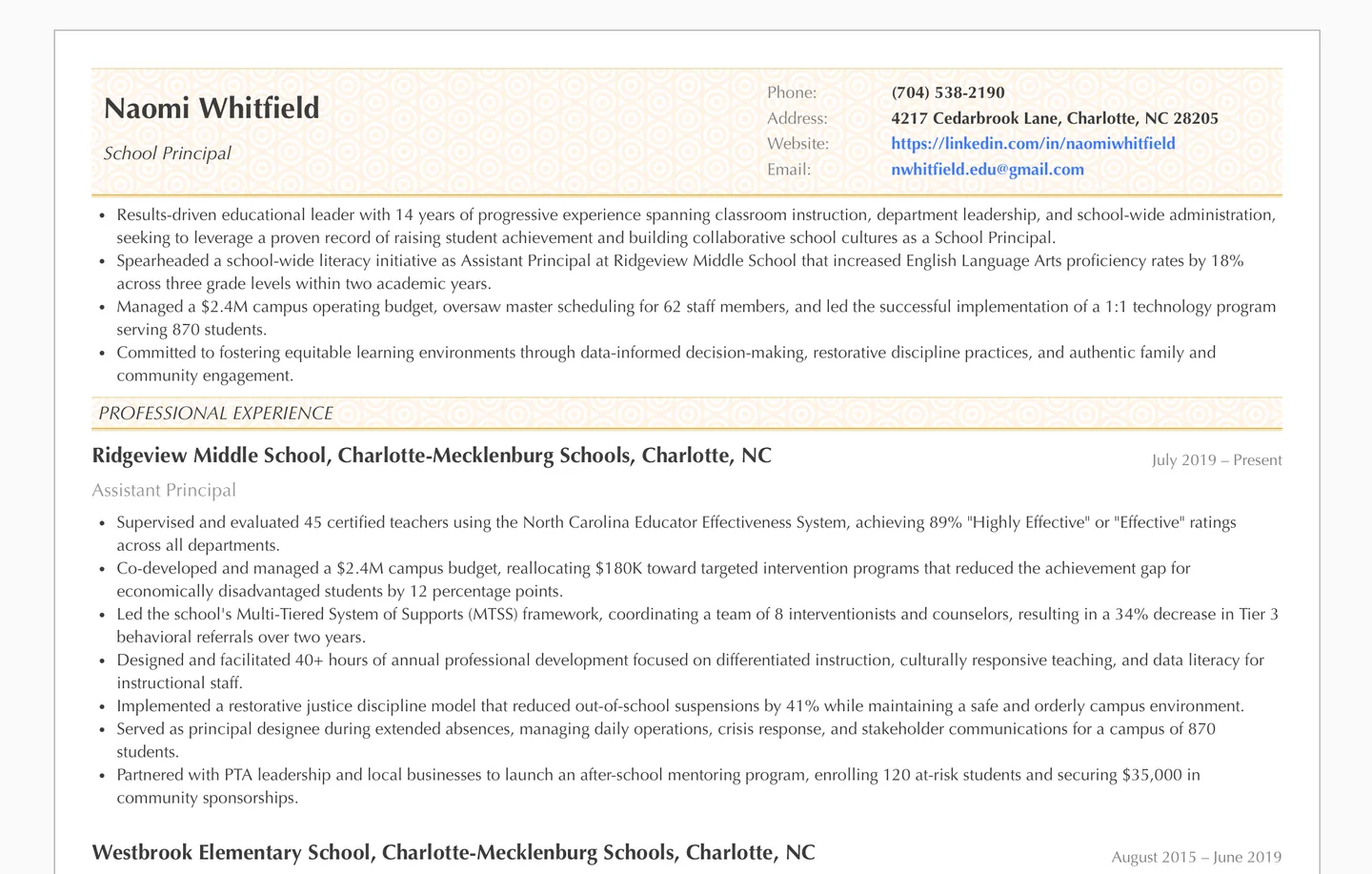
https://www.resumonk.com/school-principal-resumeSchool PrincipalChoosing the Right Resume Format for Your School Principal Application
The reverse-chronological format stands as your strongest ally here. Why? Because school boards and superintendents reviewing your application need to immediately see your progression through educational leadership. They're looking for that narrative arc - from passionate teacher to department head, from assistant principal to your readiness for the principal's office.
This format places your most recent and relevant accomplishments front and center, letting your leadership evolution shine through.
Structure Your Principal Resume for Maximum Impact
Begin with a powerful professional summary that captures your educational philosophy and leadership achievements in 3-4 lines. This isn't the place for generic statements about being "passionate about education" - every candidate claims that.
Instead, lead with concrete impact.
❌ Don't write a vague summary:
Dedicated educational professional with many years of experience in teaching and administration. Passionate about student success and creating positive learning environments.
✅ Do write with specificity and impact:
Transformational educational leader with 12 years driving academic excellence, including 5 years as Assistant Principal overseeing 1,200+ student middle school. Increased state test proficiency rates by 23% through data-driven instruction initiatives and comprehensive teacher development programs. Expert in fostering inclusive school cultures while managing $3.2M annual budgets.
Essential Sections to Include
After your summary, structure your resume with these critical sections in this order - Professional Experience, Education & Certifications, Leadership Achievements, and Professional Development. Some principals also benefit from adding a "Community Engagement" section, particularly if you've built strong partnerships with local organizations or parent groups.
Remember, being a principal means being the face of the school to the broader community.
For international considerations, UK head teachers should emphasize their Ofsted inspection results prominently, while Canadian principals should highlight their provincial certification status. Australian principals need to showcase their registration with their state's education authority.
U.S. principals must clearly list their state administrative license number and any multi-state reciprocity.
Crafting Your Professional Experience as a School Principal Candidate
Your journey to the principal's office likely began in a classroom, and that's beautiful - but here's the thing. The hiring committee already assumes you can teach. What they're desperately seeking is evidence that you can lead teachers, manage budgets, navigate political pressures, and still keep student achievement at the heart of every decision.
Your work experience section needs to tell this leadership story.
Quantify Your Educational Impact
Every bullet point in your experience section should answer the unspoken question - "So what?" You implemented a new reading program? So what? The answer better involve improved literacy rates, engaged students, or transformed teaching practices.
School boards think in metrics because they answer to communities that think in metrics.
❌ Don't write responsibility-focused descriptions:
Assistant Principal, Lincoln Middle School (2019-2024)
• Responsible for student discipline and attendance
• Supervised teaching staff
• Assisted with budget management
• Participated in hiring decisions
✅ Do write achievement-focused descriptions:
Assistant Principal, Lincoln Middle School (2019-2024)
• Reduced chronic absenteeism by 34% through implementation of early intervention system and family engagement protocols, improving overall academic performance
• Mentored and evaluated 45 teachers, resulting in 89% receiving "Highly Effective" ratings and 12 teachers earning district-wide recognition
• Managed $450,000 Title I budget, reallocating resources to establish STEM lab that served 800+ students annually
• Led hiring committees that recruited and retained 15 exceptional educators, achieving 95% retention rate over 3 years
Showcase Your Progressive Leadership Journey
Your earlier teaching roles matter, but they need strategic presentation. Focus on leadership initiatives you took as a teacher - did you chair committees, mentor new teachers, or pilot innovative programs?
These experiences demonstrate that your leadership abilities emerged organically, not suddenly when you got your first administrative title.
For department heads and instructional coaches transitioning to principalship, emphasize your system-wide thinking. How did your curriculum decisions impact the entire school? How did your coaching improve not just individual teachers but grade-level or subject-area teams? The principal's role requires this broader perspective, so prove you already possess it.
Essential Skills to Highlight on Your School Principal Resume
Here's what nobody tells you about the skills section of a principal's resume - it's not about listing every educational buzzword you know. It's about strategically selecting the competencies that address the specific challenges facing modern school leaders. You're competing with other qualified candidates who all know curriculum development and assessment strategies.
What makes you the principal who can actually move the needle?
Balance Hard and Soft Skills Strategically
Your technical skills demonstrate you can handle the operational demands of running a school - budget management, data analysis, compliance with state and federal regulations. But your soft skills reveal whether you can inspire a burned-out teaching staff, de-escalate an angry parent meeting, or build consensus among stakeholders with competing interests.
Group your skills into categories that reflect the multifaceted nature of school leadership:
Educational Leadership & Instruction
• Data-Driven Decision Making
• Curriculum Alignment & Development
• Differentiated Instruction Strategies
• Professional Learning Communities (PLC) Facilitation
• Instructional Coaching & Feedback

Operational Management
• Budget Development & Fiscal Management
• Strategic Planning & Implementation
• Facility Management & Safety Protocols
• State & Federal Compliance (ESSA, IDEA, Title IX)
• Student Information Systems (PowerSchool, Infinite Campus)

Stakeholder Engagement
• Community Partnership Development
• Crisis Communication
• Conflict Resolution & Mediation
• Board Presentation & Reporting
• Family Engagement Strategies
Customize Skills for Your Target School's Needs
Research your target school's improvement plan, recent test scores, and demographic challenges. If they're struggling with English Language Learner achievement, your "Multilingual Education Program Development" skill becomes critical. Facing budget cuts? Your "Grant Writing - Secured $2.3M in Funding" skill moves to the top.
For UK head teacher positions, include skills around academy conversion processes and multi-academy trust collaboration if relevant. Canadian principals should highlight French language proficiency where applicable, and experience with Indigenous education frameworks.
U.S. principals in urban districts need to emphasize culturally responsive teaching practices and trauma-informed education approaches.
Critical Considerations Unique to School Principal Resumes
You're not applying to be a CEO or a project manager - you're applying to shape young minds and lead educators.
This unique responsibility demands specific resume considerations that set principal applications apart from any other leadership role. The stakes couldn't be higher, and your resume needs to reflect that gravity while inspiring confidence in your ability to handle it.
Address the Elephants in the Room
School boards have specific, often unspoken concerns when hiring principals. Are you just using this position as a stepping stone to district administration? Can you handle the political pressure when test scores dip? Will you support teachers while still holding them accountable?
Your resume needs to subtly address these concerns through your accomplishments and chosen examples.
If you're making a geographic move, explain it through your cover letter, but hint at your commitment through your resume. Include community involvement in your current location, showing you put down roots wherever you serve.
If you're jumping from elementary to high school (or vice versa), highlight crossover experiences - perhaps you taught multiple grade levels or led K-12 initiatives.
Demonstrate Your Educational Philosophy Through Results
Unlike other industries where results alone matter, educational leadership demands alignment between philosophy and practice.
Your resume should implicitly communicate your beliefs about education through your achievements. Did you prioritize social-emotional learning? Show it through decreased suspension rates and improved school climate surveys. Believe in distributed leadership? Highlight teacher-led initiatives that succeeded under your guidance.
❌ Don't just list philosophical buzzwords:
• Committed to equity and inclusion
• Believe in whole-child education
• Support innovative teaching methods
✅ Do show philosophy through concrete actions:
• Eliminated achievement gap between economically disadvantaged and general population students through targeted intervention programs and resource reallocation
• Established comprehensive wellness program integrating mental health support, resulting in 40% decrease in behavioral incidents
• Launched teacher innovation grants, funding 12 classroom transformation projects that improved engagement scores by 28%
Navigate the Licensure and Certification Maze
Principal licensure requirements vary dramatically by region, and failing to clearly present your qualifications can eliminate you immediately.
List your administrative license with the state/province and expiration date. Include your unique identifier number if your region uses one. If you hold licenses in multiple states, list them all - this shows flexibility and broad qualification.
Don't forget endorsements that set you apart. Special education administration endorsement? Critical for inclusive schools. Bilingual education endorsement? Essential for diverse communities.
These aren't just checkboxes - they represent additional expertise that could make you the perfect fit for specific school challenges.
The Unwritten Rules of Principal Resume Presentation
Keep your resume to two pages maximum, even if you have 30 years of experience. Superintendents and school boards review dozens of applications - respect their time while proving you can prioritize and synthesize information (essential principal skills).
Never include student photos or names, even in portfolio attachments. Student privacy is paramount, and violating it even inadvertently signals poor judgment. Instead, use aggregate data, percentages, and anonymous case studies to illustrate your impact.
Finally, remember that your resume might be reviewed by various stakeholders - board members, teachers, parents, and students in some districts. While maintaining professionalism, ensure your language remains accessible to non-educators.
Avoid excessive jargon that might alienate community members who have a voice in the selection process.
Education Requirements and Credentials for School Principal Resume
Let us set the scene - you've spent years in the classroom, nurturing young minds, managing chaos with a smile, and now you're ready to take the helm of an entire school.
The transition from teacher to principal isn't just about leadership ambitions; it's about demonstrating that your educational foundation can support an entire institution. Your education section isn't merely a checkbox on your principal resume - it's the cornerstone that validates your readiness to shape educational policy, mentor teachers, and guide hundreds of students toward success.
Essential Degrees and Certifications
Let's be honest - becoming a school principal requires more than just passion for education. State licensing boards and school districts have specific requirements, and your resume needs to showcase these credentials prominently. Start with your highest degree first, following the reverse-chronological format. Most states require at least a master's degree in Educational Leadership, Educational Administration, or a related field.
But here's where many aspiring principals stumble - they bury their administrative credentials beneath their teaching degrees.
When listing your education, lead with the qualifications that directly qualify you for principalship. Your Master's in Educational Leadership should take precedence over your Bachelor's in Elementary Education, even if the latter came first chronologically.
❌ Don't list your education like a historical timeline:
B.A. Elementary Education - State University, 2010
M.Ed. Educational Leadership - State University, 2018
Principal Certification - State Board of Education, 2019
✅ Do prioritize administrative qualifications:
M.Ed. Educational Leadership - State University, 2018
• Concentration: School Administration and Policy
• Capstone Project: "Implementing Restorative Justice in Urban Middle Schools"
Principal Certification - State Board of Education, 2019
B.A. Elementary Education - State University, 2010
• Summa Cum Laude, GPA: 3.9/4.0
Specialized Training and Professional Development
Your journey from classroom teacher to administrative leader likely included specialized training that doesn't fit neatly into traditional degree categories. This is where you differentiate yourself from other candidates. Include relevant coursework, especially if you're transitioning from assistant principal or department head roles.
Leadership institutes, administrative workshops, and specialized certifications in areas like special education administration or bilingual education management deserve prominence.
Remember that different regions have varying requirements - in Texas, you need a principal certificate from an approved educator preparation program, while New York requires a School Building Leader certificate. International schools often look for IB workshop attendance or accreditation experience. Make sure your education section reflects the specific requirements of your target position.
Showcasing Awards and Publications on Your School Principal Resume
You know that moment when a parent stops you in the grocery store to thank you for the impact you've had on their child? Those intangible victories don't translate easily to paper, but your formal recognitions do.
Awards and publications serve as third-party validation of your educational philosophy and leadership capabilities - crucial elements when convincing a school board that you're ready to lead their institution.
Strategic Placement of Educational Honors
The awards that matter most for a principal position aren't necessarily the "Teacher of the Year" accolades from five years ago - though those certainly have their place.
Focus on recognitions that demonstrate leadership, innovation, and systemic impact. Did you receive a grant for implementing a school-wide literacy program? Were you recognized for improving standardized test scores across your grade level? These achievements show you can think beyond the individual classroom.
Position your awards strategically based on their relevance to administrative leadership. Create a hierarchy that emphasizes system-level impact over classroom-specific achievements.
❌ Don't list awards without context:
Excellence in Teaching Award - 2019
District Recognition Award - 2020
Innovation Grant Recipient - 2021
✅ Do provide impact and scope:
Innovation in School Leadership Grant - State Education Foundation, 2021
• $50,000 award for developing district-wide social-emotional learning framework
• Implemented across 12 schools, impacting 3,500+ students

Excellence in Collaborative Leadership - Regional Education Cooperative, 2020
• Recognized for leading cross-functional team of 15 teachers in curriculum redesign
• Resulted in 23% improvement in state assessment scores
Publications That Demonstrate Thought Leadership
Your published work - whether in academic journals, education blogs, or district newsletters - positions you as a thought leader ready to shape educational discourse.
But here's the challenge many educators face: how do you present your contribution to the school newsletter alongside someone who's published in peer-reviewed journals? The answer lies in framing each publication through the lens of leadership impact.
Include publications that demonstrate your ability to communicate with diverse stakeholders - research for academics, practical guides for teachers, policy briefs for administrators, and even community-facing articles for parents. This range shows you can navigate the complex communication demands of a principalship.
Strategic References for Your School Principal Resume
Remember when you first started teaching and your references were professors and student teaching supervisors?
Those days are long gone. As a principal candidate, your references need to represent the full spectrum of your leadership capabilities - from managing up to the superintendent's office to supporting teachers in the trenches. The traditional "References available upon request" won't cut it anymore; selection committees want to see that you have champions at every level of the educational ecosystem.
Curating Your Reference Portfolio
The most compelling principal candidates present references that tell a complete leadership story. You need at least one direct supervisor (assistant superintendent or current principal if you're an AP), one peer leader (fellow administrator or department head), and one subordinate (a teacher you've mentored or supervised).
Some districts also value community references - a PTA president or school board member who's witnessed your leadership firsthand.
Consider creating a separate reference sheet that goes beyond basic contact information. Include a brief description of your relationship and what aspect of your leadership each reference can specifically address.
❌ Don't list references generically:
Dr. John Smith - Superintendent - (555) 123-4567
Mrs. Jane Doe - Teacher - (555) 234-5678
Mr. Bob Johnson - Parent - (555) 345-6789
✅ Do provide context and relationship:
Dr. John Smith, Superintendent
Metro City School District | (555) 123-4567 | [email protected]
Relationship: Direct supervisor during my role as Assistant Principal (2019-present)
Can speak to: Budget management, policy implementation, crisis leadership

Sarah Martinez, 8th Grade Lead Teacher
Lincoln Middle School | (555) 234-5678 | [email protected]
Relationship: Mentored through National Board Certification process (2020-2021)
Can speak to: Instructional leadership, professional development, coaching skills
International and Regional Considerations
Reference expectations vary significantly across regions.
In the UK, you'll typically need to provide your current headteacher as a reference, and it's standard practice to request permission before listing anyone. Australian schools often require formal written references submitted with your application. Canadian districts might request references to complete structured questionnaires about your leadership competencies.
In the United States, be prepared for extensive reference checks - some districts conduct 45-minute phone interviews with each reference. Prep your references by providing them with the job description and key points you'd like them to emphasize.
Remember that many states have laws about what previous employers can disclose, so personal references who've observed your professional work might be more forthcoming with specific examples.
Managing Confidential Searches
Here's the delicate situation many aspiring principals face - you're applying for positions while still employed, and you can't use your current supervisor as a reference without revealing your job search.
In these cases, create a tiered reference strategy. Provide initial references who can speak to your leadership potential (former supervisors, mentors, or colleagues from professional organizations), and indicate that current supervisor contact information will be provided upon mutual interest. Most selection committees understand this professional courtesy, especially if you're currently in a leadership role.
Crafting a Compelling Cover Letter for Your School Principal Application
Think back to your first day as a teacher - that mix of excitement, nervousness, and determination to make a difference.
Now multiply that by an entire school's worth of responsibility. Your cover letter for a principal position needs to capture not just your qualifications, but your vision for educational leadership. Unlike the teacher cover letters you've written before, this document must speak to board members, superintendents, and community stakeholders who are entrusting you with their most precious resource - their children's education.
Opening with Educational Vision
Skip the generic "I am writing to apply for" opening that plagued your early teaching applications. School districts receive dozens of principal applications from qualified candidates - your cover letter needs to immediately establish your unique leadership philosophy.
Start with a compelling anecdote that demonstrates your understanding of the specific challenges facing their school or district.
Perhaps you've noticed their recent state report card showed gaps in English Language Learner achievement, and you have specific experience addressing this challenge. Or maybe their school website emphasizes STEM integration, aligning perfectly with the robotics program you established at your current school.
Make the connection explicit and immediate.
Demonstrating Stakeholder Management
The transition from managing a classroom to leading an entire school requires proving you can navigate complex stakeholder relationships. Your cover letter should include specific examples of how you've successfully managed competing interests - mediating between teacher unions and administration, balancing parent demands with educational best practices, or aligning district mandates with school-specific needs.
Use the STAR method (Situation, Task, Action, Result) to structure one or two key examples that showcase your leadership under pressure. Remember, in the UK and Australia, cover letters tend to be more formal and should directly address selection criteria if provided.
In the US and Canada, you have more flexibility to tell your leadership story narratively.
Closing with Actionable Next Steps
End your cover letter with specificity about what you bring to their particular school.
Reference their School Improvement Plan, recent bond initiatives, or demographic shifts - show you've done your homework. Propose specific initiatives you could implement in your first 90 days, demonstrating you're already thinking like their principal. This transforms your cover letter from a request for consideration into a preview of your leadership.
Key Takeaways
After navigating through the complexities of crafting your school principal resume, let's distill the essential elements that will set your application apart from the stack on the superintendent's desk. These aren't just tips - they're your strategic playbook for landing that leadership role you've been working toward.
- Use the reverse-chronological format exclusively - School boards need to see your leadership progression clearly, from classroom teacher to administrative readiness
- Lead with quantifiable impact, not responsibilities - Transform "Supervised teaching staff" into "Mentored 45 teachers, achieving 89% 'Highly Effective' ratings"
- Structure your resume with these sections in order - Professional Summary, Experience, Education & Certifications, Leadership Achievements, Professional Development
- Address the unspoken concerns - Show commitment to the community, prove you're not using this as a stepping stone, and demonstrate philosophy through results
- Prioritize administrative credentials over teaching degrees - Your M.Ed. in Educational Leadership matters more than your B.A. in Elementary Education for this role
- Customize skills for your target school's specific challenges - Research their improvement plan and demographic needs, then highlight relevant competencies
- Keep it to two pages maximum - Even with 30 years of experience, prove you can prioritize and synthesize (essential principal skills)
- Provide strategic references with context - Include supervisors, peers, and subordinates who can speak to different aspects of your leadership
- Never include student photos or identifying information - Respect privacy while using aggregate data to demonstrate impact
- Balance educational jargon with accessible language - Remember that parents and community members may review your application
Ready to step into the principal's office?
Your journey from classroom to school leadership starts with a resume that tells your story powerfully. Create your principal resume with Resumonk's intelligent tools and educational leadership expertise.
Start Building Your Principal Resume Today →
More Education resume examples
- Camp Counselor resume example
- School Counselor resume example
- Librarian resume example
- Paraprofessional resume example
See all Education resume examples, or browse every category.
Resume writing tips
You've spent years in classrooms, led departments, maybe transformed a school's culture as assistant principal. Now you're ready for the top seat. But distilling a career dedicated to shaping young minds into two pages that convince a school board? That's its own kind of challenge.
Because school boards aren't hiring a schedule manager. They're hiring a visionary who can navigate political pressures, re-energize burned-out teachers, engage skeptical parents, and build an environment where every student thrives. Equal parts educator, CEO, counselor, and community liaison.
Your resume needs to bridge the gap between where you've been and the leader you're ready to become.
Whether you're an assistant principal stepping up, a department head with administrative ambitions, or a master teacher tapped for leadership - this guide covers every section:
- Formatting that showcases your leadership evolution, not just your teaching timeline
- Writing a professional summary that goes beyond generic passion statements
- Structuring experience around budgets, data, and human dynamics - not just instruction
- Balancing technical competencies with the soft skills that actually keep schools running
- Handling geographic moves, grade-level transitions, and confidential searches
- Presenting awards, publications, and credentials that matter to selection committees
- Building a reference strategy that tells your complete leadership story
Let's get started with it!
The Best School Principal Resume Example/Sample
https://www.resumonk.com/school-principal-resumeSchool PrincipalChoosing the Right Resume Format for Your School Principal Application
The reverse-chronological format stands as your strongest ally here. Why? Because school boards and superintendents reviewing your application need to immediately see your progression through educational leadership. They're looking for that narrative arc - from passionate teacher to department head, from assistant principal to your readiness for the principal's office.
This format places your most recent and relevant accomplishments front and center, letting your leadership evolution shine through.
Structure Your Principal Resume for Maximum Impact
Begin with a powerful professional summary that captures your educational philosophy and leadership achievements in 3-4 lines. This isn't the place for generic statements about being "passionate about education" - every candidate claims that.
Instead, lead with concrete impact.
❌ Don't write a vague summary:
Dedicated educational professional with many years of experience in teaching and administration. Passionate about student success and creating positive learning environments.
✅ Do write with specificity and impact:
Transformational educational leader with 12 years driving academic excellence, including 5 years as Assistant Principal overseeing 1,200+ student middle school. Increased state test proficiency rates by 23% through data-driven instruction initiatives and comprehensive teacher development programs. Expert in fostering inclusive school cultures while managing $3.2M annual budgets.
Essential Sections to Include
After your summary, structure your resume with these critical sections in this order - Professional Experience, Education & Certifications, Leadership Achievements, and Professional Development. Some principals also benefit from adding a "Community Engagement" section, particularly if you've built strong partnerships with local organizations or parent groups.
Remember, being a principal means being the face of the school to the broader community.
For international considerations, UK head teachers should emphasize their Ofsted inspection results prominently, while Canadian principals should highlight their provincial certification status. Australian principals need to showcase their registration with their state's education authority.
U.S. principals must clearly list their state administrative license number and any multi-state reciprocity.
Crafting Your Professional Experience as a School Principal Candidate
Your journey to the principal's office likely began in a classroom, and that's beautiful - but here's the thing. The hiring committee already assumes you can teach. What they're desperately seeking is evidence that you can lead teachers, manage budgets, navigate political pressures, and still keep student achievement at the heart of every decision.
Your work experience section needs to tell this leadership story.
Quantify Your Educational Impact
Every bullet point in your experience section should answer the unspoken question - "So what?" You implemented a new reading program? So what? The answer better involve improved literacy rates, engaged students, or transformed teaching practices.
School boards think in metrics because they answer to communities that think in metrics.
❌ Don't write responsibility-focused descriptions:
Assistant Principal, Lincoln Middle School (2019-2024)
• Responsible for student discipline and attendance
• Supervised teaching staff
• Assisted with budget management
• Participated in hiring decisions
✅ Do write achievement-focused descriptions:
Assistant Principal, Lincoln Middle School (2019-2024)
• Reduced chronic absenteeism by 34% through implementation of early intervention system and family engagement protocols, improving overall academic performance
• Mentored and evaluated 45 teachers, resulting in 89% receiving "Highly Effective" ratings and 12 teachers earning district-wide recognition
• Managed $450,000 Title I budget, reallocating resources to establish STEM lab that served 800+ students annually
• Led hiring committees that recruited and retained 15 exceptional educators, achieving 95% retention rate over 3 years
Showcase Your Progressive Leadership Journey
Your earlier teaching roles matter, but they need strategic presentation. Focus on leadership initiatives you took as a teacher - did you chair committees, mentor new teachers, or pilot innovative programs?
These experiences demonstrate that your leadership abilities emerged organically, not suddenly when you got your first administrative title.
For department heads and instructional coaches transitioning to principalship, emphasize your system-wide thinking. How did your curriculum decisions impact the entire school? How did your coaching improve not just individual teachers but grade-level or subject-area teams? The principal's role requires this broader perspective, so prove you already possess it.
Essential Skills to Highlight on Your School Principal Resume
Here's what nobody tells you about the skills section of a principal's resume - it's not about listing every educational buzzword you know. It's about strategically selecting the competencies that address the specific challenges facing modern school leaders. You're competing with other qualified candidates who all know curriculum development and assessment strategies.
What makes you the principal who can actually move the needle?
Balance Hard and Soft Skills Strategically
Your technical skills demonstrate you can handle the operational demands of running a school - budget management, data analysis, compliance with state and federal regulations. But your soft skills reveal whether you can inspire a burned-out teaching staff, de-escalate an angry parent meeting, or build consensus among stakeholders with competing interests.
Group your skills into categories that reflect the multifaceted nature of school leadership:
Educational Leadership & Instruction
• Data-Driven Decision Making
• Curriculum Alignment & Development
• Differentiated Instruction Strategies
• Professional Learning Communities (PLC) Facilitation
• Instructional Coaching & Feedback

Operational Management
• Budget Development & Fiscal Management
• Strategic Planning & Implementation
• Facility Management & Safety Protocols
• State & Federal Compliance (ESSA, IDEA, Title IX)
• Student Information Systems (PowerSchool, Infinite Campus)

Stakeholder Engagement
• Community Partnership Development
• Crisis Communication
• Conflict Resolution & Mediation
• Board Presentation & Reporting
• Family Engagement Strategies
Customize Skills for Your Target School's Needs
Research your target school's improvement plan, recent test scores, and demographic challenges. If they're struggling with English Language Learner achievement, your "Multilingual Education Program Development" skill becomes critical. Facing budget cuts? Your "Grant Writing - Secured $2.3M in Funding" skill moves to the top.
For UK head teacher positions, include skills around academy conversion processes and multi-academy trust collaboration if relevant. Canadian principals should highlight French language proficiency where applicable, and experience with Indigenous education frameworks.
U.S. principals in urban districts need to emphasize culturally responsive teaching practices and trauma-informed education approaches.
Critical Considerations Unique to School Principal Resumes
You're not applying to be a CEO or a project manager - you're applying to shape young minds and lead educators.
This unique responsibility demands specific resume considerations that set principal applications apart from any other leadership role. The stakes couldn't be higher, and your resume needs to reflect that gravity while inspiring confidence in your ability to handle it.
Address the Elephants in the Room
School boards have specific, often unspoken concerns when hiring principals. Are you just using this position as a stepping stone to district administration? Can you handle the political pressure when test scores dip? Will you support teachers while still holding them accountable?
Your resume needs to subtly address these concerns through your accomplishments and chosen examples.
If you're making a geographic move, explain it through your cover letter, but hint at your commitment through your resume. Include community involvement in your current location, showing you put down roots wherever you serve.
If you're jumping from elementary to high school (or vice versa), highlight crossover experiences - perhaps you taught multiple grade levels or led K-12 initiatives.
Demonstrate Your Educational Philosophy Through Results
Unlike other industries where results alone matter, educational leadership demands alignment between philosophy and practice.
Your resume should implicitly communicate your beliefs about education through your achievements. Did you prioritize social-emotional learning? Show it through decreased suspension rates and improved school climate surveys. Believe in distributed leadership? Highlight teacher-led initiatives that succeeded under your guidance.
❌ Don't just list philosophical buzzwords:
• Committed to equity and inclusion
• Believe in whole-child education
• Support innovative teaching methods
✅ Do show philosophy through concrete actions:
• Eliminated achievement gap between economically disadvantaged and general population students through targeted intervention programs and resource reallocation
• Established comprehensive wellness program integrating mental health support, resulting in 40% decrease in behavioral incidents
• Launched teacher innovation grants, funding 12 classroom transformation projects that improved engagement scores by 28%
Navigate the Licensure and Certification Maze
Principal licensure requirements vary dramatically by region, and failing to clearly present your qualifications can eliminate you immediately.
List your administrative license with the state/province and expiration date. Include your unique identifier number if your region uses one. If you hold licenses in multiple states, list them all - this shows flexibility and broad qualification.
Don't forget endorsements that set you apart. Special education administration endorsement? Critical for inclusive schools. Bilingual education endorsement? Essential for diverse communities.
These aren't just checkboxes - they represent additional expertise that could make you the perfect fit for specific school challenges.
The Unwritten Rules of Principal Resume Presentation
Keep your resume to two pages maximum, even if you have 30 years of experience. Superintendents and school boards review dozens of applications - respect their time while proving you can prioritize and synthesize information (essential principal skills).
Never include student photos or names, even in portfolio attachments. Student privacy is paramount, and violating it even inadvertently signals poor judgment. Instead, use aggregate data, percentages, and anonymous case studies to illustrate your impact.
Finally, remember that your resume might be reviewed by various stakeholders - board members, teachers, parents, and students in some districts. While maintaining professionalism, ensure your language remains accessible to non-educators.
Avoid excessive jargon that might alienate community members who have a voice in the selection process.
Education Requirements and Credentials for School Principal Resume
Let us set the scene - you've spent years in the classroom, nurturing young minds, managing chaos with a smile, and now you're ready to take the helm of an entire school.
The transition from teacher to principal isn't just about leadership ambitions; it's about demonstrating that your educational foundation can support an entire institution. Your education section isn't merely a checkbox on your principal resume - it's the cornerstone that validates your readiness to shape educational policy, mentor teachers, and guide hundreds of students toward success.
Essential Degrees and Certifications
Let's be honest - becoming a school principal requires more than just passion for education. State licensing boards and school districts have specific requirements, and your resume needs to showcase these credentials prominently. Start with your highest degree first, following the reverse-chronological format. Most states require at least a master's degree in Educational Leadership, Educational Administration, or a related field.
But here's where many aspiring principals stumble - they bury their administrative credentials beneath their teaching degrees.
When listing your education, lead with the qualifications that directly qualify you for principalship. Your Master's in Educational Leadership should take precedence over your Bachelor's in Elementary Education, even if the latter came first chronologically.
❌ Don't list your education like a historical timeline:
B.A. Elementary Education - State University, 2010
M.Ed. Educational Leadership - State University, 2018
Principal Certification - State Board of Education, 2019
✅ Do prioritize administrative qualifications:
M.Ed. Educational Leadership - State University, 2018
• Concentration: School Administration and Policy
• Capstone Project: "Implementing Restorative Justice in Urban Middle Schools"
Principal Certification - State Board of Education, 2019
B.A. Elementary Education - State University, 2010
• Summa Cum Laude, GPA: 3.9/4.0
Specialized Training and Professional Development
Your journey from classroom teacher to administrative leader likely included specialized training that doesn't fit neatly into traditional degree categories. This is where you differentiate yourself from other candidates. Include relevant coursework, especially if you're transitioning from assistant principal or department head roles.
Leadership institutes, administrative workshops, and specialized certifications in areas like special education administration or bilingual education management deserve prominence.
Remember that different regions have varying requirements - in Texas, you need a principal certificate from an approved educator preparation program, while New York requires a School Building Leader certificate. International schools often look for IB workshop attendance or accreditation experience. Make sure your education section reflects the specific requirements of your target position.
Showcasing Awards and Publications on Your School Principal Resume
You know that moment when a parent stops you in the grocery store to thank you for the impact you've had on their child? Those intangible victories don't translate easily to paper, but your formal recognitions do.
Awards and publications serve as third-party validation of your educational philosophy and leadership capabilities - crucial elements when convincing a school board that you're ready to lead their institution.
Strategic Placement of Educational Honors
The awards that matter most for a principal position aren't necessarily the "Teacher of the Year" accolades from five years ago - though those certainly have their place.
Focus on recognitions that demonstrate leadership, innovation, and systemic impact. Did you receive a grant for implementing a school-wide literacy program? Were you recognized for improving standardized test scores across your grade level? These achievements show you can think beyond the individual classroom.
Position your awards strategically based on their relevance to administrative leadership. Create a hierarchy that emphasizes system-level impact over classroom-specific achievements.
❌ Don't list awards without context:
Excellence in Teaching Award - 2019
District Recognition Award - 2020
Innovation Grant Recipient - 2021
✅ Do provide impact and scope:
Innovation in School Leadership Grant - State Education Foundation, 2021
• $50,000 award for developing district-wide social-emotional learning framework
• Implemented across 12 schools, impacting 3,500+ students

Excellence in Collaborative Leadership - Regional Education Cooperative, 2020
• Recognized for leading cross-functional team of 15 teachers in curriculum redesign
• Resulted in 23% improvement in state assessment scores
Publications That Demonstrate Thought Leadership
Your published work - whether in academic journals, education blogs, or district newsletters - positions you as a thought leader ready to shape educational discourse.
But here's the challenge many educators face: how do you present your contribution to the school newsletter alongside someone who's published in peer-reviewed journals? The answer lies in framing each publication through the lens of leadership impact.
Include publications that demonstrate your ability to communicate with diverse stakeholders - research for academics, practical guides for teachers, policy briefs for administrators, and even community-facing articles for parents. This range shows you can navigate the complex communication demands of a principalship.
Strategic References for Your School Principal Resume
Remember when you first started teaching and your references were professors and student teaching supervisors?
Those days are long gone. As a principal candidate, your references need to represent the full spectrum of your leadership capabilities - from managing up to the superintendent's office to supporting teachers in the trenches. The traditional "References available upon request" won't cut it anymore; selection committees want to see that you have champions at every level of the educational ecosystem.
Curating Your Reference Portfolio
The most compelling principal candidates present references that tell a complete leadership story. You need at least one direct supervisor (assistant superintendent or current principal if you're an AP), one peer leader (fellow administrator or department head), and one subordinate (a teacher you've mentored or supervised).
Some districts also value community references - a PTA president or school board member who's witnessed your leadership firsthand.
Consider creating a separate reference sheet that goes beyond basic contact information. Include a brief description of your relationship and what aspect of your leadership each reference can specifically address.
❌ Don't list references generically:
Dr. John Smith - Superintendent - (555) 123-4567
Mrs. Jane Doe - Teacher - (555) 234-5678
Mr. Bob Johnson - Parent - (555) 345-6789
✅ Do provide context and relationship:
Dr. John Smith, Superintendent
Metro City School District | (555) 123-4567 | [email protected]
Relationship: Direct supervisor during my role as Assistant Principal (2019-present)
Can speak to: Budget management, policy implementation, crisis leadership

Sarah Martinez, 8th Grade Lead Teacher
Lincoln Middle School | (555) 234-5678 | [email protected]
Relationship: Mentored through National Board Certification process (2020-2021)
Can speak to: Instructional leadership, professional development, coaching skills
International and Regional Considerations
Reference expectations vary significantly across regions.
In the UK, you'll typically need to provide your current headteacher as a reference, and it's standard practice to request permission before listing anyone. Australian schools often require formal written references submitted with your application. Canadian districts might request references to complete structured questionnaires about your leadership competencies.
In the United States, be prepared for extensive reference checks - some districts conduct 45-minute phone interviews with each reference. Prep your references by providing them with the job description and key points you'd like them to emphasize.
Remember that many states have laws about what previous employers can disclose, so personal references who've observed your professional work might be more forthcoming with specific examples.
Managing Confidential Searches
Here's the delicate situation many aspiring principals face - you're applying for positions while still employed, and you can't use your current supervisor as a reference without revealing your job search.
In these cases, create a tiered reference strategy. Provide initial references who can speak to your leadership potential (former supervisors, mentors, or colleagues from professional organizations), and indicate that current supervisor contact information will be provided upon mutual interest. Most selection committees understand this professional courtesy, especially if you're currently in a leadership role.
Crafting a Compelling Cover Letter for Your School Principal Application
Think back to your first day as a teacher - that mix of excitement, nervousness, and determination to make a difference.
Now multiply that by an entire school's worth of responsibility. Your cover letter for a principal position needs to capture not just your qualifications, but your vision for educational leadership. Unlike the teacher cover letters you've written before, this document must speak to board members, superintendents, and community stakeholders who are entrusting you with their most precious resource - their children's education.
Opening with Educational Vision
Skip the generic "I am writing to apply for" opening that plagued your early teaching applications. School districts receive dozens of principal applications from qualified candidates - your cover letter needs to immediately establish your unique leadership philosophy.
Start with a compelling anecdote that demonstrates your understanding of the specific challenges facing their school or district.
Perhaps you've noticed their recent state report card showed gaps in English Language Learner achievement, and you have specific experience addressing this challenge. Or maybe their school website emphasizes STEM integration, aligning perfectly with the robotics program you established at your current school.
Make the connection explicit and immediate.
Demonstrating Stakeholder Management
The transition from managing a classroom to leading an entire school requires proving you can navigate complex stakeholder relationships. Your cover letter should include specific examples of how you've successfully managed competing interests - mediating between teacher unions and administration, balancing parent demands with educational best practices, or aligning district mandates with school-specific needs.
Use the STAR method (Situation, Task, Action, Result) to structure one or two key examples that showcase your leadership under pressure. Remember, in the UK and Australia, cover letters tend to be more formal and should directly address selection criteria if provided.
In the US and Canada, you have more flexibility to tell your leadership story narratively.
Closing with Actionable Next Steps
End your cover letter with specificity about what you bring to their particular school.
Reference their School Improvement Plan, recent bond initiatives, or demographic shifts - show you've done your homework. Propose specific initiatives you could implement in your first 90 days, demonstrating you're already thinking like their principal. This transforms your cover letter from a request for consideration into a preview of your leadership.
Key Takeaways
After navigating through the complexities of crafting your school principal resume, let's distill the essential elements that will set your application apart from the stack on the superintendent's desk. These aren't just tips - they're your strategic playbook for landing that leadership role you've been working toward.
- Use the reverse-chronological format exclusively - School boards need to see your leadership progression clearly, from classroom teacher to administrative readiness
- Lead with quantifiable impact, not responsibilities - Transform "Supervised teaching staff" into "Mentored 45 teachers, achieving 89% 'Highly Effective' ratings"
- Structure your resume with these sections in order - Professional Summary, Experience, Education & Certifications, Leadership Achievements, Professional Development
- Address the unspoken concerns - Show commitment to the community, prove you're not using this as a stepping stone, and demonstrate philosophy through results
- Prioritize administrative credentials over teaching degrees - Your M.Ed. in Educational Leadership matters more than your B.A. in Elementary Education for this role
- Customize skills for your target school's specific challenges - Research their improvement plan and demographic needs, then highlight relevant competencies
- Keep it to two pages maximum - Even with 30 years of experience, prove you can prioritize and synthesize (essential principal skills)
- Provide strategic references with context - Include supervisors, peers, and subordinates who can speak to different aspects of your leadership
- Never include student photos or identifying information - Respect privacy while using aggregate data to demonstrate impact
- Balance educational jargon with accessible language - Remember that parents and community members may review your application
Ready to step into the principal's office?
Your journey from classroom to school leadership starts with a resume that tells your story powerfully. Create your principal resume with Resumonk's intelligent tools and educational leadership expertise.
Start Building Your Principal Resume Today →
More Education resume examples
- Camp Counselor resume example
- School Counselor resume example
- Librarian resume example
- Paraprofessional resume example
See all Education resume examples, or browse every category.
Resume writing tips