School Nurse Resume Example (with Expert Advice and Tips)
Introduction
School nursing isn't hospital nursing with smaller patients. It's its own world entirely.
One moment you're administering insulin. The next you're teaching fifth-graders about puberty. By lunch, you've handled a playground fracture, calmed an anxious parent, and sat in an IEP meeting - all as the only medical professional responsible for hundreds of students.
Maybe you're coming from pediatrics, public health, or even adult care. Regardless of your background, the challenge is the same: your resume needs to speak two languages - healthcare and education.
It's not enough to prove you can handle emergencies. You need to show you understand the ecosystem of a school, where you're equal parts clinician, educator, counselor, and the calm voice during a lice outbreak that spreads faster than gossip in the teachers' lounge.
This guide covers every section of a school nurse resume:
- Formatting that showcases your dual healthcare-education expertise
- Structuring experience around population health, not just clinical skills
- Presenting certifications specific to school nursing
- Balancing clinical competencies with the soft skills that matter in schools
- Cover letters that frame your transition into school nursing
- Choosing references who can speak to both your independence and collaboration
Let's build it.
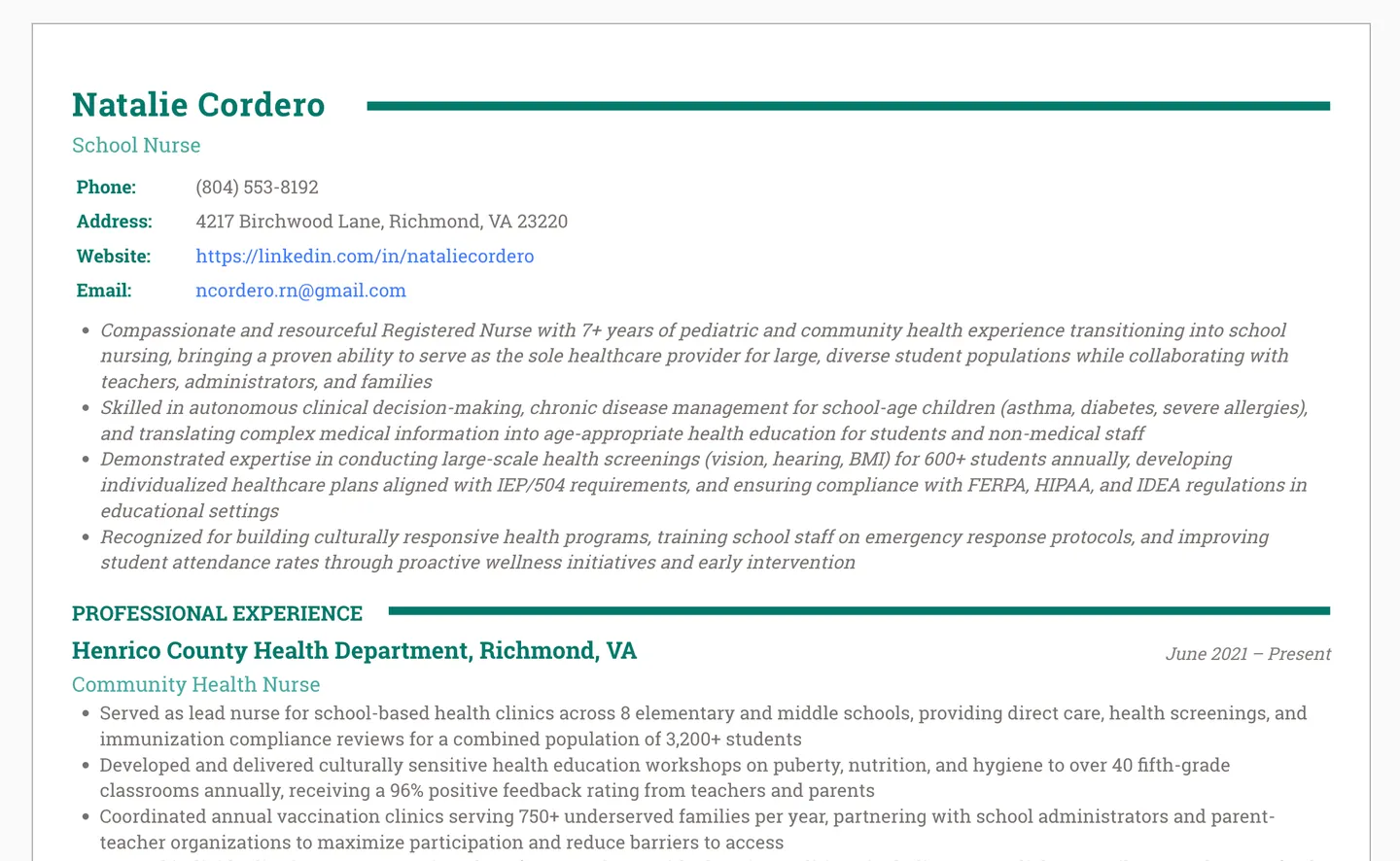
The Best School Nurse Resume Example/Sample
https://www.resumonk.com/school-nurse-resumeSchool NurseResume Format for School Nurse Positions
The reverse-chronological format stands as your strongest ally here. Why? Because school administrators and hiring committees need to see your most recent and relevant experience first.
They're juggling multiple responsibilities and want to quickly identify whether you've handled the unique challenges of school health - from managing diabetic students to conducting vision screenings for hundreds of children.
Structure Your School Nurse Resume Strategically
Start with a professional summary that immediately establishes your dual identity as both a healthcare provider and an educational team member. This isn't the place for generic nursing statements - school nursing is its own beast, requiring you to be part clinician, part counselor, part health educator, and sometimes part detective when tracking down immunization records.
Your contact information should include your nursing license number prominently. Many districts require active RN licensure, and displaying it upfront shows you understand the non-negotiables of the position.
Follow this with your professional summary, then dive into your reverse-chronological work experience, education, certifications, and finally, your skills section.
Formatting Considerations for Different Regions
If you're applying in the United States, remember that school nursing requirements vary significantly by state. California might emphasize your School Nurse Services Credential, while Texas focuses on your experience with state-mandated health screenings. In the UK, where school nurses often work across multiple schools as part of the NHS, your resume should highlight your ability to manage multiple sites and work autonomously.
Canadian applications often require demonstration of public health nursing experience, while Australian school nurse positions may emphasize your experience with Indigenous health programs or rural healthcare delivery.
Work Experience on Your School Nurse Resume
Here's where the rubber meets the road - or rather, where the Band-Aid meets the scraped knee. Your work experience section needs to tell a story that resonates with school administrators who might not fully grasp the complexity of what you do.
They know you'll handle playground injuries, but do they understand you're also tracking epidemiological data during flu season, managing complex medical conditions, and serving as the healthcare liaison for students with IEPs?
Translating Clinical Experience for Educational Settings
If you're transitioning from hospital or clinical nursing, your challenge lies in demonstrating transferable skills while acknowledging the unique environment of schools.
That time you managed multiple critical patients in the ER? That translates to handling simultaneous medical emergencies during a food allergy outbreak in the cafeteria. Your experience educating parents about post-operative care? That's directly applicable to training teachers on recognizing asthma triggers.
Let's look at how to frame your experience effectively:
❌ Don't write vaguely about general nursing duties:
Provided nursing care to pediatric patients
Administered medications as prescribed
Maintained patient records
✅ Do write specifically about school-relevant achievements:
- Managed healthcare needs for 750 elementary students, including 45 with chronic conditions
- Developed and implemented school-wide allergy action plans, reducing emergency incidents by 30%
- Collaborated with special education team to create individualized healthcare plans for 23 students with complex medical needs
Quantifying Your School Health Impact
Numbers tell a story that words alone cannot. When you mention reducing absenteeism through your flu vaccination program or screening 400 students for vision problems, you're demonstrating both your clinical efficiency and your understanding of educational priorities.
Schools care deeply about attendance rates, and if your health initiatives kept kids in classrooms, that's gold on your resume.
Consider this transformation:
❌ Don't minimize your population health impact:
Conducted health screenings for students
Managed immunization records
Provided first aid as needed
✅ Do showcase your comprehensive school health management:
- Completed state-mandated health screenings for 500+ students within 6-week deadline
- Achieved 98% immunization compliance through systematic record review and parent outreach
- Responded to average of 25 daily health office visits while maintaining detailed incident documentation
Essential Skills for Your School Nurse Resume
The skills section of a school nurse resume requires a delicate balance - you need to demonstrate clinical competence while showcasing the soft skills that make you effective in an educational environment. Think about it - you're the person who can insert an IV if needed, but you're also the one who knows exactly how to calm a kindergartener with a stomach ache who really just misses mom.
Clinical Skills That Matter in Schools
Your clinical skills list should reflect the reality of school nursing - heavy on assessment and triage, emergency response, and chronic disease management, but also including the specific competencies schools require.
Medication administration in schools follows different protocols than hospitals. You're often the only medical professional in the building, making your assessment skills absolutely critical.
Priority clinical skills to highlight include emergency response and first aid, chronic disease management (especially asthma, diabetes, and severe allergies), medication administration and delegation to unlicensed staff, health assessment and screening procedures, and infection control in congregate settings.
The Soft Skills That Set You Apart
Beyond the stethoscope and thermometer, school nursing demands a unique set of interpersonal skills. You're communicating with five-year-olds one moment and presenting to the school board the next.
Your ability to translate medical jargon for teachers, comfort anxious parents, and advocate for students' health needs within educational budget constraints - these skills deserve prominent placement.
Here's how to present your skills effectively:
❌ Don't list generic skills without context:
Skills:
- Patient care
- Communication
- Documentation
- Team player
- Computer skills
✅ Do provide specific, school-relevant skills:
Clinical Competencies:
- Emergency response and disaster preparedness planning
- Diabetes management including insulin pump and CGM troubleshooting
- Seizure action plan development and staff training
- Vision, hearing, and scoliosis screening certification

Educational Environment Skills:
- IEP/504 plan development and implementation
- Crisis intervention and de-escalation techniques
- Health education curriculum development
- Multi-disciplinary team collaboration
Specific Considerations for School Nurse Resumes
Now let's talk about the elements that make school nurse resumes truly unique - the aspects that hiring committees are specifically scanning for, often without explicitly stating them in job postings. You're applying for a position that exists at the intersection of public health, pediatric nursing, and education, and your resume needs to reflect this multifaceted reality.
Highlighting Your Understanding of Educational Law and Policy
School nurses operate within a complex framework of educational and healthcare regulations.
Your familiarity with FERPA, HIPAA in school settings, IDEA requirements, and state-specific school health mandates isn't just nice to have - it's essential. If you've navigated the complexities of medication administration in schools, developed policies for field trip medical management, or ensured compliance during state health audits, these experiences deserve prominence.
Consider adding a brief section showcasing your policy and compliance expertise:
Regulatory Compliance & Policy Development:
- Developed district-wide anaphylaxis response protocol adopted by 5 elementary schools
- Ensured 100% compliance with state immunization requirements through systematic tracking
- Created FERPA-compliant health information sharing procedures for divorced parent situations
Demonstrating Cultural Competency and Inclusive Practices
Modern schools serve increasingly diverse populations, and your resume should reflect your ability to provide culturally responsive care.
Have you worked with English Language Learner families to ensure they understand health requirements? Developed health materials in multiple languages? Collaborated with community organizations to address health disparities?
These experiences position you as someone who understands that school nursing extends far beyond the health office.
The Unique Challenge of Professional Development
Unlike hospital nurses who might focus on clinical certifications, school nurses need to show continuous learning in both healthcare and education. Your professional development section should include not just your CPR and first aid certifications, but also training in areas like behavioral health, trauma-informed care, and perhaps even courses on educational technology or special education law.
Remember to include school-specific certifications that vary by region - the National Board for Certification of School Nurses (NBCSN) certification in the US, specialized school nursing qualifications in the UK, or provincial requirements in Canada. These credentials signal your commitment to school nursing as a specialty, not just a job.
Addressing the Substitute Coverage Dilemma
Here's something unique to school nursing - you're often the only nurse for hundreds or thousands of students, and your absence creates significant challenges. If you've developed comprehensive substitute nursing plans, created emergency reference guides for non-medical staff, or established protocols that maintain continuity of care during your absence, these demonstrate the forward-thinking and systems-level planning that excellent school nurses possess.
This might look like:
Continuity of Care Initiatives:
- Created detailed substitute nurse orientation manual reducing coverage gaps by 80%
- Developed quick-reference emergency cards for all students with chronic conditions
- Trained 15 staff members in basic first aid and medication administration delegation
Education Requirements and Listing for School Nurse Resume
As a School Nurse, you're not just any healthcare professional - you're the medical Swiss Army knife of the educational world. Your education section needs to reflect both your clinical competence and your understanding that a 7-year-old with a "tummy ache" might just be nervous about their spelling test.
Let's dive into how to present your educational credentials in a way that makes principals and hiring committees see you as the perfect guardian of their students' health.
The Non-Negotiable Foundations
First things first - your nursing degree and license are your golden tickets. Without these, you're essentially trying to board a plane without a boarding pass. List your highest nursing degree first, working backward in reverse-chronological order.
Remember, School Nurses typically need at minimum an Associate Degree in Nursing (ADN), though many districts prefer or require a Bachelor of Science in Nursing (BSN).
Here's where many candidates stumble - they list their education like a grocery receipt. Your education section should tell a story of preparation for this specific role.
❌ Don't write your education like this:
BSN - University of State
Graduated 2018
✅ Do enhance it with relevant details:
Bachelor of Science in Nursing (BSN)
University of State, College of Nursing - May 2018
Relevant Coursework: Pediatric Nursing, Community Health, Developmental Psychology
Clinical Rotation: Children's Hospital Pediatric Unit (120 hours)
Certifications That Make You Stand Out
Beyond your basic nursing education, School Nurses often need specific certifications. These aren't just checkboxes - they're proof that you understand the unique challenges of school health. Your state might require a School Nurse Certification or a School Health Services Credential.
Some states like California require additional educational credentials, while others like Texas have specific School Nurse certification programs.
List these certifications immediately after your degree, especially if they're required for the position. Include your license number and expiration date - this shows you're detail-oriented and saves the hiring committee time.
Active RN License - State Board of Nursing #123456 (Expires: 12/2025)
National Certified School Nurse (NCSN) - National Board for Certification of School Nurses
CPR/BLS Certification - American Heart Association (Current through 2024)
Specialized Training That Shows You Get It
School nursing isn't just about bandaging knees - it's about understanding child development, managing chronic conditions in an educational setting, and sometimes being the only healthcare professional for hundreds of students. Any specialized training in pediatrics, adolescent health, mental health first aid, or managing conditions like diabetes, asthma, or food allergies should be highlighted.
If you've taken courses in special education, child psychology, or even completed training in mandated reporting or bullying prevention, include these. They show you understand that school nursing extends beyond the clinic door.
Awards and Publications on School Nurse Resume
School nursing is a specialty where being recognized for your work carries extra weight. Why? Because you often work independently, making critical decisions without immediate physician backup.
Awards and publications demonstrate that your peers and supervisors have noticed your ability to handle this unique responsibility.
Which Awards Actually Matter
Not all awards are created equal when it comes to School Nurse positions. That "Employee of the Month" from your hospital job? Nice, but not as impactful as recognition specifically related to pediatric care, community health, or educational settings.
Focus on awards that showcase skills directly transferable to school nursing.
Awards that resonate include those for patient education, preventive care initiatives, or community health programs. Did you receive recognition for creating a diabetes management program? Perfect. Were you honored for your work during a communicable disease outbreak?
Absolutely include it.
❌ Don't list awards vaguely:
Excellence in Nursing Award - 2022
Perfect Attendance Award - 2021
✅ Do provide context that relates to school nursing:
Excellence in Pediatric Patient Education Award - Children's Hospital, 2022
- Recognized for developing age-appropriate asthma action plans resulting in 40% reduction in ER visits

Community Health Champion Award - County Health Department, 2021
- Honored for implementing vaccination clinic serving 500+ underserved families
Publications That Demonstrate Your Expertise
You might be thinking, "I'm not a researcher - I'm a hands-on nurse!" But publications aren't just peer-reviewed journal articles.
In the school nursing world, publications can include newsletter articles about health topics, contributions to school district health policies, or even well-crafted health education materials you've developed.
If you've written anything - a piece for the school newsletter about managing food allergies, a guide for teachers on recognizing mental health concerns, or contributed to your district's health services manual - these count. They show you can communicate complex health information to non-medical audiences, a crucial skill for School Nurses.
"Creating Inclusive PE Programs for Students with Chronic Conditions"
- School Health Quarterly, Spring 2023

"A Parent's Guide to Managing Food Allergies at School"
- Contributing Author, District Health Services Manual, 2022
Professional Presentations and Community Involvement
Have you presented at a PTA meeting about childhood obesity? Led a workshop for teachers on recognizing signs of abuse? These activities demonstrate your ability to be the bridge between healthcare and education.
School Nurses are educators as much as they are clinicians, and these experiences prove you can wear both hats.
Strategic Reference Selection for School Nurse Resume
You're entering a world where you'll be responsible for hundreds of children, often as the sole medical professional on campus. Your references need to paint a picture of someone who can handle that responsibility while also collaborating with teachers, administrators, and parents who might have very different perspectives on health and wellness.
The Power Players You Need in Your Corner
The ideal reference list for a School Nurse position includes a strategic mix of clinical supervisors and education-adjacent professionals. If you've worked in pediatrics, your pediatric nursing supervisor is gold.
If you've done any community health work, that supervisor understands the independence and resourcefulness required in school nursing.
But here's what many candidates miss - including a reference who can speak to your ability to work with non-medical professionals. This could be a child life specialist you collaborated with, a social worker from your hospital, or even a school administrator if you've done any health education presentations.
These references can attest to your ability to communicate medical information to lay audiences - a daily requirement in school nursing.
❌ Don't list references without context:
References:
Jane Smith - 555-1234
John Doe - 555-5678
Mary Johnson - 555-9012
✅ Do provide complete, professional information:
Professional References:

Sarah Mitchell, RN, MSN
Pediatric Unit Manager - Children's Regional Hospital
Phone: (555) 234-5678 | Email: [email protected]
Relationship: Direct Supervisor (2019-2023)

Dr. James Patterson
Director of Community Health Services - County Health Department
Phone: (555) 345-6789 | Email: [email protected]
Relationship: Supervised my work on school-based vaccination clinics
Preparing Your References for Success
Your references can't sell what they don't know you're buying.
When you ask someone to be a reference for a School Nurse position, don't just ask if they'll provide a reference - prepare them for what the hiring committee will likely ask about. School administrators want to know: Can you work independently? How do you handle anxious parents? Can you manage multiple emergencies simultaneously while maintaining calm?
Send your references the job description and a brief note about why you're interested in school nursing. Remind them of specific examples where you demonstrated skills relevant to the position. That time you successfully managed five pediatric emergencies during a particularly chaotic shift?
Your supervisor might have forgotten, but it's exactly the kind of story that resonates with school administrators.
International Considerations and Regional Differences
If you're applying in the United States, references are typically provided upon request, and you'll note "References available upon request" on your resume. However, some school districts want them upfront - check the application requirements carefully.
In the UK, where School Nurses often have additional health visitor qualifications, at least one reference should be from your current or most recent employer, and they'll likely be contacted before an interview. Canadian schools often require references from both clinical and community health settings, reflecting their public health approach to school nursing.
Australian schools frequently require a reference from someone who can verify your Working with Children clearance and your understanding of mandatory reporting requirements. Don't assume your references know to mention these qualifications - prompt them.
The Reference Red Flags to Avoid
Never list family members, even if they work in healthcare. Avoid references who haven't seen your work in the past three to five years unless they supervised particularly relevant experience.
And here's a subtle but important point - if you're transitioning from adult care to pediatrics, make sure at least one reference can speak to your ability to work with children, even if it's from volunteer work or community activities.
Remember, in school nursing, your references aren't just confirming your employment dates - they're vouching for your judgment when you're the only medical professional making decisions about children's health. Choose wisely, prepare thoroughly, and make sure your references understand the unique demands and rewards of school nursing.
Cover Letter Strategies for School Nurse Resume
Think of writing your cover letter as your opportunity to have a conversation with the hiring committee before you meet them.
It's where you connect the dots between your emergency room experience and why that makes you perfect for handling playground emergencies. It's where you explain that your work with pediatric diabetes patients taught you not just about insulin management, but about helping kids feel normal despite their medical needs.
Opening With Purpose - Not Platitudes
School administrators read dozens of cover letters that start with "I am writing to apply for the School Nurse position."
They already know that - you applied! Instead, open with something that immediately shows you understand what school nursing really entails.
❌ Don't open with generic enthusiasm:
Dear Hiring Manager,
I am excited to apply for the School Nurse position at Elementary School.
I have been a nurse for five years and love working with children.
✅ Do open with specific understanding:
Dear Principal Johnson,
When a second-grader recently asked me if their friend's peanut allergy meant they couldn't sit together at lunch anymore, I realized that school nursing isn't just about managing medical conditions - it's about helping entire communities understand and support health needs while maintaining normalcy.
Bridging Clinical Experience to Educational Settings
Most School Nurses come from clinical backgrounds, and hiring committees know this.
What they want to see is that you understand the dramatic differences between hospital nursing and school nursing. In the hospital, you have doctors down the hall and specialized equipment at your fingertips. In school, you might be the only medical professional for 500 students, working with a thermometer, bandages, and your clinical judgment.
Your cover letter should demonstrate that you're prepared for this independence and actually excited about it. Mention specific scenarios where you've had to make autonomous decisions, educate non-medical staff, or manage multiple priorities with limited resources.
During my time in the pediatric unit, I often served as the liaison between medical staff and families, translating complex medical information into understandable action plans. This experience prepared me for the School Nurse role, where I'd partner with teachers and parents to ensure students with chronic conditions can fully participate in their education.
Addressing the Elephant in the Room - Salary and Schedule
Let's be real - School Nurses often make less than their hospital counterparts, but work a schedule that many nurses dream about. If you're transitioning from clinical nursing, the hiring committee might wonder if you've really thought this through.
Without mentioning salary directly, your cover letter should subtly indicate that you understand and value what school nursing offers beyond compensation.
Mention your interest in preventive care, health education, or being part of a child's long-term development. These aspects show you're choosing school nursing for the right reasons - not just for summers off.
The Closing That Compels Action
Your closing paragraph shouldn't just thank them for their time - it should reinforce your unique value and prompt next steps. Reference something specific about their school or district that excites you.
Maybe they have an innovative wellness program, or perhaps they serve a diverse population that aligns with your experience.
I'm particularly drawn to Lincoln Elementary's commitment to inclusive health education and would welcome the opportunity to discuss how my experience developing culturally sensitive health materials could support your diverse student population. I'm available for an interview at your convenience and can be reached at [phone] or [email].
Key Takeaways
After exploring every aspect of creating an outstanding School Nurse resume, here are the essential points to remember as you craft your own:
- Use reverse-chronological format to showcase your most recent and relevant experience first, helping busy administrators quickly identify your qualifications for managing school health challenges
- Bridge the healthcare-education gap in your professional summary by establishing yourself as both a skilled clinician and an educational team member who understands the unique demands of school nursing
- Translate clinical experience into school-relevant achievements by focusing on pediatric care, health education, autonomous decision-making, and working with non-medical professionals
- Quantify your impact with specific numbers - students served, health screenings completed, attendance rates improved, or emergency incidents managed
- Highlight both clinical competencies and educational environment skills, including emergency response, chronic disease management, IEP/504 plan involvement, and crisis intervention abilities
- Showcase your understanding of educational law and policy such as FERPA, HIPAA in school settings, IDEA requirements, and state-specific health mandates
- Include school-specific certifications and training like National Certified School Nurse (NCSN) credentials, mental health first aid, or specialized training in managing conditions common in school settings
- Demonstrate cultural competency and inclusive practices through examples of working with diverse populations or developing culturally responsive health materials
- Address unique school nursing challenges like developing substitute coverage plans and training non-medical staff for health emergencies
- Craft a compelling cover letter that explains your passion for school nursing and demonstrates understanding of the role's unique independence and responsibilities
- Select references strategically, including both clinical supervisors and professionals who can speak to your ability to work in educational settings
Ready to create a School Nurse resume that opens doors to the health office of your dreams?
Start building your professional resume with Resumonk's templates and AI guidance. Your next opportunity to be the healthcare hero for hundreds of students is just a click away.
Begin crafting your School Nurse resume today →
More Nursing resume examples
- Nursing resume example
- Charge Nurse resume example
- Nursing Student resume example
- Nurse Practitioner (Entry-Level) resume example
See all Nursing resume examples, or browse every category.
Resume writing tips
School nursing isn't hospital nursing with smaller patients. It's its own world entirely.
One moment you're administering insulin. The next you're teaching fifth-graders about puberty. By lunch, you've handled a playground fracture, calmed an anxious parent, and sat in an IEP meeting - all as the only medical professional responsible for hundreds of students.
Maybe you're coming from pediatrics, public health, or even adult care. Regardless of your background, the challenge is the same: your resume needs to speak two languages - healthcare and education.
It's not enough to prove you can handle emergencies. You need to show you understand the ecosystem of a school, where you're equal parts clinician, educator, counselor, and the calm voice during a lice outbreak that spreads faster than gossip in the teachers' lounge.
This guide covers every section of a school nurse resume:
- Formatting that showcases your dual healthcare-education expertise
- Structuring experience around population health, not just clinical skills
- Presenting certifications specific to school nursing
- Balancing clinical competencies with the soft skills that matter in schools
- Cover letters that frame your transition into school nursing
- Choosing references who can speak to both your independence and collaboration
Let's build it.
The Best School Nurse Resume Example/Sample
https://www.resumonk.com/school-nurse-resumeSchool NurseResume Format for School Nurse Positions
The reverse-chronological format stands as your strongest ally here. Why? Because school administrators and hiring committees need to see your most recent and relevant experience first.
They're juggling multiple responsibilities and want to quickly identify whether you've handled the unique challenges of school health - from managing diabetic students to conducting vision screenings for hundreds of children.
Structure Your School Nurse Resume Strategically
Start with a professional summary that immediately establishes your dual identity as both a healthcare provider and an educational team member. This isn't the place for generic nursing statements - school nursing is its own beast, requiring you to be part clinician, part counselor, part health educator, and sometimes part detective when tracking down immunization records.
Your contact information should include your nursing license number prominently. Many districts require active RN licensure, and displaying it upfront shows you understand the non-negotiables of the position.
Follow this with your professional summary, then dive into your reverse-chronological work experience, education, certifications, and finally, your skills section.
Formatting Considerations for Different Regions
If you're applying in the United States, remember that school nursing requirements vary significantly by state. California might emphasize your School Nurse Services Credential, while Texas focuses on your experience with state-mandated health screenings. In the UK, where school nurses often work across multiple schools as part of the NHS, your resume should highlight your ability to manage multiple sites and work autonomously.
Canadian applications often require demonstration of public health nursing experience, while Australian school nurse positions may emphasize your experience with Indigenous health programs or rural healthcare delivery.
Work Experience on Your School Nurse Resume
Here's where the rubber meets the road - or rather, where the Band-Aid meets the scraped knee. Your work experience section needs to tell a story that resonates with school administrators who might not fully grasp the complexity of what you do.
They know you'll handle playground injuries, but do they understand you're also tracking epidemiological data during flu season, managing complex medical conditions, and serving as the healthcare liaison for students with IEPs?
Translating Clinical Experience for Educational Settings
If you're transitioning from hospital or clinical nursing, your challenge lies in demonstrating transferable skills while acknowledging the unique environment of schools.
That time you managed multiple critical patients in the ER? That translates to handling simultaneous medical emergencies during a food allergy outbreak in the cafeteria. Your experience educating parents about post-operative care? That's directly applicable to training teachers on recognizing asthma triggers.
Let's look at how to frame your experience effectively:
❌ Don't write vaguely about general nursing duties:
Provided nursing care to pediatric patients
Administered medications as prescribed
Maintained patient records
✅ Do write specifically about school-relevant achievements:
- Managed healthcare needs for 750 elementary students, including 45 with chronic conditions
- Developed and implemented school-wide allergy action plans, reducing emergency incidents by 30%
- Collaborated with special education team to create individualized healthcare plans for 23 students with complex medical needs
Quantifying Your School Health Impact
Numbers tell a story that words alone cannot. When you mention reducing absenteeism through your flu vaccination program or screening 400 students for vision problems, you're demonstrating both your clinical efficiency and your understanding of educational priorities.
Schools care deeply about attendance rates, and if your health initiatives kept kids in classrooms, that's gold on your resume.
Consider this transformation:
❌ Don't minimize your population health impact:
Conducted health screenings for students
Managed immunization records
Provided first aid as needed
✅ Do showcase your comprehensive school health management:
- Completed state-mandated health screenings for 500+ students within 6-week deadline
- Achieved 98% immunization compliance through systematic record review and parent outreach
- Responded to average of 25 daily health office visits while maintaining detailed incident documentation
Essential Skills for Your School Nurse Resume
The skills section of a school nurse resume requires a delicate balance - you need to demonstrate clinical competence while showcasing the soft skills that make you effective in an educational environment. Think about it - you're the person who can insert an IV if needed, but you're also the one who knows exactly how to calm a kindergartener with a stomach ache who really just misses mom.
Clinical Skills That Matter in Schools
Your clinical skills list should reflect the reality of school nursing - heavy on assessment and triage, emergency response, and chronic disease management, but also including the specific competencies schools require.
Medication administration in schools follows different protocols than hospitals. You're often the only medical professional in the building, making your assessment skills absolutely critical.
Priority clinical skills to highlight include emergency response and first aid, chronic disease management (especially asthma, diabetes, and severe allergies), medication administration and delegation to unlicensed staff, health assessment and screening procedures, and infection control in congregate settings.
The Soft Skills That Set You Apart
Beyond the stethoscope and thermometer, school nursing demands a unique set of interpersonal skills. You're communicating with five-year-olds one moment and presenting to the school board the next.
Your ability to translate medical jargon for teachers, comfort anxious parents, and advocate for students' health needs within educational budget constraints - these skills deserve prominent placement.
Here's how to present your skills effectively:
❌ Don't list generic skills without context:
Skills:
- Patient care
- Communication
- Documentation
- Team player
- Computer skills
✅ Do provide specific, school-relevant skills:
Clinical Competencies:
- Emergency response and disaster preparedness planning
- Diabetes management including insulin pump and CGM troubleshooting
- Seizure action plan development and staff training
- Vision, hearing, and scoliosis screening certification

Educational Environment Skills:
- IEP/504 plan development and implementation
- Crisis intervention and de-escalation techniques
- Health education curriculum development
- Multi-disciplinary team collaboration
Specific Considerations for School Nurse Resumes
Now let's talk about the elements that make school nurse resumes truly unique - the aspects that hiring committees are specifically scanning for, often without explicitly stating them in job postings. You're applying for a position that exists at the intersection of public health, pediatric nursing, and education, and your resume needs to reflect this multifaceted reality.
Highlighting Your Understanding of Educational Law and Policy
School nurses operate within a complex framework of educational and healthcare regulations.
Your familiarity with FERPA, HIPAA in school settings, IDEA requirements, and state-specific school health mandates isn't just nice to have - it's essential. If you've navigated the complexities of medication administration in schools, developed policies for field trip medical management, or ensured compliance during state health audits, these experiences deserve prominence.
Consider adding a brief section showcasing your policy and compliance expertise:
Regulatory Compliance & Policy Development:
- Developed district-wide anaphylaxis response protocol adopted by 5 elementary schools
- Ensured 100% compliance with state immunization requirements through systematic tracking
- Created FERPA-compliant health information sharing procedures for divorced parent situations
Demonstrating Cultural Competency and Inclusive Practices
Modern schools serve increasingly diverse populations, and your resume should reflect your ability to provide culturally responsive care.
Have you worked with English Language Learner families to ensure they understand health requirements? Developed health materials in multiple languages? Collaborated with community organizations to address health disparities?
These experiences position you as someone who understands that school nursing extends far beyond the health office.
The Unique Challenge of Professional Development
Unlike hospital nurses who might focus on clinical certifications, school nurses need to show continuous learning in both healthcare and education. Your professional development section should include not just your CPR and first aid certifications, but also training in areas like behavioral health, trauma-informed care, and perhaps even courses on educational technology or special education law.
Remember to include school-specific certifications that vary by region - the National Board for Certification of School Nurses (NBCSN) certification in the US, specialized school nursing qualifications in the UK, or provincial requirements in Canada. These credentials signal your commitment to school nursing as a specialty, not just a job.
Addressing the Substitute Coverage Dilemma
Here's something unique to school nursing - you're often the only nurse for hundreds or thousands of students, and your absence creates significant challenges. If you've developed comprehensive substitute nursing plans, created emergency reference guides for non-medical staff, or established protocols that maintain continuity of care during your absence, these demonstrate the forward-thinking and systems-level planning that excellent school nurses possess.
This might look like:
Continuity of Care Initiatives:
- Created detailed substitute nurse orientation manual reducing coverage gaps by 80%
- Developed quick-reference emergency cards for all students with chronic conditions
- Trained 15 staff members in basic first aid and medication administration delegation
Education Requirements and Listing for School Nurse Resume
As a School Nurse, you're not just any healthcare professional - you're the medical Swiss Army knife of the educational world. Your education section needs to reflect both your clinical competence and your understanding that a 7-year-old with a "tummy ache" might just be nervous about their spelling test.
Let's dive into how to present your educational credentials in a way that makes principals and hiring committees see you as the perfect guardian of their students' health.
The Non-Negotiable Foundations
First things first - your nursing degree and license are your golden tickets. Without these, you're essentially trying to board a plane without a boarding pass. List your highest nursing degree first, working backward in reverse-chronological order.
Remember, School Nurses typically need at minimum an Associate Degree in Nursing (ADN), though many districts prefer or require a Bachelor of Science in Nursing (BSN).
Here's where many candidates stumble - they list their education like a grocery receipt. Your education section should tell a story of preparation for this specific role.
❌ Don't write your education like this:
BSN - University of State
Graduated 2018
✅ Do enhance it with relevant details:
Bachelor of Science in Nursing (BSN)
University of State, College of Nursing - May 2018
Relevant Coursework: Pediatric Nursing, Community Health, Developmental Psychology
Clinical Rotation: Children's Hospital Pediatric Unit (120 hours)
Certifications That Make You Stand Out
Beyond your basic nursing education, School Nurses often need specific certifications. These aren't just checkboxes - they're proof that you understand the unique challenges of school health. Your state might require a School Nurse Certification or a School Health Services Credential.
Some states like California require additional educational credentials, while others like Texas have specific School Nurse certification programs.
List these certifications immediately after your degree, especially if they're required for the position. Include your license number and expiration date - this shows you're detail-oriented and saves the hiring committee time.
Active RN License - State Board of Nursing #123456 (Expires: 12/2025)
National Certified School Nurse (NCSN) - National Board for Certification of School Nurses
CPR/BLS Certification - American Heart Association (Current through 2024)
Specialized Training That Shows You Get It
School nursing isn't just about bandaging knees - it's about understanding child development, managing chronic conditions in an educational setting, and sometimes being the only healthcare professional for hundreds of students. Any specialized training in pediatrics, adolescent health, mental health first aid, or managing conditions like diabetes, asthma, or food allergies should be highlighted.
If you've taken courses in special education, child psychology, or even completed training in mandated reporting or bullying prevention, include these. They show you understand that school nursing extends beyond the clinic door.
Awards and Publications on School Nurse Resume
School nursing is a specialty where being recognized for your work carries extra weight. Why? Because you often work independently, making critical decisions without immediate physician backup.
Awards and publications demonstrate that your peers and supervisors have noticed your ability to handle this unique responsibility.
Which Awards Actually Matter
Not all awards are created equal when it comes to School Nurse positions. That "Employee of the Month" from your hospital job? Nice, but not as impactful as recognition specifically related to pediatric care, community health, or educational settings.
Focus on awards that showcase skills directly transferable to school nursing.
Awards that resonate include those for patient education, preventive care initiatives, or community health programs. Did you receive recognition for creating a diabetes management program? Perfect. Were you honored for your work during a communicable disease outbreak?
Absolutely include it.
❌ Don't list awards vaguely:
Excellence in Nursing Award - 2022
Perfect Attendance Award - 2021
✅ Do provide context that relates to school nursing:
Excellence in Pediatric Patient Education Award - Children's Hospital, 2022
- Recognized for developing age-appropriate asthma action plans resulting in 40% reduction in ER visits

Community Health Champion Award - County Health Department, 2021
- Honored for implementing vaccination clinic serving 500+ underserved families
Publications That Demonstrate Your Expertise
You might be thinking, "I'm not a researcher - I'm a hands-on nurse!" But publications aren't just peer-reviewed journal articles.
In the school nursing world, publications can include newsletter articles about health topics, contributions to school district health policies, or even well-crafted health education materials you've developed.
If you've written anything - a piece for the school newsletter about managing food allergies, a guide for teachers on recognizing mental health concerns, or contributed to your district's health services manual - these count. They show you can communicate complex health information to non-medical audiences, a crucial skill for School Nurses.
"Creating Inclusive PE Programs for Students with Chronic Conditions"
- School Health Quarterly, Spring 2023

"A Parent's Guide to Managing Food Allergies at School"
- Contributing Author, District Health Services Manual, 2022
Professional Presentations and Community Involvement
Have you presented at a PTA meeting about childhood obesity? Led a workshop for teachers on recognizing signs of abuse? These activities demonstrate your ability to be the bridge between healthcare and education.
School Nurses are educators as much as they are clinicians, and these experiences prove you can wear both hats.
Strategic Reference Selection for School Nurse Resume
You're entering a world where you'll be responsible for hundreds of children, often as the sole medical professional on campus. Your references need to paint a picture of someone who can handle that responsibility while also collaborating with teachers, administrators, and parents who might have very different perspectives on health and wellness.
The Power Players You Need in Your Corner
The ideal reference list for a School Nurse position includes a strategic mix of clinical supervisors and education-adjacent professionals. If you've worked in pediatrics, your pediatric nursing supervisor is gold.
If you've done any community health work, that supervisor understands the independence and resourcefulness required in school nursing.
But here's what many candidates miss - including a reference who can speak to your ability to work with non-medical professionals. This could be a child life specialist you collaborated with, a social worker from your hospital, or even a school administrator if you've done any health education presentations.
These references can attest to your ability to communicate medical information to lay audiences - a daily requirement in school nursing.
❌ Don't list references without context:
References:
Jane Smith - 555-1234
John Doe - 555-5678
Mary Johnson - 555-9012
✅ Do provide complete, professional information:
Professional References:

Sarah Mitchell, RN, MSN
Pediatric Unit Manager - Children's Regional Hospital
Phone: (555) 234-5678 | Email: [email protected]
Relationship: Direct Supervisor (2019-2023)

Dr. James Patterson
Director of Community Health Services - County Health Department
Phone: (555) 345-6789 | Email: [email protected]
Relationship: Supervised my work on school-based vaccination clinics
Preparing Your References for Success
Your references can't sell what they don't know you're buying.
When you ask someone to be a reference for a School Nurse position, don't just ask if they'll provide a reference - prepare them for what the hiring committee will likely ask about. School administrators want to know: Can you work independently? How do you handle anxious parents? Can you manage multiple emergencies simultaneously while maintaining calm?
Send your references the job description and a brief note about why you're interested in school nursing. Remind them of specific examples where you demonstrated skills relevant to the position. That time you successfully managed five pediatric emergencies during a particularly chaotic shift?
Your supervisor might have forgotten, but it's exactly the kind of story that resonates with school administrators.
International Considerations and Regional Differences
If you're applying in the United States, references are typically provided upon request, and you'll note "References available upon request" on your resume. However, some school districts want them upfront - check the application requirements carefully.
In the UK, where School Nurses often have additional health visitor qualifications, at least one reference should be from your current or most recent employer, and they'll likely be contacted before an interview. Canadian schools often require references from both clinical and community health settings, reflecting their public health approach to school nursing.
Australian schools frequently require a reference from someone who can verify your Working with Children clearance and your understanding of mandatory reporting requirements. Don't assume your references know to mention these qualifications - prompt them.
The Reference Red Flags to Avoid
Never list family members, even if they work in healthcare. Avoid references who haven't seen your work in the past three to five years unless they supervised particularly relevant experience.
And here's a subtle but important point - if you're transitioning from adult care to pediatrics, make sure at least one reference can speak to your ability to work with children, even if it's from volunteer work or community activities.
Remember, in school nursing, your references aren't just confirming your employment dates - they're vouching for your judgment when you're the only medical professional making decisions about children's health. Choose wisely, prepare thoroughly, and make sure your references understand the unique demands and rewards of school nursing.
Cover Letter Strategies for School Nurse Resume
Think of writing your cover letter as your opportunity to have a conversation with the hiring committee before you meet them.
It's where you connect the dots between your emergency room experience and why that makes you perfect for handling playground emergencies. It's where you explain that your work with pediatric diabetes patients taught you not just about insulin management, but about helping kids feel normal despite their medical needs.
Opening With Purpose - Not Platitudes
School administrators read dozens of cover letters that start with "I am writing to apply for the School Nurse position."
They already know that - you applied! Instead, open with something that immediately shows you understand what school nursing really entails.
❌ Don't open with generic enthusiasm:
Dear Hiring Manager,
I am excited to apply for the School Nurse position at Elementary School.
I have been a nurse for five years and love working with children.
✅ Do open with specific understanding:
Dear Principal Johnson,
When a second-grader recently asked me if their friend's peanut allergy meant they couldn't sit together at lunch anymore, I realized that school nursing isn't just about managing medical conditions - it's about helping entire communities understand and support health needs while maintaining normalcy.
Bridging Clinical Experience to Educational Settings
Most School Nurses come from clinical backgrounds, and hiring committees know this.
What they want to see is that you understand the dramatic differences between hospital nursing and school nursing. In the hospital, you have doctors down the hall and specialized equipment at your fingertips. In school, you might be the only medical professional for 500 students, working with a thermometer, bandages, and your clinical judgment.
Your cover letter should demonstrate that you're prepared for this independence and actually excited about it. Mention specific scenarios where you've had to make autonomous decisions, educate non-medical staff, or manage multiple priorities with limited resources.
During my time in the pediatric unit, I often served as the liaison between medical staff and families, translating complex medical information into understandable action plans. This experience prepared me for the School Nurse role, where I'd partner with teachers and parents to ensure students with chronic conditions can fully participate in their education.
Addressing the Elephant in the Room - Salary and Schedule
Let's be real - School Nurses often make less than their hospital counterparts, but work a schedule that many nurses dream about. If you're transitioning from clinical nursing, the hiring committee might wonder if you've really thought this through.
Without mentioning salary directly, your cover letter should subtly indicate that you understand and value what school nursing offers beyond compensation.
Mention your interest in preventive care, health education, or being part of a child's long-term development. These aspects show you're choosing school nursing for the right reasons - not just for summers off.
The Closing That Compels Action
Your closing paragraph shouldn't just thank them for their time - it should reinforce your unique value and prompt next steps. Reference something specific about their school or district that excites you.
Maybe they have an innovative wellness program, or perhaps they serve a diverse population that aligns with your experience.
I'm particularly drawn to Lincoln Elementary's commitment to inclusive health education and would welcome the opportunity to discuss how my experience developing culturally sensitive health materials could support your diverse student population. I'm available for an interview at your convenience and can be reached at [phone] or [email].
Key Takeaways
After exploring every aspect of creating an outstanding School Nurse resume, here are the essential points to remember as you craft your own:
- Use reverse-chronological format to showcase your most recent and relevant experience first, helping busy administrators quickly identify your qualifications for managing school health challenges
- Bridge the healthcare-education gap in your professional summary by establishing yourself as both a skilled clinician and an educational team member who understands the unique demands of school nursing
- Translate clinical experience into school-relevant achievements by focusing on pediatric care, health education, autonomous decision-making, and working with non-medical professionals
- Quantify your impact with specific numbers - students served, health screenings completed, attendance rates improved, or emergency incidents managed
- Highlight both clinical competencies and educational environment skills, including emergency response, chronic disease management, IEP/504 plan involvement, and crisis intervention abilities
- Showcase your understanding of educational law and policy such as FERPA, HIPAA in school settings, IDEA requirements, and state-specific health mandates
- Include school-specific certifications and training like National Certified School Nurse (NCSN) credentials, mental health first aid, or specialized training in managing conditions common in school settings
- Demonstrate cultural competency and inclusive practices through examples of working with diverse populations or developing culturally responsive health materials
- Address unique school nursing challenges like developing substitute coverage plans and training non-medical staff for health emergencies
- Craft a compelling cover letter that explains your passion for school nursing and demonstrates understanding of the role's unique independence and responsibilities
- Select references strategically, including both clinical supervisors and professionals who can speak to your ability to work in educational settings
Ready to create a School Nurse resume that opens doors to the health office of your dreams?
Start building your professional resume with Resumonk's templates and AI guidance. Your next opportunity to be the healthcare hero for hundreds of students is just a click away.
Begin crafting your School Nurse resume today →
More Nursing resume examples
- Nursing resume example
- Charge Nurse resume example
- Nursing Student resume example
- Nurse Practitioner (Entry-Level) resume example
See all Nursing resume examples, or browse every category.
Resume writing tips