Retail Pharmacist Resume Example, Guide and Tips
Introduction
Let's step into this scene - you're standing behind the pharmacy counter at 7 PM on a Tuesday, the fluorescent lights humming overhead as you verify your 247th prescription of the day.
The phone is ringing with a patient asking about drug interactions, there's a line of customers waiting for flu shots, and somewhere in the back of your mind, you're thinking about that job posting you saw for the pharmacy closer to home, the one with better hours and a signing bonus. You know you're qualified - after all, you've been doing this dance of dispensing medications, counseling patients, and navigating insurance mazes for years now. But when you sit down to write your resume, suddenly all those skills that come as naturally as breathing feel impossible to capture on paper.
As a retail pharmacist, you occupy a unique space in healthcare - part clinician, part customer service expert, part business operator. You're the healthcare professional people see most frequently, often more than their own doctors. You've prevented countless drug interactions, administered thousands of vaccines, and explained the difference between brand and generic medications more times than you can count. Yet somehow, translating all of this into a resume that will catch a pharmacy manager's attention feels like trying to fit an entire formulary into a single prescription bottle.
Whether you're a recent PharmD graduate looking to land your first retail position, or you're a seasoned pharmacist ready to move from that 24-hour location to something with more reasonable hours, this guide will walk you through creating a retail pharmacist resume that speaks directly to what hiring managers need to see. We'll start with understanding the optimal resume format - the reverse-chronological structure that immediately showcases your most recent experience with controlled substances and pharmacy management systems. Then we'll dive deep into crafting compelling work experience descriptions that go beyond "filled prescriptions" to showcase your real impact on patient outcomes and pharmacy operations.
We'll explore how to present your essential credentials - from your PharmD and state licensure to those increasingly important immunization certifications. You'll learn to articulate both the clinical skills that keep patients safe and the soft skills that keep them coming back. We'll tackle those specific considerations unique to retail pharmacy, like highlighting your availability for evening shifts or your experience with high-volume flu clinics. Throughout, we'll provide specific examples tailored to different situations - whether you're applying to a major chain like CVS or Walgreens, transitioning from hospital pharmacy, or returning to practice after a break.
By the time you finish reading this guide, you'll have everything you need to create a retail pharmacist resume that captures both your clinical expertise and your ability to thrive in the fast-paced, customer-facing world of retail pharmacy. A resume that makes pharmacy managers think, "Yes, this is exactly the pharmacist who can handle our Monday morning rush while maintaining perfect accuracy." Let's transform your pharmacy experience into a document that opens doors to your next opportunity.
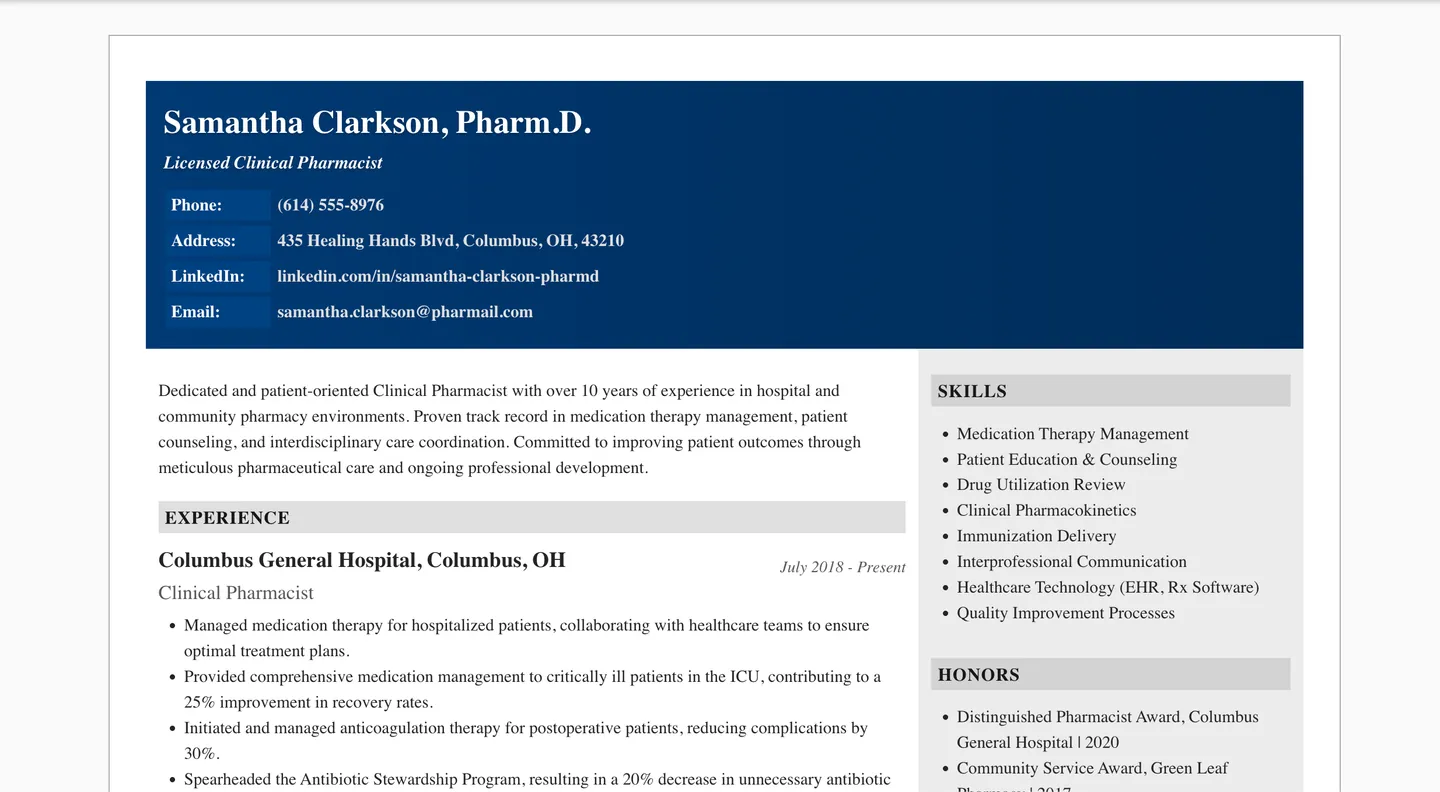
The Ultimate Retail Pharmacist Resume Example/Sample
https://www.resumonk.com/retail-pharmacistRetail PharmacistResume Format for Retail Pharmacist Resume
The reverse-chronological format stands as your strongest ally here.
Why? Because pharmacy managers and hiring directors care deeply about your most recent experience with controlled substances, insurance systems, and patient interactions. They want to see immediately whether you've been actively practicing, maintaining your continuing education credits, and staying current with the ever-changing landscape of pharmaceutical regulations.
Structure Your Retail Pharmacist Resume Sections
Start with your contact information and professional summary at the top - this isn't just about listing your PharmD; it's about immediately establishing that you're a licensed, practicing professional.
Follow this with your professional experience section, then your education, licenses and certifications, and finally your skills. This order matters because retail pharmacy hiring happens quickly - stores need coverage, and they need to know fast if you can legally and competently fill that role.
Your professional summary should be a concentrated dose of your pharmacy expertise - think of it as your professional compound. In 3-4 lines, you need to establish your licensing status, years of experience, and what makes you particularly suited for retail pharmacy versus hospital or clinical settings.
❌ Don't write a generic objective that could apply to any healthcare professional:
Seeking a challenging position in healthcare where I can utilize my education and help people
✅ Do write a targeted summary that speaks directly to retail pharmacy needs:
Licensed Pharmacist (RPh) with 5+ years in high-volume retail settings, processing 300+ prescriptions
daily while maintaining zero dispensing errors. Experienced in Medicare Part D consultation,
immunization administration (500+ vaccines delivered), and managing pharmacy technician teams of 4-6 members
Formatting Specifications for Different Regions
If you're applying in the United States, keep your resume to one page if you have less than 10 years of experience, two pages maximum for senior pharmacists.
Canadian pharmacists often include both their provincial license numbers and their NAPRA certification details prominently. UK pharmacists should reference their GPhC registration clearly, while Australian pharmacists need to highlight their AHPRA registration status upfront.
Work Experience on Retail Pharmacist Resume
The pharmacy counter is where theory meets reality - where your knowledge of drug interactions meets Mrs. Johnson who's confused about her new diabetes medication while juggling three insurance cards. Your work experience section needs to capture both the clinical expertise and the retail realities of your role.
Quantify Your Pharmacy Operations
Retail pharmacy runs on numbers - prescriptions filled, inventory managed, wait times reduced.
Every hiring manager understands these metrics because they directly impact store performance and patient satisfaction scores. When you led that inventory optimization project, don't just say you "improved inventory management." Specify that you reduced expired medication waste by 30% and saved the pharmacy $15,000 annually.
Start each bullet point with a strong action verb that reflects the dual nature of retail pharmacy work. You don't just "fill prescriptions" - you verify, compound, counsel, collaborate, optimize, and ensure.
Each of these verbs tells a different story about your capabilities.
❌ Don't write vague descriptions that undersell your impact:
• Filled prescriptions and helped customers
• Worked with insurance companies
• Managed inventory
✅ Do write specific, impact-driven accomplishments:
• Verified and dispensed average of 250 prescriptions daily while maintaining 99.8% accuracy rate
• Resolved insurance rejections for 40+ patients weekly, securing coverage for critical medications
 and saving patients average of $200/month
• Implemented perpetual inventory system that reduced stock-outs by 45% and improved cash flow by $25,000
Highlighting Patient Care in Retail Settings
Remember that retail pharmacy is healthcare's front line.
You're often the most accessible healthcare professional in your community. Your resume should reflect this unique position - you're not just processing transactions; you're providing MTM consultations, administering vaccines, and often catching potentially dangerous drug interactions that could save lives.
Include specific examples of clinical interventions within the retail environment. Did you identify a serious drug interaction that required physician consultation? Did you implement a successful medication synchronization program that improved adherence rates? These stories matter because they show you understand that retail pharmacy is about patient outcomes, not just prescription output.
Skills to Include on Retail Pharmacist Resume
Walking into a retail pharmacy requires a unique skill cocktail - one part clinical knowledge, one part technological proficiency, and a generous splash of customer service expertise. Your skills section isn't just a keyword dump; it's a carefully curated list that shows you can handle both the Pyxis machine and the angry customer whose prior authorization was denied.
Technical and System Proficiencies
Every pharmacy chain has its own ecosystem of software, but certain competencies translate universally.
List your experience with specific pharmacy management systems like RxConnect, NexGen, or Pioneer. Include your familiarity with insurance processing platforms, especially for Medicare Part D and Medicaid. Don't forget about your immunization certifications - with pharmacies becoming vaccination hubs, this skill has moved from "nice to have" to "absolutely essential."
Group your technical skills logically. Pharmacy information systems go together, clinical competencies cluster naturally, and regulatory knowledge forms its own category.
This organization helps hiring managers quickly scan for their must-haves.
❌ Don't list skills randomly without context or organization:
Skills: Customer service, Vaccines, Computer skills, Spanish, Inventory, Counseling, Insurance
✅ Do organize skills into meaningful categories:
Pharmacy Systems: RxConnect, QS/1, Pioneer RX, Micro Merchant Inventory Management
Clinical Competencies: Immunization Certified (APhA), MTM Consultations, Diabetes Education,
 Compounding (non-sterile), Drug Utilization Review
Insurance & Billing: Medicare Part D expertise, Prior Authorization processing, Medicaid,
 Express Scripts, Caremark systems
Soft Skills That Make the Difference
In retail pharmacy, your ability to explain why generic metformin is just as effective as the brand name - while a line of impatient customers grows behind your patient - that's the real skill. Include communication abilities, but be specific about the context.
"Bilingual patient counseling (Spanish/English)" carries more weight than just "communication skills."
"De-escalation and conflict resolution in high-stress situations" tells a story that every retail pharmacy manager has lived.
Don't overlook operational skills that keep the pharmacy running smoothly. Team leadership, workflow optimization, and the ability to train pharmacy technicians are crucial in retail settings where turnover can be high and efficiency directly impacts profitability.
Specific Considerations and Tips for Retail Pharmacist Resume
Here's what the generic resume guides won't tell you about retail pharmacy - you're applying to join a profession where a single error can make headlines, where you need to be equally comfortable discussing drug mechanisms of action and explaining insurance copays, and where your state board license number might be more important than your GPA ever was.
License and Certification Prominence
Unlike other healthcare roles where licensure is assumed, retail pharmacy employers need immediate confirmation of your legal ability to practice.
Create a dedicated "Licenses and Certifications" section immediately after your contact information or professional summary. Include your license numbers, states of licensure, and expiration dates. If you're licensed in multiple states or have compact licensure, this dramatically increases your value to chain pharmacies with multi-state presence.
List your immunization certifications with the certifying body and date. Include any additional certifications like diabetes education, smoking cessation counseling, or point-of-care testing. These aren't just resume padding - each represents additional revenue streams for retail pharmacies.
Addressing the Retail Reality
Retail pharmacy has unique challenges that your resume should acknowledge and address.
If you've worked Black Fridays, handled flu shot clinics that administered 200+ vaccines in a day, or managed a pharmacy during a technician shortage, these experiences matter. They show you understand the retail pharmacy environment isn't the quiet, controlled setting of a hospital pharmacy.
Include metrics that matter to retail operations. Your days' supply of inventory on hand, your pharmacy's performance on mystery shopper evaluations, or your success in converting flu shot customers to other pharmacy services - these numbers speak directly to what keeps retail pharmacy managers up at night.
❌ Don't ignore the business side of retail pharmacy:
Worked as pharmacist at CVS pharmacy providing pharmaceutical services
✅ Do acknowledge both clinical and business responsibilities:
Managed high-volume CVS pharmacy generating $4M annual revenue, increased flu shot
administration by 40% through proactive outreach program, and improved customer
satisfaction scores from 3.2 to 4.6 through enhanced consultation practices
The New Retail Pharmacy Landscape
Modern retail pharmacy has evolved beyond just dispensing medications. If you've been involved in COVID vaccine administration, point-of-care testing, or minute clinic collaborations, these experiences position you as understanding pharmacy's expanding scope.
Telepharmacy experience, even if limited, shows adaptability to emerging practice models.
Finally, remember that retail pharmacy hiring often happens through district managers who oversee multiple locations. Your resume might be reviewed by someone juggling coverage at five different stores. Make their job easier - be clear about your availability, whether you can work weekends, and if you're willing to float between locations.
These practical considerations, stated professionally in your cover letter or resume header, can fast-track your application when a manager needs someone who can start Monday at the location that just lost a pharmacist.
Education Requirements for Retail Pharmacist Resume
The journey to becoming a retail pharmacist typically involves a Doctor of Pharmacy (PharmD) degree, which takes about four years after completing prerequisite undergraduate coursework. Some of you might have the older Bachelor of Pharmacy (BPharm) degree if you've been in the field for a while.
Either way, listing your education correctly on your resume is crucial because it immediately establishes your credibility and legal eligibility to practice.
Structuring Your Pharmacy Education
When listing your pharmacy education, always start with your highest degree first - this is typically your PharmD.
Include the full name of the degree, the institution, location, and graduation date. If you graduated within the last five years, including your GPA can be beneficial, especially if it's 3.5 or higher. Remember, pharmacy school is notoriously challenging, and employers know this.
Here's how to properly format your pharmacy education:
❌ Don't write vaguely:
Pharmacy Degree - State University
Graduated 2020
✅ Do write with specificity:
Doctor of Pharmacy (PharmD)
University of California, San Francisco School of Pharmacy
San Francisco, CA | May 2020
GPA: 3.7/4.0 | Dean's List: Fall 2018, Spring 2019
Including Licensure and Certifications
Your pharmacist license is as important as your degree - without it, you can't legally dispense medications.
Create a separate section called "Licensure and Certifications" immediately after your education. List your active pharmacist license with the state(s) where you're licensed, including license numbers if the application specifically requests them.
For retail pharmacists, immunization certification has become increasingly important, especially post-2020. If you're certified to administer vaccines, this should be prominently displayed. Many retail pharmacists also obtain certifications in areas like diabetes management, medication therapy management (MTM), or specialty areas like compounding.
❌ Don't bury important certifications:
Licensed pharmacist with various certifications
✅ Do list certifications clearly:
Active Pharmacist License - California Board of Pharmacy (#RPH 12345)
Immunization Certification - American Pharmacists Association (2021)
Basic Life Support (BLS) - American Heart Association (Expires: 2025)
Handling Continuing Education
As a retail pharmacist, you're required to complete continuing education (CE) hours to maintain your license. While you shouldn't list every CE course you've taken, highlighting relevant ones that align with the job you're applying for can set you apart.
For instance, if you're applying to a pharmacy that serves a large elderly population, mentioning CE courses in geriatric pharmacy or polypharmacy management shows forward thinking.
Awards and Publications on Retail Pharmacist Resume
Let's be honest - when you think "retail pharmacist," the image of someone publishing groundbreaking research might not immediately come to mind.
You're probably more familiar with insurance prior authorizations than academic journals. But here's the thing - the retail pharmacy landscape is evolving rapidly, and many pharmacists are contributing to professional publications, winning recognition for patient care initiatives, or being acknowledged for their community health impact. These achievements can significantly distinguish you from other candidates who might have similar educational backgrounds and work experience.
Understanding What Awards Matter in Retail Pharmacy
Awards in retail pharmacy often recognize different achievements than those in clinical or research settings.
You might have received recognition for customer service excellence, achieving high immunization rates, implementing successful medication therapy management programs, or improving medication adherence metrics. These awards directly relate to the core competencies employers seek in retail pharmacists.
Perhaps you were named "Pharmacist of the Month" multiple times at your current position, or maybe you received recognition from your district manager for having the lowest inventory shrinkage. While these might seem less prestigious than academic honors, they demonstrate exactly what retail pharmacy employers want - someone who excels at both the clinical and business aspects of pharmacy practice.
❌ Don't list awards without context:
Employee of the Month - January 2023
Various pharmacy awards
✅ Do provide meaningful detail:
CVS Health Excellence in Patient Care Award - Q3 2023
Recognized for achieving 95% medication adherence rate among diabetes patients through
personalized counseling program

Walgreens Community Champion Award - 2022
Led flu vaccination drive resulting in 2,500+ immunizations, exceeding district goal by 40%
Publications and Professional Contributions
You might not have published in the New England Journal of Medicine, but many retail pharmacists contribute to pharmacy trade publications, write for pharmacy blogs, or create patient education materials. Maybe you've written an article for Drug Topics about managing difficult insurance rejections, or contributed to your state pharmacy association's newsletter about implementing point-of-care testing in community pharmacies.
If you've developed standard operating procedures (SOPs) that were adopted company-wide, or created training materials used across multiple stores, these count as professional contributions worth mentioning. These demonstrate your ability to think beyond your immediate role and contribute to the broader pharmacy practice.
Presenting Your Achievements Strategically
When including awards and publications, create a dedicated section only if you have three or more items to list. Otherwise, incorporate them into your work experience descriptions.
For recent pharmacy school graduates, academic awards like Rho Chi membership or the Patient Care Award can help compensate for limited work experience.
❌ Don't mix unrelated achievements:
High school valedictorian
Published article about pharmacy
Won bowling league trophy
✅ Do keep it professionally relevant:
PUBLICATIONS
"Implementing Medicare Part D Consultations in High-Volume Retail Settings"
Pharmacy Times, March 2023

"Improving Vaccine Hesitancy Through Pharmacist Intervention"
Journal of Community Pharmacy Practice, December 2022
Strategic Reference Selection for Retail Pharmacist Resume
After years of building relationships with pharmacy managers, fellow pharmacists, and even regular patients who've watched you grow from nervous new grad to confident practitioner, choosing the right references can feel overwhelming.
In retail pharmacy, your references carry unique weight because they can speak to both your clinical competence and your ability to thrive in a customer-facing, fast-paced environment. The pharmacy world is surprisingly small - there's a good chance your references know someone at the pharmacy where you're applying.
Choosing Your Pharmacy References Wisely
Your ideal reference list should include a mix of supervisory and peer references who can speak to different aspects of your pharmacy practice. Your current or most recent pharmacy manager is usually essential - they can verify your employment, discuss your performance metrics, and speak to your reliability during busy shifts or staff shortages.
If you're currently employed and concerned about confidentiality, a previous pharmacy manager or district manager can be equally effective.
Consider including a fellow pharmacist who has worked alongside you, especially one who has observed you handling difficult situations - maybe they watched you de-escalate an angry customer or saw you catch a dangerous drug interaction. Staff pharmacists who've covered your shifts or worked opposite shifts can provide valuable peer perspective on your work quality and professional standards.
❌ Don't list references without context:
John Smith - 555-0123
Jane Doe - 555-0456
Bob Johnson - 555-0789
✅ Do provide complete professional information:
Dr. Sarah Mitchell, PharmD
Pharmacy Manager - Walgreens #5672
Relationship: Direct Supervisor (2021-Present)
Phone: (555) 123-4567
Email: [email protected]
Beyond Traditional Pharmacy References
While pharmacy professionals should form the core of your reference list, consider including others who can speak to relevant skills. A physician whose patients you regularly serve can attest to your clinical knowledge and collaborative approach.
If you've worked with nursing home consultants or home health agencies, these professionals can discuss your ability to manage complex medication regimens and communicate across healthcare settings.
For newer graduates, preceptors from pharmacy rotations make excellent references, especially those from retail or community pharmacy rotations. They observed you during your training and can speak to your learning ability, work ethic, and potential for growth in retail pharmacy.
Managing Reference Preparation
Before listing anyone as a reference, have a conversation about your job search. Remind them of specific accomplishments they witnessed - that time you caught a serious drug interaction, implemented a new workflow system, or trained multiple pharmacy technicians.
Provide them with the job description so they can tailor their recommendation to emphasize relevant experiences.
In retail pharmacy, timing matters. Your references might be managing busy pharmacies themselves, so give them advance notice and be mindful of their schedules. Avoid listing someone who's about to go on vacation or is dealing with inventory period - they need to be available when potential employers call.
Regional Considerations for References
In the United States, references are typically provided on a separate sheet rather than on the resume itself, usually with "References available upon request" noted on your resume. However, for retail pharmacy positions, having a reference list ready to provide immediately after an interview shows preparedness.
In Canada, particularly for positions with major chains like Shoppers Drug Mart or Rexall, references from within the same pharmacy chain can carry additional weight due to familiarity with company-specific systems and protocols. UK pharmacists applying to Boots or Lloyds Pharmacy should note that references are typically contacted only after a provisional job offer, following General Pharmaceutical Council verification.
Australian retail pharmacists should be aware that many employers require at least one reference from a registered pharmacist who can verify your AHPRA registration status and practice history. Include your AHPRA registration number with your reference list to streamline verification.
❌ Don't forget to update your references:
References from 2018 pharmacy school rotation
Former colleague (haven't spoken in 2 years)
✅ Do maintain current, relevant references:
Current pharmacy manager who supervised your last performance review
Pharmacist colleague who collaborates with you on MTM services
District manager aware of your contributions to store metrics
Medical director from clinic where you provide collaborative services
Cover Letter Strategies for Retail Pharmacist Resume
You've probably filled thousands of prescriptions, but writing about yourself?
That's a different kind of challenge. The cover letter for a retail pharmacist position is your opportunity to show the person behind the PharmD - the one who calms anxious patients, navigates insurance nightmares with grace, and somehow manages to explain drug interactions while three phone lines are ringing. Unlike hospital or clinical positions where technical expertise might be the primary focus, retail pharmacy employers want to know you can handle both the scientific and service aspects of the role.
Opening with Impact
Your opening paragraph needs to immediately establish why you're writing and what makes you worth considering.
Avoid generic openings that could apply to any healthcare position. Instead, demonstrate your understanding of what retail pharmacy actually entails - the unique blend of healthcare provision, customer service, and business operations.
❌ Don't start with a generic introduction:
Dear Hiring Manager,
I am writing to apply for the Retail Pharmacist position at your pharmacy.
I have a PharmD degree and am licensed to practice pharmacy.
✅ Do open with specific enthusiasm and relevance:
Dear Ms. Johnson,
As a pharmacist who has helped launch three successful medication therapy management programs while maintaining a 98% customer satisfaction score at CVS Health, I am excited about the opportunity to bring my patient-centered approach to the Retail Pharmacist role at Rite Aid Store #4521.
Addressing the Retail Reality
The body of your cover letter should acknowledge the realities of retail pharmacy while showing you thrive in that environment. Yes, you'll be on your feet for hours. Yes, you'll deal with insurance rejections. Yes, you'll have customers who are frustrated before they even reach your counter.
But successful retail pharmacists see these as opportunities to make a difference, not obstacles to endure.
Share specific examples of how you've handled challenging retail situations. Maybe you implemented a system to reduce wait times during peak hours, or perhaps you developed relationships with local prescribers to streamline prior authorization processes. These stories show you understand the job beyond just checking prescriptions for accuracy.
Demonstrating Business Acumen
Retail pharmacy is a business, and employers want pharmacists who understand this.
Your cover letter should subtly demonstrate awareness of metrics that matter - prescription volume, inventory management, immunization goals, and customer satisfaction scores. If you've contributed to improving any of these metrics in previous positions, this is where you highlight those achievements.
For example, mentioning how you increased flu shot administration by 30% shows you understand both the health benefit and the revenue importance of immunizations. Discussing how you reduced inventory waste demonstrates fiscal responsibility alongside clinical knowledge.
❌ Don't ignore the business side:
I am passionate about helping patients and have extensive knowledge of medications.
✅ Do show business awareness:
In my current role, I've balanced clinical excellence with business objectives, increasing generic substitution rates to 89% while maintaining patient satisfaction scores above 4.8/5.0, contributing to both better patient outcomes and improved pharmacy margins.
Closing with Confidence
Your closing paragraph should reiterate your interest and prompt next steps. Include your license status and availability for different shift patterns if relevant - many retail positions require evening and weekend coverage.
Express enthusiasm for the specific company or location, showing you've researched beyond just finding a job posting.
Key Takeaways
- Use reverse-chronological format - List your most recent pharmacy experience first, as hiring managers need to quickly verify your current practice status and recent experience with pharmacy management systems
- Lead with licensure and credentials - Make your active pharmacist license (RPh or PharmD) and state registration immediately visible, along with immunization certifications that are now essential for retail practice
- Quantify your pharmacy metrics - Include specific numbers like prescriptions filled daily (e.g., 250+), accuracy rates (99.8%), immunizations administered (500+ annually), and any cost savings or efficiency improvements you've achieved
- Balance clinical and business achievements - Showcase both your patient care accomplishments (drug interaction interventions, MTM consultations) and business contributions (inventory management, customer satisfaction scores, insurance processing success rates)
- Organize skills strategically - Group your competencies into categories like Pharmacy Systems (RxConnect, QS/1), Clinical Skills (immunizations, compounding), and Insurance/Billing expertise rather than listing them randomly
- Address retail-specific realities - Include experience with high-volume periods, multi-tasking abilities, evening/weekend availability, and any experience floating between multiple locations
- Highlight relevant continuing education - While you don't need every CE course listed, include those particularly relevant to the position, such as geriatric pharmacy for stores serving elderly populations
- Keep it concise but complete - One page for less than 10 years of experience, two pages maximum for senior pharmacists, ensuring every line adds value to your candidacy
Creating a standout retail pharmacist resume doesn't have to feel like compounding a complex prescription without a formula. With Resumonk, you can build a professional retail pharmacist resume that captures both your clinical expertise and your retail pharmacy experience. Our intuitive platform offers professionally designed templates specifically suited for healthcare professionals, along with AI-powered recommendations that help you articulate your achievements in the language pharmacy managers understand. Whether you're highlighting your experience with high-volume prescription processing or showcasing your patient consultation skills, Resumonk guides you through each section, ensuring nothing important gets left in the stock bottle.
Ready to compound the perfect retail pharmacist resume?
Start building your professional resume with Resumonk today and land that retail pharmacy position you've been eyeing.
Create Your Retail Pharmacist Resume with Resumonk →
More Medical resume examples
- Pharmacist resume example
- Dentist resume example
- Optician resume example
- Physical Therapist resume example
See all Medical resume examples, or browse every category.
Resume writing tips
Let's step into this scene - you're standing behind the pharmacy counter at 7 PM on a Tuesday, the fluorescent lights humming overhead as you verify your 247th prescription of the day.
The phone is ringing with a patient asking about drug interactions, there's a line of customers waiting for flu shots, and somewhere in the back of your mind, you're thinking about that job posting you saw for the pharmacy closer to home, the one with better hours and a signing bonus. You know you're qualified - after all, you've been doing this dance of dispensing medications, counseling patients, and navigating insurance mazes for years now. But when you sit down to write your resume, suddenly all those skills that come as naturally as breathing feel impossible to capture on paper.
As a retail pharmacist, you occupy a unique space in healthcare - part clinician, part customer service expert, part business operator. You're the healthcare professional people see most frequently, often more than their own doctors. You've prevented countless drug interactions, administered thousands of vaccines, and explained the difference between brand and generic medications more times than you can count. Yet somehow, translating all of this into a resume that will catch a pharmacy manager's attention feels like trying to fit an entire formulary into a single prescription bottle.
Whether you're a recent PharmD graduate looking to land your first retail position, or you're a seasoned pharmacist ready to move from that 24-hour location to something with more reasonable hours, this guide will walk you through creating a retail pharmacist resume that speaks directly to what hiring managers need to see. We'll start with understanding the optimal resume format - the reverse-chronological structure that immediately showcases your most recent experience with controlled substances and pharmacy management systems. Then we'll dive deep into crafting compelling work experience descriptions that go beyond "filled prescriptions" to showcase your real impact on patient outcomes and pharmacy operations.
We'll explore how to present your essential credentials - from your PharmD and state licensure to those increasingly important immunization certifications. You'll learn to articulate both the clinical skills that keep patients safe and the soft skills that keep them coming back. We'll tackle those specific considerations unique to retail pharmacy, like highlighting your availability for evening shifts or your experience with high-volume flu clinics. Throughout, we'll provide specific examples tailored to different situations - whether you're applying to a major chain like CVS or Walgreens, transitioning from hospital pharmacy, or returning to practice after a break.
By the time you finish reading this guide, you'll have everything you need to create a retail pharmacist resume that captures both your clinical expertise and your ability to thrive in the fast-paced, customer-facing world of retail pharmacy. A resume that makes pharmacy managers think, "Yes, this is exactly the pharmacist who can handle our Monday morning rush while maintaining perfect accuracy." Let's transform your pharmacy experience into a document that opens doors to your next opportunity.
The Ultimate Retail Pharmacist Resume Example/Sample
https://www.resumonk.com/retail-pharmacistRetail PharmacistResume Format for Retail Pharmacist Resume
The reverse-chronological format stands as your strongest ally here.
Why? Because pharmacy managers and hiring directors care deeply about your most recent experience with controlled substances, insurance systems, and patient interactions. They want to see immediately whether you've been actively practicing, maintaining your continuing education credits, and staying current with the ever-changing landscape of pharmaceutical regulations.
Structure Your Retail Pharmacist Resume Sections
Start with your contact information and professional summary at the top - this isn't just about listing your PharmD; it's about immediately establishing that you're a licensed, practicing professional.
Follow this with your professional experience section, then your education, licenses and certifications, and finally your skills. This order matters because retail pharmacy hiring happens quickly - stores need coverage, and they need to know fast if you can legally and competently fill that role.
Your professional summary should be a concentrated dose of your pharmacy expertise - think of it as your professional compound. In 3-4 lines, you need to establish your licensing status, years of experience, and what makes you particularly suited for retail pharmacy versus hospital or clinical settings.
❌ Don't write a generic objective that could apply to any healthcare professional:
Seeking a challenging position in healthcare where I can utilize my education and help people
✅ Do write a targeted summary that speaks directly to retail pharmacy needs:
Licensed Pharmacist (RPh) with 5+ years in high-volume retail settings, processing 300+ prescriptions
daily while maintaining zero dispensing errors. Experienced in Medicare Part D consultation,
immunization administration (500+ vaccines delivered), and managing pharmacy technician teams of 4-6 members
Formatting Specifications for Different Regions
If you're applying in the United States, keep your resume to one page if you have less than 10 years of experience, two pages maximum for senior pharmacists.
Canadian pharmacists often include both their provincial license numbers and their NAPRA certification details prominently. UK pharmacists should reference their GPhC registration clearly, while Australian pharmacists need to highlight their AHPRA registration status upfront.
Work Experience on Retail Pharmacist Resume
The pharmacy counter is where theory meets reality - where your knowledge of drug interactions meets Mrs. Johnson who's confused about her new diabetes medication while juggling three insurance cards. Your work experience section needs to capture both the clinical expertise and the retail realities of your role.
Quantify Your Pharmacy Operations
Retail pharmacy runs on numbers - prescriptions filled, inventory managed, wait times reduced.
Every hiring manager understands these metrics because they directly impact store performance and patient satisfaction scores. When you led that inventory optimization project, don't just say you "improved inventory management." Specify that you reduced expired medication waste by 30% and saved the pharmacy $15,000 annually.
Start each bullet point with a strong action verb that reflects the dual nature of retail pharmacy work. You don't just "fill prescriptions" - you verify, compound, counsel, collaborate, optimize, and ensure.
Each of these verbs tells a different story about your capabilities.
❌ Don't write vague descriptions that undersell your impact:
• Filled prescriptions and helped customers
• Worked with insurance companies
• Managed inventory
✅ Do write specific, impact-driven accomplishments:
• Verified and dispensed average of 250 prescriptions daily while maintaining 99.8% accuracy rate
• Resolved insurance rejections for 40+ patients weekly, securing coverage for critical medications
 and saving patients average of $200/month
• Implemented perpetual inventory system that reduced stock-outs by 45% and improved cash flow by $25,000
Highlighting Patient Care in Retail Settings
Remember that retail pharmacy is healthcare's front line.
You're often the most accessible healthcare professional in your community. Your resume should reflect this unique position - you're not just processing transactions; you're providing MTM consultations, administering vaccines, and often catching potentially dangerous drug interactions that could save lives.
Include specific examples of clinical interventions within the retail environment. Did you identify a serious drug interaction that required physician consultation? Did you implement a successful medication synchronization program that improved adherence rates? These stories matter because they show you understand that retail pharmacy is about patient outcomes, not just prescription output.
Skills to Include on Retail Pharmacist Resume
Walking into a retail pharmacy requires a unique skill cocktail - one part clinical knowledge, one part technological proficiency, and a generous splash of customer service expertise. Your skills section isn't just a keyword dump; it's a carefully curated list that shows you can handle both the Pyxis machine and the angry customer whose prior authorization was denied.
Technical and System Proficiencies
Every pharmacy chain has its own ecosystem of software, but certain competencies translate universally.
List your experience with specific pharmacy management systems like RxConnect, NexGen, or Pioneer. Include your familiarity with insurance processing platforms, especially for Medicare Part D and Medicaid. Don't forget about your immunization certifications - with pharmacies becoming vaccination hubs, this skill has moved from "nice to have" to "absolutely essential."
Group your technical skills logically. Pharmacy information systems go together, clinical competencies cluster naturally, and regulatory knowledge forms its own category.
This organization helps hiring managers quickly scan for their must-haves.
❌ Don't list skills randomly without context or organization:
Skills: Customer service, Vaccines, Computer skills, Spanish, Inventory, Counseling, Insurance
✅ Do organize skills into meaningful categories:
Pharmacy Systems: RxConnect, QS/1, Pioneer RX, Micro Merchant Inventory Management
Clinical Competencies: Immunization Certified (APhA), MTM Consultations, Diabetes Education,
 Compounding (non-sterile), Drug Utilization Review
Insurance & Billing: Medicare Part D expertise, Prior Authorization processing, Medicaid,
 Express Scripts, Caremark systems
Soft Skills That Make the Difference
In retail pharmacy, your ability to explain why generic metformin is just as effective as the brand name - while a line of impatient customers grows behind your patient - that's the real skill. Include communication abilities, but be specific about the context.
"Bilingual patient counseling (Spanish/English)" carries more weight than just "communication skills."
"De-escalation and conflict resolution in high-stress situations" tells a story that every retail pharmacy manager has lived.
Don't overlook operational skills that keep the pharmacy running smoothly. Team leadership, workflow optimization, and the ability to train pharmacy technicians are crucial in retail settings where turnover can be high and efficiency directly impacts profitability.
Specific Considerations and Tips for Retail Pharmacist Resume
Here's what the generic resume guides won't tell you about retail pharmacy - you're applying to join a profession where a single error can make headlines, where you need to be equally comfortable discussing drug mechanisms of action and explaining insurance copays, and where your state board license number might be more important than your GPA ever was.
License and Certification Prominence
Unlike other healthcare roles where licensure is assumed, retail pharmacy employers need immediate confirmation of your legal ability to practice.
Create a dedicated "Licenses and Certifications" section immediately after your contact information or professional summary. Include your license numbers, states of licensure, and expiration dates. If you're licensed in multiple states or have compact licensure, this dramatically increases your value to chain pharmacies with multi-state presence.
List your immunization certifications with the certifying body and date. Include any additional certifications like diabetes education, smoking cessation counseling, or point-of-care testing. These aren't just resume padding - each represents additional revenue streams for retail pharmacies.
Addressing the Retail Reality
Retail pharmacy has unique challenges that your resume should acknowledge and address.
If you've worked Black Fridays, handled flu shot clinics that administered 200+ vaccines in a day, or managed a pharmacy during a technician shortage, these experiences matter. They show you understand the retail pharmacy environment isn't the quiet, controlled setting of a hospital pharmacy.
Include metrics that matter to retail operations. Your days' supply of inventory on hand, your pharmacy's performance on mystery shopper evaluations, or your success in converting flu shot customers to other pharmacy services - these numbers speak directly to what keeps retail pharmacy managers up at night.
❌ Don't ignore the business side of retail pharmacy:
Worked as pharmacist at CVS pharmacy providing pharmaceutical services
✅ Do acknowledge both clinical and business responsibilities:
Managed high-volume CVS pharmacy generating $4M annual revenue, increased flu shot
administration by 40% through proactive outreach program, and improved customer
satisfaction scores from 3.2 to 4.6 through enhanced consultation practices
The New Retail Pharmacy Landscape
Modern retail pharmacy has evolved beyond just dispensing medications. If you've been involved in COVID vaccine administration, point-of-care testing, or minute clinic collaborations, these experiences position you as understanding pharmacy's expanding scope.
Telepharmacy experience, even if limited, shows adaptability to emerging practice models.
Finally, remember that retail pharmacy hiring often happens through district managers who oversee multiple locations. Your resume might be reviewed by someone juggling coverage at five different stores. Make their job easier - be clear about your availability, whether you can work weekends, and if you're willing to float between locations.
These practical considerations, stated professionally in your cover letter or resume header, can fast-track your application when a manager needs someone who can start Monday at the location that just lost a pharmacist.
Education Requirements for Retail Pharmacist Resume
The journey to becoming a retail pharmacist typically involves a Doctor of Pharmacy (PharmD) degree, which takes about four years after completing prerequisite undergraduate coursework. Some of you might have the older Bachelor of Pharmacy (BPharm) degree if you've been in the field for a while.
Either way, listing your education correctly on your resume is crucial because it immediately establishes your credibility and legal eligibility to practice.
Structuring Your Pharmacy Education
When listing your pharmacy education, always start with your highest degree first - this is typically your PharmD.
Include the full name of the degree, the institution, location, and graduation date. If you graduated within the last five years, including your GPA can be beneficial, especially if it's 3.5 or higher. Remember, pharmacy school is notoriously challenging, and employers know this.
Here's how to properly format your pharmacy education:
❌ Don't write vaguely:
Pharmacy Degree - State University
Graduated 2020
✅ Do write with specificity:
Doctor of Pharmacy (PharmD)
University of California, San Francisco School of Pharmacy
San Francisco, CA | May 2020
GPA: 3.7/4.0 | Dean's List: Fall 2018, Spring 2019
Including Licensure and Certifications
Your pharmacist license is as important as your degree - without it, you can't legally dispense medications.
Create a separate section called "Licensure and Certifications" immediately after your education. List your active pharmacist license with the state(s) where you're licensed, including license numbers if the application specifically requests them.
For retail pharmacists, immunization certification has become increasingly important, especially post-2020. If you're certified to administer vaccines, this should be prominently displayed. Many retail pharmacists also obtain certifications in areas like diabetes management, medication therapy management (MTM), or specialty areas like compounding.
❌ Don't bury important certifications:
Licensed pharmacist with various certifications
✅ Do list certifications clearly:
Active Pharmacist License - California Board of Pharmacy (#RPH 12345)
Immunization Certification - American Pharmacists Association (2021)
Basic Life Support (BLS) - American Heart Association (Expires: 2025)
Handling Continuing Education
As a retail pharmacist, you're required to complete continuing education (CE) hours to maintain your license. While you shouldn't list every CE course you've taken, highlighting relevant ones that align with the job you're applying for can set you apart.
For instance, if you're applying to a pharmacy that serves a large elderly population, mentioning CE courses in geriatric pharmacy or polypharmacy management shows forward thinking.
Awards and Publications on Retail Pharmacist Resume
Let's be honest - when you think "retail pharmacist," the image of someone publishing groundbreaking research might not immediately come to mind.
You're probably more familiar with insurance prior authorizations than academic journals. But here's the thing - the retail pharmacy landscape is evolving rapidly, and many pharmacists are contributing to professional publications, winning recognition for patient care initiatives, or being acknowledged for their community health impact. These achievements can significantly distinguish you from other candidates who might have similar educational backgrounds and work experience.
Understanding What Awards Matter in Retail Pharmacy
Awards in retail pharmacy often recognize different achievements than those in clinical or research settings.
You might have received recognition for customer service excellence, achieving high immunization rates, implementing successful medication therapy management programs, or improving medication adherence metrics. These awards directly relate to the core competencies employers seek in retail pharmacists.
Perhaps you were named "Pharmacist of the Month" multiple times at your current position, or maybe you received recognition from your district manager for having the lowest inventory shrinkage. While these might seem less prestigious than academic honors, they demonstrate exactly what retail pharmacy employers want - someone who excels at both the clinical and business aspects of pharmacy practice.
❌ Don't list awards without context:
Employee of the Month - January 2023
Various pharmacy awards
✅ Do provide meaningful detail:
CVS Health Excellence in Patient Care Award - Q3 2023
Recognized for achieving 95% medication adherence rate among diabetes patients through
personalized counseling program

Walgreens Community Champion Award - 2022
Led flu vaccination drive resulting in 2,500+ immunizations, exceeding district goal by 40%
Publications and Professional Contributions
You might not have published in the New England Journal of Medicine, but many retail pharmacists contribute to pharmacy trade publications, write for pharmacy blogs, or create patient education materials. Maybe you've written an article for Drug Topics about managing difficult insurance rejections, or contributed to your state pharmacy association's newsletter about implementing point-of-care testing in community pharmacies.
If you've developed standard operating procedures (SOPs) that were adopted company-wide, or created training materials used across multiple stores, these count as professional contributions worth mentioning. These demonstrate your ability to think beyond your immediate role and contribute to the broader pharmacy practice.
Presenting Your Achievements Strategically
When including awards and publications, create a dedicated section only if you have three or more items to list. Otherwise, incorporate them into your work experience descriptions.
For recent pharmacy school graduates, academic awards like Rho Chi membership or the Patient Care Award can help compensate for limited work experience.
❌ Don't mix unrelated achievements:
High school valedictorian
Published article about pharmacy
Won bowling league trophy
✅ Do keep it professionally relevant:
PUBLICATIONS
"Implementing Medicare Part D Consultations in High-Volume Retail Settings"
Pharmacy Times, March 2023

"Improving Vaccine Hesitancy Through Pharmacist Intervention"
Journal of Community Pharmacy Practice, December 2022
Strategic Reference Selection for Retail Pharmacist Resume
After years of building relationships with pharmacy managers, fellow pharmacists, and even regular patients who've watched you grow from nervous new grad to confident practitioner, choosing the right references can feel overwhelming.
In retail pharmacy, your references carry unique weight because they can speak to both your clinical competence and your ability to thrive in a customer-facing, fast-paced environment. The pharmacy world is surprisingly small - there's a good chance your references know someone at the pharmacy where you're applying.
Choosing Your Pharmacy References Wisely
Your ideal reference list should include a mix of supervisory and peer references who can speak to different aspects of your pharmacy practice. Your current or most recent pharmacy manager is usually essential - they can verify your employment, discuss your performance metrics, and speak to your reliability during busy shifts or staff shortages.
If you're currently employed and concerned about confidentiality, a previous pharmacy manager or district manager can be equally effective.
Consider including a fellow pharmacist who has worked alongside you, especially one who has observed you handling difficult situations - maybe they watched you de-escalate an angry customer or saw you catch a dangerous drug interaction. Staff pharmacists who've covered your shifts or worked opposite shifts can provide valuable peer perspective on your work quality and professional standards.
❌ Don't list references without context:
John Smith - 555-0123
Jane Doe - 555-0456
Bob Johnson - 555-0789
✅ Do provide complete professional information:
Dr. Sarah Mitchell, PharmD
Pharmacy Manager - Walgreens #5672
Relationship: Direct Supervisor (2021-Present)
Phone: (555) 123-4567
Email: [email protected]
Beyond Traditional Pharmacy References
While pharmacy professionals should form the core of your reference list, consider including others who can speak to relevant skills. A physician whose patients you regularly serve can attest to your clinical knowledge and collaborative approach.
If you've worked with nursing home consultants or home health agencies, these professionals can discuss your ability to manage complex medication regimens and communicate across healthcare settings.
For newer graduates, preceptors from pharmacy rotations make excellent references, especially those from retail or community pharmacy rotations. They observed you during your training and can speak to your learning ability, work ethic, and potential for growth in retail pharmacy.
Managing Reference Preparation
Before listing anyone as a reference, have a conversation about your job search. Remind them of specific accomplishments they witnessed - that time you caught a serious drug interaction, implemented a new workflow system, or trained multiple pharmacy technicians.
Provide them with the job description so they can tailor their recommendation to emphasize relevant experiences.
In retail pharmacy, timing matters. Your references might be managing busy pharmacies themselves, so give them advance notice and be mindful of their schedules. Avoid listing someone who's about to go on vacation or is dealing with inventory period - they need to be available when potential employers call.
Regional Considerations for References
In the United States, references are typically provided on a separate sheet rather than on the resume itself, usually with "References available upon request" noted on your resume. However, for retail pharmacy positions, having a reference list ready to provide immediately after an interview shows preparedness.
In Canada, particularly for positions with major chains like Shoppers Drug Mart or Rexall, references from within the same pharmacy chain can carry additional weight due to familiarity with company-specific systems and protocols. UK pharmacists applying to Boots or Lloyds Pharmacy should note that references are typically contacted only after a provisional job offer, following General Pharmaceutical Council verification.
Australian retail pharmacists should be aware that many employers require at least one reference from a registered pharmacist who can verify your AHPRA registration status and practice history. Include your AHPRA registration number with your reference list to streamline verification.
❌ Don't forget to update your references:
References from 2018 pharmacy school rotation
Former colleague (haven't spoken in 2 years)
✅ Do maintain current, relevant references:
Current pharmacy manager who supervised your last performance review
Pharmacist colleague who collaborates with you on MTM services
District manager aware of your contributions to store metrics
Medical director from clinic where you provide collaborative services
Cover Letter Strategies for Retail Pharmacist Resume
You've probably filled thousands of prescriptions, but writing about yourself?
That's a different kind of challenge. The cover letter for a retail pharmacist position is your opportunity to show the person behind the PharmD - the one who calms anxious patients, navigates insurance nightmares with grace, and somehow manages to explain drug interactions while three phone lines are ringing. Unlike hospital or clinical positions where technical expertise might be the primary focus, retail pharmacy employers want to know you can handle both the scientific and service aspects of the role.
Opening with Impact
Your opening paragraph needs to immediately establish why you're writing and what makes you worth considering.
Avoid generic openings that could apply to any healthcare position. Instead, demonstrate your understanding of what retail pharmacy actually entails - the unique blend of healthcare provision, customer service, and business operations.
❌ Don't start with a generic introduction:
Dear Hiring Manager,
I am writing to apply for the Retail Pharmacist position at your pharmacy.
I have a PharmD degree and am licensed to practice pharmacy.
✅ Do open with specific enthusiasm and relevance:
Dear Ms. Johnson,
As a pharmacist who has helped launch three successful medication therapy management programs while maintaining a 98% customer satisfaction score at CVS Health, I am excited about the opportunity to bring my patient-centered approach to the Retail Pharmacist role at Rite Aid Store #4521.
Addressing the Retail Reality
The body of your cover letter should acknowledge the realities of retail pharmacy while showing you thrive in that environment. Yes, you'll be on your feet for hours. Yes, you'll deal with insurance rejections. Yes, you'll have customers who are frustrated before they even reach your counter.
But successful retail pharmacists see these as opportunities to make a difference, not obstacles to endure.
Share specific examples of how you've handled challenging retail situations. Maybe you implemented a system to reduce wait times during peak hours, or perhaps you developed relationships with local prescribers to streamline prior authorization processes. These stories show you understand the job beyond just checking prescriptions for accuracy.
Demonstrating Business Acumen
Retail pharmacy is a business, and employers want pharmacists who understand this.
Your cover letter should subtly demonstrate awareness of metrics that matter - prescription volume, inventory management, immunization goals, and customer satisfaction scores. If you've contributed to improving any of these metrics in previous positions, this is where you highlight those achievements.
For example, mentioning how you increased flu shot administration by 30% shows you understand both the health benefit and the revenue importance of immunizations. Discussing how you reduced inventory waste demonstrates fiscal responsibility alongside clinical knowledge.
❌ Don't ignore the business side:
I am passionate about helping patients and have extensive knowledge of medications.
✅ Do show business awareness:
In my current role, I've balanced clinical excellence with business objectives, increasing generic substitution rates to 89% while maintaining patient satisfaction scores above 4.8/5.0, contributing to both better patient outcomes and improved pharmacy margins.
Closing with Confidence
Your closing paragraph should reiterate your interest and prompt next steps. Include your license status and availability for different shift patterns if relevant - many retail positions require evening and weekend coverage.
Express enthusiasm for the specific company or location, showing you've researched beyond just finding a job posting.
Key Takeaways
- Use reverse-chronological format - List your most recent pharmacy experience first, as hiring managers need to quickly verify your current practice status and recent experience with pharmacy management systems
- Lead with licensure and credentials - Make your active pharmacist license (RPh or PharmD) and state registration immediately visible, along with immunization certifications that are now essential for retail practice
- Quantify your pharmacy metrics - Include specific numbers like prescriptions filled daily (e.g., 250+), accuracy rates (99.8%), immunizations administered (500+ annually), and any cost savings or efficiency improvements you've achieved
- Balance clinical and business achievements - Showcase both your patient care accomplishments (drug interaction interventions, MTM consultations) and business contributions (inventory management, customer satisfaction scores, insurance processing success rates)
- Organize skills strategically - Group your competencies into categories like Pharmacy Systems (RxConnect, QS/1), Clinical Skills (immunizations, compounding), and Insurance/Billing expertise rather than listing them randomly
- Address retail-specific realities - Include experience with high-volume periods, multi-tasking abilities, evening/weekend availability, and any experience floating between multiple locations
- Highlight relevant continuing education - While you don't need every CE course listed, include those particularly relevant to the position, such as geriatric pharmacy for stores serving elderly populations
- Keep it concise but complete - One page for less than 10 years of experience, two pages maximum for senior pharmacists, ensuring every line adds value to your candidacy
Creating a standout retail pharmacist resume doesn't have to feel like compounding a complex prescription without a formula. With Resumonk, you can build a professional retail pharmacist resume that captures both your clinical expertise and your retail pharmacy experience. Our intuitive platform offers professionally designed templates specifically suited for healthcare professionals, along with AI-powered recommendations that help you articulate your achievements in the language pharmacy managers understand. Whether you're highlighting your experience with high-volume prescription processing or showcasing your patient consultation skills, Resumonk guides you through each section, ensuring nothing important gets left in the stock bottle.
Ready to compound the perfect retail pharmacist resume?
Start building your professional resume with Resumonk today and land that retail pharmacy position you've been eyeing.
Create Your Retail Pharmacist Resume with Resumonk →
More Medical resume examples
- Pharmacist resume example
- Dentist resume example
- Optician resume example
- Physical Therapist resume example
See all Medical resume examples, or browse every category.
Resume writing tips