Quality Engineer Resume Example, Guide and Tips
Introduction
You're staring at a job posting for a Quality Engineer position, and something about it feels right.
Maybe it's the step up from your current Quality Technician role, where you've been doing the inspection work but know you're ready for the root cause analysis, the process improvement projects, the cross-functional problem-solving that Quality Engineers actually drive. Or maybe you've been in manufacturing engineering or another technical role, and you've realized that the quality challenges are what get you out of bed in the morning. That moment when you trace a defect back to its source, when you see a process stabilize after implementing your corrective action, when an audit goes smoothly because the systems you helped build actually work. That's the work that matters to you, and now you need a resume that convincingly tells that story.
Here's the thing about Quality Engineer resumes that most people get wrong. They read like job descriptions instead of achievement records. They list responsibilities instead of demonstrating impact. They say "performed quality inspections" when they should say "redesigned incoming inspection process using risk-based sampling, reducing inspection time by 40% while improving defect detection rates by 23%." The difference matters enormously, because Quality Engineer is not an entry-level role. You're past the "follow the checklist" stage. Hiring managers are looking for someone who can design the checklist, who understands why ISO 9001 requires certain documentation, who can explain to a frustrated production supervisor why that dimension really does need to be inspected even though it's slowing down the line. Your resume needs to prove you're that person.
This guide will walk you through exactly how to build a Quality Engineer resume that works. We'll start with the foundational decision of resume format and why the reverse-chronological approach serves Quality Engineers better than alternatives. Then we'll dig deep into your work experience section, because that's where Quality Engineer resumes succeed or fail. You'll learn how to write bullet points that demonstrate your technical competency with quality methodologies while also showing the business impact of your work. We'll cover which skills to emphasize and how to organize them so they resonate with both the hiring manager who understands Six Sigma and the HR person who's screening for keywords. You'll get specific guidance on presenting your education and certifications strategically, understanding that your ASQ Certified Quality Engineer credential might matter more than your GPA at this point in your career.
We'll also address the nuanced situations that make Quality Engineer resumes tricky. Maybe you're transitioning from a different engineering discipline and need to highlight your quality-adjacent experience without overstating it. Perhaps you're in a niche industry like aerospace or medical devices and need to demonstrate your understanding of AS9100 or FDA regulations. Or maybe you've been a Quality Engineer for several years but your resume still looks like it did when you were a Quality Technician, and you're not sure how to show that progression. We'll cover how to handle these scenarios, along with practical advice on cover letters, references, and awards that actually strengthen a Quality Engineer application. By the end, you'll have a clear roadmap for creating a resume that positions you as the systematic, results-driven Quality Engineer that organizations need.
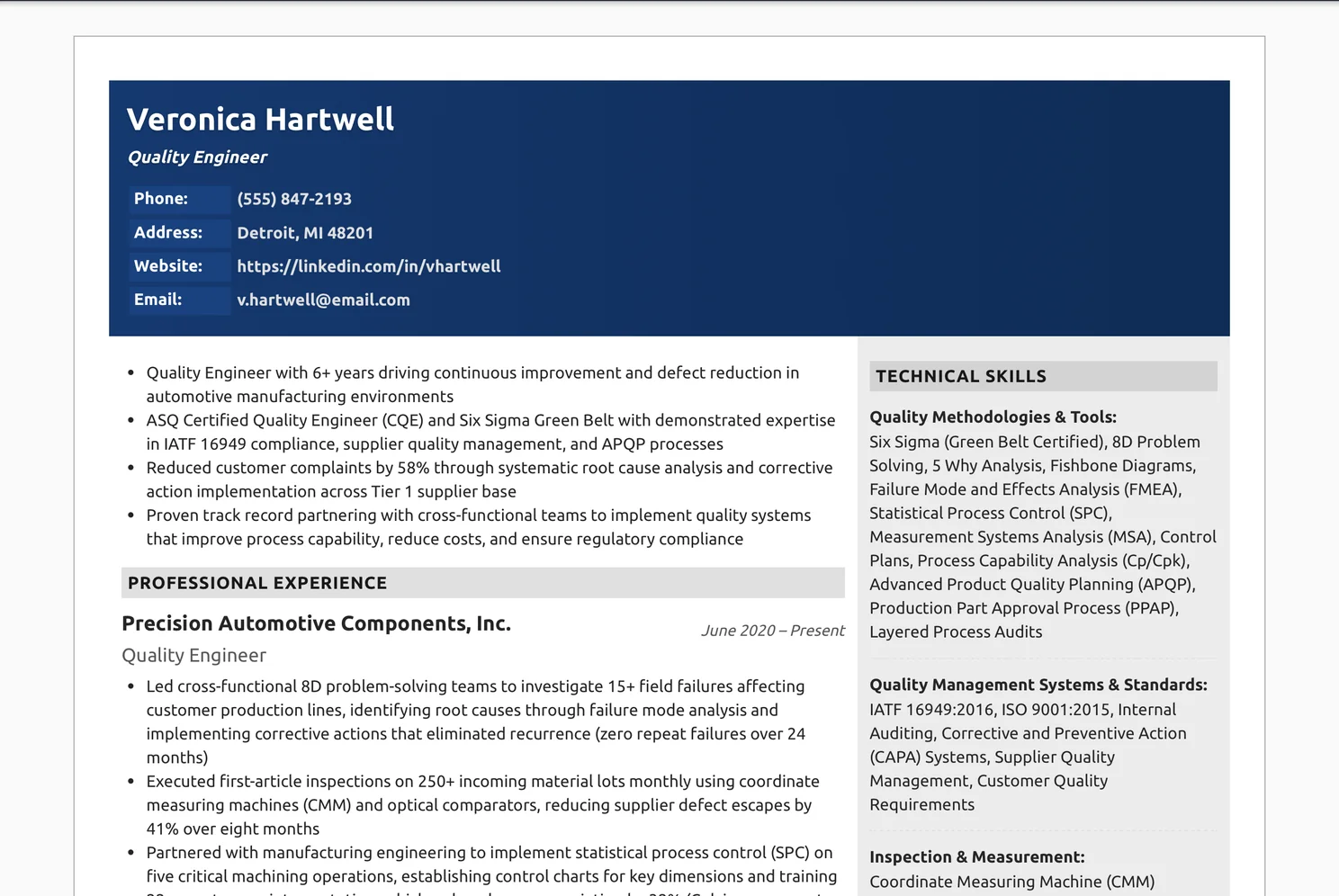
The Ultimate Quality Engineer Resume Example/Sample
https://www.resumonk.com/quality-engineerQuality EngineerResume Format for Your Quality Engineer Resume
When you're standing at the threshold of a Quality Engineering career, the format of your resume isn't merely about aesthetics. It's about presenting your professional story in a way that immediately signals to hiring managers that you understand the systematic, detail-oriented nature of quality work itself. Think about it: you're applying for a role where documentation standards, traceability, and methodical processes are everything.
Your resume format should reflect that same precision.
Why Reverse-Chronological Format Works Best for Quality Engineers
The reverse-chronological format is your strongest ally here.
This format lists your most recent experience first and works backward through your career history. For Quality Engineers, this matters enormously because quality methodologies, compliance standards, and industry regulations evolve constantly. A hiring manager reviewing your resume needs to see immediately that your most recent experience aligns with current quality frameworks like ISO 9001:2015, Six Sigma methodologies, or industry-specific standards such as AS9100 for aerospace or ISO 13485 for medical devices.
If you're transitioning into Quality Engineering from a related field like manufacturing engineering, mechanical engineering, or laboratory work, the reverse-chronological format helps you demonstrate progression. It shows how you've gradually taken on more quality-related responsibilities, even if your previous job titles didn't explicitly include "quality" in them. Perhaps you started as a Manufacturing Engineer where you occasionally participated in root cause analysis, then moved into a role with more inspection and validation responsibilities.
That trajectory tells a compelling story when arranged chronologically.
When Alternative Formats Might Apply
There are limited scenarios where you might consider a combination format (also called a hybrid format). If you're a recent graduate with a degree in Quality Engineering, Industrial Engineering, or a related field, but your internship experience is thin, a combination format allows you to lead with a robust skills section showcasing your technical competencies before diving into your limited work history. However, even here, be cautious.
Quality Engineering hiring managers tend to be traditional in their preferences, mirroring the structured nature of the profession itself.
Functional formats, which organize information by skill categories rather than chronology, are generally inadvisable for Quality Engineers. Quality work is inherently about traceability and establishing clear chains of evidence. A functional resume obscures your career timeline, which can raise red flags for hiring managers who need to verify that your experience with specific quality systems or industries is current and relevant.
Structural Elements Your Quality Engineer Resume Must Include
Your resume should open with a header containing your contact information, followed immediately by a professional summary or objective statement (more on this in later sections). Then comes your work experience section, which will be your most substantial component, followed by education, certifications, technical skills, and any additional relevant sections like professional affiliations or notable projects.
Keep your resume to one or two pages depending on your experience level. If you have under seven years of experience, a single page is appropriate and demonstrates your ability to distill information effectively.
Beyond that threshold, two pages allows you adequate space to detail your quality initiatives, process improvements, and compliance achievements without sacrificing the specificity that makes your experience credible.
Crafting Compelling Work Experience on Your Quality Engineer Resume
Here's where most Quality Engineer resumes either soar or stumble.
Your work experience section isn't a job description regurgitation. It's not a place to list that you "performed quality inspections" or "maintained quality documentation." Every Quality Engineer does those things. What separates a compelling work experience section from a forgettable one is specificity, quantification, and demonstration of impact.
Understanding What Hiring Managers Actually Want to See
Put yourself in the shoes of the person reading your resume. They're likely a Quality Manager, Engineering Manager, or someone from HR with a detailed job description checklist. They're asking themselves: Can this person reduce our defect rates? Will they help us pass our next ISO audit? Do they understand statistical process control well enough to identify trends before they become problems? Can they work with production teams without creating bottlenecks?
Your work experience bullets need to answer these questions preemptively.
The Anatomy of an Effective Quality Engineer Bullet Point
Each bullet point in your work experience should follow a general structure: action verb + specific quality activity + methodology or tool used + quantifiable result or business impact. Let's break this down with examples that illustrate the difference between weak and strong approaches.
❌ Don't write generic, responsibility-focused bullets:
Responsible for conducting quality inspections on incoming materials
Maintained calibration records for measurement equipment
Participated in root cause analysis activities
✅ Do write specific, achievement-focused bullets with context:
- Executed first-article inspections on 200+ incoming material lots monthly using coordinate measuring machines (CMM) and optical comparators, reducing supplier defect escapes by 34% over six months
- Redesigned calibration tracking system using Microsoft Access database, ensuring 100% compliance during ISO 9001:2015 surveillance audit and reducing calibration lapses from 12 to 0 annually
- Led cross-functional 8D problem-solving team to investigate field failure affecting 500 units, identifying root cause through failure mode analysis and implementing corrective action that eliminated recurrence (0 failures in subsequent 18 months)
Showcasing Different Types of Quality Engineering Work
Quality Engineering encompasses diverse responsibilities depending on your industry and company size. Some Quality Engineers focus heavily on supplier quality, conducting audits and managing corrective action requests with vendors. Others concentrate on in-process quality, working on the manufacturing floor with production teams. Still others emphasize validation and verification activities, particularly in regulated industries.
Your work experience section should clearly communicate where your expertise lies.
If you've worked in supplier quality, highlight specific examples like this:
Conducted on-site supplier audits for five critical vendors across three states, identifying 23 non-conformances and collaborating with suppliers to implement corrective actions, resulting in 40% improvement in incoming quality metrics (from 94% to 96.8% acceptance rate)
If your strength is process quality and working with production teams:
Partnered with manufacturing engineering to implement statistical process control (SPC) on three critical machining operations, establishing control charts for key dimensions and training 15 operators on interpretation, which reduced process variation by 28% (Cpk improvement from 1.12 to 1.67)
For those in validation-heavy environments like medical devices or pharmaceuticals:
Authored and executed 12 Installation Qualification (IQ), Operational Qualification (OQ), and Performance Qualification (PQ) protocols for new manufacturing equipment, ensuring FDA compliance and supporting successful pre-approval inspection with zero observations
Addressing Experience Gaps and Career Transitions
Perhaps you're transitioning from a quality technician role into a Quality Engineer position, or you're moving from another engineering discipline into quality.
Your work experience section needs to bridge that gap by emphasizing transferable quality-related activities. If you were a Manufacturing Engineer who occasionally participated in failure analysis, dedicate bullets to those quality-adjacent experiences. If you were a Quality Technician who took initiative beyond your prescribed duties (perhaps you suggested a process improvement or volunteered to help with an audit), those activities deserve prominence.
For career changers, consider adding a brief contextual phrase to your bullets:
While supporting production operations as Manufacturing Engineer, identified recurring weld defect pattern and initiated Fishbone analysis with quality team, leading to equipment modification that reduced weld rejects by 22%
Industry-Specific Considerations for Work Experience
Different industries have different quality languages and priorities.
Automotive quality professionals should reference IATF 16949, PPAP (Production Part Approval Process), and APQP (Advanced Product Quality Planning). Aerospace Quality Engineers need to mention AS9100, First Article Inspection Reports (FAIR), and familiarity with Nadcap requirements if applicable. Medical device quality professionals should highlight Design Controls, Design History Files, and 21 CFR Part 820 compliance. Tailor your work experience descriptions to speak the language of your target industry.
Essential Skills to Showcase on Your Quality Engineer Resume
The skills section of your Quality Engineer resume operates as both a technical showcase and a keyword repository that helps your resume resonate with hiring managers quickly scanning for qualifications. But here's the nuance: Quality Engineering skills fall into several distinct categories, and how you present them matters as much as which ones you list.
Technical Quality Skills That Demonstrate Competency
Start with your quality-specific technical skills.
These are the methodologies, tools, and frameworks that define Quality Engineering work. Your proficiency with statistical analysis techniques, problem-solving methodologies, and quality management systems should be immediately apparent. However, listing these skills without context creates a credibility problem. Anyone can claim they know Six Sigma or root cause analysis. The power comes from demonstrating these skills within your work experience section while also listing them in your skills section for quick reference.
Consider organizing your skills section with subcategories. For instance:
Quality Methodologies & Tools:
Six Sigma (Green Belt Certified), 8D Problem Solving, 5 Why Analysis, Fishbone Diagrams, Failure Mode and Effects Analysis (FMEA), Statistical Process Control (SPC), Measurement Systems Analysis (MSA), Control Plans, Process Capability Analysis (Cp/Cpk)
Quality Management Systems & Standards:
ISO 9001:2015, IATF 16949 (if automotive), AS9100 Rev D (if aerospace), ISO 13485 (if medical device), Internal Auditing, Corrective and Preventive Action (CAPA) Systems
Inspection & Measurement:
Coordinate Measuring Machine (CMM) Programming and Operation, Geometric Dimensioning and Tolerancing (GD&T) Interpretation, Optical Comparators, Micrometers, Calipers, Surface Roughness Testing, Non-Destructive Testing (NDT) Methods
Software and Data Analysis Capabilities
Quality Engineers increasingly need to demonstrate data literacy and software proficiency.
Modern quality work involves managing data in quality management software platforms, conducting statistical analysis, and sometimes even basic database management. Your technical skills should reflect this reality.
Quality & Data Analysis Software:
Minitab, JMP, Microsoft Excel (Advanced: Pivot Tables, Statistical Functions, Macro Creation), Quality Management Systems (specify which: ETQ, Sparta, MasterControl, TrackWise), SAP Quality Management Module, Power BI or Tableau for Quality Dashboards
Notice the specificity here. Don't list "Microsoft Office." Every professional uses Microsoft Office.
Instead, call out your advanced Excel capabilities specifically, because Quality Engineers use Excel extensively for data analysis, and hiring managers want to know you can handle complex datasets, create control charts, and automate repetitive quality calculations.
Soft Skills That Matter in Quality Engineering
Here's where many Quality Engineer resumes go astray. Candidates either omit soft skills entirely, assuming technical competencies are sufficient, or they list generic soft skills that could appear on any resume in any profession. Quality Engineers need specific interpersonal and cognitive skills because of the nature of the role. You're often the bearer of uncomfortable news (quality issues, process non-compliance, audit findings).
You need to influence without direct authority, convincing production supervisors to halt processes or engineering teams to revisit designs.
❌ Don't list vague soft skills without quality context:
Communication Skills, Team Player, Attention to Detail, Problem Solver
✅ Do integrate quality-relevant soft skills into your professional summary or demonstrate them within work experience bullets, then list the most critical ones:
Cross-Functional Collaboration, Technical Report Writing, Audit Communication (Internal & External), Conflict Resolution in Quality Disputes, Training & Mentoring (Quality Procedures & Systems)
Certifications as a Special Category of Skills
Quality Engineering certifications deserve special attention in your skills section, though they may also warrant their own dedicated section depending on your experience level.
Certifications like ASQ Certified Quality Engineer (CQE), Six Sigma Green Belt or Black Belt, ASQ Certified Quality Auditor (CQA), or Lead Auditor certifications for specific standards (ISO 9001, AS9100, etc.) significantly strengthen your candidacy.
If you're pursuing a certification but haven't completed it yet, you can mention this strategically:
Six Sigma Green Belt (In Progress - Certification Expected May 2024)
This shows initiative and commitment to professional development, which quality-focused organizations value highly.
Balancing Breadth and Depth in Your Skills Section
There's a temptation to list every quality tool or methodology you've ever encountered.
Resist this. Your skills section should reflect genuine proficiency, not superficial exposure. If you attended a one-hour training on Design of Experiments (DOE) but have never actually designed or analyzed an experiment, listing DOE as a skill creates a vulnerability in interviews. Focus on skills you can discuss intelligently and provide examples of applying in real work situations.
For early-career Quality Engineers, your skills section might compensate for limited work experience by highlighting academic projects, internship applications, or coursework. For experienced Quality Engineers, your skills section should evolve to emphasize specialized competencies, industry-specific expertise, or advanced methodologies that differentiate you from generalist candidates.
Specific Considerations and Tips for Your Quality Engineer Resume
Quality Engineering occupies a unique professional space that demands particular attention to how you present yourself on paper.
Unlike some engineering disciplines where pure technical prowess dominates, or unlike some business roles where relationship skills overshadow everything else, Quality Engineering requires you to demonstrate a balanced profile: technical competence, systematic thinking, compliance awareness, and interpersonal effectiveness. Here are the nuanced considerations that can elevate your Quality Engineer resume from adequate to compelling.
Emphasize Your Understanding of Regulatory and Compliance Context
Quality Engineers don't work in a vacuum. Your work exists within regulatory frameworks, industry standards, and company quality systems. A sophisticated Quality Engineer resume demonstrates awareness of this context. When you describe implementing a new inspection process, mention how it supported compliance with specific standards.
When you discuss participating in an audit, specify whether it was an internal audit, second-party supplier audit, third-party certification audit, or regulatory audit (like FDA inspections for medical devices or FAA audits for aerospace).
This contextual awareness signals to hiring managers that you understand quality work isn't about personal preferences or arbitrary standards. It's about meeting defined requirements that have business and legal implications. A Quality Engineer who reduced defects by 20% is good; a Quality Engineer who reduced defects by 20% while maintaining full compliance with industry regulations and enabling the company to pass a critical certification audit is exponentially more valuable.
Demonstrate Your Financial Impact Understanding
Quality work directly affects the bottom line through several mechanisms: reducing scrap and rework costs, preventing warranty claims, avoiding regulatory penalties, and protecting brand reputation.
Yet many Quality Engineer resumes focus purely on technical activities without connecting them to business outcomes. Whenever possible, translate your quality improvements into financial terms or business impact.
❌ Don't stop at technical achievements:
Implemented new receiving inspection procedure for electronic components
✅ Do connect technical work to business impact:
Implemented enhanced receiving inspection procedure for electronic components, detecting defective capacitor batch before assembly and preventing estimated $125,000 in rework costs and 3-week production delay
If you don't have access to specific financial figures (many Quality Engineers don't), use other business-relevant metrics: time saved, customer complaints prevented, production uptime improved, or quality ratings increased. These demonstrate that you think beyond your immediate technical responsibilities and understand how quality performance affects organizational success.
Address the Influence Without Authority Challenge
One of the defining characteristics of Quality Engineering work is that you're often responsible for outcomes you don't directly control.
You don't operate the production equipment, but you're accountable for ensuring it produces conforming parts. You don't design the products, but you verify that designs are manufacturable and meet specifications. This means effective Quality Engineers must influence, persuade, and collaborate across organizational boundaries.
Your resume should subtly demonstrate this capability through your language choices. Notice the difference in these approaches:
❌ Passive or isolated language:
Completed quality audits of production processes
Wrote non-conformance reports for defective materials
✅ Collaborative and influence-oriented language:
Partnered with production supervisors to conduct process audits, facilitating immediate corrective action discussions that improved compliance from 78% to 94% over three months
Collaborated with purchasing and engineering teams to resolve supplier quality issues through structured 8D process, maintaining positive supplier relationships while driving 50% reduction in incoming defects
Tailor Industry-Specific Language and Priorities
Quality Engineering looks different across industries, and your resume should reflect awareness of where you're applying.
Automotive quality professionals should emphasize production part approval processes, layered process audits, and containment actions. Aerospace Quality Engineers should highlight configuration management, traceability, and specialized process controls. Medical device quality professionals need to emphasize design controls, risk management (ISO 14971), and validation protocols. Electronics manufacturing quality roles often focus on surface mount technology inspection, IPC standards, and electrostatic discharge controls.
If you're applying across industries, research the target company's sector and adjust your resume emphasis accordingly. Your core quality competencies remain relevant, but highlighting the most applicable experiences and using industry-familiar terminology increases your resume's resonance with hiring managers.
Strategic Use of Your Professional Summary
The professional summary (or objective statement for entry-level candidates) at the top of your Quality Engineer resume deserves careful crafting. This 3-4 line section should accomplish several goals simultaneously: identify your quality specialty or experience level, highlight your most impressive achievement or qualification, mention your relevant certifications or education, and indicate your industry experience if applicable.
For an experienced Quality Engineer:
Quality Engineer with 5+ years driving continuous improvement in automotive manufacturing environments. ASQ Certified Quality Engineer (CQE) and Six Sigma Green Belt with demonstrated expertise in IATF 16949 compliance, supplier quality management, and APQP processes. Reduced customer complaints by 62% through systematic root cause analysis and corrective action implementation across Tier 1 supplier base.
For an entry-level Quality Engineer or recent graduate:
Recent Industrial Engineering graduate with Quality Engineering focus and Six Sigma Yellow Belt certification. Completed internship at medical device manufacturer conducting validation activities and contributing to successful ISO 13485 certification audit. Seeking Quality Engineer position to apply statistical analysis skills and regulatory knowledge in supporting product quality and compliance objectives.
Education Section Nuances for Quality Engineers
Your education section should list your degree(s) in reverse-chronological order with your major, institution name, location, and graduation date.
For Quality Engineers, certain academic details deserve emphasis. If your coursework included quality-specific classes (Quality Control, Statistical Quality Control, Reliability Engineering, Quality Management Systems), consider adding a "Relevant Coursework" line, especially if you're early in your career. If you completed a senior capstone project or thesis related to quality topics, briefly mention it with a quantifiable outcome if possible.
For candidates without engineering degrees but with strong technical backgrounds (perhaps you have a technology degree or science degree), don't despair. Emphasize any quality-related certifications, training, or demonstrated application of quality principles in your work experience.
Many successful Quality Engineers have taken non-traditional educational paths but built credibility through professional certifications and proven results.
The Strategic Omission: What Not to Include
Knowing what to exclude from your Quality Engineer resume is as important as knowing what to include. Avoid listing unrelated hobbies unless they genuinely demonstrate relevant qualities (perhaps you're a competitive chess player, which shows strategic thinking). Don't include your high school information if you have a college degree.
Omit the "References available upon request" line - this is assumed and wastes valuable space.
More importantly, avoid negative or defensive language. If you were part of a team that failed an audit, don't mention the audit failure; instead, focus on your role in the subsequent corrective action success.
If a quality initiative you led didn't achieve its intended results, either omit it or carefully frame what was learned and applied subsequently.
Visual Presentation and Detail Orientation as a Quality Signal
Here's a subtle but important consideration: your resume's visual presentation sends a signal about your attention to detail and organizational standards. Quality Engineers are expected to be meticulous, and a resume with inconsistent formatting, typos, or unclear organization undermines that expectation before you've had a chance to interview. Ensure consistent formatting of dates, perfect alignment of bullets, uniform verb tenses, and flawless grammar. Have multiple people review your resume before submission.
Consider this resume development process as analogous to creating a quality document at work - it requires verification, review, and approval before release.
Geographic Considerations for Quality Engineer Resumes
In the USA and Canada, the resume conventions described throughout this guide apply broadly. In the UK, the terms "CV" and "resume" are sometimes used interchangeably, though CVs tend to be more detailed. UK Quality Engineer applications may expect slightly more emphasis on formal qualifications and memberships in professional bodies (like Chartered Quality Institute membership).
Australian Quality Engineer resumes follow similar conventions to US resumes, though Australian candidates should ensure they reference Australian standards where applicable (like AS/NZS ISO 9001) alongside international standards.
The Cover Letter Complement
While this guide focuses on your resume, recognize that a targeted cover letter significantly enhances your application for Quality Engineer positions.
Use the cover letter to explain your interest in the specific industry or company, elaborate on a particularly relevant achievement, or address any unusual aspects of your background (like career transitions or employment gaps). The cover letter allows you to demonstrate written communication skills - a critical competency for Quality Engineers who regularly write audit reports, non-conformance documentation, and technical procedures.
Education to List on Your Quality Engineer Resume
Quality Engineers typically sit at that interesting intersection of engineering principles and manufacturing reality. You're usually 3-7 years into your career, having moved past the "Quality Technician" or "Quality Inspector" roles, and you're now someone who designs quality systems, leads root cause analyses, and interfaces with cross-functional teams.
Your education section needs to reflect that you have the technical chops for this level.
Degree Requirements and How to Present Them
Most Quality Engineer positions require a Bachelor's degree in Engineering, Industrial Technology, or a related field.
If you have a degree in Mechanical Engineering, Industrial Engineering, Manufacturing Engineering, or even Materials Science, you're in good shape. List your degree with the institution name, location, and graduation year in reverse-chronological order. Here's where candidates often stumble: they either over-explain or under-explain their educational background.
❌ Don't do this if you graduated more than 5 years ago:
Bachelor of Science in Mechanical Engineering
State University, City, State
Graduated: May 2018
GPA: 3.4/4.0
Relevant Coursework: Statistics, Quality Control, Manufacturing Processes, Thermodynamics
Dean's List: Fall 2016, Spring 2017
✅ Do this instead:
Bachelor of Science in Mechanical Engineering
State University, City, State | 2018
The reason? Once you're at the Quality Engineer level with several years of experience, your GPA and coursework become less relevant. Your professional certifications and work experience tell a much stronger story. However, if you graduated within the last 2-3 years, including your GPA (if it's above 3.3) and relevant coursework can actually help fill out your resume and demonstrate your theoretical foundation.
What If You Don't Have an Engineering Degree?
Now, let's address the elephant in the room. Maybe you have a degree in Quality Management, Business, or even a technical associate degree combined with years of experience. The quality field is actually more forgiving than pure engineering disciplines in this regard.
Many successful Quality Engineers have non-traditional educational backgrounds but compensated with certifications and hands-on experience.
If this is you, don't try to hide it or apologize for it in your education section. Present it confidently and let your certifications section (which should be prominently placed on your resume) and your experience do the talking:
Bachelor of Science in Quality Management
Technical University, City, State | 2019
Associate of Applied Science in Manufacturing Technology
Community College, City, State | 2016
The key is to never leave your education section blank or vague. Even if you have some college credits but didn't complete a degree, you can list it as:
Completed 90 credits toward Bachelor of Science in Industrial Technology
State University, City, State | 2015-2018
Certifications Within the Education Section
Here's where Quality Engineers have a unique advantage.
Your certifications often matter as much as, or more than, your formal degree. ASQ (American Society for Quality) certifications like CQE (Certified Quality Engineer), Six Sigma Green Belt or Black Belt, and industry-specific certifications can be placed either in a separate "Certifications" section or integrated with your education. My recommendation? Create a separate, highly visible "Certifications & Professional Development" section right after your professional summary, but before your work experience. This puts your most relevant credentials front and center.
However, if you're earlier in your Quality Engineer career and your certifications list is short, you can combine them with education:
EDUCATION & CERTIFICATIONS
- Bachelor of Science in Industrial Engineering
State University, City, State | 2020

- Certified Quality Engineer (CQE)
American Society for Quality | 2022

- Six Sigma Green Belt
International Association for Six Sigma Certification | 2021
International Degrees and Credentials
If you earned your degree outside of the United States but you're applying for positions in the U.S., include information about credential evaluation if you've had it done. Quality Engineering roles often involve compliance with specific standards (ISO 9001, AS9100, IATF 16949), and hiring managers want to know your degree is equivalent to a U.S. Bachelor's degree:
Bachelor of Engineering in Mechanical Engineering
Technical University of Munich, Germany | 2017
(U.S. equivalency evaluated by WES: Bachelor's Degree)
For candidates in the UK, Canada, or Australia, the principles remain the same, though some nomenclature differs. In the UK, you might have a BEng or MEng, and in Canada, you may want to note if you're working toward or have achieved P.Eng. designation.
In Australia, quality roles often value Engineers Australia membership.
Continuing Education and Professional Development
Quality Engineering is a field that evolves with new methodologies, technologies, and regulatory requirements. If you've taken recent courses in areas like Design of Experiments (DOE), Failure Mode and Effects Analysis (FMEA), Advanced Product Quality Planning (APQP), or quality software systems (Minitab, SPC software, quality management databases), consider adding a subsection under education:
Professional Development:
• Advanced FMEA Training, TÜV SÜD Academy | 2023
• Minitab Statistical Software Certification | 2022
• Core Tools Training (APQP, PPAP, FMEA, MSA, SPC) | 2021
This shows you're staying current with industry practices, which is crucial in quality roles where methodologies and tools continuously evolve. Just keep this section concise - three to five recent, relevant courses or certifications are sufficient.
You're not trying to list every webinar you've attended, but rather demonstrate ongoing commitment to your professional development in quality systems and methodologies.
Awards and Publications on Your Quality Engineer Resume
Let's be honest about something: most Quality Engineers aren't publishing peer-reviewed papers in academic journals, and that's perfectly fine. You're not in academia, you're in manufacturing, aerospace, medical devices, automotive, or another industry where quality engineering keeps operations running smoothly and products meeting specifications.
But here's what often surprises people - Quality Engineers actually have more opportunities for meaningful awards and recognition than they realize, and knowing how to present these on your resume can significantly differentiate you from other candidates.
Why Awards Matter for Quality Engineers
Quality Engineering is fundamentally about problem-solving, process improvement, and preventing defects.
When you've led an initiative that reduced scrap rates, improved first-pass yield, or solved a chronic quality issue, that's award-worthy work. Many manufacturing and engineering organizations have formal recognition programs for these achievements. Maybe your company has quarterly awards for operational excellence, or perhaps you've been recognized by a customer for quality performance. These aren't just feel-good moments to mention in your annual review - they're concrete proof that your work delivered measurable value.
The key distinction is this: awards on a Quality Engineer resume serve as third-party validation of your impact. Anyone can write "reduced defect rates" on their resume. But when you can show that this work earned you your company's Excellence Award or recognition from a major automotive OEM, suddenly that claim has weight behind it.
Types of Awards That Belong on Your Quality Engineer Resume
Think beyond the traditional "Employee of the Month" recognition (though if you've received that, it can still have a place). Quality Engineers often receive or should highlight:
- Quality Performance Awards: Recognition for achieving specific quality metrics or leading quality improvement initiatives
- Customer Quality Awards: These are gold in industries like automotive. If your facility received a Supplier Quality Award from Honda, Toyota, or another major customer, and you played a role, that's resume-worthy
- Internal Process Improvement Recognition: Kaizen awards, Lean Six Sigma project recognition, cost savings awards for quality improvements
- Safety and Compliance Awards: Zero-defect periods, audit performance recognitions, compliance excellence awards
- Team Leadership Awards: Recognition for leading cross-functional quality initiatives or corrective action teams
How to Present Awards on Your Resume
You have two main options for where to place awards on your Quality Engineer resume.
If you have multiple significant awards (three or more), create a dedicated section called "Awards & Recognition" or "Professional Recognition" placed after your work experience or certifications. If you have only one or two awards, integrate them directly into your work experience descriptions where they're most relevant.
❌ Don't write awards like this:
AWARDS
• Employee of the Quarter, Q3 2022
• Quality Award, 2021
• Team Award, 2020
✅ Do write awards with context and impact:
AWARDS & RECOGNITION
Honda Supplier Quality Excellence Award | 2023
- Recognized as part of facility team achieving zero customer complaints and 100% on-time delivery for 12 consecutive months, supporting $15M in annual production volume.
Operational Excellence Award - Quality Category | 2022
- Awarded for leading cross-functional DMAIC project that reduced internal scrap by 34% and generated $180K in annual cost savings.
ASQ Section Outstanding Engineer Award | 2021
- Honored by local American Society for Quality chapter for contributions to quality engineering profession and community mentorship.
See the difference? The second version tells a story. It explains what you did to earn the recognition and quantifies the impact where possible.
This transforms an award from a line item into evidence of your capabilities.
What About Publications?
Now, about publications - this is where Quality Engineers need to think differently than academic researchers. You're probably not publishing in the Journal of Quality Technology (though if you are, absolutely include it).
However, Quality Engineers do create and share technical content that can be considered publications:
- Industry Conference Presentations: Have you presented at an ASQ conference, an industry-specific quality symposium, or even an internal technical conference?
- Case Studies: Some companies publish case studies about quality improvements or problem-solving methodologies used
- Technical Articles: Articles in industry publications, company newsletters, or professional organization publications
- White Papers: Technical documentation on quality methodologies, lessons learned, or best practices
- Training Materials: If you've developed formal training programs or documentation that's been adopted beyond your immediate team
Most Quality Engineers won't have a publications section, and that's completely normal and acceptable. However, if you do have any of the above, here's how to present them:
PUBLICATIONS & PRESENTATIONS

- "Implementing Automated In-Line Inspection: A Case Study in Defect Detection"
Quality Magazine, March 2023 (co-author)

- "Advanced FMEA Techniques for Complex Assemblies"
Presentation, ASQ Annual Quality Conference, May 2022

- "Root Cause Analysis Using 8D Methodology: Practical Applications"
Internal Technical Symposium, XYZ Manufacturing, November 2021
When to Include (or Exclude) Awards and Publications
Here's the practical reality: if you're a Quality Engineer with 5-8 years of experience and you have no awards or publications to list, your resume is still perfectly fine. Don't manufacture this section just to have it. Your work experience, technical skills, and certifications carry far more weight. However, if you have even one significant award or publication, include it.
It adds dimension to your professional profile.
A common question: should you include older awards? Generally, stick to the last 5-7 years unless it's a particularly prestigious recognition. If you won an industry award 10 years ago as a Quality Technician, it's probably not as relevant to your current Quality Engineer application as more recent achievements at your current level.
Also consider relevance. Academic awards from your university days (Dean's List, academic scholarships) become less impressive as you progress in your career. By the time you're applying for Quality Engineer roles, your professional achievements should take precedence.
Save the academic honors for early-career positions or recent graduates.
Listing References on Your Quality Engineer Resume
There's a curious artifact from earlier decades that still appears on resumes occasionally: the line "References available upon request" at the bottom of the page.
If you have this on your Quality Engineer resume, delete it immediately. It's understood that you have references and will provide them when asked. Using valuable resume space to state this obvious fact is like putting "I will show up to work if hired" on your resume - it's assumed. But while references don't belong on your resume itself, how you prepare and present them when they are requested is crucial to landing a Quality Engineer role, and most candidates handle this part poorly.
Why References Matter Specifically for Quality Engineers
Quality Engineering sits at a unique intersection in most organizations. You're working with manufacturing teams, engineering teams, suppliers, customers, and leadership. You're often the bearer of bad news when you identify quality issues, yet you need to maintain collaborative relationships to drive improvements. Because of this cross-functional nature, hiring managers for Quality Engineer positions care deeply about what others say about your working style, technical competence, and problem-solving approach. They want to know: Can you communicate effectively with people at different technical levels? Do you stick to your quality standards under pressure? Can you manage conflict constructively? Do you follow through on corrective actions?
Your references will answer these questions.
Think about it from the hiring manager's perspective. They can verify that you know how to run a Gage R&R study during a technical interview, but they can't easily determine if you're someone who gets defensive when an operator questions your inspection requirements, or if you're collaborative in helping solve floor problems.
Your references provide this insight into your professional character and working style, which matters tremendously in a role like Quality Engineering where technical competence alone isn't enough.
When and How References Come Into Play
The typical sequence is this: you submit your resume and cover letter, you go through phone screenings and interviews, and then, when they're seriously considering extending an offer, they'll request your references.
Some companies ask for references earlier in the process, but most wait until you're a finalist candidate. This means you shouldn't proactively send your reference list with your initial application unless explicitly requested. Instead, have your reference list prepared and ready to provide when asked, typically within 24 hours of the request.
Format your reference list as a separate document (not part of your resume) with the same header design as your resume for consistency. Title it clearly: "Professional References for [Your Name]". Include three to four references with complete information for each: full name, professional title, company/organization, relationship to you (e.g., "Direct Supervisor at ABC Manufacturing" or "Manager of Engineering, worked together on supplier quality team"), phone number, email address, and optionally, LinkedIn profile URL.
Who Should Be Your Quality Engineer References?
Your references should be people who have directly observed your work as a Quality Engineer or in closely related roles, and they should be able to speak to different aspects of your capabilities. The ideal reference list includes:
A direct supervisor from your current or most recent Quality Engineering role: This is your most important reference. They can speak to your day-to-day performance, technical capabilities, reliability, and how you handle quality challenges. If you're employed and concerned about confidentiality, you can note on your reference list "Please contact only if extending offer" next to this reference, or provide a former manager instead.
A cross-functional colleague who worked with you on quality initiatives: Maybe a Manufacturing Engineer who worked with you on resolving a process capability issue, or a Design Engineer who collaborated with you on FMEA reviews. This reference demonstrates your ability to work across departments, which is crucial for Quality Engineers.
A senior quality professional who can speak to your technical competence: This could be a Quality Manager, Quality Director, or even a senior Quality Engineer you've worked with. They can address your understanding of quality methodologies, your approach to problem-solving, and your technical growth.
Optionally, if relevant to the role you're applying for, consider including a supplier or customer contact who can speak to your external relationship management skills. This is particularly valuable if you're applying for a Supplier Quality Engineer or Customer Quality Engineer role.
Who Should NOT Be Your References
Avoid these common reference mistakes.
Don't list coworkers at your same level unless they have a specific, meaningful perspective on your work (like a cross-functional project lead). Don't list personal references like friends or family members - this is a professional role requiring professional references. Don't list professors or academic advisors unless you're a recent graduate (within 1-2 years). By the time you're at the Quality Engineer level, your professional references should far outweigh academic ones. And don't list someone who doesn't actually know your work well just because they have an impressive title.
If the VP of Quality at your company has never directly worked with you, their vague reference won't help you.
Preparing Your References the Right Way
Here's where most candidates fail: they put someone's name on a reference list without ever asking permission or preparing that person for what to expect.
This is disrespectful to your references and potentially damaging to your candidacy. Instead, follow this process:
First, ask permission. Reach out to each potential reference individually, preferably by phone or in-person conversation, and ask if they would be comfortable serving as a reference for your job search. Explain that you're pursuing Quality Engineer positions and would appreciate their willingness to speak about your work. Most people will be flattered and happy to help, but giving them the option to decline prevents awkward situations.
Second, once they've agreed, provide context. Send each reference a brief email that includes: the types of positions you're applying for, a copy of your current resume, and key points you hope they might mention about your work together. You're not scripting what they should say, but you are helping them prepare by reminding them of specific projects, achievements, or skills they observed.
For example:
Hi Jennifer,
Thank you again for agreeing to serve as a reference for me as I pursue Quality Engineer positions in the automotive sector. I wanted to send you my current resume and remind you of a few projects we worked on together that might be relevant:
- The 8D corrective action I led on the hydraulic valve leakage issue, where we reduced field failures by 85%
- My role in preparing for and successfully passing our IATF 16949 surveillance audit with zero major findings
- The supplier audit program I helped establish for our critical raw material suppliers
If a potential employer contacts you, they'll likely ask about my technical capabilities in quality tools, my problem-solving approach, and my ability to work with cross-functional teams. Any insights you can share about these areas would be greatly appreciated.
Thanks again for your support.
Best regards,
[Your Name]
This email accomplishes several things: it refreshes their memory about specific accomplishments, it indicates what employers are likely to ask about, and it maintains professionalism while making their job as a reference easier.
Keeping Your References Informed
When you provide your reference list to a potential employer, immediately send a heads-up to your references.
Let them know they might receive a call from [Company Name] regarding a Quality Engineer position you've interviewed for. Give them any relevant context about the role or company that might help them tailor their comments. And critically, follow up after your references have been contacted - whether you get the job or not - to thank them for their time and let them know the outcome. References are doing you a favor; acknowledge it appropriately.
The "References Available Upon Request" Alternative
I mentioned earlier that "References available upon request" is outdated and should not appear on your resume. However, there is one scenario where addressing references on your resume makes sense: when you have a reference who is particularly impressive or relevant.
In this case, you might include a brief line in your cover letter (not your resume) such as:
I would be happy to provide references upon request, including my current Quality Manager who can speak to my experience leading the facility's ISO 9001:2015 transition and achieving zero customer complaints over a 12-month period.
This signals that you have a strong reference who can verify a significant achievement, creating interest without taking up resume space. Use this technique sparingly and only when the reference adds genuine value to your candidacy.
Regional and Industry Variations
Reference practices are fairly consistent across the U.S., UK, Canada, and Australia for Quality Engineer positions, with a few nuances. In the UK, it's more common for employers to request references earlier in the hiring process, and they may contact references before making a final offer. In the U.S., reference checks typically occur after the final interview when the employer is ready to extend an offer. In Canada, practices mirror the U.S. closely.
In Australia, be prepared for potentially more thorough reference checks, as Australian employers often conduct comprehensive background verification.
In highly regulated industries - medical devices, aerospace, pharmaceutical - expect more rigorous reference checking as part of the overall employment verification process. These industries take quality roles seriously because quality failures can have severe consequences, so they invest more time in validating candidates through references and background checks.
What If You Have Difficult Reference Situations?
Sometimes you're in a tricky spot with references. Maybe you left your last job on less-than-ideal terms, or your best supervisor has since left the company and you've lost touch, or you're currently employed and absolutely cannot have your current employer contacted. These situations require strategic thinking. If you left a previous position under difficult circumstances, choose a different reference from that company - perhaps a peer who became a supervisor elsewhere, or a cross-functional manager you worked with. If you've lost touch with former supervisors, use LinkedIn to reconnect professionally before you need them as references.
If you're currently employed, clearly indicate on your reference list that your current employer should only be contacted after an offer is extended, and supplement with strong references from previous positions or external professional relationships.
The key principle: never leave a potential employer unable to verify your quality engineering work. If you have legitimate constraints about certain references, be proactive in explaining your situation during the interview process and offering alternative references who can speak credibly to your capabilities. Quality Engineering is fundamentally about solving problems within constraints - approach your reference situation with that same problem-solving mindset, and hiring managers will understand and respect your professionalism in navigating it.
Cover Letter Tips for Your Quality Engineer Resume
Let me tell you what hiring managers are thinking when they review Quality Engineer applications.
They're looking at dozens of resumes that all start to blur together after a while. Everyone claims to know Six Sigma, everyone lists experience with root cause analysis, and everyone says they're detail-oriented. Your resume shows what you've done, but a well-crafted cover letter shows who you are as a problem-solver, how you think about quality, and why you're genuinely interested in their specific position. For a Quality Engineer role - where communication, stakeholder management, and the ability to influence without direct authority are crucial - your cover letter is your first quality inspection. Make it pass.
The Purpose of a Quality Engineer Cover Letter
Your cover letter serves three specific functions that your resume cannot fully accomplish.
First, it explains your career trajectory and any transitions you've made. Maybe you started in manufacturing operations and moved into quality, or perhaps you're transitioning from Quality Technician to Quality Engineer. Your resume shows these moves, but your cover letter explains the logic and intentionality behind them. Second, it demonstrates your written communication skills. Quality Engineers write a lot - nonconformance reports, corrective action plans, audit reports, procedures, and emails to stakeholders who may not understand technical details. Your cover letter is your writing sample.
Third, it shows you've done your homework about the company and role, connecting your specific experience to their specific needs.
Structure That Works for Quality Engineer Cover Letters
Forget the generic three-paragraph format you learned in college. Quality Engineers solve problems systematically, and your cover letter should reflect that same logical approach. Open with a strong statement that immediately establishes your relevant experience and interest in the specific role. Then address these key elements: what you bring technically, what you bring in terms of quality methodologies and problem-solving approach, and why this particular company and role align with your career direction.
Close by indicating next steps and your enthusiasm for discussing how you can contribute to their quality objectives.
❌ Don't open your cover letter like this:
Dear Hiring Manager,
I am writing to apply for the Quality Engineer position posted on your website. I have a degree in Mechanical Engineering and three years of quality experience. I believe I would be a good fit for your company.
✅ Do open with specific relevance and impact:
Dear [Hiring Manager Name],
When I read that your team is implementing Advanced Product Quality Planning across your supplier base while managing the transition to IATF 16949:2016, I immediately recognized this as the challenge I've been preparing for. Over the past four years at [Current Company], I've led supplier quality initiatives that reduced incoming defect rates by 47% while managing relationships with 35+ suppliers across North America and Asia.
The second version immediately shows you understand their specific situation, you have directly relevant experience, and you can quantify your impact. You're not just another applicant - you're someone who gets what they're dealing with because you've dealt with it yourself.
Connecting Your Experience to Their Needs
This is where most Quality Engineer cover letters fail. Candidates simply restate their resume in paragraph form, listing their responsibilities and experience. Instead, research the company and role to identify their specific quality challenges, then explicitly connect your experience to those challenges. Are they in a highly regulated industry like medical devices or aerospace? Emphasize your experience with design controls, traceability, and managing regulatory audits. Are they a growing manufacturing company? Highlight your experience building quality systems from the ground up. Are they dealing with supplier quality issues?
Focus on your supplier audit experience and corrective action management.
Here's how to make these connections explicit:
Your job posting mentions the need for someone who can lead Gage R&R studies and improve measurement system capability. This directly aligns with a project I completed last year, where I redesigned our measurement system for a critical characteristic on a hydraulic component. By conducting a comprehensive MSA study and working with our metrology team to reduce operator variation, we improved our Gage R&R from 38% to 12%, which enabled us to confidently reduce our inspection sampling plan and save 15 hours of inspection time weekly.
Notice how this doesn't just say "I have experience with Gage R&R." It tells a complete story with specific technical details that prove competency, and it includes both the technical achievement and the business impact. This is the level of specificity that makes hiring managers think, "This person can actually do the job."
Addressing Career Transitions or Gaps
If there's anything potentially concerning about your background - you're transitioning from a different engineering discipline into quality, you have a gap in employment, you're making an industry change, or you're moving from Quality Technician to Quality Engineer level - your cover letter is your opportunity to address it proactively and positively. Don't ignore these elephants in the room; confront them directly but frame them as strengths or intentional career decisions.
If you're stepping up from Quality Technician to Quality Engineer:
While my current title is Quality Technician, my responsibilities have evolved significantly beyond typical inspection duties. Over the past two years, I've taken on projects that include leading 8D corrective actions, conducting internal audits, and training new team members on GD&T interpretation - work that aligns with Quality Engineer responsibilities. I'm now ready to formalize this transition and take on the full scope of a Quality Engineer role, which is why your position particularly appeals to me.
If you're changing industries (say, from consumer products to automotive):
While my quality engineering background is in consumer electronics, the core principles of quality management translate directly to automotive applications. In fact, the high-volume, tight-tolerance requirements of electronics manufacturing have prepared me well for the rigorous quality demands of automotive production. I've already begun familiarizing myself with IATF 16949 requirements and completed training in Core Tools (APQP, PPAP, FMEA), understanding that automotive quality requires additional specific methodologies beyond ISO 9001.
Demonstrating Your Quality Mindset
Here's something subtle but powerful: your cover letter itself should demonstrate quality thinking. Be precise in your language. Use correct terminology. If you're referencing specific standards, get the nomenclature right (it's IATF 16949:2016, not just "automotive standards"). If you mention Six Sigma projects, use proper DMAIC language.
Quality Engineers are expected to be detail-oriented, and if your cover letter has typos, grammatical errors, or vague claims, you're demonstrating the opposite of what the role requires.
Also, consider the problem-solving narrative structure that Quality Engineers use daily. When describing your experience, you can use a format that mirrors root cause analysis: describe the problem/situation, explain your approach/methodology, and present the results/outcomes.
This subtly reinforces that you think like a Quality Engineer.
Closing With Intent and Next Steps
Don't end your cover letter with the passive "I look forward to hearing from you" line that appears on 90% of cover letters. Quality Engineers drive action and follow through.
Your closing should reflect that:
I would welcome the opportunity to discuss how my experience with supplier quality management and corrective action systems can contribute to [Company Name]'s quality objectives. I'm particularly interested in learning more about your plans for ISO 14001 integration, as I've supported environmental management system implementation at my current facility. I'll follow up next week to ensure you've received my application, and I'm available for a conversation at your convenience.
This closing does several things: it reiterates specific relevant experience, it shows you've researched beyond just the job description, and it indicates you'll take initiative in following up. These are all Quality Engineer qualities.
Regional Considerations for Cover Letters
In the United States, cover letters are commonly expected but often optional.
Include one unless the application specifically says not to. In the UK and Australia, cover letters are fairly standard for professional roles like Quality Engineer positions. In Canada, practices are similar to the U.S. One notable difference: in the UK, you might address your letter to "Dear Sir/Madam" if you cannot find a specific name, while in the U.S., "Dear Hiring Manager" is more common. Across all regions, if you can find the actual name of the hiring manager or quality manager (LinkedIn is your friend here), use it. It shows initiative.
Length and Formatting
Keep your Quality Engineer cover letter to one page, typically three to four paragraphs of substantive content. This isn't a dissertation; it's a focused argument for why you're the right Quality Engineer for this specific role. Use standard business letter formatting with your contact information at the top, the date, the employer's information, and a formal greeting.
Use the same header design (with your name and contact info) that you use on your resume - this creates a cohesive, professional application package that looks polished and intentional.
Finally, save your cover letter as a PDF with a clear filename like "YourName_CoverLetter_QualityEngineer.pdf" - not "coverletter.pdf" or "document1.pdf". Quality Engineering is about attention to detail in everything, including how you name your files. These small things create an impression of professionalism and thoroughness that aligns with what Quality Engineer roles demand.
Key Takeaways
Creating an effective Quality Engineer resume requires balancing technical credibility with demonstrated business impact. Here are the essential points to remember as you build or refine your resume:
- Use reverse-chronological format to showcase your most recent and relevant quality engineering experience first, demonstrating that your expertise aligns with current industry standards and methodologies.
- Write achievement-focused work experience bullets that follow the structure of action verb + specific quality activity + methodology or tool + quantifiable result, moving beyond generic responsibility statements.
- Quantify your quality impact wherever possible with metrics like defect reduction percentages, cost savings, process capability improvements (Cp/Cpk), audit results, or customer complaint reductions.
- Organize your skills section strategically with subcategories for quality methodologies, management systems/standards, inspection and measurement capabilities, and software proficiency, emphasizing depth over breadth.
- Highlight relevant certifications prominently such as ASQ Certified Quality Engineer (CQE), Six Sigma belts, or industry-specific credentials, as these often carry as much weight as your degree for Quality Engineer positions.
- Tailor industry-specific language to your target sector, whether that means referencing IATF 16949 and PPAP for automotive, AS9100 and FAIR for aerospace, or ISO 13485 and design controls for medical devices.
- Demonstrate cross-functional collaboration through language that shows your ability to influence without authority, partner with production and engineering teams, and manage supplier or customer relationships effectively.
- Connect quality work to business outcomes by translating technical achievements into financial impact, compliance success, or operational improvements that matter to organizational leadership.
- Keep your resume concise and error-free as a reflection of the attention to detail expected in quality roles, typically limiting it to one page if you have under seven years of experience or two pages beyond that threshold.
- Prepare a targeted cover letter that explains your career trajectory, connects your specific experience to the employer's quality challenges, and demonstrates your written communication skills.
- Build a strong reference list of supervisors and cross-functional colleagues who can speak to both your technical competency and your collaborative working style, preparing them with context about your job search.
Now that you understand what makes a Quality Engineer resume effective, you can create your own using Resumonk's intuitive platform. Resumonk offers professionally designed templates that maintain the clean, organized aesthetic that Quality Engineer roles demand, while our AI-powered suggestions help you articulate your achievements with the specificity and impact that hiring managers expect. You can easily customize sections to highlight your certifications, organize your quality methodologies and tools, and ensure your technical competencies stand out. Whether you're transitioning from Quality Technician to Quality Engineer, moving between industries, or simply refreshing your resume to reflect your latest process improvements and problem-solving successes, Resumonk gives you the flexibility to tell your quality engineering story effectively.
Ready to build your Quality Engineer resume?
Start creating your professional, achievement-focused resume today with Resumonk's specialized templates and AI recommendations designed for technical professionals.
Get started now to land that Quality Engineer position you've been preparing for.
More Manufacturing & Production resume examples
- Maintenance Supervisor resume example
- Machine Operator resume example
- Mechanic resume example
- Manufacturing Engineer resume example
See all Manufacturing & Production resume examples, or browse every category.
Resume writing tips
You're staring at a job posting for a Quality Engineer position, and something about it feels right.
Maybe it's the step up from your current Quality Technician role, where you've been doing the inspection work but know you're ready for the root cause analysis, the process improvement projects, the cross-functional problem-solving that Quality Engineers actually drive. Or maybe you've been in manufacturing engineering or another technical role, and you've realized that the quality challenges are what get you out of bed in the morning. That moment when you trace a defect back to its source, when you see a process stabilize after implementing your corrective action, when an audit goes smoothly because the systems you helped build actually work. That's the work that matters to you, and now you need a resume that convincingly tells that story.
Here's the thing about Quality Engineer resumes that most people get wrong. They read like job descriptions instead of achievement records. They list responsibilities instead of demonstrating impact. They say "performed quality inspections" when they should say "redesigned incoming inspection process using risk-based sampling, reducing inspection time by 40% while improving defect detection rates by 23%." The difference matters enormously, because Quality Engineer is not an entry-level role. You're past the "follow the checklist" stage. Hiring managers are looking for someone who can design the checklist, who understands why ISO 9001 requires certain documentation, who can explain to a frustrated production supervisor why that dimension really does need to be inspected even though it's slowing down the line. Your resume needs to prove you're that person.
This guide will walk you through exactly how to build a Quality Engineer resume that works. We'll start with the foundational decision of resume format and why the reverse-chronological approach serves Quality Engineers better than alternatives. Then we'll dig deep into your work experience section, because that's where Quality Engineer resumes succeed or fail. You'll learn how to write bullet points that demonstrate your technical competency with quality methodologies while also showing the business impact of your work. We'll cover which skills to emphasize and how to organize them so they resonate with both the hiring manager who understands Six Sigma and the HR person who's screening for keywords. You'll get specific guidance on presenting your education and certifications strategically, understanding that your ASQ Certified Quality Engineer credential might matter more than your GPA at this point in your career.
We'll also address the nuanced situations that make Quality Engineer resumes tricky. Maybe you're transitioning from a different engineering discipline and need to highlight your quality-adjacent experience without overstating it. Perhaps you're in a niche industry like aerospace or medical devices and need to demonstrate your understanding of AS9100 or FDA regulations. Or maybe you've been a Quality Engineer for several years but your resume still looks like it did when you were a Quality Technician, and you're not sure how to show that progression. We'll cover how to handle these scenarios, along with practical advice on cover letters, references, and awards that actually strengthen a Quality Engineer application. By the end, you'll have a clear roadmap for creating a resume that positions you as the systematic, results-driven Quality Engineer that organizations need.
The Ultimate Quality Engineer Resume Example/Sample
https://www.resumonk.com/quality-engineerQuality EngineerResume Format for Your Quality Engineer Resume
When you're standing at the threshold of a Quality Engineering career, the format of your resume isn't merely about aesthetics. It's about presenting your professional story in a way that immediately signals to hiring managers that you understand the systematic, detail-oriented nature of quality work itself. Think about it: you're applying for a role where documentation standards, traceability, and methodical processes are everything.
Your resume format should reflect that same precision.
Why Reverse-Chronological Format Works Best for Quality Engineers
The reverse-chronological format is your strongest ally here.
This format lists your most recent experience first and works backward through your career history. For Quality Engineers, this matters enormously because quality methodologies, compliance standards, and industry regulations evolve constantly. A hiring manager reviewing your resume needs to see immediately that your most recent experience aligns with current quality frameworks like ISO 9001:2015, Six Sigma methodologies, or industry-specific standards such as AS9100 for aerospace or ISO 13485 for medical devices.
If you're transitioning into Quality Engineering from a related field like manufacturing engineering, mechanical engineering, or laboratory work, the reverse-chronological format helps you demonstrate progression. It shows how you've gradually taken on more quality-related responsibilities, even if your previous job titles didn't explicitly include "quality" in them. Perhaps you started as a Manufacturing Engineer where you occasionally participated in root cause analysis, then moved into a role with more inspection and validation responsibilities.
That trajectory tells a compelling story when arranged chronologically.
When Alternative Formats Might Apply
There are limited scenarios where you might consider a combination format (also called a hybrid format). If you're a recent graduate with a degree in Quality Engineering, Industrial Engineering, or a related field, but your internship experience is thin, a combination format allows you to lead with a robust skills section showcasing your technical competencies before diving into your limited work history. However, even here, be cautious.
Quality Engineering hiring managers tend to be traditional in their preferences, mirroring the structured nature of the profession itself.
Functional formats, which organize information by skill categories rather than chronology, are generally inadvisable for Quality Engineers. Quality work is inherently about traceability and establishing clear chains of evidence. A functional resume obscures your career timeline, which can raise red flags for hiring managers who need to verify that your experience with specific quality systems or industries is current and relevant.
Structural Elements Your Quality Engineer Resume Must Include
Your resume should open with a header containing your contact information, followed immediately by a professional summary or objective statement (more on this in later sections). Then comes your work experience section, which will be your most substantial component, followed by education, certifications, technical skills, and any additional relevant sections like professional affiliations or notable projects.
Keep your resume to one or two pages depending on your experience level. If you have under seven years of experience, a single page is appropriate and demonstrates your ability to distill information effectively.
Beyond that threshold, two pages allows you adequate space to detail your quality initiatives, process improvements, and compliance achievements without sacrificing the specificity that makes your experience credible.
Crafting Compelling Work Experience on Your Quality Engineer Resume
Here's where most Quality Engineer resumes either soar or stumble.
Your work experience section isn't a job description regurgitation. It's not a place to list that you "performed quality inspections" or "maintained quality documentation." Every Quality Engineer does those things. What separates a compelling work experience section from a forgettable one is specificity, quantification, and demonstration of impact.
Understanding What Hiring Managers Actually Want to See
Put yourself in the shoes of the person reading your resume. They're likely a Quality Manager, Engineering Manager, or someone from HR with a detailed job description checklist. They're asking themselves: Can this person reduce our defect rates? Will they help us pass our next ISO audit? Do they understand statistical process control well enough to identify trends before they become problems? Can they work with production teams without creating bottlenecks?
Your work experience bullets need to answer these questions preemptively.
The Anatomy of an Effective Quality Engineer Bullet Point
Each bullet point in your work experience should follow a general structure: action verb + specific quality activity + methodology or tool used + quantifiable result or business impact. Let's break this down with examples that illustrate the difference between weak and strong approaches.
❌ Don't write generic, responsibility-focused bullets:
Responsible for conducting quality inspections on incoming materials
Maintained calibration records for measurement equipment
Participated in root cause analysis activities
✅ Do write specific, achievement-focused bullets with context:
- Executed first-article inspections on 200+ incoming material lots monthly using coordinate measuring machines (CMM) and optical comparators, reducing supplier defect escapes by 34% over six months
- Redesigned calibration tracking system using Microsoft Access database, ensuring 100% compliance during ISO 9001:2015 surveillance audit and reducing calibration lapses from 12 to 0 annually
- Led cross-functional 8D problem-solving team to investigate field failure affecting 500 units, identifying root cause through failure mode analysis and implementing corrective action that eliminated recurrence (0 failures in subsequent 18 months)
Showcasing Different Types of Quality Engineering Work
Quality Engineering encompasses diverse responsibilities depending on your industry and company size. Some Quality Engineers focus heavily on supplier quality, conducting audits and managing corrective action requests with vendors. Others concentrate on in-process quality, working on the manufacturing floor with production teams. Still others emphasize validation and verification activities, particularly in regulated industries.
Your work experience section should clearly communicate where your expertise lies.
If you've worked in supplier quality, highlight specific examples like this:
Conducted on-site supplier audits for five critical vendors across three states, identifying 23 non-conformances and collaborating with suppliers to implement corrective actions, resulting in 40% improvement in incoming quality metrics (from 94% to 96.8% acceptance rate)
If your strength is process quality and working with production teams:
Partnered with manufacturing engineering to implement statistical process control (SPC) on three critical machining operations, establishing control charts for key dimensions and training 15 operators on interpretation, which reduced process variation by 28% (Cpk improvement from 1.12 to 1.67)
For those in validation-heavy environments like medical devices or pharmaceuticals:
Authored and executed 12 Installation Qualification (IQ), Operational Qualification (OQ), and Performance Qualification (PQ) protocols for new manufacturing equipment, ensuring FDA compliance and supporting successful pre-approval inspection with zero observations
Addressing Experience Gaps and Career Transitions
Perhaps you're transitioning from a quality technician role into a Quality Engineer position, or you're moving from another engineering discipline into quality.
Your work experience section needs to bridge that gap by emphasizing transferable quality-related activities. If you were a Manufacturing Engineer who occasionally participated in failure analysis, dedicate bullets to those quality-adjacent experiences. If you were a Quality Technician who took initiative beyond your prescribed duties (perhaps you suggested a process improvement or volunteered to help with an audit), those activities deserve prominence.
For career changers, consider adding a brief contextual phrase to your bullets:
While supporting production operations as Manufacturing Engineer, identified recurring weld defect pattern and initiated Fishbone analysis with quality team, leading to equipment modification that reduced weld rejects by 22%
Industry-Specific Considerations for Work Experience
Different industries have different quality languages and priorities.
Automotive quality professionals should reference IATF 16949, PPAP (Production Part Approval Process), and APQP (Advanced Product Quality Planning). Aerospace Quality Engineers need to mention AS9100, First Article Inspection Reports (FAIR), and familiarity with Nadcap requirements if applicable. Medical device quality professionals should highlight Design Controls, Design History Files, and 21 CFR Part 820 compliance. Tailor your work experience descriptions to speak the language of your target industry.
Essential Skills to Showcase on Your Quality Engineer Resume
The skills section of your Quality Engineer resume operates as both a technical showcase and a keyword repository that helps your resume resonate with hiring managers quickly scanning for qualifications. But here's the nuance: Quality Engineering skills fall into several distinct categories, and how you present them matters as much as which ones you list.
Technical Quality Skills That Demonstrate Competency
Start with your quality-specific technical skills.
These are the methodologies, tools, and frameworks that define Quality Engineering work. Your proficiency with statistical analysis techniques, problem-solving methodologies, and quality management systems should be immediately apparent. However, listing these skills without context creates a credibility problem. Anyone can claim they know Six Sigma or root cause analysis. The power comes from demonstrating these skills within your work experience section while also listing them in your skills section for quick reference.
Consider organizing your skills section with subcategories. For instance:
Quality Methodologies & Tools:
Six Sigma (Green Belt Certified), 8D Problem Solving, 5 Why Analysis, Fishbone Diagrams, Failure Mode and Effects Analysis (FMEA), Statistical Process Control (SPC), Measurement Systems Analysis (MSA), Control Plans, Process Capability Analysis (Cp/Cpk)
Quality Management Systems & Standards:
ISO 9001:2015, IATF 16949 (if automotive), AS9100 Rev D (if aerospace), ISO 13485 (if medical device), Internal Auditing, Corrective and Preventive Action (CAPA) Systems
Inspection & Measurement:
Coordinate Measuring Machine (CMM) Programming and Operation, Geometric Dimensioning and Tolerancing (GD&T) Interpretation, Optical Comparators, Micrometers, Calipers, Surface Roughness Testing, Non-Destructive Testing (NDT) Methods
Software and Data Analysis Capabilities
Quality Engineers increasingly need to demonstrate data literacy and software proficiency.
Modern quality work involves managing data in quality management software platforms, conducting statistical analysis, and sometimes even basic database management. Your technical skills should reflect this reality.
Quality & Data Analysis Software:
Minitab, JMP, Microsoft Excel (Advanced: Pivot Tables, Statistical Functions, Macro Creation), Quality Management Systems (specify which: ETQ, Sparta, MasterControl, TrackWise), SAP Quality Management Module, Power BI or Tableau for Quality Dashboards
Notice the specificity here. Don't list "Microsoft Office." Every professional uses Microsoft Office.
Instead, call out your advanced Excel capabilities specifically, because Quality Engineers use Excel extensively for data analysis, and hiring managers want to know you can handle complex datasets, create control charts, and automate repetitive quality calculations.
Soft Skills That Matter in Quality Engineering
Here's where many Quality Engineer resumes go astray. Candidates either omit soft skills entirely, assuming technical competencies are sufficient, or they list generic soft skills that could appear on any resume in any profession. Quality Engineers need specific interpersonal and cognitive skills because of the nature of the role. You're often the bearer of uncomfortable news (quality issues, process non-compliance, audit findings).
You need to influence without direct authority, convincing production supervisors to halt processes or engineering teams to revisit designs.
❌ Don't list vague soft skills without quality context:
Communication Skills, Team Player, Attention to Detail, Problem Solver
✅ Do integrate quality-relevant soft skills into your professional summary or demonstrate them within work experience bullets, then list the most critical ones:
Cross-Functional Collaboration, Technical Report Writing, Audit Communication (Internal & External), Conflict Resolution in Quality Disputes, Training & Mentoring (Quality Procedures & Systems)
Certifications as a Special Category of Skills
Quality Engineering certifications deserve special attention in your skills section, though they may also warrant their own dedicated section depending on your experience level.
Certifications like ASQ Certified Quality Engineer (CQE), Six Sigma Green Belt or Black Belt, ASQ Certified Quality Auditor (CQA), or Lead Auditor certifications for specific standards (ISO 9001, AS9100, etc.) significantly strengthen your candidacy.
If you're pursuing a certification but haven't completed it yet, you can mention this strategically:
Six Sigma Green Belt (In Progress - Certification Expected May 2024)
This shows initiative and commitment to professional development, which quality-focused organizations value highly.
Balancing Breadth and Depth in Your Skills Section
There's a temptation to list every quality tool or methodology you've ever encountered.
Resist this. Your skills section should reflect genuine proficiency, not superficial exposure. If you attended a one-hour training on Design of Experiments (DOE) but have never actually designed or analyzed an experiment, listing DOE as a skill creates a vulnerability in interviews. Focus on skills you can discuss intelligently and provide examples of applying in real work situations.
For early-career Quality Engineers, your skills section might compensate for limited work experience by highlighting academic projects, internship applications, or coursework. For experienced Quality Engineers, your skills section should evolve to emphasize specialized competencies, industry-specific expertise, or advanced methodologies that differentiate you from generalist candidates.
Specific Considerations and Tips for Your Quality Engineer Resume
Quality Engineering occupies a unique professional space that demands particular attention to how you present yourself on paper.
Unlike some engineering disciplines where pure technical prowess dominates, or unlike some business roles where relationship skills overshadow everything else, Quality Engineering requires you to demonstrate a balanced profile: technical competence, systematic thinking, compliance awareness, and interpersonal effectiveness. Here are the nuanced considerations that can elevate your Quality Engineer resume from adequate to compelling.
Emphasize Your Understanding of Regulatory and Compliance Context
Quality Engineers don't work in a vacuum. Your work exists within regulatory frameworks, industry standards, and company quality systems. A sophisticated Quality Engineer resume demonstrates awareness of this context. When you describe implementing a new inspection process, mention how it supported compliance with specific standards.
When you discuss participating in an audit, specify whether it was an internal audit, second-party supplier audit, third-party certification audit, or regulatory audit (like FDA inspections for medical devices or FAA audits for aerospace).
This contextual awareness signals to hiring managers that you understand quality work isn't about personal preferences or arbitrary standards. It's about meeting defined requirements that have business and legal implications. A Quality Engineer who reduced defects by 20% is good; a Quality Engineer who reduced defects by 20% while maintaining full compliance with industry regulations and enabling the company to pass a critical certification audit is exponentially more valuable.
Demonstrate Your Financial Impact Understanding
Quality work directly affects the bottom line through several mechanisms: reducing scrap and rework costs, preventing warranty claims, avoiding regulatory penalties, and protecting brand reputation.
Yet many Quality Engineer resumes focus purely on technical activities without connecting them to business outcomes. Whenever possible, translate your quality improvements into financial terms or business impact.
❌ Don't stop at technical achievements:
Implemented new receiving inspection procedure for electronic components
✅ Do connect technical work to business impact:
Implemented enhanced receiving inspection procedure for electronic components, detecting defective capacitor batch before assembly and preventing estimated $125,000 in rework costs and 3-week production delay
If you don't have access to specific financial figures (many Quality Engineers don't), use other business-relevant metrics: time saved, customer complaints prevented, production uptime improved, or quality ratings increased. These demonstrate that you think beyond your immediate technical responsibilities and understand how quality performance affects organizational success.
Address the Influence Without Authority Challenge
One of the defining characteristics of Quality Engineering work is that you're often responsible for outcomes you don't directly control.
You don't operate the production equipment, but you're accountable for ensuring it produces conforming parts. You don't design the products, but you verify that designs are manufacturable and meet specifications. This means effective Quality Engineers must influence, persuade, and collaborate across organizational boundaries.
Your resume should subtly demonstrate this capability through your language choices. Notice the difference in these approaches:
❌ Passive or isolated language:
Completed quality audits of production processes
Wrote non-conformance reports for defective materials
✅ Collaborative and influence-oriented language:
Partnered with production supervisors to conduct process audits, facilitating immediate corrective action discussions that improved compliance from 78% to 94% over three months
Collaborated with purchasing and engineering teams to resolve supplier quality issues through structured 8D process, maintaining positive supplier relationships while driving 50% reduction in incoming defects
Tailor Industry-Specific Language and Priorities
Quality Engineering looks different across industries, and your resume should reflect awareness of where you're applying.
Automotive quality professionals should emphasize production part approval processes, layered process audits, and containment actions. Aerospace Quality Engineers should highlight configuration management, traceability, and specialized process controls. Medical device quality professionals need to emphasize design controls, risk management (ISO 14971), and validation protocols. Electronics manufacturing quality roles often focus on surface mount technology inspection, IPC standards, and electrostatic discharge controls.
If you're applying across industries, research the target company's sector and adjust your resume emphasis accordingly. Your core quality competencies remain relevant, but highlighting the most applicable experiences and using industry-familiar terminology increases your resume's resonance with hiring managers.
Strategic Use of Your Professional Summary
The professional summary (or objective statement for entry-level candidates) at the top of your Quality Engineer resume deserves careful crafting. This 3-4 line section should accomplish several goals simultaneously: identify your quality specialty or experience level, highlight your most impressive achievement or qualification, mention your relevant certifications or education, and indicate your industry experience if applicable.
For an experienced Quality Engineer:
Quality Engineer with 5+ years driving continuous improvement in automotive manufacturing environments. ASQ Certified Quality Engineer (CQE) and Six Sigma Green Belt with demonstrated expertise in IATF 16949 compliance, supplier quality management, and APQP processes. Reduced customer complaints by 62% through systematic root cause analysis and corrective action implementation across Tier 1 supplier base.
For an entry-level Quality Engineer or recent graduate:
Recent Industrial Engineering graduate with Quality Engineering focus and Six Sigma Yellow Belt certification. Completed internship at medical device manufacturer conducting validation activities and contributing to successful ISO 13485 certification audit. Seeking Quality Engineer position to apply statistical analysis skills and regulatory knowledge in supporting product quality and compliance objectives.
Education Section Nuances for Quality Engineers
Your education section should list your degree(s) in reverse-chronological order with your major, institution name, location, and graduation date.
For Quality Engineers, certain academic details deserve emphasis. If your coursework included quality-specific classes (Quality Control, Statistical Quality Control, Reliability Engineering, Quality Management Systems), consider adding a "Relevant Coursework" line, especially if you're early in your career. If you completed a senior capstone project or thesis related to quality topics, briefly mention it with a quantifiable outcome if possible.
For candidates without engineering degrees but with strong technical backgrounds (perhaps you have a technology degree or science degree), don't despair. Emphasize any quality-related certifications, training, or demonstrated application of quality principles in your work experience.
Many successful Quality Engineers have taken non-traditional educational paths but built credibility through professional certifications and proven results.
The Strategic Omission: What Not to Include
Knowing what to exclude from your Quality Engineer resume is as important as knowing what to include. Avoid listing unrelated hobbies unless they genuinely demonstrate relevant qualities (perhaps you're a competitive chess player, which shows strategic thinking). Don't include your high school information if you have a college degree.
Omit the "References available upon request" line - this is assumed and wastes valuable space.
More importantly, avoid negative or defensive language. If you were part of a team that failed an audit, don't mention the audit failure; instead, focus on your role in the subsequent corrective action success.
If a quality initiative you led didn't achieve its intended results, either omit it or carefully frame what was learned and applied subsequently.
Visual Presentation and Detail Orientation as a Quality Signal
Here's a subtle but important consideration: your resume's visual presentation sends a signal about your attention to detail and organizational standards. Quality Engineers are expected to be meticulous, and a resume with inconsistent formatting, typos, or unclear organization undermines that expectation before you've had a chance to interview. Ensure consistent formatting of dates, perfect alignment of bullets, uniform verb tenses, and flawless grammar. Have multiple people review your resume before submission.
Consider this resume development process as analogous to creating a quality document at work - it requires verification, review, and approval before release.
Geographic Considerations for Quality Engineer Resumes
In the USA and Canada, the resume conventions described throughout this guide apply broadly. In the UK, the terms "CV" and "resume" are sometimes used interchangeably, though CVs tend to be more detailed. UK Quality Engineer applications may expect slightly more emphasis on formal qualifications and memberships in professional bodies (like Chartered Quality Institute membership).
Australian Quality Engineer resumes follow similar conventions to US resumes, though Australian candidates should ensure they reference Australian standards where applicable (like AS/NZS ISO 9001) alongside international standards.
The Cover Letter Complement
While this guide focuses on your resume, recognize that a targeted cover letter significantly enhances your application for Quality Engineer positions.
Use the cover letter to explain your interest in the specific industry or company, elaborate on a particularly relevant achievement, or address any unusual aspects of your background (like career transitions or employment gaps). The cover letter allows you to demonstrate written communication skills - a critical competency for Quality Engineers who regularly write audit reports, non-conformance documentation, and technical procedures.
Education to List on Your Quality Engineer Resume
Quality Engineers typically sit at that interesting intersection of engineering principles and manufacturing reality. You're usually 3-7 years into your career, having moved past the "Quality Technician" or "Quality Inspector" roles, and you're now someone who designs quality systems, leads root cause analyses, and interfaces with cross-functional teams.
Your education section needs to reflect that you have the technical chops for this level.
Degree Requirements and How to Present Them
Most Quality Engineer positions require a Bachelor's degree in Engineering, Industrial Technology, or a related field.
If you have a degree in Mechanical Engineering, Industrial Engineering, Manufacturing Engineering, or even Materials Science, you're in good shape. List your degree with the institution name, location, and graduation year in reverse-chronological order. Here's where candidates often stumble: they either over-explain or under-explain their educational background.
❌ Don't do this if you graduated more than 5 years ago:
Bachelor of Science in Mechanical Engineering
State University, City, State
Graduated: May 2018
GPA: 3.4/4.0
Relevant Coursework: Statistics, Quality Control, Manufacturing Processes, Thermodynamics
Dean's List: Fall 2016, Spring 2017
✅ Do this instead:
Bachelor of Science in Mechanical Engineering
State University, City, State | 2018
The reason? Once you're at the Quality Engineer level with several years of experience, your GPA and coursework become less relevant. Your professional certifications and work experience tell a much stronger story. However, if you graduated within the last 2-3 years, including your GPA (if it's above 3.3) and relevant coursework can actually help fill out your resume and demonstrate your theoretical foundation.
What If You Don't Have an Engineering Degree?
Now, let's address the elephant in the room. Maybe you have a degree in Quality Management, Business, or even a technical associate degree combined with years of experience. The quality field is actually more forgiving than pure engineering disciplines in this regard.
Many successful Quality Engineers have non-traditional educational backgrounds but compensated with certifications and hands-on experience.
If this is you, don't try to hide it or apologize for it in your education section. Present it confidently and let your certifications section (which should be prominently placed on your resume) and your experience do the talking:
Bachelor of Science in Quality Management
Technical University, City, State | 2019
Associate of Applied Science in Manufacturing Technology
Community College, City, State | 2016
The key is to never leave your education section blank or vague. Even if you have some college credits but didn't complete a degree, you can list it as:
Completed 90 credits toward Bachelor of Science in Industrial Technology
State University, City, State | 2015-2018
Certifications Within the Education Section
Here's where Quality Engineers have a unique advantage.
Your certifications often matter as much as, or more than, your formal degree. ASQ (American Society for Quality) certifications like CQE (Certified Quality Engineer), Six Sigma Green Belt or Black Belt, and industry-specific certifications can be placed either in a separate "Certifications" section or integrated with your education. My recommendation? Create a separate, highly visible "Certifications & Professional Development" section right after your professional summary, but before your work experience. This puts your most relevant credentials front and center.
However, if you're earlier in your Quality Engineer career and your certifications list is short, you can combine them with education:
EDUCATION & CERTIFICATIONS
- Bachelor of Science in Industrial Engineering
State University, City, State | 2020

- Certified Quality Engineer (CQE)
American Society for Quality | 2022

- Six Sigma Green Belt
International Association for Six Sigma Certification | 2021
International Degrees and Credentials
If you earned your degree outside of the United States but you're applying for positions in the U.S., include information about credential evaluation if you've had it done. Quality Engineering roles often involve compliance with specific standards (ISO 9001, AS9100, IATF 16949), and hiring managers want to know your degree is equivalent to a U.S. Bachelor's degree:
Bachelor of Engineering in Mechanical Engineering
Technical University of Munich, Germany | 2017
(U.S. equivalency evaluated by WES: Bachelor's Degree)
For candidates in the UK, Canada, or Australia, the principles remain the same, though some nomenclature differs. In the UK, you might have a BEng or MEng, and in Canada, you may want to note if you're working toward or have achieved P.Eng. designation.
In Australia, quality roles often value Engineers Australia membership.
Continuing Education and Professional Development
Quality Engineering is a field that evolves with new methodologies, technologies, and regulatory requirements. If you've taken recent courses in areas like Design of Experiments (DOE), Failure Mode and Effects Analysis (FMEA), Advanced Product Quality Planning (APQP), or quality software systems (Minitab, SPC software, quality management databases), consider adding a subsection under education:
Professional Development:
• Advanced FMEA Training, TÜV SÜD Academy | 2023
• Minitab Statistical Software Certification | 2022
• Core Tools Training (APQP, PPAP, FMEA, MSA, SPC) | 2021
This shows you're staying current with industry practices, which is crucial in quality roles where methodologies and tools continuously evolve. Just keep this section concise - three to five recent, relevant courses or certifications are sufficient.
You're not trying to list every webinar you've attended, but rather demonstrate ongoing commitment to your professional development in quality systems and methodologies.
Awards and Publications on Your Quality Engineer Resume
Let's be honest about something: most Quality Engineers aren't publishing peer-reviewed papers in academic journals, and that's perfectly fine. You're not in academia, you're in manufacturing, aerospace, medical devices, automotive, or another industry where quality engineering keeps operations running smoothly and products meeting specifications.
But here's what often surprises people - Quality Engineers actually have more opportunities for meaningful awards and recognition than they realize, and knowing how to present these on your resume can significantly differentiate you from other candidates.
Why Awards Matter for Quality Engineers
Quality Engineering is fundamentally about problem-solving, process improvement, and preventing defects.
When you've led an initiative that reduced scrap rates, improved first-pass yield, or solved a chronic quality issue, that's award-worthy work. Many manufacturing and engineering organizations have formal recognition programs for these achievements. Maybe your company has quarterly awards for operational excellence, or perhaps you've been recognized by a customer for quality performance. These aren't just feel-good moments to mention in your annual review - they're concrete proof that your work delivered measurable value.
The key distinction is this: awards on a Quality Engineer resume serve as third-party validation of your impact. Anyone can write "reduced defect rates" on their resume. But when you can show that this work earned you your company's Excellence Award or recognition from a major automotive OEM, suddenly that claim has weight behind it.
Types of Awards That Belong on Your Quality Engineer Resume
Think beyond the traditional "Employee of the Month" recognition (though if you've received that, it can still have a place). Quality Engineers often receive or should highlight:
- Quality Performance Awards: Recognition for achieving specific quality metrics or leading quality improvement initiatives
- Customer Quality Awards: These are gold in industries like automotive. If your facility received a Supplier Quality Award from Honda, Toyota, or another major customer, and you played a role, that's resume-worthy
- Internal Process Improvement Recognition: Kaizen awards, Lean Six Sigma project recognition, cost savings awards for quality improvements
- Safety and Compliance Awards: Zero-defect periods, audit performance recognitions, compliance excellence awards
- Team Leadership Awards: Recognition for leading cross-functional quality initiatives or corrective action teams
How to Present Awards on Your Resume
You have two main options for where to place awards on your Quality Engineer resume.
If you have multiple significant awards (three or more), create a dedicated section called "Awards & Recognition" or "Professional Recognition" placed after your work experience or certifications. If you have only one or two awards, integrate them directly into your work experience descriptions where they're most relevant.
❌ Don't write awards like this:
AWARDS
• Employee of the Quarter, Q3 2022
• Quality Award, 2021
• Team Award, 2020
✅ Do write awards with context and impact:
AWARDS & RECOGNITION
Honda Supplier Quality Excellence Award | 2023
- Recognized as part of facility team achieving zero customer complaints and 100% on-time delivery for 12 consecutive months, supporting $15M in annual production volume.
Operational Excellence Award - Quality Category | 2022
- Awarded for leading cross-functional DMAIC project that reduced internal scrap by 34% and generated $180K in annual cost savings.
ASQ Section Outstanding Engineer Award | 2021
- Honored by local American Society for Quality chapter for contributions to quality engineering profession and community mentorship.
See the difference? The second version tells a story. It explains what you did to earn the recognition and quantifies the impact where possible.
This transforms an award from a line item into evidence of your capabilities.
What About Publications?
Now, about publications - this is where Quality Engineers need to think differently than academic researchers. You're probably not publishing in the Journal of Quality Technology (though if you are, absolutely include it).
However, Quality Engineers do create and share technical content that can be considered publications:
- Industry Conference Presentations: Have you presented at an ASQ conference, an industry-specific quality symposium, or even an internal technical conference?
- Case Studies: Some companies publish case studies about quality improvements or problem-solving methodologies used
- Technical Articles: Articles in industry publications, company newsletters, or professional organization publications
- White Papers: Technical documentation on quality methodologies, lessons learned, or best practices
- Training Materials: If you've developed formal training programs or documentation that's been adopted beyond your immediate team
Most Quality Engineers won't have a publications section, and that's completely normal and acceptable. However, if you do have any of the above, here's how to present them:
PUBLICATIONS & PRESENTATIONS

- "Implementing Automated In-Line Inspection: A Case Study in Defect Detection"
Quality Magazine, March 2023 (co-author)

- "Advanced FMEA Techniques for Complex Assemblies"
Presentation, ASQ Annual Quality Conference, May 2022

- "Root Cause Analysis Using 8D Methodology: Practical Applications"
Internal Technical Symposium, XYZ Manufacturing, November 2021
When to Include (or Exclude) Awards and Publications
Here's the practical reality: if you're a Quality Engineer with 5-8 years of experience and you have no awards or publications to list, your resume is still perfectly fine. Don't manufacture this section just to have it. Your work experience, technical skills, and certifications carry far more weight. However, if you have even one significant award or publication, include it.
It adds dimension to your professional profile.
A common question: should you include older awards? Generally, stick to the last 5-7 years unless it's a particularly prestigious recognition. If you won an industry award 10 years ago as a Quality Technician, it's probably not as relevant to your current Quality Engineer application as more recent achievements at your current level.
Also consider relevance. Academic awards from your university days (Dean's List, academic scholarships) become less impressive as you progress in your career. By the time you're applying for Quality Engineer roles, your professional achievements should take precedence.
Save the academic honors for early-career positions or recent graduates.
Listing References on Your Quality Engineer Resume
There's a curious artifact from earlier decades that still appears on resumes occasionally: the line "References available upon request" at the bottom of the page.
If you have this on your Quality Engineer resume, delete it immediately. It's understood that you have references and will provide them when asked. Using valuable resume space to state this obvious fact is like putting "I will show up to work if hired" on your resume - it's assumed. But while references don't belong on your resume itself, how you prepare and present them when they are requested is crucial to landing a Quality Engineer role, and most candidates handle this part poorly.
Why References Matter Specifically for Quality Engineers
Quality Engineering sits at a unique intersection in most organizations. You're working with manufacturing teams, engineering teams, suppliers, customers, and leadership. You're often the bearer of bad news when you identify quality issues, yet you need to maintain collaborative relationships to drive improvements. Because of this cross-functional nature, hiring managers for Quality Engineer positions care deeply about what others say about your working style, technical competence, and problem-solving approach. They want to know: Can you communicate effectively with people at different technical levels? Do you stick to your quality standards under pressure? Can you manage conflict constructively? Do you follow through on corrective actions?
Your references will answer these questions.
Think about it from the hiring manager's perspective. They can verify that you know how to run a Gage R&R study during a technical interview, but they can't easily determine if you're someone who gets defensive when an operator questions your inspection requirements, or if you're collaborative in helping solve floor problems.
Your references provide this insight into your professional character and working style, which matters tremendously in a role like Quality Engineering where technical competence alone isn't enough.
When and How References Come Into Play
The typical sequence is this: you submit your resume and cover letter, you go through phone screenings and interviews, and then, when they're seriously considering extending an offer, they'll request your references.
Some companies ask for references earlier in the process, but most wait until you're a finalist candidate. This means you shouldn't proactively send your reference list with your initial application unless explicitly requested. Instead, have your reference list prepared and ready to provide when asked, typically within 24 hours of the request.
Format your reference list as a separate document (not part of your resume) with the same header design as your resume for consistency. Title it clearly: "Professional References for [Your Name]". Include three to four references with complete information for each: full name, professional title, company/organization, relationship to you (e.g., "Direct Supervisor at ABC Manufacturing" or "Manager of Engineering, worked together on supplier quality team"), phone number, email address, and optionally, LinkedIn profile URL.
Who Should Be Your Quality Engineer References?
Your references should be people who have directly observed your work as a Quality Engineer or in closely related roles, and they should be able to speak to different aspects of your capabilities. The ideal reference list includes:
A direct supervisor from your current or most recent Quality Engineering role: This is your most important reference. They can speak to your day-to-day performance, technical capabilities, reliability, and how you handle quality challenges. If you're employed and concerned about confidentiality, you can note on your reference list "Please contact only if extending offer" next to this reference, or provide a former manager instead.
A cross-functional colleague who worked with you on quality initiatives: Maybe a Manufacturing Engineer who worked with you on resolving a process capability issue, or a Design Engineer who collaborated with you on FMEA reviews. This reference demonstrates your ability to work across departments, which is crucial for Quality Engineers.
A senior quality professional who can speak to your technical competence: This could be a Quality Manager, Quality Director, or even a senior Quality Engineer you've worked with. They can address your understanding of quality methodologies, your approach to problem-solving, and your technical growth.
Optionally, if relevant to the role you're applying for, consider including a supplier or customer contact who can speak to your external relationship management skills. This is particularly valuable if you're applying for a Supplier Quality Engineer or Customer Quality Engineer role.
Who Should NOT Be Your References
Avoid these common reference mistakes.
Don't list coworkers at your same level unless they have a specific, meaningful perspective on your work (like a cross-functional project lead). Don't list personal references like friends or family members - this is a professional role requiring professional references. Don't list professors or academic advisors unless you're a recent graduate (within 1-2 years). By the time you're at the Quality Engineer level, your professional references should far outweigh academic ones. And don't list someone who doesn't actually know your work well just because they have an impressive title.
If the VP of Quality at your company has never directly worked with you, their vague reference won't help you.
Preparing Your References the Right Way
Here's where most candidates fail: they put someone's name on a reference list without ever asking permission or preparing that person for what to expect.
This is disrespectful to your references and potentially damaging to your candidacy. Instead, follow this process:
First, ask permission. Reach out to each potential reference individually, preferably by phone or in-person conversation, and ask if they would be comfortable serving as a reference for your job search. Explain that you're pursuing Quality Engineer positions and would appreciate their willingness to speak about your work. Most people will be flattered and happy to help, but giving them the option to decline prevents awkward situations.
Second, once they've agreed, provide context. Send each reference a brief email that includes: the types of positions you're applying for, a copy of your current resume, and key points you hope they might mention about your work together. You're not scripting what they should say, but you are helping them prepare by reminding them of specific projects, achievements, or skills they observed.
For example:
Hi Jennifer,
Thank you again for agreeing to serve as a reference for me as I pursue Quality Engineer positions in the automotive sector. I wanted to send you my current resume and remind you of a few projects we worked on together that might be relevant:
- The 8D corrective action I led on the hydraulic valve leakage issue, where we reduced field failures by 85%
- My role in preparing for and successfully passing our IATF 16949 surveillance audit with zero major findings
- The supplier audit program I helped establish for our critical raw material suppliers
If a potential employer contacts you, they'll likely ask about my technical capabilities in quality tools, my problem-solving approach, and my ability to work with cross-functional teams. Any insights you can share about these areas would be greatly appreciated.
Thanks again for your support.
Best regards,
[Your Name]
This email accomplishes several things: it refreshes their memory about specific accomplishments, it indicates what employers are likely to ask about, and it maintains professionalism while making their job as a reference easier.
Keeping Your References Informed
When you provide your reference list to a potential employer, immediately send a heads-up to your references.
Let them know they might receive a call from [Company Name] regarding a Quality Engineer position you've interviewed for. Give them any relevant context about the role or company that might help them tailor their comments. And critically, follow up after your references have been contacted - whether you get the job or not - to thank them for their time and let them know the outcome. References are doing you a favor; acknowledge it appropriately.
The "References Available Upon Request" Alternative
I mentioned earlier that "References available upon request" is outdated and should not appear on your resume. However, there is one scenario where addressing references on your resume makes sense: when you have a reference who is particularly impressive or relevant.
In this case, you might include a brief line in your cover letter (not your resume) such as:
I would be happy to provide references upon request, including my current Quality Manager who can speak to my experience leading the facility's ISO 9001:2015 transition and achieving zero customer complaints over a 12-month period.
This signals that you have a strong reference who can verify a significant achievement, creating interest without taking up resume space. Use this technique sparingly and only when the reference adds genuine value to your candidacy.
Regional and Industry Variations
Reference practices are fairly consistent across the U.S., UK, Canada, and Australia for Quality Engineer positions, with a few nuances. In the UK, it's more common for employers to request references earlier in the hiring process, and they may contact references before making a final offer. In the U.S., reference checks typically occur after the final interview when the employer is ready to extend an offer. In Canada, practices mirror the U.S. closely.
In Australia, be prepared for potentially more thorough reference checks, as Australian employers often conduct comprehensive background verification.
In highly regulated industries - medical devices, aerospace, pharmaceutical - expect more rigorous reference checking as part of the overall employment verification process. These industries take quality roles seriously because quality failures can have severe consequences, so they invest more time in validating candidates through references and background checks.
What If You Have Difficult Reference Situations?
Sometimes you're in a tricky spot with references. Maybe you left your last job on less-than-ideal terms, or your best supervisor has since left the company and you've lost touch, or you're currently employed and absolutely cannot have your current employer contacted. These situations require strategic thinking. If you left a previous position under difficult circumstances, choose a different reference from that company - perhaps a peer who became a supervisor elsewhere, or a cross-functional manager you worked with. If you've lost touch with former supervisors, use LinkedIn to reconnect professionally before you need them as references.
If you're currently employed, clearly indicate on your reference list that your current employer should only be contacted after an offer is extended, and supplement with strong references from previous positions or external professional relationships.
The key principle: never leave a potential employer unable to verify your quality engineering work. If you have legitimate constraints about certain references, be proactive in explaining your situation during the interview process and offering alternative references who can speak credibly to your capabilities. Quality Engineering is fundamentally about solving problems within constraints - approach your reference situation with that same problem-solving mindset, and hiring managers will understand and respect your professionalism in navigating it.
Cover Letter Tips for Your Quality Engineer Resume
Let me tell you what hiring managers are thinking when they review Quality Engineer applications.
They're looking at dozens of resumes that all start to blur together after a while. Everyone claims to know Six Sigma, everyone lists experience with root cause analysis, and everyone says they're detail-oriented. Your resume shows what you've done, but a well-crafted cover letter shows who you are as a problem-solver, how you think about quality, and why you're genuinely interested in their specific position. For a Quality Engineer role - where communication, stakeholder management, and the ability to influence without direct authority are crucial - your cover letter is your first quality inspection. Make it pass.
The Purpose of a Quality Engineer Cover Letter
Your cover letter serves three specific functions that your resume cannot fully accomplish.
First, it explains your career trajectory and any transitions you've made. Maybe you started in manufacturing operations and moved into quality, or perhaps you're transitioning from Quality Technician to Quality Engineer. Your resume shows these moves, but your cover letter explains the logic and intentionality behind them. Second, it demonstrates your written communication skills. Quality Engineers write a lot - nonconformance reports, corrective action plans, audit reports, procedures, and emails to stakeholders who may not understand technical details. Your cover letter is your writing sample.
Third, it shows you've done your homework about the company and role, connecting your specific experience to their specific needs.
Structure That Works for Quality Engineer Cover Letters
Forget the generic three-paragraph format you learned in college. Quality Engineers solve problems systematically, and your cover letter should reflect that same logical approach. Open with a strong statement that immediately establishes your relevant experience and interest in the specific role. Then address these key elements: what you bring technically, what you bring in terms of quality methodologies and problem-solving approach, and why this particular company and role align with your career direction.
Close by indicating next steps and your enthusiasm for discussing how you can contribute to their quality objectives.
❌ Don't open your cover letter like this:
Dear Hiring Manager,
I am writing to apply for the Quality Engineer position posted on your website. I have a degree in Mechanical Engineering and three years of quality experience. I believe I would be a good fit for your company.
✅ Do open with specific relevance and impact:
Dear [Hiring Manager Name],
When I read that your team is implementing Advanced Product Quality Planning across your supplier base while managing the transition to IATF 16949:2016, I immediately recognized this as the challenge I've been preparing for. Over the past four years at [Current Company], I've led supplier quality initiatives that reduced incoming defect rates by 47% while managing relationships with 35+ suppliers across North America and Asia.
The second version immediately shows you understand their specific situation, you have directly relevant experience, and you can quantify your impact. You're not just another applicant - you're someone who gets what they're dealing with because you've dealt with it yourself.
Connecting Your Experience to Their Needs
This is where most Quality Engineer cover letters fail. Candidates simply restate their resume in paragraph form, listing their responsibilities and experience. Instead, research the company and role to identify their specific quality challenges, then explicitly connect your experience to those challenges. Are they in a highly regulated industry like medical devices or aerospace? Emphasize your experience with design controls, traceability, and managing regulatory audits. Are they a growing manufacturing company? Highlight your experience building quality systems from the ground up. Are they dealing with supplier quality issues?
Focus on your supplier audit experience and corrective action management.
Here's how to make these connections explicit:
Your job posting mentions the need for someone who can lead Gage R&R studies and improve measurement system capability. This directly aligns with a project I completed last year, where I redesigned our measurement system for a critical characteristic on a hydraulic component. By conducting a comprehensive MSA study and working with our metrology team to reduce operator variation, we improved our Gage R&R from 38% to 12%, which enabled us to confidently reduce our inspection sampling plan and save 15 hours of inspection time weekly.
Notice how this doesn't just say "I have experience with Gage R&R." It tells a complete story with specific technical details that prove competency, and it includes both the technical achievement and the business impact. This is the level of specificity that makes hiring managers think, "This person can actually do the job."
Addressing Career Transitions or Gaps
If there's anything potentially concerning about your background - you're transitioning from a different engineering discipline into quality, you have a gap in employment, you're making an industry change, or you're moving from Quality Technician to Quality Engineer level - your cover letter is your opportunity to address it proactively and positively. Don't ignore these elephants in the room; confront them directly but frame them as strengths or intentional career decisions.
If you're stepping up from Quality Technician to Quality Engineer:
While my current title is Quality Technician, my responsibilities have evolved significantly beyond typical inspection duties. Over the past two years, I've taken on projects that include leading 8D corrective actions, conducting internal audits, and training new team members on GD&T interpretation - work that aligns with Quality Engineer responsibilities. I'm now ready to formalize this transition and take on the full scope of a Quality Engineer role, which is why your position particularly appeals to me.
If you're changing industries (say, from consumer products to automotive):
While my quality engineering background is in consumer electronics, the core principles of quality management translate directly to automotive applications. In fact, the high-volume, tight-tolerance requirements of electronics manufacturing have prepared me well for the rigorous quality demands of automotive production. I've already begun familiarizing myself with IATF 16949 requirements and completed training in Core Tools (APQP, PPAP, FMEA), understanding that automotive quality requires additional specific methodologies beyond ISO 9001.
Demonstrating Your Quality Mindset
Here's something subtle but powerful: your cover letter itself should demonstrate quality thinking. Be precise in your language. Use correct terminology. If you're referencing specific standards, get the nomenclature right (it's IATF 16949:2016, not just "automotive standards"). If you mention Six Sigma projects, use proper DMAIC language.
Quality Engineers are expected to be detail-oriented, and if your cover letter has typos, grammatical errors, or vague claims, you're demonstrating the opposite of what the role requires.
Also, consider the problem-solving narrative structure that Quality Engineers use daily. When describing your experience, you can use a format that mirrors root cause analysis: describe the problem/situation, explain your approach/methodology, and present the results/outcomes.
This subtly reinforces that you think like a Quality Engineer.
Closing With Intent and Next Steps
Don't end your cover letter with the passive "I look forward to hearing from you" line that appears on 90% of cover letters. Quality Engineers drive action and follow through.
Your closing should reflect that:
I would welcome the opportunity to discuss how my experience with supplier quality management and corrective action systems can contribute to [Company Name]'s quality objectives. I'm particularly interested in learning more about your plans for ISO 14001 integration, as I've supported environmental management system implementation at my current facility. I'll follow up next week to ensure you've received my application, and I'm available for a conversation at your convenience.
This closing does several things: it reiterates specific relevant experience, it shows you've researched beyond just the job description, and it indicates you'll take initiative in following up. These are all Quality Engineer qualities.
Regional Considerations for Cover Letters
In the United States, cover letters are commonly expected but often optional.
Include one unless the application specifically says not to. In the UK and Australia, cover letters are fairly standard for professional roles like Quality Engineer positions. In Canada, practices are similar to the U.S. One notable difference: in the UK, you might address your letter to "Dear Sir/Madam" if you cannot find a specific name, while in the U.S., "Dear Hiring Manager" is more common. Across all regions, if you can find the actual name of the hiring manager or quality manager (LinkedIn is your friend here), use it. It shows initiative.
Length and Formatting
Keep your Quality Engineer cover letter to one page, typically three to four paragraphs of substantive content. This isn't a dissertation; it's a focused argument for why you're the right Quality Engineer for this specific role. Use standard business letter formatting with your contact information at the top, the date, the employer's information, and a formal greeting.
Use the same header design (with your name and contact info) that you use on your resume - this creates a cohesive, professional application package that looks polished and intentional.
Finally, save your cover letter as a PDF with a clear filename like "YourName_CoverLetter_QualityEngineer.pdf" - not "coverletter.pdf" or "document1.pdf". Quality Engineering is about attention to detail in everything, including how you name your files. These small things create an impression of professionalism and thoroughness that aligns with what Quality Engineer roles demand.
Key Takeaways
Creating an effective Quality Engineer resume requires balancing technical credibility with demonstrated business impact. Here are the essential points to remember as you build or refine your resume:
- Use reverse-chronological format to showcase your most recent and relevant quality engineering experience first, demonstrating that your expertise aligns with current industry standards and methodologies.
- Write achievement-focused work experience bullets that follow the structure of action verb + specific quality activity + methodology or tool + quantifiable result, moving beyond generic responsibility statements.
- Quantify your quality impact wherever possible with metrics like defect reduction percentages, cost savings, process capability improvements (Cp/Cpk), audit results, or customer complaint reductions.
- Organize your skills section strategically with subcategories for quality methodologies, management systems/standards, inspection and measurement capabilities, and software proficiency, emphasizing depth over breadth.
- Highlight relevant certifications prominently such as ASQ Certified Quality Engineer (CQE), Six Sigma belts, or industry-specific credentials, as these often carry as much weight as your degree for Quality Engineer positions.
- Tailor industry-specific language to your target sector, whether that means referencing IATF 16949 and PPAP for automotive, AS9100 and FAIR for aerospace, or ISO 13485 and design controls for medical devices.
- Demonstrate cross-functional collaboration through language that shows your ability to influence without authority, partner with production and engineering teams, and manage supplier or customer relationships effectively.
- Connect quality work to business outcomes by translating technical achievements into financial impact, compliance success, or operational improvements that matter to organizational leadership.
- Keep your resume concise and error-free as a reflection of the attention to detail expected in quality roles, typically limiting it to one page if you have under seven years of experience or two pages beyond that threshold.
- Prepare a targeted cover letter that explains your career trajectory, connects your specific experience to the employer's quality challenges, and demonstrates your written communication skills.
- Build a strong reference list of supervisors and cross-functional colleagues who can speak to both your technical competency and your collaborative working style, preparing them with context about your job search.
Now that you understand what makes a Quality Engineer resume effective, you can create your own using Resumonk's intuitive platform. Resumonk offers professionally designed templates that maintain the clean, organized aesthetic that Quality Engineer roles demand, while our AI-powered suggestions help you articulate your achievements with the specificity and impact that hiring managers expect. You can easily customize sections to highlight your certifications, organize your quality methodologies and tools, and ensure your technical competencies stand out. Whether you're transitioning from Quality Technician to Quality Engineer, moving between industries, or simply refreshing your resume to reflect your latest process improvements and problem-solving successes, Resumonk gives you the flexibility to tell your quality engineering story effectively.
Ready to build your Quality Engineer resume?
Start creating your professional, achievement-focused resume today with Resumonk's specialized templates and AI recommendations designed for technical professionals.
Get started now to land that Quality Engineer position you've been preparing for.
More Manufacturing & Production resume examples
- Maintenance Supervisor resume example
- Machine Operator resume example
- Mechanic resume example
- Manufacturing Engineer resume example
See all Manufacturing & Production resume examples, or browse every category.
Resume writing tips