Python Developer Resume Example (with Expert Advice and Tips)
Introduction
You've been staring at your terminal for the past hour, tweaking that algorithm to shave off another 100 milliseconds of runtime.
Maybe you're surrounded by coffee cups and Stack Overflow tabs, having just solved that threading issue that's been haunting you for days. Or perhaps you're fresh out of university, your head still spinning from that data structures course where you finally understood why dictionaries in Python are so brilliantly fast. Now you're ready to channel all that knowledge, those late-night debugging sessions, and your passion for clean, Pythonic code into landing your next role as a Python Developer - not a team lead, not a manager, but a hands-on coder who solves real problems with elegant solutions.
The Python Developer role you're targeting is clear in its expectations - you'll be writing production code, building APIs, wrangling data, or perhaps training machine learning models. Whether you're transitioning from your first junior position where you've mastered Django basics, or you're a mid-level developer who's been shipping features in Flask for years, the challenge remains the same. How do you distill your experience with list comprehensions, your understanding of generators, and that time you optimized a data pipeline from 6 hours to 30 minutes into a two-page document that gets you past the first screening?
This comprehensive guide walks you through every crucial element of crafting a Python Developer resume that actually lands interviews. We'll start with choosing the right format - specifically why the reverse-chronological format works best for technical roles and how to structure it for maximum impact. You'll learn how to write work experience bullets that showcase achievements rather than responsibilities, how to organize your technical skills section so it doesn't look like keyword soup, and which Python-specific accomplishments deserve precious resume real estate.
We'll also dive into the nuances that separate good Python Developer resumes from great ones - how to handle the education section when you're self-taught versus traditionally educated, when to include that GitHub portfolio link and when it might hurt you, and how to address regional differences in resume expectations. Plus, we'll cover those tricky situations unique to Python developers, like transitioning from data science to backend development, or explaining why your experience with legacy Python 2.7 systems is actually valuable. By the end of this guide, you'll have a clear template and the knowledge to adapt it to your unique background, whether you're a bootcamp graduate, a computer science major, or a self-taught programmer who learned Python to automate the boring stuff and never looked back.
The Best Python Developer Resume Example/Sample
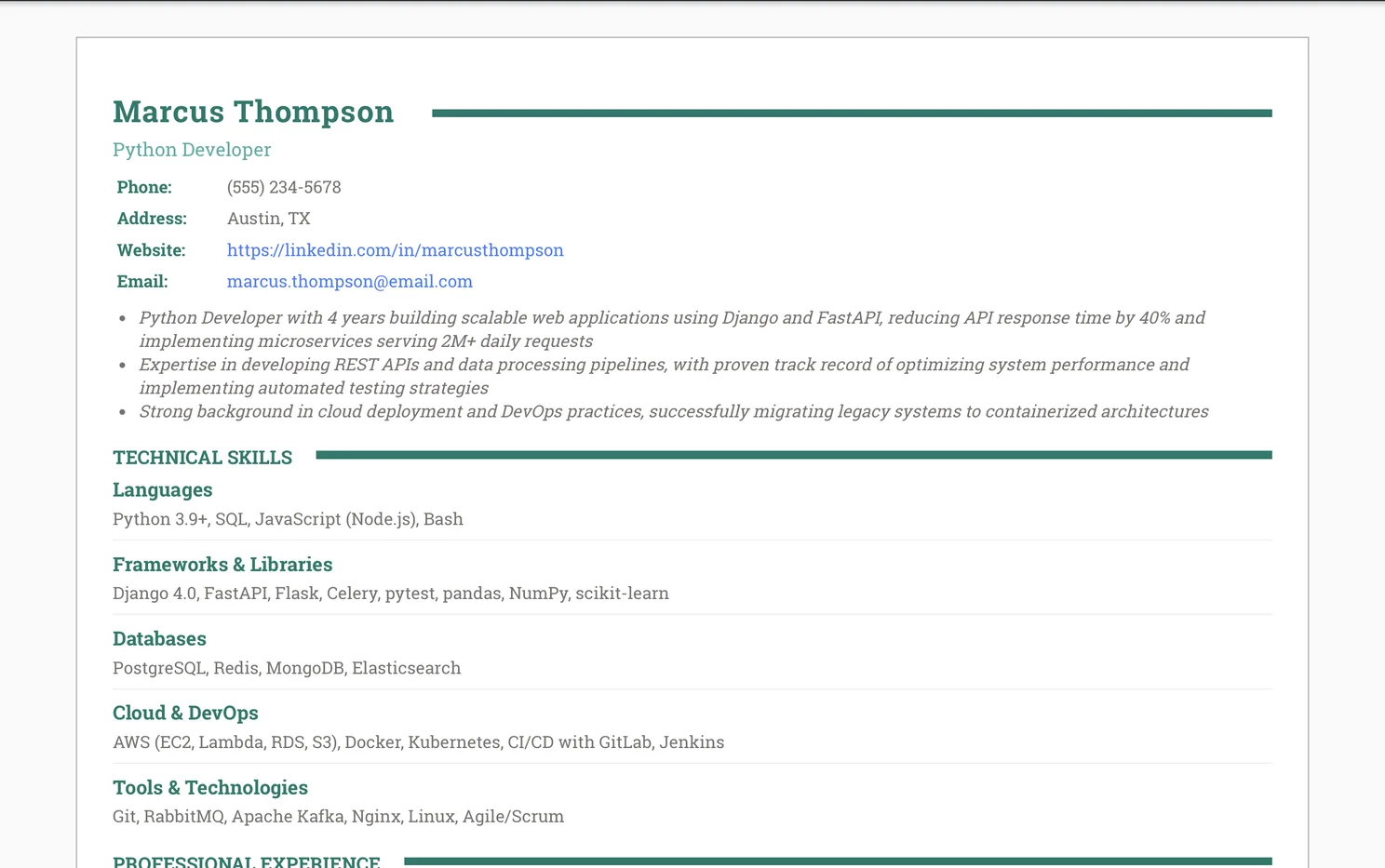
https://www.resumonk.com/python-developer-resumePython DeveloperResume Format for Python Developer Resume
For Python Developers, the reverse-chronological resume format reigns supreme. This format places your most recent experience at the top, cascading down to older positions. Why does this work so brilliantly for Python roles? Because the tech stack evolves rapidly - what you worked on six months ago with Django 4.0 and Python 3.10 is far more relevant than that Flask project from 2018.
The One-Page vs Two-Page Dilemma
If you're a Python Developer with less than 5 years of experience, stick to one page.
Your resume should be as clean and efficient as your code - no redundancy, no unnecessary complexity. For those with 5-10 years of experience, you've earned the right to spill onto a second page, but only if every line adds value.
Senior Python Developers with over a decade of experience can confidently use two full pages.
Section Order That Works
Your resume should follow this structure - Contact Information, Professional Summary (2-3 lines maximum), Technical Skills, Professional Experience, Projects (if space permits), and Education. Notice how Technical Skills comes before Experience?
That's because recruiters and hiring managers want to quickly verify you have the Python expertise they need before diving into where you've applied it.
The professional summary should be a compact piece of code that executes your value proposition. Avoid the outdated objective statement that talks about what you want - instead, focus on what you bring to the table.
❌ Don't write a generic summary:
Seeking a challenging position as a Python Developer where I can utilize my skills
✅ Do write a value-driven summary:
Python Developer with 4 years building scalable web applications using Django and FastAPI,
reducing API response time by 40% and implementing microservices serving 2M+ daily requests
Work Experience on Python Developer Resume
Remember that moment when you finally got your code to work after hours of debugging, and you wanted to show everyone what you accomplished?
That's exactly the energy you need to channel when writing your work experience section. But here's where many Python Developers stumble - they list responsibilities instead of achievements. You weren't hired to write Python code; you were hired to solve business problems using Python as your tool.
The STAR Method Adapted for Developers
Structure each bullet point to tell a mini-story.
Start with an action verb, explain what you built or improved, mention the technologies used, and quantify the impact. Think of it as writing a commit message that actually explains the 'why' behind your code.
For each role, include 3-5 bullet points that showcase different aspects of your Python expertise. Mix technical achievements with business impact - yes, you refactored that legacy codebase, but what matters is that you reduced bug reports by 60% and deployment time from 2 hours to 15 minutes.
❌ Don't write vague descriptions:
• Worked on Python applications
• Fixed bugs and wrote code
• Participated in team meetings
✅ Do write specific, impactful achievements:
• Developed REST APIs using FastAPI handling 10,000+ requests/minute, reducing latency by 35%
• Refactored legacy Django monolith into microservices, decreasing deployment time from 2 hours to 15 minutes
• Implemented automated testing pipeline with pytest, increasing code coverage from 45% to 85%
Handling Different Experience Levels
If you're transitioning from another programming language to Python, emphasize transferable skills while highlighting any Python projects, even personal ones.
Coming from data analysis or science? Show how you've used Python for automation and scaling beyond Jupyter notebooks. Career changers from non-tech backgrounds should focus on problem-solving achievements and any Python bootcamp or self-taught projects that demonstrate real application.
For contract or freelance Python developers, list each significant client engagement as a separate position, but group smaller projects under a single "Freelance Python Developer" heading to avoid resume clutter.
Skills to Include on Python Developer Resume
The skills section of your Python Developer resume is like your IDE's autocomplete feature - it needs to be comprehensive yet relevant, organized yet accessible. You've spent countless hours mastering list comprehensions, decorators, and async programming, but throwing every Python keyword you know onto your resume won't land you the job.
Core Python Skills - The Non-Negotiables
Start with Python versions you're proficient in (Python 3.8+), then list the frameworks that define your expertise. Are you a web developer? Django, FastAPI, or Flask should be prominent. Data engineering more your thing? Apache Spark, Airflow, and Pandas take priority. Machine learning specialist? TensorFlow, PyTorch, and scikit-learn are your headlines.
Beyond frameworks, include essential Python libraries relevant to your target role. Don't just list "NumPy" - everyone knows NumPy. Instead, show depth with specific expertise like "NumPy for large-scale array operations" or group related tools meaningfully.
The Technical Ecosystem
Python doesn't exist in a vacuum, and neither should your skills section. Include databases you've worked with (PostgreSQL, MongoDB, Redis), cloud platforms (AWS, GCP, Azure), containerization tools (Docker, Kubernetes), and version control systems (Git, obviously). Message queuing systems like RabbitMQ or Kafka?
Absolutely include them if you've built distributed systems.
❌ Don't create an unorganized skill dump:
Skills: Python, Java, JavaScript, HTML, CSS, SQL, NoSQL, AWS, Django, Flask, React,
Angular, Docker, Linux, Windows, MySQL, PostgreSQL, MongoDB, Git, Jenkins
✅ Do organize skills logically:
Languages: Python 3.9+, SQL, JavaScript (Node.js)
Frameworks: Django 4.0, FastAPI, Celery, pytest
Databases: PostgreSQL, Redis, MongoDB, Elasticsearch
Cloud & DevOps: AWS (EC2, Lambda, RDS), Docker, Kubernetes, CI/CD with GitLab
Soft Skills That Actually Matter
While your technical skills get you the interview, soft skills often determine the job offer. For Python Developers, emphasize problem-solving, debugging expertise, code review proficiency, and documentation skills. If you've mentored junior developers or led technical discussions, include "technical mentorship" or "cross-functional collaboration."
Remember, "good communication skills" is meaningless - "presented technical concepts to non-technical stakeholders" shows real value.
Specific Considerations and Tips for Python Developer Resume
Here's something most Python Developer resume guides won't tell you - the hiring manager reviewing your resume might not be a Python expert.
They might be a Java developer, a technical recruiter who knows just enough to be dangerous, or an engineering manager who hasn't written production code in years. This reality shapes how you should present your Python expertise.
The GitHub Portfolio Paradox
Yes, include your GitHub profile, but understand its true purpose. Hiring managers rarely dive deep into your code during initial screening. Instead, they look for consistent commit history, documentation quality, and project diversity. Pin repositories that showcase different aspects of your Python skills - a web application, a data processing pipeline, maybe a contribution to an open-source project.
Each should have a comprehensive README that explains the problem solved, not just installation instructions.
If your best code is proprietary from previous jobs, create simplified versions that demonstrate similar concepts without violating NDAs. A "Customer Churn Prediction Model" can become a "Generic Classification Pipeline" that shows your sklearn and pandas expertise without revealing business logic.
Regional Differences That Matter
In the United States, Python Developer resumes often emphasize scalability and performance metrics. Include specific numbers about request handling, data processing volumes, or cost savings. UK employers tend to value formal qualifications more heavily, so your computer science degree or Python certifications should be more prominent.
Canadian employers often look for bilingual capabilities (French/English) in certain regions, while Australian tech companies frequently emphasize experience with agile methodologies and cross-functional team collaboration.
The Version Control Commitment
Never claim expertise in "Python" generically. Specify Python 3.x experience, and if you're unfortunate enough to have Python 2.7 legacy system experience, frame it as migration expertise rather than outdated knowledge. Similarly, don't just list "Django" - specify "Django 3.2+" or "Django REST Framework" to show current knowledge.
❌ Don't use outdated terminology:
• Expert in Python programming and scripting
• Experience with Django web framework
• Knowledge of machine learning
✅ Do demonstrate current expertise:
• Python 3.10+ development with type hints and async/await patterns
• Django 4.0 with DRF for RESTful API development
• Production ML model deployment using MLflow and FastAPI
The Testing Philosophy Statement
Python's "batteries included" philosophy extends to testing, and your resume should reflect this.
Don't just mention pytest or unittest - demonstrate your testing philosophy. Include coverage percentages you've achieved, testing strategies you've implemented (TDD, BDD), or how you've integrated testing into CI/CD pipelines. This shows you write maintainable, production-ready code, not just scripts that work on your machine.
The Hidden Differentiator - Domain Knowledge
Python Developers often overlook their domain expertise.
If you've spent three years building fintech applications, you understand more than Django - you understand PCI compliance, transaction processing, and financial regulations. Healthcare experience means HIPAA compliance and HL7 standards. E-commerce backgrounds bring knowledge of payment gateways, inventory systems, and seasonal scaling. This domain knowledge, combined with Python expertise, makes you exponentially more valuable than a generalist developer.
Education Section for Python Developer Resume
As an entry-level Python Developer, your education section carries more weight than it would for senior positions. Recruiters understand you might not have extensive professional experience yet, so they're looking at your educational background to gauge your potential.
This is where you demonstrate that you've built a solid foundation in programming concepts, not just memorized Python syntax.
Structuring Your Education for Maximum Impact
Start with your highest degree and work backward in reverse-chronological order.
Include your graduation date (or expected graduation date), institution name, degree type, and GPA if it's above 3.5. But here's where Python Developer resumes differ - you'll want to selectively highlight coursework that directly relates to Python development or transferable programming skills.
❌ Don't write a generic education entry:
Bachelor of Science in Computer Science
State University, 2023
✅ Do enhance it with relevant details:
Bachelor of Science in Computer Science
State University, May 2023
GPA: 3.7/4.0
Relevant Coursework: Data Structures & Algorithms (Python), Web Development with Django,
Machine Learning Fundamentals, Database Management Systems, Software Engineering
Bootcamps and Online Certifications - Your Secret Weapons
Maybe you're transitioning from another field, or you've supplemented your traditional education with specialized Python training.
Bootcamps and certifications deserve prominent placement in your education section. These intensive programs show initiative and focused skill development - exactly what employers want to see from entry-level Python Developers.
List these programs with the same detail as traditional degrees. Include completion dates, the institution or platform name, and any notable projects or achievements. For online courses from platforms like Coursera, edX, or Udacity, only include substantial programs - think specializations or professional certificates, not individual two-hour courses.
✅ Do format bootcamp education properly:
Python Development Bootcamp
Coding Academy, September 2023 - December 2023
- Completed 500+ hours of hands-on Python programming
- Built 5 full-stack applications using Django and Flask
- Collaborated on team projects using Git and Agile methodologies
Academic Projects That Demonstrate Python Prowess
If you're fresh out of school, consider adding a brief "Academic Projects" subsection within your education. This works particularly well when you've completed substantial Python projects as part of your coursework.
Keep descriptions concise but specific about the technologies used.
Awards and Publications on Python Developer Resume
The awards and publications section serves as social proof of your capabilities. It tells employers that third parties have recognized your skills or that you've contributed meaningful work to the programming community.
For Python Developers specifically, this section can showcase your problem-solving abilities, creativity with code, and engagement with the broader Python ecosystem.
What Counts as an Award for Python Developers?
Think beyond traditional "Employee of the Month" style awards. For Python Developers, relevant awards include hackathon placements, coding competition rankings, academic honors related to computer science, and even recognition for open-source contributions.
The key is relevance - that "Best Debater" award from high school probably isn't helping your case unless you can tie it to technical communication skills.
When listing awards, include the year, the awarding organization, and a brief description if the award name isn't self-explanatory. Arrange them in reverse-chronological order, with the most recent and impressive awards first.
❌ Don't list awards without context:
First Place - Hackathon 2023
Dean's List
✅ Do provide meaningful details:
First Place, FinTech Category - StateHack 2023
- Developed Python-based fraud detection system using scikit-learn
- Competed against 150+ teams from 20 universities

Dean's List - Fall 2022, Spring 2023
State University, School of Computer Science
Publications and Technical Writing
Publications for entry-level Python Developers rarely mean peer-reviewed journal articles.
Instead, think about technical blog posts, contributed documentation, GitHub repositories with significant stars or forks, or even well-received answers on Stack Overflow. If you've written tutorials, created educational content about Python, or maintained documentation for open-source projects, these all count as publications in the modern tech world.
The Python community values knowledge sharing, so demonstrating that you can explain technical concepts clearly is a huge plus. If you've written about implementing algorithms in Python, created Jupyter notebooks for data analysis projects, or contributed to Python package documentation, include these contributions.
When to Skip This Section Entirely
Here's some real talk - if you don't have relevant awards or publications, don't force it.
A weak awards section with your high school perfect attendance certificate does more harm than good. Instead, strengthen other sections of your resume like projects or technical skills. Remember, white space on a resume isn't a failure; irrelevant content is.
Listing References for Python Developer Resume
For entry-level Python Developers, references carry extra weight because you likely don't have years of professional experience to speak for itself.
Recruiters want to hear from people who've seen you code, solve problems, and work in team settings. They're looking for confirmation that you can translate your educational or personal projects into professional capabilities.
Who Makes a Strong Reference for Python Developers?
Your best references are those who can speak specifically about your Python programming abilities and your potential as a developer. Computer science professors who taught Python-heavy courses, bootcamp instructors who've reviewed your code, supervisors from internships where you used Python, or even senior developers who mentored you on open-source projects - these are gold standard references.
If you've done freelance Python development work, even small projects, those clients can provide powerful references about your ability to deliver real-world solutions. Team members from significant group projects or hackathons can also vouch for your collaboration skills and technical contributions.
❌ Don't list references without context:
References:
Dr. Smith - [email protected]
John Doe - [email protected]
✅ Do provide relevant details:
References available upon request

Dr. Sarah Smith
Professor of Computer Science, State University
Taught: Advanced Python Programming, Database Systems
Email: [email protected]
Phone: (555) 123-4567
Relationship: Supervised my senior capstone project on ML-based recommendation systems
The "References Available Upon Request" Debate
In most English-speaking countries, simply stating "References available upon request" at the bottom of your resume has become the standard approach. This saves valuable resume space and gives you time to prep your references before they're contacted.
However, if the job posting specifically asks for references, include them on a separate page with your application.
For entry-level positions, some candidates choose to include one particularly strong reference directly on their resume if that person is well-known in the Python community or has a particularly relevant title. Use this strategy sparingly and only when it adds significant value.
Preparing Your References for Success
Before listing someone as a reference, always ask permission and brief them on the positions you're applying for. Send them the job description and remind them of specific Python projects or achievements they could highlight.
If your professor supervised your Django web application project, remind them of the specific challenges you overcame and the technologies you used.
Create a separate reference sheet that matches your resume's formatting. Include each reference's current title, organization, contact information, and a brief note about your relationship. This shows attention to detail and makes the recruiter's job easier.
International Considerations
Reference expectations vary significantly by country. In the US and Canada, references are typically contacted after initial interviews. In the UK, references are often checked only after a job offer is made. In Australia, written references or LinkedIn recommendations might be requested upfront.
Research the norms in your target country and industry, but when in doubt, the "available upon request" approach is universally acceptable.
For entry-level Python Developer positions, remember that your references are often the final piece of the puzzle. They transform you from a collection of skills and credentials into a real person that someone trusted and believed in. Choose them wisely, prepare them thoroughly, and they'll help bridge the gap between your potential and your first Python Developer role.
Cover Letter Tips for Python Developer Resume
Many entry-level Python Developers make the mistake of either skipping the cover letter entirely (because "the code speaks for itself") or writing a generic letter that could apply to any programming position.
But here's the thing - hiring managers are looking for developers who can communicate effectively with non-technical stakeholders, document their code clearly, and work collaboratively in teams. Your cover letter is the first proof that you possess these soft skills.
The Three-Act Structure of a Python Developer Cover Letter
Your opening paragraph should immediately establish why you're interested in this specific Python Developer role at this specific company. Maybe they're using Django for projects you're passionate about, or perhaps their commitment to open-source aligns with your values.
Avoid generic openings that could apply to any tech company.
❌ Don't write generic openings:
I am writing to apply for the Python Developer position at your company.
I recently graduated with a Computer Science degree and I am eager to start my career.
✅ Do personalize and show enthusiasm:
As someone who built their first Flask application to automate their university's course registration system, I was thrilled to see TechCorp's Python Developer opening focused on education technology solutions. Your recent blog post about scaling Python microservices particularly resonated with challenges I faced in my capstone project.
The middle section should highlight 2-3 specific achievements or projects that demonstrate your Python skills. Don't just repeat your resume - expand on the story behind your most impressive work. Explain the problem you solved, the Python libraries or frameworks you used, and the impact of your solution.
Use metrics where possible, but for entry-level positions, learning outcomes and problem-solving approaches are equally valuable.
Addressing the Experience Gap
As an entry-level candidate, you might feel insecure about your limited professional experience. Instead of apologizing for what you lack, focus on your potential and learning velocity. Discuss side projects, contributions to open-source Python projects, or times when you quickly learned new Python frameworks or libraries.
Employers hiring entry-level Python Developers are betting on your growth potential, so show them you're a good investment.
Your closing paragraph should reiterate your enthusiasm and include a clear call to action. But avoid the passive "I look forward to hearing from you." Instead, show initiative while remaining respectful of their process.
Technical Details That Matter
When discussing technical projects in your cover letter, strike a balance between being specific enough to show expertise and accessible enough for potentially non-technical HR screeners. Mention specific Python libraries (pandas, NumPy, Django, Flask) but explain what you achieved with them in plain English.
For different regions, adjust your tone accordingly. US cover letters can be more enthusiastic and personal, UK letters tend toward formal and understated, while Canadian and Australian letters fall somewhere in between.
However, the tech industry globally tends to be less formal than traditional sectors, so a conversational yet professional tone usually works well.
Key Takeaways
After diving deep into the anatomy of an effective Python Developer resume, here are the essential points to remember as you craft your own:
- Use reverse-chronological format - Place your most recent experience first, as recent Python projects and modern framework experience matter more than older work
- Keep it concise - One page for less than 5 years experience, two pages maximum for senior developers with 10+ years
- Lead with technical skills - Position your Python expertise and related technologies before work experience to immediately confirm you have the required skills
- Write achievement-focused bullets - Don't list responsibilities; showcase specific problems you solved, technologies you used, and measurable impacts you delivered
- Specify Python versions and frameworks - Never write generic "Python experience" - always specify versions (Python 3.9+) and frameworks (Django 4.0, FastAPI, Flask)
- Organize skills logically - Group your technical skills by category (Languages, Frameworks, Databases, Cloud & DevOps) rather than creating an unreadable skill dump
- Include relevant metrics - Quantify your achievements with specific numbers about performance improvements, request handling, data processing volumes, or cost savings
- Showcase testing expertise - Highlight your experience with pytest, unittest, coverage percentages, and testing methodologies to prove you write maintainable code
- Don't overlook domain knowledge - If you have industry-specific experience (fintech, healthcare, e-commerce), emphasize this alongside your Python skills
- Tailor education section strategically - Highlight Python-relevant coursework, bootcamps, and certifications, especially for entry-level positions
- Make your GitHub count - Include your profile but ensure pinned repositories have comprehensive READMEs and showcase diverse Python skills
- Adapt to regional expectations - US resumes emphasize metrics and scalability, UK values formal qualifications, while Canadian and Australian markets have their own nuances
Creating a compelling Python Developer resume doesn't have to feel like debugging a particularly nasty piece of legacy code. With Resumonk, you can build a professional, visually appealing resume that incorporates all these best practices while maintaining clean, readable formatting. Our AI-powered suggestions help you craft impactful bullet points specific to Python Developer roles, while our range of professionally designed templates ensure your technical skills and achievements stand out to both recruiters and hiring managers. Whether you're a junior developer fresh from a bootcamp or a seasoned Pythonista with years of Django under your belt, Resumonk adapts to your experience level and helps you present your Python journey in the most compelling way possible.
Ready to build your Python Developer resume?
Start creating your professional Python Developer resume with Resumonk's intelligent templates and AI recommendations. Join thousands of developers who've successfully landed their dream Python roles.
Create Your Python Developer Resume Now →
More Software resume examples
See all Software resume examples, or browse every category.
Resume writing tips
You've been staring at your terminal for the past hour, tweaking that algorithm to shave off another 100 milliseconds of runtime.
Maybe you're surrounded by coffee cups and Stack Overflow tabs, having just solved that threading issue that's been haunting you for days. Or perhaps you're fresh out of university, your head still spinning from that data structures course where you finally understood why dictionaries in Python are so brilliantly fast. Now you're ready to channel all that knowledge, those late-night debugging sessions, and your passion for clean, Pythonic code into landing your next role as a Python Developer - not a team lead, not a manager, but a hands-on coder who solves real problems with elegant solutions.
The Python Developer role you're targeting is clear in its expectations - you'll be writing production code, building APIs, wrangling data, or perhaps training machine learning models. Whether you're transitioning from your first junior position where you've mastered Django basics, or you're a mid-level developer who's been shipping features in Flask for years, the challenge remains the same. How do you distill your experience with list comprehensions, your understanding of generators, and that time you optimized a data pipeline from 6 hours to 30 minutes into a two-page document that gets you past the first screening?
This comprehensive guide walks you through every crucial element of crafting a Python Developer resume that actually lands interviews. We'll start with choosing the right format - specifically why the reverse-chronological format works best for technical roles and how to structure it for maximum impact. You'll learn how to write work experience bullets that showcase achievements rather than responsibilities, how to organize your technical skills section so it doesn't look like keyword soup, and which Python-specific accomplishments deserve precious resume real estate.
We'll also dive into the nuances that separate good Python Developer resumes from great ones - how to handle the education section when you're self-taught versus traditionally educated, when to include that GitHub portfolio link and when it might hurt you, and how to address regional differences in resume expectations. Plus, we'll cover those tricky situations unique to Python developers, like transitioning from data science to backend development, or explaining why your experience with legacy Python 2.7 systems is actually valuable. By the end of this guide, you'll have a clear template and the knowledge to adapt it to your unique background, whether you're a bootcamp graduate, a computer science major, or a self-taught programmer who learned Python to automate the boring stuff and never looked back.
The Best Python Developer Resume Example/Sample
https://www.resumonk.com/python-developer-resumePython DeveloperResume Format for Python Developer Resume
For Python Developers, the reverse-chronological resume format reigns supreme. This format places your most recent experience at the top, cascading down to older positions. Why does this work so brilliantly for Python roles? Because the tech stack evolves rapidly - what you worked on six months ago with Django 4.0 and Python 3.10 is far more relevant than that Flask project from 2018.
The One-Page vs Two-Page Dilemma
If you're a Python Developer with less than 5 years of experience, stick to one page.
Your resume should be as clean and efficient as your code - no redundancy, no unnecessary complexity. For those with 5-10 years of experience, you've earned the right to spill onto a second page, but only if every line adds value.
Senior Python Developers with over a decade of experience can confidently use two full pages.
Section Order That Works
Your resume should follow this structure - Contact Information, Professional Summary (2-3 lines maximum), Technical Skills, Professional Experience, Projects (if space permits), and Education. Notice how Technical Skills comes before Experience?
That's because recruiters and hiring managers want to quickly verify you have the Python expertise they need before diving into where you've applied it.
The professional summary should be a compact piece of code that executes your value proposition. Avoid the outdated objective statement that talks about what you want - instead, focus on what you bring to the table.
❌ Don't write a generic summary:
Seeking a challenging position as a Python Developer where I can utilize my skills
✅ Do write a value-driven summary:
Python Developer with 4 years building scalable web applications using Django and FastAPI,
reducing API response time by 40% and implementing microservices serving 2M+ daily requests
Work Experience on Python Developer Resume
Remember that moment when you finally got your code to work after hours of debugging, and you wanted to show everyone what you accomplished?
That's exactly the energy you need to channel when writing your work experience section. But here's where many Python Developers stumble - they list responsibilities instead of achievements. You weren't hired to write Python code; you were hired to solve business problems using Python as your tool.
The STAR Method Adapted for Developers
Structure each bullet point to tell a mini-story.
Start with an action verb, explain what you built or improved, mention the technologies used, and quantify the impact. Think of it as writing a commit message that actually explains the 'why' behind your code.
For each role, include 3-5 bullet points that showcase different aspects of your Python expertise. Mix technical achievements with business impact - yes, you refactored that legacy codebase, but what matters is that you reduced bug reports by 60% and deployment time from 2 hours to 15 minutes.
❌ Don't write vague descriptions:
• Worked on Python applications
• Fixed bugs and wrote code
• Participated in team meetings
✅ Do write specific, impactful achievements:
• Developed REST APIs using FastAPI handling 10,000+ requests/minute, reducing latency by 35%
• Refactored legacy Django monolith into microservices, decreasing deployment time from 2 hours to 15 minutes
• Implemented automated testing pipeline with pytest, increasing code coverage from 45% to 85%
Handling Different Experience Levels
If you're transitioning from another programming language to Python, emphasize transferable skills while highlighting any Python projects, even personal ones.
Coming from data analysis or science? Show how you've used Python for automation and scaling beyond Jupyter notebooks. Career changers from non-tech backgrounds should focus on problem-solving achievements and any Python bootcamp or self-taught projects that demonstrate real application.
For contract or freelance Python developers, list each significant client engagement as a separate position, but group smaller projects under a single "Freelance Python Developer" heading to avoid resume clutter.
Skills to Include on Python Developer Resume
The skills section of your Python Developer resume is like your IDE's autocomplete feature - it needs to be comprehensive yet relevant, organized yet accessible. You've spent countless hours mastering list comprehensions, decorators, and async programming, but throwing every Python keyword you know onto your resume won't land you the job.
Core Python Skills - The Non-Negotiables
Start with Python versions you're proficient in (Python 3.8+), then list the frameworks that define your expertise. Are you a web developer? Django, FastAPI, or Flask should be prominent. Data engineering more your thing? Apache Spark, Airflow, and Pandas take priority. Machine learning specialist? TensorFlow, PyTorch, and scikit-learn are your headlines.
Beyond frameworks, include essential Python libraries relevant to your target role. Don't just list "NumPy" - everyone knows NumPy. Instead, show depth with specific expertise like "NumPy for large-scale array operations" or group related tools meaningfully.
The Technical Ecosystem
Python doesn't exist in a vacuum, and neither should your skills section. Include databases you've worked with (PostgreSQL, MongoDB, Redis), cloud platforms (AWS, GCP, Azure), containerization tools (Docker, Kubernetes), and version control systems (Git, obviously). Message queuing systems like RabbitMQ or Kafka?
Absolutely include them if you've built distributed systems.
❌ Don't create an unorganized skill dump:
Skills: Python, Java, JavaScript, HTML, CSS, SQL, NoSQL, AWS, Django, Flask, React,
Angular, Docker, Linux, Windows, MySQL, PostgreSQL, MongoDB, Git, Jenkins
✅ Do organize skills logically:
Languages: Python 3.9+, SQL, JavaScript (Node.js)
Frameworks: Django 4.0, FastAPI, Celery, pytest
Databases: PostgreSQL, Redis, MongoDB, Elasticsearch
Cloud & DevOps: AWS (EC2, Lambda, RDS), Docker, Kubernetes, CI/CD with GitLab
Soft Skills That Actually Matter
While your technical skills get you the interview, soft skills often determine the job offer. For Python Developers, emphasize problem-solving, debugging expertise, code review proficiency, and documentation skills. If you've mentored junior developers or led technical discussions, include "technical mentorship" or "cross-functional collaboration."
Remember, "good communication skills" is meaningless - "presented technical concepts to non-technical stakeholders" shows real value.
Specific Considerations and Tips for Python Developer Resume
Here's something most Python Developer resume guides won't tell you - the hiring manager reviewing your resume might not be a Python expert.
They might be a Java developer, a technical recruiter who knows just enough to be dangerous, or an engineering manager who hasn't written production code in years. This reality shapes how you should present your Python expertise.
The GitHub Portfolio Paradox
Yes, include your GitHub profile, but understand its true purpose. Hiring managers rarely dive deep into your code during initial screening. Instead, they look for consistent commit history, documentation quality, and project diversity. Pin repositories that showcase different aspects of your Python skills - a web application, a data processing pipeline, maybe a contribution to an open-source project.
Each should have a comprehensive README that explains the problem solved, not just installation instructions.
If your best code is proprietary from previous jobs, create simplified versions that demonstrate similar concepts without violating NDAs. A "Customer Churn Prediction Model" can become a "Generic Classification Pipeline" that shows your sklearn and pandas expertise without revealing business logic.
Regional Differences That Matter
In the United States, Python Developer resumes often emphasize scalability and performance metrics. Include specific numbers about request handling, data processing volumes, or cost savings. UK employers tend to value formal qualifications more heavily, so your computer science degree or Python certifications should be more prominent.
Canadian employers often look for bilingual capabilities (French/English) in certain regions, while Australian tech companies frequently emphasize experience with agile methodologies and cross-functional team collaboration.
The Version Control Commitment
Never claim expertise in "Python" generically. Specify Python 3.x experience, and if you're unfortunate enough to have Python 2.7 legacy system experience, frame it as migration expertise rather than outdated knowledge. Similarly, don't just list "Django" - specify "Django 3.2+" or "Django REST Framework" to show current knowledge.
❌ Don't use outdated terminology:
• Expert in Python programming and scripting
• Experience with Django web framework
• Knowledge of machine learning
✅ Do demonstrate current expertise:
• Python 3.10+ development with type hints and async/await patterns
• Django 4.0 with DRF for RESTful API development
• Production ML model deployment using MLflow and FastAPI
The Testing Philosophy Statement
Python's "batteries included" philosophy extends to testing, and your resume should reflect this.
Don't just mention pytest or unittest - demonstrate your testing philosophy. Include coverage percentages you've achieved, testing strategies you've implemented (TDD, BDD), or how you've integrated testing into CI/CD pipelines. This shows you write maintainable, production-ready code, not just scripts that work on your machine.
The Hidden Differentiator - Domain Knowledge
Python Developers often overlook their domain expertise.
If you've spent three years building fintech applications, you understand more than Django - you understand PCI compliance, transaction processing, and financial regulations. Healthcare experience means HIPAA compliance and HL7 standards. E-commerce backgrounds bring knowledge of payment gateways, inventory systems, and seasonal scaling. This domain knowledge, combined with Python expertise, makes you exponentially more valuable than a generalist developer.
Education Section for Python Developer Resume
As an entry-level Python Developer, your education section carries more weight than it would for senior positions. Recruiters understand you might not have extensive professional experience yet, so they're looking at your educational background to gauge your potential.
This is where you demonstrate that you've built a solid foundation in programming concepts, not just memorized Python syntax.
Structuring Your Education for Maximum Impact
Start with your highest degree and work backward in reverse-chronological order.
Include your graduation date (or expected graduation date), institution name, degree type, and GPA if it's above 3.5. But here's where Python Developer resumes differ - you'll want to selectively highlight coursework that directly relates to Python development or transferable programming skills.
❌ Don't write a generic education entry:
Bachelor of Science in Computer Science
State University, 2023
✅ Do enhance it with relevant details:
Bachelor of Science in Computer Science
State University, May 2023
GPA: 3.7/4.0
Relevant Coursework: Data Structures & Algorithms (Python), Web Development with Django,
Machine Learning Fundamentals, Database Management Systems, Software Engineering
Bootcamps and Online Certifications - Your Secret Weapons
Maybe you're transitioning from another field, or you've supplemented your traditional education with specialized Python training.
Bootcamps and certifications deserve prominent placement in your education section. These intensive programs show initiative and focused skill development - exactly what employers want to see from entry-level Python Developers.
List these programs with the same detail as traditional degrees. Include completion dates, the institution or platform name, and any notable projects or achievements. For online courses from platforms like Coursera, edX, or Udacity, only include substantial programs - think specializations or professional certificates, not individual two-hour courses.
✅ Do format bootcamp education properly:
Python Development Bootcamp
Coding Academy, September 2023 - December 2023
- Completed 500+ hours of hands-on Python programming
- Built 5 full-stack applications using Django and Flask
- Collaborated on team projects using Git and Agile methodologies
Academic Projects That Demonstrate Python Prowess
If you're fresh out of school, consider adding a brief "Academic Projects" subsection within your education. This works particularly well when you've completed substantial Python projects as part of your coursework.
Keep descriptions concise but specific about the technologies used.
Awards and Publications on Python Developer Resume
The awards and publications section serves as social proof of your capabilities. It tells employers that third parties have recognized your skills or that you've contributed meaningful work to the programming community.
For Python Developers specifically, this section can showcase your problem-solving abilities, creativity with code, and engagement with the broader Python ecosystem.
What Counts as an Award for Python Developers?
Think beyond traditional "Employee of the Month" style awards. For Python Developers, relevant awards include hackathon placements, coding competition rankings, academic honors related to computer science, and even recognition for open-source contributions.
The key is relevance - that "Best Debater" award from high school probably isn't helping your case unless you can tie it to technical communication skills.
When listing awards, include the year, the awarding organization, and a brief description if the award name isn't self-explanatory. Arrange them in reverse-chronological order, with the most recent and impressive awards first.
❌ Don't list awards without context:
First Place - Hackathon 2023
Dean's List
✅ Do provide meaningful details:
First Place, FinTech Category - StateHack 2023
- Developed Python-based fraud detection system using scikit-learn
- Competed against 150+ teams from 20 universities

Dean's List - Fall 2022, Spring 2023
State University, School of Computer Science
Publications and Technical Writing
Publications for entry-level Python Developers rarely mean peer-reviewed journal articles.
Instead, think about technical blog posts, contributed documentation, GitHub repositories with significant stars or forks, or even well-received answers on Stack Overflow. If you've written tutorials, created educational content about Python, or maintained documentation for open-source projects, these all count as publications in the modern tech world.
The Python community values knowledge sharing, so demonstrating that you can explain technical concepts clearly is a huge plus. If you've written about implementing algorithms in Python, created Jupyter notebooks for data analysis projects, or contributed to Python package documentation, include these contributions.
When to Skip This Section Entirely
Here's some real talk - if you don't have relevant awards or publications, don't force it.
A weak awards section with your high school perfect attendance certificate does more harm than good. Instead, strengthen other sections of your resume like projects or technical skills. Remember, white space on a resume isn't a failure; irrelevant content is.
Listing References for Python Developer Resume
For entry-level Python Developers, references carry extra weight because you likely don't have years of professional experience to speak for itself.
Recruiters want to hear from people who've seen you code, solve problems, and work in team settings. They're looking for confirmation that you can translate your educational or personal projects into professional capabilities.
Who Makes a Strong Reference for Python Developers?
Your best references are those who can speak specifically about your Python programming abilities and your potential as a developer. Computer science professors who taught Python-heavy courses, bootcamp instructors who've reviewed your code, supervisors from internships where you used Python, or even senior developers who mentored you on open-source projects - these are gold standard references.
If you've done freelance Python development work, even small projects, those clients can provide powerful references about your ability to deliver real-world solutions. Team members from significant group projects or hackathons can also vouch for your collaboration skills and technical contributions.
❌ Don't list references without context:
References:
Dr. Smith - [email protected]
John Doe - [email protected]
✅ Do provide relevant details:
References available upon request

Dr. Sarah Smith
Professor of Computer Science, State University
Taught: Advanced Python Programming, Database Systems
Email: [email protected]
Phone: (555) 123-4567
Relationship: Supervised my senior capstone project on ML-based recommendation systems
The "References Available Upon Request" Debate
In most English-speaking countries, simply stating "References available upon request" at the bottom of your resume has become the standard approach. This saves valuable resume space and gives you time to prep your references before they're contacted.
However, if the job posting specifically asks for references, include them on a separate page with your application.
For entry-level positions, some candidates choose to include one particularly strong reference directly on their resume if that person is well-known in the Python community or has a particularly relevant title. Use this strategy sparingly and only when it adds significant value.
Preparing Your References for Success
Before listing someone as a reference, always ask permission and brief them on the positions you're applying for. Send them the job description and remind them of specific Python projects or achievements they could highlight.
If your professor supervised your Django web application project, remind them of the specific challenges you overcame and the technologies you used.
Create a separate reference sheet that matches your resume's formatting. Include each reference's current title, organization, contact information, and a brief note about your relationship. This shows attention to detail and makes the recruiter's job easier.
International Considerations
Reference expectations vary significantly by country. In the US and Canada, references are typically contacted after initial interviews. In the UK, references are often checked only after a job offer is made. In Australia, written references or LinkedIn recommendations might be requested upfront.
Research the norms in your target country and industry, but when in doubt, the "available upon request" approach is universally acceptable.
For entry-level Python Developer positions, remember that your references are often the final piece of the puzzle. They transform you from a collection of skills and credentials into a real person that someone trusted and believed in. Choose them wisely, prepare them thoroughly, and they'll help bridge the gap between your potential and your first Python Developer role.
Cover Letter Tips for Python Developer Resume
Many entry-level Python Developers make the mistake of either skipping the cover letter entirely (because "the code speaks for itself") or writing a generic letter that could apply to any programming position.
But here's the thing - hiring managers are looking for developers who can communicate effectively with non-technical stakeholders, document their code clearly, and work collaboratively in teams. Your cover letter is the first proof that you possess these soft skills.
The Three-Act Structure of a Python Developer Cover Letter
Your opening paragraph should immediately establish why you're interested in this specific Python Developer role at this specific company. Maybe they're using Django for projects you're passionate about, or perhaps their commitment to open-source aligns with your values.
Avoid generic openings that could apply to any tech company.
❌ Don't write generic openings:
I am writing to apply for the Python Developer position at your company.
I recently graduated with a Computer Science degree and I am eager to start my career.
✅ Do personalize and show enthusiasm:
As someone who built their first Flask application to automate their university's course registration system, I was thrilled to see TechCorp's Python Developer opening focused on education technology solutions. Your recent blog post about scaling Python microservices particularly resonated with challenges I faced in my capstone project.
The middle section should highlight 2-3 specific achievements or projects that demonstrate your Python skills. Don't just repeat your resume - expand on the story behind your most impressive work. Explain the problem you solved, the Python libraries or frameworks you used, and the impact of your solution.
Use metrics where possible, but for entry-level positions, learning outcomes and problem-solving approaches are equally valuable.
Addressing the Experience Gap
As an entry-level candidate, you might feel insecure about your limited professional experience. Instead of apologizing for what you lack, focus on your potential and learning velocity. Discuss side projects, contributions to open-source Python projects, or times when you quickly learned new Python frameworks or libraries.
Employers hiring entry-level Python Developers are betting on your growth potential, so show them you're a good investment.
Your closing paragraph should reiterate your enthusiasm and include a clear call to action. But avoid the passive "I look forward to hearing from you." Instead, show initiative while remaining respectful of their process.
Technical Details That Matter
When discussing technical projects in your cover letter, strike a balance between being specific enough to show expertise and accessible enough for potentially non-technical HR screeners. Mention specific Python libraries (pandas, NumPy, Django, Flask) but explain what you achieved with them in plain English.
For different regions, adjust your tone accordingly. US cover letters can be more enthusiastic and personal, UK letters tend toward formal and understated, while Canadian and Australian letters fall somewhere in between.
However, the tech industry globally tends to be less formal than traditional sectors, so a conversational yet professional tone usually works well.
Key Takeaways
After diving deep into the anatomy of an effective Python Developer resume, here are the essential points to remember as you craft your own:
- Use reverse-chronological format - Place your most recent experience first, as recent Python projects and modern framework experience matter more than older work
- Keep it concise - One page for less than 5 years experience, two pages maximum for senior developers with 10+ years
- Lead with technical skills - Position your Python expertise and related technologies before work experience to immediately confirm you have the required skills
- Write achievement-focused bullets - Don't list responsibilities; showcase specific problems you solved, technologies you used, and measurable impacts you delivered
- Specify Python versions and frameworks - Never write generic "Python experience" - always specify versions (Python 3.9+) and frameworks (Django 4.0, FastAPI, Flask)
- Organize skills logically - Group your technical skills by category (Languages, Frameworks, Databases, Cloud & DevOps) rather than creating an unreadable skill dump
- Include relevant metrics - Quantify your achievements with specific numbers about performance improvements, request handling, data processing volumes, or cost savings
- Showcase testing expertise - Highlight your experience with pytest, unittest, coverage percentages, and testing methodologies to prove you write maintainable code
- Don't overlook domain knowledge - If you have industry-specific experience (fintech, healthcare, e-commerce), emphasize this alongside your Python skills
- Tailor education section strategically - Highlight Python-relevant coursework, bootcamps, and certifications, especially for entry-level positions
- Make your GitHub count - Include your profile but ensure pinned repositories have comprehensive READMEs and showcase diverse Python skills
- Adapt to regional expectations - US resumes emphasize metrics and scalability, UK values formal qualifications, while Canadian and Australian markets have their own nuances
Creating a compelling Python Developer resume doesn't have to feel like debugging a particularly nasty piece of legacy code. With Resumonk, you can build a professional, visually appealing resume that incorporates all these best practices while maintaining clean, readable formatting. Our AI-powered suggestions help you craft impactful bullet points specific to Python Developer roles, while our range of professionally designed templates ensure your technical skills and achievements stand out to both recruiters and hiring managers. Whether you're a junior developer fresh from a bootcamp or a seasoned Pythonista with years of Django under your belt, Resumonk adapts to your experience level and helps you present your Python journey in the most compelling way possible.
Ready to build your Python Developer resume?
Start creating your professional Python Developer resume with Resumonk's intelligent templates and AI recommendations. Join thousands of developers who've successfully landed their dream Python roles.
Create Your Python Developer Resume Now →
More Software resume examples
See all Software resume examples, or browse every category.
Resume writing tips