Project Coordinator Resume Example (with Expert Advice and Tips)
Introduction
Picture yourself at your desk, surrounded by sticky notes, Gantt charts on one monitor, seventeen browser tabs open on the other, and your phone buzzing with Slack notifications while you're updating a project timeline in Asana. You're not quite the Project Manager making the big decisions, but you're definitely not the intern fetching coffee either. You're in that sweet spot where you're the one who actually makes projects happen - the Project Coordinator, the maestro of the mundane yet critical, the person who turns chaos into coordinated action.
And right now, you're staring at a blank document, trying to figure out how to capture all of that organized chaos into a resume that will land you your next role.
Whether you're currently an administrative assistant who's been secretly running projects without the title, a recent graduate who managed to coordinate every group project in college while everyone else argued about fonts, or someone from an entirely different field who's discovered their superpower is making sure things actually get done - you need a resume that speaks the language of project coordination. The challenge? Project Coordinator means different things in different industries. In tech, you might be managing sprint cycles and product roadmaps. In construction, you're tracking permits and subcontractor schedules. In healthcare, you're coordinating between departments while navigating compliance requirements. But at its core, this role is about being the connective tissue that holds projects together.
This guide will walk you through everything you need to build a Project Coordinator resume that actually works. We'll start with choosing the right format - spoiler alert, reverse-chronological is your friend here - and show you exactly how to structure each section to highlight your coordination superpowers. You'll learn how to transform your work experience into project management language that hiring managers understand, even if your current title is something like "Office Assistant" or "Customer Service Representative." We'll dive deep into which skills to showcase, from your MS Project expertise to your ability to mediate between feuding departments without anyone realizing there was a conflict.
We'll also tackle the tricky parts - like how to position certifications when you're not quite ready for that PMP yet, how to handle the fact that you're applying from a different industry, and what to do when you've been coordinating projects for years but never had the official title. You'll discover how to craft an education section that goes beyond just listing your degree, how to present awards and recognition that matter for this role, and yes, we'll even cover how to write a cover letter that proves you can communicate as well as you can coordinate. By the time you finish reading, you'll have a complete blueprint for creating a Project Coordinator resume that doesn't just list your qualifications but tells the story of someone who's ready to be the organizational backbone of their next team.
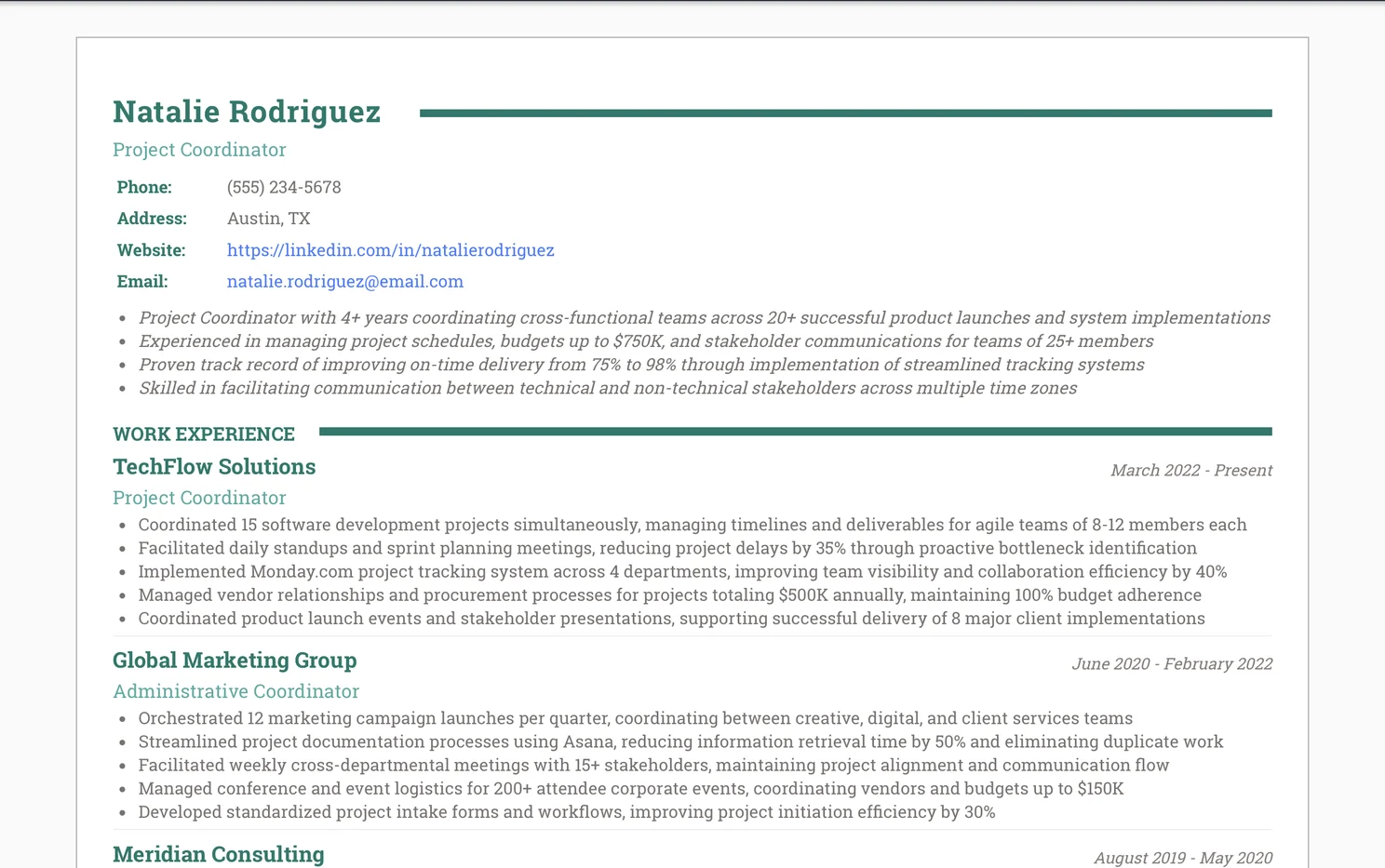
The Best Project Coordinator Resume Example/Sample
https://www.resumonk.com/project-coordinator-resumeProject CoordinatorResume Format to Follow for Project Coordinator Resume
The reverse-chronological format is your golden ticket here.
Why? Because hiring managers want to see your progression, your ability to handle increasingly complex coordination tasks, and most importantly, that you've been trusted with real project responsibilities recently. This format puts your latest achievements front and center, showing that you're not just theoretically capable but practically proven.
Structure Your Project Coordinator Resume Like a Well-Run Project
Start with a professional summary that acts like your project charter - clear, concise, and compelling.
This isn't the place for vague statements about being a "team player." Instead, think of it as your elevator pitch to a busy project manager who needs someone yesterday.
❌ Don't write a generic summary:
Hardworking professional seeking Project Coordinator position. Good communication skills and attention to detail.
✅ Do write a targeted, achievement-focused summary:
Project Coordinator with 3+ years coordinating cross-functional teams across 15+ successful product launches.
Experienced in managing project schedules, budgets up to $500K, and stakeholder communications for teams of 20+ members.
Following your summary, your experience section should read like a series of successfully completed projects. Each role you list needs clear start and end dates (month and year), just like project milestones. Your education follows, then skills, and finally, any relevant certifications like CAPM or your Scrum fundamentals certificate that's been sitting proudly on your LinkedIn.
Regional Formatting Considerations
If you're applying in the UK or Australia, keep your resume to two pages maximum and call it a CV.
In the US and Canada, stick to one page unless you have over 5 years of directly relevant experience. Europeans might expect a photo, but North American employers will raise an eyebrow if they see your smiling face staring back at them.
And regardless of geography, remember that project management is increasingly global - your format should be clean enough to translate across borders.
Work Experience on Project Coordinator Resume
Here's where the rubber meets the road. Your work experience section isn't just a chronological diary of places you've collected paychecks - it's your proving ground. As someone stepping into or advancing within project coordination, you need to demonstrate that you understand the trinity of project management: scope, time, and budget.
Even if your previous title was Administrative Assistant, Office Manager, or Junior Analyst, you've likely been coordinating projects without the formal title.
Mining Your Experience for Project Gold
Think about every time you've organized something - that office move, the annual conference, the system implementation where you were the go-to person. These are all projects, and you coordinated them.
The key is translating these experiences into project management language that resonates with hiring managers.
Start each bullet point with an action verb that screams coordination: orchestrated, facilitated, synchronized, streamlined, coordinated (obviously), or implemented. Then follow with what you did, how you did it, and most crucially, what happened as a result.
❌ Don't write vague job duties:
• Helped with various projects
• Attended meetings and took notes
• Worked with different departments
✅ Do write specific, quantified achievements:
• Coordinated 12 product launch events across 3 quarters, managing vendor relationships and budgets totaling $200K
• Facilitated weekly cross-functional meetings with 15+ stakeholders, reducing project delays by 30%
• Implemented new project tracking system using Monday.com, improving team visibility and on-time delivery from 70% to 95%
Demonstrating Progressive Responsibility
Even if you've held the same title for three years, your bullets should show growth.
Your first year might have been about maintaining meeting schedules and updating project dashboards. By year three, you should be showing how you've taken on budget tracking, risk assessment, or vendor management. This progression tells employers you're ready for the next level.
Remember to include any cross-functional work, even if it wasn't your primary role. That time you coordinated between IT and Marketing for the website redesign? That's project coordination. The summer you managed the office renovation while your manager was on leave?
Pure project management gold.
Addressing Different Industry Contexts
A Project Coordinator in construction manages different beasts than one in software development, but the core skills translate.
If you're switching industries, translate your experience into universal project language. Instead of industry jargon, focus on the coordination aspects - timeline management, stakeholder communication, resource allocation, and problem-solving.
Skills to Show on Project Coordinator Resume
Welcome to the skills section, where you get to showcase your Swiss Army knife of capabilities.
But here's the thing - as a Project Coordinator, you're not just listing skills like ingredients on a recipe card. You're strategically positioning yourself as the person who can juggle flaming torches while riding a unicycle (metaphorically speaking, unless you're coordinating circus projects).
The Technical Foundation
Let's start with the hard skills - the ones that make IT departments and project managers breathe a sigh of relief. Your proficiency in project management software isn't just nice to have; it's your entry ticket to the coordination party.
But don't just list every software you've ever opened once.
❌ Don't create a software graveyard:
Skills: Microsoft Office, Email, Internet, Windows, Mac OS, Google, Zoom
✅ Do showcase relevant technical proficiencies:
Project Management Tools: MS Project, Asana, Trello, JIRA (Scrum/Kanban boards)
Data Analysis: Advanced Excel (Pivot Tables, VLOOKUP), Tableau basics, Google Analytics
Communication Platforms: Slack, Microsoft Teams, Confluence documentation
Notice how the second example doesn't just name-drop software but hints at how you use it? That's the secret sauce.
Anyone can claim they know Excel, but mentioning pivot tables and VLOOKUP shows you can actually wrangle data for project reports.
The Soft Skills That Make You Irreplaceable
Now for the soft skills - except let's not call them soft because there's nothing soft about mediating between a demanding client and a stressed development team. These are your human skills, and as a Project Coordinator, they're what separate you from a very organized spreadsheet.
But here's where most candidates mess up - they list soft skills like they're writing a dating profile. "Good communication skills" means nothing. Instead, weave these skills into your experience section and back them up with evidence.
If you must have a skills section for soft skills, make them specific to project coordination:
Core Competencies:
• Stakeholder Management - Experience managing expectations across C-level, vendors, and team members
• Risk Assessment - Proactive identification and mitigation planning for project bottlenecks
• Cross-cultural Communication - Coordinated global teams across 4 time zones
• Conflict Resolution - Mediated resource allocation disputes, maintaining project timeline integrity
Industry-Specific Skills That Set You Apart
Depending on your industry, certain skills carry more weight. Tech Project Coordinators might emphasize Agile methodologies and sprint planning. Construction Project Coordinators should highlight their understanding of building codes and permit processes. Healthcare Project Coordinators need to show HIPAA compliance knowledge.
Research your target industry and speak their language.
Specific Considerations and Tips for Project Coordinator Resume
Alright, let's talk about the elephant in the room - you're not a Project Manager (yet), and you're not an entry-level assistant (anymore). You're in that sweet spot where you have enough experience to be dangerous but not enough seniority to sign off on major decisions.
Your resume needs to navigate this middle ground with the grace of a tightrope walker.
The Certification Question
Here's something nobody tells you - as a Project Coordinator, certifications can be your secret weapon, but they can also backfire if positioned wrong. A PMP certification might actually work against you (you'll look overqualified), but a CAPM (Certified Associate in Project Management) or Scrum Fundamentals certificate shows initiative without overshooting your target role.
If you're currently pursuing a certification, absolutely mention it:
Certifications:
• CAPM (Certified Associate in Project Management) - Expected completion: March 2024
• Google Project Management Certificate - Completed November 2023
The Portfolio Problem
Unlike designers or developers, Project Coordinators can't exactly showcase a portfolio of beautiful projects.
Or can you? Consider creating a simple one-page project summary as an addendum to your resume. Include a brief case study of your most successful project coordination effort - the challenge, your approach, and the results.
This shows you can think strategically about projects, not just execute tasks.
Navigating the Hierarchy Puzzle
One unique challenge for Project Coordinators is showing you can take direction while also demonstrating leadership. You're not the boss, but you're also not just following orders. Your resume should reflect this delicate balance.
Use phrases that show collaborative leadership:
• Influenced cross-functional team of 12 to adopt new project tracking methodology, improving visibility by 40%
• Partnered with Project Manager to develop risk mitigation strategies for $2M initiative
• Guided junior team members through project documentation processes while reporting to Senior PM
The Remote Revolution Consideration
Post-2020, project coordination has gone digital in ways we never imagined. If you've successfully coordinated remote projects, that's not just a nice-to-have - it's essential. Highlight your ability to manage virtual teams, coordinate across time zones, and maintain project momentum without in-person meetings.
This isn't just about knowing Zoom; it's about showing you can maintain human connections and project cohesion in a digital environment.
The Metrics That Matter
Finally, remember that Project Coordinators live and die by metrics, but not just any metrics - the right ones.
On-time delivery percentage, budget adherence, stakeholder satisfaction scores, number of projects simultaneously managed - these numbers tell your story. But here's the kicker - if you don't have access to formal metrics, create them retroactively. That project that went smoothly? It was delivered 100% on time. The one where nobody complained? High stakeholder satisfaction.
Your resume as a Project Coordinator isn't just about showing you can manage tasks - it's about proving you're the oil that keeps the project machine running smoothly. You're the translator between technical and non-technical teams, the keeper of timelines, and the person who somehow makes sure everyone shows up to the right meeting at the right time with the right information.
Your resume should reflect this unique blend of organization, communication, and quiet leadership that makes projects actually happen.
Education to List on Project Coordinator Resume
As someone aspiring to become a Project Coordinator, you're entering a role that sits at the fascinating intersection of planning, communication, and execution.
You're not the Project Manager yet - that's your boss - but you're the engine that keeps projects moving forward, tracking deadlines, coordinating meetings, and ensuring everyone has what they need. This context matters immensely when crafting your education section.
The Reverse-Chronological Approach - Your Best Friend
Start with your most recent educational achievement and work backward. This isn't just about following convention - it's about showing progression. Maybe you started with a general business degree and recently completed a certificate in project management.
That trajectory tells a story of intentional career development.
What Degrees Matter Most?
While Project Coordinators come from diverse educational backgrounds, certain degrees naturally align with the role. Business Administration, Communications, Information Technology, or even Psychology degrees all provide relevant foundations.
The key isn't having the "perfect" degree - it's showing how your education prepared you for coordination work.
Here's how to frame different educational backgrounds effectively:
❌ Don't write vaguely about your degree:
Bachelor of Arts in Communications
State University, 2022
✅ Do highlight relevant coursework and achievements:
Bachelor of Arts in Communications | GPA: 3.6
State University, May 2022
Relevant Coursework: Project Management Fundamentals, Business Writing,
Organizational Behavior, Data Analysis
Dean's List: Fall 2021, Spring 2022
Certifications - Your Secret Weapon
Even if you're early in your career, certifications can set you apart.
For Project Coordinators, consider including CAPM (Certified Associate in Project Management) preparation, Google Project Management Certificate, or even Microsoft Project certifications. These show initiative and specific interest in the field.
Place certifications either within your education section if you're early-career, or create a separate "Certifications" section if you have multiple. Remember, you're not expected to have a PMP certification yet - that's typically for Project Managers with years of experience.
Geographic Considerations
In the UK and Australia, including your A-levels or HSC results might be relevant if you're early in your career.
In the USA and Canada, high school education is typically omitted unless it's your highest level of education. European applicants should note that master's degrees are more common and expected, so a bachelor's alone might need supplementation with relevant certifications or training.
The Recent Graduate Advantage
If you graduated within the last 2-3 years, leverage academic projects that mirror real-world coordination work. Did you organize a campus event? Lead a group project that required timeline management?
These experiences belong in your education section as they directly translate to Project Coordinator responsibilities.
❌ Don't hide relevant academic experiences:
Bachelor of Business Administration
University of Texas, 2023
✅ Do showcase coordination-relevant achievements:
Bachelor of Business Administration
University of Texas, May 2023
• Led 5-person team for capstone project on supply chain optimization
• Organized annual Business School networking event (200+ attendees)
• Completed semester-long project simulation using MS Project and Asana
Awards and Publications on Project Coordinator Resume
Let's be honest - as someone pursuing a Project Coordinator position, you're probably not coming from a background filled with industry publications or Nobel prizes. And that's perfectly fine! The awards and recognition that matter for your role are likely different from what you might imagine.
You're entering a position where recognition often comes from being the reliable backbone of successful projects, the person who made sure the conference room was booked, the stakeholders were informed, and the deliverables were tracked meticulously.
Redefining "Awards" for the Project Coordinator Role
Think beyond traditional academic or professional awards.
As a Project Coordinator, relevant recognition might include Employee of the Month awards from your administrative role, recognition for process improvements you suggested, or even certificates of completion from relevant training programs. These demonstrate the exact qualities employers seek - reliability, initiative, and continuous improvement.
Perhaps you received recognition for maintaining 100% accuracy in data entry over a quarter, or you were commended for coordinating a particularly complex company event. These achievements matter because they directly translate to the meticulous nature required in project coordination.
Making Non-Traditional Awards Shine
The trick is in the presentation. You want to frame any recognition in terms of skills that transfer to project coordination - organization, attention to detail, communication, and problem-solving.
❌ Don't list awards without context:
Employee Excellence Award - ABC Company, 2023
✅ Do provide context that relates to coordination skills:
Employee Excellence Award - ABC Company, 2023
Recognized for streamlining office scheduling system, reducing conflicts
by 40% and improving meeting room utilization
When Publications Actually Matter
Now, you might be thinking, "Publications?
I'm applying to be a Project Coordinator, not a researcher!" True, but consider this - have you written process documentation that became standard in your department? Created training materials that are still being used? Contributed to your company newsletter about a successful project? These are all forms of professional writing that demonstrate communication skills crucial for a Project Coordinator.
If you've written blog posts about productivity tools, created guides for using project management software, or even maintained detailed project documentation that became a template for others - these contributions matter. They show you can communicate complex information clearly, a skill you'll use daily when sending project updates to stakeholders.
The Strategic Placement Decision
Here's where strategy comes in.
If you have one or two relevant awards, integrate them into your work experience or education sections where they occurred. However, if you have three or more meaningful recognitions, create a dedicated section. Call it "Awards & Recognition" rather than "Awards & Publications" if you don't have publications - there's no shame in being accurate.
Industry-Specific Considerations
In tech companies, contributions to internal wikis or documentation repositories count as valuable "publications." In healthcare or finance, compliance training certificates and accuracy awards carry significant weight.
In creative agencies, any recognition for organizational excellence stands out because it balances the creative chaos.
Remember, the goal isn't to artificially inflate your achievements but to thoughtfully present the recognition you've earned in ways that demonstrate your readiness for project coordination responsibilities. Every Project Manager started somewhere, and showing that you're already being recognized for coordinator-level skills is exactly the narrative you want to build.
Listing References for Project Coordinator Resume
Here's a reality check about references for aspiring Project Coordinators - you're not just listing people who can confirm you showed up to work on time. You're strategically selecting professionals who can vouch for the exact skills that make great coordinators: your ability to juggle multiple tasks, communicate across departments, and keep projects moving forward even when chaos erupts.
And let's face it, in your journey toward becoming a Project Coordinator, you've probably already been doing this work under different titles.
The "References Upon Request" Debate
The old-school approach of writing "References available upon request" at the bottom of your resume is essentially dead. Everyone knows you have references - it's like saying "I breathe oxygen." For Project Coordinator positions, especially, you want to be more strategic.
Create a separate references document that you can provide when asked, or better yet, be proactive and include it with your application if the job posting seems particularly promising.
In the USA and Canada, references are typically requested after an initial interview. In the UK and Australia, they might be checked before the interview stage.
Knowing this helps you time when to give your references a heads-up.
Choosing References That Tell Your Coordination Story
Your reference lineup should be like a well-coordinated project team - diverse perspectives that all point toward the same goal: proving you're ready for this role. Ideally, you want someone who's seen you manage timelines, someone who's witnessed your communication skills, and someone who can speak to your ability to handle project details.
Think beyond just former managers. That project manager you supported as an admin assistant? Gold. The department head who watched you coordinate the office move? Perfect. Even a senior colleague who you helped coordinate training sessions with can provide valuable perspective.
Formatting Your References - The Professional Approach
When you do provide references, the format matters. This document represents your attention to detail - a crucial Project Coordinator skill.
❌ Don't provide minimal information:
John Smith
ABC Company
[email protected]
✅ Do provide comprehensive, useful details:
John Smith
Senior Project Manager | ABC Technology Corporation
Email: [email protected] | Phone: (555) 123-4567
Relationship: Direct Supervisor (2021-2023)
LinkedIn: linkedin.com/in/johnsmith

John supervised me during the implementation of three major client projects
where I served as administrative support, tracking deliverables and
coordinating team meetings.
The Reference Preparation Protocol
Here's what separates amateur applicants from professionals - and as someone aiming to coordinate projects, you need to demonstrate professional-level preparation. Before listing anyone as a reference, have a conversation with them. Not just a quick "Can I list you?" text, but an actual discussion about the role you're pursuing and what aspects of your work together they might highlight.
Send them the job description and remind them of specific projects or achievements they witnessed. For a Project Coordinator role, prompt them to think about times you managed competing deadlines, resolved scheduling conflicts, or improved team communication processes.
This isn't coaching them to lie - it's helping them remember relevant details that might otherwise be forgotten.
The Academic Reference Question
If you're a recent graduate, one academic reference is acceptable, but choose wisely. The professor who supervised your capstone project where you coordinated team meetings and managed timelines? Yes. The professor whose class you aced but never coordinated anything? Skip them.
For those with more than two years of work experience, academic references should generally be avoided unless they supervised relevant project work.
Managing Reference Fatigue
If you're applying to multiple Project Coordinator positions, be mindful of reference fatigue.
Let your references know approximately how many positions you're pursuing and over what timeframe. Consider having four or five references ready so you can rotate them if you're in an extended job search. This shows respect for their time - exactly the kind of stakeholder management skills a Project Coordinator needs.
Remember, in some industries like government or healthcare, reference checks are extensive and might include specific questions about your ability to handle confidential information or work within strict regulatory frameworks. Prepare your references accordingly.
The LinkedIn Strategy
While not a replacement for traditional references, LinkedIn recommendations can supplement your reference strategy. Having two or three recommendations that specifically mention your coordination, organization, or project support skills can provide immediate credibility.
These are particularly valuable because they're public and pre-written, showing that people were willing to publicly endorse your abilities before you even asked for a formal reference.
Cover Letter Tips for Project Coordinator Resume
You've spent hours perfecting your resume, tailoring every bullet point to showcase your organizational prowess and attention to detail. But here's the thing about applying for Project Coordinator positions - your resume shows what you've done, but your cover letter needs to show who you are in action. Think of it this way: Project Coordinators are essentially professional communicators, translating between team members, stakeholders, and project managers.
If you can't write a compelling cover letter, how can you convince anyone you'll write clear project updates?
Understanding Your Unique Position
As someone aspiring to be a Project Coordinator, you're likely coming from one of several backgrounds - perhaps you're an administrative assistant ready to level up, a recent graduate with internship experience, or someone from a completely different field who's discovered a knack for keeping things organized and people connected. Your cover letter needs to bridge that gap between where you've been and where you're going.
The beauty of the Project Coordinator role is that it values transferable skills over specific industry experience. Your cover letter is where you connect those dots explicitly. Maybe you've never held the title "Project Coordinator," but you've certainly coordinated projects - even if they were called "events," "initiatives," or simply "getting stuff done."
The Three-Paragraph Power Structure
Your opening paragraph needs to grab attention while establishing credibility.
Don't start with "I am writing to apply for..." - everyone does that. Instead, open with a brief story or achievement that encapsulates your coordination abilities.
❌ Don't open generically:
I am writing to express my interest in the Project Coordinator position at your company. I have 2 years of experience in administration.
✅ Do open with impact:
When I successfully coordinated a 500-person conference with just two weeks'
notice after our vendor fell through, I discovered my calling in project coordination. This experience at ABC Corp taught me that thriving under pressure while keeping multiple stakeholders informed isn't just a skill -
it's my professional superpower.
Your middle paragraph should provide specific examples that mirror the job requirements. If they want someone proficient in project management software, mention your Asana or Monday.com experience. If they emphasize stakeholder communication, describe how you've managed competing priorities and kept everyone informed.
The closing paragraph shouldn't just thank them for their time - it should reinforce your value proposition and include a subtle call to action. Express enthusiasm about specific aspects of their company or projects, showing you've done your homework.
The Keywords Dance - Natural, Not Forced
Unlike your resume, your cover letter should flow naturally while still incorporating relevant terminology. Terms like "stakeholder management," "timeline tracking," "resource coordination," and "cross-functional collaboration" should appear organically within your stories and examples, not as a forced list.
Addressing the Experience Gap
If you're transitioning into project coordination from another field, your cover letter is where you address this head-on - but positively. Frame your diverse background as an asset.
Maybe your retail experience taught you to juggle multiple priorities under pressure, or your teaching background gave you exceptional communication and organizational skills.
Regional Differences Matter
In the UK, cover letters tend to be more formal and shorter - stick to one page and avoid overly enthusiastic language. Australian employers appreciate a bit more personality but still expect professionalism. American cover letters can be slightly longer and more narrative-driven, while Canadian employers often fall somewhere in between.
Regardless of location, research the company culture and mirror their tone.
The Email Cover Letter Consideration
Sometimes your cover letter will be the email body itself. In these cases, keep it shorter - three concise paragraphs maximum. The subject line becomes crucial: "Project Coordinator Application - [Your Name] - [Unique Qualifier]" works better than just "Application."
Key Takeaways
- Use reverse-chronological format to showcase your progression and recent project coordination experience, putting your latest achievements front and center
- Transform any role into project coordination language by focusing on organization, timeline management, stakeholder communication, and cross-functional collaboration - even if your title was Administrative Assistant
- Quantify everything possible - number of projects coordinated, budget sizes managed, team sizes supported, percentage improvements in efficiency, and on-time delivery rates
- Lead with action verbs that demonstrate coordination skills: orchestrated, facilitated, synchronized, streamlined, and implemented rather than passive descriptions
- Highlight relevant technical skills strategically - don't just list software, but indicate proficiency levels (MS Project for Gantt charts, Excel pivot tables, Asana for task management)
- Choose CAPM or Google Project Management Certificate over PMP - these show initiative without appearing overqualified for a coordinator-level position
- Weave soft skills into accomplishments rather than listing them generically - show stakeholder management through specific examples, not just claiming "good communication"
- Include relevant academic projects and internships if you're early-career, framing them as coordination experiences with real deliverables and timelines
- Prepare references who can speak to coordination abilities - not just supervisors, but project managers you've supported or colleagues who've seen you juggle multiple priorities
- Write a cover letter that demonstrates communication skills - open with a specific coordination achievement and connect your background to the role's requirements naturally
Creating your Project Coordinator resume doesn't have to feel like managing a project with no clear requirements and shifting deadlines. With Resumonk, you can build a professional, polished resume that captures all these elements while maintaining clean, organized formatting that mirrors the coordination skills you bring to the role. Our platform offers specialized templates designed for Project Coordinators, with AI-powered suggestions that help you translate your experience into the project management language that gets noticed. Whether you're transitioning from an administrative role or climbing the project management ladder, Resumonk's intuitive builder ensures your unique coordination story shines through.
Ready to coordinate your way into your dream role?
Start building your Project Coordinator resume with Resumonk's professionally designed templates and intelligent content suggestions. Transform your coordination experience into a compelling career story today.
Get started with Resumonk now →
More Business Operations resume examples
- Overnight Stocker resume example
- Business Analyst resume example
- Event Coordinator resume example
- HR Coordinator resume example
See all Business Operations resume examples, or browse every category.
Resume writing tips
Picture yourself at your desk, surrounded by sticky notes, Gantt charts on one monitor, seventeen browser tabs open on the other, and your phone buzzing with Slack notifications while you're updating a project timeline in Asana. You're not quite the Project Manager making the big decisions, but you're definitely not the intern fetching coffee either. You're in that sweet spot where you're the one who actually makes projects happen - the Project Coordinator, the maestro of the mundane yet critical, the person who turns chaos into coordinated action.
And right now, you're staring at a blank document, trying to figure out how to capture all of that organized chaos into a resume that will land you your next role.
Whether you're currently an administrative assistant who's been secretly running projects without the title, a recent graduate who managed to coordinate every group project in college while everyone else argued about fonts, or someone from an entirely different field who's discovered their superpower is making sure things actually get done - you need a resume that speaks the language of project coordination. The challenge? Project Coordinator means different things in different industries. In tech, you might be managing sprint cycles and product roadmaps. In construction, you're tracking permits and subcontractor schedules. In healthcare, you're coordinating between departments while navigating compliance requirements. But at its core, this role is about being the connective tissue that holds projects together.
This guide will walk you through everything you need to build a Project Coordinator resume that actually works. We'll start with choosing the right format - spoiler alert, reverse-chronological is your friend here - and show you exactly how to structure each section to highlight your coordination superpowers. You'll learn how to transform your work experience into project management language that hiring managers understand, even if your current title is something like "Office Assistant" or "Customer Service Representative." We'll dive deep into which skills to showcase, from your MS Project expertise to your ability to mediate between feuding departments without anyone realizing there was a conflict.
We'll also tackle the tricky parts - like how to position certifications when you're not quite ready for that PMP yet, how to handle the fact that you're applying from a different industry, and what to do when you've been coordinating projects for years but never had the official title. You'll discover how to craft an education section that goes beyond just listing your degree, how to present awards and recognition that matter for this role, and yes, we'll even cover how to write a cover letter that proves you can communicate as well as you can coordinate. By the time you finish reading, you'll have a complete blueprint for creating a Project Coordinator resume that doesn't just list your qualifications but tells the story of someone who's ready to be the organizational backbone of their next team.
The Best Project Coordinator Resume Example/Sample
https://www.resumonk.com/project-coordinator-resumeProject CoordinatorResume Format to Follow for Project Coordinator Resume
The reverse-chronological format is your golden ticket here.
Why? Because hiring managers want to see your progression, your ability to handle increasingly complex coordination tasks, and most importantly, that you've been trusted with real project responsibilities recently. This format puts your latest achievements front and center, showing that you're not just theoretically capable but practically proven.
Structure Your Project Coordinator Resume Like a Well-Run Project
Start with a professional summary that acts like your project charter - clear, concise, and compelling.
This isn't the place for vague statements about being a "team player." Instead, think of it as your elevator pitch to a busy project manager who needs someone yesterday.
❌ Don't write a generic summary:
Hardworking professional seeking Project Coordinator position. Good communication skills and attention to detail.
✅ Do write a targeted, achievement-focused summary:
Project Coordinator with 3+ years coordinating cross-functional teams across 15+ successful product launches.
Experienced in managing project schedules, budgets up to $500K, and stakeholder communications for teams of 20+ members.
Following your summary, your experience section should read like a series of successfully completed projects. Each role you list needs clear start and end dates (month and year), just like project milestones. Your education follows, then skills, and finally, any relevant certifications like CAPM or your Scrum fundamentals certificate that's been sitting proudly on your LinkedIn.
Regional Formatting Considerations
If you're applying in the UK or Australia, keep your resume to two pages maximum and call it a CV.
In the US and Canada, stick to one page unless you have over 5 years of directly relevant experience. Europeans might expect a photo, but North American employers will raise an eyebrow if they see your smiling face staring back at them.
And regardless of geography, remember that project management is increasingly global - your format should be clean enough to translate across borders.
Work Experience on Project Coordinator Resume
Here's where the rubber meets the road. Your work experience section isn't just a chronological diary of places you've collected paychecks - it's your proving ground. As someone stepping into or advancing within project coordination, you need to demonstrate that you understand the trinity of project management: scope, time, and budget.
Even if your previous title was Administrative Assistant, Office Manager, or Junior Analyst, you've likely been coordinating projects without the formal title.
Mining Your Experience for Project Gold
Think about every time you've organized something - that office move, the annual conference, the system implementation where you were the go-to person. These are all projects, and you coordinated them.
The key is translating these experiences into project management language that resonates with hiring managers.
Start each bullet point with an action verb that screams coordination: orchestrated, facilitated, synchronized, streamlined, coordinated (obviously), or implemented. Then follow with what you did, how you did it, and most crucially, what happened as a result.
❌ Don't write vague job duties:
• Helped with various projects
• Attended meetings and took notes
• Worked with different departments
✅ Do write specific, quantified achievements:
• Coordinated 12 product launch events across 3 quarters, managing vendor relationships and budgets totaling $200K
• Facilitated weekly cross-functional meetings with 15+ stakeholders, reducing project delays by 30%
• Implemented new project tracking system using Monday.com, improving team visibility and on-time delivery from 70% to 95%
Demonstrating Progressive Responsibility
Even if you've held the same title for three years, your bullets should show growth.
Your first year might have been about maintaining meeting schedules and updating project dashboards. By year three, you should be showing how you've taken on budget tracking, risk assessment, or vendor management. This progression tells employers you're ready for the next level.
Remember to include any cross-functional work, even if it wasn't your primary role. That time you coordinated between IT and Marketing for the website redesign? That's project coordination. The summer you managed the office renovation while your manager was on leave?
Pure project management gold.
Addressing Different Industry Contexts
A Project Coordinator in construction manages different beasts than one in software development, but the core skills translate.
If you're switching industries, translate your experience into universal project language. Instead of industry jargon, focus on the coordination aspects - timeline management, stakeholder communication, resource allocation, and problem-solving.
Skills to Show on Project Coordinator Resume
Welcome to the skills section, where you get to showcase your Swiss Army knife of capabilities.
But here's the thing - as a Project Coordinator, you're not just listing skills like ingredients on a recipe card. You're strategically positioning yourself as the person who can juggle flaming torches while riding a unicycle (metaphorically speaking, unless you're coordinating circus projects).
The Technical Foundation
Let's start with the hard skills - the ones that make IT departments and project managers breathe a sigh of relief. Your proficiency in project management software isn't just nice to have; it's your entry ticket to the coordination party.
But don't just list every software you've ever opened once.
❌ Don't create a software graveyard:
Skills: Microsoft Office, Email, Internet, Windows, Mac OS, Google, Zoom
✅ Do showcase relevant technical proficiencies:
Project Management Tools: MS Project, Asana, Trello, JIRA (Scrum/Kanban boards)
Data Analysis: Advanced Excel (Pivot Tables, VLOOKUP), Tableau basics, Google Analytics
Communication Platforms: Slack, Microsoft Teams, Confluence documentation
Notice how the second example doesn't just name-drop software but hints at how you use it? That's the secret sauce.
Anyone can claim they know Excel, but mentioning pivot tables and VLOOKUP shows you can actually wrangle data for project reports.
The Soft Skills That Make You Irreplaceable
Now for the soft skills - except let's not call them soft because there's nothing soft about mediating between a demanding client and a stressed development team. These are your human skills, and as a Project Coordinator, they're what separate you from a very organized spreadsheet.
But here's where most candidates mess up - they list soft skills like they're writing a dating profile. "Good communication skills" means nothing. Instead, weave these skills into your experience section and back them up with evidence.
If you must have a skills section for soft skills, make them specific to project coordination:
Core Competencies:
• Stakeholder Management - Experience managing expectations across C-level, vendors, and team members
• Risk Assessment - Proactive identification and mitigation planning for project bottlenecks
• Cross-cultural Communication - Coordinated global teams across 4 time zones
• Conflict Resolution - Mediated resource allocation disputes, maintaining project timeline integrity
Industry-Specific Skills That Set You Apart
Depending on your industry, certain skills carry more weight. Tech Project Coordinators might emphasize Agile methodologies and sprint planning. Construction Project Coordinators should highlight their understanding of building codes and permit processes. Healthcare Project Coordinators need to show HIPAA compliance knowledge.
Research your target industry and speak their language.
Specific Considerations and Tips for Project Coordinator Resume
Alright, let's talk about the elephant in the room - you're not a Project Manager (yet), and you're not an entry-level assistant (anymore). You're in that sweet spot where you have enough experience to be dangerous but not enough seniority to sign off on major decisions.
Your resume needs to navigate this middle ground with the grace of a tightrope walker.
The Certification Question
Here's something nobody tells you - as a Project Coordinator, certifications can be your secret weapon, but they can also backfire if positioned wrong. A PMP certification might actually work against you (you'll look overqualified), but a CAPM (Certified Associate in Project Management) or Scrum Fundamentals certificate shows initiative without overshooting your target role.
If you're currently pursuing a certification, absolutely mention it:
Certifications:
• CAPM (Certified Associate in Project Management) - Expected completion: March 2024
• Google Project Management Certificate - Completed November 2023
The Portfolio Problem
Unlike designers or developers, Project Coordinators can't exactly showcase a portfolio of beautiful projects.
Or can you? Consider creating a simple one-page project summary as an addendum to your resume. Include a brief case study of your most successful project coordination effort - the challenge, your approach, and the results.
This shows you can think strategically about projects, not just execute tasks.
Navigating the Hierarchy Puzzle
One unique challenge for Project Coordinators is showing you can take direction while also demonstrating leadership. You're not the boss, but you're also not just following orders. Your resume should reflect this delicate balance.
Use phrases that show collaborative leadership:
• Influenced cross-functional team of 12 to adopt new project tracking methodology, improving visibility by 40%
• Partnered with Project Manager to develop risk mitigation strategies for $2M initiative
• Guided junior team members through project documentation processes while reporting to Senior PM
The Remote Revolution Consideration
Post-2020, project coordination has gone digital in ways we never imagined. If you've successfully coordinated remote projects, that's not just a nice-to-have - it's essential. Highlight your ability to manage virtual teams, coordinate across time zones, and maintain project momentum without in-person meetings.
This isn't just about knowing Zoom; it's about showing you can maintain human connections and project cohesion in a digital environment.
The Metrics That Matter
Finally, remember that Project Coordinators live and die by metrics, but not just any metrics - the right ones.
On-time delivery percentage, budget adherence, stakeholder satisfaction scores, number of projects simultaneously managed - these numbers tell your story. But here's the kicker - if you don't have access to formal metrics, create them retroactively. That project that went smoothly? It was delivered 100% on time. The one where nobody complained? High stakeholder satisfaction.
Your resume as a Project Coordinator isn't just about showing you can manage tasks - it's about proving you're the oil that keeps the project machine running smoothly. You're the translator between technical and non-technical teams, the keeper of timelines, and the person who somehow makes sure everyone shows up to the right meeting at the right time with the right information.
Your resume should reflect this unique blend of organization, communication, and quiet leadership that makes projects actually happen.
Education to List on Project Coordinator Resume
As someone aspiring to become a Project Coordinator, you're entering a role that sits at the fascinating intersection of planning, communication, and execution.
You're not the Project Manager yet - that's your boss - but you're the engine that keeps projects moving forward, tracking deadlines, coordinating meetings, and ensuring everyone has what they need. This context matters immensely when crafting your education section.
The Reverse-Chronological Approach - Your Best Friend
Start with your most recent educational achievement and work backward. This isn't just about following convention - it's about showing progression. Maybe you started with a general business degree and recently completed a certificate in project management.
That trajectory tells a story of intentional career development.
What Degrees Matter Most?
While Project Coordinators come from diverse educational backgrounds, certain degrees naturally align with the role. Business Administration, Communications, Information Technology, or even Psychology degrees all provide relevant foundations.
The key isn't having the "perfect" degree - it's showing how your education prepared you for coordination work.
Here's how to frame different educational backgrounds effectively:
❌ Don't write vaguely about your degree:
Bachelor of Arts in Communications
State University, 2022
✅ Do highlight relevant coursework and achievements:
Bachelor of Arts in Communications | GPA: 3.6
State University, May 2022
Relevant Coursework: Project Management Fundamentals, Business Writing,
Organizational Behavior, Data Analysis
Dean's List: Fall 2021, Spring 2022
Certifications - Your Secret Weapon
Even if you're early in your career, certifications can set you apart.
For Project Coordinators, consider including CAPM (Certified Associate in Project Management) preparation, Google Project Management Certificate, or even Microsoft Project certifications. These show initiative and specific interest in the field.
Place certifications either within your education section if you're early-career, or create a separate "Certifications" section if you have multiple. Remember, you're not expected to have a PMP certification yet - that's typically for Project Managers with years of experience.
Geographic Considerations
In the UK and Australia, including your A-levels or HSC results might be relevant if you're early in your career.
In the USA and Canada, high school education is typically omitted unless it's your highest level of education. European applicants should note that master's degrees are more common and expected, so a bachelor's alone might need supplementation with relevant certifications or training.
The Recent Graduate Advantage
If you graduated within the last 2-3 years, leverage academic projects that mirror real-world coordination work. Did you organize a campus event? Lead a group project that required timeline management?
These experiences belong in your education section as they directly translate to Project Coordinator responsibilities.
❌ Don't hide relevant academic experiences:
Bachelor of Business Administration
University of Texas, 2023
✅ Do showcase coordination-relevant achievements:
Bachelor of Business Administration
University of Texas, May 2023
• Led 5-person team for capstone project on supply chain optimization
• Organized annual Business School networking event (200+ attendees)
• Completed semester-long project simulation using MS Project and Asana
Awards and Publications on Project Coordinator Resume
Let's be honest - as someone pursuing a Project Coordinator position, you're probably not coming from a background filled with industry publications or Nobel prizes. And that's perfectly fine! The awards and recognition that matter for your role are likely different from what you might imagine.
You're entering a position where recognition often comes from being the reliable backbone of successful projects, the person who made sure the conference room was booked, the stakeholders were informed, and the deliverables were tracked meticulously.
Redefining "Awards" for the Project Coordinator Role
Think beyond traditional academic or professional awards.
As a Project Coordinator, relevant recognition might include Employee of the Month awards from your administrative role, recognition for process improvements you suggested, or even certificates of completion from relevant training programs. These demonstrate the exact qualities employers seek - reliability, initiative, and continuous improvement.
Perhaps you received recognition for maintaining 100% accuracy in data entry over a quarter, or you were commended for coordinating a particularly complex company event. These achievements matter because they directly translate to the meticulous nature required in project coordination.
Making Non-Traditional Awards Shine
The trick is in the presentation. You want to frame any recognition in terms of skills that transfer to project coordination - organization, attention to detail, communication, and problem-solving.
❌ Don't list awards without context:
Employee Excellence Award - ABC Company, 2023
✅ Do provide context that relates to coordination skills:
Employee Excellence Award - ABC Company, 2023
Recognized for streamlining office scheduling system, reducing conflicts
by 40% and improving meeting room utilization
When Publications Actually Matter
Now, you might be thinking, "Publications?
I'm applying to be a Project Coordinator, not a researcher!" True, but consider this - have you written process documentation that became standard in your department? Created training materials that are still being used? Contributed to your company newsletter about a successful project? These are all forms of professional writing that demonstrate communication skills crucial for a Project Coordinator.
If you've written blog posts about productivity tools, created guides for using project management software, or even maintained detailed project documentation that became a template for others - these contributions matter. They show you can communicate complex information clearly, a skill you'll use daily when sending project updates to stakeholders.
The Strategic Placement Decision
Here's where strategy comes in.
If you have one or two relevant awards, integrate them into your work experience or education sections where they occurred. However, if you have three or more meaningful recognitions, create a dedicated section. Call it "Awards & Recognition" rather than "Awards & Publications" if you don't have publications - there's no shame in being accurate.
Industry-Specific Considerations
In tech companies, contributions to internal wikis or documentation repositories count as valuable "publications." In healthcare or finance, compliance training certificates and accuracy awards carry significant weight.
In creative agencies, any recognition for organizational excellence stands out because it balances the creative chaos.
Remember, the goal isn't to artificially inflate your achievements but to thoughtfully present the recognition you've earned in ways that demonstrate your readiness for project coordination responsibilities. Every Project Manager started somewhere, and showing that you're already being recognized for coordinator-level skills is exactly the narrative you want to build.
Listing References for Project Coordinator Resume
Here's a reality check about references for aspiring Project Coordinators - you're not just listing people who can confirm you showed up to work on time. You're strategically selecting professionals who can vouch for the exact skills that make great coordinators: your ability to juggle multiple tasks, communicate across departments, and keep projects moving forward even when chaos erupts.
And let's face it, in your journey toward becoming a Project Coordinator, you've probably already been doing this work under different titles.
The "References Upon Request" Debate
The old-school approach of writing "References available upon request" at the bottom of your resume is essentially dead. Everyone knows you have references - it's like saying "I breathe oxygen." For Project Coordinator positions, especially, you want to be more strategic.
Create a separate references document that you can provide when asked, or better yet, be proactive and include it with your application if the job posting seems particularly promising.
In the USA and Canada, references are typically requested after an initial interview. In the UK and Australia, they might be checked before the interview stage.
Knowing this helps you time when to give your references a heads-up.
Choosing References That Tell Your Coordination Story
Your reference lineup should be like a well-coordinated project team - diverse perspectives that all point toward the same goal: proving you're ready for this role. Ideally, you want someone who's seen you manage timelines, someone who's witnessed your communication skills, and someone who can speak to your ability to handle project details.
Think beyond just former managers. That project manager you supported as an admin assistant? Gold. The department head who watched you coordinate the office move? Perfect. Even a senior colleague who you helped coordinate training sessions with can provide valuable perspective.
Formatting Your References - The Professional Approach
When you do provide references, the format matters. This document represents your attention to detail - a crucial Project Coordinator skill.
❌ Don't provide minimal information:
John Smith
ABC Company
[email protected]
✅ Do provide comprehensive, useful details:
John Smith
Senior Project Manager | ABC Technology Corporation
Email: [email protected] | Phone: (555) 123-4567
Relationship: Direct Supervisor (2021-2023)
LinkedIn: linkedin.com/in/johnsmith

John supervised me during the implementation of three major client projects
where I served as administrative support, tracking deliverables and
coordinating team meetings.
The Reference Preparation Protocol
Here's what separates amateur applicants from professionals - and as someone aiming to coordinate projects, you need to demonstrate professional-level preparation. Before listing anyone as a reference, have a conversation with them. Not just a quick "Can I list you?" text, but an actual discussion about the role you're pursuing and what aspects of your work together they might highlight.
Send them the job description and remind them of specific projects or achievements they witnessed. For a Project Coordinator role, prompt them to think about times you managed competing deadlines, resolved scheduling conflicts, or improved team communication processes.
This isn't coaching them to lie - it's helping them remember relevant details that might otherwise be forgotten.
The Academic Reference Question
If you're a recent graduate, one academic reference is acceptable, but choose wisely. The professor who supervised your capstone project where you coordinated team meetings and managed timelines? Yes. The professor whose class you aced but never coordinated anything? Skip them.
For those with more than two years of work experience, academic references should generally be avoided unless they supervised relevant project work.
Managing Reference Fatigue
If you're applying to multiple Project Coordinator positions, be mindful of reference fatigue.
Let your references know approximately how many positions you're pursuing and over what timeframe. Consider having four or five references ready so you can rotate them if you're in an extended job search. This shows respect for their time - exactly the kind of stakeholder management skills a Project Coordinator needs.
Remember, in some industries like government or healthcare, reference checks are extensive and might include specific questions about your ability to handle confidential information or work within strict regulatory frameworks. Prepare your references accordingly.
The LinkedIn Strategy
While not a replacement for traditional references, LinkedIn recommendations can supplement your reference strategy. Having two or three recommendations that specifically mention your coordination, organization, or project support skills can provide immediate credibility.
These are particularly valuable because they're public and pre-written, showing that people were willing to publicly endorse your abilities before you even asked for a formal reference.
Cover Letter Tips for Project Coordinator Resume
You've spent hours perfecting your resume, tailoring every bullet point to showcase your organizational prowess and attention to detail. But here's the thing about applying for Project Coordinator positions - your resume shows what you've done, but your cover letter needs to show who you are in action. Think of it this way: Project Coordinators are essentially professional communicators, translating between team members, stakeholders, and project managers.
If you can't write a compelling cover letter, how can you convince anyone you'll write clear project updates?
Understanding Your Unique Position
As someone aspiring to be a Project Coordinator, you're likely coming from one of several backgrounds - perhaps you're an administrative assistant ready to level up, a recent graduate with internship experience, or someone from a completely different field who's discovered a knack for keeping things organized and people connected. Your cover letter needs to bridge that gap between where you've been and where you're going.
The beauty of the Project Coordinator role is that it values transferable skills over specific industry experience. Your cover letter is where you connect those dots explicitly. Maybe you've never held the title "Project Coordinator," but you've certainly coordinated projects - even if they were called "events," "initiatives," or simply "getting stuff done."
The Three-Paragraph Power Structure
Your opening paragraph needs to grab attention while establishing credibility.
Don't start with "I am writing to apply for..." - everyone does that. Instead, open with a brief story or achievement that encapsulates your coordination abilities.
❌ Don't open generically:
I am writing to express my interest in the Project Coordinator position at your company. I have 2 years of experience in administration.
✅ Do open with impact:
When I successfully coordinated a 500-person conference with just two weeks'
notice after our vendor fell through, I discovered my calling in project coordination. This experience at ABC Corp taught me that thriving under pressure while keeping multiple stakeholders informed isn't just a skill -
it's my professional superpower.
Your middle paragraph should provide specific examples that mirror the job requirements. If they want someone proficient in project management software, mention your Asana or Monday.com experience. If they emphasize stakeholder communication, describe how you've managed competing priorities and kept everyone informed.
The closing paragraph shouldn't just thank them for their time - it should reinforce your value proposition and include a subtle call to action. Express enthusiasm about specific aspects of their company or projects, showing you've done your homework.
The Keywords Dance - Natural, Not Forced
Unlike your resume, your cover letter should flow naturally while still incorporating relevant terminology. Terms like "stakeholder management," "timeline tracking," "resource coordination," and "cross-functional collaboration" should appear organically within your stories and examples, not as a forced list.
Addressing the Experience Gap
If you're transitioning into project coordination from another field, your cover letter is where you address this head-on - but positively. Frame your diverse background as an asset.
Maybe your retail experience taught you to juggle multiple priorities under pressure, or your teaching background gave you exceptional communication and organizational skills.
Regional Differences Matter
In the UK, cover letters tend to be more formal and shorter - stick to one page and avoid overly enthusiastic language. Australian employers appreciate a bit more personality but still expect professionalism. American cover letters can be slightly longer and more narrative-driven, while Canadian employers often fall somewhere in between.
Regardless of location, research the company culture and mirror their tone.
The Email Cover Letter Consideration
Sometimes your cover letter will be the email body itself. In these cases, keep it shorter - three concise paragraphs maximum. The subject line becomes crucial: "Project Coordinator Application - [Your Name] - [Unique Qualifier]" works better than just "Application."
Key Takeaways
- Use reverse-chronological format to showcase your progression and recent project coordination experience, putting your latest achievements front and center
- Transform any role into project coordination language by focusing on organization, timeline management, stakeholder communication, and cross-functional collaboration - even if your title was Administrative Assistant
- Quantify everything possible - number of projects coordinated, budget sizes managed, team sizes supported, percentage improvements in efficiency, and on-time delivery rates
- Lead with action verbs that demonstrate coordination skills: orchestrated, facilitated, synchronized, streamlined, and implemented rather than passive descriptions
- Highlight relevant technical skills strategically - don't just list software, but indicate proficiency levels (MS Project for Gantt charts, Excel pivot tables, Asana for task management)
- Choose CAPM or Google Project Management Certificate over PMP - these show initiative without appearing overqualified for a coordinator-level position
- Weave soft skills into accomplishments rather than listing them generically - show stakeholder management through specific examples, not just claiming "good communication"
- Include relevant academic projects and internships if you're early-career, framing them as coordination experiences with real deliverables and timelines
- Prepare references who can speak to coordination abilities - not just supervisors, but project managers you've supported or colleagues who've seen you juggle multiple priorities
- Write a cover letter that demonstrates communication skills - open with a specific coordination achievement and connect your background to the role's requirements naturally
Creating your Project Coordinator resume doesn't have to feel like managing a project with no clear requirements and shifting deadlines. With Resumonk, you can build a professional, polished resume that captures all these elements while maintaining clean, organized formatting that mirrors the coordination skills you bring to the role. Our platform offers specialized templates designed for Project Coordinators, with AI-powered suggestions that help you translate your experience into the project management language that gets noticed. Whether you're transitioning from an administrative role or climbing the project management ladder, Resumonk's intuitive builder ensures your unique coordination story shines through.
Ready to coordinate your way into your dream role?
Start building your Project Coordinator resume with Resumonk's professionally designed templates and intelligent content suggestions. Transform your coordination experience into a compelling career story today.
Get started with Resumonk now →
More Business Operations resume examples
- Overnight Stocker resume example
- Business Analyst resume example
- Event Coordinator resume example
- HR Coordinator resume example
See all Business Operations resume examples, or browse every category.
Resume writing tips