Politician Resume Example (with Expert Advice and Tips)
Introduction
You're sitting at your kitchen table at 11 PM, surrounded by newspaper clippings of council meetings you've attended, volunteer certificates from the local food bank, and that photo from when you organized the neighborhood watch program that actually reduced break-ins by 40%.
Your spouse is asleep, but you're wide awake because tomorrow you're finally doing it - you're throwing your hat into the political ring. Maybe it's for school board, maybe city council, or perhaps you're taking that leap into state legislature. But here's the thing that's keeping you up - how do you translate years of caring about your community, fighting for better schools, or advocating for small businesses into a resume that makes party officials, donors, and ultimately voters say, "Yes, this is exactly who we need"?
The path to political office isn't like applying for a job at a corporation where you send your resume to HR and wait for a callback. You're not trying to impress one hiring manager - you're presenting yourself to an entire ecosystem of stakeholders. Campaign managers need to see you're electable. Party officials want to know you can raise funds and mobilize volunteers. Journalists will scrutinize every line for inconsistencies. And voters? They need to trust that you understand their struggles because you've lived them, worked through them, or dedicated yourself to solving them. A politician's resume isn't just a career summary - it's the foundation document of your public service narrative, the proof that you're not just another person with opinions at the town hall microphone, but someone with the experience, skills, and dedication to actually get things done.
This comprehensive guide walks you through every crucial element of crafting a politician resume that resonates with your unique audience. We'll start by exploring the optimal resume format - why reverse-chronological structure works best for showcasing your recent community involvement and growing political engagement. Then we'll dive deep into presenting your work experience in a way that demonstrates governance capability, even if you've never held elected office before. You'll learn which skills actually matter in politics (hint: "leadership" without context means nothing) and how to present them credibly. We'll navigate the unique considerations that make political resumes different from any other type - from the opposition research test to managing partisan considerations and maintaining consistency across multiple versions for different audiences.
As we continue, we'll examine how to present your educational background as intellectual preparation for governance, not just degrees on a wall. We'll explore strategic selection of awards and publications that build your political brand. You'll discover how a politician's cover letter functions as your first campaign speech rather than a traditional application letter. And we'll conclude with the delicate art of selecting references who serve as early validators of your candidacy. By the end of this guide, you'll have everything you need to create a politician resume that doesn't just list your qualifications - it launches your campaign narrative and positions you as the leader your community needs.
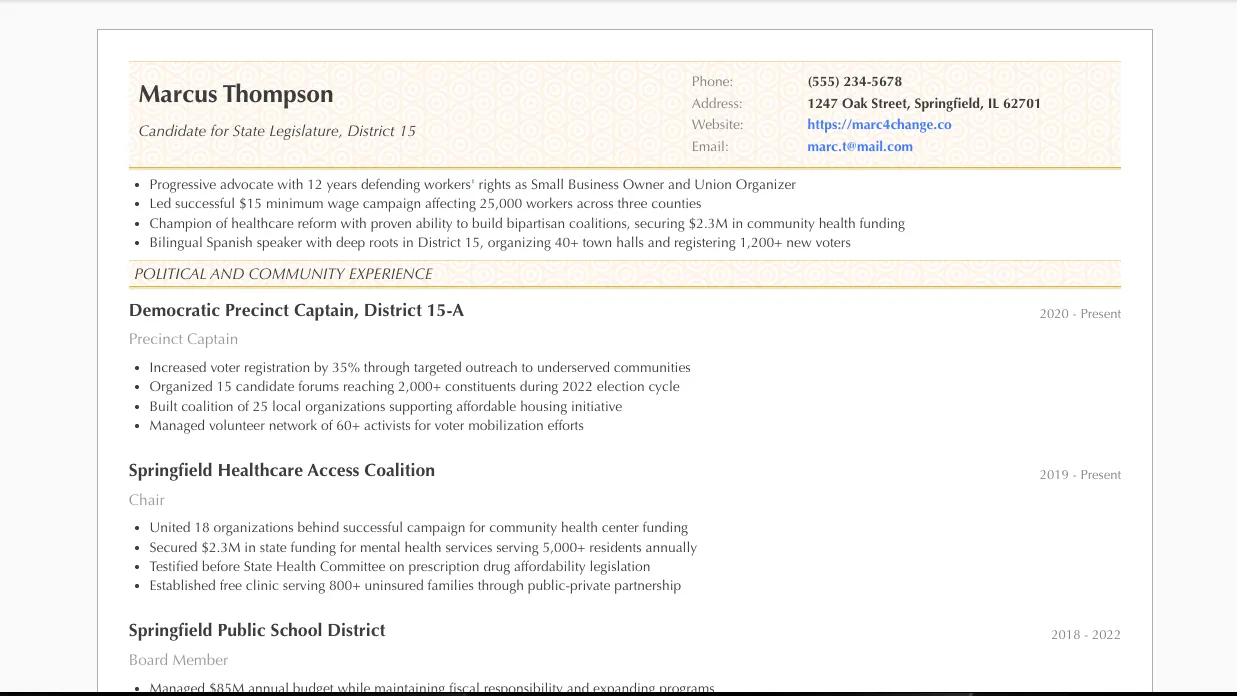
The Best Politician Resume Example/Sample
https://www.resumonk.com/politicianPoliticianResume Format to Follow for Politician Resume
The reverse-chronological format stands as your strongest ally here. Why? Because in politics, your recent activities matter most - voters want to know what you've been doing lately for the community, not what you did fifteen years ago (unless it's remarkably relevant).
This format places your most recent experience at the top, allowing readers to immediately see your current involvement and recent accomplishments.
Structure Your Political Resume Strategically
Start with a powerful summary statement that captures your political philosophy and key achievements in 3-4 lines. This isn't the place for vague statements about being a "people person" - you need concrete positioning that shows your political identity and track record.
❌ Don't write a generic summary:
Dedicated individual seeking political office with strong communication skills
and desire to serve the community.
✅ Do write a compelling political narrative:
- Progressive advocate with 8 years defending workers' rights as Labor Union President.
- Led successful $15 minimum wage campaign affecting 50,000 workers.
- Champion of education reform with proven ability to build bipartisan coalitions.
Organizing Sections for Maximum Impact
After your summary, prioritize sections based on what strengthens your political narrative most. If you have previous elected experience, that goes first. No elected experience? Lead with your community involvement or professional background that demonstrates leadership. The key is showing progression toward this political moment - every section should answer the voter's question of "Why should I trust this person with power?"
Consider using a combination format if you're transitioning from a non-political career. This allows you to highlight transferable skills (like budget management from your business career) while maintaining the reverse-chronological structure that shows your evolution toward public service.
Regional Considerations
In the USA, include party affiliation prominently if running in a partisan race. UK candidates should emphasize constituency work and local connections. Canadian politicians often benefit from highlighting bilingual abilities and experience with diverse communities.
Australian political resumes should stress community consultation and preference dealing experience.
Work Experience on Politician Resume
Your work experience section isn't just a career history - it's your proof of capability to govern.
Every role you list needs to demonstrate skills relevant to political office: leadership, consensus-building, budget management, or community service. That teaching job from five years ago? It shows you understand education policy from the ground up. That small business you ran? Evidence you grasp economic challenges facing your constituents.
Framing Non-Political Experience Politically
Most aspiring politicians don't have extensive elected experience, and that's perfectly fine.
The trick lies in translating your professional experience into political capital. Think about how each role prepared you for public service.
❌ Don't list job duties without political context:
Marketing Manager, ABC Corporation (2018-2023)
- Managed team of 10 employees
- Developed marketing campaigns
- Increased sales by 25%
✅ Do connect experience to public service capabilities:
Marketing Manager, ABC Corporation (2018-2023)
- Led diverse team of 10, fostering inclusive workplace policies later adopted company-wide
- Created community-focused campaigns partnering with 15 local nonprofits
- Managed $2M budget with full transparency and stakeholder accountability
- Established company's first sustainability initiative, reducing waste by 40%
Highlighting Political and Civic Experience
Any political experience - campaign volunteer, party official, appointed board member - deserves prominent placement. But here's where many candidates stumble: they list the position without showcasing the impact.
Your role as Democratic/Republican precinct captain means nothing if you don't explain how you registered 500 new voters or increased primary turnout by 30%.
Include volunteer positions that demonstrate long-term commitment to causes. That five-year stint on the PTA shows dedication, not just resume padding. Quantify your impact wherever possible - dollars raised, people served, legislation influenced.
Addressing Employment Gaps
Politics attracts career-changers and people re-entering the workforce. If you took time off to raise children, care for family, or pursue education, frame these experiences as preparation for public service. Parenting teaches budget management and conflict resolution.
Caregiving develops empathy and understanding of healthcare systems.
❌ Don't hide or apologize for gaps:
2019-2021: Not employed
✅ Do explain how gaps contributed to your readiness:
2019-2021: Community Advocate and Family Caregiver
- Coordinated care for elderly parent, gaining firsthand experience with Medicare system
- Organized neighborhood support network for 20+ families during pandemic
- Researched and advocated for improved senior services at city council meetings
Skills to Show on Politician Resume
Political skills differ from traditional job skills - you're showing more than competence, you're demonstrating readiness to represent thousands (or millions) of people. Your skills section should balance hard governmental competencies with soft skills that prove you can connect with constituents across the political spectrum.
Core Governmental Competencies
Start with skills that directly relate to the office you're seeking.
Running for city council? Budget analysis, urban planning knowledge, and public meeting facilitation matter more than foreign policy expertise. Seeking state legislature? Understanding of legislative process, bill drafting, and committee work take precedence.
List specific, demonstrable skills rather than vague qualities. "Leadership" means nothing without context. "Coalition Building" becomes meaningful when followed by examples.
❌ Don't use generic political buzzwords:
Skills:
- Leadership
- Communication
- Integrity
- Problem-solving
- Team player
✅ Do specify concrete political competencies:
Core Competencies:
- Legislative Process: Drafted 12 policy proposals, 3 adopted by city council
- Budget Analysis: Reviewed and provided input on $50M municipal budget
- Constituent Services: Resolved 200+ citizen concerns through systematic follow-up
- Coalition Building: United 15 organizations behind affordable housing initiative
- Public Speaking: Delivered 50+ speeches to audiences ranging from 10 to 1,000
- Bilingual: Fluent Spanish speaker, conducted 30+ town halls in Spanish
Technology and Modern Campaign Skills
Modern politics requires digital fluency. Include skills like social media management, data analysis, digital organizing, and virtual meeting facilitation.
Show you can reach constituents where they are - both at traditional town halls and on Twitter.
Policy Area Expertise
Identify 3-4 policy areas where you have genuine expertise.
These become your political brand. Maybe you're the education candidate with 15 years teaching experience, or the small business champion who's created 100 jobs. Don't claim expertise in everything - voters see through that immediately.
Frame these as knowledge areas with practical application. Instead of just listing "Healthcare Policy," specify "Healthcare Policy: Implemented workplace wellness program reducing costs 20%, studied single-payer systems in 5 countries."
Cross-Party Appeal Skills
In today's polarized environment, showing ability to work across the aisle is crucial.
Include skills like mediation, negotiation, and consensus-building. Provide evidence of bipartisan achievements, even if small-scale. That time you got liberal and conservative parents to agree on school lunch improvements? That's political gold.
Specific Considerations and Tips for Politician Resume
Here's what separates political resumes from every other type - you're not just qualified, you need to be electable. Your resume isn't just read by professionals; it's scrutinized by journalists, opposition researchers, and voters.
Every line could become a campaign ad - for or against you.
The Opposition Research Test
Before finalizing your resume, read it through your opponent's eyes.
That "consultant" period - was it lobbying? Better to address it transparently than have it discovered. That organization you led - did it take controversial positions? Provide context that shows thoughtful evolution rather than flip-flopping.
Never lie or significantly embellish. In politics, everything gets verified. That "Harvard executive education certificate"? If it was a three-day seminar, don't list it like a degree.
Your opponent will find out, and your credibility evaporates.
Values-Based Accomplishments
Unlike corporate resumes focusing on profit and efficiency, political resumes should emphasize values-driven accomplishments.
Show how you've fought for fairness, expanded opportunity, or protected vulnerable populations. Even business achievements can be reframed around values.
❌ Don't focus solely on business metrics:
Increased company revenue by 30% through aggressive cost-cutting
✅ Do highlight values alongside achievements:
Increased company revenue by 30% while maintaining all jobs and expanding
employee benefits, proving business success doesn't require sacrificing workers
Geographic and Community Roots
Voters want representatives who understand their community.
Emphasize local connections throughout your resume. Mention specific neighborhoods, local institutions, and regional challenges you've addressed. If you're from elsewhere originally, show how you've invested in your adopted community.
Endorsements and Coalitions
While not traditional resume content, consider adding a brief section listing key endorsements or organizational support. This social proof matters enormously in politics.
Keep it to major endorsements - local newspaper, significant unions, respected community leaders.
The Spouse and Family Question
Political resumes often mention family, unlike professional ones. A single line like "Married to Jane Doe (local teacher), two children in public schools" humanizes you and shows investment in community institutions.
However, this varies by region and political level - more expected in local races, less relevant in policy-focused positions.
Avoiding Partisan Landmines
Unless running in a deeply partisan district, avoid unnecessarily polarizing language. Instead of "fought against socialist policies," try "advocated for fiscal responsibility." Instead of "battled right-wing extremists," use "defended democratic institutions."
You can be principled without being needlessly inflammatory.
Financial Transparency Preparation
Many political positions require financial disclosure. Ensure your resume's employment history perfectly aligns with what you'll disclose. Include all sources of significant income, board positions, and investments that might appear in disclosures.
Better to be boringly thorough than suspiciously vague.
Multiple Versions for Different Audiences
Create versions tailored to different audiences.
The resume for party officials might emphasize partisan activities and fundraising. The version for community groups might highlight nonprofit work. The media version should be concise and quotable. All versions must be consistent in facts, varying only in emphasis.
Remember, your political resume launches conversations, it doesn't end them. Every accomplishment should invite follow-up questions you're prepared to answer. Every position should have a story that connects to your campaign narrative.
In politics, your resume isn't just your past - it's the foundation of your promise for the future.
Education to List on Politician Resume
The fascinating thing about political careers is that there's no single educational path that guarantees success.
Unlike becoming a doctor or engineer, politicians come from everywhere - law schools, business programs, public administration degrees, even theater majors who discovered they could channel their performance skills into inspiring speeches. But here's what matters: how you present that education needs to show you're prepared for the intellectual rigor of governance.
Degree Hierarchy and Relevance
Start with your highest degree and work backwards.
If you have a law degree from Harvard but also a Bachelor's in Political Science from your state university, both matter - but differently. The J.D. shows you can navigate legal frameworks, while that Political Science degree demonstrates you've been committed to understanding governance since day one.
❌ Don't write your education like a robot:
Bachelor of Arts - 2018
State University
✅ Do showcase relevant focus areas and achievements:
Bachelor of Arts in Political Science, Minor in Economics
State University, summa cum laude, 2018
• Thesis: "Bridging Urban-Rural Divides in State Healthcare Policy"
• President, Student Government Association (15,000 students represented)
• Completed Legislative Fellowship with Senator Jane Smith
Academic Achievements That Matter in Politics
Your GPA might have gotten you into grad school, but voters care more about what you actually did with that education. Were you published in your university's policy review? Did you lead a successful campaign to change campus policies?
These experiences show you didn't just study government - you practiced it.
Think about including specialized coursework only if it directly relates to your political platform. If you're running on education reform, that semester you spent studying comparative education systems in Scandinavia suddenly becomes very relevant. Running on economic policy? Those advanced econometrics courses aren't just academic fluff anymore.
International Perspectives
In the UK, your Oxbridge education carries weight but can also paint you as elite - balance it carefully with public service experience.
In Canada, bilingual education programs show you can serve all constituents. Australian politicians often highlight TAFE or vocational training alongside university degrees to connect with working-class voters.
American politicians might emphasize state schools to appear relatable, or Ivy League credentials when running in educated districts.
Awards and Publications on Politician Resume
Remember that moment when you won that community service award, or when your op-ed about local infrastructure finally got published in the city newspaper?
Those weren't just personal victories - they were the early indicators of your ability to lead and influence public discourse. In politics, awards on your resume and your publications serve as third-party validation that you're not just another person with opinions; you're someone whose ideas and service have been recognized as valuable.
Strategic Selection of Awards
Not all awards are created equal in the political arena. That "Employee of the Month" from your corporate days? Maybe skip it. But the "Young Leader Award" from your state's Chamber of Commerce? That's gold.
Focus on recognition that demonstrates community service, leadership, policy expertise, or successful advocacy.
❌ Don't list awards without context:
Community Champion Award - 2020
Excellence in Service - 2019
Leadership Recognition - 2018
✅ Do provide meaningful detail that shows impact:
Community Champion Award - Urban League of Greater Metro Area, 2020
• Recognized for establishing free legal clinic serving 500+ low-income families annually

State Policy Innovation Award - Citizens for Better Government, 2019
• Honored for authoring and advocating legislation reducing prescription drug costs by 30%
Publications That Build Your Political Brand
Your published work - whether it's academic papers, opinion pieces, or policy briefs - creates a paper trail of your evolving political philosophy.
Voters and opponents alike will dig through these, so choose wisely. That passionate blog post from college about revolutionary change might need context now that you're running as a moderate reformer.
Include publications that demonstrate your expertise in key policy areas. Academic publications show depth of knowledge, while op-eds in major newspapers show you can communicate complex ideas to regular voters. Policy briefs for think tanks position you as a serious policy wonk.
The Credibility Balance
Awards from partisan organizations can be double-edged swords.
The "Conservative Leader of Tomorrow" award might energize your base but could alienate moderates. Consider your audience and the office you're seeking. Local elections might favor community-based recognition, while state or federal races might require more prestigious, broadly-recognized honors.
For international context, UK politicians often highlight honours from professional bodies or charitable organizations. Canadian politicians frequently include bilingual publication credits.
Australian politicians might emphasize union or industry association awards depending on their constituency.
Listing References for Politician Resume
Your references in politics aren't just people who can vouch that you showed up to work on time.
They're your political capital made tangible - the network of respected individuals willing to stake their own reputations on your candidacy. That former mayor who mentored you, the union leader whose endorsement you earned, the constituent whose life you changed through casework - these references tell voters who believes in you before they're asked to.
The Strategic Selection Process
Political references require chess-level strategic thinking. You need a mix that demonstrates broad support while maintaining ideological coherence.
Including both the progressive activist and the chamber of commerce president shows coalition-building skills, but only if you can actually deliver both endorsements without seeming inauthentic.
❌ Don't list references without context:
References:
John Smith - 555-0123
Jane Doe - 555-0124
Bob Johnson - 555-0125
✅ Do provide strategic positioning:
References:
Hon. Patricia Williams
Former Mayor of Cityville (2010-2018)
Phone: 555-0123
Relationship: Mentored my infrastructure initiative that secured $50M in federal funding

Marcus Chen
President, Local 542 Teachers Union
Phone: 555-0124
Relationship: Partnered on education reform legislation affecting 10,000 educators
The Unwritten Rules of Political References
In politics, some references carry invisible weight. A reference from someone who lost their last election might signal you're aligned with failed strategies. A reference from someone under investigation could torpedo your campaign overnight.
Vet your references not just for what they'll say about you, but for what their association says about you.
Consider creating different reference lists for different audiences. Primary voters might value ideological purity validators, while general election voters might prefer pragmatic problem-solvers who've worked with you. Party officials considering you for appointment might want to see you can work within existing power structures.
International Considerations
UK politicians should be particularly mindful of party affiliations and whether references from MPs or Lords are appropriate for the position sought. Canadian politicians often benefit from references that span linguistic and cultural communities. Australian politicians should consider including union or business council leaders depending on their party affiliation. In the US, the local vs. state vs. federal hierarchy of references matters enormously - a congressional reference for a school board race might seem like overkill.
Always secure permission before listing references, but in politics, go further - brief them on your key messages and positions. Your references aren't just confirming your employment history; they're early campaign surrogates who need to stay on message.
Cover Letter Tips for Politician Resume
Here's something they don't tell you in political science classes - a politician's cover letter isn't really a cover letter at all.
It's your first campaign speech, your initial policy platform, and your personal narrative all rolled into one page. While corporate applicants write cover letters to HR departments, you're writing to voters, party officials, campaign managers, or appointment committees. Each word is a mini-campaign promise.
The Opening That Commands Attention
Forget the standard "I am writing to apply for..." opening. You're not applying; you're declaring your intention to serve. Your opening paragraph should immediately establish why this moment, this position, and this constituency need your leadership.
❌ Don't open with generic political platitudes:
Dear Voters,
I have always been passionate about public service and would like to run for City Council. I believe I can make a difference.
✅ Do open with specific vision and credibility:
Dear Members of the Democratic Committee,
After spending three years organizing our district's response to the housing crisis - resulting in 200 new affordable units and preventing 500 evictions - I am ready to bring this proven approach to the State Legislature where we can scale these solutions statewide.
The Body - Policy Meets Personal
Your middle paragraphs need to weave together three critical elements: your understanding of constituent needs, your relevant experience, and your specific plan of action. This isn't the place for vague promises about "fighting for working families."
Instead, demonstrate that you understand exactly which policies affect working families and how you'll change them.
Remember that different political positions require different tones. A letter for a judicial appointment emphasizes non-partisan fairness and legal expertise. A letter for party endorsement in a primary can be more ideologically bold.
A letter introducing yourself for a general election needs to appeal to the broadest coalition possible.
Closing With Commitment
Your closing shouldn't ask for consideration - it should affirm your readiness to serve and invite engagement. Provide specific next steps, whether that's attending town halls, participating in debates, or meeting with party officials.
In Canada, consider having versions in both English and French for federal positions. UK politicians should be mindful of formal titles and proper forms of address. Australian politicians often adopt a more informal, direct tone reflecting the country's political culture. American politicians need to calibrate formality based on region - what works in Vermont might not work in Virginia.
Key Takeaways
After working through this comprehensive guide, here are the essential elements to remember as you craft your politician resume:
- Use reverse-chronological format to highlight your most recent and relevant political involvement, community service, and professional experience that demonstrates readiness for public office
- Frame all experience through a political lens - translate every role, whether corporate, nonprofit, or volunteer, into demonstrable skills relevant to governance and public service
- Quantify your community impact with specific numbers - voters registered, funds raised, people served, legislation influenced, or community problems solved
- Balance partisan positioning carefully - be clear about your values and party affiliation where appropriate, but avoid unnecessarily polarizing language that might alienate potential supporters
- Apply the opposition research test - review every line through the eyes of potential opponents and journalists, ensuring complete honesty and strategic transparency
- Demonstrate deep local connections by emphasizing geographic roots, community involvement, and understanding of constituent-specific challenges throughout your resume
- Create multiple tailored versions for different audiences (party officials, donors, media, voters) while maintaining absolute consistency in facts
- Include policy expertise areas where you have genuine depth - typically 3-4 areas where your experience gives you credible authority to propose solutions
- Select references strategically as political validators who represent the coalition you're building and can speak to your readiness for public service
- Write your cover letter as a campaign declaration that establishes your vision, credibility, and specific plans rather than a traditional job application
Creating a compelling politician resume might feel overwhelming when you're transitioning from community activism, business leadership, or any other field into the political arena. The good news is that Resumonk's intuitive platform makes this complex process manageable. With professionally designed templates that understand the unique needs of political candidates, you can focus on crafting your narrative while we handle the formatting. Our AI-powered suggestions help you identify and articulate transferable skills from any background, ensuring your resume speaks fluently in the language of political capability. Whether you're running for local school board or setting your sights on state legislature, Resumonk provides the tools to present your experience, values, and vision in a format that resonates with party officials, donors, and voters alike.
Ready to transform your passion for public service into a powerful political resume?
Start building your politician resume today with Resumonk's specialized templates and intelligent recommendations. Successfully launch your political career with a professionally crafted resume that tells your unique story of service and leadership.
Get started with Resumonk now and take the first step from concerned citizen to candidate.
More Government resume examples
See all Government resume examples, or browse every category.
Resume writing tips
You're sitting at your kitchen table at 11 PM, surrounded by newspaper clippings of council meetings you've attended, volunteer certificates from the local food bank, and that photo from when you organized the neighborhood watch program that actually reduced break-ins by 40%.
Your spouse is asleep, but you're wide awake because tomorrow you're finally doing it - you're throwing your hat into the political ring. Maybe it's for school board, maybe city council, or perhaps you're taking that leap into state legislature. But here's the thing that's keeping you up - how do you translate years of caring about your community, fighting for better schools, or advocating for small businesses into a resume that makes party officials, donors, and ultimately voters say, "Yes, this is exactly who we need"?
The path to political office isn't like applying for a job at a corporation where you send your resume to HR and wait for a callback. You're not trying to impress one hiring manager - you're presenting yourself to an entire ecosystem of stakeholders. Campaign managers need to see you're electable. Party officials want to know you can raise funds and mobilize volunteers. Journalists will scrutinize every line for inconsistencies. And voters? They need to trust that you understand their struggles because you've lived them, worked through them, or dedicated yourself to solving them. A politician's resume isn't just a career summary - it's the foundation document of your public service narrative, the proof that you're not just another person with opinions at the town hall microphone, but someone with the experience, skills, and dedication to actually get things done.
This comprehensive guide walks you through every crucial element of crafting a politician resume that resonates with your unique audience. We'll start by exploring the optimal resume format - why reverse-chronological structure works best for showcasing your recent community involvement and growing political engagement. Then we'll dive deep into presenting your work experience in a way that demonstrates governance capability, even if you've never held elected office before. You'll learn which skills actually matter in politics (hint: "leadership" without context means nothing) and how to present them credibly. We'll navigate the unique considerations that make political resumes different from any other type - from the opposition research test to managing partisan considerations and maintaining consistency across multiple versions for different audiences.
As we continue, we'll examine how to present your educational background as intellectual preparation for governance, not just degrees on a wall. We'll explore strategic selection of awards and publications that build your political brand. You'll discover how a politician's cover letter functions as your first campaign speech rather than a traditional application letter. And we'll conclude with the delicate art of selecting references who serve as early validators of your candidacy. By the end of this guide, you'll have everything you need to create a politician resume that doesn't just list your qualifications - it launches your campaign narrative and positions you as the leader your community needs.
The Best Politician Resume Example/Sample
https://www.resumonk.com/politicianPoliticianResume Format to Follow for Politician Resume
The reverse-chronological format stands as your strongest ally here. Why? Because in politics, your recent activities matter most - voters want to know what you've been doing lately for the community, not what you did fifteen years ago (unless it's remarkably relevant).
This format places your most recent experience at the top, allowing readers to immediately see your current involvement and recent accomplishments.
Structure Your Political Resume Strategically
Start with a powerful summary statement that captures your political philosophy and key achievements in 3-4 lines. This isn't the place for vague statements about being a "people person" - you need concrete positioning that shows your political identity and track record.
❌ Don't write a generic summary:
Dedicated individual seeking political office with strong communication skills
and desire to serve the community.
✅ Do write a compelling political narrative:
- Progressive advocate with 8 years defending workers' rights as Labor Union President.
- Led successful $15 minimum wage campaign affecting 50,000 workers.
- Champion of education reform with proven ability to build bipartisan coalitions.
Organizing Sections for Maximum Impact
After your summary, prioritize sections based on what strengthens your political narrative most. If you have previous elected experience, that goes first. No elected experience? Lead with your community involvement or professional background that demonstrates leadership. The key is showing progression toward this political moment - every section should answer the voter's question of "Why should I trust this person with power?"
Consider using a combination format if you're transitioning from a non-political career. This allows you to highlight transferable skills (like budget management from your business career) while maintaining the reverse-chronological structure that shows your evolution toward public service.
Regional Considerations
In the USA, include party affiliation prominently if running in a partisan race. UK candidates should emphasize constituency work and local connections. Canadian politicians often benefit from highlighting bilingual abilities and experience with diverse communities.
Australian political resumes should stress community consultation and preference dealing experience.
Work Experience on Politician Resume
Your work experience section isn't just a career history - it's your proof of capability to govern.
Every role you list needs to demonstrate skills relevant to political office: leadership, consensus-building, budget management, or community service. That teaching job from five years ago? It shows you understand education policy from the ground up. That small business you ran? Evidence you grasp economic challenges facing your constituents.
Framing Non-Political Experience Politically
Most aspiring politicians don't have extensive elected experience, and that's perfectly fine.
The trick lies in translating your professional experience into political capital. Think about how each role prepared you for public service.
❌ Don't list job duties without political context:
Marketing Manager, ABC Corporation (2018-2023)
- Managed team of 10 employees
- Developed marketing campaigns
- Increased sales by 25%
✅ Do connect experience to public service capabilities:
Marketing Manager, ABC Corporation (2018-2023)
- Led diverse team of 10, fostering inclusive workplace policies later adopted company-wide
- Created community-focused campaigns partnering with 15 local nonprofits
- Managed $2M budget with full transparency and stakeholder accountability
- Established company's first sustainability initiative, reducing waste by 40%
Highlighting Political and Civic Experience
Any political experience - campaign volunteer, party official, appointed board member - deserves prominent placement. But here's where many candidates stumble: they list the position without showcasing the impact.
Your role as Democratic/Republican precinct captain means nothing if you don't explain how you registered 500 new voters or increased primary turnout by 30%.
Include volunteer positions that demonstrate long-term commitment to causes. That five-year stint on the PTA shows dedication, not just resume padding. Quantify your impact wherever possible - dollars raised, people served, legislation influenced.
Addressing Employment Gaps
Politics attracts career-changers and people re-entering the workforce. If you took time off to raise children, care for family, or pursue education, frame these experiences as preparation for public service. Parenting teaches budget management and conflict resolution.
Caregiving develops empathy and understanding of healthcare systems.
❌ Don't hide or apologize for gaps:
2019-2021: Not employed
✅ Do explain how gaps contributed to your readiness:
2019-2021: Community Advocate and Family Caregiver
- Coordinated care for elderly parent, gaining firsthand experience with Medicare system
- Organized neighborhood support network for 20+ families during pandemic
- Researched and advocated for improved senior services at city council meetings
Skills to Show on Politician Resume
Political skills differ from traditional job skills - you're showing more than competence, you're demonstrating readiness to represent thousands (or millions) of people. Your skills section should balance hard governmental competencies with soft skills that prove you can connect with constituents across the political spectrum.
Core Governmental Competencies
Start with skills that directly relate to the office you're seeking.
Running for city council? Budget analysis, urban planning knowledge, and public meeting facilitation matter more than foreign policy expertise. Seeking state legislature? Understanding of legislative process, bill drafting, and committee work take precedence.
List specific, demonstrable skills rather than vague qualities. "Leadership" means nothing without context. "Coalition Building" becomes meaningful when followed by examples.
❌ Don't use generic political buzzwords:
Skills:
- Leadership
- Communication
- Integrity
- Problem-solving
- Team player
✅ Do specify concrete political competencies:
Core Competencies:
- Legislative Process: Drafted 12 policy proposals, 3 adopted by city council
- Budget Analysis: Reviewed and provided input on $50M municipal budget
- Constituent Services: Resolved 200+ citizen concerns through systematic follow-up
- Coalition Building: United 15 organizations behind affordable housing initiative
- Public Speaking: Delivered 50+ speeches to audiences ranging from 10 to 1,000
- Bilingual: Fluent Spanish speaker, conducted 30+ town halls in Spanish
Technology and Modern Campaign Skills
Modern politics requires digital fluency. Include skills like social media management, data analysis, digital organizing, and virtual meeting facilitation.
Show you can reach constituents where they are - both at traditional town halls and on Twitter.
Policy Area Expertise
Identify 3-4 policy areas where you have genuine expertise.
These become your political brand. Maybe you're the education candidate with 15 years teaching experience, or the small business champion who's created 100 jobs. Don't claim expertise in everything - voters see through that immediately.
Frame these as knowledge areas with practical application. Instead of just listing "Healthcare Policy," specify "Healthcare Policy: Implemented workplace wellness program reducing costs 20%, studied single-payer systems in 5 countries."
Cross-Party Appeal Skills
In today's polarized environment, showing ability to work across the aisle is crucial.
Include skills like mediation, negotiation, and consensus-building. Provide evidence of bipartisan achievements, even if small-scale. That time you got liberal and conservative parents to agree on school lunch improvements? That's political gold.
Specific Considerations and Tips for Politician Resume
Here's what separates political resumes from every other type - you're not just qualified, you need to be electable. Your resume isn't just read by professionals; it's scrutinized by journalists, opposition researchers, and voters.
Every line could become a campaign ad - for or against you.
The Opposition Research Test
Before finalizing your resume, read it through your opponent's eyes.
That "consultant" period - was it lobbying? Better to address it transparently than have it discovered. That organization you led - did it take controversial positions? Provide context that shows thoughtful evolution rather than flip-flopping.
Never lie or significantly embellish. In politics, everything gets verified. That "Harvard executive education certificate"? If it was a three-day seminar, don't list it like a degree.
Your opponent will find out, and your credibility evaporates.
Values-Based Accomplishments
Unlike corporate resumes focusing on profit and efficiency, political resumes should emphasize values-driven accomplishments.
Show how you've fought for fairness, expanded opportunity, or protected vulnerable populations. Even business achievements can be reframed around values.
❌ Don't focus solely on business metrics:
Increased company revenue by 30% through aggressive cost-cutting
✅ Do highlight values alongside achievements:
Increased company revenue by 30% while maintaining all jobs and expanding
employee benefits, proving business success doesn't require sacrificing workers
Geographic and Community Roots
Voters want representatives who understand their community.
Emphasize local connections throughout your resume. Mention specific neighborhoods, local institutions, and regional challenges you've addressed. If you're from elsewhere originally, show how you've invested in your adopted community.
Endorsements and Coalitions
While not traditional resume content, consider adding a brief section listing key endorsements or organizational support. This social proof matters enormously in politics.
Keep it to major endorsements - local newspaper, significant unions, respected community leaders.
The Spouse and Family Question
Political resumes often mention family, unlike professional ones. A single line like "Married to Jane Doe (local teacher), two children in public schools" humanizes you and shows investment in community institutions.
However, this varies by region and political level - more expected in local races, less relevant in policy-focused positions.
Avoiding Partisan Landmines
Unless running in a deeply partisan district, avoid unnecessarily polarizing language. Instead of "fought against socialist policies," try "advocated for fiscal responsibility." Instead of "battled right-wing extremists," use "defended democratic institutions."
You can be principled without being needlessly inflammatory.
Financial Transparency Preparation
Many political positions require financial disclosure. Ensure your resume's employment history perfectly aligns with what you'll disclose. Include all sources of significant income, board positions, and investments that might appear in disclosures.
Better to be boringly thorough than suspiciously vague.
Multiple Versions for Different Audiences
Create versions tailored to different audiences.
The resume for party officials might emphasize partisan activities and fundraising. The version for community groups might highlight nonprofit work. The media version should be concise and quotable. All versions must be consistent in facts, varying only in emphasis.
Remember, your political resume launches conversations, it doesn't end them. Every accomplishment should invite follow-up questions you're prepared to answer. Every position should have a story that connects to your campaign narrative.
In politics, your resume isn't just your past - it's the foundation of your promise for the future.
Education to List on Politician Resume
The fascinating thing about political careers is that there's no single educational path that guarantees success.
Unlike becoming a doctor or engineer, politicians come from everywhere - law schools, business programs, public administration degrees, even theater majors who discovered they could channel their performance skills into inspiring speeches. But here's what matters: how you present that education needs to show you're prepared for the intellectual rigor of governance.
Degree Hierarchy and Relevance
Start with your highest degree and work backwards.
If you have a law degree from Harvard but also a Bachelor's in Political Science from your state university, both matter - but differently. The J.D. shows you can navigate legal frameworks, while that Political Science degree demonstrates you've been committed to understanding governance since day one.
❌ Don't write your education like a robot:
Bachelor of Arts - 2018
State University
✅ Do showcase relevant focus areas and achievements:
Bachelor of Arts in Political Science, Minor in Economics
State University, summa cum laude, 2018
• Thesis: "Bridging Urban-Rural Divides in State Healthcare Policy"
• President, Student Government Association (15,000 students represented)
• Completed Legislative Fellowship with Senator Jane Smith
Academic Achievements That Matter in Politics
Your GPA might have gotten you into grad school, but voters care more about what you actually did with that education. Were you published in your university's policy review? Did you lead a successful campaign to change campus policies?
These experiences show you didn't just study government - you practiced it.
Think about including specialized coursework only if it directly relates to your political platform. If you're running on education reform, that semester you spent studying comparative education systems in Scandinavia suddenly becomes very relevant. Running on economic policy? Those advanced econometrics courses aren't just academic fluff anymore.
International Perspectives
In the UK, your Oxbridge education carries weight but can also paint you as elite - balance it carefully with public service experience.
In Canada, bilingual education programs show you can serve all constituents. Australian politicians often highlight TAFE or vocational training alongside university degrees to connect with working-class voters.
American politicians might emphasize state schools to appear relatable, or Ivy League credentials when running in educated districts.
Awards and Publications on Politician Resume
Remember that moment when you won that community service award, or when your op-ed about local infrastructure finally got published in the city newspaper?
Those weren't just personal victories - they were the early indicators of your ability to lead and influence public discourse. In politics, awards on your resume and your publications serve as third-party validation that you're not just another person with opinions; you're someone whose ideas and service have been recognized as valuable.
Strategic Selection of Awards
Not all awards are created equal in the political arena. That "Employee of the Month" from your corporate days? Maybe skip it. But the "Young Leader Award" from your state's Chamber of Commerce? That's gold.
Focus on recognition that demonstrates community service, leadership, policy expertise, or successful advocacy.
❌ Don't list awards without context:
Community Champion Award - 2020
Excellence in Service - 2019
Leadership Recognition - 2018
✅ Do provide meaningful detail that shows impact:
Community Champion Award - Urban League of Greater Metro Area, 2020
• Recognized for establishing free legal clinic serving 500+ low-income families annually

State Policy Innovation Award - Citizens for Better Government, 2019
• Honored for authoring and advocating legislation reducing prescription drug costs by 30%
Publications That Build Your Political Brand
Your published work - whether it's academic papers, opinion pieces, or policy briefs - creates a paper trail of your evolving political philosophy.
Voters and opponents alike will dig through these, so choose wisely. That passionate blog post from college about revolutionary change might need context now that you're running as a moderate reformer.
Include publications that demonstrate your expertise in key policy areas. Academic publications show depth of knowledge, while op-eds in major newspapers show you can communicate complex ideas to regular voters. Policy briefs for think tanks position you as a serious policy wonk.
The Credibility Balance
Awards from partisan organizations can be double-edged swords.
The "Conservative Leader of Tomorrow" award might energize your base but could alienate moderates. Consider your audience and the office you're seeking. Local elections might favor community-based recognition, while state or federal races might require more prestigious, broadly-recognized honors.
For international context, UK politicians often highlight honours from professional bodies or charitable organizations. Canadian politicians frequently include bilingual publication credits.
Australian politicians might emphasize union or industry association awards depending on their constituency.
Listing References for Politician Resume
Your references in politics aren't just people who can vouch that you showed up to work on time.
They're your political capital made tangible - the network of respected individuals willing to stake their own reputations on your candidacy. That former mayor who mentored you, the union leader whose endorsement you earned, the constituent whose life you changed through casework - these references tell voters who believes in you before they're asked to.
The Strategic Selection Process
Political references require chess-level strategic thinking. You need a mix that demonstrates broad support while maintaining ideological coherence.
Including both the progressive activist and the chamber of commerce president shows coalition-building skills, but only if you can actually deliver both endorsements without seeming inauthentic.
❌ Don't list references without context:
References:
John Smith - 555-0123
Jane Doe - 555-0124
Bob Johnson - 555-0125
✅ Do provide strategic positioning:
References:
Hon. Patricia Williams
Former Mayor of Cityville (2010-2018)
Phone: 555-0123
Relationship: Mentored my infrastructure initiative that secured $50M in federal funding

Marcus Chen
President, Local 542 Teachers Union
Phone: 555-0124
Relationship: Partnered on education reform legislation affecting 10,000 educators
The Unwritten Rules of Political References
In politics, some references carry invisible weight. A reference from someone who lost their last election might signal you're aligned with failed strategies. A reference from someone under investigation could torpedo your campaign overnight.
Vet your references not just for what they'll say about you, but for what their association says about you.
Consider creating different reference lists for different audiences. Primary voters might value ideological purity validators, while general election voters might prefer pragmatic problem-solvers who've worked with you. Party officials considering you for appointment might want to see you can work within existing power structures.
International Considerations
UK politicians should be particularly mindful of party affiliations and whether references from MPs or Lords are appropriate for the position sought. Canadian politicians often benefit from references that span linguistic and cultural communities. Australian politicians should consider including union or business council leaders depending on their party affiliation. In the US, the local vs. state vs. federal hierarchy of references matters enormously - a congressional reference for a school board race might seem like overkill.
Always secure permission before listing references, but in politics, go further - brief them on your key messages and positions. Your references aren't just confirming your employment history; they're early campaign surrogates who need to stay on message.
Cover Letter Tips for Politician Resume
Here's something they don't tell you in political science classes - a politician's cover letter isn't really a cover letter at all.
It's your first campaign speech, your initial policy platform, and your personal narrative all rolled into one page. While corporate applicants write cover letters to HR departments, you're writing to voters, party officials, campaign managers, or appointment committees. Each word is a mini-campaign promise.
The Opening That Commands Attention
Forget the standard "I am writing to apply for..." opening. You're not applying; you're declaring your intention to serve. Your opening paragraph should immediately establish why this moment, this position, and this constituency need your leadership.
❌ Don't open with generic political platitudes:
Dear Voters,
I have always been passionate about public service and would like to run for City Council. I believe I can make a difference.
✅ Do open with specific vision and credibility:
Dear Members of the Democratic Committee,
After spending three years organizing our district's response to the housing crisis - resulting in 200 new affordable units and preventing 500 evictions - I am ready to bring this proven approach to the State Legislature where we can scale these solutions statewide.
The Body - Policy Meets Personal
Your middle paragraphs need to weave together three critical elements: your understanding of constituent needs, your relevant experience, and your specific plan of action. This isn't the place for vague promises about "fighting for working families."
Instead, demonstrate that you understand exactly which policies affect working families and how you'll change them.
Remember that different political positions require different tones. A letter for a judicial appointment emphasizes non-partisan fairness and legal expertise. A letter for party endorsement in a primary can be more ideologically bold.
A letter introducing yourself for a general election needs to appeal to the broadest coalition possible.
Closing With Commitment
Your closing shouldn't ask for consideration - it should affirm your readiness to serve and invite engagement. Provide specific next steps, whether that's attending town halls, participating in debates, or meeting with party officials.
In Canada, consider having versions in both English and French for federal positions. UK politicians should be mindful of formal titles and proper forms of address. Australian politicians often adopt a more informal, direct tone reflecting the country's political culture. American politicians need to calibrate formality based on region - what works in Vermont might not work in Virginia.
Key Takeaways
After working through this comprehensive guide, here are the essential elements to remember as you craft your politician resume:
- Use reverse-chronological format to highlight your most recent and relevant political involvement, community service, and professional experience that demonstrates readiness for public office
- Frame all experience through a political lens - translate every role, whether corporate, nonprofit, or volunteer, into demonstrable skills relevant to governance and public service
- Quantify your community impact with specific numbers - voters registered, funds raised, people served, legislation influenced, or community problems solved
- Balance partisan positioning carefully - be clear about your values and party affiliation where appropriate, but avoid unnecessarily polarizing language that might alienate potential supporters
- Apply the opposition research test - review every line through the eyes of potential opponents and journalists, ensuring complete honesty and strategic transparency
- Demonstrate deep local connections by emphasizing geographic roots, community involvement, and understanding of constituent-specific challenges throughout your resume
- Create multiple tailored versions for different audiences (party officials, donors, media, voters) while maintaining absolute consistency in facts
- Include policy expertise areas where you have genuine depth - typically 3-4 areas where your experience gives you credible authority to propose solutions
- Select references strategically as political validators who represent the coalition you're building and can speak to your readiness for public service
- Write your cover letter as a campaign declaration that establishes your vision, credibility, and specific plans rather than a traditional job application
Creating a compelling politician resume might feel overwhelming when you're transitioning from community activism, business leadership, or any other field into the political arena. The good news is that Resumonk's intuitive platform makes this complex process manageable. With professionally designed templates that understand the unique needs of political candidates, you can focus on crafting your narrative while we handle the formatting. Our AI-powered suggestions help you identify and articulate transferable skills from any background, ensuring your resume speaks fluently in the language of political capability. Whether you're running for local school board or setting your sights on state legislature, Resumonk provides the tools to present your experience, values, and vision in a format that resonates with party officials, donors, and voters alike.
Ready to transform your passion for public service into a powerful political resume?
Start building your politician resume today with Resumonk's specialized templates and intelligent recommendations. Successfully launch your political career with a professionally crafted resume that tells your unique story of service and leadership.
Get started with Resumonk now and take the first step from concerned citizen to candidate.
More Government resume examples
See all Government resume examples, or browse every category.
Resume writing tips