Paraprofessional Resume Example (with Tips and Best Practices)
Introduction
Picture yourself standing in the doorway of a bustling classroom at 7:45 AM, coffee in hand, watching as 25 unique learners begin to file in. There's Jamie, who needs help organizing his materials for the day. Maria, who communicates through her AAC device and lights up when she sees you. And Thomas, whose autism means he thrives on the predictable routine you help maintain. You're not the teacher, but you're absolutely essential to making this classroom work.
You're a paraprofessional - that vital bridge between educational planning and actual learning, between a teacher's vision and a student's understanding, between struggle and breakthrough.
Maybe you're here because you've been volunteering at your kid's school and realized you have a gift for connecting with struggling learners. Perhaps you're transitioning from another career - retail, healthcare, childcare - and you're ready to channel your skills into meaningful educational support. Or you might be fresh from your associate degree, eager to make a difference while you decide if teaching is your ultimate path. Whatever brought you here, you're searching for more than just a generic resume template. You need guidance that understands the unique position of a paraprofessional - not quite teacher, more than aide, absolutely indispensable.
Finding the right paraprofessional resume example matters because this role exists in such a specific space. You need to demonstrate educational competence without a teaching license, show leadership qualities while emphasizing your collaborative nature, and prove you can handle significant responsibilities while respecting the classroom hierarchy. It's a delicate balance that generic resume advice simply doesn't address.
In this comprehensive guide, we'll walk you through everything from choosing the perfect resume format that highlights your relevant experience (even if it's not in education), to crafting work descriptions that capture your actual impact on student success. We'll explore how to showcase your education and certifications in ways that meet district requirements, what skills really matter to principals and special education directors, and those insider tips that separate memorable applications from the forgotten pile. We'll also tackle the often-overlooked elements - how awards and recognition translate for paraprofessionals, why your cover letter might matter even more than teachers' letters, and how to strategically select and present references who can speak to your unique value. By the end, you'll have everything you need to create a resume that genuinely reflects your potential to support, nurture, and empower students who need you most.
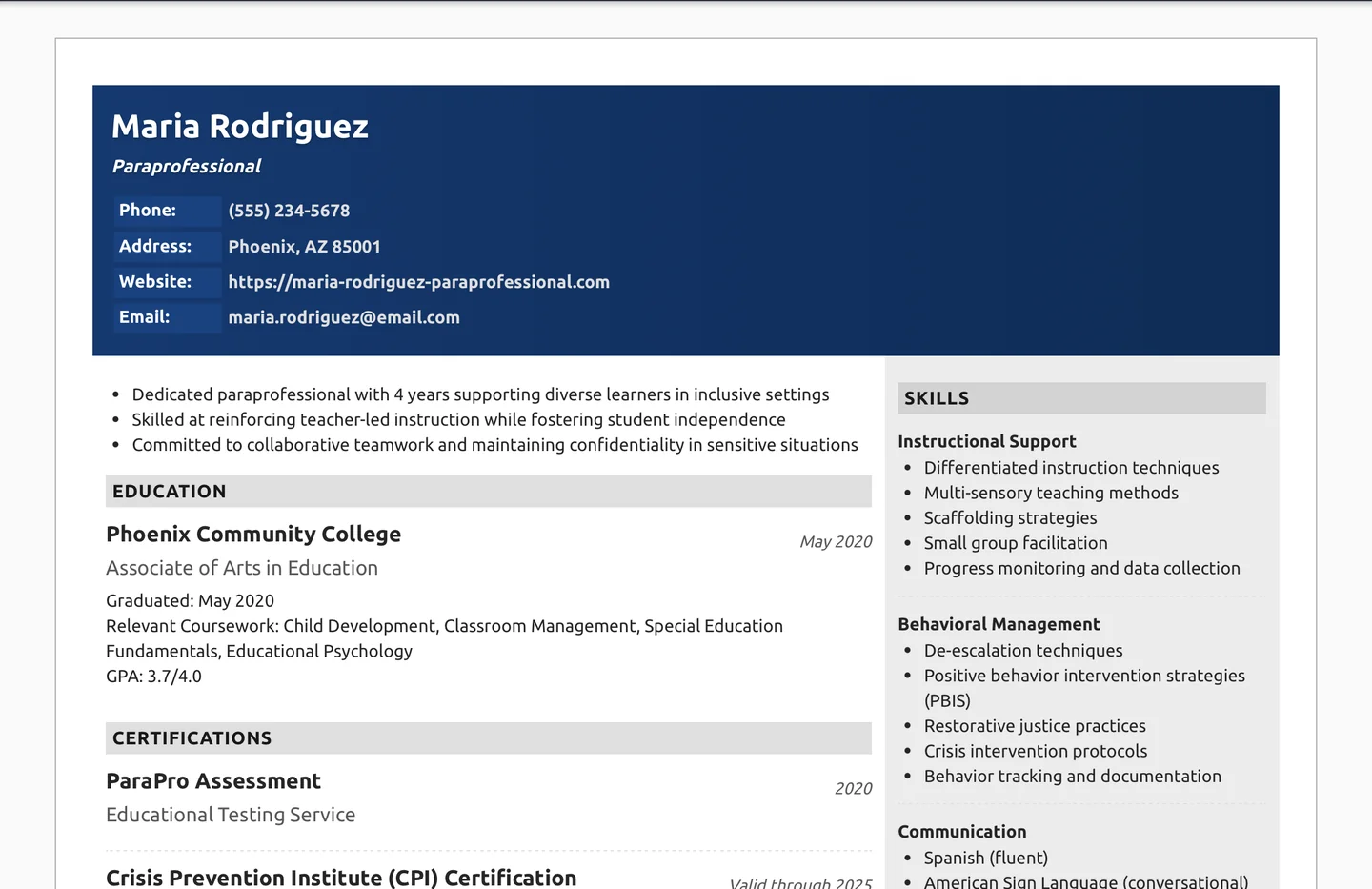
The Ultimate Paraprofessional Resume Example/Sample
https://www.resumonk.com/paraprofessionalParaprofessionalChoosing the Right Resume Format for Your Paraprofessional Resume
The reverse-chronological format stands as your strongest ally here. Why? Because school administrators and hiring committees want to see your most recent educational involvement first - whether that's your student teaching experience, your volunteer work at the after-school program, or your current role as a substitute teacher.
This format immediately showcases your current connection to education, which matters immensely in a field where understanding today's classroom dynamics is crucial.
When to Consider Alternative Formats
However, if you're making that brave leap from retail management or healthcare into education support, a combination format might serve you better. This hybrid approach lets you lead with a skills summary that translates your customer service excellence or patient care experience into classroom-relevant capabilities, then follows with your work history.
Think of it as building a bridge between where you've been and where you're headed.
The functional format rarely works for paraprofessional positions. School districts need to verify your employment history and see your progression - they're entrusting you with supporting vulnerable learners, after all.
Hiding your timeline behind a skills-only format might raise unnecessary red flags.
Structuring Your Paraprofessional Resume Sections
Your resume should flow in this order - contact information, a brief professional summary (2-3 lines maximum), your education credentials, relevant certifications, work experience, and finally your skills. Notice how education comes before experience? That's intentional. Whether you have an associate's degree in education, a bachelor's in any field, or specific paraprofessional certification, these credentials need visibility.
In states like Texas or New York where paraprofessional requirements differ significantly, your educational qualifications might be the first checkpoint for eligibility.
Keep everything within two pages - one page if you're entry-level, two if you have substantial relevant experience. Remember, the principal reviewing your resume between IEP meetings and parent conferences needs to quickly understand why you belong in their school community.
Crafting Your Work Experience as a Paraprofessional
Here's where many paraprofessional candidates stumble - they list duties instead of painting a picture of their impact. You weren't just "present in the classroom." You were the bridge between a struggling third-grader and their eureka moment in mathematics. You were the calm presence that helped a student with autism navigate the chaos of changing classes.
Your work experience section needs to capture these moments while maintaining professional credibility.
Quantifying Your Classroom Impact
Start each bullet point with an action verb that captures your supportive yet proactive role. Words like "facilitated," "reinforced," "adapted," and "collaborated" show you understand the delicate balance of supporting without overstepping the lead teacher's authority.
❌ Don't write vague descriptions:
Helped students with their work
Assisted teacher in classroom
Worked with special needs children
✅ Do write specific, impactful statements:
- Reinforced math concepts for 8 struggling students through group instruction - 15% average grade improvement
- Adapted learning materials for 3 students with IEPs, collaborating weekly with special education team
- Facilitated smooth transitions for 5 students with behavioral challenges using de-escalation techniques
Translating Non-Education Experience
If you're transitioning from another field, your challenge lies in translation. That retail experience? It taught you crowd control and conflict resolution - essential for managing a cafeteria full of middle schoolers. Your healthcare background?
Patient charting translates beautifully to maintaining detailed student progress records.
For example, a former customer service representative might write:
- Resolved average of 50+ customer concerns daily using active listening and problem-solving skills
- Maintained detailed interaction logs and followed up on complex cases requiring multiple touchpoints
These experiences directly parallel managing student behavioral incidents and tracking intervention progress - skills every school desperately needs.
Addressing Different Educational Settings
Your experience section should reflect the specific environment you've worked in.
Elementary paraprofessionals focus on foundational learning support and basic skill reinforcement. Middle school paraprofessionals often emphasize behavioral management and adolescent engagement strategies. High school paraprofessionals might highlight subject-specific support or transition planning for students with disabilities.
In the UK, where the role is called a Teaching Assistant, emphasize your understanding of the National Curriculum. Canadian applicants should highlight experience with provincial curriculum standards.
Australian candidates need to show familiarity with the Australian Curriculum framework.
Essential Skills for Your Paraprofessional Resume
The skills section of your paraprofessional resume walks a tightrope - you need to demonstrate educational competence without appearing to overshadow the certified teachers you'll support. Think of yourself as the Swiss Army knife of the classroom - versatile, reliable, and equipped with exactly the right tool for each situation.
Technical Skills That Matter
Modern classrooms run on technology, and your comfort with educational platforms sets you apart.
List specific systems you've mastered - Google Classroom, Seesaw, Class Dojo, or whatever learning management system your target district uses. Include any assistive technology experience, as many paraprofessionals support students who rely on communication devices or specialized software.
❌ Don't list generic technical skills:
Computer skills
Microsoft Office
Internet research
✅ Do specify educational technology:
- Google Classroom content management and assignment tracking
- Boardmaker symbol-supported communication materials creation
- Read&Write Gold literacy support software
Soft Skills with Substance
Every paraprofessional resume claims "patience" and "communication skills," but yours needs to go deeper.
Instead of listing patience, demonstrate it through specific contexts. Rather than claiming communication skills, show your multilingual abilities or your experience with alternative communication methods.
Consider organizing your soft skills within context:
- Behavioral Management:
De-escalation techniques, positive behavior intervention strategies (PBIS), restorative justice practices
-
Communication:
American Sign Language (conversational), Spanish (fluent), picture exchange communication system (PECS)
-
Instructional Support:
Differentiated instruction techniques, multi-sensory teaching methods, scaffolding strategies
Certification and Compliance Skills
Don't forget the unglamorous but essential qualifications.
Your CPR/First Aid certification, mandated reporter training, and any state-specific paraprofessional certificates belong here. In states requiring paraprofessional assessments like the ParaPro Assessment or WorkKeys, include your scores if they exceed minimum requirements.
For different regions, adjust accordingly - UK Teaching Assistants should mention their Level 2 or 3 qualifications, Canadians might include their Educational Assistant diploma, and Australians should reference their Certificate III or IV in Education Support.
Specific Considerations and Tips for Your Paraprofessional Resume
Now for the insider knowledge that separates memorable paraprofessional resumes from the forgotten pile. You're not just another education candidate - you're applying for a role that exists in a unique space between teacher and support staff, between instructor and advocate, between professional and nurturer.
Understanding Your Actual Audience
Unlike teacher resumes that often go through district HR first, paraprofessional resumes frequently land directly on a principal's or special education director's desk. These administrators are looking for someone who understands boundaries - you'll work closely with teachers without stepping on toes, support students without enabling dependence, and maintain professionalism while building genuine connections.
Include a brief professional summary that acknowledges this balance:
- Dedicated paraprofessional with 3 years supporting diverse learners in inclusive settings.
- Skilled at reinforcing teacher-led instruction while fostering student independence.
- Committed to collaborative teamwork and maintaining confidentiality in sensitive situations.
The IEP and Special Education Factor
If you have any experience with Individualized Education Programs (IEPs) or 504 plans, this deserves prominent placement. Many paraprofessionals are hired specifically to support students with special needs, and your familiarity with these documents shows you understand the legal and educational framework you'll operate within.
Don't just mention IEP experience - demonstrate your understanding:
❌ Don't write vaguely:
Familiar with IEPs
Worked with special education students
✅ Do show specific knowledge:
- Implemented accommodations and modifications outlined in 12 student IEPs
- Documented daily progress toward IEP goals using district-approved tracking systems
- Participated in quarterly IEP review meetings, providing observational data to the team
The Substitute Teaching Advantage
If you've worked as a substitute teacher, even occasionally, this experience carries special weight. It shows you can manage a classroom independently when needed - a huge asset when teachers need coverage for IEP meetings or professional development.
Frame this experience as complementary to your paraprofessional goals, not as a stepping stone to teaching.
Addressing the Career Trajectory Question
Here's the elephant in the room - many view paraprofessional roles as stepping stones to teaching positions. While this might be your long-term plan, your resume should convey genuine enthusiasm for the paraprofessional role itself. Avoid any language suggesting you're just biding time until you finish your teaching degree.
Instead, emphasize your commitment to student support and your appreciation for the paraprofessional's unique contribution to student success.
Location-Specific Considerations
Different districts and regions have vastly different expectations.
Urban districts might prioritize multilingual abilities and cultural competency. Rural districts often need paraprofessionals who can wear multiple hats - supporting in the classroom, monitoring the playground, and assisting with bus duty. Research your target district's specific needs and adjust your resume accordingly.
In Title I schools, emphasize any experience working with economically disadvantaged populations. For private or charter schools, highlight your alignment with their specific educational philosophy, whether that's Montessori, Waldorf, or project-based learning.
The Reference Strategy
While you won't list references on your resume, have a strategic mix ready.
Include at least one teacher you've worked with who can speak to your collaborative abilities, one administrator who can verify your professionalism, and if possible, a parent who can attest to your positive impact on their child. This combination shows you build positive relationships across the school community.
Education to List on Paraprofessional Resume
Imagine this - you're standing at the crossroads of education and healthcare, armed with your knowledge and ready to make a difference in students' lives.
As a paraprofessional, you're that essential bridge between teachers and students who need extra support, whether that's helping a child with autism navigate their daily routine or assisting a student with learning disabilities master long division. Your educational background isn't just a checkbox on your resume; it's the foundation that proves you're ready for this meaningful work.
The Educational Sweet Spot for Paraprofessionals
Here's the thing about paraprofessional roles - they sit in this interesting middle ground.
You're not required to have a teaching license, but you need more than just a high school diploma in most cases. Most school districts require at least an associate degree or 60 credit hours of college coursework. Some positions, especially those working with special needs students, might prefer candidates with specialized training or certifications.
When listing your education, think of it as telling the story of how you've prepared yourself for this unique role. Start with your highest level of education and work backward in reverse-chronological order. But here's where it gets interesting - unlike other professions where your major might be irrelevant, for paraprofessionals, every course counts.
Crafting Your Education Section with Purpose
The key is highlighting coursework that directly relates to working with students. Did you take child psychology? Educational theory? Special education courses?
These aren't just classes - they're proof that you understand the complex world of student support.
❌ Don't write your education like this:
Associate Degree
Community College
2020-2022
✅ Do write it with relevant detail:
Associate of Arts in Education | Riverside Community College, Portland, OR
- Graduated: May 2022
- Relevant Coursework: Child Development, Classroom Management,
Special Education Fundamentals, Educational Psychology
- GPA: 3.6/4.0
Professional Development and Certifications Matter
Remember, as a paraprofessional, you're often required to meet specific state requirements.
The No Child Left Behind Act established standards that many states still follow, requiring paraprofessionals to pass assessment tests or complete specific training. Include these certifications prominently in your education section.
For example, if you've passed the ParaPro Assessment or your state's paraprofessional qualification test, list it right after your formal education. These aren't just test scores - they're your professional credentials that set you apart from other candidates.
❌ Don't bury important certifications:
Various certifications completed
✅ Do showcase them specifically:
- ParaPro Assessment - Passed with score of 478 (2023)
- Crisis Prevention Institute (CPI) Certification - Valid through 2025
- First Aid/CPR Certified - American Red Cross (2024)
Awards and Publications on Paraprofessional Resume
Let's be honest - when you think about awards and publications, your mind might immediately jump to teachers with their "Educator of the Year" plaques or professors with their research papers. But here's what many paraprofessionals don't realize: your recognition matters just as much, and it comes in forms you might not even recognize as award-worthy.
Recognizing Your Hidden Achievements
As a paraprofessional, you're often the unsung hero of the classroom.
Maybe you've never published a paper in an educational journal, but have you created visual learning aids that other paraprofessionals now use? Have you received a thank-you letter from a parent whose child finally learned to read with your help? These are your awards and publications - they just look different from traditional academic achievements.
Think about it this way: awards for paraprofessionals often come in the form of recognition from your school district, certificates of completion for specialized training, or even informal acknowledgments that demonstrate your impact. That "Support Staff Member of the Month" recognition? That's gold on your resume. The certificate you received for completing a behavior intervention training?
That shows initiative and expertise.
How to Present Your Achievements
When listing awards on your paraprofessional resume, context is everything.
Don't just list the award - explain briefly why it matters. School administrators reviewing your resume want to see that you've been recognized for the specific skills that make a great paraprofessional.
❌ Don't list awards without context:
Employee of the Month - January 2023
Certificate of Appreciation - 2022
✅ Do provide meaningful detail:
1. Paraprofessional Excellence Award - Lincoln Elementary School (2023)
Recognized for developing innovative communication strategies for
non-verbal students with autism
2. Perfect Attendance Award - Academic Year 2022-2023
Demonstrated reliability crucial for maintaining student routine and trust
Publications and Resource Creation
Now, about publications - you might think this section doesn't apply to you, but think again.
Have you created any educational materials? Contributed to your school's newsletter with tips for working with special needs students? Developed a guide for new paraprofessionals? These all count as publications in the context of your role.
Even if you haven't formally published anything, consider what you've created. That behavior tracking system you designed that's now used school-wide? That's a professional contribution worth highlighting. The visual schedule cards you created that other paraprofessionals request copies of? That's valuable intellectual property you've developed.
❌ Don't dismiss your creative contributions:
Made some materials for classroom use
✅ Do highlight your resource development:
1. Created "Visual Learning Support Toolkit" - Adopted district-wide
for special education classrooms (2023)

2. Contributed article "Building Trust with Non-Verbal Students"
to School District Newsletter (Spring 2024)
Listing References for Paraprofessional Resume
Think about this for a moment - as a paraprofessional, you're being trusted with some of the most vulnerable students in the education system. The student with severe ADHD who needs constant redirection. The child with Down syndrome who requires patient, repetitive instruction. The teenager with emotional disabilities who might have behavioral outbursts. Schools need to know, beyond a shadow of a doubt, that you're someone they can trust.
This is where your references become not just important, but absolutely critical to landing the job.
Choosing References Who've Seen You in Action
Your references as a paraprofessional candidate need to be more than just people who can vouch for your character - they need to be individuals who have witnessed you working with students, handling challenging behaviors, or demonstrating the specific skills required for this role.
That supervising teacher who watched you successfully calm a student during a meltdown? That's reference gold. The special education coordinator who observed you implementing behavior intervention plans? Put them at the top of your list.
If you're new to the field, think creatively but relevantly. Did you volunteer at a summer camp for children with special needs? The camp director could speak to your abilities. Have you tutored students with learning disabilities?
Those parents or the tutoring center coordinator could provide powerful testimonials about your impact.
Preparing Your References for Success
Here's something most candidates don't do but absolutely should - prepare a brief reference sheet for each person you're listing. Send them a quick email with bullet points about the specific position you're applying for and remind them of particular situations where you demonstrated relevant skills. Remember, your references are busy people, often juggling multiple responsibilities.
Help them help you by making it easy to recall your strengths.
❌ Don't list references without context:
References:
Jane Smith - 555-0123
John Doe - 555-0456
Mary Johnson - 555-0789
✅ Do provide complete, professional information:
Professional References:

1. Sarah Martinez, M.Ed - Special Education Lead Teacher, Riverside Elementary School
- Phone: (555) 123-4567
- Email: [email protected]
- Relationship: Direct Supervisor (2022-2024)
- Can speak to: Behavior management skills, IEP implementation,
 collaboration with multidisciplinary team

2. Michael Chen, Parent of Former Student
- Phone: (555) 234-5678
- Email: [email protected]
- Relationship: Parent of student with autism I supported (2023)
- Can speak to: Communication skills, patience, ability to build
 trust with non-verbal students
The Reference Strategy That Sets You Apart
Consider including what I call a "diverse reference portfolio" - instead of three teachers, aim for a mix that shows different aspects of your capabilities. Include a supervising teacher who can speak to your day-to-day performance, a parent who can testify to your impact on their child, and perhaps a school administrator or specialist who can vouch for your professionalism and growth mindset.
For those in the UK and Australia, remember that written references or "testimonials" are often expected alongside contact information. In the US and Canada, contact information alone is typically sufficient, with the understanding that references will be contacted directly.
Always check what's standard in your region and specific school district.
When to Include References on Your Resume
Here's the strategic part - whether to include references directly on your resume or simply note "References available upon request" depends on several factors.
If you're applying to a smaller school district where personal connections matter, including references upfront shows transparency and confidence. If you're applying through a larger district's online system, you might save space by providing references separately when requested.
However, as a paraprofessional candidate, if you have particularly strong references - like a well-known special education director or a parent who's also a school board member - including them on your resume can give you an immediate credibility boost. Just remember to always ask permission before listing anyone as a reference, and give them a heads up when you're actively job searching.
One final thought - maintain your reference relationships even when you're not job searching. Send them occasional updates about your professional development, thank them when you land a position, and let them know how their recommendation helped you grow. These relationships are part of your professional network, and in the tight-knit world of education support staff, they're invaluable for your long-term career growth.
Cover Letter Tips for Paraprofessional Resume
Here's a truth that might surprise you - your cover letter as a paraprofessional candidate might be even more important than those written by teacher applicants. Why? Because while teachers have degrees and certifications that speak for themselves, you need to paint a picture of who you are beyond your credentials.
You need to show that you have that special combination of patience, creativity, and genuine care that makes someone excel in supporting students with diverse needs.
Opening with Your 'Why'
School administrators read dozens of cover letters that start with "I am writing to apply for the paraprofessional position at your school." But you? You're going to start with the moment you knew this was your calling. Maybe it was when you helped your younger sibling with learning disabilities navigate homework.
Perhaps it was during your volunteer time in a classroom when you saw a struggling student finally understand a concept with your help.
Your opening paragraph should make them feel something. Paraprofessional work is deeply personal - it's about forming connections with students who often struggle to connect.
Show them you understand this from the very first sentence.
❌ Don't start with a generic opening:
I am interested in the paraprofessional position posted on your website.
I have experience working with children and feel I would be a good fit.
✅ Do start with a compelling connection:
When Marcus, a non-verbal student with autism, used his communication device to tell me "thank you" for the first time after months of working together,
I knew that supporting special needs students wasn't just my job - it was my purpose. This is why I'm excited about the paraprofessional opportunity at Washington Elementary, where your inclusive education model aligns with my belief that every student deserves individualized support.
Demonstrating Your Understanding of the Role
The middle section of your cover letter needs to show that you truly understand what being a paraprofessional entails.
This isn't about being a teacher's assistant who makes copies and organizes supplies (though yes, you'll do that too). This is about being a learning facilitator, a behavior support specialist, a communication bridge, and sometimes, the one stable presence in a child's chaotic day.
Use specific examples that show you understand the nuances. Talk about how you've adapted materials for different learning styles. Describe a time when you had to think on your feet to redirect challenging behavior.
Mention your understanding of IEPs and how you've helped implement individualized strategies.
Addressing the Collaboration Aspect
Here's something crucial that many paraprofessional candidates miss in their cover letters - you need to show that you're a team player who respects professional boundaries.
You'll be working under the guidance of certified teachers, collaborating with special education specialists, and communicating with therapists. Your cover letter should demonstrate that you understand this collaborative hierarchy while also showing that you bring valuable insights to the team.
❌ Don't position yourself incorrectly:
I have many ideas about how to improve classroom management and would like to implement my own teaching methods.
✅ Do show collaborative understanding:
I excel at implementing teacher-directed strategies while also providing valuable feedback about student progress. In my previous role, I maintained detailed observation notes that helped the special education team adjust IEP goals, demonstrating my ability to support the educational team while respecting established protocols.
Regional Considerations for Your Cover Letter
If you're applying in different regions, be aware of varying terminology and requirements.
In the UK, you might be applying for a "Teaching Assistant" or "Learning Support Assistant" position. In Canada, the role might be called "Educational Assistant." In Australia, it could be "Teacher's Aide."
Adjust your language accordingly, and research specific regional requirements - for instance, some Canadian provinces require specific Educational Assistant certificates that you should mention if you have them.
Key Takeaways
After diving deep into the world of paraprofessional resume writing, let's crystallize the essential points that will transform your application from overlooked to outstanding. Keep this list handy as you craft your resume - these are the non-negotiables that hiring managers and principals are actively seeking.
- Choose reverse-chronological format unless you're making a significant career change - schools need to see your recent educational involvement and verify your employment history easily
- Lead with education and certifications before work experience - your associate degree, college credits, or paraprofessional certifications are often the first eligibility checkpoint
- Quantify your classroom impact with specific numbers - how many students you supported, percentage of improvement you contributed to, or behavioral incidents you helped reduce
- Translate non-education experience into classroom-relevant skills - customer service becomes conflict resolution, healthcare experience becomes detailed progress documentation
- Showcase educational technology proficiency beyond basic computer skills - list specific platforms like Google Classroom, assistive technology, or communication apps you've mastered
- Include IEP and special education knowledge prominently if you have it - this experience is gold for paraprofessional positions and shows you understand the framework you'll operate within
- Demonstrate collaborative skills while respecting boundaries - show you can support without overstepping, contribute insights while following teacher direction
- Don't hide behind generic terms - replace "helped students" with specific support strategies like "facilitated small group instruction" or "implemented behavior intervention plans"
- Include relevant certifications and assessments - ParaPro Assessment scores, CPI training, First Aid/CPR, and state-specific qualifications belong front and center
- Select diverse references strategically - include a mix of supervising teachers, administrators, and even parents who can speak to different aspects of your capabilities
Creating a compelling paraprofessional resume doesn't have to be overwhelming when you have the right tools and guidance. Resumonk makes this process significantly easier with intelligent AI recommendations that understand the nuances of educational support roles. Our platform guides you through each section, suggesting powerful action verbs and helping you quantify your impact in ways that resonate with school administrators. With professionally designed templates that organize your information clearly and effectively, you can focus on showcasing your unique value as a paraprofessional rather than wrestling with formatting.
Ready to create your standout paraprofessional resume?
Our beautiful templates and AI-powered suggestions ensure your application captures the perfect balance of educational competence, collaborative spirit, and genuine care for student success.
Start building your paraprofessional resume today and take the first step toward making a meaningful difference in students' lives.
More Education resume examples
- Camp Counselor resume example
- School Counselor resume example
- Librarian resume example
- Instructional Designer resume example
See all Education resume examples, or browse every category.
Resume writing tips
Picture yourself standing in the doorway of a bustling classroom at 7:45 AM, coffee in hand, watching as 25 unique learners begin to file in. There's Jamie, who needs help organizing his materials for the day. Maria, who communicates through her AAC device and lights up when she sees you. And Thomas, whose autism means he thrives on the predictable routine you help maintain. You're not the teacher, but you're absolutely essential to making this classroom work.
You're a paraprofessional - that vital bridge between educational planning and actual learning, between a teacher's vision and a student's understanding, between struggle and breakthrough.
Maybe you're here because you've been volunteering at your kid's school and realized you have a gift for connecting with struggling learners. Perhaps you're transitioning from another career - retail, healthcare, childcare - and you're ready to channel your skills into meaningful educational support. Or you might be fresh from your associate degree, eager to make a difference while you decide if teaching is your ultimate path. Whatever brought you here, you're searching for more than just a generic resume template. You need guidance that understands the unique position of a paraprofessional - not quite teacher, more than aide, absolutely indispensable.
Finding the right paraprofessional resume example matters because this role exists in such a specific space. You need to demonstrate educational competence without a teaching license, show leadership qualities while emphasizing your collaborative nature, and prove you can handle significant responsibilities while respecting the classroom hierarchy. It's a delicate balance that generic resume advice simply doesn't address.
In this comprehensive guide, we'll walk you through everything from choosing the perfect resume format that highlights your relevant experience (even if it's not in education), to crafting work descriptions that capture your actual impact on student success. We'll explore how to showcase your education and certifications in ways that meet district requirements, what skills really matter to principals and special education directors, and those insider tips that separate memorable applications from the forgotten pile. We'll also tackle the often-overlooked elements - how awards and recognition translate for paraprofessionals, why your cover letter might matter even more than teachers' letters, and how to strategically select and present references who can speak to your unique value. By the end, you'll have everything you need to create a resume that genuinely reflects your potential to support, nurture, and empower students who need you most.
The Ultimate Paraprofessional Resume Example/Sample
https://www.resumonk.com/paraprofessionalParaprofessionalChoosing the Right Resume Format for Your Paraprofessional Resume
The reverse-chronological format stands as your strongest ally here. Why? Because school administrators and hiring committees want to see your most recent educational involvement first - whether that's your student teaching experience, your volunteer work at the after-school program, or your current role as a substitute teacher.
This format immediately showcases your current connection to education, which matters immensely in a field where understanding today's classroom dynamics is crucial.
When to Consider Alternative Formats
However, if you're making that brave leap from retail management or healthcare into education support, a combination format might serve you better. This hybrid approach lets you lead with a skills summary that translates your customer service excellence or patient care experience into classroom-relevant capabilities, then follows with your work history.
Think of it as building a bridge between where you've been and where you're headed.
The functional format rarely works for paraprofessional positions. School districts need to verify your employment history and see your progression - they're entrusting you with supporting vulnerable learners, after all.
Hiding your timeline behind a skills-only format might raise unnecessary red flags.
Structuring Your Paraprofessional Resume Sections
Your resume should flow in this order - contact information, a brief professional summary (2-3 lines maximum), your education credentials, relevant certifications, work experience, and finally your skills. Notice how education comes before experience? That's intentional. Whether you have an associate's degree in education, a bachelor's in any field, or specific paraprofessional certification, these credentials need visibility.
In states like Texas or New York where paraprofessional requirements differ significantly, your educational qualifications might be the first checkpoint for eligibility.
Keep everything within two pages - one page if you're entry-level, two if you have substantial relevant experience. Remember, the principal reviewing your resume between IEP meetings and parent conferences needs to quickly understand why you belong in their school community.
Crafting Your Work Experience as a Paraprofessional
Here's where many paraprofessional candidates stumble - they list duties instead of painting a picture of their impact. You weren't just "present in the classroom." You were the bridge between a struggling third-grader and their eureka moment in mathematics. You were the calm presence that helped a student with autism navigate the chaos of changing classes.
Your work experience section needs to capture these moments while maintaining professional credibility.
Quantifying Your Classroom Impact
Start each bullet point with an action verb that captures your supportive yet proactive role. Words like "facilitated," "reinforced," "adapted," and "collaborated" show you understand the delicate balance of supporting without overstepping the lead teacher's authority.
❌ Don't write vague descriptions:
Helped students with their work
Assisted teacher in classroom
Worked with special needs children
✅ Do write specific, impactful statements:
- Reinforced math concepts for 8 struggling students through group instruction - 15% average grade improvement
- Adapted learning materials for 3 students with IEPs, collaborating weekly with special education team
- Facilitated smooth transitions for 5 students with behavioral challenges using de-escalation techniques
Translating Non-Education Experience
If you're transitioning from another field, your challenge lies in translation. That retail experience? It taught you crowd control and conflict resolution - essential for managing a cafeteria full of middle schoolers. Your healthcare background?
Patient charting translates beautifully to maintaining detailed student progress records.
For example, a former customer service representative might write:
- Resolved average of 50+ customer concerns daily using active listening and problem-solving skills
- Maintained detailed interaction logs and followed up on complex cases requiring multiple touchpoints
These experiences directly parallel managing student behavioral incidents and tracking intervention progress - skills every school desperately needs.
Addressing Different Educational Settings
Your experience section should reflect the specific environment you've worked in.
Elementary paraprofessionals focus on foundational learning support and basic skill reinforcement. Middle school paraprofessionals often emphasize behavioral management and adolescent engagement strategies. High school paraprofessionals might highlight subject-specific support or transition planning for students with disabilities.
In the UK, where the role is called a Teaching Assistant, emphasize your understanding of the National Curriculum. Canadian applicants should highlight experience with provincial curriculum standards.
Australian candidates need to show familiarity with the Australian Curriculum framework.
Essential Skills for Your Paraprofessional Resume
The skills section of your paraprofessional resume walks a tightrope - you need to demonstrate educational competence without appearing to overshadow the certified teachers you'll support. Think of yourself as the Swiss Army knife of the classroom - versatile, reliable, and equipped with exactly the right tool for each situation.
Technical Skills That Matter
Modern classrooms run on technology, and your comfort with educational platforms sets you apart.
List specific systems you've mastered - Google Classroom, Seesaw, Class Dojo, or whatever learning management system your target district uses. Include any assistive technology experience, as many paraprofessionals support students who rely on communication devices or specialized software.
❌ Don't list generic technical skills:
Computer skills
Microsoft Office
Internet research
✅ Do specify educational technology:
- Google Classroom content management and assignment tracking
- Boardmaker symbol-supported communication materials creation
- Read&Write Gold literacy support software
Soft Skills with Substance
Every paraprofessional resume claims "patience" and "communication skills," but yours needs to go deeper.
Instead of listing patience, demonstrate it through specific contexts. Rather than claiming communication skills, show your multilingual abilities or your experience with alternative communication methods.
Consider organizing your soft skills within context:
- Behavioral Management:
De-escalation techniques, positive behavior intervention strategies (PBIS), restorative justice practices
-
Communication:
American Sign Language (conversational), Spanish (fluent), picture exchange communication system (PECS)
-
Instructional Support:
Differentiated instruction techniques, multi-sensory teaching methods, scaffolding strategies
Certification and Compliance Skills
Don't forget the unglamorous but essential qualifications.
Your CPR/First Aid certification, mandated reporter training, and any state-specific paraprofessional certificates belong here. In states requiring paraprofessional assessments like the ParaPro Assessment or WorkKeys, include your scores if they exceed minimum requirements.
For different regions, adjust accordingly - UK Teaching Assistants should mention their Level 2 or 3 qualifications, Canadians might include their Educational Assistant diploma, and Australians should reference their Certificate III or IV in Education Support.
Specific Considerations and Tips for Your Paraprofessional Resume
Now for the insider knowledge that separates memorable paraprofessional resumes from the forgotten pile. You're not just another education candidate - you're applying for a role that exists in a unique space between teacher and support staff, between instructor and advocate, between professional and nurturer.
Understanding Your Actual Audience
Unlike teacher resumes that often go through district HR first, paraprofessional resumes frequently land directly on a principal's or special education director's desk. These administrators are looking for someone who understands boundaries - you'll work closely with teachers without stepping on toes, support students without enabling dependence, and maintain professionalism while building genuine connections.
Include a brief professional summary that acknowledges this balance:
- Dedicated paraprofessional with 3 years supporting diverse learners in inclusive settings.
- Skilled at reinforcing teacher-led instruction while fostering student independence.
- Committed to collaborative teamwork and maintaining confidentiality in sensitive situations.
The IEP and Special Education Factor
If you have any experience with Individualized Education Programs (IEPs) or 504 plans, this deserves prominent placement. Many paraprofessionals are hired specifically to support students with special needs, and your familiarity with these documents shows you understand the legal and educational framework you'll operate within.
Don't just mention IEP experience - demonstrate your understanding:
❌ Don't write vaguely:
Familiar with IEPs
Worked with special education students
✅ Do show specific knowledge:
- Implemented accommodations and modifications outlined in 12 student IEPs
- Documented daily progress toward IEP goals using district-approved tracking systems
- Participated in quarterly IEP review meetings, providing observational data to the team
The Substitute Teaching Advantage
If you've worked as a substitute teacher, even occasionally, this experience carries special weight. It shows you can manage a classroom independently when needed - a huge asset when teachers need coverage for IEP meetings or professional development.
Frame this experience as complementary to your paraprofessional goals, not as a stepping stone to teaching.
Addressing the Career Trajectory Question
Here's the elephant in the room - many view paraprofessional roles as stepping stones to teaching positions. While this might be your long-term plan, your resume should convey genuine enthusiasm for the paraprofessional role itself. Avoid any language suggesting you're just biding time until you finish your teaching degree.
Instead, emphasize your commitment to student support and your appreciation for the paraprofessional's unique contribution to student success.
Location-Specific Considerations
Different districts and regions have vastly different expectations.
Urban districts might prioritize multilingual abilities and cultural competency. Rural districts often need paraprofessionals who can wear multiple hats - supporting in the classroom, monitoring the playground, and assisting with bus duty. Research your target district's specific needs and adjust your resume accordingly.
In Title I schools, emphasize any experience working with economically disadvantaged populations. For private or charter schools, highlight your alignment with their specific educational philosophy, whether that's Montessori, Waldorf, or project-based learning.
The Reference Strategy
While you won't list references on your resume, have a strategic mix ready.
Include at least one teacher you've worked with who can speak to your collaborative abilities, one administrator who can verify your professionalism, and if possible, a parent who can attest to your positive impact on their child. This combination shows you build positive relationships across the school community.
Education to List on Paraprofessional Resume
Imagine this - you're standing at the crossroads of education and healthcare, armed with your knowledge and ready to make a difference in students' lives.
As a paraprofessional, you're that essential bridge between teachers and students who need extra support, whether that's helping a child with autism navigate their daily routine or assisting a student with learning disabilities master long division. Your educational background isn't just a checkbox on your resume; it's the foundation that proves you're ready for this meaningful work.
The Educational Sweet Spot for Paraprofessionals
Here's the thing about paraprofessional roles - they sit in this interesting middle ground.
You're not required to have a teaching license, but you need more than just a high school diploma in most cases. Most school districts require at least an associate degree or 60 credit hours of college coursework. Some positions, especially those working with special needs students, might prefer candidates with specialized training or certifications.
When listing your education, think of it as telling the story of how you've prepared yourself for this unique role. Start with your highest level of education and work backward in reverse-chronological order. But here's where it gets interesting - unlike other professions where your major might be irrelevant, for paraprofessionals, every course counts.
Crafting Your Education Section with Purpose
The key is highlighting coursework that directly relates to working with students. Did you take child psychology? Educational theory? Special education courses?
These aren't just classes - they're proof that you understand the complex world of student support.
❌ Don't write your education like this:
Associate Degree
Community College
2020-2022
✅ Do write it with relevant detail:
Associate of Arts in Education | Riverside Community College, Portland, OR
- Graduated: May 2022
- Relevant Coursework: Child Development, Classroom Management,
Special Education Fundamentals, Educational Psychology
- GPA: 3.6/4.0
Professional Development and Certifications Matter
Remember, as a paraprofessional, you're often required to meet specific state requirements.
The No Child Left Behind Act established standards that many states still follow, requiring paraprofessionals to pass assessment tests or complete specific training. Include these certifications prominently in your education section.
For example, if you've passed the ParaPro Assessment or your state's paraprofessional qualification test, list it right after your formal education. These aren't just test scores - they're your professional credentials that set you apart from other candidates.
❌ Don't bury important certifications:
Various certifications completed
✅ Do showcase them specifically:
- ParaPro Assessment - Passed with score of 478 (2023)
- Crisis Prevention Institute (CPI) Certification - Valid through 2025
- First Aid/CPR Certified - American Red Cross (2024)
Awards and Publications on Paraprofessional Resume
Let's be honest - when you think about awards and publications, your mind might immediately jump to teachers with their "Educator of the Year" plaques or professors with their research papers. But here's what many paraprofessionals don't realize: your recognition matters just as much, and it comes in forms you might not even recognize as award-worthy.
Recognizing Your Hidden Achievements
As a paraprofessional, you're often the unsung hero of the classroom.
Maybe you've never published a paper in an educational journal, but have you created visual learning aids that other paraprofessionals now use? Have you received a thank-you letter from a parent whose child finally learned to read with your help? These are your awards and publications - they just look different from traditional academic achievements.
Think about it this way: awards for paraprofessionals often come in the form of recognition from your school district, certificates of completion for specialized training, or even informal acknowledgments that demonstrate your impact. That "Support Staff Member of the Month" recognition? That's gold on your resume. The certificate you received for completing a behavior intervention training?
That shows initiative and expertise.
How to Present Your Achievements
When listing awards on your paraprofessional resume, context is everything.
Don't just list the award - explain briefly why it matters. School administrators reviewing your resume want to see that you've been recognized for the specific skills that make a great paraprofessional.
❌ Don't list awards without context:
Employee of the Month - January 2023
Certificate of Appreciation - 2022
✅ Do provide meaningful detail:
1. Paraprofessional Excellence Award - Lincoln Elementary School (2023)
Recognized for developing innovative communication strategies for
non-verbal students with autism
2. Perfect Attendance Award - Academic Year 2022-2023
Demonstrated reliability crucial for maintaining student routine and trust
Publications and Resource Creation
Now, about publications - you might think this section doesn't apply to you, but think again.
Have you created any educational materials? Contributed to your school's newsletter with tips for working with special needs students? Developed a guide for new paraprofessionals? These all count as publications in the context of your role.
Even if you haven't formally published anything, consider what you've created. That behavior tracking system you designed that's now used school-wide? That's a professional contribution worth highlighting. The visual schedule cards you created that other paraprofessionals request copies of? That's valuable intellectual property you've developed.
❌ Don't dismiss your creative contributions:
Made some materials for classroom use
✅ Do highlight your resource development:
1. Created "Visual Learning Support Toolkit" - Adopted district-wide
for special education classrooms (2023)

2. Contributed article "Building Trust with Non-Verbal Students"
to School District Newsletter (Spring 2024)
Listing References for Paraprofessional Resume
Think about this for a moment - as a paraprofessional, you're being trusted with some of the most vulnerable students in the education system. The student with severe ADHD who needs constant redirection. The child with Down syndrome who requires patient, repetitive instruction. The teenager with emotional disabilities who might have behavioral outbursts. Schools need to know, beyond a shadow of a doubt, that you're someone they can trust.
This is where your references become not just important, but absolutely critical to landing the job.
Choosing References Who've Seen You in Action
Your references as a paraprofessional candidate need to be more than just people who can vouch for your character - they need to be individuals who have witnessed you working with students, handling challenging behaviors, or demonstrating the specific skills required for this role.
That supervising teacher who watched you successfully calm a student during a meltdown? That's reference gold. The special education coordinator who observed you implementing behavior intervention plans? Put them at the top of your list.
If you're new to the field, think creatively but relevantly. Did you volunteer at a summer camp for children with special needs? The camp director could speak to your abilities. Have you tutored students with learning disabilities?
Those parents or the tutoring center coordinator could provide powerful testimonials about your impact.
Preparing Your References for Success
Here's something most candidates don't do but absolutely should - prepare a brief reference sheet for each person you're listing. Send them a quick email with bullet points about the specific position you're applying for and remind them of particular situations where you demonstrated relevant skills. Remember, your references are busy people, often juggling multiple responsibilities.
Help them help you by making it easy to recall your strengths.
❌ Don't list references without context:
References:
Jane Smith - 555-0123
John Doe - 555-0456
Mary Johnson - 555-0789
✅ Do provide complete, professional information:
Professional References:

1. Sarah Martinez, M.Ed - Special Education Lead Teacher, Riverside Elementary School
- Phone: (555) 123-4567
- Email: [email protected]
- Relationship: Direct Supervisor (2022-2024)
- Can speak to: Behavior management skills, IEP implementation,
 collaboration with multidisciplinary team

2. Michael Chen, Parent of Former Student
- Phone: (555) 234-5678
- Email: [email protected]
- Relationship: Parent of student with autism I supported (2023)
- Can speak to: Communication skills, patience, ability to build
 trust with non-verbal students
The Reference Strategy That Sets You Apart
Consider including what I call a "diverse reference portfolio" - instead of three teachers, aim for a mix that shows different aspects of your capabilities. Include a supervising teacher who can speak to your day-to-day performance, a parent who can testify to your impact on their child, and perhaps a school administrator or specialist who can vouch for your professionalism and growth mindset.
For those in the UK and Australia, remember that written references or "testimonials" are often expected alongside contact information. In the US and Canada, contact information alone is typically sufficient, with the understanding that references will be contacted directly.
Always check what's standard in your region and specific school district.
When to Include References on Your Resume
Here's the strategic part - whether to include references directly on your resume or simply note "References available upon request" depends on several factors.
If you're applying to a smaller school district where personal connections matter, including references upfront shows transparency and confidence. If you're applying through a larger district's online system, you might save space by providing references separately when requested.
However, as a paraprofessional candidate, if you have particularly strong references - like a well-known special education director or a parent who's also a school board member - including them on your resume can give you an immediate credibility boost. Just remember to always ask permission before listing anyone as a reference, and give them a heads up when you're actively job searching.
One final thought - maintain your reference relationships even when you're not job searching. Send them occasional updates about your professional development, thank them when you land a position, and let them know how their recommendation helped you grow. These relationships are part of your professional network, and in the tight-knit world of education support staff, they're invaluable for your long-term career growth.
Cover Letter Tips for Paraprofessional Resume
Here's a truth that might surprise you - your cover letter as a paraprofessional candidate might be even more important than those written by teacher applicants. Why? Because while teachers have degrees and certifications that speak for themselves, you need to paint a picture of who you are beyond your credentials.
You need to show that you have that special combination of patience, creativity, and genuine care that makes someone excel in supporting students with diverse needs.
Opening with Your 'Why'
School administrators read dozens of cover letters that start with "I am writing to apply for the paraprofessional position at your school." But you? You're going to start with the moment you knew this was your calling. Maybe it was when you helped your younger sibling with learning disabilities navigate homework.
Perhaps it was during your volunteer time in a classroom when you saw a struggling student finally understand a concept with your help.
Your opening paragraph should make them feel something. Paraprofessional work is deeply personal - it's about forming connections with students who often struggle to connect.
Show them you understand this from the very first sentence.
❌ Don't start with a generic opening:
I am interested in the paraprofessional position posted on your website.
I have experience working with children and feel I would be a good fit.
✅ Do start with a compelling connection:
When Marcus, a non-verbal student with autism, used his communication device to tell me "thank you" for the first time after months of working together,
I knew that supporting special needs students wasn't just my job - it was my purpose. This is why I'm excited about the paraprofessional opportunity at Washington Elementary, where your inclusive education model aligns with my belief that every student deserves individualized support.
Demonstrating Your Understanding of the Role
The middle section of your cover letter needs to show that you truly understand what being a paraprofessional entails.
This isn't about being a teacher's assistant who makes copies and organizes supplies (though yes, you'll do that too). This is about being a learning facilitator, a behavior support specialist, a communication bridge, and sometimes, the one stable presence in a child's chaotic day.
Use specific examples that show you understand the nuances. Talk about how you've adapted materials for different learning styles. Describe a time when you had to think on your feet to redirect challenging behavior.
Mention your understanding of IEPs and how you've helped implement individualized strategies.
Addressing the Collaboration Aspect
Here's something crucial that many paraprofessional candidates miss in their cover letters - you need to show that you're a team player who respects professional boundaries.
You'll be working under the guidance of certified teachers, collaborating with special education specialists, and communicating with therapists. Your cover letter should demonstrate that you understand this collaborative hierarchy while also showing that you bring valuable insights to the team.
❌ Don't position yourself incorrectly:
I have many ideas about how to improve classroom management and would like to implement my own teaching methods.
✅ Do show collaborative understanding:
I excel at implementing teacher-directed strategies while also providing valuable feedback about student progress. In my previous role, I maintained detailed observation notes that helped the special education team adjust IEP goals, demonstrating my ability to support the educational team while respecting established protocols.
Regional Considerations for Your Cover Letter
If you're applying in different regions, be aware of varying terminology and requirements.
In the UK, you might be applying for a "Teaching Assistant" or "Learning Support Assistant" position. In Canada, the role might be called "Educational Assistant." In Australia, it could be "Teacher's Aide."
Adjust your language accordingly, and research specific regional requirements - for instance, some Canadian provinces require specific Educational Assistant certificates that you should mention if you have them.
Key Takeaways
After diving deep into the world of paraprofessional resume writing, let's crystallize the essential points that will transform your application from overlooked to outstanding. Keep this list handy as you craft your resume - these are the non-negotiables that hiring managers and principals are actively seeking.
- Choose reverse-chronological format unless you're making a significant career change - schools need to see your recent educational involvement and verify your employment history easily
- Lead with education and certifications before work experience - your associate degree, college credits, or paraprofessional certifications are often the first eligibility checkpoint
- Quantify your classroom impact with specific numbers - how many students you supported, percentage of improvement you contributed to, or behavioral incidents you helped reduce
- Translate non-education experience into classroom-relevant skills - customer service becomes conflict resolution, healthcare experience becomes detailed progress documentation
- Showcase educational technology proficiency beyond basic computer skills - list specific platforms like Google Classroom, assistive technology, or communication apps you've mastered
- Include IEP and special education knowledge prominently if you have it - this experience is gold for paraprofessional positions and shows you understand the framework you'll operate within
- Demonstrate collaborative skills while respecting boundaries - show you can support without overstepping, contribute insights while following teacher direction
- Don't hide behind generic terms - replace "helped students" with specific support strategies like "facilitated small group instruction" or "implemented behavior intervention plans"
- Include relevant certifications and assessments - ParaPro Assessment scores, CPI training, First Aid/CPR, and state-specific qualifications belong front and center
- Select diverse references strategically - include a mix of supervising teachers, administrators, and even parents who can speak to different aspects of your capabilities
Creating a compelling paraprofessional resume doesn't have to be overwhelming when you have the right tools and guidance. Resumonk makes this process significantly easier with intelligent AI recommendations that understand the nuances of educational support roles. Our platform guides you through each section, suggesting powerful action verbs and helping you quantify your impact in ways that resonate with school administrators. With professionally designed templates that organize your information clearly and effectively, you can focus on showcasing your unique value as a paraprofessional rather than wrestling with formatting.
Ready to create your standout paraprofessional resume?
Our beautiful templates and AI-powered suggestions ensure your application captures the perfect balance of educational competence, collaborative spirit, and genuine care for student success.
Start building your paraprofessional resume today and take the first step toward making a meaningful difference in students' lives.
More Education resume examples
- Camp Counselor resume example
- School Counselor resume example
- Librarian resume example
- Instructional Designer resume example
See all Education resume examples, or browse every category.
Resume writing tips