Optometrist Resume Example (with Tips and Best Practices)
Introduction
You've spent the better part of a decade getting here. Four years of undergraduate coursework, countless hours preparing for the OAT, four more years of optometry school juggling didactic classes with clinic rotations, board exams that tested every corner of your knowledge, and maybe even a residency year where you refined your clinical judgment under the watchful eyes of experienced practitioners.
Now you're sitting down to write your optometrist resume, and somehow distilling all of that education, training, and patient care experience into a document that fits on one or two pages feels more daunting than your binocular vision final exam ever did.
Here's what makes this particularly tricky for optometrists. You're not just listing job duties like "conducted eye exams" because that tells a hiring manager absolutely nothing they don't already assume. Every optometrist conducts eye exams. What they want to know is whether you can handle their specific patient volume, whether you're comfortable with their practice model (corporate retail versus private practice makes a huge difference), whether you have experience with the diagnostic technology they use, and whether you can fit into their practice culture. Your resume needs to answer these questions clearly and quickly, because that practice owner reviewing applications has twelve other qualified O.D.s in the pile, and they're making snap judgments about who gets an interview based on how well you communicate your clinical competency and practice fit.
This guide walks you through every component of building an optometrist resume that actually works. We'll start with choosing the right resume format (spoiler: reverse-chronological is almost always your best bet, and we'll explain exactly why that matters for healthcare professionals). Then we'll dig into the most critical section, your work experience, where you'll learn how to transform generic descriptions into specific, quantified achievements that demonstrate both your clinical skills and your understanding of practice operations. We'll cover how to present your education credentials properly, what skills deserve prominent placement versus what's just resume filler, and how to handle those tricky situations like being a new graduate with limited post-school experience or transitioning between different practice settings.
We'll also address the components that separate good resumes from great ones, including when awards and publications actually add value (and when they're just taking up space), how to write a cover letter that provides context your resume cannot, and the right way to handle professional references. Whether you're a recent graduate looking for your first associate position, an experienced optometrist considering a move from corporate to private practice, or someone returning to clinical work after a career break, you'll find specific guidance for your situation. By the end of this article, you'll understand not just what to include on your optometrist resume, but why each element matters and how to present it in a way that makes hiring managers want to call you for an interview.
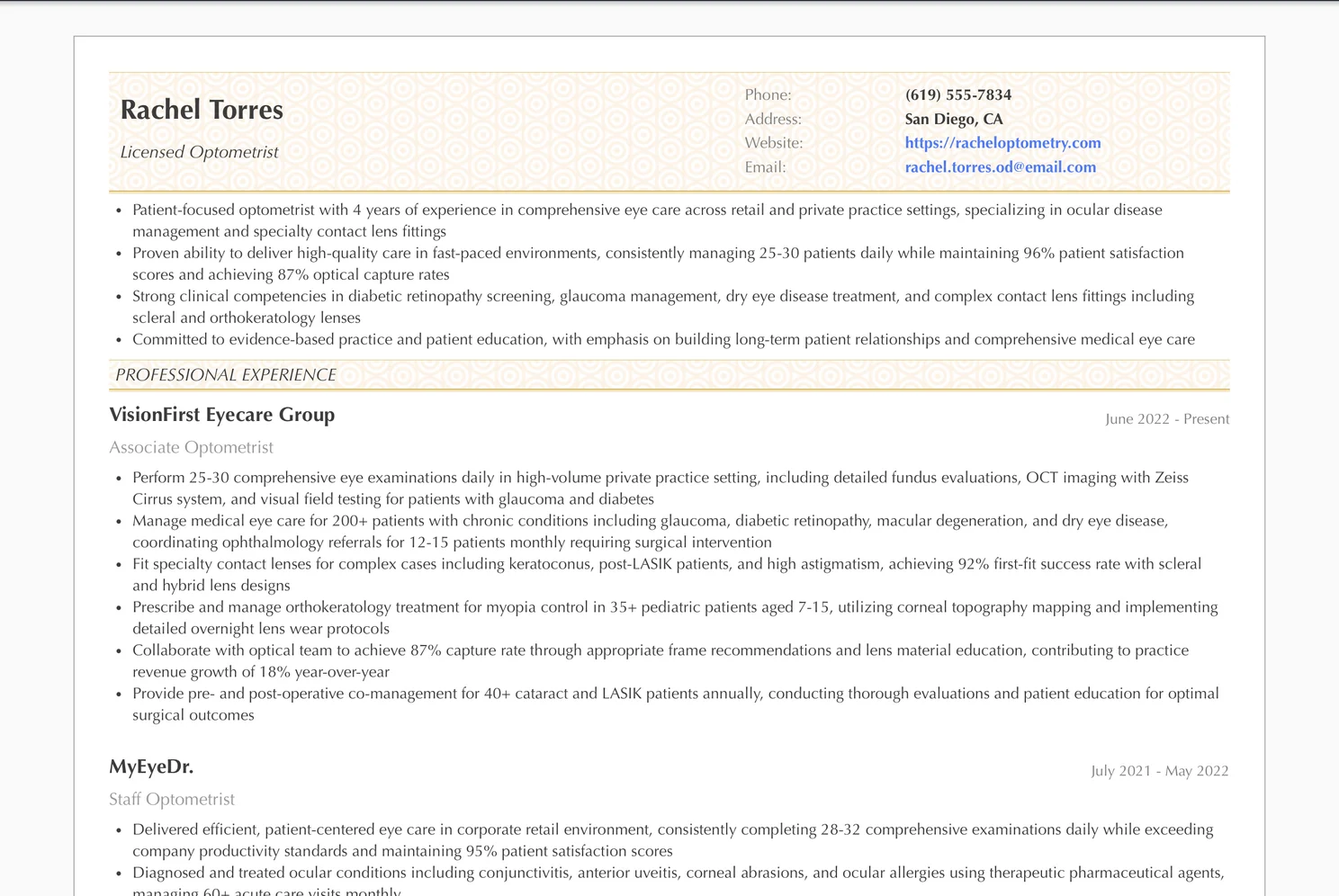
The Best Optometrist Resume Example/Sample
https://www.resumonk.com/optometristOptometristChoosing the Right Resume Format for Your Optometrist Resume
For optometrists, the reverse-chronological resume format is your best choice, and here's why.
As a licensed healthcare professional, your career progression tells a story that hiring managers actively want to follow. Whether you're a recent graduate completing your residency in pediatric optometry or an experienced O.D. transitioning from corporate optometry to private practice, employers need to see where you trained, what patient populations you've served, and how your clinical competencies have developed over time.
Why Reverse-Chronological Works for Optometry
The optometry field values recency and relevance. A practice owner wants to know what you've been doing in the past year, not what you did during your undergraduate research project five years ago. The reverse-chronological format positions your most recent clinical experience at the top, immediately showing hiring managers that you've been actively practicing, seeing patients, and maintaining your skills. This is particularly important in optometry where clinical techniques, diagnostic technology, and treatment protocols evolve rapidly.
Your experience with OCT imaging from last month matters more than your proficiency with a phoropter from your second year of optometry school.
This format also accommodates the natural career trajectory of optometrists. You'll list your current or most recent position first, whether that's an associate optometrist role, a residency position, or even a part-time locum tenens arrangement, followed by your externship rotations during optometry school, and then your education.
This creates a clear narrative arc that demonstrates professional growth and increasing responsibility.
Structuring Your Optometrist Resume
Your resume should open with a header containing your name, O.D. credentials, license numbers (if applying within your licensed states), phone number, email, and location.
Follow this with a professional summary that distills your clinical focus and key strengths into three to four sentences. Then proceed with your work experience section, followed by education, licensure and certifications, and finally your skills section.
For recent graduates still completing residencies or in your first post-graduate position, you might worry that your work experience section looks thin. Don't let this push you toward a functional resume format that emphasizes skills over experience. Hiring managers in healthcare are skeptical of functional resumes because they obscure employment gaps and make it difficult to assess clinical competency development. Instead, leverage your clinical externships as legitimate work experience entries. That rotation at the Veterans Affairs hospital where you managed 25 patients weekly? That's work experience. Your externship at a pediatric optometry practice where you conducted vision therapy sessions?
Also work experience.
What Not to Do
Avoid hybrid or combination formats unless you're making a dramatic career change, such as transitioning from clinical practice into pharmaceutical sales or optometry education.
These formats split attention between skills and experience in ways that dilute both sections. For straightforward optometry positions, whether in retail settings like LensCrafters or private practices, the reverse-chronological format provides the clarity and professionalism that medical professionals are expected to demonstrate.
Presenting Work Experience on Your Optometrist Resume
The work experience section is where you demonstrate not only what you did, but how well you did it, what populations you served, what technologies you mastered, and what outcomes you achieved. Hiring managers reviewing optometrist resumes are looking for specific clinical competencies, patient volume capacity, and evidence that you can handle the particular demands of their practice environment.
Structuring Each Position Entry
For each position, list your job title, the practice or organization name, location, and dates of employment in month and year format.
Your job title matters more than you might think. If you held an associate optometrist position, state that clearly rather than using just "Optometrist," which could mean anything from an independent contractor to a part-time fill-in role. If you completed a residency, include the specialty, such as "Optometric Resident, Ocular Disease" or "Pediatric Optometry Resident."
Below this header information, include three to six bullet points that capture the scope, scale, and significance of your work. Each bullet point should begin with a strong action verb and include specific details that differentiate your experience from every other optometrist applying to the same position.
The Wrong Way and the Right Way
Let's look at how most optometrists initially draft their experience versus how it should actually read:
❌ Don't write generic descriptions that could apply to any optometrist:
Conducted comprehensive eye examinations
Prescribed eyeglasses and contact lenses
Diagnosed eye diseases
Provided patient education
✅ Do write specific, detailed descriptions that showcase your clinical competencies and achievements:
- Performed 25-30 comprehensive eye examinations daily in high-volume retail setting, including visual field testing, retinal imaging with Optos widefield technology, and OCT scans for patients with diabetes and glaucoma risk factors
- Managed medically necessary contact lens fittings for complex cases including keratoconus, post-RK patients, and presbyopes, achieving 90% first-fit success rate with scleral and hybrid lens designs
- Diagnosed and co-managed ocular diseases including glaucoma, diabetic retinopathy, and macular degeneration, coordinating referrals with ophthalmology for 15-20 patients monthly requiring surgical intervention
- Prescribed and dispensed orthokeratology lenses for myopia control in pediatric patients aged 8-16, managing 40+ active ortho-k patients with detailed topography mapping and overnight lens wear protocols
Quantify Your Clinical Impact
Numbers transform vague claims into concrete evidence of capability.
How many patients did you see per day? What was your optical capture rate? How many patients did you manage with chronic conditions? If you worked in a practice that tracked performance metrics, include them. A hiring manager at a private practice needs to know whether you can handle their patient volume. A corporate optometry position wants evidence that you can meet productivity expectations while maintaining quality care.
Consider these quantifiable elements: patient volume per day or week, percentage of medical versus routine exams, number of specialty contact lens fittings monthly, optical capture rates, patient satisfaction scores, percentage of patients requiring specialist referrals, and the number of patients you managed with chronic conditions like glaucoma or diabetic retinopathy.
Tailor to Practice Type
An optometrist applying to a private practice should emphasize different competencies than one applying to a corporate retail position.
For private practices, highlight your clinical autonomy, disease management experience, and ability to build long-term patient relationships. For corporate or retail optometry, emphasize efficiency, high patient volume capacity, teamwork with opticians and store management, and adaptability to structured workflows.
❌ Don't use the same generic bullets for every application:
Examined patients and prescribed corrective lenses in busy practice setting
✅ Do customize your experience descriptions to match the practice type:
For private practice applications:- Established patient-centered care approach in solo practice setting, managing continuity of care for 800+ active patients including annual comprehensive exams, urgent care visits for ocular emergencies, and long-term glaucoma and dry eye disease managementFor corporate retail applications:- Delivered efficient, high-quality eye care in fast-paced retail environment, consistently exceeding company productivity standards by completing 30+ exams daily while maintaining 95% patient satisfaction scores and seamlessly coordinating with optical team to achieve 85% capture rate
Addressing Externships and Clinical Rotations
For recent graduates, your clinical externships during optometry school are legitimate work experience and should be presented as such. List each externship site as a separate entry with the title "Extern" or "Clinical Extern" and describe your responsibilities and patient exposure with the same specificity you would use for a post-graduate position. Don't relegate these to an "Education" section or minimize them as mere training experiences.
You saw real patients, made real diagnoses, and developed real clinical skills under supervision.
✅ Present externships as valuable clinical experience:
Clinical Extern, Ocular Disease
Veterans Affairs Medical Center, Phoenix, AZ | January 2024 - April 2024
Conducted comprehensive eye examinations for veteran population with high incidence of systemic disease, performing detailed fundus evaluations for diabetic retinopathy screening in 60+ patients with diabetes monthly
Managed treatment protocols for ocular surface disease, anterior uveitis, and glaucoma under supervision of staff optometrists, gaining proficiency with therapeutic pharmaceutical agents and follow-up care scheduling
Utilized advanced diagnostic technology including OCT, fundus photography, visual field testing, and pachymetry for glaucoma suspect evaluation and monitoring
Essential Skills to Showcase on Your Optometrist Resume
Think about what happens when a practice owner reviews your resume.
They're not reading linearly from top to bottom like a novel. Their eyes jump around, looking for specific keywords and competencies that match their needs. Do you have experience with the same electronic health records system they use? Can you fit specialty contact lenses? Are you therapeutically licensed? Can you perform minor procedures? Your skills section answers these questions at a glance.
Clinical Skills: The Core of Your Competency
Begin with clinical skills that demonstrate your scope of practice. These should reflect actual procedures and diagnostic techniques you perform regularly, not a wishlist of things you learned about in optometry school but haven't touched since.
Hiring managers can spot resume inflation, and claiming expertise in procedures you've performed five times during externships will become painfully obvious during an interview or, worse, during your first week on the job.
Focus on comprehensive examination skills, disease diagnosis and management, contact lens fitting specialties, pediatric optometry capabilities, binocular vision and vision therapy expertise, low vision rehabilitation, and minor procedures like foreign body removal or punctal plug insertion if you're trained and experienced in these areas.
Diagnostic Technology and Equipment
Optometry has become increasingly technology-driven, and practices want to know whether you can walk in on day one and operate their equipment or whether they'll need to invest time training you. List specific diagnostic technologies you're proficient with, using manufacturer names when relevant because different practices use different systems and compatibility matters.
Include technologies like OCT (specify manufacturers like Zeiss, Heidelberg, or Optovue if you have strong experience with particular systems), retinal imaging systems (Optos, fundus cameras), corneal topographers, automated refraction systems, visual field analyzers (Humphrey, Octopus), pachymeters, anterior segment photography, and any specialty equipment like meibography for dry eye assessment or equipment used in vision therapy.
❌ Don't create a vague list of generic terms:
Skills: Eye exams, Contact lenses, Eye diseases, Patient care, Medical equipment
✅ Do provide specific, relevant competencies organized logically:
1. Clinical Competencies:
Comprehensive Eye Examinations | Ocular Disease Diagnosis & Management | Diabetic Retinopathy Screening | Glaucoma Management | Dry Eye Disease Treatment | Specialty Contact Lens Fitting (Scleral, RGP, Hybrid) | Orthokeratology | Pediatric Eye Exams | Binocular Vision Assessment
2. Diagnostic Technology:
OCT (Zeiss Cirrus, Heidelberg Spectralis) | Optos Widefield Retinal Imaging | Corneal Topography | Visual Field Testing (Humphrey) | Autorefraction | Fundus Photography | Pachymetry | Anterior Segment Imaging
3. Therapeutic & Procedural:
Pharmaceutical Treatment of Ocular Disease | Foreign Body Removal | Punctal Plug Insertion | Emergency Eye Care | Pre/Post-Operative Cataract & LASIK Co-Management
Software and Administrative Systems
Modern optometry practice involves substantial time with electronic health records, practice management software, and digital diagnostic systems.
If you have experience with specific EHR systems common in optometry like Eyefinity, Compulink, Crystal PM, RevolutionEHR, or MaximEyes, list them. Practices using these systems strongly prefer candidates who won't need extensive software training.
Also include any experience with telehealth platforms if you provided remote consultations, which became more relevant during recent years and remains a service some practices offer.
Specialized Areas of Practice
If you have specialized training or significant experience in particular areas of optometry, create a distinct section or clearly group these skills. Specialties like pediatric optometry, vision therapy and rehabilitation, sports vision, low vision care, orthokeratology and myopia control, dry eye disease treatment and specialty clinics, or pre- and post-operative co-management for refractive surgery deserve prominent placement if they're relevant to the position.
What Not to Include
Avoid listing basic skills that every licensed optometrist possesses. "Patient care" or "attention to detail" or "communication skills" add no value because they're assumed baseline competencies for any healthcare professional. Similarly, don't list soft skills like "teamwork" or "time management" in your skills section.
These qualities should be demonstrated through your work experience descriptions, not claimed in a skills list.
Also resist the urge to list every piece of equipment you've used once. If you operated a lensometer during a two-day externship rotation but haven't touched one since, leave it off. Your skills section should reflect current, confident competencies, not a comprehensive history of every tool you've encountered.
Certifications and Licensure
While technically separate from skills, your licensure and certifications deserve prominent placement, often in their own section immediately following your education or work experience. List your optometry license numbers for states where you're actively licensed, your therapeutic pharmaceutical agent certification (standard in most states but worth explicitly noting), glaucoma certification if required in your state, DEA number if you have prescribing authority for controlled substances, and any specialty certifications like fellowship status in the American Academy of Optometry or board certification in a specialty area.
For optometrists licensed in multiple states, which is increasingly common with telemedicine and locum tenens work, list all active licenses with their numbers and expiration dates if space permits, or note "Licensed in CA, AZ, NV" if you need to conserve space.
Critical Considerations and Strategic Tips for Optometrist Resumes
You're competing in a unique professional space. Unlike many healthcare fields with critical shortages, optometry has a relatively balanced supply and demand, meaning your resume needs to do more than prove basic competency. It needs to demonstrate that you're the right fit for a specific practice culture, patient population, and business model. The optometrist who thrives in a corporate retail environment might struggle in a private practice setting, and vice versa.
Your resume should signal which environments match your strengths and experience.
The Private Practice Versus Corporate Divide
This distinction matters more in optometry than in almost any other healthcare field, and your resume should reflect awareness of these different practice models.
Private practice owners are typically looking for optometrists who can build long-term patient relationships, exercise clinical autonomy, potentially buy into the practice eventually, and contribute to practice growth beyond pure clinical work. If you're targeting private practices, emphasize your patient retention, continuity of care experience, involvement in practice development or marketing, and any business coursework or entrepreneurial interests.
Corporate and retail optometry positions, whether at chains like Costco, Target Optical, MyEyeDr, or LensCrafters, prioritize efficiency, adaptability to company protocols, teamwork with retail staff, and the ability to maintain quality care while meeting productivity metrics. For these positions, emphasize patient volume, collaboration with optical teams, optical capture rates, ability to work within structured systems, and flexibility with scheduling.
❌ Don't present a one-size-fits-all resume:
Experienced optometrist seeking position in established practice. Skilled in comprehensive eye care and patient management.
✅ Do tailor your approach to the practice model:
For private practice:Patient-focused optometrist with emphasis on comprehensive medical eye care and long-term disease management. Experienced in building loyal patient base through personalized care approach and strong optical dispensing partnerships. Interested in eventual practice ownership opportunities.
For corporate retail:Efficient, team-oriented optometrist experienced in high-volume retail settings. Proven ability to deliver quality care while meeting productivity standards, with consistent 85%+ optical capture rates and 95% patient satisfaction scores. Adaptable to company protocols and collaborative with store management.
Medical Versus Routine Care Balance
The profession is increasingly shifting toward medical optometry, and practices want to know where you fall on this spectrum.
If you're applying to a practice that emphasizes medical eye care, disease management, and specialty services, your resume should highlight diagnostic skills, ocular disease experience, co-management relationships with ophthalmologists, therapeutic treatment protocols, and familiarity with medical billing and coding. Include the percentage of your exams that were medical versus routine if it's impressive.
Conversely, if you're applying to a retail position where the majority of care is routine refractive exams and contact lens fittings, emphasize your efficiency, your ability to handle high patient volume, your contact lens fitting success rates, and your skill in identifying when a patient needs more extensive care or referral.
Addressing New Graduate Status
If you graduated within the past year, you face a specific challenge.
Most practices want to see at least some post-graduate experience, yet every optometrist obviously starts as a new graduate at some point. Don't apologize for your new graduate status or try to hide it. Instead, position your recent education as an asset. You're current on the latest diagnostic techniques, familiar with newer technologies that weren't available ten years ago, and trained in contemporary treatment protocols.
Emphasize your externship diversity. If you completed rotations in different practice settings like a VA hospital, a private practice, a retail chain, and a specialty contact lens practice, you've actually seen more variety than some optometrists who have worked in a single practice for five years. List each externship separately as work experience, and describe your patient volume and clinical responsibilities in detail.
If you completed a residency, this is a significant competitive advantage that should be prominently featured.
Handling Employment Gaps or Career Transitions
Optometry attracts many professionals who take career breaks for family reasons, pursue additional education, or transition between practice models. If you have a gap in your work history, address it briefly in your cover letter rather than leaving it as an elephant in the room on your resume.
On the resume itself, use years rather than months for positions if this smooths over a short gap, though don't use this technique for gaps longer than several months as it can appear deceptive.
If you're returning to clinical practice after time away, consider taking locum tenens positions or part-time roles to build recent experience before applying to competitive full-time positions. Even a few months of recent clinical work makes your resume substantially stronger than years-old experience followed by a gap.
Geographic Licensing Considerations
Optometry is state-licensed, and interstate practice rules vary significantly.
If you're applying to positions in states where you're not currently licensed, address this proactively. Include a line in your professional summary stating "Eligible for licensure in [state]" or "Arizona license in process, expected [month/year]." Practices are often willing to wait for the right candidate to obtain licensure, but they need to know you're aware of the requirement and actively pursuing it.
For telehealth positions or practices near state borders where you might serve patients in multiple states, list all states where you hold active licenses prominently in your credentials section.
The Optical Dispensing Component
Most optometry positions involve some degree of optical dispensing, whether you're directly helping patients select frames or working closely with opticians who handle this function. Practices with optical dispensaries want to see evidence that you understand this part of the business and can contribute to optical sales, not through pushy sales tactics, but through appropriate recommendations and strong working relationships with optical staff.
If you have experience with frame styling, lens material recommendations, progressive lens troubleshooting, or achieving strong optical capture rates, include this information.
What to Leave Off
Resist including information that doesn't advance your candidacy.
Your undergraduate major in biology or psychology is largely irrelevant once you have a Doctor of Optometry degree. Unless your undergraduate institution was particularly prestigious or you graduated with significant honors, minimize this to a single line. High school information should never appear on a professional optometrist resume.
Personal interests and hobbies add little value unless they directly relate to optometry or demonstrate something unique about your candidacy. If you volunteer providing eye care to underserved populations or you're involved in optometry advocacy organizations, include this. If you enjoy hiking and reading, that's lovely but irrelevant to your clinical competence.
References don't belong on your resume itself. The phrase "References available upon request" is outdated and wastes valuable space.
Prepare a separate reference list with three to four professional references (former supervisors, optometry school professors, or colleagues who can speak to your clinical skills) that you'll provide when requested during the interview process.
Professional Organizations and Continuing Education
Membership in professional organizations like the American Optometric Association, state optometric associations, or specialty groups signals professional engagement and commitment to staying current in the field.
If you hold any leadership positions within these organizations or have presented at conferences, this deserves prominent mention. Continuing education is required for license renewal, but if you've pursued education beyond minimum requirements or in specialized areas relevant to the position, consider including a brief section noting significant recent coursework.
The Length Question
New graduates and optometrists with less than ten years of experience should maintain a one-page resume.
You simply don't have enough distinct experience to justify two pages, and trying to stretch your content makes you appear either verbose or like you're padding your qualifications. Experienced optometrists with 10+ years of diverse experience, multiple practice settings, leadership roles, publications, or extensive continuing education credentials can extend to two pages, but the second page should contain substantive information, not filler.
Every line should earn its place by either demonstrating clinical competency, showing practice compatibility, or differentiating you from other candidates. If you find yourself stretching to fill space, you're including too much. If you're cramming text into tiny margins with minimal white space, you're including too much. Your resume should be comprehensive but scannable, detailed but focused, thorough but strategic.
Education Requirements on an Optometrist Resume
You've spent years getting through undergrad, aced the OAT, survived four years of optometry school, passed your boards, and possibly completed a residency. That journey wasn't easy, and your education section needs to reflect the rigor and legitimacy of your qualifications without becoming a cluttered mess of dates and acronyms.
Structuring Your Doctor of Optometry Degree
Your Doctor of Optometry (O.D.) degree goes at the top of your education section, listed in reverse-chronological order if you have multiple degrees. This is non-negotiable and needs complete clarity. Include the full degree name, the institution, location (city and state/province), and graduation date.
If you graduated within the last few years, including your graduation month can be helpful; if you're further into your career, the year alone suffices.
Here's where optometry gets specific: if your school is ACOE-accredited (Accreditation Council on Optometric Education) in the U.S. or similarly recognized internationally, and it's not a widely known institution, you might consider adding that accreditation detail. For Canadian graduates, ensure your institution is recognized by the Canadian Council on Accreditation of Optometric Education Programs.
UK optometrists should note their General Optical Council (GOC) registration eligibility.
❌ Don't write it vaguely:
Doctorate in Optometry
Studied eyes and vision
2018-2022
✅ Do write it with complete, professional detail:
Doctor of Optometry (O.D.)
Southern College of Optometry, Memphis, TN
Graduated: May 2022
Should You Include Your GPA?
This is contextual. If you're a recent graduate (within 2-3 years) and your GPA was 3.5 or higher, including it can strengthen your application, especially for competitive positions or residencies. Beyond that timeframe, your clinical experience speaks louder than your academic performance.
Nobody's asking about your GPA when you've been practicing for five years and have excellent patient outcomes.
Residency Programs Deserve Prominence
If you completed a residency in a specialty area like pediatric optometry, ocular disease, low vision, cornea and contact lenses, or vision therapy, this absolutely belongs in your education section, not buried in your experience.
Residencies signal advanced training and specialization that many positions specifically seek. Format it similarly to your O.D., including the institution, location, specialty area, and completion date.
Residency in Ocular Disease
Bascom Palmer Eye Institute, Miami, FL
Completed: June 2023
Your Undergraduate Degree
Include your bachelor's degree below your O.D., but keep it concise. The hiring manager cares that you completed the prerequisite education, but the details matter less than your professional degree. Include degree type, major (especially if it was in a related field like biology, chemistry, or vision science), institution, and graduation year.
If you're more than five years into practice, you can omit your undergraduate GPA entirely.
Continuing Education and Certifications
Here's where it gets interesting. Optometry requires continuing education for license renewal, and many optometrists pursue additional certifications that expand their scope of practice. However, these don't belong in your main education section. Create a separate "Certifications & Licenses" or "Professional Development" section for items like your state licensure, therapeutic pharmaceutical agent (TPA) certification, glaucoma certification, or laser certification.
Similarly, if you've completed numerous CE courses in areas like myopia management, specialty contact lenses, or dry eye treatment, consider whether these warrant a brief mention in a professional development section or should be woven into your work experience descriptions instead.
International Credentials
If you trained outside the country where you're applying, this section requires extra attention. For international optometrists applying in the U.S., include details about your credential evaluation and any additional examinations you've completed (like the NBEO exams). Canadian optometrists moving between provinces should note their registration status.
Australian optometrists should reference OCANZ accreditation, and UK optometrists should mention GOC registration clearly.
Doctor of Optometry
University of Waterloo School of Optometry and Vision Science, Waterloo, ON
Graduated: 2021
Credentials evaluated by NCCAOM | Passed NBEO Parts I, II, III
Awards and Publications on an Optometrist Resume
Should awards and publications go on an optometrist resume? The answer is nuanced, and it depends entirely on what you have and where you're applying. Let's think about what awards and publications actually signal to a hiring manager: they indicate that you've gone beyond the baseline requirements of your role, that external parties have recognized your expertise or contributions, and that you're engaged with the profession at a level deeper than just seeing patients and going home.
Why Publications Matter in Optometry
Even though optometry is primarily a clinical profession, publications carry weight. If you've contributed to research, written case reports, or published articles in journals like Optometry and Vision Science, Clinical and Experimental Optometry, or Contact Lens and Anterior Eye, you're demonstrating several valuable qualities: analytical thinking, commitment to evidence-based practice, and the ability to communicate complex information clearly.
This becomes especially relevant if you're applying to academic positions, hospital-based clinics, or practices that emphasize specialty care. A publication about innovative myopia control strategies or a case study on managing complex anterior segment disease shows you're staying current and thinking critically about patient care.
How to List Publications
Use a standard citation format, typically AMA (American Medical Association) style for healthcare professions.
List publications in reverse-chronological order, with your name clearly identifiable. If you were the primary author, that carries more weight than being fifth in a list of seven authors, but both are worth including.
Publications:
1. Chen L, Rodriguez M, Patel NK, Williams R. - "Long-term outcomes of orthokeratology in pediatric myopia management: A 5-year retrospective study." - J Optom. 2023;16(2):145-153.
2. Williams R, Thompson J. - "Management of chronic dry eye disease with intense pulsed light therapy: A case series." - Cont Lens Anterior Eye. 2022;45(4):301-307.
If you've written for professional publications that aren't peer-reviewed academic journals but are still respected in the field, like Review of Optometry, Optometric Management, or Primary Care Optometry News, these count too. They demonstrate thought leadership and professional engagement, even if they're not research publications.
What Awards Are Worth Including?
This is where optometrists sometimes undersell themselves. You might think an award needs to be the "Young Optometrist of the Year" from your state association to be worth mentioning, but there's a broader range of recognitions that add value to your resume.
Academic awards from optometry school, like Dean's List honors, clinical excellence awards, or specialty area recognitions (like the contact lens award or low vision award) are absolutely worth including if you're early in your career. These show you excelled during your training in ways that were formally recognized.
Professional awards from optometric associations, whether local, state/provincial, or national, definitely belong here. These might include early career awards, volunteer recognition, or leadership awards from organizations like the American Optometric Association, Canadian Association of Optometrists, or Australian Optometry Association.
Even practice-based recognition, if it's substantial and specific, can be valuable. "Top Revenue Producer 2022-2023" or "Highest Patient Satisfaction Scores, Q4 2023" shows measurable excellence. However, generic "Employee of the Month" awards from years ago probably don't add much unless you're very early career and building your resume.
❌ Don't list every minor recognition without context:
Awards:
- Perfect attendance
- Employee of the Month
- Certificate of completion for CE course
✅ Do list meaningful awards with relevant details:
Awards & Recognition:
Clinical Excellence Award in Primary Care, New England College of Optometry, 2021
Young Optometrist of the Year, Texas Optometric Association, 2024
President's Volunteer Service Award for 100+ hours of vision screening in underserved communities, 2023
Presentations and Poster Sessions
If you've presented at conferences, whether at AOA, AAO (American Academy of Optometry), regional meetings, or international conferences, these belong in this section.
Presentations, especially invited lectures or podium presentations, indicate that your peers view you as knowledgeable enough to educate others. Even poster presentations at major conferences show research involvement and professional engagement.
Professional Presentations:

1. "Implementing a Dry Eye Center of Excellence in Private Practice," podium presentation, American Optometric Association Annual Meeting, Washington, DC, June 2024

2. "Myopia Management Outcomes: Comparing Three Treatment Modalities," poster presentation, American Academy of Optometry Annual Meeting, Indianapolis, IN, October 2023
When to Skip This Section Entirely
If you're a practicing optometrist without publications, significant awards, or conference presentations, don't force this section onto your resume. A resume without this section is completely normal and acceptable. What's not acceptable is padding it with irrelevant items or CE completion certificates that everyone in the profession is required to obtain.
Your clinical experience, patient care skills, and practice growth achievements will speak for themselves.
However, if you have even one or two solid items in this category, include the section. It differentiates you from other candidates and shows professional engagement beyond your daily clinical responsibilities.
Listing References on an Optometrist Resume
For optometrists, references carry particular weight because the profession is relatively small, interconnected, and relationship-driven.
Your references aren't just confirming employment dates; they're vouching for your clinical competence, professionalism, patient interaction skills, and whether you'd be a good colleague. Getting this section right matters.
The "References Available Upon Request" Debate
Let's address the elephant in the room. That line at the bottom of resumes that says "References available upon request" is largely outdated. Hiring managers assume you have references. Using that line just wastes space that could be devoted to your accomplishments, skills, or experience.
Unless you're submitting a one-page resume and need a visual way to signal the end of the document, skip this phrase entirely.
❌ Don't waste space with assumed information:
References available upon request
✅ Do prepare a separate reference sheet and mention it in your cover letter if applicable:
In your cover letter: "I'm happy to provide professional references from my current and previous practice settings at your request."
Creating a Separate Reference Sheet
The modern standard is to prepare a separate reference sheet that matches your resume's formatting and design (same fonts, header style, and layout).
This sheet doesn't accompany your initial resume submission unless specifically requested. Instead, you bring it to interviews and have it ready to provide immediately when employers begin checking references.
Your reference sheet should include your name and contact information at the top (matching your resume header), followed by three to four professional references. For each reference, include their full name, professional title, organization/practice name, relationship to you (how they know you professionally), phone number, and email address.
You can optionally include their mailing address, though phone and email are most important.
PROFESSIONAL REFERENCES FOR RACHEL CHEN, O.D.

1. Dr. Michael Thompson, O.D.
- Practice Owner, Thompson Family Eyecare
- Relationship: Direct Supervisor (2021-Present)
- Phone: (555) 234-5678 | Email: [email protected]

2. Dr. Jennifer Wu, O.D., FAAO
- Residency Supervisor, University Eye Institute
- Relationship: Residency Director
- Phone: (555) 345-6789 | Email: [email protected]
Who Should Your References Be?
For optometrists, the strongest references come from other optometrists or ophthalmologists who've directly observed your clinical work. This typically means supervisors, practice owners, residency directors, or senior colleagues from your current or previous positions.
These individuals can speak credibly about your clinical decision-making, patient care approach, technical skills, and professional behavior.
The ideal reference mix for most optometrists includes: your current or most recent supervising optometrist (if leaving on good terms), an optometry school faculty member or residency director (particularly valuable for new graduates within 3-5 years), and a colleague or another professional who can speak to your teamwork, reliability, and professional character.
If you're currently employed and concerned about confidentiality, it's acceptable to note on your reference sheet "Current employer may be contacted after mutual agreement" and rely on previous positions for immediate references. Most hiring managers understand this discretion during an active job search.
References to Avoid
Personal references (friends, family, clergy members) carry minimal weight for professional optometry positions unless the position specifically requests character references, which is rare. Similarly, references from undergraduate professors or jobs completely unrelated to healthcare don't add value unless you're a new graduate with limited optometric experience.
Be cautious about listing colleagues at your current practice if you haven't disclosed your job search. The optometry community is surprisingly small, and word can travel. If you need a reference from your current workplace but haven't announced your departure, consider waiting until later in the hiring process or using references from previous positions.
Always Ask Permission First
This should be obvious, but never list someone as a reference without asking them first.
This conversation serves multiple purposes beyond basic courtesy. It confirms they're comfortable providing a positive reference, gives them advance notice so they're not caught off-guard by a call, and allows you to briefly remind them of your work together and what aspects of your performance you hope they'll emphasize.
When asking, be specific about the position you're applying for and what qualities the role emphasizes. If you're applying for a position focused on pediatric optometry, remind your reference about your work with children and ask if they'd feel comfortable speaking to that experience. If the position emphasizes practice growth and business development, ask if they can speak to your contributions in those areas.
Keeping References Current
Touch base with your references periodically, especially if your job search extends over several months. A quick email updating them on your search status and thanking them for their willingness to support you maintains the relationship and keeps you fresh in their mind when calls come.
After you accept a position, send a thank-you note to everyone who served as a reference, letting them know the outcome.
International Considerations
If you're applying for optometry positions across borders, consider whether your references will be familiar to the hiring country.
A reference from a prominent Canadian optometry program carries weight with Canadian employers but might need context for U.S. employers (and vice versa). In these situations, a brief description of the reference's position can help: "Dr. Smith is the Director of Clinical Education at one of Canada's two English-language optometry schools and oversees clinical training for 280 students."
Also be aware of time zone differences and international calling costs. If you're providing international references, you might note in parentheses "(UK-based reference, GMT timezone)" so employers can plan their outreach accordingly.
Providing both phone and email for international references is especially important, as email may be more practical.
Special Situations: Career Gaps or Practice Changes
If you have a gap in employment due to family leave, health issues, or other circumstances, you might lack recent supervisor references. In these cases, consider references from volunteer work, professional association involvement, or CE course instructors who can speak to your continued professional engagement.
A reference from a colleague who stayed in touch during your absence and can vouch for your current readiness to practice can be valuable.
If you're transitioning from corporate optometry to private practice (or vice versa), choose references who can speak to transferable skills and character traits rather than specific practice setting experience. A reference who can discuss your patient care philosophy, clinical thoroughness, and professional reliability is valuable regardless of practice setting.
When References Are Checked
Understanding when reference checks typically occur helps you time your reference preparation. Most employers check references after interviewing candidates but before making a formal offer. Some wait until they've selected their top candidate and are essentially verifying their decision.
This means your references should be prepared to receive calls relatively late in your application process, potentially weeks after you've submitted your resume.
Occasionally, employers check references before interviews to narrow their candidate pool, though this is less common in optometry than in some other fields. If you're asked to provide references with your initial application, ensure your reference sheet is polished and your references are already aware they might be contacted soon.
Cover Letter Tips for an Optometrist Resume
The reality is that cover letters for optometry positions exist in this strange middle ground. Some hiring managers read every word; others glance at the first paragraph before moving to your resume. Corporate optical chains might process hundreds of applications through HR departments where cover letters get minimal attention. But private practices, specialty clinics, and group practices where the optometrist-owner is personally hiring?
They're reading it, and they're making judgments about whether you'd be a good fit for their practice culture.
What Your Cover Letter Should Actually Accomplish
Your resume is a structured document that lists what you've done. Your cover letter is where you explain why you've made specific career choices, what you're looking for in your next position, and why this particular practice or organization interests you.
It's not a place to repeat your resume in paragraph form (please don't do this), but rather to provide narrative context that helps a hiring manager understand who you are as a professional.
For optometrists, this means addressing things like: Why are you leaving your current position or relocating to a new area? What specific aspects of patient care do you find most fulfilling? What type of practice environment allows you to do your best work? If you're transitioning from retail optometry to private practice, or from general optometry to a specialty focus, why?
These narratives matter because optometry practices are relatively small professional environments where fit and motivation significantly impact success.
Opening Strong with Specific Connection
Generic openings kill cover letters. "I am writing to apply for the optometrist position at your practice" tells the reader nothing they don't already know.
Instead, open with a specific connection to the position or practice that demonstrates you've done your research and have genuine interest.
❌ Don't open generically:
Dear Hiring Manager,
I am writing to apply for the optometrist position. I am a licensed optometrist with three years of experience and I am very interested in this opportunity.
✅ Do open with specific connection and context:
Dear Dr. Martinez,
When I learned that Vision Care Associates is expanding its pediatric optometry services and seeking an optometrist with myopia management expertise, I immediately recognized the alignment with both my clinical focus and my commitment to early intervention in children's vision care. My three years specializing in pediatric optometry at a high-volume practice, combined with my residency training in pediatric eye disease, have prepared me specifically for this type of role.
Demonstrating Clinical Philosophy and Approach
What makes you different from the fifteen other qualified optometrists applying for this position? Often, it's not your technical skills (which are likely similar) but your approach to patient care, your clinical interests, and how you think about optometric practice.
This is where your cover letter can shine by providing insight your resume cannot.
Are you someone who thrives on complex contact lens fittings and loves the problem-solving aspect of specialty lenses? Do you prioritize patient education and spend extra time ensuring patients understand their conditions? Are you particularly skilled at managing anxious patients or children? Do you view optometry through a medical model, emphasizing disease detection and management, or do you balance medical care with optical services and frame styling?
None of these approaches is inherently better than others, but they indicate what kind of practice environment you'll thrive in. A medical optometry clinic focused on dry eye and anterior segment disease wants to know you're clinically driven and stay current with therapeutic options. A private practice that emphasizes full-scope care and optical sales wants to know you value the entire patient experience, not just the exam.
Throughout my career, I've found the most satisfaction in complex ocular disease management, particularly in underserved populations where patients often present with advanced, undiagnosed conditions. My ability to build trust quickly with patients who've had limited healthcare access, combined with my comfort managing conditions like advanced glaucoma, diabetic retinopathy, and ocular surface disease, has consistently resulted in high patient retention and successful treatment outcomes in these communities.
Addressing Practical Considerations
Optometry practices have practical concerns that your cover letter can address upfront, saving everyone time.
Are you relocating for family reasons (indicating stability)? Are you looking for full-time or part-time work? Do you have Saturday availability, which many practices require? If you're a new graduate, are you comfortable with the supervision structure during your first year of practice?
For positions in different countries, address your licensure status clearly. If you're a U.S.-trained optometrist applying in Canada, acknowledge the registration process with provincial colleges.
If you're relocating to Australia, mention your AHPRA (Australian Health Practitioner Regulation Agency) registration status or timeline.
Tailoring to Practice Type
A cover letter for a corporate optical position should emphasize different qualities than one for a private practice or a hospital-based role.
Corporate optometry values efficiency, patient volume management, teamwork with retail staff, and often sales-related metrics. Private practices might emphasize continuity of care, community involvement, clinical autonomy, and growth potential. Hospital or medical center roles focus on medical optometry, interdisciplinary collaboration, and often complex patient populations.
Research the practice before writing. Look at their website, read their patient reviews, check if they advertise specialty services. Then speak directly to what they're clearly emphasizing. If their website highlights their dry eye clinic and specialty contact lens services, and you have experience in those areas, that's your focus. If they're a family practice in a small community emphasizing personalized care and community involvement, speak to those values.
Closing with Clear Next Steps
Don't end with passive statements like "I look forward to hearing from you" or "Thank you for your consideration." While polite, these closings miss an opportunity to reinforce your interest and suggest clear next steps.
Indicate your availability for an interview, mention you're happy to provide additional information or references, and reiterate your specific interest in this position.
I would welcome the opportunity to discuss how my experience in medical optometry and passion for ocular disease management would contribute to your practice's continued growth. I'm available for an interview at your convenience and happy to provide additional references or answer any questions about my clinical approach. Thank you for considering my application for this position.
Length and Format Considerations
Keep your cover letter to a single page, typically three to four substantive paragraphs.
Healthcare hiring managers are busy, and a concise, focused letter demonstrates respect for their time and your ability to communicate efficiently. Use a professional business letter format with your contact information, date, and employer's contact information at the top. Address it to a specific person whenever possible - "Dear Dr. Williams" is infinitely better than "Dear Hiring Manager" or "To Whom It May Concern."
For email applications where you're attaching your resume, your cover letter typically goes in the body of the email itself, slightly shortened and formatted without the formal business letter header.
Key Takeaways
Creating an effective optometrist resume requires understanding what hiring managers in different practice settings actually need to see. Here are the essential points to remember as you build or refine your resume:
- Choose the reverse-chronological format for your optometrist resume unless you're making a dramatic career change outside clinical practice. This format best showcases your clinical progression, recent experience, and professional development in a way that healthcare employers expect and trust.
- Quantify your clinical experience with specific numbers like patient volume per day, optical capture rates, percentage of medical versus routine exams, and specialty contact lens fitting success rates. These metrics transform vague claims into concrete evidence of your capabilities.
- Tailor your resume to the practice model you're targeting. Private practices want to see continuity of care, patient relationship building, and potential ownership interest. Corporate retail positions need evidence of efficiency, teamwork, high volume capacity, and adaptability to structured systems.
- Present clinical externships as legitimate work experience, especially if you're a recent graduate. These rotations involved real patient care under supervision and developed genuine clinical skills that deserve detailed description, not a footnote in your education section.
- Be specific about technology and equipment in your skills section. Listing manufacturer names for OCT systems, retinal imaging devices, and EHR software helps employers immediately assess whether you can operate their existing systems or need training time.
- List your Doctor of Optometry degree with complete details, including institution, location, and graduation date. If you completed a residency in a specialty area, give it prominent placement as this signals advanced training that many positions specifically seek.
- Include awards, publications, or presentations only if they're substantive. A research publication, conference presentation, or professional association award adds value. Generic certificates of CE completion or minor workplace recognition typically don't warrant inclusion.
- Write a tailored cover letter that provides context your resume cannot, explaining your clinical philosophy, why you're interested in this specific practice, and what you're looking for in your next position. This narrative matters in a relationship-driven profession.
- Prepare a separate reference sheet with three to four professional references (supervisors, residency directors, or senior colleagues who can speak to your clinical work). Always ask permission before listing someone as a reference.
- Keep your resume to one page if you have less than ten years of experience. Every line should demonstrate clinical competency, show practice compatibility, or differentiate you from other candidates. If you're stretching to fill space, you're including too much.
Building your optometrist resume with Resumonk gives you access to professionally designed templates that present your credentials with the polish and clarity healthcare employers expect. Our AI-powered recommendations help you strengthen your bullet points with specific achievements and appropriate clinical terminology, while our formatting ensures your resume remains clean, scannable, and focused on what matters most. Whether you're a new graduate presenting your externship experience or an experienced O.D. showcasing years of patient care across multiple practice settings, Resumonk's tools help you create a resume that communicates your qualifications effectively and positions you as the right candidate for the opportunities you're pursuing.
Ready to create your optometrist resume?
Start building with Resumonk's professional templates and AI-powered guidance designed specifically for healthcare professionals.
Get your resume interview-ready today with Resumonk!
More Medical resume examples
- Pharmacist resume example
- Dentist resume example
- Optician resume example
- Retail Pharmacist resume example
See all Medical resume examples, or browse every category.
Resume writing tips
You've spent the better part of a decade getting here. Four years of undergraduate coursework, countless hours preparing for the OAT, four more years of optometry school juggling didactic classes with clinic rotations, board exams that tested every corner of your knowledge, and maybe even a residency year where you refined your clinical judgment under the watchful eyes of experienced practitioners.
Now you're sitting down to write your optometrist resume, and somehow distilling all of that education, training, and patient care experience into a document that fits on one or two pages feels more daunting than your binocular vision final exam ever did.
Here's what makes this particularly tricky for optometrists. You're not just listing job duties like "conducted eye exams" because that tells a hiring manager absolutely nothing they don't already assume. Every optometrist conducts eye exams. What they want to know is whether you can handle their specific patient volume, whether you're comfortable with their practice model (corporate retail versus private practice makes a huge difference), whether you have experience with the diagnostic technology they use, and whether you can fit into their practice culture. Your resume needs to answer these questions clearly and quickly, because that practice owner reviewing applications has twelve other qualified O.D.s in the pile, and they're making snap judgments about who gets an interview based on how well you communicate your clinical competency and practice fit.
This guide walks you through every component of building an optometrist resume that actually works. We'll start with choosing the right resume format (spoiler: reverse-chronological is almost always your best bet, and we'll explain exactly why that matters for healthcare professionals). Then we'll dig into the most critical section, your work experience, where you'll learn how to transform generic descriptions into specific, quantified achievements that demonstrate both your clinical skills and your understanding of practice operations. We'll cover how to present your education credentials properly, what skills deserve prominent placement versus what's just resume filler, and how to handle those tricky situations like being a new graduate with limited post-school experience or transitioning between different practice settings.
We'll also address the components that separate good resumes from great ones, including when awards and publications actually add value (and when they're just taking up space), how to write a cover letter that provides context your resume cannot, and the right way to handle professional references. Whether you're a recent graduate looking for your first associate position, an experienced optometrist considering a move from corporate to private practice, or someone returning to clinical work after a career break, you'll find specific guidance for your situation. By the end of this article, you'll understand not just what to include on your optometrist resume, but why each element matters and how to present it in a way that makes hiring managers want to call you for an interview.
The Best Optometrist Resume Example/Sample
https://www.resumonk.com/optometristOptometristChoosing the Right Resume Format for Your Optometrist Resume
For optometrists, the reverse-chronological resume format is your best choice, and here's why.
As a licensed healthcare professional, your career progression tells a story that hiring managers actively want to follow. Whether you're a recent graduate completing your residency in pediatric optometry or an experienced O.D. transitioning from corporate optometry to private practice, employers need to see where you trained, what patient populations you've served, and how your clinical competencies have developed over time.
Why Reverse-Chronological Works for Optometry
The optometry field values recency and relevance. A practice owner wants to know what you've been doing in the past year, not what you did during your undergraduate research project five years ago. The reverse-chronological format positions your most recent clinical experience at the top, immediately showing hiring managers that you've been actively practicing, seeing patients, and maintaining your skills. This is particularly important in optometry where clinical techniques, diagnostic technology, and treatment protocols evolve rapidly.
Your experience with OCT imaging from last month matters more than your proficiency with a phoropter from your second year of optometry school.
This format also accommodates the natural career trajectory of optometrists. You'll list your current or most recent position first, whether that's an associate optometrist role, a residency position, or even a part-time locum tenens arrangement, followed by your externship rotations during optometry school, and then your education.
This creates a clear narrative arc that demonstrates professional growth and increasing responsibility.
Structuring Your Optometrist Resume
Your resume should open with a header containing your name, O.D. credentials, license numbers (if applying within your licensed states), phone number, email, and location.
Follow this with a professional summary that distills your clinical focus and key strengths into three to four sentences. Then proceed with your work experience section, followed by education, licensure and certifications, and finally your skills section.
For recent graduates still completing residencies or in your first post-graduate position, you might worry that your work experience section looks thin. Don't let this push you toward a functional resume format that emphasizes skills over experience. Hiring managers in healthcare are skeptical of functional resumes because they obscure employment gaps and make it difficult to assess clinical competency development. Instead, leverage your clinical externships as legitimate work experience entries. That rotation at the Veterans Affairs hospital where you managed 25 patients weekly? That's work experience. Your externship at a pediatric optometry practice where you conducted vision therapy sessions?
Also work experience.
What Not to Do
Avoid hybrid or combination formats unless you're making a dramatic career change, such as transitioning from clinical practice into pharmaceutical sales or optometry education.
These formats split attention between skills and experience in ways that dilute both sections. For straightforward optometry positions, whether in retail settings like LensCrafters or private practices, the reverse-chronological format provides the clarity and professionalism that medical professionals are expected to demonstrate.
Presenting Work Experience on Your Optometrist Resume
The work experience section is where you demonstrate not only what you did, but how well you did it, what populations you served, what technologies you mastered, and what outcomes you achieved. Hiring managers reviewing optometrist resumes are looking for specific clinical competencies, patient volume capacity, and evidence that you can handle the particular demands of their practice environment.
Structuring Each Position Entry
For each position, list your job title, the practice or organization name, location, and dates of employment in month and year format.
Your job title matters more than you might think. If you held an associate optometrist position, state that clearly rather than using just "Optometrist," which could mean anything from an independent contractor to a part-time fill-in role. If you completed a residency, include the specialty, such as "Optometric Resident, Ocular Disease" or "Pediatric Optometry Resident."
Below this header information, include three to six bullet points that capture the scope, scale, and significance of your work. Each bullet point should begin with a strong action verb and include specific details that differentiate your experience from every other optometrist applying to the same position.
The Wrong Way and the Right Way
Let's look at how most optometrists initially draft their experience versus how it should actually read:
❌ Don't write generic descriptions that could apply to any optometrist:
Conducted comprehensive eye examinations
Prescribed eyeglasses and contact lenses
Diagnosed eye diseases
Provided patient education
✅ Do write specific, detailed descriptions that showcase your clinical competencies and achievements:
- Performed 25-30 comprehensive eye examinations daily in high-volume retail setting, including visual field testing, retinal imaging with Optos widefield technology, and OCT scans for patients with diabetes and glaucoma risk factors
- Managed medically necessary contact lens fittings for complex cases including keratoconus, post-RK patients, and presbyopes, achieving 90% first-fit success rate with scleral and hybrid lens designs
- Diagnosed and co-managed ocular diseases including glaucoma, diabetic retinopathy, and macular degeneration, coordinating referrals with ophthalmology for 15-20 patients monthly requiring surgical intervention
- Prescribed and dispensed orthokeratology lenses for myopia control in pediatric patients aged 8-16, managing 40+ active ortho-k patients with detailed topography mapping and overnight lens wear protocols
Quantify Your Clinical Impact
Numbers transform vague claims into concrete evidence of capability.
How many patients did you see per day? What was your optical capture rate? How many patients did you manage with chronic conditions? If you worked in a practice that tracked performance metrics, include them. A hiring manager at a private practice needs to know whether you can handle their patient volume. A corporate optometry position wants evidence that you can meet productivity expectations while maintaining quality care.
Consider these quantifiable elements: patient volume per day or week, percentage of medical versus routine exams, number of specialty contact lens fittings monthly, optical capture rates, patient satisfaction scores, percentage of patients requiring specialist referrals, and the number of patients you managed with chronic conditions like glaucoma or diabetic retinopathy.
Tailor to Practice Type
An optometrist applying to a private practice should emphasize different competencies than one applying to a corporate retail position.
For private practices, highlight your clinical autonomy, disease management experience, and ability to build long-term patient relationships. For corporate or retail optometry, emphasize efficiency, high patient volume capacity, teamwork with opticians and store management, and adaptability to structured workflows.
❌ Don't use the same generic bullets for every application:
Examined patients and prescribed corrective lenses in busy practice setting
✅ Do customize your experience descriptions to match the practice type:
For private practice applications:- Established patient-centered care approach in solo practice setting, managing continuity of care for 800+ active patients including annual comprehensive exams, urgent care visits for ocular emergencies, and long-term glaucoma and dry eye disease managementFor corporate retail applications:- Delivered efficient, high-quality eye care in fast-paced retail environment, consistently exceeding company productivity standards by completing 30+ exams daily while maintaining 95% patient satisfaction scores and seamlessly coordinating with optical team to achieve 85% capture rate
Addressing Externships and Clinical Rotations
For recent graduates, your clinical externships during optometry school are legitimate work experience and should be presented as such. List each externship site as a separate entry with the title "Extern" or "Clinical Extern" and describe your responsibilities and patient exposure with the same specificity you would use for a post-graduate position. Don't relegate these to an "Education" section or minimize them as mere training experiences.
You saw real patients, made real diagnoses, and developed real clinical skills under supervision.
✅ Present externships as valuable clinical experience:
Clinical Extern, Ocular Disease
Veterans Affairs Medical Center, Phoenix, AZ | January 2024 - April 2024
Conducted comprehensive eye examinations for veteran population with high incidence of systemic disease, performing detailed fundus evaluations for diabetic retinopathy screening in 60+ patients with diabetes monthly
Managed treatment protocols for ocular surface disease, anterior uveitis, and glaucoma under supervision of staff optometrists, gaining proficiency with therapeutic pharmaceutical agents and follow-up care scheduling
Utilized advanced diagnostic technology including OCT, fundus photography, visual field testing, and pachymetry for glaucoma suspect evaluation and monitoring
Essential Skills to Showcase on Your Optometrist Resume
Think about what happens when a practice owner reviews your resume.
They're not reading linearly from top to bottom like a novel. Their eyes jump around, looking for specific keywords and competencies that match their needs. Do you have experience with the same electronic health records system they use? Can you fit specialty contact lenses? Are you therapeutically licensed? Can you perform minor procedures? Your skills section answers these questions at a glance.
Clinical Skills: The Core of Your Competency
Begin with clinical skills that demonstrate your scope of practice. These should reflect actual procedures and diagnostic techniques you perform regularly, not a wishlist of things you learned about in optometry school but haven't touched since.
Hiring managers can spot resume inflation, and claiming expertise in procedures you've performed five times during externships will become painfully obvious during an interview or, worse, during your first week on the job.
Focus on comprehensive examination skills, disease diagnosis and management, contact lens fitting specialties, pediatric optometry capabilities, binocular vision and vision therapy expertise, low vision rehabilitation, and minor procedures like foreign body removal or punctal plug insertion if you're trained and experienced in these areas.
Diagnostic Technology and Equipment
Optometry has become increasingly technology-driven, and practices want to know whether you can walk in on day one and operate their equipment or whether they'll need to invest time training you. List specific diagnostic technologies you're proficient with, using manufacturer names when relevant because different practices use different systems and compatibility matters.
Include technologies like OCT (specify manufacturers like Zeiss, Heidelberg, or Optovue if you have strong experience with particular systems), retinal imaging systems (Optos, fundus cameras), corneal topographers, automated refraction systems, visual field analyzers (Humphrey, Octopus), pachymeters, anterior segment photography, and any specialty equipment like meibography for dry eye assessment or equipment used in vision therapy.
❌ Don't create a vague list of generic terms:
Skills: Eye exams, Contact lenses, Eye diseases, Patient care, Medical equipment
✅ Do provide specific, relevant competencies organized logically:
1. Clinical Competencies:
Comprehensive Eye Examinations | Ocular Disease Diagnosis & Management | Diabetic Retinopathy Screening | Glaucoma Management | Dry Eye Disease Treatment | Specialty Contact Lens Fitting (Scleral, RGP, Hybrid) | Orthokeratology | Pediatric Eye Exams | Binocular Vision Assessment
2. Diagnostic Technology:
OCT (Zeiss Cirrus, Heidelberg Spectralis) | Optos Widefield Retinal Imaging | Corneal Topography | Visual Field Testing (Humphrey) | Autorefraction | Fundus Photography | Pachymetry | Anterior Segment Imaging
3. Therapeutic & Procedural:
Pharmaceutical Treatment of Ocular Disease | Foreign Body Removal | Punctal Plug Insertion | Emergency Eye Care | Pre/Post-Operative Cataract & LASIK Co-Management
Software and Administrative Systems
Modern optometry practice involves substantial time with electronic health records, practice management software, and digital diagnostic systems.
If you have experience with specific EHR systems common in optometry like Eyefinity, Compulink, Crystal PM, RevolutionEHR, or MaximEyes, list them. Practices using these systems strongly prefer candidates who won't need extensive software training.
Also include any experience with telehealth platforms if you provided remote consultations, which became more relevant during recent years and remains a service some practices offer.
Specialized Areas of Practice
If you have specialized training or significant experience in particular areas of optometry, create a distinct section or clearly group these skills. Specialties like pediatric optometry, vision therapy and rehabilitation, sports vision, low vision care, orthokeratology and myopia control, dry eye disease treatment and specialty clinics, or pre- and post-operative co-management for refractive surgery deserve prominent placement if they're relevant to the position.
What Not to Include
Avoid listing basic skills that every licensed optometrist possesses. "Patient care" or "attention to detail" or "communication skills" add no value because they're assumed baseline competencies for any healthcare professional. Similarly, don't list soft skills like "teamwork" or "time management" in your skills section.
These qualities should be demonstrated through your work experience descriptions, not claimed in a skills list.
Also resist the urge to list every piece of equipment you've used once. If you operated a lensometer during a two-day externship rotation but haven't touched one since, leave it off. Your skills section should reflect current, confident competencies, not a comprehensive history of every tool you've encountered.
Certifications and Licensure
While technically separate from skills, your licensure and certifications deserve prominent placement, often in their own section immediately following your education or work experience. List your optometry license numbers for states where you're actively licensed, your therapeutic pharmaceutical agent certification (standard in most states but worth explicitly noting), glaucoma certification if required in your state, DEA number if you have prescribing authority for controlled substances, and any specialty certifications like fellowship status in the American Academy of Optometry or board certification in a specialty area.
For optometrists licensed in multiple states, which is increasingly common with telemedicine and locum tenens work, list all active licenses with their numbers and expiration dates if space permits, or note "Licensed in CA, AZ, NV" if you need to conserve space.
Critical Considerations and Strategic Tips for Optometrist Resumes
You're competing in a unique professional space. Unlike many healthcare fields with critical shortages, optometry has a relatively balanced supply and demand, meaning your resume needs to do more than prove basic competency. It needs to demonstrate that you're the right fit for a specific practice culture, patient population, and business model. The optometrist who thrives in a corporate retail environment might struggle in a private practice setting, and vice versa.
Your resume should signal which environments match your strengths and experience.
The Private Practice Versus Corporate Divide
This distinction matters more in optometry than in almost any other healthcare field, and your resume should reflect awareness of these different practice models.
Private practice owners are typically looking for optometrists who can build long-term patient relationships, exercise clinical autonomy, potentially buy into the practice eventually, and contribute to practice growth beyond pure clinical work. If you're targeting private practices, emphasize your patient retention, continuity of care experience, involvement in practice development or marketing, and any business coursework or entrepreneurial interests.
Corporate and retail optometry positions, whether at chains like Costco, Target Optical, MyEyeDr, or LensCrafters, prioritize efficiency, adaptability to company protocols, teamwork with retail staff, and the ability to maintain quality care while meeting productivity metrics. For these positions, emphasize patient volume, collaboration with optical teams, optical capture rates, ability to work within structured systems, and flexibility with scheduling.
❌ Don't present a one-size-fits-all resume:
Experienced optometrist seeking position in established practice. Skilled in comprehensive eye care and patient management.
✅ Do tailor your approach to the practice model:
For private practice:Patient-focused optometrist with emphasis on comprehensive medical eye care and long-term disease management. Experienced in building loyal patient base through personalized care approach and strong optical dispensing partnerships. Interested in eventual practice ownership opportunities.
For corporate retail:Efficient, team-oriented optometrist experienced in high-volume retail settings. Proven ability to deliver quality care while meeting productivity standards, with consistent 85%+ optical capture rates and 95% patient satisfaction scores. Adaptable to company protocols and collaborative with store management.
Medical Versus Routine Care Balance
The profession is increasingly shifting toward medical optometry, and practices want to know where you fall on this spectrum.
If you're applying to a practice that emphasizes medical eye care, disease management, and specialty services, your resume should highlight diagnostic skills, ocular disease experience, co-management relationships with ophthalmologists, therapeutic treatment protocols, and familiarity with medical billing and coding. Include the percentage of your exams that were medical versus routine if it's impressive.
Conversely, if you're applying to a retail position where the majority of care is routine refractive exams and contact lens fittings, emphasize your efficiency, your ability to handle high patient volume, your contact lens fitting success rates, and your skill in identifying when a patient needs more extensive care or referral.
Addressing New Graduate Status
If you graduated within the past year, you face a specific challenge.
Most practices want to see at least some post-graduate experience, yet every optometrist obviously starts as a new graduate at some point. Don't apologize for your new graduate status or try to hide it. Instead, position your recent education as an asset. You're current on the latest diagnostic techniques, familiar with newer technologies that weren't available ten years ago, and trained in contemporary treatment protocols.
Emphasize your externship diversity. If you completed rotations in different practice settings like a VA hospital, a private practice, a retail chain, and a specialty contact lens practice, you've actually seen more variety than some optometrists who have worked in a single practice for five years. List each externship separately as work experience, and describe your patient volume and clinical responsibilities in detail.
If you completed a residency, this is a significant competitive advantage that should be prominently featured.
Handling Employment Gaps or Career Transitions
Optometry attracts many professionals who take career breaks for family reasons, pursue additional education, or transition between practice models. If you have a gap in your work history, address it briefly in your cover letter rather than leaving it as an elephant in the room on your resume.
On the resume itself, use years rather than months for positions if this smooths over a short gap, though don't use this technique for gaps longer than several months as it can appear deceptive.
If you're returning to clinical practice after time away, consider taking locum tenens positions or part-time roles to build recent experience before applying to competitive full-time positions. Even a few months of recent clinical work makes your resume substantially stronger than years-old experience followed by a gap.
Geographic Licensing Considerations
Optometry is state-licensed, and interstate practice rules vary significantly.
If you're applying to positions in states where you're not currently licensed, address this proactively. Include a line in your professional summary stating "Eligible for licensure in [state]" or "Arizona license in process, expected [month/year]." Practices are often willing to wait for the right candidate to obtain licensure, but they need to know you're aware of the requirement and actively pursuing it.
For telehealth positions or practices near state borders where you might serve patients in multiple states, list all states where you hold active licenses prominently in your credentials section.
The Optical Dispensing Component
Most optometry positions involve some degree of optical dispensing, whether you're directly helping patients select frames or working closely with opticians who handle this function. Practices with optical dispensaries want to see evidence that you understand this part of the business and can contribute to optical sales, not through pushy sales tactics, but through appropriate recommendations and strong working relationships with optical staff.
If you have experience with frame styling, lens material recommendations, progressive lens troubleshooting, or achieving strong optical capture rates, include this information.
What to Leave Off
Resist including information that doesn't advance your candidacy.
Your undergraduate major in biology or psychology is largely irrelevant once you have a Doctor of Optometry degree. Unless your undergraduate institution was particularly prestigious or you graduated with significant honors, minimize this to a single line. High school information should never appear on a professional optometrist resume.
Personal interests and hobbies add little value unless they directly relate to optometry or demonstrate something unique about your candidacy. If you volunteer providing eye care to underserved populations or you're involved in optometry advocacy organizations, include this. If you enjoy hiking and reading, that's lovely but irrelevant to your clinical competence.
References don't belong on your resume itself. The phrase "References available upon request" is outdated and wastes valuable space.
Prepare a separate reference list with three to four professional references (former supervisors, optometry school professors, or colleagues who can speak to your clinical skills) that you'll provide when requested during the interview process.
Professional Organizations and Continuing Education
Membership in professional organizations like the American Optometric Association, state optometric associations, or specialty groups signals professional engagement and commitment to staying current in the field.
If you hold any leadership positions within these organizations or have presented at conferences, this deserves prominent mention. Continuing education is required for license renewal, but if you've pursued education beyond minimum requirements or in specialized areas relevant to the position, consider including a brief section noting significant recent coursework.
The Length Question
New graduates and optometrists with less than ten years of experience should maintain a one-page resume.
You simply don't have enough distinct experience to justify two pages, and trying to stretch your content makes you appear either verbose or like you're padding your qualifications. Experienced optometrists with 10+ years of diverse experience, multiple practice settings, leadership roles, publications, or extensive continuing education credentials can extend to two pages, but the second page should contain substantive information, not filler.
Every line should earn its place by either demonstrating clinical competency, showing practice compatibility, or differentiating you from other candidates. If you find yourself stretching to fill space, you're including too much. If you're cramming text into tiny margins with minimal white space, you're including too much. Your resume should be comprehensive but scannable, detailed but focused, thorough but strategic.
Education Requirements on an Optometrist Resume
You've spent years getting through undergrad, aced the OAT, survived four years of optometry school, passed your boards, and possibly completed a residency. That journey wasn't easy, and your education section needs to reflect the rigor and legitimacy of your qualifications without becoming a cluttered mess of dates and acronyms.
Structuring Your Doctor of Optometry Degree
Your Doctor of Optometry (O.D.) degree goes at the top of your education section, listed in reverse-chronological order if you have multiple degrees. This is non-negotiable and needs complete clarity. Include the full degree name, the institution, location (city and state/province), and graduation date.
If you graduated within the last few years, including your graduation month can be helpful; if you're further into your career, the year alone suffices.
Here's where optometry gets specific: if your school is ACOE-accredited (Accreditation Council on Optometric Education) in the U.S. or similarly recognized internationally, and it's not a widely known institution, you might consider adding that accreditation detail. For Canadian graduates, ensure your institution is recognized by the Canadian Council on Accreditation of Optometric Education Programs.
UK optometrists should note their General Optical Council (GOC) registration eligibility.
❌ Don't write it vaguely:
Doctorate in Optometry
Studied eyes and vision
2018-2022
✅ Do write it with complete, professional detail:
Doctor of Optometry (O.D.)
Southern College of Optometry, Memphis, TN
Graduated: May 2022
Should You Include Your GPA?
This is contextual. If you're a recent graduate (within 2-3 years) and your GPA was 3.5 or higher, including it can strengthen your application, especially for competitive positions or residencies. Beyond that timeframe, your clinical experience speaks louder than your academic performance.
Nobody's asking about your GPA when you've been practicing for five years and have excellent patient outcomes.
Residency Programs Deserve Prominence
If you completed a residency in a specialty area like pediatric optometry, ocular disease, low vision, cornea and contact lenses, or vision therapy, this absolutely belongs in your education section, not buried in your experience.
Residencies signal advanced training and specialization that many positions specifically seek. Format it similarly to your O.D., including the institution, location, specialty area, and completion date.
Residency in Ocular Disease
Bascom Palmer Eye Institute, Miami, FL
Completed: June 2023
Your Undergraduate Degree
Include your bachelor's degree below your O.D., but keep it concise. The hiring manager cares that you completed the prerequisite education, but the details matter less than your professional degree. Include degree type, major (especially if it was in a related field like biology, chemistry, or vision science), institution, and graduation year.
If you're more than five years into practice, you can omit your undergraduate GPA entirely.
Continuing Education and Certifications
Here's where it gets interesting. Optometry requires continuing education for license renewal, and many optometrists pursue additional certifications that expand their scope of practice. However, these don't belong in your main education section. Create a separate "Certifications & Licenses" or "Professional Development" section for items like your state licensure, therapeutic pharmaceutical agent (TPA) certification, glaucoma certification, or laser certification.
Similarly, if you've completed numerous CE courses in areas like myopia management, specialty contact lenses, or dry eye treatment, consider whether these warrant a brief mention in a professional development section or should be woven into your work experience descriptions instead.
International Credentials
If you trained outside the country where you're applying, this section requires extra attention. For international optometrists applying in the U.S., include details about your credential evaluation and any additional examinations you've completed (like the NBEO exams). Canadian optometrists moving between provinces should note their registration status.
Australian optometrists should reference OCANZ accreditation, and UK optometrists should mention GOC registration clearly.
Doctor of Optometry
University of Waterloo School of Optometry and Vision Science, Waterloo, ON
Graduated: 2021
Credentials evaluated by NCCAOM | Passed NBEO Parts I, II, III
Awards and Publications on an Optometrist Resume
Should awards and publications go on an optometrist resume? The answer is nuanced, and it depends entirely on what you have and where you're applying. Let's think about what awards and publications actually signal to a hiring manager: they indicate that you've gone beyond the baseline requirements of your role, that external parties have recognized your expertise or contributions, and that you're engaged with the profession at a level deeper than just seeing patients and going home.
Why Publications Matter in Optometry
Even though optometry is primarily a clinical profession, publications carry weight. If you've contributed to research, written case reports, or published articles in journals like Optometry and Vision Science, Clinical and Experimental Optometry, or Contact Lens and Anterior Eye, you're demonstrating several valuable qualities: analytical thinking, commitment to evidence-based practice, and the ability to communicate complex information clearly.
This becomes especially relevant if you're applying to academic positions, hospital-based clinics, or practices that emphasize specialty care. A publication about innovative myopia control strategies or a case study on managing complex anterior segment disease shows you're staying current and thinking critically about patient care.
How to List Publications
Use a standard citation format, typically AMA (American Medical Association) style for healthcare professions.
List publications in reverse-chronological order, with your name clearly identifiable. If you were the primary author, that carries more weight than being fifth in a list of seven authors, but both are worth including.
Publications:
1. Chen L, Rodriguez M, Patel NK, Williams R. - "Long-term outcomes of orthokeratology in pediatric myopia management: A 5-year retrospective study." - J Optom. 2023;16(2):145-153.
2. Williams R, Thompson J. - "Management of chronic dry eye disease with intense pulsed light therapy: A case series." - Cont Lens Anterior Eye. 2022;45(4):301-307.
If you've written for professional publications that aren't peer-reviewed academic journals but are still respected in the field, like Review of Optometry, Optometric Management, or Primary Care Optometry News, these count too. They demonstrate thought leadership and professional engagement, even if they're not research publications.
What Awards Are Worth Including?
This is where optometrists sometimes undersell themselves. You might think an award needs to be the "Young Optometrist of the Year" from your state association to be worth mentioning, but there's a broader range of recognitions that add value to your resume.
Academic awards from optometry school, like Dean's List honors, clinical excellence awards, or specialty area recognitions (like the contact lens award or low vision award) are absolutely worth including if you're early in your career. These show you excelled during your training in ways that were formally recognized.
Professional awards from optometric associations, whether local, state/provincial, or national, definitely belong here. These might include early career awards, volunteer recognition, or leadership awards from organizations like the American Optometric Association, Canadian Association of Optometrists, or Australian Optometry Association.
Even practice-based recognition, if it's substantial and specific, can be valuable. "Top Revenue Producer 2022-2023" or "Highest Patient Satisfaction Scores, Q4 2023" shows measurable excellence. However, generic "Employee of the Month" awards from years ago probably don't add much unless you're very early career and building your resume.
❌ Don't list every minor recognition without context:
Awards:
- Perfect attendance
- Employee of the Month
- Certificate of completion for CE course
✅ Do list meaningful awards with relevant details:
Awards & Recognition:
Clinical Excellence Award in Primary Care, New England College of Optometry, 2021
Young Optometrist of the Year, Texas Optometric Association, 2024
President's Volunteer Service Award for 100+ hours of vision screening in underserved communities, 2023
Presentations and Poster Sessions
If you've presented at conferences, whether at AOA, AAO (American Academy of Optometry), regional meetings, or international conferences, these belong in this section.
Presentations, especially invited lectures or podium presentations, indicate that your peers view you as knowledgeable enough to educate others. Even poster presentations at major conferences show research involvement and professional engagement.
Professional Presentations:

1. "Implementing a Dry Eye Center of Excellence in Private Practice," podium presentation, American Optometric Association Annual Meeting, Washington, DC, June 2024

2. "Myopia Management Outcomes: Comparing Three Treatment Modalities," poster presentation, American Academy of Optometry Annual Meeting, Indianapolis, IN, October 2023
When to Skip This Section Entirely
If you're a practicing optometrist without publications, significant awards, or conference presentations, don't force this section onto your resume. A resume without this section is completely normal and acceptable. What's not acceptable is padding it with irrelevant items or CE completion certificates that everyone in the profession is required to obtain.
Your clinical experience, patient care skills, and practice growth achievements will speak for themselves.
However, if you have even one or two solid items in this category, include the section. It differentiates you from other candidates and shows professional engagement beyond your daily clinical responsibilities.
Listing References on an Optometrist Resume
For optometrists, references carry particular weight because the profession is relatively small, interconnected, and relationship-driven.
Your references aren't just confirming employment dates; they're vouching for your clinical competence, professionalism, patient interaction skills, and whether you'd be a good colleague. Getting this section right matters.
The "References Available Upon Request" Debate
Let's address the elephant in the room. That line at the bottom of resumes that says "References available upon request" is largely outdated. Hiring managers assume you have references. Using that line just wastes space that could be devoted to your accomplishments, skills, or experience.
Unless you're submitting a one-page resume and need a visual way to signal the end of the document, skip this phrase entirely.
❌ Don't waste space with assumed information:
References available upon request
✅ Do prepare a separate reference sheet and mention it in your cover letter if applicable:
In your cover letter: "I'm happy to provide professional references from my current and previous practice settings at your request."
Creating a Separate Reference Sheet
The modern standard is to prepare a separate reference sheet that matches your resume's formatting and design (same fonts, header style, and layout).
This sheet doesn't accompany your initial resume submission unless specifically requested. Instead, you bring it to interviews and have it ready to provide immediately when employers begin checking references.
Your reference sheet should include your name and contact information at the top (matching your resume header), followed by three to four professional references. For each reference, include their full name, professional title, organization/practice name, relationship to you (how they know you professionally), phone number, and email address.
You can optionally include their mailing address, though phone and email are most important.
PROFESSIONAL REFERENCES FOR RACHEL CHEN, O.D.

1. Dr. Michael Thompson, O.D.
- Practice Owner, Thompson Family Eyecare
- Relationship: Direct Supervisor (2021-Present)
- Phone: (555) 234-5678 | Email: [email protected]

2. Dr. Jennifer Wu, O.D., FAAO
- Residency Supervisor, University Eye Institute
- Relationship: Residency Director
- Phone: (555) 345-6789 | Email: [email protected]
Who Should Your References Be?
For optometrists, the strongest references come from other optometrists or ophthalmologists who've directly observed your clinical work. This typically means supervisors, practice owners, residency directors, or senior colleagues from your current or previous positions.
These individuals can speak credibly about your clinical decision-making, patient care approach, technical skills, and professional behavior.
The ideal reference mix for most optometrists includes: your current or most recent supervising optometrist (if leaving on good terms), an optometry school faculty member or residency director (particularly valuable for new graduates within 3-5 years), and a colleague or another professional who can speak to your teamwork, reliability, and professional character.
If you're currently employed and concerned about confidentiality, it's acceptable to note on your reference sheet "Current employer may be contacted after mutual agreement" and rely on previous positions for immediate references. Most hiring managers understand this discretion during an active job search.
References to Avoid
Personal references (friends, family, clergy members) carry minimal weight for professional optometry positions unless the position specifically requests character references, which is rare. Similarly, references from undergraduate professors or jobs completely unrelated to healthcare don't add value unless you're a new graduate with limited optometric experience.
Be cautious about listing colleagues at your current practice if you haven't disclosed your job search. The optometry community is surprisingly small, and word can travel. If you need a reference from your current workplace but haven't announced your departure, consider waiting until later in the hiring process or using references from previous positions.
Always Ask Permission First
This should be obvious, but never list someone as a reference without asking them first.
This conversation serves multiple purposes beyond basic courtesy. It confirms they're comfortable providing a positive reference, gives them advance notice so they're not caught off-guard by a call, and allows you to briefly remind them of your work together and what aspects of your performance you hope they'll emphasize.
When asking, be specific about the position you're applying for and what qualities the role emphasizes. If you're applying for a position focused on pediatric optometry, remind your reference about your work with children and ask if they'd feel comfortable speaking to that experience. If the position emphasizes practice growth and business development, ask if they can speak to your contributions in those areas.
Keeping References Current
Touch base with your references periodically, especially if your job search extends over several months. A quick email updating them on your search status and thanking them for their willingness to support you maintains the relationship and keeps you fresh in their mind when calls come.
After you accept a position, send a thank-you note to everyone who served as a reference, letting them know the outcome.
International Considerations
If you're applying for optometry positions across borders, consider whether your references will be familiar to the hiring country.
A reference from a prominent Canadian optometry program carries weight with Canadian employers but might need context for U.S. employers (and vice versa). In these situations, a brief description of the reference's position can help: "Dr. Smith is the Director of Clinical Education at one of Canada's two English-language optometry schools and oversees clinical training for 280 students."
Also be aware of time zone differences and international calling costs. If you're providing international references, you might note in parentheses "(UK-based reference, GMT timezone)" so employers can plan their outreach accordingly.
Providing both phone and email for international references is especially important, as email may be more practical.
Special Situations: Career Gaps or Practice Changes
If you have a gap in employment due to family leave, health issues, or other circumstances, you might lack recent supervisor references. In these cases, consider references from volunteer work, professional association involvement, or CE course instructors who can speak to your continued professional engagement.
A reference from a colleague who stayed in touch during your absence and can vouch for your current readiness to practice can be valuable.
If you're transitioning from corporate optometry to private practice (or vice versa), choose references who can speak to transferable skills and character traits rather than specific practice setting experience. A reference who can discuss your patient care philosophy, clinical thoroughness, and professional reliability is valuable regardless of practice setting.
When References Are Checked
Understanding when reference checks typically occur helps you time your reference preparation. Most employers check references after interviewing candidates but before making a formal offer. Some wait until they've selected their top candidate and are essentially verifying their decision.
This means your references should be prepared to receive calls relatively late in your application process, potentially weeks after you've submitted your resume.
Occasionally, employers check references before interviews to narrow their candidate pool, though this is less common in optometry than in some other fields. If you're asked to provide references with your initial application, ensure your reference sheet is polished and your references are already aware they might be contacted soon.
Cover Letter Tips for an Optometrist Resume
The reality is that cover letters for optometry positions exist in this strange middle ground. Some hiring managers read every word; others glance at the first paragraph before moving to your resume. Corporate optical chains might process hundreds of applications through HR departments where cover letters get minimal attention. But private practices, specialty clinics, and group practices where the optometrist-owner is personally hiring?
They're reading it, and they're making judgments about whether you'd be a good fit for their practice culture.
What Your Cover Letter Should Actually Accomplish
Your resume is a structured document that lists what you've done. Your cover letter is where you explain why you've made specific career choices, what you're looking for in your next position, and why this particular practice or organization interests you.
It's not a place to repeat your resume in paragraph form (please don't do this), but rather to provide narrative context that helps a hiring manager understand who you are as a professional.
For optometrists, this means addressing things like: Why are you leaving your current position or relocating to a new area? What specific aspects of patient care do you find most fulfilling? What type of practice environment allows you to do your best work? If you're transitioning from retail optometry to private practice, or from general optometry to a specialty focus, why?
These narratives matter because optometry practices are relatively small professional environments where fit and motivation significantly impact success.
Opening Strong with Specific Connection
Generic openings kill cover letters. "I am writing to apply for the optometrist position at your practice" tells the reader nothing they don't already know.
Instead, open with a specific connection to the position or practice that demonstrates you've done your research and have genuine interest.
❌ Don't open generically:
Dear Hiring Manager,
I am writing to apply for the optometrist position. I am a licensed optometrist with three years of experience and I am very interested in this opportunity.
✅ Do open with specific connection and context:
Dear Dr. Martinez,
When I learned that Vision Care Associates is expanding its pediatric optometry services and seeking an optometrist with myopia management expertise, I immediately recognized the alignment with both my clinical focus and my commitment to early intervention in children's vision care. My three years specializing in pediatric optometry at a high-volume practice, combined with my residency training in pediatric eye disease, have prepared me specifically for this type of role.
Demonstrating Clinical Philosophy and Approach
What makes you different from the fifteen other qualified optometrists applying for this position? Often, it's not your technical skills (which are likely similar) but your approach to patient care, your clinical interests, and how you think about optometric practice.
This is where your cover letter can shine by providing insight your resume cannot.
Are you someone who thrives on complex contact lens fittings and loves the problem-solving aspect of specialty lenses? Do you prioritize patient education and spend extra time ensuring patients understand their conditions? Are you particularly skilled at managing anxious patients or children? Do you view optometry through a medical model, emphasizing disease detection and management, or do you balance medical care with optical services and frame styling?
None of these approaches is inherently better than others, but they indicate what kind of practice environment you'll thrive in. A medical optometry clinic focused on dry eye and anterior segment disease wants to know you're clinically driven and stay current with therapeutic options. A private practice that emphasizes full-scope care and optical sales wants to know you value the entire patient experience, not just the exam.
Throughout my career, I've found the most satisfaction in complex ocular disease management, particularly in underserved populations where patients often present with advanced, undiagnosed conditions. My ability to build trust quickly with patients who've had limited healthcare access, combined with my comfort managing conditions like advanced glaucoma, diabetic retinopathy, and ocular surface disease, has consistently resulted in high patient retention and successful treatment outcomes in these communities.
Addressing Practical Considerations
Optometry practices have practical concerns that your cover letter can address upfront, saving everyone time.
Are you relocating for family reasons (indicating stability)? Are you looking for full-time or part-time work? Do you have Saturday availability, which many practices require? If you're a new graduate, are you comfortable with the supervision structure during your first year of practice?
For positions in different countries, address your licensure status clearly. If you're a U.S.-trained optometrist applying in Canada, acknowledge the registration process with provincial colleges.
If you're relocating to Australia, mention your AHPRA (Australian Health Practitioner Regulation Agency) registration status or timeline.
Tailoring to Practice Type
A cover letter for a corporate optical position should emphasize different qualities than one for a private practice or a hospital-based role.
Corporate optometry values efficiency, patient volume management, teamwork with retail staff, and often sales-related metrics. Private practices might emphasize continuity of care, community involvement, clinical autonomy, and growth potential. Hospital or medical center roles focus on medical optometry, interdisciplinary collaboration, and often complex patient populations.
Research the practice before writing. Look at their website, read their patient reviews, check if they advertise specialty services. Then speak directly to what they're clearly emphasizing. If their website highlights their dry eye clinic and specialty contact lens services, and you have experience in those areas, that's your focus. If they're a family practice in a small community emphasizing personalized care and community involvement, speak to those values.
Closing with Clear Next Steps
Don't end with passive statements like "I look forward to hearing from you" or "Thank you for your consideration." While polite, these closings miss an opportunity to reinforce your interest and suggest clear next steps.
Indicate your availability for an interview, mention you're happy to provide additional information or references, and reiterate your specific interest in this position.
I would welcome the opportunity to discuss how my experience in medical optometry and passion for ocular disease management would contribute to your practice's continued growth. I'm available for an interview at your convenience and happy to provide additional references or answer any questions about my clinical approach. Thank you for considering my application for this position.
Length and Format Considerations
Keep your cover letter to a single page, typically three to four substantive paragraphs.
Healthcare hiring managers are busy, and a concise, focused letter demonstrates respect for their time and your ability to communicate efficiently. Use a professional business letter format with your contact information, date, and employer's contact information at the top. Address it to a specific person whenever possible - "Dear Dr. Williams" is infinitely better than "Dear Hiring Manager" or "To Whom It May Concern."
For email applications where you're attaching your resume, your cover letter typically goes in the body of the email itself, slightly shortened and formatted without the formal business letter header.
Key Takeaways
Creating an effective optometrist resume requires understanding what hiring managers in different practice settings actually need to see. Here are the essential points to remember as you build or refine your resume:
- Choose the reverse-chronological format for your optometrist resume unless you're making a dramatic career change outside clinical practice. This format best showcases your clinical progression, recent experience, and professional development in a way that healthcare employers expect and trust.
- Quantify your clinical experience with specific numbers like patient volume per day, optical capture rates, percentage of medical versus routine exams, and specialty contact lens fitting success rates. These metrics transform vague claims into concrete evidence of your capabilities.
- Tailor your resume to the practice model you're targeting. Private practices want to see continuity of care, patient relationship building, and potential ownership interest. Corporate retail positions need evidence of efficiency, teamwork, high volume capacity, and adaptability to structured systems.
- Present clinical externships as legitimate work experience, especially if you're a recent graduate. These rotations involved real patient care under supervision and developed genuine clinical skills that deserve detailed description, not a footnote in your education section.
- Be specific about technology and equipment in your skills section. Listing manufacturer names for OCT systems, retinal imaging devices, and EHR software helps employers immediately assess whether you can operate their existing systems or need training time.
- List your Doctor of Optometry degree with complete details, including institution, location, and graduation date. If you completed a residency in a specialty area, give it prominent placement as this signals advanced training that many positions specifically seek.
- Include awards, publications, or presentations only if they're substantive. A research publication, conference presentation, or professional association award adds value. Generic certificates of CE completion or minor workplace recognition typically don't warrant inclusion.
- Write a tailored cover letter that provides context your resume cannot, explaining your clinical philosophy, why you're interested in this specific practice, and what you're looking for in your next position. This narrative matters in a relationship-driven profession.
- Prepare a separate reference sheet with three to four professional references (supervisors, residency directors, or senior colleagues who can speak to your clinical work). Always ask permission before listing someone as a reference.
- Keep your resume to one page if you have less than ten years of experience. Every line should demonstrate clinical competency, show practice compatibility, or differentiate you from other candidates. If you're stretching to fill space, you're including too much.
Building your optometrist resume with Resumonk gives you access to professionally designed templates that present your credentials with the polish and clarity healthcare employers expect. Our AI-powered recommendations help you strengthen your bullet points with specific achievements and appropriate clinical terminology, while our formatting ensures your resume remains clean, scannable, and focused on what matters most. Whether you're a new graduate presenting your externship experience or an experienced O.D. showcasing years of patient care across multiple practice settings, Resumonk's tools help you create a resume that communicates your qualifications effectively and positions you as the right candidate for the opportunities you're pursuing.
Ready to create your optometrist resume?
Start building with Resumonk's professional templates and AI-powered guidance designed specifically for healthcare professionals.
Get your resume interview-ready today with Resumonk!
More Medical resume examples
- Pharmacist resume example
- Dentist resume example
- Optician resume example
- Retail Pharmacist resume example
See all Medical resume examples, or browse every category.
Resume writing tips