Optician Resume Example (with Expert Advice and Tips)
Introduction
You're here because you need a resume that actually works for optician positions, not generic career advice that treats your specialized healthcare role like it's interchangeable with retail management or office administration. You know the reality of your work: you're interpreting prescriptions that someone else might misread, taking measurements accurate to fractions of millimeters, adjusting frames with precision tools, and explaining complex optical concepts to patients who just want to see clearly and look good. This isn't entry-level retail, despite what some job postings might suggest with their vague "customer service" language.
You're a licensed or certified healthcare professional working in a skilled trade that requires technical training, ongoing education, and in many states, legal credentialing to practice.
The challenge you're facing right now is translating the nuanced, hands-on reality of optical dispensing into a document that hiring managers will actually read and respond to. You might be wondering whether to emphasize your technical skills with lensometers and frame adjustments, or your patient interaction abilities that turn confused, overwhelmed customers into confident people who trust your recommendations. You're probably unsure how much detail to include about insurance processing, whether your apprenticeship counts as much as someone's associate degree, and how to make "fitted eyeglasses" sound like the complex clinical work it actually is. And if you're transitioning between practice settings, moving from that busy LensCrafters to a boutique optical shop or from retail to a medical practice, you're trying to figure out how to position your experience so it translates across these different environments.
This guide walks you through building an optician resume that works for your specific situation, whether you're a newly certified optician applying for your first licensed position, an experienced dispenser looking to move into lead or management roles, or someone returning to the field after time away. We'll start with choosing the right resume format, the reverse-chronological structure that works for most opticians but with specific considerations for career changers and those with employment gaps. Then we'll dig into the work experience section, where you'll learn to transform generic duty statements into achievement-focused descriptions that quantify your patient volume, technical complexity, and outcomes. We'll cover the skills section with the specificity this field requires, distinguishing between technical optical competencies, equipment proficiencies, product knowledge, and the patient care capabilities that matter as much as your lensometry skills.
Beyond the core resume sections, we'll address the considerations unique to opticianry: how to present your ABO and NCLE certifications prominently, how to handle the state-by-state licensing variations that make credentialing complex, how to balance the medical and retail aspects of your work without underselling either dimension, and how to demonstrate your value whether you're fitting basic single-vision lenses or complex progressive prescriptions for high myopes. We'll talk about education formatting for both traditional opticianry programs and apprenticeship training, cover awards and recognition in a field where "sales awards" need careful framing, walk through cover letter strategies that demonstrate you understand the specific practice you're applying to, and handle the reference question with the professionalism this healthcare role demands. By the end, you'll have a clear framework for creating an optician resume that positions you as the skilled clinical professional you are, ready to move forward in your optical career with confidence.
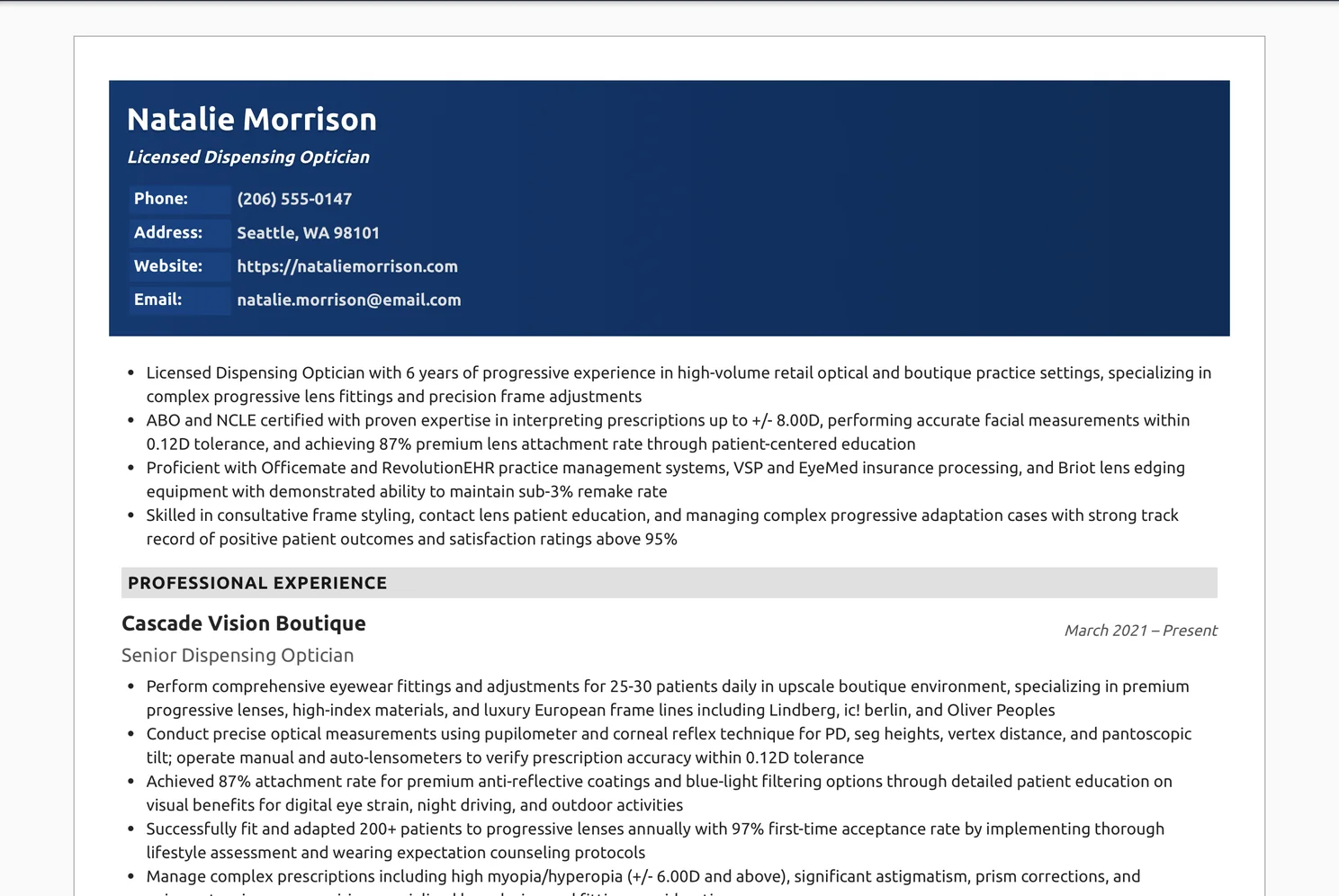
The Ultimate Optician Resume Example/Sample
https://www.resumonk.com/opticianOpticianResume Format to Follow for an Optician Resume
The resume format you choose matters because it tells the story of how you've built competency in this specific field. For most Opticians, the reverse-chronological format is your strongest choice. This format lists your most recent position first and works backward through your career history. Why does this work so well for Opticians? Because your field values progression and cumulative expertise.
Whether you completed an associate degree in opticianry, went through an apprenticeship, or earned your license through state-specific pathways, hiring managers want to see your most current capabilities front and center.
When the Reverse-Chronological Format Works Best
If you've been working as an Optician or in optical retail for any meaningful period, this format showcases your journey from fitting your first pair of frames to handling complex prescriptions for progressive lenses or specialty contact lenses.
Your recent experience at LensCrafters, Pearle Vision, or that busy ophthalmology practice demonstrates current knowledge of inventory systems, insurance processing, and the latest frame styles and lens technologies. Hiring managers in optical retail or private practices want to see continuity - that you understand the flow of a busy optical dispensary, that you've maintained your license, and that you've kept pace with changes in lens manufacturing and fitting techniques.
Alternative Formats for Specific Situations
The functional or combination format might serve you better in specific circumstances. If you're transitioning into opticianry from optical sales or as an optical assistant, and you've recently completed your certification but lack extensive licensed experience, a combination format lets you highlight your technical training and relevant skills (frame styling, PD measurements, lens edging) before diving into work history that might be titled differently.
Similarly, if you took time away from the field to raise children or care for family, then returned and renewed your license, a combination format can emphasize that your skills are current even if there's a gap in your employment dates.
However, be cautious with functional formats. Optical practices are often small businesses or parts of larger retail chains with established protocols. They're looking for someone who can step into their workflow quickly.
A resume that obscures when and where you gained your experience can raise questions about recency of your skills or whether you're familiar with current lens technologies like digital progressives or blue-light filtering options.
Structural Considerations for Your Optician Resume
Regardless of which format variation you choose, your resume should open with your contact information followed immediately by a brief professional summary that establishes your credentials. State your licensure status clearly - whether you're an ABO-certified Optician, licensed in specific states, or NCLE-certified for contact lenses. This isn't the place for modesty.
Your license is your entry ticket to this profession, and it should be visible within the first few lines.
Following your summary, your work experience section becomes the centerpiece of your resume. Each position should include your job title, employer name, location, and dates of employment. Under each role, you'll describe your responsibilities and achievements, which we'll explore in detail in the next section. After work experience, include your education and certifications, followed by a skills section. For Opticians, this structure makes sense because your hands-on experience is what differentiates you from other candidates who might have the same basic certification.
Work Experience on Your Optician Resume
Think about what actually happens during your day. You're interpreting prescriptions, sometimes catching errors or clarifications needed before proceeding. You're taking precise measurements - pupillary distance, optical centers, seg heights for bifocals and progressives. You're operating a lensometer to verify prescriptions and checking that the finished glasses match the Rx exactly. You're adjusting temples and nose pads using specialized pliers and heat. You're explaining the difference between polycarbonate and high-index lenses to someone who has never thought about lens materials. You're managing frame inventory, processing insurance claims, and possibly cutting and edging lenses if you work in a location with an on-site lab.
All of this needs to appear in your work experience descriptions.
Writing Achievement-Oriented Descriptions
The weakest Optician resumes simply list duties: "Fitted eyeglasses and contact lenses.
Assisted customers with frame selection. Processed insurance claims." This tells a hiring manager nothing about your level of skill or what you actually accomplished in the role. Instead, frame each bullet point around specific outcomes, volumes, or complexity levels you handled.
Let's look at the difference:
❌ Don't write generic duty statements:
"Responsible for fitting eyeglasses for customers"
✅ Do quantify and specify your technical work:
"Performed precise fitting and adjustment of eyeglasses for 30-40 patients daily, including complex progressive lens fittings and specialty frame adjustments for high prescriptions (+/- 6.00D and above)"
Notice how the second version tells the hiring manager your volume capacity, the complexity level you're comfortable with, and your familiarity with challenging prescriptions. This matters because a busy practice needs to know you can handle their patient flow, and a specialty practice needs to know you're not intimidated by unusual prescriptions or frame requirements.
Highlighting Technical Proficiencies
Your work experience should make clear which systems and equipment you've used.
Different optical practices use different management software - Officemate, RevolutionEHR, Crystal PM, or Eyefinity. If you've worked with these systems, name them. If you've operated an auto-lensometer versus a manual one, or if you've used a pupilometer for precise PD measurements, mention these tools. If your location had an in-house lab and you performed lens edging, mounting, and quality control, this significantly expands your value because you understand the entire process from prescription to finished product.
❌ Don't leave your technical work vague:
"Used optical equipment to measure and verify prescriptions"
✅ Do specify the equipment and processes:
"Operated manual and auto-lensometers to verify Rx accuracy within 0.12D tolerance; utilized pupilometer and corneal reflex technique for precise PD measurements; performed frame tracing and edging using Briot lens edging system"
Demonstrating Patient Care and Sales Outcomes
While technical skill is crucial, Opticians also need to guide patients through decisions that affect both their vision and their wallet.
Many patients feel overwhelmed by options - single vision versus progressives, standard plastic versus high-index, anti-reflective coatings, photochromic lenses, blue-light filtering. Your ability to educate patients and help them choose appropriate eyewear directly impacts both patient satisfaction and practice revenue.
If you consistently met or exceeded sales targets for lens upgrades or second-pair sales, include these metrics. If you received positive patient feedback or had a high rate of successful progressive lens adaptations (many patients struggle with their first progressives), these outcomes demonstrate your communication skills and patience.
❌ Don't reduce patient interaction to generic customer service:
"Provided excellent customer service and helped customers choose frames"
✅ Do show your consultative approach and results:
"Consulted with patients to recommend appropriate lens materials and coatings based on prescription strength, lifestyle needs, and budget; achieved 85% attachment rate for anti-reflective coatings through education on glare reduction and visual clarity benefits"
Including Insurance and Administrative Experience
Insurance processing is a reality of modern optical practice, and it's often one of the more frustrating aspects of the job. If you've navigated vision insurance plans - VSP, EyeMed, Davis Vision, Spectera - and understand benefits verification, eligibility checks, and out-of-pocket cost calculations, this administrative competency is valuable.
Many smaller practices particularly need Opticians who can handle the business side efficiently so the optometrist can focus on examinations.
❌ Don't simply state you processed insurance:
"Handled insurance claims and billing"
✅ Do demonstrate your knowledge of insurance systems:
"Verified vision insurance eligibility and benefits for VSP, EyeMed, and Medicare patients; explained coverage limitations and out-of-pocket costs; maintained 98% clean claim submission rate through accurate coding and documentation"
Structuring Multiple Positions
If you've held several Optician positions, use your space strategically. Your most recent role should receive the most detailed treatment with 5-7 bullet points covering the full range of your responsibilities. Previous positions can be described more concisely with 3-4 bullets focusing on what was unique or different about that role.
If you worked in a high-volume retail setting at one point and then moved to a boutique optical shop or medical practice, highlight how each environment developed different aspects of your skill set - volume and efficiency in one, personalized service and premium products in the other.
Skills to Show on Your Optician Resume
For Opticians, skills fall into several distinct categories, and your resume should represent all of them. You have technical optical skills, equipment and technology proficiencies, product knowledge, regulatory and compliance understanding, and interpersonal capabilities.
The mistake many Opticians make is either listing skills too generically ("customer service," "teamwork") or too narrowly, focusing only on the technical side while ignoring the patient interaction components that are equally crucial to success in this role.
Technical Optical Skills
These are the core competencies that define you as an Optician. They're the skills you learned during your training program or apprenticeship and have refined through practice. This includes prescription interpretation, facial measurements (PD, seg height, vertex distance, pantoscopic tilt, wrap angle), frame adjustment and repair, lens verification using lensometry, and contact lens insertion and removal training for patients.
If you have experience with specialty areas like low vision aids, prism prescriptions, or pediatric fittings, these specialized skills should be called out because they're not universal among Opticians.
Your skills section should reflect actual technical capabilities, not aspirational ones. If you've only observed contact lens fittings but haven't been trained or certified to do them independently (NCLE certification), don't list contact lens fitting as a skill. However, if you regularly train patients on insertion, removal, and care of contacts that were prescribed by the optometrist, that patient education component is a legitimate skill to include.
Equipment and Software Proficiencies
Optical practices want to know what systems you can use from day one versus what they'll need to train you on.
List specific practice management software you've used - Officemate, Eyefinity, RevolutionEHR, Crystal PM, or MaximEyes. Include equipment you're proficient with: manual and auto-lensometers, pupilometers, frame tracers, lens edging systems (specify brands like Briot, Essilor, or Huvitz if you have experience), and frame heating and adjustment tools. If you've used digital measurement devices like the Visioffice or similar digital dispensing tools, these represent current technology that not all Opticians have encountered yet.
Don't invent expertise you don't have, but also don't sell yourself short. If you used a particular system for two years at your previous position, you're proficient with it, even if you don't consider yourself an expert. Hiring managers understand they'll need to orient you to their specific workflows, but they want to know you're not starting from zero with technology.
Product Knowledge Areas
Your resume should signal your familiarity with the product categories and brands that are standard in the optical industry.
This includes lens types (single vision, bifocal, trifocal, progressive/PAL), lens materials (CR-39, polycarbonate, Trivex, high-index), and lens treatments (anti-reflective/AR coatings, scratch resistance, UV protection, blue-light filtering, photochromic lenses like Transitions). If you've worked extensively with particular premium lens brands - Varilux, Crizal, Shamir, Hoya, Zeiss - naming them demonstrates you're familiar with quality-tier product lines and can speak knowledgeably with patients about their options.
Frame knowledge is equally relevant. If you've worked with designer frame lines, sports eyewear brands, or specialty products like memory metal frames or adjustable nose pad systems, these indicate your breadth of product experience.
You don't need to list every frame brand you've ever touched, but indicating familiarity with different market segments (luxury, mid-range, sports performance, pediatric) shows versatility.
Regulatory and Compliance Knowledge
This is an area many Opticians overlook on their resumes, but it matters significantly to employers.
Your understanding of FDA regulations for medical devices, HIPAA compliance in handling patient information, OSHA safety protocols (particularly if you work with lens edging equipment or chemicals), and state-specific optician licensing requirements demonstrates professional maturity. If you've maintained continuing education credits to keep your license current, your commitment to staying updated with industry standards is worth noting.
Additionally, knowledge of vision insurance systems and medical coding (even at a basic level - knowing the difference between vision coverage and medical eye care coverage, understanding how refraction fees work) is increasingly important as optical practices navigate complex billing environments.
Interpersonal and Communication Skills
Here's where you need to be more specific than the generic "excellent communication skills" that appears on every resume in every field. What does communication actually mean for an Optician? It means explaining complex optical concepts in accessible language to patients who may have limited understanding of how vision correction works. It means managing patient expectations when they're adapting to progressive lenses for the first time and feeling frustrated. It means collaborating with optometrists to clarify prescriptions or address patient concerns.
It means training new staff on frame styling or adjustment techniques if you're a senior Optician.
❌ Don't list generic soft skills without context:
Skills: Communication, Customer Service, Problem-Solving, Teamwork
✅ Do specify how these skills apply in optical settings:
Skills: Patient Education on Lens Options & Coatings, Progressive Lens Adaptation Support, Prescription Clarification with Prescribers, Frame Styling Consultation, Multi-Provider Practice Coordination
Organizing Your Skills Section
You have two organizational approaches that work well for Optician resumes.
The first is a categorized skills list where you group related competencies under headers like "Technical Optical Skills," "Practice Management Systems," "Product Knowledge," and "Patient Care Specializations." This works particularly well if you have extensive experience and want to showcase depth across multiple areas.
The second approach is a comprehensive list that mixes technical and interpersonal skills, prioritizing the most relevant capabilities for the specific position you're targeting. If you're applying to a high-volume retail optical chain, you might lead with efficiency-related skills and system proficiencies. If you're applying to a boutique practice specializing in luxury eyewear, you might emphasize frame styling consultation and premium lens product knowledge.
Whichever structure you choose, aim for 12-20 distinct skills that genuinely represent your capabilities. This is enough to demonstrate breadth without overwhelming the reader or diluting the impact of your most important competencies. And here's a practical note: if the job posting mentions specific requirements or preferences (experience with a particular practice management system, pediatric fitting experience, contact lens certification), make absolutely certain those items appear in your skills section if you possess them.
This isn't about gaming any system; it's about making it immediately obvious that you match what they're seeking.
Specific Considerations and Tips for Your Optician Resume
Now we get into the nuances that separate an adequate Optician resume from one that actually resonates with hiring managers in this field. These are the considerations that stem from understanding what makes the Optician role unique - the regulatory environment, the variability in scope of practice across different states and settings, the blend of healthcare and retail, and the physical precision required in your daily work.
Addressing Licensing and Certification Clearly
This cannot be overstated: your licensure status needs to be crystal clear on your resume, and preferably mentioned in multiple places. The regulatory landscape for Opticians varies dramatically by state. Some states require formal licensing (which typically involves completing an accredited program and passing ABO and NCLE exams), while others have no requirements whatsoever. If you're licensed, state your license number, issuing state, and expiration date. If you're ABO-certified (American Board of Opticianry), this should appear prominently, ideally in your header area or immediately in your professional summary.
If you're also NCLE-certified (National Contact Lens Examiners), that's a separate credential worth highlighting since not all Opticians are qualified to work with contact lenses.
If you're applying for positions in a different state than where you're currently licensed, research whether that state has reciprocity agreements or what the licensure transfer process involves. Some states accept out-of-state licenses readily; others require additional testing. If you're in the process of obtaining a new state license, mention this on your resume: "New York State Optician License (in process - examination scheduled June 2024)." This shows initiative and removes a potential question mark in the hiring manager's mind.
For those working in states without licensure requirements, your voluntary certifications become even more important as signals of professional competency. If you completed a formal opticianry program or apprenticeship even though your state didn't require it, emphasize this educational foundation. It differentiates you from someone who learned on the job in an unstructured way.
Highlighting Adaptability Across Practice Settings
Opticians work in remarkably diverse environments, and each setting develops different strengths. Someone who spent years at LensCrafters or Pearle Vision became efficient at high-volume dispensing, frame inventory management, and working with standardized processes across multiple locations. Someone who worked in a private ophthalmology practice gained deep experience coordinating with medical eye care, working with post-surgical patients, and potentially dealing with more complex medical prescriptions.
Someone in a boutique optical shop developed refined frame styling skills and knowledge of luxury European frame lines.
Your resume should acknowledge the specific context of your experience while demonstrating that you understand what other environments require. If you're transitioning from retail optical to a medical practice, emphasize your precision with measurements, your patient education capabilities, and any exposure you had to post-surgical patients or medical conditions affecting eyewear needs. If you're moving from a medical setting to retail, highlight your efficiency, your sales skills (even in a medical context, you were likely discussing lens upgrades and second pairs), and your customer service orientation.
This contextual awareness also matters when describing your work environment in your job descriptions. Instead of simply stating "Optician at Cohen's Fashion Optical," consider adding a brief descriptor: "Optician at Cohen's Fashion Optical (high-volume retail location averaging 200+ patient interactions weekly)."
This immediately tells the hiring manager something about the pace and nature of your experience.
Demonstrating Problem-Solving in a Precision Field
One of the aspects of Optician work that doesn't always translate well to resumes is the troubleshooting and problem-solving that happens constantly. Prescriptions that don't seem right and need clarification with the doctor. Patients who insist a frame will work for their prescription when you know the lens thickness will be problematic. Finished glasses that pass lensometer verification but somehow don't feel right to the patient.
Progressive lenses that need adjustment because the patient's wearing habits differ from standard assumptions.
When possible, work examples of your problem-solving into your job descriptions. Did you identify a pattern of returned progressive lenses and implement a more detailed patient education process that reduced remakes by 30%? Did you develop a system for flagging prescriptions that needed doctor review before processing? Did you successfully fit a patient with an unusual combination of high astigmatism and anisometropia who had been told by another Optician that they weren't a candidate for progressive lenses? These stories demonstrate clinical judgment and adaptability.
Addressing Employment Gaps in Optical Retail Context
The optical field has a fair amount of turnover, particularly in retail settings, and employment gaps aren't unusual. If you took time off to raise children, care for family members, or deal with health issues, then returned to optical work, you don't need to manufacture complicated explanations.
However, you do need to address what might be a concern for employers: whether your knowledge of current products and technologies is up to date.
If you've been out of the field and recently returned, your resume should include any refresher training you completed, continuing education courses you took to renew your license, or ways you stayed connected to the field. If you've been back for even six months, you can emphasize your reintegration: "Successfully returned to optical dispensing after family care leave; quickly reestablished proficiency with current lens technologies including digital progressive designs and blue-light filtering options."
Quantifying Impact in a Service Role
Many Opticians struggle with quantification because the work feels qualitative - you're helping people see better and feel confident in their appearance.
But there are numerous ways to add concrete numbers to your resume that illustrate your impact. Patient volume (daily, weekly, monthly), sales metrics (capture rate, average transaction value, second-pair sales percentage), operational metrics (remake rate, patient wait time, insurance claim approval rate), and efficiency measures (glasses delivered within promised timeframe percentage) all tell a story about your effectiveness.
If you worked in a practice where you don't have access to specific numbers, you can use ranges or estimates as long as they're honest: "approximately 30-35 patients daily," "consistently ranked in top 5 of 20-person optical team for monthly sales," "maintained remake rate below 3%, significantly lower than industry average of 5-8%."
Balancing Medical and Retail Aspects
One of the tensions in Optician work is that you're simultaneously a healthcare provider and, in most settings, a salesperson. Your resume needs to honor both aspects without making you sound purely transactional. The most sophisticated Optician resumes frame sales achievements in terms of patient care: not "exceeded sales targets" but "achieved 85% lens upgrade attachment rate by thoroughly educating patients about visual benefits of premium lens options."
The outcome is the same - you drove revenue - but the framing emphasizes that you did so by being a good clinician who helps patients make informed decisions about their vision.
This balance is particularly important if you're applying to medical practices or ophthalmology clinics where there's sometimes a cultural bias against "retail" opticians. Emphasize your clinical precision, your collaboration with doctors, your patient education approach, and your understanding of medical conditions that affect eyewear prescriptions. These elements position you as a healthcare professional who happens to work in a field with commercial aspects, rather than a salesperson who works with eyewear.
Including Relevant Professional Development
The optical field evolves constantly with new lens technologies, frame materials, and digital measuring tools.
Your resume should reflect that you're someone who keeps pace with these changes. This might appear in a professional development section or woven into your work experience descriptions. Have you attended Vision Expo or other industry trade shows? Completed manufacturer training on specific lens products (Varilux University, Zeiss training programs)? Taken courses on specialty topics like sports vision, occupational eyewear, or low vision? These details signal that you're invested in your craft beyond showing up for your shifts.
Additionally, if you've trained or mentored other Opticians or optical assistants, this deserves prominent mention. Training others is evidence of mastery - you understand the work well enough to teach it - and it suggests leadership potential even if you haven't held a formal management title.
State-Specific Considerations
For Opticians in the United States, Canada, the UK, and Australia, the regulatory frameworks differ significantly. In the United States, make sure you understand your state's requirements and how they compare to where you're applying. Canadian Opticians should note their provincial registration with regulatory colleges. In the UK, if you're registered with the General Optical Council (GOC), this is a critical credential to feature prominently.
Australian Opticians working under state-specific regulations should similarly ensure their registration status is clear.
If you're applying internationally or considering relocation, research carefully what credential recognition or additional certification might be required. A UK-trained Dispensing Optician might need additional certification to work in certain US states, while a US Optician might need to register with the GOC to practice in the UK.
If you're in the process of obtaining these credentials, state this clearly on your resume.
The Physical Presentation Matters
Here's an ironic consideration: Opticians help people with visual clarity, and your resume needs to demonstrate visual clarity too.
This isn't about specific fonts, but about clean organization, adequate white space, and logical flow. A cluttered, dense resume from an Optician sends an unintentional message about attention to detail. Your resume should be as precise and carefully adjusted as the eyeglasses you dispense - everything aligned properly, nothing out of place, the whole presentation polished and professional.
Make sure your contact information is current and professional. Use an email address that's appropriate for professional communication. If you include a LinkedIn profile, ensure it's updated and consistent with your resume. These might seem like minor details, but in a precision field, small details matter. They're part of how you demonstrate that you're someone who sweats the small stuff - which is exactly what fitting eyeglasses requires.
Education Requirements and Formatting for Your Optician Resume
Here's the thing about becoming an optician: unlike some healthcare roles where education is a prestige competition, your educational credentials serve a very specific purpose.
They demonstrate you've completed the necessary optical training programs, passed your certification exams, and met state licensing requirements. The person reading your resume (usually a practice manager or lead optician) isn't looking for impressive university names - they're looking for the letters ABO, NCLE, or state-specific licensing credentials that prove you can dispense eyewear without getting the practice sued.
What Educational Credentials Actually Matter
The optician profession operates on a practical credentialing system.
Your most important educational credentials are your certifications and licenses, not necessarily where you went to school. The American Board of Opticianry (ABO) certification is the industry standard, and if you work with contact lenses, the National Contact Lens Examiners (NCLE) certification is equally critical. These should be prominently displayed in your education section, or even better, in a dedicated "Licenses & Certifications" section near the top of your resume.
Start with your highest relevant credential and work backwards in reverse-chronological order. If you completed an associate degree in opticianry from a community college, that goes first. If you went through an apprenticeship program instead, list that.
Your high school diploma only needs to appear if you don't have post-secondary optical training, and even then, it's not doing much heavy lifting.
Formatting Your Optical Education Properly
Let's get specific about structure.
Each educational entry should include the credential or degree name, the institution, location, and completion date. For opticians, adding relevant coursework or specializations can actually be valuable, especially if you're early in your career and your experience section is sparse.
Here's how this looks in practice:
❌ Don't write it vaguely like this:
Education
College - 2020
Certified Optician
✅ Do provide complete, relevant details:
1. Associate of Applied Science in Opticianry
Hillsborough Community College, Tampa, FL
Graduated: May 2020
Relevant Coursework: Optical Theory, Contact Lens Fitting, Ophthalmic Dispensing, Optical Mathematics, Anatomy and Physiology of the Eye

2. American Board of Opticianry (ABO) Certification
Certified: August 2020 | License #: ABO123456

3. National Contact Lens Examiners (NCLE) Certification
Certified: September 2020 | License #: NCLE789012
Apprenticeship Programs Deserve Equal Billing
Not everyone takes the college route, and that's completely legitimate in opticianry. If you completed your training through a state-approved apprenticeship program while working at an optical practice, that's absolutely education.
Many experienced opticians actually prefer hiring apprentice-trained candidates because they've been in a real practice environment from day one.
Format your apprenticeship like this:
1. Optician Apprenticeship Program
- State-Approved Program through Johnson Vision Care, Denver, CO
- Completed: June 2021 (2,000+ supervised hours)
- Training included: Frame selection and adjustment, lens measurement and verification, PD measurement, basic optical repair, insurance processing, contact lens ordering
State Licensing Requirements Matter More Than You Think
Here's where geography gets important.
Twenty-three U.S. states require opticians to be licensed, while others have no requirements at all. If you're applying in states like New York, California, Texas, or Massachusetts where licensing is mandatory, your state license number should be prominently displayed. In the UK, while there's no mandatory registration for dispensing opticians who aren't registered with the General Optical Council, those who are GOC-registered should absolutely highlight this.
For licensed states, format it clearly:
State Licensure
1. Licensed Dispensing Optician, State of California
- License #: DO12345 | Issued: July 2020 | Expires: July 2024
Continuing Education Shows You're Staying Current
Optical technology changes fast. Progressive lens designs that were cutting-edge five years ago are now standard, and new lens materials and coatings appear constantly.
If you've completed continuing education courses, especially in specialized areas like low vision, pediatric opticianry, or advanced contact lens fitting, these deserve mention.
You don't need a separate section if you only have one or two CE courses, but you can add a line under your certifications:
Continuing Education: Advanced Progressive Lens Design (2023), Scleral Contact Lens Fitting Workshop (2022), Digital Eye Strain Management (2023)
What About Older or Incomplete Education?
Maybe you started a bachelor's degree but left to pursue optical training instead.
Maybe you went to optician school fifteen years ago and you're worried the dates make you look old. Here's the reality: completion dates matter less than you think once you have experience. If you've been working as an optician for five years, your education section shrinks in importance dramatically.
For incomplete degrees that are still relevant, you can list them honestly:
Optical Sciences Coursework
University of Houston, Houston, TX
Completed 45 credits toward degree (2018-2019)
If your optical training is dated but you've maintained certifications and continued working, simply omit graduation years if they're more than ten years old. Your certification renewal dates show you're current, which is what matters.
International Credentials Need Translation
If you trained outside the country where you're applying, you'll need to do some translation work. Canadian opticians with provincial licensing should note their SODO (Standards of Practice Document) completion. UK-trained dispensing opticians should clearly state their GOC registration status.
Australian opticians may have certificates from TAFE institutions that won't be familiar to employers in other countries.
The key is making equivalency clear:
Diploma of Optical Dispensing
TAFE NSW, Sydney, Australia
Completed: 2019
(Equivalent to Associate Degree in Opticianry in U.S. system)
Currently pursuing ABO certification (exam scheduled March 2024)
Awards and Publications on Your Optician Resume
The short answer is this: most opticians won't have a publications section, and that's completely fine.
But awards, recognition, and professional achievements? Those absolutely deserve space on your resume when you have them, and they can meaningfully differentiate you from other candidates.
Understanding What Counts as an Award in Opticianry
Awards in the optical field look different than in corporate environments.
You're not getting "Salesperson of the Quarter" plaques (though if you are, we'll talk about those). Instead, optician awards tend to fall into a few categories: customer service recognition, professional certification achievements, sales or performance awards from your practice, and industry association honors.
Customer service awards are gold in this field. If you received recognition for patient satisfaction scores, positive reviews, or service excellence, that directly speaks to the core of what makes a good optician. You're not just technically competent - you're someone patients actually enjoy working with during what can be a frustrating and expensive process.
Professional achievement awards might include things like being the first in your practice to complete a specialized certification, receiving recognition from your state optician association, or being selected for competitive training programs. These show you're invested in the profession beyond just showing up for your shift.
How to Format Awards on Your Optician Resume
The placement and formatting of awards depends entirely on how many you have and how impressive they are. If you received a significant industry award - let's say you were named "Emerging Optician of the Year" by your state association - that deserves prominent placement, possibly even in a dedicated section.
If you got an employee-of-the-month recognition once three years ago, that can live as a bullet point under that job entry in your work experience.
Here's the decision tree: three or more meaningful awards warrant their own section titled "Professional Recognition" or "Awards & Honors." Fewer than that, and they're better integrated into your work experience section where they provide context for your achievements at that specific employer.
For a dedicated section, format like this:
Professional Recognition
Patient Excellence Award, VisionWorks, 2023
Recognized for achieving 98% patient satisfaction rating across 500+ patient interactions
ABO Exam Achievement Award, American Board of Opticianry, 2021
Scored in top 10% nationally on certification examination
Apprentice of the Year, California Optometric Association, 2020
Selected from 200+ apprentices statewide for clinical skill and professional commitment
Sales Awards Need Careful Framing
Here's a delicate situation many opticians face: you might work in a retail optical environment where sales performance matters, and you might be legitimately great at it. Maybe you consistently lead your store in add-on sales for premium lens coatings or anti-reflective treatments.
That's valuable, but it needs to be framed carefully because opticians sit in an interesting space between healthcare and retail.
The key is tying sales success to patient outcomes, not just revenue. You're not selling used cars - you're helping patients invest in the best possible vision solution for their needs, and sometimes that means recommending premium products that genuinely serve them better.
❌ Don't frame it as pure sales:
Top Sales Performer, Q4 2022 - Generated $50K in premium lens upgrades
✅ Do connect it to patient value:
Patient Care Excellence Award, Q4 2022
Led practice in premium lens recommendations, helping 85% of patients select enhanced lens options better suited to their lifestyle needs (digital eye strain, driving, outdoor activities)
The Publications Question for Opticians
Now, about publications. Can opticians have publications? Sure. Will most? No. Should you force it? Absolutely not.
But there are legitimate scenarios where an optician might have something publication-worthy to list.
You might have contributed to your practice's blog or patient education materials. You might have written articles for your state optician association newsletter. If you've spoken at a local optician's meeting or given a presentation at a continuing education event, that can live in a "Presentations & Publications" section. Some opticians who specialize in areas like low vision or pediatric opticianry might contribute to professional forums or training materials.
The rule here is simple: if it's professional and optical-related, it counts. If you wrote a viral blog post about your cat, that doesn't belong on your optician resume no matter how many shares it got.
Presentations & Professional Writing
1. "Troubleshooting Progressive Lens Adaptation Issues"
- Presentation at Florida Society of Opticians Annual Conference, Miami, FL, June 2023

2. "Patient Education Strategies for First-Time Contact Lens Wearers"
Article published in The Optical Assistant quarterly newsletter, Spring 2022

3. Contributing Writer, Vision Source Practice Blog
Authored 8 patient education articles on topics including blue light protection, sports eyewear selection, and children's vision development (2021-2023)
Academic Awards from Your Training Program
If you're a recent graduate from an opticianry program, academic awards absolutely count and can help compensate for limited work experience. Dean's list, perfect attendance (which in a healthcare field demonstrates reliability), outstanding clinical performance, or academic scholarships all signal that you took your training seriously.
These lose relevance as you gain work experience - if you've been working as an optician for eight years, nobody cares that you made the dean's list in optical school anymore. But in your first few years in the field, they're worth including:
1. Academic Excellence Award, Opticianry Program, 2021
- Graduated with 3.9 GPA, received departmental recognition for clinical competency scores

2. Perfect Attendance Award, 2019-2020 Academic Year
- Completed all 1,200+ hours of required clinical training without absence
When You Have Nothing to List Here
Here's the most important thing I'll say about this entire section: if you don't have awards or publications, don't manufacture them and don't leave a sad, empty section on your resume.
The absence of an "Awards" section will not cost you a job as an optician. Your skills, experience, and certifications matter infinitely more.
Many excellent opticians have never received a formal award but have helped thousands of patients, trained dozens of new opticians, and built careers they're proud of. You don't need a trophy to be good at this job.
But if you do have genuine recognition, showcase it properly because it adds credibility and helps you stand out in a competitive job market.
Listing References on Your Optician Resume
References are the strange, awkward finale to the job application process.
You spend hours perfecting your resume and cover letter, showcasing your best professional self, and then at the end someone's going to call your former boss and ask if you were actually any good. So let's talk about how to handle references for optician positions in a way that strengthens rather than undermines your application.
Should References Live on Your Resume?
Let's settle this debate immediately. The answer is no, your references should not take up valuable space on your resume itself. That old advice about including "References available upon request" at the bottom of your resume? It's outdated. Of course references are available upon request - that's assumed.
Using three lines of your resume to say something that's already understood is a waste of prime real estate.
Your resume should focus on your qualifications, experience, and skills. References come into play later in the hiring process, typically after an interview when an employer is seriously considering making you an offer. What you should have is a separate, formatted reference sheet that's ready to provide when asked. This keeps your resume focused and professional while ensuring you can quickly respond when a potential employer requests references.
Creating a Professional Reference Sheet
Your reference sheet should match the formatting of your resume - same font, same header with your name and contact information, same professional style. This creates a cohesive application package and demonstrates attention to detail. Title it simply: "Professional References for [Your Name]."
Include three to four references. Fewer than three looks thin, like you couldn't find people willing to vouch for you. More than four is overkill and makes the hiring manager's job harder. For each reference, you need to include specific information: their full name, their professional title, the organization where they work, their phone number, their email address, and a brief phrase explaining your professional relationship to them.
Here's what a properly formatted reference entry looks like:
1. Maria Santos, Lead Dispensing Optician
- VisionWorks Optical, Denver, CO
- Phone: (555) 234-5678 | Email: [email protected]
- Relationship: Direct supervisor for two years (2021-2023)
Who Makes a Good Reference for Opticians
The best references for optician positions are people who directly observed your technical skills and patient interactions. Your ideal reference list includes a mix of supervisors who can speak to your reliability and performance, and optometrists or other healthcare professionals who can verify your clinical competence and collaborative abilities.
A practice manager or lead optician who supervised you is gold. They can speak to the full scope of your work: your technical skills, your patient manner, your reliability, your ability to handle difficult situations, and how you functioned as part of the practice team. If you worked with a particular optometrist regularly, they can vouch for your understanding of prescriptions, your ability to identify potential problems, and your professionalism in a clinical setting.
Colleagues at your level can work as references but are less powerful than supervisors or senior clinical staff. A fellow optician can speak to how you collaborate and whether you're helpful and competent, but they can't speak authoritatively about your overall performance. Use peer references only if you don't have enough supervisory references available.
References to Avoid
Don't use personal references for professional optician positions. Your neighbor who thinks you're great doesn't carry weight with a hiring manager who needs to know if you can accurately measure pupillary distance and adjust progressive lenses.
Don't use references from jobs outside the optical field unless you're new to opticianry and need to demonstrate general work ethic and reliability.
Avoid using someone as a reference if you haven't worked with them in more than five years. The optical industry changes, and someone who knew you as a brand-new apprentice seven years ago can't speak to who you are as an experienced optician now. And this should go without saying, but never list someone as a reference without asking their permission first. Surprising someone with a reference call is a good way to get a lukewarm recommendation.
❌ Don't use inappropriate references like this:
References:✅ Do use relevant professional references:
John Smith, Family Friend
Pastor Jennifer Martinez, Community Church
Dr. Robert Lee, My Personal Optometrist
Professional References
1. Jennifer Martinez, Practice Manager
- EyeCare Associates, Boston, MA
- Phone: (555) 345-6789 | Email: [email protected]
- Relationship: Direct supervisor for three years (2020-2023)

2. Dr. Robert Chen, OD
- EyeCare Associates, Boston, MA
- Phone: (555) 345-6790 |Email: [email protected]
- Relationship: Collaborated daily on patient care and frame selection (2020-2023)

3. Thomas Wilson, Senior Dispensing Optician
- ClearView Optical, Cambridge, MA
- Phone: (555) 456-7890 | Email: [email protected]
- Relationship: Apprenticeship supervisor and mentor (2018-2020)
Managing References When You're Currently Employed
Here's a common dilemma: you're currently working as an optician but looking for a new position, and you don't want your current employer to know you're job hunting.
How do you handle references? The answer is to use former supervisors and colleagues from your current workplace once it's appropriate, but hold them back until later in the process.
In your initial application, it's perfectly acceptable to note "Current employer references available after interview" or to provide references from previous positions only. Once you're past the initial interview stage and seriously being considered for a position, that's when you have the conversation about contacting your current employer.
Many hiring managers understand this situation and will respect your need for confidentiality in the early stages. What they won't respect is if you get to the offer stage and suddenly have no one from your current job who can speak to your recent work.
Plan ahead: identify a trusted senior colleague or optometrist at your current practice who can serve as a reference discreetly when the time comes.
Preparing Your References
Once you've identified your references and received their permission, don't just abandon them to figure it out when a hiring manager calls.
Prepare them. Send them a copy of the job description for positions you're seriously pursuing. Remind them of specific projects or achievements from when you worked together. Give them context about what the potential employer is likely to ask about.
A brief email works perfectly for this:
Hi Maria,

I hope you're doing well! I'm applying for a lead optician position at Anderson Eye Care in Portland, and I wanted to give you a heads up that they may contact you as a reference. I've attached the job description - they're particularly focused on contact lens fitting experience and patient education skills, which I know we worked on extensively during my time at VisionWorks.
Thank you so much for being willing to serve as a reference. I really appreciate your support. Please let me know if you need any additional information from me.

Best regards,
James
This preparation benefits everyone. Your reference knows what's coming and can prepare thoughtful responses. The hiring manager gets substantive, relevant information.
And you come across as organized and professional.
What Employers Actually Ask References
Understanding what questions references typically receive helps you choose the right people.
Hiring managers for optician positions generally ask about technical competency, reliability, patient interaction skills, and teamwork. They want to know: Did this person show up consistently? Could they handle the technical aspects of the job? How did patients respond to them? Would you hire them again?
They're also listening for enthusiasm level. A reference who gives flat, perfunctory answers suggests problems even if nothing negative is explicitly said. A reference who enthusiastically recalls specific examples of your excellent work is worth their weight in anti-reflective coating upgrades.
Some employers also ask about areas for improvement or growth. This isn't a trick question designed to sink your candidacy. A thoughtful reference might say something like "James was still building confidence with difficult pediatric patients when he left, but he was making great progress and always willing to ask for guidance when needed." That's actually a positive answer because it shows self-awareness and commitment to improvement.
International Reference Conventions
Reference expectations vary slightly by location. In the United States, providing references is standard and expected, typically after an interview. In the UK, references are often requested earlier in the process, sometimes even before an interview.
UK references also tend to be more formal and may be conducted in writing rather than by phone.
In Canada, the process is similar to the US, though some provinces have stricter privacy laws that limit what former employers can legally share. Australian employers typically request references later in the hiring process, similar to US practices.
Wherever you're applying, pay attention to when and how the employer requests references, as this signals local norms.
When References Become a Problem
What if you don't have good references?
Maybe you left your last optician job on bad terms. Maybe your former supervisor has since left the practice and you've lost touch. Maybe your last position was years ago and those connections are stale. These situations require strategy.
If you left a position on poor terms, don't pretend it didn't happen. You can't use that supervisor as a reference, but you can use other colleagues from that workplace who you did have good relationships with. You can also use references from earlier positions, supplemented with professional references like optical sales representatives you worked with regularly or instructors from continuing education courses.
If your references are outdated, it's time to rebuild your professional network. Volunteer at vision screening events where you'll work with other optical professionals. Take continuing education courses and build relationships with instructors. Join your state optician association and get involved.
These activities not only give you new potential references but also demonstrate ongoing professional engagement.
The Myth of "Professional Reference Services"
You might come across services that offer to provide professional references for a fee. Don't use them. Hiring managers can spot these fake references immediately, and using them will likely disqualify you from consideration and damage your professional reputation.
The optical community is smaller than you think, and word gets around.
If you're in a situation where you genuinely lack professional references - maybe you're entering opticianry from a completely different field - be honest about it and offer what you have. An instructor from your opticianry program, a supervisor from your apprenticeship, or a manager from your pre-optical career who can speak to your work ethic and reliability is infinitely better than a paid fake reference.
Following Up After References Are Checked
Once you know your references have been contacted, it's courteous to follow up with them, regardless of whether you get the job. Thank them for their time, let them know the outcome when appropriate, and maintain those relationships. These people invested their professional credibility in supporting your career.
That's not something to take for granted.
Your references today might be your colleagues tomorrow in this interconnected field. The practice manager who serves as your reference for this job might be hiring for a lead optician position next year when you're ready to move up. Professional relationships in opticianry are long-term investments, and treating your references with appreciation and respect is both good manners and good career strategy.
Cover Letter Tips for Your Optician Resume
Here's a hard truth: a bad cover letter is worse than no cover letter at all. So let's talk about how to write one that actually helps your application for an optician position, understanding exactly what hiring managers in optical practices are looking for and what will make them want to bring you in for an interview.
Why Cover Letters Matter for Optician Positions
Opticianry is an interesting profession because it requires both technical precision and interpersonal warmth.
You need to understand optical mathematics, lens materials, and frame adjustments, but you also need to patiently explain insurance benefits to a frustrated patient or help someone feel attractive in their glasses when they're feeling self-conscious. Your resume shows the technical qualifications - your cover letter is where you demonstrate the human side.
Practice managers and optical directors use cover letters to assess communication skills, cultural fit, and genuine interest in their specific practice. They're trying to answer questions your resume can't: Do you understand what this practice is about? Can you write clearly and professionally? Do you actually want this job, or are you just mass-applying to every optician opening in a fifty-mile radius? Your cover letter is where you answer these questions convincingly.
Structure Your Optician Cover Letter Like a Patient Consultation
Think about how you work with a patient selecting frames. You don't immediately start grabbing glasses off the wall. You ask questions, you listen, you demonstrate that you understand their needs, and then you offer solutions based on what you've learned.
Your cover letter should follow the same consultative structure.
Start with why you're writing and how you found the position. Then demonstrate you've done your homework about this specific practice. Show you understand what they need and explain how your background makes you the solution. Close with a clear next step. This shouldn't be longer than a page - hiring managers are busy, and being concise is itself a communication skill.
Here's what this looks like in practice for an opening paragraph:
❌ Don't write a generic, lifeless opening:
Dear Hiring Manager,✅ Do write something specific and engaging:
I am writing to apply for the Optician position I saw advertised online. I have been working as an optician for three years and I am ABO certified. I am a hard worker and would be a great fit for your team.
Dear Ms. Rodriguez,
When I walked into EyeCare Associates last month to attend your community vision screening event at Lincoln Elementary, I was struck by how your team managed to make vision testing feel fun for 150 nervous kids. That's exactly the kind of patient-first environment where I want to grow my optical career. I'm writing to apply for the Dispensing Optician position posted on your practice website, bringing three years of experience in pediatric opticianry and a genuine enthusiasm for the community-focused approach that defines your practice.
Do Your Homework on the Practice
This cannot be overstated: generic cover letters are immediately obvious and immediately forgettable. The optician applying to your practice should not have a cover letter that could be sent unchanged to the practice down the street.
You need to demonstrate you know something about where you're applying.
Visit the practice if you can. Check their website and social media. Notice what kinds of frames they carry - are they budget-focused or boutique? Do they specialize in anything like sports vision, pediatric eyewear, or low vision services? Are they part of a large chain or an independent practice? Do they emphasize medical optics, working closely with optometrists and ophthalmologists, or are they more retail-focused? All of this should inform how you position yourself.
If you're applying to a LensCrafters or Pearle Vision, emphasizing your ability to work efficiently in a high-volume environment makes sense. If you're applying to an independent boutique optical, talking about your eye for fashion and experience with premium frame lines is more relevant.
If it's a practice attached to an ophthalmology clinic, highlighting your experience with post-surgical patients or specialized medical eyewear matters more.
Tell Stories That Demonstrate Your Skills
Your resume lists your skills. Your cover letter should prove them with brief, specific examples. Instead of saying "I have excellent customer service skills," tell a two-sentence story about the time you spent forty-five minutes helping an elderly patient choose progressive lenses and they came back specifically to thank you because it changed their daily life.
Instead of saying "I'm proficient with difficult adjustments," mention that you've become the go-to person in your practice for rimless frame repairs.
These stories do two things: they make your letter memorable and they demonstrate your communication style. If you can tell a patient story that's empathetic and clear, the hiring manager can envision you doing the same thing with their patients.
In my current role at Vision Center, I worked with a teenage patient who was devastated about needing glasses for the first time. She was convinced she'd look "like a nerd" and nothing her parents said helped. I spent time understanding her style, showed her frames worn by athletes and musicians she admired, and helped her see glasses as an accessory rather than a medical device. She left excited about her new look, and her mother later told our manager it was the best retail experience she'd ever had. That's the kind of patient interaction that makes me love this profession.
Address the Specific Job Requirements
Job postings for optician positions often have specific requirements: experience with particular practice management software, contact lens fitting experience, insurance processing knowledge, or specialization in certain areas. Your cover letter should explicitly address the major requirements listed in the posting.
If they want someone experienced with Uprise or Revolution practice management systems and you've used both, say so. If they're looking for someone with contact lens expertise and you're NCLE certified with three years of CL fitting experience, make that connection explicit. Don't make the hiring manager work to figure out if you meet their needs - hand them the information clearly.
❌ Don't make them hunt for qualifications:
I have used many different computer systems in my optical career and I'm sure I could learn whatever system you use.✅ Do address their specific needs directly:
I notice you're looking for someone experienced with Officemate practice management software and VSP insurance processing. I've used Officemate daily for the past two years at my current practice, and I've processed over 1,000 VSP claims, becoming our team's resource person for handling complex coverage questions.
Explain Career Transitions Positively
Maybe you're coming to opticianry from retail management, or you're re-entering the field after time away, or you're moving from a large chain to a small independent practice. Your cover letter is where you frame these transitions positively and address any questions they might raise.
If you're new to opticianry but come from a strong retail or customer service background, connect those dots. If you worked in opticianry, left for a few years, and are returning, explain why you're coming back.
If you've been at a corporate optical retailer but want to move to a private practice, articulate what draws you to that environment without badmouthing your current employer.
After five years as an assistant manager at Target Optical, I'm seeking a position where I can deepen my clinical skills and build longer-term patient relationships. While I've valued the fast-paced environment and efficiency focus of retail optical, I'm drawn to Anderson Eye Care's approach of spending unhurried time with patients and offering the specialized services - like low vision consultations and custom contact lens fittings - that aren't possible in a purely retail setting.
The Closing Should Open the Door
Your closing paragraph needs to be more than "Thank you for your consideration."
It should reiterate your interest, briefly summarize why you're a strong fit, and include a clear call to action. You want to make it easy for them to take the next step.
Include your phone number and email in the closing even though they're on your resume. Express enthusiasm without desperation.
And unless the job posting specifically says "no phone calls," it's perfectly appropriate to mention that you'll follow up.
I'm genuinely excited about the possibility of bringing my technical skills and patient-centered approach to the optician team at Riverside Vision. My combination of ABO and NCLE certifications, pediatric eyewear experience, and commitment to making every patient interaction positive aligns perfectly with the values I've observed in your practice. I'd welcome the opportunity to discuss how I can contribute to your team's success.
I'll follow up next week to ensure you received my application, and I'm happy to provide additional information or references. You can reach me at (555) 123-4567 or [email protected].
Thank you for considering my application.
Common Cover Letter Mistakes Opticians Make
Let's talk about what not to do, because I've seen some rough cover letters from otherwise qualified opticians.
Don't write a novel - one page maximum. Don't just repeat your resume in paragraph form - that wastes everyone's time. Don't use weird fonts or colors trying to stand out - this is a healthcare profession, not graphic design. Don't lead with salary requirements or benefit questions - that comes later in the process.
Don't apologize for things you lack. If you don't have a specific qualification they want, either don't mention it or briefly note your plan to acquire it. Don't write "I know I don't have contact lens experience, but..." Just don't. Focus on what you do bring to the table.
And please, proofread. Nothing undermines an optician's attention to detail credibility faster than a typo in the cover letter. Have someone else read it. Use spell check. Read it out loud.
An error-free cover letter is a baseline expectation, not an achievement.
What About Location-Specific Differences?
Cover letter conventions are fairly consistent across the US, Canada, UK, and Australia for optician positions, but there are a few regional nuances worth noting.
In the UK, it's more common to see cover letters referred to as "covering letters," and they tend to be slightly more formal in tone. Canadian applications sometimes follow either US or UK conventions depending on the region. Australian cover letters tend to be slightly more direct and less formal than UK versions.
The more important geographical consideration is state licensing. If you're applying in a state or region where licensing is required and you have it, mention it prominently in your cover letter. If you're applying in a licensed state but don't yet have that state's specific license, address it directly and explain your plan to obtain it.
When You Can Skip the Cover Letter
Are there situations where a cover letter isn't necessary? Yes. If you're applying through a system that doesn't allow cover letter uploads, obviously you can't include one. If the job posting explicitly says "no cover letters," follow that instruction.
If you're applying to a large retail chain through an automated applicant tracking portal that's clearly not designed to handle cover letters, your time might be better spent on other parts of your application.
But for any position at an independent practice, a medical optical setting, or a management-track role, include the cover letter. It's your best opportunity to be more than just another resume in the stack.
Key Takeaways
Building a strong optician resume requires understanding what makes your role unique in the healthcare landscape and translating your hands-on clinical work into a document that hiring managers will respond to. Here are the essential points to remember as you create your resume:
- Lead with your credentials prominently. Your ABO certification, NCLE certification if applicable, and state licensure (with numbers and expiration dates) should be immediately visible, either in your header or professional summary. These credentials are your entry ticket to practice, not afterthoughts to bury in your education section.
- Use reverse-chronological format for most situations. This format showcases your progression and current capabilities, which matters in a field that values up-to-date knowledge of lens technologies and fitting techniques. Consider combination formats only if you're transitioning into licensed opticianry from related roles or returning after significant time away.
- Quantify your work experience with specific metrics. Replace generic statements like "fitted eyeglasses for customers" with detailed descriptions that include patient volume (30-40 daily), complexity levels (progressive lenses, high prescriptions above +/- 6.00D), and outcomes (85% lens upgrade attachment rate, sub-3% remake rate).
- Demonstrate both technical and interpersonal competencies. Your resume needs to show you can operate lensometers and perform precise measurements while also educating patients about lens options and managing difficult adaptation situations. Balance is crucial in a role that sits between healthcare and retail.
- Name specific systems and equipment you've used. List practice management software by name (Officemate, Eyefinity, RevolutionEHR), specify equipment brands (Briot edging systems, auto-lensometers), and mention insurance platforms you've worked with (VSP, EyeMed, Davis Vision). Generic "computer skills" doesn't tell hiring managers what you can do from day one.
- Tailor your experience to different practice environments. High-volume retail optical, boutique shops, medical practices, and ophthalmology clinics all value different aspects of your skill set. Emphasize efficiency and system proficiency for retail, premium product knowledge for boutique, and clinical precision for medical settings.
- Address licensing variations based on location. Twenty-three U.S. states require licensing, others don't, and international credentialing varies significantly. Make your eligibility to practice in the target location crystal clear, and if you're pursuing credentials for a new state, acknowledge this proactively.
- Frame sales achievements through a patient care lens. Don't position yourself as purely transactional. Instead of "exceeded sales targets," write "achieved 85% anti-reflective coating attachment rate through education on glare reduction and visual clarity benefits." The revenue outcome is the same, but the framing honors your healthcare role.
- Include continuing education and specialized training. Optical technology evolves constantly. Manufacturer training programs, specialty certifications in areas like low vision or pediatric opticianry, and attendance at industry conferences signal that you're keeping pace with the field.
- Keep your resume to one page if you have less than seven years of experience, two pages maximum for extensive careers. Hiring managers for optician positions need to assess your qualifications quickly. Dense, cluttered resumes undermine your message about precision and attention to detail.
- Prepare a separate reference sheet rather than listing references on your resume. Include three to four professional references (supervisors, optometrists you've worked with, senior opticians who mentored you) with complete contact information and your relationship to them clearly stated.
- Write a targeted cover letter for positions at independent practices and medical settings. Generic applications get generic responses. Research the practice, understand what makes it unique, and explain specifically why your background aligns with their environment and patient population.
Creating your optician resume with Resumonk gives you access to professionally designed templates that present your clinical credentials and technical experience with the visual clarity this field demands. The platform's AI-powered recommendations help you articulate your achievements with the specificity hiring managers are looking for, while the formatting tools ensure your licensure, certifications, and complex work history are organized logically and attractively. Whether you're building your first resume as a newly certified optician or refining your presentation as an experienced dispenser pursuing lead or specialty positions, Resumonk provides the structure and guidance to showcase your optical expertise professionally.
Ready to create a resume that positions you as the skilled optical professional you are?
Start building your optician resume with Resumonk today and access beautifully designed templates, AI-powered content suggestions tailored to healthcare roles, and formatting tools that make your technical qualifications shine.
Get started now.
More Medical resume examples
- Pharmacist resume example
- Dentist resume example
- Retail Pharmacist resume example
- Physical Therapist resume example
See all Medical resume examples, or browse every category.
Resume writing tips
You're here because you need a resume that actually works for optician positions, not generic career advice that treats your specialized healthcare role like it's interchangeable with retail management or office administration. You know the reality of your work: you're interpreting prescriptions that someone else might misread, taking measurements accurate to fractions of millimeters, adjusting frames with precision tools, and explaining complex optical concepts to patients who just want to see clearly and look good. This isn't entry-level retail, despite what some job postings might suggest with their vague "customer service" language.
You're a licensed or certified healthcare professional working in a skilled trade that requires technical training, ongoing education, and in many states, legal credentialing to practice.
The challenge you're facing right now is translating the nuanced, hands-on reality of optical dispensing into a document that hiring managers will actually read and respond to. You might be wondering whether to emphasize your technical skills with lensometers and frame adjustments, or your patient interaction abilities that turn confused, overwhelmed customers into confident people who trust your recommendations. You're probably unsure how much detail to include about insurance processing, whether your apprenticeship counts as much as someone's associate degree, and how to make "fitted eyeglasses" sound like the complex clinical work it actually is. And if you're transitioning between practice settings, moving from that busy LensCrafters to a boutique optical shop or from retail to a medical practice, you're trying to figure out how to position your experience so it translates across these different environments.
This guide walks you through building an optician resume that works for your specific situation, whether you're a newly certified optician applying for your first licensed position, an experienced dispenser looking to move into lead or management roles, or someone returning to the field after time away. We'll start with choosing the right resume format, the reverse-chronological structure that works for most opticians but with specific considerations for career changers and those with employment gaps. Then we'll dig into the work experience section, where you'll learn to transform generic duty statements into achievement-focused descriptions that quantify your patient volume, technical complexity, and outcomes. We'll cover the skills section with the specificity this field requires, distinguishing between technical optical competencies, equipment proficiencies, product knowledge, and the patient care capabilities that matter as much as your lensometry skills.
Beyond the core resume sections, we'll address the considerations unique to opticianry: how to present your ABO and NCLE certifications prominently, how to handle the state-by-state licensing variations that make credentialing complex, how to balance the medical and retail aspects of your work without underselling either dimension, and how to demonstrate your value whether you're fitting basic single-vision lenses or complex progressive prescriptions for high myopes. We'll talk about education formatting for both traditional opticianry programs and apprenticeship training, cover awards and recognition in a field where "sales awards" need careful framing, walk through cover letter strategies that demonstrate you understand the specific practice you're applying to, and handle the reference question with the professionalism this healthcare role demands. By the end, you'll have a clear framework for creating an optician resume that positions you as the skilled clinical professional you are, ready to move forward in your optical career with confidence.
The Ultimate Optician Resume Example/Sample
https://www.resumonk.com/opticianOpticianResume Format to Follow for an Optician Resume
The resume format you choose matters because it tells the story of how you've built competency in this specific field. For most Opticians, the reverse-chronological format is your strongest choice. This format lists your most recent position first and works backward through your career history. Why does this work so well for Opticians? Because your field values progression and cumulative expertise.
Whether you completed an associate degree in opticianry, went through an apprenticeship, or earned your license through state-specific pathways, hiring managers want to see your most current capabilities front and center.
When the Reverse-Chronological Format Works Best
If you've been working as an Optician or in optical retail for any meaningful period, this format showcases your journey from fitting your first pair of frames to handling complex prescriptions for progressive lenses or specialty contact lenses.
Your recent experience at LensCrafters, Pearle Vision, or that busy ophthalmology practice demonstrates current knowledge of inventory systems, insurance processing, and the latest frame styles and lens technologies. Hiring managers in optical retail or private practices want to see continuity - that you understand the flow of a busy optical dispensary, that you've maintained your license, and that you've kept pace with changes in lens manufacturing and fitting techniques.
Alternative Formats for Specific Situations
The functional or combination format might serve you better in specific circumstances. If you're transitioning into opticianry from optical sales or as an optical assistant, and you've recently completed your certification but lack extensive licensed experience, a combination format lets you highlight your technical training and relevant skills (frame styling, PD measurements, lens edging) before diving into work history that might be titled differently.
Similarly, if you took time away from the field to raise children or care for family, then returned and renewed your license, a combination format can emphasize that your skills are current even if there's a gap in your employment dates.
However, be cautious with functional formats. Optical practices are often small businesses or parts of larger retail chains with established protocols. They're looking for someone who can step into their workflow quickly.
A resume that obscures when and where you gained your experience can raise questions about recency of your skills or whether you're familiar with current lens technologies like digital progressives or blue-light filtering options.
Structural Considerations for Your Optician Resume
Regardless of which format variation you choose, your resume should open with your contact information followed immediately by a brief professional summary that establishes your credentials. State your licensure status clearly - whether you're an ABO-certified Optician, licensed in specific states, or NCLE-certified for contact lenses. This isn't the place for modesty.
Your license is your entry ticket to this profession, and it should be visible within the first few lines.
Following your summary, your work experience section becomes the centerpiece of your resume. Each position should include your job title, employer name, location, and dates of employment. Under each role, you'll describe your responsibilities and achievements, which we'll explore in detail in the next section. After work experience, include your education and certifications, followed by a skills section. For Opticians, this structure makes sense because your hands-on experience is what differentiates you from other candidates who might have the same basic certification.
Work Experience on Your Optician Resume
Think about what actually happens during your day. You're interpreting prescriptions, sometimes catching errors or clarifications needed before proceeding. You're taking precise measurements - pupillary distance, optical centers, seg heights for bifocals and progressives. You're operating a lensometer to verify prescriptions and checking that the finished glasses match the Rx exactly. You're adjusting temples and nose pads using specialized pliers and heat. You're explaining the difference between polycarbonate and high-index lenses to someone who has never thought about lens materials. You're managing frame inventory, processing insurance claims, and possibly cutting and edging lenses if you work in a location with an on-site lab.
All of this needs to appear in your work experience descriptions.
Writing Achievement-Oriented Descriptions
The weakest Optician resumes simply list duties: "Fitted eyeglasses and contact lenses.
Assisted customers with frame selection. Processed insurance claims." This tells a hiring manager nothing about your level of skill or what you actually accomplished in the role. Instead, frame each bullet point around specific outcomes, volumes, or complexity levels you handled.
Let's look at the difference:
❌ Don't write generic duty statements:
"Responsible for fitting eyeglasses for customers"
✅ Do quantify and specify your technical work:
"Performed precise fitting and adjustment of eyeglasses for 30-40 patients daily, including complex progressive lens fittings and specialty frame adjustments for high prescriptions (+/- 6.00D and above)"
Notice how the second version tells the hiring manager your volume capacity, the complexity level you're comfortable with, and your familiarity with challenging prescriptions. This matters because a busy practice needs to know you can handle their patient flow, and a specialty practice needs to know you're not intimidated by unusual prescriptions or frame requirements.
Highlighting Technical Proficiencies
Your work experience should make clear which systems and equipment you've used.
Different optical practices use different management software - Officemate, RevolutionEHR, Crystal PM, or Eyefinity. If you've worked with these systems, name them. If you've operated an auto-lensometer versus a manual one, or if you've used a pupilometer for precise PD measurements, mention these tools. If your location had an in-house lab and you performed lens edging, mounting, and quality control, this significantly expands your value because you understand the entire process from prescription to finished product.
❌ Don't leave your technical work vague:
"Used optical equipment to measure and verify prescriptions"
✅ Do specify the equipment and processes:
"Operated manual and auto-lensometers to verify Rx accuracy within 0.12D tolerance; utilized pupilometer and corneal reflex technique for precise PD measurements; performed frame tracing and edging using Briot lens edging system"
Demonstrating Patient Care and Sales Outcomes
While technical skill is crucial, Opticians also need to guide patients through decisions that affect both their vision and their wallet.
Many patients feel overwhelmed by options - single vision versus progressives, standard plastic versus high-index, anti-reflective coatings, photochromic lenses, blue-light filtering. Your ability to educate patients and help them choose appropriate eyewear directly impacts both patient satisfaction and practice revenue.
If you consistently met or exceeded sales targets for lens upgrades or second-pair sales, include these metrics. If you received positive patient feedback or had a high rate of successful progressive lens adaptations (many patients struggle with their first progressives), these outcomes demonstrate your communication skills and patience.
❌ Don't reduce patient interaction to generic customer service:
"Provided excellent customer service and helped customers choose frames"
✅ Do show your consultative approach and results:
"Consulted with patients to recommend appropriate lens materials and coatings based on prescription strength, lifestyle needs, and budget; achieved 85% attachment rate for anti-reflective coatings through education on glare reduction and visual clarity benefits"
Including Insurance and Administrative Experience
Insurance processing is a reality of modern optical practice, and it's often one of the more frustrating aspects of the job. If you've navigated vision insurance plans - VSP, EyeMed, Davis Vision, Spectera - and understand benefits verification, eligibility checks, and out-of-pocket cost calculations, this administrative competency is valuable.
Many smaller practices particularly need Opticians who can handle the business side efficiently so the optometrist can focus on examinations.
❌ Don't simply state you processed insurance:
"Handled insurance claims and billing"
✅ Do demonstrate your knowledge of insurance systems:
"Verified vision insurance eligibility and benefits for VSP, EyeMed, and Medicare patients; explained coverage limitations and out-of-pocket costs; maintained 98% clean claim submission rate through accurate coding and documentation"
Structuring Multiple Positions
If you've held several Optician positions, use your space strategically. Your most recent role should receive the most detailed treatment with 5-7 bullet points covering the full range of your responsibilities. Previous positions can be described more concisely with 3-4 bullets focusing on what was unique or different about that role.
If you worked in a high-volume retail setting at one point and then moved to a boutique optical shop or medical practice, highlight how each environment developed different aspects of your skill set - volume and efficiency in one, personalized service and premium products in the other.
Skills to Show on Your Optician Resume
For Opticians, skills fall into several distinct categories, and your resume should represent all of them. You have technical optical skills, equipment and technology proficiencies, product knowledge, regulatory and compliance understanding, and interpersonal capabilities.
The mistake many Opticians make is either listing skills too generically ("customer service," "teamwork") or too narrowly, focusing only on the technical side while ignoring the patient interaction components that are equally crucial to success in this role.
Technical Optical Skills
These are the core competencies that define you as an Optician. They're the skills you learned during your training program or apprenticeship and have refined through practice. This includes prescription interpretation, facial measurements (PD, seg height, vertex distance, pantoscopic tilt, wrap angle), frame adjustment and repair, lens verification using lensometry, and contact lens insertion and removal training for patients.
If you have experience with specialty areas like low vision aids, prism prescriptions, or pediatric fittings, these specialized skills should be called out because they're not universal among Opticians.
Your skills section should reflect actual technical capabilities, not aspirational ones. If you've only observed contact lens fittings but haven't been trained or certified to do them independently (NCLE certification), don't list contact lens fitting as a skill. However, if you regularly train patients on insertion, removal, and care of contacts that were prescribed by the optometrist, that patient education component is a legitimate skill to include.
Equipment and Software Proficiencies
Optical practices want to know what systems you can use from day one versus what they'll need to train you on.
List specific practice management software you've used - Officemate, Eyefinity, RevolutionEHR, Crystal PM, or MaximEyes. Include equipment you're proficient with: manual and auto-lensometers, pupilometers, frame tracers, lens edging systems (specify brands like Briot, Essilor, or Huvitz if you have experience), and frame heating and adjustment tools. If you've used digital measurement devices like the Visioffice or similar digital dispensing tools, these represent current technology that not all Opticians have encountered yet.
Don't invent expertise you don't have, but also don't sell yourself short. If you used a particular system for two years at your previous position, you're proficient with it, even if you don't consider yourself an expert. Hiring managers understand they'll need to orient you to their specific workflows, but they want to know you're not starting from zero with technology.
Product Knowledge Areas
Your resume should signal your familiarity with the product categories and brands that are standard in the optical industry.
This includes lens types (single vision, bifocal, trifocal, progressive/PAL), lens materials (CR-39, polycarbonate, Trivex, high-index), and lens treatments (anti-reflective/AR coatings, scratch resistance, UV protection, blue-light filtering, photochromic lenses like Transitions). If you've worked extensively with particular premium lens brands - Varilux, Crizal, Shamir, Hoya, Zeiss - naming them demonstrates you're familiar with quality-tier product lines and can speak knowledgeably with patients about their options.
Frame knowledge is equally relevant. If you've worked with designer frame lines, sports eyewear brands, or specialty products like memory metal frames or adjustable nose pad systems, these indicate your breadth of product experience.
You don't need to list every frame brand you've ever touched, but indicating familiarity with different market segments (luxury, mid-range, sports performance, pediatric) shows versatility.
Regulatory and Compliance Knowledge
This is an area many Opticians overlook on their resumes, but it matters significantly to employers.
Your understanding of FDA regulations for medical devices, HIPAA compliance in handling patient information, OSHA safety protocols (particularly if you work with lens edging equipment or chemicals), and state-specific optician licensing requirements demonstrates professional maturity. If you've maintained continuing education credits to keep your license current, your commitment to staying updated with industry standards is worth noting.
Additionally, knowledge of vision insurance systems and medical coding (even at a basic level - knowing the difference between vision coverage and medical eye care coverage, understanding how refraction fees work) is increasingly important as optical practices navigate complex billing environments.
Interpersonal and Communication Skills
Here's where you need to be more specific than the generic "excellent communication skills" that appears on every resume in every field. What does communication actually mean for an Optician? It means explaining complex optical concepts in accessible language to patients who may have limited understanding of how vision correction works. It means managing patient expectations when they're adapting to progressive lenses for the first time and feeling frustrated. It means collaborating with optometrists to clarify prescriptions or address patient concerns.
It means training new staff on frame styling or adjustment techniques if you're a senior Optician.
❌ Don't list generic soft skills without context:
Skills: Communication, Customer Service, Problem-Solving, Teamwork
✅ Do specify how these skills apply in optical settings:
Skills: Patient Education on Lens Options & Coatings, Progressive Lens Adaptation Support, Prescription Clarification with Prescribers, Frame Styling Consultation, Multi-Provider Practice Coordination
Organizing Your Skills Section
You have two organizational approaches that work well for Optician resumes.
The first is a categorized skills list where you group related competencies under headers like "Technical Optical Skills," "Practice Management Systems," "Product Knowledge," and "Patient Care Specializations." This works particularly well if you have extensive experience and want to showcase depth across multiple areas.
The second approach is a comprehensive list that mixes technical and interpersonal skills, prioritizing the most relevant capabilities for the specific position you're targeting. If you're applying to a high-volume retail optical chain, you might lead with efficiency-related skills and system proficiencies. If you're applying to a boutique practice specializing in luxury eyewear, you might emphasize frame styling consultation and premium lens product knowledge.
Whichever structure you choose, aim for 12-20 distinct skills that genuinely represent your capabilities. This is enough to demonstrate breadth without overwhelming the reader or diluting the impact of your most important competencies. And here's a practical note: if the job posting mentions specific requirements or preferences (experience with a particular practice management system, pediatric fitting experience, contact lens certification), make absolutely certain those items appear in your skills section if you possess them.
This isn't about gaming any system; it's about making it immediately obvious that you match what they're seeking.
Specific Considerations and Tips for Your Optician Resume
Now we get into the nuances that separate an adequate Optician resume from one that actually resonates with hiring managers in this field. These are the considerations that stem from understanding what makes the Optician role unique - the regulatory environment, the variability in scope of practice across different states and settings, the blend of healthcare and retail, and the physical precision required in your daily work.
Addressing Licensing and Certification Clearly
This cannot be overstated: your licensure status needs to be crystal clear on your resume, and preferably mentioned in multiple places. The regulatory landscape for Opticians varies dramatically by state. Some states require formal licensing (which typically involves completing an accredited program and passing ABO and NCLE exams), while others have no requirements whatsoever. If you're licensed, state your license number, issuing state, and expiration date. If you're ABO-certified (American Board of Opticianry), this should appear prominently, ideally in your header area or immediately in your professional summary.
If you're also NCLE-certified (National Contact Lens Examiners), that's a separate credential worth highlighting since not all Opticians are qualified to work with contact lenses.
If you're applying for positions in a different state than where you're currently licensed, research whether that state has reciprocity agreements or what the licensure transfer process involves. Some states accept out-of-state licenses readily; others require additional testing. If you're in the process of obtaining a new state license, mention this on your resume: "New York State Optician License (in process - examination scheduled June 2024)." This shows initiative and removes a potential question mark in the hiring manager's mind.
For those working in states without licensure requirements, your voluntary certifications become even more important as signals of professional competency. If you completed a formal opticianry program or apprenticeship even though your state didn't require it, emphasize this educational foundation. It differentiates you from someone who learned on the job in an unstructured way.
Highlighting Adaptability Across Practice Settings
Opticians work in remarkably diverse environments, and each setting develops different strengths. Someone who spent years at LensCrafters or Pearle Vision became efficient at high-volume dispensing, frame inventory management, and working with standardized processes across multiple locations. Someone who worked in a private ophthalmology practice gained deep experience coordinating with medical eye care, working with post-surgical patients, and potentially dealing with more complex medical prescriptions.
Someone in a boutique optical shop developed refined frame styling skills and knowledge of luxury European frame lines.
Your resume should acknowledge the specific context of your experience while demonstrating that you understand what other environments require. If you're transitioning from retail optical to a medical practice, emphasize your precision with measurements, your patient education capabilities, and any exposure you had to post-surgical patients or medical conditions affecting eyewear needs. If you're moving from a medical setting to retail, highlight your efficiency, your sales skills (even in a medical context, you were likely discussing lens upgrades and second pairs), and your customer service orientation.
This contextual awareness also matters when describing your work environment in your job descriptions. Instead of simply stating "Optician at Cohen's Fashion Optical," consider adding a brief descriptor: "Optician at Cohen's Fashion Optical (high-volume retail location averaging 200+ patient interactions weekly)."
This immediately tells the hiring manager something about the pace and nature of your experience.
Demonstrating Problem-Solving in a Precision Field
One of the aspects of Optician work that doesn't always translate well to resumes is the troubleshooting and problem-solving that happens constantly. Prescriptions that don't seem right and need clarification with the doctor. Patients who insist a frame will work for their prescription when you know the lens thickness will be problematic. Finished glasses that pass lensometer verification but somehow don't feel right to the patient.
Progressive lenses that need adjustment because the patient's wearing habits differ from standard assumptions.
When possible, work examples of your problem-solving into your job descriptions. Did you identify a pattern of returned progressive lenses and implement a more detailed patient education process that reduced remakes by 30%? Did you develop a system for flagging prescriptions that needed doctor review before processing? Did you successfully fit a patient with an unusual combination of high astigmatism and anisometropia who had been told by another Optician that they weren't a candidate for progressive lenses? These stories demonstrate clinical judgment and adaptability.
Addressing Employment Gaps in Optical Retail Context
The optical field has a fair amount of turnover, particularly in retail settings, and employment gaps aren't unusual. If you took time off to raise children, care for family members, or deal with health issues, then returned to optical work, you don't need to manufacture complicated explanations.
However, you do need to address what might be a concern for employers: whether your knowledge of current products and technologies is up to date.
If you've been out of the field and recently returned, your resume should include any refresher training you completed, continuing education courses you took to renew your license, or ways you stayed connected to the field. If you've been back for even six months, you can emphasize your reintegration: "Successfully returned to optical dispensing after family care leave; quickly reestablished proficiency with current lens technologies including digital progressive designs and blue-light filtering options."
Quantifying Impact in a Service Role
Many Opticians struggle with quantification because the work feels qualitative - you're helping people see better and feel confident in their appearance.
But there are numerous ways to add concrete numbers to your resume that illustrate your impact. Patient volume (daily, weekly, monthly), sales metrics (capture rate, average transaction value, second-pair sales percentage), operational metrics (remake rate, patient wait time, insurance claim approval rate), and efficiency measures (glasses delivered within promised timeframe percentage) all tell a story about your effectiveness.
If you worked in a practice where you don't have access to specific numbers, you can use ranges or estimates as long as they're honest: "approximately 30-35 patients daily," "consistently ranked in top 5 of 20-person optical team for monthly sales," "maintained remake rate below 3%, significantly lower than industry average of 5-8%."
Balancing Medical and Retail Aspects
One of the tensions in Optician work is that you're simultaneously a healthcare provider and, in most settings, a salesperson. Your resume needs to honor both aspects without making you sound purely transactional. The most sophisticated Optician resumes frame sales achievements in terms of patient care: not "exceeded sales targets" but "achieved 85% lens upgrade attachment rate by thoroughly educating patients about visual benefits of premium lens options."
The outcome is the same - you drove revenue - but the framing emphasizes that you did so by being a good clinician who helps patients make informed decisions about their vision.
This balance is particularly important if you're applying to medical practices or ophthalmology clinics where there's sometimes a cultural bias against "retail" opticians. Emphasize your clinical precision, your collaboration with doctors, your patient education approach, and your understanding of medical conditions that affect eyewear prescriptions. These elements position you as a healthcare professional who happens to work in a field with commercial aspects, rather than a salesperson who works with eyewear.
Including Relevant Professional Development
The optical field evolves constantly with new lens technologies, frame materials, and digital measuring tools.
Your resume should reflect that you're someone who keeps pace with these changes. This might appear in a professional development section or woven into your work experience descriptions. Have you attended Vision Expo or other industry trade shows? Completed manufacturer training on specific lens products (Varilux University, Zeiss training programs)? Taken courses on specialty topics like sports vision, occupational eyewear, or low vision? These details signal that you're invested in your craft beyond showing up for your shifts.
Additionally, if you've trained or mentored other Opticians or optical assistants, this deserves prominent mention. Training others is evidence of mastery - you understand the work well enough to teach it - and it suggests leadership potential even if you haven't held a formal management title.
State-Specific Considerations
For Opticians in the United States, Canada, the UK, and Australia, the regulatory frameworks differ significantly. In the United States, make sure you understand your state's requirements and how they compare to where you're applying. Canadian Opticians should note their provincial registration with regulatory colleges. In the UK, if you're registered with the General Optical Council (GOC), this is a critical credential to feature prominently.
Australian Opticians working under state-specific regulations should similarly ensure their registration status is clear.
If you're applying internationally or considering relocation, research carefully what credential recognition or additional certification might be required. A UK-trained Dispensing Optician might need additional certification to work in certain US states, while a US Optician might need to register with the GOC to practice in the UK.
If you're in the process of obtaining these credentials, state this clearly on your resume.
The Physical Presentation Matters
Here's an ironic consideration: Opticians help people with visual clarity, and your resume needs to demonstrate visual clarity too.
This isn't about specific fonts, but about clean organization, adequate white space, and logical flow. A cluttered, dense resume from an Optician sends an unintentional message about attention to detail. Your resume should be as precise and carefully adjusted as the eyeglasses you dispense - everything aligned properly, nothing out of place, the whole presentation polished and professional.
Make sure your contact information is current and professional. Use an email address that's appropriate for professional communication. If you include a LinkedIn profile, ensure it's updated and consistent with your resume. These might seem like minor details, but in a precision field, small details matter. They're part of how you demonstrate that you're someone who sweats the small stuff - which is exactly what fitting eyeglasses requires.
Education Requirements and Formatting for Your Optician Resume
Here's the thing about becoming an optician: unlike some healthcare roles where education is a prestige competition, your educational credentials serve a very specific purpose.
They demonstrate you've completed the necessary optical training programs, passed your certification exams, and met state licensing requirements. The person reading your resume (usually a practice manager or lead optician) isn't looking for impressive university names - they're looking for the letters ABO, NCLE, or state-specific licensing credentials that prove you can dispense eyewear without getting the practice sued.
What Educational Credentials Actually Matter
The optician profession operates on a practical credentialing system.
Your most important educational credentials are your certifications and licenses, not necessarily where you went to school. The American Board of Opticianry (ABO) certification is the industry standard, and if you work with contact lenses, the National Contact Lens Examiners (NCLE) certification is equally critical. These should be prominently displayed in your education section, or even better, in a dedicated "Licenses & Certifications" section near the top of your resume.
Start with your highest relevant credential and work backwards in reverse-chronological order. If you completed an associate degree in opticianry from a community college, that goes first. If you went through an apprenticeship program instead, list that.
Your high school diploma only needs to appear if you don't have post-secondary optical training, and even then, it's not doing much heavy lifting.
Formatting Your Optical Education Properly
Let's get specific about structure.
Each educational entry should include the credential or degree name, the institution, location, and completion date. For opticians, adding relevant coursework or specializations can actually be valuable, especially if you're early in your career and your experience section is sparse.
Here's how this looks in practice:
❌ Don't write it vaguely like this:
Education
College - 2020
Certified Optician
✅ Do provide complete, relevant details:
1. Associate of Applied Science in Opticianry
Hillsborough Community College, Tampa, FL
Graduated: May 2020
Relevant Coursework: Optical Theory, Contact Lens Fitting, Ophthalmic Dispensing, Optical Mathematics, Anatomy and Physiology of the Eye

2. American Board of Opticianry (ABO) Certification
Certified: August 2020 | License #: ABO123456

3. National Contact Lens Examiners (NCLE) Certification
Certified: September 2020 | License #: NCLE789012
Apprenticeship Programs Deserve Equal Billing
Not everyone takes the college route, and that's completely legitimate in opticianry. If you completed your training through a state-approved apprenticeship program while working at an optical practice, that's absolutely education.
Many experienced opticians actually prefer hiring apprentice-trained candidates because they've been in a real practice environment from day one.
Format your apprenticeship like this:
1. Optician Apprenticeship Program
- State-Approved Program through Johnson Vision Care, Denver, CO
- Completed: June 2021 (2,000+ supervised hours)
- Training included: Frame selection and adjustment, lens measurement and verification, PD measurement, basic optical repair, insurance processing, contact lens ordering
State Licensing Requirements Matter More Than You Think
Here's where geography gets important.
Twenty-three U.S. states require opticians to be licensed, while others have no requirements at all. If you're applying in states like New York, California, Texas, or Massachusetts where licensing is mandatory, your state license number should be prominently displayed. In the UK, while there's no mandatory registration for dispensing opticians who aren't registered with the General Optical Council, those who are GOC-registered should absolutely highlight this.
For licensed states, format it clearly:
State Licensure
1. Licensed Dispensing Optician, State of California
- License #: DO12345 | Issued: July 2020 | Expires: July 2024
Continuing Education Shows You're Staying Current
Optical technology changes fast. Progressive lens designs that were cutting-edge five years ago are now standard, and new lens materials and coatings appear constantly.
If you've completed continuing education courses, especially in specialized areas like low vision, pediatric opticianry, or advanced contact lens fitting, these deserve mention.
You don't need a separate section if you only have one or two CE courses, but you can add a line under your certifications:
Continuing Education: Advanced Progressive Lens Design (2023), Scleral Contact Lens Fitting Workshop (2022), Digital Eye Strain Management (2023)
What About Older or Incomplete Education?
Maybe you started a bachelor's degree but left to pursue optical training instead.
Maybe you went to optician school fifteen years ago and you're worried the dates make you look old. Here's the reality: completion dates matter less than you think once you have experience. If you've been working as an optician for five years, your education section shrinks in importance dramatically.
For incomplete degrees that are still relevant, you can list them honestly:
Optical Sciences Coursework
University of Houston, Houston, TX
Completed 45 credits toward degree (2018-2019)
If your optical training is dated but you've maintained certifications and continued working, simply omit graduation years if they're more than ten years old. Your certification renewal dates show you're current, which is what matters.
International Credentials Need Translation
If you trained outside the country where you're applying, you'll need to do some translation work. Canadian opticians with provincial licensing should note their SODO (Standards of Practice Document) completion. UK-trained dispensing opticians should clearly state their GOC registration status.
Australian opticians may have certificates from TAFE institutions that won't be familiar to employers in other countries.
The key is making equivalency clear:
Diploma of Optical Dispensing
TAFE NSW, Sydney, Australia
Completed: 2019
(Equivalent to Associate Degree in Opticianry in U.S. system)
Currently pursuing ABO certification (exam scheduled March 2024)
Awards and Publications on Your Optician Resume
The short answer is this: most opticians won't have a publications section, and that's completely fine.
But awards, recognition, and professional achievements? Those absolutely deserve space on your resume when you have them, and they can meaningfully differentiate you from other candidates.
Understanding What Counts as an Award in Opticianry
Awards in the optical field look different than in corporate environments.
You're not getting "Salesperson of the Quarter" plaques (though if you are, we'll talk about those). Instead, optician awards tend to fall into a few categories: customer service recognition, professional certification achievements, sales or performance awards from your practice, and industry association honors.
Customer service awards are gold in this field. If you received recognition for patient satisfaction scores, positive reviews, or service excellence, that directly speaks to the core of what makes a good optician. You're not just technically competent - you're someone patients actually enjoy working with during what can be a frustrating and expensive process.
Professional achievement awards might include things like being the first in your practice to complete a specialized certification, receiving recognition from your state optician association, or being selected for competitive training programs. These show you're invested in the profession beyond just showing up for your shift.
How to Format Awards on Your Optician Resume
The placement and formatting of awards depends entirely on how many you have and how impressive they are. If you received a significant industry award - let's say you were named "Emerging Optician of the Year" by your state association - that deserves prominent placement, possibly even in a dedicated section.
If you got an employee-of-the-month recognition once three years ago, that can live as a bullet point under that job entry in your work experience.
Here's the decision tree: three or more meaningful awards warrant their own section titled "Professional Recognition" or "Awards & Honors." Fewer than that, and they're better integrated into your work experience section where they provide context for your achievements at that specific employer.
For a dedicated section, format like this:
Professional Recognition
Patient Excellence Award, VisionWorks, 2023
Recognized for achieving 98% patient satisfaction rating across 500+ patient interactions
ABO Exam Achievement Award, American Board of Opticianry, 2021
Scored in top 10% nationally on certification examination
Apprentice of the Year, California Optometric Association, 2020
Selected from 200+ apprentices statewide for clinical skill and professional commitment
Sales Awards Need Careful Framing
Here's a delicate situation many opticians face: you might work in a retail optical environment where sales performance matters, and you might be legitimately great at it. Maybe you consistently lead your store in add-on sales for premium lens coatings or anti-reflective treatments.
That's valuable, but it needs to be framed carefully because opticians sit in an interesting space between healthcare and retail.
The key is tying sales success to patient outcomes, not just revenue. You're not selling used cars - you're helping patients invest in the best possible vision solution for their needs, and sometimes that means recommending premium products that genuinely serve them better.
❌ Don't frame it as pure sales:
Top Sales Performer, Q4 2022 - Generated $50K in premium lens upgrades
✅ Do connect it to patient value:
Patient Care Excellence Award, Q4 2022
Led practice in premium lens recommendations, helping 85% of patients select enhanced lens options better suited to their lifestyle needs (digital eye strain, driving, outdoor activities)
The Publications Question for Opticians
Now, about publications. Can opticians have publications? Sure. Will most? No. Should you force it? Absolutely not.
But there are legitimate scenarios where an optician might have something publication-worthy to list.
You might have contributed to your practice's blog or patient education materials. You might have written articles for your state optician association newsletter. If you've spoken at a local optician's meeting or given a presentation at a continuing education event, that can live in a "Presentations & Publications" section. Some opticians who specialize in areas like low vision or pediatric opticianry might contribute to professional forums or training materials.
The rule here is simple: if it's professional and optical-related, it counts. If you wrote a viral blog post about your cat, that doesn't belong on your optician resume no matter how many shares it got.
Presentations & Professional Writing
1. "Troubleshooting Progressive Lens Adaptation Issues"
- Presentation at Florida Society of Opticians Annual Conference, Miami, FL, June 2023

2. "Patient Education Strategies for First-Time Contact Lens Wearers"
Article published in The Optical Assistant quarterly newsletter, Spring 2022

3. Contributing Writer, Vision Source Practice Blog
Authored 8 patient education articles on topics including blue light protection, sports eyewear selection, and children's vision development (2021-2023)
Academic Awards from Your Training Program
If you're a recent graduate from an opticianry program, academic awards absolutely count and can help compensate for limited work experience. Dean's list, perfect attendance (which in a healthcare field demonstrates reliability), outstanding clinical performance, or academic scholarships all signal that you took your training seriously.
These lose relevance as you gain work experience - if you've been working as an optician for eight years, nobody cares that you made the dean's list in optical school anymore. But in your first few years in the field, they're worth including:
1. Academic Excellence Award, Opticianry Program, 2021
- Graduated with 3.9 GPA, received departmental recognition for clinical competency scores

2. Perfect Attendance Award, 2019-2020 Academic Year
- Completed all 1,200+ hours of required clinical training without absence
When You Have Nothing to List Here
Here's the most important thing I'll say about this entire section: if you don't have awards or publications, don't manufacture them and don't leave a sad, empty section on your resume.
The absence of an "Awards" section will not cost you a job as an optician. Your skills, experience, and certifications matter infinitely more.
Many excellent opticians have never received a formal award but have helped thousands of patients, trained dozens of new opticians, and built careers they're proud of. You don't need a trophy to be good at this job.
But if you do have genuine recognition, showcase it properly because it adds credibility and helps you stand out in a competitive job market.
Listing References on Your Optician Resume
References are the strange, awkward finale to the job application process.
You spend hours perfecting your resume and cover letter, showcasing your best professional self, and then at the end someone's going to call your former boss and ask if you were actually any good. So let's talk about how to handle references for optician positions in a way that strengthens rather than undermines your application.
Should References Live on Your Resume?
Let's settle this debate immediately. The answer is no, your references should not take up valuable space on your resume itself. That old advice about including "References available upon request" at the bottom of your resume? It's outdated. Of course references are available upon request - that's assumed.
Using three lines of your resume to say something that's already understood is a waste of prime real estate.
Your resume should focus on your qualifications, experience, and skills. References come into play later in the hiring process, typically after an interview when an employer is seriously considering making you an offer. What you should have is a separate, formatted reference sheet that's ready to provide when asked. This keeps your resume focused and professional while ensuring you can quickly respond when a potential employer requests references.
Creating a Professional Reference Sheet
Your reference sheet should match the formatting of your resume - same font, same header with your name and contact information, same professional style. This creates a cohesive application package and demonstrates attention to detail. Title it simply: "Professional References for [Your Name]."
Include three to four references. Fewer than three looks thin, like you couldn't find people willing to vouch for you. More than four is overkill and makes the hiring manager's job harder. For each reference, you need to include specific information: their full name, their professional title, the organization where they work, their phone number, their email address, and a brief phrase explaining your professional relationship to them.
Here's what a properly formatted reference entry looks like:
1. Maria Santos, Lead Dispensing Optician
- VisionWorks Optical, Denver, CO
- Phone: (555) 234-5678 | Email: [email protected]
- Relationship: Direct supervisor for two years (2021-2023)
Who Makes a Good Reference for Opticians
The best references for optician positions are people who directly observed your technical skills and patient interactions. Your ideal reference list includes a mix of supervisors who can speak to your reliability and performance, and optometrists or other healthcare professionals who can verify your clinical competence and collaborative abilities.
A practice manager or lead optician who supervised you is gold. They can speak to the full scope of your work: your technical skills, your patient manner, your reliability, your ability to handle difficult situations, and how you functioned as part of the practice team. If you worked with a particular optometrist regularly, they can vouch for your understanding of prescriptions, your ability to identify potential problems, and your professionalism in a clinical setting.
Colleagues at your level can work as references but are less powerful than supervisors or senior clinical staff. A fellow optician can speak to how you collaborate and whether you're helpful and competent, but they can't speak authoritatively about your overall performance. Use peer references only if you don't have enough supervisory references available.
References to Avoid
Don't use personal references for professional optician positions. Your neighbor who thinks you're great doesn't carry weight with a hiring manager who needs to know if you can accurately measure pupillary distance and adjust progressive lenses.
Don't use references from jobs outside the optical field unless you're new to opticianry and need to demonstrate general work ethic and reliability.
Avoid using someone as a reference if you haven't worked with them in more than five years. The optical industry changes, and someone who knew you as a brand-new apprentice seven years ago can't speak to who you are as an experienced optician now. And this should go without saying, but never list someone as a reference without asking their permission first. Surprising someone with a reference call is a good way to get a lukewarm recommendation.
❌ Don't use inappropriate references like this:
References:✅ Do use relevant professional references:
John Smith, Family Friend
Pastor Jennifer Martinez, Community Church
Dr. Robert Lee, My Personal Optometrist
Professional References
1. Jennifer Martinez, Practice Manager
- EyeCare Associates, Boston, MA
- Phone: (555) 345-6789 | Email: [email protected]
- Relationship: Direct supervisor for three years (2020-2023)

2. Dr. Robert Chen, OD
- EyeCare Associates, Boston, MA
- Phone: (555) 345-6790 |Email: [email protected]
- Relationship: Collaborated daily on patient care and frame selection (2020-2023)

3. Thomas Wilson, Senior Dispensing Optician
- ClearView Optical, Cambridge, MA
- Phone: (555) 456-7890 | Email: [email protected]
- Relationship: Apprenticeship supervisor and mentor (2018-2020)
Managing References When You're Currently Employed
Here's a common dilemma: you're currently working as an optician but looking for a new position, and you don't want your current employer to know you're job hunting.
How do you handle references? The answer is to use former supervisors and colleagues from your current workplace once it's appropriate, but hold them back until later in the process.
In your initial application, it's perfectly acceptable to note "Current employer references available after interview" or to provide references from previous positions only. Once you're past the initial interview stage and seriously being considered for a position, that's when you have the conversation about contacting your current employer.
Many hiring managers understand this situation and will respect your need for confidentiality in the early stages. What they won't respect is if you get to the offer stage and suddenly have no one from your current job who can speak to your recent work.
Plan ahead: identify a trusted senior colleague or optometrist at your current practice who can serve as a reference discreetly when the time comes.
Preparing Your References
Once you've identified your references and received their permission, don't just abandon them to figure it out when a hiring manager calls.
Prepare them. Send them a copy of the job description for positions you're seriously pursuing. Remind them of specific projects or achievements from when you worked together. Give them context about what the potential employer is likely to ask about.
A brief email works perfectly for this:
Hi Maria,

I hope you're doing well! I'm applying for a lead optician position at Anderson Eye Care in Portland, and I wanted to give you a heads up that they may contact you as a reference. I've attached the job description - they're particularly focused on contact lens fitting experience and patient education skills, which I know we worked on extensively during my time at VisionWorks.
Thank you so much for being willing to serve as a reference. I really appreciate your support. Please let me know if you need any additional information from me.

Best regards,
James
This preparation benefits everyone. Your reference knows what's coming and can prepare thoughtful responses. The hiring manager gets substantive, relevant information.
And you come across as organized and professional.
What Employers Actually Ask References
Understanding what questions references typically receive helps you choose the right people.
Hiring managers for optician positions generally ask about technical competency, reliability, patient interaction skills, and teamwork. They want to know: Did this person show up consistently? Could they handle the technical aspects of the job? How did patients respond to them? Would you hire them again?
They're also listening for enthusiasm level. A reference who gives flat, perfunctory answers suggests problems even if nothing negative is explicitly said. A reference who enthusiastically recalls specific examples of your excellent work is worth their weight in anti-reflective coating upgrades.
Some employers also ask about areas for improvement or growth. This isn't a trick question designed to sink your candidacy. A thoughtful reference might say something like "James was still building confidence with difficult pediatric patients when he left, but he was making great progress and always willing to ask for guidance when needed." That's actually a positive answer because it shows self-awareness and commitment to improvement.
International Reference Conventions
Reference expectations vary slightly by location. In the United States, providing references is standard and expected, typically after an interview. In the UK, references are often requested earlier in the process, sometimes even before an interview.
UK references also tend to be more formal and may be conducted in writing rather than by phone.
In Canada, the process is similar to the US, though some provinces have stricter privacy laws that limit what former employers can legally share. Australian employers typically request references later in the hiring process, similar to US practices.
Wherever you're applying, pay attention to when and how the employer requests references, as this signals local norms.
When References Become a Problem
What if you don't have good references?
Maybe you left your last optician job on bad terms. Maybe your former supervisor has since left the practice and you've lost touch. Maybe your last position was years ago and those connections are stale. These situations require strategy.
If you left a position on poor terms, don't pretend it didn't happen. You can't use that supervisor as a reference, but you can use other colleagues from that workplace who you did have good relationships with. You can also use references from earlier positions, supplemented with professional references like optical sales representatives you worked with regularly or instructors from continuing education courses.
If your references are outdated, it's time to rebuild your professional network. Volunteer at vision screening events where you'll work with other optical professionals. Take continuing education courses and build relationships with instructors. Join your state optician association and get involved.
These activities not only give you new potential references but also demonstrate ongoing professional engagement.
The Myth of "Professional Reference Services"
You might come across services that offer to provide professional references for a fee. Don't use them. Hiring managers can spot these fake references immediately, and using them will likely disqualify you from consideration and damage your professional reputation.
The optical community is smaller than you think, and word gets around.
If you're in a situation where you genuinely lack professional references - maybe you're entering opticianry from a completely different field - be honest about it and offer what you have. An instructor from your opticianry program, a supervisor from your apprenticeship, or a manager from your pre-optical career who can speak to your work ethic and reliability is infinitely better than a paid fake reference.
Following Up After References Are Checked
Once you know your references have been contacted, it's courteous to follow up with them, regardless of whether you get the job. Thank them for their time, let them know the outcome when appropriate, and maintain those relationships. These people invested their professional credibility in supporting your career.
That's not something to take for granted.
Your references today might be your colleagues tomorrow in this interconnected field. The practice manager who serves as your reference for this job might be hiring for a lead optician position next year when you're ready to move up. Professional relationships in opticianry are long-term investments, and treating your references with appreciation and respect is both good manners and good career strategy.
Cover Letter Tips for Your Optician Resume
Here's a hard truth: a bad cover letter is worse than no cover letter at all. So let's talk about how to write one that actually helps your application for an optician position, understanding exactly what hiring managers in optical practices are looking for and what will make them want to bring you in for an interview.
Why Cover Letters Matter for Optician Positions
Opticianry is an interesting profession because it requires both technical precision and interpersonal warmth.
You need to understand optical mathematics, lens materials, and frame adjustments, but you also need to patiently explain insurance benefits to a frustrated patient or help someone feel attractive in their glasses when they're feeling self-conscious. Your resume shows the technical qualifications - your cover letter is where you demonstrate the human side.
Practice managers and optical directors use cover letters to assess communication skills, cultural fit, and genuine interest in their specific practice. They're trying to answer questions your resume can't: Do you understand what this practice is about? Can you write clearly and professionally? Do you actually want this job, or are you just mass-applying to every optician opening in a fifty-mile radius? Your cover letter is where you answer these questions convincingly.
Structure Your Optician Cover Letter Like a Patient Consultation
Think about how you work with a patient selecting frames. You don't immediately start grabbing glasses off the wall. You ask questions, you listen, you demonstrate that you understand their needs, and then you offer solutions based on what you've learned.
Your cover letter should follow the same consultative structure.
Start with why you're writing and how you found the position. Then demonstrate you've done your homework about this specific practice. Show you understand what they need and explain how your background makes you the solution. Close with a clear next step. This shouldn't be longer than a page - hiring managers are busy, and being concise is itself a communication skill.
Here's what this looks like in practice for an opening paragraph:
❌ Don't write a generic, lifeless opening:
Dear Hiring Manager,✅ Do write something specific and engaging:
I am writing to apply for the Optician position I saw advertised online. I have been working as an optician for three years and I am ABO certified. I am a hard worker and would be a great fit for your team.
Dear Ms. Rodriguez,
When I walked into EyeCare Associates last month to attend your community vision screening event at Lincoln Elementary, I was struck by how your team managed to make vision testing feel fun for 150 nervous kids. That's exactly the kind of patient-first environment where I want to grow my optical career. I'm writing to apply for the Dispensing Optician position posted on your practice website, bringing three years of experience in pediatric opticianry and a genuine enthusiasm for the community-focused approach that defines your practice.
Do Your Homework on the Practice
This cannot be overstated: generic cover letters are immediately obvious and immediately forgettable. The optician applying to your practice should not have a cover letter that could be sent unchanged to the practice down the street.
You need to demonstrate you know something about where you're applying.
Visit the practice if you can. Check their website and social media. Notice what kinds of frames they carry - are they budget-focused or boutique? Do they specialize in anything like sports vision, pediatric eyewear, or low vision services? Are they part of a large chain or an independent practice? Do they emphasize medical optics, working closely with optometrists and ophthalmologists, or are they more retail-focused? All of this should inform how you position yourself.
If you're applying to a LensCrafters or Pearle Vision, emphasizing your ability to work efficiently in a high-volume environment makes sense. If you're applying to an independent boutique optical, talking about your eye for fashion and experience with premium frame lines is more relevant.
If it's a practice attached to an ophthalmology clinic, highlighting your experience with post-surgical patients or specialized medical eyewear matters more.
Tell Stories That Demonstrate Your Skills
Your resume lists your skills. Your cover letter should prove them with brief, specific examples. Instead of saying "I have excellent customer service skills," tell a two-sentence story about the time you spent forty-five minutes helping an elderly patient choose progressive lenses and they came back specifically to thank you because it changed their daily life.
Instead of saying "I'm proficient with difficult adjustments," mention that you've become the go-to person in your practice for rimless frame repairs.
These stories do two things: they make your letter memorable and they demonstrate your communication style. If you can tell a patient story that's empathetic and clear, the hiring manager can envision you doing the same thing with their patients.
In my current role at Vision Center, I worked with a teenage patient who was devastated about needing glasses for the first time. She was convinced she'd look "like a nerd" and nothing her parents said helped. I spent time understanding her style, showed her frames worn by athletes and musicians she admired, and helped her see glasses as an accessory rather than a medical device. She left excited about her new look, and her mother later told our manager it was the best retail experience she'd ever had. That's the kind of patient interaction that makes me love this profession.
Address the Specific Job Requirements
Job postings for optician positions often have specific requirements: experience with particular practice management software, contact lens fitting experience, insurance processing knowledge, or specialization in certain areas. Your cover letter should explicitly address the major requirements listed in the posting.
If they want someone experienced with Uprise or Revolution practice management systems and you've used both, say so. If they're looking for someone with contact lens expertise and you're NCLE certified with three years of CL fitting experience, make that connection explicit. Don't make the hiring manager work to figure out if you meet their needs - hand them the information clearly.
❌ Don't make them hunt for qualifications:
I have used many different computer systems in my optical career and I'm sure I could learn whatever system you use.✅ Do address their specific needs directly:
I notice you're looking for someone experienced with Officemate practice management software and VSP insurance processing. I've used Officemate daily for the past two years at my current practice, and I've processed over 1,000 VSP claims, becoming our team's resource person for handling complex coverage questions.
Explain Career Transitions Positively
Maybe you're coming to opticianry from retail management, or you're re-entering the field after time away, or you're moving from a large chain to a small independent practice. Your cover letter is where you frame these transitions positively and address any questions they might raise.
If you're new to opticianry but come from a strong retail or customer service background, connect those dots. If you worked in opticianry, left for a few years, and are returning, explain why you're coming back.
If you've been at a corporate optical retailer but want to move to a private practice, articulate what draws you to that environment without badmouthing your current employer.
After five years as an assistant manager at Target Optical, I'm seeking a position where I can deepen my clinical skills and build longer-term patient relationships. While I've valued the fast-paced environment and efficiency focus of retail optical, I'm drawn to Anderson Eye Care's approach of spending unhurried time with patients and offering the specialized services - like low vision consultations and custom contact lens fittings - that aren't possible in a purely retail setting.
The Closing Should Open the Door
Your closing paragraph needs to be more than "Thank you for your consideration."
It should reiterate your interest, briefly summarize why you're a strong fit, and include a clear call to action. You want to make it easy for them to take the next step.
Include your phone number and email in the closing even though they're on your resume. Express enthusiasm without desperation.
And unless the job posting specifically says "no phone calls," it's perfectly appropriate to mention that you'll follow up.
I'm genuinely excited about the possibility of bringing my technical skills and patient-centered approach to the optician team at Riverside Vision. My combination of ABO and NCLE certifications, pediatric eyewear experience, and commitment to making every patient interaction positive aligns perfectly with the values I've observed in your practice. I'd welcome the opportunity to discuss how I can contribute to your team's success.
I'll follow up next week to ensure you received my application, and I'm happy to provide additional information or references. You can reach me at (555) 123-4567 or [email protected].
Thank you for considering my application.
Common Cover Letter Mistakes Opticians Make
Let's talk about what not to do, because I've seen some rough cover letters from otherwise qualified opticians.
Don't write a novel - one page maximum. Don't just repeat your resume in paragraph form - that wastes everyone's time. Don't use weird fonts or colors trying to stand out - this is a healthcare profession, not graphic design. Don't lead with salary requirements or benefit questions - that comes later in the process.
Don't apologize for things you lack. If you don't have a specific qualification they want, either don't mention it or briefly note your plan to acquire it. Don't write "I know I don't have contact lens experience, but..." Just don't. Focus on what you do bring to the table.
And please, proofread. Nothing undermines an optician's attention to detail credibility faster than a typo in the cover letter. Have someone else read it. Use spell check. Read it out loud.
An error-free cover letter is a baseline expectation, not an achievement.
What About Location-Specific Differences?
Cover letter conventions are fairly consistent across the US, Canada, UK, and Australia for optician positions, but there are a few regional nuances worth noting.
In the UK, it's more common to see cover letters referred to as "covering letters," and they tend to be slightly more formal in tone. Canadian applications sometimes follow either US or UK conventions depending on the region. Australian cover letters tend to be slightly more direct and less formal than UK versions.
The more important geographical consideration is state licensing. If you're applying in a state or region where licensing is required and you have it, mention it prominently in your cover letter. If you're applying in a licensed state but don't yet have that state's specific license, address it directly and explain your plan to obtain it.
When You Can Skip the Cover Letter
Are there situations where a cover letter isn't necessary? Yes. If you're applying through a system that doesn't allow cover letter uploads, obviously you can't include one. If the job posting explicitly says "no cover letters," follow that instruction.
If you're applying to a large retail chain through an automated applicant tracking portal that's clearly not designed to handle cover letters, your time might be better spent on other parts of your application.
But for any position at an independent practice, a medical optical setting, or a management-track role, include the cover letter. It's your best opportunity to be more than just another resume in the stack.
Key Takeaways
Building a strong optician resume requires understanding what makes your role unique in the healthcare landscape and translating your hands-on clinical work into a document that hiring managers will respond to. Here are the essential points to remember as you create your resume:
- Lead with your credentials prominently. Your ABO certification, NCLE certification if applicable, and state licensure (with numbers and expiration dates) should be immediately visible, either in your header or professional summary. These credentials are your entry ticket to practice, not afterthoughts to bury in your education section.
- Use reverse-chronological format for most situations. This format showcases your progression and current capabilities, which matters in a field that values up-to-date knowledge of lens technologies and fitting techniques. Consider combination formats only if you're transitioning into licensed opticianry from related roles or returning after significant time away.
- Quantify your work experience with specific metrics. Replace generic statements like "fitted eyeglasses for customers" with detailed descriptions that include patient volume (30-40 daily), complexity levels (progressive lenses, high prescriptions above +/- 6.00D), and outcomes (85% lens upgrade attachment rate, sub-3% remake rate).
- Demonstrate both technical and interpersonal competencies. Your resume needs to show you can operate lensometers and perform precise measurements while also educating patients about lens options and managing difficult adaptation situations. Balance is crucial in a role that sits between healthcare and retail.
- Name specific systems and equipment you've used. List practice management software by name (Officemate, Eyefinity, RevolutionEHR), specify equipment brands (Briot edging systems, auto-lensometers), and mention insurance platforms you've worked with (VSP, EyeMed, Davis Vision). Generic "computer skills" doesn't tell hiring managers what you can do from day one.
- Tailor your experience to different practice environments. High-volume retail optical, boutique shops, medical practices, and ophthalmology clinics all value different aspects of your skill set. Emphasize efficiency and system proficiency for retail, premium product knowledge for boutique, and clinical precision for medical settings.
- Address licensing variations based on location. Twenty-three U.S. states require licensing, others don't, and international credentialing varies significantly. Make your eligibility to practice in the target location crystal clear, and if you're pursuing credentials for a new state, acknowledge this proactively.
- Frame sales achievements through a patient care lens. Don't position yourself as purely transactional. Instead of "exceeded sales targets," write "achieved 85% anti-reflective coating attachment rate through education on glare reduction and visual clarity benefits." The revenue outcome is the same, but the framing honors your healthcare role.
- Include continuing education and specialized training. Optical technology evolves constantly. Manufacturer training programs, specialty certifications in areas like low vision or pediatric opticianry, and attendance at industry conferences signal that you're keeping pace with the field.
- Keep your resume to one page if you have less than seven years of experience, two pages maximum for extensive careers. Hiring managers for optician positions need to assess your qualifications quickly. Dense, cluttered resumes undermine your message about precision and attention to detail.
- Prepare a separate reference sheet rather than listing references on your resume. Include three to four professional references (supervisors, optometrists you've worked with, senior opticians who mentored you) with complete contact information and your relationship to them clearly stated.
- Write a targeted cover letter for positions at independent practices and medical settings. Generic applications get generic responses. Research the practice, understand what makes it unique, and explain specifically why your background aligns with their environment and patient population.
Creating your optician resume with Resumonk gives you access to professionally designed templates that present your clinical credentials and technical experience with the visual clarity this field demands. The platform's AI-powered recommendations help you articulate your achievements with the specificity hiring managers are looking for, while the formatting tools ensure your licensure, certifications, and complex work history are organized logically and attractively. Whether you're building your first resume as a newly certified optician or refining your presentation as an experienced dispenser pursuing lead or specialty positions, Resumonk provides the structure and guidance to showcase your optical expertise professionally.
Ready to create a resume that positions you as the skilled optical professional you are?
Start building your optician resume with Resumonk today and access beautifully designed templates, AI-powered content suggestions tailored to healthcare roles, and formatting tools that make your technical qualifications shine.
Get started now.
More Medical resume examples
- Pharmacist resume example
- Dentist resume example
- Retail Pharmacist resume example
- Physical Therapist resume example
See all Medical resume examples, or browse every category.
Resume writing tips