Nursing Student Resume Example (with Expert Advice and Tips)
Introduction
You're knee-deep in nursing school right now, probably reading this between study sessions or maybe during a rare moment when you're not reviewing drug calculations or trying to memorize cranial nerves. You're searching for nursing student resume examples because you need to apply for something - maybe it's a student nurse extern position for the summer, maybe it's a clinical assistant role to help pay tuition, or maybe you're in your final semester frantically applying to new graduate nurse residency programs.
Whatever brought you here, you're facing a specific challenge that nursing students know all too well - you're trying to write a professional resume when your "professional experience" is still very much in progress.
Here's what makes your situation tricky. You're not a complete beginner - you've done clinical rotations, you've provided actual patient care under supervision, you've probably seen more catheters and wound dressings than you ever imagined you would. But you're also not yet a licensed RN, which means you can't present yourself the way experienced nurses do. You're in this unique in-between space where you need to showcase real clinical competency while being honest about the fact that you're still learning. That balance - between confidence and humility, between demonstrating capability and acknowledging your student status - is exactly what we're going to help you strike in this guide.
This article walks you through everything you need to create a nursing student resume that actually works for your specific situation. We'll start with the foundational question of resume format and why the reverse-chronological structure serves nursing students best, then move into how to position your education (which is currently your primary qualification) front and center. We'll tackle the tricky work experience section - how to present clinical rotations that aren't quite jobs but definitely aren't just classroom learning, how to showcase any healthcare employment you've done alongside school, and yes, even how to include non-healthcare work experience in ways that strengthen rather than dilute your application. You'll learn which clinical skills to list and how to describe them accurately without overstating your independent practice abilities, how to address your timeline and graduation date strategically, and how to handle the specific contexts of student nurse extern applications versus new graduate RN positions.
We'll also cover the elements that can set you apart - awards and publications that nursing students accumulate more often than they realize, how to write a cover letter that tells the story behind your resume, and how to prepare professional references who can vouch for your clinical performance. Throughout this guide, we're speaking directly to your reality as a nursing student, whether you're in a traditional four-year BSN program, an accelerated second-degree program, or an ADN pathway. We understand the clinical rotation schedules, the exhaustion of balancing school and work, the imposter syndrome that hits when you're applying to positions at hospitals where you're not sure you're qualified enough yet. By the end of this article, you'll have a clear roadmap for creating a nursing student resume that honestly represents where you are while powerfully communicating where you're headed in this profession.
The Ultimate Nursing Student Resume Example/Sample
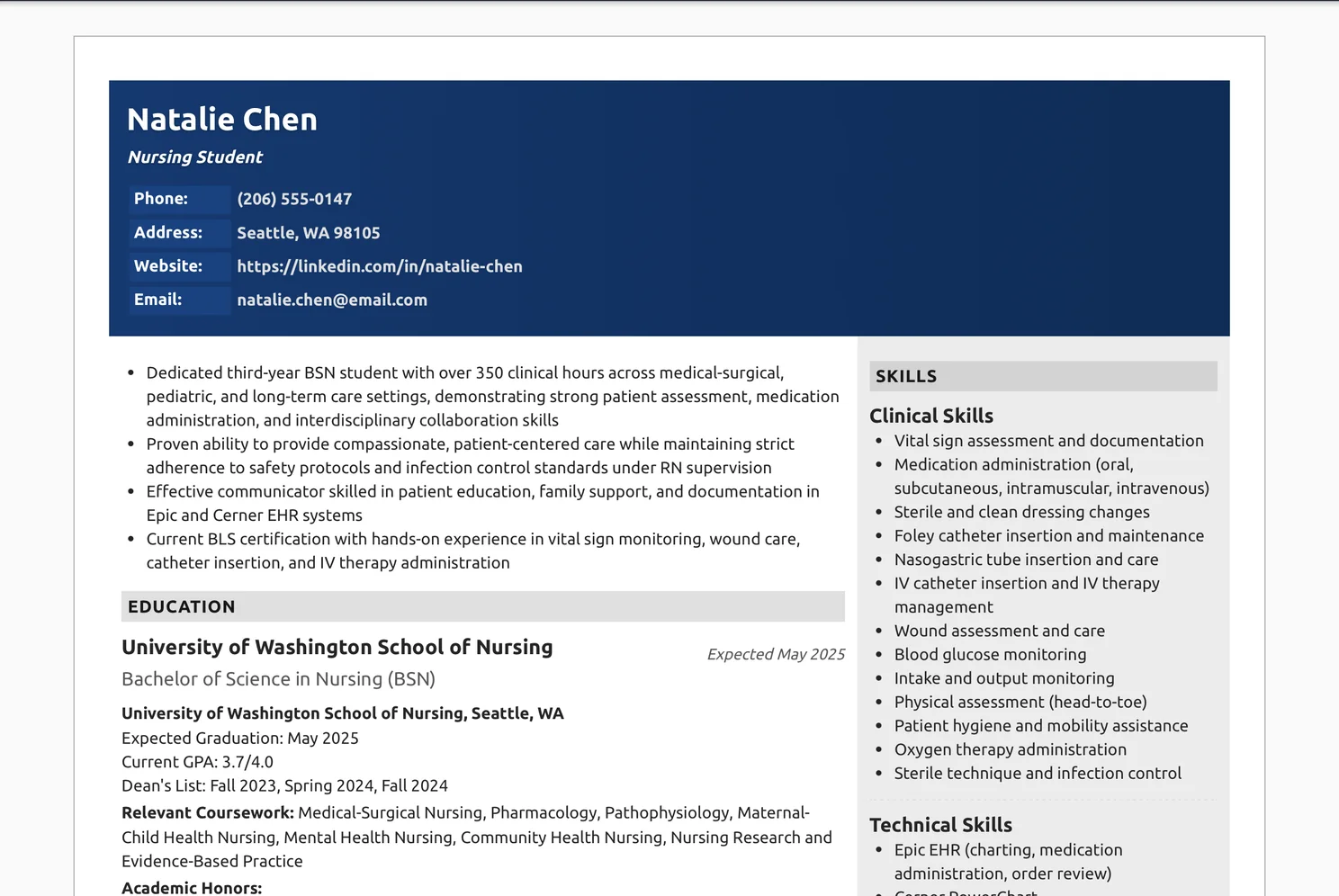
https://www.resumonk.com/nursing-studentNursing StudentResume Format to Follow for Nursing Student Resumes
You're in nursing school right now. You're juggling clinical rotations, pathophysiology exams, care plan assignments, and somehow trying to find time to build a resume that will land you that crucial student nurse extern position, clinical placement, or your first graduate nurse role after graduation.
The resume you need isn't the same as what a seasoned ICU nurse or nurse practitioner would create - it's fundamentally different because you're in an interesting in-between space where you're no longer just a student, but not yet a fully licensed professional.
The Reverse-Chronological Format is Your Foundation
For nursing students, the reverse-chronological format serves as the most effective structure for your resume.
This means listing your most recent experiences first and working backward through time. Why does this matter for you specifically? Because nursing education is progressive and cumulative. Your most recent clinical rotation in med-surg or pediatrics is more relevant and demonstrates more advanced competencies than your first-semester fundamentals lab. Hiring managers and clinical coordinators reviewing your application understand the nursing school timeline, and they want to see where you are right now in your educational journey.
This format allows you to prominently display your current semester or year of study, your most recent clinical experiences, and any healthcare-related work you're doing concurrently with your studies. Since you likely don't have decades of nursing experience to showcase, the reverse-chronological approach prevents awkward gaps and clearly demonstrates your progression through the program.
Leading With Education (Not Work Experience)
Here's where your resume diverges from what working professionals create. Your education section should appear near the top of your resume, immediately following your contact information and professional summary or objective. This isn't a weakness - it's strategic positioning. You're actively enrolled in an accredited nursing program, which is literally your primary qualification right now. Place your Bachelor of Science in Nursing (BSN) or Associate Degree in Nursing (ADN) program prominently, including your expected graduation date, current GPA if it's above 3.5, and any academic honors like Dean's List recognition.
After your formal education heading, create a dedicated "Clinical Experience" or "Clinical Rotations" section. This is absolutely critical for nursing student resumes and should be treated with the same weight as work experience. Each clinical rotation represents hands-on patient care experience in different specialties, and this is what hiring managers want to scrutinize. List the healthcare facility name, the unit or department, the dates of your rotation, and the total clinical hours completed in that setting.
Structure That Accommodates Your Unique Position
Your resume structure should flow like this: Contact Information, Professional Summary or Objective Statement, Education, Clinical Experience/Rotations, Relevant Work Experience (healthcare-related jobs like CNA, patient care technician, or medical assistant roles), Skills (divided into clinical skills and technical competencies), and Certifications. This organization immediately tells reviewers that you're a nursing student with legitimate clinical exposure, not someone with a vague interest in healthcare.
If you've worked as a certified nursing assistant, emergency room technician, or in any patient-facing role while attending nursing school, this deserves its own "Relevant Work Experience" section positioned after your clinical rotations. These roles demonstrate that you understand healthcare environments beyond your supervised student experiences.
If your work experience is entirely outside healthcare - retail, food service, tutoring - you can still include it under "Additional Experience" but keep it brief, focusing on transferable skills like communication, time management, and working under pressure.
Work Experience on Nursing Student Resumes
Let's address the elephant in the room. You're worried that your work experience section looks thin, or worse, non-existent. You might be thinking that summer you spent as a camp counselor or your current weekend shifts at a restaurant don't belong on a nursing resume.
But here's what you need to understand about work experience as a nursing student - the lens through which you present any experience matters more than the experience itself, and you have more relevant experience than you realize once you understand how to categorize it properly.
Clinical Rotations Are Work Experience (Sort Of)
First, let's clarify something crucial.
Your clinical rotations exist in a special category. They're not quite work experience because you're not being paid and you're under direct supervision with learning objectives. But they're absolutely not just "education" either. You're providing actual patient care, administering medications, performing assessments, and participating in the healthcare team. This is why they deserve their own prominent section rather than being buried under your degree information.
When documenting your clinical rotations, treat each one as you would a job entry. Include the facility name, the specific unit (not every hospital, but the actual department like "Medical-Surgical Unit, 6 West" or "Pediatric Intensive Care Unit"), and the dates of your rotation. Most importantly, describe what you actually did using active language and specific nursing terminology.
❌ Don't write vague, passive descriptions:
Assisted nurses with patient care activities and observed procedures
✅ Do write specific, action-oriented descriptions that showcase clinical competencies:
Provided direct patient care for 5-6 patients per shift including vital sign assessment, medication administration, wound care, and patient/family education under RN supervision
Notice the difference? The second version tells reviewers exactly what level of responsibility you handled and uses terminology that demonstrates clinical thinking. Specify patient populations (postoperative surgical patients, pediatric patients ages 2-12, geriatric patients with dementia), types of procedures you performed or observed (catheter insertion, IV therapy, nasogastric tube feeding), and the clinical skills you developed (sterile technique, electronic health record documentation, interdisciplinary communication).
Healthcare Employment Deserves Premium Real Estate
If you've worked as a CNA, patient care technician, EMT, medical assistant, home health aide, or in any licensed or certified healthcare capacity while in nursing school, this experience is gold.
Create a "Healthcare Experience" or "Relevant Work Experience" section positioned directly after your clinical rotations. These roles demonstrate several things that clinical rotations alone cannot: you can handle the physical and emotional demands of healthcare work over extended periods, you've experienced real workplace dynamics and expectations, and you've chosen to immerse yourself in healthcare even when class requirements didn't demand it.
When describing these roles, focus on scope of responsibility, patient interaction, and how the role prepared you for RN-level thinking. If you worked as a CNA in a nursing home, don't simply list duties. Describe the complexity of care you managed.
❌ Don't provide a generic job description:
Certified Nursing Assistant - Provided basic care to residents including bathing, feeding, and toileting
✅ Do demonstrate critical thinking and professional competencies:
Certified Nursing Assistant - Provided comprehensive care for 10-12 long-term care residents per shift, including ADL assistance, vital sign monitoring, and mobility support. Recognized and reported changes in patient condition to nursing staff. Collaborated with interdisciplinary team during care conferences to optimize resident outcomes
Non-Healthcare Work Still Has Value
Maybe you've been waiting tables to pay for textbooks, or you worked retail management before deciding to pursue nursing.
These experiences aren't irrelevant - they just need to be framed differently. Create an "Additional Experience" section and focus ruthlessly on transferable skills that matter in nursing environments. Did you handle difficult customers while staying calm? That's de-escalation and therapeutic communication. Did you manage a team or train new employees? That's leadership and mentoring. Did you handle high-pressure situations during rush periods? That's prioritization and time management under stress.
Keep these entries shorter than your healthcare-related experiences, typically 2-3 bullet points maximum, and always connect the skill back to nursing relevance either explicitly or implicitly through your word choice.
Skills to Show on Nursing Student Resumes
The skills section of your nursing student resume is where you need to walk a careful line.
You're not yet a licensed RN, so you can't claim independent practice of many clinical skills. But you're also not a complete novice - you've learned and practiced numerous technical and clinical competencies throughout your program. The key is presenting your skills honestly while demonstrating genuine capability and readiness to learn more in a professional setting.
Clinical Skills Versus Technical Skills
Organize your skills section into clear categories so reviewers can quickly assess your competencies.
Create separate subsections for "Clinical Skills," "Technical Skills," and "Professional Competencies" or "Soft Skills." This organization shows that you understand nursing requires multiple types of expertise, not simply knowing how to start an IV or administer medications.
Your clinical skills section should list hands-on procedures and assessments you've performed during your nursing education. Be specific about what you've actually done, not just learned about in theory. There's a meaningful difference between watching a video about foley catheter insertion and having successfully inserted catheters on real patients during clinical rotations. Only include skills you've physically performed under supervision.
Consider this approach for your clinical skills list:
Clinical Skills:
- Vital sign assessment and documentation
- Medication administration (oral, subcutaneous, intramuscular, intravenous)
- Sterile and clean dressing changes • Patient hygiene and mobility assistance
- Intake and output monitoring
- Venipuncture and IV catheter insertion
- Foley catheter insertion and maintenance
- Nasogastric tube care
- Physical assessment (head-to-toe)
- Blood glucose monitoring
Notice that this example uses bullet points for easy scanning and includes enough detail to demonstrate competency (specifying the routes of medication administration) without becoming exhaustive. Don't list every single skill you've ever touched - focus on the core competencies that matter for the role you're targeting.
Technical and Systems Knowledge Matters
Healthcare is increasingly technological, and your familiarity with electronic health records, medical equipment, and healthcare software is valuable.
Most nursing students have used multiple EHR systems during different clinical rotations. List these specifically - Epic, Cerner, Meditech, and CPRS are all different systems, and facilities want to know which ones you've navigated. Even if you've only charted in these systems as a student with limited access, you understand the interface and workflow, which reduces training time.
Additionally, include any specialized equipment you're trained to use. If you completed a critical care rotation and learned to interpret telemetry rhythms, that's worth mentioning. If you've operated IV pumps, patient-controlled analgesia pumps, or feeding pumps, include these. If you've used glucometers, automated blood pressure devices, or pulse oximeters (you definitely have), these demonstrate basic competency with standard patient monitoring equipment.
❌ Don't be vague about technology exposure:
Familiar with electronic health records and basic computer programs
✅ Do specify actual systems and demonstrate comfort with healthcare technology:
Technical Skills:
Epic EHR (charting, medication administration, order review)
- Cerner PowerChart
- Basic telemetry interpretation
- IV pump operation
- Microsoft Office Suite (Word, Excel, PowerPoint)
- Medical terminology
- Dosage calculation
Professional Competencies That Set You Apart
This is where many nursing students undersell themselves.
The soft skills you've developed throughout nursing school - often through extremely challenging situations - are what separate competent new graduates from exceptional ones. These aren't fluffy additions to fill space; they're critical capabilities that experienced nurses and hiring managers actively look for because they know these skills determine success in clinical environments.
Think about what nursing school has actually required of you. You've managed complex schedules balancing classes, clinical rotations, studying, and probably work or family obligations. You've had to communicate difficult information to patients and families during clinical rotations. You've worked within healthcare teams where you needed to understand hierarchy, professional boundaries, and when to seek help. You've dealt with emotionally intense situations involving pain, fear, death, and suffering. These experiences have built real competencies.
Frame these professionally:
Professional Competencies:
- Patient-centered communication
- Interdisciplinary collaboration
- Critical thinking and clinical reasoning
- Time management and prioritization
- Cultural sensitivity and diversity awareness
- Patient advocacy
- Emotional resilience
- Attention to detail
- Infection control and safety protocols
- Professional ethics and confidentiality (HIPAA)
Each of these represents a genuine skill that you can discuss in an interview with specific examples from your education and clinical experiences. Don't include soft skills you can't back up with concrete instances. If you list "leadership," be prepared to discuss when you took initiative or guided peers during a group project or simulation scenario.
Certifications and Specialized Training
While technically not in your skills section, your certifications deserve mention here because they directly support and validate your skills claims. As a nursing student, you should have current Basic Life Support (BLS) certification from the American Heart Association or American Red Cross - this is typically required for clinical participation.
If you have additional certifications like Advanced Cardiovascular Life Support (ACLS), Pediatric Advanced Life Support (PALS), or specialized training like non-violent crisis intervention, trauma-informed care, or mental health first aid, these significantly strengthen your candidacy.
Create a dedicated "Certifications" section near the bottom of your resume and include the full certification name, certifying organization, and expiration date. These details matter because healthcare employers need to verify that your certifications are current.
Specific Considerations and Tips for Nursing Student Resumes
You're operating in a unique space in the nursing profession.
You're not a nursing assistant working toward a degree (though you might have been), and you're not yet a newly licensed RN (though you will be soon). Understanding the specific considerations that apply to your exact position as a current nursing student will help you craft a resume that speaks directly to what clinical coordinators, nurse managers, and recruiters are actually looking for when they review student nurse applications.
The Timeline Declaration is Critical
One of the most important pieces of information on your nursing student resume is your expected graduation date and NCLEX eligibility timeline.
Don't bury this information or leave it ambiguous. Hiring managers reviewing your resume need to immediately understand where you are in your program because it determines what roles you're eligible for and what level of supervision you'll require. Include your anticipated graduation month and year prominently in your education section.
If you're applying for student nurse extern or nurse intern positions (summer programs typically available to students who have completed their junior year or specified clinical rotations), make sure your graduation timeline makes you eligible. If you're in your final semester applying for graduate nurse residency programs or new graduate RN positions, explicitly state "Eligible for NCLEX [month/year]" or "Anticipated licensure [month/year]." Some facilities, particularly in the United States, begin hiring new graduates several months before graduation and licensure, while others internationally or in specific regions wait until after licensure. Understanding the hiring timelines in your geographic area matters.
GPA Disclosure is a Strategic Decision
Nursing school is academically rigorous, and you know this intimately. Whether to include your GPA on your resume requires strategic thinking. The general guidance is to include your GPA if it's 3.5 or higher on a 4.0 scale (or equivalent in other grading systems used in Australia, UK, or Canada).
A strong GPA signals academic capability, attention to detail, and the ability to handle complex theoretical content - all relevant to nursing practice.
If your GPA is below 3.5 but you've made Dean's List in specific semesters, received academic honors, or have a strong GPA in nursing courses specifically (as opposed to general education requirements), you can note this instead. For example, "Nursing Major GPA: 3.7" or "Dean's List Fall 2023, Spring 2024" provides positive academic context without highlighting an overall GPA that might be lower due to prerequisite courses.
If your GPA doesn't strengthen your application, simply omit it. Your clinical performance, healthcare experience, and professional competencies can speak more powerfully than a number. No GPA listed is neutral; a low GPA included is potentially negative.
The Student Nurse Extern/Intern Context
If you're applying for student nurse extern or intern positions (sometimes called nurse tech, student nurse assistant, or clinical assistant roles depending on the facility), understand that these are structured programs designed specifically for nursing students still in school.
Your resume should emphasize that you meet the eligibility requirements (typically completion of fundamentals and medical-surgical nursing courses, current enrollment in a nursing program, and specific clinical hour thresholds). Explicitly mention completed coursework relevant to the position.
For these roles, facilities want to see that you can handle basic patient care safely, follow directions, work within your scope as a student, and demonstrate eagerness to learn. Your resume should showcase times when you took initiative during clinical rotations, asked questions to deepen your understanding, received positive feedback from clinical instructors or preceptors, and demonstrated reliability and professionalism.
New Graduate Considerations for Final-Semester Students
If you're in your final semester or have recently graduated and are applying for new graduate nurse residency programs or entry-level RN positions, your resume serves a different purpose.
You're no longer selling potential - you're demonstrating readiness. Facilities offering new graduate programs want nurses who can succeed in their structured transition-to-practice programming. They're assessing whether you have the foundational clinical knowledge, the ability to think critically under pressure, and the self-awareness to know when to ask for help.
Your resume should demonstrate breadth of clinical exposure across different patient populations and settings. If you completed clinical rotations in medical-surgical, pediatrics, obstetrics, mental health, and critical care, this breadth signals adaptability. If you're applying for specialty new graduate programs (such as pediatric residencies or critical care fellowship programs), emphasize any relevant coursework, clinical rotations, or capstone projects related to that specialty.
Addressing Gaps or Non-Traditional Pathways
Many nursing students are career changers, returning to school after time in the workforce, or managing family responsibilities while completing their education. If your educational timeline includes gaps, part-time enrollment, or took longer than traditional four years for a BSN, you don't need to draw attention to it, but you should be prepared to discuss it if asked.
Your resume doesn't need to explain every gap, but it should present a coherent narrative.
If you took time off for health reasons, family caregiving, military service, or other significant life circumstances, you can briefly note this in a cover letter if relevant, but the resume itself should focus on your qualifications and readiness. What matters most is demonstrating current competency and enthusiasm for entering the nursing profession.
International and Regional Variations
Nursing education and credential structures vary significantly across countries, and your resume should reflect the conventions of where you're applying.
In the United States, the distinction between Associate Degree in Nursing (ADN) and Bachelor of Science in Nursing (BSN) programs matters to many employers, with increasing preference for BSN-prepared nurses, particularly at magnet hospitals and academic medical centers. Clearly indicate which degree you're pursuing.
In Canada, nursing students complete either a four-year Bachelor of Science in Nursing (BScN) or a Bachelor of Nursing (BN) program, and registration requirements vary by province. Your resume should indicate which provincial regulatory body you'll be registering with (such as the College of Nurses of Ontario or the British Columbia College of Nurses and Midwives).
In the United Kingdom, nursing students complete either a three-year undergraduate degree (BSc or BNurs) or a two-year postgraduate degree if they already hold an undergraduate degree in another field. UK nursing programs require students to choose a specific field of practice (adult nursing, children's nursing, mental health nursing, or learning disabilities nursing), and this specialization should be clearly indicated on your resume as it determines your registration with the Nursing and Midwifery Council.
In Australia, nursing students complete a three-year Bachelor of Nursing program and must register with the Australian Health Practitioner Regulation Agency (AHPRA) through the Nursing and Midwifery Board of Australia. Australian nursing resumes often include a brief personal statement or career objective at the beginning, and it's common to include referees' contact information directly on the resume rather than noting "references available upon request."
What Not to Include
Resist the urge to pad your resume with irrelevant information simply because you're worried it looks too short.
Do not include high school information if you're currently in a university nursing program - your college education supersedes this. Don't list hobbies or personal interests unless they're directly relevant to healthcare or demonstrate commitment to health and wellness in ways that strengthen your nursing candidacy (such as volunteering with health-focused community organizations or running marathons to raise funds for medical research).
Avoid including a photograph on your resume unless you're applying in a country where this is standard practice (some European countries include photos, but US, Canada, UK, and Australia generally do not). Don't include personal information like marital status, number of children, age, or social security number.
Don't list references directly on the resume - save this space for relevant qualifications and note "References available upon request" if you want to include anything, though this is often considered unnecessary as it's assumed.
Proofreading is Non-Negotiable
This cannot be overstated for nursing students specifically. Attention to detail is a fundamental nursing competency because medication errors, documentation mistakes, and communication failures can harm patients. A resume with typos, grammatical errors, or formatting inconsistencies signals to hiring managers that you might bring this same lack of attention to detail into clinical practice.
This seems harsh, but it's the reality of how your resume is interpreted.
Read your resume multiple times, use spell-check, and then have someone else review it - preferably someone with healthcare experience who can catch not only grammatical errors but also clinical terminology mistakes or unclear descriptions of your experiences. Common errors to watch for include inconsistent verb tenses (past tense for completed rotations and previous jobs, present tense only for current activities), inconsistent formatting (bullet points that don't align, varying font sizes, inconsistent bolding), and spelling errors in medical terminology.
The Cover Letter Companion
While this guide focuses on your resume, understand that nursing student applications nearly always benefit from a tailored cover letter, particularly for competitive student nurse extern programs, specialty new graduate residencies, or positions at highly desirable facilities. Your resume lists what you've done; your cover letter explains why you're drawn to nursing, what you hope to learn in this specific role, and why this particular facility or program aligns with your professional goals.
The cover letter gives you space to show personality, passion, and communication skills in ways that a resume format constrains.
Use the cover letter to address anything that might raise questions in your resume (such as why you're interested in a specialty different from your most recent clinical rotation, or why you're relocating to a new area after graduation). This is also where you can expand on a particularly meaningful clinical experience that shaped your understanding of nursing or reinforced your commitment to the profession.
Education to List on Your Nursing Student Resume
Here's the thing about being a nursing student: you're in this weird middle ground where your education is your qualification, but it's also incomplete. You're not yet an RN, but you're not exactly a blank slate either. You've got clinical rotations under your belt, you've probably seen more bodily fluids in a semester than most people see in a lifetime, and you've learned to function on coffee and sheer determination.
So when it comes to listing education on your nursing student resume, you're not just listing where you go to school - you're showcasing your developing clinical competence and academic foundation.
Your Nursing Program Takes Center Stage
Your current nursing program is the headline act here.
Whether you're pursuing a BSN (Bachelor of Science in Nursing), an ADN (Associate Degree in Nursing), or an accelerated second-degree program, this goes at the top of your Education section. List your expected graduation date prominently - hiring managers for student nurse positions (like nurse extern, student nurse assistant, or clinical internship roles) need to know your timeline. Include your current GPA if it's 3.5 or above, because in nursing education, grades actually matter. They're not just abstract numbers; they demonstrate your grasp of pharmacology, pathophysiology, and all those other -ologies that keep patients safe.
Here's how to structure it:
Bachelor of Science in Nursing (BSN)
University of Washington School of Nursing, Seattle, WA
Expected Graduation: May 2025
Current GPA: 3.6/4.0
Relevant Coursework: Medical-Surgical Nursing, Pharmacology, Maternal-Child Health, Mental Health Nursing
Notice the inclusion of relevant coursework? This is where you get strategic. If you're applying for a position in pediatrics, highlight your maternal-child health and pediatric nursing courses. Eyeing a psych nursing role? Make sure mental health nursing is front and center. You're essentially saying, "I've been trained in exactly what you need."
Clinical Rotations: Your Real-World Classroom
Here's where nursing students have an advantage over students in most other fields.
Your education isn't just theoretical - it's hands-on, and that deserves space in your Education section. While some students create a separate "Clinical Experience" section, you can also integrate your clinical rotations directly under your degree program, especially if you're early in your nursing education and don't have extensive other experience.
List your clinical rotations with the healthcare facility name, the unit or department, and the dates. This shows you've had real exposure to patient care environments:
Clinical Rotations:
- Medical-Surgical Unit, Harborview Medical Center (120 hours, Fall 2024)
- Pediatric Acute Care, Seattle Children's Hospital (90 hours, Spring 2024)
- Long-term Care, Emerald Heights Skilled Nursing Facility (80 hours, Winter 2024)
Previous Education: Context Matters
If you have a previous bachelor's degree and you're in an accelerated BSN program, absolutely list that earlier degree. It shows intellectual maturity and often explains career-changing motivation. A psychology degree before nursing? That's gold for psychiatric nursing or patient communication. Biology background?
Shows your science foundation is rock-solid.
However, if you completed your high school diploma or GED and went straight into an ADN program, you can skip listing your high school once you've completed at least one year of college-level work. The nursing program is what matters now.
Certifications and Training During Your Studies
This technically falls under education, and nursing students often accumulate these throughout their program.
If you've completed your BLS (Basic Life Support) certification, ACLS (Advanced Cardiovascular Life Support), PALS (Pediatric Advanced Life Support), or specialized training like IV certification or EKG interpretation, list these under your education or create a separate "Certifications" section. These aren't just resume fluff - they're actual credentials that expand your scope of practice as a student nurse.
Certifications:
- Basic Life Support (BLS) - American Heart Association, Valid through June 2025
- IV Therapy Certification - State Board Approved, Completed December 2024
Academic Honors: More Than Just Recognition
If you've made the Dean's List, received departmental honors, or been inducted into Sigma Theta Tau International Honor Society of Nursing (the big one for nursing students), include this information directly under your degree program. In nursing, these honors signal not just intelligence but dedication - because maintaining high grades while managing clinical schedules and the emotional weight of patient care is genuinely impressive.
What Not to Inflate
Here's the reality check: don't list nursing courses that you haven't completed yet as if you've already taken them. Don't round up your GPA. Don't call your clinical rotation hours "experience" in the work experience section if they were part of your required curriculum - they belong in education.
Nursing is a profession built on integrity and accuracy, and your resume is your first demonstration of those values.
Awards and Publications on Your Nursing Student Resume
Let's be honest: when you're juggling pharmacology exams, care plans, and clinical shifts where you're learning to insert catheters without making eye contact with your instructor, publishing groundbreaking research or winning prestigious awards might not be at the top of your to-do list.
But here's what you might not realize - nursing students do accumulate recognitions and scholarly work, and these absolutely deserve space on your resume. They're not just ego boosters; they're tangible evidence of your commitment to nursing excellence and scholarly inquiry.
Why Awards and Publications Matter for Nursing Students
In nursing, we talk a lot about evidence-based practice. It's drilled into you from day one - you don't just do things because "that's how we've always done it." You look at research, you evaluate evidence, and you apply best practices. When you list awards and publications, you're showing that you don't just consume this evidence-based knowledge, you contribute to it.
You're demonstrating that you're the kind of nurse who will keep learning, keep questioning, and keep improving patient care long after graduation.
For hiring managers looking at student nurse positions, awards signal recognition from faculty and institutions who've observed your clinical judgment, compassion, and competence up close. Publications show you can think critically, write clearly, and engage with nursing science - skills that matter whether you're documenting patient care or eventually pursuing advanced practice roles.
What Counts as an Award?
You don't need to have won Nurse of the Year to have awards worth listing.
Nursing student awards span a spectrum, and they all tell a story about your strengths. Academic honors like Dean's List or President's List show intellectual capability. Sigma Theta Tau International (STTI) induction - the honor society for nursing - demonstrates sustained academic excellence and leadership potential. Did you receive the Clinical Excellence Award in a particular rotation? That's a faculty member or preceptor essentially vouching for your hands-on nursing skills. Received a scholarship based on merit or essay? That shows both financial need recognition and competitive achievement.
Here's how to present these effectively:
Awards and Honors:
- Clinical Excellence Award, Medical-Surgical Nursing Rotation, University of Washington (Fall 2024)
- Sigma Theta Tau International Honor Society of Nursing, Inductee (2024)
- Dean's List, All Semesters (2023-2024)
- Helen J. Schmidt Nursing Scholarship Recipient (2024)
- Outstanding Leadership Award, Nursing Student Association (Spring 2024)
Notice the specificity? Don't just write "received award" - name the award, name the institution, and include the date.
This isn't bragging; it's documentation.
Student Publications: Yes, They Count
Now, about publications. You might be thinking, "I'm not publishing in JAMA here." That's fine. Nursing student publications include a broader range than peer-reviewed journal articles (though if you've managed that, definitely list it first). Did you contribute to your school's nursing student journal? Write a case study for a class that was selected for presentation? Author or co-author a poster presentation at a nursing conference? Publish an article in your nursing student association newsletter?
These all count.
If you participated in undergraduate research - maybe as part of an honors program or a summer research opportunity - and presented findings, that's a publication-adjacent accomplishment that demonstrates research literacy. In nursing education, where evidence-based practice is paramount, showing you understand the research process matters.
How to Format Publications
Use a modified academic citation style, but make it readable. You're not submitting to a journal; you're helping a hiring manager quickly understand what you've done:
Publications and Presentations:
1. "Reducing Patient Falls in Acute Care Settings: A Literature Review."
- Poster presentation, Pacific Northwest Student Nursing Research Conference, Portland, OR (April 2024)

2. "The Impact of Nurse-Patient Communication on Medication Adherence."
- Co-author, Journal of Undergraduate Nursing Scholarship, Vol. 12, Issue 3 (2024)

3. "Self-Care Strategies for Nursing Students: Preventing Burnout Before Licensure."
- University of Washington Nursing Student Journal (Spring 2024)
What If You Don't Have Awards or Publications?
Here's the reality: not every nursing student will have publications, and many won't have formal awards beyond Dean's List.
That's completely normal and won't disqualify you from student nursing positions. If your Awards and Publications section would only have one or two items, you can integrate them elsewhere - put Dean's List under your degree in the Education section, mention a clinical excellence award in your cover letter. Don't create a section just to have it if it feels sparse.
But if you're early in your program and reading this thinking, "I should try for some of these," here's the practical advice: look for opportunities within your existing workload. Many nursing programs require capstone projects or evidence-based practice papers - ask if there are opportunities to present these at student conferences. Join your nursing student association; they often have awards for leadership or service.
Apply for scholarships; even if the money matters most, the recognition on your resume is a bonus.
Placement on Your Resume
If you have substantial awards and publications (three or more items), create a dedicated section. Place it after your Education section but before generic work experience.
If you have limited items, integrate them: awards can go under your degree program in Education, and a single publication might fit in a "Research Experience" bullet point.
The Authenticity Check
Only list awards you actually received and publications that actually exist in some documented form. Nursing is a small world, and nursing education is even smaller. Your clinical instructor might know the hiring manager. Your school's reputation matters.
Don't fabricate or exaggerate - it's not worth the risk, and it fundamentally contradicts the integrity nursing demands.
Listing References on Your Nursing Student Resume
References are the part of the job application process that feels a bit awkward, doesn't it?
You're essentially asking people to vouch for you, which requires both humility and confidence. But for nursing students, references carry particular weight. This isn't a retail job where references might get a cursory phone call if you get called back. In healthcare, references are part of due diligence. Hospitals and healthcare facilities are trusting you with vulnerable patients, and they want confirmation from people who've supervised you that you're competent, reliable, and safe. So let's talk about how to handle references strategically and professionally.
Should References Go on Your Resume?
Here's the definitive answer: no, don't list your actual references on your resume itself.
The old-school practice of including reference names and contact information at the bottom of a resume wastes valuable space that you could use for clinical experience, skills, or relevant coursework. It also means your references' contact information is floating around every time you upload your resume to an online portal or email it to an application coordinator.
Instead, prepare a separate references document that matches your resume formatting (same header, same font, same professional look). You'll provide this when specifically requested, which usually happens later in the hiring process.
As for the phrase "References available upon request" at the bottom of your resume? It's dated and unnecessary. Hiring managers assume you have references.
Don't waste a line on stating the obvious.
Who Should You Ask to Be a Reference?
As a nursing student, your ideal references are people who've directly observed your clinical performance and professional behavior. Your strongest references are, in order of impact: clinical instructors from recent rotations, nurse preceptors who supervised you during clinicals, charge nurses or unit managers from units where you completed significant hours, and nursing professors who can speak to your academic performance and clinical reasoning abilities.
Notice what's not on that list? Your general biology professor from freshman year, your roommate's mom who's a nurse but has never worked with you, or your best friend. References need to have directly supervised or worked closely with you in a healthcare or academic setting. They need to be able to answer specific questions about your performance, reliability, and patient care skills.
Choosing the Right References for the Position
Here's where strategy comes in. If you're applying for a pediatric student nurse position, a reference from your pediatric clinical rotation instructor carries more weight than one from your psychiatric nursing rotation.
If you're applying to work in a fast-paced emergency department, a reference who can speak to your ability to stay calm under pressure and prioritize multiple tasks matters more than one who only saw you in a slower-paced long-term care setting.
This doesn't mean you can't use references from different specialties - you absolutely can and should have a diverse set of references available. But when you're submitting three references for a specific position, think about which combination best supports your application for that particular role.
How to Ask Someone to Be Your Reference
Don't ambush people.
Don't assume. Always ask permission before listing someone as a reference, and do it professionally. Email or ask in person (in a private, non-clinical moment if it's a clinical instructor or preceptor). Be specific about what you're asking.
❌ Don't send a casual, vague request:
Hey! Can I use you as a reference? I'm applying for jobs. Thanks!
✅ Do send a professional, specific request:
Dear Professor Martinez,
I hope you're doing well. I'm applying for a Student Nurse Extern position in the medical-surgical unit at St. Joseph's Hospital, and I'm wondering if you would be willing to serve as a professional reference for me. I valued the clinical supervision you provided during my med-surg rotation last semester, and I believe you have a strong sense of my clinical skills, work ethic, and ability to work collaboratively with the nursing team. If you're comfortable recommending me, I'd be happy to provide you with details about the position and remind you of specific projects or experiences we worked on together.
Please let me know if you're willing, and thank you so much for the mentorship you've provided during my nursing education.
Best regards,
[Your name]
When they agree, send them a follow-up email with: a copy of your current resume, a brief description of the position you're applying for, and a reminder of when and where they supervised you (because they work with many students, and specific details help them write a stronger reference). Make their job easier.
How to Format Your References Document
Your references sheet should be a clean, professional document. Include a header that matches your resume (your name and contact information), then list three to four references with the following information for each: full name, professional title, organization/institution, phone number, email address, and your relationship to them (e.g., "Clinical Instructor, Medical-Surgical Nursing Rotation, Fall 2024").
Here's a formatted example:
References for [Your Name]
[Your phone] | [Your email]
1. Sarah Martinez, MSN, RN
- Clinical Instructor, Medical-Surgical Nursing, University of Washington School of Nursing
- Phone: (555) 234-5678 | Email: [email protected]
- Relationship: Supervised my 120-hour clinical rotation in medical-surgical nursing, Fall 2024
2. Jennifer Okafor, BSN, RN, CPN
- Pediatric Nurse, Seattle Children's Hospital
- Phone: (555) 345-6789 | Email: [email protected]
- Relationship: Served as my preceptor during pediatric acute care clinical rotation, Spring 2024
3. Dr. David Patel, PhD, RN
- Associate Professor of Nursing, University of Washington School of Nursing
- Phone: (555) 456-7890 | Email: [email protected]
- Relationship: Instructor for Pharmacology and Pathophysiology courses, 2023-2024
Notice how each entry includes the "Relationship" line? This gives context to the hiring manager about how this person knows you and what aspects of your performance they can speak to.
It also saves the reference from having to explain the connection during the phone call.
How Many References Do You Need?
Prepare at least three to four references to have ready.
Most applications will request three, but having a fourth option gives you flexibility. If you're applying to very different types of positions (say, both pediatrics and mental health nursing), you might want to have five or six references available so you can mix and match depending on the role.
Keeping Your References Updated
Send your references a heads-up email when you've submitted an application and they might be contacted. This isn't just courtesy (though it is that); it's strategy. You want them to be prepared, not caught off-guard by a phone call from a nurse manager when they're in the middle of clinical instruction.
A simple email saying, "I wanted to let you know I've applied for a student nurse position at City Hospital, and they may be contacting you in the next week or two" keeps everyone in the loop.
After you get the job (or even if you don't), send a thank-you note to anyone who provided a reference. Email is fine, but a handwritten note is memorable. People are more likely to serve as references again in the future if they feel appreciated, and in nursing, you'll be asking for references multiple times throughout your career - for your first RN position after graduation, for graduate school, for specialty certifications, for promotions.
What If You Don't Have Clinical Instructors Who Know You Well?
This can happen, especially in large nursing programs where clinical groups rotate through many instructors. If you don't have strong relationships with clinical instructors, focus on: professors who taught skills labs or simulation courses where they observed your hands-on performance, advisors who've worked with you throughout your program, nurse preceptors from clinical sites who might remember you even if the formal instructor doesn't, or supervisors from any healthcare-related work (CNA, medical assistant, unit clerk) you've done alongside nursing school.
If you're realizing you don't have strong reference options, this is your reminder to be intentional about building professional relationships going forward. Show up to clinical prepared. Ask thoughtful questions. Follow up with thank-you emails after rotations. These small professional gestures create relationships that become references later.
Special Considerations for Different Countries
In the United States and Canada, the reference process described above is standard.
In the UK, references are often requested earlier in the process and may be contacted before an interview is even offered, so having your references prepared and notified early is even more critical. In Australia, referee checks are standard practice, and it's common to include a statement on your resume or application that references are available upon request, though the actual contact details still go on a separate sheet. Wherever you're applying, research the norms for that country and healthcare system.
The Bottom Line on References
References are your professional reputation speaking on your behalf when you're not in the room. Choose them thoughtfully, treat them respectfully, keep them informed, and prepare them to speak specifically about your strengths as a developing nurse.
Done right, a strong reference can be the deciding factor that gets you the student nurse position that launches your nursing career.
Cover Letter Tips for Your Nursing Student Resume
So you've got your resume looking sharp, and now you're staring at a blank document wondering if you really need to write a cover letter.
The short answer: yes, especially as a nursing student. The longer answer: a cover letter is your chance to do something your resume can't - tell the story of why you're choosing nursing, why you want this particular position, and why your still-in-progress education has already prepared you to contribute. Nursing is a deeply human profession, and the cover letter is where your humanity comes through.
Why Cover Letters Matter in Nursing Student Applications
Think about what hiring managers for student nurse positions are looking for.
They're not expecting years of experience - they know you're a student. What they want to know is: Are you genuinely committed to nursing? Can you handle the emotional and physical demands? Will you show up reliably? Do you understand what you're getting into? A resume lists your clinical rotations; a cover letter explains what you learned about yourself during that night shift in the ICU when a patient coded and you realized you could stay calm under pressure.
Student nurse positions - whether they're called nurse extern, patient care assistant, student nurse assistant, or clinical internship roles - are often your first real taste of working as part of a healthcare team outside the protective structure of school-supervised clinicals. Hiring managers want to see self-awareness, maturity, and genuine interest.
Your cover letter provides that context.
Structure: The Three-Part Framework
A strong nursing student cover letter follows a clear structure: opening with connection and intent, middle with evidence of readiness, and closing with enthusiasm and availability. Let's break each down.
The Opening: Make It Personal and Specific
Don't start with "I am writing to apply for the position of Student Nurse Extern." They know why you're writing - your resume is attached. Instead, open with a specific connection to the organization or role. Did you complete a clinical rotation at this hospital? Mention it. Are you drawn to their specialized patient population? Say so. Is their mission statement about patient-centered care something that aligns with why you chose nursing? Connect those dots.
❌ Don't write a generic opening:
I am writing to apply for the Student Nurse Extern position at City Hospital. I am currently a nursing student and believe I would be a good fit.
✅ Do write a specific, connected opening:
During my medical-surgical clinical rotation at City Hospital last fall, I watched your nursing staff transform what could have been a chaotic, frightening experience for a newly diagnosed diabetic patient into a teaching moment filled with compassion and clarity. That's the kind of nurse I'm training to become, and I'm writing to apply for the Student Nurse Extern position on the 5th-floor medical unit.
See the difference? The second version shows you've actually been there, you've observed the culture, and you've reflected on what kind of nursing resonates with you.
The Middle: Evidence of Your Readiness
This is where you bridge your education and clinical experience to the specific requirements of the role.
Look at the job posting - what are they asking for? If it's a student extern position in pediatrics, talk about your pediatric clinical rotation, but don't just list it. Describe a moment that tested you or taught you something meaningful. If they want someone who can work night shifts, address your availability directly and maybe mention how clinical rotations have prepared you for early mornings and irregular schedules.
The key here is specificity. Nursing is built on details - you chart specific observations, you follow specific protocols, you notice specific changes in patient condition. Your cover letter should reflect that same attention to detail.
❌ Don't write vague claims about your skills:
I have strong communication skills and work well in teams. I am compassionate and detail-oriented. I have completed clinical rotations in various settings.
✅ Do write specific examples that demonstrate those skills:
During my 120-hour rotation in the medical-surgical unit at Regional Medical Center, I cared for a post-operative patient who spoke limited English. I worked with our unit's interpreter services and created a visual pain scale chart that the patient could point to, which the nursing staff continued using after my rotation ended. That experience taught me that compassionate care requires creativity and advocacy, not just clinical skills.
The second example shows communication skills, teamwork, compassion, and detail-orientation without ever using those buzzwords. You're showing, not telling.
Addressing Your Student Status Directly
Don't dance around the fact that you're still in school. Address it directly and frame it as an advantage. You're current on the latest evidence-based practices. You're used to being evaluated and receiving feedback. You're still in that mindset of constant learning.
These are genuinely valuable qualities, especially in healthcare settings that value continuous improvement.
For example:
As a third-year BSN student with an expected graduation date of May 2025, I'm at the stage in my education where I've completed core nursing courses and clinical rotations, but I'm hungry for more hands-on experience. I'm looking for a student nurse position that will bridge my academic learning with real-world practice, and I'm eager to contribute while continuing to learn from experienced nurses.
The Closing: Enthusiasm and Next Steps
End with genuine enthusiasm and a clear call to action. Thank them for their consideration, reiterate your interest, and make it easy for them to contact you.
Include your phone number and email even though it's on your resume - make their life easier.
❌ Don't close with passive language:
Thank you for considering my application. I hope to hear from you soon.
✅ Do close with confident enthusiasm:
I would welcome the opportunity to discuss how my clinical training and genuine commitment to patient-centered care would contribute to the medical-surgical team at City Hospital. I'm available for an interview at your convenience and can be reached at (555) 123-4567 or [email protected]. Thank you for considering my application.
Length and Formatting
Keep your cover letter to one page - three to four paragraphs.
Use a professional font and standard business letter formatting. Address it to a specific person whenever possible; if the job posting doesn't include a name, calling the unit or checking LinkedIn for the nurse manager's name shows initiative.
Use "Dear Hiring Manager" only as a last resort.
Common Pitfalls to Avoid
Don't write about how nursing will be a rewarding career for you.
Focus on what you bring to patient care, not what the job will give you. Don't apologize for being a student or frame your lack of experience as a weakness. Don't repeat your resume - the cover letter should complement it, not duplicate it. And please, proofread. Typos in a nursing student cover letter suggest carelessness, and carelessness in nursing has consequences.
The Truth About Cover Letters
Here's something that might surprise you: not every application will require or read your cover letter carefully. But when you're competing against other nursing students with similar GPAs and similar clinical rotations, a thoughtful cover letter can be the differentiator. It shows you care enough to put in extra effort, and in nursing, that extra effort often makes all the difference in patient outcomes.
Practice that now.
Key Takeaways
Creating a strong nursing student resume requires understanding your unique position - you're showcasing developing clinical competency and educational progress rather than years of independent practice. Here are the essential points to remember as you build your resume:
- Use reverse-chronological format and lead with education. Your nursing program is your primary qualification right now. Position it prominently with your expected graduation date, current GPA if above 3.5, and relevant coursework that aligns with the positions you're targeting.
- Treat clinical rotations as substantial experience. Create a dedicated Clinical Experience section that lists each rotation with the healthcare facility, specific unit, dates, and total hours. Describe your responsibilities using active language and specific nursing terminology that demonstrates hands-on patient care skills.
- Showcase healthcare employment prominently. If you've worked as a CNA, patient care tech, EMT, or in any licensed healthcare role, this experience deserves a "Relevant Work Experience" section positioned right after clinical rotations. These roles prove you can handle real workplace expectations in healthcare settings.
- Be strategic with skills and honest about scope. List clinical skills you've actually performed under supervision, not just learned about theoretically. Organize skills into clear categories (Clinical Skills, Technical Skills, Professional Competencies) and include specific EHR systems, equipment, and certifications like BLS.
- Make your timeline crystal clear. Include your expected graduation date and NCLEX eligibility timeline prominently. Hiring managers need to immediately understand where you are in your program to determine what roles you're eligible for and what supervision you'll require.
- Tailor your resume to the specific role. Student nurse extern positions require different emphasis than new graduate RN applications. Highlight relevant clinical rotations, coursework, and experiences that align with the specialty or patient population of each position.
- Include awards and publications when applicable. Academic honors like Dean's List, Sigma Theta Tau induction, clinical excellence awards, and any research presentations or publications demonstrate commitment to nursing excellence and scholarly practice.
- Prepare a strong cover letter. Your resume lists what you've done; your cover letter explains why you're drawn to nursing and this specific position. Use specific examples from clinical rotations to demonstrate self-awareness, clinical reasoning, and genuine commitment to patient care.
- Create a separate references document. Don't list references on your resume itself. Prepare a formatted references sheet with three to four clinical instructors, preceptors, or nursing professors who can speak directly to your clinical performance and professional behavior.
- Proofread relentlessly. In nursing, attention to detail isn't optional - it's a patient safety issue. A resume with typos or formatting inconsistencies signals carelessness that hiring managers will assume transfers to clinical practice.
Now that you understand exactly what goes into an effective nursing student resume, you're ready to create your own. Resumonk makes this process straightforward with professionally designed templates that work perfectly for nursing students at any stage - whether you're applying for your first student extern position or preparing for new graduate RN roles after graduation. You can build your resume from scratch with AI-powered recommendations that suggest relevant skills, help you describe clinical experiences with appropriate terminology, and ensure your formatting remains clean and professional throughout. The platform understands the unique needs of healthcare resumes and helps you present your education, clinical rotations, and developing competencies in ways that resonate with nurse managers and clinical coordinators.
Ready to create your nursing student resume?
Start building your professional resume today with Resumonk's intuitive platform and healthcare-focused templates. Get your resume ready for that student nurse extern position or new graduate role.
Get started with Resumonk now and take the next step in your nursing career.
More Nursing resume examples
- Nursing resume example
- School Nurse resume example
- Charge Nurse resume example
- Nurse Practitioner (Entry-Level) resume example
See all Nursing resume examples, or browse every category.
Resume writing tips
You're knee-deep in nursing school right now, probably reading this between study sessions or maybe during a rare moment when you're not reviewing drug calculations or trying to memorize cranial nerves. You're searching for nursing student resume examples because you need to apply for something - maybe it's a student nurse extern position for the summer, maybe it's a clinical assistant role to help pay tuition, or maybe you're in your final semester frantically applying to new graduate nurse residency programs.
Whatever brought you here, you're facing a specific challenge that nursing students know all too well - you're trying to write a professional resume when your "professional experience" is still very much in progress.
Here's what makes your situation tricky. You're not a complete beginner - you've done clinical rotations, you've provided actual patient care under supervision, you've probably seen more catheters and wound dressings than you ever imagined you would. But you're also not yet a licensed RN, which means you can't present yourself the way experienced nurses do. You're in this unique in-between space where you need to showcase real clinical competency while being honest about the fact that you're still learning. That balance - between confidence and humility, between demonstrating capability and acknowledging your student status - is exactly what we're going to help you strike in this guide.
This article walks you through everything you need to create a nursing student resume that actually works for your specific situation. We'll start with the foundational question of resume format and why the reverse-chronological structure serves nursing students best, then move into how to position your education (which is currently your primary qualification) front and center. We'll tackle the tricky work experience section - how to present clinical rotations that aren't quite jobs but definitely aren't just classroom learning, how to showcase any healthcare employment you've done alongside school, and yes, even how to include non-healthcare work experience in ways that strengthen rather than dilute your application. You'll learn which clinical skills to list and how to describe them accurately without overstating your independent practice abilities, how to address your timeline and graduation date strategically, and how to handle the specific contexts of student nurse extern applications versus new graduate RN positions.
We'll also cover the elements that can set you apart - awards and publications that nursing students accumulate more often than they realize, how to write a cover letter that tells the story behind your resume, and how to prepare professional references who can vouch for your clinical performance. Throughout this guide, we're speaking directly to your reality as a nursing student, whether you're in a traditional four-year BSN program, an accelerated second-degree program, or an ADN pathway. We understand the clinical rotation schedules, the exhaustion of balancing school and work, the imposter syndrome that hits when you're applying to positions at hospitals where you're not sure you're qualified enough yet. By the end of this article, you'll have a clear roadmap for creating a nursing student resume that honestly represents where you are while powerfully communicating where you're headed in this profession.
The Ultimate Nursing Student Resume Example/Sample
https://www.resumonk.com/nursing-studentNursing StudentResume Format to Follow for Nursing Student Resumes
You're in nursing school right now. You're juggling clinical rotations, pathophysiology exams, care plan assignments, and somehow trying to find time to build a resume that will land you that crucial student nurse extern position, clinical placement, or your first graduate nurse role after graduation.
The resume you need isn't the same as what a seasoned ICU nurse or nurse practitioner would create - it's fundamentally different because you're in an interesting in-between space where you're no longer just a student, but not yet a fully licensed professional.
The Reverse-Chronological Format is Your Foundation
For nursing students, the reverse-chronological format serves as the most effective structure for your resume.
This means listing your most recent experiences first and working backward through time. Why does this matter for you specifically? Because nursing education is progressive and cumulative. Your most recent clinical rotation in med-surg or pediatrics is more relevant and demonstrates more advanced competencies than your first-semester fundamentals lab. Hiring managers and clinical coordinators reviewing your application understand the nursing school timeline, and they want to see where you are right now in your educational journey.
This format allows you to prominently display your current semester or year of study, your most recent clinical experiences, and any healthcare-related work you're doing concurrently with your studies. Since you likely don't have decades of nursing experience to showcase, the reverse-chronological approach prevents awkward gaps and clearly demonstrates your progression through the program.
Leading With Education (Not Work Experience)
Here's where your resume diverges from what working professionals create. Your education section should appear near the top of your resume, immediately following your contact information and professional summary or objective. This isn't a weakness - it's strategic positioning. You're actively enrolled in an accredited nursing program, which is literally your primary qualification right now. Place your Bachelor of Science in Nursing (BSN) or Associate Degree in Nursing (ADN) program prominently, including your expected graduation date, current GPA if it's above 3.5, and any academic honors like Dean's List recognition.
After your formal education heading, create a dedicated "Clinical Experience" or "Clinical Rotations" section. This is absolutely critical for nursing student resumes and should be treated with the same weight as work experience. Each clinical rotation represents hands-on patient care experience in different specialties, and this is what hiring managers want to scrutinize. List the healthcare facility name, the unit or department, the dates of your rotation, and the total clinical hours completed in that setting.
Structure That Accommodates Your Unique Position
Your resume structure should flow like this: Contact Information, Professional Summary or Objective Statement, Education, Clinical Experience/Rotations, Relevant Work Experience (healthcare-related jobs like CNA, patient care technician, or medical assistant roles), Skills (divided into clinical skills and technical competencies), and Certifications. This organization immediately tells reviewers that you're a nursing student with legitimate clinical exposure, not someone with a vague interest in healthcare.
If you've worked as a certified nursing assistant, emergency room technician, or in any patient-facing role while attending nursing school, this deserves its own "Relevant Work Experience" section positioned after your clinical rotations. These roles demonstrate that you understand healthcare environments beyond your supervised student experiences.
If your work experience is entirely outside healthcare - retail, food service, tutoring - you can still include it under "Additional Experience" but keep it brief, focusing on transferable skills like communication, time management, and working under pressure.
Work Experience on Nursing Student Resumes
Let's address the elephant in the room. You're worried that your work experience section looks thin, or worse, non-existent. You might be thinking that summer you spent as a camp counselor or your current weekend shifts at a restaurant don't belong on a nursing resume.
But here's what you need to understand about work experience as a nursing student - the lens through which you present any experience matters more than the experience itself, and you have more relevant experience than you realize once you understand how to categorize it properly.
Clinical Rotations Are Work Experience (Sort Of)
First, let's clarify something crucial.
Your clinical rotations exist in a special category. They're not quite work experience because you're not being paid and you're under direct supervision with learning objectives. But they're absolutely not just "education" either. You're providing actual patient care, administering medications, performing assessments, and participating in the healthcare team. This is why they deserve their own prominent section rather than being buried under your degree information.
When documenting your clinical rotations, treat each one as you would a job entry. Include the facility name, the specific unit (not every hospital, but the actual department like "Medical-Surgical Unit, 6 West" or "Pediatric Intensive Care Unit"), and the dates of your rotation. Most importantly, describe what you actually did using active language and specific nursing terminology.
❌ Don't write vague, passive descriptions:
Assisted nurses with patient care activities and observed procedures
✅ Do write specific, action-oriented descriptions that showcase clinical competencies:
Provided direct patient care for 5-6 patients per shift including vital sign assessment, medication administration, wound care, and patient/family education under RN supervision
Notice the difference? The second version tells reviewers exactly what level of responsibility you handled and uses terminology that demonstrates clinical thinking. Specify patient populations (postoperative surgical patients, pediatric patients ages 2-12, geriatric patients with dementia), types of procedures you performed or observed (catheter insertion, IV therapy, nasogastric tube feeding), and the clinical skills you developed (sterile technique, electronic health record documentation, interdisciplinary communication).
Healthcare Employment Deserves Premium Real Estate
If you've worked as a CNA, patient care technician, EMT, medical assistant, home health aide, or in any licensed or certified healthcare capacity while in nursing school, this experience is gold.
Create a "Healthcare Experience" or "Relevant Work Experience" section positioned directly after your clinical rotations. These roles demonstrate several things that clinical rotations alone cannot: you can handle the physical and emotional demands of healthcare work over extended periods, you've experienced real workplace dynamics and expectations, and you've chosen to immerse yourself in healthcare even when class requirements didn't demand it.
When describing these roles, focus on scope of responsibility, patient interaction, and how the role prepared you for RN-level thinking. If you worked as a CNA in a nursing home, don't simply list duties. Describe the complexity of care you managed.
❌ Don't provide a generic job description:
Certified Nursing Assistant - Provided basic care to residents including bathing, feeding, and toileting
✅ Do demonstrate critical thinking and professional competencies:
Certified Nursing Assistant - Provided comprehensive care for 10-12 long-term care residents per shift, including ADL assistance, vital sign monitoring, and mobility support. Recognized and reported changes in patient condition to nursing staff. Collaborated with interdisciplinary team during care conferences to optimize resident outcomes
Non-Healthcare Work Still Has Value
Maybe you've been waiting tables to pay for textbooks, or you worked retail management before deciding to pursue nursing.
These experiences aren't irrelevant - they just need to be framed differently. Create an "Additional Experience" section and focus ruthlessly on transferable skills that matter in nursing environments. Did you handle difficult customers while staying calm? That's de-escalation and therapeutic communication. Did you manage a team or train new employees? That's leadership and mentoring. Did you handle high-pressure situations during rush periods? That's prioritization and time management under stress.
Keep these entries shorter than your healthcare-related experiences, typically 2-3 bullet points maximum, and always connect the skill back to nursing relevance either explicitly or implicitly through your word choice.
Skills to Show on Nursing Student Resumes
The skills section of your nursing student resume is where you need to walk a careful line.
You're not yet a licensed RN, so you can't claim independent practice of many clinical skills. But you're also not a complete novice - you've learned and practiced numerous technical and clinical competencies throughout your program. The key is presenting your skills honestly while demonstrating genuine capability and readiness to learn more in a professional setting.
Clinical Skills Versus Technical Skills
Organize your skills section into clear categories so reviewers can quickly assess your competencies.
Create separate subsections for "Clinical Skills," "Technical Skills," and "Professional Competencies" or "Soft Skills." This organization shows that you understand nursing requires multiple types of expertise, not simply knowing how to start an IV or administer medications.
Your clinical skills section should list hands-on procedures and assessments you've performed during your nursing education. Be specific about what you've actually done, not just learned about in theory. There's a meaningful difference between watching a video about foley catheter insertion and having successfully inserted catheters on real patients during clinical rotations. Only include skills you've physically performed under supervision.
Consider this approach for your clinical skills list:
Clinical Skills:
- Vital sign assessment and documentation
- Medication administration (oral, subcutaneous, intramuscular, intravenous)
- Sterile and clean dressing changes • Patient hygiene and mobility assistance
- Intake and output monitoring
- Venipuncture and IV catheter insertion
- Foley catheter insertion and maintenance
- Nasogastric tube care
- Physical assessment (head-to-toe)
- Blood glucose monitoring
Notice that this example uses bullet points for easy scanning and includes enough detail to demonstrate competency (specifying the routes of medication administration) without becoming exhaustive. Don't list every single skill you've ever touched - focus on the core competencies that matter for the role you're targeting.
Technical and Systems Knowledge Matters
Healthcare is increasingly technological, and your familiarity with electronic health records, medical equipment, and healthcare software is valuable.
Most nursing students have used multiple EHR systems during different clinical rotations. List these specifically - Epic, Cerner, Meditech, and CPRS are all different systems, and facilities want to know which ones you've navigated. Even if you've only charted in these systems as a student with limited access, you understand the interface and workflow, which reduces training time.
Additionally, include any specialized equipment you're trained to use. If you completed a critical care rotation and learned to interpret telemetry rhythms, that's worth mentioning. If you've operated IV pumps, patient-controlled analgesia pumps, or feeding pumps, include these. If you've used glucometers, automated blood pressure devices, or pulse oximeters (you definitely have), these demonstrate basic competency with standard patient monitoring equipment.
❌ Don't be vague about technology exposure:
Familiar with electronic health records and basic computer programs
✅ Do specify actual systems and demonstrate comfort with healthcare technology:
Technical Skills:
Epic EHR (charting, medication administration, order review)
- Cerner PowerChart
- Basic telemetry interpretation
- IV pump operation
- Microsoft Office Suite (Word, Excel, PowerPoint)
- Medical terminology
- Dosage calculation
Professional Competencies That Set You Apart
This is where many nursing students undersell themselves.
The soft skills you've developed throughout nursing school - often through extremely challenging situations - are what separate competent new graduates from exceptional ones. These aren't fluffy additions to fill space; they're critical capabilities that experienced nurses and hiring managers actively look for because they know these skills determine success in clinical environments.
Think about what nursing school has actually required of you. You've managed complex schedules balancing classes, clinical rotations, studying, and probably work or family obligations. You've had to communicate difficult information to patients and families during clinical rotations. You've worked within healthcare teams where you needed to understand hierarchy, professional boundaries, and when to seek help. You've dealt with emotionally intense situations involving pain, fear, death, and suffering. These experiences have built real competencies.
Frame these professionally:
Professional Competencies:
- Patient-centered communication
- Interdisciplinary collaboration
- Critical thinking and clinical reasoning
- Time management and prioritization
- Cultural sensitivity and diversity awareness
- Patient advocacy
- Emotional resilience
- Attention to detail
- Infection control and safety protocols
- Professional ethics and confidentiality (HIPAA)
Each of these represents a genuine skill that you can discuss in an interview with specific examples from your education and clinical experiences. Don't include soft skills you can't back up with concrete instances. If you list "leadership," be prepared to discuss when you took initiative or guided peers during a group project or simulation scenario.
Certifications and Specialized Training
While technically not in your skills section, your certifications deserve mention here because they directly support and validate your skills claims. As a nursing student, you should have current Basic Life Support (BLS) certification from the American Heart Association or American Red Cross - this is typically required for clinical participation.
If you have additional certifications like Advanced Cardiovascular Life Support (ACLS), Pediatric Advanced Life Support (PALS), or specialized training like non-violent crisis intervention, trauma-informed care, or mental health first aid, these significantly strengthen your candidacy.
Create a dedicated "Certifications" section near the bottom of your resume and include the full certification name, certifying organization, and expiration date. These details matter because healthcare employers need to verify that your certifications are current.
Specific Considerations and Tips for Nursing Student Resumes
You're operating in a unique space in the nursing profession.
You're not a nursing assistant working toward a degree (though you might have been), and you're not yet a newly licensed RN (though you will be soon). Understanding the specific considerations that apply to your exact position as a current nursing student will help you craft a resume that speaks directly to what clinical coordinators, nurse managers, and recruiters are actually looking for when they review student nurse applications.
The Timeline Declaration is Critical
One of the most important pieces of information on your nursing student resume is your expected graduation date and NCLEX eligibility timeline.
Don't bury this information or leave it ambiguous. Hiring managers reviewing your resume need to immediately understand where you are in your program because it determines what roles you're eligible for and what level of supervision you'll require. Include your anticipated graduation month and year prominently in your education section.
If you're applying for student nurse extern or nurse intern positions (summer programs typically available to students who have completed their junior year or specified clinical rotations), make sure your graduation timeline makes you eligible. If you're in your final semester applying for graduate nurse residency programs or new graduate RN positions, explicitly state "Eligible for NCLEX [month/year]" or "Anticipated licensure [month/year]." Some facilities, particularly in the United States, begin hiring new graduates several months before graduation and licensure, while others internationally or in specific regions wait until after licensure. Understanding the hiring timelines in your geographic area matters.
GPA Disclosure is a Strategic Decision
Nursing school is academically rigorous, and you know this intimately. Whether to include your GPA on your resume requires strategic thinking. The general guidance is to include your GPA if it's 3.5 or higher on a 4.0 scale (or equivalent in other grading systems used in Australia, UK, or Canada).
A strong GPA signals academic capability, attention to detail, and the ability to handle complex theoretical content - all relevant to nursing practice.
If your GPA is below 3.5 but you've made Dean's List in specific semesters, received academic honors, or have a strong GPA in nursing courses specifically (as opposed to general education requirements), you can note this instead. For example, "Nursing Major GPA: 3.7" or "Dean's List Fall 2023, Spring 2024" provides positive academic context without highlighting an overall GPA that might be lower due to prerequisite courses.
If your GPA doesn't strengthen your application, simply omit it. Your clinical performance, healthcare experience, and professional competencies can speak more powerfully than a number. No GPA listed is neutral; a low GPA included is potentially negative.
The Student Nurse Extern/Intern Context
If you're applying for student nurse extern or intern positions (sometimes called nurse tech, student nurse assistant, or clinical assistant roles depending on the facility), understand that these are structured programs designed specifically for nursing students still in school.
Your resume should emphasize that you meet the eligibility requirements (typically completion of fundamentals and medical-surgical nursing courses, current enrollment in a nursing program, and specific clinical hour thresholds). Explicitly mention completed coursework relevant to the position.
For these roles, facilities want to see that you can handle basic patient care safely, follow directions, work within your scope as a student, and demonstrate eagerness to learn. Your resume should showcase times when you took initiative during clinical rotations, asked questions to deepen your understanding, received positive feedback from clinical instructors or preceptors, and demonstrated reliability and professionalism.
New Graduate Considerations for Final-Semester Students
If you're in your final semester or have recently graduated and are applying for new graduate nurse residency programs or entry-level RN positions, your resume serves a different purpose.
You're no longer selling potential - you're demonstrating readiness. Facilities offering new graduate programs want nurses who can succeed in their structured transition-to-practice programming. They're assessing whether you have the foundational clinical knowledge, the ability to think critically under pressure, and the self-awareness to know when to ask for help.
Your resume should demonstrate breadth of clinical exposure across different patient populations and settings. If you completed clinical rotations in medical-surgical, pediatrics, obstetrics, mental health, and critical care, this breadth signals adaptability. If you're applying for specialty new graduate programs (such as pediatric residencies or critical care fellowship programs), emphasize any relevant coursework, clinical rotations, or capstone projects related to that specialty.
Addressing Gaps or Non-Traditional Pathways
Many nursing students are career changers, returning to school after time in the workforce, or managing family responsibilities while completing their education. If your educational timeline includes gaps, part-time enrollment, or took longer than traditional four years for a BSN, you don't need to draw attention to it, but you should be prepared to discuss it if asked.
Your resume doesn't need to explain every gap, but it should present a coherent narrative.
If you took time off for health reasons, family caregiving, military service, or other significant life circumstances, you can briefly note this in a cover letter if relevant, but the resume itself should focus on your qualifications and readiness. What matters most is demonstrating current competency and enthusiasm for entering the nursing profession.
International and Regional Variations
Nursing education and credential structures vary significantly across countries, and your resume should reflect the conventions of where you're applying.
In the United States, the distinction between Associate Degree in Nursing (ADN) and Bachelor of Science in Nursing (BSN) programs matters to many employers, with increasing preference for BSN-prepared nurses, particularly at magnet hospitals and academic medical centers. Clearly indicate which degree you're pursuing.
In Canada, nursing students complete either a four-year Bachelor of Science in Nursing (BScN) or a Bachelor of Nursing (BN) program, and registration requirements vary by province. Your resume should indicate which provincial regulatory body you'll be registering with (such as the College of Nurses of Ontario or the British Columbia College of Nurses and Midwives).
In the United Kingdom, nursing students complete either a three-year undergraduate degree (BSc or BNurs) or a two-year postgraduate degree if they already hold an undergraduate degree in another field. UK nursing programs require students to choose a specific field of practice (adult nursing, children's nursing, mental health nursing, or learning disabilities nursing), and this specialization should be clearly indicated on your resume as it determines your registration with the Nursing and Midwifery Council.
In Australia, nursing students complete a three-year Bachelor of Nursing program and must register with the Australian Health Practitioner Regulation Agency (AHPRA) through the Nursing and Midwifery Board of Australia. Australian nursing resumes often include a brief personal statement or career objective at the beginning, and it's common to include referees' contact information directly on the resume rather than noting "references available upon request."
What Not to Include
Resist the urge to pad your resume with irrelevant information simply because you're worried it looks too short.
Do not include high school information if you're currently in a university nursing program - your college education supersedes this. Don't list hobbies or personal interests unless they're directly relevant to healthcare or demonstrate commitment to health and wellness in ways that strengthen your nursing candidacy (such as volunteering with health-focused community organizations or running marathons to raise funds for medical research).
Avoid including a photograph on your resume unless you're applying in a country where this is standard practice (some European countries include photos, but US, Canada, UK, and Australia generally do not). Don't include personal information like marital status, number of children, age, or social security number.
Don't list references directly on the resume - save this space for relevant qualifications and note "References available upon request" if you want to include anything, though this is often considered unnecessary as it's assumed.
Proofreading is Non-Negotiable
This cannot be overstated for nursing students specifically. Attention to detail is a fundamental nursing competency because medication errors, documentation mistakes, and communication failures can harm patients. A resume with typos, grammatical errors, or formatting inconsistencies signals to hiring managers that you might bring this same lack of attention to detail into clinical practice.
This seems harsh, but it's the reality of how your resume is interpreted.
Read your resume multiple times, use spell-check, and then have someone else review it - preferably someone with healthcare experience who can catch not only grammatical errors but also clinical terminology mistakes or unclear descriptions of your experiences. Common errors to watch for include inconsistent verb tenses (past tense for completed rotations and previous jobs, present tense only for current activities), inconsistent formatting (bullet points that don't align, varying font sizes, inconsistent bolding), and spelling errors in medical terminology.
The Cover Letter Companion
While this guide focuses on your resume, understand that nursing student applications nearly always benefit from a tailored cover letter, particularly for competitive student nurse extern programs, specialty new graduate residencies, or positions at highly desirable facilities. Your resume lists what you've done; your cover letter explains why you're drawn to nursing, what you hope to learn in this specific role, and why this particular facility or program aligns with your professional goals.
The cover letter gives you space to show personality, passion, and communication skills in ways that a resume format constrains.
Use the cover letter to address anything that might raise questions in your resume (such as why you're interested in a specialty different from your most recent clinical rotation, or why you're relocating to a new area after graduation). This is also where you can expand on a particularly meaningful clinical experience that shaped your understanding of nursing or reinforced your commitment to the profession.
Education to List on Your Nursing Student Resume
Here's the thing about being a nursing student: you're in this weird middle ground where your education is your qualification, but it's also incomplete. You're not yet an RN, but you're not exactly a blank slate either. You've got clinical rotations under your belt, you've probably seen more bodily fluids in a semester than most people see in a lifetime, and you've learned to function on coffee and sheer determination.
So when it comes to listing education on your nursing student resume, you're not just listing where you go to school - you're showcasing your developing clinical competence and academic foundation.
Your Nursing Program Takes Center Stage
Your current nursing program is the headline act here.
Whether you're pursuing a BSN (Bachelor of Science in Nursing), an ADN (Associate Degree in Nursing), or an accelerated second-degree program, this goes at the top of your Education section. List your expected graduation date prominently - hiring managers for student nurse positions (like nurse extern, student nurse assistant, or clinical internship roles) need to know your timeline. Include your current GPA if it's 3.5 or above, because in nursing education, grades actually matter. They're not just abstract numbers; they demonstrate your grasp of pharmacology, pathophysiology, and all those other -ologies that keep patients safe.
Here's how to structure it:
Bachelor of Science in Nursing (BSN)
University of Washington School of Nursing, Seattle, WA
Expected Graduation: May 2025
Current GPA: 3.6/4.0
Relevant Coursework: Medical-Surgical Nursing, Pharmacology, Maternal-Child Health, Mental Health Nursing
Notice the inclusion of relevant coursework? This is where you get strategic. If you're applying for a position in pediatrics, highlight your maternal-child health and pediatric nursing courses. Eyeing a psych nursing role? Make sure mental health nursing is front and center. You're essentially saying, "I've been trained in exactly what you need."
Clinical Rotations: Your Real-World Classroom
Here's where nursing students have an advantage over students in most other fields.
Your education isn't just theoretical - it's hands-on, and that deserves space in your Education section. While some students create a separate "Clinical Experience" section, you can also integrate your clinical rotations directly under your degree program, especially if you're early in your nursing education and don't have extensive other experience.
List your clinical rotations with the healthcare facility name, the unit or department, and the dates. This shows you've had real exposure to patient care environments:
Clinical Rotations:
- Medical-Surgical Unit, Harborview Medical Center (120 hours, Fall 2024)
- Pediatric Acute Care, Seattle Children's Hospital (90 hours, Spring 2024)
- Long-term Care, Emerald Heights Skilled Nursing Facility (80 hours, Winter 2024)
Previous Education: Context Matters
If you have a previous bachelor's degree and you're in an accelerated BSN program, absolutely list that earlier degree. It shows intellectual maturity and often explains career-changing motivation. A psychology degree before nursing? That's gold for psychiatric nursing or patient communication. Biology background?
Shows your science foundation is rock-solid.
However, if you completed your high school diploma or GED and went straight into an ADN program, you can skip listing your high school once you've completed at least one year of college-level work. The nursing program is what matters now.
Certifications and Training During Your Studies
This technically falls under education, and nursing students often accumulate these throughout their program.
If you've completed your BLS (Basic Life Support) certification, ACLS (Advanced Cardiovascular Life Support), PALS (Pediatric Advanced Life Support), or specialized training like IV certification or EKG interpretation, list these under your education or create a separate "Certifications" section. These aren't just resume fluff - they're actual credentials that expand your scope of practice as a student nurse.
Certifications:
- Basic Life Support (BLS) - American Heart Association, Valid through June 2025
- IV Therapy Certification - State Board Approved, Completed December 2024
Academic Honors: More Than Just Recognition
If you've made the Dean's List, received departmental honors, or been inducted into Sigma Theta Tau International Honor Society of Nursing (the big one for nursing students), include this information directly under your degree program. In nursing, these honors signal not just intelligence but dedication - because maintaining high grades while managing clinical schedules and the emotional weight of patient care is genuinely impressive.
What Not to Inflate
Here's the reality check: don't list nursing courses that you haven't completed yet as if you've already taken them. Don't round up your GPA. Don't call your clinical rotation hours "experience" in the work experience section if they were part of your required curriculum - they belong in education.
Nursing is a profession built on integrity and accuracy, and your resume is your first demonstration of those values.
Awards and Publications on Your Nursing Student Resume
Let's be honest: when you're juggling pharmacology exams, care plans, and clinical shifts where you're learning to insert catheters without making eye contact with your instructor, publishing groundbreaking research or winning prestigious awards might not be at the top of your to-do list.
But here's what you might not realize - nursing students do accumulate recognitions and scholarly work, and these absolutely deserve space on your resume. They're not just ego boosters; they're tangible evidence of your commitment to nursing excellence and scholarly inquiry.
Why Awards and Publications Matter for Nursing Students
In nursing, we talk a lot about evidence-based practice. It's drilled into you from day one - you don't just do things because "that's how we've always done it." You look at research, you evaluate evidence, and you apply best practices. When you list awards and publications, you're showing that you don't just consume this evidence-based knowledge, you contribute to it.
You're demonstrating that you're the kind of nurse who will keep learning, keep questioning, and keep improving patient care long after graduation.
For hiring managers looking at student nurse positions, awards signal recognition from faculty and institutions who've observed your clinical judgment, compassion, and competence up close. Publications show you can think critically, write clearly, and engage with nursing science - skills that matter whether you're documenting patient care or eventually pursuing advanced practice roles.
What Counts as an Award?
You don't need to have won Nurse of the Year to have awards worth listing.
Nursing student awards span a spectrum, and they all tell a story about your strengths. Academic honors like Dean's List or President's List show intellectual capability. Sigma Theta Tau International (STTI) induction - the honor society for nursing - demonstrates sustained academic excellence and leadership potential. Did you receive the Clinical Excellence Award in a particular rotation? That's a faculty member or preceptor essentially vouching for your hands-on nursing skills. Received a scholarship based on merit or essay? That shows both financial need recognition and competitive achievement.
Here's how to present these effectively:
Awards and Honors:
- Clinical Excellence Award, Medical-Surgical Nursing Rotation, University of Washington (Fall 2024)
- Sigma Theta Tau International Honor Society of Nursing, Inductee (2024)
- Dean's List, All Semesters (2023-2024)
- Helen J. Schmidt Nursing Scholarship Recipient (2024)
- Outstanding Leadership Award, Nursing Student Association (Spring 2024)
Notice the specificity? Don't just write "received award" - name the award, name the institution, and include the date.
This isn't bragging; it's documentation.
Student Publications: Yes, They Count
Now, about publications. You might be thinking, "I'm not publishing in JAMA here." That's fine. Nursing student publications include a broader range than peer-reviewed journal articles (though if you've managed that, definitely list it first). Did you contribute to your school's nursing student journal? Write a case study for a class that was selected for presentation? Author or co-author a poster presentation at a nursing conference? Publish an article in your nursing student association newsletter?
These all count.
If you participated in undergraduate research - maybe as part of an honors program or a summer research opportunity - and presented findings, that's a publication-adjacent accomplishment that demonstrates research literacy. In nursing education, where evidence-based practice is paramount, showing you understand the research process matters.
How to Format Publications
Use a modified academic citation style, but make it readable. You're not submitting to a journal; you're helping a hiring manager quickly understand what you've done:
Publications and Presentations:
1. "Reducing Patient Falls in Acute Care Settings: A Literature Review."
- Poster presentation, Pacific Northwest Student Nursing Research Conference, Portland, OR (April 2024)

2. "The Impact of Nurse-Patient Communication on Medication Adherence."
- Co-author, Journal of Undergraduate Nursing Scholarship, Vol. 12, Issue 3 (2024)

3. "Self-Care Strategies for Nursing Students: Preventing Burnout Before Licensure."
- University of Washington Nursing Student Journal (Spring 2024)
What If You Don't Have Awards or Publications?
Here's the reality: not every nursing student will have publications, and many won't have formal awards beyond Dean's List.
That's completely normal and won't disqualify you from student nursing positions. If your Awards and Publications section would only have one or two items, you can integrate them elsewhere - put Dean's List under your degree in the Education section, mention a clinical excellence award in your cover letter. Don't create a section just to have it if it feels sparse.
But if you're early in your program and reading this thinking, "I should try for some of these," here's the practical advice: look for opportunities within your existing workload. Many nursing programs require capstone projects or evidence-based practice papers - ask if there are opportunities to present these at student conferences. Join your nursing student association; they often have awards for leadership or service.
Apply for scholarships; even if the money matters most, the recognition on your resume is a bonus.
Placement on Your Resume
If you have substantial awards and publications (three or more items), create a dedicated section. Place it after your Education section but before generic work experience.
If you have limited items, integrate them: awards can go under your degree program in Education, and a single publication might fit in a "Research Experience" bullet point.
The Authenticity Check
Only list awards you actually received and publications that actually exist in some documented form. Nursing is a small world, and nursing education is even smaller. Your clinical instructor might know the hiring manager. Your school's reputation matters.
Don't fabricate or exaggerate - it's not worth the risk, and it fundamentally contradicts the integrity nursing demands.
Listing References on Your Nursing Student Resume
References are the part of the job application process that feels a bit awkward, doesn't it?
You're essentially asking people to vouch for you, which requires both humility and confidence. But for nursing students, references carry particular weight. This isn't a retail job where references might get a cursory phone call if you get called back. In healthcare, references are part of due diligence. Hospitals and healthcare facilities are trusting you with vulnerable patients, and they want confirmation from people who've supervised you that you're competent, reliable, and safe. So let's talk about how to handle references strategically and professionally.
Should References Go on Your Resume?
Here's the definitive answer: no, don't list your actual references on your resume itself.
The old-school practice of including reference names and contact information at the bottom of a resume wastes valuable space that you could use for clinical experience, skills, or relevant coursework. It also means your references' contact information is floating around every time you upload your resume to an online portal or email it to an application coordinator.
Instead, prepare a separate references document that matches your resume formatting (same header, same font, same professional look). You'll provide this when specifically requested, which usually happens later in the hiring process.
As for the phrase "References available upon request" at the bottom of your resume? It's dated and unnecessary. Hiring managers assume you have references.
Don't waste a line on stating the obvious.
Who Should You Ask to Be a Reference?
As a nursing student, your ideal references are people who've directly observed your clinical performance and professional behavior. Your strongest references are, in order of impact: clinical instructors from recent rotations, nurse preceptors who supervised you during clinicals, charge nurses or unit managers from units where you completed significant hours, and nursing professors who can speak to your academic performance and clinical reasoning abilities.
Notice what's not on that list? Your general biology professor from freshman year, your roommate's mom who's a nurse but has never worked with you, or your best friend. References need to have directly supervised or worked closely with you in a healthcare or academic setting. They need to be able to answer specific questions about your performance, reliability, and patient care skills.
Choosing the Right References for the Position
Here's where strategy comes in. If you're applying for a pediatric student nurse position, a reference from your pediatric clinical rotation instructor carries more weight than one from your psychiatric nursing rotation.
If you're applying to work in a fast-paced emergency department, a reference who can speak to your ability to stay calm under pressure and prioritize multiple tasks matters more than one who only saw you in a slower-paced long-term care setting.
This doesn't mean you can't use references from different specialties - you absolutely can and should have a diverse set of references available. But when you're submitting three references for a specific position, think about which combination best supports your application for that particular role.
How to Ask Someone to Be Your Reference
Don't ambush people.
Don't assume. Always ask permission before listing someone as a reference, and do it professionally. Email or ask in person (in a private, non-clinical moment if it's a clinical instructor or preceptor). Be specific about what you're asking.
❌ Don't send a casual, vague request:
Hey! Can I use you as a reference? I'm applying for jobs. Thanks!
✅ Do send a professional, specific request:
Dear Professor Martinez,
I hope you're doing well. I'm applying for a Student Nurse Extern position in the medical-surgical unit at St. Joseph's Hospital, and I'm wondering if you would be willing to serve as a professional reference for me. I valued the clinical supervision you provided during my med-surg rotation last semester, and I believe you have a strong sense of my clinical skills, work ethic, and ability to work collaboratively with the nursing team. If you're comfortable recommending me, I'd be happy to provide you with details about the position and remind you of specific projects or experiences we worked on together.
Please let me know if you're willing, and thank you so much for the mentorship you've provided during my nursing education.
Best regards,
[Your name]
When they agree, send them a follow-up email with: a copy of your current resume, a brief description of the position you're applying for, and a reminder of when and where they supervised you (because they work with many students, and specific details help them write a stronger reference). Make their job easier.
How to Format Your References Document
Your references sheet should be a clean, professional document. Include a header that matches your resume (your name and contact information), then list three to four references with the following information for each: full name, professional title, organization/institution, phone number, email address, and your relationship to them (e.g., "Clinical Instructor, Medical-Surgical Nursing Rotation, Fall 2024").
Here's a formatted example:
References for [Your Name]
[Your phone] | [Your email]
1. Sarah Martinez, MSN, RN
- Clinical Instructor, Medical-Surgical Nursing, University of Washington School of Nursing
- Phone: (555) 234-5678 | Email: [email protected]
- Relationship: Supervised my 120-hour clinical rotation in medical-surgical nursing, Fall 2024
2. Jennifer Okafor, BSN, RN, CPN
- Pediatric Nurse, Seattle Children's Hospital
- Phone: (555) 345-6789 | Email: [email protected]
- Relationship: Served as my preceptor during pediatric acute care clinical rotation, Spring 2024
3. Dr. David Patel, PhD, RN
- Associate Professor of Nursing, University of Washington School of Nursing
- Phone: (555) 456-7890 | Email: [email protected]
- Relationship: Instructor for Pharmacology and Pathophysiology courses, 2023-2024
Notice how each entry includes the "Relationship" line? This gives context to the hiring manager about how this person knows you and what aspects of your performance they can speak to.
It also saves the reference from having to explain the connection during the phone call.
How Many References Do You Need?
Prepare at least three to four references to have ready.
Most applications will request three, but having a fourth option gives you flexibility. If you're applying to very different types of positions (say, both pediatrics and mental health nursing), you might want to have five or six references available so you can mix and match depending on the role.
Keeping Your References Updated
Send your references a heads-up email when you've submitted an application and they might be contacted. This isn't just courtesy (though it is that); it's strategy. You want them to be prepared, not caught off-guard by a phone call from a nurse manager when they're in the middle of clinical instruction.
A simple email saying, "I wanted to let you know I've applied for a student nurse position at City Hospital, and they may be contacting you in the next week or two" keeps everyone in the loop.
After you get the job (or even if you don't), send a thank-you note to anyone who provided a reference. Email is fine, but a handwritten note is memorable. People are more likely to serve as references again in the future if they feel appreciated, and in nursing, you'll be asking for references multiple times throughout your career - for your first RN position after graduation, for graduate school, for specialty certifications, for promotions.
What If You Don't Have Clinical Instructors Who Know You Well?
This can happen, especially in large nursing programs where clinical groups rotate through many instructors. If you don't have strong relationships with clinical instructors, focus on: professors who taught skills labs or simulation courses where they observed your hands-on performance, advisors who've worked with you throughout your program, nurse preceptors from clinical sites who might remember you even if the formal instructor doesn't, or supervisors from any healthcare-related work (CNA, medical assistant, unit clerk) you've done alongside nursing school.
If you're realizing you don't have strong reference options, this is your reminder to be intentional about building professional relationships going forward. Show up to clinical prepared. Ask thoughtful questions. Follow up with thank-you emails after rotations. These small professional gestures create relationships that become references later.
Special Considerations for Different Countries
In the United States and Canada, the reference process described above is standard.
In the UK, references are often requested earlier in the process and may be contacted before an interview is even offered, so having your references prepared and notified early is even more critical. In Australia, referee checks are standard practice, and it's common to include a statement on your resume or application that references are available upon request, though the actual contact details still go on a separate sheet. Wherever you're applying, research the norms for that country and healthcare system.
The Bottom Line on References
References are your professional reputation speaking on your behalf when you're not in the room. Choose them thoughtfully, treat them respectfully, keep them informed, and prepare them to speak specifically about your strengths as a developing nurse.
Done right, a strong reference can be the deciding factor that gets you the student nurse position that launches your nursing career.
Cover Letter Tips for Your Nursing Student Resume
So you've got your resume looking sharp, and now you're staring at a blank document wondering if you really need to write a cover letter.
The short answer: yes, especially as a nursing student. The longer answer: a cover letter is your chance to do something your resume can't - tell the story of why you're choosing nursing, why you want this particular position, and why your still-in-progress education has already prepared you to contribute. Nursing is a deeply human profession, and the cover letter is where your humanity comes through.
Why Cover Letters Matter in Nursing Student Applications
Think about what hiring managers for student nurse positions are looking for.
They're not expecting years of experience - they know you're a student. What they want to know is: Are you genuinely committed to nursing? Can you handle the emotional and physical demands? Will you show up reliably? Do you understand what you're getting into? A resume lists your clinical rotations; a cover letter explains what you learned about yourself during that night shift in the ICU when a patient coded and you realized you could stay calm under pressure.
Student nurse positions - whether they're called nurse extern, patient care assistant, student nurse assistant, or clinical internship roles - are often your first real taste of working as part of a healthcare team outside the protective structure of school-supervised clinicals. Hiring managers want to see self-awareness, maturity, and genuine interest.
Your cover letter provides that context.
Structure: The Three-Part Framework
A strong nursing student cover letter follows a clear structure: opening with connection and intent, middle with evidence of readiness, and closing with enthusiasm and availability. Let's break each down.
The Opening: Make It Personal and Specific
Don't start with "I am writing to apply for the position of Student Nurse Extern." They know why you're writing - your resume is attached. Instead, open with a specific connection to the organization or role. Did you complete a clinical rotation at this hospital? Mention it. Are you drawn to their specialized patient population? Say so. Is their mission statement about patient-centered care something that aligns with why you chose nursing? Connect those dots.
❌ Don't write a generic opening:
I am writing to apply for the Student Nurse Extern position at City Hospital. I am currently a nursing student and believe I would be a good fit.
✅ Do write a specific, connected opening:
During my medical-surgical clinical rotation at City Hospital last fall, I watched your nursing staff transform what could have been a chaotic, frightening experience for a newly diagnosed diabetic patient into a teaching moment filled with compassion and clarity. That's the kind of nurse I'm training to become, and I'm writing to apply for the Student Nurse Extern position on the 5th-floor medical unit.
See the difference? The second version shows you've actually been there, you've observed the culture, and you've reflected on what kind of nursing resonates with you.
The Middle: Evidence of Your Readiness
This is where you bridge your education and clinical experience to the specific requirements of the role.
Look at the job posting - what are they asking for? If it's a student extern position in pediatrics, talk about your pediatric clinical rotation, but don't just list it. Describe a moment that tested you or taught you something meaningful. If they want someone who can work night shifts, address your availability directly and maybe mention how clinical rotations have prepared you for early mornings and irregular schedules.
The key here is specificity. Nursing is built on details - you chart specific observations, you follow specific protocols, you notice specific changes in patient condition. Your cover letter should reflect that same attention to detail.
❌ Don't write vague claims about your skills:
I have strong communication skills and work well in teams. I am compassionate and detail-oriented. I have completed clinical rotations in various settings.
✅ Do write specific examples that demonstrate those skills:
During my 120-hour rotation in the medical-surgical unit at Regional Medical Center, I cared for a post-operative patient who spoke limited English. I worked with our unit's interpreter services and created a visual pain scale chart that the patient could point to, which the nursing staff continued using after my rotation ended. That experience taught me that compassionate care requires creativity and advocacy, not just clinical skills.
The second example shows communication skills, teamwork, compassion, and detail-orientation without ever using those buzzwords. You're showing, not telling.
Addressing Your Student Status Directly
Don't dance around the fact that you're still in school. Address it directly and frame it as an advantage. You're current on the latest evidence-based practices. You're used to being evaluated and receiving feedback. You're still in that mindset of constant learning.
These are genuinely valuable qualities, especially in healthcare settings that value continuous improvement.
For example:
As a third-year BSN student with an expected graduation date of May 2025, I'm at the stage in my education where I've completed core nursing courses and clinical rotations, but I'm hungry for more hands-on experience. I'm looking for a student nurse position that will bridge my academic learning with real-world practice, and I'm eager to contribute while continuing to learn from experienced nurses.
The Closing: Enthusiasm and Next Steps
End with genuine enthusiasm and a clear call to action. Thank them for their consideration, reiterate your interest, and make it easy for them to contact you.
Include your phone number and email even though it's on your resume - make their life easier.
❌ Don't close with passive language:
Thank you for considering my application. I hope to hear from you soon.
✅ Do close with confident enthusiasm:
I would welcome the opportunity to discuss how my clinical training and genuine commitment to patient-centered care would contribute to the medical-surgical team at City Hospital. I'm available for an interview at your convenience and can be reached at (555) 123-4567 or [email protected]. Thank you for considering my application.
Length and Formatting
Keep your cover letter to one page - three to four paragraphs.
Use a professional font and standard business letter formatting. Address it to a specific person whenever possible; if the job posting doesn't include a name, calling the unit or checking LinkedIn for the nurse manager's name shows initiative.
Use "Dear Hiring Manager" only as a last resort.
Common Pitfalls to Avoid
Don't write about how nursing will be a rewarding career for you.
Focus on what you bring to patient care, not what the job will give you. Don't apologize for being a student or frame your lack of experience as a weakness. Don't repeat your resume - the cover letter should complement it, not duplicate it. And please, proofread. Typos in a nursing student cover letter suggest carelessness, and carelessness in nursing has consequences.
The Truth About Cover Letters
Here's something that might surprise you: not every application will require or read your cover letter carefully. But when you're competing against other nursing students with similar GPAs and similar clinical rotations, a thoughtful cover letter can be the differentiator. It shows you care enough to put in extra effort, and in nursing, that extra effort often makes all the difference in patient outcomes.
Practice that now.
Key Takeaways
Creating a strong nursing student resume requires understanding your unique position - you're showcasing developing clinical competency and educational progress rather than years of independent practice. Here are the essential points to remember as you build your resume:
- Use reverse-chronological format and lead with education. Your nursing program is your primary qualification right now. Position it prominently with your expected graduation date, current GPA if above 3.5, and relevant coursework that aligns with the positions you're targeting.
- Treat clinical rotations as substantial experience. Create a dedicated Clinical Experience section that lists each rotation with the healthcare facility, specific unit, dates, and total hours. Describe your responsibilities using active language and specific nursing terminology that demonstrates hands-on patient care skills.
- Showcase healthcare employment prominently. If you've worked as a CNA, patient care tech, EMT, or in any licensed healthcare role, this experience deserves a "Relevant Work Experience" section positioned right after clinical rotations. These roles prove you can handle real workplace expectations in healthcare settings.
- Be strategic with skills and honest about scope. List clinical skills you've actually performed under supervision, not just learned about theoretically. Organize skills into clear categories (Clinical Skills, Technical Skills, Professional Competencies) and include specific EHR systems, equipment, and certifications like BLS.
- Make your timeline crystal clear. Include your expected graduation date and NCLEX eligibility timeline prominently. Hiring managers need to immediately understand where you are in your program to determine what roles you're eligible for and what supervision you'll require.
- Tailor your resume to the specific role. Student nurse extern positions require different emphasis than new graduate RN applications. Highlight relevant clinical rotations, coursework, and experiences that align with the specialty or patient population of each position.
- Include awards and publications when applicable. Academic honors like Dean's List, Sigma Theta Tau induction, clinical excellence awards, and any research presentations or publications demonstrate commitment to nursing excellence and scholarly practice.
- Prepare a strong cover letter. Your resume lists what you've done; your cover letter explains why you're drawn to nursing and this specific position. Use specific examples from clinical rotations to demonstrate self-awareness, clinical reasoning, and genuine commitment to patient care.
- Create a separate references document. Don't list references on your resume itself. Prepare a formatted references sheet with three to four clinical instructors, preceptors, or nursing professors who can speak directly to your clinical performance and professional behavior.
- Proofread relentlessly. In nursing, attention to detail isn't optional - it's a patient safety issue. A resume with typos or formatting inconsistencies signals carelessness that hiring managers will assume transfers to clinical practice.
Now that you understand exactly what goes into an effective nursing student resume, you're ready to create your own. Resumonk makes this process straightforward with professionally designed templates that work perfectly for nursing students at any stage - whether you're applying for your first student extern position or preparing for new graduate RN roles after graduation. You can build your resume from scratch with AI-powered recommendations that suggest relevant skills, help you describe clinical experiences with appropriate terminology, and ensure your formatting remains clean and professional throughout. The platform understands the unique needs of healthcare resumes and helps you present your education, clinical rotations, and developing competencies in ways that resonate with nurse managers and clinical coordinators.
Ready to create your nursing student resume?
Start building your professional resume today with Resumonk's intuitive platform and healthcare-focused templates. Get your resume ready for that student nurse extern position or new graduate role.
Get started with Resumonk now and take the next step in your nursing career.
More Nursing resume examples
- Nursing resume example
- School Nurse resume example
- Charge Nurse resume example
- Nurse Practitioner (Entry-Level) resume example
See all Nursing resume examples, or browse every category.
Resume writing tips