Nurse Practitioner (Entry-Level) Resume Example, Guide and Tips
Introduction
You've earned the NP after your name. But sitting down to write your first Nurse Practitioner resume? That's a different kind of challenge.
Everything that made you an exceptional RN doesn't automatically translate into NP language. The IV skills you perfected over five years aren't the selling point anymore. Your ability to manage four critical patients simultaneously - impressive, but not what a primary care clinic is scanning for in their newest provider.
Here's what makes your position unique: you're simultaneously a healthcare rookie and a seasoned veteran.
You've never independently prescribed a medication, yet you've recommended countless adjustments to residents who trusted your clinical judgment. You've never billed for a patient encounter, but you've performed more comprehensive assessments than most providers twice your age.
Your resume needs to capture that duality - readiness for advanced practice, honesty about where you are in the provider journey.
This guide breaks down every section of an entry-level NP resume, including:
- Choosing a format that highlights new credentials without burying your nursing foundation
- Presenting clinical rotations as real provider experience
- Reframing RN experience through an advanced practice lens
- Selecting skills that actually matter to hiring managers
- Navigating NP certifications, licensure, and specialty mismatches
- Writing a cover letter that addresses the "new to prescribing" question head-on
- Picking references who speak to clinical decision-making, not just nursing skills
Let's get into it.
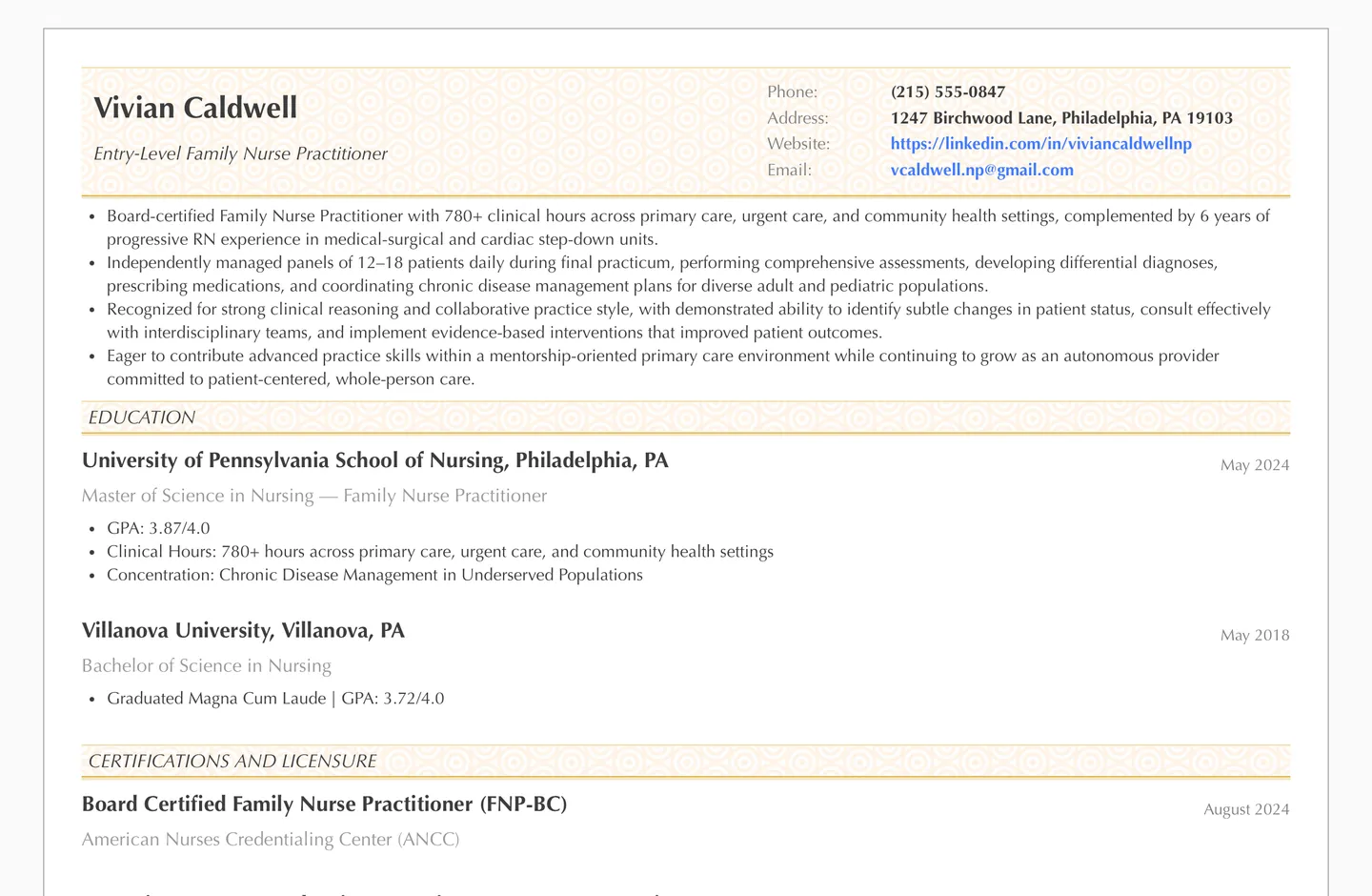
The Ultimate Nurse Practitioner (Entry-Level) Resume Example/Sample
https://www.resumonk.com/nurse-practitioner-entry-levelNurse Practitioner (Entry-Level)Resume Format for Entry-Level Nurse Practitioner Resume
The reverse-chronological format stands as your strongest ally here.
Why? Because hiring managers at clinics, hospitals, and private practices need to immediately see your most recent achievement - that shiny new NP certification and graduate education. They're not interested in your nursing assistant role from eight years ago buried at the top of your resume.
Structure Your Entry-Level NP Resume Strategically
Start with a professional summary, not an objective statement. You're no longer stating what you want - you're declaring what you bring to the table as a newly minted advanced practice provider. Follow this with your education section, placing your MSN or DNP degree prominently.
Your clinical rotations during NP school deserve their own dedicated section, separate from your RN work experience.
Think of your resume as telling the story of your evolution.
Your format should flow like this - Professional Summary, Education & Certifications, Clinical Rotations, Professional Experience (RN roles), and finally Skills.
This arrangement immediately signals to employers that while you may be entry-level as an NP, you're bringing substantial healthcare experience to the role.
The One-Page vs. Two-Page Dilemma
Here's where entry-level NPs often stumble. You have years of RN experience plus your NP training - that's a lot to compress. For entry-level NP positions in the United States and Canada, a two-page resume is perfectly acceptable and often necessary. Your clinical rotations alone might take up half a page when properly detailed.
However, if you're applying in the UK or Australia, where CVs are more common for healthcare roles, you might extend to 2-3 pages to include all relevant clinical placements and professional development activities.
Remember, white space is your friend. A cramped, text-heavy resume suggests you can't prioritize - hardly the quality employers want in someone making diagnostic decisions.
Work Experience on Entry-Level Nurse Practitioner Resume
The paradox of being an "entry-level" Nurse Practitioner is that you're simultaneously new and experienced. You're new to prescribing medications and managing patient panels independently, yet you've likely spent years assessing patients, collaborating with physicians, and making critical clinical decisions as an RN.
Your work experience section needs to honor both realities.
Presenting Your Clinical Rotations
Your NP clinical rotations aren't just educational requirements - they're your first taste of practicing at an advanced level.
List each rotation as you would a job, including the facility name, specialty area, preceptor's credentials, and specific dates. Focus on procedures you performed, conditions you managed, and the level of autonomy you achieved.
❌ Don't write vaguely about your rotations:
Family Practice Rotation - Local Clinic
Saw patients and learned about primary care
✅ Do provide specific, quantifiable details:
Family Practice Clinical Rotation - Riverside Family Health Center
January 2024 - April 2024 | 240 clinical hours
• Independently managed 15-20 patients daily under MD supervision
• Performed comprehensive physical exams and developed treatment plans for acute and chronic conditions
• Initiated and adjusted medications for hypertension, diabetes, and hyperlipidemia
• Conducted Medicare Annual Wellness Visits and preventive health screenings
Transforming Your RN Experience
Your registered nursing experience isn't just background - it's the foundation of your clinical judgment.
However, you need to reframe it through an advanced practice lens. Instead of focusing on task completion, emphasize clinical reasoning, leadership, and collaborative practice.
Consider how different these two descriptions feel:
❌ Don't minimize your RN role to tasks:
ICU Registered Nurse - City Medical Center
• Administered medications and monitored vital signs
• Cared for critically ill patients
• Worked with healthcare team
✅ Do highlight advanced-level thinking:
ICU Registered Nurse - City Medical Center
• Managed complex medication regimens for 2-3 critically ill patients, titrating vasoactive drips based on hemodynamic parameters
• Led rapid response team interventions, demonstrating advanced assessment skills in identifying early signs of clinical deterioration
• Collaborated with intensivists to implement evidence-based protocols, reducing ventilator-associated pneumonia rates by 15%
• Mentored new graduate nurses in advanced cardiac life support and critical care protocols
Addressing Employment Gaps
If you took time off from bedside nursing to complete your NP program full-time, that's not a gap - it's an investment. List your graduate education period clearly and include any relevant activities during that time such as teaching assistantships, research projects, or volunteer clinical work.
Skills to Include on Entry-Level Nurse Practitioner Resume
The skills section of your entry-level NP resume requires careful curation. You're walking a tightrope between showcasing your RN competencies and demonstrating your readiness for advanced practice.
Generic skills like "communication" and "teamwork" won't differentiate you from the dozens of other new grad NPs applying for the same position.
Clinical and Diagnostic Skills
Lead with the advanced skills you've developed during your NP training. These are the competencies that separate you from your RN colleagues and justify your transition to provider status.
Think about the specific procedures you've mastered, the diagnostic equipment you've used, and the clinical decision-making tools you've learned to apply.
Structure your clinical skills to show progression from basic to advanced:
Clinical Skills:
• Comprehensive physical examination across the lifespan
• Point-of-care testing - strep, flu, COVID-19, urinalysis, pregnancy testing
• Suturing simple lacerations and wound care management
• Joint injections and trigger point injections
• Interpretation of basic laboratory results and ECGs
• Cervical cancer screening and women's health procedures
Technology and Documentation Proficiency
Every healthcare facility runs on electronic health records, but each system has its quirks.
As an entry-level NP, showing familiarity with multiple EHR platforms signals your adaptability. Don't just list the systems - indicate your proficiency level.
❌ Don't create a meaningless list:
Computer Skills: Epic, Cerner, Microsoft Office
✅ Do demonstrate practical application:
Healthcare Technology:
• Epic - Advanced proficiency in order entry, e-prescribing, and clinical decision support tools
• Cerner PowerChart - Experienced in documentation, medication reconciliation, and quality measure reporting
• UpToDate and Epocrates - Regular use for evidence-based clinical decision-making
• Telehealth platforms - Conducted virtual visits during clinical rotations using Doxy.me and Zoom for Healthcare
Prescriptive Authority and Pharmacology
Your ability to prescribe medications represents one of the most significant differences between your RN and NP roles.
Even as an entry-level NP, you need to convey confidence in pharmacological management. Include your DEA registration status (if obtained), any specialized pharmacology training, and specific medication classes you're comfortable managing.
For different regions, requirements vary - in the United States, mention your prescriptive authority status and any collaborative agreement experience. In Canada, reference your controlled drug and substances registration.
UK applicants should note their qualification as Independent or Supplementary Prescribers.
Specific Considerations and Tips for Entry-Level Nurse Practitioner Resume
The entry-level NP resume faces unique challenges that other healthcare resumes don't encounter. You're asking employers to see you differently - not as the experienced RN they might have worked alongside for years, but as a healthcare provider ready to diagnose, treat, and manage patient care independently or with minimal supervision.
Navigate the Certification and Licensure Maze
Unlike your RN resume where a single license sufficed, your NP resume must clearly display multiple credentials.
The order matters, and it varies by region. In the United States, list your highest degree first, then licensure, then certifications. A Family Nurse Practitioner would write - Jane Smith, MSN, RN, FNP-BC.
Don't forget to spell out your certifying body the first time you mention it.
Certifications and Licensure:
• Family Nurse Practitioner Board Certified (FNP-BC) - American Nurses Credentialing Center, 2024
• Advanced Practice Registered Nurse License - State of California, License #123456
• Registered Nurse License - State of California, License #654321
• DEA Registration - Pending (or include number if obtained)
• Basic Life Support (BLS) and Advanced Cardiovascular Life Support (ACLS) - Current
Address the Preceptor Dilemma
Here's something nobody tells you about entry-level NP resumes - your clinical preceptors can make or break your application.
If you trained under well-known physicians or NPs in your area, mention them by name (with their permission). If your preceptor runs the clinic where you're applying, that connection deserves prominent placement.
However, if your preceptor had a falling out with local healthcare systems, you might need to be more discreet.
The Portfolio Problem
Traditional resumes often feel inadequate for capturing the breadth of your NP preparation.
Consider creating a professional portfolio as a supplement, not replacement, to your resume. Include case studies from clinical rotations, quality improvement projects, or that evidence-based practice paper on diabetes management you presented at your university's research day.
Reference your portfolio's availability in your resume's header or summary section.
Geographic Mobility and Compact Licensure
If you're open to relocation or hold compact licensure privileges, make this crystal clear. Rural and underserved areas desperately need NPs and often offer better autonomy for new graduates.
A single line stating "Compact RN License - Eligible for multi-state practice" or "Open to relocation for rural health opportunities" could open doors you didn't know existed.
The Specialty Struggle
As an entry-level NP, you might be certified as a Family Nurse Practitioner but dream of working in cardiology. Your resume needs to bridge this gap strategically. Highlight any cardiac experience from your RN days, emphasize relevant clinical rotations, and showcase continuing education in cardiac topics.
Don't pretend to be a cardiac NP, but do make the connection obvious.
❌ Don't ignore the specialty mismatch:
Objective: Seeking position as Cardiology NP
Experience: FNP clinical rotations in primary care settings
✅ Do build bridges between your training and goals:
Professional Summary: Family Nurse Practitioner with concentrated cardiac nursing background and focused clinical training in cardiovascular risk management

Relevant Experience:
• Cardiac Step-Down RN - 3 years managing post-cardiac catheterization and acute coronary syndrome patients
• Clinical Rotation - Internal Medicine with emphasis on cardiovascular disease prevention and management
• Continuing Education - Completed 20 hours of cardiovascular pharmacology and ECG interpretation courses
Remember, your entry-level status as an NP doesn't erase your nursing expertise. It transforms it.
Your resume should tell that transformation story with confidence, clarity, and clinical precision.
Education to List on Entry-Level Nurse Practitioner Resume
So you've completed your grueling Master of Science in Nursing program, survived countless clinical hours, and now you're ready to take that first step into autonomous practice as a Nurse Practitioner. The education section of your resume isn't just a formality - it's your golden ticket that proves you've met the rigorous academic requirements to diagnose, prescribe, and manage patient care independently.
As an entry-level NP, your education carries more weight than it might for seasoned practitioners, since your clinical experience in this advanced role is still developing.
Leading with Your Advanced Practice Credentials
Your Master's degree or Doctor of Nursing Practice (DNP) should take center stage, listed in reverse-chronological order with your most recent degree first. Remember, you're not just another RN anymore - you're showcasing advanced practice education that took years of dedication to complete.
Include your specialty track (Family, Adult-Gerontology, Pediatric, Psychiatric-Mental Health, etc.) because hiring managers need to know immediately if you're qualified for their specific patient population.
Here's how to structure your NP education effectively:
❌ Don't write vaguely about your degree:
Master of Science in Nursing
University of Pennsylvania
2023
✅ Do include your specialty and relevant details:
Master of Science in Nursing - Family Nurse Practitioner
University of Pennsylvania School of Nursing
Philadelphia, PA | May 2023
GPA: 3.8/4.0
Clinical Hours: 780+ hours across primary care settings
Concentration: Rural and Underserved Populations
Strategic Inclusion of Your RN Foundation
Your Bachelor of Science in Nursing still matters, but it plays a supporting role now. List it after your advanced degree, but don't feel compelled to include extensive details unless they're particularly relevant to the position.
If you completed an accelerated BSN program or had exceptional achievements during your undergraduate years, those details can demonstrate your consistent excellence in nursing education.
Certifications and Licensure - Your Professional Identity
While technically not degrees, your board certification and state licensure belong in or near your education section.
As an entry-level NP, you might be listing "Board Eligible" if you haven't taken your certification exam yet, or your recent certification date if you've passed. Be specific about which certifying body (AANP or ANCC) and include your NPI number if you have it - this shows you're ready to hit the ground running.
Format your certifications clearly:
Board Certified Family Nurse Practitioner (FNP-BC)
American Nurses Credentialing Center (ANCC) | Certified: August 2023
DEA Registration: Pending
State Licensure: Pennsylvania CRNP #12345 (Active)
Continuing Education and Special Training
As a new NP, you might be tempted to list every conference and workshop you've attended.
Instead, be selective and include only those directly relevant to the position. That suturing workshop? Absolutely include it for urgent care positions. The diabetes management certification course? Perfect for endocrinology practices.
Your ACLS and BLS certifications should be listed, as they're often requirements rather than bonuses.
Awards and Publications on Entry-Level Nurse Practitioner Resume
Let's face it - as an entry-level Nurse Practitioner, you probably don't have a New England Journal of Medicine publication under your belt, and that's perfectly okay.
What you likely do have are academic achievements, clinical excellence awards, and perhaps a capstone project or DNP scholarly project that deserves recognition. These accomplishments help differentiate you from other new grads who might have identical degrees and similar clinical rotations.
Academic Honors That Matter to Employers
Your Sigma Theta Tau membership isn't just alphabet soup - it signals that you were in the top 35% of your nursing program and value scholarship in nursing. Dean's List recognition, graduation honors (cum laude, magna cum laude), and academic scholarships all paint a picture of someone who excels under pressure - exactly what practices want in their newest provider.
List these achievements with enough context for non-academic hiring managers to understand their significance.
❌ Don't undersell your achievements:
Various academic awards
Sigma member
✅ Do provide meaningful context:
- Summa Cum Laude, MSN Program | GPA: 3.95/4.0
- Sigma Theta Tau International Honor Society of Nursing | Inducted 2022
- Excellence in Clinical Practice Award | University Medical Center Clinical Rotation 2023
- Jonas Nurse Leaders Scholar | $10,000 merit scholarship for leadership potential
Your Scholarly Project as a Publication
That DNP project you spent months perfecting?
Even if it's not published in a peer-reviewed journal, it demonstrates your ability to identify clinical problems, synthesize evidence, and implement solutions - core NP competencies. If you presented at your university's symposium or at a regional conference, that counts as dissemination of scholarship. Frame these appropriately for the clinical world, focusing on patient outcomes and practical applications rather than theoretical frameworks.
Present your scholarly work professionally:
DNP Scholarly Project: "Implementing Telehealth Protocols for Diabetes Management
in Rural Primary Care" | May 2023
- Reduced HbA1c levels by average of 1.2% in 40-patient pilot program
- Presented findings at Pennsylvania NP Association Annual Conference
Quality Improvement and Clinical Recognition
During your clinical rotations, did you help implement a new screening protocol?
Were you recognized by a preceptor for exceptional patient care? Did you receive the "Outstanding NP Student" award at your clinical site? These achievements show you're already thinking like a provider, not just a student.
They're especially valuable for entry-level positions because they demonstrate real-world impact, not just academic success.
Listing References for Entry-Level Nurse Practitioner Resume
References for an entry-level NP position carry more weight than they might for other roles because employers need reassurance about your clinical judgment and readiness for autonomous practice. Your reference list is essentially a panel of experienced providers and educators vouching that yes, you're ready to prescribe medications and make diagnostic decisions.
The days of listing your charge nurse from three years ago are over - you need heavy hitters who can speak to your advanced practice capabilities.
Choosing Your Clinical Preceptors Strategically
Your strongest references come from NP or physician preceptors who've directly observed your clinical decision-making. That family practice NP who supervised your final 200-hour rotation? Gold. The internal medicine physician who let you manage complex patients independently? Essential. These providers can speak specifically to your assessment skills, differential diagnosis abilities, and readiness for practice.
Ideally, choose preceptors from similar practice settings to where you're applying - a pediatric NP preceptor won't carry as much weight for an adult gerontology position.
When listing clinical references, include their full credentials and context:
Dr. Sarah Mitchell, MD, FAAFP
Attending Physician, Family Medicine
Riverside Primary Care Associates
(215) 555-0100 | [email protected]
Relationship: Primary Care Clinical Preceptor (200 hours, Spring 2023)
Academic References with Clinical Relevance
Your clinical faculty members make excellent references because they've seen both your academic performance and clinical growth over time.
The professor who supervised your DNP project can speak to your evidence-based practice skills and ability to implement quality improvements - key NP competencies. However, avoid professors who only knew you in the classroom unless they can speak to specific clinical applications of your learning.
Strategic RN Supervisors
While your focus should be on advanced practice references, one strong RN supervisor reference can be valuable, especially if they can speak to relevant experience.
The ICU manager who watched you manage complex cardiac patients for five years can attest to your critical thinking skills. The emergency department director who saw you triage independently adds weight to your assessment abilities. Frame these references in context of how your RN experience prepared you for NP practice.
Reference List Protocol for Different Regions
In the United States, references are typically provided on a separate page with "Available upon request" on your resume.
However, some practices, especially smaller clinics or urgent care centers, might want them upfront. Canadian employers often expect references listed directly, while UK positions might call them "referees." Australian NP positions frequently request clinical references be available immediately due to their stringent credentialing processes.
Always prepare your references for potential contact:
"Dr. Johnson, I'm applying for an FNP position at Green Valley Medical Group.
They may contact you about my clinical rotation where I managed diabetes patients
and performed minor procedures. I've attached the job description for your reference."
Managing Recent Graduate Reference Challenges
If you're applying immediately after graduation, you might face the challenge of preceptors who supervised dozens of students.
Stand out by maintaining regular contact, sending updates on your certification progress, and reminding them of specific cases you managed together. If a key preceptor is unavailable, the medical director of the clinic where you rotated can sometimes serve as an alternative, especially if they reviewed your notes or observed your presentations.
Remember, as an entry-level NP, your references aren't just confirming employment - they're validating your readiness to join the ranks of advanced practice providers. Choose them wisely, prepare them thoroughly, and present them professionally.
Cover Letter Tips for Entry-Level Nurse Practitioner Resume
A strong cover letter is where you transform from a list of qualifications into a living, breathing healthcare provider with a genuine passion for patient care. As an entry-level NP, you can't lean on years of prescribing experience or established patient panels.
Instead, your cover letter needs to bridge the gap between your RN experience and your readiness for advanced practice, while demonstrating deep understanding of what this specific practice needs.
Opening with Clinical Confidence
Skip the generic "I am writing to apply for..." opening that screams template. Instead, lead with a compelling clinical scenario or insight that shows you understand the patient population. If you're applying to a federally qualified health center, maybe you start with your experience during clinical rotations managing complex social determinants of health. For a cardiology practice, perhaps you open with your ICU background and how it prepared you to recognize subtle cardiac symptoms.
Your opening paragraph should immediately establish why you're not just any new grad NP, but the right NP for their specific practice. Connect your past nursing experience to your future NP role in a way that shows progression and purpose, not just career advancement.
Demonstrating Practice-Ready Skills
The body of your cover letter needs to address the elephant in the room - yes, you're entry-level, but you're absolutely ready to manage a patient panel. Highlight specific clinical experiences from your NP program that mirror the role's responsibilities. Did you complete 200 hours in a similar practice setting? Did you manage diabetic patients independently during your final practicum?
Be specific about procedures you've performed, EMR systems you've used, and patient populations you've served.
❌ Don't write vaguely about your experience:
"I completed all required clinical rotations and saw many different types of patients during my NP program."
✅ Do provide specific, relevant examples:
"During my 300-hour primary care practicum at Community Health Center, I independently managed a panel of 15-20 patients daily, including conducting Medicare wellness visits, managing chronic conditions, and performing procedures including suturing, I&D, and joint injections under minimal supervision."
Addressing the Supervision Question
Many entry-level NP positions mention training periods or collaborative practice agreements.
Use your cover letter to show you understand and embrace this learning curve. Mention your experience working with interdisciplinary teams as an RN, your comfort seeking consultation when needed, and your commitment to continuous learning. If the practice offers mentorship or residency programs, express genuine enthusiasm for these opportunities rather than seeing them as hurdles.
Closing with Next Steps
Your closing paragraph should be action-oriented and confident.
You're not hoping for an interview - you're looking forward to discussing how your clinical training aligns with their practice needs. If you have pending certifications or licensure, mention your timeline. If you're willing to obtain additional certifications specific to their practice, say so.
End with professional enthusiasm that shows you've researched their practice and genuinely want to grow your NP career with them.
Key Takeaways
After diving deep into the nuances of crafting your entry-level Nurse Practitioner resume, here are the essential points to remember as you prepare to launch your advanced practice career:
- Use reverse-chronological format strategically - Lead with your MSN/DNP education and board certification, positioning yourself as a provider first, experienced nurse second
- Treat clinical rotations as legitimate experience - Detail them like job positions with specific hours, procedures performed, and patient populations managed
- Reframe your RN experience through an advanced practice lens - Emphasize clinical reasoning, collaboration with physicians, and leadership rather than task completion
- Include specialty-specific clinical skills - List procedures, diagnostic abilities, and prescriptive authority clearly to show practice readiness
- Present credentials precisely - Order matters (degree, licensure, certification) and varies by region, so research your target location's conventions
- Two pages are acceptable - Don't cram your clinical rotations and RN experience into one page at the expense of readability
- Address specialty mismatches strategically - Bridge gaps between your certification and desired specialty through relevant experience and continuing education
- Showcase scholarly work appropriately - Your DNP project or capstone demonstrates evidence-based practice skills even if unpublished
- Select references who can speak to provider capabilities - Prioritize clinical preceptors and faculty who observed your advanced practice skills
- Write cover letters that acknowledge and embrace your entry-level status - Show enthusiasm for mentorship while confidently asserting your readiness for practice
Ready to create your standout entry-level Nurse Practitioner resume?
Start building your professional resume on Resumonk today with our ready-to-go templates and expert AI suggestions. Your journey from RN to NP deserves a resume that captures every aspect of your clinical expertise and advanced practice readiness.
Begin crafting your NP resume with Resumonk now →
More Nursing resume examples
- Nursing resume example
- School Nurse resume example
- Charge Nurse resume example
- Nursing Student resume example
See all Nursing resume examples, or browse every category.
Resume writing tips
You've earned the NP after your name. But sitting down to write your first Nurse Practitioner resume? That's a different kind of challenge.
Everything that made you an exceptional RN doesn't automatically translate into NP language. The IV skills you perfected over five years aren't the selling point anymore. Your ability to manage four critical patients simultaneously - impressive, but not what a primary care clinic is scanning for in their newest provider.
Here's what makes your position unique: you're simultaneously a healthcare rookie and a seasoned veteran.
You've never independently prescribed a medication, yet you've recommended countless adjustments to residents who trusted your clinical judgment. You've never billed for a patient encounter, but you've performed more comprehensive assessments than most providers twice your age.
Your resume needs to capture that duality - readiness for advanced practice, honesty about where you are in the provider journey.
This guide breaks down every section of an entry-level NP resume, including:
- Choosing a format that highlights new credentials without burying your nursing foundation
- Presenting clinical rotations as real provider experience
- Reframing RN experience through an advanced practice lens
- Selecting skills that actually matter to hiring managers
- Navigating NP certifications, licensure, and specialty mismatches
- Writing a cover letter that addresses the "new to prescribing" question head-on
- Picking references who speak to clinical decision-making, not just nursing skills
Let's get into it.
The Ultimate Nurse Practitioner (Entry-Level) Resume Example/Sample
https://www.resumonk.com/nurse-practitioner-entry-levelNurse Practitioner (Entry-Level)Resume Format for Entry-Level Nurse Practitioner Resume
The reverse-chronological format stands as your strongest ally here.
Why? Because hiring managers at clinics, hospitals, and private practices need to immediately see your most recent achievement - that shiny new NP certification and graduate education. They're not interested in your nursing assistant role from eight years ago buried at the top of your resume.
Structure Your Entry-Level NP Resume Strategically
Start with a professional summary, not an objective statement. You're no longer stating what you want - you're declaring what you bring to the table as a newly minted advanced practice provider. Follow this with your education section, placing your MSN or DNP degree prominently.
Your clinical rotations during NP school deserve their own dedicated section, separate from your RN work experience.
Think of your resume as telling the story of your evolution.
Your format should flow like this - Professional Summary, Education & Certifications, Clinical Rotations, Professional Experience (RN roles), and finally Skills.
This arrangement immediately signals to employers that while you may be entry-level as an NP, you're bringing substantial healthcare experience to the role.
The One-Page vs. Two-Page Dilemma
Here's where entry-level NPs often stumble. You have years of RN experience plus your NP training - that's a lot to compress. For entry-level NP positions in the United States and Canada, a two-page resume is perfectly acceptable and often necessary. Your clinical rotations alone might take up half a page when properly detailed.
However, if you're applying in the UK or Australia, where CVs are more common for healthcare roles, you might extend to 2-3 pages to include all relevant clinical placements and professional development activities.
Remember, white space is your friend. A cramped, text-heavy resume suggests you can't prioritize - hardly the quality employers want in someone making diagnostic decisions.
Work Experience on Entry-Level Nurse Practitioner Resume
The paradox of being an "entry-level" Nurse Practitioner is that you're simultaneously new and experienced. You're new to prescribing medications and managing patient panels independently, yet you've likely spent years assessing patients, collaborating with physicians, and making critical clinical decisions as an RN.
Your work experience section needs to honor both realities.
Presenting Your Clinical Rotations
Your NP clinical rotations aren't just educational requirements - they're your first taste of practicing at an advanced level.
List each rotation as you would a job, including the facility name, specialty area, preceptor's credentials, and specific dates. Focus on procedures you performed, conditions you managed, and the level of autonomy you achieved.
❌ Don't write vaguely about your rotations:
Family Practice Rotation - Local Clinic
Saw patients and learned about primary care
✅ Do provide specific, quantifiable details:
Family Practice Clinical Rotation - Riverside Family Health Center
January 2024 - April 2024 | 240 clinical hours
• Independently managed 15-20 patients daily under MD supervision
• Performed comprehensive physical exams and developed treatment plans for acute and chronic conditions
• Initiated and adjusted medications for hypertension, diabetes, and hyperlipidemia
• Conducted Medicare Annual Wellness Visits and preventive health screenings
Transforming Your RN Experience
Your registered nursing experience isn't just background - it's the foundation of your clinical judgment.
However, you need to reframe it through an advanced practice lens. Instead of focusing on task completion, emphasize clinical reasoning, leadership, and collaborative practice.
Consider how different these two descriptions feel:
❌ Don't minimize your RN role to tasks:
ICU Registered Nurse - City Medical Center
• Administered medications and monitored vital signs
• Cared for critically ill patients
• Worked with healthcare team
✅ Do highlight advanced-level thinking:
ICU Registered Nurse - City Medical Center
• Managed complex medication regimens for 2-3 critically ill patients, titrating vasoactive drips based on hemodynamic parameters
• Led rapid response team interventions, demonstrating advanced assessment skills in identifying early signs of clinical deterioration
• Collaborated with intensivists to implement evidence-based protocols, reducing ventilator-associated pneumonia rates by 15%
• Mentored new graduate nurses in advanced cardiac life support and critical care protocols
Addressing Employment Gaps
If you took time off from bedside nursing to complete your NP program full-time, that's not a gap - it's an investment. List your graduate education period clearly and include any relevant activities during that time such as teaching assistantships, research projects, or volunteer clinical work.
Skills to Include on Entry-Level Nurse Practitioner Resume
The skills section of your entry-level NP resume requires careful curation. You're walking a tightrope between showcasing your RN competencies and demonstrating your readiness for advanced practice.
Generic skills like "communication" and "teamwork" won't differentiate you from the dozens of other new grad NPs applying for the same position.
Clinical and Diagnostic Skills
Lead with the advanced skills you've developed during your NP training. These are the competencies that separate you from your RN colleagues and justify your transition to provider status.
Think about the specific procedures you've mastered, the diagnostic equipment you've used, and the clinical decision-making tools you've learned to apply.
Structure your clinical skills to show progression from basic to advanced:
Clinical Skills:
• Comprehensive physical examination across the lifespan
• Point-of-care testing - strep, flu, COVID-19, urinalysis, pregnancy testing
• Suturing simple lacerations and wound care management
• Joint injections and trigger point injections
• Interpretation of basic laboratory results and ECGs
• Cervical cancer screening and women's health procedures
Technology and Documentation Proficiency
Every healthcare facility runs on electronic health records, but each system has its quirks.
As an entry-level NP, showing familiarity with multiple EHR platforms signals your adaptability. Don't just list the systems - indicate your proficiency level.
❌ Don't create a meaningless list:
Computer Skills: Epic, Cerner, Microsoft Office
✅ Do demonstrate practical application:
Healthcare Technology:
• Epic - Advanced proficiency in order entry, e-prescribing, and clinical decision support tools
• Cerner PowerChart - Experienced in documentation, medication reconciliation, and quality measure reporting
• UpToDate and Epocrates - Regular use for evidence-based clinical decision-making
• Telehealth platforms - Conducted virtual visits during clinical rotations using Doxy.me and Zoom for Healthcare
Prescriptive Authority and Pharmacology
Your ability to prescribe medications represents one of the most significant differences between your RN and NP roles.
Even as an entry-level NP, you need to convey confidence in pharmacological management. Include your DEA registration status (if obtained), any specialized pharmacology training, and specific medication classes you're comfortable managing.
For different regions, requirements vary - in the United States, mention your prescriptive authority status and any collaborative agreement experience. In Canada, reference your controlled drug and substances registration.
UK applicants should note their qualification as Independent or Supplementary Prescribers.
Specific Considerations and Tips for Entry-Level Nurse Practitioner Resume
The entry-level NP resume faces unique challenges that other healthcare resumes don't encounter. You're asking employers to see you differently - not as the experienced RN they might have worked alongside for years, but as a healthcare provider ready to diagnose, treat, and manage patient care independently or with minimal supervision.
Navigate the Certification and Licensure Maze
Unlike your RN resume where a single license sufficed, your NP resume must clearly display multiple credentials.
The order matters, and it varies by region. In the United States, list your highest degree first, then licensure, then certifications. A Family Nurse Practitioner would write - Jane Smith, MSN, RN, FNP-BC.
Don't forget to spell out your certifying body the first time you mention it.
Certifications and Licensure:
• Family Nurse Practitioner Board Certified (FNP-BC) - American Nurses Credentialing Center, 2024
• Advanced Practice Registered Nurse License - State of California, License #123456
• Registered Nurse License - State of California, License #654321
• DEA Registration - Pending (or include number if obtained)
• Basic Life Support (BLS) and Advanced Cardiovascular Life Support (ACLS) - Current
Address the Preceptor Dilemma
Here's something nobody tells you about entry-level NP resumes - your clinical preceptors can make or break your application.
If you trained under well-known physicians or NPs in your area, mention them by name (with their permission). If your preceptor runs the clinic where you're applying, that connection deserves prominent placement.
However, if your preceptor had a falling out with local healthcare systems, you might need to be more discreet.
The Portfolio Problem
Traditional resumes often feel inadequate for capturing the breadth of your NP preparation.
Consider creating a professional portfolio as a supplement, not replacement, to your resume. Include case studies from clinical rotations, quality improvement projects, or that evidence-based practice paper on diabetes management you presented at your university's research day.
Reference your portfolio's availability in your resume's header or summary section.
Geographic Mobility and Compact Licensure
If you're open to relocation or hold compact licensure privileges, make this crystal clear. Rural and underserved areas desperately need NPs and often offer better autonomy for new graduates.
A single line stating "Compact RN License - Eligible for multi-state practice" or "Open to relocation for rural health opportunities" could open doors you didn't know existed.
The Specialty Struggle
As an entry-level NP, you might be certified as a Family Nurse Practitioner but dream of working in cardiology. Your resume needs to bridge this gap strategically. Highlight any cardiac experience from your RN days, emphasize relevant clinical rotations, and showcase continuing education in cardiac topics.
Don't pretend to be a cardiac NP, but do make the connection obvious.
❌ Don't ignore the specialty mismatch:
Objective: Seeking position as Cardiology NP
Experience: FNP clinical rotations in primary care settings
✅ Do build bridges between your training and goals:
Professional Summary: Family Nurse Practitioner with concentrated cardiac nursing background and focused clinical training in cardiovascular risk management

Relevant Experience:
• Cardiac Step-Down RN - 3 years managing post-cardiac catheterization and acute coronary syndrome patients
• Clinical Rotation - Internal Medicine with emphasis on cardiovascular disease prevention and management
• Continuing Education - Completed 20 hours of cardiovascular pharmacology and ECG interpretation courses
Remember, your entry-level status as an NP doesn't erase your nursing expertise. It transforms it.
Your resume should tell that transformation story with confidence, clarity, and clinical precision.
Education to List on Entry-Level Nurse Practitioner Resume
So you've completed your grueling Master of Science in Nursing program, survived countless clinical hours, and now you're ready to take that first step into autonomous practice as a Nurse Practitioner. The education section of your resume isn't just a formality - it's your golden ticket that proves you've met the rigorous academic requirements to diagnose, prescribe, and manage patient care independently.
As an entry-level NP, your education carries more weight than it might for seasoned practitioners, since your clinical experience in this advanced role is still developing.
Leading with Your Advanced Practice Credentials
Your Master's degree or Doctor of Nursing Practice (DNP) should take center stage, listed in reverse-chronological order with your most recent degree first. Remember, you're not just another RN anymore - you're showcasing advanced practice education that took years of dedication to complete.
Include your specialty track (Family, Adult-Gerontology, Pediatric, Psychiatric-Mental Health, etc.) because hiring managers need to know immediately if you're qualified for their specific patient population.
Here's how to structure your NP education effectively:
❌ Don't write vaguely about your degree:
Master of Science in Nursing
University of Pennsylvania
2023
✅ Do include your specialty and relevant details:
Master of Science in Nursing - Family Nurse Practitioner
University of Pennsylvania School of Nursing
Philadelphia, PA | May 2023
GPA: 3.8/4.0
Clinical Hours: 780+ hours across primary care settings
Concentration: Rural and Underserved Populations
Strategic Inclusion of Your RN Foundation
Your Bachelor of Science in Nursing still matters, but it plays a supporting role now. List it after your advanced degree, but don't feel compelled to include extensive details unless they're particularly relevant to the position.
If you completed an accelerated BSN program or had exceptional achievements during your undergraduate years, those details can demonstrate your consistent excellence in nursing education.
Certifications and Licensure - Your Professional Identity
While technically not degrees, your board certification and state licensure belong in or near your education section.
As an entry-level NP, you might be listing "Board Eligible" if you haven't taken your certification exam yet, or your recent certification date if you've passed. Be specific about which certifying body (AANP or ANCC) and include your NPI number if you have it - this shows you're ready to hit the ground running.
Format your certifications clearly:
Board Certified Family Nurse Practitioner (FNP-BC)
American Nurses Credentialing Center (ANCC) | Certified: August 2023
DEA Registration: Pending
State Licensure: Pennsylvania CRNP #12345 (Active)
Continuing Education and Special Training
As a new NP, you might be tempted to list every conference and workshop you've attended.
Instead, be selective and include only those directly relevant to the position. That suturing workshop? Absolutely include it for urgent care positions. The diabetes management certification course? Perfect for endocrinology practices.
Your ACLS and BLS certifications should be listed, as they're often requirements rather than bonuses.
Awards and Publications on Entry-Level Nurse Practitioner Resume
Let's face it - as an entry-level Nurse Practitioner, you probably don't have a New England Journal of Medicine publication under your belt, and that's perfectly okay.
What you likely do have are academic achievements, clinical excellence awards, and perhaps a capstone project or DNP scholarly project that deserves recognition. These accomplishments help differentiate you from other new grads who might have identical degrees and similar clinical rotations.
Academic Honors That Matter to Employers
Your Sigma Theta Tau membership isn't just alphabet soup - it signals that you were in the top 35% of your nursing program and value scholarship in nursing. Dean's List recognition, graduation honors (cum laude, magna cum laude), and academic scholarships all paint a picture of someone who excels under pressure - exactly what practices want in their newest provider.
List these achievements with enough context for non-academic hiring managers to understand their significance.
❌ Don't undersell your achievements:
Various academic awards
Sigma member
✅ Do provide meaningful context:
- Summa Cum Laude, MSN Program | GPA: 3.95/4.0
- Sigma Theta Tau International Honor Society of Nursing | Inducted 2022
- Excellence in Clinical Practice Award | University Medical Center Clinical Rotation 2023
- Jonas Nurse Leaders Scholar | $10,000 merit scholarship for leadership potential
Your Scholarly Project as a Publication
That DNP project you spent months perfecting?
Even if it's not published in a peer-reviewed journal, it demonstrates your ability to identify clinical problems, synthesize evidence, and implement solutions - core NP competencies. If you presented at your university's symposium or at a regional conference, that counts as dissemination of scholarship. Frame these appropriately for the clinical world, focusing on patient outcomes and practical applications rather than theoretical frameworks.
Present your scholarly work professionally:
DNP Scholarly Project: "Implementing Telehealth Protocols for Diabetes Management
in Rural Primary Care" | May 2023
- Reduced HbA1c levels by average of 1.2% in 40-patient pilot program
- Presented findings at Pennsylvania NP Association Annual Conference
Quality Improvement and Clinical Recognition
During your clinical rotations, did you help implement a new screening protocol?
Were you recognized by a preceptor for exceptional patient care? Did you receive the "Outstanding NP Student" award at your clinical site? These achievements show you're already thinking like a provider, not just a student.
They're especially valuable for entry-level positions because they demonstrate real-world impact, not just academic success.
Listing References for Entry-Level Nurse Practitioner Resume
References for an entry-level NP position carry more weight than they might for other roles because employers need reassurance about your clinical judgment and readiness for autonomous practice. Your reference list is essentially a panel of experienced providers and educators vouching that yes, you're ready to prescribe medications and make diagnostic decisions.
The days of listing your charge nurse from three years ago are over - you need heavy hitters who can speak to your advanced practice capabilities.
Choosing Your Clinical Preceptors Strategically
Your strongest references come from NP or physician preceptors who've directly observed your clinical decision-making. That family practice NP who supervised your final 200-hour rotation? Gold. The internal medicine physician who let you manage complex patients independently? Essential. These providers can speak specifically to your assessment skills, differential diagnosis abilities, and readiness for practice.
Ideally, choose preceptors from similar practice settings to where you're applying - a pediatric NP preceptor won't carry as much weight for an adult gerontology position.
When listing clinical references, include their full credentials and context:
Dr. Sarah Mitchell, MD, FAAFP
Attending Physician, Family Medicine
Riverside Primary Care Associates
(215) 555-0100 | [email protected]
Relationship: Primary Care Clinical Preceptor (200 hours, Spring 2023)
Academic References with Clinical Relevance
Your clinical faculty members make excellent references because they've seen both your academic performance and clinical growth over time.
The professor who supervised your DNP project can speak to your evidence-based practice skills and ability to implement quality improvements - key NP competencies. However, avoid professors who only knew you in the classroom unless they can speak to specific clinical applications of your learning.
Strategic RN Supervisors
While your focus should be on advanced practice references, one strong RN supervisor reference can be valuable, especially if they can speak to relevant experience.
The ICU manager who watched you manage complex cardiac patients for five years can attest to your critical thinking skills. The emergency department director who saw you triage independently adds weight to your assessment abilities. Frame these references in context of how your RN experience prepared you for NP practice.
Reference List Protocol for Different Regions
In the United States, references are typically provided on a separate page with "Available upon request" on your resume.
However, some practices, especially smaller clinics or urgent care centers, might want them upfront. Canadian employers often expect references listed directly, while UK positions might call them "referees." Australian NP positions frequently request clinical references be available immediately due to their stringent credentialing processes.
Always prepare your references for potential contact:
"Dr. Johnson, I'm applying for an FNP position at Green Valley Medical Group.
They may contact you about my clinical rotation where I managed diabetes patients
and performed minor procedures. I've attached the job description for your reference."
Managing Recent Graduate Reference Challenges
If you're applying immediately after graduation, you might face the challenge of preceptors who supervised dozens of students.
Stand out by maintaining regular contact, sending updates on your certification progress, and reminding them of specific cases you managed together. If a key preceptor is unavailable, the medical director of the clinic where you rotated can sometimes serve as an alternative, especially if they reviewed your notes or observed your presentations.
Remember, as an entry-level NP, your references aren't just confirming employment - they're validating your readiness to join the ranks of advanced practice providers. Choose them wisely, prepare them thoroughly, and present them professionally.
Cover Letter Tips for Entry-Level Nurse Practitioner Resume
A strong cover letter is where you transform from a list of qualifications into a living, breathing healthcare provider with a genuine passion for patient care. As an entry-level NP, you can't lean on years of prescribing experience or established patient panels.
Instead, your cover letter needs to bridge the gap between your RN experience and your readiness for advanced practice, while demonstrating deep understanding of what this specific practice needs.
Opening with Clinical Confidence
Skip the generic "I am writing to apply for..." opening that screams template. Instead, lead with a compelling clinical scenario or insight that shows you understand the patient population. If you're applying to a federally qualified health center, maybe you start with your experience during clinical rotations managing complex social determinants of health. For a cardiology practice, perhaps you open with your ICU background and how it prepared you to recognize subtle cardiac symptoms.
Your opening paragraph should immediately establish why you're not just any new grad NP, but the right NP for their specific practice. Connect your past nursing experience to your future NP role in a way that shows progression and purpose, not just career advancement.
Demonstrating Practice-Ready Skills
The body of your cover letter needs to address the elephant in the room - yes, you're entry-level, but you're absolutely ready to manage a patient panel. Highlight specific clinical experiences from your NP program that mirror the role's responsibilities. Did you complete 200 hours in a similar practice setting? Did you manage diabetic patients independently during your final practicum?
Be specific about procedures you've performed, EMR systems you've used, and patient populations you've served.
❌ Don't write vaguely about your experience:
"I completed all required clinical rotations and saw many different types of patients during my NP program."
✅ Do provide specific, relevant examples:
"During my 300-hour primary care practicum at Community Health Center, I independently managed a panel of 15-20 patients daily, including conducting Medicare wellness visits, managing chronic conditions, and performing procedures including suturing, I&D, and joint injections under minimal supervision."
Addressing the Supervision Question
Many entry-level NP positions mention training periods or collaborative practice agreements.
Use your cover letter to show you understand and embrace this learning curve. Mention your experience working with interdisciplinary teams as an RN, your comfort seeking consultation when needed, and your commitment to continuous learning. If the practice offers mentorship or residency programs, express genuine enthusiasm for these opportunities rather than seeing them as hurdles.
Closing with Next Steps
Your closing paragraph should be action-oriented and confident.
You're not hoping for an interview - you're looking forward to discussing how your clinical training aligns with their practice needs. If you have pending certifications or licensure, mention your timeline. If you're willing to obtain additional certifications specific to their practice, say so.
End with professional enthusiasm that shows you've researched their practice and genuinely want to grow your NP career with them.
Key Takeaways
After diving deep into the nuances of crafting your entry-level Nurse Practitioner resume, here are the essential points to remember as you prepare to launch your advanced practice career:
- Use reverse-chronological format strategically - Lead with your MSN/DNP education and board certification, positioning yourself as a provider first, experienced nurse second
- Treat clinical rotations as legitimate experience - Detail them like job positions with specific hours, procedures performed, and patient populations managed
- Reframe your RN experience through an advanced practice lens - Emphasize clinical reasoning, collaboration with physicians, and leadership rather than task completion
- Include specialty-specific clinical skills - List procedures, diagnostic abilities, and prescriptive authority clearly to show practice readiness
- Present credentials precisely - Order matters (degree, licensure, certification) and varies by region, so research your target location's conventions
- Two pages are acceptable - Don't cram your clinical rotations and RN experience into one page at the expense of readability
- Address specialty mismatches strategically - Bridge gaps between your certification and desired specialty through relevant experience and continuing education
- Showcase scholarly work appropriately - Your DNP project or capstone demonstrates evidence-based practice skills even if unpublished
- Select references who can speak to provider capabilities - Prioritize clinical preceptors and faculty who observed your advanced practice skills
- Write cover letters that acknowledge and embrace your entry-level status - Show enthusiasm for mentorship while confidently asserting your readiness for practice
Ready to create your standout entry-level Nurse Practitioner resume?
Start building your professional resume on Resumonk today with our ready-to-go templates and expert AI suggestions. Your journey from RN to NP deserves a resume that captures every aspect of your clinical expertise and advanced practice readiness.
Begin crafting your NP resume with Resumonk now →
More Nursing resume examples
- Nursing resume example
- School Nurse resume example
- Charge Nurse resume example
- Nursing Student resume example
See all Nursing resume examples, or browse every category.
Resume writing tips