Nanny Resume Example and Tips
Introduction
This nanny resume example shows how to write a nanny resume for a private family. It also shows how to put nanny work on a resume you already have. It covers duties by age group, bullet ideas, skills and other job titles.
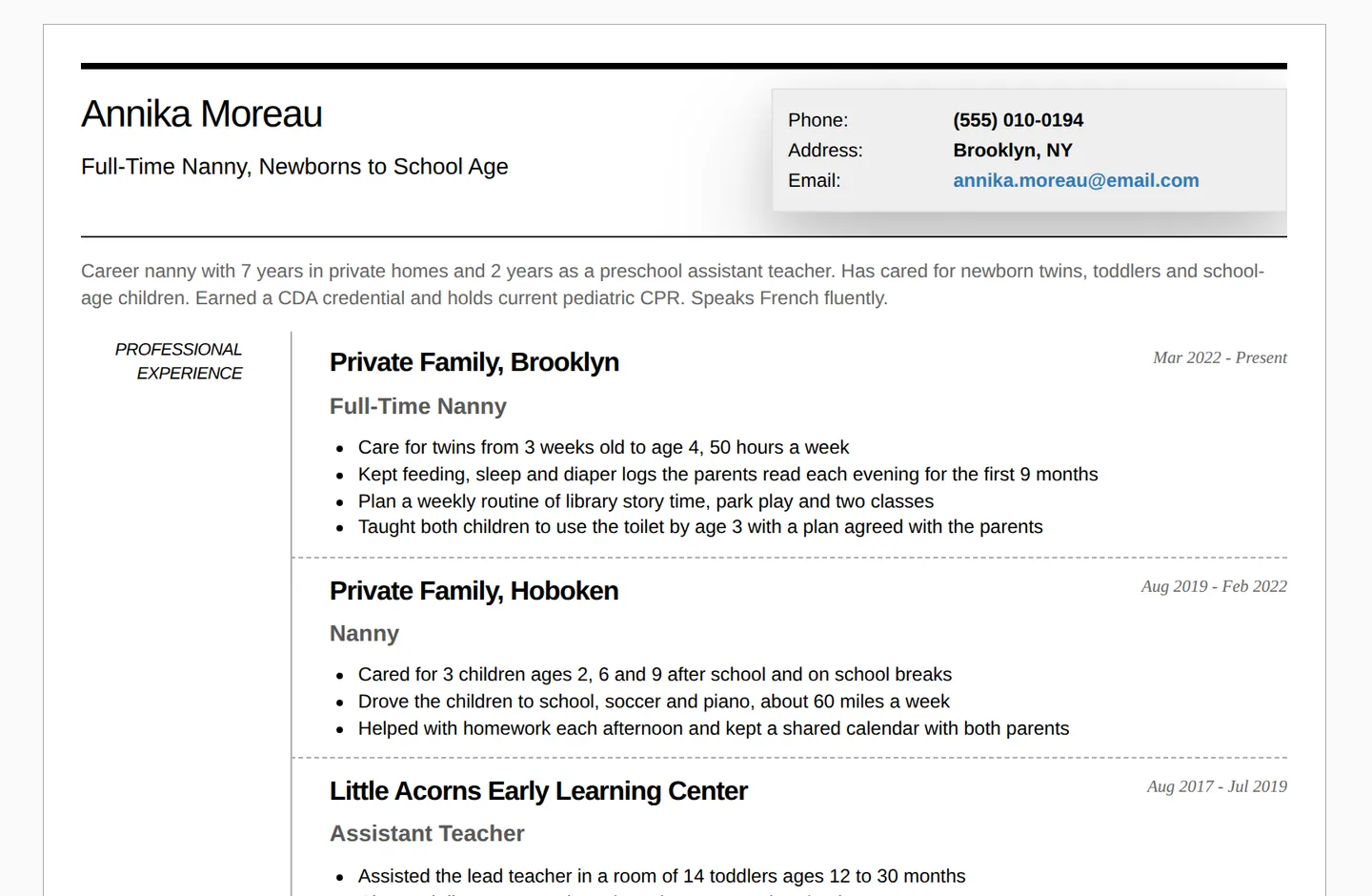
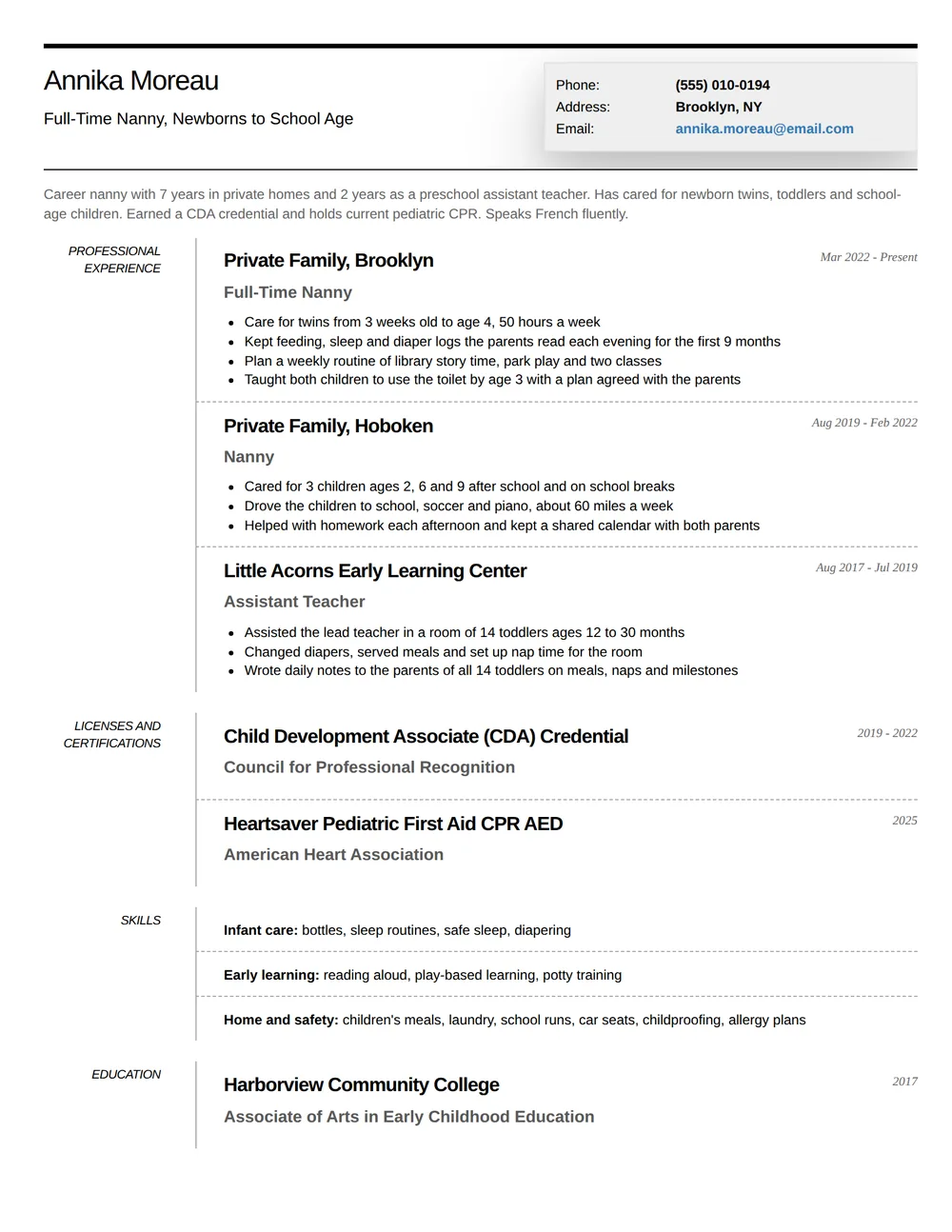
The sample belongs to Annika Moreau, a career nanny in Brooklyn with 7 years in two private homes. Her jobs come first, then her CDA credential and pediatric CPR. Each job names the children's ages and the hours or miles involved.
A career nanny's resume with three jobs
https://www.resumonk.com/nanny-resumeNannyNanny resume format for a private family job
List each family as its own job, with "Private Family" and the city in place of the family's name.
How to put nanny on a resume
The sample's first job line looks like this:
Full-Time Nanny, Private Family, Brooklyn | Mar 2022 - Present
Families value privacy, so their surname stays off. If you nannied part time beside another job, list it the same way with "Part-Time Nanny".
To add nanny work to a resume for an office or school job, keep the same job line. Pick the bullets that match the new job, such as scheduling or teaching. Leave out the children's names and any photos of them.
Put the parts in this order: name and contact, a short summary, nanny jobs, CPR and other training, skills, then education.
Should I put nanny work on my resume?
Yes, when it was regular and paid. It fills the dates honestly, and it shows planning, safety and trust with a family.
A summer nanny job counts too. Mark it "Summer Nanny" so the short dates make sense.
Nanny resume template
Choose a simple, friendly template that reads well on a phone and on paper.
What a nanny resume can skip
- The family's street address. The city is enough.
- Your hourly rate. Families ask about pay in the interview.
- Why a job ended. Explain that in the interview if a family asks.
- One-night babysitting gigs, once you have two or more nanny jobs.
Children's ages, hours and routines in each job
Give the children's ages and your weekly hours in the first bullet of each family. Here is the sample's:
Care for twins from 3 weeks old to age 4, 50 hours a week
A parent can see at once whether you have cared for children like theirs.
Nanny duties and responsibilities by age
Use this nanny job description to pick your duties. Write them as bullets under each family.
- Newborn and infant: bottles and feeding logs, safe sleep, naps on a schedule, baths, tummy time.
- Toddler: potty training, meals and snacks, outings, early reading, play dates.
- School age: school drop-off and pickup, homework help, rides to activities, screen time rules.
- Around the house: children's laundry, tidy playrooms, meal prep for the kids, the family calendar.
Nanny resume ideas: bullet points to adapt
Six example bullets from different nanny jobs. Use your own children's ages and numbers:
- Cared for a newborn from 2 weeks old, 40 hours a week, while both parents returned to work
- Kept a nap and feeding schedule that had the baby sleeping 7 hours a night by 4 months
- Planned 3 outings a week to parks, museums and story times
- Taught a 5-year-old to read short books using flash cards and daily reading
- Packed school lunches and snacks around a peanut allergy plan
- Traveled with the family for 2 weeks each summer as the children's caregiver
Nanny experience from your own family
Caring for a relative's children counts if it was regular and you were in charge. List it as "Nanny, Private Family", with honest hours and dates. Occasional evening care fits a babysitter resume better.
What goes in a live-in nanny job description?
The same duties, plus the hours on call and the trips. Example lines for a live-in or traveling nanny:
- Lived with the family and cared for 2 children ages 1 and 4, five days a week
- Covered 2 overnight shifts a week while the parents traveled for work
- Packed for and ran the children's routine on 4 family trips a year
- Kept the children's rooms, laundry and supplies stocked, and ordered groceries for their meals
Care, learning, household and safety skills
Infant care leads the sample's three skill lines, followed by Early learning, then Home and safety. Name things a parent can picture.
- Infant care: bottles, sleep routines, diapering, baby-led weaning
- Early learning: reading aloud, Montessori-style play, potty training
- Household: children's meals, laundry, errands, family calendar
- Safety: car seats, childproofing, allergy and medicine plans
A second language is worth a line in the summary or a section of its own. Some families look for a nanny who can speak it with their children.
Which nanny skills count as hard skills?
The ones you can be trained and checked on:
- Pediatric CPR and first aid
- Safe driving, with car seats installed correctly
- Infant feeding and sleep routines
- Meal prep around allergies
Special needs care also counts when you can name it, such as following a therapy home plan or a feeding tube routine.
How can a nanny prove soft skills like reliability?
Put the proof in a bullet, with a time span or a count. Two example lines:
- Missed no workdays in three years with the same family
- Handled a toddler's fever alone until a parent got home, and kept a symptom log for the doctor
Other words for nanny on a resume
"Nanny" is a clear title that parents use in their job posts. Use another word only when it fits what you did:
- Childcare Provider: a plain choice for an office or school application.
- Newborn Care Specialist: only with newborn training and several newborn jobs.
- Family Assistant: when errands and household tasks were half the job.
- Household Manager: when you ran staff, bills or the house schedule.
- Au Pair: only if you came through an au pair program.
Nanny resume summary
A professional nanny resume opens with two or three lines on years, ages and training. The sample's summary gives 7 years, newborn twins to school-age children, and the CDA credential.
For a resume for a nanny position with a newborn or infant, put newborn work first in the summary.
Three summaries to adapt, for different nanny jobs:
Infant nanny
Nanny with 5 years of infant care, including two newborns from their first week. Keeps feeding and sleep logs, and holds pediatric CPR.

After-school nanny
Part-time nanny for school-age children, with a clean driving record and 4 years of homework help and activity runs.

Nanny and house manager
Nanny and household manager with 9 years in one family. Runs the children's schedule, the grocery orders and two cleaners.
How do you describe nanny work on a professional resume?
Keep the nanny title, and write bullets in the words of the new job. A few translations:
- Kept the family calendar becomes "Managed schedules for 2 working parents and 3 children."
- Homework help becomes "Tutored a 3rd grader in reading and math, 5 afternoons a week."
- Ran the household budget for groceries becomes "Tracked a $600 monthly budget and receipts."
CDA credential, CPR and early childhood classes
Families often ask for pediatric CPR and first aid. Keep the card current, and list it with the month or year.
The CDA credential from the Council for Professional Recognition is a strong extra. It is valid for three years and renews only in the setting where you earned it. If yours has lapsed, give the years you held it, as the sample does.
Early childhood classes and a degree go in education, as the sample shows. A high school diploma is enough if you have none.
Do you need a degree to be a nanny?
No. Private nanny jobs usually have no degree or license rule, so experience, references and a CPR card carry the most weight.
Classes still help. Early childhood courses, a newborn care course or a first aid class each get one line here.
Your first nanny resume, without nanny jobs yet
Lead with the child care you have done: babysitting, daycare work, camp counseling or Sunday school. Then put the CPR card near the top.
An objective can carry the page. Two to adapt:
- Camp counselor for three summers with pediatric CPR, seeking a full-time nanny job with school-age children.
- Daycare assistant with two years in an infant room, seeking a first nanny position with a newborn.
Letters and phone numbers from past families
Past families are the references parents call. Ask each family for a short letter when you leave, while the details are fresh.
- Ask before you share a family's phone number.
- Keep their names and numbers on a separate list, not on the resume.
- Bring the letters to the interview, or send them when a family asks.
Many families also run a background check or ask for your driving record. Be ready to sign a consent form.
What if a family will not give a reference?
Leave them off your list and offer another past family, or a supervisor from a daycare or school. Do not ask a friend to pose as a parent.
A short note to the family
Write to the parents by name in four or five sentences. Say the children's ages you have cared for, your hours, and one routine you are good at. On care sites such as Care.com, your profile does the work of this note.
What should a nanny cover letter say?
One child care moment, your hours, and why their family. A note to adapt:
For the past three years I have cared for two boys, now 3 and 6, from breakfast to bedtime routines. I can work weekdays from 8 to 6 and drive to school and activities. Your post mentions a baby on the way, and I have cared for a newborn from week one.
Order your nanny portfolio for family interviews
Families often interview nannies at home, so bring your papers along. Put them in a folder in this order:
- Your resume, printed.
- Letters from past families.
- Your pediatric CPR and first aid card.
- Your CDA or other training certificates.
- Your driver's license, if the job includes driving.
- A sample week of activities for children of their ages.
Start from what you have
Already have a resume? Upload the file and start from it. Build your nanny resume
More Child Care resume examples
See all Child Care resume examples, or browse every category.
Resume writing tips