Daycare Resume Example, Guide and Tips
Introduction
Picture yourself at 6:47 AM, coffee in hand, mentally preparing for another day where you'll simultaneously be a teacher, nurse, entertainer, and professional nose-wiper.
You've mastered the art of making naptime happen for fifteen energetic toddlers (a skill that should honestly qualify for the Olympics), and you can spot a brewing meltdown from across a playground. Now you're home, facing your laptop screen, trying to translate these daily victories into a resume that captures just how essential your work really is. The cursor blinks expectantly, and suddenly you're wondering how to explain that yes, you're qualified to shape young minds during their most crucial developmental years, and no, it's not "just babysitting."
Working in daycare is one of those remarkable professions where your genuine love for children, endless patience, and ability to find joy in finger painting mishaps matter just as much as your certifications and training hours. Whether you're fresh from your Early Childhood Education program, transitioning from another field because you've discovered your calling, or you've been the go-to childcare provider in your community for years, creating the perfect daycare worker resume requires a special touch - one that balances professional qualifications with the warmth and dedication that makes parents trust you with their most precious treasures.
In this comprehensive guide, we'll walk you through every element of crafting a standout daycare worker resume, starting with choosing the ideal resume format that showcases your caregiving journey. We'll explore how to transform your daily classroom victories into compelling work experience bullets, identify which skills make daycare directors take notice, and navigate the specific requirements and certifications that vary by region. You'll learn how to present your education and training in ways that demonstrate your commitment to child development, discover why awards and volunteer recognition matter more than you think in this field, and master the art of writing a cover letter that captures your authentic passion for early childhood education.
We'll also dive into the strategic aspects that many overlook - from managing references who can vouch for your patience during the terrible twos, to addressing common concerns like employment gaps or career transitions into childcare. By the time you finish reading, you'll have all the tools to create a resume that not only meets the technical requirements of daycare positions but also conveys the heart, creativity, and dedication that makes you the kind of childcare professional parents request by name and children run to greet each morning.
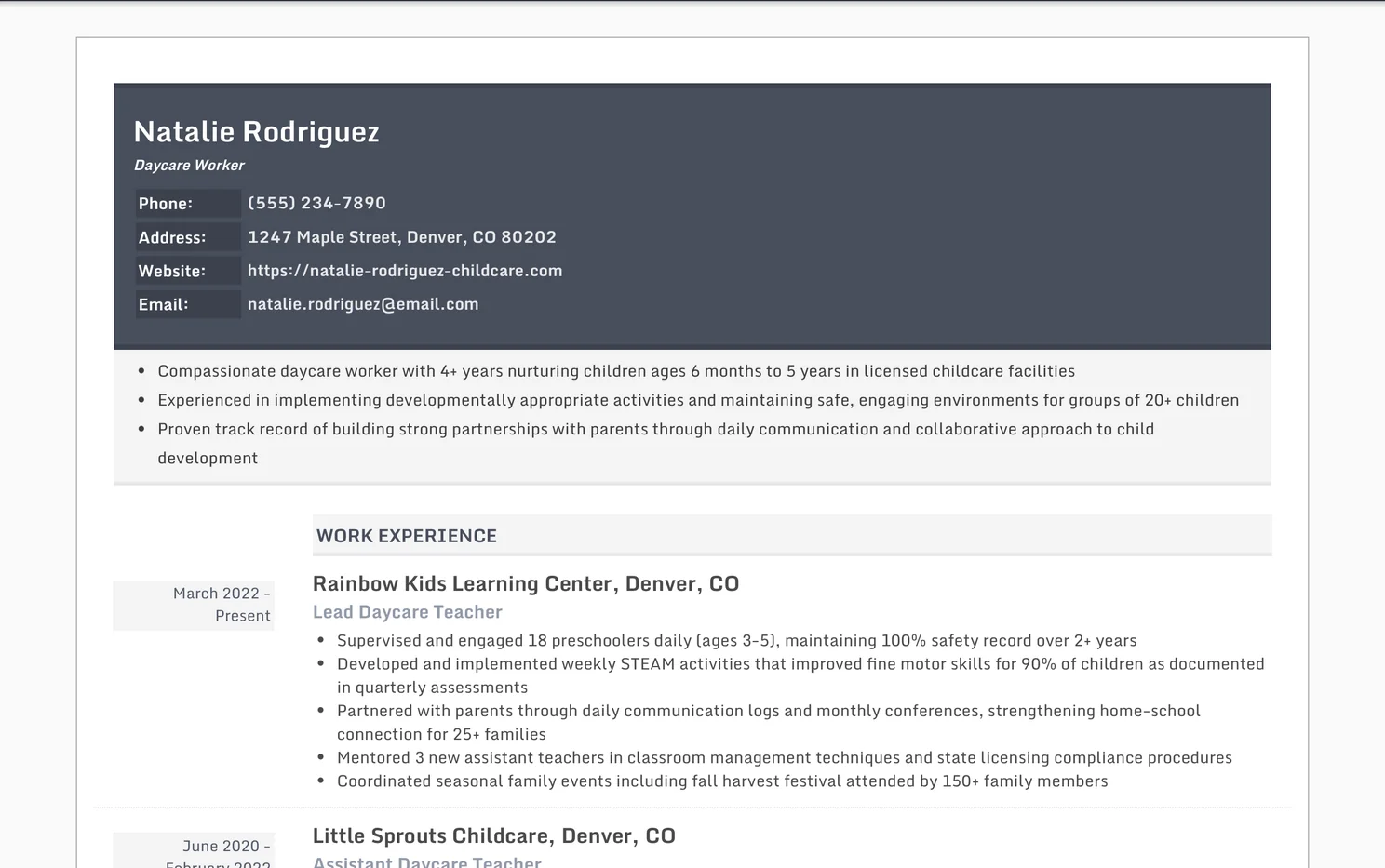
The Best Daycare Resume Example/Sample
https://www.resumonk.com/daycare-resumeDaycareResume Format for Daycare Worker Resume
Here's the thing about daycare work - it's one of those beautiful professions where your genuine love for children matters just as much as your formal qualifications. Whether you're fresh out of your Early Childhood Education program or you've been the neighborhood's go-to babysitter for years, the reverse-chronological format is your best friend for showcasing your journey in childcare.
Why Reverse-Chronological Works Best
The reverse-chronological format starts with your most recent experience and works backward, which is perfect for daycare positions because hiring managers want to see your current level of expertise immediately. They're looking for someone who can jump right in when little Emma has a meltdown or when the finger painting activity turns into an impromptu wall mural session.
Your resume should flow in this order - contact information at the top, followed by a brief professional summary (2-3 lines maximum), then your work experience, education, relevant certifications, and finally your skills. This structure tells your childcare story in a way that makes sense to directors who are probably reading your resume between snack time and outdoor play.
The Professional Summary Sweet Spot
Skip the objective statement - everyone knows you want the job. Instead, craft a professional summary that captures your childcare philosophy and experience level.
Think of it as your elevator pitch if that elevator was full of energetic four-year-olds.
❌ Don't write a generic objective:
Seeking a position in a daycare where I can use my skills
✅ Do write a compelling summary:
Compassionate daycare worker with 3+ years nurturing children ages 2-5. Experienced in implementing age-appropriate activities and maintaining safe, engaging environments for groups of 15+ children
Regional Considerations
If you're applying in the United States, keep your resume to one page unless you have over 10 years of experience.
Canadian daycares often appreciate a bit more detail about your specific training programs. UK nurseries (as they call them across the pond) typically expect to see your relevant qualifications prominently displayed, while Australian childcare centers often look for specific regulatory compliance knowledge right up front.
Work Experience on Daycare Worker Resume
Remember that time you successfully got a group of toddlers to clean up their toys without a single tantrum?
That's not just a Tuesday miracle - that's demonstrable classroom management skills. Your work experience section is where these daily wins transform into professional accomplishments that make hiring managers take notice.
Structuring Your Daycare Experience
Each work experience entry should tell a mini-story about your impact on young lives. Start with your job title, the daycare or childcare facility name, location, and dates of employment. But here's where many daycare worker resumes fall flat - they list duties instead of achievements. You didn't just "watch children."
You created nurturing environments where little humans thrived.
Format each position with 3-5 bullet points that showcase specific contributions. Use action verbs that paint a picture of your active role in children's development.
Words like "developed," "implemented," "coordinated," and "facilitated" show you're a proactive childcare professional, not just a passive supervisor.
❌ Don't write vague duty descriptions:
• Watched children during the day
• Helped with activities
• Changed diapers when needed
✅ Do write achievement-focused bullets:
• Supervised and engaged 12 toddlers daily, maintaining 100% safety record over 2 years
• Developed and implemented weekly sensory play activities that improved fine motor skills for 85% of children
• Partnered with parents through daily communication logs, strengthening home-school connection for 20+ families
Quantifying Your Childcare Impact
Numbers might seem out of place in a field driven by hugs and story time, but they're incredibly powerful on your resume.
How many children did you care for? What age groups? How many activities did you plan per week? Did you help improve nap time compliance? (Every parent reading this just perked up.) These metrics transform fuzzy feelings into concrete professional value.
Handling Different Experience Levels
If you're new to formal daycare work but have been babysitting since you were thirteen, don't discount that experience. Private childcare, nannying, or even volunteer work at your church nursery all count. The key is presenting them professionally. That summer you watched your three cousins becomes "Provided full-time childcare for three children ages 2-7, including meal preparation, educational activities, and transportation."
For those transitioning from other fields - perhaps you're a former retail worker who's realized your true calling is with the tiny humans - focus on transferable skills. Customer service becomes "parent communication," inventory management becomes "classroom supply organization," and crisis management... well, that stays exactly the same.
Skills to Include on Daycare Worker Resume
Let's be honest - working in daycare requires a skill set that would make a CEO jealous.
You're simultaneously a teacher, nurse, entertainer, counselor, artist, and sometimes a human jungle gym. The skills section of your resume needs to capture this beautiful chaos in a way that resonates with daycare directors who know exactly what they're looking for.
The Essential Hard Skills
Start with the non-negotiables - the certifications and technical skills that keep children safe and programs compliant. First Aid and CPR certification should be prominently displayed (and make sure they're current - expired certifications are worse than none at all).
Include any early childhood education coursework, child development knowledge, and specific curriculum experience like Montessori or Reggio Emilia approaches.
Don't forget the practical skills that make daily daycare life possible. Diaper changing might seem too basic to mention, but for infant room positions, it's essential. Same goes for bottle preparation, sleep schedule management, and potty training support. These aren't glamorous, but they're the backbone of quality childcare.
❌ Don't list skills without context:
• Good with kids
• Patient
• Creative
✅ Do provide specific, relevant skills:
• Child behavior management using positive reinforcement techniques
• Infant care including feeding, diapering, and sleep routine establishment
• Creative curriculum planning for mixed age groups (2-5 years)
The Soft Skills That Make You Shine
Here's where your personality gets to sparkle.
Patience isn't just a virtue in daycare - it's a survival skill. But instead of just writing "patient," demonstrate it. "Calm under pressure" becomes "Maintains composure during challenging behaviors while implementing consistent discipline strategies."
Communication skills deserve special attention because you're not just talking to children all day. You're translating toddler speak to concerned parents, collaborating with co-teachers, and sometimes explaining why little Johnny bit someone (again).
Highlight your ability to communicate across all these audiences.
Age-Specific Expertise
Different age groups require different skill sets, and daycare directors know this. If you're a baby whisperer who can soothe any infant, say so. If you're the preschool teacher who can turn any object into a learning opportunity, showcase that.
Be specific about your age group expertise:
• Infant development knowledge (0-12 months) including milestone tracking
• Toddler engagement through sensory play and motor skill activities
• Pre-K school readiness preparation including letter recognition and counting
Specific Considerations and Tips for Daycare Worker Resume
Now for the insider knowledge - the resume tips that separate the daycare professionals from the well-meaning applicants who think "liking kids" is enough of a qualification.
You know better. You know that daycare work is about creating structured chaos, educational magic, and somehow keeping everyone alive, happy, and learning until pickup time.
The Mandatory Compliance Section
Unlike many professions, daycare work comes with strict legal requirements that vary by state, province, or country.
Your resume must clearly show you meet these requirements. Create a dedicated "Certifications and Clearances" section that includes your background check status, any required health screenings, and mandated reporter training. In the US, mention your completion of state-specific training hours. UK applicants should reference their DBS check status. Australians need to highlight their Working with Children Check.
This isn't just bureaucratic box-checking - it shows you understand the professional standards of childcare and saves directors the awkward conversation about whether you can legally work with children.
The Portfolio Power Move
While you can't (and shouldn't) share photos of the children you've worked with, mentioning that you have a professional portfolio available upon request sets you apart.
This portfolio might include lesson plans you've created, examples of classroom newsletters, or photos of classroom setups and activity stations you've designed. One sentence at the bottom of your resume - "Professional portfolio including curriculum samples and classroom management strategies available upon request" - shows you're serious about your craft.
Addressing the Elephant in the Room - Turnover
Daycare work has high turnover rates, and directors know it.
If you've been at the same center for more than two years, that's gold - highlight it. If you've moved between centers, focus on the progression of your responsibilities or the diverse experiences you've gained.
Maybe you moved from an infant room to preschool to gain experience across age groups - that's strategic career development, not job hopping.
❌ Don't leave unexplained gaps or frequent changes:
Happy Times Daycare - 3 months
Sunshine Center - 4 months
Little Learners - 2 months
✅ Do explain your progression:
Little Learners Academy - Preschool Teacher (6 months)
 Promoted from Assistant to Lead Teacher within 3 months
Sunshine Center - Infant Room Specialist (8 months)
 Sought position to expand expertise with 0-24 month age group
The Secret Weapon - Continuing Education
Daycare directors love candidates who pursue ongoing professional development.
Whether it's workshops on behavior management, online courses in child psychology, or attendance at early childhood conferences, show that you're committed to growing your skills. Even mentioning that you regularly read early childhood education blogs or participate in online ECE communities demonstrates your passion extends beyond clock-out time.
The Parent Partnership Angle
Modern daycare work is as much about parent relations as child care.
Directors are looking for workers who can navigate helicopter parents, communicate developmental concerns diplomatically, and turn frustrated families into program advocates. Include specific examples of parent collaboration, whether it's organizing family events, creating detailed daily reports, or successfully handling difficult conversations about challenging behaviors.
Remember, your resume is telling the story of someone who shapes young minds during their most formative years. You're not just keeping kids safe until their parents return - you're laying the foundation for their entire educational journey. Make sure your resume reflects the profound importance of this work, because the right daycare director will recognize a kindred spirit who understands that what happens in those bright, chaotic rooms matters more than most people realize.
Education Requirements and Listing for Daycare Worker Resume
Let's face it - you're passionate about working with children, and now you're staring at your resume wondering how to make your educational background shine for that daycare position.
Whether you're fresh out of high school with babysitting experience or transitioning from another field entirely, the education section of your daycare worker resume needs careful attention. Unlike many other fields where education might be a formality, in childcare, it directly speaks to your preparedness to handle the precious responsibility of caring for young children.
Essential Educational Qualifications
Most daycare centers require at least a high school diploma or GED as the baseline. But here's where it gets interesting - the childcare field values specialized training just as much as formal degrees. Your education section should be positioned strategically on your resume. If you have relevant childcare education or certifications, place this section near the top, right after your summary.
If your education is less directly related, it can follow your experience section.
How to Format Your Education Section
The reverse-chronological format works best here - start with your most recent educational achievement and work backwards. But remember, relevance trumps recency when it comes to daycare positions.
That Early Childhood Education certificate you earned last year is more impressive than the unrelated bachelor's degree from five years ago.
Here's how to structure each educational entry:
❌ Don't write vaguely:
High School Diploma
Lincoln High School
✅ Do include relevant details and dates:
High School Diploma - June 2023
Lincoln High School, Portland, OR
Relevant Coursework: Child Development, Family Studies
Childcare Practicum: 120 hours at Little Stars Preschool
Highlighting Relevant Certifications and Training
In the daycare world, certifications can sometimes speak louder than degrees. CPR and First Aid certifications aren't just nice-to-haves - they're often mandatory.
Your state-required childcare training hours, food handler's permit, and any specialized training in areas like special needs care or infant care should all find their home in this section.
If you're listing multiple certifications, organize them clearly:
✅ Do organize certifications effectively:
CERTIFICATIONS & TRAINING
• CPR and First Aid Certified - American Red Cross (Expires: May 2025)
• 45-Hour State Childcare Certification - Oregon Registry (2023)
• Safe Sleep Training for Infant Care - State Health Department (2023)
• Mandated Reporter Training - Completed January 2024
Educational Background for Career Changers
Perhaps you're coming from retail, food service, or another field entirely.
Your education section becomes your bridge, showing how your background translates to childcare. That psychology degree? Highlight child psychology coursework. That business diploma? Mention any organizational or communication courses that apply to managing classroom activities.
Remember that in the USA, most states require specific training hours within the first few months of employment. In Canada, ECE certification requirements vary by province. UK applicants should note their Level 2 or 3 childcare qualifications prominently. Australian daycare workers need to highlight their Certificate III in Early Childhood Education and Care.
Being upfront about your progress toward these requirements shows initiative and commitment to the field.
Awards and Publications on Daycare Worker Resume
You might be thinking - awards and publications for a daycare position? I'm not applying to be a professor! But hold on. The daycare field has its own ecosystem of recognition, and showcasing these achievements can set you apart from the stack of applications on a director's desk.
Every parent wants their child cared for by someone exceptional, and awards demonstrate that others have recognized your exceptional qualities too.
Types of Awards That Matter in Childcare
Awards in the daycare context look different than in corporate settings.
Maybe you were named "Teacher of the Month" at your previous center, or perhaps you received recognition for perfect attendance - showing reliability that's crucial when parents depend on you. Student teachers often receive awards for their practicum performance, and these absolutely belong on your resume.
Even seemingly unrelated awards can work in your favor if positioned correctly. That "Employee of the Month" from your retail job? It shows dedication and people skills. Academic awards demonstrate your ability to learn and follow through - qualities essential for implementing curriculum and following state regulations.
❌ Don't list awards without context:
Excellence Award - 2023
Perfect Attendance
✅ Do provide meaningful details:
Sunshine Award for Outstanding Classroom Management - Happy Hearts Daycare, March 2023
Recognized for creating innovative calming strategies for toddler classroom

Perfect Attendance Award - 2022-2023 School Year
Demonstrated reliability crucial for maintaining consistent care and classroom ratios
Professional Development and Publications
Now, about publications - you're probably not writing peer-reviewed articles on child development.
But in the modern daycare world, there are other ways you might be "published" that count. Did you create a popular classroom newsletter that parents loved? Have you contributed to your center's blog about sensory play activities? Maybe you developed a curriculum guide that other teachers now use?
These creative contributions show initiative and expertise beyond basic caregiving. They demonstrate that you think deeply about early childhood education and can communicate with both children and adults - a dual skill set that daycare directors highly value.
Presenting Volunteer Recognition
Volunteer work with children often comes with its own recognition.
That certificate of appreciation from the library's summer reading program where you led story time? That belongs here. The thank-you letter from the church nursery coordinator praising your dedication? Turn it into a resume line item. These demonstrate that you choose to spend your free time with children - showing genuine passion rather than just professional obligation.
✅ Do format volunteer recognition professionally:
RECOGNITION & ACHIEVEMENTS

Community Service Award - City Library System, Summer 2023
Led weekly story time sessions for 30+ preschoolers as volunteer coordinator

Outstanding Volunteer Recognition - St. Mary's Church Nursery, 2022-2023
Praised for implementing age-appropriate activities and maintaining safe environment
Remember, in the daycare field, parents are your indirect audience. They want to know their children are with someone special, someone who goes above and beyond.
Awards and recognition, even small ones, provide that third-party validation that you're not just another warm body meeting ratio requirements - you're a dedicated childcare professional who others have noticed and appreciated.
References Strategy for Daycare Worker Resume
References in the daycare world carry more weight than you might think. While other industries might barely glance at them, daycare directors often call every single reference before making a hiring decision. Why? Because they're not just hiring an employee - they're selecting someone who will shape young minds, comfort crying toddlers, and become part of families' daily routines.
Your references become character witnesses to your ability to handle this profound responsibility.
Who Makes the Best References for Daycare Positions
Forget the usual "References available upon request" line - in daycare, you want to be more strategic.
Your reference list is like assembling your personal cheerleading squad, but choose wisely. That professor who barely knew you won't carry as much weight as the parent who watched you babysit their infant through teething, sleep regression, and first steps.
The golden standard for daycare references includes current or former childcare supervisors who can speak to your classroom management skills, reliability, and ability to follow licensing regulations. But don't overlook other powerful references - parents you've worked with privately, volunteer coordinators from children's programs, or even experienced co-teachers who've observed your natural way with children.
❌ Don't list references without context:
References:
John Smith - 555-0123
Mary Johnson - 555-0456
Bob Williams - 555-0789
✅ Do provide complete, relevant information:
PROFESSIONAL REFERENCES

Sarah Martinez, Lead Teacher
Little Explorers Daycare Center
Phone: (555) 123-4567
Email: [email protected]
Relationship: Direct Supervisor (2022-2023)
Can speak to: Classroom management, infant care expertise, parent communication

Jennifer Chen, Parent
Phone: (555) 234-5678
Email: [email protected]
Relationship: Babysitting client (2021-present)
Can speak to: Reliability, patience with special needs child, creative activity planning
Preparing Your References for Success
Here's something most daycare applicants don't do but should - prep your references before listing them.
When Mrs. Thompson gets a call about you, she should be ready to share specific stories about how you calmed the entire toddler room during a fire drill, not scrambling to remember which applicant you are. Send each reference a quick message with the position you're applying for, the center's name, and a gentle reminder of one or two specific achievements they might mention.
Consider creating a reference sheet separate from your resume that includes not just contact information, but also helpful context for the hiring manager. Note what ages of children you worked with under each supervisor, any special programs you participated in together, or specific challenges you overcame that they witnessed.
International Differences in Reference Expectations
Reference expectations vary significantly by country. In the USA, three references are standard, and they're usually contacted by phone. Canadian employers often want to see at least one reference from your most recent childcare position. In the UK, you'll need at least two references, and one must be your current or most recent employer - they're typically contacted via email with formal reference request forms.
Australian childcare centers often require working with children checks (Blue Card in Queensland, for example) in addition to references, and may ask for references from your practical placement supervisors if you're newly qualified.
Managing Challenging Reference Situations
What if you're new to childcare and lack professional daycare references?
Get creative but stay honest. That family you babysat for throughout high school? They count. The youth group leader who watched you manage vacation bible school chaos? Perfect. Even professors from child development courses can work if they can speak to your understanding of child psychology and your dedication to the field.
If you're leaving your first daycare position on less-than-ideal terms, you still need a reference from there. Consider asking a co-teacher or the assistant director instead of the director. Most importantly, never list someone without their permission - nothing damages your credibility faster than a surprised reference who wasn't prepared for the call.
✅ Do organize references strategically for different scenarios:
For Career Changers:
1. Volunteer coordinator from library reading program (shows work with children)
2. Current supervisor (demonstrates work ethic and reliability)
3. Parent from regular babysitting (validates natural childcare abilities)

For Recent Graduates:
1. Student teaching supervisor (academic to practical skills)
2. Daycare practicum mentor (hands-on experience validation)
3. Long-term babysitting client (real-world application)
Remember, in the intimate world of daycare, references often make or break hiring decisions. Directors know that skills can be taught, but character, patience, and genuine love for children cannot.
Your references are the voices that confirm what your resume and cover letter promise - that you're someone parents will trust, children will adore, and colleagues will appreciate having on their team.
Cover Letter Strategies for Daycare Worker Resume
Picture this - a daycare director sits at their desk, surrounded by resumes that all list the same certifications, similar experience, and required training hours.
Then they reach your application, complete with a cover letter that makes them pause. Not because you've used fancy words or corporate jargon, but because you've captured exactly why you're meant to work with children. That's the power of a well-crafted daycare worker cover letter.
Why Daycare Positions Especially Need Cover Letters
Unlike many entry-level positions where cover letters might be optional, daycare positions practically demand them. Why? Because parents entrust centers with their most precious possessions, and directors need to know you understand the weight of that responsibility.
Your resume shows you can do the job - your cover letter shows why you want to do it and how you'll bring warmth, creativity, and dedication to their specific center.
The daycare industry runs on relationships - with children, parents, colleagues, and administrators. Your cover letter is your first chance to demonstrate those interpersonal skills that no resume bullet point can fully capture. It's where you transform from a list of qualifications into a real person who genuinely enjoys singing nursery rhymes, doesn't mind changing diapers, and finds joy in a toddler's first successful attempt at sharing.
Structure That Connects With Daycare Directors
Your opening paragraph needs to grab attention without being gimmicky.
Skip the generic "I am writing to apply for..." and instead, lead with your genuine connection to childcare.
Maybe it's a brief moment that crystallized your calling, or perhaps it's your understanding of the center's specific philosophy.
❌ Don't open generically:
Dear Hiring Manager,
I am writing to apply for the Daycare Worker position at your center.
I have the required certifications and am available immediately.
✅ Do open with authentic enthusiasm:
Dear Ms. Johnson,
When I visited Sunshine Learning Center last week and saw the sensory garden where toddlers were exploring different textures, I knew this was where I wanted to contribute my passion for hands-on early learning. Your center's emphasis on outdoor exploration aligns perfectly with my belief that children learn best through discovery.
Addressing the Real Concerns
Daycare directors have specific worries when hiring - Will this person show up reliably?
Can they handle challenging behaviors with patience? Will parents feel comfortable during drop-off? Your cover letter should preemptively address these concerns through specific examples. Don't just claim you're patient - describe managing a classroom during a particularly chaotic day. Don't just say you're reliable - mention your track record of stepping in for sick colleagues or arriving early to prep activities.
The middle paragraph should bridge your experience to their needs. If the job posting mentions infant care, discuss your experience with feeding schedules and sleep routines. If they emphasize curriculum implementation, detail how you've adapted lesson plans for different learning styles.
Make it impossible for them to imagine their center without you.
Cultural Fit and Center Philosophy
Every daycare center has its own personality - some follow Montessori principles, others embrace play-based learning, and some focus on school readiness. Your cover letter must show you've done your homework. Reference their mission statement, but more importantly, show how you embody it. If they pride themselves on diversity and inclusion, mention your experience creating activities that celebrate different cultures.
If they emphasize STEAM learning, discuss the science experiments you've successfully conducted with preschoolers.
✅ Do demonstrate alignment with their values:
Your center's commitment to "learning through play" resonates deeply with my approach.
Last month, I transformed a simple water table activity into an engineering challenge where four-year-olds built boats from recycled materials, naturally learning about buoyancy while developing problem-solving skills. This is exactly the kind of emergent curriculum I'm excited to bring to your classroom.
Close your letter with confidence, not desperation. Express enthusiasm for contributing to their team while maintaining professionalism. Mention your availability for an interview and any scheduling considerations - remember, daycare centers often need coverage during specific hours, so flexibility here can be a selling point. Sign off warmly but professionally, because in childcare, that balance between friendly and professional is exactly what they're seeking.
Key Takeaways
- Use the reverse-chronological format to showcase your most recent childcare experience first, organizing your resume with contact information, professional summary, work experience, education, certifications, and skills in that order
- Transform daily duties into measurable achievements by quantifying your impact - number of children supervised, safety records maintained, parent satisfaction rates, and specific developmental improvements observed
- Prioritize relevant certifications and compliance requirements including current CPR/First Aid, state-mandated training hours, background checks, and any specialized training in areas like infant care or special needs support
- Balance hard skills with soft skills by combining technical qualifications (curriculum planning, developmental milestone tracking) with essential personality traits (patience, creativity, communication) using specific examples
- Tailor your resume to age-group expertise whether you specialize in infant care, toddler engagement, or pre-K preparation, making your specific strengths clear to directors filling particular classroom needs
- Include a compelling professional summary instead of an objective statement, capturing your childcare philosophy and experience level in 2-3 impactful lines that immediately convey your value
- Address regional requirements upfront by highlighting state-specific training hours, national certifications, or international clearances depending on your location, showing you understand regulatory compliance
- Leverage volunteer work and related experience including babysitting, church nursery work, or camp counseling, presenting them professionally to demonstrate genuine passion for childcare
- Create a separate references strategy preparing 3-4 strong references who can speak to your reliability, patience, and natural way with children, briefing them on the positions you're pursuing
- Write a personalized cover letter that demonstrates knowledge of the center's philosophy, addresses common director concerns about reliability and patience, and shares your authentic connection to early childhood education
Creating a resume that captures your unique gifts as a daycare worker doesn't have to feel overwhelming. With Resumonk's intuitive platform, you can build a professional daycare worker resume that showcases your childcare expertise while maintaining the warmth and approachability that makes you great with children. Our AI-powered suggestions help you identify the most impactful action verbs and metrics for the childcare industry, while our selection of clean, professional templates ensures your qualifications are presented clearly - perfect for busy daycare directors reviewing applications between naptime and snack preparation. Whether you're highlighting your classroom management skills, organizing your certifications, or crafting that perfect professional summary, Resumonk guides you through each section with industry-specific recommendations that resonate with childcare employers.
Ready to create a daycare worker resume that captures both your qualifications and your genuine passion for early childhood education?
Start building your professional resume with Resumonk today, where smart formatting meets beautiful design, helping you land that perfect position where you can continue making a difference in young lives.
Begin your journey to your dream daycare position here.
More Child Care resume examples
See all Child Care resume examples, or browse every category.
Resume writing tips
Picture yourself at 6:47 AM, coffee in hand, mentally preparing for another day where you'll simultaneously be a teacher, nurse, entertainer, and professional nose-wiper.
You've mastered the art of making naptime happen for fifteen energetic toddlers (a skill that should honestly qualify for the Olympics), and you can spot a brewing meltdown from across a playground. Now you're home, facing your laptop screen, trying to translate these daily victories into a resume that captures just how essential your work really is. The cursor blinks expectantly, and suddenly you're wondering how to explain that yes, you're qualified to shape young minds during their most crucial developmental years, and no, it's not "just babysitting."
Working in daycare is one of those remarkable professions where your genuine love for children, endless patience, and ability to find joy in finger painting mishaps matter just as much as your certifications and training hours. Whether you're fresh from your Early Childhood Education program, transitioning from another field because you've discovered your calling, or you've been the go-to childcare provider in your community for years, creating the perfect daycare worker resume requires a special touch - one that balances professional qualifications with the warmth and dedication that makes parents trust you with their most precious treasures.
In this comprehensive guide, we'll walk you through every element of crafting a standout daycare worker resume, starting with choosing the ideal resume format that showcases your caregiving journey. We'll explore how to transform your daily classroom victories into compelling work experience bullets, identify which skills make daycare directors take notice, and navigate the specific requirements and certifications that vary by region. You'll learn how to present your education and training in ways that demonstrate your commitment to child development, discover why awards and volunteer recognition matter more than you think in this field, and master the art of writing a cover letter that captures your authentic passion for early childhood education.
We'll also dive into the strategic aspects that many overlook - from managing references who can vouch for your patience during the terrible twos, to addressing common concerns like employment gaps or career transitions into childcare. By the time you finish reading, you'll have all the tools to create a resume that not only meets the technical requirements of daycare positions but also conveys the heart, creativity, and dedication that makes you the kind of childcare professional parents request by name and children run to greet each morning.
The Best Daycare Resume Example/Sample
https://www.resumonk.com/daycare-resumeDaycareResume Format for Daycare Worker Resume
Here's the thing about daycare work - it's one of those beautiful professions where your genuine love for children matters just as much as your formal qualifications. Whether you're fresh out of your Early Childhood Education program or you've been the neighborhood's go-to babysitter for years, the reverse-chronological format is your best friend for showcasing your journey in childcare.
Why Reverse-Chronological Works Best
The reverse-chronological format starts with your most recent experience and works backward, which is perfect for daycare positions because hiring managers want to see your current level of expertise immediately. They're looking for someone who can jump right in when little Emma has a meltdown or when the finger painting activity turns into an impromptu wall mural session.
Your resume should flow in this order - contact information at the top, followed by a brief professional summary (2-3 lines maximum), then your work experience, education, relevant certifications, and finally your skills. This structure tells your childcare story in a way that makes sense to directors who are probably reading your resume between snack time and outdoor play.
The Professional Summary Sweet Spot
Skip the objective statement - everyone knows you want the job. Instead, craft a professional summary that captures your childcare philosophy and experience level.
Think of it as your elevator pitch if that elevator was full of energetic four-year-olds.
❌ Don't write a generic objective:
Seeking a position in a daycare where I can use my skills
✅ Do write a compelling summary:
Compassionate daycare worker with 3+ years nurturing children ages 2-5. Experienced in implementing age-appropriate activities and maintaining safe, engaging environments for groups of 15+ children
Regional Considerations
If you're applying in the United States, keep your resume to one page unless you have over 10 years of experience.
Canadian daycares often appreciate a bit more detail about your specific training programs. UK nurseries (as they call them across the pond) typically expect to see your relevant qualifications prominently displayed, while Australian childcare centers often look for specific regulatory compliance knowledge right up front.
Work Experience on Daycare Worker Resume
Remember that time you successfully got a group of toddlers to clean up their toys without a single tantrum?
That's not just a Tuesday miracle - that's demonstrable classroom management skills. Your work experience section is where these daily wins transform into professional accomplishments that make hiring managers take notice.
Structuring Your Daycare Experience
Each work experience entry should tell a mini-story about your impact on young lives. Start with your job title, the daycare or childcare facility name, location, and dates of employment. But here's where many daycare worker resumes fall flat - they list duties instead of achievements. You didn't just "watch children."
You created nurturing environments where little humans thrived.
Format each position with 3-5 bullet points that showcase specific contributions. Use action verbs that paint a picture of your active role in children's development.
Words like "developed," "implemented," "coordinated," and "facilitated" show you're a proactive childcare professional, not just a passive supervisor.
❌ Don't write vague duty descriptions:
• Watched children during the day
• Helped with activities
• Changed diapers when needed
✅ Do write achievement-focused bullets:
• Supervised and engaged 12 toddlers daily, maintaining 100% safety record over 2 years
• Developed and implemented weekly sensory play activities that improved fine motor skills for 85% of children
• Partnered with parents through daily communication logs, strengthening home-school connection for 20+ families
Quantifying Your Childcare Impact
Numbers might seem out of place in a field driven by hugs and story time, but they're incredibly powerful on your resume.
How many children did you care for? What age groups? How many activities did you plan per week? Did you help improve nap time compliance? (Every parent reading this just perked up.) These metrics transform fuzzy feelings into concrete professional value.
Handling Different Experience Levels
If you're new to formal daycare work but have been babysitting since you were thirteen, don't discount that experience. Private childcare, nannying, or even volunteer work at your church nursery all count. The key is presenting them professionally. That summer you watched your three cousins becomes "Provided full-time childcare for three children ages 2-7, including meal preparation, educational activities, and transportation."
For those transitioning from other fields - perhaps you're a former retail worker who's realized your true calling is with the tiny humans - focus on transferable skills. Customer service becomes "parent communication," inventory management becomes "classroom supply organization," and crisis management... well, that stays exactly the same.
Skills to Include on Daycare Worker Resume
Let's be honest - working in daycare requires a skill set that would make a CEO jealous.
You're simultaneously a teacher, nurse, entertainer, counselor, artist, and sometimes a human jungle gym. The skills section of your resume needs to capture this beautiful chaos in a way that resonates with daycare directors who know exactly what they're looking for.
The Essential Hard Skills
Start with the non-negotiables - the certifications and technical skills that keep children safe and programs compliant. First Aid and CPR certification should be prominently displayed (and make sure they're current - expired certifications are worse than none at all).
Include any early childhood education coursework, child development knowledge, and specific curriculum experience like Montessori or Reggio Emilia approaches.
Don't forget the practical skills that make daily daycare life possible. Diaper changing might seem too basic to mention, but for infant room positions, it's essential. Same goes for bottle preparation, sleep schedule management, and potty training support. These aren't glamorous, but they're the backbone of quality childcare.
❌ Don't list skills without context:
• Good with kids
• Patient
• Creative
✅ Do provide specific, relevant skills:
• Child behavior management using positive reinforcement techniques
• Infant care including feeding, diapering, and sleep routine establishment
• Creative curriculum planning for mixed age groups (2-5 years)
The Soft Skills That Make You Shine
Here's where your personality gets to sparkle.
Patience isn't just a virtue in daycare - it's a survival skill. But instead of just writing "patient," demonstrate it. "Calm under pressure" becomes "Maintains composure during challenging behaviors while implementing consistent discipline strategies."
Communication skills deserve special attention because you're not just talking to children all day. You're translating toddler speak to concerned parents, collaborating with co-teachers, and sometimes explaining why little Johnny bit someone (again).
Highlight your ability to communicate across all these audiences.
Age-Specific Expertise
Different age groups require different skill sets, and daycare directors know this. If you're a baby whisperer who can soothe any infant, say so. If you're the preschool teacher who can turn any object into a learning opportunity, showcase that.
Be specific about your age group expertise:
• Infant development knowledge (0-12 months) including milestone tracking
• Toddler engagement through sensory play and motor skill activities
• Pre-K school readiness preparation including letter recognition and counting
Specific Considerations and Tips for Daycare Worker Resume
Now for the insider knowledge - the resume tips that separate the daycare professionals from the well-meaning applicants who think "liking kids" is enough of a qualification.
You know better. You know that daycare work is about creating structured chaos, educational magic, and somehow keeping everyone alive, happy, and learning until pickup time.
The Mandatory Compliance Section
Unlike many professions, daycare work comes with strict legal requirements that vary by state, province, or country.
Your resume must clearly show you meet these requirements. Create a dedicated "Certifications and Clearances" section that includes your background check status, any required health screenings, and mandated reporter training. In the US, mention your completion of state-specific training hours. UK applicants should reference their DBS check status. Australians need to highlight their Working with Children Check.
This isn't just bureaucratic box-checking - it shows you understand the professional standards of childcare and saves directors the awkward conversation about whether you can legally work with children.
The Portfolio Power Move
While you can't (and shouldn't) share photos of the children you've worked with, mentioning that you have a professional portfolio available upon request sets you apart.
This portfolio might include lesson plans you've created, examples of classroom newsletters, or photos of classroom setups and activity stations you've designed. One sentence at the bottom of your resume - "Professional portfolio including curriculum samples and classroom management strategies available upon request" - shows you're serious about your craft.
Addressing the Elephant in the Room - Turnover
Daycare work has high turnover rates, and directors know it.
If you've been at the same center for more than two years, that's gold - highlight it. If you've moved between centers, focus on the progression of your responsibilities or the diverse experiences you've gained.
Maybe you moved from an infant room to preschool to gain experience across age groups - that's strategic career development, not job hopping.
❌ Don't leave unexplained gaps or frequent changes:
Happy Times Daycare - 3 months
Sunshine Center - 4 months
Little Learners - 2 months
✅ Do explain your progression:
Little Learners Academy - Preschool Teacher (6 months)
 Promoted from Assistant to Lead Teacher within 3 months
Sunshine Center - Infant Room Specialist (8 months)
 Sought position to expand expertise with 0-24 month age group
The Secret Weapon - Continuing Education
Daycare directors love candidates who pursue ongoing professional development.
Whether it's workshops on behavior management, online courses in child psychology, or attendance at early childhood conferences, show that you're committed to growing your skills. Even mentioning that you regularly read early childhood education blogs or participate in online ECE communities demonstrates your passion extends beyond clock-out time.
The Parent Partnership Angle
Modern daycare work is as much about parent relations as child care.
Directors are looking for workers who can navigate helicopter parents, communicate developmental concerns diplomatically, and turn frustrated families into program advocates. Include specific examples of parent collaboration, whether it's organizing family events, creating detailed daily reports, or successfully handling difficult conversations about challenging behaviors.
Remember, your resume is telling the story of someone who shapes young minds during their most formative years. You're not just keeping kids safe until their parents return - you're laying the foundation for their entire educational journey. Make sure your resume reflects the profound importance of this work, because the right daycare director will recognize a kindred spirit who understands that what happens in those bright, chaotic rooms matters more than most people realize.
Education Requirements and Listing for Daycare Worker Resume
Let's face it - you're passionate about working with children, and now you're staring at your resume wondering how to make your educational background shine for that daycare position.
Whether you're fresh out of high school with babysitting experience or transitioning from another field entirely, the education section of your daycare worker resume needs careful attention. Unlike many other fields where education might be a formality, in childcare, it directly speaks to your preparedness to handle the precious responsibility of caring for young children.
Essential Educational Qualifications
Most daycare centers require at least a high school diploma or GED as the baseline. But here's where it gets interesting - the childcare field values specialized training just as much as formal degrees. Your education section should be positioned strategically on your resume. If you have relevant childcare education or certifications, place this section near the top, right after your summary.
If your education is less directly related, it can follow your experience section.
How to Format Your Education Section
The reverse-chronological format works best here - start with your most recent educational achievement and work backwards. But remember, relevance trumps recency when it comes to daycare positions.
That Early Childhood Education certificate you earned last year is more impressive than the unrelated bachelor's degree from five years ago.
Here's how to structure each educational entry:
❌ Don't write vaguely:
High School Diploma
Lincoln High School
✅ Do include relevant details and dates:
High School Diploma - June 2023
Lincoln High School, Portland, OR
Relevant Coursework: Child Development, Family Studies
Childcare Practicum: 120 hours at Little Stars Preschool
Highlighting Relevant Certifications and Training
In the daycare world, certifications can sometimes speak louder than degrees. CPR and First Aid certifications aren't just nice-to-haves - they're often mandatory.
Your state-required childcare training hours, food handler's permit, and any specialized training in areas like special needs care or infant care should all find their home in this section.
If you're listing multiple certifications, organize them clearly:
✅ Do organize certifications effectively:
CERTIFICATIONS & TRAINING
• CPR and First Aid Certified - American Red Cross (Expires: May 2025)
• 45-Hour State Childcare Certification - Oregon Registry (2023)
• Safe Sleep Training for Infant Care - State Health Department (2023)
• Mandated Reporter Training - Completed January 2024
Educational Background for Career Changers
Perhaps you're coming from retail, food service, or another field entirely.
Your education section becomes your bridge, showing how your background translates to childcare. That psychology degree? Highlight child psychology coursework. That business diploma? Mention any organizational or communication courses that apply to managing classroom activities.
Remember that in the USA, most states require specific training hours within the first few months of employment. In Canada, ECE certification requirements vary by province. UK applicants should note their Level 2 or 3 childcare qualifications prominently. Australian daycare workers need to highlight their Certificate III in Early Childhood Education and Care.
Being upfront about your progress toward these requirements shows initiative and commitment to the field.
Awards and Publications on Daycare Worker Resume
You might be thinking - awards and publications for a daycare position? I'm not applying to be a professor! But hold on. The daycare field has its own ecosystem of recognition, and showcasing these achievements can set you apart from the stack of applications on a director's desk.
Every parent wants their child cared for by someone exceptional, and awards demonstrate that others have recognized your exceptional qualities too.
Types of Awards That Matter in Childcare
Awards in the daycare context look different than in corporate settings.
Maybe you were named "Teacher of the Month" at your previous center, or perhaps you received recognition for perfect attendance - showing reliability that's crucial when parents depend on you. Student teachers often receive awards for their practicum performance, and these absolutely belong on your resume.
Even seemingly unrelated awards can work in your favor if positioned correctly. That "Employee of the Month" from your retail job? It shows dedication and people skills. Academic awards demonstrate your ability to learn and follow through - qualities essential for implementing curriculum and following state regulations.
❌ Don't list awards without context:
Excellence Award - 2023
Perfect Attendance
✅ Do provide meaningful details:
Sunshine Award for Outstanding Classroom Management - Happy Hearts Daycare, March 2023
Recognized for creating innovative calming strategies for toddler classroom

Perfect Attendance Award - 2022-2023 School Year
Demonstrated reliability crucial for maintaining consistent care and classroom ratios
Professional Development and Publications
Now, about publications - you're probably not writing peer-reviewed articles on child development.
But in the modern daycare world, there are other ways you might be "published" that count. Did you create a popular classroom newsletter that parents loved? Have you contributed to your center's blog about sensory play activities? Maybe you developed a curriculum guide that other teachers now use?
These creative contributions show initiative and expertise beyond basic caregiving. They demonstrate that you think deeply about early childhood education and can communicate with both children and adults - a dual skill set that daycare directors highly value.
Presenting Volunteer Recognition
Volunteer work with children often comes with its own recognition.
That certificate of appreciation from the library's summer reading program where you led story time? That belongs here. The thank-you letter from the church nursery coordinator praising your dedication? Turn it into a resume line item. These demonstrate that you choose to spend your free time with children - showing genuine passion rather than just professional obligation.
✅ Do format volunteer recognition professionally:
RECOGNITION & ACHIEVEMENTS

Community Service Award - City Library System, Summer 2023
Led weekly story time sessions for 30+ preschoolers as volunteer coordinator

Outstanding Volunteer Recognition - St. Mary's Church Nursery, 2022-2023
Praised for implementing age-appropriate activities and maintaining safe environment
Remember, in the daycare field, parents are your indirect audience. They want to know their children are with someone special, someone who goes above and beyond.
Awards and recognition, even small ones, provide that third-party validation that you're not just another warm body meeting ratio requirements - you're a dedicated childcare professional who others have noticed and appreciated.
References Strategy for Daycare Worker Resume
References in the daycare world carry more weight than you might think. While other industries might barely glance at them, daycare directors often call every single reference before making a hiring decision. Why? Because they're not just hiring an employee - they're selecting someone who will shape young minds, comfort crying toddlers, and become part of families' daily routines.
Your references become character witnesses to your ability to handle this profound responsibility.
Who Makes the Best References for Daycare Positions
Forget the usual "References available upon request" line - in daycare, you want to be more strategic.
Your reference list is like assembling your personal cheerleading squad, but choose wisely. That professor who barely knew you won't carry as much weight as the parent who watched you babysit their infant through teething, sleep regression, and first steps.
The golden standard for daycare references includes current or former childcare supervisors who can speak to your classroom management skills, reliability, and ability to follow licensing regulations. But don't overlook other powerful references - parents you've worked with privately, volunteer coordinators from children's programs, or even experienced co-teachers who've observed your natural way with children.
❌ Don't list references without context:
References:
John Smith - 555-0123
Mary Johnson - 555-0456
Bob Williams - 555-0789
✅ Do provide complete, relevant information:
PROFESSIONAL REFERENCES

Sarah Martinez, Lead Teacher
Little Explorers Daycare Center
Phone: (555) 123-4567
Email: [email protected]
Relationship: Direct Supervisor (2022-2023)
Can speak to: Classroom management, infant care expertise, parent communication

Jennifer Chen, Parent
Phone: (555) 234-5678
Email: [email protected]
Relationship: Babysitting client (2021-present)
Can speak to: Reliability, patience with special needs child, creative activity planning
Preparing Your References for Success
Here's something most daycare applicants don't do but should - prep your references before listing them.
When Mrs. Thompson gets a call about you, she should be ready to share specific stories about how you calmed the entire toddler room during a fire drill, not scrambling to remember which applicant you are. Send each reference a quick message with the position you're applying for, the center's name, and a gentle reminder of one or two specific achievements they might mention.
Consider creating a reference sheet separate from your resume that includes not just contact information, but also helpful context for the hiring manager. Note what ages of children you worked with under each supervisor, any special programs you participated in together, or specific challenges you overcame that they witnessed.
International Differences in Reference Expectations
Reference expectations vary significantly by country. In the USA, three references are standard, and they're usually contacted by phone. Canadian employers often want to see at least one reference from your most recent childcare position. In the UK, you'll need at least two references, and one must be your current or most recent employer - they're typically contacted via email with formal reference request forms.
Australian childcare centers often require working with children checks (Blue Card in Queensland, for example) in addition to references, and may ask for references from your practical placement supervisors if you're newly qualified.
Managing Challenging Reference Situations
What if you're new to childcare and lack professional daycare references?
Get creative but stay honest. That family you babysat for throughout high school? They count. The youth group leader who watched you manage vacation bible school chaos? Perfect. Even professors from child development courses can work if they can speak to your understanding of child psychology and your dedication to the field.
If you're leaving your first daycare position on less-than-ideal terms, you still need a reference from there. Consider asking a co-teacher or the assistant director instead of the director. Most importantly, never list someone without their permission - nothing damages your credibility faster than a surprised reference who wasn't prepared for the call.
✅ Do organize references strategically for different scenarios:
For Career Changers:
1. Volunteer coordinator from library reading program (shows work with children)
2. Current supervisor (demonstrates work ethic and reliability)
3. Parent from regular babysitting (validates natural childcare abilities)

For Recent Graduates:
1. Student teaching supervisor (academic to practical skills)
2. Daycare practicum mentor (hands-on experience validation)
3. Long-term babysitting client (real-world application)
Remember, in the intimate world of daycare, references often make or break hiring decisions. Directors know that skills can be taught, but character, patience, and genuine love for children cannot.
Your references are the voices that confirm what your resume and cover letter promise - that you're someone parents will trust, children will adore, and colleagues will appreciate having on their team.
Cover Letter Strategies for Daycare Worker Resume
Picture this - a daycare director sits at their desk, surrounded by resumes that all list the same certifications, similar experience, and required training hours.
Then they reach your application, complete with a cover letter that makes them pause. Not because you've used fancy words or corporate jargon, but because you've captured exactly why you're meant to work with children. That's the power of a well-crafted daycare worker cover letter.
Why Daycare Positions Especially Need Cover Letters
Unlike many entry-level positions where cover letters might be optional, daycare positions practically demand them. Why? Because parents entrust centers with their most precious possessions, and directors need to know you understand the weight of that responsibility.
Your resume shows you can do the job - your cover letter shows why you want to do it and how you'll bring warmth, creativity, and dedication to their specific center.
The daycare industry runs on relationships - with children, parents, colleagues, and administrators. Your cover letter is your first chance to demonstrate those interpersonal skills that no resume bullet point can fully capture. It's where you transform from a list of qualifications into a real person who genuinely enjoys singing nursery rhymes, doesn't mind changing diapers, and finds joy in a toddler's first successful attempt at sharing.
Structure That Connects With Daycare Directors
Your opening paragraph needs to grab attention without being gimmicky.
Skip the generic "I am writing to apply for..." and instead, lead with your genuine connection to childcare.
Maybe it's a brief moment that crystallized your calling, or perhaps it's your understanding of the center's specific philosophy.
❌ Don't open generically:
Dear Hiring Manager,
I am writing to apply for the Daycare Worker position at your center.
I have the required certifications and am available immediately.
✅ Do open with authentic enthusiasm:
Dear Ms. Johnson,
When I visited Sunshine Learning Center last week and saw the sensory garden where toddlers were exploring different textures, I knew this was where I wanted to contribute my passion for hands-on early learning. Your center's emphasis on outdoor exploration aligns perfectly with my belief that children learn best through discovery.
Addressing the Real Concerns
Daycare directors have specific worries when hiring - Will this person show up reliably?
Can they handle challenging behaviors with patience? Will parents feel comfortable during drop-off? Your cover letter should preemptively address these concerns through specific examples. Don't just claim you're patient - describe managing a classroom during a particularly chaotic day. Don't just say you're reliable - mention your track record of stepping in for sick colleagues or arriving early to prep activities.
The middle paragraph should bridge your experience to their needs. If the job posting mentions infant care, discuss your experience with feeding schedules and sleep routines. If they emphasize curriculum implementation, detail how you've adapted lesson plans for different learning styles.
Make it impossible for them to imagine their center without you.
Cultural Fit and Center Philosophy
Every daycare center has its own personality - some follow Montessori principles, others embrace play-based learning, and some focus on school readiness. Your cover letter must show you've done your homework. Reference their mission statement, but more importantly, show how you embody it. If they pride themselves on diversity and inclusion, mention your experience creating activities that celebrate different cultures.
If they emphasize STEAM learning, discuss the science experiments you've successfully conducted with preschoolers.
✅ Do demonstrate alignment with their values:
Your center's commitment to "learning through play" resonates deeply with my approach.
Last month, I transformed a simple water table activity into an engineering challenge where four-year-olds built boats from recycled materials, naturally learning about buoyancy while developing problem-solving skills. This is exactly the kind of emergent curriculum I'm excited to bring to your classroom.
Close your letter with confidence, not desperation. Express enthusiasm for contributing to their team while maintaining professionalism. Mention your availability for an interview and any scheduling considerations - remember, daycare centers often need coverage during specific hours, so flexibility here can be a selling point. Sign off warmly but professionally, because in childcare, that balance between friendly and professional is exactly what they're seeking.
Key Takeaways
- Use the reverse-chronological format to showcase your most recent childcare experience first, organizing your resume with contact information, professional summary, work experience, education, certifications, and skills in that order
- Transform daily duties into measurable achievements by quantifying your impact - number of children supervised, safety records maintained, parent satisfaction rates, and specific developmental improvements observed
- Prioritize relevant certifications and compliance requirements including current CPR/First Aid, state-mandated training hours, background checks, and any specialized training in areas like infant care or special needs support
- Balance hard skills with soft skills by combining technical qualifications (curriculum planning, developmental milestone tracking) with essential personality traits (patience, creativity, communication) using specific examples
- Tailor your resume to age-group expertise whether you specialize in infant care, toddler engagement, or pre-K preparation, making your specific strengths clear to directors filling particular classroom needs
- Include a compelling professional summary instead of an objective statement, capturing your childcare philosophy and experience level in 2-3 impactful lines that immediately convey your value
- Address regional requirements upfront by highlighting state-specific training hours, national certifications, or international clearances depending on your location, showing you understand regulatory compliance
- Leverage volunteer work and related experience including babysitting, church nursery work, or camp counseling, presenting them professionally to demonstrate genuine passion for childcare
- Create a separate references strategy preparing 3-4 strong references who can speak to your reliability, patience, and natural way with children, briefing them on the positions you're pursuing
- Write a personalized cover letter that demonstrates knowledge of the center's philosophy, addresses common director concerns about reliability and patience, and shares your authentic connection to early childhood education
Creating a resume that captures your unique gifts as a daycare worker doesn't have to feel overwhelming. With Resumonk's intuitive platform, you can build a professional daycare worker resume that showcases your childcare expertise while maintaining the warmth and approachability that makes you great with children. Our AI-powered suggestions help you identify the most impactful action verbs and metrics for the childcare industry, while our selection of clean, professional templates ensures your qualifications are presented clearly - perfect for busy daycare directors reviewing applications between naptime and snack preparation. Whether you're highlighting your classroom management skills, organizing your certifications, or crafting that perfect professional summary, Resumonk guides you through each section with industry-specific recommendations that resonate with childcare employers.
Ready to create a daycare worker resume that captures both your qualifications and your genuine passion for early childhood education?
Start building your professional resume with Resumonk today, where smart formatting meets beautiful design, helping you land that perfect position where you can continue making a difference in young lives.
Begin your journey to your dream daycare position here.
More Child Care resume examples
See all Child Care resume examples, or browse every category.
Resume writing tips