Medical Receptionist Resume Example (with Tips and Best Practices)
Introduction
Picture yourself walking into a medical office on a Monday morning. The phones are already ringing, patients are checking in for their 8 AM appointments, and somewhere between verifying insurance and calming a nervous first-time patient, you realize - this is where healthcare actually begins. Not in the exam room, but right here at the front desk where you're orchestrating the entire symphony of a medical practice. You're ready to be that vital first point of contact, but your resume feels like it's missing that professional polish that says "I belong in healthcare."
As a Medical Receptionist, you're applying for a role that sits at the fascinating intersection of healthcare administration and customer service. Maybe you're transitioning from retail where you've mastered the art of managing difficult customers, or perhaps you're fresh out of high school with a natural ability to stay calm under pressure. Either way, you need a resume that speaks the language of medical practices - one that shows you understand the unique blend of empathy, efficiency, and discretion this role demands.
In this comprehensive guide, we'll walk you through creating a Medical Receptionist resume that gets noticed for all the right reasons. We'll start with choosing the perfect resume format - specifically the reverse-chronological layout that medical practices prefer - then dive deep into crafting compelling work experience descriptions that transform everyday tasks into meaningful achievements. You'll learn which technical and soft skills to highlight, from EMR systems to emotional intelligence, and how to present your education and certifications in ways that resonate with healthcare employers.
We'll also cover the nuances that many overlook - understanding your place in the healthcare hierarchy, demonstrating HIPAA awareness without overdoing it, and tailoring your application to different practice types, whether it's a bustling pediatric clinic or a specialized cardiology office. Plus, we'll guide you through writing a cover letter that brings your resume to life and selecting references who can vouch for your healthcare readiness. By the end, you'll have all the tools to create a Medical Receptionist resume that opens doors - quite literally - to your career in healthcare administration.
The Best Medical Receptionist Resume Example/Sample
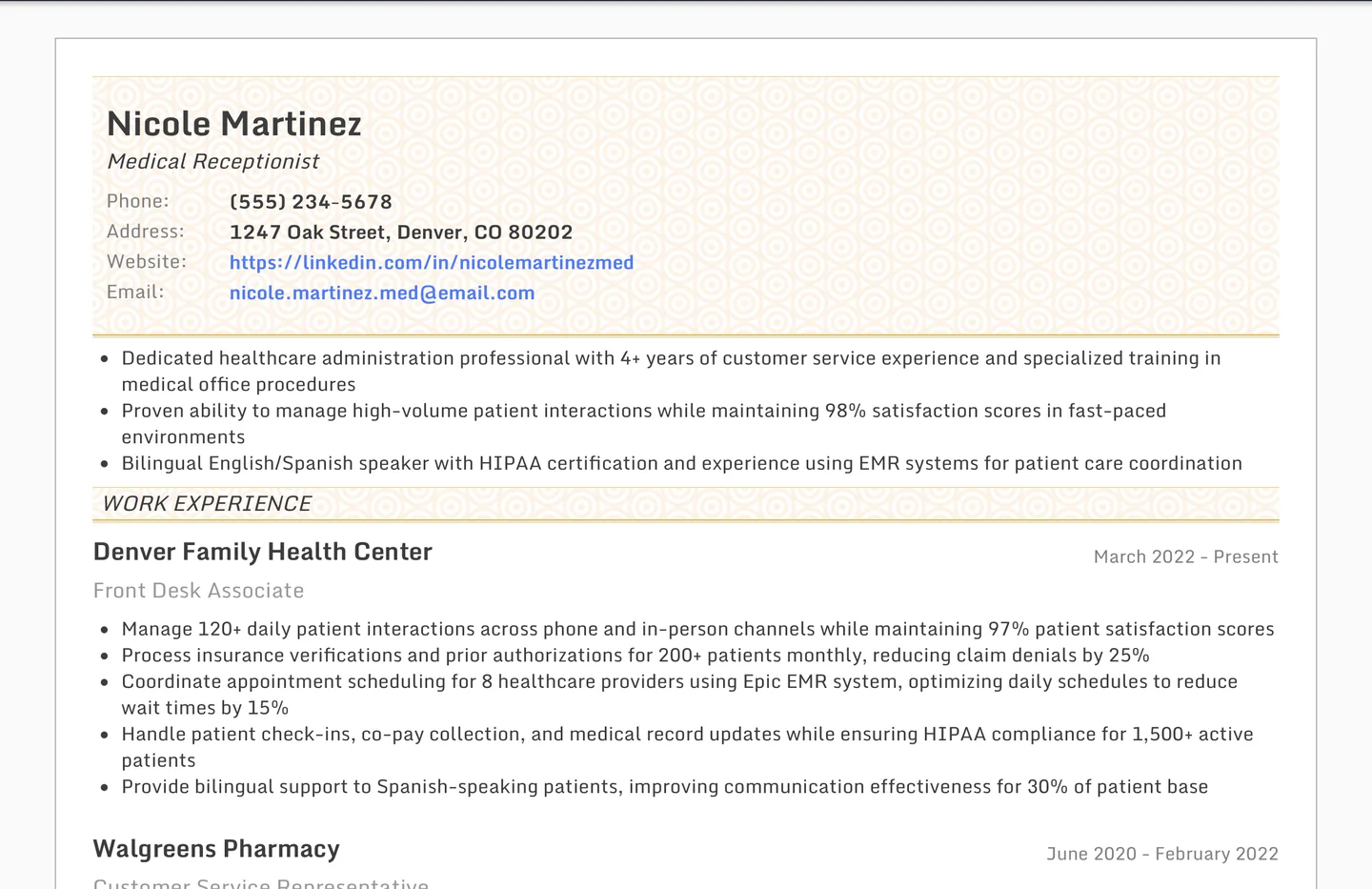
https://www.resumonk.com/medical-receptionistMedical ReceptionistResume Format to Follow for Medical Receptionist Resume
For a Medical Receptionist position, the reverse-chronological resume format is your best friend.
Think of it as the medical chart of resume formats - organized, clear, and telling your professional story from most recent to past. This format works brilliantly because medical offices value stability and progressive experience. They want to see immediately that you've handled the controlled chaos of a busy practice, not dig through paragraphs to find it.
Why Reverse-Chronological Works for Medical Receptionists
Medical practices run on precision and predictability.
When a hiring manager picks up your resume between patient calls, they need to quickly assess whether you can handle their specific brand of organized mayhem. The reverse-chronological format delivers this information like a well-organized patient file - most relevant information first, supporting details following in logical order.
Start with your contact information at the top (yes, including that professional email address, not [email protected]), followed by a crisp professional summary that captures your medical receptionist essence in 2-3 lines. Then dive straight into your work experience, starting with your current or most recent position.
Structuring Your Medical Receptionist Resume Sections
Your resume should flow in this order - Contact Information, Professional Summary, Work Experience, Skills, Education, and if relevant, Certifications. This isn't random; it's strategic.
Medical offices often have mere minutes between patients to review resumes, and this structure ensures they see your most compelling qualifications first.
If you're transitioning from retail or general administrative work into medical reception, don't panic. The reverse-chronological format still works - you'll just need to highlight transferable skills more prominently in your summary and skill descriptions. That time you managed Black Friday at the department store? That's crowd control experience. Those months handling customer complaints at the call center? That's patient de-escalation training in disguise.
For those in the UK, remember that your resume becomes a CV and typically includes a bit more detail about your educational background. Australian medical practices often appreciate a brief mention of your visa status if you're not a permanent resident, while Canadian employers might look for bilingual capabilities, especially in Quebec.
Work Experience on Medical Receptionist Resume
Here's where the rubber meets the road - or rather, where the phone meets the ear. Your work experience section isn't just a list of places you've collected paychecks; it's your opportunity to prove you can juggle flaming torches while answering phones, scheduling appointments, and explaining insurance benefits to confused patients.
Crafting Compelling Job Descriptions
Each role you list needs to tell a story of competence and growth. Start with your job title, the practice or facility name, location, and dates of employment. But here's where most Medical Receptionist resumes flatline - they list duties instead of achievements.
You didn't just "answer phones" - you managed a multi-line system while maintaining a professional demeanor during peak hours.
Let's look at how to transform mundane duties into compelling achievements:
❌ Don't write generic job duties:
Answered phones and scheduled appointments
Checked in patients
Filed medical records
✅ Do write specific achievements with context:
- Managed 100+ daily patient interactions across phone and in-person channels while maintaining 98% satisfaction scores
- Streamlined appointment scheduling process, reducing wait times by 20% and accommodating 15% more patients daily
- Digitized 500+ paper medical records using EMR system, improving retrieval time by 75%
Quantifying Your Medical Reception Impact
Numbers speak louder than adjectives in healthcare. Every medical practice tracks metrics - patient volume, wait times, no-show rates, billing accuracy. Even if you weren't formally measured on these, you can estimate. Did you handle 50 or 150 calls per day? Did you work in a practice with 2 doctors or 10?
These details paint a picture of your capacity and experience level.
For those transitioning from non-medical reception roles, focus on transferable victories. That hotel front desk experience?
Frame it around managing stressed individuals (guests become patients), handling confidential information (room charges become medical records), and coordinating with multiple departments (housekeeping becomes nursing staff).
Addressing Employment Gaps and Career Changes
Maybe you took time off to care for a family member, or perhaps you tried your hand at medical coding before realizing you missed human interaction. Address gaps honestly but briefly, focusing on any relevant activities during that time - volunteer work at health fairs, online medical terminology courses, or even managing your family's complex medical appointments.
For career changers, create a bridge between your past and future. Were you a teacher? Highlight your communication skills and ability to explain complex information simply. Retail manager? Emphasize your scheduling expertise and conflict resolution abilities.
Skills to Show on Medical Receptionist Resume
The skills section of your Medical Receptionist resume is like a Swiss Army knife - compact, but packed with exactly the tools needed for the job.
This isn't the place for fluff or generic "people person" claims. Medical practices need specific capabilities, and you need to prove you have them.
Technical Skills That Make You Stand Out
First, let's talk about the technical arsenal every Medical Receptionist needs.
Electronic Medical Records (EMR) systems are the backbone of modern medical practices. If you've used Epic, Cerner, Allscripts, or even smaller systems like Practice Fusion, name them specifically. Don't just say "computer proficient" - that's like a chef saying they can "work with food."
Medical billing and coding knowledge, even basic understanding, sets you apart. You don't need to be a Certified Professional Coder, but knowing the difference between CPT and ICD-10 codes, understanding prior authorizations, and navigating insurance verification systems are golden skills. List specific insurance providers you've worked with - dealing with Blue Cross Blue Shield versus Medicaid requires different approaches, and practices know this.
Here's how to present your technical skills effectively:
❌ Don't use vague skill descriptions:
Computer skills
Medical software experience
Insurance knowledge
Good with scheduling
✅ Do be specific and relevant:
- EMR Systems: Epic (3 years), NextGen (2 years)
- Medical Billing: Insurance verification, prior authorizations, co-pay collection
- Scheduling Software: Zocdoc integration, multi-provider calendar management
- HIPAA Compliance: Trained in privacy protocols, handled PHI for 500+ patients
Soft Skills That Truly Matter in Medical Reception
Now for the human element - because let's face it, you're often dealing with people at their worst.
They're sick, scared, confused about insurance, or frustrated about wait times. Your soft skills aren't just nice-to-haves; they're essential for practice survival.
Empathy and emotional intelligence top the list, but don't just list them. Demonstrate them through examples in your work experience. Multitasking isn't just a skill - it's your default mode. You're simultaneously checking in patients, answering phones, processing co-pays, and calming down someone who just learned their insurance doesn't cover their procedure.
Language skills deserve special mention. If you speak Spanish, Mandarin, ASL, or any other language besides English, highlight it prominently. In diverse communities, bilingual Medical Receptionists are worth their weight in gold.
Even basic medical Spanish or the ability to use interpretation services effectively is valuable.
Certifications and Continuous Learning
While Medical Receptionists don't require licenses like clinical staff, certain certifications boost your credibility. HIPAA certification, CPR/First Aid, Medical Terminology certificates, or even customer service certifications from previous roles show commitment to professional development.
If you've taken online courses in medical administration, completed modules on Coursera about healthcare systems, or attended workshops on patient communication, include them. The medical field evolves rapidly - showing you're a continuous learner suggests you'll adapt to new systems and protocols without resistance.
Specific Considerations and Tips for Medical Receptionist Resume
Now let's dive into the insider secrets - the things that make medical practice managers nod their heads and move your resume to the "interview" pile. These aren't generic resume tips; they're specific to the unique ecosystem of medical reception where HIPAA violations are nightmares and a smile can literally improve health outcomes.
Understanding the Healthcare Hierarchy and Your Place In It
Medical Receptionists occupy a unique position - you're not clinical staff, but you're far more than administrative support. Your resume needs to reflect this understanding. Avoid overstepping by claiming clinical knowledge you don't have, but don't undersell your role in patient care coordination.
You're the air traffic controller of the medical practice - you don't fly the planes, but nothing moves without your expertise.
Show that you understand the workflow of a medical practice. Mention your experience with morning huddles, your role in managing provider schedules around procedures, or how you've handled pharmaceutical representative visits.
These details signal that you understand the medical practice ecosystem, not just the reception desk.
The HIPAA Dance - Showing Privacy Prowess Without Being Paranoid
Every medical employer's biggest fear?
A HIPAA violation that brings federal scrutiny and massive fines. Your resume needs to subtly but clearly communicate that you're a vault when it comes to patient information. Don't just mention HIPAA training - demonstrate understanding through your language choices.
For instance, when describing achievements, be careful not to violate HIPAA even in your resume. Never mention specific patient names or identifying details. Instead of "Helped Mr. Smith navigate his diabetes treatment schedule," write "Coordinated complex treatment schedules for chronic care patients." This subtle difference shows you inherently understand privacy requirements.
Specialization Signals - Tailoring to Practice Types
A pediatric practice operates differently from a cardiology clinic, and your resume should reflect this understanding. If you're applying to a pediatric office, highlight experience with anxious parents, vaccination schedules, and school form management.
For specialty practices, emphasize your ability to handle complex referrals, prior authorizations, and coordination with primary care providers.
Research the specific practice before tailoring your resume. A solo practitioner values independence and initiative, while a large medical group needs someone who thrives in structured systems. Urgent care centers need speed and efficiency, while specialty practices often require more detailed patient education and follow-up coordination.
The Technology Evolution - Showing Adaptability
Medical practices are in various stages of digital transformation. Some still have paper charts in filing cabinets; others are fully digital with patient portals and telehealth integration. Your resume should indicate flexibility across this spectrum.
If you've experienced a practice's transition from paper to digital, that's gold - it shows you can handle change management while maintaining operations.
Mention any experience with telehealth coordination, especially post-2020. Include familiarity with patient portal management, online appointment scheduling, or virtual check-in processes. These modern skills show you're ready for the evolving landscape of medical reception.
Red Flags to Avoid in Medical Reception Resumes
Certain phrases or admissions can inadvertently disqualify you.
Never mention personal health information or your own medical history, even if you think it creates connection. Avoid complaining about difficult patients or providers in any context - medical practices need someone who maintains professionalism regardless of circumstances.
Be cautious about over-emphasizing medical knowledge without credentials. Saying you "diagnosed patients' needs" could raise red flags about scope of practice. Instead, focus on "identified patient service requirements" or "assessed scheduling priorities based on symptom urgency as directed by clinical staff."
Geographic and Cultural Considerations
Different regions have different medical cultures.
In the United States, understanding insurance complexities is crucial. Canadian Medical Receptionists should emphasize experience with provincial health systems. UK-based candidates should highlight NHS experience if applicable, while Australian medical receptionists might emphasize bulk billing knowledge.
Urban practices often see higher volume and diversity, while rural practices value community connection and versatility. If you're applying to a practice in a culturally specific neighborhood, relevant language skills or cultural competency becomes even more valuable.
A Medical Receptionist in Miami's Little Havana who speaks Spanish isn't just helpful - they're essential.
Education Requirements for Medical Receptionist Resume
The medical receptionist role sits at that interesting intersection where healthcare meets administration. Unlike clinical positions that require specific certifications, this front-desk position often welcomes candidates from diverse educational backgrounds.
Whether you have a high school diploma with some relevant coursework or an associate degree in health administration, what matters most is how you present what you've learned.
Essential Education Components to Highlight
Start with your highest level of education and work backward - that's the reverse-chronological format that hiring managers expect. But here's where it gets interesting for medical receptionists - you want to emphasize any coursework or training that relates to healthcare administration, medical terminology, or office management, even if it wasn't part of a formal degree program.
Let's say you took a single medical terminology course at your community college while working retail. That's gold for your resume. Or perhaps you completed an online certification in HIPAA compliance during the pandemic - absolutely include that. These educational snippets show initiative and industry-specific knowledge that set you apart from someone applying with generic administrative experience.
❌ Don't list education without context:
High School Diploma
Lincoln High School, 2021
✅ Do include relevant coursework and achievements:
High School Diploma - June 2021 | Lincoln High School, Chicago, IL
- Relevant Coursework: Business Communications, Computer Applications
- Honor Roll Student (3.8 GPA)
Certifications and Short Courses That Make a Difference
The beauty of applying for medical receptionist positions is that many valuable certifications can be obtained quickly and affordably.
Think about it - you're sitting at home, maybe working a part-time job, and you can complete a Medical Office Administration certificate online in just a few weeks. These focused educational experiences demonstrate commitment to the healthcare field without requiring years of study.
Include any healthcare-related training, even if it seems tangential. CPR certification? List it. A weekend workshop on medical billing basics? Include it. That free online course on patient privacy laws? Absolutely mention it. Each educational element builds your credibility as someone serious about working in healthcare administration.
❌ Don't undervalue short courses:
Some online courses in medical stuff
✅ Do specify and give proper credit to your learning:
Certificate in Medical Office Procedures - March 2023 | Community College of Denver (Online Program)
- 40-hour comprehensive program covering appointment scheduling, insurance verification, and medical records management
Regional Variations in Educational Requirements
In the United States, most medical receptionist positions require a high school diploma or GED as the minimum. However, practices in urban areas or specialized medical facilities might prefer candidates with post-secondary education. Canadian employers often look favorably upon graduates from Medical Office Assistant programs offered at career colleges.
In the UK, you'll find that NVQ Level 2 in Business Administration or similar qualifications carry weight, while Australian employers might seek candidates with a Certificate III in Business Administration (Medical).
The key insight here? Research your local market. A medical receptionist position at a small family practice in rural Missouri has different educational expectations than one at a prestigious dermatology clinic in Manhattan.
Tailor your education section accordingly, emphasizing the credentials that matter most in your specific context.
Showcasing Awards and Achievements on Your Medical Receptionist Resume
Medical receptionists occupy a unique position where soft skills often matter more than technical achievements. You're the first voice patients hear when they're anxious about their health, the problem-solver when insurance issues arise, and the coordinator keeping the entire office flowing smoothly.
Awards and recognitions that highlight these capabilities are incredibly relevant, even if they come from non-medical settings.
Types of Awards That Resonate with Healthcare Employers
Think about the core competencies of a medical receptionist - organization, empathy, reliability, and grace under pressure.
Any award or recognition that demonstrates these qualities deserves a place on your resume. Perhaps you received a certificate of appreciation for perfect attendance at your previous job - that shows the reliability crucial for maintaining consistent front desk coverage.
Maybe you were recognized for implementing a new filing system at your church office - that demonstrates the organizational innovation medical practices value.
❌ Don't dismiss non-medical recognitions:
Various awards from previous jobs
✅ Do connect achievements to medical receptionist skills:
Customer Service Excellence Award - June 2022 - Walmart Store #2341, Springfield, MO
- Recognized for maintaining 98% customer satisfaction scores while handling 50+ customer interactions daily
- Selected from team of 30 associates for exceptional conflict resolution skills
Academic and Training Achievements Worth Highlighting
Remember that completing a medical terminology course with distinction is an achievement worth noting.
If you graduated from your Medical Office Assistant program at the top of your class, that's not just education - it's an award. These academic accomplishments show dedication to learning the specific skills needed in medical administration.
Don't overlook smaller recognitions either. Were you selected to be a peer mentor in your office skills class? Did you receive a certificate of completion for mastering electronic health records software in record time? These achievements, while not traditional awards, demonstrate your capacity to excel in the technical aspects of medical reception work.
Presenting Community Recognition and Volunteer Achievements
Healthcare is fundamentally about serving the community, and medical practices appreciate receptionists who embody this service mindset. If you've been recognized for volunteer work - whether organizing blood drives, coordinating church events, or helping at health fairs - these achievements directly relate to the community-oriented nature of medical reception work.
❌ Don't hide volunteer recognitions:
Some volunteer work
✅ Do highlight community service achievements:
Volunteer Coordinator Recognition - September 2023 - Red Cross Blood Drive Campaign, Local Chapter
- Organized quarterly blood drives resulting in 200+ units collected
- Awarded for exceptional organizational skills and community outreach effectiveness
Strategic Approach to References for Medical Receptionist Applications
The traditional "References available upon request" line is outdated, particularly for medical receptionist positions where trust is paramount.
Modern medical practices often want to move quickly on strong candidates, and having your references ready shows you're serious and prepared. Plus, in healthcare settings where background checks are standard, being proactive with references demonstrates transparency.
Selecting References Who Can Speak to Medical Reception Competencies
Your reference selection strategy should focus on people who can vouch for skills directly applicable to medical reception work.
That retail supervisor who watched you de-escalate situations with upset customers? Perfect. The office manager from your volunteer position who saw you maintain confidentiality with sensitive information? Ideal. Even a professor who observed your attention to detail in medical terminology class can provide valuable validation.
Avoid the temptation to list only friends or family members, even if they work in healthcare. Professional references carry more weight, even if they're from non-medical settings. A restaurant manager who can attest to your ability to multitask during busy periods provides more relevant insight than your aunt who happens to be a nurse but has never supervised your work.
❌ Don't list references without context:
References:
John Smith - 555-0123
Jane Doe - 555-0456
Bob Johnson - 555-0789
✅ Do provide complete, professional reference listings:
Professional References:

Sarah Martinez, Store Manager
Target Store #1234, Denver, CO
Phone: (303) 555-0123
Email: [email protected]
Relationship: Direct Supervisor (2021-2023)
Can verify: Customer service excellence, cash handling, schedule coordination

Michael Chen, Office Administrator
Grace Community Church, Denver, CO
Phone: (303) 555-0456
Email: [email protected]
Relationship: Volunteer Coordinator (2022-Present)
Can verify: Database management, event coordination, confidentiality practices
Preparing Your References for Healthcare-Specific Questions
Once you've selected your references, prepare them for the unique questions medical practices might ask. Healthcare employers often inquire about your ability to maintain confidentiality, handle stressful situations, and work with diverse populations.
Brief your references on the specific medical receptionist position so they can tailor their responses accordingly.
Send your references a quick email outlining the position, the key requirements, and specific examples they might mention. For instance, remind your former supervisor about the time you caught a billing error that saved the company money - this translates directly to the attention to detail needed for insurance verification in medical settings.
Managing References When Transitioning into Healthcare
If you're new to healthcare, acknowledge this transition in how you present your references. Consider including one reference who can speak to your learning ability and adaptability.
Maybe it's an instructor from a recent medical administration course or someone who observed you quickly master new systems in a previous role.
For those with gaps in employment or limited work history, consider including a character reference from someone in the medical field who knows you personally but can speak professionally about your qualities. A family doctor who has observed your organizational skills as you've coordinated care for an elderly parent, for example, can provide unique insight into your suitability for medical reception work.
International Variations in Reference Expectations
Reference expectations vary significantly by country.
In the United States, three professional references are standard, and employers typically contact them after the interview stage. Canadian medical offices often expect references to include at least one direct supervisor and may check references earlier in the process. UK employers frequently request written references before the interview and may specify they want your current or most recent employer included. Australian medical practices often use referee checks as a formal part of the selection process and may require specific referee report forms to be completed.
Remember that medical receptionist positions, while entry-level, involve significant responsibility for patient care coordination and practice efficiency. Your references serve as testimonials that you can be trusted with these crucial duties.
Choose them wisely, prepare them thoroughly, and present them professionally to maximize your chances of landing that medical receptionist position you're pursuing.
Crafting an Effective Cover Letter for Your Medical Receptionist Application
Many medical receptionist applicants make the mistake of simply repeating their resume in paragraph form. But consider this - the office manager reading your application probably sees dozens of resumes listing "excellent communication skills" and "proficiency in scheduling software."
Your cover letter is where you prove these claims through specific stories and demonstrate your understanding of what makes medical reception different from general administrative work.
Opening Your Cover Letter with Healthcare-Specific Context
Start by showing you understand the unique demands of medical reception.
Maybe you mention how your experience calming anxious customers in retail directly translates to reassuring nervous patients. Or perhaps you describe a moment when you helped an elderly relative navigate their medical appointments, giving you firsthand insight into the patience and clarity patients need from medical receptionists.
❌ Don't use generic openings:
Dear Hiring Manager,
I am writing to apply for the Medical Receptionist position at your office.
I have good communication skills and am detail-oriented.
✅ Do create a connection to healthcare immediately:
Dear Dr. Patterson,
When I helped my grandmother schedule her specialty appointments last year,
I experienced firsthand how a compassionate and organized medical receptionist can transform a stressful healthcare experience into a manageable one. This personal experience, combined with my three years in customer service, has prepared me to excel as your practice's next medical receptionist.
Demonstrating Your Understanding of Medical Office Dynamics
The middle section of your cover letter should show that you grasp the multi-faceted nature of medical reception work. You're not just answering phones - you're triaging patient concerns, managing provider schedules, navigating insurance protocols, and maintaining HIPAA compliance all while projecting calm professionalism.
Use specific examples that show you understand these various responsibilities.
Perhaps you managed conflicting priorities in your previous role, or you learned to maintain confidentiality while working with sensitive information. Maybe you've dealt with upset customers and can translate that to handling anxious patients. These real-world parallels make your application memorable and credible.
Closing with Specific Value Proposition
End your cover letter by articulating exactly what you bring to this specific practice.
Research the medical office - are they a busy pediatric practice that needs someone comfortable with anxious parents? A specialty clinic requiring someone detail-oriented enough to manage complex referrals? Tailor your closing to show you've thought about their specific needs.
❌ Don't use weak, generic closings:
I hope to hear from you soon about this position.
Thank you for your consideration.
✅ Do close with confidence and specificity:
I'm excited about the opportunity to bring my bilingual skills and experience with high-volume customer service to your diverse patient population. I'm available for an interview at your convenience and look forward to discussing how I can contribute to maintaining the warm, efficient environment your practice is known for.
Regional Considerations for Cover Letters
In the United States, keep your cover letter to one page and focus on how you'll solve the practice's problems.
Canadian employers often appreciate a slightly more formal tone and specific mention of relevant healthcare regulations you understand. UK medical practices typically expect a more structured approach with clear paragraphs addressing specific selection criteria. Australian medical reception applications often require you to address key selection criteria directly, sometimes in a separate document.
Key Takeaways
- Use the reverse-chronological format - Present your most recent experience first, as medical practices value progressive experience and need to quickly assess your current skill level
- Quantify your achievements - Transform duties into accomplishments by adding numbers (patient volume, phone calls handled, satisfaction scores) to demonstrate your capacity
- Highlight healthcare-specific technical skills - Name specific EMR systems, insurance providers, and medical software rather than using generic terms like "computer proficient"
- Emphasize both technical and soft skills - Balance your EMR expertise with emotional intelligence, showing you can handle both the systems and the stressed patients
- Include relevant education and certifications - List any medical terminology courses, HIPAA training, or healthcare administration certificates, even if obtained online
- Tailor to practice type - Adjust your resume focus based on whether you're applying to pediatric, specialty, urgent care, or general practices
- Show HIPAA awareness subtly - Demonstrate privacy understanding through your language choices without overemphasizing it
- Address career transitions strategically - Frame non-medical experience through a healthcare lens, showing how retail or hospitality skills transfer to patient care
- Prepare strong, relevant references - Choose references who can speak to skills directly applicable to medical reception, even if from non-healthcare settings
- Craft a compelling cover letter - Tell the story your resume can't, showing genuine understanding of medical office dynamics and patient care coordination
Ready to create your standout Medical Receptionist resume? Resumonk makes it simple with professionally designed templates that capture the perfect balance of healthcare professionalism and approachability. Our AI-powered suggestions help you articulate your experience in ways that resonate with medical practices, while our intuitive builder ensures your resume maintains the clean, organized appearance that healthcare employers expect. Whether you're transitioning from another field or advancing your medical administration career, Resumonk provides the tools to present yourself as the capable, compassionate professional medical practices need at their front desk.
Start building your Medical Receptionist resume today with Resumonk's intelligent resume builder.
Get started with Resumonk now and transform your experience into the professional Medical Receptionist resume that opens doors to your healthcare career.
More Healthcare Support resume examples
- Phlebotomist resume example
- Medical Assistant resume example
- Caregiver resume example
- Radiology Technician resume example
See all Healthcare Support resume examples, or browse every category.
Resume writing tips
Picture yourself walking into a medical office on a Monday morning. The phones are already ringing, patients are checking in for their 8 AM appointments, and somewhere between verifying insurance and calming a nervous first-time patient, you realize - this is where healthcare actually begins. Not in the exam room, but right here at the front desk where you're orchestrating the entire symphony of a medical practice. You're ready to be that vital first point of contact, but your resume feels like it's missing that professional polish that says "I belong in healthcare."
As a Medical Receptionist, you're applying for a role that sits at the fascinating intersection of healthcare administration and customer service. Maybe you're transitioning from retail where you've mastered the art of managing difficult customers, or perhaps you're fresh out of high school with a natural ability to stay calm under pressure. Either way, you need a resume that speaks the language of medical practices - one that shows you understand the unique blend of empathy, efficiency, and discretion this role demands.
In this comprehensive guide, we'll walk you through creating a Medical Receptionist resume that gets noticed for all the right reasons. We'll start with choosing the perfect resume format - specifically the reverse-chronological layout that medical practices prefer - then dive deep into crafting compelling work experience descriptions that transform everyday tasks into meaningful achievements. You'll learn which technical and soft skills to highlight, from EMR systems to emotional intelligence, and how to present your education and certifications in ways that resonate with healthcare employers.
We'll also cover the nuances that many overlook - understanding your place in the healthcare hierarchy, demonstrating HIPAA awareness without overdoing it, and tailoring your application to different practice types, whether it's a bustling pediatric clinic or a specialized cardiology office. Plus, we'll guide you through writing a cover letter that brings your resume to life and selecting references who can vouch for your healthcare readiness. By the end, you'll have all the tools to create a Medical Receptionist resume that opens doors - quite literally - to your career in healthcare administration.
The Best Medical Receptionist Resume Example/Sample
https://www.resumonk.com/medical-receptionistMedical ReceptionistResume Format to Follow for Medical Receptionist Resume
For a Medical Receptionist position, the reverse-chronological resume format is your best friend.
Think of it as the medical chart of resume formats - organized, clear, and telling your professional story from most recent to past. This format works brilliantly because medical offices value stability and progressive experience. They want to see immediately that you've handled the controlled chaos of a busy practice, not dig through paragraphs to find it.
Why Reverse-Chronological Works for Medical Receptionists
Medical practices run on precision and predictability.
When a hiring manager picks up your resume between patient calls, they need to quickly assess whether you can handle their specific brand of organized mayhem. The reverse-chronological format delivers this information like a well-organized patient file - most relevant information first, supporting details following in logical order.
Start with your contact information at the top (yes, including that professional email address, not [email protected]), followed by a crisp professional summary that captures your medical receptionist essence in 2-3 lines. Then dive straight into your work experience, starting with your current or most recent position.
Structuring Your Medical Receptionist Resume Sections
Your resume should flow in this order - Contact Information, Professional Summary, Work Experience, Skills, Education, and if relevant, Certifications. This isn't random; it's strategic.
Medical offices often have mere minutes between patients to review resumes, and this structure ensures they see your most compelling qualifications first.
If you're transitioning from retail or general administrative work into medical reception, don't panic. The reverse-chronological format still works - you'll just need to highlight transferable skills more prominently in your summary and skill descriptions. That time you managed Black Friday at the department store? That's crowd control experience. Those months handling customer complaints at the call center? That's patient de-escalation training in disguise.
For those in the UK, remember that your resume becomes a CV and typically includes a bit more detail about your educational background. Australian medical practices often appreciate a brief mention of your visa status if you're not a permanent resident, while Canadian employers might look for bilingual capabilities, especially in Quebec.
Work Experience on Medical Receptionist Resume
Here's where the rubber meets the road - or rather, where the phone meets the ear. Your work experience section isn't just a list of places you've collected paychecks; it's your opportunity to prove you can juggle flaming torches while answering phones, scheduling appointments, and explaining insurance benefits to confused patients.
Crafting Compelling Job Descriptions
Each role you list needs to tell a story of competence and growth. Start with your job title, the practice or facility name, location, and dates of employment. But here's where most Medical Receptionist resumes flatline - they list duties instead of achievements.
You didn't just "answer phones" - you managed a multi-line system while maintaining a professional demeanor during peak hours.
Let's look at how to transform mundane duties into compelling achievements:
❌ Don't write generic job duties:
Answered phones and scheduled appointments
Checked in patients
Filed medical records
✅ Do write specific achievements with context:
- Managed 100+ daily patient interactions across phone and in-person channels while maintaining 98% satisfaction scores
- Streamlined appointment scheduling process, reducing wait times by 20% and accommodating 15% more patients daily
- Digitized 500+ paper medical records using EMR system, improving retrieval time by 75%
Quantifying Your Medical Reception Impact
Numbers speak louder than adjectives in healthcare. Every medical practice tracks metrics - patient volume, wait times, no-show rates, billing accuracy. Even if you weren't formally measured on these, you can estimate. Did you handle 50 or 150 calls per day? Did you work in a practice with 2 doctors or 10?
These details paint a picture of your capacity and experience level.
For those transitioning from non-medical reception roles, focus on transferable victories. That hotel front desk experience?
Frame it around managing stressed individuals (guests become patients), handling confidential information (room charges become medical records), and coordinating with multiple departments (housekeeping becomes nursing staff).
Addressing Employment Gaps and Career Changes
Maybe you took time off to care for a family member, or perhaps you tried your hand at medical coding before realizing you missed human interaction. Address gaps honestly but briefly, focusing on any relevant activities during that time - volunteer work at health fairs, online medical terminology courses, or even managing your family's complex medical appointments.
For career changers, create a bridge between your past and future. Were you a teacher? Highlight your communication skills and ability to explain complex information simply. Retail manager? Emphasize your scheduling expertise and conflict resolution abilities.
Skills to Show on Medical Receptionist Resume
The skills section of your Medical Receptionist resume is like a Swiss Army knife - compact, but packed with exactly the tools needed for the job.
This isn't the place for fluff or generic "people person" claims. Medical practices need specific capabilities, and you need to prove you have them.
Technical Skills That Make You Stand Out
First, let's talk about the technical arsenal every Medical Receptionist needs.
Electronic Medical Records (EMR) systems are the backbone of modern medical practices. If you've used Epic, Cerner, Allscripts, or even smaller systems like Practice Fusion, name them specifically. Don't just say "computer proficient" - that's like a chef saying they can "work with food."
Medical billing and coding knowledge, even basic understanding, sets you apart. You don't need to be a Certified Professional Coder, but knowing the difference between CPT and ICD-10 codes, understanding prior authorizations, and navigating insurance verification systems are golden skills. List specific insurance providers you've worked with - dealing with Blue Cross Blue Shield versus Medicaid requires different approaches, and practices know this.
Here's how to present your technical skills effectively:
❌ Don't use vague skill descriptions:
Computer skills
Medical software experience
Insurance knowledge
Good with scheduling
✅ Do be specific and relevant:
- EMR Systems: Epic (3 years), NextGen (2 years)
- Medical Billing: Insurance verification, prior authorizations, co-pay collection
- Scheduling Software: Zocdoc integration, multi-provider calendar management
- HIPAA Compliance: Trained in privacy protocols, handled PHI for 500+ patients
Soft Skills That Truly Matter in Medical Reception
Now for the human element - because let's face it, you're often dealing with people at their worst.
They're sick, scared, confused about insurance, or frustrated about wait times. Your soft skills aren't just nice-to-haves; they're essential for practice survival.
Empathy and emotional intelligence top the list, but don't just list them. Demonstrate them through examples in your work experience. Multitasking isn't just a skill - it's your default mode. You're simultaneously checking in patients, answering phones, processing co-pays, and calming down someone who just learned their insurance doesn't cover their procedure.
Language skills deserve special mention. If you speak Spanish, Mandarin, ASL, or any other language besides English, highlight it prominently. In diverse communities, bilingual Medical Receptionists are worth their weight in gold.
Even basic medical Spanish or the ability to use interpretation services effectively is valuable.
Certifications and Continuous Learning
While Medical Receptionists don't require licenses like clinical staff, certain certifications boost your credibility. HIPAA certification, CPR/First Aid, Medical Terminology certificates, or even customer service certifications from previous roles show commitment to professional development.
If you've taken online courses in medical administration, completed modules on Coursera about healthcare systems, or attended workshops on patient communication, include them. The medical field evolves rapidly - showing you're a continuous learner suggests you'll adapt to new systems and protocols without resistance.
Specific Considerations and Tips for Medical Receptionist Resume
Now let's dive into the insider secrets - the things that make medical practice managers nod their heads and move your resume to the "interview" pile. These aren't generic resume tips; they're specific to the unique ecosystem of medical reception where HIPAA violations are nightmares and a smile can literally improve health outcomes.
Understanding the Healthcare Hierarchy and Your Place In It
Medical Receptionists occupy a unique position - you're not clinical staff, but you're far more than administrative support. Your resume needs to reflect this understanding. Avoid overstepping by claiming clinical knowledge you don't have, but don't undersell your role in patient care coordination.
You're the air traffic controller of the medical practice - you don't fly the planes, but nothing moves without your expertise.
Show that you understand the workflow of a medical practice. Mention your experience with morning huddles, your role in managing provider schedules around procedures, or how you've handled pharmaceutical representative visits.
These details signal that you understand the medical practice ecosystem, not just the reception desk.
The HIPAA Dance - Showing Privacy Prowess Without Being Paranoid
Every medical employer's biggest fear?
A HIPAA violation that brings federal scrutiny and massive fines. Your resume needs to subtly but clearly communicate that you're a vault when it comes to patient information. Don't just mention HIPAA training - demonstrate understanding through your language choices.
For instance, when describing achievements, be careful not to violate HIPAA even in your resume. Never mention specific patient names or identifying details. Instead of "Helped Mr. Smith navigate his diabetes treatment schedule," write "Coordinated complex treatment schedules for chronic care patients." This subtle difference shows you inherently understand privacy requirements.
Specialization Signals - Tailoring to Practice Types
A pediatric practice operates differently from a cardiology clinic, and your resume should reflect this understanding. If you're applying to a pediatric office, highlight experience with anxious parents, vaccination schedules, and school form management.
For specialty practices, emphasize your ability to handle complex referrals, prior authorizations, and coordination with primary care providers.
Research the specific practice before tailoring your resume. A solo practitioner values independence and initiative, while a large medical group needs someone who thrives in structured systems. Urgent care centers need speed and efficiency, while specialty practices often require more detailed patient education and follow-up coordination.
The Technology Evolution - Showing Adaptability
Medical practices are in various stages of digital transformation. Some still have paper charts in filing cabinets; others are fully digital with patient portals and telehealth integration. Your resume should indicate flexibility across this spectrum.
If you've experienced a practice's transition from paper to digital, that's gold - it shows you can handle change management while maintaining operations.
Mention any experience with telehealth coordination, especially post-2020. Include familiarity with patient portal management, online appointment scheduling, or virtual check-in processes. These modern skills show you're ready for the evolving landscape of medical reception.
Red Flags to Avoid in Medical Reception Resumes
Certain phrases or admissions can inadvertently disqualify you.
Never mention personal health information or your own medical history, even if you think it creates connection. Avoid complaining about difficult patients or providers in any context - medical practices need someone who maintains professionalism regardless of circumstances.
Be cautious about over-emphasizing medical knowledge without credentials. Saying you "diagnosed patients' needs" could raise red flags about scope of practice. Instead, focus on "identified patient service requirements" or "assessed scheduling priorities based on symptom urgency as directed by clinical staff."
Geographic and Cultural Considerations
Different regions have different medical cultures.
In the United States, understanding insurance complexities is crucial. Canadian Medical Receptionists should emphasize experience with provincial health systems. UK-based candidates should highlight NHS experience if applicable, while Australian medical receptionists might emphasize bulk billing knowledge.
Urban practices often see higher volume and diversity, while rural practices value community connection and versatility. If you're applying to a practice in a culturally specific neighborhood, relevant language skills or cultural competency becomes even more valuable.
A Medical Receptionist in Miami's Little Havana who speaks Spanish isn't just helpful - they're essential.
Education Requirements for Medical Receptionist Resume
The medical receptionist role sits at that interesting intersection where healthcare meets administration. Unlike clinical positions that require specific certifications, this front-desk position often welcomes candidates from diverse educational backgrounds.
Whether you have a high school diploma with some relevant coursework or an associate degree in health administration, what matters most is how you present what you've learned.
Essential Education Components to Highlight
Start with your highest level of education and work backward - that's the reverse-chronological format that hiring managers expect. But here's where it gets interesting for medical receptionists - you want to emphasize any coursework or training that relates to healthcare administration, medical terminology, or office management, even if it wasn't part of a formal degree program.
Let's say you took a single medical terminology course at your community college while working retail. That's gold for your resume. Or perhaps you completed an online certification in HIPAA compliance during the pandemic - absolutely include that. These educational snippets show initiative and industry-specific knowledge that set you apart from someone applying with generic administrative experience.
❌ Don't list education without context:
High School Diploma
Lincoln High School, 2021
✅ Do include relevant coursework and achievements:
High School Diploma - June 2021 | Lincoln High School, Chicago, IL
- Relevant Coursework: Business Communications, Computer Applications
- Honor Roll Student (3.8 GPA)
Certifications and Short Courses That Make a Difference
The beauty of applying for medical receptionist positions is that many valuable certifications can be obtained quickly and affordably.
Think about it - you're sitting at home, maybe working a part-time job, and you can complete a Medical Office Administration certificate online in just a few weeks. These focused educational experiences demonstrate commitment to the healthcare field without requiring years of study.
Include any healthcare-related training, even if it seems tangential. CPR certification? List it. A weekend workshop on medical billing basics? Include it. That free online course on patient privacy laws? Absolutely mention it. Each educational element builds your credibility as someone serious about working in healthcare administration.
❌ Don't undervalue short courses:
Some online courses in medical stuff
✅ Do specify and give proper credit to your learning:
Certificate in Medical Office Procedures - March 2023 | Community College of Denver (Online Program)
- 40-hour comprehensive program covering appointment scheduling, insurance verification, and medical records management
Regional Variations in Educational Requirements
In the United States, most medical receptionist positions require a high school diploma or GED as the minimum. However, practices in urban areas or specialized medical facilities might prefer candidates with post-secondary education. Canadian employers often look favorably upon graduates from Medical Office Assistant programs offered at career colleges.
In the UK, you'll find that NVQ Level 2 in Business Administration or similar qualifications carry weight, while Australian employers might seek candidates with a Certificate III in Business Administration (Medical).
The key insight here? Research your local market. A medical receptionist position at a small family practice in rural Missouri has different educational expectations than one at a prestigious dermatology clinic in Manhattan.
Tailor your education section accordingly, emphasizing the credentials that matter most in your specific context.
Showcasing Awards and Achievements on Your Medical Receptionist Resume
Medical receptionists occupy a unique position where soft skills often matter more than technical achievements. You're the first voice patients hear when they're anxious about their health, the problem-solver when insurance issues arise, and the coordinator keeping the entire office flowing smoothly.
Awards and recognitions that highlight these capabilities are incredibly relevant, even if they come from non-medical settings.
Types of Awards That Resonate with Healthcare Employers
Think about the core competencies of a medical receptionist - organization, empathy, reliability, and grace under pressure.
Any award or recognition that demonstrates these qualities deserves a place on your resume. Perhaps you received a certificate of appreciation for perfect attendance at your previous job - that shows the reliability crucial for maintaining consistent front desk coverage.
Maybe you were recognized for implementing a new filing system at your church office - that demonstrates the organizational innovation medical practices value.
❌ Don't dismiss non-medical recognitions:
Various awards from previous jobs
✅ Do connect achievements to medical receptionist skills:
Customer Service Excellence Award - June 2022 - Walmart Store #2341, Springfield, MO
- Recognized for maintaining 98% customer satisfaction scores while handling 50+ customer interactions daily
- Selected from team of 30 associates for exceptional conflict resolution skills
Academic and Training Achievements Worth Highlighting
Remember that completing a medical terminology course with distinction is an achievement worth noting.
If you graduated from your Medical Office Assistant program at the top of your class, that's not just education - it's an award. These academic accomplishments show dedication to learning the specific skills needed in medical administration.
Don't overlook smaller recognitions either. Were you selected to be a peer mentor in your office skills class? Did you receive a certificate of completion for mastering electronic health records software in record time? These achievements, while not traditional awards, demonstrate your capacity to excel in the technical aspects of medical reception work.
Presenting Community Recognition and Volunteer Achievements
Healthcare is fundamentally about serving the community, and medical practices appreciate receptionists who embody this service mindset. If you've been recognized for volunteer work - whether organizing blood drives, coordinating church events, or helping at health fairs - these achievements directly relate to the community-oriented nature of medical reception work.
❌ Don't hide volunteer recognitions:
Some volunteer work
✅ Do highlight community service achievements:
Volunteer Coordinator Recognition - September 2023 - Red Cross Blood Drive Campaign, Local Chapter
- Organized quarterly blood drives resulting in 200+ units collected
- Awarded for exceptional organizational skills and community outreach effectiveness
Strategic Approach to References for Medical Receptionist Applications
The traditional "References available upon request" line is outdated, particularly for medical receptionist positions where trust is paramount.
Modern medical practices often want to move quickly on strong candidates, and having your references ready shows you're serious and prepared. Plus, in healthcare settings where background checks are standard, being proactive with references demonstrates transparency.
Selecting References Who Can Speak to Medical Reception Competencies
Your reference selection strategy should focus on people who can vouch for skills directly applicable to medical reception work.
That retail supervisor who watched you de-escalate situations with upset customers? Perfect. The office manager from your volunteer position who saw you maintain confidentiality with sensitive information? Ideal. Even a professor who observed your attention to detail in medical terminology class can provide valuable validation.
Avoid the temptation to list only friends or family members, even if they work in healthcare. Professional references carry more weight, even if they're from non-medical settings. A restaurant manager who can attest to your ability to multitask during busy periods provides more relevant insight than your aunt who happens to be a nurse but has never supervised your work.
❌ Don't list references without context:
References:
John Smith - 555-0123
Jane Doe - 555-0456
Bob Johnson - 555-0789
✅ Do provide complete, professional reference listings:
Professional References:

Sarah Martinez, Store Manager
Target Store #1234, Denver, CO
Phone: (303) 555-0123
Email: [email protected]
Relationship: Direct Supervisor (2021-2023)
Can verify: Customer service excellence, cash handling, schedule coordination

Michael Chen, Office Administrator
Grace Community Church, Denver, CO
Phone: (303) 555-0456
Email: [email protected]
Relationship: Volunteer Coordinator (2022-Present)
Can verify: Database management, event coordination, confidentiality practices
Preparing Your References for Healthcare-Specific Questions
Once you've selected your references, prepare them for the unique questions medical practices might ask. Healthcare employers often inquire about your ability to maintain confidentiality, handle stressful situations, and work with diverse populations.
Brief your references on the specific medical receptionist position so they can tailor their responses accordingly.
Send your references a quick email outlining the position, the key requirements, and specific examples they might mention. For instance, remind your former supervisor about the time you caught a billing error that saved the company money - this translates directly to the attention to detail needed for insurance verification in medical settings.
Managing References When Transitioning into Healthcare
If you're new to healthcare, acknowledge this transition in how you present your references. Consider including one reference who can speak to your learning ability and adaptability.
Maybe it's an instructor from a recent medical administration course or someone who observed you quickly master new systems in a previous role.
For those with gaps in employment or limited work history, consider including a character reference from someone in the medical field who knows you personally but can speak professionally about your qualities. A family doctor who has observed your organizational skills as you've coordinated care for an elderly parent, for example, can provide unique insight into your suitability for medical reception work.
International Variations in Reference Expectations
Reference expectations vary significantly by country.
In the United States, three professional references are standard, and employers typically contact them after the interview stage. Canadian medical offices often expect references to include at least one direct supervisor and may check references earlier in the process. UK employers frequently request written references before the interview and may specify they want your current or most recent employer included. Australian medical practices often use referee checks as a formal part of the selection process and may require specific referee report forms to be completed.
Remember that medical receptionist positions, while entry-level, involve significant responsibility for patient care coordination and practice efficiency. Your references serve as testimonials that you can be trusted with these crucial duties.
Choose them wisely, prepare them thoroughly, and present them professionally to maximize your chances of landing that medical receptionist position you're pursuing.
Crafting an Effective Cover Letter for Your Medical Receptionist Application
Many medical receptionist applicants make the mistake of simply repeating their resume in paragraph form. But consider this - the office manager reading your application probably sees dozens of resumes listing "excellent communication skills" and "proficiency in scheduling software."
Your cover letter is where you prove these claims through specific stories and demonstrate your understanding of what makes medical reception different from general administrative work.
Opening Your Cover Letter with Healthcare-Specific Context
Start by showing you understand the unique demands of medical reception.
Maybe you mention how your experience calming anxious customers in retail directly translates to reassuring nervous patients. Or perhaps you describe a moment when you helped an elderly relative navigate their medical appointments, giving you firsthand insight into the patience and clarity patients need from medical receptionists.
❌ Don't use generic openings:
Dear Hiring Manager,
I am writing to apply for the Medical Receptionist position at your office.
I have good communication skills and am detail-oriented.
✅ Do create a connection to healthcare immediately:
Dear Dr. Patterson,
When I helped my grandmother schedule her specialty appointments last year,
I experienced firsthand how a compassionate and organized medical receptionist can transform a stressful healthcare experience into a manageable one. This personal experience, combined with my three years in customer service, has prepared me to excel as your practice's next medical receptionist.
Demonstrating Your Understanding of Medical Office Dynamics
The middle section of your cover letter should show that you grasp the multi-faceted nature of medical reception work. You're not just answering phones - you're triaging patient concerns, managing provider schedules, navigating insurance protocols, and maintaining HIPAA compliance all while projecting calm professionalism.
Use specific examples that show you understand these various responsibilities.
Perhaps you managed conflicting priorities in your previous role, or you learned to maintain confidentiality while working with sensitive information. Maybe you've dealt with upset customers and can translate that to handling anxious patients. These real-world parallels make your application memorable and credible.
Closing with Specific Value Proposition
End your cover letter by articulating exactly what you bring to this specific practice.
Research the medical office - are they a busy pediatric practice that needs someone comfortable with anxious parents? A specialty clinic requiring someone detail-oriented enough to manage complex referrals? Tailor your closing to show you've thought about their specific needs.
❌ Don't use weak, generic closings:
I hope to hear from you soon about this position.
Thank you for your consideration.
✅ Do close with confidence and specificity:
I'm excited about the opportunity to bring my bilingual skills and experience with high-volume customer service to your diverse patient population. I'm available for an interview at your convenience and look forward to discussing how I can contribute to maintaining the warm, efficient environment your practice is known for.
Regional Considerations for Cover Letters
In the United States, keep your cover letter to one page and focus on how you'll solve the practice's problems.
Canadian employers often appreciate a slightly more formal tone and specific mention of relevant healthcare regulations you understand. UK medical practices typically expect a more structured approach with clear paragraphs addressing specific selection criteria. Australian medical reception applications often require you to address key selection criteria directly, sometimes in a separate document.
Key Takeaways
- Use the reverse-chronological format - Present your most recent experience first, as medical practices value progressive experience and need to quickly assess your current skill level
- Quantify your achievements - Transform duties into accomplishments by adding numbers (patient volume, phone calls handled, satisfaction scores) to demonstrate your capacity
- Highlight healthcare-specific technical skills - Name specific EMR systems, insurance providers, and medical software rather than using generic terms like "computer proficient"
- Emphasize both technical and soft skills - Balance your EMR expertise with emotional intelligence, showing you can handle both the systems and the stressed patients
- Include relevant education and certifications - List any medical terminology courses, HIPAA training, or healthcare administration certificates, even if obtained online
- Tailor to practice type - Adjust your resume focus based on whether you're applying to pediatric, specialty, urgent care, or general practices
- Show HIPAA awareness subtly - Demonstrate privacy understanding through your language choices without overemphasizing it
- Address career transitions strategically - Frame non-medical experience through a healthcare lens, showing how retail or hospitality skills transfer to patient care
- Prepare strong, relevant references - Choose references who can speak to skills directly applicable to medical reception, even if from non-healthcare settings
- Craft a compelling cover letter - Tell the story your resume can't, showing genuine understanding of medical office dynamics and patient care coordination
Ready to create your standout Medical Receptionist resume? Resumonk makes it simple with professionally designed templates that capture the perfect balance of healthcare professionalism and approachability. Our AI-powered suggestions help you articulate your experience in ways that resonate with medical practices, while our intuitive builder ensures your resume maintains the clean, organized appearance that healthcare employers expect. Whether you're transitioning from another field or advancing your medical administration career, Resumonk provides the tools to present yourself as the capable, compassionate professional medical practices need at their front desk.
Start building your Medical Receptionist resume today with Resumonk's intelligent resume builder.
Get started with Resumonk now and transform your experience into the professional Medical Receptionist resume that opens doors to your healthcare career.
More Healthcare Support resume examples
- Phlebotomist resume example
- Medical Assistant resume example
- Caregiver resume example
- Radiology Technician resume example
See all Healthcare Support resume examples, or browse every category.
Resume writing tips